
The Sumerian Week That Wasn’t: A Forensic Analysis of AI Confabulation, Ancient Mesopotamian Calendars & Biblical Claims in a 4chan Thread
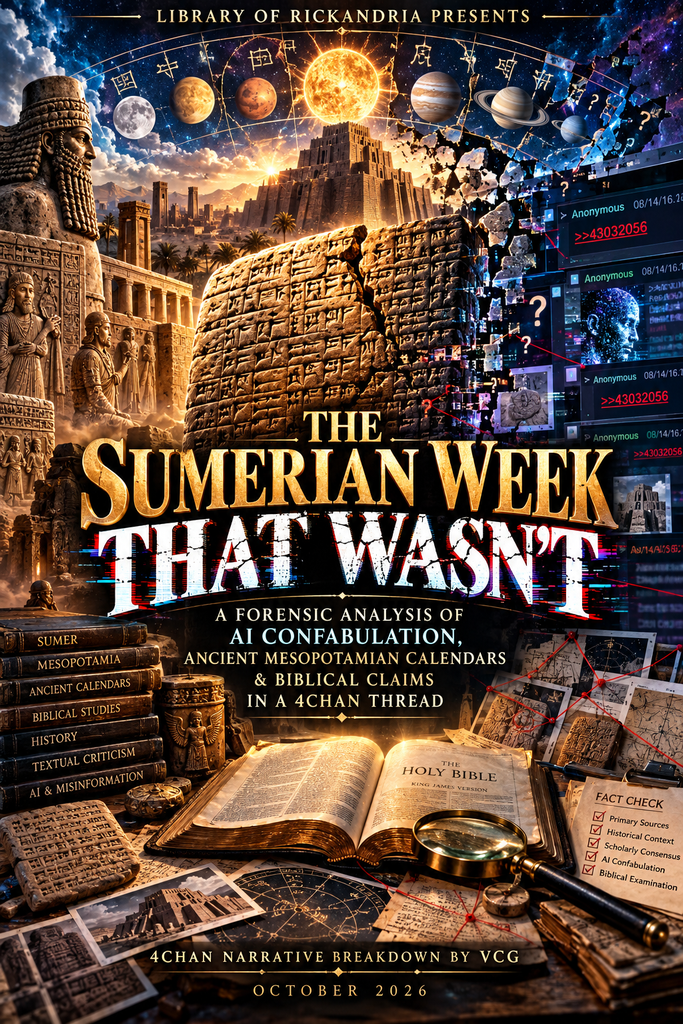
UPDATED BY VCG ON 10/01/2026 @ 12:34 EST
Anyone can do this, but most won’t.
ChatGPT – Library of Rickandria
Abstract
On October 1–2, 2026, a short thread on 4chan’s /x/ board began with a polished infographic titled The Sumerian Week: The Seven Days • The Seven Heavenly Powers.

/x/ – I just made the 7 day week anti-Semitic. – Paranormal – 4chan
The image claimed that ancient Sumerians followed a recurring seven-day cycle in which each day corresponded to a deity and celestial body.
From there, the discussion moved rapidly through:
- Sumerian religion
- Judaism
- Christianity
- artificial intelligence
- Aristotle
- the lost planet “Maldek”
- Lucifer
- Venus
- Theosophy
and the origins of the modern week.
/x/ – I just made the 7 day week anti-Semitic. – Paranormal – 4chan
The thread is worth studying because it demonstrates something subtler than ordinary misinformation.
Much of the opening infographic is built from real historical ingredients.
Nanna really was the Mesopotamian Moon god.
Utu really was the Sun god.
Inanna/Ištar really did have an astral identity as Venus.
Nergal really became associated with Mars in Mesopotamian astral scholarship.
Nippur really had an ancient lunar calendar.
Babylonian and Assyrian scholars really did pay close attention to celestial bodies and calendrical omens.
Ancient Mesopotamian Gods and Goddesses – Nanna/Suen/Sin (god)
The problem is the assembly.
The infographic takes authentic:
- persons
- deities
- celestial associations
- calendrical facts
from different periods and contexts and combines them into an orderly seven-day Sumerian planetary week for which the historical evidence presented does not exist.
The result is what this paper will call an authentic-ingredients/false-synthesis error.
Recent scholarship by Ilaria Bultrighini and Sacha Stern goes considerably further:
they argue that assumptions of an ancient Egyptian or Mesopotamian seven-day cycle are unsupported by the surviving corpora, that the securely evidenced planetary week first appears in Rome and central Italy in the late first century BCE, and that the familiar seven-day week emerged through convergence between the Jewish biblical Sabbath tradition and the Roman planetary week during the early imperial period.
They explicitly note that their reconstruction differs from older scholarship that conjectured Babylonian or Egyptian origins for the planetary week.
At the same time, some rebuttals in the 4chan thread introduce new errors.
The duplicate Venus in the infographic does not provide evidence for a destroyed water world called Maldek/Lucifer.
The existence of older Sumerian calendars does not by itself demonstrate that Genesis copied them.
Aristotle’s theory of natural slavery does not establish that Gentiles constitute a naturally servile class.
And the assertion that Sumerians had no astral worship or divine-celestial associations before later Babylonian influence conflicts directly with evidence for:
- Nanna
- Utu
- Inanna
- Ninsi’anna
Aristotle’s Political Theory (Stanford Encyclopedia of Philosophy)
The central conclusion is therefore deliberately narrower than either side of the thread:
The opening “Sumerian Week” infographic is not reliable evidence for an ancient Sumerian seven-day planetary week.
It combines genuine Mesopotamian religious material with an unestablished calendrical framework.
Correcting that error does not require denying genuine Sumerian astral religion, Mesopotamian calendrical sophistication, or the complexity of the later history of the seven-day week.
For the biblical portion of this study, Scripture quotations are taken from the supplied King James Bible, Pure Cambridge Edition.
1. Why This Thread Is Worth More Than a Quick Debunk
At first glance, there is not much here.
The entire surviving thread is only a handful of posts.
The opening poster announces that he has made the seven-day week “anti-Semitic,” supplies an infographic, and receives several argumentative replies.
Before long, participants are discussing:
- AI
- Maldek
- Lucifer
- natural slavery
- Gentiles
- Jews
- Christians
and the Nippur calendar. 4chan
Yet that compression is precisely what makes the exchange useful.
Internet misinformation rarely arrives as a formal historical thesis with footnotes.
More often it arrives as a compressed narrative:
real fact → plausible association → hidden assumption → dramatic conclusion.
By the time anyone challenges the conclusion, the hidden assumption has already disappeared from view.
This thread lets us slow that process down.
We will therefore resist the temptation to ask only,
“Who won the argument?”
That is not a useful scholarly question.
Instead we will ask five different questions and refuse to merge them.
History:
What evidence survives from:
- Sumer
- Babylonia
- Judaism
- the Hellenistic world
and Rome?
Methodology:
What conclusion is actually warranted by that evidence?
Psychology:
What known cognitive or social mechanisms might make a narrative of this sort persuasive, without pretending to diagnose anonymous posters?
Interpretation:
Where has somebody moved from fact into:
- inference
- speculation
- analogy
or worldview?
Scripture:
What does the biblical text actually say, and where would it be improper to make Scripture answer an archaeological question it does not address?
That separation is foundational to the paper.
2. The Thread as a Primary Artifact
The thread began on October 1, 2026, with post No. 43032056.
Its attached image was titled The Sumerian Week — The Seven Days • The Seven Heavenly Powers.
It proposed seven deity/day correspondences:
Nanna/Moon; Utu/Sun; Inanna/Venus; Ningal/Evening Star or Venus; Nergal/Mars; Ninhursag/Earth; and Anu/Sky or Jupiter.
It additionally claimed that the Sumerians counted a recurring week around seven celestial deities and that such cycles appeared in astronomical or divinatory usage. 4chan
The replies then proceeded approximately as follows.
Post 43032929 noticed that Venus occurred twice and proposed Maldek/Lucifer as the missing explanation.
Post 43032937 called the infographic “AI slop” and attached material about Aristotle’s natural slavery.
Post 43032948 responded that AI was now ubiquitous.
Post 43032967 made the more precise objection that using AI for layout differs from allowing it to generate the factual content itself.
The thread then deteriorated into personal and sexualized insults before returning in 43033384 to an attached Sumerian Calendar of Nippur image and claims that the calendar predated Genesis, that the seven-day week was “not semite,” and that Sumerians did not associate their gods with stars before Babylonian influence. 4chan
That last image is important because it contains more authentic historical material than the first.
Some of its Nippur month names correspond to attested Ur III month names.
But it also displays each supposedly ancient month through a modern Sun–Mon–Tue–Wed–Thu–Fri–Sat calendar grid.
That visual convention should never be mistaken for evidence that Nippur itself used our weekday structure. 4chan
This is our primary artifact.
Everything else in this paper is an attempt to test it.
3. Evidence Before Narrative
A recurring weakness in online ancient-history discussions is that every source gets treated as though it carries equal weight.
- A tablet
- a specialist edition of that tablet
- a scholarly reconstruction
- an encyclopedia entry
- an AI-generated infographic
- a nineteenth-century occult book
and an anonymous forum post are not interchangeable.
For this investigation, the working hierarchy is:
| Evidentiary level | Examples | What it can reasonably establish |
|---|---|---|
| Primary ancient evidence | Cuneiform texts, dated tablets, inscriptions, manuscripts | What an ancient source actually records |
| Critical corpora / editions | CDLI, ORACC, edited astronomical and calendrical texts | Reading, dating, provenance, scholarly identification |
| Specialist scholarship | Peer-reviewed monographs, chapters, journal articles | Historical reconstruction and interpretation |
| Institutional scientific sources | NASA, NIST | Current scientific evidence and technical definitions |
| Reference works | SEP, Cambridge scholarly summaries | Context and historiography |
| Popular/esoteric sources | Occult organizations, popular sites | Evidence that a belief or tradition exists—not that its claims are true |
| AI graphics / anonymous posts | The thread itself | Evidence of what somebody claimed |
That distinction resolves many apparent mysteries.
If an esoteric organization says Maldek existed, that establishes that the organization teaches about Maldek.
It does not establish an exploded planet.
If an AI infographic says Sumerians named weekdays after gods, that establishes that the infographic contains the claim.
It does not establish the ancient practice.
If a cuneiform text identifies a planet with Nergal, that establishes a historical association in the period and context of that text.
It does not automatically establish a Nergal weekday in third-millennium Sumer.
The burden of proof rises as claims accumulate.
“Venus can appear as the morning star”
requires modest evidence.
“The duplicate Venus in an infographic represents an exploded water planet called Maldek, identified with Lucifer, remembered by Theosophists and suppressed or appropriated by modern scientists”
requires evidence for every link in that chain.
Lucifer as Morning Star, Fallen Angel, Light-Bringer & Symbol of Sovereignty – Library of Rickandria
That principle will matter repeatedly.
4. The Claim Map
The thread’s argument can be reconstructed as a series of bridges:
| Step | Claim | Evidentiary status |
|---|---|---|
| Sumer possessed ancient lunar calendars | Yes | Documented |
| Sumerian religion included celestial deities | Yes | Documented |
| Nanna = Moon; Utu = Sun; Inanna has Venus aspect | Yes | Documented |
| Therefore Sumer possessed a continuous seven-day week | Does not follow | Unestablished bridge |
| Therefore each weekday belonged to one of seven Sumerian gods | No adequate evidence supplied | Unsupported |
| Therefore OP’s exact seven-god chart is historical | Contradicted internally and externally | Unsupported |
| The chart duplicates Venus | Yes | Directly observable |
| Therefore the second Venus was Maldek/Lucifer | Does not follow | Rescue hypothesis |
| Ancient Nippur calendars predate surviving Genesis manuscripts | Yes | Chronologically true in that limited sense |
| Therefore Genesis derived its week from Nippur | Does not follow | Dependency not established |
| Sumerians lacked astral divine associations | No | Contradicted by evidence |
| AI may confidently synthesize false historical claims | Yes | Documented technical risk |
The reader should notice a pattern.
The largest errors are often not the nouns.
They are the arrows.
5. A Chronology: Sumer Is Not Babylon Is Not Rome
Ancient Near Eastern history becomes much easier to misrepresent when several thousand years are compressed into the word ancient.
A simplified chronology helps.
| Approximate period | Relevant evidence |
|---|---|
| Late 4th–3rd millennium BCE | Sumerian city cultures; very early attestations of Nanna; Utu and other major gods; development of cuneiform traditions |
| Ur III, c. 21st century BCE | Rich administrative records; distinct local calendars; Nippur month names such as bara₂-za₃-gar, gu₄-si-su, du₆-ku₃, apin-du₈-a; intercalation documented |
| Late 3rd / early 2nd millennium BCE | Ninsi’anna identified with Venus and increasingly syncretized with Inanna/Ištar |
| 2nd–1st millennia BCE | Increasingly elaborate Mesopotamian celestial divination, hemerologies and astronomical scholarship |
| 1st millennium BCE | Nergal/Mars, Marduk/Jupiter and other planetary identifications prominent in Mesopotamian astral systems |
| Biblical tradition | Sabbath cycle fundamental to Torah; Genesis 1–2:3 presents creation in a seven-day structure |
| Late 1st century BCE | According to Bultrighini and Stern, first secure appearance of planetary week in Rome/central Italy |
| 1st–2nd centuries CE | Jewish week and planetary week increasingly function as time-reckoning structures in Roman world |
| 4th century CE | Seven-day week spreads massively through Christianized Roman Empire |
The CDLI table is especially instructive.
Ur III communities did not even use one uniform set of month names:
- Nippur
- Ur
- Umma
- Girsu
and Drehem can differ, and intercalary thirteenth months occur in the evidence.
That is what real historical calendrical complexity looks like.
Ur III Month Names – Cuneiform Digital Library Initiative
Bultrighini and Stern’s recent reconstruction deserves particular care because it challenges an older story still widely repeated online.
They argue that supposed Egyptian or Mesopotamian origins of a continuous seven-day week rest on assumptions rather than evidence.
They treat the Old Assyrian hamuštum as a possible exception, but note that its duration and meaning are disputed and may represent a variable fraction of the lunar month rather than a continuous seven-day week. UCL Discovery
They then locate the first secure planetary week in Rome and central Italy in the late first century BCE.
Its seven “planets” were the five naked-eye planets—
- Mercury
- Venus
- Mars
- Jupiter
- Saturn
—together with the Sun and Moon.
In the Roman sequence described in their study, the days ran:
- Saturn
- Sun
- Moon
- Mars
- Mercury
- Jupiter
- Venus
That is already enough to expose a major problem with the OP chart.
6. Seven Is Not Yet a Week
This distinction deserves a section of its own.
Ancient peoples used the number seven in many ways.
A text may mention:
- seven gods
- seven days
- seventh-day rituals
- lunar phases roughly seven days apart
or recurrent ritual restrictions.
None of those things automatically demonstrates a continuous abstract seven-day week.
Consider later Assyrian hemerologies.
Eleanor Robson notes that certain dangerous days included the:
- 7th
- 14th
- 19th
- 21st
- 28th
of a month; four of those five can be related to lunar-cycle intervals.
A 2025 University of Hamburg discussion likewise notes recurring unfavourable days on the 7th, 14th, 21st and 28th associated with lunar phases.
That is interesting calendrical evidence.
But notice what it is not.
The sequence resets according to the lunar month.
The exceptional 19th is not a simple multiple of seven.
The scheme concerns auspicious and dangerous dates within a month, rather than a free-running, endlessly repeating weekday cycle independent of lunar months.
Thus:
seven-day spacing is not automatically a week;
lunar quarters are not automatically weekdays;
special seventh dates are not automatically Sabbaths;
seven astral gods are not automatically seven planetary weekdays.
This is why the history cannot be reconstructed merely by finding the number seven somewhere in Mesopotamia.
7. Autopsy of the Opening Infographic
Now we can return to the image itself.
Its persuasive power comes partly from the fact that several rows begin correctly.
Nanna / Sin — Moon
This association is genuine.
ORACC identifies Nanna/Suen/Sin as the Mesopotamian Moon god.
Nanna is the Sumerian name; Su’en/Sin are Akkadian forms.
His cult at Ur reaches back into very early Mesopotamian history.
Ancient Mesopotamian Gods and Goddesses – Nanna/Suen/Sin (god)
What does not follow is the caption:
“Day of Nanna.”
A deity can be lunar without governing Monday—or any ancient equivalent.
Utu / Shamash — Sun
Again, the celestial identity is genuine.
Utu/Šamaš is the Mesopotamian Sun god, attested through the cuneiform tradition and already known in very early material.
Ancient Mesopotamian Gods and Goddesses – Utu/Šamaš (god)
But
“Utu is solar”
and
“Sumer had a recurring weekday assigned to Utu”
are two different claims.
The first is sourced.
The second still requires evidence.
Inanna / Ishtar — Venus
This association is also real, and strongly so.
ORACC explicitly states that in her astral aspect Inanna/Ištar is Venus—the morning and evening star.
An Old Akkadian cylinder seal depicting Ištar dates around 2300 BCE, and Ninsi’anna is identified as a Sumerian Venus deity later syncretized with Inanna/Ištar, probably by the end of the third millennium.
Ancient Mesopotamian Gods and Goddesses – Inana/Ištar (goddess)
This becomes important later because a thread participant claims Sumerians did not associate their gods with celestial objects before:
“Babylonian influence.”
The evidence is not compatible with such a blanket statement.
Ningal — Venus Again
Here the chart begins visibly breaking down.
It has already assigned Venus to Inanna and then assigns the:
“Evening Star/Venus”
to Ningal. 4chan
Yet Ningal is attested principally as the wife of Nanna/Sin and, in one important Sumerian genealogy, mother of Inanna and Utu.
By contrast, the actual named Sumerian deity explicitly connected with the planet Venus is Ninsi’anna.
Ancient Mesopotamian Gods and Goddesses – Nanna/Suen/Sin (god)
This duplication is not a minor typo because the image claims to represent seven celestial powers.
If one of seven slots is Venus twice, the proposed astronomical structure is already unstable.
Nergal — Mars
There is authentic material here too.
Nergal is an underworld, destructive and martial deity, and later Mesopotamian astral materials associate Nergal with Mars.
ORACC’s Assyrian material even describes Nergal as often identified with Mars, while omen commentary can gloss Nergal imagery as Mars.
Assyrian Empire Builders – People, gods & places
But again chronology matters.
A genuine first-millennium astral identification does not prove a third-millennium Sumerian weekday.
Ninhursag — Earth
This is where the chart appears to import a modern planetary category.
Ninhursag belongs to the Mesopotamian mother-goddess complex.
ORACC describes this complex primarily in terms of pregnancy, birth and creation of humankind.
Ancient Mesopotamian Gods and Goddesses – Mother Goddess (Ninmah, Nintud/r, Belet-ili)
Calling a fertility or mother goddess “earth-related” in a broad symbolic discussion is one thing.
Installing planet Earth into an ancient seven-planet weekday system is another.
The ancient planetary seven are precisely those wandering lights observed in the sky:
- Sun
- Moon
- Mercury
- Venus
- Mars
- Jupiter
- Saturn
Earth is where the observer stands.
NASA likewise notes the seven bright sky objects familiar to ancient Roman observers:
Sun, Moon and the five naked-eye planets.
The infographic’s scheme therefore has Earth where Mercury or Saturn ought to be if it were genuinely reproducing a seven-planet system.
An / Anu — Sky / Jupiter
An/Anu genuinely is the Mesopotamian sky god and one of the oldest high deities.
Ancient Mesopotamian Gods and Goddesses – An/Anu (god)
But that is not the same thing as Jupiter.
ORACC notes that Marduk was identified with Jupiter in the first millennium BCE.
Ancient Mesopotamian Gods and Goddesses – Marduk (god)
So the infographic again takes a genuine divine concept—Anu as heaven/sky—and slides it into an astronomical planetary slot.
The final result contains:
Venus twice,
Earth,
no Mercury,
no Saturn,
and a Sky/Jupiter conflation.
That is not what we would expect from an authentically transmitted seven-planet weekday system.
8. The Nippur Calendar: Real Calendar, Misleading Presentation
The thread’s second infographic is more interesting because it rests upon genuinely attested month names.
CDLI’s Ur III month-name table gives Nippur entries including:
bára-za-gar as month 1,
gu-si-su as month 2,
du-ku as month 7,
apin-du-a as month 8,
GAN-GAN-e as month 9,
AB-e as month 10,
and diri as an intercalary thirteenth month.
Ur III Month Names – Cuneiform Digital Library Initiative
The infographic therefore did not invent the entire idea of a Nippur calendar.
But look carefully at the visual presentation.
Each month has been placed above a modern rectangular calendar containing:
- Sun
- Mon
- Tue
- Wed
- Thu
- Fri
- Sat
Those grids are not ancient evidence.
They are the designer’s modern visualization.
This is an important methodological problem because graphics can smuggle assumptions into a reader’s mind without stating them propositionally.
If a modern seven-column grid appears beneath an ancient month name, the eye begins to treat the week as part of the ancient source.
It is not.
CDLI instead shows a much more interesting reality:
different Ur III centers used differing month systems and month positions.
A genuine historical reconstruction therefore has to cope with local variation, lunar reckoning, intercalation and institutional change. CDLI
The neat infographic suppresses precisely the messiness that makes history historical.
9. Authentic Ingredients, False Synthesis
We can now state the central forensic principle of this paper.
The opening image is persuasive because it is not composed entirely of falsehoods.
It is closer to a mosaic made from genuine pieces that have been put together in the wrong arrangement.
Nanna is real.
The Moon association is real.
Utu is real.
The Sun association is real.
Inanna is real.
Her Venus association is real.
Nergal is real.
Later Mars associations are real.
Ninhursag is real.
Anu is real.
Mesopotamian astronomical divination is real.
Ancient lunar calendars are real.
Seven had significance in the ancient Near East.
The false synthesis arises when those truths are silently converted into:
therefore the Sumerians had this exact repeating seven-deity planetary week.
That distinction is more important than the label:
“AI slop.”
A person could manually create exactly the same false synthesis.
Likewise, an AI system could generate a perfectly correct description if supplied and constrained by reliable sources.
The epistemic problem is therefore not fundamentally:
machine versus human.
It is:
sourced inference versus plausible fabrication.
10. Walking Through the Thread, Post by Post
Post 43032056: the opening provocation
The OP frames the infographic through an explicitly ethnic/religious provocation:
he says he has made the seven-day week
“anti-Semitic.”
History
The historical problem is immediate.
Calendrical traditions do not become antisemitic merely because one proposes an earlier non-Jewish antecedent.
More importantly, recent research does not support the simple story implied by the provocation.
Bultrighini and Stern argue that the modern week grew out of convergence between a Jewish biblical Sabbath tradition and a Roman planetary week.
They further entertain the possibility that the Roman planetary scheme itself may have been stimulated by Roman interpretation of the Jewish Sabbath. UCL Discovery
Thus, even the framing:
“Sumer versus Jews”
may be asking the wrong question.
Methodology
The existence of an older practice similar to a younger practice would not by itself negate the younger tradition.
Priority is not identity.
Parallel is not derivation.
Derivation is not fraud.
One must establish the specific relationship.
Psychology
Beginning with a provocative social conclusion can reverse the proper order of inquiry.
Instead of evidence leading toward a conclusion, the reader is given the conclusion first and then invited to interpret evidence through it.
Ziva Kunda’s classic review of motivated reasoning describes how motivation can influence which cognitive strategies and beliefs become accessible during reasoning.
That is useful as a general framework.
It does not tell us the OP’s private motive; we cannot infer that from a single post.
The case for motivated reasoning – PubMed
Scripture
The biblical Sabbath is presented theologically, not ethnically.
Exodus says:
“Remember the sabbath day, to keep it holy… But the seventh day is the sabbath of the LORD thy God.”
and grounds that command in God’s creation and rest.
Earlier, Exodus 16 depicts a recurring six-day gathering pattern followed by the Sabbath.
That tells us what the biblical text claims about the Sabbath.
It does not tell us the archaeological history of every seven-day practice in Mesopotamia.
Keeping those categories separate strengthens rather than weakens biblical interpretation.
Post 43032929: Venus twice, therefore Maldek?
This poster spots a genuine anomaly:
Venus appears twice in the infographic.
Then the post proposes that the extra morning/evening star was a destroyed water world called Maldek or Lucifer located between Mars and Jupiter, claims Theosophists knew about it, and accuses modern scientists of appropriating esoteric discoveries. 4chan
This is one of the most instructive moments in the thread.
Observation: correct
Venus really is duplicated.
First explanation: ordinary error
The image is internally inconsistent.
Rescue hypothesis: extraordinary
Perhaps the duplicate is not an error at all.
Perhaps it preserves a lost planet.
Once that hypothesis is introduced, however, it creates a chain of additional propositions requiring independent evidence:
Maldek existed.
Maldek orbited between Mars and Jupiter.
Maldek had abundant water.
Maldek was destroyed.
Ancient traditions remembered it.
“Lucifer” referred to it.
That tradition entered Theosophy.
Scientists later appropriated the underlying knowledge.
None of those propositions follows from:
“the infographic accidentally says Venus twice.”
This is a classic rescue hypothesis:
rather than allowing an anomaly to count against the original model, an auxiliary theory is introduced to preserve it.
That does not automatically make every rescue hypothesis false.
Science sometimes discovers that anomalies really do require a new theory.
The issue is that the new theory itself needs evidence.
11. Maldek: What Is Actually Documented?
There genuinely are modern esoteric organizations that teach about Maldek.
The Aetherius Society, for example, describes Maldek as a former planet between Mars and Jupiter, depicts it as a fertile world, and says its inhabitants destroyed it through catastrophic warfare.
The organization presents this information as spiritual or extraterrestrial revelation associated with George King and mid-twentieth-century communications.
Maldek – “The Lost Water World” – The Aetherius Society
That establishes the history of a belief.
It does not establish the history of the Solar System.
The astronomical evidence points elsewhere.
NASA’s Ask an Astrophysicist material notes that an exploded planet was indeed one possible historical explanation for the asteroid belt, but explains why scientists favor the alternative:
there is too little mass in the belt to represent a normal planet, and important compositional differences among asteroids argue against all of them being fragments of a single destroyed world.
Jupiter’s gravitational influence provides a mechanism for preventing primordial material from accreting into a full planet.
This is a useful correction to both extremes.
It would be inaccurate to say scientists have never contemplated a destroyed-planet hypothesis.
They have.
It would also be inaccurate to say current astronomy has confirmed Maldek.
It has not.
The claim in the thread about “Theosophists” knowing the exact Maldek/Lucifer story more than a century ago is harder to substantiate.
Clear Maldek narratives are easy to document in later contactee/New Age traditions; establishing the exact proposition in early classical Theosophy requires much better primary documentation than the thread provides.
That uncertainty should be preserved rather than filled with confidence.
12. Venus Does Not Require Maldek
The astronomy of the morning and evening star is not mysterious.
NASA describes Venus as the third-brightest object in the sky after the Sun and Moon and notes that ancient observers could regard its morning and evening appearances as two different objects.
Because Venus orbits closer to the Sun than Earth, it appears from our perspective alternately in morning and evening configurations.
Even more important for this thread, Mesopotamian evidence already supplies the missing explanation.
Ninsi’anna is explicitly described by ORACC as the Sumerian deity of Venus, venerated as morning and evening star.
The deity became syncretized with Inanna/Ištar by roughly the end of the third millennium.
Ancient Mesopotamian Gods and Goddesses – Ninsi’anna (god/goddess)
We therefore do not need a hypothetical destroyed planet to explain why Mesopotamian religious material contains morning/evening-star symbolism.
Venus itself does the job.
13. Post 43032937: AI Criticism and Aristotle’s “Natural Slave”
This reply contains two completely different moves.
The first—calling the infographic AI-generated nonsense—has substantive merit, though the thread does not establish precisely which parts of the image were generated by what system.
The second—the claim that a Gentile is therefore a “natural slave”—does not.
The AI criticism
NIST uses the term confabulation for cases in which generative AI confidently presents erroneous or false content.
NIST also notes that such outputs can include fabricated reasoning or citations that increase the appearance of trustworthiness.
Artificial Intelligence Risk Management Framework: Generative Artificial Intelligence Profile
That description fits the information structure of the infographic remarkably well:
real historical vocabulary;
authoritative presentation;
smooth explanatory prose;
internally consistent-looking categories;
yet multiple claims that fail external verification.
We still cannot prove from content alone that every historical sentence was generated by AI.
What we can establish is that the result exhibits the sort of factual synthesis for which independent verification is necessary.
Aristotle
The accompanying screenshot concerns Aristotle’s defense of “natural slavery.”
That doctrine is real.
The Stanford Encyclopedia of Philosophy summarizes Aristotle as claiming that some people naturally lack sufficient deliberative capacity for self-rule, while noting that he asserts this without evidence and does not adequately justify the conclusion.
Aristotle’s Political Theory (Stanford Encyclopedia of Philosophy)
But Aristotle’s proposition does not yield:
Gentile → natural slave.
Nothing in Aristotle’s argument creates that category.
The reply therefore substitutes an insulting classification for an evidentiary rebuttal.
Scripture
The New Testament directly frustrates any attempt to turn Jew/Gentile identity into a Christian hierarchy of intrinsic human spiritual worth.
Paul writes:
“There is neither Jew nor Greek, there is neither bond nor free… for ye are all one in Christ Jesus.”
Romans likewise asks whether God is God of Jews only and answers that he is also God of Gentiles.
That does not erase every covenantal, historical or ethnic distinction in Scripture.
It does rule out using Gentile identity itself as evidence of a naturally servile spiritual caste.
14. Posts 43032948 and 43032967: The Best Methodological Exchange in the Thread
One poster responds that AI is everywhere and that anyone objecting to AI-generated infographics should leave the internet.
The next poster makes the more careful distinction:
using AI to format material is not the same as allowing it to generate the supposed historical facts. 4chan
The second point is methodologically stronger.
Whether AI is common is irrelevant to whether any particular statement is true.
Likewise, whether something was AI-generated is not enough to prove it false.
The appropriate question remains:
Can the claim be independently verified?
This is where NIST’s definition matters.
Confabulation is not merely bad spelling or ugly image generation.
It is precisely the danger of fluent, confident factual error.
The proper response to AI, therefore, is neither:
“AI said it, therefore true,”
nor:
“AI said it, therefore false.”
It is:
“AI said it; now show me the source.”
That is a much stronger epistemology.
15. Posts 43032977 and 43033000: When the Argument Stops Being an Argument
The next exchanges consist mainly of personal ridicule and a homophobic slur. 4chan
There is almost nothing historical to fact-check.
That is itself worth noting.
Once the participants stop discussing evidence and begin attacking one another’s social status, personality or sexuality, the question of the Sumerian week has not been resolved.
It has simply been abandoned.
Psychology
John Suler’s influential work on the online disinhibition effect identifies several properties of online communication—including anonymity and invisibility—that can reduce ordinary social restraints.
The framework helps explain why anonymous internet environments can produce unusually harsh or intimate behavior.
It does not mean every hostile anonymous post can be psychologically diagnosed from afar.
The online disinhibition effect – PubMed
That distinction is important throughout this paper.
We can analyze rhetorical behavior.
We cannot responsibly infer:
- clinical conditions
- intelligence
- personality disorders
or hidden personal histories from a few anonymous sentences.
Scripture
James gives a remarkably relevant speech ethic:
“Therewith bless we God, even the Father; and therewith curse we men, which are made after the similitude of God… My brethren, these things ought not so to be.”
The same chapter describes wisdom from above as:
- pure
- peaceable
- gentle
and free from partiality.
That is not an instruction never to say a claim is false.
It is an instruction not to confuse refuting falsehood with degrading persons.
16. Post 43032991: Jews, Christians and a Compressed History
Another poster asks whether the target hates modern Jews or Christians and frames modern Judaism as having split away from Jews who became Christians.
The poster then says Sumer worship somehow benefits:
“post-Christian Jews.”
The first historical statement is too compressed.
Jesus and his earliest followers were Jewish.
The differentiation of Christianity and what became rabbinic Judaism was gradual, regionally variable and incomplete for a long period.
A recent Cambridge overview summarizes the matter carefully: Jesus was a Jewish preacher, his earliest followers lived in Jewish contexts, distinctions became visible gradually, and although a
“parting of the ways”
occurred, it was never absolute; Jews and Christians continued observing and influencing one another.
Neither Jewish nor Pagan? (Chapter 1) – The Early Christians
Thus neither simplistic formula works well:
Christianity instantly split from a fully formed modern Judaism, or
modern Jews simply broke away from the “real Jews” who became Christians.
Historical development was more complicated.
The second claim—that “Sumer worship” benefits some Jewish constituency—is too underspecified to evaluate.
No mechanism is supplied.
Does “benefit” mean theological legitimation?
propaganda?
political advantage?
cultural prestige?
An implication is not yet an argument.
17. Post 43033384: “It Predates Genesis”
This sentence is more interesting than it appears because it contains at least three possible claims.
Meaning 1: surviving Sumerian calendrical documents are older than surviving manuscripts of Genesis
Yes.
Third-millennium BCE Sumerian administrative and calendrical materials are vastly older than surviving biblical manuscript fragments.
The Israel Antiquities Authority dates 4Q Genesisᵍ, among the oldest surviving Genesis copies, to approximately 100–1 BCE.
Ur III Month Names – Cuneiform Digital Library Initiative
But manuscript survival tells us when a copy was made, not when the underlying work or tradition originated.
Meaning 2: Sumerian calendar material predates the literary composition of Genesis
Under many historical-critical models, much Sumerian material certainly predates the final composition of Genesis.
But the compositional history of Genesis is itself a scholarly question.
Yale’s introductory material describes source-critical models in which Genesis developed from multiple traditions and editorial strata and notes continuing disagreement about the date of some of those materials.
Genesis → Introduction to the Course – Study Guide – Yale Bible Study
A traditional Jewish or Christian account of Mosaic authorship is a different theological/historical model.
This paper does not need to resolve that dispute to evaluate the 4chan claim.
Meaning 3: Sumerian texts predate the events narrated in Genesis
That conclusion does not follow from the age of surviving manuscripts or from a historical-critical theory of composition.
Text-date, manuscript-date and event-date are three different questions.
This is why:
“it predates Genesis”
is insufficiently precise to carry much argumentative weight.
18. Chronological Priority Is Not Literary Dependence
Even if cultural object A is unquestionably older than text B, it does not follow that B copied A.
To establish dependence, historians normally look for more than chronological priority.
They ask about:
- contact
- transmission pathways
- distinctive shared structures
- vocabulary
- combinations of features unlikely to arise independently
- direction of borrowing
and transformations of the borrowed material.
There are genuine and important ancient Near Eastern parallels to material in Genesis.
Historical-critical scholarship has long discussed relationships between Genesis and Mesopotamian creation and flood traditions; Yale’s Genesis materials, for example, explicitly discuss parallels with:
- Atrahasis
- Gilgamesh
- Enuma Elish
Genesis → Introduction to the Course – Study Guide – Yale Bible Study
Those comparisons deserve study.
But none of them licenses the formula:
Sumer is older → therefore every biblical seven derives from Sumer.
That is not comparative history.
It is chronological shortcutting.
19. “The 7 Day Week Is Not Semite”
The phrase is historically imprecise before we even evaluate it.
Weeks are cultural institutions, not ethnic organisms.
Saying a week is “Semite” or “not Semite” collapses:
- language
- ethnicity
- religion
and calendrical practice into one label.
More importantly, the best evidence does not support the binary choice implied by the post.
Bultrighini and Stern argue that the week familiar to later Western and global timekeeping arose from a convergence of traditions.
On their reconstruction, the Jewish biblical Sabbath week is one stream and the Roman planetary week another.
The combined institution standardizes in the early Roman imperial period and spreads widely with Christianization. UCL Discovery
They also argue, provocatively, that the Roman planetary week may not have been wholly independent of Jewish influence.
A Roman reinterpretation of Sabbath as Saturn’s day may have contributed to expansion of the full planetary sequence.
The authors present this as a plausible historical scenario, not a mathematical certainty. UCL Discovery
That is a much richer history than “Sumerian” versus “Semitic.”
20. “Sumerians Did Not Have Star Worship”
This is the point where the thread’s rebuttal overcorrects.
The phrase “star worship” itself is loose.
We should therefore formulate the correction precisely:
Sumerian and broader Mesopotamian religion undeniably included deities whose identities were tied to celestial bodies.
Nanna is the Moon god. Oracc
Utu is the Sun god. Oracc
Ninsi’anna is the Sumerian deity of Venus as morning and evening star. Oracc
Inanna/Ištar has a well-attested astral identity as Venus. Oracc
Therefore the claim that Sumerians did not associate gods with celestial objects is too strong.
But—and this is crucial—none of those facts proves the OP’s seven-day weekday chart.
Both propositions can be true simultaneously:
Sumerian religion was genuinely astral in important respects.
The specific
“Sumerian planetary week”
infographic is unsupported.
That is the kind of distinction that polemical internet debate tends to lose.
21. What “Before Babylonian Influence” Gets Wrong
The phrase also risks flattening a complicated cultural history.
“Sumerian” and “Babylonian” are useful historical categories, but Mesopotamian religious traditions developed through long interaction among Sumerian- and Akkadian-speaking communities.
- Deities
- divine names
- cults
- scribal traditions
- celestial associations
did not wait behind impermeable ethnic walls.
Ninsi’anna is particularly damaging to the claim.
ORACC identifies the deity as Sumerian and says the Venus deity was probably syncretized with Inanna/Ištar by the end of the third millennium BCE and certainly by the early second millennium. Oracc
Similarly, Nanna’s lunar identity and Utu’s solar identity are not late Babylonian inventions retrojected into an astrally blank Sumer. Oracc
The correction must therefore be surgical:
Do not project the later organized planetary week backward into Sumer.
But do not “correct” that mistake by removing celestial religion from Sumer.
22. The AI Problem: Confabulation Rather Than Mere Error
The thread’s AI dispute deserves more than a paragraph because the opening infographic illustrates a new information problem.
NIST defines generative-AI confabulation as the confident presentation of erroneous or false content. It specifically warns that outputs may be internally inconsistent and may include invented logic or citations that make the answer appear better justified than it is. NIST Publications
The Sumerian-week image contains several hallmarks of this kind of failure:
| Surface feature | Why it inspires confidence | What verification reveals |
|---|---|---|
| Correct deity names | Looks specialist | Names are real |
| Cuneiform-like labels | Suggests primary sourcing | No tablet citation establishes the weekday scheme |
| Astral correspondences | Several are genuine | Different periods and contexts are collapsed |
| Seven-column symmetry | Feels systematic | Venus duplicated; Mercury/Saturn absent |
| Ancient tablet image | Implies documentary proof | Caption itself admits a later context |
| Confident explanatory prose | Creates narrative coherence | Historical transitions are unreferenced |
The danger is not that the reader sees obvious nonsense.
The danger is that the reader sees 90 percent familiar-looking truth and does not notice where the unsupported 10 percent changes the entire conclusion.
23. Visual Authority
Historical graphics communicate through more than words.
The OP uses:
- lapis-blue and gold
- monumental architecture
- divine figures
- cuneiform
- clean columns
and repeated iconography. 4chan
The Nippur image uses the same aesthetic grammar:
- ancient-looking deities
- temple scenes
- tablet motifs
- tidy month panels

None of those design choices is deceptive by itself.
The problem is that presentation can generate epistemic spillover:
because the artifact looks researched, the claims begin to feel researched.
The most striking example is the modern Sunday–Saturday grid inside the Nippur calendar image.
The viewer does not need to read a sentence saying:
“the Sumerians used modern weeks.”
The layout quietly suggests it.
This is why source verification should sometimes begin by stripping an infographic of its design.
Rewrite every panel as a bare proposition.
Then ask:
What document proves this sentence?
When the gold borders disappear, evidence has nowhere to hide.
24. Repetition, Fluency and the Illusory-Truth Problem
There is a psychological reason this matters, but we must state it cautiously.
A 2026 systematic review and meta-analysis examined 182 studies and more than 31,000 participants concerning the illusory truth effect—the tendency for repeated statements to receive higher truth judgments.
The effect remains robust, although its magnitude varies and methodological qualifications matter.
This does not mean anyone who believes the infographic is irrational.
Human beings necessarily use familiarity as one among many cues when processing information.
The danger arises when a fabricated framework is repeatedly presented in different-looking forms.
First:
Nanna → Moon → Day 1.
Then perhaps another graphic.
Then a repost.
Then an AI answer trained or prompted from the repost.
Then a forum participant says the connection is:
“well known.”
Eventually, what began as an unsourced association acquires the psychological texture of common knowledge.
That is why provenance matters.
25. Motivated Reasoning Without Mind-Reading
The thread also demonstrates why psychological language must be used carefully.
Kunda’s work on motivated reasoning shows that people can preferentially access and construct beliefs or inferential strategies compatible with desired conclusions.
The case for motivated reasoning – PubMed
But from that research we may conclude only:
motivated reasoning is a possible mechanism relevant to emotionally or identity-laden arguments.
We may not conclude:
this anonymous poster definitely fabricated the claim because he hates group X.
That would itself be an unsupported inference.
The safer analysis looks at observable reasoning patterns.
For example, the thread repeatedly shifts from evidence about calendars into questions of:
- Jews
- Gentiles
- generations
- intelligence
- status
Those shifts make identity increasingly salient.
Identity salience can make motivated reasoning more plausible as a general risk.
But motive remains unknown.
A forensic paper should be strict about its own inferential boundaries.
26. Anomaly Amplification and Explanatory Closure
The duplicate Venus gives us another useful reasoning pattern.
A mundane anomaly has low narrative value:
The infographic probably made a mistake.
A hidden-world anomaly has enormous narrative value:
The duplicated Venus reveals the memory of a destroyed planet concealed from conventional history.
The second explanation can feel deeper because it explains not only the anomaly but also why ordinary scholarship supposedly fails to acknowledge it.
This is what we can call explanatory closure:
a theory becomes attractive because apparent counterevidence is absorbed into the theory itself.
No evidence for Maldek?
That may be described as suppression.
Scientists reject the theory?
That may be described as theft or institutional bias.
Infographic has an error?
That becomes a hidden clue.
Once every possible observation can be reinterpreted as support, the theory becomes difficult to falsify.
That is methodologically dangerous regardless of subject matter.
27. Source Laundering
A further danger deserves a name: source laundering.
Imagine the following chain:
an uncited AI-generated infographic makes a claim;
a forum post repeats it;
a blog quotes the forum;
another AI model searches the web and finds the blog;
the next infographic cites the AI summary;
eventually several websites repeat the same statement.
The quantity of references has increased.
The quantity of independent evidence has not.
This is why provenance must be traced backward until we reach the source that actually contains the information.
For the Sumerian week, the decisive question is not:
How many websites say this?
It is:
Which cuneiform source says it?
28. What Scholars Actually Disagree About
A responsible paper must not replace internet certainty with academic certainty where the scholarship remains debated.
Several questions remain genuinely open or contested.
The deep prehistory of the week is difficult to reconstruct.
Mesopotamian cultures indisputably possessed:
- lunar calendars
- seven-related structures
- hemerological restrictions
- sophisticated astral traditions
How those phenomena contributed indirectly to later calendrical developments remains a legitimate historical question.
Older scholarship often proposed Babylonian, Egyptian or Hellenistic origins for the planetary week.
Bultrighini and Stern explicitly reject those reconstructions as unsupported by surviving evidence and argue for an Italian/Roman origin in the late first century BCE.
Their work is significant precisely because it revises an older historiography rather than simply repeating unanimous ancient knowledge. UCL Discovery
Similarly, the literary formation of Genesis is debated among historical-critical scholars, and those academic models differ from traditional Jewish and Christian accounts of authorship.
Yale’s presentation acknowledges continuing disagreement even within source-critical reconstruction, especially concerning the dating of the Yahwist material. Yale Bible Study
Therefore our conclusion should remain proportional:
We have strong grounds to reject the specific Sumerian seven-deity weekday chart.
We do not need to claim that Mesopotamia contributed nothing whatsoever to later astronomy, calendrics or cultural ideas of time.
That stronger claim would outrun the evidence.
29. Scripture: What It Says
Now we deliberately change categories.
Everything in the preceding sections was principally historical, astronomical or methodological.
Scripture has its own questions.
Creation and the heavenly bodies
Genesis 1 says:
“And God said, Let there be lights in the firmament of the heaven to divide the day from the night; and let them be for signs, and for seasons, and for days, and years.”
Within the biblical narrative, heavenly bodies belong to creation and serve created functions.
They are not rival creators.
Sabbath
Exodus 20 grounds Sabbath observance in God’s work of creation:
“For in six days the LORD made heaven and earth, the sea, and all that in them is, and rested the seventh day…”
Exodus 31 additionally calls the Sabbath a sign between the LORD and Israel.
Those are theological claims made by Scripture about the meaning of Sabbath.
Astral worship
Deuteronomy warns:
“And lest thou lift up thine eyes unto heaven, and when thou seest the sun, and the moon, and the stars, even all the host of heaven, shouldest be driven to worship them, and serve them…”
The prohibition is relevant because it establishes the biblical Creator/creature distinction.
Romans develops the same theological principle:
“Who changed the truth of God into a lie, and worshipped and served the creature more than the Creator…”
Testing claims
Two texts are especially appropriate to the method of this paper.
Proverbs warns:
“He that answereth a matter before he heareth it, it is folly and shame unto him.”
and then:
“He that is first in his own cause seemeth just; but his neighbour cometh and searcheth him.”
Acts commends the Bereans because they:
“searched the scriptures daily, whether those things were so.”
And Paul writes:
“Prove all things; hold fast that which is good.”
In immediate context, 1 Thessalonians 5 is speaking about Christian discernment, including prophecy.
It is not a technical command about internet fact-checking.
Yet the posture of testing rather than indiscriminate acceptance remains a legitimate application.
30. Scripture: What It Does Not Say
This boundary is just as important.
Scripture does not tell us which Ur III administrative tablet belongs to which year.
It does not give a lexicon of Nippur month names.
It does not tell us whether hamuštum lasted six, seven, eight or ten days.
It does not date the Roman planetary week.
It does not identify asteroid spectra.
It does not say the asteroid belt was Maldek.
It does not tell us that every pagan story must be historically false in every descriptive detail.
It does not require Christians to deny that Sumerian astronomers observed celestial cycles.
And it does not license inventing archaeological claims in order to defend biblical claims.
That last point matters.
A Christian response to a false historical argument should not be another false historical argument with Christian branding.
Truth does not need fabricated support.
31. “Lucifer”: What Isaiah 14 Actually Says
The Maldek post connects the supposed destroyed planet with “Lucifer,” so this requires a careful textual examination.
The KJV reads in Isaiah 14:12:
“How art thou fallen from heaven, O Lucifer, son of the morning! how art thou cut down to the ground, which didst weaken the nations!”
If that verse is isolated, it is easy to treat “Lucifer” as though the passage simply names Satan.
But the preceding context matters enormously.
Isaiah 14:4 introduces the speech:
“That thou shalt take up this proverb against the king of Babylon…”
The poem then mocks the ruler’s pride, fall and humiliation.
Later, observers ask:
“Is this the man that made the earth to tremble, that did shake kingdoms…?”
Thus the immediate literary referent is the king of Babylon portrayed through exalted celestial imagery.
The term lucifer comes through the Latin tradition and means:
“light-bearer/light-bringer,”
used of the morning star; reference works note the connection of Isaiah’s image to Venus and explain that later Christian interpretation associated Isaiah 14’s fall imagery with Satan.
These two observations need not be confused.
Textual-historical reading:
the taunt addresses the king of Babylon through morning-star imagery.
Later Christian theological interpretation:
many Christian writers saw in the proud heavenly fall an additional pattern applicable to Satan.
A reader may adopt a typological or double-reference interpretation theologically.
But that is an interpretive step, not something that allows us to convert Isaiah 14 into astronomy about an exploded planet.
Nothing in Isaiah says:
Maldek,
asteroid belt,
water planet,
Mars–Jupiter orbit,
or planetary destruction.
Those elements come from elsewhere.
32. Morning-Star Language Does Not Equal a Lost Planet
Once the Isaiah context is restored, the Maldek inference becomes weaker still.
The morning-star image is intelligible without a destroyed celestial body because Venus itself has long been the obvious morning/evening star.
NASA explains the observational phenomenon directly.
Mesopotamian evidence does the same: Ninsi’anna is Venus as morning and evening star. Oracc
So we have both:
a normal astronomical explanation,
and an ancient Mesopotamian religious explanation.
Neither requires Maldek.
33. Jew and Gentile: Scripture Against the Thread’s Ethnic Spiral
Several posts convert a historical question into Jew-versus-Gentile hostility.
The New Testament’s own categories make that move difficult to sustain.
Romans first levels the moral field:
“for we have before proved both Jews and Gentiles, that they are all under sin.”
Then Paul asks:
“Is he the God of the Jews only?
is he not also of the Gentiles?
Yes, of the Gentiles also.”
Galatians speaks of believers as one in Christ across Jew/Greek and slave/free distinctions.
Ephesians goes further in its reconciliation language:
Gentiles who had been far off are brought near, Christ makes both one, breaks down the wall of partition, and reconciles both in one body.
None of this means Paul thought Israel’s history irrelevant.
Clearly he did not.
It means Christian biblical theology cannot be reduced to ethnic point-scoring.
The thread’s
“natural slave Gentile”
rhetoric and Jew-versus-Christian framing operate in almost the opposite direction from Paul’s emphasis on reconciliation in Christ.
34. Days, Months and Christ
The subject of calendars also raises an important New Testament distinction.
Colossians 2 warns believers not to allow others to judge them:
“in respect of an holyday, or of the new moon, or of the sabbath days:
Which are a shadow of things to come; but the body is of Christ.”
Galatians likewise warns its audience in a particular controversy about returning to bondage through observing
“days, and months, and times, and years.”
Christian traditions interpret the Sabbath question differently, and this paper need not settle those denominational disagreements.
What is unmistakable in Paul’s argument is that the ultimate Christian focus is not mastery of an astral calendar but Christ.
That is a relevant corrective when an internet discussion begins treating possession of the “real” ancient week as a kind of religious weapon.
35. A Primary-Source Versus Reconstruction Matrix
This is perhaps the clearest way to see the problem.
| Thread/infographic claim | What primary/specialist evidence actually supports | What has been added |
|---|---|---|
| Nanna = Moon | Strongly attested | “Therefore Nanna had a weekday” |
| Utu = Sun | Strongly attested | “Therefore Utu had a weekday” |
| Inanna = Venus | Strongly attested astral aspect | “Therefore Inanna occupied a weekday slot” |
| Ningal = Venus/evening star | Ningal is Nanna’s consort; actual Venus deity Ninsi’anna | Second Venus slot |
| Nergal = Mars | Later Mesopotamian astral association supported | Projection into supposed Sumerian week |
| Ninhursag = Earth | Mother/creation goddess traditions | Modern “planet Earth” slot |
| Anu = Jupiter | Anu = sky god; later Jupiter strongly associated with Marduk | Sky and Jupiter merged |
| Seven gods = seven days | No cited Sumerian weekday text | Entire week structure |
| Nippur month system | Real | Modern Sun–Sat grids |
| Seven-ish lunar dates | Later hemerological evidence exists | Continuous abstract week |
| Morning/evening star | Venus fully explains it | Maldek |
| Isaiah’s Lucifer | King-of-Babylon taunt with morning-star imagery; later Satan interpretation | Destroyed planet |
That is the anatomy of the false synthesis.
36. Full Claim Ledger
| Claim | Assessment | Confidence |
|---|---|---|
| Sumer had ancient calendars | Supported | High |
| Nippur had named lunar months | Supported | High |
| Sumerian centers could use different month systems | Supported | High |
| Nanna was lunar | Supported | High |
| Utu was solar | Supported | High |
| Inanna/Ištar had Venus identity | Supported | High |
| Ninsi’anna represented Venus as morning/evening star | Supported | High |
| Nergal was associated with Mars | Supported in later Mesopotamian astral tradition | High |
| Marduk was associated with Jupiter | Supported, especially first millennium | High |
| Sumer had OP’s exact seven-deity planetary week | Not established | High |
| Ningal belonged in a Venus weekday slot | Not established | High |
| Ninhursag was planet Earth in a seven-planet week | Not established | High |
| Anu was Jupiter in OP’s system | Conflation / misleading | High |
| Sumerians had no astral divine associations | False as stated | High |
| Special lunar dates spaced around seven days existed in Mesopotamia | Supported in later hemerologies | High |
| Those dates establish the modern continuous week | Does not follow | High |
| The planetary week is securely attested in Sumer | No | High |
| Recent scholarship places first secure planetary week in late-1st-c. BCE Italy | Yes, Bultrighini/Stern reconstruction | High |
| Venus can appear as morning and evening star | Supported | High |
| Venus is almost as bright as the Moon | False | High |
| Asteroid belt is confirmed debris of Maldek | Unsupported | High |
| Scientists have never considered an exploded planet | False | High |
| Current science favors material that never formed a planet | Supported | High |
| Maldek traditions exist in modern esotericism | Supported | High |
| The thread proves classical Theosophy taught exact Maldek/Lucifer scenario 100+ years ago | Not established | Moderate-high |
| Aristotle defended natural slavery | Supported | High |
| Therefore Gentiles are natural slaves | Non sequitur | High |
| Ancient Sumerian tablets predate surviving Genesis manuscripts | Supported | High |
| Therefore Genesis copied the Sumerian week | Does not follow | High |
| AI can confidently generate historically false material | Supported phenomenon | High |
| The infographic’s factual text was certainly generated entirely by AI | Not proven by thread alone | Moderate/unknown |
37. What Would Change This Paper’s Conclusion?
A serious conclusion should be falsifiable.
The historical assessment would need substantial revision if researchers produced a securely provenanced Sumerian-period cuneiform text that clearly did all or most of the following:
identified an endlessly recurring seven-day cycle;
treated that cycle independently of resetting lunar month dates;
gave each day a consistent divine or celestial ruler;
included the relevant deities in a sequence comparable to the infographic;
and could be dated securely to Sumerian rather than later Babylonian, Hellenistic or Roman contexts.
Even better would be multiple independent documents from different archives confirming the same institution.
In such a case, scholarship should change.
That is what evidence is supposed to do.
The goal of fact-checking is not to make a conclusion impossible to overturn.
It is to make overturning it require better evidence than the evidence that produced it.
38. What This Paper Cannot Conclude
Equally important are conclusions we have not earned.
We cannot prove from appearance alone which generative model produced the infographic or how much human editing occurred.
We cannot infer the private motives or mental health of anonymous posters.
We cannot conclude that every assertion associated with esotericism is false merely because it is esoteric.
We cannot conclude that Mesopotamian astronomy had no influence on later Mediterranean astronomy or astrology.
We cannot conclude that ancient Jewish calendrical practice developed in total isolation from the cultures surrounding Israel.
We cannot settle the entire historical formation of Genesis from one internet thread.
We cannot use cuneiform archaeology by itself to prove or disprove theological claims about divine inspiration.
And we cannot honestly defend Scripture by pretending unresolved historical questions are already resolved.
Those limits are not weaknesses.
They are part of the result.
39. Reproducibility
This investigation was conducted against the live thread on October 2, 2026.
The key surviving posts examined were:
| Post | Function in thread |
|---|---|
| 43032056 | OP and “Sumerian Week” infographic |
| 43032929 | duplicate Venus → Maldek/Lucifer hypothesis |
| 43032937 | AI criticism + Aristotle natural slavery image |
| 43032948 | AI ubiquity argument |
| 43032967 | distinction between AI layout and AI factual generation |
| 43032977 | personal attack |
| 43032991 | Jews/Christians/Sumer claim |
| 43033000 | personal slur |
| 43033384 | Nippur infographic + Genesis/star-worship claims |
The thread itself is preserved at the source retrieved during this investigation. 4chan
The two critical visual artifacts are the opening Sumerian Week infographic and the later Sumerian Calendar of Nippur. 4chan
Because imageboard content is ephemeral, a finished archival edition of this paper should additionally preserve local copies of the images, record retrieval timestamps, store file hashes, and save a PDF or WARC capture of the thread where legally and technically appropriate.
That would allow a future researcher to distinguish the original thread from subsequent reposts or modifications.
40. A Compact Forensic Method for Ancient-History Claims Online
The method developed through this case can be condensed into ten questions:
- What exactly is the claim? Rewrite the graphic as a plain sentence.
- What is the earliest source? Do not stop at the webpage repeating it.
- What is the source’s date and provenance?
- Does the source actually say what the graphic says?
- Are several different periods being collapsed together?
- Is an association being converted into an institution? A Moon god is not automatically Monday.
- Is chronological priority being mistaken for borrowing?
- Does an anomaly weaken the theory, or is an unsupported rescue hypothesis being added?
- Which statements are history, which are scientific claims, which are interpretation, and which are theological claims?
- What evidence would make us change our mind?
That final question is the safeguard against replacing one dogmatism with another.
Conclusion: The Sumerian Week That Wasn’t
The most interesting thing about this thread is not that anonymous people were wrong on the internet.
That would hardly deserve a paper.
What matters is how the wrongness was constructed.
The original infographic did not invent an imaginary civilization from nothing.
It did something much more persuasive.
It collected legitimate pieces of Mesopotamian culture and arranged them into a historical system that appears obvious only after the arrangement has already been supplied.
Nanna really is the Moon god.
Utu really is the Sun god.
Inanna really is Venus in an astral aspect.
Nergal really does acquire a Mars association.
Ancient Mesopotamians really did study celestial phenomena.
Nippur really had a sophisticated lunar calendar.
Later Assyrian hemerologies really did give particular significance to dates clustered around intervals of seven.
All of that is true.
And the Sumerian planetary weekday system in the opening infographic still does not follow.
That is the central lesson.
A false narrative does not need false ingredients.
It needs only true ingredients connected by false bridges.
The rebuttals teach the companion lesson.
Once we notice the first false bridge, we are not free to construct our own.
A duplicated Venus does not give us Maldek.
An old Sumerian calendar does not, by chronology alone, give us literary dependence in Genesis.
Correctly rejecting the invented planetary week does not give us an astrally barren Sumer.
Aristotle does not give us an inferior Gentile caste.
And the existence of later Christian interpretation of Lucifer does not turn Isaiah 14 into an astronomical report of an exploded planet.
The historian must be willing to say:
this part is true;
this part is false;
this part is possible;
this part is interpretation;
this part is still disputed;
and this part we simply do not know.
The biblical reader should demand the same discipline.
Genesis presents the lights of heaven as creatures serving:
- signs
- seasons
- days
- years
Exodus grounds Israel’s Sabbath in the LORD and his works.
Deuteronomy forbids worship of sun, moon and stars.
Romans distinguishes Creator from creature.
Paul refuses to make Jew and Gentile into rival classes before God.
James refuses to reconcile blessing God with cursing men made in God’s similitude.
And Scripture repeatedly commends examination rather than gullibility.
The Bereans:
“searched the scriptures daily, whether those things were so.”
Proverbs warns against answering before hearing and reminds us that the first case sounds convincing until it is searched.
Paul gives perhaps the shortest summary of the entire method:
“Prove all things; hold fast that which is good.”— 1 Thessalonians 5:21, KJV
Applied carefully, that principle cuts in every direction.
It tests the infographic.
It tests the occult rescue theory.
It tests the debunker.
It tests the historian.
It tests our preferred interpretation.
And it requires us to hold onto whatever survives the examination—even when the surviving truth belongs to the person on the other side of the argument.
That, more than winning a thread, is what careful research is for.
Soli Deo Gloria.
Selected External Research Sources
- Ilaria Bultrighini & Sacha Stern, “The Seven-Day Week in the Roman Empire: Origins, Standardization, and Diffusion” (UCL/Brill, 2021): the major modern study used here for the Jewish and planetary-week chronology and its reassessment of older Babylonian-origin theories. Open the UCL study
- Cuneiform Digital Library Initiative, Ur III Month Names: primary-data-oriented comparison of month names across Nippur, Ur, Umma, Girsu and Drehem. Open the CDLI month-name table
- ORACC, Nanna/Suen/Sin: specialist reference for the Mesopotamian Moon god. Open ORACC’s Nanna entry
- ORACC, Utu/Šamaš: specialist reference for the Mesopotamian Sun god. Open ORACC’s Utu entry
- ORACC, Inanna/Ištar: specialist reference for Inanna’s Venus aspect. Open ORACC’s Inanna entry
- ORACC, Ninsi’anna: specialist discussion of the Sumerian Venus deity as morning and evening star. Open ORACC’s Ninsi’anna entry
- ORACC, An/Anu and Marduk: relevant to distinguishing the sky god Anu from Marduk’s later Jupiter identification. Open An/Anu Open Marduk
- NASA, Venus Facts: astronomy of Venus as morning/evening star and its brightness. Open NASA’s Venus reference
- NASA, Ask an Astrophysicist: discussion of the destroyed-planet hypothesis for the asteroid belt and why the non-accretion model is favored. Open NASA’s Solar System Q&A
- NIST AI 600-1: formal treatment of generative-AI confabulation and the danger of confident false content. Open NIST AI 600-1
- Stanford Encyclopedia of Philosophy, Aristotle’s Political Theory: discussion of Aristotle’s natural-slavery argument and its evidentiary problems. Open the SEP article
- Cambridge University Press, The Early Christians: modern scholarly treatment of the gradual and incomplete Jewish-Christian “parting of the ways.” Open the Cambridge chapter
- Israel Antiquities Authority, Dead Sea Scrolls: dating and description of 4Q Genesisᵍ, among the oldest surviving Genesis manuscripts. Open the IAA featured scrolls
- Yale Bible Study, Genesis: a historical-critical scholarly framework for Genesis’s literary formation and Ancient Near Eastern parallels; cited here as a scholarly interpretation rather than as the biblical text itself. Open Yale’s Genesis introduction
- The Aetherius Society, Maldek: useful specifically as primary evidence that a modern esoteric Maldek tradition exists—not as astronomical proof that Maldek existed. Open the Aetherius account
4CHAN THREAD & POST BREAKDOWNS – Library of Rickandria
VCG PAPER PROJECTS – Library of Rickandria