
UNMASKING SAMHAIN: CHAPTER 15 — JACK-O’-LANTERNS, TURNIPS, PUMPKINS & FOLK BELIEF
UPDATED BY VCG ON 10/27/2026 @ 13:13 EST
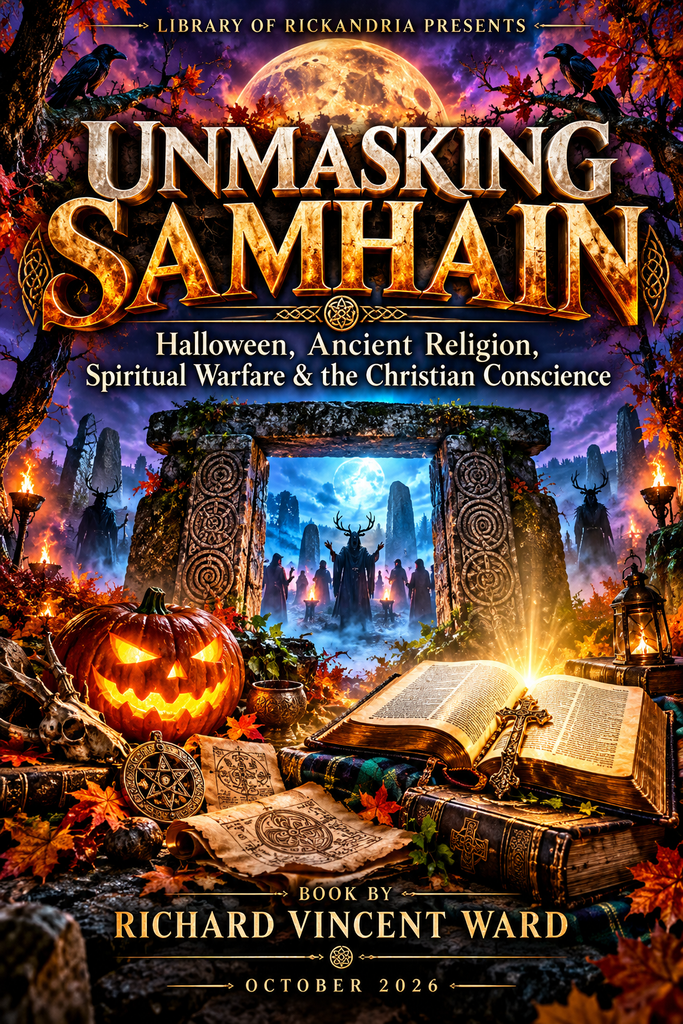
UNMASKING SAMHAIN
Halloween, Ancient Religion, Spiritual Warfare & the Christian Conscience
PART III — THE SYMBOLS UNDER EXAMINATION
CHAPTER 15
JACK-O’-LANTERNS, TURNIPS, PUMPKINS & FOLK BELIEF
The Wandering Lights, the Legend of Stingy Jack, Irish Lantern Customs, American Pumpkin Carving & the Allegation of Spiritual Gateways
“Turn ye not unto idols, nor make to yourselves molten gods:
I am the LORD your God.”— Leviticus 19:4, King James Bible
1. The Face in the Window
There is something remarkable about a light shining through a carved face.
The object itself is ordinary.
A vegetable has been hollowed out.
A knife has cut openings through its surface.
A small light burns or glows within it.
Yet when darkness falls, the object appears transformed.
The eyes shine.
The mouth seems to move as the flame flickers.
The expression may look cheerful, menacing, sorrowful, or mischievous.
From a distance, the viewer may momentarily perceive a living face.
The illusion is simple.
Its emotional effect can be powerful.
Today, this illuminated face is among the most recognizable symbols of Halloween.
It appears on doorsteps, windowsills, greeting cards, advertisements, classroom decorations, and commercial packaging.
It may be carved from an actual pumpkin.
It may also be manufactured from plastic, ceramic, metal, or glass.
Sometimes the face is frightening.
Sometimes it is deliberately ridiculous.
Sometimes it is merely a pattern of stars or geometric shapes.
But behind this familiar object lies a complicated history.
The jack-o’-lantern did not begin as one standardized orange pumpkin.
Its English name was applied to wandering lights long before the modern Halloween pumpkin became widespread.
Its associated folklore concerns travelers, dangerous marshes, tricksters, supernatural punishment, and strange lights in the darkness.
Its material history includes turnips and other root vegetables.
Its American development reflects migration, agriculture, literature, printing, and commercial culture.
These facts are important because the original 2025 edition of Unmasking Samhain made a far more specific claim.
It described the jack-o’-lantern as a sacrificial object.
It asserted that the light represented a trapped spirit.
It treated the placement of a lantern outside a household as a spiritual agreement involving the dead.
And it connected the modern decoration with an invisible system of demonic access.
Some genuine historical material appeared within that account.
Turnip lanterns are documented.
Folkloric beliefs concerning spirits are documented.
Stories about Jack and his wandering light are documented.
But the original manuscript moved beyond those facts.
It assigned one universal spiritual function to a symbol whose meanings developed through several different historical settings.
That conclusion requires examination.
The first question is not whether a jack-o’-lantern can possess religious meaning.
It can.
The question is whether the historical and biblical evidence establishes the particular meaning attributed to every lantern.
Our investigation therefore begins with an object whose history can be traced through an actual museum collection.
A turnip.
Not a pumpkin.
And certainly not an independently verified sacrificial altar.
2. The Ghost Turnip from County Donegal
At the National Museum of Ireland—Country Life, an unusual object preserves an important piece of Halloween history.
Its face appears almost skeletal.
Deep openings create eyes and a mouth.
The irregular shape of the turnip gives the object a disturbing expression.
It looks considerably more frightening than many modern smiling pumpkin decorations.
The museum identifies the object through collection number F1943.350.
Its story is unusually well documented.
The 1943 Collection Record
In 1943, a schoolteacher named Rois Ní Braonáin, working near Fintown in County Donegal, provided information and a turnip lantern to the National Museum of Ireland.
She explained that this was the kind of lantern traditionally made in the locality around 1900.
The museum subsequently had its artist, Eileen Barnes, create and paint a plaster model representing the object.
That model is associated with the museum’s present display.
The distinction between the original turnip and the plaster representation is important.
Museum evidence should be described accurately.
The surviving display should not simply be called a prehistoric original or an ancient Druidic artifact.
The National Museum of Ireland’s official Ghost Turnip collection record explains the object’s provenance.
What the Lantern Was Used For
According to the museum, people carved frightening faces into turnips and placed candles inside them.
The illuminated faces were used to frighten people on October 31.
This is a genuine historical finding.
The practice is not imaginary.
It was remembered within a particular Irish locality.
And it connects the Halloween season with the deliberate creation of frightening illuminated faces.
What the Evidence Does Not Establish
The collection record does not identify the lantern as an altar.
It does not describe the sacrifice of a human victim.
It does not state that the object contained an actual spirit.
It does not record a religious contract made by every household that displayed one.
Nor does it identify the practice as a universal prehistoric Druidic ceremony.
The surviving evidence concerns a later Irish folk custom.
Its significance should not be diminished.
But neither should it be expanded beyond what the record establishes.
The museum preserves evidence of a frightening turnip lantern—not proof of a sacrificial object inhabited by a spirit.
3. Why Turnips?
The material itself matters.
A modern American pumpkin provides a large surface for carving.
Its hollow interior can accommodate a light.
Its skin and flesh can be cut into recognizable shapes.
But pumpkins were not originally a common feature of prehistoric Irish agriculture.
The pumpkin belongs to the American history of cultivated squash.
Turnips and other root vegetables were familiar within later European farming and household life.
They were available during the autumn season.
They could be hollowed out with ordinary tools.
And when illuminated, they could produce a striking visual effect.
A Practical Historical Explanation
The availability of materials can influence the development of a custom.
A person wishing to make a simple lantern may use the material at hand.
A hollowed root vegetable offers a container for a small flame.
Carving openings allows light to pass through its surface.
The face can then serve as a frightening decoration or prank.
Such practical explanations do not exclude religious symbolism.
They demonstrate that a custom can develop through several influences at once.
The Problem with a Single-Origin Theory
If the original book’s explanation were complete, every carved vegetable would need to be treated as a sacrificial object.
But the evidence does not support that universal classification.
Some lanterns were deliberately frightening.
Some were associated with folk beliefs.
Others became part of amusement and decoration.
The material and its use must be distinguished from claims about supernatural operation.
A turnip can become a ceremonial object.
It can also become a toy, lantern, or seasonal decoration.
Its purpose depends upon the historical context.
4. The Name Is Older Than the Pumpkin
One of the most revealing discoveries concerns the term jack-o’-lantern.
The name did not begin as a label for a carved American pumpkin.
Its recorded history is older and more complicated.
The Historical Dictionary Evidence
The Online Etymology Dictionary’s entry for Jack-o’-Lantern traces forms such as Jack with the lantern to seventeenth-century English usage.
The expression became associated with mysterious lights visible at night, particularly in marshy places.
These wandering lights were also called will-o’-the-wisps.
The dictionary records the application of the name to carved pumpkin lanterns in American English during the nineteenth century.
A historical dictionary preserving material from the early Oxford English Dictionary identifies additional senses.
These include a man carrying a lantern, a night watchman, a wandering light, and a lantern fashioned from a turnip or pumpkin.
See Jack-o’-Lantern, World English Historical Dictionary.
Three Different Meanings
The history therefore contains several distinguishable uses.
First, Jack with a lantern could identify a person carrying a light.
Second, jack-o’-lantern could refer to a mysterious or elusive light seen at night.
Third, the name came to identify a hollowed vegetable illuminated from within.
The relationships among these meanings developed over time.
Why This Matters
A word can acquire a new meaning while retaining an older one.
The modern pumpkin does not explain every earlier use of jack-o’-lantern.
Nor does the earlier meaning establish that every modern pumpkin contains the spirit imagined within folk stories.
The history of the name is evidence of linguistic and cultural development.
It is not evidence of an automatic supernatural mechanism.
The name points us first toward mysterious lights.
To understand the folklore, we must follow those lights into the marshes.
5. The Wandering Lights of the Marsh
Across Britain and Ireland, people told stories about lights seen hovering over wetlands, marshes, bogs, and difficult ground.
The lights appeared to move.
They sometimes seemed to retreat as travelers approached.
In folklore, they could be interpreted as mischievous beings leading people astray.
Other stories associated them with lost souls, spirits, or supernatural warning.
The names varied.
Will-o’-the-wisp.
Jack-o’-lantern.
Ignis fatuus.
Fairy lights.
These expressions did not always identify exactly the same imagined being.
But they belonged to a broader world of explanations for unusual lights in darkness.
The Historical Importance of the Reports
The reports are evidence that people believed such lights existed or claimed to have witnessed them.
The folklore records their attempts to explain the experience.
A strange light over a bog could be interpreted through the religious ideas and storytelling traditions available to the observer.
The belief itself may be historically established.
The supernatural explanation is a separate proposition.
The Danger of the Landscape
Bogs and marshes can be physically dangerous.
The ground may be unstable.
Water can be concealed beneath vegetation.
Travelers moving through unfamiliar wetlands at night may become disoriented.
A story about a light leading someone into danger therefore possesses an understandable narrative setting.
Whether the light was caused by a natural phenomenon, a human source, misperception, or another circumstance requires investigation.
A Crucial Distinction
The historical investigator can document a belief concerning wandering spirits.
That does not establish the objective presence of a wandering spirit.
The same evidentiary principle applies to medieval Irish accounts of supernatural encounters and to early modern claims of witchcraft.
The story must not be confused with independent verification of the event it describes.
6. The Science of Wandering Lights
Natural explanations for mysterious marsh lights have been discussed for centuries.
Decomposing vegetation can release gases.
Methane is among the gases associated with anaerobic decomposition.
For a long time, researchers considered whether methane and related chemical processes could produce some of the lights described in folklore.
But the mechanism of spontaneous ignition presented difficulties.
A Modern Scientific Development
In 2025, researchers Yu Xia, Yifan Meng, Jianbo Shi, and Richard N. Zare published a study in the Proceedings of the National Academy of Sciences.
The article was entitled:
Unveiling ignis fatuus: Microlightning between microbubbles.
The researchers demonstrated that electrical discharges can occur between rising methane-containing microbubbles in water.
Their observations offer a possible mechanism relevant to certain natural luminous phenomena.
This research is scientifically interesting because it investigates how small electrical discharges might occur without a conventional external ignition source.
What the Study Establishes
It demonstrates a physical phenomenon under the conditions studied.
It provides a possible mechanism that may help explain some historical reports of marsh lights.
It contributes to the scientific investigation of an old natural-history problem.
What It Does Not Establish
The study does not prove that every historical will-o’-the-wisp report resulted from the same mechanism.
It does not establish that every apparent light over a bog was physically real.
It does not eliminate the possibility of misperception, artificial lights, or other natural processes in particular cases.
And it does not establish the existence or nonexistence of spiritual beings.
A scientific mechanism and a theological interpretation belong to different forms of inquiry.
The Historical Lesson
A person living centuries ago could sincerely explain an unusual light through a story concerning a wandering soul.
Modern research may identify a natural process capable of producing similar visual effects.
The story remains important as folklore.
But its literal supernatural explanation is not automatically verified by the sincerity of the person telling it.
The reality of a reported experience and the accuracy of its explanation must be examined separately.
7. The 1836 Irish Story of Jack
The most valuable historical sources are often those that allow us to see a legend before it has been reduced to one familiar modern version.
A particularly important example appeared on January 16, 1836.
The Dublin Penny Journal published a story entitled Jack o’ the Lantern.
The author was identified by the initials E. W.
The article appeared in volume 4, number 185, pages 229–232.
Its bibliographical record is preserved through JSTOR.
The University of Notre Dame’s Rare Books and Special Collections department discusses the story in An Irish Story Produces a Halloween Icon.
The Setting of the Story
The narrative concerns an observer traveling near a bog with an older relative.
The uncle interprets mysterious lights through the story of Jack.
The narrator offers a more naturalistic explanation involving ignis fatuus.
The two characters therefore represent differing approaches to the same phenomenon.
One interprets the lights through folklore.
The other appeals to a physical explanation.
This contrast is especially important for the present investigation.
The nineteenth-century text itself distinguishes a reported phenomenon from the interpretation assigned to it.
What the 1836 Article Establishes
It demonstrates that the legend of Jack and the wandering light circulated in Irish storytelling by that date.
It preserves a particular literary presentation of the tradition.
It connects the figure of Jack with the mysterious lights associated with bogs.
What It Does Not Establish
The article is not a prehistoric Irish manuscript.
It does not document a Druidic sacrifice.
It does not establish that every carved lantern was intended to contain a spirit.
Nor does it prove that every element of the standardized modern Stingy Jack story was present in the same form in 1836.
The later legend developed through different versions.
That distinction deserves attention.
8. Stingy Jack: The Familiar Version
The version now widely repeated tells of a dishonest or miserly man called Jack.
Sometimes he is described as a blacksmith.
Sometimes he is a habitual drinker.
Sometimes he is simply a cunning trickster.
In one familiar telling, he persuades the Devil to assume the form of a coin.
He then traps the Devil by placing the coin near a cross.
In another episode, Jack tricks the Devil into climbing a tree and prevents him from descending by marking the tree with a cross.
Eventually, Jack dies.
He is refused admission to heaven.
The Devil also refuses to receive him.
Jack is condemned to wander.
A burning coal provides his only light.
He carries it inside a hollowed turnip.
From this comes the familiar explanation of Jack of the Lantern.
The Folkloric Meaning
The story concerns deception, judgment, selfishness, supernatural punishment, and wandering after death.
It contains religious imagery.
It draws upon ideas concerning heaven, hell, the Devil, and the moral consequences of earthly behavior.
It may function as a warning against dishonesty or spiritual presumption.
It may also function as entertainment.
The Historical Problem
The best-known modern version should not automatically be treated as one ancient, fixed narrative.
Different versions contain different details.
Some emphasize a blacksmith.
Others emphasize hospitality, broken promises, or a bargain.
The means by which Jack traps the Devil vary.
The circumstances of his punishment vary.
These differences demonstrate the normal development of folklore.
The Correct Historical Conclusion
Stingy Jack is a genuine figure of later folklore.
His story is relevant to the history of the jack-o’-lantern.
But he is not an independently documented historical individual whose postmortem wandering can be verified.
Nor does his legend establish the presence of actual spirits inside modern pumpkins.
The story explains a belief and a name; it does not prove the supernatural events it narrates.
9. Did the Story Give the Name to the Object?
Popular summaries often state that the carved lantern was named directly after Stingy Jack.
That explanation is understandable.
But the historical chronology requires qualification.
The name jack-o’-lantern was used for mysterious lights before its familiar application to carved pumpkins.
The folklore concerning Jack also developed in multiple versions.
The relationship among the name, the wandering-light tradition, and the carved object therefore cannot be reduced to one simple moment of invention.
A More Careful Reconstruction
The expression circulated in English as a name for a person or wandering light.
Stories about Jack supplied a memorable explanation for those lights.
The name also became associated with hollowed vegetables illuminated from within.
Later popular retellings connected the carved object increasingly closely with the legend of Stingy Jack.
The precise development of each stage is not equally documented.
But the broad linguistic and cultural relationship is supported.
A Common Historical Mistake
The modern legend may be retold as though it explains the earliest appearance of the word.
But the earliest recorded word history cannot simply be replaced by a later narrative.
The two should be compared.
A folk explanation may be culturally important without providing a complete etymology.
This distinction also applies to the original book.
Its spiritual explanation cannot replace the documented linguistic history merely because it makes the symbol appear more ominous.
10. Why Did People Carve Frightening Faces?
The evidence supports several possible functions for illuminated vegetable faces.
Some were used to frighten neighbors.
Some were associated with protective beliefs.
Some belonged to seasonal mischief.
Others became decorations.
These functions may overlap within particular traditions.
The Frightening Face
The museum’s Donegal account identifies the use of turnip lanterns to frighten people.
The lantern’s appearance was therefore part of its social function.
A hollowed face illuminated by a candle can look unsettling.
This provides a straightforward explanation for why the object became associated with Halloween mischief.
Protective Folk Belief
Later accounts also describe frightening faces intended to repel spirits or supernatural beings.
This is relevant evidence concerning historical belief.
A participant who deliberately made a lantern for that purpose may have regarded the object as protective.
The religious or magical meaning should be recognized.
The Difference Between Protection and Invitation
Here the original 2025 argument encounters a problem.
A tradition describing a lantern as a means of repelling spirits does not automatically support a claim that the lantern was used to welcome spirits into the household.
Those are different functions.
One seeks exclusion.
The other seeks admission.
A single custom may develop contrasting interpretations over time.
But the historian must establish which interpretation belonged to which sources.
The original manuscript treated the lantern as both a ward against evil and a spiritual welcome without adequately explaining the contradiction.
The Correct Conclusion
The presence of protective folklore is historically meaningful.
But the precise purpose varied.
And a historical belief that an object warded off spirits does not establish that the object objectively possessed such power.
11. The Lantern as a Prank
One of the clearest documented uses of carved lanterns concerns practical jokes.
A frightening face placed in a dark doorway could startle a passerby.
An illuminated vegetable could be moved unexpectedly.
The apparent expression could seem alive as the flame flickered.
These features made the lantern well suited to seasonal mischief.
The American Newspaper Record
The University of Notre Dame’s Rare Books and Special Collections department highlights an important illustration published in Harper’s Weekly on November 23, 1867.
The engraving accompanied an article called The Pumpkin Effigy.
It depicted a carved pumpkin face used to frighten people.
The article described a custom involving mischievous children.
See An Irish Story Produces a Halloween Icon, University of Notre Dame.
An Important Chronological Detail
The 1867 article did not present the image specifically as a Halloween illustration.
Its appearance in November is suggestive of the autumnal setting.
But the source should not be rewritten as though it explicitly identified October 31.
The historical evidence establishes that pumpkin-face pranks were recognizable within nineteenth-century American culture.
Their exact relationship to Halloween developed through a broader process.
The Corrective Value of the Source
A frightening pumpkin in a newspaper story is evidence of a prank tradition.
It is not evidence of an occult sacrifice.
The same object can later become a familiar Halloween decoration.
The transition can be investigated through newspapers, illustrations, and material culture.
There is no need to invent an unbroken prehistoric ritual in order to explain the documented American development.
12. The Pumpkin Crosses into Halloween History
The pumpkin possesses a history independent of Ireland.
Botanically, pumpkins belong to cultivated groups of squash within the genus Cucurbita.
These plants originated in the Americas.
Indigenous communities cultivated forms of squash and pumpkin long before European colonization.
The history extends thousands of years.
The Smithsonian Institution’s Origins of Thanksgiving Foods discusses the domestication and cultivation of American squash.
This background is essential.
The pumpkin did not arrive in Ireland as a prehistoric Celtic crop.
Its later use in Halloween developed through the agricultural and cultural history of the Americas.
Why the Pumpkin Was Useful
Pumpkins could grow large.
Their hollow interiors made them suitable for illumination.
Their skins could be carved into recognizable designs.
Their orange color was already associated with autumn harvest imagery.
These practical features helped the pumpkin become an effective material for a lantern.
Migration and Adaptation
Irish and Scottish migrants brought customs, stories, and seasonal practices to North America.
American communities also possessed existing traditions involving pumpkins and harvest celebrations.
The modern pumpkin lantern developed through the interaction of these influences.
It should not be explained solely through one unchanged imported custom.
The historical evidence permits a more nuanced account.
Old World lantern traditions were relevant.
American pumpkin culture was also relevant.
Literature and popular entertainment helped strengthen the association.
Commercial advertising later standardized it.
The Material Transformation
A turnip lantern and a pumpkin lantern share recognizable features.
Both may be hollowed.
Both may be illuminated.
Both may depict a face.
But the difference in material is historically important.
A custom changed in response to a new agricultural environment.
That is cultural adaptation.
It is not evidence that every element retained the same religious meaning.
13. Cindy Ott and the American Pumpkin
One of the most important scholarly studies of the pumpkin’s cultural history is Cindy Ott’s Pumpkin: The Curious History of an American Icon, published by the University of Washington Press in 2012.
The book examines how pumpkins became associated with rural life, family memory, harvest celebrations, American identity, and Halloween.
The Smithsonian Libraries’ catalogue record provides its bibliographic details.
Ott’s work is important because it places pumpkin symbolism within American history rather than treating the vegetable merely as the material successor to an alleged prehistoric ritual.
The Pumpkin and Rural Memory
During the nineteenth and twentieth centuries, Americans developed strong cultural associations between pumpkins and the rural past.
Pumpkin displays could evoke farms, harvests, agricultural abundance, and seasonal change.
These associations existed alongside frightening folklore.
They were not necessarily religious sacrifices.
The Pumpkin as an American Icon
A carved pumpkin could become a symbol of autumn entertainment.
Its image could appear in advertising.
It could decorate a household.
It could represent rural nostalgia.
It could also be used in a frightening story.
The object possessed multiple meanings.
The Historical Importance
Ott’s scholarship challenges the idea that the pumpkin’s modern cultural function can be understood entirely through prehistoric European religion.
The pumpkin’s American history is not a minor detail.
It is central to the symbol’s modern development.
The familiar jack-o’-lantern is partly an American cultural creation, not merely an ancient Irish object reproduced without change.
14. The Headless Horseman and the Pumpkin
American literature contributed to the pumpkin’s supernatural reputation.
Washington Irving’s The Legend of Sleepy Hollow, first published in 1820, is among the most influential examples.
The story features Ichabod Crane, the mysterious Headless Horseman, and the atmosphere of local legend.
In the climax, an object is hurled toward Ichabod.
A smashed pumpkin is later discovered.
The Important Historical Correction
In Irving’s original story, the pumpkin is not described as a glowing carved jack-o’-lantern.
Later illustrations and adaptations frequently portray the Headless Horseman carrying a flaming or illuminated pumpkin head.
That familiar image belongs significantly to the story’s later visual reception.
The distinction is discussed in The Twisted Transatlantic Tale of American Jack-o’-Lanterns, National Geographic.
Why This Matters
The history of the Halloween pumpkin was shaped not only by folklore but by artistic adaptation.
A literary detail became an image.
The image was repeated.
Later audiences came to associate the image with the original narrative.
Eventually, the popular memory of the story could differ from the original text.
This is a familiar process within cultural history.
It resembles the development of broader Samhain narratives.
A later reconstruction becomes memorable.
Repetition makes it familiar.
The distinction between original evidence and later interpretation becomes obscured.
The Lesson
The historian should return to the original source.
The original story and later imagery are related.
They are not identical.
Likewise, an ancient seasonal festival and a modern jack-o’-lantern may be historically related without possessing one unchanged religious function.
15. Nathaniel Hawthorne and the Nineteenth-Century Lantern
The writer Nathaniel Hawthorne also employed jack-o’-lantern imagery.
His story The Great Carbuncle, published in 1835, uses the term as a familiar comparison involving light.
Later, Feathertop (1852) contains a memorable pumpkin-headed scarecrow.
These literary examples belong to the nineteenth-century American cultural environment.
They demonstrate that pumpkin and lantern imagery was developing within fiction and popular imagination.
Literature as Historical Evidence
A fictional story can document what images and expressions were intelligible to readers of its period.
It can reveal how an author used a symbol.
It can help establish that an object or term was culturally familiar.
But the fictional events are not thereby transformed into historical occurrences.
A pumpkin-headed character in a tale is not evidence that pumpkins were inhabited by spirits.
It is evidence of a literary representation.
The Larger Pattern
The jack-o’-lantern developed through the interaction of physical objects and stories.
A turnip could be carved.
A wandering light could be explained through folklore.
A pumpkin could become a prank.
A literary character could acquire supernatural associations.
A commercial illustration could reproduce the image.
The symbol became increasingly familiar.
No single stage establishes a universal demonic mechanism.
16. The 1867 Pumpkin Effigy
The Harper’s Weekly illustration of November 23, 1867, deserves further attention.
The engraving, associated with L. W. Atwater, is commonly identified as one of the earliest major American illustrations of a carved pumpkin face.
Historian Cindy Ott discusses it in the visual research accompanying her book.
See The Pumpkin Effigy, Cindy Ott’s historical exhibition.
The article concerns a frightening prank.
It is not an account of sacrificial worship.
The Word Effigy
An effigy is a representation of a person or figure.
The word does not automatically mean an idol receiving worship.
An effigy can be used in political demonstration.
It may appear in a theatrical performance.
It may be burned in a protest.
It may serve as a prank.
The purpose must be established from context.
The Original Manuscript’s Error
The 2025 edition treated frightening carved faces as evidence of sacrificial continuity.
But the 1867 source describes the object in terms of mischief.
The image may have older influences.
Its immediate documented use is not an offering of human blood or an invitation to a spirit.
The Historical Finding
The 1867 material demonstrates a recognizable American pumpkin-face tradition.
It does not independently identify a prehistoric Druidic ceremony.
This is the kind of distinction the revised edition must preserve.
17. The Pumpkin Becomes a Commercial Symbol
By the early twentieth century, pumpkins had become increasingly prominent within American Halloween imagery.
The development can be traced through advertisements, postcards, party manuals, and newspaper illustrations.
The image became standardized.
A round orange face.
Triangular eyes.
A broad mouth.
A light inside.
The Smithsonian Record
Smithsonian Gardens, Ghosts of Pumpkins Past describes the development of pumpkin carving in the United States during the nineteenth century.
Its materials include a photograph of American jack-o’-lanterns dated to 1912.
The image illustrates the growing cultural familiarity of carved pumpkin faces.
Newspaper Evidence
The Library of Congress’s Halloween: Topics in Chronicling America identifies a 1915 New York Tribune feature treating the jack-o’-lantern as a recognizable Halloween symbol.
This is valuable because the source belongs to the period itself.
It does not merely assert that pumpkin lanterns were popular.
It preserves the contemporary cultural language surrounding them.
Party Supplies and Decoration
Companies such as Dennison Manufacturing promoted Halloween party decorations during the early twentieth century.
Their products included paper pumpkins, faces, cats, witches, and other familiar seasonal imagery.
The Henry Ford Museum preserves an edition of Dennison’s Bogie Book from 1922.
The catalogue demonstrates the commercialization of Halloween decorations.
The Significance
A symbol can spread because it is inexpensive, recognizable, and attractive.
Its prevalence does not independently establish a religious campaign.
Commerce can amplify imagery whose origins are varied.
The modern jack-o’-lantern became part of that process.
18. Orange, Black and the Allegation of Hidden Ritual Color Codes
The original manuscript also assigned fixed spiritual meanings to Halloween colors.
Orange was interpreted through fire.
Black was associated with death and spiritual darkness.
These associations are understandable.
Colors can carry symbolic meaning.
But a universal religious interpretation requires evidence.
The Historical Development of Halloween Colors
Orange is associated visually with pumpkins and autumn harvests.
Black can suggest night, shadows, and mystery.
The combination became attractive within seasonal decoration.
Historian Lesley Bannatyne has discussed the development of these colors through early twentieth-century party merchandise and printed decorations.
Companies such as Dennison and Beistle helped standardize the palette.
The Kansas Historical Society’s account of early Halloween costumes preserves material evidence of this commercial history.
The Problem of Exclusive Meaning
Orange can represent harvest.
Black can represent night.
Both may appear in religious, secular, artistic, or commercial settings.
The existence of one symbolic interpretation does not eliminate others.
The Original Claim
The 2025 edition treated the color scheme as evidence of spiritual forces being invoked.
But the commercial and artistic history supplies another major explanation for the familiar palette.
The colors alone do not establish that an invocation is occurring.
To demonstrate religious participation, the actual ceremony and intention must be identified.
A color association is not a documented spiritual transaction.
19. Was the Original Lantern Sacrificial?
We now return to the most serious historical allegation.
The original manuscript explicitly described the jack-o’-lantern as an object that was:
“not decorative but sacrificial.”
This is a specific claim.
It concerns the purpose of the object.
What evidence would establish it?
The Necessary Historical Evidence
We would need evidence that the lantern was used as an offering within an identifiable ceremony.
We would need to know what was sacrificed.
We would need to identify the religious recipient or purpose.
We would need to establish the date and cultural setting.
And if the claim concerned prehistoric Druids, we would need evidence linking the ceremony to the relevant ancient community.
The mere existence of a frightening face would not suffice.
The existence of a legend concerning a wandering soul would not suffice.
Nor would the existence of human sacrifice in a different ancient source establish the function of a carved turnip.
What the Available Sources Establish
The museum evidence documents turnip lanterns used to frighten people.
The linguistic evidence documents the name’s association with wandering lights.
The folklore documents beliefs concerning Jack and supernatural beings.
The American evidence documents pumpkin carving, pranks, literature, and commercial development.
These are substantial findings.
But none establishes the proposed universal sacrificial function.
The Correct Classification
The claim that every original jack-o’-lantern was sacrificial is unsupported by the evidence examined.
The statement should not remain in the revised manuscript as historical fact.
20. Did the Lantern Contain a Trapped Spirit?
The original edition also claimed:
“It represented the spirit trapped inside”
The statement draws upon the folkloric association between a wandering soul and a lantern.
But a story about a soul carrying a light is not necessarily a belief that a spirit is imprisoned inside every carved vegetable.
The Difference Between Representation and Containment
A lantern may represent a character.
Its light may symbolize that character’s wandering.
A frightening face may evoke supernatural danger.
But representation does not establish literal occupancy.
A painting of a person does not contain the person.
A statue depicting an animal does not contain the animal.
A carved vegetable depicting a fictional ghost does not automatically house a spirit.
The Historical Question
Did some folk traditions associate lanterns with supernatural beings?
Yes.
Did some people believe their lanterns could ward off harmful spirits?
Later evidence supports such beliefs.
Does that prove every lantern objectively contained a spirit?
No.
The assertion requires evidence that the sources do not establish.
The Biblical Question
Scripture contains discussions of idolatry, spirits, and forbidden consultation.
But it does not identify illuminated vegetables as containers of demons.
The metaphor of a trapped soul should not be presented as a literal spiritual mechanism without explanation and support.
21. Was Putting a Lantern Outside a House a Pact?
The original manuscript made an additional assertion:
“Placing them outside homes was a pact:”
The sentence assigned a specific spiritual meaning to the placement of the object.
It interpreted the act as an agreement welcoming the dead.
This claim must be separated into three questions.
The Historical Question
Did people place lanterns outside their homes?
Yes.
Did some traditions associate lanterns with spirits or protection?
Yes.
Does the evidence demonstrate that every placement constituted an agreement to welcome spirits?
No.
In fact, a tradition intending to frighten spirits away has a different stated purpose from one intending to invite them inside.
The Theological Question
What constitutes a spiritual covenant?
Within biblical narratives, covenants involve identifiable parties and commitments.
The word carries substantial theological meaning.
To claim that placing a decoration constitutes a covenant with a supernatural being requires a reasoned explanation of how that relationship is established.
The relevant biblical passages do not directly identify ordinary lantern placement as such a covenant.
The Evidentiary Question
If the claim concerns invisible consequences independent of intention, how is that mechanism known?
Is it explicitly taught in Scripture?
Is it inferred from a theological system?
Does it arise from testimony?
Is it merely asserted?
The source of the claim should be identified.
The original manuscript did not adequately establish the alleged mechanism.
The Correct Conclusion
The historical practice of placing lanterns near homes is documented.
The assertion that every such act constitutes an occult covenant is unestablished.
22. The Bible and Manufactured Objects
A serious Christian investigation should not dismiss biblical warnings concerning idols.
The Scriptures contain direct prohibitions against idolatry.
But the object of those warnings must be identified correctly.
Leviticus 19:4
The verse states:
“Turn ye not unto idols, nor make to yourselves molten gods:
I am the LORD your God.”
The passage concerns religious devotion directed toward idols and the making of representations intended as gods.
A carved pumpkin is not automatically such an object merely because it has a face.
Its religious function must be established.
Exodus 20:3–5
The Decalogue prohibits worship of other gods and bowing to forbidden images.
Christian traditions differ in their interpretations of religious imagery.
Some adopt strict limitations upon images used in worship.
Others distinguish religious representation from idolatrous adoration.
The exact theological questions require careful treatment.
But the text does not automatically classify every carved or painted object as an idol.
The issue involves worship and the prohibited forms of religious devotion.
Jeremiah 10:3–5
Jeremiah describes the manufacture of idols.
Wood is cut.
An artisan fashions the object.
It is decorated.
Its lack of genuine divine power is exposed.
The passage is sometimes applied to modern decorations merely because they are manufactured from natural materials.
But the context is an explicit polemic against idols.
The prophet is not discussing every craft made from wood or vegetation.
The Necessary Distinction
An object may be manufactured.
It may possess symbolic meaning.
It may be used in worship.
But these propositions are not automatically identical.
The biblical critique concerns false worship and idolatrous trust.
It cannot be applied accurately without identifying the actual religious function.
23. First Corinthians 8 — An Idol and the Object Associated with It
Paul’s discussion of food offered to idols provides a particularly useful interpretive framework.
In First Corinthians 8:4, the KJV states:
“As concerning therefore the eating of those things that are offered in sacrifice unto idols, we know that an idol is nothing in the world, and that there is none other God but one.”
The passage concerns actual disputes over food associated with idolatrous worship.
Paul recognizes the religious context.
He also distinguishes the idol from the reality of the one God.
Knowledge and Conscience
Paul warns that knowledge must be governed by love.
Some believers may possess a conscience troubled by former associations.
Others may understand the situation differently.
The ethical response must consider the effect upon fellow believers.
The Relevance to Halloween
A Christian may object to particular symbols because of their associations.
That is a genuine conscientious concern.
But historical association alone does not establish that every object permanently possesses one religious function.
Paul’s argument does not support ignoring actual idolatry.
It does require distinguishing worship from other circumstances involving the same material objects or associated practices.
The Jack-o’-Lantern Question
If someone intentionally uses a lantern within a ritual invoking a deity or spirit, the religious context matters.
If another person carves a smiling face into a pumpkin as seasonal decoration, the same ritual has not thereby been established.
The physical resemblance is insufficient.
The action, context, and purpose must be examined.
24. First Corinthians 10 — Actual Religious Fellowship
First Corinthians 10:14 contains a direct instruction:
“Wherefore, my dearly beloved, flee from idolatry.”
The chapter subsequently addresses participation in sacrificial meals.
Paul warns against fellowship with devils through idolatrous worship.
The seriousness of the passage should not be minimized.
The Important Context
Paul discusses actual religious participation.
He identifies the relationship between sacrifices, worshippers, and the religious table.
But he also distinguishes other circumstances involving ordinary food.
The chapter therefore requires precise interpretation.
The Unestablished Extension
The original book treated an illuminated pumpkin as an altar and its placement as spiritual fellowship.
But the historical evidence does not establish that every pumpkin is used as a religious offering.
The biblical passage does not name the object.
It does not identify an invisible mechanism automatically activated through decoration.
The further conclusion requires argument.
A Stronger Christian Application
A Christian may examine whether a particular activity involves intentional idolatrous worship.
That is directly relevant to Paul’s warning.
A Christian may also consider whether a symbol creates confusion, violates personal conscience, or encourages practices the family wishes to avoid.
These concerns can be discussed without claiming that every pumpkin necessarily operates as a spiritual gateway.
25. Isaiah 8 — The Difference Between a Ghost Story and Necromancy
Because the jack-o’-lantern is associated with ghost folklore, Isaiah 8 is relevant.
Verse 19 warns against seeking those who claim access to familiar spirits and the dead.
The passage raises a serious theological issue concerning the source of supernatural counsel.
A Folktale Is Not Necessarily a Consultation
Telling the story of Stingy Jack does not automatically mean attempting to contact him.
A historian studying the story is not necessarily practicing necromancy.
A child hearing the tale is not automatically asking the dead for guidance.
The activity must be identified.
A Religious Ritual Can Be Different
If a person deliberately uses an object as part of an attempted invocation, that action presents another question.
The symbol’s use within a ceremony may be central to its meaning.
This is why the historical context matters.
The Correct Application
Scripture’s prohibition against spirit consultation should be taken seriously.
But it cannot be expanded into the claim that every representation of a ghost constitutes actual consultation.
The difference between a story, a decoration, and a religious act must remain clear.
26. Light in Scripture Is Not One Universal Symbol
The original edition associated the lantern’s light with fire, spiritual torment, and the dark supernatural realm.
But the Bible employs light in many ways.
It can symbolize divine instruction.
It can represent truth.
It can serve as a physical means of illumination.
It can also appear in imagery concerning judgment or deception.
The meaning depends upon context.
Psalm 119:105
The KJV reads:
“Thy word is a lamp unto my feet, and a light unto my path.”
The verse uses light metaphorically for divine guidance.
It does not imply that every physical lamp is sacred.
John 8:12
Jesus describes himself as the light of the world.
The statement belongs to the Gospel’s theological presentation of Christ.
It does not identify every ordinary light as an act of worship.
Luke 11:33
Jesus refers to lighting a candle and placing it where its light can be seen.
The imagery draws upon the ordinary function of household illumination.
The existence of a light source does not automatically carry one supernatural meaning.
The Biblical Lesson
Light can possess religious symbolism.
But its physical presence does not settle the spiritual character of an activity.
A lantern can illuminate a room.
It can frighten a passerby.
It can decorate a home.
It can also be used in a religious ceremony.
The context determines which claim is relevant.
The physical light does not explain its own religious meaning.
27. The Psychology of the Carved Face
Why does a carved pumpkin seem to have a personality?
The explanation involves human perception.
People are highly responsive to facial patterns.
A pair of openings and a mouth-like shape can produce the impression of a face.
This tendency is related to pareidolia, the perception of meaningful forms in ambiguous visual patterns.
The Flickering Effect
When a candle flickers within a carved vegetable, the shadows change.
The apparent expression may seem to shift.
An observer may experience the face as more lifelike than the material actually is.
This is especially effective at night.
Fear and Expectation
A person who expects a frightening image may experience the face as threatening.
Another person may find the same carving humorous.
The emotional response is influenced by prior experience, context, and expectation.
The Historical Significance
These perceptual effects help explain why carved lanterns became useful for pranks and seasonal entertainment.
A frightening face does not require a supernatural occupant to produce an emotional response.
The Limit of the Psychological Explanation
Understanding a perceptual mechanism does not answer every theological question concerning intentional religious ritual.
But it does offer a credible explanation for why an ordinary carved object can appear unsettling.
The historian should not leap from a frightening appearance to an invisible spiritual cause.
28. The Cultural Power of the Pumpkin Face
The modern jack-o’-lantern possesses remarkable symbolic flexibility.
A triangular-eyed face can signify Halloween immediately.
A smiling version may suggest family celebration.
A threatening version may suggest horror.
A stylized version may appear in advertising.
A handcrafted version may represent children’s creativity.
An elaborate carving may function as sculpture.
The Same Object, Different Meanings
A pumpkin displayed outside a house may indicate participation in neighborhood festivities.
It may express an interest in autumn decoration.
It may signal that a household is welcoming trick-or-treaters.
It may be associated with a religious observance in some settings.
But the object alone cannot tell us which meaning is intended.
The investigator must examine the circumstances.
The Problem of Automatic Attribution
The original edition treated every displayed lantern as evidence of a spiritual agreement.
That conclusion assigns one purpose regardless of the participant’s actual conduct.
It also ignores the historically documented development of pumpkin carving through American literature, pranks, agricultural culture, and commercial decoration.
The Correct Research Standard
When an object has several possible meanings, the author should not select the most alarming interpretation merely because it supports a preferred conclusion.
The appropriate meaning must be established from relevant evidence.
This principle is central to the entire investigation.
29. The Claim of a Worldwide Shared Ritual Root
The 2025 manuscript connected Halloween with religious commemorations in Mexico, Japan, and India.
It asserted a common underlying root involving offerings and communication with the dead.
This comparison requires substantial qualification.
Different Religious Histories
Mexico’s Día de los Muertos developed through the interaction of Indigenous traditions and Catholic commemorations within particular regional histories.
Japanese Obon belongs to the development of Buddhist and Japanese ancestral observances.
Pitru Paksha belongs to Hindu religious traditions concerning departed ancestors and ritual obligations.
These observances possess distinct histories, theological frameworks, and cultural functions.
Similarity Does Not Establish Common Origin
More than one religion may commemorate the dead.
More than one society may use light or food within a ceremony.
But the existence of similar elements does not prove that all ceremonies descend from one ancient occult system.
Historical transmission must be demonstrated.
The Specific Jack-o’-Lantern Problem
A Mexican memorial display is not automatically derived from Irish turnip carving.
A Japanese ancestral observance is not automatically a form of Samhain.
A Hindu rite is not evidence that a carved American pumpkin houses a spirit.
The comparisons may be interesting.
But they should not be used to create an unsupported universal genealogy.
The Corrected Conclusion
Religious traditions around the world contain observances concerning ancestors and the dead.
Their similarities may invite comparative study.
Their distinctive histories must nevertheless be respected.
30. The Practical Safety Question
A responsible discussion of jack-o’-lanterns should also address ordinary physical risks.
A candle placed inside a hollowed vegetable produces heat.
A lantern may be placed near clothing, dry leaves, decorations, or other combustible materials.
A sharp carving tool can cause injury.
Children may require supervision.
These concerns are practical.
They do not depend upon a supernatural theory.
Safer Illumination
Battery-powered lights can provide illumination without an exposed flame.
A family may choose to use them.
Others may avoid carved lanterns entirely.
The decision can involve safety, aesthetics, conscience, or religious conviction.
A Necessary Distinction
A preventable burn or knife injury is an identifiable physical danger.
The claim that the object automatically grants demons access is a different proposition.
Evidence for one does not establish the other.
The book should not obscure genuine safety concerns by presenting an unverified supernatural mechanism as the principal danger.
31. The Original 2025 Chapter Under Examination
The original manuscript made three especially important claims concerning the jack-o’-lantern.
First, it stated that the object was sacrificial rather than decorative.
Second, it described the carved lantern as representing a trapped spirit.
Third, it interpreted placing lanterns near homes as a spiritual pact.
Each claim goes beyond the basic historical evidence.
Historical Evidence Retained
The original edition correctly identified turnips as important predecessors of modern pumpkin lanterns.
It correctly recognized that folk beliefs concerning spirits and frightening faces belong to Halloween’s history.
It also recognized that lantern imagery can carry supernatural associations.
These elements should remain within the revised account.
Unsupported Historical Extensions
The original edition did not adequately demonstrate that the first carved lanterns were sacrificial objects.
It did not establish that ancient Druids used them within a specific documented human-sacrifice ceremony.
It did not establish that a literal spirit occupied the lantern.
Nor did it demonstrate a continuous ritual system extending unchanged into modern American pumpkin carving.
Unsupported Theological Extensions
The original edition also asserted invisible spiritual consequences.
But the relevant biblical passages do not identify a carved lantern as an automatic altar.
They do not establish a covenant through ordinary seasonal decoration.
And they do not teach that an illuminated vegetable itself opens a spiritual gateway.
These conclusions must be identified as unestablished interpretations rather than presented as direct biblical revelation.
32. Claim-by-Claim Editorial Rebuttal
Claim 15.1 — Halloween Lanterns Were Historically Carved from Turnips
Finding: Verified.
The National Museum of Ireland preserves specific collection evidence from County Donegal.
Claim 15.2 — Turnip Lanterns Could Be Used to Frighten People
Finding: Verified.
The museum’s record explicitly describes that use.
Claim 15.3 — Some Later Traditions Associated Lanterns with Repelling Spirits
Finding: Supported as folkloric belief.
The belief is documented in modern summaries of older regional traditions.
Its precise prehistoric origin remains uncertain.
Claim 15.4 — The Jack-o’-Lantern Was Originally a Universal Druidic Sacrificial Altar
Finding: Unsupported.
The cited historical evidence does not establish the alleged ritual.
Claim 15.5 — The Name Jack-o’-Lantern Was Associated with Wandering Lights Before Modern Pumpkins
Finding: Verified.
Historical dictionaries document the earlier meanings.
Claim 15.6 — A Story Concerning Jack and Marsh Lights Was Published in 1836
Finding: Verified.
The Dublin Penny Journal printed Jack o’ the Lantern on January 16, 1836.
Claim 15.7 — Every Detail of the Modern Stingy Jack Legend Was Fixed in Prehistoric Ireland
Finding: Unsupported.
The legend exists in multiple versions, and its surviving print history is much later.
Claim 15.8 — The Legend Proves That Jack’s Soul Literally Wanders the Earth
Finding: Not established.
The tale is evidence of folklore, not independent verification of its supernatural events.
Claim 15.9 — Some Wandering-Light Reports May Have Natural Explanations
Finding: Supported.
Scientific research offers plausible mechanisms for certain phenomena.
No one explanation has been demonstrated for every historical report.
Claim 15.10 — The Pumpkin Is Native to the Americas
Finding: Verified.
Botanical and archaeological evidence establishes the American origins of cultivated Cucurbita.
Claim 15.11 — Pumpkin Lanterns Developed in Nineteenth-Century American Culture
Finding: Supported.
Literary, dictionary, and visual evidence documents the development.
Claim 15.12 — The 1867 Pumpkin Effigy Was Explicitly a Halloween Illustration
Finding: Incorrect.
The contemporary article described a prank and did not identify Halloween as its subject.
Claim 15.13 — Literature Helped Popularize Pumpkin Imagery
Finding: Supported.
Washington Irving, Nathaniel Hawthorne, and later visual adaptations contributed to the cultural development.
Claim 15.14 — Early Twentieth-Century Commercial Culture Standardized Pumpkin Imagery
Finding: Supported.
Newspaper illustrations, party catalogues, and museum records document the process.
Claim 15.15 — Orange and Black Possess One Exclusive Occult Meaning
Finding: Unsupported.
Their uses include seasonal, artistic, commercial, and symbolic associations.
Claim 15.16 — A Carved Lantern Automatically Contains a Spirit
Finding: Unestablished supernatural assertion.
No historical or biblical evidence examined establishes a universal mechanism.
Claim 15.17 — Placing a Lantern Near a Home Automatically Creates a Spiritual Pact
Finding: Unestablished theological assertion.
The practice has multiple documented purposes, and the claimed covenant is not directly taught by the cited texts.
Claim 15.18 — All Religious Traditions Honoring the Dead Share One Historical Origin in Samhain
Finding: Unsupported.
Distinct religious traditions require distinct historical investigations.
Claim 15.19 — Scripture Condemns Actual Idolatry
Finding: Directly supported.
Exodus 20, Leviticus 19, and First Corinthians 8–10 contain relevant teachings.
Claim 15.20 — Scripture Identifies Every Carved Pumpkin as an Idol
Finding: Not established.
The religious function of the object must be identified.
Claim 15.21 — Christians May Abstain from Halloween Lanterns for Reasons of Conscience
Finding: Supported as a possible ethical decision.
Such abstention need not depend upon unsupported allegations of automatic supernatural access.
Claim 15.22 — Every Christian Household Must Adopt the Same Historical and Theological Interpretation
Finding: Not established.
The relevant practices and conscientious judgments vary.
33. Corrected Replacement Passage for the 2026 Edition
The Jack-o’-Lantern: Folklore, History and Christian Conscience
The jack-o’-lantern developed through the interaction of European folklore, practical lantern-making, nineteenth-century American culture, and modern Halloween decoration.
Its name is older than the familiar carved pumpkin.
Seventeenth-century English expressions associated with Jack with the lantern came to identify mysterious lights seen at night, especially in marshes and wetlands.
These lights were also known as will-o’-the-wisps.
Folkloric explanations sometimes described them as wandering spirits or supernatural beings leading travelers astray.
Irish storytelling developed accounts concerning a figure known as Jack.
One important printed version appeared in the Dublin Penny Journal in 1836.
The story connected Jack with mysterious lights observed over a bog.
Later versions presented him as a dishonest or miserly trickster who deceived the Devil and was condemned to wander after death.
The details differed among retellings.
The legend is important evidence of popular belief.
It is not proof that the supernatural events occurred.
In Ireland, Halloween lanterns could be made from hollowed turnips.
The National Museum of Ireland preserves evidence of a County Donegal tradition remembered around 1900.
The lanterns were illuminated and used to frighten people on October 31.
Later accounts also associate such objects with efforts to repel wandering spirits.
These beliefs deserve historical recognition.
But the museum evidence does not establish the lantern as a universal sacrificial object.
Nor does it prove that the object literally contained a spirit.
The familiar pumpkin lantern developed prominently in North America.
Pumpkins are native to the Americas and had a substantial agricultural and cultural history before becoming Halloween symbols.
Nineteenth-century literature, illustration, and seasonal customs helped establish carved pumpkins as recognizable objects.
An important Harper’s Weekly illustration from 1867 depicted a pumpkin face used in a prank, although the article did not explicitly identify Halloween.
During the early twentieth century, newspapers, party catalogues, commercial decorations, and popular entertainment further standardized the image.
The modern jack-o’-lantern therefore possesses a complex history.
Its meanings include frightening entertainment, seasonal decoration, folklore, artistic creativity, and, in some circumstances, deliberate religious symbolism.
These uses should not be treated as automatically identical.
The Christian Scriptures condemn actual idolatry and forbidden spirit consultation.
Those prohibitions remain serious.
But the Bible does not specifically identify a carved vegetable as a demonic altar or teach that placing such an object outside a home automatically creates a spiritual covenant.
A religious object must be examined according to its use.
A person intentionally performing an invocation presents a different theological question from a family displaying an ordinary seasonal decoration.
Christians may disagree concerning the appropriateness of particular Halloween symbols.
Some families may avoid all such decorations because of conscience.
Others may distinguish folklore and entertainment from intentional occult practice.
These decisions deserve careful biblical reflection.
However, the moral evaluation should not be supported through unsupported historical or supernatural claims.
The original 2025 edition correctly recognized the importance of Irish turnip lanterns, the legend of Jack, and the symbol’s associations with supernatural folklore.
But it described the lantern as inherently sacrificial, asserted that it represented a trapped spirit, and interpreted its placement outside the home as a spiritual pact.
Those conclusions were not adequately demonstrated.
The revised edition therefore preserves the authentic historical material while rejecting the universal claims of sacrificial function and automatic spiritual access.
The purpose is not to declare every symbol morally harmless.
It is to identify the symbol accurately before interpreting its meaning.
Historical evidence, biblical teaching, and contemporary conduct must each be considered within their proper contexts.
This is the responsible foundation for Christian discernment.
34. Conclusion — The Light Reveals a Longer History
We began with a face shining through a hollowed vegetable.
Its history seemed simple.
Its development was not.
We encountered a turnip lantern from County Donegal.
We examined the National Museum of Ireland’s collection evidence.
We traced the word jack-o’-lantern to wandering lights and older English expressions.
We followed those lights into the bogs of Irish folklore.
We read about a tale published in the Dublin Penny Journal in 1836.
We considered the later versions of Stingy Jack.
We examined the possible natural causes of marsh lights.
We followed the pumpkin through American agriculture, literature, newspaper illustration, and commercial culture.
And we returned to the original 2025 manuscript’s assertion that the familiar lantern was a spiritual altar.
The surviving evidence supports a genuine historical relationship among lantern-making, folklore, Halloween, and the modern pumpkin.
But it does not support the entire supernatural system attributed to the object.
The turnip lantern was real.
The wandering-light legends were real as traditions.
The Stingy Jack story was real as folklore.
The nineteenth-century American pumpkin-face custom was real.
The modern commercial symbol is real.
What has not been established is that every carved lantern constitutes a sacrifice.
Nor has it been demonstrated that a literal spirit resides within it.
Nor does the historical record establish that placing a pumpkin outside a house creates a covenant with supernatural beings.
Those further assertions require evidence.
The biblical texts also demand careful treatment.
Scripture condemns idolatry.
It warns against seeking spiritual counsel through forbidden means.
It instructs believers to flee actual idolatrous fellowship.
These principles remain serious.
But they do not establish that every manufactured face is an idol.
They do not teach that every illuminated vegetable houses a demon.
And they do not identify ordinary pumpkin carving as an automatic act of necromancy.
A Christian household may decide to abstain.
Another may regard the pumpkin as a seasonal decoration.
A particular religious practitioner may use an illuminated object ceremonially.
The moral significance of those activities must be evaluated according to what actually takes place.
The historical ancestry cannot substitute for the present conduct.
The symbol cannot be made to testify to a spiritual relationship that has not been established.
The duty of truthful investigation is therefore clear.
We should not deny the spiritual beliefs of people who historically regarded lanterns as protective.
We should not dismiss genuine religious uses of lights and images.
But neither should we transform every popular decoration into a supernatural pact merely because a frightening story can be attached to it.
The historical evidence must determine the history.
The biblical text must determine what Scripture teaches.
Theological interpretation must be identified honestly.
And claims concerning invisible consequences must not be presented as verified facts when their basis remains unestablished.
The original edition sought to expose hidden meaning.
The revised edition must go further.
It must examine whether the hidden meaning was ever demonstrated.
The answer, in this case, is that the familiar symbol possesses several authentic historical meanings.
But the universal sacrificial and covenantal meaning attributed to it in 2025 was not established.
The glowing face remains.
The stories remain.
The history remains.
What must change is the certainty with which unsupported conclusions were presented.
“Prove all things; hold fast that which is good.”— 1 Thessalonians 5:21, KJV
We have now examined the lantern’s materials, name, folklore, artistic development, and alleged spiritual function.
The next chapter will move from the doorstep decoration to the doorstep exchange.
We shall examine trick-or-treating, candy, historical souling, guising, neighborhood mischief, and the claims concerning cursed sweets and spiritual transactions.
The central question will once again concern the relationship between historical ancestry, contemporary conduct, and biblical interpretation.
For now, the finding is clear.
Irish turnip lanterns are documented.
The legend of Jack is documented as folklore.
American pumpkin carving developed through identifiable cultural processes.
The jack-o’-lantern’s older name was associated with wandering lights.
But the claim that every carved lantern is a sacrificial altar or spiritual gateway remains unestablished.
The task of Christian discernment is not to make every object frightening.
It is to examine what the object actually means.
Let evidence determine the history.
Let Scripture govern its own interpretation.
Let conscience operate with truthful information.
And let every claim be tested.
Soli Deo Gloria.
CHAPTER 15 — RESEARCH NOTES & SOURCE REGISTER
A. The Original 2025 Manuscript
1. Richard Vincent Ward / Library of Rickandria (2025)
Unmasking Samhain: Exposing the Satanic Roots of Halloween.
Original manuscript, especially Chapter 1, Samhain — The Pagan Portal, and Chapter 4, Blood, Fire & Sacrifice — The Hidden Altars of Halloween.
Primary source for the claims undergoing correction.
Unmasking Samhain: Exposing the Satanic Roots of Halloween – Library of Rickandria
B. Irish Turnip Lanterns and Material Evidence
2. National Museum of Ireland
Ghost Turnip, collection F1943.350.
Museum record concerning a lantern provided in 1943 by Rois Ní Braonáin from the Fintown area of County Donegal, representing a custom remembered around 1900.
Ghost turnip | National Museum of Ireland
3. National Museum of Ireland / Our Irish Heritage
The Ghost Turnip & Other Hallowe’en Traditions.
Museum-related discussion of Irish vegetable lanterns, masks, and folk beliefs associated with supernatural danger.
4. Library of Congress (2021)
The Origins of Halloween Traditions.
Popular historical overview of the Stingy Jack legend and turnip-lantern customs. Its prehistoric claims should be distinguished from independently documented early evidence.
The Origins of Halloween Traditions | Headlines & Heroes
C. Primary Folklore and Etymology
5. E. W. (1836)
“Jack o’ the Lantern.”
The Dublin Penny Journal, volume 4, number 185, January 16, 1836, pages 229–232.
Primary nineteenth-century literary witness concerning the legend of Jack and mysterious lights over a bog.
6. University of Notre Dame, Rare Books and Special Collections (2024)
An Irish Story Produces a Halloween Icon.
Scholarly collection note discussing the 1836 article and the 1867 Pumpkin Effigy illustration.
An Irish Story Produces a Halloween Icon – RBSC at ND
7. Online Etymology Dictionary
Jack-o’-Lantern.
Historical development from seventeenth-century English expressions for wandering lights to later American vegetable lanterns.
Jack-o’-lantern – Etymology, Origin & Meaning of the Name
8. World English Historical Dictionary
Jack-o’-Lantern.
Historical senses and quotations preserved from the early Oxford English Dictionary tradition.
Jack-o’-lantern, jack-a-lantern. World English Historical Dictionary
9. Online Etymology Dictionary
Will-o’-the-Wisp.
Etymological history of the name for mysterious moving lights.
Will-o’-the-wisp – Etymology, Origin & Meaning
D. Scientific Investigation of Marsh Lights
10. Yu Xia, Yifan Meng, Jianbo Shi and Richard N. Zare (2025)
“Unveiling ignis fatuus: Microlightning between microbubbles.”
Proceedings of the National Academy of Sciences, 122(41), e2521255122.
Experimental research concerning electrical discharges between methane-containing microbubbles and their possible relevance to luminous marsh phenomena.
Unveiling ignis fatuus: Microlightning between microbubbles | PNAS
Open-access research article:
Unveiling ignis fatuus: Microlightning between microbubbles – PMC
E. American Pumpkin History
11. Cindy Ott (2012)
Pumpkin: The Curious History of an American Icon.
University of Washington Press.
Major scholarly history of the pumpkin in North American agriculture, popular culture, seasonal celebrations, and identity.
Pumpkin: The Curious History of an American Icon | JSTOR
Smithsonian Libraries catalogue:
Pumpkin : the curious history of an American icon / Cindy Ott | Smithsonian Institution
12. Cindy Ott
The Pumpkin Effigy, visual research accompanying Pumpkin: The Curious History of an American Icon.
Discussion of the November 23, 1867, Harper’s Weekly engraving.
13. Smithsonian Institution
Origins of Thanksgiving Foods.
Historical and botanical background on pumpkin and squash domestication in the Americas.
Origins of Thanksgiving Foods | Smithsonian Institution
14. Smithsonian Gardens
Ghosts of Pumpkins Past.
Research and photographic evidence concerning American pumpkin carving and jack-o’-lanterns, including a 1912 photograph.
15. Blane Bachelor (2020)
The Twisted Transatlantic Tale of American Jack-o’-Lanterns.
National Geographic, October 27, 2020.
History of wandering-light folklore, Irish turnips, American pumpkins, the Headless Horseman, and nineteenth-century illustration.
The history of American jack-o’-lanterns | National Geographic
16. Washington Irving (1820)
The Legend of Sleepy Hollow.
Primary American literary source involving the Headless Horseman and the pumpkin discovered after Ichabod Crane’s disappearance.
Text available through Project Gutenberg:
The Legend of Sleepy Hollow by Washington Irving | Project Gutenberg
17. Nathaniel Hawthorne (1835 and 1852)
The Great Carbuncle and Feathertop.
Literary examples relevant to nineteenth-century American lantern and pumpkin imagery.
The Great Stone Face and Other Tales of the White Mountains, by Nathaniel Hawthorne
F. Halloween Commercialization
18. Library of Congress
Halloween: Topics in Chronicling America — Selected Articles.
Guide to historical American newspaper coverage, including the October 24, 1915, New York Tribune jack-o’-lantern feature.
19. The Henry Ford Museum
Dennison’s Bogie Book: Suggestions for Halloween, 1922.
Collection record documenting early twentieth-century commercial party decorations and seasonal imagery.
Dennison’s Bogie Book: Suggestions for Halloween, 1922
20. Kansas Historical Society
Halloween Costume.
Historical analysis of twentieth-century party materials, Dennison crepe paper, decorations, and seasonal imagery.
Halloween Costume – Kansapedia – Kansas Historical Society
G. Comparative Historical Interpretation
21. Ronald Hutton (2024)
“The Celtic New Year and Feast of the Dead.”
Folklore, 135(1), 69–86.
Important historical reassessment of broad prehistoric claims involving Samhain, the dead, and later Halloween traditions.
Full article: The Celtic New Year and Feast of the Dead
22. Nicholas Rogers (2002)
Halloween: From Pagan Ritual to Party Night.
Oxford University Press.
Historical investigation of Halloween’s development through folklore, migration, community customs, and commercialization.
H. King James Bible — Scripture Register
Idols and Manufactured Religious Objects
- Exodus 20:3–6 — Prohibitions concerning other gods and forbidden images.
- Leviticus 19:4 — Idolatry and manufactured gods.
- Deuteronomy 12:29–32 — Forbidden religious imitation.
- Psalm 115:4–8 — The inability of idols to act.
- Isaiah 44:9–20 — The manufacture and worship of idols.
- Jeremiah 10:1–16 — The biblical critique of idols.
- Acts 17:22–31 — Manufactured images and divine nature.
Spirit Consultation and the Dead
- Leviticus 19:31 — Familiar spirits and wizards.
- Deuteronomy 18:9–14 — Forbidden divination and necromancy.
- Isaiah 8:19–20 — Seeking spiritual guidance.
- 1 Samuel 28 — Saul and the woman at Endor.
Light, Darkness and Symbolic Meaning
- Psalm 119:105 — The word as a lamp.
- John 8:12 — Christ and the light of the world.
- Luke 11:33–36 — A candle and the illustration of light.
- Ephesians 5:1–14 — Christian conduct and the imagery of darkness and light.
Idolatry, Food and Christian Conscience
- 1 Corinthians 8:1–13 — Idols, knowledge, and conscience.
- 1 Corinthians 10:14–33 — Religious fellowship and ethical responsibility.
- Romans 14:1–23 — Conscientious disputes.
- Colossians 2:16–23 — Religious regulation and judgment.
Truthful Investigation
- Exodus 23:1 — The prohibition against false reports.
- Proverbs 18:13, 17 — The examination of competing claims.
- Acts 17:11 — Testing religious teaching.
- 1 Thessalonians 5:21 — Proving all things.
Primary English biblical text: The Holy Bible, Authorized King James Version, Pure Cambridge Edition, supplied for this project.
CHAPTER 15 — FINAL EDITORIAL VERDICT
| Historical, biblical or theological proposition | Finding |
|---|---|
| Turnip lanterns were used in parts of Ireland at Halloween | Verified |
| The National Museum of Ireland preserves evidence of a Donegal tradition around 1900 | Verified |
| Some lanterns were used to frighten people | Verified |
| Later folklore associates lanterns with warding off spirits | Supported as historical belief |
| Every lantern was originally a sacrificial altar | Unsupported |
| The name jack-o’-lantern predates the familiar modern pumpkin | Verified |
| The name was associated with wandering lights | Verified |
| An Irish story about Jack appeared in print in 1836 | Verified |
| The legend’s supernatural events are established as historical facts | Unsupported |
| Natural processes may explain some reports of marsh lights | Supported |
| One scientific explanation accounts for every historical report | Not established |
| Pumpkins originated in the Americas | Verified |
| Pumpkin-face carving developed within nineteenth-century American culture | Supported |
| The 1867 Pumpkin Effigy expressly identified Halloween | Incorrect |
| Washington Irving’s original Horseman carried a carved, illuminated pumpkin | Not established by the original story |
| Nineteenth-century literature influenced pumpkin imagery | Supported |
| Early twentieth-century commerce helped standardize Halloween pumpkin decorations | Supported |
| Orange and black possess one exclusive religious meaning | Unsupported |
| A carved lantern literally contains a trapped spirit | Unestablished supernatural assertion |
| Placing a lantern outside a house automatically forms a spiritual covenant | Unestablished theological assertion |
| All ancestral commemorations worldwide descend from Samhain | Unsupported |
| Scripture prohibits actual idolatry | Supported |
| Scripture identifies every pumpkin decoration as an idol | Not established |
| Scripture explicitly describes pumpkin carving as necromancy | Not established |
| A deliberate religious invocation raises a different moral question from ordinary decoration | Supported as a relevant distinction |
| Christians may abstain from Halloween imagery for reasons of conscience | Supported |
| All Christian households must adopt one unsupported theory of supernatural lanterns | Not established |
Final finding:
Irish vegetable lantern traditions, the folklore of wandering lights, and the modern American pumpkin are historically connected through a complex process of linguistic development, storytelling, migration, artistic representation, and commercialization.
The evidence does not establish that the original lanterns were universally sacrificial, that they contained actual spirits, or that modern placement of a carved pumpkin automatically creates a spiritual covenant.
The 2025 edition correctly identified genuine folkloric associations but overstated their historical and theological implications.
The revised edition must preserve the documented history while rejecting unsupported claims of automatic spiritual access.
End of Chapter 15 — Jack-o’-Lanterns, Turnips, Pumpkins & Folk Belief
Richard Vincent Ward
Library of Rickandria
October 2026
SOLI DEO GLORIA
CONTINUE
THE 4CHAN FILES: Where Anonymous Claims Meet Evidence & Scripture – Library of Rickandria
VCG PAPER PROJECTS – Library of Rickandria
UNMASKING SAMHAIN: CHAPTER 15 — JACK-O’-LANTERNS, TURNIPS, PUMPKINS & FOLK BELIEF