
UNMASKING SAMHAIN: CHAPTER 17 — HARVEST FESTIVALS, CHURCH ALTERNATIVES & CULTURAL ADAPTATION
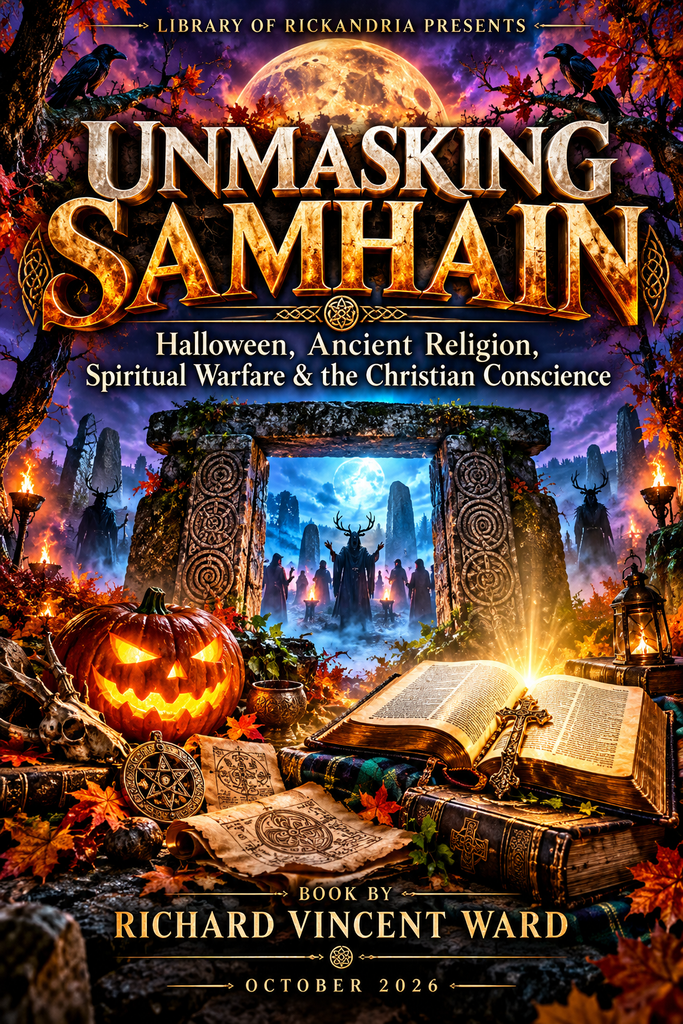
UPDATED BY VCG ON 10/27/2026 @ 14:14 EST
UNMASKING SAMHAIN
Halloween, Ancient Religion, Spiritual Warfare & the Christian Conscience
PART III — THE SYMBOLS UNDER EXAMINATION
CHAPTER 17
HARVEST FESTIVALS, CHURCH ALTERNATIVES & CULTURAL ADAPTATION
Harvest Thanksgiving, Trunk-or-Treat, Light Parties, Missionary Accommodation, Biblical Separation, Christian Liberty & the Allegation of Spiritual Compromise
“One man esteemeth one day above another:
another esteemeth every day alike.
Let every man be fully persuaded in his own mind.”— Romans 14:5, King James Bible
1. The Church Beneath the Autumn Sky
Imagine a church parking lot on the last Saturday of October.
The evening is cool.
Leaves move across the pavement.
Families arrive carrying children, folding chairs, bags of sweets, and dishes prepared for a shared meal.
A few vehicles have been decorated with autumn colors.
One table holds apples and cider.
Another has pumpkins, small prizes, and children’s games.
Inside the building, volunteers prepare a room for younger children.
A pastor speaks briefly with parents near the entrance.
The event has been announced as a Fall Harvest Celebration.
There are no séances.
No invocations of spirits.
No sacrifices to pagan deities.
No attempt to communicate with the dead.
The organizers say their purpose is to provide fellowship, hospitality, and an opportunity to introduce neighboring families to the congregation.
Yet the date is close to Halloween.
Some children are wearing costumes.
Candy is being distributed.
Certain outward features resemble activities taking place in the surrounding community.
A Christian observer may therefore ask whether the event represents faithful outreach or spiritual compromise.
The original 2025 edition of Unmasking Samhain answered that question with considerable certainty.
Chapter 7, entitled Harvest Festivals & the Spirit of Compromise, argued that church-sponsored alternatives merely concealed the spiritual nature of Halloween beneath Christian language.
The manuscript declared:
“The fruit of a thing is determined by its root.”
It claimed that an event could remain spiritually polluted even when its organizers rejected occult imagery.
It described the changed setting as a change of altar rather than a change of religious meaning.
And it suggested that churches holding such events were continuing the festival’s alleged spiritual ritual while convincing themselves that they had escaped it.
This was a sweeping judgment.
It did not distinguish an ordinary autumn thanksgiving service from an explicitly Halloween-themed outreach event.
It did not adequately examine the history of Christian harvest observances.
It did not identify the particular acts constituting idolatry in each kind of gathering.
And it treated disputed historical theories concerning Samhain as sufficient to establish invisible spiritual consequences for modern congregations.
The revised investigation must proceed differently.
Church-sponsored autumn events are not all the same.
Some are simply occasions of harvest thanksgiving.
Some are alternatives to trick-or-treating.
Some are intentional Halloween outreach programs.
Some are connected to the Christian commemoration of All Saints.
Some feature costumes.
Others prohibit costumes.
Some include evangelistic teaching.
Others center upon food distribution or social fellowship.
The moral evaluation cannot responsibly begin by treating all these activities as identical.
The question is not whether church organizers are sincere.
Sincerity matters, but it does not automatically settle every ethical issue.
The question is whether the historical evidence and biblical texts actually support the judgment being made.
Can a cultural practice change its meaning?
Can Christians legitimately adapt a social occasion?
Does a troubling historical association make every later use permanently forbidden?
And how can a church distinguish faithful engagement from genuine religious compromise?
These questions will guide the chapter.
2. Five Different Events That Must Not Be Confused
Before examining the historical record, we must identify the activities under discussion.
A Harvest Thanksgiving Service
A congregation gathers to express gratitude to God for food, agricultural provision, and the work of those who produce and distribute necessities.
The service may include hymns, Scripture readings, prayers, and charitable collections.
Its relationship to Halloween may be nonexistent.
It may occur in September or early October.
A Fall Festival
A church hosts an autumn-themed gathering involving food, games, crafts, or community activities.
The emphasis may be recreation and fellowship rather than a formal worship service.
Some events are deliberately scheduled near Halloween.
Others occur independently of it.
Trunk-or-Treat
Participants decorate vehicles and distribute sweets to children in an organized location, often a church or school parking lot.
The event commonly functions as an alternative to neighborhood trick-or-treating.
Its content varies.
Some examples include costumes and Halloween imagery.
Others use more general seasonal themes.
A Light Party
A church or Christian organization intentionally offers an alternative to Halloween activities, often emphasizing biblical images of light, hope, and the person of Jesus Christ.
Such gatherings may include games, crafts, music, Bible teaching, and hospitality.
An All Saints’ Observance
A Christian congregation commemorates faithful believers within its liturgical tradition.
Such a service belongs to the history of the Christian calendar.
Its theology differs across denominations.
These events are historically and functionally distinct.
Some may overlap.
But one cannot reasonably claim that a September harvest thanksgiving service is necessarily a renamed Samhain rite merely because both occur during autumn.
Nor can a church claim that every activity becomes spiritually appropriate simply because a Christian label has been attached to it.
The actual practice must be examined.
3. Harvest Thanksgiving Was Not Invented as a Halloween Alternative
The modern British church harvest festival possesses a history that can be traced with unusual precision.
A central figure was the Reverend Robert Stephen Hawker.
Hawker served as vicar of Morwenstow, a parish in Cornwall.
In 1843, he organized a special Christian thanksgiving service associated with the completion of the harvest.
The observance helped popularize the modern Anglican harvest festival.
The Historical Setting
Morwenstow was an agricultural and coastal community.
The success or failure of the harvest mattered directly to ordinary households.
Seasonal celebrations were already familiar.
Hawker’s contribution was to establish a distinctive church observance centered upon thanksgiving to God.
The Church of England’s Account
The Church of England explains in its official resource A Time for Creation that Harvest Thanksgiving is a comparatively modern addition to the church calendar.
It traces the familiar form to Hawker’s 1843 adaptation of earlier customs.
It also acknowledges evidence of previous Christian harvest thanksgiving practices.
The official account identifies 1862 as the year when the observance received formal recognition within the Church of England.
This history is important.
The widely recognized Anglican Harvest Thanksgiving tradition developed independently of twentieth-century American Halloween alternatives.
The Date Matters
Hawker’s well-known service took place on the first Sunday of October 1843.
That was not October 31.
The event was not created as a substitute for modern trick-or-treating.
The familiar modern custom had not yet developed.
Nor was its purpose to replace a twentieth-century Halloween carnival.
The event concerned thanksgiving for agricultural provision.
The Necessary Correction
The original manuscript treated harvest festivals largely as sanitized Halloween celebrations.
But the historical record establishes an important distinction.
Christian harvest thanksgiving possesses a documented institutional history of its own.
A harvest thanksgiving service is not automatically a Halloween alternative, and an autumn date is not evidence of pagan worship.
4. Robert Hawker’s Invitation
The history becomes especially clear when we examine Hawker’s own words.
A later biography by Sabine Baring-Gould reproduces Hawker’s invitation to his parishioners.
The text appears in The Vicar of Morwenstow.
The invitation asks the people to remember divine provision and gather for thanksgiving.
Hawker refers to the harvest and to the bread prepared from the new corn.
He connects the occasion with Christian worship and the sacrament.
His stated purpose is explicit.
What the Invitation Establishes
The observance was presented as thanksgiving to God.
It concerned agricultural abundance.
It belonged to a Christian parish setting.
It was connected with worship and community life.
What the Invitation Does Not Establish
It does not describe a hidden Druidic ceremony.
It does not identify Samhain as the recipient of religious devotion.
It does not propose communicating with spirits.
It does not state that the parishioners were reenacting a prehistoric sacrifice.
The historical source supports the stated Christian purpose.
Does Stated Purpose Settle the Theological Question?
Not entirely.
A theological critic may still argue that Hawker’s adaptation of existing harvest customs raises questions concerning the permissible use of inherited cultural forms.
That disagreement is legitimate.
But the argument must identify the actual practice.
It cannot simply replace Hawker’s documented purpose with an alleged occult motive for which there is no supporting evidence.
The source establishes what the organizer said he intended.
Whether the method was biblically appropriate requires further interpretation.
5. Lammas, Harvest Home and the Older Agricultural Calendar
Hawker did not invent the idea of thanking God for agricultural provision.
Nor did Christianity first develop agricultural observances during the nineteenth century.
The history is considerably older.
Lammas
The English term Lammas is historically connected with loaf mass.
The observance falls on or near August 1.
Within medieval Christian practice, bread made from newly harvested grain could be associated with church worship and thanksgiving.
The Church of England’s historical account recognizes Lammas as part of the background to later Harvest Thanksgiving.
Harvest Home
European communities also developed seasonal gatherings following the completion of agricultural work.
Such celebrations might include food, drinking, music, games, and expressions of communal relief.
Their precise customs varied by region.
Some possessed religious associations.
Others were primarily social.
Hawker’s Adaptation
Hawker’s 1843 service can therefore be understood as an intentional Christian adaptation within an existing agricultural culture.
The Church of England describes his choice as a Christian response to the traditional but largely secular harvest-home celebration.
This is documented adaptation.
It should not be denied.
The Important Distinction
Adapting a seasonal occasion is not the same thing as secretly continuing the religious worship of an earlier deity.
The precise relationship depends upon what was retained.
Was the event still directed toward a former god?
Were former rituals continued?
Were the same invocations used?
Was the purpose genuinely altered?
Did the gathering simply retain a common season and social form?
These questions require evidence.
The broad category of cultural adaptation does not answer them automatically.
6. Harvest Thanksgiving in the Bible
The Bible itself contains substantial teaching concerning harvest.
Agricultural imagery appears in law, poetry, prophecy, parables, and apostolic instruction.
The relevance of this material must be acknowledged.
Exodus 23:16
The KJV states:
“And the feast of harvest, the firstfruits of thy labours, which thou hast sown in the field: and the feast of ingathering, which is in the end of the year, when thou hast gathered in thy labours out of the field.”
The verse belongs to instructions concerning Israel’s appointed festivals.
It explicitly recognizes harvest and ingathering as occasions of religious significance.
Exodus 34:22
The text similarly identifies the feast of weeks and the feast of ingathering.
These instructions belong to Israel’s covenantal calendar.
They should not be treated as direct commands requiring Christians to organize an October fall carnival.
But they establish that agricultural thanksgiving was not inherently alien to biblical religion.
Deuteronomy 16
The chapter addresses appointed feasts and the relationship between worship, rejoicing, and divine provision.
The Feast of Tabernacles is associated with agricultural gathering and communal rejoicing.
Again, the historical setting is ancient Israel.
The text is not a direct description of modern church harvest festivals.
Psalm 65
The psalm celebrates divine provision through rain, fertile ground, and abundant produce.
Its imagery connects agricultural blessing with thanksgiving.
Acts 14:17
Paul and Barnabas address a pagan audience in Lystra.
They appeal to God’s provision through rain and fruitful seasons.
The argument presents agricultural blessing as evidence of divine goodness.
The Biblical Conclusion
Scripture contains legitimate religious reflection upon harvest and provision.
That fact does not establish that every modern harvest observance is required.
It does establish that thanking God for food and agricultural abundance is not, by itself, a uniquely pagan concept.
A harvest celebration cannot be condemned merely because harvest festivals have also existed in non-Christian religions.
The content and object of worship must be examined.
7. A Biblical Harvest Feast Is Not Automatically a Modern Church Festival
We must also avoid an argument in the opposite direction.
The presence of harvest observances in the Old Testament does not automatically authorize every modern event carrying the word harvest.
The ancient Israelite festivals belonged to particular covenantal instructions.
Christian traditions differ in their understanding of how those instructions relate to the church.
Some emphasize fulfillment in Christ.
Some emphasize enduring moral principles while distinguishing ceremonial regulations.
Others preserve additional liturgical continuity.
Consequently, a modern church festival requires theological consideration on its own terms.
Thanksgiving Is One Question
May Christians thank God for agricultural provision?
The general biblical basis is substantial.
A Formal Annual Festival Is Another
Must churches establish a yearly festival?
The New Testament does not prescribe a universal modern Harvest Thanksgiving date.
The Use of Entertainment Is Another
May a church incorporate games, costumes, prizes, or seasonal decorations?
This requires further ethical consideration.
Deliberate Adaptation Is Another
May a church schedule an event near Halloween in order to reach families already gathering during that season?
That raises a question concerning engagement and cultural accommodation.
The original manuscript collapsed these separate questions into a single verdict.
The revised edition must examine them individually.
8. Gregory the Great: A Documented Case of Christian Adaptation
Chapter 9 examined a decisive historical source.
In AD 601, Pope Gregory I sent instructions concerning the Christian mission to the Anglo-Saxons.
The letter was addressed to Mellitus.
Its contents survive through the historical tradition associated with Bede.
The Fordham University Internet Medieval Sourcebook preserves the text in English translation.
Gregory’s Instructions
Gregory advised that certain existing pagan temples should not necessarily be destroyed.
Instead, their idols should be removed.
Christian altars and relics could be installed.
The buildings could then be used for Christian worship.
He also addressed communal feasting associated with earlier animal sacrifices.
His proposal permitted elements of festive gathering to remain while redirecting the practice toward the worship of God.
An Authentic Example of Accommodation
This was intentional adaptation.
The historical evidence is explicit.
It would be dishonest to claim that Christian leaders never repurposed earlier religious buildings or customs.
The Critical Question
Was Gregory’s policy theologically correct?
Christians may disagree.
Some regard it as a practical method of removing idolatry while preserving harmless forms.
Others object that retaining former religious structures and customs risks confusion or compromise.
Those positions deserve careful consideration.
What the Letter Does Not Establish
It does not mention Samhain.
It does not prescribe modern Halloween alternatives.
It does not establish an invisible rule by which every adapted custom permanently retains its former religious meaning.
Nor does it prove that all forms of adaptation are acceptable.
It documents one historical strategy.
Its theological evaluation remains a separate question.
9. Three Models of Christian Cultural Engagement
The historical record and biblical evidence suggest several possible approaches to inherited cultural practices.
These approaches are not identical.
Rejection
A Christian community may conclude that a particular practice is inseparable from forbidden religious worship.
It may choose not to participate.
The biblical prohibition of idolatry provides a serious basis for such decisions where actual idolatrous practice is involved.
Adaptation
A community may retain a social form while changing its purpose, content, or religious setting.
A former communal feast may become a Christian gathering.
A familiar seasonal activity may be used for charitable purposes.
The historical legitimacy and theological appropriateness of the adaptation must be examined.
Independent Observance
A community may create an event whose timing is influenced by the calendar but whose activities are not intended as a continuation of the surrounding festival.
A harvest thanksgiving service may belong primarily to agricultural gratitude.
An All Saints’ service may belong to a Christian liturgical tradition.
A prayer meeting may simply occur on the same evening.
The Central Point
The word alternative does not determine the moral character of an activity.
Neither does the word Christian.
A genuine religious invocation does not cease to be an invocation merely because it is advertised as family-friendly.
Conversely, a gathering does not automatically become an occult ritual merely because it occurs on October 31.
The practice itself must be identified.
10. Trunk-or-Treat: A Modern American Development
The organized trunk-or-treat event is far more recent than many people assume.
Its history belongs primarily to late twentieth-century North American community life.
The Newspaper Evidence
An examination of historical newspaper references published by political scientist Paul Musgrave identifies reports from the late 1980s and early 1990s.
A November 1, 1989, report in the Chico Enterprise-Record described a trunk-or-treat gathering involving congregations of the Church of Jesus Christ of Latter-day Saints.
The report described it as the second year of that local event.
Other newspaper references appeared in 1990 and the following years.
See Paul Musgrave, The Politics of Trunk or Treat.
These reports do not establish the exact first invention of trunk-or-treating.
They do establish that the form was circulating by the late 1980s.
Other Documented Examples
A 1994 report in The Birmingham News described an event at Hilldale Baptist Church in Center Point, Alabama.
National Public Radio summarized this history in What to Know About Trunk-or-Treating, a Trick-or-Treating Alternative.
The event offered games and organized activities for children.
The Historical Purpose
Churches commonly presented trunk-or-treat as a more controlled alternative to traditional neighborhood visiting.
Some emphasized concern about safety.
Others wanted to create a community event.
Others hoped to develop relationships with families.
The Critical Distinction
These purposes are documented within the modern institutional history.
They do not establish that every trunk-or-treat is biblically appropriate.
But neither do they establish an ancient sacrificial origin.
A parking-lot event organized in the late twentieth century must be evaluated through the activities that actually occur.
11. Safety Claims Should Be Accurate
Trunk-or-treat is often described as safer than neighborhood trick-or-treating.
That assertion requires qualification.
An organized location may make supervision easier.
It may reduce the distance children walk.
It may permit designated parking arrangements.
It may facilitate access for families with younger children.
But safety depends upon the event’s design.
Potential Hazards
Vehicles may create risks if they move through pedestrian areas.
Food allergies still matter.
Children require appropriate supervision.
Crowded events may need clear entrances and exits.
Activities may require age-appropriate planning.
Avoiding Exaggeration
The historical fear of widespread poisoned Halloween candy has often exceeded the corroborated evidence.
Therefore, a church should not claim that ordinary neighborhoods are universally dangerous merely to justify its own event.
The event may possess legitimate benefits without such exaggeration.
The Correct Standard
A church should describe the actual safety advantages it can provide.
It should identify foreseeable risks.
It should avoid promising absolute safety.
And it should not present a preference for an organized setting as proof of a hidden spiritual danger in every other setting.
12. Light Parties: An Intentional Christian Alternative
Another important contemporary development is the Light Party.
These events are especially visible within churches in the United Kingdom.
They often emphasize Jesus as the light of the world.
Activities may include crafts, games, music, Bible stories, and hospitality.
The stated purpose is generally explicit.
The organizers wish to offer an alternative to frightening Halloween imagery and create an opportunity for Christian teaching.
Scripture Union
Scripture Union’s Halloween resources describe Light Parties as occasions for engaging children and families through Bible-based activities.
The organization offers materials for different age groups.
Its resources include teaching related to the Gospel of John and the theme of light.
The Diocese of Ely
The Diocese of Ely’s Light Party resource page identifies numerous activities intended for Christian ministry with children.
The page also advises organizers to select resources appropriate to their own theological tradition and local context.
That qualification is significant.
The Church of England does not present every possible activity as suitable for every congregation.
The Theological Question
The use of a biblical theme does not automatically settle the morality of every activity.
A church should still examine its games, costumes, teaching, and treatment of children.
But it would be historically inaccurate to describe a Scripture Union Light Party as an undisclosed Druidic invocation when its published purpose is Bible teaching and community engagement.
A theological critic may oppose the strategy.
That opposition should address the actual strategy.
13. A Church Door Opened on Halloween
A particularly instructive modern example appeared in the Diocese of Guildford.
In October 2024, the diocese described a church that welcomed families during Halloween with hot chocolate, small gifts, crafts, and biblical material.
The organizers illuminated the church building and displayed pumpkins carved with crosses and hearts rather than frightening faces.
The event was presented as an opportunity to welcome local people and speak about Christian hope.
See Light in the Darkness—An Alternative to Halloween, Diocese of Guildford.
What the Source Establishes
The church deliberately engaged with people already participating in the surrounding seasonal activity.
It used hospitality.
It employed the biblical theme of light.
It adapted familiar visual forms.
What the Source Does Not Establish
It does not independently prove that everyone who attended experienced spiritual benefit.
It does not establish that the strategy was unquestionably correct.
Nor does it demonstrate that every comparable event is effective.
Those conclusions require further evidence and theological judgment.
The Original Manuscript’s Claim
The 2025 edition treated such adaptation as evidence of compromise regardless of the specific content.
But the Guildford example supplies a documented contemporary case with an identifiable purpose.
A serious critique must explain precisely why the actual activities are considered wrong.
The date and outward resemblance alone do not settle the matter.
14. The Methodist “Halloween Pitstop”
A second example comes from Southampton.
In September 2025, the Methodist Church published an account of an event held the preceding October by St James Road Methodist Church.
The congregation organized a Halloween Pitstop.
According to the church’s report, volunteers distributed hot dogs, hot chocolate, and small gifts.
The gathering included a Bible treasure hunt, Christian crafts, and a message from the minister.
The church reported distributing approximately 750 hot dogs during the event.
See Halloween for Mission, Methodist Church.
The Organizers’ Explanation
The published account presented the gathering not as participation in occult worship but as an opportunity to offer hospitality and connect with neighbors.
Some organizers acknowledged concerns about holding an event associated with Halloween.
They nevertheless regarded the occasion as an opportunity for Christian outreach.
Evidence and Interpretation
The article documents the organizers’ reported purpose and activities.
Its attendance and distribution figures are institutional self-reports.
They are not independently verified measurements of long-term spiritual outcomes.
That distinction should be maintained.
The Ethical Question
Was this legitimate Christian mission?
Some believers would say yes.
Others would object to the use of Halloween as the occasion.
Both positions should be evaluated through Scripture.
But the historical record does not justify replacing the stated activities with an allegation of secret sacrifice.
No such act is documented by the source.
15. The Difference Between Outreach and Worship
One important issue is often lost in the debate.
A church can engage with a cultural occasion without adopting that occasion as a religious ceremony.
This distinction requires care.
Worship
A religious ceremony involves deliberate devotion, prayer, proclamation, or other acts directed toward an object of worship.
The church must examine whether such practices are consistent with its theological commitments.
Outreach
An outreach event may involve hospitality, conversation, instruction, or assistance to people outside the congregation.
It may occur in a public setting.
It may be scheduled because families are already gathering nearby.
Fellowship
A congregation may gather for ordinary social interaction.
Food, games, and conversation do not automatically become formal worship merely because they occur on church property.
Cultural Participation
A church may incorporate familiar social forms into its activities.
That decision raises legitimate questions concerning appropriateness.
But the form and the content must be distinguished.
The Crucial Question
Is the congregation participating in an actual religious rite directed toward another deity?
Or is it conducting a different activity within the same season?
Those are not identical situations.
A theological argument must identify which one is occurring.
16. Deuteronomy 12: The Strongest Biblical Objection to Religious Borrowing
Christians who oppose cultural adaptation often appeal to Deuteronomy 12.
The passage deserves careful consideration.
Verses 30–31 warn Israel against imitating the religious practices of the surrounding nations.
The KJV states:
“Take heed to thyself that thou be not snared by following them, after that they be destroyed from before thee; and that thou inquire not after their gods, saying, How did these nations serve their gods? even so will I do likewise.”— Deuteronomy 12:30
The following verse rejects using the abominable practices of those nations in worship of the LORD.
The Immediate Concern
The passage prohibits adopting the worship of other gods.
It specifically identifies practices the biblical text regards as abhorrent, including the sacrifice of children.
The religious context is unmistakable.
The Serious Principle
A Christian critique of deliberately incorporating idolatrous ceremonies into worship may reasonably draw upon this passage.
The concern is not imaginary.
Scripture repeatedly distinguishes the worship of the LORD from worship directed toward other gods.
The Necessary Historical Question
Has the particular church event actually incorporated an idolatrous rite?
Or has it merely retained an ordinary cultural form, such as a shared meal, a seasonal date, or a children’s game?
The answer cannot be supplied by assuming that everything occurring near Halloween constitutes one unchanged religious ceremony.
The actual practice must be established.
Theological Disagreement
Some Christian traditions adopt especially strict principles governing corporate worship.
Others distinguish prohibited religious rites from cultural forms that may be used for legitimate purposes.
This disagreement deserves fair treatment.
But neither position is strengthened by inventing the history of the particular event.
17. First Corinthians 10: Paul Distinguishes Religious Fellowship from Ordinary Activity
The strongest New Testament comparison appears in First Corinthians 10.
Paul commands believers to flee idolatry.
He condemns participation in sacrificial fellowship associated with other gods.
Yet the same chapter addresses ordinary eating within markets and private homes.
The Direct Prohibition
First Corinthians 10:14 reads:
“Wherefore, my dearly beloved, flee from idolatry.”
The passage does not trivialize actual religious compromise.
The Distinction Concerning Food
Verse 25 states:
“Whatsoever is sold in the shambles, that eat, asking no question for conscience sake:”
Paul then discusses food served in the home of an unbeliever.
He does not treat every possible historical religious association as requiring automatic abstention.
The Question of Known Sacrificial Meaning
If someone explicitly identifies food as offered in sacrifice, Paul instructs the believer to consider the conscience involved and refrain.
The social and religious meaning of the act matters.
The Principle for Church Alternatives
A Christian congregation should avoid actual participation in idolatrous fellowship.
But the presence of familiar food, games, decorations, or a shared date does not independently establish that fellowship.
The circumstances must be examined.
A Necessary Qualification
Paul’s teaching does not mean that intention alone makes every religious practice acceptable.
A person may be mistaken about the meaning of an act.
The act itself may carry an identifiable religious function.
Conscience and the effect upon others also matter.
Nevertheless, the passage requires distinctions rather than one universal rule based solely upon ancestry.
18. Romans 11:16 — The “Root” Argument Misapplied
The 2025 edition presented Romans 11:16 as support for the proposition that a festival is permanently determined by its origin.
The verse reads:
“For if the firstfruit be holy, the lump is also holy:
and if the root be holy, so are the branches.”
The original manuscript then argued that because Halloween supposedly possessed a demonic root, every adapted celebration must remain polluted.
This interpretation requires correction.
The Context of Romans 11
Paul is discussing Israel, the Gentiles, divine promises, unbelief, faith, and the relationship between natural and grafted branches.
The olive-tree imagery belongs to a theological argument about God’s purposes for Israel and the inclusion of Gentiles.
What the Root Represents
The interpretation of the root has been discussed by commentators.
Many understand it in relation to Israel’s patriarchal origins or God’s covenantal promises.
Others emphasize related aspects of Israel’s sanctification or historical calling.
But the passage is not a general theory concerning the permanent moral character of holidays.
The Original Application
The 2025 manuscript moved from Paul’s olive-tree metaphor to the proposition that a cultural festival remains permanently spiritually contaminated by its earliest proposed historical association.
That conclusion does not follow directly from the text.
Paul is not discussing Halloween.
He is not describing the development of customs across centuries.
He is not teaching that every object retains the religious meaning of its oldest known use.
The Corrected Finding
The original citation constitutes a misapplication of Romans 11:16 when presented as direct proof of an immutable pagan origin.
A theological argument against adopting idolatrous ceremonies must be made through passages actually addressing that question.
Deuteronomy 12 and First Corinthians 10 are more directly relevant.
The use of Romans 11 should be corrected.
19. Galatians 5:9 — “A Little Leaven”
Chapter 7 of the original manuscript opened with:
“A little leaven leaveneth the whole lump.”— Galatians 5:9
The verse was used to suggest that retaining small elements associated with Halloween contaminates an entire Christian gathering.
But the immediate context must be examined.
The Galatian Controversy
Paul is addressing teachings that threatened the churches’ understanding of the gospel.
The surrounding verses concern circumcision, justification, faith, and pressure from those advocating a particular religious obligation.
The Function of the Metaphor
The saying about leaven illustrates how an influence can spread.
Within the passage, it serves Paul’s warning concerning the teaching confronting the Galatians.
What It Does Not Establish
The verse does not identify an autumn festival.
It does not define every cultural similarity as spiritual contamination.
It does not establish that the date October 31 transfers an invisible covenant into every gathering held on that night.
A Possible Broader Application
A Christian may reasonably use the image to discuss the spread of genuinely harmful teaching or behavior.
But the harmful element must first be identified.
The mere presence of candy or a seasonal date does not establish that the element is evil.
Otherwise, the argument assumes what it must prove.
A warning that harmful influence can spread does not establish that every disputed cultural form is harmful.
20. Galatians 6:7 — “God Is Not Mocked”
The original chapter also declared that God is not mocked.
Galatians 6:7 reads:
“Be not deceived; God is not mocked:
for whatsoever a man soweth, that shall he also reap.”
The passage concerns moral responsibility and the consequences of conduct.
The following verse contrasts sowing to the flesh with sowing to the Spirit.
Verse 9 encourages perseverance in doing good.
The Agricultural Metaphor
Paul employs the imagery of sowing and reaping.
The metaphor is appropriate to moral formation and spiritual responsibility.
It does not, however, establish that every modern harvest gathering inherits the religious character of an ancient festival.
The Correct Question
What is the congregation sowing?
Is it teaching truthfully?
Is it practicing hospitality?
Is it encouraging moral conduct?
Is it deliberately participating in forbidden worship?
Is it pressuring people against conscience?
These questions concern the actual conduct.
They cannot be answered solely by identifying a calendar date.
The Biblical Point
The passage demands responsibility.
It does not authorize an author to assign hidden motives or mechanisms without evidence.
21. Second Corinthians 6: Separation and Religious Fellowship
Second Corinthians 6:14–18 provides an important biblical basis for Christian teaching concerning separation from idolatry.
Verse 14 begins:
“Be ye not unequally yoked together with unbelievers:
for what fellowship hath righteousness with unrighteousness? and what communion hath light with darkness?”
The passage continues with contrasts involving Christ, Belial, the temple of God, and idols.
Its religious seriousness should not be minimized.
The Context of Religious Compromise
Paul is concerned with relationships and forms of fellowship incompatible with devotion to God.
The comparison with idols is explicit.
The Question of Ordinary Social Contact
The passage must also be compared with Paul’s wider teaching.
In First Corinthians 5:9–10, Paul explains that believers cannot avoid all association with immoral people outside the church without leaving the world itself.
In First Corinthians 10, he discusses attending a meal offered by an unbeliever.
Thus, separation from idolatry does not necessarily require complete withdrawal from every ordinary social encounter with non-Christians.
The Application to Church Alternatives
If an event includes actual worship of another deity, the biblical concern is direct.
If a church offers hot chocolate to neighbors on October 31, the existence of ordinary social contact is not itself identical to idolatrous fellowship.
The question is what the church is participating in.
The Theological Difference
Christians may differ over how far to extend principles of separation into cultural practices.
But the application must be argued.
The original manuscript treated proximity to Halloween as conclusive.
The biblical passage requires a more precise identification of fellowship and worship.
22. First Corinthians 9: Mission and Adaptation
Christians who favor cultural engagement frequently appeal to Paul’s missionary flexibility.
First Corinthians 9:22 states:
“To the weak became I as weak, that I might gain the weak:
I am made all things to all men, that I might by all means save some.”
The passage belongs to Paul’s explanation of his missionary conduct.
He voluntarily limits his freedoms in order to serve others.
The Significance for Outreach
Paul’s example supports the importance of understanding one’s audience.
He adjusts his approach within different communities.
He seeks to remove unnecessary barriers.
He does not demand that every cultural practice be identical among the people he addresses.
The Necessary Limit
Paul also states that he remains under obligation to Christ.
His flexibility is not unlimited.
The passage does not justify idolatry or deliberate wrongdoing for evangelistic purposes.
The Church-Event Question
A congregation may seek to welcome families who are already gathering during Halloween.
That may be a legitimate missionary consideration.
But it does not automatically settle the appropriateness of every activity.
The event must still be examined according to Christian ethical commitments.
The Balanced Conclusion
First Corinthians 9 supports consideration of missionary adaptation.
First Corinthians 10 establishes limits concerning actual idolatrous fellowship.
Neither passage should be isolated from the other.
A responsible theology of cultural engagement must account for both.
23. Acts 17: Engagement Without Identical Worship
Paul’s visit to Athens provides another important example.
Acts 17 describes the apostle encountering a city filled with objects of worship.
He speaks in the synagogue and marketplace.
He addresses philosophers.
He observes an altar inscribed to an unknown god and uses that observation within his proclamation.
The Historical Setting
Paul does not endorse all the city’s religious practices.
He challenges its assumptions.
But he demonstrates awareness of the surrounding culture.
He refers to the audience’s religious language.
He reasons from material familiar to them.
The Relevant Principle
Cultural engagement can involve understanding and discussing existing practices without participating in their worship.
The Limitation
Acts 17 does not authorize every form of religious adaptation.
It does not describe a Halloween festival.
Nor does it settle the legitimacy of using particular symbols.
The Corrected Application
A Christian ministry may seek to communicate through familiar cultural forms.
But it must distinguish communication from religious participation.
The content of the message and the nature of the activity matter.
A church event should not be declared legitimate merely because it is evangelistic.
Neither should it be declared idolatrous merely because it occurs within the cultural environment the church seeks to reach.
24. Acts 19: The Case Against Genuine Occult Participation
The opposite side of the argument also requires attention.
Acts 19 describes people in Ephesus who had practiced curious arts and subsequently abandoned them.
Verse 19 records the public disposal of books associated with those practices.
This is an important example of rejecting conduct regarded as incompatible with the gospel.
The Direct Historical and Theological Point
The narrative concerns people who actually practiced activities described as curious arts.
They were not merely watching a theatrical portrayal.
They were abandoning practices in which they had participated.
The Relevance to Halloween
A Christian who has engaged in intentional occult invocation may regard the passage as relevant to repentance and the rejection of such activity.
But the verse does not establish that every seasonal game, costume, or candy exchange constitutes the same conduct.
The activity must be identified.
The Necessary Balance
Acts 17 demonstrates cultural engagement.
Acts 19 describes the rejection of particular practices.
The two passages should be read together.
The Christian response may require engagement in one circumstance and abstention in another.
There is no biblical warrant for collapsing every circumstance into one category without investigation.
25. Romans 14: The Conscience Question
Romans 14 is central to disputes concerning days and food.
Paul addresses disagreements among believers.
Some regard particular days differently.
Some eat foods that others avoid.
The passage warns against contempt and destructive judgment.
Romans 14:5
The KJV states:
“One man esteemeth one day above another:
another esteemeth every day alike. Let every man be fully persuaded in his own mind.” Romans 14:6
Paul adds:
“He that regardeth the day, regardeth it unto the Lord; and he that regardeth not the day, to the Lord he doth not regard it.”
The passage recognizes conscientious differences concerning particular observances.
The Important Limitation
Romans 14 does not authorize idolatry.
It cannot be used to excuse deliberately participating in worship that Scripture forbids.
The Important Protection
But where the matter belongs to disputable conduct, believers should not treat every difference of conscience as rebellion against God.
Applying the Principle
One Christian may abstain from all Halloween-related gatherings.
Another may attend an autumn thanksgiving service.
Another may host a Light Party.
Another may offer ordinary hospitality to visiting families.
The ethical evaluation depends upon what actually occurs and how relevant biblical teaching applies.
A church should neither pressure objecting families to participate nor automatically accuse participating families of demonic fellowship without evidence.
The Responsibility of Love
Romans 14 also warns against placing stumbling blocks before others.
The freedom of one believer should not become a means of humiliating another.
The disagreement should be approached through patience, truthful teaching, and regard for conscience.
26. First John 2:15 — What Does It Mean to Love the World?
The original manuscript used First John 2:15 to oppose Christian alternatives.
The KJV reads:
“Love not the world, neither the things that are in the world.
If any man love the world, the love of the Father is not in him.”
The verse belongs to a passage warning against disordered desires and attachment to what is passing away.
The Meaning of “World”
The word world can carry different meanings in the New Testament.
Sometimes it refers to the created order.
Sometimes to humanity.
Sometimes to a system of desires or values opposed to God.
The immediate context of First John 2 identifies the lust of the flesh, the lust of the eyes, and the pride of life.
The Interpretive Problem
The original manuscript treated engagement with a popular cultural occasion as equivalent to loving the world.
But the passage does not establish that every use of an ordinary social practice constitutes worldly allegiance.
The Necessary Contrast
A Christian can reject disordered desire while continuing to live among neighbors.
The Gospel of John also records Jesus praying concerning his disciples’ presence in the world.
John 17:15 states:
“I pray not that thou shouldest take them out of the world, but that thou shouldest keep them from the evil.”
The two passages should be considered together.
Christian separation from evil is not automatically identical to withdrawal from every shared social setting.
The Corrected Conclusion
The relevant concern is allegiance, conduct, and moral orientation.
A church event may become worldly if it prioritizes popularity, financial gain, or conduct contrary to its convictions.
But that judgment must be established through the actual event.
It does not follow automatically from scheduling or cultural resemblance.
27. The Question of “Spiritual Legal Access”
The original 2025 edition repeatedly described Halloween as creating spiritual access through participation, invitation, and ritual alignment.
Its wider argument included the assertion that ordinary participants could enter dangerous spiritual relationships even without recognizing what they had done.
This theory was then extended to church alternatives.
The Historical Problem
The argument assumes that the modern event continues the same ancient ritual.
But Chapters 5–16 have demonstrated that the proposed historical continuity is often incomplete or unsupported.
The modern customs developed through multiple cultural processes.
The Theological Problem
The Bible contains warnings concerning idolatry and spiritual deception.
But the original manuscript did not adequately establish a general rule that every adapted cultural event creates an invisible legal right for demons to enter.
The Need for Definition
What constitutes the alleged legal access?
Which biblical passage defines it?
What action creates it?
Does intention matter?
Does the ceremony matter?
Does an ordinary shared date suffice?
How is the claim known?
These questions cannot be avoided.
A Genuine Biblical Concern Is Not the Same as an Invented Mechanism
A church that knowingly incorporates actual idol worship would raise a serious biblical issue.
A church that merely distributes food during a community event has not thereby been shown to perform the same act.
The moral and religious categories differ.
The Correct Finding
The existence of spiritual warfare within Christian theology does not establish every proposed mechanism of spiritual access.
The original manuscript’s automatic-access theory remains unestablished by the passages cited.
It should not be presented as verified doctrine.
28. A Christian Event Can Still Be Poorly Designed
Correcting the original manuscript does not require defending every church alternative.
Some events may possess legitimate problems.
Confusing Messages
A congregation may claim to reject Halloween’s occult imagery while incorporating religious symbols it regards as inappropriate.
This may create confusion.
Consumerism
An event may become primarily concerned with entertainment, prizes, publicity, or competition.
Such priorities can conflict with the organizers’ stated theological purpose.
Pressure Upon Conscience
A pastor may treat participation as mandatory.
Families who abstain may feel judged or excluded.
This raises an ethical problem.
Inadequate Child Protection
An event may fail to provide appropriate supervision, safeguarding procedures, or clear boundaries.
The concern is practical and serious.
Poor Teaching
A church may make inaccurate historical claims concerning Halloween.
It may frighten children with unsupported stories.
It may use evangelism in ways that shame or manipulate.
Misrepresentation of Others
A church may describe Wiccans, Pagans, or secular neighbors through false stereotypes.
Such statements do not become truthful merely because the event is Christian.
The Relevant Principle
A church alternative should be examined according to its actual content and conduct.
An event is not made holy simply by changing its name.
But neither is it proven unholy merely because its date is close to Halloween.
29. Four Practical Cases
Consider four hypothetical congregations.
Case One: The September Harvest Thanksgiving
A rural congregation holds a service in September.
The members give thanks for agricultural provision.
They collect food for struggling households.
There are no Halloween costumes or supernatural themes.
The event has a clear connection to the modern Christian harvest thanksgiving tradition.
Historical finding: The event resembles a documented church observance associated with agricultural gratitude.
Biblical question: Whether the congregation’s form of thanksgiving and worship is consistent with its theological commitments.
Unsupported allegation: That the occasion is necessarily Samhain worship because it occurs during autumn.
Case Two: A Fall Carnival on October 31
A church organizes games and food distribution on October 31.
No religious invocation occurs.
Some children wear fictional costumes.
Historical finding: The event is a modern cultural adaptation.
Biblical question: Whether the activities, content, and use of the occasion are appropriate for Christian fellowship or outreach.
Unsupported allegation: That the calendar date alone creates a demonic covenant.
Case Three: A Religious Invocation Disguised as Outreach
An organization advertises a family event but conducts an actual ceremony invoking a deity or spirit outside the Christian faith.
Historical finding: The advertised description does not accurately represent the activity.
Biblical question: Whether the ceremony constitutes forbidden religious participation.
Relevant warning: Deuteronomy 12 and First Corinthians 10 directly address idolatrous worship.
The Christian label does not make the ceremony acceptable.
Case Four: A Light Party
A congregation welcomes neighborhood families with food and games.
It offers voluntary Bible teaching about Jesus as the light of the world.
The program does not include occult invocation.
Historical finding: The gathering belongs to the documented modern Light Party movement.
Biblical question: Whether the method of outreach, activities, and presentation are appropriate.
Unsupported allegation: That the event automatically possesses the religious purpose of an ancient Samhain ceremony.
These examples demonstrate why one universal verdict is inadequate.
The moral issue must be identified in each case.
30. The Responsibility of Pastors and Church Leaders
Church leaders carry particular responsibilities when organizing events involving children and families.
The issue extends beyond ancient origins.
Truthful Teaching
Historical claims should be sourced.
Biblical passages should be interpreted in context.
Speculative supernatural mechanisms should not be presented as established facts.
Appropriate Safeguarding
Activities should provide responsible supervision.
Volunteers should understand their duties.
The event should have appropriate procedures for accidents or emergencies.
Food safety and allergies should be considered.
Respect for Conscience
Families should be free to decline participation without ridicule.
Participation should not become a test of spiritual maturity.
Clear Religious Identity
If the event includes Christian teaching, its nature should be communicated honestly.
Visitors should not be misled about what is being offered.
Hospitality Without Manipulation
A gift should be a gift.
Food and welcome should not be conditioned upon accepting religious instruction.
Voluntary conversation differs from coercion.
Respect for Neighbors
The church may disagree with the religious beliefs of others.
But it should avoid false allegations and hostility.
Christian witness is not strengthened by misrepresentation.
These responsibilities are practical expressions of truthful and conscientious ministry.
31. The Strongest Case for Abstention
A fair investigation should present the strongest responsible argument for abstaining from church-sponsored Halloween alternatives.
That argument need not rely upon invented demons inside candy or an immutable supernatural meaning attached to October 31.
It may proceed as follows.
Halloween contains genuine historical associations with supernatural beliefs and practices.
Some contemporary people observe Samhain religiously.
Certain modern entertainment themes involve imagery that particular Christians regard as unsuitable.
A church’s participation may blur distinctions important to its theological identity.
An event may cause confusion among members or outsiders.
A congregation may therefore conclude that abstention best preserves its understanding of holiness and worship.
This is a recognizable Christian position.
Its strength depends upon biblical interpretation, the actual circumstances, and the congregation’s theological commitments.
It does not require falsely claiming that every church event constitutes ritual sacrifice.
The Limits of Abstention Arguments
A conscientious decision to abstain does not automatically establish that all other Christians are knowingly worshipping demons.
Nor does it authorize accusations concerning hidden spiritual consequences without evidence.
The decision may be principled without becoming a universal historical claim.
32. The Strongest Case for Selective Engagement
The opposing position also deserves fair representation.
A Christian congregation may argue that ordinary social forms can be distinguished from forbidden religious worship.
The community already gathers during the autumn season.
The church can offer hospitality.
It can provide activities consistent with its moral commitments.
It can avoid content it considers objectionable.
It can speak openly about its faith.
It can respect families who choose not to participate.
This position may appeal to First Corinthians 9, Acts 17, Romans 14, and Paul’s distinctions concerning food and religious fellowship.
The Limits of Engagement Arguments
A church cannot justify actual idolatry merely by calling it outreach.
Nor does the goal of attracting visitors excuse manipulative teaching or unsafe practices.
Cultural adaptation remains subject to moral evaluation.
The Shared Responsibility
Both positions should examine the same evidence.
Both should interpret Scripture carefully.
Both should avoid caricaturing the other.
And both should recognize that the Bible’s explicit prohibitions are more important than any modern organization’s branding.
33. Re-examining the Original 2025 Chapter
We now return directly to Harvest Festivals & the Spirit of Compromise.
The original chapter made several interconnected claims.
It stated that churches retaining the date, costumes, candy, or celebration were preserving Halloween’s spiritual character.
It described the entire practice as contaminated by origin.
It used Romans 11:16 to support that conclusion.
It invoked Galatians 5:9 as proof that a small retained element corrupted the whole event.
It cited biblical holiness and separation texts.
And it characterized outreach-based alternatives as camouflage for the continuation of the ritual.
What the Original Chapter Correctly Recognized
Christian communities should examine the practices they adopt.
Religious compromise is a legitimate biblical concern.
The use of Christian language does not automatically make an activity morally appropriate.
Some church events may genuinely confuse worship and entertainment.
The desire for popularity can undermine integrity.
A church should not participate in actual idol worship.
These concerns deserve retention.
Where the Historical Argument Failed
The chapter treated every harvest event as a form of Halloween adaptation.
That does not reflect the separate history of Christian harvest thanksgiving.
It treated the origins of Halloween as settled beyond dispute.
Previous chapters have demonstrated that several central historical claims require qualification.
It assumed that the survival of cultural forms established the survival of one supernatural ritual.
The sources do not demonstrate that universal conclusion.
Where the Biblical Argument Failed
Romans 11 concerns Israel and Gentile inclusion, not the permanent spiritual essence of holidays.
Galatians 5:9 belongs to Paul’s warning concerning false teaching.
The broader separation passages concern actual religious compromise.
They do not directly establish that every fall carnival is an occult ceremony.
The Proper Correction
The revised edition must maintain serious biblical warnings without using misapplied verses to supply missing historical evidence.
A Christian event should be evaluated according to what actually occurs.
The label does not settle the question.
The date does not settle the question.
The presence of cultural resemblance does not settle the question.
And a claim of invisible spiritual access requires evidence beyond assertion.
34. Claim-by-Claim Editorial Findings
Claim 17.1 — Churches Organize Harvest Festivals and Fall Carnivals
Finding: Verified.
Such events are documented within contemporary Christian practice.
Claim 17.2 — All Harvest Festivals Were Created as Halloween Alternatives
Finding: Contradicted.
The modern Anglican harvest thanksgiving tradition developed through a separate nineteenth-century history.
Claim 17.3 — Robert Stephen Hawker Popularized a Harvest Thanksgiving Service in 1843
Finding: Verified.
The Church of England and Hawker’s later biography preserve the relevant history.
Claim 17.4 — Hawker’s Service Occurred on October 31
Finding: Incorrect.
The documented service took place on the first Sunday of October 1843.
Claim 17.5 — Christian Agricultural Thanksgiving Has Earlier Historical and Biblical Antecedents
Finding: Supported.
Lammas, biblical harvest observances, and other traditions predate the modern Anglican form.
Claim 17.6 — Christianity Historically Adapted Some Earlier Cultural Practices
Finding: Verified.
Gregory the Great’s AD 601 instructions provide an explicit example.
Claim 17.7 — Every Act of Cultural Adaptation Is Therefore Biblically Approved
Finding: Unsupported.
Each practice requires theological evaluation.
Claim 17.8 — Every Act of Cultural Adaptation Is Therefore Idolatry
Finding: Unsupported as a universal proposition.
The actual conduct and religious purpose must be identified.
Claim 17.9 — Trunk-or-Treat Developed as a Modern Community Alternative
Finding: Supported.
Late twentieth-century newspaper evidence documents its development.
Claim 17.10 — Trunk-or-Treat Is an Unchanged Prehistoric Druidic Ceremony
Finding: Unsupported.
Its directly documented institutional history is modern.
Claim 17.11 — Churches Organize Light Parties with Explicit Christian Teaching
Finding: Verified.
Scripture Union and several Anglican dioceses publish relevant resources.
Claim 17.12 — Every Light Party Contains an Undisclosed Pagan Invocation
Finding: Unsupported.
The documented programs possess varied but identifiable activities.
Claim 17.13 — Some Churches Intentionally Use Halloween as an Outreach Opportunity
Finding: Verified.
Church publications describe specific examples.
Claim 17.14 — Evangelistic Purpose Automatically Justifies Every Activity
Finding: Unsupported.
The actual method and conduct must be examined.
Claim 17.15 — Deuteronomy 12 Warns Against Adopting Idolatrous Worship
Finding: Directly supported.
The passage provides a serious theological principle.
Claim 17.16 — Deuteronomy 12 Names Church Fall Festivals as Forbidden Worship
Finding: Not established.
The passage does not address those modern events by name.
Claim 17.17 — First Corinthians 10 Distinguishes Idolatrous Fellowship from Other Food-Related Circumstances
Finding: Verified.
The distinction is explicit in the chapter’s argument.
Claim 17.18 — Romans 11:16 Teaches That a Festival Is Permanently Defined by Its Earliest Alleged Origin
Finding: Misapplied Scripture.
Paul’s metaphor concerns Israel, Gentiles, and divine promises.
Claim 17.19 — Galatians 5:9 Teaches That Harmful Influence Can Spread
Finding: Supported within its context.
Paul applies the image to the teaching confronting the Galatians.
Claim 17.20 — Galatians 5:9 Proves That Candy or Costumes Automatically Corrupt Christian Worship
Finding: Unsupported.
The allegedly harmful conduct must first be established.
Claim 17.21 — Second Corinthians 6 Warns Against Incompatible Religious Fellowship
Finding: Supported.
The passage includes explicit contrasts involving idols.
Claim 17.22 — Second Corinthians 6 Forbids Every Social Interaction with Non-Christians
Finding: Not supported by Paul’s broader teaching.
Other passages recognize appropriate contact and hospitality.
Claim 17.23 — Romans 14 Recognizes Conscientious Differences Concerning Days and Food
Finding: Verified.
Its application remains limited to matters not otherwise forbidden.
Claim 17.24 — Christian Liberty Automatically Permits Idolatry
Finding: Contradicted.
Paul explicitly condemns idolatrous participation.
Claim 17.25 — Every Church Alternative Grants Demons Spiritual Legal Access
Finding: Unestablished theological assertion.
The cited texts do not define the proposed universal mechanism.
Claim 17.26 — A Church May Critically Examine Whether an Event Compromises Its Convictions
Finding: Supported as an ethical responsibility.
The examination should be based upon actual content and conduct.
Claim 17.27 — All Christian Congregations Must Adopt One Identical Approach to Every Halloween-Adjacent Event
Finding: Not established.
The activities, traditions, theological commitments, and conscientious judgments vary.
35. Corrected Replacement Passage for the 2026 Edition
Harvest Festivals, Church Alternatives and the Christian Conscience
Christian harvest celebrations and modern Halloween alternatives possess different historical origins and should not be treated as identical.
The modern Anglican Harvest Thanksgiving tradition developed substantially through the influence of Robert Stephen Hawker, who organized a special thanksgiving service at Morwenstow in Cornwall in October 1843.
The observance drew upon earlier agricultural customs and Christian traditions, including Lammas and harvest-home celebrations.
Its stated purpose was thanksgiving to God for agricultural provision.
It was not created as a modern Halloween alternative.
The Bible itself contains harvest festivals within ancient Israel’s covenantal calendar and numerous passages expressing gratitude for food and fruitful seasons.
These texts do not command contemporary churches to organize an October carnival.
They do establish that agricultural thanksgiving is not inherently an act of pagan worship.
Modern fall festivals, trunk-or-treat events, and Light Parties belong to a different history.
They developed through contemporary church and community efforts to provide recreation, hospitality, safety, or Christian outreach during the Halloween season.
Documented examples include trunk-or-treat gatherings by the late 1980s and Christian Light Parties supported by organizations such as Scripture Union.
Some congregations avoid Halloween themes.
Others adapt selected seasonal forms.
Some offer food and conversation to visiting families.
Others emphasize biblical teaching concerning light, hope, and Christian discipleship.
These activities differ in content and purpose.
Their moral evaluation requires examination of what actually occurs.
Christian history also contains genuine examples of cultural adaptation.
Pope Gregory the Great’s AD 601 instructions concerning the Anglo-Saxon mission advocated retaining certain buildings and communal practices while removing idols and redirecting worship.
The letter provides evidence that deliberate accommodation occurred.
It does not prove that every form of accommodation is biblically appropriate.
Nor does it establish that cultural forms necessarily retain one invisible religious meaning forever.
Scripture warns against genuine idolatrous worship.
Deuteronomy 12 prohibits adopting the worship practices of other gods.
First Corinthians 10 rejects participation in idolatrous sacrificial fellowship.
These teachings must remain central to Christian discernment.
But Paul also distinguishes such religious participation from ordinary circumstances involving food and social interaction.
His teaching does not support the claim that every later use of an object or custom automatically reproduces its oldest alleged religious purpose.
First Corinthians 9 and Acts 17 demonstrate the importance of understanding and engaging with surrounding communities.
These passages do not authorize wrongdoing for the sake of evangelism.
They do show that cultural contact and religious fidelity are not necessarily opposites.
Romans 14 addresses disagreements among believers concerning food and days.
It recognizes the importance of conscience and warns against contemptuous judgment.
The passage cannot be used to excuse practices Scripture explicitly forbids.
But it cautions Christians against turning every disputable cultural decision into grounds for condemnation.
The original 2025 edition argued that harvest festivals and other church alternatives remained spiritually polluted because Halloween allegedly possessed a demonic origin.
It used Romans 11:16 to assert that the fruit of an event is permanently determined by its root.
However, Romans 11 concerns the relationship between Israel, Gentiles, and divine promises.
It does not establish a universal rule concerning the permanent spiritual essence of cultural festivals.
The manuscript also used Galatians 5:9, concerning the spread of harmful influence, without establishing that every retained seasonal custom was itself evil.
The historical and exegetical foundations for those universal conclusions were inadequate.
The revised edition therefore distinguishes actual religious participation from social resemblance.
It also distinguishes the history of harvest thanksgiving from the history of Halloween alternatives.
A church event should be evaluated according to its content, purpose, conduct, and relevant biblical teaching.
A Christian label does not make every activity appropriate.
A disputed historical association does not make every later activity automatically idolatrous.
And the mere date of October 31 does not establish an invisible demonic covenant.
Congregations may reach different conscientious judgments.
Some may abstain from all Halloween-adjacent events.
Others may hold harvest thanksgiving services or community gatherings.
Others may offer explicitly Christian alternatives.
Each congregation should examine its practices carefully, respect the consciences of families, avoid false historical claims, and ensure that its teaching and conduct remain consistent with its stated convictions.
The purpose of biblical discernment is not to justify every cultural adaptation.
Neither is it to condemn every adaptation through an unsupported theory of spiritual contamination.
It is to identify genuine wrongdoing, apply Scripture faithfully, and act with truthfulness, wisdom, and love.
This is the historically and biblically responsible foundation for evaluating harvest festivals and church alternatives.
36. Conclusion — Can a Church Change the Meaning of a Day?
We began in a church parking lot.
Children were gathering.
Families were speaking with neighbors.
Food was being offered.
Games were being prepared.
The original manuscript interpreted the scene through the idea of an unchanged spiritual root.
Because Halloween supposedly began as a demonic ceremony, any church gathering retaining the date or recognizable customs was said to remain spiritually compromised.
The argument was forceful.
But the historical and biblical evidence has not established its universal conclusion.
The familiar Anglican harvest thanksgiving service arose through a documented nineteenth-century development.
Its history is not identical to that of modern Halloween.
The biblical record contains genuine agricultural thanksgiving.
It also contains serious prohibitions against idolatrous worship.
Christian missionary history includes intentional cultural adaptation.
Modern trunk-or-treat and Light Party events possess identifiable institutional histories.
And church communities have developed different ways of responding to Halloween.
These facts cannot be collapsed into one ritual without losing essential distinctions.
The biblical analysis is equally important.
Deuteronomy 12 warns against adopting idolatrous worship.
First Corinthians 10 prohibits actual religious fellowship with idols.
These texts must be taken seriously.
But the same apostle who condemns idolatry also distinguishes ordinary food from sacrificial participation.
He teaches missionary flexibility.
He recognizes conscientious differences.
He warns believers against unnecessary offense.
And he calls for conduct directed toward the glory of God.
The Scriptures therefore demand a careful evaluation of actual practices.
They do not authorize a blanket judgment based solely upon a disputed history of cultural ancestry.
The original edition also misapplied Romans 11:16.
The passage’s root-and-branches imagery concerns Israel, Gentiles, and divine promises.
It does not establish that every later cultural activity permanently possesses the spiritual character of its earliest alleged origin.
Galatians 5:9 likewise warns about the spread of harmful influence within a specific theological controversy.
It does not establish that every seasonal resemblance constitutes evil.
The verses must be returned to their contexts.
The historical evidence must be returned to its proper chronology.
The moral evaluation must be returned to the conduct actually taking place.
This does not mean a congregation should automatically organize Halloween alternatives.
A church may reasonably abstain.
A pastor may conclude that the timing creates unnecessary confusion.
A family may regard even recreational participation as incompatible with its conscience.
Those decisions can be made without inventing supernatural contracts.
Another congregation may organize a gathering focused upon thanksgiving, charity, or Christian teaching.
Such an event must still be examined.
But its use of the season does not, by itself, establish that the congregation is worshipping a pagan deity.
Both forms of Christian response deserve honest analysis.
The original manuscript’s most important oversight was the failure to distinguish historical influence from present religious participation.
A custom can retain a form while changing its purpose.
A church can also change a name while retaining genuinely problematic practices.
Both possibilities exist.
Therefore, neither the name nor the date settles the question.
The event itself must be investigated.
A Christian label does not automatically sanctify a practice.
An earlier pagan association does not automatically establish the meaning of every later practice.
A cultural form may be adapted, but its adaptation must still be morally evaluated.
And a biblical prohibition must not be expanded through an undocumented theory of spiritual contamination.
The practical responsibility is therefore clear.
Churches should teach accurately.
They should respect conscience.
They should protect children.
They should avoid manipulation.
They should extend hospitality without sacrificing truth.
They should reject actual idolatry.
And they should refuse to accuse others of hidden spiritual wrongdoing without evidence.
The goal is not to win a contest over who possesses the most severe Halloween policy.
The goal is to live consistently with the truth one claims to teach.
Paul’s instruction remains a fitting conclusion:
“Whether therefore ye eat, or drink, or whatsoever ye do, do all to the glory of God.”— 1 Corinthians 10:31, KJV
That principle reaches beyond October 31.
It applies to sermons.
To church gatherings.
To household decisions.
To historical writing.
To the treatment of neighbors.
And to the way Christians represent the beliefs of those with whom they disagree.
The book must now move beyond the history of symbols and church alternatives into the modern controversy.
We shall examine contemporary Paganism, Wicca, and Satanism according to their documented histories and stated beliefs.
We shall distinguish actual religious ceremonies from fictional representations and unsupported allegations.
And we shall investigate the responsibilities of Christians when confronting serious claims about spiritual influence and harm.
For now, the central finding is established.
Harvest Thanksgiving has a documented Christian history independent of modern Halloween alternatives.
Church-sponsored alternatives have developed through identifiable contemporary practices.
Christian cultural adaptation is historically real and theologically disputed.
Scripture prohibits actual idolatrous fellowship.
But the claim that every church harvest festival or Halloween alternative automatically creates a demonic covenant remains unestablished.
The distinction must be preserved.
Let Scripture speak within its context.
Let history be reconstructed from evidence.
Let conscience be respected.
And let Christian witness be governed by truth.
Soli Deo Gloria.
CHAPTER 17 — RESEARCH NOTES & SOURCE REGISTER
A. The Original 2025 Manuscript
1. Richard Vincent Ward / Library of Rickandria (2025)
Unmasking Samhain: Exposing the Satanic Roots of Halloween.
Original Chapter 7, Harvest Festivals & the Spirit of Compromise, with related statements in the prologue and Chapters 1, 6, and 9.
Unmasking Samhain: Exposing the Satanic Roots of Halloween – Library of Rickandria
B. The History of Christian Harvest Thanksgiving
2. Church of England
A Time for Creation.
Official worship and liturgical resource identifying the modern harvest thanksgiving tradition, Hawker’s 1843 service, Lammas, harvest home, and official recognition in 1862.
A Time for Creation | The Church of England
3. Sabine Baring-Gould (nineteenth century)
The Vicar of Morwenstow.
Biography containing the text of Robert Stephen Hawker’s invitation to his parishioners concerning harvest thanksgiving.
The Project Gutenberg eBook of The Vicar of Morwenstow, by S. (Sabine) Baring-Gould
4. Royal School of Church Music
Harvest Festivals and Other Services for the Agricultural Year.
Liturgical and historical resource concerning the development of the modern Anglican festival.
5. Museum of Cornish Life (2024)
Cornish Customs of the Corn.
Local historical discussion of harvest customs and Hawker’s role at Morwenstow.
C. Christian Adaptation in Early Medieval History
6. Pope Gregory the Great (AD 601)
Letter to Mellitus.
Primary evidence concerning the proposed adaptation of former pagan religious buildings and communal feasts during the Anglo-Saxon mission.
Internet History Sourcebooks: Medieval Sourcebook
7. Bede
Ecclesiastical History of the English People, Book I, Chapter 30.
Historical transmission of Gregory’s letter and its missionary context.
Internet History Sourcebooks: Medieval Sourcebook
D. Trunk-or-Treat
8. Paul Musgrave (2023)
The Politics of Trunk or Treat.
Historical newspaper investigation identifying relevant reports from 1989 onward, including church-sponsored events.
The Politics of Trunk or Treat – by Paul Musgrave
9. National Public Radio (2023)
What to Know About Trunk-or-Treating, a Trick-or-Treating Alternative.
Journalistic historical overview of organized church alternatives, including a documented 1994 Alabama example.
What to know about trunk-or-treating, a trick-or-treating alternative – capradio.org
E. Light Parties and Church Outreach
10. Scripture Union
Helping You Share the Light This Halloween.
Christian ministry resources for Light Parties, games, Bible teaching, and community outreach.
Helping you share the light this Halloween | Scripture Union
11. Scripture Union
The Best of SU Light Parties.
Children’s ministry resource for church, school, and community settings.
The Best of SU Light Parties | Scripture Union
12. Diocese of Ely, Church of England
Light Party and Halloween Resources.
Ministry resource guide emphasizing contextual suitability and different activities.
Light Party and Halloween Resources – Diocese of Ely
13. Church of England
Share a Little Light.
Official family resource discussing Halloween, All Saints, remembrance, and Light Parties.
Share a little light | The Church of England
14. Diocese of Guildford (2024)
Light in the Darkness—An Alternative to Halloween.
Documented example of seasonal hospitality, crafts, illuminated decorations, and Christian outreach.
Light in the darkness- an alternative to Halloween – Diocese of Guildford
15. Methodist Church (2025)
Halloween for Mission.
Institutional account of the Halloween Pitstop organized by St James Road Methodist Church, Southampton.
Halloween for mission – The Methodist Church
16. Diocese of Lincoln
Children, Youth and Families Resources for Light Parties.
Practical ministry guidance concerning activities, supervision, allergies, registration, costumes, and the treatment of children.
CYF Resources for Light Parties – Diocese of Lincoln
F. Contemporary Christian Disagreement
17. Christianity Today (2016)
Trick or Treat or Tracts: 1 in 3 Evangelical Pastors Want Gospel Given on Halloween.
Report on a LifeWay Research survey of Protestant pastors, documenting different approaches to Halloween, abstention, outreach, and fall festivals.
The survey should be understood as evidence of the respondents’ reported positions, not proof that one approach is theologically correct.
G. King James Bible — Scripture Register
Harvest and Thanksgiving
- Exodus 23:14–19 — Harvest and ingathering within Israel’s covenantal calendar.
- Exodus 34:21–23 — Agricultural seasons and appointed feasts.
- Leviticus 23 — Israel’s appointed festivals.
- Deuteronomy 16:13–17 — The Feast of Tabernacles and rejoicing.
- Psalm 65 — Divine provision and fruitful fields.
- Psalm 67 — Thanksgiving and the earth’s increase.
- Acts 14:15–17 — Rain, fruitful seasons, and divine goodness.
- James 1:17 — Every good and perfect gift.
Separation and Idolatry
- Exodus 20:1–6 — The prohibition against other gods.
- Deuteronomy 12:29–32 — Forbidden religious imitation.
- 1 Corinthians 8:1–13 — Idols and conscience.
- 1 Corinthians 10:14–33 — Sacrificial fellowship and ordinary food.
- 2 Corinthians 6:14–7:1 — Religious separation and holiness.
- Acts 19:18–20 — Abandonment of curious arts.
Missionary Engagement
- Matthew 5:13–16 — Salt and light.
- Matthew 9:10–13 — Jesus and social contact with sinners.
- John 17:14–18 — Disciples in the world.
- Acts 17:16–34 — Paul’s engagement with Athenian culture.
- 1 Corinthians 9:19–23 — Missionary adaptation under obligation to Christ.
- Colossians 4:5–6 — Wisdom toward outsiders.
Conscience and Christian Liberty
- Romans 14:1–23 — Food, days, conscience, and judgment.
- Romans 15:1–7 — Bearing with one another.
- 1 Corinthians 10:23–33 — Liberty, edification, and consideration for others.
- Galatians 5:1–15 — Freedom and love.
- Colossians 2:16–23 — Religious regulations and judgments.
Texts Requiring Correction from the 2025 Edition
- Romans 11:16–24 — The olive tree, Israel, and Gentile inclusion.
- Galatians 5:1–12 — The leaven metaphor within the Galatian controversy.
- Galatians 6:7–10 — Sowing, reaping, and doing good.
- 1 John 2:15–17 — The world and disordered desires.
- 1 Peter 1:13–16 — Holiness and obedient conduct.
- 1 Thessalonians 5:21–22 — Testing and rejecting evil.
Primary biblical text: The Holy Bible, Authorized King James Version, Pure Cambridge Edition, supplied for this project.
CHAPTER 17 — FINAL EDITORIAL VERDICT
| Historical or theological proposition | Finding |
|---|---|
| Christian harvest thanksgiving has a documented history independent of Halloween alternatives | Verified |
| Robert Stephen Hawker popularized a modern Anglican Harvest Thanksgiving in 1843 | Verified |
| Hawker organized the service as a modern Halloween alternative | Incorrect |
| Christian thanksgiving for harvest possesses earlier biblical and historical antecedents | Supported |
| Gregory the Great advocated adapting certain existing religious buildings and feasts | Verified |
| Gregory’s policy establishes that every adaptation is theologically correct | Unsupported |
| Gregory’s policy establishes that every adaptation is inherently sinful | Unsupported |
| Trunk-or-treat existed in church settings by the late 1980s | Supported |
| Light Parties are documented modern Christian alternatives | Verified |
| Some churches deliberately use Halloween as an occasion for outreach | Verified |
| Every such event involves actual occult invocation | Unsupported |
| Some church activities may genuinely blur religious commitments | Possible; requires practice-specific examination |
| Deuteronomy 12 condemns adopting idolatrous worship | Explicit |
| First Corinthians 10 condemns actual idolatrous fellowship | Explicit |
| First Corinthians 10 distinguishes other food-related circumstances | Verified |
| Romans 11:16 teaches that every festival permanently retains its oldest alleged religious meaning | Misapplied Scripture |
| Galatians 5:9 identifies all seasonal cultural resemblance as spiritual contamination | Misapplied Scripture |
| Second Corinthians 6 warns against incompatible religious fellowship | Supported |
| Second Corinthians 6 prohibits all ordinary social contact with non-Christians | Not established |
| First Corinthians 9 presents missionary adaptability within moral limits | Supported |
| Romans 14 recognizes conscientious differences concerning disputable practices | Verified |
| Evangelistic intention automatically makes every practice permissible | Unsupported |
| The date October 31 automatically creates an occult covenant | Unestablished |
| Every harvest festival or church alternative gives demons spiritual legal access | Unestablished theological assertion |
| Christian congregations may conscientiously abstain from Halloween-related events | Supported |
| Christian congregations may examine selective engagement through Scripture and conscience | Supported as a theological approach |
| Church leaders should provide truthful teaching, appropriate safeguarding, and respect for conscience | Supported as ethical responsibilities |
Final conclusion:
Harvest Thanksgiving, trunk-or-treat, Light Parties, and Halloween-oriented church outreach possess different histories, purposes, and forms.
Genuine Christian cultural adaptation is historically documented and remains subject to theological debate.
Scripture directly condemns idolatrous worship but does not establish that all autumn gatherings or Halloween alternatives automatically reproduce a prehistoric ritual.
The original 2025 edition correctly recognized the danger of genuine religious compromise but used disputed historical continuity and misapplied biblical passages to justify a universal condemnation.
The revised edition must examine actual activities, distinguish worship from social engagement, respect conscience, and reject unsupported claims of automatic spiritual access.
End of Chapter 17 — Harvest Festivals, Church Alternatives & Cultural Adaptation
End of Part III — The Symbols Under Examination
Richard Vincent Ward
Library of Rickandria
October 2026
SOLI DEO GLORIA
CONTINUE
UNMASKING SAMHAIN: CHAPTER 18 — MODERN PAGANISM, WICCA & SATANISM – Library of Rickandria
THE 4CHAN FILES: Where Anonymous Claims Meet Evidence & Scripture – Library of Rickandria
VCG PAPER PROJECTS – Library of Rickandria
UNMASKING SAMHAIN: CHAPTER 17 — HARVEST FESTIVALS, CHURCH ALTERNATIVES & CULTURAL ADAPTATION