UPDATED BY VCG ON 10/29/2026 @ 10:10 EST
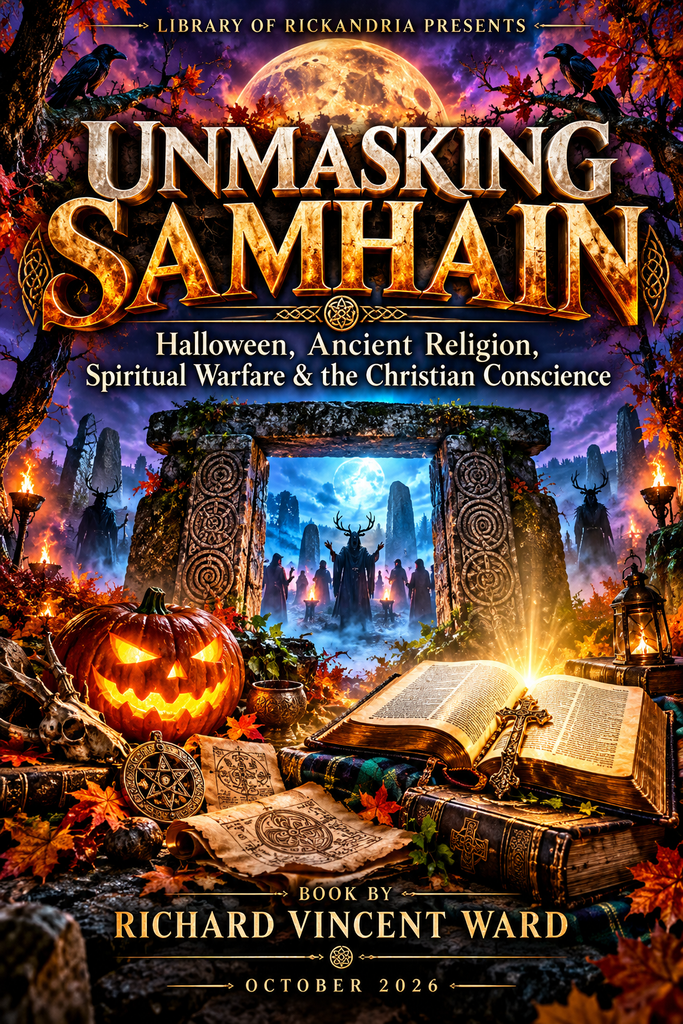
UNMASKING SAMHAIN
Halloween, Ancient Religion, Spiritual Warfare & the Christian Conscience
PART IV — THE MODERN CONTROVERSY
Satanism, Allegations, Psychology, Children & Cultural Influence
CHAPTER 19
SATANIC RITUAL ABUSE, RUMORS & THE BURDEN OF PROOF
The Satanic Panic, Documented Ritual Violence, Child-Abuse Investigations, False Accusations, Memory Reliability, Moral Panic & the Biblical Obligation to Establish Truth
“Thou shalt not raise a false report:
put not thine hand with the wicked to be an unrighteous witness.”— Exodus 23:1, King James Bible
1. The Accusation That Changed Everything
In the autumn of 1983, an accusation began circulating through a community in Manhattan Beach, California.
A preschool teacher was suspected of sexually abusing a child.
The allegation was serious.
It required careful investigation.
But what followed became one of the most consequential controversies in the modern history of child-protection investigations.
Police contacted parents.
Questions were asked.
Additional allegations emerged.
The claims expanded beyond ordinary descriptions of abuse.
Children were said to have been transported through secret tunnels, subjected to extraordinary ceremonies, and involved in events that seemed to resemble stories of organized Satanic ritual activity.
The allegations attracted national attention.
Television reports circulated.
Parents became frightened.
Investigators worked under enormous pressure.
A community divided.
A lengthy criminal prosecution followed.
Years later, the McMartin preschool case ended without a conviction.
The lives of the accused had been transformed.
The families involved had experienced years of uncertainty.
The wider public had encountered a frightening narrative that would influence other investigations.
The case became a defining episode of what is now called the Satanic Panic.
But the central issue was never merely whether a particular community believed in Satan.
It was whether serious allegations could be established through reliable evidence.
That distinction is the foundation of this chapter.
The original 2025 edition of Unmasking Samhain asserted that modern Halloween was connected with organized ritual violence.
It referred to former occult practitioners, survivor testimonies, kidnappings, bloodletting, and child trafficking.
It stated that certain forms of abuse and sacrifice increased around Halloween.
The allegations were presented with great certainty.
Yet the manuscript did not adequately distinguish verified criminal incidents from uncorroborated reports, disputed memories, popular rumors, or theological interpretation.
That failure matters.
An allegation of human sacrifice is not a minor historical detail.
An accusation involving child abuse is not an ordinary disagreement over religious symbolism.
Such claims concern victims, suspects, families, criminal justice, and public safety.
If a crime occurred, it deserves investigation.
If an accusation is false, it may destroy innocent lives.
If investigators become absorbed in an unsupported conspiracy theory, genuine abuse may be missed or mishandled.
And if an author teaches frightening allegations as settled fact without establishing them, the author may contribute to precisely the confusion that makes responsible protection more difficult.
The investigation therefore requires two commitments.
Take allegations of abuse seriously.
Do not treat an allegation as a verified event without adequate evidence.
These commitments do not contradict one another.
They are both necessary to justice.
2. Three Questions That Must Be Kept Separate
Discussions of Satanic ritual abuse often collapse several propositions into one.
They must be separated.
Question One: Does Child Abuse Occur?
Yes.
Child sexual abuse is a documented public-health and criminal-justice problem.
Its reality does not depend upon the existence of Satanic organizations.
Its victims deserve protection and appropriate care.
Question Two: Can Perpetrators Use Religious Language, Symbols or Ceremonies to Frighten Victims?
Yes.
An abuser may claim supernatural power.
An abuser may use threats involving divine punishment, demons, curses, or religious authority.
Such conduct can be part of coercion.
The use of a religious claim does not establish that the claimed supernatural power is real.
It may nevertheless be a very real method of intimidation.
Question Three: Has a Widespread, Coordinated Satanic Conspiracy Committing Ritual Child Abuse Been Established?
That is a different and much larger allegation.
It involves claims about organized networks, repeated crimes, institutional concealment, and sometimes mass killings.
It requires evidence proportionate to its scope.
Historical investigations have repeatedly failed to corroborate the expansive conspiracy narratives promoted during the Satanic Panic.
That finding does not erase genuine child abuse.
It identifies a failure to substantiate particular claims about its organization, purpose, and scale.
The distinction is essential.
The reality of abuse does not prove every proposed explanation of abuse.
3. What Is Meant by “Ritual Abuse”?
The term ritual abuse is not always used consistently.
Some writers employ it for abuse associated with an organized religious ceremony.
Others use it for repeated, patterned abuse involving symbolic acts.
Some use it for incidents in which perpetrators employ frightening religious language to control victims.
Still others use it specifically for allegations of organized Satanic ceremonies.
These definitions are not identical.
A Religious Ceremony
An act may be performed as part of a religious ceremony involving a particular deity, spiritual being, or sacred purpose.
The religious motivation must be established.
Ritualized Violence
A perpetrator may repeat certain actions in a pattern.
The behavior may be ritualized without being part of a religion.
Coercion Through Supernatural Fear
An abuser may threaten that demons will punish a victim who speaks.
The threat may function as psychological control.
The victim’s fear can be genuine even when the supernatural claim is unverified.
An Alleged Organized Conspiracy
A report may describe a large secret organization committing coordinated crimes.
This is an allegation concerning institutional structure and repeated criminal activity.
The claim requires evidence of the organization and its actions.
Why Definitions Matter
If all these cases are called Satanic ritual abuse, the resulting statistics become misleading.
A documented incident of religious intimidation may be counted as evidence of an international conspiracy.
An ordinary criminal act may be labeled Satanic because of a symbol found nearby.
Or an entirely uncorroborated story may be reported as though it were a verified offense.
Accurate investigation requires the classification to follow the evidence.
The definition must not predetermine the conclusion.
4. The Reality of Child Sexual Abuse
Before examining false accusations, we must establish the reality of the crime itself.
The Centers for Disease Control and Prevention describes child sexual abuse as a serious public-health problem.
Its 2024 summary notes that many victims delay disclosure or never report their experiences.
Consequently, available estimates likely understate the true extent of the problem.
The CDC identifies a substantial proportion of abuse as involving people already known to the child or family.
See CDC, About Child Sexual Abuse.
Why This Matters
Popular narratives sometimes portray the principal danger as an unknown person associated with a sinister religious cult.
But many documented cases involve adults known to the child.
The perpetrator may be a relative, acquaintance, caregiver, authority figure, or someone regarded as trustworthy.
An investigation focused exclusively upon imagined strangers may overlook more common patterns of risk.
A Serious Historical Lesson
The Satanic Panic sometimes redirected concern away from identifiable conduct and toward elaborate theories of hidden organizations.
That redirection could make investigations less effective.
The possibility of false allegations should not become a reason to minimize real abuse.
Likewise, the reality of abuse should not become a reason to accept every allegation about its supernatural or organizational context.
A responsible child-protection approach must do both things well.
It must recognize the seriousness of abuse.
And it must investigate specific facts.
5. The Emergence of the Satanic Panic
During the late 1970s and 1980s, stories concerning organized Satanic abuse became increasingly visible in North American popular culture.
The claims appeared in books, television interviews, religious publications, conferences, and later criminal investigations.
They often described secret organizations conducting elaborate ceremonies.
Some accounts included claims of widespread institutional infiltration.
Others involved alleged murders for which no corresponding victims or physical evidence could be found.
The movement became known retrospectively as the Satanic Panic.
A Climate of Anxiety
The period involved genuine concern about child abuse.
Public awareness of previously underrecognized forms of harm was growing.
At the same time, some investigators and commentators adopted theories concerning large clandestine networks.
Religious anxieties, changing attitudes toward family life, media sensationalism, and competing ideas about memory contributed to the controversy.
The Essential Distinction
The historical fact that a moral panic occurred does not establish that every underlying allegation was false.
But it does mean that claims circulating during the period must be examined individually.
The category Satanic Panic describes a broader social and institutional development.
It is not an evidentiary finding concerning every person who ever reported abuse.
A careful author must avoid both universal dismissal and universal acceptance.
6. Michelle Remembers and the Power of a Published Narrative
One influential publication appeared in 1980.
Michelle Remembers was written by Michelle Smith and psychiatrist Lawrence Pazder.
The book presented accounts of supposed childhood Satanic abuse emerging through therapy.
It became influential in the public development of ritual-abuse narratives.
The Historical Significance
The book introduced readers to a dramatic interpretation of childhood trauma and hidden religious crime.
Its claims circulated widely.
The book helped make extraordinary ritual-abuse narratives familiar to audiences who had never encountered them.
The Evidence Question
A published autobiographical account is evidence that the authors made particular claims.
It is not, merely through publication, independent corroboration of every event described.
The circumstances under which memories emerged matter.
The relationship between therapy, suggestion, expectation, and memory requires examination.
A Later Historical Study
Charles Brown’s University of Virginia thesis, Believe the Children: Re-Reading the Satanic Panic Through Michelle Remembers, examines the book’s influence upon the broader panic.
The research identifies the relationship among therapeutic claims, media attention, and the subsequent acceptance of ritual-abuse narratives.
The Lesson
One story can influence the interpretation of later reports.
People may adopt familiar descriptions.
Investigators may begin asking questions that presuppose particular ceremonies.
Witnesses may encounter the same imagery through media coverage.
If several reports share details, the historian must therefore ask whether the witnesses obtained their information independently.
Similar stories do not automatically constitute independent corroboration.
7. A Narrative Can Become an Investigative Expectation
An investigator begins with a report.
That report contains uncertainty.
But suppose the investigator has already been taught that a particular kind of crime involves secret tunnels, masked ceremonies, ritual calendars, and organized cults.
Ordinary details may then be interpreted through that framework.
A dark room may become a ritual chamber.
A costume may become ceremonial clothing.
A frightening story may become evidence of a hidden organization.
An ambiguous statement may be treated as confirmation.
This process is not inevitable.
Professional investigators can recognize and resist it.
But the possibility is important.
Confirmation Bias
When a person strongly expects one explanation, evidence supporting that expectation may receive more attention than evidence challenging it.
Source Contamination
A witness may learn details from a parent, interviewer, television program, or another witness.
Later testimony may then repeat those details.
The repetition may create the impression of independent agreement.
Escalation
An investigation may expand because each new allegation is interpreted as evidence of a larger conspiracy.
The absence of expected physical evidence may itself be explained as proof of extraordinary secrecy.
At that point, the theory becomes difficult to test.
The Necessary Standard
A reliable investigation must preserve the distinction between what the witness independently reported and what the investigator introduced.
The questions asked matter.
The timing of disclosures matters.
The consistency of physical evidence matters.
And alternative explanations must remain open to examination.
8. McMartin: The Historical Record
The McMartin preschool case began in 1983.
The preschool was located in Manhattan Beach, California.
Following an initial allegation, police contacted additional parents.
Reports expanded.
Several employees were charged.
The trial became lengthy and intensely publicized.
The Criminal Proceedings
In January 1990, Peggy McMartin Buckey and Raymond Buckey were acquitted on numerous charges.
The jury could not reach agreement on other counts against Raymond.
A second trial followed.
In July 1990, the second jury also deadlocked.
Prosecutors declined to pursue a third trial.
The case ended without criminal convictions.
Contemporary reporting is preserved in the Los Angeles Times accounts of January 19, 1990, and July 29, 1990.
The Interviewing Problem
Later analyses identified substantial concerns concerning the methods used to interview children.
Some questions were leading.
Some interviews encouraged children to supply answers consistent with investigators’ expectations.
Repeated questioning could communicate that an earlier answer was unacceptable.
The Modern Reassessment
A 2024 Los Angeles Times retrospective examined the case’s institutional failures.
The article reported that the former district attorney who had brought the prosecution later acknowledged that proceeding to trial had been a mistake.
The reporting also discussed the long-term consequences for those accused.
See Wild Claims of Mass Child Molestation Rocked an L.A. Beach Town.
The Proper Legal Conclusion
The prosecutions ended without convictions.
That is the established legal outcome.
The record also supports serious criticism of investigative methods and the handling of evidence.
But a historian should distinguish the verdict, the procedural concerns, and broader claims concerning every underlying experience reported by every person involved.
The case cannot be used responsibly as proof of the elaborate Satanic network alleged during the controversy.
Nor should it become an excuse for dismissing unrelated reports of abuse.
9. What McMartin Teaches About Evidence
The McMartin case is often remembered through its most extraordinary allegations.
But its most important lesson concerns investigative method.
Begin with the Report
A possible victim’s statement deserves attention.
Avoid Supplying the Story
An interviewer should not introduce an elaborate account and then ask a child to confirm it.
Preserve Independent Recollection
Open-ended questions are generally preferable to repeated suggestions.
Seek Corroboration
Relevant records, observations, forensic evidence, timelines, and other witnesses should be examined.
Do Not Confuse a Theory with a Fact
The investigator may consider the possibility of organized wrongdoing.
But the theory must remain open to correction.
Protect Everyone’s Rights
Children deserve protection from abuse.
Accused people deserve fair procedures.
Both duties belong to a just investigation.
The importance of the case is not that child protection should become less vigorous.
It is that protection must become more reliable.
Poor investigative methods can harm victims and innocent suspects simultaneously.
10. The Keller Case: A Wrongful Conviction
A second case demonstrates the consequences of unreliable evidence even more starkly.
Dan and Fran Keller operated a daycare in Texas.
During the early 1990s, they were accused of crimes involving allegations of Satanic ritual activity.
They were convicted in 1992.
Each received a sentence of forty-eight years.
They spent approximately twenty-one years imprisoned.
The Medical Evidence
An examining physician had interpreted a physical finding as evidence consistent with abuse.
Years later, the physician acknowledged that the original conclusion was medically mistaken.
The change undermined a central element of the prosecution’s evidence.
Release and Exoneration
The Kellers were released in 2013.
In 2017, Texas authorities approved their declarations of innocence.
The Associated Press reported the development in Texas Judge Finds Ex-Day Care Owners Innocent of Abuse.
The state subsequently approved compensation for their wrongful imprisonment.
Why the Case Matters
The allegations had sounded extraordinarily serious.
A court had accepted the prosecution.
A conviction had been imposed.
But the evidentiary foundation did not withstand later examination.
The outcome demonstrates why a conviction cannot always be treated as the final word on the factual reliability of every claim.
Legal systems can make mistakes.
They require avenues for correction.
The Moral Conclusion
False convictions do not merely inconvenience the accused.
They take years of human life.
They damage relationships.
They can destroy livelihoods.
And they undermine trust in institutions responsible for protecting actual victims.
The Kellers’ case demonstrates why the burden of proof is not an obstacle to justice.
It is part of justice.
11. An International Example: Christchurch, New Zealand
The controversies were not confined to the United States.
In Christchurch, New Zealand, Peter Ellis worked at a civic childcare centre.
He was convicted in 1993 on multiple counts of sexual offending against children.
The case also attracted allegations containing extraordinary and Satanic themes.
Ellis maintained his innocence.
He was released from prison in 2000.
He died in 2019.
The Supreme Court Decision
On October 7, 2022, the Supreme Court of New Zealand quashed Ellis’s convictions.
The court found a miscarriage of justice associated with the handling and reliability of the children’s evidence, including problems concerning investigative processes.
The official court record is available at Ellis v The King, [2022] NZSC 115.
The Importance of the Decision
The case illustrates how concerns about child-interviewing procedures can affect the reliability of criminal evidence.
It also demonstrates the lasting consequences of an investigation shaped by intense public attention.
The Necessary Qualification
The court’s decision concerns a particular prosecution.
It should not be generalized into the claim that all allegations made by children are false.
Nor should an earlier conviction be used as automatic proof of allegations that were later overturned.
Each case requires its own evidence.
12. The FBI’s 1992 Investigation Guide
One of the most important primary sources in this chapter is a report prepared by Kenneth V. Lanning.
Lanning was a supervisory special agent associated with the FBI’s Behavioral Science Unit.
His report appeared in January 1992.
Its title was Investigator’s Guide to Allegations of “Ritual” Child Abuse.
The publication is catalogued by the United States Department of Justice:
National Criminal Justice Reference Service, NCJ 136592.
Lanning’s Professional Concern
Lanning specialized in the sexual victimization of children.
He did not approach the controversy from the position that child sexual abuse was imaginary.
He regarded it as a serious problem requiring competent investigation.
His Central Finding
The claims concerning widespread organized Satanic abuse had not been corroborated in proportion to their scope.
He warned that focusing excessively upon elaborate Satanic explanations could interfere with establishing identifiable abuse.
A Crucial Distinction
Lanning did not argue that every allegation involving ritual elements should be dismissed.
He recognized that offenders could use fear, religious symbolism, or unusual conduct.
He also recognized the possibility of organized exploitation.
His concern was that investigators distinguish actual offenses from unsupported explanatory theories.
The Investigative Lesson
A crime can be established without proving that every claimed occult component occurred.
If a child was assaulted, that harm matters.
If an investigator cannot prove a supposed secret cult, the absence of such proof should not necessarily prevent investigation of the underlying assault.
Conversely, a dramatic cult theory should not replace evidence that a particular accused person committed a crime.
This distinction is foundational.
13. Why the Absence of Corroboration Matters
Some allegations involve events that would ordinarily produce substantial physical or documentary evidence.
A claimed ceremony involving a large number of people may generate witnesses.
A claimed repeated killing may generate missing-person reports, remains, or other evidence.
A supposed network involving numerous participants may generate communications or identifiable relationships.
Not every crime leaves the same evidence.
Not every investigation can recover everything.
But the expected evidence matters.
A Testable Claim
An allegation that a specific person committed an act at a particular location can be investigated.
The investigator may examine records, witnesses, access, travel, physical findings, and competing explanations.
An Expanding Claim
If every absence of evidence is explained as proof of perfect concealment, the allegation becomes difficult to test.
An investigator should not assume that lack of evidence disproves every possible event.
But neither should the absence of expected corroboration be treated as positive proof that the conspiracy is exceptionally powerful.
The Burden of a Large Conspiracy Claim
A theory involving thousands of coordinated offenders requires evidence of that coordination.
The seriousness of the accusation increases the need for reliable corroboration.
The Historical Conclusion
The failure to corroborate expansive Satanic Panic narratives was a meaningful investigative finding.
It should not be dismissed through an automatic claim that the alleged conspirators must have erased every trace.
Such a response substitutes an unfalsifiable explanation for investigation.
14. The British Government-Sponsored Investigation
The United Kingdom also experienced controversies involving allegations of organized ritual abuse.
During the late 1980s and early 1990s, reports arose in several communities.
Some cases involved the removal of children from their families.
Others involved extensive allegations of ceremonial abuse.
The British government commissioned research into the claims.
Jean La Fontaine’s Study
Anthropologist Jean La Fontaine conducted research for the Department of Health.
The findings appeared in 1994 as The Extent and Nature of Organised and Ritual Abuse: Research Findings.
The publication examined eighty-four cases reported between 1987 and 1992.
The study distinguished allegations of organized abuse from allegations involving ritual or Satanic elements.
The Findings
The research did not substantiate the claimed widespread Satanic ceremonial system.
Some cases involved actual abuse or ritualized intimidation.
Three cases contained evidence of ritual-like elements associated with abuse, but the study did not establish a genuinely Satanic religious objective for those acts.
Contemporary reporting summarized the findings in UPI’s June 2, 1994 report.
The Important Distinction
The finding was not that every child-abuse allegation in Britain had been fabricated.
It was that the evidence did not support the particular claims of organized Satanic religious ceremonies.
Actual criminal conduct and the alleged religious explanation had to be distinguished.
Later Government Research
A 2012 literature review funded by the United Kingdom’s Department for Education revisited child abuse associated with faith or belief.
It discussed La Fontaine’s findings alongside later research and safeguarding concerns.
The review recognized that religious and supernatural language can be relevant to abuse without establishing a universal hidden Satanic network.
The historical record therefore supports a more careful vocabulary than the original 2025 edition used.
15. A Critical Counterexample: Matamoros, 1989
A truthful investigation must also acknowledge documented killings involving ritualized practices.
The absence of evidence for the expansive Satanic Panic conspiracy does not mean that every crime with occult elements was imaginary.
An important example occurred near Matamoros, Mexico, in 1989.
Investigators discovered numerous human remains associated with a drug-trafficking group led by Adolfo de Jesús Constanzo.
The case involved actual deaths.
Authorities identified ritual elements.
The group reportedly believed its practices could provide supernatural protection from law enforcement.
The Historical Record
Contemporary Associated Press reporting described the discovery of bodies and statements made by suspects.
The Los Angeles Times reported the investigation in April 1989.
A later FBI Law Enforcement Bulletin article also discussed the case in the context of ritualized killings and organized crime.
See Santa Muerte: Inspired and Ritualistic Killings.
What the Case Establishes
Actual ritualized violence can occur.
Criminal groups may employ supernatural beliefs.
Religious or magical claims can become entangled with organized criminal activity.
These possibilities should not be denied.
What the Case Does Not Establish
The crimes were associated with a particular drug-trafficking group.
They were not documented as part of a Halloween campaign.
They did not establish that modern Wicca commits human sacrifice.
They did not establish that the Church of Satan or The Satanic Temple directed the murders.
And they cannot be used to accuse unrelated Afro-Caribbean religious traditions as a whole of the same crimes.
The Necessary Lesson
A documented case must retain its own identity.
Its perpetrators, location, date, motive, and evidence matter.
One verified ritualized crime proves that such a crime can occur. It does not prove that every alleged ritual conspiracy exists.
This distinction protects the historical record from both denial and exaggeration.
16. The Difference Between a Crime and Its Religious Explanation
The Matamoros case illustrates a larger principle.
Suppose a murderer believes that a ritual will grant supernatural protection.
The investigator may establish that the murderer performed the ritual.
The investigator may establish that a victim was killed.
The investigator may establish that the perpetrator believed the ritual possessed spiritual power.
Those facts are historically and criminally significant.
But they do not establish that the claimed supernatural protection actually worked.
Three Different Propositions
The physical act occurred.
The perpetrator assigned religious meaning to the act.
The claimed supernatural mechanism was objectively real.
These statements require different kinds of evidence.
The first may be established through forensic investigation.
The second may be established through testimony, records, or the offender’s statements.
The third is a theological or metaphysical proposition.
The Importance for Christian Writing
A Christian may interpret a violent ritual through the biblical condemnation of murder and idolatry.
The Christian may also hold theological convictions concerning evil spiritual beings.
But the historical description should not treat a perpetrator’s supernatural claim as automatically verified.
A crime can be condemned without proving the metaphysics claimed by the criminal.
Indeed, its physical wrongdoing is already sufficient for condemnation.
17. Recovered Memories: The Central Scientific Dispute
Some Satanic Panic allegations arose from adult memories reportedly recovered during therapy.
The issue requires care.
Memory is not a simple recording device.
People may remember real experiences after long periods in which they did not consciously recall them.
People may also develop mistaken memories.
External suggestion can influence recollection.
The scientific challenge is determining what occurred in a particular case.
The American Psychological Association
The American Psychological Association addressed these questions in its publication Questions and Answers About Memories of Childhood Abuse.
The association recognized that both delayed recollection and the formation of inaccurate memories are possible.
It warned against therapists assuming in advance that abuse must have occurred.
It also warned against automatically dismissing reported memories.
No Universal Rule
The existence of false-memory phenomena does not establish that every delayed recollection is false.
The possibility of genuine delayed remembering does not establish that every recovered account is accurate.
The Role of Corroboration
Independent evidence may help establish what occurred.
The reliability of a particular memory cannot always be determined through the witness’s confidence alone.
The Historical Error
The original manuscript treated certain extraordinary survivor testimonies as sufficiently authoritative to establish widespread ritual violence.
But a testimony concerning a specific alleged event still requires investigation.
Its emotional force does not automatically establish every detail.
The proper response is careful, trauma-informed evaluation rather than unquestioning acceptance or reflexive disbelief.
18. Suggestion and Memory Contamination
Some investigative or therapeutic practices can increase the risk of inaccurate recollection.
A person may be repeatedly told that symptoms necessarily indicate a forgotten history of abuse.
A therapist may interpret dreams as literal memory.
An interviewer may ask questions containing unverified details.
A witness may come to remember a story shaped partly by such suggestions.
These processes can occur without deliberate dishonesty.
The Problem of Certainty
A person may become sincerely confident in a memory that is inaccurate.
Sincerity and accuracy are distinct.
The Problem of Interpretation
A dream may feel vivid.
An image may carry intense emotion.
But vividness does not establish the historical event depicted.
The Problem of Repetition
Repeated questioning can strengthen familiarity with a proposed narrative.
Familiarity can be mistaken for independent recollection.
The Clinical Responsibility
A therapist should not attempt to prove a preconceived theory of hidden Satanic abuse through suggestive methods.
The goal of treatment is responsible care.
The goal of a forensic investigation is reliable evidence.
Those purposes overlap in concern for the person, but they are not identical.
The distinction should be respected.
19. Children and Suggestive Interviewing
Children can provide important and accurate information about experiences of harm.
But interviews must account for developmental differences.
A child may attempt to please an adult.
A child may misunderstand a complicated question.
A child may infer that a particular answer is expected.
Repeated questioning can influence responses.
These facts do not mean that children are inherently unreliable.
They mean that interviewing methods matter.
The NICHD Protocol
The National Institute of Child Health and Human Development developed an investigative interview protocol designed to promote accurate information from children.
The protocol emphasizes rapport, open-ended prompts, and free recall.
The National Institute of Justice summarizes the approach in NICHD Investigative Interview Protocol.
Open-Ended Questions
An interviewer may invite the child to explain what happened in the child’s own words.
This reduces the risk of supplying the answer.
A Child’s Right to Correct the Adult
The protocol teaches children that they may say they do not know or do not remember.
They may also correct an interviewer.
These instructions matter because an adult’s authority can influence a child’s responses.
The Proper Investigation
A child should not be repeatedly pressured to confirm a dramatic narrative.
The interview should be conducted by appropriately trained professionals.
The objective is not to produce a particular accusation.
It is to obtain reliable information while minimizing additional harm.
20. Professional Guidelines for Forensic Interviews
The Association of Professionals Solving the Abuse of Children published updated guidelines in 2023.
Its Forensic Interviewing of Children emphasizes methods intended to reduce suggestion and promote accurate reporting.
The guidelines prefer open-ended questions where possible.
They caution against questions that introduce information the child has not supplied.
They also recognize that carefully framed more focused questions may be necessary in some circumstances.
The Importance of Recorded Method
A later reader of a child’s statement should know how the information was obtained.
What question was asked?
Was a detail volunteered?
Was it suggested?
Was the interview repeated?
Were adults discussing the expected answer with the child?
Such details can affect the interpretation of evidence.
Why This Matters for Alleged Ritual Abuse
Extraordinary ritual narratives often contain numerous details.
A responsible investigator must determine whether those details originated independently from the witness or were introduced during questioning.
Without that distinction, repeated similarities may be misleading.
The Central Principle
The purpose of an interview is to discover what the child knows—not to teach the child what the investigator believes happened.
This principle protects genuine victims.
It also protects innocent people from false accusations.
21. Listening to a Child Without Conducting Your Own Investigation
Parents, teachers, pastors, and other trusted adults may receive a disclosure of possible abuse.
Their response matters.
The correct response is neither interrogation nor dismissal.
Remain Calm
A child may be frightened or confused.
An adult’s intense reaction can increase distress.
Listen
Allow the child to speak.
Avoid repeatedly asking the child to recount painful details.
Do Not Supply a Theory
Do not introduce claims about Satanic ceremonies, secret tunnels, trafficking rings, or other details not raised by the child.
Seek Appropriate Help
Where abuse is suspected, follow applicable reporting requirements and involve appropriate child-protection or law-enforcement authorities.
A medical professional or trained child-advocacy specialist may also be needed.
Do Not Promise Absolute Secrecy
A child may need help from adults responsible for protection.
The child should be treated respectfully while appropriate steps are taken.
The Clinical Guidance
The World Health Organization recommends minimizing repeated accounts, asking clear and open-ended questions, and reducing additional trauma when children disclose sexual abuse.
See WHO, Responding to Children and Adolescents Who Have Been Sexually Abused.
The American Academy of Pediatrics likewise advises parents not to conduct repeated independent questioning.
The relevant clinical guidance is based upon protecting the child and preserving the reliability of the investigation.
The Pastoral Implication
A pastor is not automatically qualified to conduct a forensic interview.
Prayer and pastoral care should not replace reporting or professional assessment.
The duty to protect children includes recognizing the limits of one’s expertise.
22. Theological Language Can Be Used to Control Victims
Some perpetrators employ religious fear as a method of coercion.
They may claim supernatural authority.
They may threaten divine punishment.
They may assert that spirits will retaliate if the victim reports the abuse.
The supernatural claim may be false.
The intimidation may nevertheless be real.
The Importance of the Distinction
A child frightened by threats of demons may experience genuine fear.
A victim may remain silent because of such threats.
The investigator should take the intimidation seriously.
But the threats do not establish that the perpetrator possesses supernatural power.
A Christian Responsibility
Religious authority should never be used to silence a person reporting harm.
A leader’s claim to spiritual power is not evidence of innocence.
The misuse of biblical language can itself become part of coercion.
The Historical Lesson
The phrase ritual abuse may sometimes describe the use of religious forms to frighten or control.
Such incidents must not be ignored.
But the presence of religious intimidation does not automatically establish an international Satanic organization.
The specific wrongdoing should be identified and addressed.
23. What Does a Real Conspiracy Require?
A conspiracy is an agreement among people to commit wrongdoing.
Actual criminal conspiracies exist.
They may involve trafficking, exploitation, corruption, or concealment.
But the allegation must be supported by evidence of coordination.
Identifiable Participants
Who allegedly took part?
Identifiable Conduct
What acts were committed?
Identifiable Relationships
How were participants connected?
Supporting Evidence
Are there records, communications, financial transactions, witnesses, forensic findings, or other corroborating material?
The Problem of Endless Expansion
An allegation may become increasingly broad.
Every skeptical investigator may be accused of complicity.
Every missing record may be treated as evidence of a cover-up.
Every contrary fact may be explained away.
The resulting theory may become impossible to disprove because it permits no evidence against itself.
That is not a reliable investigative method.
The Correct Standard
A conspiracy allegation should become stronger through specific evidence.
It should not become stronger merely because it is difficult to verify.
The burden of proof increases with the scope of the claim.
24. Halloween and the Allegation of a Seasonal Crime Peak
The original 2025 manuscript asserted that serious crimes associated with blood sacrifice, trafficking, and ritual abuse increased during Halloween.
This is a statistical claim.
It is not established by a single story.
What Evidence Would Be Required?
A defined category of crime.
Reliable records across multiple years.
Dates of occurrence rather than merely dates of reporting.
Comparable rates outside the Halloween period.
Appropriate controls for geography, population, and reporting practices.
An analysis distinguishing ordinary crime from alleged ritual motivation.
The Sources Examined
The FBI’s 1992 guidance does not establish a nationwide Halloween peak in organized Satanic ritual abuse.
La Fontaine’s British study does not establish such a pattern.
The McMartin and Keller cases do not establish it.
The documented Matamoros murders do not establish an October 31 pattern.
The Important Difference
A religious practitioner may regard Samhain as important.
An offender might intentionally choose a symbolic date.
Those possibilities do not establish a statistically measurable increase in ritual crime.
The particular pattern must be demonstrated.
The Editorial Finding
The original manuscript did not provide adequate evidence for the alleged Halloween crime peak.
The claim should be removed or clearly identified as unverified unless reliable contemporary data can substantiate it.
25. Abortion, Trafficking and Ritual Abuse Are Not One Statistical Category
The original edition grouped abortion, child trafficking, and alleged Satanic ritual abuse within a single narrative of modern sacrifice.
This conflation requires correction.
Different Subjects
Abortion concerns medical, legal, ethical, and religious questions involving pregnancy.
Child trafficking concerns crimes of exploitation.
Ritual abuse allegations concern claimed patterns of harm associated with ceremonies or religious intimidation.
These categories possess different definitions, evidence, reporting systems, and legal frameworks.
The Problem of Combining Them
If an author asserts that all three increase around Halloween, each claim requires its own supporting data.
The existence of one category does not establish a seasonal pattern in another.
Theological Metaphor Versus Criminal Fact
A religious writer may employ the language of sacrifice metaphorically when criticizing a practice.
But that metaphor should not be confused with a forensic finding of ritual murder.
The Editorial Correction
The original manuscript’s grouping created the impression of one coordinated sacrificial system.
The historical and statistical evidence examined does not establish that system.
The subjects should therefore be addressed separately.
Serious issues deserve precise language.
26. The Modern Return of Ritual-Conspiracy Narratives
The Satanic Panic did not disappear entirely when its most prominent prosecutions ended.
Later rumors developed through new forms of communication.
Social media provided new ways to spread allegations rapidly.
Stories concerning secret trafficking networks, powerful elites, concealed ceremonies, and child sacrifice acquired renewed visibility.
Some narratives resembled the earlier Satanic Panic.
Others developed new political or cultural themes.
Recent Scholarship
Stefan Wuchty and Joseph E. Uscinski examined such developments in New Satanic Panic, published in Political Science Quarterly.
Their study analyzed public belief in several forms of contemporary conspiracy allegations.
The research demonstrates that claims involving organized child abuse and ritual violence remain socially influential.
A Neutral Evidentiary Principle
The political or religious identity of the person spreading an allegation does not determine its truth.
A claim should be tested regardless of whether it originates with a pastor, politician, journalist, activist, former practitioner, or anonymous online account.
The Danger of Digital Repetition
One story can be copied across hundreds of websites.
The repetition may create an impression of independent confirmation.
But repeated circulation is not the same thing as corroboration.
The original source must be identified.
The evidence must be examined.
27. The Psychology of Moral Panic
A moral panic occurs when a perceived threat becomes the focus of intense public concern and the response may exceed what the evidence justifies.
The term should not be used merely to dismiss every moral concern.
Societies can confront genuine dangers.
But they can also misunderstand those dangers or exaggerate their causes.
The Role of the Child
Stories concerning children provoke strong protective emotions.
That response is understandable.
Children can be vulnerable.
Adults possess genuine responsibilities to protect them.
The Role of Hidden Evil
An alleged secret organization may explain otherwise confusing events through one powerful narrative.
The theory offers a recognizable enemy.
It may also assign meaning to unrelated symbols.
The Role of Religious Fear
When the threat is described as supernatural, ordinary uncertainty may appear insufficient.
The alleged enemy becomes invisible.
The lack of proof may be interpreted as evidence of greater concealment.
The Role of Social Reinforcement
People sharing the same concern may repeat one another’s claims.
Disagreement may be interpreted as indifference to victims.
This can make careful questioning socially difficult.
The Corrective
The existence of an emotionally compelling narrative does not remove the obligation to examine evidence.
Protecting children and avoiding unsupported allegations are not competing moral goals.
Both are necessary.
28. The Biblical Duty to Investigate
The King James Bible contains direct warnings against false reports and hasty judgment.
These passages are particularly relevant to the subject.
Exodus 23:1
“Thou shalt not raise a false report:
put not thine hand with the wicked to be an unrighteous witness.”
The command concerns truthful testimony and justice.
It is not limited to ordinary disputes.
It applies with particular seriousness to accusations that can destroy lives.
Proverbs 18:13
“He that answereth a matter before he heareth it, it is folly and shame unto him.”
The proverb warns against reaching conclusions before hearing a matter.
A serious allegation should not be accepted merely because it confirms an existing fear.
Proverbs 18:17
“He that is first in his own cause seemeth just; but his neighbour cometh and searcheth him.”
The passage recognizes the importance of examining competing accounts.
One statement may appear convincing until further evidence is considered.
Deuteronomy 13:14
The text directs Israel to inquire carefully and establish whether a serious religious allegation is true.
Its specific historical setting concerns ancient Israel’s covenantal legal order.
It is not permission for private modern religious investigations or violence.
Nevertheless, the emphasis upon careful inquiry is significant.
The Biblical Principle
The Scriptures do not commend irresponsible accusation.
They condemn false witness.
They recognize the need for evidence.
And they warn against hasty judgment.
These commands are particularly important when allegations involve children and crimes of extraordinary seriousness.
29. Deuteronomy 19 and the Problem of False Witnesses
Deuteronomy 19 addresses testimony and judicial proceedings.
Verse 15 sets out the requirement for multiple witnesses within ancient Israelite law.
The passage then considers the possibility of a malicious or false witness.
This is an important feature of the biblical legal tradition.
The Need for Examination
The text does not assume that an accusation is true merely because it is made.
It recognizes the danger of false testimony.
It directs attention toward judicial inquiry.
The Historical Context
The legal provisions belong to ancient Israel.
They should not be transferred directly into contemporary private punishment.
But the moral concern remains relevant.
The Practical Application
An allegation must be examined.
A person’s reputation should not be destroyed through rumor.
An accused individual should not be punished without appropriate evidence and lawful process.
At the same time, an investigation should not be obstructed merely because the accused occupies a respected position.
The protection of victims and the protection against false accusation belong together.
30. Matthew 18 and the Duty to Protect Children
Jesus’ teaching concerning children is central to Christian ethics.
Matthew 18 contains serious warnings against causing harm or spiritual stumbling to little ones.
The passage also includes teaching concerning humility, care, and the responsibility not to despise children.
The Moral Responsibility
Children should be treated with dignity.
Their safety should be taken seriously.
Adults who exploit or harm them commit serious wrongdoing.
The Error of Using Protection as a Slogan
A religious organization may claim to protect children while failing to investigate actual abuse within its own institution.
A church may become absorbed in stories about distant occult conspiracies while ignoring credible warnings about a familiar adult.
That would be a profound failure of responsibility.
The Correct Priority
Protect the child before protecting the institution’s reputation.
Seek appropriate professional and legal assistance.
Do not treat spiritual authority as a substitute for investigation.
Do not silence a child through religious pressure.
And do not manufacture accusations against others in the name of protecting the vulnerable.
The biblical responsibility is practical as well as verbal.
31. First John 4:1 and the Testing of Claims
First John 4:1 states:
“Beloved, believe not every spirit, but try the spirits whether they are of God:
because many false prophets are gone out into the world.”
The immediate context concerns competing religious claims and prophetic teaching.
The passage is often cited in discussions of spiritual discernment.
The Consistency Requirement
If Christian readers are instructed not to accept every religious claim uncritically, the principle must also apply to alarming claims made by Christian speakers.
An alleged former occultist may be mistaken.
A popular author may repeat an inaccurate story.
A pastor may misunderstand a historical source.
A testimony may contain unverified details.
The Necessary Application
Testing claims should involve examining their content and support.
The command to discern is not permission to assume that the most frightening account is automatically true.
Nor does it authorize dismissing a genuine report without examination.
A faithful application requires disciplined judgment.
32. What Would a Responsible Pastor Do?
Consider a hypothetical situation.
A parent approaches a pastor and reports that a child has described troubling conduct by an adult.
The parent also believes that the incident may involve occult symbols.
What should happen?
First: Attend to Immediate Safety
The child’s protection is the priority.
If there is immediate danger, appropriate emergency services should be contacted.
Second: Listen Without Coaching
The pastor should not attempt to extract an elaborate ritual narrative.
The child should not be asked repeated leading questions.
Third: Report Appropriately
Applicable child-protection laws and institutional safeguarding requirements should be followed.
A religious leader should not assume that an internal church meeting replaces lawful reporting.
Fourth: Preserve Relevant Information
Relevant records, messages, dates, and other evidence should be handled appropriately.
Potential evidence should not be publicly circulated or altered.
Fifth: Avoid Public Accusations
The names of children and alleged offenders should not become material for sermons, social media, or speculation.
Sixth: Cooperate With Qualified Professionals
Law enforcement, child-protection agencies, medical professionals, and trained forensic interviewers possess roles that cannot be replaced by religious enthusiasm.
Seventh: Offer Pastoral Care
The child and family may need support.
Pastoral care should be compassionate and should not direct the person toward a predetermined interpretation of the event.
The Central Principle
A pastor can provide spiritual care without acting as an untrained detective.
The duty to protect children includes knowing when qualified help is required.
33. What If an Adult Reports Recovered Memories?
A different situation arises when an adult reports memories of past abuse that emerged after years of incomplete or absent recall.
The proper response is neither immediate accusation nor dismissal.
Respect the Person
The report may be deeply distressing.
The person deserves compassionate treatment.
Avoid Certainty Beyond the Evidence
A memory may be genuine.
It may also contain inaccuracies.
Confidence and vividness alone cannot settle every detail.
Do Not Conduct Suggestive “Recovery”
A pastor should not pressure the person to uncover supposed secret ceremonies.
Nor should a minister supply details about an alleged cult and encourage the person to identify with them.
Encourage Qualified Care
A licensed mental-health professional experienced in trauma and memory may be appropriate.
The professional should not approach the case with an assumption that abuse necessarily occurred or necessarily did not.
Address Concrete Evidence
If the person reports an identifiable crime, appropriate professional and legal advice may be needed.
The particular evidence should guide the investigation.
The Ethical Goal
The person should receive support without having a speculative narrative imposed upon them.
Compassion does not require pretending that every recollection has been independently verified.
Skepticism does not require treating the person harshly.
Truth and care can coexist.
34. The Original Manuscript’s Most Serious Allegation
We now return directly to the first edition.
Its Chapter 4 asserted that contemporary occult groups continued literal sacrifices during Halloween.
The statement included the words:
“literal sacrifices still occur on this night.”
The chapter also claimed that categories of serious wrongdoing included activities that:
“peak around Halloween.”
These assertions require evidence.
The Historical Evidence Supplied
The original manuscript referred to ancient sacrifices, later folklore, modern occult identities, and testimony attributed to former practitioners.
But those materials do not independently establish a contemporary statistical pattern.
The Criminal Evidence Required
The claim of ongoing sacrifice would require identified cases.
The claim of organizational involvement would require evidence connecting perpetrators to the alleged organization.
The claim of a Halloween peak would require reliable date-based data.
The Missing Connection
An ancient Gallic report does not verify a modern crime.
A modern religious observance does not establish a killing.
A reported supernatural threat does not establish actual demonic power.
A testimony does not become independently corroborated through repetition.
The Editorial Conclusion
The first edition’s universal language exceeded the evidence.
The revised manuscript must distinguish verified criminal cases from generalized allegations.
Claims concerning widespread ritual violence should not remain as established facts unless appropriately corroborated.
35. The Difference Between a Warning and an Accusation
A Christian may warn against practices regarded as spiritually forbidden.
But the manner in which the warning is framed matters.
A Theological Warning
A statement that Scripture prohibits divination is a theological claim grounded in identifiable texts.
A Historical Claim
A statement that a particular ceremony existed in ancient Ireland requires historical evidence.
A Criminal Allegation
A statement that a named organization kidnaps children requires evidence of the alleged crimes.
A Statistical Claim
A statement that crimes increase on October 31 requires reliable data.
A Supernatural Claim
A statement that a particular object automatically opens a demonic gateway requires theological support identifying the mechanism.
The original 2025 edition repeatedly moved among these categories without distinguishing them.
The result was an appearance of cumulative proof.
But one kind of evidence cannot automatically establish another.
Biblical opposition to wrongdoing does not prove that a particular person committed it.
That distinction is not a concession to evil.
It is a requirement of truthful judgment.
36. Editorial Audit of the 2025 Edition
Claim 19.1 — Child Sexual Abuse Is a Genuine and Serious Problem
Finding: Verified.
Public-health research and criminal-justice records establish its reality.
Claim 19.2 — Some Perpetrators Use Religious Threats to Control Victims
Finding: Supported.
Religious language and alleged supernatural punishment can function as coercive methods.
Claim 19.3 — All Ritual-Abuse Allegations Describe One Identical Crime
Finding: Incorrect.
The terminology encompasses different claimed activities and investigative situations.
Claim 19.4 — A Widespread International Satanic Child-Abuse Network Was Established by the 1980s Investigations
Finding: Not established.
Major investigations failed to corroborate the expansive conspiracy narratives.
Claim 19.5 — The McMartin Prosecutions Ended Without Convictions
Finding: Verified.
The final prosecution ended in 1990.
Claim 19.6 — The McMartin Case Proved an Underground Satanic Ritual Network
Finding: Unsupported.
The criminal proceedings did not establish that allegation.
Claim 19.7 — Dan and Fran Keller Were Wrongfully Imprisoned
Finding: Verified.
Their convictions were overturned, and they received declarations of innocence in 2017.
Claim 19.8 — The Keller Case Demonstrates the Possibility of False Convictions
Finding: Supported.
It is a documented miscarriage of justice.
Claim 19.9 — Peter Ellis’s Convictions Were Quashed in 2022
Finding: Verified.
The Supreme Court of New Zealand found a miscarriage of justice.
Claim 19.10 — No Crime Has Ever Involved Ritualized Violence
Finding: Incorrect.
Documented cases exist, including the 1989 Matamoros killings.
Claim 19.11 — The Matamoros Case Established a Worldwide Wiccan or Satanist Child-Sacrifice Conspiracy
Finding: Unsupported.
The case involved a particular criminal group and cannot be generalized in that way.
Claim 19.12 — The FBI’s 1992 Guide Warned Against Unsupported Satanic Explanations
Finding: Verified.
It recommended evidence-centered investigations.
Claim 19.13 — The FBI’s Guide Declared All Abuse Allegations False
Finding: Incorrect.
The report recognized actual abuse and the need for careful investigation.
Claim 19.14 — Jean La Fontaine Investigated Eighty-Four British Cases
Finding: Verified.
The 1994 study examined reported organized and ritual-abuse cases.
Claim 19.15 — The British Study Corroborated an Organized Satanic Sacrifice Network
Finding: Not supported.
The study did not substantiate the alleged religious conspiracy.
Claim 19.16 — Recovered Memories Are Always Accurate
Finding: Unsupported.
Memory may be influenced by suggestion and other factors.
Claim 19.17 — Recovered Memories Are Always False
Finding: Unsupported.
Delayed recollection can occur; individual accuracy requires evaluation.
Claim 19.18 — Suggestive Interviewing Can Affect Children’s Reports
Finding: Supported by research.
Professional protocols attempt to reduce this risk.
Claim 19.19 — A Child Reporting Abuse Should Be Automatically Disbelieved
Finding: Rejected.
Reports deserve appropriate safeguarding and investigation.
Claim 19.20 — A Child Should Be Repeatedly Questioned Until an Expected Ritual Narrative Emerges
Finding: Contrary to professional interviewing guidance.
Leading and repeated suggestive questioning can undermine reliability and cause harm.
Claim 19.21 — Some Crimes Can Be Committed by Groups Acting Together
Finding: Verified.
The existence of organized crime is not disputed.
Claim 19.22 — Every Allegation of a Large Secret Cult Is Therefore True
Finding: Unsupported.
Coordination must be demonstrated in each case.
Claim 19.23 — Satanic Ritual Abuse, Trafficking and Other Serious Crimes Peak Around Halloween
Finding: Not established by the examined statistical evidence.
The original manuscript did not provide adequate corroboration.
Claim 19.24 — A Religious Organization’s Official Rules Prove No Member Can Ever Commit a Crime
Finding: Unsupported.
Official doctrine and individual conduct require separate examination.
Claim 19.25 — An Organization’s Satanic Name Proves Criminal Conduct
Finding: Unsupported.
The alleged crime requires evidence.
Claim 19.26 — A Former-Practitioner Testimony Automatically Establishes Every Alleged Event
Finding: Unsupported.
Testimony should be considered and, where possible, corroborated.
Claim 19.27 — Exaggerated Conspiracy Narratives Can Obstruct Protection of Actual Victims
Finding: Supported as an investigative concern.
They can redirect attention and undermine reliable procedures.
Claim 19.28 — Scripture Condemns False Witness
Finding: Explicit.
Exodus 20, Exodus 23, and other passages are directly relevant.
Claim 19.29 — Scripture Calls for Justice and Protection of the Vulnerable
Finding: Supported.
The biblical record contains substantial teaching concerning justice and care.
Claim 19.30 — Christians May Accuse Entire Religious Communities of Ritual Murder Without Proof
Finding: Contrary to the responsibility to avoid false reports and unjust accusations.
Claim 19.31 — Genuine Abuse Should Be Investigated Even When Ritual Claims Remain Uncorroborated
Finding: Supported.
The underlying conduct deserves independent attention.
Claim 19.32 — Responsible Christian Discernment Requires Both Compassion and Evidence
Finding: Supported as an ethical and methodological conclusion.
37. Corrected Replacement Passage for the 2026 Edition
Ritual-Abuse Allegations and the Christian Responsibility to Establish Truth
Child sexual abuse is a serious and documented form of harm.
Victims may experience lasting physical, emotional, and social consequences.
Reports of possible abuse should receive appropriate attention, and children should be protected through responsible safeguarding and professional investigation.
Some perpetrators employ religious language or supernatural threats to intimidate victims.
Such coercion may be relevant to understanding a particular offense.
However, the presence of ritualized conduct or religious symbolism does not automatically establish the existence of a widespread organized Satanic network.
During the 1980s and early 1990s, North America and parts of Europe experienced intense public concern over allegations of organized Satanic ritual abuse.
Books, interviews, religious publications, professional conferences, and media reports circulated accounts of secret ceremonies, extensive abuse networks, and alleged sacrificial killings.
The resulting controversy became known as the Satanic Panic.
Several major investigations produced serious concerns about the reliability of particular claims and methods.
The McMartin preschool prosecution in California began in 1983 and ended in 1990 without a conviction.
The case raised substantial concerns about suggestive interviewing and the handling of evidence.
Dan and Fran Keller were convicted in Texas in 1992 in a case involving Satanic ritual-abuse allegations.
After spending approximately twenty-one years imprisoned, they were released, and in 2017 they received declarations of innocence.
In New Zealand, the Supreme Court quashed the convictions of Peter Ellis in 2022, identifying a miscarriage of justice involving the handling and reliability of evidence.
These cases demonstrate the danger of unreliable accusation and flawed investigative practices.
They do not establish that every allegation of child abuse is false.
The proper response is not to dismiss reports but to investigate them competently.
Kenneth V. Lanning’s 1992 FBI guide urged investigators to focus upon corroborated conduct rather than assuming expansive Satanic explanations.
Jean La Fontaine’s 1994 British government-sponsored study similarly failed to establish the organized Satanic conspiracy alleged in the cases examined.
At the same time, documented crimes involving ritualized violence have occurred.
The 1989 Matamoros killings involved a particular drug-trafficking group whose members employed supernatural beliefs in connection with violent crimes.
Such cases should be acknowledged accurately.
But they do not establish that modern Pagan or Satanist organizations generally commit similar acts or that ritual violence peaks on Halloween.
Specific crimes must be distinguished from generalized allegations.
Memory evidence also requires careful treatment.
A person may accurately remember abuse after a delay.
A person may also develop inaccurate memories through suggestion or other influences.
The existence of either possibility does not determine the truth of every individual report.
Professional interviewing and clinical guidance emphasize open-ended questions, avoidance of suggestion, appropriate corroboration, and compassionate support.
Parents, pastors, and other trusted adults should not attempt to conduct elaborate independent investigations through repeated questioning.
Where abuse is suspected, appropriate safeguarding and lawful reporting procedures should be followed.
The original 2025 edition of Unmasking Samhain claimed that contemporary occult groups carried out ritual sacrifices during Halloween.
It also asserted that certain forms of abuse, trafficking, and sacrifice increased around the holiday.
These allegations were not supported by adequate contemporary criminal or statistical evidence.
The revised edition therefore cannot present them as established fact.
This correction does not deny the reality of child abuse.
Nor does it deny that individuals may employ religious or occult symbolism while committing crimes.
It rejects the movement from specific allegations to an unsupported universal conspiracy.
Christian Scripture contains direct prohibitions against murder, exploitation, false testimony, and unjust judgment.
It also calls for care toward vulnerable people.
Exodus 23:1 forbids false reports.
Proverbs 18 warns against reaching conclusions before hearing and examining a matter.
Deuteronomy 19 addresses the danger of false witnesses.
The teachings of Jesus concerning children require serious concern for their welfare.
These principles should operate together.
The Christian obligation to protect children does not authorize the fabrication or repetition of unsupported accusations.
Likewise, the obligation to avoid false witness does not justify ignoring possible victims.
Genuine reports of harm deserve appropriate investigation.
Claims concerning widespread ritual conspiracies require evidence proportionate to their scope.
The revised edition therefore rejects the assertion that Halloween participation, modern Pagan identity, or Satanic symbolism automatically establishes criminal ritual activity.
It distinguishes historical evidence, testimony, institutional doctrine, criminal findings, psychological research, and theological interpretation.
The goal is not to silence legitimate warnings.
It is to ensure that warnings are truthful.
Protection requires evidence.
Justice requires fairness.
And Christian discernment requires both.
38. Conclusion — Justice Cannot Be Built Upon Rumor
We began with an accusation.
It concerned a child.
It demanded attention.
But the history that followed demonstrated how quickly a serious report can become part of a much larger narrative.
In California, the McMartin prosecutions consumed years and ended without convictions.
In Texas, the Kellers lost more than two decades of freedom before receiving declarations of innocence.
In New Zealand, a Supreme Court judgment exposed a miscarriage of justice associated with a profoundly controversial childcare prosecution.
In Britain, investigators examined allegations of organized ritual abuse and failed to corroborate the expansive Satanic conspiracy described in those reports.
These are serious historical findings.
They must not be minimized.
But our investigation also encountered the reality of child sexual abuse.
We examined evidence that perpetrators may use religious threats to frighten victims.
We considered documented ritualized violence in the Matamoros case.
We reviewed professional guidance concerning interviews, memory, and safeguarding.
And we recognized that a person reporting possible abuse deserves care regardless of whether an accompanying conspiracy theory can be established.
The proper response is not a choice between believing every allegation and dismissing every allegation.
That is a false choice.
The proper response is responsible investigation.
A report may contain accurate information.
It may contain mistakes.
It may include interpretation.
It may involve details influenced by suggestion.
It may describe actual harm while attributing that harm to an organization or supernatural mechanism that has not been established.
An investigator must separate these possibilities.
The moral urgency of protecting children does not remove the burden of proof.
It makes reliable investigation more important.
The original 2025 edition failed to maintain that standard.
It referred to modern ritual sacrifice and organized abuse as though their extent and Halloween connection were established.
It relied heavily upon testimony and symbolic association.
It connected ancient sacrifice, modern religious identity, child trafficking, and alleged Satanic ceremonies into one narrative.
But the necessary historical, criminal, and statistical evidence was not adequately supplied.
The revised manuscript must therefore correct the record.
The existence of ancient sacrifice does not prove a modern crime.
The recognition of Halloween by a Satanist organization does not establish a killing.
The use of religious imagery by a perpetrator does not establish a worldwide religious conspiracy.
The fact that some people describe extraordinary memories does not eliminate the need for corroboration.
And the seriousness of an allegation does not make its unverified details true.
The biblical responsibility is equally clear.
Scripture warns against false witness.
It recognizes the need for careful examination.
It condemns unjust judgment.
It calls for the protection of vulnerable people.
These teachings are not separate obligations competing for attention.
They belong together.
A child should not be abandoned because an adult fears making an accusation.
An innocent person should not be condemned because a community fears an invisible enemy.
A pastor should not become an amateur interrogator.
An investigator should not permit a predetermined theory to control the evidence.
And a Christian author should not transform rumor into doctrine.
The moral damage caused by false allegations is real.
So is the moral damage caused by refusing to investigate genuine abuse.
Justice requires resistance to both failures.
The Final Historical Finding
The Satanic Panic was a genuine social and institutional phenomenon.
Some allegations produced prosecutions and convictions later recognized as wrongful.
Major investigations did not corroborate the expansive hidden Satanic networks alleged.
Documented cases of ritualized violence nevertheless exist.
And child abuse remains a real problem requiring protection, support, and competent investigation.
These conclusions can be held together without contradiction.
The Final Theological Finding
Christian Scripture supplies serious prohibitions against idolatry, murder, exploitation, and false witness.
It does not authorize the invention of criminal evidence against religious minorities.
Nor does it establish that every Halloween participant belongs to an organized ritual conspiracy.
A theological warning should identify the conduct it condemns.
A criminal allegation should identify the evidence supporting it.
And a historical claim should identify the source from which it is drawn.
The strongest Christian response is not the loudest accusation.
It is the most truthful and responsible one.
“He that is first in his own cause seemeth just; but his neighbour cometh and searcheth him.”— Proverbs 18:17, KJV
The proverb describes the need for examination.
A claim can appear persuasive when only one side has been heard.
Further investigation may confirm it.
Further investigation may correct it.
The task is to discover which.
The next chapter will examine the psychology of fear, horror, and entertainment.
We shall consider why frightening stories attract attention, how repeated imagery influences expectation, how moral panic develops, and why the mind can associate ordinary objects with extraordinary threats.
That investigation will help explain the persuasive power of Halloween allegations without assuming that every fearful experience has the same cause.
For now, the verdict is established.
Child abuse is real.
Religious intimidation can be real.
Ritualized criminal violence can occur.
False accusations and wrongful convictions are also real.
The expansive Satanic conspiracy narratives of the 1980s and 1990s were not corroborated by the major investigations examined.
And the original manuscript’s claim of a general Halloween peak in ritual violence remains unestablished.
The Christian responsibility is therefore not to choose between compassion and evidence.
It is to practice both.
Protect the vulnerable.
Investigate the allegation.
Do not manufacture certainty.
Do not bear false witness.
And let truth govern every judgment.
Soli Deo Gloria.
CHAPTER 19 — RESEARCH NOTES & SOURCE REGISTER
A. Original Manuscript Under Examination
1. Richard Vincent Ward / Library of Rickandria (2025)
Unmasking Samhain: Exposing the Satanic Roots of Halloween.
Original Chapter 4, Blood, Fire & Sacrifice — The Hidden Altars of Halloween, with related allegations in the prologue and chapters concerning spiritual warfare, witchcraft, and modern ritual activity.
Primary source for the claims under correction.
Unmasking Samhain: Exposing the Satanic Roots of Halloween – Library of Rickandria
B. Child-Abuse Evidence and Safeguarding
2. Centers for Disease Control and Prevention (2024)
About Child Sexual Abuse.
Public-health explanation of child sexual abuse, its prevalence, underreporting, and the importance of prevention.
About Child Sexual Abuse | Child Abuse and Neglect Prevention | CDC
3. World Health Organization (2017)
Responding to Children and Adolescents Who Have Been Sexually Abused: WHO Clinical Guidelines.
Professional guidance concerning trauma-sensitive response, medical assessment, interviewing, and minimizing repeated questioning.
4. American Academy of Pediatrics (2013)
The Evaluation of Children in the Primary Care Setting When Sexual Abuse Is Suspected.
Clinical guidance emphasizing child protection, cooperation with authorities, appropriate assessment, and avoidance of repeated parental interrogation.
C. The Satanic Panic and Its Origins
5. Charles Brown (2024)
Believe the Children: Re-Reading the Satanic Panic Through Michelle Remembers.
University of Virginia master’s thesis.
Historical examination of the influence of Michelle Remembers upon the development of the Satanic Panic.
Believe the Children: Re-Reading the Satanic Panic Through Michelle Remembers
6. Stefan Wuchty and Joseph E. Uscinski (2025)
“New Satanic Panic.”
Political Science Quarterly, 140(2), 249–268.
Published online August 28, 2024.
Research concerning contemporary belief in revived ritual-abuse conspiracy narratives.
New Satanic Panic | Political Science Quarterly | Oxford Academic
D. McMartin Preschool
7. Los Angeles Times (January 19, 1990)
McMartin Verdict: Not Guilty.
Contemporary reporting on acquittals and unresolved counts following the principal trial.
8. Los Angeles Times (July 29, 1990)
McMartin Jury Deadlocks; Buckey Won’t Be Retried.
Contemporary report on the end of the prosecution.
9. Christopher Goffard (2024)
Wild Claims of Mass Child Molestation Rocked an L.A. Beach Town.
Los Angeles Times retrospective examining the McMartin case and institutional failures.
10. Scholarly Case Study
Suggestive Interviewing in the McMartin Preschool and Kelly Michaels Daycare Abuse Cases.
Research concerning leading questions, interviewing practices, and testimony reliability.
E. Wrongful Convictions
11. Associated Press (June 20, 2017)
Texas Judge Finds Ex-Day Care Owners Innocent of Abuse.
Reporting on the declarations of innocence granted to Dan and Fran Keller.
Texas judge finds ex-day care owners innocent of abuse | KSL.com
12. CBS News / Associated Press (August 23, 2017)
Texas Couple Cleared of Satanic Abuse Claims to Get $3.4 Million.
Reporting on compensation following the wrongful convictions.
Texas couple cleared of satanic abuse claims to get $3.4 million – CBS News
13. Supreme Court of New Zealand (2022)
Ellis v The King, [2022] NZSC 115.
Official judgment quashing the convictions of Peter Ellis.
Peter Hugh McGregor Ellis v R SC 49/2019 – 7 October 2022 — Courts of New Zealand
F. Investigative Research
14. Kenneth V. Lanning (1992)
Investigator’s Guide to Allegations of “Ritual” Child Abuse.
Federal Bureau of Investigation, National Center for the Analysis of Violent Crime.
United States Department of Justice, National Criminal Justice Reference Service, NCJ 136592.
Investigator’s Guide to Allegations of “Ritual” Child Abuse | Office of Justice Programs
15. Jean S. La Fontaine (1994)
The Extent and Nature of Organised and Ritual Abuse: Research Findings.
United Kingdom Department of Health.
London: HMSO.
Government-sponsored investigation of eighty-four reported cases.
ISBN 9780113217977.
16. United Press International (June 2, 1994)
UK Report: No Satanic Abuse Evidence.
Contemporary reporting on La Fontaine’s findings.
UK report: no satanic abuse evidence – UPI Archives
17. Antonia Simon, Hanan Hauari, Katie Hollingworth and John Vorhaus (2012)
A Rapid Literature Review of Evidence on Child Abuse Linked to Faith or Belief.
Childhood Wellbeing Research Centre Working Paper 15.
Research funded by the United Kingdom Department for Education.
G. Documented Ritualized Violence
18. Associated Press / Los Angeles Times (April 14, 1989)
13th Victim of Drug, Murder Cult Unearthed.
Contemporary reporting concerning the Matamoros drug-trafficking group and ritualized killings.
13th Victim of Drug, Murder Cult Unearthed – Los Angeles Times
19. Robert J. Bunker (2013)
Santa Muerte: Inspired and Ritualistic Killings.
FBI Law Enforcement Bulletin.
Includes discussion of the 1989 Matamoros case and the distinction between criminal ritual violence and broader religious traditions.
Santa Muerte: Inspired and Ritualistic Killings — LEB
H. Memory Research and Forensic Interviewing
20. American Psychological Association (1995)
Questions and Answers About Memories of Childhood Abuse.
Guidance concerning delayed recollection, suggestion, inaccurate memory, and the importance of avoiding predetermined conclusions.
Questions and answers about memories of childhood abuse
21. National Institute of Justice
NICHD Investigative Interview Protocol.
Evidence-based explanation of open-ended questioning and techniques intended to reduce contamination of children’s recollections.
22. Association of Professionals Solving the Abuse of Children (2023)
Forensic Interviewing of Children.
Professional guidelines concerning interviewing methods, question formats, and the reliability of testimony.
Practice Guidelines – Association of Professionals Solving the Abuse of Children
I. Reporting and Protection
23. National Center for Missing & Exploited Children
CyberTipline.
United States reporting resource for suspected online child sexual exploitation.
This reporting service does not replace emergency services or other applicable child-protection reporting obligations.
J. King James Bible — Scripture Register
Truth, Testimony and False Accusation
- Exodus 20:16 — False witness.
- Exodus 23:1–3 — False reports and unjust testimony.
- Deuteronomy 13:12–15 — Inquiry before action within ancient Israel’s legal setting.
- Deuteronomy 19:15–21 — Witnesses, inquiry, and false testimony.
- Proverbs 14:15 — The simple and the prudent.
- Proverbs 18:13 — Judgment before hearing.
- Proverbs 18:17 — Examining competing claims.
- Proverbs 31:8–9 — Speaking for those unable to defend themselves.
- John 7:51 — Hearing a person before judgment.
Children, Vulnerability and Justice
- Psalm 82:3–4 — Justice for the afflicted and needy.
- Isaiah 1:17 — Seeking judgment and relieving the oppressed.
- Micah 6:8 — Justice, mercy, and humility.
- Matthew 18:1–14 — The care of little ones.
- Mark 9:42 — The seriousness of causing harm to little ones.
- James 1:27 — Care for the vulnerable.
Discernment and Spiritual Claims
- Deuteronomy 18:9–14 — Forbidden spiritual practices.
- 1 Corinthians 10:14–22 — Idolatrous fellowship.
- 2 Corinthians 11:13–15 — Deceptive religious presentation.
- Ephesians 6:10–18 — Spiritual warfare.
- 1 John 4:1–6 — Testing religious claims.
- 1 Thessalonians 5:21 — Testing all things.
Speech and Pastoral Responsibility
- Matthew 12:36–37 — Accountability for words.
- Romans 12:17–21 — Peaceable conduct.
- 1 Corinthians 13:4–7 — Love, iniquity, and truth.
- Ephesians 4:25 — Speaking truth.
- 2 Timothy 2:24–26 — Gentleness and patient correction.
- James 3:1–18 — The responsibility of teachers and the tongue.
- 1 Peter 3:15–16 — Meekness, respect, and a good conscience.
Primary biblical text: The Holy Bible, Authorized King James Version, Pure Cambridge Edition, supplied for this project.
CHAPTER 19 — FINAL EDITORIAL VERDICT
| Historical, investigative or theological proposition | Finding |
|---|---|
| Child sexual abuse is a serious documented problem | Verified |
| Some perpetrators use religious or supernatural threats to intimidate victims | Supported |
| All ritual-abuse allegations describe one identical phenomenon | Incorrect |
| The Satanic Panic emerged prominently during the 1980s | Verified |
| Michelle Remembers influenced the controversy | Supported |
| The McMartin preschool case ended without convictions | Verified |
| McMartin established a secret Satanic abuse network | Unsupported |
| Dan and Fran Keller received declarations of innocence in 2017 | Verified |
| The Keller case demonstrates the danger of wrongful convictions | Supported |
| Peter Ellis’s convictions were quashed in 2022 | Verified |
| The FBI’s 1992 guide warned against unsupported ritual-conspiracy theories | Verified |
| The FBI’s guide advised ignoring all possible victims | Incorrect |
| La Fontaine’s 1994 study examined eighty-four British cases | Verified |
| The study corroborated a widespread Satanic sacrifice network | Not established |
| Actual ritualized killings have occurred in particular criminal cases | Verified |
| The Matamoros case proves a universal Halloween sacrifice conspiracy | Unsupported |
| Every delayed memory of abuse is false | Unsupported |
| Every recovered memory is accurate | Unsupported |
| Suggestive questioning can undermine testimony reliability | Supported |
| Children reporting possible abuse deserve protection and appropriate investigation | Supported |
| A criminal conspiracy must be supported by evidence of coordination | Supported |
| Halloween is a statistically established peak for Satanic ritual murder | Not established |
| Ancient sacrificial history proves contemporary crimes | Unsupported |
| Religious symbolism alone establishes criminal guilt | Unsupported |
| An official organizational denial proves no member can ever offend | Unsupported |
| An allegation becomes true through repeated publication | Unsupported |
| Scripture condemns false witness and hasty judgment | Explicit |
| Scripture calls for justice and care toward vulnerable people | Supported |
| Christian discernment requires testing claims rather than accepting every alarming report | Supported |
| The original 2025 manuscript adequately established its broad modern ritual-abuse allegations | No |
| The revised edition must distinguish verified crimes from uncorroborated conspiracy narratives | Required editorial correction |
Final conclusion:
Child abuse is real, and some offenders have employed religious threats or ritualized conduct.
Documented ritualized killings also exist in particular criminal cases.
But these facts do not corroborate the expansive Satanic conspiracy narratives associated with the historical Satanic Panic.
Several major prosecutions ended without convictions or were later recognized as miscarriages of justice.
Investigative research emphasizes corroboration, competent interviewing, and attention to identifiable harm.
The original 2025 edition presented broad allegations of Halloween-linked ritual violence and seasonal crime increases without adequate evidence.
Those assertions must be corrected.
Biblical fidelity requires both the protection of the vulnerable and the rejection of false witness.
End of Chapter 19 — Satanic Ritual Abuse, Rumors & the Burden of Proof
Richard Vincent Ward
Library of Rickandria
October 2026
SOLI DEO GLORIA
THE 4CHAN FILES: Where Anonymous Claims Meet Evidence & Scripture – Library of Rickandria
VCG PAPER PROJECTS – Library of Rickandria
UNMASKING SAMHAIN: CHAPTER 19 — SATANIC RITUAL ABUSE, RUMORS & THE BURDEN OF PROOF