
The Voynich Manuscript on /x/: A Forensic Fact-Check of Cryptography, Conspiracy, Psychology & Scripture
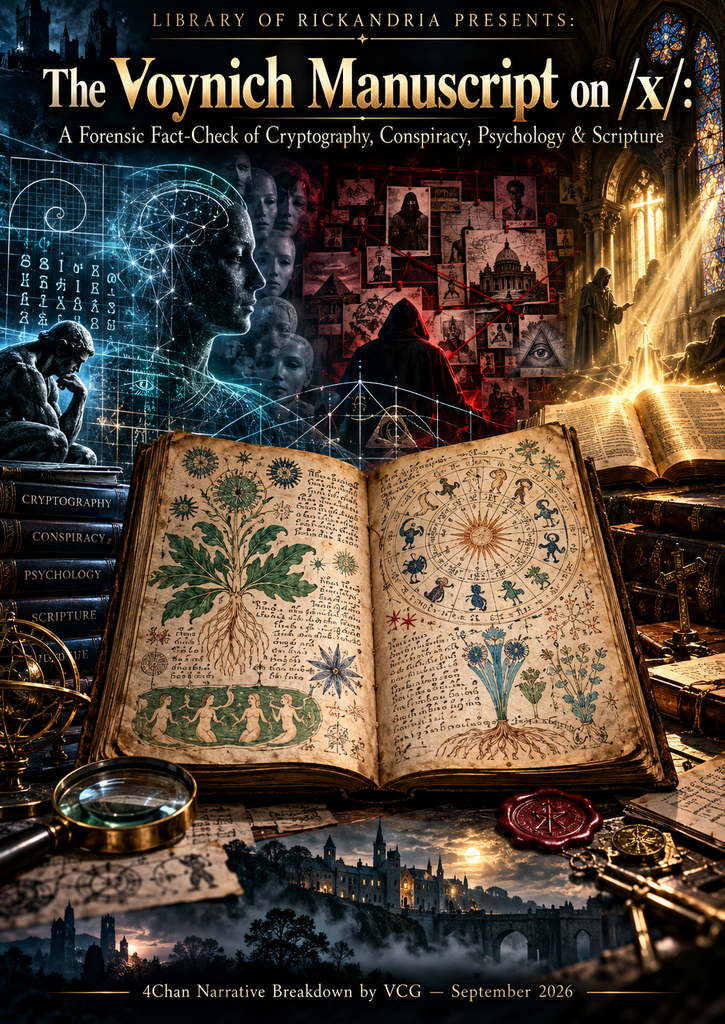
UPDATED BY VCG ON 9/25/2026 @ 03:33 EST
Anyone can do this, but most won’t.
ChatGPT – Library of Rickandria
“It is the glory of God to conceal a thing: but the honour of kings is to search out a matter.” — Proverbs 25:2, KJV
Abstract
On September 23–24, 2026, an anonymous thread on 4chan’s /x/ board began with a familiar mystery: the Voynich Manuscript.
/x/ – Even AI can’t decipher it. My theory: it’s an ali – Paranormal – 4chan
The opening poster reasoned from the manuscript’s resistance to modern decipherment—including attempts involving artificial intelligence—to the possibility that its writing might be extraterrestrial.
The replies quickly expanded into competing explanations:
- meaningless text
- an elaborate historical hoax
- a grille-generated cipher
- Romani
- “Tartarian”
- Old Turkish
- religious allegory
- a private biological journal
- fairy language
and finally an alleged translation describing a murderous cult.
This paper treats the thread neither as authoritative scholarship nor as something to mock.
It treats it as a useful case study in how people reason when evidence is incomplete.
The investigation proceeds along five separate evidentiary tracks:
- manuscript history and material evidence
- linguistics and cryptology
- standards of decipherment
- psychology of uncertainty and online discourse
and Scripture.
Those categories are deliberately kept separate.
Radiocarbon analysis can tell us something about parchment but nothing about whether a particular theological interpretation is correct.
Statistical linguistics can identify structure without revealing meaning.
Psychological research can illuminate patterns of reasoning without diagnosing anonymous posters.
Scripture can govern:
- honesty
- discernment
- testimony
- occult practice
and humility without supplying the plaintext of an undeciphered medieval manuscript.
The principal finding is deliberately modest.
- The Voynich Manuscript is an authentic historical artifact whose parchment is medieval
- its text exhibits substantial nonrandom structure
- no generally accepted decipherment exists as of September 25, 2026
- natural-language, cryptographic, and deliberately generated-text models all remain subjects of serious investigation
and the thread supplies no positive evidence for:
- extraterrestrial
- fairy
- Tartarian-supercivilization
or murderous-cult explanations.
Recent 2025–2026 cryptological work makes the question more interesting rather than less:
some unusual statistical properties of Voynichese can apparently be reproduced by historically plausible verbose substitution systems, strengthening the case that structured ciphertext remains viable without providing an actual decipherment.
The governing principle of the paper is therefore not:
“believe nothing strange.”
It is:
“Prove all things; hold fast that which is good.” — 1 Thessalonians 5:21, KJV
I. Why This Thread Is Worth Taking Seriously
It would be easy to dismiss an anonymous /x/ discussion as internet noise.
That would miss something important.
The Voynich Manuscript is exactly the sort of object that exposes weaknesses in human reasoning because it gives us enough structure to invite interpretation, but not enough understood meaning to constrain interpretation strongly.
Its pages look purposeful.
- Plants
- circular diagrams
- human figures
- containers
- stars
- pools
- tubes
- symbols
and hundreds of lines of unfamiliar writing practically demand an explanation.
Yet the usual corrective—simply reading the text—is unavailable.
That creates fertile ground for two opposite errors.
One is credulity:
“We cannot explain this, therefore an extraordinary hidden explanation must be true.”
The other is dismissiveness:
“We cannot explain this, therefore there is nothing there to explain.”
The /x/ thread contains both.
Our task is consequently not to replace one kind of confidence with another.
It is to ask, claim by claim:
CLAIM → EVIDENCE → TEST → RESULT → SCRIPTURAL PRINCIPLE
That sequence will be used throughout this paper.
II. Method: Keeping Five Different Questions Separate
A recurring problem in discussions of the Voynich Manuscript is category confusion.
- Historical evidence
- cryptanalysis
- psychology
- iconography
- theology
get mixed together until a suggestive fact in one field is treated as proof in another.
This paper therefore uses five distinct lanes.
History and material evidence concern what the physical manuscript is, when its constituent materials were produced, who possessed it, and what documents attest its existence.
Linguistics and cryptology concern:
- statistical structure
- glyph distribution
- recurring tokens
- entropy
- positional constraints
- possible encryption
and possible relationships to natural language.
Interpretation concerns proposed meanings:
- herbal manual
- medical book
- encoded journal
- hoax
- religious allegory
- Turkish text
- Romani text
and so forth.
Psychology concerns mechanisms known from experimental and social research—
- confirmation bias
- pattern detection
- uncertainty reduction
- repetition effects
- online disinhibition
These mechanisms are discussed as possible features of discourse, never as diagnoses of anonymous individuals.
Scripture supplies theological and ethical principles concerning:
- truth
- testimony
- judgment
- speech
- occult practice
- humility
Scripture is not used as a shortcut around manuscript research.
The distinction is fundamental.
Finding an astrological-looking diagram does not prove demon worship.
Finding language-like statistics does not prove readable prose.
Demonstrating that a hoax could have been generated does not prove that it was.
And showing that a biblical text condemns divination does not establish that the unknown author of MS 408 practiced divination.
III. Evidence Grades Used in This Paper
To prevent possibility from quietly becoming certainty, claims are assigned an evidentiary status.
| Grade | Meaning |
|---|---|
| Established | Supported directly by strong primary, institutional, or converging scholarly evidence. |
| Strongly Supported | Multiple substantial lines of evidence favor the claim, while some uncertainty remains. |
| Plausible | A workable mechanism or meaningful evidence exists, but historical demonstration is lacking. |
| Speculative | Possible, but positive evidence is weak or highly incomplete. |
| Unsupported | No adequate positive evidence was supplied or found. |
| Contradicted | Conflicts with substantial established evidence in the form asserted. |
These grades apply to claims, not people.
A person can make an unsupported claim without being dishonest.
A mistaken claim may be based on partial information.
Conversely, a skeptical claim is not automatically stronger merely because it sounds conservative.
IV. Findings at a Glance
| Question | Finding |
|---|---|
| Is the manuscript a modern invention by Wilfrid Voynich? | Contradicted. It is documented centuries before Voynich and its parchment is medieval. |
| Does radiocarbon dating prove the writing itself was applied in 1404–1438? | No. That range dates sampled parchment, not the precise moment of inscription. |
| Is there “no pattern” in Voynichese? | Contradicted. Extensive statistical structure is documented. |
| Does language-like structure prove ordinary plaintext language? | No. Cipher systems and generated text can also produce structured statistics. |
| Has the manuscript been conclusively translated as Turkish? | No. Genuine Turkish proposals exist, but no generally accepted decipherment has resulted. |
| Has a Romani solution been proposed? | Yes. A recent proposal exists, but it remains unconfirmed and has received substantial methodological criticism. |
| Is a hoax impossible? | No. Historically plausible pseudotext-generation mechanisms have been demonstrated. |
| Has a hoax been proved? | No. Demonstrating possibility is not evidence that the historical author used that mechanism. |
| Did “Tartary” exist historically? | Yes, as a broad European geographical/cartographic designation. |
| Do Tartary maps prove a suppressed advanced Tartarian civilization authored the Voynich? | No. That inference lacks evidence. |
| Does AI’s failure imply extraterrestrial authorship? | No. That is an argument from ignorance. |
| Does Scripture identify the Voynich Manuscript? | No. Scripture provides principles for discernment and condemns actual occult practices, but does not identify MS 408’s author or language. |
| Is there accepted evidence that the manuscript describes a child-killing cult? | No. The thread supplies no reproducible decipherment supporting this claim. |
V. Before the Theories: What Is the Voynich Manuscript?
The object usually called the Voynich Manuscript is Beinecke MS 408, held by Yale University’s Beinecke Rare Book & Manuscript Library.
Yale describes it as a richly illustrated manuscript written in an unidentified script by an unknown author.
The writing remains undeciphered.
Its images have traditionally been grouped into botanical, astronomical or astrological, bathing or “biological,” cosmological, pharmaceutical, and largely text-oriented sections sometimes provisionally described as recipes.
That description already tells us something important.
“Unknown” does not mean “unexamined.”
Scholars can:
- describe the manuscript’s physical construction
- identify recurring glyph forms
- compare sections
- distinguish illustrations
- reconstruct ownership history
- analyze inks and pigments
and measure the statistical behavior of the writing without knowing what the writing says.
The parchment date—and what it does not prove
Radiocarbon work on sampled parchment produced a combined early-fifteenth-century range commonly reported as approximately 1404–1438 at 95% probability.
This is one of the most important facts about the manuscript, but it is frequently misstated.
Radiocarbon dating measures the animal material used to manufacture the parchment.
It does not, by itself, date the instant when a scribe later applied ink.
Specialists involved in the dating have explicitly cautioned against treating the parchment date as an automatic date for the writing.
That distinction matters.
It makes a twentieth-century fabrication by Voynich extraordinarily difficult to reconcile with the evidence, especially because documentary records of the manuscript long predate Voynich.
But the parchment date by itself cannot exclude every possibility that the parchment sat unused before being written on.
Materials analysis provides additional context.
McCrone Associates examined inks and pigments and found materials such as iron-gall-type writing ink, azurite-related blue pigment, copper-containing greens, and iron-based earth colors consistent with historical manuscript practice.
No decisive modern pigment requiring a modern-forgery explanation emerged from those tests.
The careful conclusion is therefore stronger than:
“we carbon-dated the writing,”
but weaker than
“every stroke has been directly dated to 1415.”
The parchment is medieval; the physical materials are compatible with historical production; documentary evidence establishes that the manuscript existed centuries before Voynich.
Provenance: incomplete is not nonexistent
The thread later claims that there is:
“no chain of custody.”
That is much too strong.
A seventeenth-century trail links the mysterious volume to Georg Baresch or Barschius, Johannes Marcus Marci, and the Jesuit polymath Athanasius Kircher.
The surviving Marci letter sent with the manuscript to Kircher reports an earlier story that Emperor Rudolf II had bought the book for 600 ducats, with Roger Bacon suggested as author.
That part of the provenance is reported information, not equivalent to a surviving imperial sales receipt, and should be described as such.
Later ownership is much firmer:
Voynich acquired the manuscript from a Jesuit collection in 1912; it subsequently passed through:
- Ethel Voynich
- Anne Nill
- bookseller H. P. Kraus
and eventually Yale.
There are gaps and uncertainties, especially toward the beginning.
But:
“we cannot reconstruct every transfer”
is not the same proposition as:
“there is no provenance.”
That distinction—between an incomplete record and no record at all—will recur throughout this investigation.
VI. The First Major Correction: Voynichese Does Have Rules
One of the thread’s strongest skeptical claims is that if scholars cannot decipher the manuscript, then its writing must lack consistent rules.
That proposition is contradicted by decades of research.
- Jorge Stolfi
- Jacques Guy
- Prescott Currier
- Gabriel Landini
- Marcelo Montemurro
- Damián Zanette
- Diego Amancio
- Claire Bowern
- Luke Lindemann
and many others have studied recurring structural features in Voynichese.
Landini’s spectral analysis found statistical behavior compatible in important respects with linguistic organization rather than random character sequences.
Amancio and colleagues found network and intermittency measures broadly compatible with natural-language behavior and inconsistent with simple random text.
Montemurro and Zanette identified long-range distributional structure they argued was compatible with meaningful linguistic sequences.
Bowern and Lindemann later reviewed the linguistic evidence and concluded that natural-language-based explanations deserve serious consideration despite the absence of a decipherment.
Yet there is an equally important complication.
Voynichese is not statistically ordinary.
Character predictability is unusually high in some analyses.
Glyphs exhibit strong positional constraints within tokens.
Different manuscript sections show meaningful vocabulary differences.
Some forms occur in specific places with surprising regularity.
These facts can be read as evidence of:
- unusual orthography
- abbreviation
- cipher mechanics
- generated text
—or some combination thereof.
The proper conclusion is therefore not:
“It looks like language, therefore it is ordinary plaintext.”
Nor:
“It has unusual statistics, therefore it is nonsense.”
It is:
The production process is strongly structured.
What produced that structure remains unresolved.
VII. The 2025–2026 Development: Cipher Models Became More Interesting
The newest research makes simplistic conclusions even harder.
Michael Greshko’s 2025 Cryptologia work introduced the “Naibbe cipher,” a historically motivated hand-executable verbose substitution system designed using techniques and materials plausible for the fifteenth century.
The significance of the experiment is not that Greshko decoded the Voynich Manuscript—he did not—but that the resulting ciphertext reportedly reproduces several statistical peculiarities associated with Voynichese.
Rod Kinnison’s September 2026 Cryptologia paper goes further into positional entropy.
It reports a pronounced pattern in Voynichese in which uncertainty behaves differently across token positions,
and compares this phenomenon with:
- natural languages
- constructed languages
- cipher outputs
A verbose substitution cipher derived from Latin reportedly reproduced the relevant entropy profile substantially better than ordinary language controls.
Shuffling destroys the effect, indicating that the pattern depends upon structured generation rather than mere character frequency.
Again, this is not a translation.
It is evidence concerning the space of plausible mechanisms.
There is no contradiction in saying that earlier studies found language-like organization while later studies find that certain cipher systems can reproduce unusual Voynich statistics.
A ciphertext can contain a natural-language message underneath it.
Different statistical tests also examine different properties.
The emerging picture is therefore not:
“language versus cipher”
as an absolute dichotomy.
A cipher may encode language.
A special notation may encode language.
A generated pseudotext system may imitate some linguistic statistics.
The difficult question is which model explains the largest range of properties with the fewest arbitrary exceptions.
VIII. What Would Count as a Real Decipherment?
Voynich research is crowded with announced solutions.
That makes methodological standards more important than enthusiasm.
A convincing decipherment should establish a stable glyph or token system before translating convenient examples.
The same rules should operate across large portions of the manuscript rather than a few selected labels.
The proposed language or cipher should explain:
- recurring words
- rare words
- positional restrictions
- repeated phrases
- section-specific vocabulary
and variant glyphs without requiring constant improvised exceptions.
Most importantly, a serious method should survive held-out testing.
A researcher could develop a system on one defined portion of the manuscript, freeze the rules publicly, and then apply them to previously untreated folios.
Other researchers should be able to follow the method without consulting the inventor for each difficult word.
Successful decipherment would therefore involve several converging properties:
- reproducibility
- corpus coverage
- grammatical or cryptographic consistency
- historical plausibility
- explanatory power
- low interpretive freedom
- predictive success
Historical plausibility alone is not sufficient.
A fifteenth-century language may be historically possible and still be the wrong language.
A cipher may be technically possible and still not be the cipher used.
A translated sentence may sound meaningful and still be the result of excessive interpretive freedom.
This gives us a useful rule:
A decipherment is not established when the inventor can make the text say something.
It becomes persuasive when other people, using the same fixed rules, can independently recover the same thing.
IX. Why Decipherment Claims So Easily Overfit
Imagine a proposed system in which one Voynich glyph may represent three different vowels, another can be ignored as a “silent marker,” spaces may be moved when necessary, adjacent symbols may sometimes be transposed, unusual spelling is allowed because the language is medieval, and the solver may occasionally select cognates from neighboring languages.
With enough flexibility, meaningful-looking phrases become surprisingly easy to produce.
This is the cryptanalytic equivalent of moving the target after each shot.
The danger becomes especially severe when the solver already knows what the picture depicts.
A plant illustration encourages the solver to search for words meaning:
- leaf
- root
- herb
- water
- medicine
- green
- seed
or flower.
An astronomical picture encourages:
- sun
- moon
- star
- circle
- heaven
- year
- zodiac
or planet.
If dozens of candidate substitutions are permitted, accidental semantic matches can begin to look impressive.
The antidote is not cynicism.
It is constraint.
Declare the rules first.
Minimize discretionary choices.
Test passages whose interpretation was not used to construct the system.
Measure failure as carefully as success.
And invite independent reproduction.
X. Steelmanning the Major Explanatory Models
Before criticizing theories, it is fair to state their strongest form.
Natural-language model
The strongest version does not claim that Voynichese is simply ordinary medieval Italian or Latin written in a funny alphabet.
It proposes that underlying natural language may be represented through:
- an unusual orthography
- abbreviation system
- transformation
or cipher layer.
- The linguistic-like distributions
- recurring morphology-like patterns
- section-specific vocabulary
and long-range organization support taking this possibility seriously.
Its difficulty is that no proposed language has produced an accepted, reproducible reading of the corpus, and some entropy properties are unlike ordinary natural-language writing.
Status: Plausible and seriously supported as a research family, not demonstrated as a specific solution.
Cipher model
A strong cipher model explains why the manuscript is systematically structured while remaining resistant to straightforward linguistic identification.
Historically plausible verbose or homophonic systems can generate unusual distributions, and recent Cryptologia work strengthens this family of explanations.
Its difficulty is obvious:
no actual historical key or reproducible corpus-wide decryption has been recovered.
Status: Plausible and increasingly technically interesting; not deciphered.
Meaningless pseudotext or hoax
Gordon Rugg demonstrated that relatively simple historical methods involving tables of components and a Cardan-grille-like device could generate large quantities of Voynich-like text without requiring the author to compose meaningful plaintext.
This is a major point in favor of the possibility of a sophisticated historical hoax.
The difficulty is that Rugg reconstructed a possible process.
He did not uncover the historical author’s:
- grille
- workshop notes
- confession
or source table.
Status: Plausible mechanism; historical use unproved.
Mnemonic, technical, or constructed notation
The text could represent information by a system that does not map neatly onto ordinary prose:
- recipes
- mnemonic forms
- index-like notation
- structured labels
- compressed technical material
or another specialized system.
This can potentially explain some unusual regularity without requiring meaningless content.
The difficulty is that it remains highly underdetermined.
Status: Speculative but methodologically legitimate.
Random gibberish
Simple independent random characters do not fit the demonstrated:
- recurrence patterns
- positional constraints
- section differences
- long-range organization
Status: Contradicted in the simple form.
Extraterrestrial, fairy, or hidden-Tartarian language
These proposals would require positive evidence distinguishing them from human alternatives. None has been produced.
Status: Unsupported.
XI. Line-by-Line Forensic Walkthrough of the /x/ Thread
Post 43000855 — AI has failed; perhaps the language is extraterrestrial
The opening post connects two ideas: modern systems have not decoded the manuscript, and perhaps the reason is that the language is alien.
The first part is broadly fair with qualifications.
Computational methods and machine learning have been applied to Voynichese without producing a universally accepted decipherment.
A University of Alberta project led by Greg Kondrak and Bradley Hauer, for example, used computational language-identification methods and ranked Hebrew highly under a particular set of assumptions.
The researchers themselves stressed that identifying a candidate language would only be a first step.
Their subsequent demonstration depended heavily upon assumptions about alphagrams and letter rearrangement and never became an independently validated corpus-wide reading.
The leap to extraterrestrial authorship is different.
Failure to solve a human puzzle does not supply positive evidence for nonhuman authorship.
This is an argument from ignorance:
“We do not know X; therefore Y.”
To make an extraterrestrial hypothesis evidentially useful, it would need observations more expected under extraterrestrial authorship than under:
- human language
- cipher
- notation
or pseudotext.
The thread offers none.
Everything physically established about the manuscript—
- parchment
- inks
- pigments
- manuscript construction
- historical correspondence
—places the object comfortably inside a human manuscript context.
This does not philosophically prove that extraterrestrial intelligence cannot exist.
It simply means extraterrestrials are doing no explanatory work here.
Psychological note:
uncertainty naturally encourages causal explanation.
Research on conspiracy and extraordinary belief suggests that epistemic needs for explanation and some forms of pattern perception can influence belief formation under uncertainty.
That is population-level research, not a diagnosis of this poster.
Scriptural correction:
Scripture never identifies the Voynich Manuscript or instructs believers to fill unknowns with supernatural speculation.
Proverbs 18:13 says,
“He that answereth a matter before he heareth it, it is folly and shame unto him.”
Christian supernaturalism is not paranormal credulity.
Post 43001287 — Perhaps it is simply meaningless
This is much more economical than the extraterrestrial theory, but economy does not equal proof.
A meaningless-text explanation is historically possible.
Rugg’s work matters because it demonstrates that a premodern mechanism could generate structured-looking pseudotext without requiring a meaningful message.
But “meaningless” has to be defined carefully.
There is a large difference between randomly striking symbols and systematically generating meaningless sequences according to rules.
Voynichese is inconsistent with naive random-character models precisely because it is highly organized.
So we should distinguish:
random noise,
structured pseudotext, and
structured meaningful text or ciphertext.
Only the first is strongly contradicted by the statistical evidence.
The other two remain in contention.
The Christian methodological point is simple: skepticism is also a claim that must be tested.
First Thessalonians 5:21 does not say
“test strange things but accept skeptical things automatically.”
It says,
“Prove all things.”
Post 43001307 — If it cannot be deciphered, there must be no consistent linguistic rules
This is the clearest factual error in the early thread.
Voynichese does exhibit consistent rules.
Researchers have documented recurring:
- token patterns
- strong positional restrictions
- section-related vocabulary shifts
- long-range word clustering
and statistically nonrandom behavior.
Different researchers disagree over what those patterns mean, but the existence of substantial regularity is not seriously captured by:
“there is no pattern.”
The logical error is a false equivalence between:
“I cannot recover the meaning”
and
“there are no governing rules.”
A ciphertext can obey rigid rules while remaining unread to someone without its key.
A formal notation can contain consistent grammar without mapping transparently onto ordinary words.
A pseudotext generator can also have strict production rules.
The 2026 positional-entropy work makes the mistake even clearer:
Kinnison finds too much systematic positional constraint to treat Voynichese as structureless noise.
Status of the claim: Contradicted.
Scriptural principle: Proverbs 18:13 applies particularly well here.
The evidence needs to be heard before the conclusion is pronounced.
Post 43001439 — Perhaps its rules are beyond human understanding
This reply correctly sees the false dichotomy in the preceding post:
failure to decipher does not mean absence of rules.
But it then moves toward an explanation that is almost impossible to test.
A claim that something is
“beyond human understanding”
can immunize itself against every outcome.
If scholars find structure, perhaps the incomprehensible system contains structure.
If they fail to find structure, that too may be because it is incomprehensible.
If every possible observation is compatible with the theory, the theory predicts very little.
Furthermore, the manuscript is already partially understandable in the limited scientific sense.
Researchers can:
- model its distributions
- distinguish text types
- identify repeated forms
- detect scribal variation
and describe its material composition.
Whatever its semantic content may be, it is not wholly outside human analysis.
The post also turns toward personal abuse.
That is a separate issue from whether its argument contains a valid point.
Research on the online disinhibition effect has identified:
- anonymity
- invisibility
- asynchronicity
- reduced social cues
as factors that can loosen ordinary interpersonal restraints online.
An anonymous imageboard supplies several of those conditions.
Again, this explains a communication environment; it does not diagnose the person posting.
Scripture explicitly joins correction of error with manner of correction:
“And the servant of the Lord must not strive; but be gentle unto all men, apt to teach, patient, In meekness instructing those that oppose themselves.” — 2 Timothy 2:24–25
Being correct does not give a Christian permission to become vicious.
Post 43001464 — It is a hoax; there is no provenance or author, and it was made to fleece a buyer
This post contains one fact, one exaggeration, and one speculation.
The author is indeed unknown.
The provenance is incomplete.
But the claim that there is no custody history is wrong.
Seventeenth-century correspondence anchors the manuscript in the Baresch–Marci–Kircher circle, and its modern ownership history after Voynich is well documented.
The earlier Rudolf II connection is reported rather than fully documented by a surviving purchase instrument, so a careful historian should preserve that distinction.
The idea that someone made the book specifically to defraud a wealthy purchaser is possible but unsupported by evidence supplied in the thread.
This requires another distinction:
A historical hoax is not the same as a modern forgery.
The evidence strongly contradicts the idea that Wilfrid Voynich fabricated the manuscript in the twentieth century.
A much earlier pseudotext or deceptive artifact remains possible.
Rugg’s experiment makes such an early hoax technically imaginable.
It does not identify the:
- motive
- culprit
- buyer
or historical occasion.
Status: Unknown author — Established.
Incomplete provenance — Established.
No provenance — Contradicted. Fraud motive — Unsupported.
Historical hoax — Plausible.
Scriptural principle:
skepticism receives no exemption from:
“prove all things.”
Post 43001483 — “Stop sinning”
As Christian theology, the universal need for repentance is a legitimate biblical subject.
As cryptanalysis, the statement contributes no evidence.
It identifies neither what sin is allegedly occurring nor how that bears upon MS 408.
This distinction matters because biblical truth can be used badly when it is detached from context.
A true sentence does not automatically become a relevant argument.
If the concern were:
- lying
- false accusation
- occult practice
- railing
- pride
or another identifiable behavior, Scripture could be applied to that behavior carefully.
But
“stop sinning”
cannot serve as a substitute for manuscript analysis.
Second Timothy 2 does not present Christian correction as indiscriminate rebuke.
It emphasizes patience, teaching, and meekness.
Post 43001512 — The hoax answer is probably the right one
This adds social agreement but little new evidence.
Consensus can matter when it reflects independent expert investigation.
Agreement among anonymous replies repeating the same premise is something else.
The distinction is independence.
If ten websites repeat a claim originating in one speculative paper, we do not possess ten independent sources.
If several posters repeat the idea that the Voynich is a hoax without providing additional historical or cryptographic evidence, the evidentiary base has not multiplied simply because the idea has become familiar.
This matters psychologically because repeated statements often feel increasingly true.
Research on the illusory truth effect, including modern meta-analytic work, finds that repetition can increase perceived truth even when the repeated claim is false or questionable.
That does not mean agreement is meaningless.
It means repetition should never be confused with independent confirmation.
Post 43001518 — Perhaps it is “fairy language”
There is no evidence provided for this hypothesis.
As a folklore concept, fairies can be studied historically.
As a cryptanalytic explanation, “fairy language” supplies no:
- testable mapping
- corpus
- grammar
- external reference text
or physical evidence.
The biblical distinction is important.
Scripture speaks of:
- angels
- devils
- unclean spirits
- cherubim
- seraphim
and other spiritual beings in particular contexts.
It does not furnish “fairies” as a category by which undeciphered medieval manuscripts should be classified.
It would therefore be improper to take a category from later folklore, merge it with biblical demonology, and then use Scripture as though Scripture had made the identification.
Status: Unsupported.
Post 43001819 — The text was generated by looking through holes and copying letters from existing text
This post appears to contain a distorted memory of a real scholarly proposal.
Gordon Rugg demonstrated a method involving tables of word components and a Cardan-grille-like sheet with openings.
Moving the grille over the table allows combinations of fragments to be selected, producing extensive Voynich-like sequences.
It was an experimental demonstration that sophisticated pseudotext could be produced efficiently using historically plausible technology.
But Rugg did not discover the author’s actual perforated sheet.
Nor is his core proposal simply:
“hold holes over existing books and copy letters.”
This is an excellent example of how information mutates online:
researcher demonstrates a possible mechanism → secondary summaries simplify it → later retellings turn the possibility into a discovered fact.
The fair conclusion is:
Rugg substantially strengthened the technical plausibility of a pseudotext/hoax model.
He did not prove that the Voynich author used his reconstructed process.
Status: Partly grounded in real research; historical certainty unsupported.
Post 43001857 — Ancient language, Romani, perhaps Tartarian
This post bundles several very different possibilities together.
“Ancient language”
is so broad that it makes almost no discriminating prediction.
Romani is different.
It is a documented Indo-Aryan language with a historical development that linguists can study.
Early written evidence is sparse, especially for the period relevant to the Voynich.
Sources on Romani history place the earliest surviving word lists and textual witnesses in the early sixteenth century, leaving a limited direct written corpus for comparison with a fifteenth-century manuscript.
Interestingly, a 2026 proposal has indeed argued for an archaic Balkan Romani reading of Voynichese.
A specialist critique subsequently reported substantial problems with the claimed lexical coverage and reconstruction.
That critique itself should not be treated as the last word—it is part of an ongoing specialist debate—but it illustrates why an announced solution requires independent validation.
“Tartarian” poses a different historical problem.
Tartary or Tartaria really did appear on European maps.
It was a broad and shifting geographical designation applied to large regions of northern and central Asia, often associated by Europeans with various Turkic, Mongolic, and other populations.
Library of Congress maps preserve labels such as Western Tartary, Chinese Tartary, and Independent Tartary.
What does not follow is that every historical map label represents one unified hidden civilization, much less that this civilization authored the Voynich Manuscript.
Map label → geographical category → state → civilization → Voynich authorship.
Each arrow requires evidence.
The thread supplies none.
Post 43001941 — Tartaria never existed
This correction overcorrects.
If “Tartaria” means the historical geographical designation, then the statement is plainly wrong.
Historical maps and geographical works use the term extensively.
If the poster instead means a particular modern theory of a concealed technologically advanced global Tartarian empire, then saying that historical maps do not establish such a civilization would be a defensible correction.
Accuracy matters even when rebutting a bad argument.
The best response to misuse of history is better history—not an opposite simplification.
The personal abuse and death wish attached to the post add nothing evidentially and run directly against the manner of Christian correction described in 2 Timothy 2:24–25.
Post 43001984 — The manuscript has already been translated as ancient Turkish
There really are Turkish decipherment proposals.
That part should not be dismissed.
Researchers and independent investigators associated with the ATA project have proposed that portions of Voynichese can be read as forms of historical Turkish, and some publications present transliterations and translations of selected pages.
The problem is the word already.
An announced decipherment is not the same thing as an accepted decipherment.
Yale continues to describe the manuscript as undeciphered, and the broader linguistic and cryptological literature continues to investigate it as an unsolved text.
The existence of ongoing 2025–2026 cipher research would itself be difficult to reconcile with the claim that a reproducible consensus translation had already settled the matter.
A Turkish hypothesis should receive exactly the same test as every other candidate:
freeze the mapping;
apply it widely;
explain grammar and spelling consistently;
translate held-out text;
and let independent Turkish historical linguists reproduce the results.
Status: Turkish proposal exists — Established.
Voynich conclusively translated as Turkish — Unsupported by scholarly consensus.
Proverbs 18:17 captures the methodological principle:
“He that is first in his own cause seemeth just; but his neighbour cometh and searcheth him.”
That is not a rule against new theories.
It is a rule against stopping at the first persuasive presentation.
Post 43002337 — Perhaps the imagery is a religious allegory
Unlike several stronger assertions, this is framed as a possibility.
Religious allegory is historically conceivable.
Medieval and early-modern manuscript culture could combine:
- medicine
- astrology
- theology
- cosmology
- natural philosophy
- symbolism
- practical instruction
in ways that do not fit modern disciplinary boundaries.
But the pictures alone do not prove a primarily religious purpose.
Yale’s conventional section descriptions emphasize:
- plants, astronomical or astrological diagrams
- bathing imagery
- cosmology
- pharmaceutical material
and text-heavy sections.
Some of these can carry symbolic meanings without making the whole manuscript a theological allegory.
This post demonstrates something worth preserving:
speculation becomes much healthier when explicitly labeled speculation.
“Could this be allegorical?”
invites testing.
“This is the secret religion behind the manuscript”
demands evidence.
Status: Speculative.
Post 43002476 — How many other unknown languages has AI actually deciphered?
This is one of the thread’s most valuable methodological questions.
The opening post treats “AI” almost as though it were one universal decipherment machine. It is not.
Computational performance depends on what problem researchers ask the system to solve and what assumptions they feed it.
Does the text represent substitution?
Transposition?
An abjad?
Abbreviated Latin?
A syllabary?
A verbose homophonic cipher?
An invented language?
Structured nonsense?
How are glyph variants transcribed?
Are spaces meaningful?
What candidate languages are included?
Without a known:
- plaintext
- parallel text
- key
or secure linguistic anchor, evaluation becomes especially difficult.
The Alberta experiment demonstrates both the promise and the limitation.
Algorithms could rank candidate languages under specific assumptions.
That did not transform the computer into an independent oracle capable of announcing the manuscript’s meaning.
So “AI failed” tells us much less than the opening post assumes.
Post 43003523 — Is the Turkish claim real?
The clean answer is:
The proposal is real.
The decipherment is not established.
This is an important distinction for every sensational headline involving the Voynich Manuscript.
“Researcher claims to decode manuscript”
describes an event.
“Manuscript decoded”
describes a successful evidentiary conclusion.
Those statements are not interchangeable.
Post 43003534 — Tartaria believers and Atlantis believers do not always overlap
This observation concerns online subcultures more than the manuscript.
It does usefully remind us that “alternative history” is not a single belief package.
Someone can entertain Atlantis while rejecting Tartaria, or vice versa.
Psychological research does show that endorsement of one conspiracy narrative can correlate statistically with broader styles of conspiratorial interpretation.
But such population-level correlations do not license us to infer an individual’s entire belief system from one forum comment.
For our purposes, this post provides no evidence about Voynichese itself.
Post 43003599 — Perhaps it was a private coded biological journal whose key was lost
This is one of the more historically plausible classes of hypothesis in the thread.
The manuscript contains extensive botanical-looking material, human figures associated with pools or tubes, astronomical or astrological diagrams, and apparent pharmaceutical imagery.
A private technical or scholarly manuscript using an idiosyncratic cipher is therefore quite imaginable.
Calling it a “biology journal,” however, imports a modern disciplinary category into a period when:
- medicine
- astrology
- pharmacy
- botany
- natural philosophy
- cosmology
and religious assumptions were frequently intertwined.
The stronger formulation is:
The manuscript may encode technical, medical, pharmaceutical, natural-philosophical, astrological, or related practical knowledge through a private notation or cipher.
That is historically plausible.
It is not yet proved.
The 2025–2026 cipher work makes this general class of theory especially worthy of investigation without validating the specific “biology journal” description.
Post 43003972 — “I can read it”
A claimed ability without a demonstrated method cannot be evaluated.
A serious follow-up would require the reader to publish the:
- transcription rules
- glyph values
- grammar
or cipher process, translations of substantial passages, and predictions for untreated pages.
If those appear, the claim becomes testable.
Until then,
“I can read it”
is testimony without demonstration.
First Thessalonians 5:21 provides an appropriate principle:
“Prove all things; hold fast that which is good.”
The point is not reflexive disbelief.
It is verification.
Post 43004291 — Another anonymous poster supposedly translated it as a cult celebrating the killing of children
This is the most sensational assertion in the thread and among the least evidenced.
We are given no surviving translation, no glyph table, no post reference establishing the method, no complete transcription, no grammar, no key, no independent reader, and no held-out validation.
What has been established?
Only that one anonymous participant reports remembering another anonymous participant who supposedly had a consistent translation.
That is multiple steps removed from primary evidence.
The emotional intensity of the alleged content does not increase its evidentiary weight.
Indeed, the more serious the accusation, the more cautious the investigator should become.
Deuteronomy 19:15 states within Israel’s legal context that:
“at the mouth of two witnesses, or at the mouth of three witnesses, shall the matter be established.”
That verse is not a modern scientific statistics manual, and we should not misuse it as one.
But the underlying biblical concern with corroborated testimony rather than unsupported accusation is unmistakable.
If a reproducible translation demonstrating ritual child-killing emerges, it can be examined.
Until then, the claim remains unsupported.
XII. Master Claim Matrix
| Post | Core claim | Evidence status | Principal problem | Scriptural principle |
|---|---|---|---|---|
| 43000855 | AI failure suggests alien language | Unsupported | Argument from ignorance | Prov. 18:13; 1 Thess. 5:21 |
| 43001287 | Text may be meaningless | Plausible in structured-pseudotext form | Possible ≠ proved | 1 Thess. 5:21 |
| 43001307 | No decipherment means no rules | Contradicted | Documented statistical structure | Prov. 18:13 |
| 43001439 | Rules may be beyond human understanding | Speculative | Weak falsifiability | Humility in judgment |
| 43001464 | Hoax; no provenance; created to scam buyer | Mixed: hoax plausible, no provenance contradicted, scam motive unsupported | Collapses three separate propositions | 1 Thess. 5:21 |
| 43001483 | Stop sinning | Theologically general but irrelevant as evidence | Does not address manuscript claim | 2 Tim. 2:24–25 |
| 43001512 | Hoax is most likely because others agree | Unsupported as stated | Agreement ≠ independent evidence | Prov. 18:17 |
| 43001518 | Fairy language | Unsupported | No testable evidence | Do not add folklore to Scripture |
| 43001819 | Author used holes over source text | Partially grounded / overstated | Confuses reconstructed grille possibility with discovered historical method | 1 Thess. 5:21 |
| 43001857 | Romani/Tartarian/ancient language | Speculative | Bundles unrelated hypotheses | John 7:24 |
| 43001941 | Tartaria never existed | Contradicted if referring to historical toponym | Overcorrection | John 7:24; 2 Tim. 2:24 |
| 43001984 | Already translated as Old Turkish | Proposal established; successful decipherment unconfirmed | Proposal ≠ validated solution | Prov. 18:17 |
| 43002337 | Religious allegory | Speculative | Iconography alone insufficient | Avoid adding certainty beyond evidence |
| 43002476 | AI premise deserves scrutiny | Methodologically sound question | “AI” treated too generically by OP | 1 Thess. 5:21 |
| 43003523 | Is Turkish claim real? | The question is appropriate | Need distinguish existence from validation | Prov. 18:17 |
| 43003534 | Alternative-history communities differ | Possible social observation | Not evidence about manuscript | — |
| 43003599 | Private coded scientific/biological notebook | Plausible general class | Specific content still unknown | 1 Thess. 5:21 |
| 43003972 | Poster can read it | Unsupported | No method presented | 1 Thess. 5:21 |
| 43004291 | Cult/child-killing translation exists | Unsupported | Hearsay with no reproducible decipherment | Deut. 19:15; Prov. 18:17 |
The thread itself can be reviewed here:
Original /x/ thread, retrieved September 25, 2026
XIII. The Psychology of the Thread
Psychology is useful here only if handled carefully.
We do not know the:
- identities
- histories
- mental health
- sincerity
or motivations of the posters.
Nothing in this paper licenses a diagnosis.
What psychology can do is identify mechanisms demonstrated in populations that make certain conversational patterns understandable.
Uncertainty creates explanatory pressure
Karen Douglas and colleagues have organized motivations for conspiracy belief into epistemic, existential, and social categories.
People generally want explanations that make events understandable, preserve a sense of predictability, and fit broader models of the world.
An undeciphered manuscript is an almost perfect uncertainty machine.
There is clearly something there.
We just cannot confidently say what.
The urge to close the gap is understandable.
Pattern perception is both necessary and dangerous
Humans survive by detecting patterns.
Without pattern detection, there would be no language, science, historical reconstruction, or cryptanalysis.
The problem is not that people see patterns.
The problem is that sufficiently flexible searches will sometimes find connections that are not causally meaningful.
Experimental research has reported associations between illusory pattern perception and endorsement of paranormal or conspiratorial claims, although this relationship is probabilistic and should not be caricatured.
Voynich research presents a particularly difficult environment because the investigator can choose among thousands of glyph sequences, hundreds of pictures, many possible languages, flexible word boundaries, historical spelling variation, and almost unlimited semantic synonyms.
That is why methodological constraints matter.
Confirmation bias
Raymond Nickerson’s classic review describes confirmation bias as the tendency to seek or interpret evidence in ways partial to existing beliefs or hypotheses.
In Voynich research, the danger can appear like this:
A researcher suspects Turkish.
Turkish-looking candidates become memorable.
Failures are explained as spelling variation.
A botanical picture seems to confirm a guessed plant name.
The apparent successes then strengthen confidence in the original Turkish assumption.
Exactly the same loop could operate for:
- Latin
- Hebrew
- Romani
- astrology
- occultism
- extraterrestrials
or a hoax.
The solution is not to accuse the researcher of bias.
It is to design tests that make bias less powerful.
Repetition and familiarity
The illusory truth effect shows that repeated propositions often acquire greater subjective credibility merely through familiarity.
Recent reviews and meta-analyses continue to find a measurable effect across many contexts.
That is relevant to forum environments in which a rumor may be restated dozens of times until participants vaguely remember that
“somebody proved”
it.
A claim can move through stages:
someone proposed it → someone published it → researchers discussed it → it has been translated → everybody knows it says X.
At each stage, the epistemic strength may remain essentially unchanged even while the rhetoric becomes more confident.
Online disinhibition
John Suler’s work on online disinhibition describes how:
- anonymity
- invisibility
- asynchronicity
- reduced authority cues
and other features of online environments can alter behavior.
The /x/ thread moves rapidly from genuine methodological questions to contempt, insults, and a death wish.
That progression is psychologically understandable.
It is not intellectually productive.
And for a Christian investigator, it is not ethically neutral.
XIV. The Anatomy of a Viral Mystery Narrative
The thread develops in a recognizable sequence.
It begins with uncertainty:
nobody has conclusively deciphered the manuscript.
Uncertainty becomes an extraordinary suggestion:
perhaps it is alien.
That generates skeptical collapse:
perhaps it is simply nonsense.
The skeptic overstates his case:
no decipherment means no rules.
That invites a counter-mystery:
perhaps the rules transcend human understanding.
A historical explanation appears:
hoax.
The hoax then receives a remembered mechanism:
a grille.
Alternative identities accumulate:
Romani, Tartarian, Turkish.
Once one proposed translation enters the discussion, the conversation shifts from what is it? to someone already solved it.
Finally, a secondhand purported translation supplies emotionally potent content:
a murderous cult.
This does not demonstrate that anyone deliberately fabricated anything.
It demonstrates how a narrative can gain specificity faster than it gains evidence.
That is one of the most important lessons of the entire thread.
XV. The Tartaria Case Study: How a Real Historical Fact Becomes a Much Larger Claim
Tartaria provides an unusually clear lesson in historical reasoning.
First proposition:
Old European maps use “Tartary” or “Tartaria.”
True.
Second proposition:
The term referred to geographical regions associated with peoples Europeans broadly called Tartars.
Also true, with the normal complications of changing early-modern geographical terminology.
Third proposition:
Therefore all regions called Tartary belonged to one unified political state.
That no longer follows automatically.
Fourth proposition:
Therefore this state represented one suppressed technologically advanced civilization.
That requires another large body of evidence.
Fifth proposition:
Therefore the Voynich Manuscript is written in its language.
That requires yet another body of evidence.
The mistake is not recognizing “Tartaria” on an old map.
The mistake is treating a chain of separate propositions as though proving the first proves all the rest.
Historical investigation must move arrow by arrow.
XVI. AI Mythology and the Voynich Manuscript
The OP’s phrase “even AI” deserves special attention because it reflects a broader cultural misconception.
Artificial intelligence is not a universal truth machine.
A machine-learning model does not approach an unknown text without assumptions. Researchers determine how glyphs are transcribed, which features matter, what candidate languages exist, what transformations are permitted, and what objective counts as success.
If the manuscript employs a cipher type absent from the model’s search space, the correct answer may never be considered.
If spaces are deceptive, treating them as word boundaries may distort every measurement.
If the writing represents syllables rather than letters, a letter-based model may ask the wrong question.
If the text is pseudotext, language-identification software may still return the “closest” known language because ranking algorithms generally return something.
The Alberta Hebrew experiment is instructive precisely because it was not foolish research.
It showed what computation can do:
search large hypothesis spaces more systematically than humans.
But it also showed what computation cannot do automatically: turn an underdetermined historical object into ground truth.
The appropriate question is never merely:
“Did AI solve it?”
It is:
“What model, trained on what data, under what assumptions, optimized for what task, and validated how?”
XVII. Occultism: Evidence Versus Association
The Voynich Manuscript contains imagery that modern viewers may immediately call occult.
There are circular astronomical or astrological diagrams.
There are zodiac-like motifs.
There are unusual human figures.
There are strange botanical forms.
There are structures whose functions are unknown.
None of those observations, individually or together, proves:
- ritual magic
- demon worship
- necromancy
- sorcery
or satanic authorship.
Historically:
- astrology
- medicine
- astronomy
- calendrical calculation
- humoral theory
- natural philosophy
- herbalism
and religious cosmology overlapped in ways modern categories often obscure.
That does not mean occult practices did not exist.
Scripture is explicit concerning practices such as:
- divination
- enchantment
- witchcraft
- consulting familiar spirits
- wizardry
- necromancy
Deuteronomy 18:9–11 names and condemns them directly.
Isaiah likewise rebukes resort to familiar spirits and wizards and directs the people:
“To the law and to the testimony.”
Those texts tell us what Scripture says about actual occult practices.
They do not tell us that an unidentified circular drawing in MS 408 constitutes one of those practices.
The correct sequence is:
First establish historically what the manuscript depicts.
Then, if an identifiable practice corresponds to something Scripture addresses, apply the biblical text accurately.
Anything else risks using Scripture to baptize speculation.
XVIII. A Biblical Epistemology for Investigating Claims
The Bible is not a cryptology textbook.
But it repeatedly teaches habits deeply relevant to inquiry.
Hear before answering
“He that answereth a matter before he heareth it, it is folly and shame unto him.” — Proverbs 18:13
This directly opposes premature certainty.
Hear the other examination
“He that is first in his own cause seemeth just; but his neighbour cometh and searcheth him.” — Proverbs 18:17
A convincing first presentation should be tested by adversarial examination.
Search
Acts 17 praises the Bereans because they
“searched the scriptures daily, whether those things were so.”
The immediate subject is apostolic preaching and Scripture, not medieval cryptography. Nevertheless, the text unmistakably praises examination rather than passive reception.
Test
“Prove all things; hold fast that which is good.” — 1 Thessalonians 5:21
The command combines openness and discrimination.
Do not reject everything.
Do not believe everything.
Test.
Judge by reality rather than surface impression
“Judge not according to the appearance, but judge righteous judgment.” — John 7:24
Again, the original context must be respected.
Yet appearance-versus-right-judgment is directly relevant to our temptation to treat visually mysterious things as automatically mystical.
Seek corroboration where accusation is serious
Deuteronomy 19:15 requires multiple witnesses in Israel’s legal process.
It is not a direct command governing modern peer review.
But it reflects a biblical unwillingness to establish serious accusations on uncorroborated testimony.
Correct without becoming contentious
Second Timothy warns against foolish quarrels and commands gentleness, patience, and meekness in correction.
That matters especially on anonymous forums, where contempt can masquerade as discernment.
XIX. Scripture, Interpretation, and Historical Claims Must Not Be Blurred
For clarity, every Christian investigation should distinguish at least four levels.
Biblical statement:
what the text actually says.
Example: Deuteronomy condemns necromancy.
Biblical principle or application:
a reasoned application of the text.
Example:
Christians should not seek occult divination.
Theological or historical inference:
a conclusion requiring additional reasoning.
Example:
a particular historical ritual corresponds to biblical necromancy.
Empirical claim:
a proposition established through history, science, linguistics, archaeology, or another evidentiary discipline.
Example:
the Voynich Manuscript depicts that ritual.
The first does not automatically establish the fourth.
This distinction protects Scripture from being made responsible for conclusions Scripture never made.
It also protects research from pretending neutrality requires ignoring Scripture.
The two questions can coexist honestly.
XX. An Interesting Historical Note from the KJV Translators
The supplied Pure Cambridge Edition preserves the translators’ historical preface, The Translators to the Reader.
That preface is not inspired Scripture and should never be quoted as though it were.
Yet its methodological humility is worth noticing.
The translators explicitly discussed places where words or senses were difficult and defended acknowledging uncertainty rather than dogmatizing where the evidence did not permit certainty.
They also praised the searching and studying of Scripture.
That attitude is relevant here precisely because it is so different from internet certainty.
Intellectual humility does not mean truth is unknowable.
It means the investigator should not pretend to possess what the evidence has not yielded.
XXI. Alternative Explanations Compared by Evidence
This table deliberately does not select a “winner.”
It asks what each model explains and what evidence would move it forward.
| Model | What it explains | Main difficulty | What would strongly advance it | Current evidentiary status |
|---|---|---|---|---|
| Natural language under unusual orthography | Long-range organization, recurring morphology-like patterns, section vocabulary | Unusual entropy and no accepted reading | Reproducible grammar and held-out translation | Plausible |
| Natural language encrypted by verbose/homophonic cipher | Structure plus unusual character statistics | No recovered key/plaintext | Historically coherent cipher yielding broad reproducible plaintext | Plausible |
| Constructed technical notation or mnemonic system | Rigid recurring forms, domain-specific organization | No external key/comparison | Mapping that predicts unseen sections | Speculative |
| Meaningful text generated through tables/grilles | Can produce unusual systematic text | Historical method not identified | Physical/documentary evidence or successful consistent decoding | Plausible mechanism |
| Meaningless structured pseudotext/hoax | Explains undecipherability while preserving regularity | Natural-language-like organization and unknown historical motive/process | Documentary/physical production evidence | Plausible |
| Pure random gibberish | Explains undecipherability | Fails to explain documented structure | Would require statistical evidence currently lacking | Contradicted in simple form |
| Turkish plaintext | Some researchers claim lexical/grammatical correspondences | No broad independent consensus reproduction | Frozen corpus-wide method independently replicated | Unconfirmed proposal |
| Romani plaintext | Historically conceivable language family; recent proposal exists | Sparse early corpus and serious methodological challenges | Independent historical-linguistic replication | Unconfirmed proposal |
| Religious allegory | Symbolic manuscript culture historically plausible | Pictures do not uniquely imply allegory | Correlated reproducible reading of text and images | Speculative |
| Alien/fairy language | Explains mystery only by adding another mystery | No positive discriminating evidence | Unique evidence impossible under human models | Unsupported |
| Hidden Tartarian language | Historical “Tartary” term exists | No evidentiary bridge to Voynich | Actual linguistic/documentary connection | Unsupported |
XXII. Falsifiability: What Could Make Each Theory Lose?
A good hypothesis should risk being wrong.
An extraterrestrial theory needs some property that a human manuscript could not reasonably explain.
If every unexplained feature is simply called “alien,” the proposal is insulated rather than tested.
A fairy-language theory has the same problem, compounded by the absence of an independently documented fairy-language corpus.
A specific Turkish or Romani solution is much easier to test:
publish a fixed reading system and apply it to substantial untreated text.
Repeated failure outside handpicked passages would seriously weaken it.
A meaningless-hoax model would be strongly weakened by a reproducible decipherment that consistently generates grammatical, historically appropriate plaintext across the manuscript.
A natural-language model would be weakened if increasingly powerful generative or cryptographic models reproduced the manuscript’s detailed structure without semantic information while repeated language-based decoding attempts continued to require heavy ad hoc adjustment.
A cipher model would be dramatically strengthened by discovery of a stable transformation yielding coherent plaintext, but simple failure to find the key cannot by itself falsify every conceivable cipher.
The point is not that every historical hypothesis can be falsified as cleanly as a laboratory physics experiment.
The point is that investigators should identify in advance what evidence would make them change their minds.
If the answer is “nothing,” we are no longer doing much investigation.
XXIII. The Voynich Timeline: 1404–2026
| Date | Event / Evidence |
|---|---|
| 1404–1438 | Radiocarbon range commonly reported for sampled parchment; this dates parchment, not automatically the inscription. |
| 15th–16th century | Current Yale catalog situates manuscript production broadly in Central European manuscript culture; exact writing date remains debated. |
| Early 17th century | Reported connection with Rudolf II and later Jacobus Horčický de Tepenec; aspects remain historically less secure than later provenance. |
| 1630s onward | Georg Baresch/Barschius known to have possessed or investigated the manuscript; correspondence enters the documentary record. |
| 1665–1666 | Johannes Marcus Marci sends manuscript to Athanasius Kircher with the surviving explanatory letter. |
| 1912 | Wilfrid Voynich acquires manuscript from a Jesuit collection. |
| 1961 | Anne Nill sells it to H. P. Kraus. |
| 1969 | Kraus donates it to Yale’s Beinecke Library. |
| 2001 | Landini publishes spectral evidence for linguistic-like structure. |
| 2004 | Gordon Rugg publishes experimental table/grille hoax-generation model. |
| 2009 | Material and radiocarbon investigations strongly anchor the physical manuscript in historical rather than modern production. |
| 2011 | Modern computational/cryptological analyses increasingly formalize what is known about Voynichese. |
| 2013 | Independent statistical studies report natural-language-like long-range and network structure. |
| 2018 | Alberta computational project proposes Hebrew as a candidate under specific assumptions, without producing an accepted decipherment. |
| 2020 | Lisa Fagin Davis publishes palaeographical work arguing for multiple scribal hands; computational work continues to analyze unusual entropy. |
| 2021 | Bowern and Lindemann publish major linguistic review emphasizing the seriousness of natural-language-based analysis while the manuscript remains undeciphered. |
| 2025 | Greshko’s Naibbe cipher demonstrates that a historically plausible verbose substitution mechanism can reproduce multiple Voynich-like statistical properties. |
| 2026 | Kinnison publishes evidence that the manuscript’s unusual positional entropy profile can be reproduced by a verbose cipher model; this strengthens cipher viability without yielding plaintext. |
| 2026 | New claimed Turkish and Romani interpretations continue to circulate; no generally accepted corpus-wide decipherment exists as of September 25, 2026. |
The timeline itself teaches caution: “old parchment,” “fifteenth-century writing,” and “first documented owner” are three different claims.
XXIV. A Note on Scribal Hands: Even Apparently Settled Details Can Remain Open
Lisa Fagin Davis’s palaeographical analysis argued that multiple scribes—commonly summarized as five principal hands—participated in producing the manuscript.
This work is significant because multiple hands could imply a collaborative or workshop-like production environment rather than one isolated eccentric author.
More recent work has challenged aspects of that interpretation, arguing that glyph variation may alternatively reflect development within a single hand or a different account of scribal variation.
The newer challenge has not erased the earlier scholarship simply by existing.
Nor should the earlier paper be treated as untouchable because it was published first.
The correct presentation is:
Multiple hands are a serious palaeographical interpretation; aspects of the claim remain contested.
This is what responsible uncertainty looks like.
XXV. Source-Provenance Audit
Not all sources answer the same kinds of questions.
Primary and institutional material includes the manuscript itself, historical correspondence, Yale’s Beinecke catalog and digital scans, and laboratory reports.
These are our strongest sources for what the object physically is and what surviving documents contain.
Peer-reviewed scholarship includes Cryptologia, Manuscript Studies, Annual Review of Linguistics, PLOS ONE, and related linguistic or cryptographic research.
These sources are strongest for technical arguments, although peer review is a quality-control process rather than a guarantee that conclusions are final.
Specialist research sites and preprints can be extremely useful, especially in a small field where discoveries circulate quickly, but their claims require additional scrutiny.
University news and journalism help explain technical work and establish who claimed what.
They should not replace the underlying research when the underlying research is available.
Forums and anonymous posts are primary sources only for the discourse itself:
they prove what was said in the discussion.
They do not prove the historical or scientific proposition being discussed.
The same principle applies to independence.
Five articles derived from one press release are not five independent confirmations.
Twenty forum posts repeating one translation claim are not twenty decipherments.
Source-counting must never replace source-tracing.
XXVI. Open Questions We Should Refuse to Pretend Are Closed
A rigorous investigation should preserve unanswered questions rather than conceal them.
We still do not know with confidence who authored or commissioned the manuscript.
We do not know the exact date on which its text was written.
We do not know whether all sections were produced at the same time.
The number and identity of scribes remain debated.
We do not know the precise geographic place of production.
We do not know whether Voynichese directly represents a natural language.
We do not know whether it encodes natural language through a cipher.
We do not know whether it represents a specialized notation system.
We do not know whether some or all of the text was deliberately generated without semantic content.
We do not know the relationship between every image and neighboring text.
We do not know whether the conventional:
- botanical
- pharmaceutical
- biological
or recipe labels accurately describe the author’s intended categories.
And we do not possess a generally accepted plaintext.
Those are not failures of the paper.
They are findings.
XXVII. Reproducibility Appendix
This investigation used the live 4chan /x/ thread numbered 43000855 as the discourse object and reviewed the visible posts through 43004291 as available on September 25, 2026.
The thread is used only to establish what anonymous participants claimed.
Each substantive claim was separated into one or more testable propositions.
For example,
“it is a hoax with no chain of custody created to fleece a buyer”
becomes three questions:
Is a historical hoax technically possible?
Is there documentary provenance?
Is there evidence of a fraudulent sales motive?
Historical claims were checked preferentially against Yale/Beinecke material, surviving provenance documentation, laboratory reports, and specialist manuscript research.
Claims about linguistic structure were checked against peer-reviewed statistical, linguistic, and cryptographic work.
Current “solution” claims were evaluated by distinguishing the existence of a proposal from successful independent decipherment.
Psychological concepts were drawn from published population-level research and were not applied as clinical diagnoses.
Scripture quotations and references were checked against the supplied Authorized King James Version, Pure Cambridge Edition.
Scripture was used to establish theological teaching and principles of truthful judgment, not to fill empirical gaps in manuscript research.
The research cutoff for this version is September 25, 2026.
XXVIII. Selected External Research Links
For readers wishing to audit the work directly, the following sources provide useful starting points.
Yale Beinecke Library — Voynich Manuscript / MS 408
Original 4chan /x/ thread 43000855
These links should not be read as though every author agrees with every other author.
Several disagree sharply.
Their usefulness lies precisely in allowing the reader to inspect the competing evidence.
XXIX. Mystery Is Not Evidence: A Christian Discipline of Uncertainty
The most important conclusion of this paper is not a proposed solution to the Voynich Manuscript.
It is a method for living with something we have not solved.
Mystery is real.
Mystery can provoke wonder.
Mystery can motivate careful investigation.
But mystery is not positive evidence for whichever explanation most excites or frightens us.
The fact that Scripture affirms a supernatural world does not mean every unexplained object is supernatural.
The fact that hoaxes exist does not mean every mysterious object is fraudulent.
The fact that historical conspiracies exist does not mean gaps in documentation are proof of conspiracy.
The fact that artificial intelligence cannot solve a text does not make the text alien.
The fact that something resembles a plant does not prove the neighboring symbols name the plant.
The fact that a proposed translation produces a meaningful sentence does not prove the decoding system is correct.
And the fact that somebody remembers another anonymous poster having solved the manuscript does not establish what the manuscript says.
The thread repeatedly invites us toward two temptations: credulity and contempt.
Credulity says, I want this extraordinary explanation to be true, so ambiguity becomes evidence.
Contempt says, I find this explanation ridiculous, so I no longer need to examine it fairly.
Neither is a good method.
Scripture points toward something more disciplined.
Hear before answering.
Search.
Test.
Allow a claim to be cross-examined.
Judge beyond appearances.
Demand appropriate testimony.
Correct error without becoming vicious.
Hold fast only after proving.
The Bereans were commended because they
“searched the scriptures daily, whether those things were so.”
Proverbs warns that the first presentation of a case may seem persuasive until another searches it.
Paul commands:
“Prove all things; hold fast that which is good.”
Those principles do not give us the Voynich key.
They give us something necessary for searching for it honestly.
As of September 25, 2026, the responsible conclusion remains that the Voynich Manuscript is a genuine historical manuscript containing highly structured writing whose production mechanism and semantic content have not been securely recovered.
Natural-language explanations deserve serious investigation.
Cipher explanations deserve serious investigation.
Structured pseudotext and historical-hoax mechanisms deserve serious investigation.
Specific claimed decipherments deserve fair testing.
Aliens, fairies, a hidden Tartarian civilization, or an alleged child-killing cult require evidence that has not been produced.
Where the evidence speaks, we should follow it.
Where it contradicts us, we should correct ourselves.
Where Scripture speaks, we should not soften it.
Where Scripture does not speak, we should not put our speculation into its mouth.
And where the evidence ends, three honest words remain available:
We do not know.
That is not surrender.
Sometimes it is the beginning of wisdom.
Soli Deo Gloria.
4CHAN THREAD & POST BREAKDOWNS – Library of Rickandria
VCG PAPER PROJECTS – Library of Rickandria