
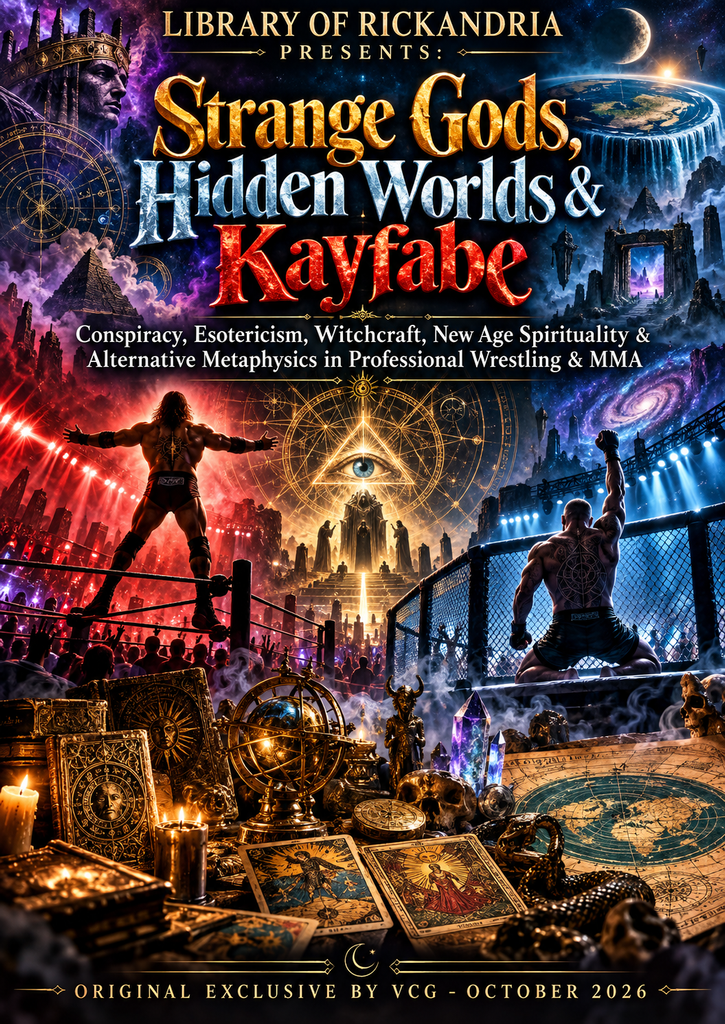
Strange Gods, Hidden Worlds & Kayfabe: Conspiracy, Esotericism, Witchcraft, New Age Spirituality & Alternative Metaphysics in Professional Wrestling & MMA
UPDATED BY VCG ON 10/05/2026 @ 09:11 EST
Anyone can do this, but most won’t.
ChatGPT – Library of Rickandria
LIBRARY OF RICKANDRIA PRESENTS
STRANGE GODS, HIDDEN WORLDS & KAYFABE
Conspiracy, Esotericism, Witchcraft, New Age Spirituality & Alternative Metaphysics in Professional Wrestling & MMA
ORIGINAL EXCLUSIVE BY VCG
OCTOBER 2026
“Prove all things; hold fast that which is good.”— 1 Thessalonians 5:21, KJV
INTRODUCTION
When Kayfabe Meets the Invisible World
Professional wrestling has always lived on an unusual border between fiction and reality.
A wrestler is a real human being playing a heightened version of a person who may or may not resemble who he actually is.
Rivalries may be fictional, partly real, or built around real animosity.
Promos may contain genuine convictions delivered through a character.
A frightening supernatural persona may belong to a completely conventional person when the cameras stop rolling.
Mixed martial arts appears simpler because the competition itself is real.
Yet the MMA world has developed its own strange cultural ecosystem:
- long-form podcasts
- psychedelic exploration
- alternative-health subcultures
- unconventional martial philosophies
- UFO stories
- conspiracy media
- “energy” language
- shamanic ceremony
and intense speculation about consciousness.
Put the two worlds together and we get something genuinely unusual.
We find wrestlers who actually practice ritual magic.
We find wrestlers who call themselves witches outside the ring.
We find fighters who describe psychedelic encounters as spiritual awakenings.
We find former champions who talk about missing time and UFOs while insisting they do not know what happened.
We find promoters who claim to have witnessed apparent human transformation but admit hallucination remains possible.
We find conspiracy broadcasters who combine distrust of governments with ideas about:
- cosmic consciousness
- Akashic Records
- hidden realities
And we find people whose apparently shocking beliefs turn out to have been:
- wrestling gimmicks
- provocative performances
- misunderstandings
—or ideas they later explicitly repudiated.
The purpose of this paper is therefore not to assemble the longest possible list of:
“weird wrestlers.”
That would be easy.
The harder and more useful task is to determine:
What did each person actually say?
Was the statement serious or kayfabe?
Was it a religious belief, an experience, a question, a performance, or merely something discussed on a podcast?
Did the person later change his or her mind?
What can psychology explain without pretending to settle metaphysics?
What does Scripture actually condemn—and what are Christians merely assuming?
Those distinctions will guide everything that follows.
I. WHAT THIS PAPER IS — AND WHAT IT IS NOT
This is not a catalogue of every wrestler or fighter who is:
- Muslim
- Buddhist
- Hindu
- Jewish
- atheist
or otherwise non-Christian.
That would be a different project.
Our focus is the more specific cultural territory of:
- occultism
- ritual magic
- witchcraft
- divination
- esotericism
- New Age and alternative spirituality
- Gnostic or neo-Gnostic ideas
- paranormal claims
- UFO experiences
- altered states
- psychedelic spirituality
- flat Earth
- conspiracy culture
- cryptozoology
- alternative cosmology
and related metaphysical claims.
There is another important boundary.
The Library of Rickandria already has material devoted to wrestlers and fighters who publicly profess Jesus Christ or Christianity.
Therefore, people whose unusual views are explicitly embedded in a Christian profession are generally treated here as crossover cases rather than members of the principal roster.
Bryce Mitchell is the clearest example.
His flat-Earth belief is highly relevant to MMA conspiracy culture, but he explicitly frames it through his Christianity and his interpretation of Scripture.
He therefore belongs principally on the Christian page, even though he will appear in our methodological appendix.
The same principle applies to Diego Sanchez and Ian McCall for different reasons.
That is not an attempt to protect Christianity from awkward examples.
It is simply keeping the databases conceptually consistent.
II. OUR SOURCE RULES
Research on wrestling desperately needs source discipline because kayfabe makes careless quotation especially dangerous.
For this paper, evidence is ranked roughly in this order:
A — Direct first-person evidence.
- An interview
- podcast
- book
- public statement
or recording in which the person directly describes the belief or practice.
B — Strong secondary evidence.
Reliable journalism quoting or documenting the person’s statements.
C — Contextual evidence.
Material demonstrating interests, imagery or participation without proving personal belief.
D — Weak or disputed evidence.
Secondhand testimony, fan interpretation, rumor or material that cannot safely establish the claim by itself.
We also use four additional labels:
K — Kayfabe/performance.
The material was at least partly constructed as wrestling presentation.
P — Platforming.
The person gives a public platform to a belief without necessarily endorsing it.
R — Retracted or repudiated
The person once circulated the claim but later rejected, apologized for or substantially qualified it.
X — Crossover/exclusion.
Relevant to the subject, but primarily belonging on our Christian-profession page or another category.
These labels solve an enormous problem.
Without them, Vampiro practicing Thelema, Chris Jericho interviewing a flat-earther and Flip Gordon pretending to be more conspiratorial to generate heat could all be placed in the same category.
They plainly should not be.
III. WHAT DO “NEW AGE,” “OCCULT” AND “ESOTERIC” ACTUALLY MEAN?
Before assigning labels to people, we need to know what the labels mean.
Academic treatments describe the New Age not as one church or creed but as a loose spiritual environment incorporating combinations of:
- meditation
- alternative healing
- astrology
- psychic phenomena
- crystals
- Eastern religious influences
- human-potential teachings
- UFO beliefs
- earth mysteries
and related ideas.
The New Age (Chapter 15) – The Cambridge Companion to New Religious Movements
Likewise, Western esotericism is not simply a scholarly synonym for “evil.”
It is a historical field encompassing currents such as:
- Spiritualism
- Theosophy
- ceremonial magic
- Thelema
- modern witchcraft
often involving ideas about:
- hidden knowledge
- transformation
- initiation
or higher realities.
That distinction matters because the word occult is frequently used in wrestling fandom to mean nothing more than:
dark lighting,
horns,
pentagrams,
black clothing,
Latin phrases,
or spooky entrance music.
Historically, those visual elements can draw from occult traditions.
Biographically, however, they prove almost nothing.
IV. MAGIC IS NOT ONE THING
One of the easiest ways to ruin a paper like this is to call everything “magic.”
A stage illusionist performs stage magic.
A ceremonial magician may deliberately conduct ritual practices intended to affect consciousness or spiritual reality.
A tarot reader practices a form of divination or symbolic reading depending upon the practitioner’s understanding.
A modern witch may identify:
- religiously
- spiritually
- culturally
or magically with witchcraft.
An Indigenous ceremony has its own cultural and religious context and should not automatically be translated into Western categories such as “black magic.”
Meditation can be religious, secular, therapeutic or contemplative.
Psychedelic use can be recreational, clinical, spiritual or ceremonial.
A person who reads Aleister Crowley is not automatically a Thelemite.
A person wearing the horns of Cernunnos is not automatically worshipping Cernunnos.
And a wrestler performing as a supernatural monster is no more automatically an occultist than Anthony Hopkins was a serial killer because he portrayed Hannibal Lecter.
This will become especially important when we reach Malakai Black, Alex Pereira and the theatrical history of wrestling.
V. THE HISTORICAL BACKGROUND: WRESTLING’S OCCULT THEATRE
Long before wrestlers were discussing DMT entities on podcasts,
professional wrestling was borrowing heavily from:
- horror
- religion
- voodoo imagery
- Satanic panic
- supernatural fiction
The broader American Satanic Panic of the 1980s and early 1990s was a genuine cultural phenomenon in which exaggerated fears concerning hidden Satanic networks became part of media and public discourse.
Scholars routinely describe it as a moral panic.
Professional wrestling absorbed that atmosphere.
Kevin Sullivan became associated with dark, allegedly satanic presentation.
Yet Sullivan himself later emphasized that he deliberately avoided simply presenting himself as “Satan,” and some of his later supernatural wrestling material was consciously tongue-in-cheek.
The Undertaker’s Ministry of Darkness took theatrical ritual imagery even further.
WWE’s own retrospective history describes:
- sacrifices
- dark ceremonies
- demonic imagery
as part of the fictional storyline.
That establishes something important.
Wrestling unquestionably has a history of occult aesthetics.
It does not establish that the actors portraying those stories privately practiced what their characters portrayed.
We must therefore separate two histories:
the history of occult imagery in wrestling
and
the history of wrestlers personally engaging occult or alternative religious ideas.
They overlap occasionally.
They are not identical.
VI. VAMPIRO
When the Character and the Practice Really Do Meet
If someone wanted one case demonstrating why this project cannot simply be dismissed as wrestling theatrics, Ian Hodgkinson—Vampiro—is probably the place to begin.
His wrestling appearance obviously proves little by itself.
The name Vampiro, face paint, dark presentation and association with horror-themed wrestling could all be kayfabe.
But Hodgkinson has discussed his private life directly.
In a 2020 interview he described moving deeply into meditation and practicing ritual magic.
He also discussed:
- Freemasonry
- esoteric study
- geometry
- stars
- energetic ideas
and ritual practice outside wrestling.
Later, while discussing the rebirth of Radio Vampiro, Hodgkinson said the program would explore magic, ritual and tarot and identified the religion he was practicing as Thelema, explicitly connecting it to Aleister Crowley.
Welcome to my world…. RADIO VAMPIRO ENGLISH | iHeart
This is much stronger evidence than appearance or symbolism.
Thelema is a modern religious movement founded by Crowley and deeply intertwined historically with ceremonial magic and Western esotericism.
Oxford scholarship places it firmly in the family of modern magical religions.
Aleister Crowley and Western Esotericism | Oxford Academic
We therefore do not need to speculate about whether Vampiro’s imagery:
“secretly means something.”
He tells us that his real-life practice includes ritual magic and Thelema.
Classification: A — Explicit practice.
VII. TAYLOR WILDE
“This Is Not a Gimmick”
Taylor Wilde provides another unusually clear case.
Wilde’s more recent wrestling identity openly incorporates witchcraft.
But once again, appearance is not the decisive evidence.
She is.
Speaking about the development of her character, Wilde explained that those who know her know that the identity reflects who she actually is.
Her phrase was direct:
“This is not a gimmick.”
She described the wrestling persona as her actual self amplified for performance.
Her podcast Wilde On has likewise openly incorporated witchcraft and tarot into its identity, describing Wilde as the People’s Witch.
Toronto’s Taylor Wilde finds her authentic self in an Impact Wrestling ring
There is consequently little reason to retreat into vague language here.
Wilde openly presents witchcraft as part of her life outside scripted wrestling.
What we should not do is infer from the generic label “witch” every specific:
- doctrine
- spell
- spirit
or theological belief she may or may not hold.
Classification: A — Explicit identification/practice.
VIII. MALAKAI BLACK
Fascination With the Occult Is Not the Same as an Occult Religion
Malakai Black is one of the most useful people in this entire paper because careless research would almost certainly overstate him.
Black has openly described a fascination with occultism.
He has explained that disturbing religious experiences in his childhood led him into reading about esoteric subjects and occult traditions.
He has drawn heavily upon those interests when constructing wrestling characters.
He has also incorporated specific mythological imagery.
One of his masks, for example, drew upon Cernunnos, the horned Celtic deity.
That sounds like an easy path to headlines about:
“occult wrestler Malakai Black.”
But Black has also specifically said that he has no substantial personal religious affiliation and that he uses frightening religious and psychological ideas because they fascinate him artistically.
Malakai Black Recalls Shawn Michaels Showing Tape From Chris Jericho Feud
The evidence therefore permits us to say:
Black studies esoteric and occult material.
Black is fascinated by it.
Black intentionally incorporates it into wrestling.
The evidence does not permit us to say:
Black worships Cernunnos.
Black practices ceremonial magic.
Black belongs to a secret occult order.
That gap between what is interesting and what is provable is precisely where responsible research matters most.
Classification: B/K — Serious study plus performance.
IX. BILLY CORGAN
The Wrestling Promoter Who Says He Saw a Human Transformation
Billy Corgan belongs in this paper not merely because he is the frontman of the Smashing Pumpkins.
He is directly part of professional wrestling.
The National Wrestling Alliance states that it is currently owned by Corgan’s company, Lightning One.
And Corgan has publicly described one of the stranger paranormal experiences associated with anyone in wrestling management.
During appearances with Howard Stern, Corgan claimed to have witnessed a person apparently transform in a way he could not explain.
When he revisited the story in 2018, he said the phenomenon happened twice.
But the most important sentence may be his qualification:
“Maybe I had a hallucination, but I saw what I saw.”
That is remarkably useful language for our purposes.
There are two historical facts here:
Corgan reports that he witnessed something extraordinary.
Corgan himself allows hallucination as one possible explanation.
There is not a third established fact:
that a literal shapeshifting being has therefore been scientifically verified.
Corgan’s testimony belongs in the record.
Its ultimate explanation remains undetermined.
Classification: B — Paranormal testimony with explicit uncertainty.
X. JESSE VENTURA
Wrestling’s Conspiracy Statesman
Former wrestler and Minnesota governor Jesse Ventura represents something different.
His contribution to this subject is not witchcraft or New Age spirituality.
It is the institutionalization of conspiracy investigation as a public identity.
Ventura hosted Conspiracy Theory with Jesse Ventura, wrote books concerning alleged hidden government activity, and has spent years challenging official accounts of events including the Kennedy assassination and 9/11.
In a CNN interview he framed the central issue as mistrust of government secrecy and demanded independent investigation rather than deference to authority.
Interestingly, Ventura’s metaphysical position is not occult.
He has publicly identified as an atheist.
In a 2011 interview with Piers Morgan he stated that plainly.
That fact helps destroy an overly simplistic theory that conspiracy culture is always religious.
Sometimes conspiracy thinking joins New Age spirituality.
Sometimes it joins Christian apocalypticism.
Sometimes it joins political libertarianism.
And sometimes, as with Ventura, it coexists with atheism.
Classification: A — Conspiracy advocacy/investigation; atheist worldview.
XI. MATT SYDAL
The Spirit Guide and the Spiritual Wrestler
Matt Sydal—formerly WWE’s Evan Bourne—belongs in a softer category.
Sydal has openly discussed spirituality, Buddhist ideas and the idea of a spirit guide.
Asked about the concept, he explained that one’s own self can function as the first guide and spoke about pursuing spiritual as well as physical dimensions of wrestling.
His wrestling presentation later incorporated “third eye,” enlightenment and spirit-guide language.
The important word here is overlap.
There is personal spiritual interest.
There is also wrestling character development.
We should not inflate that into ceremonial magic.
Sydal fits much more comfortably in the broad world of individualized alternative or Eastern-influenced spirituality.
Classification: B/K — Personal spirituality with kayfabe amplification.
XII. ROB VAN DAM
A Wrestling Career Interrupted by a “Spiritual Journey”
Rob Van Dam has described his own life using distinctly spiritual language.
When discussing his period away from WWE, RVD characterized it as something like a spiritual journey, explaining that he was studying life and examining his own spiritual path.
Exclusive interview: Rob Van Dam discusses WWE return | WWE
The evidence establishes individualized spiritual exploration.
It does not establish membership in a defined occult religion.
RVD therefore belongs on the spectrum of alternative spirituality rather than beside Vampiro under ceremonial occult practice.
Classification: B — Individualized spiritual exploration.
XIII. FLIP GORDON
When a Conspiracy Theory Becomes Heel Heat
Flip Gordon is where wrestling research becomes almost comically complicated.
Earlier interviews gave the impression that Gordon was genuinely entertaining flat Earth.
He questioned whether people could trust textbooks and conventional accounts and suggested the idea might deserve consideration.
Then Gordon later explained what happened.
He genuinely enjoyed conspiracy theories.
But wrestling taught him that conspiracy material could generate reactions.
So he amplified it.
Gordon explained that Juventud Guerrera suggested the flat-Earth angle, that he personally found the concept ridiculous, and that he deliberately leaned harder into conspiratorial ideas because they worked as a heel gimmick.
That gives us one of the most instructive lines in the entire investigation:
A wrestler can sincerely enjoy conspiracy culture while simultaneously performing a more extreme version of his own beliefs for heat.
If we quote only the earlier material, we misrepresent him.
If we quote only the later gimmick explanation, we erase his genuine conspiratorial curiosity.
Both belong in the file.
Classification: B/K — Conspiracy interest deliberately intensified through kayfabe.
XIV. STEVIE RICHARDS
Flat Earth Discussion Without a Clear Creed
In 2017, Stevie Richards appeared for an 83-minute episode of The Flat Earth Podcast.
The episode description says Richards discussed NASA, the globe-versus-flat-Earth debate and why professional wrestlers seem unusually drawn to conspiracy theories.
106 – Stevie Richards – The Flat Earth Podcast on Tapesearch
That makes Richards relevant to the history of wrestling’s conspiracy environment.
But an appearance on a flat-Earth podcast does not, by itself, justify writing:
Stevie Richards is a confirmed flat-earther.
The available evidence is better summarized as:
participant in extended flat-Earth/NASA/conspiracy discussion; final personal cosmology not established strongly enough for a definitive label.
Classification: C/P — Relevant discussion, uncertain personal commitment.
XV. BRIAN KENDRICK
Why Retractions Must Be Preserved
Brian Kendrick demonstrates the ethical importance of keeping a historical database current.
Older interviews contained extreme conspiracy material, including offensive claims involving real atrocities.
Those recordings resurfaced publicly in 2022.
Kendrick then issued an explicit apology, saying the comments were vile and stating that they were not beliefs he held.
A researcher may reasonably question how the old material should be interpreted.
What a researcher may not reasonably do is silently omit the retraction because the old quotation makes a more dramatic article.
Kendrick therefore belongs here historically, but he should not be presented as a confirmed current believer in material he has explicitly disavowed.
Classification: R — Historical conspiracy material, subsequently repudiated.
XVI. CHRIS JERICHO
The Art Bell of Professional Wrestling
Chris Jericho may be one of the most important people in this story even if he is not one of its strongest examples of personal occult belief.
Why?
Because Jericho became a major transmission point.
He has explained that when he developed Talk Is Jericho, one of his goals was essentially to become a new-generation Art Bell.
Jericho described longstanding fascination with paranormal subjects and said he happily gives airtime to:
- conspiracy theorists
- vampire hunters
- flat-Earth advocates
- UFO researchers
- ghost stories
- Bigfoot
and lake-monster claims.
His stated philosophy is that he does not want to mock guests for their beliefs; he wants them to tell their stories.
REINVENTED With AEW Professional Wrestler & Singer Chris Jericho — Jennifer Eckhart
The program has indeed hosted flat-Earth discussions and episodes involving aliens, Illuminati narratives, Aleister Crowley, occultism and New World Order claims.
But this brings us back to our methodology.
A host does not automatically believe everything a guest says.
Jericho’s strongest classification is therefore not “occultist.”
It is:
one of professional wrestling’s most influential paranormal and conspiracy media gatekeepers.
Classification: P — Major platformer/media gateway.
XVII. GERALD BRISCO & JBL
Bigfoot Comes to Wrestling Podcasting
As recently as September 2026, Gerald Brisco and John “Bradshaw” Layfield devoted an episode of Stories with Brisco and Bradshaw to a Bigfoot investigator.
The discussion centered on claimed physical evidence and cryptozoological assertions.
Subsequent reporting noted that JBL appeared particularly receptive to the evidence being presented, even as questions remained concerning outside institutional verification.
This is not evidence of ceremonial occultism.
Bigfoot is not a religion.
Cryptozoology is not automatically New Age.
But it demonstrates how thoroughly paranormal investigation has entered the wrestling-media ecosystem.
Classification: P/B — Paranormal platforming, with JBL showing greater expressed receptivity.
XVIII. EDDIE BRAVO
Where Conspiracy Culture and Alternative Metaphysics Merge
Eddie Bravo is arguably the single most important MMA-world figure in this paper.
His public reputation is inseparable from conspiracy culture.
Bravo spent years publicly questioning NASA imagery, the moon landing and Earth’s shape.
His statements have sometimes been more cautious than the meme-version of:
“Eddie Bravo is a flat-earther”
—for example, in one 2017 conversation he said there was no proof Earth was flat while immediately continuing to question globe evidence and NASA.
His own Look Into It program continues to feature conspiracy topics, including flat Earth.
But Bravo becomes much more interesting when we move beyond geography.
In a long Joe Rogan discussion, Bravo described belief in an afterlife and the Akashic Records—a concept associated with Theosophical and New Age traditions in which some form of universal record or field contains information beyond ordinary human access.
Bravo suggested meditation and shifts in “frequency” might provide access to such information.
This is where an academic concept becomes especially useful.
XIX. CONSPIRITUALITY
When Hidden Cabals Meet Higher Consciousness
In 2011, Charlotte Ward and David Voas used the term conspirituality to describe an emerging hybrid of conspiracy thinking and New Age spirituality.
Their model involved two especially important convictions:
first, that powerful hidden groups secretly control—or seek to control—social and political life;
second, that humanity is approaching or requires a transformation in consciousness.
The Emergence of Conspirituality: Journal of Contemporary Religion: Vol 26, No 1
Later scholars argued that the relationship between conspiracy theory and esotericism is older and deeper than a purely twenty-first-century New Age phenomenon.
And in 2026 Hannah Dick proposed broadening the theoretical usefulness of the concept beyond narrowly defined New Age settings.
Eddie Bravo is almost a textbook case of why this category can be useful.
Government distrust.
NASA skepticism.
Alternative cosmology.
Meditation.
Akashic information.
Frequency.
Afterlife speculation.
Hidden knowledge.
The point is not that every one of Bravo’s beliefs comes from one religion.
Quite the opposite.
Conspirituality describes the blending itself.
It also helps explain why conspiracy culture and alternative spirituality can feel naturally compatible.
Both often begin by telling the seeker:
The reality you have been given is incomplete.
Authorities cannot be trusted.
Direct awakening can reveal what ordinary society cannot see.
That structure does not prove the beliefs false.
But it explains why apparently unrelated beliefs can cluster together.
Eddie Bravo classification: A/P — Sustained conspiracy advocacy plus explicit alternative metaphysics.
XX. JAKE SHIELDS
From Christianity to Deism, DMT and the “Spirit World”
Jake Shields has become one of MMA’s most active alternative-media figures through Fight Back.
The program has hosted:
- flat-Earth advocates
- alternative-history figures
- critics of conventional institutions
- discussions of esoteric religion
But Shields’s personal position is more interesting than simply listing his guests.
In a 2026 discussion, Shields said he had been Christian for years but no longer considered himself Christian.
He described himself approximately as a deist who was still trying to determine what he believed.
He also expressed openness to some sort of spirit world while stopping short of endorsing every extraordinary claim placed before him.
His departure from atheism appears to have been influenced in part by a DMT experience that he interpreted as exposure to something ordinarily unseen.
His program has also hosted serious discussion of Gnosticism, including an episode with scholar M. David Litwa addressing the demiurge, Nag Hammadi texts and the “divine spark.”
That does not make Shields a Gnostic.
It does make him particularly relevant to our Gnosticism exception because Gnostic material now forms part of the intellectual ecosystem he platforms.
Classification: A/P — Deistic/alternative spiritual seeker and major conspiracy-media platformer.
XXI. PAT MILETICH
The Conspiracy Farm
Former UFC champion Pat Miletich did not merely appear occasionally on conspiracy programs.
He co-hosted one.
On Joe Rogan’s program, Miletich discussed The Conspiracy Farm,
describing his interest in researching:
- political
- geopolitical
- institutional
claims.
What makes Miletich useful for our methodology is that he also demonstrates skepticism inside conspiracy culture.
Asked about QAnon, Miletich said he and his co-host concluded that it was essentially a psychological operation rather than accepting it at face value.
That reminds us that “conspiracy theorist” is not a single worldview.
People who distrust official narratives frequently distrust alternative narratives too.
Classification: A/P — Conspiracy researcher and broadcaster.
XXII. JIŘÍ PROCHÁZKA
Energy, Belief and a Fighter Who Later Questioned His Own Spiritual Interpretation
Jiří Procházka may be the richest UFC case for studying the boundary between:
- spirituality
- psychology
- fighting
Procházka does not describe himself through conventional organized religion.
In an ESPN profile he spoke instead about an “energy of belief” and suggested that what a person deeply believes effectively becomes his religion.
He has drawn heavily from Miyamoto Musashi and disciplined meditative practice.
Then came Alex Pereira.
Before UFC 303, Procházka publicly challenged Pereira over what he understood as shamanic or spiritual rituals and suggested Pereira was drawing upon supernatural assistance.
Reuters documented the accusation as well as Pereira’s rejection of the framing.
Prochazka wants champion Pereira to shun magic rituals before UFC 303 | Reuters
Later, however, Procházka did something that makes this case far more valuable.
He reflected on how deeply he had entered the spiritual interpretation and acknowledged that he had become too consumed by the idea of black magic and unseen forces affecting him.
He described returning his attention toward training and his own responsibility rather than continuing to interpret his opponent through that framework.
That gives us an unusually complete chain:
spiritual worldview → magical interpretation of opponent → intensified belief → later self-correction.
We should preserve the entire chain.
Classification: A/B — Explicit energy-based spirituality; documented period of magical interpretation; later retrenchment.
XXIII. ALEX PEREIRA
Indigenous Identity Is Not Evidence of “Black Magic”
Alex Pereira stands on the other side of Procházka’s accusation.
Pereira has openly incorporated his Indigenous ancestry into his public identity and pre-fight presentation.
When Procházka suggested that spiritual forces were assisting him, Pereira replied in spiritual language—essentially saying that everyone has a spirit and that it was not his fault if another person had not found his.
His coach Plinio Cruz later laughed at the “witchcraft” interpretation and said Pereira was honoring his Indigenous background and the culture of his people.
Alex Pereira got $303,000 bonus from Dana White for UFC 303 knockout, coach reveals | MMA Fighting
That is exactly why cultural translation requires caution.
We can document Pereira’s spiritual language.
We can document Indigenous symbolism.
We can document Procházka’s allegation.
We cannot convert the allegation into the fact:
Alex Pereira practices black magic.
The evidence does not get us there.
Classification: B — Ancestral/spiritual language; magical accusation unproven.
XXIV. GEORGES ST-PIERRE
UFOs, Missing Time and the Courage to Say “I Don’t Know”
Georges St-Pierre has discussed UFOs and experiences of apparent missing time going back many years.
On Joe Rogan’s program, GSP described periods in which he felt that time had passed without his awareness and explained that unusual experiences contributed to his interest in extraterrestrial possibilities.
Yet GSP repeatedly resisted claiming certainty.
He explicitly said that he had no proof.
He acknowledged that he might simply have fallen asleep.
He did not present himself as someone who could prove alien abduction.
In later conversations he continued exploring the subject while emphasizing that human perception and memory can be mistaken and that extraordinary extraterrestrial conclusions lack firm evidence.
This is a model case for the difference between:
reporting an experience
and
claiming to know its cause.
Something unusual may have happened to GSP.
His own account does not tell us exactly what.
Classification: B — UFO/paranormal interest with explicit epistemic caution.
XXV. DAN HARDY
Ayahuasca and Deliberate Spiritual Exploration
Former UFC title challenger Dan Hardy traveled to Peru and participated in multiple ceremonial psychedelic experiences.
Hardy has described tobacco ceremony, ayahuasca and San Pedro in a setting explicitly connected with self-exploration and spiritual interpretation.
That makes his case meaningfully different from recreational psychedelic use.
The substance was being used inside a framework intended to generate personal or spiritual insight.
Still, that does not make Hardy a ceremonial magician.
The more accurate category is entheogenic or neo-shamanic spiritual exploration.
Classification: A/B — Intentional psychedelic-spiritual practice.
XXVI. RASHAD EVANS
Mushrooms, Kundalini and Awakening
Former UFC champion Rashad Evans has described psychedelic experience using explicitly spiritual language.
Speaking about psilocybin mushrooms, Evans compared what happened to a Kundalini-type awakening.
He described a sense of information pouring into him and an altered understanding of energy and consciousness.
What matters here is not merely that Evans used mushrooms.
Many people do.
The relevant feature is the interpretation:
awakening,
energy,
expanded information,
meditation,
spiritual transformation.
That places Evans squarely within psychedelic spirituality rather than mere recreational drug use.
Classification: A/B — Psychedelic awakening interpreted spiritually.
XXVII. CAIN VELASQUEZ
Psychedelics as Healing Rather Than Occult Practice
Cain Velasquez—important to both MMA and professional wrestling—has spoken publicly about ayahuasca and 5-MeO-DMT following severe family trauma and loss.
Velasquez described these experiences primarily as forms of healing and emotional processing.
His case belongs in the paper because entheogenic culture overlaps heavily with contemporary alternative spirituality.
But again, psychedelic use alone should not be translated into:
witchcraft,
occultism,
spirit worship,
or membership in a New Age religion.
Velasquez described transformation and healing.
That is what the evidence gives us.
Classification: B — Entheogenic healing and personal transformation.
XXVIII. JOE ROGAN
DMT Entities, Disembodied Consciousness—and Increasing Skepticism
Joe Rogan is not merely a UFC commentator in this story.
He is one of the primary media hubs through which:
- MMA culture
- psychedelics
- conspiracies
- UFOs
- alternative spirituality
and consciousness research have intersected.
Rogan has repeatedly described intense DMT experiences involving apparently autonomous entities.
In a conversation with Aaron Rodgers, he described how profoundly the encounter affected him and entertained the possibility that some form of disembodied consciousness might exist in a realm accessible during the state.
The Joe Rogan Experience – #1865 – Aaron Rodgers Transcript and Discussion
Yet Rogan’s position has evolved.
In a 2025 conversation with psychiatrist and DMT researcher Rick Strassman, Rogan said he had become more skeptical of psychedelic experience and criticized the spiritual narcissism that can emerge when people begin treating altered-state experiences as unquestionable revelation.
That change matters.
The accurate summary is not:
Joe Rogan proved DMT entities exist.
Nor is it:
Joe Rogan thinks everything he saw was meaningless hallucination.
It is:
Rogan had experiences he perceived as encounters with entities.
He has seriously entertained metaphysical explanations.
He now expresses greater skepticism about interpreting psychedelic experience with certainty.
Classification: A/B/P — Psychedelic-metaphysical explorer and major media platformer, increasingly cautious.
XXIX. WHAT PSYCHEDELIC SCIENCE CAN—AND CANNOT—TELL US
At this point a psychological distinction becomes essential.
Research confirms that people taking DMT frequently report encounters with:
- beings
- entities
- guides
- spirits
or apparently autonomous intelligences.
A large survey of more than 2,500 people who reported DMT entity encounters found that participants often experienced the beings as conscious and independent, and many emerged with changed beliefs about reality.
Other research similarly finds that psychedelic experiences can resemble religious or mystical encounters and can permanently change a person’s worldview.
Naturalistic DMT research has also documented strikingly frequent reports of “other worlds” and entities.
But we must pay attention to exactly what these studies establish.
They establish that:
people genuinely have these experiences;
the experiences can seem profoundly real;
they can produce lasting changes in belief.
They do not, by themselves, establish:
that an external spirit objectively entered the room;
that the entity was extraterrestrial;
that the entity was demonic;
that the entity was a dead person;
or that consciousness literally traveled to another dimension.
Psychology studies the experience and its effects.
Ontology asks what ultimately exists.
Those are not the same question.
This is where both skeptics and spiritual enthusiasts frequently move too quickly.
XXX. ISRAEL ADESANYA
Psychedelics, Meditation and Ancestral Possibility
Israel Adesanya has described psychedelic mushrooms as useful for deep introspection.
He has spoken about therapy, meditation and altered states and has wondered whether some experiences might involve ancestral dimensions, while keeping the language speculative rather than dogmatic.
Israel Adesanya explains how psychedelics, therapy aided fighting career | MMA Fighting
That makes him relevant to the broader alternative-spiritual environment.
It does not justify calling him an occultist.
Classification: B — Psychedelic introspection with spiritual speculation.
XXXI. KEVIN HOLLAND
A Vision of the Future
Kevin Holland provides a smaller but fascinating example.
Holland described a mushroom experience in which he believed he saw his future and envisioned himself becoming UFC champion.
A single visionary statement is not enough evidence from which to construct an entire theology.
So Holland belongs in the record, but not near the top of the hierarchy.
Classification: B/C — Isolated psychedelic visionary claim.
XXXII. RONDA ROUSEY
A Conspiracy Mistake—and an Unequivocal Retraction
Ronda Rousey’s case is morally more serious because it involved a real tragedy.
In 2013 she reposted conspiracy material concerning the Sandy Hook school shooting.
In 2024 she issued a lengthy apology.
Rousey said that sharing the video was the most regrettable decision of her life and explicitly stated that she did not truly believe it even at the time.
She described herself as grasping at an alternative fiction because reality was horrifying and expressed profound remorse for contributing to the conspiracy ecosystem.
A responsible paper must therefore record both events:
2013: amplification.
2024: explicit repudiation and apology.
Keeping only the first would be misleading.
Classification: R — Historical amplification, later repudiated.
XXXIII. THE BOUNDARY CASE
Diego Sanchez, Joshua Fabia and the Guru Problem
Diego Sanchez’s period with Joshua Fabia deserves its own section because it sits directly on our boundary line.
Fabia founded the School of Self Awareness and became Sanchez’s coach, manager and “guru.”
MMA Fighting documented the increasingly controversial relationship and Sanchez’s eventual decision to sever it.
Sanchez later described Fabia as using mental manipulation.
More importantly for our subject, Sanchez framed the relationship through a Christian interpretation.
He said he had been a strong Christian throughout his life and contrasted his own belief in Jesus Christ with what he described as Fabia’s shamanism.
He interpreted the entire episode as a kind of spiritual warfare.
Diego Sanchez hints at ‘spiritual warfare’ behind Joshua Fabia story | MMA Mania
This is why Sanchez should not simply be transferred onto our non-Christian alternative-spirituality list.
His story is relevant.
But his own theological interpretation is explicitly Christian.
Fabia, meanwhile, belongs in the broader ecosystem as a controversial self-awareness teacher/healer figure, although Sanchez’s retrospective description of his “shamanism” should not be expanded beyond what the evidence establishes.
Classification: Sanchez — X, Christian crossover. Fabia — ecosystem/guru case.
XXXIV. ERIK PAULSON
A Secondary Case Where Secondhand Evidence Is All We Have
Veteran MMA fighter and coach Erik Paulson is worth preserving as a secondary lead, not yet as a major profile.
Josh Barnett has described Paulson burning sage around a gym to cleanse negative energy or apparent spirits and using chakra-oriented material in training environments.
That is interesting.
But notice the source type.
It is Barnett describing Paulson.
We do not presently have an equally strong first-person Paulson statement explaining his own theology or metaphysics.
Therefore the correct research label is:
documented secondhand report of alternative spiritual practices; full worldview undetermined.
Not:
Erik Paulson confirmed occultist.
Classification: C — Credible secondary testimony, insufficient for stronger classification.
XXXV. FALSE POSITIVES
People We Refuse to Mislabel
A good archive needs a section documenting not only whom it includes, but whom it refuses to misrepresent.
AJ Styles
Styles became the subject of wrestling jokes about flat Earth, but he explicitly said:
“I am not a flat-earther.”
He acknowledged finding some arguments interesting and enjoying conspiracy material, but curiosity is not identical to belief.
Verdict: conspiracy curiosity; not a confirmed flat-earther.
Bryce Mitchell
Mitchell is unquestionably a public flat-Earth advocate.
But his reasoning is explicitly connected to God, the Bible and his Christian profession.
Verdict: extremely relevant to MMA conspiracy culture, but primarily a Christian crossover case for the Library’s separate Christian-profession project.
Ian McCall
Former UFC fighter Ian McCall has become deeply involved in psychedelic healing, including:
- ayahuasca
- ibogaine
- psilocybin
- breathwork
and related practices.
But in a 2026 profile McCall explicitly identified himself as Catholic.
Verdict: psychedelic-spirituality crossover, but should remain on the Christian/crossover side of our organizational divide.
Brian Kendrick
Old conspiracy statements are historically real.
His later repudiation is equally real.
Verdict: do not present him as a current believer in material he has explicitly rejected.
Ronda Rousey
Same principle.
Verdict: historical amplification is documented; present belief has been explicitly repudiated.
Malakai Black
Occult study and imagery are real.
Personal occult religious commitment is not established.
Verdict: study is not worship.
Alex Pereira
Spiritual and Indigenous cultural language is real.
Procházka’s “black magic” interpretation is not independently established.
Verdict: allegation is not proof.
The Undertaker, Kevin Sullivan and supernatural characters generally
Occult or satanic presentation is historically part of wrestling.
Character work cannot be turned automatically into biography.
Verdict: kayfabe is evidence about wrestling culture, not necessarily about personal religion.
This appendix may be one of the most important parts of the paper.
It shows what we discarded.
XXXVI. WHY WRESTLING AND CONSPIRACY CULTURE FIT EACH OTHER SO WELL
Here we move from history into interpretation.
Professional wrestling trains its audience to ask questions that sound remarkably similar to conspiracy thinking:
What is the official story?
What really happened backstage?
Who knew beforehand?
Was the injury real?
Was the argument a work?
Is the feud legitimate?
Is management misleading the audience?
Is this person secretly leaving?
Is the apparent reality actually scripted?
For generations, wrestling fans learned that the public story could be false while a hidden backstage story existed beneath it.
That does not mean wrestling causes conspiracy belief.
It does mean wrestling culture makes the intellectual structure of conspiratorial thinking unusually familiar.
The wrestling fan is already trained to entertain:
“What if the story being publicly presented isn’t the real story?”
Then podcasts arrived.
Wrestlers no longer needed magazines or television producers to mediate what they said.
They could speak for three hours.
- Conspiracy theory
- UFO speculation
- altered states
- ancient religion
and paranormal experiences could now coexist with road stories and match analysis.
Chris Jericho became an Art Bell-style host.
Eddie Bravo became a conspiracy broadcaster.
Jesse Ventura turned investigation into a second career.
Brisco and JBL explored Bigfoot.
Joe Rogan built perhaps the largest long-form conversational platform ever associated with combat sports.
The result is an ecosystem where kayfabe’s hidden-story logic meets the internet’s hidden-story culture.
That does not establish whether any particular hidden story is true.
But culturally, the attraction makes sense.
XXXVII. THE ECOSYSTEM IS BIGGER THAN THE PERFORMERS
Once we stop looking only at active wrestlers and fighters, the structure becomes easier to see.
The ecosystem includes:
performers — Vampiro, Taylor Wilde, Eddie Bravo, Jiří Procházka;
promoters/owners — Billy Corgan;
podcasters — Chris Jericho, Joe Rogan, Jake Shields, Pat Miletich;
coaches and gurus — Joshua Fabia, Erik Paulson;
commentators/media figures — JBL and others;
retired stars turned investigators — Jesse Ventura;
psychedelic seekers — Rashad Evans, Dan Hardy, Cain Velasquez, Israel Adesanya;
character performers — Malakai Black and countless historically supernatural wrestling personas.
This tells us that we are not studying one secret ideology.
We are studying a cultural network through which ideas travel.
XXXVIII. FLAT EARTH
Unlike Metaphysics, This One Can Be Physically Measured
Some questions in this paper are difficult to test.
Whether consciousness can exist apart from the brain remains philosophically and scientifically contested.
Whether a DMT entity exists objectively is difficult to establish.
Whether Corgan witnessed a paranormal transformation cannot now be independently reconstructed.
The shape of Earth is different.
It is a measurable physical question.
NOAA’s National Geodetic Survey describes Earth mathematically as approximately an oblate ellipsoid, while its actual gravity-defined surface is represented more precisely by the geoid.
This conclusion does not depend upon trusting one photograph from NASA.
It rests upon centuries of:
- surveying
- geodesy
- astronomy
- navigation
and repeatable measurement.
Thus when Eddie Bravo or anyone else questions whether Earth is a globe, we should distinguish two valid statements:
He genuinely questions it.
and
The physical evidence nevertheless supports an approximately spherical/oblate Earth.
Respecting a person’s sincerity does not require pretending every proposition has equal empirical support.
XXXIX. CONSPIRACIES: REAL CATEGORY, BAD SHORTCUT
We should also resist the opposite mistake.
The word conspiracy does not mean:
“something that cannot happen.”
Actual conspiracies happen constantly.
Criminal organizations conspire.
Companies conceal wrongdoing.
Officials lie.
Intelligence agencies keep secrets.
Governments have conducted unethical programs.
People coordinate illegally.
The logical mistake occurs when:
some conspiracies are real
becomes
therefore my specific conspiracy theory is true.
Each claim needs its own evidence.
Pat Miletich can distrust institutions while rejecting QAnon.
Jesse Ventura can correctly note that governments have concealed information without thereby proving every conclusion he reaches.
Ronda Rousey can circulate false conspiracy material and later recognize that she did so.
The proper question is never:
“Are conspiracies real?”
Of course they are.
The question is:
“What evidence supports this conspiracy?”
XL. GNOSTICISM
The Category We Need to Handle Especially Carefully
The user specifically requested that Gnosticism remain within scope even though it sometimes uses Christian vocabulary.
That requires historical caution.
Scholars themselves debate how broadly the word Gnosticism should be used.
The Oxford Handbook of Early Christian Studies notes that there is no scholarly consensus about whether “Gnosticism” should be treated as one unified religious phenomenon at all.
The Oxford Classical Dictionary similarly emphasizes the diversity of groups commonly brought under the term, including Valentinian and Sethian currents.
Cambridge likewise notes that even defining “Gnosticism” is difficult and that the modern umbrella term should not be carelessly projected backward.
‘Gnosticism’ | The Oxford Handbook of Early Christian Studies | Oxford Academic
Modern neo-Gnosticism is another matter again.
Oxford scholarship distinguishes modern forms of “gnosis” and neo-Gnostic thought from ancient movements.
Where does this touch our wrestling/MMA study?
First, Thelema, practiced by Vampiro, emerged from the modern Western esoteric environment and historically intersects with currents sometimes described as neo-Gnostic.
That does not make Thelema identical to ancient Valentinian Christianity.
Second, Jake Shields has platformed direct scholarly discussion of Gnosticism, the demiurge and Nag Hammadi literature.
But that does not establish Shields as a Gnostic.
Our conclusion at present is therefore modest:
Gnostic material is demonstrably present in the MMA alternative-media environment, but we have not established a major wrestling or MMA figure who clearly identifies himself or herself as a practicing ancient-style Valentinian or Sethian Gnostic.
We leave the category open rather than manufacturing a candidate.
XLI. A CHRISTIAN READING
What Scripture Actually Says
Everything up to this point has been principally historical and evidentiary.
Now we deliberately change categories.
The question is no longer:
What do these people believe?
The question becomes:
How does the biblical text instruct a Christian to evaluate such practices and claims?
Those are different questions.
Scripture Commands Testing
Paul writes:
“Prove all things; hold fast that which is good.”
— 1 Thessalonians 5:21
In immediate context Paul is discussing prophecy and spiritual discernment.
So we should not turn the verse into a generic laboratory-method slogan.
Yet its principle is unmistakably relevant:
a spiritual claim is not to be believed merely because it is spiritual.
The Bereans are similarly commended because they:
“searched the scriptures daily, whether those things were so.”
— Acts 17:11
The biblical ideal is therefore neither gullibility nor automatic ridicule.
It is examination.
XLII. SCRIPTURE EXPLICITLY FORBIDS CERTAIN OCCULT PRACTICES
Deuteronomy is specific:
“There shall not be found among you any one … that useth divination, or an observer of times, or an enchanter, or a witch,
Or a charmer, or a consulter with familiar spirits, or a wizard, or a necromancer.”
— Deuteronomy 18:10–11
For biblical theology, practices such as divination, necromancy and consultation with spirits are not spiritually neutral.
Isaiah similarly asks:
“should not a people seek unto their God? for the living to the dead?”
and then directs the hearer:
“To the law and to the testimony…”
— Isaiah 8:19–20
So if someone openly says:
I practice ritual magic,
or
I intentionally consult spirits for guidance,
the Christian does not need to pretend Scripture has nothing to say.
It does.
But biblical precision remains important.
Deuteronomy 18 does not say that:
studying mythology is divination;
wearing black clothing is witchcraft;
every meditation practice is necromancy;
every psychedelic hallucination is a familiar spirit;
every conspiracy theorist is a magician;
every Indigenous ceremony is Satanism;
every strange dream is revelation.
Those equations have to be argued.
They cannot simply be inserted into the biblical text.
XLIII. “TRY THE SPIRITS” DOES NOT MEAN “BELIEVE EVERY PARANORMAL STORY”
John writes:
“Beloved, believe not every spirit, but try the spirits whether they are of God:
because many false prophets are gone out into the world.”
— 1 John 4:1
The following verses immediately connect that testing with confession concerning Jesus Christ.
That context matters.
Christians sometimes quote “try the spirits” after immediately assuming that an unusual event is definitely a spirit.
But John’s first command is:
“believe not every spirit.”
Even the claimed spiritual identity is subject to testing.
Thus if Joe Rogan says he encountered entities on DMT, a Christian may reasonably ask theological questions about spiritual deception.
But the Christian should not pretend that the statement:
“I saw an entity”
already proves:
“A demon objectively manifested during that experience.”
The second proposition requires another step.
Biblical supernaturalism is not permission to become careless with evidence.
XLIV. SCRIPTURE DOES AFFIRM A SPIRITUAL CONFLICT
Paul writes:
“For we wrestle not against flesh and blood, but against principalities, against powers, against the rulers of the darkness of this world, against spiritual wickedness in high places.”
— Ephesians 6:12
Christian theology therefore does not reduce reality to matter alone.
It affirms spiritual evil.
But note the first phrase:
“we wrestle not against flesh and blood”
That ought to restrain the very temptation a paper like this could create.
The people examined here are not objects for demonization.
They are human beings.
A Christian can reject a practice without turning the practitioner into a monster.
That seems especially appropriate in a paper about fighters.
XLV. EVEN SUPERNATURAL POWER WOULD NOT AUTOMATICALLY VALIDATE A MESSAGE
Paul’s warning in Galatians is striking:
“But though we, or an angel from heaven, preach any other gospel unto you than that which we have preached unto you, let him be accursed.”
— Galatians 1:8
Within Christian theology, even an apparently supernatural messenger does not outrank the gospel.
That is directly relevant to esoteric revelation.
A spirit.
An angel.
A psychedelic entity.
A channeled intelligence.
A magical revelation.
A vision.
A claimed hidden teacher.
None becomes true merely by being extraordinary.
Christian discernment is doctrinal before it is sensational.
XLVI. SCRIPTURE ALSO WARNS ABOUT ACTUAL IDOLATROUS SPIRITUAL PARTICIPATION
Paul’s discussion of pagan sacrifice in 1 Corinthians is stronger still.
He writes that the things Gentiles sacrificed were sacrificed:
“to devils, and not to God,”
and warns Christians against fellowship with them.
That means a Christian interpretation cannot simply dismiss all non-Christian ritual as automatically spiritually meaningless.
Scripture itself allows a category in which idolatrous religious participation has genuine spiritual danger.
But again, that teaching does not establish the supernatural explanation of every individual case in this paper.
A tarot practitioner and a fighter reporting missing time are not evidentially identical.
A Thelemic ritual and a Bigfoot podcast are not the same category.
Scriptural seriousness and research precision should reinforce each other.
XLVII. WHAT WE WILL NOT CLAIM
For clarity, the paper’s conclusions do not establish that:
Billy Corgan definitely witnessed a literal shapeshifter.
Georges St-Pierre was abducted by extraterrestrials.
Joe Rogan’s DMT entities were objectively demons, aliens or independent minds.
Alex Pereira practices black magic.
Malakai Black worships pagan gods.
Every psychedelic experience is supernatural.
Every supernatural-looking wrestling character reflects the actor’s religion.
Every conspiracy claim is false.
Every non-mainstream claim is true because institutions sometimes lie.
Every Indigenous spiritual tradition is interchangeable with Western occultism.
Every person who appears on a conspiracy podcast endorses the guest.
Every former conspiratorial statement remains a person’s present belief forever.
Those would be stronger claims than our evidence supports.
Refusing them does not weaken the investigation.
It makes the investigation trustworthy.
XLVIII. A WORKING HISTORICAL TIMELINE
1980s–early 1990s — Satanic Panic and supernatural wrestling imagery
American culture experiences intense fears of hidden Satanism.
Wrestling borrows occult and horror imagery, with performers such as Kevin Sullivan and later supernatural characters becoming part of that visual vocabulary.
The key question is predominantly character and symbolism.
Mid-1990s–2000s — The internet creates conspiracy communities
Alternative accounts of:
- government events
- UFOs and hidden history
migrate from:
- books
- radio
- VHS
culture to web forums and early online media.
Wrestlers increasingly encounter conspiracy culture outside traditional locker-room storytelling.
2010s — Podcasts change everything
Joe Rogan, Chris Jericho and numerous wrestling/MMA personalities create long-form media in which:
- UFOs
- psychedelics
- flat Earth
- spirituality
- institutional distrust
can be discussed for hours.
The question shifts from:
“What does this character symbolize?”
to:
“What does this performer actually think?”
Late 2010s–early 2020s — Flat Earth, psychedelic spirituality and “energy”
Eddie Bravo becomes synonymous with conspiracy exploration.
Rashad Evans discusses Kundalini-type awakening.
Dan Hardy describes ayahuasca.
Cain Velasquez describes psychedelic healing.
Matt Sydal uses spiritual language.
Alternative spirituality and conspiracy culture increasingly overlap.
2020s — Conspirituality becomes visible
Podcast culture mixes:
anti-establishment suspicion,
spiritual awakening,
psychedelics,
hidden history,
UFO disclosure,
alternative cosmology,
esotericism,
and distrust of conventional institutions.
The wrestling/MMA world increasingly mirrors the wider digital culture.
2024–2026 — Self-correction becomes part of the story
Ronda Rousey publicly apologizes for historical conspiracy amplification.
Jiří Procházka reassesses his own immersion in black-magic interpretations.
Joe Rogan speaks more openly about skepticism toward psychedelic certainty.
GSP repeatedly emphasizes uncertainty.
These developments are important because they show that beliefs are not frozen in time.
XLIX. MASTER EVIDENCE MATRIX
| Person | World | Main subject | Evidence | Kayfabe/Platform/Retraction | Current conclusion |
|---|---|---|---|---|---|
| Vampiro | Wrestling | Thelema, ritual magic, tarot | A | — | Explicit practitioner |
| Taylor Wilde | Wrestling | Witchcraft, tarot | A | Some wrestling presentation | Explicit real-life identification |
| Malakai Black | Wrestling | Occult/esoteric study, mythology | A/B | K | Genuine fascination; religion not established |
| Billy Corgan | Wrestling promoter | Apparent shapeshifter experience | A | — | Reports event; allows hallucination |
| Jesse Ventura | Wrestling | Conspiracy investigation | A | P | Major conspiracy broadcaster; atheist |
| Matt Sydal | Wrestling | Spirituality, spirit-guide language | A/B | K | Alternative spirituality |
| Rob Van Dam | Wrestling | Spiritual journey | A | — | Individual spiritual exploration |
| Flip Gordon | Wrestling | Conspiracies, flat Earth | A | K | Genuine curiosity, knowingly exaggerated |
| Stevie Richards | Wrestling | Flat Earth/NASA discussion | B/C | P | Relevant participant; final belief uncertain |
| Brian Kendrick | Wrestling | Extreme historical conspiracies | A | R | Old material explicitly repudiated |
| Chris Jericho | Wrestling | Paranormal/conspiracy media | A | P | Major gateway/platformer |
| Brisco/JBL | Wrestling | Bigfoot/cryptozoology | B | P | Paranormal platforming/receptivity |
| Eddie Bravo | MMA/BJJ | Flat Earth, conspiracies, Akashic Records, frequency | A | P | Strong conspirituality case |
| Jake Shields | MMA | Deism, DMT, spirit world, conspiracy media | A | P | Alternative spiritual/conspiracy platform |
| Pat Miletich | MMA | Conspiracy research | A | P | Conspiracy broadcaster |
| Jiří Procházka | MMA | Energy spirituality, black-magic interpretation | A | later self-correction | Strong but evolving |
| Alex Pereira | MMA | Indigenous/spiritual symbolism | A/B | accused by opponent | Spiritual language; black magic unproved |
| Georges St-Pierre | MMA | UFOs, missing time | A | — | Reports experiences while stressing uncertainty |
| Dan Hardy | MMA | Ayahuasca/shamanic ceremony | A | — | Entheogenic spirituality |
| Rashad Evans | MMA | Psychedelic/Kundalini awakening | A | — | Spiritual interpretation of psychedelics |
| Cain Velasquez | MMA/Wrestling | Ayahuasca, 5-MeO-DMT | A | — | Entheogenic healing |
| Joe Rogan | MMA media | DMT entities, consciousness, paranormal ideas | A | P | Serious exploration; growing skepticism |
| Israel Adesanya | MMA | Psychedelic introspection | A | — | Spiritual speculation, not occult identification |
| Kevin Holland | MMA | Psychedelic future vision | A | — | Isolated visionary claim |
| Ronda Rousey | MMA/Wrestling | Historical conspiracy amplification | A | R | Explicitly repudiated |
| Diego Sanchez | MMA | Guru/shamanism controversy | A/B | X | Christian crossover |
| Joshua Fabia | MMA ecosystem | School of Self Awareness/guru role | B | — | Relevant influence; theology not fully established |
| Erik Paulson | MMA coaching | Sage cleansing, chakra material | C | secondhand | Interesting but insufficient for stronger claim |
| AJ Styles | Wrestling | Flat-Earth curiosity | A | X/false positive | Explicitly denies being flat-earther |
| Bryce Mitchell | MMA | Flat Earth | A | X | Explicit belief, but Christian crossover |
| Ian McCall | MMA | Psychedelic healing | A | X | Explicitly Catholic; crossover |
L. WHAT THE PAPER ACTUALLY FOUND
After all of these profiles, we can finally answer the central question.
There is no single occult movement controlling professional wrestling or MMA.
The evidence points instead to several overlapping cultures.
There are explicit practitioners of modern occult or magical religion, most clearly Vampiro.
There are explicit witches, most clearly Taylor Wilde.
There are people deeply fascinated with occult material without evidence of personal religious practice, such as Malakai Black.
There are alternative spiritual seekers, including Matt Sydal and Rob Van Dam.
There are psychedelic spiritual explorers, including Rashad Evans, Dan Hardy, Cain Velasquez, Israel Adesanya and Joe Rogan.
There are major conspiracy broadcasters, especially Jesse Ventura, Eddie Bravo, Jake Shields and Pat Miletich.
There are paranormal experiencers who preserve uncertainty, particularly Billy Corgan and Georges St-Pierre.
There are media figures who provide enormous platforms for alternative claims without necessarily endorsing each claim, especially Chris Jericho and Joe Rogan.
There are people who temporarily interpreted events through magical frameworks and later pulled back, most strikingly Jiří Procházka.
There are conspiracy claims deliberately exaggerated as wrestling performance, as with Flip Gordon.
There are old statements later repudiated, as with Brian Kendrick and Ronda Rousey.
And there are people whom the internet frequently misclassifies because a dramatic label sounds better than the evidence.
Those differences are not side notes.
They are the main finding.
CONCLUSION
Strange Gods, Hidden Worlds—and the Discipline of Not Pretending to Know More Than We Know
Professional wrestling and MMA attract unusual people because unusual people often excel in unusual professions.
Fighters voluntarily enter cages.
Wrestlers spend decades blurring reality and performance.
Both groups live in worlds where:
- discipline
- pain
- charisma
- myth
- fear
- personal reinvention
- extraordinary confidence
are rewarded.
It should probably not surprise us that some also explore extraordinary ideas.
Some search for hidden political explanations.
Some search for hidden spiritual realities.
Some use psychedelic substances to explore consciousness.
Some use ritual.
Some read Crowley.
Some read Musashi.
Some investigate UFOs.
Some question NASA.
Some consult tarot.
Some talk about spirits.
Some merely play characters who appear to do those things.
And some later decide they went too far.
The temptation for a Christian researcher is to make everything fit too neatly.
Every strange light becomes a demon.
Every unusual symbol becomes Satanism.
Every altered state becomes spirit contact.
Every conspiracy becomes either obviously true or obviously ridiculous.
Every non-Christian spiritual practice becomes identical.
Scripture itself gives us no excuse for that kind of intellectual laziness.
The Bible condemns:
- divination
- witchcraft
- necromancy
- forbidden spirit consultation
explicitly.
It warns Christians that spiritual evil is real.
It warns that even an apparent angel cannot overthrow the gospel.
It commands believers not to believe every spirit.
And at the same time it commends examination:
“Prove all things; hold fast that which is good.”
— 1 Thessalonians 5:21
That may be the best research rule in this entire subject.
Believe neither the official story merely because it is official nor the alternative story merely because it is alternative.
Do not confuse skepticism with wisdom.
Do not confuse novelty with truth.
Do not confuse a vivid experience with a demonstrated explanation.
Do not confuse a wrestling character with the man playing him.
Do not confuse Indigenous culture with “black magic.”
Do not erase someone’s retraction because an old statement makes better clickbait.
Do not call a man a flat-earther after he explicitly says he is not one.
Do not call an occult student an occult worshipper without evidence.
Do not call a hallucination a demon unless the evidence actually allows the identification.
And do not call something harmless merely because modern culture considers spiritual danger unfashionable.
Investigate.
Compare.
Test.
Separate what was said from what was proved.
Separate what Scripture says from what we infer.
And where the evidence ends, have the discipline to write:
We do not know.
That is not weakness.
In a world of:
- kayfabe
- conspiracy
- hidden knowledge
and competing claims to spiritual revelation, it may be one of the most important forms of honesty we have.
SELECTED EXTERNAL RESEARCH LIBRARY
For continued study, these are among the strongest source groups used in the paper.
Academic background:
Cambridge — The New Age
Oxford — Aleister Crowley and Western Esotericism
Oxford — Gnosticism in Early Christian Studies
Ward & Voas — The Emergence of Conspirituality
NOAA — Earth’s measured shape
Wrestling:
Taylor Wilde — “This is not a gimmick”
Malakai Black — occult and religious fascination
Billy Corgan — apparent transformation experience
Chris Jericho — paranormal and conspiracy podcast philosophy
Stevie Richards — Flat Earth Podcast appearance
Brian Kendrick — apology and repudiation
MMA:
Reuters — Procházka/Pereira spiritual-ritual dispute
MMA Fighting — Pereira’s Indigenous cultural context
MMA Fighting — Cain Velasquez’s psychedelic journey
Joe Rogan/Aaron Rodgers — DMT entity discussion
MMA Fighting — Israel Adesanya on psychedelics and therapy
MMA Fighting — Ronda Rousey’s Sandy Hook apology
MMA Fighting — Diego Sanchez ends relationship with Joshua Fabia
Research cutoff: October 5, 2026.
Scripture quotations: Authorized King James Version, Pure Cambridge Edition, from the Library of Rickandria source copy.
4CHAN THREAD & POST BREAKDOWNS – Library of Rickandria
VCG PAPER PROJECTS – Library of Rickandria