UPDATED BY VCG ON 11/24/2026 @ 00:00 EST
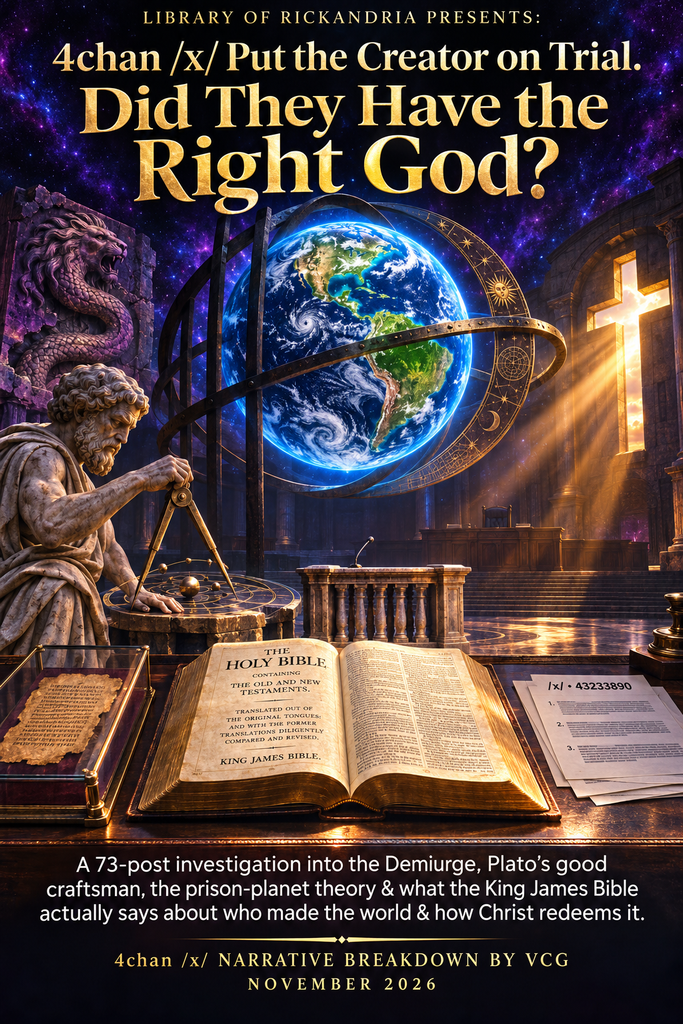
A 73-post investigation into the Demiurge, Plato’s good craftsman, the prison-planet theory & what the King James Bible actually says about who made the world & how Christ redeems it.
Anyone can do this, but most won’t.
4chan /x/ Put the Creator on Trial. Did They Have the Right God? examines all 73 posts in “Sympathy for the Demiurge,” tracing how a debate about who made the world turned into claims about reincarnation, a prison planet, and a hidden cure for death.
The paper checks those claims against their sources and finds that Plato’s good craftsman, the Gnostic Yaldabaoth, and Brahmā differ in what they know, whom they answer to, and why they create.
It also asks why suffering makes stories of a hidden jailer persuasive and what evidence could distinguish cosmic imprisonment from the claim that we chose to be here.
Reading Genesis, John, Romans, and 1 Corinthians in context, the paper shows how the King James Bible answers the thread’s strongest question:
the Creator entered the world in Christ, and the promised deliverance includes the resurrection of the body and the redemption of creation.
ChatGPT – Library of Rickandria
The finding
The strongest source work in this thread came from two anonymous posters who opened the Bhāgavata Purāṇa and quoted an exchange between Nārada and Brahmā.
/x/ – Sympathy for the Demiurge – Paranormal – 4chan
They found a subordinate maker who acknowledges a higher source of his power.
That makes Brahmā comparable to a demiurge in a limited sense.
The comparison becomes more revealing when we ask what the maker knows.
Brahmā acknowledges his dependence.
Yaldabaoth proclaims his own supremacy from ignorance.
Plato’s craftsman deliberately orders the cosmos toward goodness.
The three accounts assign different intentions, knowledge, and authority to figures who can all loosely be called makers.
Bhāgavata Purāṇa 2.5 · Apocryphon of John, translated by Marvin Meyer · Timaeus, Greek and English.
The KJV gives a fourth account.
Genesis calls creation very good.
John identifies the Word as the one through whom all things were made and says the Word became flesh.
Colossians gives Christ authority over creation and locates reconciliation in the blood of his cross.
Romans 8 acknowledges creation’s suffering and looks forward to its deliverance, including the redemption of the body.
The identity of the Creator matters because, in these passages, creation and redemption belong to the same story.
Genesis 1, John 1, Colossians 1, and Hebrews 1, KJV · Romans 8:20–23, KJV.
The record and how to read it
The archived thread, “Sympathy for the Demiurge,” #43233890, contains 73 numbered posts, including the opener, from November 18 through November 23, 2026, as displayed in the archive.
There are 32 posts with attachment entries and 13 outbound media links.
The opener has a title and a PNG entry.
Its image returned an access error, so the body of the audit makes no inference about what that image says.
Other attachment-dependent posts are assessed from their surviving captions and metadata.
One outbound video was identified by its title and watch page, the Rolling Stones’ Sympathy for the Devil.
The remaining 12 thread-linked media items were unverified.
The four Rickandria videos at the end of this paper were checked separately.
Full archived thread · Rolling Stones video.
The audit follows the archived order.
Every numbered entry has a direct post link.
Substantive lines are paraphrased in sequence, with longer posts broken into their constituent claims.
A quoted reply keeps its original attribution.
Under history, the question is whether a text, date, or tradition supports the claim.
Under methodology, the question is what observation could establish it.
Under psychology, the paper examines reasoning and persuasion visible on the page.
Anonymous posts provide too little evidence to diagnose their authors or infer their private motives.
Under KJV Scripture, the paper treats the surrounding passage as part of the evidence.
One historical qualification belongs up front.
Gnosticism is a debated category for diverse ancient texts and movements.
The Apocryphon of John gives us a particular account of Sophia and Yaldabaoth.
Irenaeus’s report of Valentinian teaching gives us another account of a subordinate maker.
Irenaeus is also writing as a critic.
Where the inquiry depends on the precise beliefs of a movement, the difference between an extant text and an opponent’s description matters.
Michael Williams, Rethinking “Gnosticism” · Irenaeus, Against Heresies, Book I · Apocryphon of John translation collection.
Part I. The opener, Plato, and the first source check
1. The opener. “Sympathy for the Demiurge” gives the discussion its subject.
The surviving text supplies no definition of the Demiurge and no argument for sympathy.
The unavailable PNG may have provided context.
Several respondents proceed as if the opener had endorsed a specific theology, which the surviving text cannot establish.
2. One-word rejection.
A brief refusal appears with a GIF.
The text alone cannot tell us whether the writer rejects sympathy, the being’s existence, or the premise of the joke.
3. Gnosticism, children, ketamine, and blood.
The writer first alleges that Gnosticism blames children for war and evil, then attaches claims about drug or blood use and a longer lifespan.
The ancient texts examined here give no support to that account of Gnosticism.
No evidence connects the alleged practices to a Gnostic program, and the FDA says young-donor plasma has no proven benefit for the anti-aging uses for which it has been promoted.
Ketamine’s recognized medical uses supply no evidence of anti-aging efficacy.
Deuteronomy 24:16 also bears directly on the allegation of inherited judicial guilt between parents and children.
#43233897 · Gnosticism overview · FDA on young-donor plasma.
4. Approval and a JPG. A single word signals approval or amusement.
The inaccessible image leaves its precise target unresolved.
5. An image reply.
The reply reference points to the opener.
There is no recoverable written proposition beyond the reference.
6. Self-deification, denial of the Demiurge, and a videogame world.
These are three propositions.
The first is an unsupported claim of divine identity.
The second depends on which meaning of demiurge is intended.
The third supplies no observation that would distinguish a videogame universe from competing explanations.
Bostrom’s simulation argument is a conditional philosophical argument.
It gives no empirical confirmation of the poster’s declaration.
Isaiah 45:5 and Acts 17:24–29 distinguish God from the people who depend on him for life.
#43234950 · Nick Bostrom, the simulation argument · Acts 17:24–29, KJV.
7. Gnostics, free will, and Calvinists.
The reply assigns a motive to a whole group and treats a dispute about ancient religion as though it were one about Reformation theology.
Neither move has historical support in the post. Compatibilism illustrates why free will needs a definition before conclusions follow.
The Westminster Confession itself devotes a chapter to free will.
Its position can be debated from what it says.
Isaiah 10:5–15 gives a biblical case where God uses Assyria and judges the king’s intent and arrogance.
#43234967 · Stanford on compatibilism · Westminster Confession, chapter 9.
8. Forgiveness, a basilisk, and multiple timelines.
Showing kindness and making better use of the present are ethical proposals.
The timeline and basilisk lines add speculation.
Roko’s Basilisk may be the internet reference, though the post supplies too little to establish the allusion.
Romans 12:17–21 gives an independent biblical basis for overcoming evil with good.
#43235002 · Roko’s Basilisk background · Romans 12:17–21, KJV.
9. Brahmā’s service and the reader’s alleged past life.
Brahmā’s service to a higher power broadly fits the passage the next replies cite.
The claims about mistakes and management need particular episodes and definitions.
The final line tells the reader they once occupied Brahmā’s role.
It supplies no personal testimony, corroboration, or textual source for that claim.
Hebrews 9:24–28 places human death and judgment alongside Christ’s once-for-all offering.
#43235010 · Bhāgavata Purāṇa 2.5 · Hebrews 9:24–28, KJV.
10. The correction about Vishnu.
The familiar triad associates Brahmā with creation and Vishnu with preservation.
The word manage is broad enough that this distinction alone cannot settle the dispute.
In the Purāṇic passage brought into the discussion, Brahmā’s creative work is real and dependent.
The Supreme has the wider role.
#43235033 · Manitoba education resource on Hinduism · Bhāgavata Purāṇa 2.5.9–18.
11. Nārada’s eight verses.
Verse 1 asks for knowledge of the individual soul and Supersoul.
Verse 2 asks how the cosmos comes into being, is sustained, and is controlled.
Verse 3 praises Brahmā’s knowledge across time.
Verse 4 asks where that knowledge and power come from.
Verse 5 introduces the spider and its web.
Verse 6 continues the praise of Brahmā’s apparent creative power.
Verse 7 asks whether his austerities point to a power above him.
Verse 8 closes the student’s request.
Notice the movement from praise to inquiry.
At this point in the dialogue we have Nārada’s questions.
The word scientifically in the English rendering of verse 3 belongs to the translation.
The passage is a religious dialogue.
#43235071 · Bhāgavata Purāṇa 2.5.1–8, Bhaktivedanta translation.
12. Brahmā’s answer and the missing verse.
Verse 9 welcomes the question. Verse 10 says observers can mistake Brahmā’s power for ultimate power.
Verse 11 makes his creative work dependent on prior divine activity.
Verse 12 names Kṛṣṇa, Vāsudeva in this translation
The poster then draws a comparison with the Gnostic Demiurge.
Verse 17, absent from the post, sharpens that comparison.
Brahmā credits Nārāyaṇa with what was already created and with Brahmā’s own origin.
A subordinate maker who says where his authority comes from occupies a different position from Yaldabaoth, whose claim to exclusivity stems from ignorance.
#43235076 · Bhāgavata Purāṇa 2.5.9–17 · Apocryphon of John.
13. Plato’s good craftsman.
The poster gets several major points right.
In Timaeus 28a–30c the craftsman works from an eternal model, is free of envy, and orders a living cosmos.
The making of mortal beings is delegated at 41a–d.
The post conflates the receptacle and necessity.
The receptacle is introduced as a third kind alongside the model and what comes to be.
Necessity concerns conditions and causal processes with which intellect works.
Plato’s language about persuasion belongs to that account.
The suggestion that delegation keeps the maker away from messy work is the commenter’s gloss.
Plato’s text also cannot adjudicate which later movements constitute “true Gnosticism.”
#43235175 · Timaeus, Greek and English · Stanford commentary.
14. Opposition, victimhood, and the “No True Scotsman” objection.
Opposition alone does not make someone a victim.
The fallacy charge has force if a definition is revised solely to discard counterexamples.
Historians can still defend a category through stated criteria and evidence.
Asking several contemporary believers what they believe can yield useful testimony about them.
Generalizing from those interviews to ancient movements would require a different source base.
#43235206 · “No True Scotsman,” Wiley · Williams on the historical category.
15. All antagonism is victimhood.
A dispute over a principle provides a counterexample.
The exhortation to love everyone has a clearer ethical meaning.
Matthew 5:44 calls believers to love their enemies and pray for persecutors.
The passage takes the existence of enemies seriously while instructing the hearer how to respond.
#43235366 · Matthew 5:43–48, KJV.
16. Football, external bondage, and Vedānta.
Two opposing football teams show that antagonism can exist without victimhood.
The post’s account of external rulers fits some Gnostic stories, including the Apocryphon.
Bondage through ignorance is recognizable in Śaṅkara’s Advaita Vedānta.
Treating Advaita as the single Vedānta position erases disagreements within the tradition.
The further claim that Western thinkers supplied the idea of cosmic opposition ignores ancient Iranian evidence.
The KJV also allows more than one source of opposition.
James 1:14 addresses human desire, and Ephesians 6:12 describes spiritual opposition.
#43235603 · Stanford on Śaṅkara · Encyclopaedia Iranica on the Gathas.
Part II. When a cosmology starts explaining everyone’s suffering
17. The greeting and the name.
Two elliptical lines address the opener.
A specific identity, quotation, or referent cannot be established.
18. An evil creator and an appeal to Zoroaster.
The writer accuses an undefined group of imposture, declares the creator evil, and invokes Zoroaster without quoting a text.
The Gathas describe a morally charged opposition.
Ahura Mazdā is associated with wisdom, goodness, and creation.
The appeal therefore requires much more than the name Zoroaster to support a claim that the creator is evil.
Genesis 1:31 and James 1:13 place their own limits on that conclusion.
#43235879 · The Gathas · Ahura Mazdā.
19. A defective copy becomes a prison.
The post first treats the difference between Plato’s model and the generated cosmos as incompetence.
Plato presents the craftsman as trying to make the cosmos as good as possible under the conditions in the dialogue.
The reply then adds that creation was unnecessary, that people entered it for sport, and that it now traps them.
Each requires independent support.
Quicksand conveys the feeling of entrapment with considerable force.
It establishes no account of how anyone came to exist.
#43236115 · Stanford on the cosmology of the Timaeus.
20. Dismissing archaeology and asserting universal consent.
An archaeological finding can be challenged through its provenance, dating, stratigraphy, or competing interpretation.
Dismissing the entire discipline removes those ways to correct error.
The writer then asserts universal pre-birth consent and attributes a desire to hate to an opponent.
Neither claim is independently supported.
The asymmetry is visible on the page.
The opposing evidence faces a sweeping demand for certainty while the preferred cosmology receives assent without a test.
#43236315 · Raymond Nickerson’s review of confirmation bias.
21. Does the maker love us?
This question deserves an answer from each source.
Plato’s craftsman intends goodness.
Yaldabaoth’s acts must be read in his own narrative.
Genesis 1:31 gives God’s evaluation of creation, and John 3:16 speaks of God’s love for the world.
Those are different kinds of answers to the question the poster raises.
#43239057 · Timaeus · Apocryphon of John · John 3:16–21, KJV.
22. Entire lives were programmed.
The programmers are unnamed and their method unspecified.
The prediction of a coming reveal lacks a date and a measurable outcome.
Ridicule can make disagreement socially costly. It provides no new evidence.
23. Poverty, birthplace, and free will.
Birth circumstances constrain opportunity, and intergenerational mobility varies substantially.
The post goes further by declaring improvement impossible.
That would require evidence for the person or population described.
A person can exercise real agency while facing sharply limited choices.
James 2:1–9 condemns preferential treatment for the rich, which gives the discussion a biblical way to recognize the injustice involved.
#43239159 · World Bank on intergenerational mobility.
24. A loving maker who knows his flaws.
The affection and self-awareness are conjectures.
The latter fits poorly with the account of Yaldabaoth’s ignorant declaration of supremacy.
Deuteronomy 32:4 ascribes perfect work and justice to the LORD.
#43240147 · Apocryphon of John · Deuteronomy 32:4, KJV.
25. The consequences of Sophia’s act.
The reference is recognizable. In the Apocryphon, Sophia’s action gives rise to Yaldabaoth, whom she conceals.
The reply leaves the exact point of comparison open.
Proverbs 8 personifies Wisdom, but the text does not give Wisdom the role of producing the God who creates in Genesis.
#43240173 · Sophia episode, Apocryphon of John · Proverbs 8, KJV
26. The long defense of choosing Earth.
The Pleroma and the maker’s IQ.
Relative ignorance is intelligible within a hierarchy.
A thousandfold IQ claim would require a defined population, scale, and means of measurement.
The numerical claim supplies none.
Optional creation and recreation.
Saying an act can be worthwhile without being necessary answers one narrow objection.
It leaves the maker’s actual purpose and responsibility open.
Consent inferred from presence.
Finding a person somewhere does not tell us whether they agreed to be there.
An account of consent must identify who agreed, what they knew, and whether the choice was voluntary or revocable.
The prodigal son and Platonic persuasion.
Luke 15 begins with criticism of Jesus for receiving sinners.
The son asks for his inheritance, leaves, suffers, comes to himself, and returns.
Plato’s persuasion at Timaeus 47e–48a concerns intellect and necessity.
Neither passage depicts a soul agreeing to enter a human body.
Reincarnation and the terror of solitude.
The writer imagines an eternity so empty that embodied life becomes preferable.
That is a thought experiment.
Research on human responses to short periods of unstructured thought cannot establish the nature of a preexistent realm.
The KJV’s picture of God dwelling with his people also gives the proposed solitude a direct textual counterpoint.
Earth and incarnation without beginning or end.
The writer explicitly departs from the Sophia sequence and adds an eternal Earth and endless incarnations.
Genesis 1:1 gives the created order a beginning.
Psalm 90:2 distinguishes the everlasting God from the earth he formed.
Hebrews 9 and 1 Corinthians 15 set out death, judgment, and resurrection.
The closing agreement with another poster restates the same consent premise.
#43240217 · Luke 15, KJV · Plato on necessity · Wilson et al. on unstructured thought · Genesis 1 and Psalm 90, KJV.
27. A creature becomes an angel in a vision.
The post establishes that a vision was reported.
The conditions of the experience and its cause are unknown.
The conclusion that a being transformed in the world outside the experience requires further evidence.
First John 4:1–3 calls for testing spirits.
Second Corinthians 11:13–15 warns against giving appearances decisive authority.
#43243325 · 1 John 4 and 2 Corinthians 11, KJV.
28. Remove hatred of matter and get Neoplatonism.
The post identifies a real comparison and oversimplifies its history.
Plotinus’s Ennead II.9 argues against people who denigrate the maker and cosmos.
His philosophy also gives distinct roles to the One, Intellect, and Soul.
The failed art student describes the poster’s interpretation of a world-maker.
Plato’s text gives its craftsman a more affirmative purpose.
#43243857 · Plotinus, Against the Gnostics · Gnosticism and Platonism.
29. Loosh and the alleged Hitler allusion.
The writer turns an analogy about a maker into an accusation against the person using it.
The proposed reference to Hitler depends on a possible association with the phrase about an unsuccessful artist.
Intent remains unknown.
The word loosh has a recoverable modern source in Robert Monroe’s Far Journeys.
Tracing the story to a book establishes literary provenance.
The claim that beings harvest human suffering still needs corroboration.
#43243895 · Monroe Institute listing for Far Journeys.
30. How do creatures know what their maker does not?
In the Apocryphon, the lower maker is distinct from higher powers, and the revealer brings knowledge from beyond his domain.
That answers an internal question about how the story works.
It does not independently establish that the story describes our world.
#43243986 · Apocryphon of John.
31. Clarifying the artist analogy.
The writer correctly distinguishes describing the Demiurge from identifying as the Demiurge.
It also makes sense to distinguish the moral responsibility of people who commit crimes from the material conditions in which crimes occur.
The attack on the other writer’s purity is irrelevant to either point.
The closing line confirms a flawed-replica interpretation that the reader can distinguish from Plato’s own explanation of the maker’s purpose.
#43244116 · Plato’s Timaeus · Romans 8:20–23, KJV.
32. How do you know the other realm is like that?
This reply identifies the gap in #43240217.
It is possible to imagine a condition that would make life here preferable.
We would need independent evidence that the condition exists, that people have experienced it, and that it accounts for incarnation.
33. Someone is farming you.
A testable harvesting claim needs something measurable, a proposed route of transfer, and a result that would distinguish it from ordinary suffering.
The post supplies no such observation.
34. The Ichthys descending from the Pleroma.
The post gestures toward a real literary motif.
A revealer comes from a higher realm and discloses knowledge.
The Christian fish symbol supplies no additional evidence about that figure’s identity.
John 1 and 1 Corinthians 15 identify the Christian proclamation by incarnation, death, burial, and resurrection.
#43244646 · Apocryphon of John · 1 Corinthians 15:1–19, KJV.
35. Saturn, sacrificial love, matter, and the maker’s intentions.
The first line attaches loyalty to Saturn without showing a connection.
The next line argues that coercion cannot command the same loyalty as love.
That ethical point is intelligible on its own.
The writer then says matter makes spiritual experience possible and that the Demiurge wanted humanity to succeed.
Incarnation and resurrection give embodied life spiritual significance in the KJV.
The universal claim about matter and the claim about the Demiurge’s intention each require further support.
#43245606 · John 15:9–17 and Philippians 2:5–11, KJV.
Part III. Threats, divine names, and the Logos
36. Esoteric practice, demons, and a threat.
A reported experience of healing or light in an esoteric practice would still need interpretation.
It cannot by itself establish that the Demiurge exists or that such a being is impossible.
The demon identity and victory over the Christian God are unsupported assertions dressed in pop-culture language.
A weapon threat follows.
The record establishes that the threat was written.
It supplies no basis for determining intent or capability.
Hebrews 2:14 describes Christ’s death as defeating the one associated with the power of death, and Romans 12:19 forbids private vengeance.
#43245693 · Hebrews 2:14–15 and Romans 12:19, KJV.
37. A Suno link.
The only substantive entry is a link.
Its title and audio could not be verified during the audit.
38. Resurrected demiurges and an “elohim” conquest.
The resurrection boast names no witness or event that can be checked.
The conquest is equally undefined.
Elohim must be read in context.
Its use in Genesis 1 supplies no caste of demiurges.
Intimidation then gives way to a demand invoking Christ.
Luke 24:46–47 gives the content of Christian proclamation, and 2 Timothy 2:24–25 describes the Lord’s servant instructing others with gentleness and meekness.
#43246200 · Luke 24:44–49 and 2 Timothy 2:24–25, KJV.
39. El Shaddai, YHWH, Ein Sof, Sophia, henads, the eclipse, and winter judgment.
The reply builds a hierarchy from terms found in different traditions.
Each proposed relationship needs its own evidence.
| Claim or term | What the source supports |
|---|---|
| El Shaddai above YHWH | In Genesis 17:1, the LORD identifies himself to Abram as Almighty God. In Exodus 6:2–3, the same speaker refers to the patriarchs and identifies himself as the LORD, with the KJV form JEHOVAH. There is a separate literary question about the appearances of the name in Genesis. The speaker in Exodus 6 does not introduce a second god. |
| Ein Sof becomes Sophia and then a human | Ein Sof is Kabbalistic language for the boundless divine. Sophia has a specific role in the Apocryphon of John. The post gives no source for this proposed sequence of transformations. |
| A higher YHWH rules over henads | Henads belong to technical discussions in late Platonism, including Proclus. The presence of that word gives provenance to a term. It supplies no warrant for combining it with YHWH or Ein Sof in the arrangement proposed. |
| An eclipse signaled defeat | NASA documents eclipses in 2026, including the total solar eclipse on August 12. The poster supplies no exact date, documented result, or causal link between an eclipse and the claimed victory. |
| Final judgment by winter | The post supplies a seasonal limit. It leaves the exact deadline, year, time zone, and observable criterion unstated. As of this November audit, a prospective reading of the claimed deadline had not elapsed. Matthew 24:36 and Acts 1:7 give no authority for this prediction. |
#43246238 · Genesis 17:1 and Exodus 6:2–3, KJV · Jewish Encyclopedia, “En Sof” · Stanford on Proclus · NASA’s 2026 eclipse record · Matthew 24 and Acts 1:7, KJV.
40. The Greek word for maker.
Dēmiourgos can designate a public worker, craftsman, or maker.
That lexical range is useful.
The original or ordinary sense does not exhaust the word’s use in a dialogue or sacred text.
Hebrews 11:10 uses the Greek word for the maker of the city Abraham seeks, rendered “maker” in the KJV.
The remainder of the post mocks the previous threats and asks about the resurrection boast.
It contributes no evidence about the writers’ conduct away from the forum.
#43247114 · Greek lexical entry · Hebrews 11:10, KJV.
41. Sexualized irreverence.
The joke substitutes sexual provocation for sympathy and ascribes a gender to the figure.
It gives no basis for identifying the figure or attributing that gender.
Ephesians 5:4 addresses the speech itself.
42. “Sympathy for the Devil.”
The account labeled Blackmagic links the Rolling Stones lyric video.
Its title gives the thread a clear musical parallel.
It does not settle whether Yaldabaoth and Satan are the same figure.
The Apocryphon names its subordinate ruler and Revelation 12:9 names the dragon.
Equating them requires an argument from the two accounts.
#43249595 · Official lyric video · Revelation 12:9, KJV.
43. Imagining an encounter with Yaldabaoth.
The caption stages a hypothetical encounter.
The image presumably supplies its punchline, and its contents were unavailable for inspection.
The post provides no record of an actual encounter.
44. Image-only entry.
The archive preserves a JPG record.
No substantive prose accompanies it.
45. An offer of sympathy.
The first in a series of short captions offers sympathy with an image.
It gives no reason or adequately specified addressee on its own.
46. Sympathy in the face of hostility.
The caption continues the previous thought.
Hostility is visible elsewhere in the thread, though the caption does not specifically attribute it.
47. The Logos enters.
The caption invokes Logos without defining the figure.
Philosophical and Christian traditions use the term.
John 1 identifies its referent through the Word’s relation to God, creation, and incarnation.
48. The supreme champion.
Read with the previous caption, the claim is one of the Logos’s supremacy.
Colossians 1:15–20 gives that supremacy specific content in creation, resurrection, the church, and reconciliation through the cross.
The image caption alone cannot establish whether it means the same thing.
#43249914 · Colossians 1:15–20, KJV
49. Universal freedom and everlasting Pleroma.
The caption predicts universal deliverance and the eternal reign of a higher fullness.
In Colossians 1:19 the fullness dwells in Christ.
Philosophical or theological comparisons have to deal with the differences in referent.
A Christian argument about universal deliverance would also have to address John 5:28–29 and Revelation 20, which distinguish outcomes at judgment.
#43249918 · John 5:28–29 and Revelation 20, KJV.
50. Unity.
A single word closes the image sequence.
It could name reconciliation, cooperation, metaphysical oneness, or an artistic theme.
Ephesians 4:4–6 gives unity a definable ecclesial and theological context.
51. Free will, quoted back.
The phrase from #43234967 appears with an image.
There is insufficient recoverable text to assign the writer a position on agency or determinism.
52. Monists, dualists, and the Triforce.
The joke obtains its three-way comparison from a game symbol.
Nintendo identifies its three elements with power, wisdom, and courage.
This establishes the cultural reference.
The number of parts in the symbol has no bearing on how many basic principles reality has.
The linked video was unverified.
#43251299 · Nintendo’s Triforce guide.
53. Why do the higher powers leave us here?
This is the thread’s strongest philosophical question.
If benevolent higher beings understand what is happening, have the power to act, and wish to help, apparent inaction needs an explanation.
The added claim that gnosis helped nobody is a universal that the post cannot establish.
The question deserves a full hearing after the audit because it tests both the prison narrative and what the Christian sources actually say Jesus came to do.
#43251310 · Stanford on the problem of evil · 1 Corinthians 15:1–19, KJV.
Part IV. God as totality, prayer as recalibration, and immortality as a political promise
54. The impersonal totality and the reinvention of Jesus.
Anthropomorphism.
The writer cautions against imagining God as a human decision-maker with a moral checklist.
Psychology can study how people assign human traits to nonhuman agents.
Those studies do not determine what God is.
Acts 17:24–29 rejects the idea that the Creator is contained in human temples or depends on human service.
Creator and creation identified as one.
The existence of physical regularities is compatible with competing metaphysical accounts.
Identifying God with a totality that includes both sides of every opposition requires an additional argument.
Genesis 1 and Acts 17 distinguish the Creator from what depends on him.
Jesus’s occupation and literacy.
Mark 6:3 calls him a carpenter.
John 7:15 depicts listeners surprised at his learning, and Luke 4:16–21 depicts him reading publicly.
Historicity, formal scribal education, and degrees of literacy are distinct questions.
His occupation settles none of those by itself.
The claim about the literacy of everyone around him exceeds the evidence.
Innate morality, social conditioning, and the Father.
A blank slate and a child already wired with a fully specified moral code are claims the writer needs to reconcile.
A widely cited infant study reported a preference for helpers.
A large coordinated replication did not reproduce a reliable preference in the tested paradigm.
Neither study adjudicates the theological claim or the accusation against philanthropic leaders.
Did institutions invent divine judgment?
Religious institutions can wield authority for political purposes.
First Thessalonians 1:9–10, commonly dated around 50 CE, already joins Jesus’s resurrection with deliverance from coming wrath.
That evidence predates imperial Christianity by centuries.
A later institution’s use of an idea and that idea’s historical origin require separate evidence.
#43251355 · Epley et al. on anthropomorphism · Chris Keith on John 7:15 · Original infant study · ManyBabies replication · Historical introduction to 1 Thessalonians · 1 Thessalonians 1:10, KJV.
55. Mock deference to Brahmā.
The reply caricatures the earlier defense of the maker.
It cites no Purāṇic passage and gives no answer to the claims about hierarchy, preexistence, or consent.
56. Who made God, and does the present prove everything is eternal?
The North Pole analogy.
Asking what lies north of the North Pole illustrates how a question can exceed the terms that give it meaning.
Applying the analogy to time requires the premise that time has the relevant boundary or that the cause under discussion is timeless.
The illustration cannot establish that premise.
Nothing can be outside everything.
This is true by definition if everything means all reality.
The key disputed premise is whether all reality is exhausted by physical things and their laws.
The parts require causes and the whole does not.
An inference about every part may fail when extended to the whole.
Exempting the whole from explanation likewise needs an argument.
The inability of nothing to produce something does not establish that nothingness is logically impossible.
Since things exist now, everything has always existed.
This conclusion does not follow.
Even granting the existence of something eternal leaves open what it is and whether the present physical cosmos is eternal.
The example of a sculptor presupposes a stone that already exists.
Matter, energy, free will, and Alpha and Omega.
Transformations in nature do not resolve the question of why there is a cosmos or how human agency works.
Revelation 21:5–7 places Alpha and Omega in the speech of the one who makes all things new.
Psalm 90:2 distinguishes the everlasting God from the world he formed.
#43251429 · Stanford on cosmological arguments · Psalm 90:2 and Revelation 21:5–7, KJV.
57. Prayer reduced to internal recalibration.
Reflection, quiet, and gratitude can accompany prayer.
The post goes further by treating inward adjustment as the whole practice.
The antivirus metaphor illustrates its theory of mental correction.
It gives no reason to identify God with a system an individual tunes into.
Matthew 6:6–13 directs prayer to the Father and includes provision, forgiveness, and deliverance.
Philippians 4:6 joins thanksgiving with bringing requests to God.
Neither outbound clip was verified.
#43251523 · Matthew 6 and Philippians 4, KJV.
58. The second picture choice.
A caption connects the antivirus joke to a file named mcafee.jpg.
This confirms the association intended by the reply.
It contributes no distinct claim about prayer or software.
59. Fruit, weeds, wolves, and Bukele.
Matthew 7:15–20 uses fruit to discern false prophets.
The poster adds an image of the good gardener pulling weeds.
In Matthew 13:24–30 the householder actually tells servants to leave the tares until harvest to avoid uprooting wheat.
Jesus identifies the harvest with the end of the world in verses 36–43.
John 10 identifies the good shepherd through his willingness to lay down his life for the sheep.
The political analogy also requires a specific law, statement, and set of outcomes.
The Inter-American Commission on Human Rights examines El Salvador’s state of exception and raises due-process questions that the metaphor bypasses.
#43251623 · Matthew 7:15–20 and 13:24–43, KJV · John 10, KJV · IACHR report on El Salvador.
60. Ethnic blame, public institutions, and Revelation’s Beast.
The reply explicitly rejects blaming Jews or assigning corruption according to ethnicity.
Responsibility belongs with identifiable actors and demonstrable conduct.
The next claim, that every civilization’s public institutions attract one particular personality profile, would require comparative evidence and a baseline.
Policy capture is documented and can be examined using named decisions and incentives.
The fact that nature displays regularity does not establish universal moral perfection.
The closing proposal about replacing a corrupt rider with a virtuous one is a political metaphor.
Revelation 17 gives the woman and beast particular roles and says the beast’s allies turn against the woman.
It supplies no premise that changing riders makes the beast a guardian.
#43251701 · OECD on policy capture · Revelation 17, KJV.
61. The maker is acquitted.
The emphatic caption gives a verdict without identifying the charge or presenting reasons.
The attached image could not establish the intended reading in this audit.
62. A brawl with the creature.
The sentence is bravado directed toward the thread’s mythic figure.
No actual encounter or identifiable real-world target is established.
63. Organ theft.
The accusation identifies no specific act, witness, record, or verifiable subject.
Whether the writer intended humor or was expressing fear remains open.
64. A date, a $500 request, and cosmic blame.
The concrete allegations are a request for money and no reliable date to meet.
That resembles a documented romance-scam pattern when money is requested by a contact one has never met.
The post cannot authenticate the exchange or conclusively identify a scammer.
A claim of cosmic involvement adds an explanation without additional evidence.
#43251999 · FTC guidance on romance scams
65. Thanks to the moderators.
The reference to “trips” might concern a tripcode or an in-joke.
It establishes no particular moderator action.
66. An individual emerges from matter and rewrites their origin.
The post begins with matter, adds the emergence of one individual’s consciousness, then says that individual’s power became so great they had always existed and made their earlier origin a consequence.
Beginning to exist and always existing conflict when asserted in the same sense and timeline.
A speculative model could distinguish senses or timelines.
The post neither defines nor tests such a model.
Psalm 90:2 presents God as everlasting before the formation of the world.
67. Approval and an Otomo reference.
The post signals appreciation and invokes Otomo.
A cultural allusion is plausible, but the linked clip could not be verified and the precise reference remains open.
68. Dismissal of the Triforce joke.
Disdain tells us how the reply was received.
It offers no reason to accept or reject any account of reality.
69. Physics, Lao Tzu, entropy, and understanding.
The writer is on firm ground in denying moral intent to atoms or fundamental forces.
The account of equilibrium needs more care.
Open systems can develop local order through exchanges with their surroundings, while total entropy still increases.
Stable structures depend on specified conditions, and living systems can depend on gradients that equilibrium would remove.
Tao Te Ching chapter 16 describes return and stillness.
The analogy to thermodynamic equilibrium is a modern interpretive move.
The final distinction between retaining information and understanding it has educational value and does not require an appeal to physics.
#43252572 · OpenStax on entropy · Tao Te Ching, chapter 16.
70. Why would a revealer give knowledge instead of opening the prison?
This restates the strongest objection and adds that gnosis seems to amount to behaving well.
The Apocryphon depicts a revealer who acts by disclosing knowledge and aiding deliverance.
The reason for rescue through revelation, and the reason suffering persists, remain legitimate questions for its account.
Ephesians 2:8–10 places grace through faith first and gives good works their place in the life that follows.
#43253933 · Apocryphon of John · Ephesians 2:8–10, KJV.
71. Brain death, nature, Moses, physical immortality, and a hidden clique.
The burned-book analogy.
The writer moves from uncertainty about the afterlife to confidence that death ends consciousness.
Death by neurologic criteria is a clinical determination involving permanent loss of function of the brain as a whole, including the brainstem.
A burned book illustrates the loss of a physical record.
The further claim that this resolves all questions about identity, consciousness, or resurrection is philosophical.
Lightning, boulders, and human control.
The examples show physical forces harming people without choosing victims.
They also show people using the same forces constructively.
Control itself does not make an act just.
Moral responsibility turns in part on who chooses what to do with that control.
Moses and the back of God.
Exodus 33:18–23 describes Moses asking to see God’s glory.
The LORD responds, acts, and limits what Moses will see.
The passage addresses the limits of human access to divine glory.
It gives the speaker agency, which the post’s reading of God as impersonal must account for.
Enlightenment inevitably yields physical immortality.
The post identifies no demonstrated mechanism or human outcome.
Research into aging documents interacting biological processes.
Extending a measure of health or lifespan falls far short of showing indefinite survival.
In 1 Corinthians 15:50–57, immortality belongs to Paul’s account of resurrection.
A small clique is the sole obstacle.
The allegation requires a recoverable discovery, named decision-makers, records of suppression, and independent corroboration.
No such chain appears in the post.
The appeals to Bastiat and the Borg indicate political preferences.
They do not verify the allegation.
#43254395 · Consensus guideline on neurologic death · Exodus 33:17–23, KJV · Hallmarks of Aging · Human life-extension analysis.
72. Propaganda, the WHO, replaceable leaders, and concealed networks.
Who issued which rule?
A claim that the WHO imposed a specific policy needs the recommendation, date, jurisdiction, domestic legal instrument, and enforcement record.
Institutional guidance and a national or local mandate are distinct links in the chain.
The Oxford tracker documents substantial variation across governments.
Scapegoats and distractions.
Leaders can be replaced, organizations can try to preserve influence, and unrelated events can displace a story.
Whether any particular case was engineered turns on contemporaneous communications, actual changes to authority, and independently verifiable conduct.
A change in the news cycle alone cannot identify a coordinator.
Public discussion of the state.
The claim that teachers and journalists never discuss political obligation or the social contract is too broad.
There is a public body of scholarship and teaching on both.
Kings, presidents, and general secretaries may share some functions while holding offices with materially different succession and oversight rules.
Proverbs 18:17 commends examining the case after hearing the first side.
#43254610 · WHO on the International Health Regulations · Oxford COVID-19 Government Response Tracker · Stanford on political obligation · Federalist No. 51.
73. The final “repper” remark.
The reply points back to #43249526 and may use reptilian-conspiracy shorthand.
The language is ambiguous.
Even under that reading, a replacement label gives no evidence of the figure’s identity.
The thread closes with another proposed name for the being it opened by asking readers to sympathize with.
Part V. If the higher powers are good, why haven’t they opened the door?
Posts #43251310 and #43253933 raise a question worth retaining after the insults and jokes have fallen away.
Suppose human beings are trapped, the higher realm knows it, and its inhabitants can intervene.
Why is hidden knowledge the apparent means of help?
Why does the suffering continue?
The strongest version of the objection makes its premises explicit.
It asks who knows, who has the authority and power to act, and what evidence would count as an intervention.
First objection · Second objection · Stanford on the problem of evil.
Within the Apocryphon of John, the higher realm does act.
The revealer discloses the origin and condition of humanity and aids deliverance.
For a story in which ignorance helps hold people in bondage, disclosure can constitute an intervention.
The objection still has force.
Why should rescue take that form, and how would an outside reader identify the revelation as genuine?
The text’s internal coherence gives readers something to assess.
Independent grounds for believing its account of reality remain a separate question.
Apocryphon of John, Frederik Wisse translation · Marvin Meyer translation.
The KJV starts from a different premise about who made the world.
John says the Word who made all things became flesh.
Paul says Christ died, was buried, and rose, and he names people to whom Christ was reported to have appeared.
Those are historical claims made by the text, whose evidentiary merits can be investigated.
Paul also states the theological consequence if its central claim fails.
In 1 Corinthians 15:14, if Christ has not risen, Christian preaching and faith are vain.
Romans 8 meanwhile speaks in the present tense about groaning and waiting.
Its promise of redemption does not require a denial of suffering while we wait.
John 1:1–14, KJV · 1 Corinthians 15:1–19, KJV · Romans 8:18–25, KJV.
Part VI. Who put us here? What would test each answer?
The thread changes explanations several times without changing the problem that motivates them.
A jailer explains why life can feel like confinement.
Pre-birth consent explains why people are here despite the suffering.
An impersonal totality removes the need for a morally responsible creator.
A hidden clique explains why supposed physical immortality remains out of reach.
Those accounts differ substantially.
The observation they all try to explain, that people suffer under conditions they did not consciously choose, cannot distinguish among them by itself.
Three findings from psychology help explain the structure of the discussion.
- An agent gives suffering a face.
The father, failed artist, and farmer images each give the universe an intention that readers can picture.
Research on anthropomorphism examines how people assign human qualities to nonhuman agents.
For our purposes, the question is what evidence supports the assigned intention in addition to what makes it easy to imagine.
- The same observation can reinforce opposite stories.
Remaining here supposedly proves entrapment to one writer and consent to another.
If the observation is expected under both explanations, it does very little to decide between them.
A fair comparison asks in advance what result would cause each person to revise the claim.
Nickerson on confirmation bias.
- A hidden controller can make separate problems feel like one problem.
Douglas, Sutton, and Cichocka review why conspiratorial explanations can appeal to needs for understanding, security, and group standing.
Their findings help explain the attraction of the form of argument.
A particular cover-up remains a case to establish through records.
OECD work on policy capture illustrates how named decisions and patterns of influence can be investigated without inferring an all-controlling network.
Douglas, Sutton, and Cichocka · OECD on policy capture.
Part VII. What does Paul mean by a spiritual body?
This is where the KJV’s answer becomes most concrete.
First Corinthians 15:42–44 describes what is sown corruptible and raised incorruptible, what is sown in dishonor and raised in glory, and what is sown in weakness and raised in power.
Paul calls the raised reality a spiritual body.
The noun matters, and so do the contrasts around it.
He is describing an embodied life transformed, with a different relation to corruption and death.
In verses 50–53, the mortal puts on immortality.
Paul uses language of change in the people raised and in those alive at the event he describes.
| Claim raised in the thread | How the KJV frames the issue |
|---|---|
| The body is the jail. | Romans 8:23 calls the promised outcome the redemption of the body. First Corinthians 15 describes that body as raised in incorruption and power. |
| We keep cycling back into mortal lives. | Hebrews 9:27–28 connects dying once and judgment with Christ’s once-for-all offering and future appearing. First Corinthians 15 presents resurrection as the defeat of death. |
| A technological breakthrough will inevitably make us immortal. | This is an empirical prediction calling for biological evidence. Paul’s claim about immortality concerns the resurrection and attributes victory to God through Jesus Christ. |
| The created world is evil at its source. | Genesis 1:31 speaks of creation as very good. Genesis 3 gives disobedience and its consequences a place in the story. Romans 8 speaks of present corruption and its future deliverance. |
Romans 8:18–25, KJV · Hebrews 9:24–28, KJV · 1 Corinthians 15:42–58, KJV.
Isaiah 45:7 deserves attention because it can sound, in isolation, like evidence for the thread’s charge.
In the KJV,
“I make peace, and create evil”
pairs evil with the opposite of peace.
The surrounding passage concerns the LORD’s sovereignty over history and calamity.
James 1:13 addresses moral temptation and denies that God tempts anyone to evil.
Reading both passages in context allows judgment, calamity, and moral agency to retain their distinct meanings.
Isaiah 45:1–9, KJV · James 1:12–18, KJV.
Colossians 1:15 also needs its next sentence.
Read
“firstborn of every creature”
with verses 16–18, where the passage explains Christ’s relation to all creation, his priority, and his preeminence.
John 1:3 likewise places the Word on the side of the one through whom made things come into being.
Hebrews 1:1–3 joins the Son’s role in making and sustaining the world with his work of purging sins.
The identity of the rescuer follows from the way these passages identify the Maker.
John 1, Colossians 1, and Hebrews 1, KJV.
Conclusion
The thread’s best contribution was the decision to open a text and follow the dialogue.
Brahmā knows he serves the Supreme.
Plato’s craftsman intends goodness.
Yaldabaoth claims supremacy from ignorance.
Once those differences are visible, it becomes harder to move an accusation from one account to another simply because all three have a figure who makes or orders something.
The same care is due to the KJV. Its account gives suffering, corruption, and judgment serious attention, then places the hope of creation in the incarnate and risen Christ.
The thread asks whether the maker would come to help.
The Christian proclamation makes that claim openly, and 1 Corinthians 15 names the event on which it stands.
Bhāgavata Purāṇa 2.5 · Timaeus · Apocryphon of John · 1 Corinthians 15, KJV.
Verification appendix
| Item | What the reader can check |
|---|---|
| Thread and post anchors | The opener appears under its full title. The numbered anchors above lead to each post. Compare a reply with the post it quotes before attributing a claim. Archive |
| Plato | Use the Stephanus references in Exhibit 1. Read 28a–30c on the maker’s intention, 41a–d on delegation, and 47e–53b on intellect, necessity, and the receptacle. Greek and English text · Stanford commentary |
| The Bhāgavata Purāṇa | The thread quotes the Bhaktivedanta translation of 2.5.1–12 across two posts. Read through verse 17. Identify the translation when drawing conclusions from particular words in English. Canto 2, chapter 5 |
| The Apocryphon of John | Compare the Wisse and Meyer translations and identify the version when making a claim about a detail of the narrative. Translation collection |
| Winter judgment | The post says “till winter for the final judgement.” It appears on November 20 in the archive display. The wording gives no exact cutoff or operational criterion. Preserve that ambiguity when scoring any later claim of fulfillment. Prediction at #43246238 |
| Attachments and media | The archive records attachment entries and captions. The unavailable opening PNG and other unverified attachments cannot corroborate a claim. The identified Rolling Stones video belongs to the thread record. Rolling Stones official video |
Related Library of Rickandria investigations
God, the Demiurge & Nine Dead.
A companion /x/ case for the YHWH–Yaldabaoth identification and for the question of what suffering can establish about God’s character.
The God-Hatred Hoax.
A second example of a thread moving from spiritual despair to a claim of concealed cosmic control.
Was Jesus a Gnostic?
Useful alongside posts #43251355 and #43253933, where the identity and purpose of Jesus shift between rival interpretations.
Don’t Go Into the Light?
A separate thread investigation into the white-light trap, archons, and afterlife testimony.
9,000 Lives, Zero Proof.
A companion to posts #43235010 and #43240217 on past lives, recovered claims, and the alleged soul farm.
Frequency, Resurrection & the New Creation.
A companion to the discussion of prayer, spiritual access, and the meaning of resurrection.
Is Your Mind Creating Reality?
A Rickandria investigation into Hermetic mentalism that pairs with the thread’s claims about self-deification and mind as the basis of reality.
VCG companion videos
I verified these four watch pages against the official channel and read their descriptions.
Two older embeds, You Are Not the Creator and The Hell Factor, returned “Video unavailable” during the check.
All links below go straight to the verified watch pages, with no tracking parameters.
Official Library of Rickandria video channel.
| Video | Where it fits in the paper |
|---|---|
| Test the Claim | The closest fit for the methodology. The video asks what bridges a reported experience and its proposed cause, and what result would change a conclusion. Pair it with the vision in #43243325 and the challenge in #43244206. Watch on YouTube |
| House of the Replica Sun | The strongest visual companion. Its dystopian science fiction uses manufactured light and replaceable bodies to explore control and human agency. Pair it with the prison-world and simulation discussion. Watch on YouTube |
| Feeling Ain’t a Verdict (Heart Lag) | A breakup track with a useful parallel to the psychology section. Its description explores how nostalgic memory selects what to preserve and how a feeling can linger after the facts have changed. Watch on YouTube |
| Sorry Is Not Repentance | A companion to the prodigal son correction. The video distinguishes regret from turning back and ties the distinction to 2 Corinthians 7:8–11 and Matthew 3:8. Watch on YouTube |
Soli Deo Gloria.
THE 4CHAN /X/ FILES: DOWN THE RABBIT HOLE—UP AGAINST THE EVIDENCE – Library of Rickandria
4chan /x/ Put the Creator on Trial. Did They Have the Right God?
4chan /x/ Put the Creator on Trial. Did They Have the Right God? – Library of Rickandria