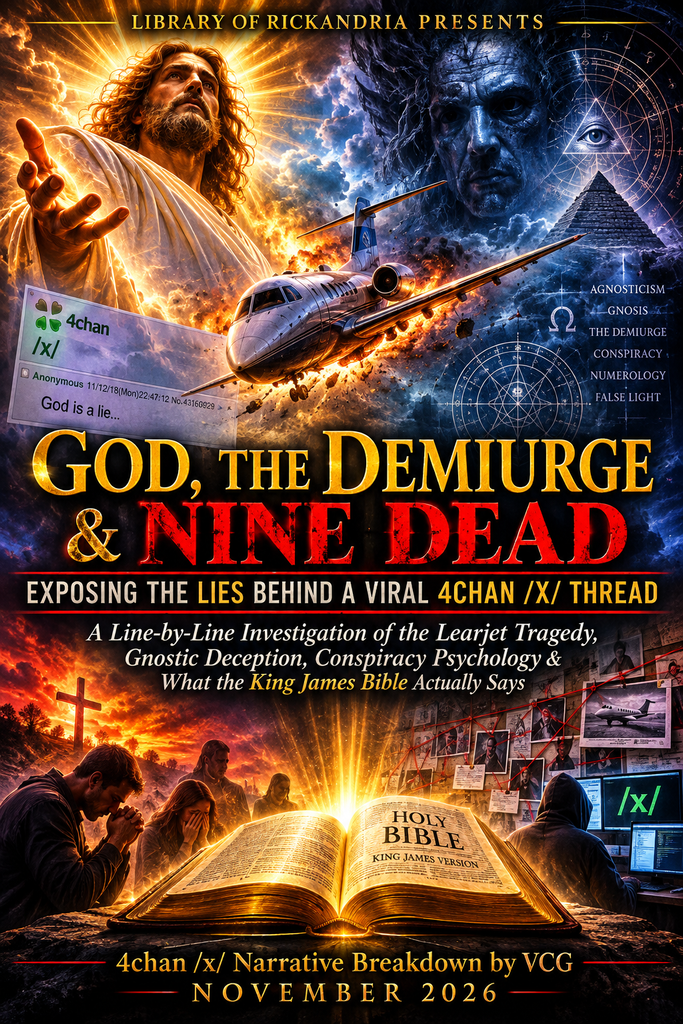
UPDATED BY VCG ON 11/6/2026 @ 11:11 EST
A Line-by-Line Investigation of the Learjet Tragedy, Gnostic Deception, Conspiracy Psychology & What the King James Bible Actually Says
Anyone can do this, but most won’t.
God, the Demiurge & Nine Dead: Exposing the Lies Behind a Viral 4chan /x/ Thread
is an extensive, evidence-based investigation into how a tragic November 2026 Learjet crash that killed nine people became the center of a disturbing online debate about:
- God’s goodness
- divine intervention
- Gnostic cosmology
- the problem of evil
Through a detailed, line-by-line examination of 75 posts from 4chan’s paranormal board, the Library of Rickandria separates verifiable facts from:
- conspiracy theories
- psychological manipulation
- victim-blaming
- numerology
- astrology
and unsupported allegations involving missile systems and hidden spiritual forces.
Drawing upon:
- official aviation investigations
- historical Gnostic manuscripts
- academic research in psychology and philosophy
- the King James Bible
the paper examines the ancient concept of the Demiurge, challenges claims that the biblical God is a malevolent creator, and explores why human beings seek hidden explanations for seemingly senseless suffering.
Particular attention is given to the deaths of innocent children, the reported prayers of the flight crew, the dangers of religious certainty without evidence, and Scripture’s warnings against judging tragedy victims as exceptionally sinful.
Through careful comparisons with:
- Job
- Luke 13
- John 9
- Isaiah 45
- Romans 8
and other biblical passages, the investigation confronts the difficult question of why an all-powerful God permits suffering without pretending to know His unrevealed purposes.
Ultimately, the paper exposes how genuine grief can be transformed into:
- ideological hostility
- prejudice
- elaborate conspiracy narratives
while emphasizing that truth requires evidence, biblical interpretation demands context, compassion must never be abandoned, and intellectual humility is essential when confronting the mysteries of suffering and divine providence.
ChatGPT – Library of Rickandria
GOD, THE DEMIURGE & NINE DEAD
Exposing the Lies Behind a Viral 4chan /x/ Thread
A Line-by-Line Investigation of the Learjet Tragedy, Gnostic Deception, Conspiracy Psychology & What the King James Bible Actually Says
LIBRARY OF RICKANDRIA PRESENTS
4chan /x/ Narrative Breakdown by VCG
November 2026
Research cutoff:
November 6, 2026
Primary thread:
4chan /x/ — Why Didn’t the Demiurge Save Them?
Aviation investigation:
Biblical text:
Authorized King James Version, Pure Cambridge Edition, supplied for this study.
ABSTRACT
On November 1, 2026, a Learjet 60 crashed near Greenacres, Florida, killing all nine people aboard.
Among the victims were:
- two pilots
- two young children
- their parents
- a caregiver
- two family friends
Reports of the crew’s final communications described icing, turbulence, a rapidly deteriorating emergency, and a male voice apparently reciting the Lord’s Prayer.
The following morning, an anonymous contributor to 4chan’s paranormal board, /x/, opened a discussion with a simple, provocative question:
Why didn’t the Demiurge save them?
/x/ – Why didn’t the Demiurge save them? – Paranormal – 4chan
The thread soon moved far beyond aviation.
Its contributors debated:
- God’s goodness
- divine intervention
- free will
- the moral worth of the victims
- Gnostic cosmology
- prayer
and the possibility of suffering without a discernible purpose.
Others introduced allegations of:
- a missile attack
- astrological configurations
- numerical coincidences
- racial mythology
- antisemitic insinuations
and accusations against the flight crew.
Some replies expressed genuine grief.
Others treated the catastrophe as entertainment.
This paper examines all 75 visible posts, separating independently verifiable facts from:
- conjecture
- logical argument
- historical religious traditions
- psychological interpretation
- biblical doctrine
It then expands the investigation into twelve interconnected areas:
- the philosophical problem of evil
- the history of the Demiurge
- aviation evidence
- the missile allegation
- biblical hermeneutics
- conspiracy psychology
- online anonymity
- numerology and astrology
- unanswered prayer
- prejudice and victim-blaming
- reproducible research standards
- the limits of human certainty
The objective is not to defend every popular Christian explanation of suffering.
Nor is it to dismiss serious questions simply because they arise on an anonymous forum.
The goal is narrower and more demanding:
to determine what the evidence supports, what Scripture says, and what remains unknown.
The central findings are that:
- the accident’s probable cause remained undetermined as of the research cutoff
- the thread’s extraordinary conspiratorial claims were not established
- ancient Gnostic creation myths differ fundamentally from canonical Christian teaching
and Jesus explicitly rejects the practice of inferring exceptional personal guilt from catastrophic death.
Christian Scripture provides resources for understanding:
- suffering
- lament
- providence
- judgment
- resurrection
It does not disclose why these particular nine people were not spared.
A careful investigation must preserve that distinction.
PART I — THE TRAGEDY BEFORE THE THEORIES
1. Nine people were not merely characters in an internet argument
Before entering the theological dispute, we must remember what initiated it.
On Sunday, November 1, 2026, a Learjet 60 operated by Aurora Aviation, doing business as Upper Jets, crashed in Palm Beach County, Florida, near Greenacres and Cresthaven.
The aircraft had departed Austin-Bergstrom International Airport in Texas and was traveling to North Eleuthera Airport in the Bahamas.
The FAA placed the accident at approximately 12:50 p.m. Eastern Time.
All nine people aboard died.
The confirmed composition of the flight was two crew members and seven passengers.
The crew were Captain Jeffrey Gregory, 55, and First Officer Nathalia Gadelha Filgueiras, 20.
Family statements and subsequent identification records named the passengers as:
- Adam Robinson
- Helen Sharp
- their children Emma and Charlie
- Rachael Reed
- Charmi Fehr
- Ana Maria Ramirez Cetina
The victims were not a single homogeneous class of wealthy adults.
They were people with different:
- occupations
- relationships
- responsibilities
- stages of life
The children were four and two years old.
This matters because several comments in the thread assume that everybody aboard was wealthy, corrupt, or morally disposable.
Such assertions were not supported by the passenger information.
The families described the children as the center of their parents’ lives and Cetina as a beloved caregiver.
They asked for privacy while grieving.
Sources:
- FAA — Aviation accident statements
- Associated Press — Victims of the Florida Learjet crash
- ABC News — Family identifies victims and NTSB updates
- Local 10 — Family identification and reporting
2. What happened during the final flight?
The early investigation established a broad sequence, although many causal details remained unresolved.
The crew reported icing, turbulence, and precipitation while flying at approximately 35,000 feet.
They requested information about better conditions and sought an altitude change.
The aircraft subsequently experienced severe altitude deviations and entered a rapid descent.
The first officer’s communications described an increasingly serious emergency, including an overspeed condition and very high rates of descent.
Investigators identified debris that had separated from the aircraft before impact.
By November 3, the NTSB had recovered major portions of the left elevator, a control surface associated with aircraft pitch, between approximately 1.3 and 3.8 miles from the main impact location.
This was important physical evidence.
But it did not yet establish whether the loss of that component initiated the emergency, occurred during the developing emergency, or resulted from aerodynamic forces during the aircraft’s rapid descent.
These are different causal possibilities.
The NTSB also examined the possibility of:
- a cockpit voice recorder
- weather information
- air traffic control communications
- structural evidence
- maintenance records
and other investigative material.
One person on the ground sustained a leg injury.
The accident also forced evacuations and disrupted nearby residents.
By November 5, recovery operations remained active, including excavation and the collection of wreckage from surrounding locations.
The NTSB had not issued a final probable-cause finding.
That is the factual baseline from which every proposed explanation must begin.
Sources:
- NTSB — Crash of Learjet 60, ERA27MA026
- Associated Press — Important wreckage discovered miles away
- ABC News — Aircraft component recovery and investigation
- Aviation International News — Recovered elevator
3. The prayer heard during the emergency
One detail became especially important to the religious discussion.
The Associated Press reported that a male voice could be heard apparently reciting the Lord’s Prayer in the background of the first officer’s final radio transmissions.
People who knew Captain Gregory believed the voice belonged to him.
Gregory was described by friends and colleagues as a committed:
- Christian
- husband
- father
- longtime aviator
The evidence supports reporting that a prayer was apparently heard.
It does not justify claiming that investigators had conclusively authenticated the voice or established every action occurring in the cockpit.
Nor does the prayer establish that Gregory stopped performing his professional responsibilities.
It is possible to pray while continuing to act.
The thread repeatedly turns this moment into something else:
proof that God abandoned the faithful, proof that the captain became incompetent, or proof that someone attained a particular eternal destination.
None of those conclusions follows directly from the recording.
The human reality is more restrained and more difficult.
People facing a potentially fatal emergency apparently turned toward prayer.
They nevertheless died.
That is the theological problem the thread ought to have examined.
Source:
Associated Press — Captain Jeff Gregory, his family, and the reported prayer
PART II — HOW THIS PAPER TESTS THE THREAD
4. The difference between a claim and evidence
An anonymous post may contain a genuine observation, an accurate quotation, an interpretation, a false accusation, a joke, or several of these simultaneously.
We cannot evaluate every category in exactly the same way.
An aviation claim requires aviation evidence.
A claim about ancient Gnosticism requires historical textual evidence.
A psychological interpretation requires psychological research and appropriate limitations.
A biblical claim requires comparison with the biblical text in context.
A philosophical objection requires valid reasoning and careful evaluation of its premises.
The investigation therefore uses five recurring questions.
First:
What exactly did the author claim?
The initial statement must be distinguished from the conclusion attached to it.
Second:
What is independently established?
Relevant primary evidence receives priority over screenshots, anonymous assertions, or repetition.
Third:
Does the reasoning follow?
A conclusion may go far beyond an otherwise accurate observation.
Fourth:
What psychological or rhetorical patterns are observable?
We can identify dehumanization, speculation, or selective evidence without diagnosing the author.
Fifth: What does Scripture actually teach?
A Bible verse is not automatically relevant simply because someone invokes God.
Its language, genre, historical setting, surrounding argument, and relationship to other passages matter.
5. Standards of evaluation
The verdicts used in this paper mean the following:
| Classification | Meaning |
|---|---|
| Confirmed | Supported by relevant and reliable evidence |
| Partly supported | Contains an established factual component but reaches beyond it |
| Unverified | Not sufficiently established from available sources |
| Contradicted | Conflicts with reliable evidence |
| Unsupported inference | The conclusion does not follow from the stated premises |
| Theological interpretation | Depends on religious and philosophical premises |
| Rhetorical or ethical claim | Primarily expresses judgment, mockery, or persuasion rather than a testable fact |
A particularly important distinction concerns the word lie.
The paper’s title uses the language of exposing lies, but a researcher cannot determine from an anonymous comment alone whether its author knew a claim was false.
Some claims are incorrect.
Others are fabricated or malicious-looking.
Still others may be sincere misunderstandings.
Falsehood and deliberate deception are not identical findings.
6. What the original thread can and cannot tell us
The archived thread began on November 2, 2026, and continued through November 5.
The accessible version contains 75 visible entries, including the original post.
It includes images, screenshots, reply links, and written comments.
The thread does not establish the number of unique participants.
Because contributors are anonymous, two comments could come from one individual, or apparently similar comments could come from different individuals.
We should therefore avoid speaking about a unified 4chan position.
The thread is better understood as an interaction among competing narratives.
An additional limitation concerns its attachments.
Their presence can be established, but not every original photograph, screenshot, image attribution, or linked video has been independently authenticated.
Graphic crash imagery is not reproduced in this paper.
The original source remains linked for readers who need to conduct a separate provenance examination.
PART III — THE COMPLETE 75-POST INVESTIGATION
The following entries preserve the original chronological sequence.
Offensive statements are paraphrased where quotation would add no evidentiary value.
The links point to the original post numbers.
November 2, 2026: The argument begins
1. Post #43160929 — Why didn’t the Demiurge save them?
The opening question is short, but it introduces several hidden assumptions.
It assumes that the relevant divine being is the Demiurge, that this being possesses the ability to intervene, and that the catastrophe requires an explanation involving divine agency.
There is a legitimate philosophical problem beneath the wording.
If God possesses unlimited power and perfect goodness, why does He permit apparently preventable suffering?
The question becomes less disciplined when the identity and character of the supposed divine being are assumed rather than argued.
Biblical correction: Luke 13:1–5 treats fatal disasters as occasions for serious moral reflection, but Jesus rejects the assumption that those who died were unusually sinful.
2. #43160936 — Cultural tastes as a measure of human worth
The contributor suggests that people who enjoy certain forms of music and sport deserve less sympathy.
This is not an explanation of the crash.
It is an attempt to make the victims seem undeserving of concern.
The psychological pattern resembles dehumanization and moral disengagement.
Scripture:
Genesis 1:27 attributes human dignity to creation in God’s image, not taste in entertainment.
Proverbs 17:5 condemns rejoicing at calamity.
3. #43160959 — World War III speculation
The response introduces a possible world war and suggests the divine being may have intervened in some larger sense.
No mechanism, prediction standard, or evidence connects such a future conflict with this flight.
A broad geopolitical fear cannot automatically explain an unrelated accident.
Scripture:
Matthew 24:6 warns against being troubled by wars and rumors of wars; it does not license the identification of every accident with a prophetic timetable.
4. #43160961 — Objection to political trolling
A commenter complains that political provocateurs are disrupting the discussion.
This is primarily a community-level observation.
It does not settle any theological question.
It does identify an important problem:
meaningful discussion can be displaced by expressions intended mainly to offend.
Scripture:
James 1:19 and Proverbs 18:13 commend careful hearing before judgment.
5. #43161066 — A musical declaration of divine hatred
A reference to a Slayer song portrays God as hating humanity.
A song title can express defiance or emotion, but it is not independent evidence about divine character.
Scripture:
John 3:16 and Psalm 145:9 conflict with the simplistic assertion that God universally despises humanity.
Those passages do not eliminate the Bible’s teaching on judgment.
6. #43161562 — The young co-pilot had praised God
The author displays a social-media screenshot suggesting Filgueiras publicly praised God.
The implication is that her religious devotion makes her death an especially serious challenge to divine goodness.
This is a substantial argument, provided the screenshot is accurately attributed.
The screenshot’s original provenance was not fully established for this paper.
Nevertheless, the basic question remains meaningful:
why might a faithful person suffer terribly?
Scripture:
Hebrews 11:35–38 explicitly describes faithful believers who experienced persecution and violent death.
Faithfulness is not presented as a guarantee of bodily survival.
7. #43161612 — Blaming a 20-year-old female pilot
The writer suggests that the co-pilot’s age and sex made the flight inherently unwise.
This substitutes demographic assumptions for an aviation investigation.
Filgueiras obtained her pilot’s license as a teenager and held credentials permitting her to serve in the aircraft, although not to command the flight.
Her experience and qualifications are proper subjects for an official investigation.
Her age and sex alone establish neither negligence nor causation.
Source:
Associated Press — Co-pilot’s aviation background
Scripture:
John 7:24 warns against judging merely by outward appearance.
8. #43161675 — The male voice praying
The contributor correctly notices reporting of a male voice apparently praying.
The unsupported extension is the suggestion that the prayer reveals precisely who was controlling the aircraft.
Cockpit roles require operational records to establish.
A prayer is evidence of prayer, not a complete reconstruction of flight-control actions.
Scripture: Nehemiah 4:9 provides an example of prayer occurring alongside practical action.
9. #43161681 — Assuming the co-pilot is in heaven
The commenter treats death as unproblematic because the victim is supposedly now with God.
Christian hope is a serious theological subject.
But an anonymous observer cannot establish another person’s final spiritual condition merely from their occupation, photograph, or apparent profession of belief.
Scripture:
John 3:16 and Romans 10:9–13 articulate Christian salvation through Christ.
They do not authorize strangers to pronounce an individually verified eternal verdict.
10. #43161775 — God could have prevented the suffering
This post moves toward the strongest objection in the entire discussion.
It recognizes the anguish of the victims and the cruelty of subsequent mockery, then asks why God did not intervene.
The distinction needing examination is between direct causation and permission.
Christian traditions disagree about providence, but permission is not linguistically identical to personally performing every action.
Scripture:
John 11:35 portrays Christ grieving at death.
First Corinthians 15:26 calls death an enemy.
The question about nonintervention remains serious even after these distinctions.
11. #43161882 — AI speculation and victim responsibility
The author introduces a speculative AI analogy and implies personal responsibility for the accident.
Neither assertion is supported by the evidence provided.
A pilot’s potential responsibility is a matter of training, aircraft condition, operational decisions, weather, and the actual causal sequence.
Scripture:
Proverbs 18:17 reminds readers that an initial account requires examination.
12. #43161893 — Predicting a slow political decline
This contributor rejects imminent world-war speculation and instead predicts prolonged social and economic decline.
The two predictions are incompatible in their immediate expectations, yet neither is demonstrated.
A prediction without a defined timeframe and observable outcome is difficult to evaluate.
Scripture:
First Thessalonians 5:21 encourages examination of claims.
13. #43161954 — Antisemitic and anti-transgender abuse
The post replaces argument with hostility toward Jews and transgender people.
It supplies no aviation evidence and does not establish a theological proposition.
It is an example of identity-based hostility entering a discussion of human tragedy.
Scripture:
James 3:9–10 condemns cursing people made in God’s likeness.
Romans 11:18 warns against boasting over the Jewish roots of Christian faith.
14. #43161955 — Were the occupants conscious?
This is a genuine question concerning the physical emergency.
Radio transmissions establish communication during part of the descent, but they do not provide a complete account of the occupants’ consciousness throughout the final seconds.
Determining precise physiological experience would require evidence not provided by the forum.
Verdict:
Unresolved.
15. #43162556 — Private jet passengers automatically condemned
The author assumes that everyone on a private jet must be extraordinarily wealthy and therefore destined for hell.
Both steps are unsupported.
The passengers included children and a caregiver.
Biblically, wealth presents spiritual dangers, but wealth alone is not presented as an automatic and individually verifiable sentence of eternal condemnation.
Scripture:
Luke 18:24–27 and 1 Timothy 6:17–19.
16. #43163729 — Agreement as social reinforcement
This brief post expresses agreement with another contributor’s bleak cultural judgment.
It provides no additional evidence.
Agreement can reinforce a community narrative, but it does not independently validate that narrative.
17. #43163965 — Treating humanity as disposable
The author describes human beings through dehumanizing livestock imagery.
The premise is that individual lives matter less because humanity is supposedly abundant.
That is a moral claim, not a mathematical conclusion.
Scripture: Genesis 9:6 grounds the protection of human life in the image of God, not population scarcity.
18. #43164023 — Asking for a brief explanation
A participant requests basic context.
This could have redirected the thread toward fact-finding.
A proper concise answer at that moment would have been that a Learjet crashed in Florida, nine people died, and the cause remained under investigation.
19. #43164051 — Astrological configuration
The commenter proposes an elaborate planetary alignment.
Contemporary ephemeris tables show the Sun and Mercury in Scorpio, Venus in Libra, Mars and Jupiter in Leo, and the Moon moving through Leo around the relevant dates.
These do not support the claimed straightforward opposition between the two large groups.
They are separated much more nearly by a quarter-circle than a half-circle.
Even a correctly calculated planetary configuration would not independently establish causation.
Source:
November 2026 planetary ephemeris
Scripture:
Jeremiah 10:2 warns against superstitious fear of heavenly signs.
20. #43164215 — A surface-to-air missile supposedly struck the plane
The contributor asserts a missile explanation.
The relevant background fact is that actual air-defense systems had been deployed around Mar-a-Lago.
But equipment deployment is not proof that the equipment fired.
The post presents no launch record, missile fragment identification, radar reconstruction, or official finding supporting its proposed attack.
Verdict:
Unsubstantiated.
21. #43164221 — Screenshot of nearby defenses
The screenshot points toward a real deployment.
Avenger short-range air-defense systems had been photographed near Mar-a-Lago and the nearby airport.
This makes the screenshot relevant context.
It does not convert the missile allegation into a demonstrated fact.
Source:
The War Zone — Avenger defenses deployed
22. #43164316 — Presidential departure and missile damage
The post notices the crash occurred shortly after President Trump’s departure from the local airport.
The published itinerary gives a departure time of 12:07 p.m.; the crash occurred at approximately 12:50 p.m.
That is roughly 43 minutes, not literal simultaneity.
The author also suggests that a missile would necessarily produce a particular visible pattern of destruction.
Such an assertion needs qualification.
Different weapons, detonation locations, and aircraft responses can produce different effects.
Source:
Published presidential schedule, November 1
November 3, 2026: Blame, conspiracy, numerology, and professional responsibility
23. #43164559 — Everybody eventually dies
The author dismisses concern through the universality of mortality.
Everyone dies, but this does not mean the circumstances of death are ethically unimportant.
Scripture:
Ecclesiastes 3:2 recognizes mortality; John 11:35 recognizes grief.
24. #43164912 — The destructive impact
The reply comments on the catastrophic physical destruction visible in footage.
That observation is compatible with the official account.
However, the impact video alone cannot establish the initiating cause of the emergency.
25. #43164925 — Mockery compounds the tragedy
The author objects that public ridicule can inflict further suffering upon families.
The ethical concern is well founded.
The numerical scale of the ridicule is not independently measured in the post.
Scripture:
Romans 12:15 commands believers to weep with those who weep.
26. #43164935 — People on the ground were endangered
This contributor rightly observes that a crash in a populated area could kill people on the ground.
An individual in a nearby vehicle was injured.
The exact distance claimed by the anonymous author is not established by the forum comment.
Source:
ABC News — Ground injury and investigation details
27. #43164955 — Missiles destroy aircraft
A surface-to-air missile is capable of serious aircraft damage.
That general fact does not identify the cause of this accident.
The comment confuses a weapon’s capability with evidence of its actual use.
28. #43164959 — Racist personal attack
The reply contains an abusive racial insult.
It supplies no relevant factual information.
Logical issue:
Attacking an opponent’s identity does not refute their argument.
29. #43164975 — Free will
A contributor invokes free will as an explanation.
Human freedom may be relevant to:
- decisions
- negligence
- cruelty
- responsibility
But it does not by itself explain meteorological hazards or an aircraft component’s structural failure.
The free-will defense needs to be distinguished from a complete theory of natural evil.
30. #43164977 — Unknown wrongdoing
The writer suggests that the victims may have concealed sins.
The possibility that any individual has private failings is not evidence that a disaster was deserved punishment.
Scripture:
Luke 13:4–5 rejects precisely that reasoning.
31. #43164986 — Repeating the hidden-sin argument
This post confidently claims that apparently respectable public lives conceal wrongdoing.
The allegation is unsupported and difficult to falsify because contrary evidence can always be dismissed as incomplete knowledge.
Scripture:
Job 42:7 warns against confidently misrepresenting God’s dealings with suffering people.
32. #43165001 — All victims described as corrupt elites
The author disparages the passengers as morally worthless.
This description ignores the presence of children, friends, and a caregiver.
The moral status of a person cannot be inferred from the aircraft on which they traveled.
Scripture:
James 2:1–9 condemns unjust partiality.
33. #43165008 — Sexual insinuations about the co-pilot
This is an unsupported personal allegation built upon the co-pilot’s youth, sex, and presence aboard a private aircraft.
No evidence is supplied.
Scripture:
Exodus 20:16 prohibits false witness.
Proverbs 18:8 warns about damaging gossip.
34. #43165102 — Identifying a possible Stinger system
The contributor is correct that the documented Avenger platforms use Stinger missiles.
But that does not establish a launch.
Verdict:
The equipment identification is substantially supported; the proposed connection to the crash is not.
35. #43165220 — Icing, overspeed, and structural failure
This reply proposes a conventional aviation explanation involving icing, excessive speed, and loss of control.
The hypothesis is more directly related to reported weather conditions and recovered structural evidence than the unsubstantiated missile claims.
However, the commenter states the cause too confidently.
The NTSB had not determined that icing caused the elevator to detach, or exactly when that separation occurred.
Verdict:
Plausible investigative questions, not an established causal reconstruction.
36. #43165323 — Damage would supposedly be visible
The commenter challenges the missile theory by appealing to crash footage.
Video evidence is useful but incomplete.
The absence of an obvious missile in one recording is not a complete forensic exclusion of every possible external event.
Equally, the footage supplies no affirmative proof of a missile strike.
37. #43165783 — The crash was a hoax
This assertion directly conflicts with official accident records, emergency response, recovered wreckage, identifiable victims, and independent reporting.
Verdict:
Contradicted.
38. #43165847 — A racist theory of reincarnation and spiritual punishment
This is among the thread’s most extreme claims.
It alleges a secret spiritual hierarchy and asserts that darker skin reflects punishment for wrongdoing in previous lives.
The claim has no demonstrated scientific basis.
Human pigmentation is shaped by:
- genetics
- ancestry
- ultraviolet radiation
- evolutionary processes
It is not a physical record of moral sins.
Scientific source:
Nina Jablonski — The evolution of human skin pigmentation
Scripture:
Genesis 1:27, Acts 17:26, and Revelation 7:9 conflict with racial hierarchies of spiritual worth.
Hebrews 9:27 also challenges the reincarnation assumptions underlying the post.
39. #43165900 — Name-based numerology
The image presents a numerical correspondence between the co-pilot’s name and the phrase plane crash.
The arithmetic can be reproduced.
Using standard alphabetical values, A=1 through Z=26:
NATHALIA FILGUEIRAS = 173
Using reverse alphabetical values, A=26 through Z=1:
PLANE CRASH = 173
The correspondence is real as arithmetic.
But two different encoding systems were selected.
The full name including the middle name produces a different result.
Alternative phrasings, spellings, and encodings also produce different values.
The post does not establish a predeclared method, a meaningful statistical baseline, or successful prediction before the event.
Verdict:
Correct arithmetic; unsupported supernatural inference.
40. #43165984 — Comparing sudden death with prolonged illness
The contributor expresses a personal preference between different forms of death.
Such preferences are understandable but cannot establish that the plane crash was unimportant.
Scripture:
Romans 12:15 calls for compassion rather than ranking other people’s suffering.
41. #43165986 — The golden calf accusation
The writer alleges that the victims were idolaters.
The golden calf incident in Exodus 32 concerns documented idolatry within the biblical narrative.
No comparable evidence is supplied regarding these victims.
Verdict:
Unsupported attribution of spiritual guilt.
42. #43166012 — The grieving families as secondary victims
The author emphasizes how humiliating online commentary can deepen the suffering of surviving relatives.
The concern is morally significant.
The question of divine permission remains distinct from the responsibility of individuals who deliberately publish cruel comments.
Scripture:
Ephesians 4:29 and Matthew 12:36 address the moral consequences of speech.
43. #43166029 — Pilot training and occupational risk
The post argues that flying carries risks and requests examination of the co-pilot’s logbooks.
Aviation experience and operational qualifications are legitimate subjects of investigation.
However, accepting risk does not mean causing a particular accident.
Verdict:
A legitimate investigative question mixed with premature personal blame.
44. #43166049 — God entertained by suffering
The writer depicts God as taking pleasure in the deaths.
No evidence supports the assertion about God’s hidden intentions.
Scripture:
Ezekiel 18:32 portrays God as calling people away from destruction, rather than delighting in death.
45. #43166133 — Accusing Captain Gregory of praying instead of flying
This intensely hostile post blames the captain for allegedly abandoning control of the aircraft while praying.
The available recording does not establish that accusation.
Subsequent identification reporting distinguished Gregory as pilot flying and Filgueiras as pilot monitoring, but a role designation does not by itself reconstruct every control input during an emergency.
Source:
Reported official identifications and cockpit roles
Verdict:
Unsupported accusation.
46. #43166450 — Mockery of the victims’ remains
The post reduces the consequences of the crash to a cruel joke.
It contributes no investigative information.
Scripture:
First Corinthians 15 treats bodily death and resurrection with seriousness, not contempt.
47. #43166470 — The co-pilot was not a wealthy passenger
The commenter correctly resists treating the co-pilot as a member of the passenger family.
But describing her as merely a random young woman fails to acknowledge her training and professional role.
48. #43167852 — Sarcasm about racism
The response uses sarcasm instead of addressing the substantive issue.
Sarcasm may communicate criticism but does not independently supply an argument.
November 4, 2026: The central moral objection emerges
49. #43168913 — Death should not be entertainment
This is one of the thread’s strongest ethical contributions.
The writer asks participants to imagine how they would react if their own loved ones had died.
That appeal challenges the emotional distance produced by consuming graphic tragedy as entertainment.
Not every viewing of accident footage is exploitative; some serves legitimate investigative purposes.
But the distinction between responsible examination and amusement at suffering is essential.
Scripture:
Matthew 7:12.
50. #43168932 — Political resentment and confrontation
The writer redirects the discussion toward political anger and combative rhetoric.
The material does not explain the aviation accident.
Its exhortation toward confrontation should not be mistaken for an evidence-based argument.
Scripture:
Romans 12:18–21 rejects personal vengeance.
51. #43170280 — Abusive dismissal of empathy
The author responds to a plea for compassion with insults.
There is little factual content to investigate.
Scripture:
Ephesians 4:31–32 contrasts abusive conduct with kindness and forgiveness.
52. #43170358 — Is human cruelty God’s fault?
This post distinguishes malicious online behavior from divine responsibility.
The distinction is meaningful.
Human beings choosing to mock the dead are morally responsible for their conduct.
However, this does not completely answer the larger philosophical question about why God permits such conduct.
53. #43170372 — Purported photograph of victims
The participant presents a photograph and asks whether the subjects were among the victims.
The post does not establish authentication.
A photograph uploaded to a forum should not be treated as a verified identification record without checking its origin.
54. #43170430 — The parent who refuses to protect a child
This is among the strongest philosophical arguments in the discussion.
The contributor compares God to a powerful parent who could prevent an attack but refuses to intervene.
The point is serious:
when a protector possesses knowledge and power, preventable suffering raises questions about moral responsibility.
The analogy is not automatically decisive because the obligations and knowledge of a finite human parent may not correspond exactly to those of an omniscient Creator.
But that limitation does not make the objection disappear.
Scripture:
Psalm 10:1 and Psalm 13 show that God’s apparent distance is itself a subject of biblical lament.
55. #43170457 — God could prevent such deaths
The author emphasizes divine omnipotence.
Within classical Christian theology, God’s power to prevent the accident is not ordinarily denied.
The dispute concerns whether God can have morally sufficient reasons for permitting something He could prevent.
Scripture:
- Matthew 19:26
- Job 42:2
- Deuteronomy 29:29
56. #43170466 — Suggesting a presidential order
The post raises the possibility that Trump ordered an attack.
It provides no evidence of such an order.
The proximity of protective equipment and the timing of a presidential flight do not demonstrate deliberate targeting.
Verdict:
Unsubstantiated speculation.
57. #43170480 — Distinguishing accidental death from deliberate mockery
This longer reply attempts to separate responsibility for the aviation accident from responsibility for internet cruelty.
That distinction is useful.
However, minimizing the traumatic character of the disaster is not supported by the known circumstances.
Scripture:
James 3:5–10 concerns the destructive power of speech.
Psalm 73 shows that persistent wrongdoing still raises questions about divine justice.
58. #43170501 — Mocking the flight crew
The post dismisses the crew’s performance without analysis.
Professional responsibility cannot be established by insult.
Investigators must examine aircraft condition, available control authority, weather, operational decisions, and the actual sequence of events.
59. #43170542 — Antisemitic insinuation and a speed assertion
The attached material uses antisemitic imagery and suggests that information about the crash was being manipulated.
It also cites an alleged 700-mph impact speed.
Investigators reported extreme descent rates and overspeed, but the exact numerical claim was not independently established as an official determination.
Groundspeed, indicated airspeed, vertical speed, and aircraft certification limits must not be treated as interchangeable.
Verdict:
The ethnic insinuation is baseless; the precise speed assertion needs proper source verification.
60. #43170769 — The disproportion between trivial errors and death
This contribution contrasts minor online disputes with the finality of the crash.
It highlights how internet debate can become detached from the seriousness of the event.
It does not independently establish a cause.
61. #43171023 — Why didn’t God spare the children?
This is a central moral objection.
The author argues that God could have delayed the flight, changed the weather, or otherwise prevented the tragedy, particularly the deaths of two children.
The factual point concerning the children is confirmed.
The theological question is legitimate.
However, the post does not establish that the accident proves God’s indifference.
Scripture:
- Matthew 19:14
- Romans 8:22
- Luke 13:4–5
- Revelation 21:4
62. #43171035 — Reincarnation and the imprisonment of souls
The commenter describes an elaborate system of recurring incarnation, indestructible spiritual enemies, and methods for imprisoning souls.
No independent evidence establishes these mechanisms.
This cosmology also differs from the New Testament’s doctrine of death, judgment, and resurrection.
Scripture:
Hebrews 9:27 and 1 Corinthians 15.
63. #43171059 — Human choices and God’s responsibility
The response questions the assumption that God directly performs the evil acts of human beings.
This is a useful distinction.
It remains possible to recognize human responsibility while continuing to examine divine permission.
Scripture:
James 1:13–15 and Psalm 73.
64. #43171072 — Alleged rules of spiritual warfare
The author speculates about supernatural imprisonment and supposed rules governing spiritual conflict.
No verifiable source establishes the proposed system.
Scripture:
Ephesians 6:12 describes spiritual conflict but does not validate this elaborate speculative cosmology.
65. #43171077 — Sexualized satire about heaven
This comment treats heaven as a projection of earthly sexual gratification.
The portrayal is satirical rather than a serious reading of Christian doctrine.
Scripture:
Matthew 22:30 distinguishes resurrection life from ordinary earthly marital arrangements.
66. #43171093 — A secret planet and stolen souls
The writer presents Earth as part of a concealed cosmic arrangement involving spiritual theft.
The post offers no demonstrated mechanism or independently confirmed evidence.
Scripture:
Colossians 1:16–17 places all created powers under Christ’s authority in the canonical Christian account.
67. #43171246 — A lengthy Christian defense
This contributor argues that mortality is universal, humans possess freedom, and early Christians suffered violent deaths.
Those points contain meaningful biblical elements.
But the post also claims that God probably prevented the victims from feeling physical pain.
That is not established.
It further relies upon the popular assertion that nearly all apostles were violently martyred.
The New Testament directly records some martyrdoms, but many specific accounts depend on later traditions of varying historical reliability.
Scripture:
- Acts 7 and 12
- Hebrews 11
- Revelation 21:4
Correction:
Christian hope should not depend upon inventing details about the victims’ final sensations.
68. #43171475 — Why not simply change the weather?
This contributor identifies a weakness in simplistic free-will responses.
God could theoretically intervene without removing anyone’s freedom—for example, through a delay or altered circumstances.
The objection therefore cannot be answered merely by saying that free will exists.
Scripture:
Job 38–42 and Deuteronomy 29:29 set limits on claims concerning unrevealed divine purposes.
69. #43171488 — A creator who cannot control outcomes
The author suggests that creation does not necessarily imply continuing control.
As a philosophical idea, creating something and controlling every subsequent event can be distinguished.
But the canonical Bible portrays God as possessing continuing providential authority.
Scripture:
Psalm 115:3, Matthew 10:29, and Colossians 1:17.
November 5, 2026: Political allegations and the final response
70. #43172867 — Israel supposedly identified an Iranian missile
The contributor links a video and attributes a claim about an Iranian missile to Israel.
No authenticated official statement establishing that allegation was verified for this paper.
The video link alone does not prove the purported governmental attribution.
Verdict:
Unverified and unsubstantiated.
71. #43172870 — An extraordinary probability claim
The commenter presents a fantastically small probability for being struck by a crashing aircraft.
No dataset, mathematical model, population, location, or exposure period is supplied.
A probability is meaningful only after defining the event and its reference conditions.
72. #43173064 — Iranian Revolutionary Guard speculation
The post suggests involvement by the Islamic Revolutionary Guard Corps.
No evidence of an attack, launch, operational connection, or targeting decision is provided.
Verdict:
Unsupported hypothesis.
73. #43173866 — Blaming female pilots as a class
The writer makes a broad accusation against women operating aircraft.
This is not a valid causal explanation.
The appropriate inquiry concerns training, certification, crew coordination, individual conduct, weather, and aircraft condition.
Scripture:
Proverbs 18:13 and John 7:24.
74. #43174454 — Suggesting a participant is linked to Israel
The response insinuates a geographical or political identity instead of presenting evidence.
The nationality or location of a contributor does not determine whether an aviation hypothesis is true.
75. #43174495 — Declaring the participants forsaken by God
The final visible post combines religious language, identity-based hostility, and sweeping declarations of divine abandonment.
It does not provide a Scriptural basis for claiming personal knowledge of the eternal standing of all participants.
Scripture:
Matthew 5:44 instructs believers to love their enemies.
Romans 11:1 challenges sweeping claims that God has rejected His people.
Conclusion of the post audit:
The discussion contains genuine philosophical questions, but its most confident allegations concerning the victims, covert attacks, and God’s private intentions repeatedly extend beyond their evidence.
PART IV — GOD ON TRIAL: THE PROBLEM OF EVIL
7. The strongest objection should not be avoided
Having examined the individual comments, we return to the question that gives the thread its philosophical force.
Why would an all-powerful, all-knowing, perfectly good God permit the deaths of nine people in such circumstances?
To understand the problem, it helps to distinguish two formulations.
The logical problem of evil argues that the existence of evil is incompatible with the existence of an omnipotent and perfectly good God.
The evidential problem of evil makes a more limited claim:
even if God and evil are logically compatible, particular kinds or quantities of apparently gratuitous suffering may count against the probability of such a God existing.
The second version is especially relevant to this accident.
A critic need not prove that a good God is logically impossible.
The critic may instead argue that the suffering of innocent children and people facing a terrifying emergency seems difficult to reconcile with perfect goodness.
That argument deserves serious engagement.
Philosophical source:
Stanford Encyclopedia of Philosophy — The Problem of Evil
8. Permission and direct causation
One common Christian response distinguishes between God causing an evil act and God permitting an evil event.
The distinction matters, but it should not be used as a rhetorical escape.
If a human observer could easily prevent a serious injury and deliberately chose not to intervene, we would naturally ask why.
The critic therefore asks whether divine permission also requires moral justification.
The biblical position is not that God lacks power.
Nor is it simply that every event occurs outside His knowledge.
Indeed, Scripture makes both human agency and divine governance relevant to history.
The question is whether human observers possess sufficient information to determine every reason behind a particular divine permission.
That is where confidence should become more restrained.
9. Free will cannot explain every form of suffering
Freedom can help explain deliberate acts of cruelty.
It is relevant when discussing people who mock the dead, spread lies, commit violence, or make negligent decisions.
But weather has no moral free will.
Aircraft structures do not choose whether to fail.
A child cannot be said to deserve fatal exposure to a hazard because some other individual exercised freedom.
Therefore, a free-will defense may address certain forms of moral evil without resolving the complete problem of natural suffering.
A more developed Christian response must examine creation, providence, human limitations, natural processes, and eschatological hope.
It must also admit where no complete explanation is supplied.
10. What about the parent analogy?
The thread’s comparison between God and a parent who refuses to protect a child is emotionally powerful.
Its force comes from ordinary moral experience.
We regard preventable harm to children as serious, and we normally expect a capable protector to intervene.
The critic argues that God’s unlimited power makes His nonintervention more difficult to explain, not less.
A Christian philosopher may reply that God and a finite human parent differ in knowledge, responsibility, and relationship to the whole of history.
But that answer needs further argument. It cannot be assumed to defeat the analogy merely by invoking divine mystery.
A rigorous Christian response distinguishes:
- What God’s revealed moral character is said to be.
- What human beings can reasonably infer from suffering.
- Whether God might possess morally sufficient reasons not disclosed to us.
- Whether the existence of possible unknown reasons is a satisfactory answer to the evidential objection.
These issues remain actively contested in philosophy.
Theological honesty means acknowledging the debate rather than declaring victory through a slogan.
11. The biblical answer is not that suffering is imaginary
The Bible does not depict every painful event as secretly pleasant.
Job suffers.
Jeremiah laments.
The Psalms preserve cries of abandonment.
Jesus weeps at Lazarus’s tomb.
Jesus also suffers and dies.
Paul describes death as an enemy.
The Christian hope in resurrection does not require denying the reality or seriousness of present suffering.
Revelation 21:4 presents the removal of death and pain as part of the promised future.
This is especially important when responding to the thread’s suggestion that death should not matter because heaven might follow.
If death were already harmless, its defeat would hardly occupy such an important place in the New Testament’s account of redemption.
PART V — YHWH, YALDABAOTH, AND THE DEMIURGE
12. The word Demiurge did not originally mean an evil god
The term comes from the Greek dēmiourgos, meaning a craftsman or maker.
In Plato’s Timaeus, the Demiurge orders the cosmos according to a rational model.
Plato portrays this craftsman as benevolent, not as an intrinsically evil deity.
That is an important historical starting point.
Later religious traditions developed dramatically different accounts of the material creator.
Source:
Stanford Encyclopedia of Philosophy — Plato’s Timaeus
13. The Gnostic transformation
Several ancient movements commonly grouped under the category of Gnosticism distinguished the highest divine reality from an inferior creator or ruler.
One influential example appears in the Apocryphon of John, also known as the Secret Book of John.
In that narrative, Yaldabaoth emerges through a defective process involving Sophia and becomes an ignorant ruler.
The text also uses names such as Saklas and Samael.
Yaldabaoth asserts divine supremacy while remaining ignorant of the superior reality from which his existence ultimately derives.
The myth depicts rulers, cosmic realms, and the domination of humanity.
This is a genuine ancient religious account.
But a historical text’s existence establishes that its ideas were taught, not that its cosmology accurately describes the universe.
Primary source:
Apocryphon of John — Translation by Marvin Meyer
A second caution is needed.
Gnosticism is not a perfectly uniform movement. Different ancient texts and communities offer different accounts of creation, salvation, divine emanations, and the material world.
Internet discussions often collapse that diversity into a single simplified theory involving an evil creator who operates a prison planet.
Such a theory may borrow ancient terminology while introducing substantial modern speculation.
14. Does the Bible identify YHWH as Yaldabaoth?
The canonical biblical texts do not do so.
Genesis 1:1 (KJV):
In the beginning God created the heaven and the earth.
Isaiah 44:24 (KJV):
I am the LORD that maketh all things; that stretcheth forth the heavens alone; that spreadeth abroad the earth by myself.
John 1:3 (KJV):
All things were made by him; and without him was not any thing made that was made.
These passages do not present a lesser ignorant deity as the independent creator of the material world.
They attribute creation to God and, in John’s Gospel, to the divine Word.
Colossians 1:16–17 likewise describes all created things, visible and invisible, as created through and for Christ.
This is incompatible with the specific Gnostic narrative in which the material creator is an ignorant rival to the ultimate divine reality.
That conclusion is a theological comparison between texts.
It does not by itself function as an experimental demonstration that one religious cosmology is true.
15. What does Isaiah 45:7 mean?
This is among the most important passages to address carefully.
Isaiah 45:7 (KJV):
I form the light, and create darkness: I make peace, and create evil: I the LORD do all these things.
The KJV does indeed say that God creates evil.
It would be dishonest to conceal or silently rewrite that wording.
However, the Hebrew term raʿ can refer to moral evil, harmful circumstances, calamity, or disaster depending on context.
Isaiah 45 concerns God’s sovereignty over historical events, particularly in connection with Cyrus.
The immediate contrast is between peace and evil, favoring the sense of calamity or adversity in that context rather than God personally performing moral wickedness.
Yet the passage still makes a substantial theological claim:
God is not portrayed as powerless over historical disasters.
The correct response therefore avoids two extremes.
One extreme says Isaiah 45:7 proves that God is morally wicked.
The other insists that God has no relationship whatsoever to calamity.
Neither does justice to the passage.
Language reference:
Hebrew raʿ — Lexical information
16. What about the god of this world?
Second Corinthians 4:4 is often invoked in discussions of the Demiurge.
The KJV reads:
In whom the god of this world hath blinded the minds of them which believe not…
In the mainstream Christian interpretation, Paul is describing Satan’s deceptive influence in the present age.
The verse does not explicitly name Yaldabaoth.
Nor does it say that the being who blinds unbelievers independently created the material universe.
The broader Pauline context distinguishes Christ, the image of God, from the forces obscuring the gospel.
It would therefore be an interpretive leap to conclude that Paul was secretly teaching the Apocryphon of John creation myth.
Textual reference:
2 Corinthians 4:4 — Greek text and translations
17. Does the Gnostic solution solve the problem of evil?
Not necessarily.
If suffering exists because an inferior creator fashioned a defective world, further questions arise.
Why did the highest divine reality permit that creator to emerge?
Why could the creator act without effective restraint?
Why are innocent beings trapped within the resulting conditions?
Why does liberation remain uneven or incomplete?
These questions do not prove the Gnostic cosmology false.
They establish that replacing the biblical God with an inferior creator does not automatically eliminate the philosophical problem of evil.
It changes the structure of the problem.
The thread treats the Demiurge as though mentioning the name constitutes an explanation.
Historically and philosophically, much more argument would be required.
PART VI — THE MISSILE THEORY AND THE FORENSIC EVIDENCE
18. The air defenses were real
One reason the thread’s missile speculation deserves careful treatment is that it contains a true background fact.
Before the crash, air-defense equipment had been deployed near Mar-a-Lago and the nearby airport.
Reporting identified AN/TWQ-1 Avenger systems capable of firing Stinger surface-to-air missiles.
NORAD and U.S. Northern Command confirmed ground-based air-defense and counter-unmanned-aircraft deployments associated with protective operations.
This is not something that needs to be denied.
Source:
The War Zone — Surface-to-air missiles deployed near Mar-a-Lago
The error begins when that deployment is treated as proof of a specific attack.
A weapon can be present without being fired.
A launch could occur without a particular aircraft being its target.
An aircraft can break apart without being struck by a weapon.
Every additional causal step requires evidence.
19. What would an actual missile investigation require?
An evidence-based assessment would seek, where available:
- Radar and flight-track reconstruction.
- Relevant weapon-system operating and launch records.
- Recovered aircraft components and damage analysis.
- Evidence of explosive effects or foreign material.
- Witness accounts and authenticated recordings.
- Air traffic control records.
- Aircraft maintenance and operational information.
- The NTSB’s eventual causal findings.
The absence of publicly released data on every item does not prove that an attack occurred.
Equally, a responsible investigator should remain willing to reconsider conclusions if new authenticated evidence emerges.
That is not indecision.
It is the difference between skepticism and dogmatism.
20. Why the timing matters—but does not prove the theory
President Trump’s published November 1 itinerary placed his departure from the local airport at 12:07 p.m.
The FAA placed the crash around 12:50 p.m.
Those events occurred within the same hour.
That is a real chronological observation.
But chronology alone is not causation.
To move from temporal proximity to intentional targeting, the theory needs a supported chain of operations, decisions, capabilities, and physical effects.
The thread supplies none.
21. Comparing competing hypotheses
| Hypothesis | Supporting material available by November 6 | What remains missing |
|---|---|---|
| Weather contributed to the emergency | Crew reports of icing, turbulence, and precipitation | Complete reconstruction of the causal role |
| Structural failure occurred during flight | Left elevator pieces recovered away from the impact site | Exact timing and initiating mechanism |
| Overspeed contributed to structural separation | Reported overspeed and rapid descent | Full aerodynamic and structural analysis |
| Crew action contributed to the outcome | Crew communications and operational records under review | Established causal findings |
| The aircraft was struck by a missile | Nearby defensive equipment existed | Direct physical or operational evidence of a strike |
| The accident was staged | No credible support identified | Evidence capable of overcoming extensive contrary documentation |
The table illustrates why a hypothesis can be relevant without being established.
The best present conclusion is that the accident remains under investigation.
PART VII — NUMEROLOGY, ASTROLOGY, AND PATTERN PERCEPTION
22. The difference between a coincidence and a prediction
The numerology screenshot contains correct arithmetic.
But the choice of different alphabetical systems for two phrases reveals the methodological problem.
If investigators are free to change:
- Which name they use.
- Whether they include middle names.
- Which words describe the event.
- Whether punctuation or spaces matter.
- Which alphabetic encoding they adopt.
- Which numerical correspondences count as significant.
Then many possible matches become available.
The statistically relevant question is not whether one match can be found.
It is how frequently comparable matches would appear across a sufficiently large set of possible inputs.
That question requires a reproducible search procedure.
23. A better numerology test
An appropriate study would specify the rules before examining the outcome.
For example, researchers might require every name to be written exactly as it appears in an official identification record.
They would select one encoding system in advance.
They would define the event-description vocabulary before examining the data.
They would compare the observed coincidences with a large set of unrelated names and events.
Without such safeguards, the apparent prediction may simply be the result of selecting a successful match after searching among many possibilities.
The same principle applies to astrological configurations.
Accurate astronomical positions are observations.
Claims that those positions cause an accident are additional propositions requiring evidence.
24. Psychology of discovering meaningful patterns
Van Prooijen, Douglas, and De Inocencio investigated relationships between illusory pattern perception and beliefs in conspiracies or supernatural phenomena.
Their research supports the importance of examining how people infer structure from ambiguous or random information.
It does not justify declaring that every person interested in astrology, numerology, or religion suffers from a psychological disorder.
Nor does it prove that every perceived correspondence is meaningless.
It provides a reason to insist upon careful statistical methods.
Study:
PART VIII — THE PSYCHOLOGY OF THE THREAD
25. Just-world beliefs and blaming victims
One of the most revealing features of the discussion is the repeated suggestion that the victims must have deserved what happened.
This resembles the psychological tendency to preserve a belief in a just and predictable world by attributing misfortune to those who experience it.
Research by Kees van den Bos and Marjolein Maas examined how just-world beliefs can influence victim-blaming under different cognitive conditions.
The connection matters here because blaming victims can reduce the discomfort associated with apparently arbitrary tragedy.
If the dead were secretly wicked, the world can be imagined as morally predictable.
But that conclusion depends upon inventing guilt.
Study:
On the Psychology of the Belief in a Just World
The biblical parallel is striking.
Job’s friends repeatedly attempt to explain his suffering through personal wrongdoing.
God ultimately rebukes their misrepresentation.
26. Moral disengagement
Albert Bandura’s work on moral disengagement describes mechanisms through which people reduce the moral restraints that ordinarily discourage cruelty.
These include dehumanizing victims, minimizing suffering, shifting responsibility, and justifying harm.
The thread contains visible examples of such rhetoric.
The dead are described as less worthy because of wealth, gender, presumed entertainment preferences, or imagined spiritual status.
These observations concern the language used.
They do not establish the private motives or psychological condition of each anonymous contributor.
Study:
Albert Bandura — Moral Disengagement in the Perpetration of Inhumanities
27. Online anonymity and disinhibition
John Suler’s research on the online disinhibition effect examines how anonymity, invisibility, delayed communication, and reduced immediate accountability can influence online behavior.
An anonymous discussion board may enable unusually candid discussion.
It may also facilitate cruelty that would be less likely during direct interaction with grieving relatives.
Neither outcome is inevitable.
The thread demonstrates how quickly meaningful moral questions can be displaced by provocation.
Study:
John Suler — The Online Disinhibition Effect
28. Why conspiracy explanations attract attention
A 2025 systematic review and meta-analysis by Biddlestone and colleagues examined 971 effect sizes across 279 independent studies involving 137,406 participants.
The researchers found relationships between conspiracy beliefs and epistemic, existential, and social motivations, while emphasizing considerable heterogeneity.
In other words, conspiracy beliefs cannot be reduced to one simple personality defect.
The circumstances of this accident included uncertainty, shocking imagery, significant human losses, nearby political security infrastructure, and partial structural evidence.
Those elements made it possible to construct a dramatic story.
But the psychological appeal of a story does not establish its truth.
Study:
Reasons to Believe: Psychological Motivations Associated with Conspiracy Beliefs
29. Confirmation bias and motivated reasoning
Once an individual favors a particular theory, supporting details can become disproportionately important.
Someone convinced the disaster was an attack might emphasize the missile deployment and disregard the reported weather.
Someone convinced that pilot incompetence caused the crash might emphasize the first officer’s age while ignoring structural evidence.
Someone determined to defend God at all costs might invent hidden sins or spiritual benefits.
These patterns can affect believers and skeptics alike.
The correct response is to establish standards of proof before examining which explanation they favor.
30. How uncertainty becomes a confident narrative
The thread repeatedly follows a recognizable pattern.
A real tragedy creates uncertainty.
A contributor proposes an explanation.
Other contributors repeat or embellish it.
The growing narrative acquires details that make it feel increasingly coherent.
Eventually, some participants speak as though the initial hypothesis has become established fact.
This is a possible route by which speculation develops into misinformation.
The same mechanism can operate in religious apologetics.
The belief that God is good does not entitle a writer to invent the precise divine purpose behind every disaster.
Psychological self-examination must therefore accompany criticism of opponents.
PART IX — SCRIPTURE, SUFFERING, AND INTERPRETATION
31. Jesus directly rejects catastrophe-based victim-blaming
The most relevant passage is Luke 13:1–5.
Jesus discusses Galileans killed through political violence and eighteen people killed by the collapse of the tower in Siloam.
He asks whether the victims were greater sinners than others.
His answer is explicit.
Luke 13:4–5 (KJV):
Or those eighteen, upon whom the tower in Siloam fell, and slew them, think ye that they were sinners above all men that dwelt in Jerusalem?
I tell you, Nay: but, except ye repent, ye shall all likewise perish.
The passage does not deny that sin matters.
It rejects the inference that a person’s manner of death proves exceptional personal guilt.
That directly challenges much of the thread.
Read:
32. John 9 and the presumption of hidden sins
When Jesus encounters a man blind from birth, the disciples ask whether the condition resulted from the man’s sin or his parents’ sin.
Jesus rejects that proposed explanation.
John 9 concerns a particular healing and the manifestation of God’s works.
It should not be turned into a universal statement that human decisions never produce suffering.
Its immediate lesson is that the disciples’ proposed attribution of guilt was wrong.
The parallel with this thread is clear.
A catastrophe does not authorize strangers to invent sins committed by its victims.
Read:
33. Job: The danger of defending God falsely
The Book of Job provides perhaps the deepest biblical model for responding to unexplained suffering.
Job’s friends assume that his calamities can be explained through moral wrongdoing.
Their arguments contain recognizable religious ideas.
But their application to Job is deeply mistaken.
At the conclusion, God rebukes them.
Job 42:7 (KJV):
…ye have not spoken of me the thing that is right, as my servant Job hath.
This is crucial.
The friends were not condemned simply for refusing to defend God.
They were rebuked for speaking wrongly about Him.
The text also prevents another oversimplification.
Job 42:11 speaks of the calamity that the LORD had brought upon Job, even though the opening chapters describe Satan’s immediate agency under divine permission.
The narrative therefore cannot be reduced to either claim that God personally commits every evil act or that God is unrelated to the suffering He permits.
Read:
34. Psalm 91 is not permission to demand miraculous protection
Psalm 91 speaks powerfully of divine refuge and protection.
But Matthew 4 records the devil invoking a protection promise from the Psalm while tempting Jesus to throw Himself from the temple.
Jesus refuses.
Matthew 4:7 (KJV):
Jesus said unto him, It is written again, Thou shalt not tempt the Lord thy God.
The lesson is not that prayer is meaningless.
It is that biblical protection promises must be interpreted in the larger context of trust, obedience, and God’s purposes.
They should not be converted into a demand that God must prevent every accident in a particular fashion.
Read:
Psalm 91 and Matthew 4:5–7, KJV
35. Why James died while Peter was rescued
Acts 12 presents a particularly difficult comparison.
James is killed by Herod.
Peter is subsequently delivered from prison by an angel.
Both belong to the early Christian community.
The text records these very different outcomes without explaining every reason for the difference.
This challenges the assumption that divine favor necessarily produces the same physical outcome for every faithful person.
Read:
36. Paul prayed and was not granted the requested removal
Second Corinthians 12:7–10 describes Paul repeatedly asking for the removal of a troubling affliction.
The answer he reports is not simple removal.
Instead, the passage develops the relationship between weakness and divine grace.
The exact nature of Paul’s affliction remains debated.
The relevant point is that Scripture does not treat every unanswered request for relief as proof that prayer is worthless or that the petitioner lacks faith.
Read:
37. The Bible allows lament
Psalm 10 asks why God appears distant in trouble.
Psalm 13 asks how long the suffering will continue.
Psalm 22 opens with the language of abandonment.
Psalm 73 wrestles with the apparent prosperity of the wicked.
Lamentations contains sustained expressions of grief.
The preservation of these texts is theologically significant.
Biblical faith does not require every expression of anguish to be silenced.
A person asking why God permitted the Learjet crash is not necessarily rejecting Scripture.
The question can resemble the kinds of lament Scripture itself records.
The distinction lies in whether the question remains an honest appeal for understanding or becomes a pretext for cruelty and unsupported certainty.
38. Romans 8:28 does not trivialize suffering
Romans 8:28 teaches that God works all things together for good to those who love Him and are called according to His purpose.
But the surrounding chapter speaks of suffering, groaning creation, weakness, hope, and redemption.
The verse does not say that every event is intrinsically good.
Nor does it reveal the particular good associated with every tragedy.
A Christian may believe that God can redeem suffering while refusing to pretend that the deaths themselves are pleasant or that their purpose has been independently discovered.
Read:
39. Revelation identifies the ultimate end of suffering
Revelation 21:4 describes a future in which death, sorrow, crying, and pain are no more.
This matters philosophically.
The text does not portray suffering as eternally necessary for goodness to have meaning.
Instead, the biblical vision culminates in the removal of suffering.
The conclusion is not that the present tragedy is explained.
It is that Christianity presents a hope in which suffering and death do not have the final word.
Read:
PART X — THE MOST COMMON ERRORS IN READING SCRIPTURE ABOUT SUFFERING
40. A comparative interpretation guide
| Passage | Common misuse | Contextual correction |
|---|---|---|
| Psalm 91 | Faithful people can never suffer physical harm | Matthew 4 warns against testing God through misuse of protection promises |
| Isaiah 45:7 | God admits to being morally wicked | The surrounding context concerns sovereign power over peace and calamity |
| Amos 3:6 | Every disaster reveals God’s exact judgment against particular victims | The prophetic context concerns divine action and warning; it does not identify the reason for every modern accident |
| Luke 13:4–5 | Disaster victims must have been especially sinful | Jesus expressly rejects that inference |
| John 9:3 | Every affliction exists so observers can witness a miracle | The text concerns a particular man and a particular healing |
| Romans 8:28 | Tragedy is itself good | The chapter recognizes actual suffering while asserting hope in God’s purposes |
| Hebrews 11:35–38 | Faith guarantees physical deliverance | Faithful people may suffer and die |
| 1 Corinthians 15:26 | Death is spiritually insignificant | Death is described as an enemy |
| 2 Corinthians 4:4 | Paul explicitly teaches the Gnostic Yaldabaoth myth | The verse concerns spiritual blindness; it does not identify an ignorant material creator |
41. Christian traditions and theodicy
It would be misleading to suggest that all Christian traditions agree on every detail concerning providence.
The Westminster Confession, representative of Reformed theology, teaches a comprehensive divine decree while denying that God is the author of sin and retaining the reality of secondary causes.
The Roman Catholic Catechism addresses the scandal of evil through creation, freedom, providence, redemption, and the ultimate divine purpose.
Other Christian traditions place differing emphases on divine foreknowledge, human freedom, divine permission, and the relationship between present suffering and future restoration.
These disagreements should be described fairly.
They do not provide permission to invent a case-specific divine explanation.
Sources:
- Westminster Confession of Faith — Chapters 3 and 5
- Catechism of the Catholic Church — Providence and Evil
PART XI — PREJUDICE, ETHICS, AND THE TREATMENT OF VICTIMS
42. Human dignity cannot depend on wealth
The thread repeatedly treats private aviation as proof that everyone aboard was wealthy and therefore undeserving of compassion.
This is historically inaccurate as applied to the actual passenger group.
It is also morally inadequate.
The biblical warnings about riches concern pride, attachment, injustice, and responsibility.
They do not authorize observers to celebrate the deaths of wealthy people.
Luke 18 treats wealth as a spiritual obstacle while also emphasizing what is possible with God.
First Timothy 6 directs the wealthy toward generosity and good works.
43. Human dignity cannot depend on race
The racist reincarnation theory in the thread is contradicted by modern biological research on pigmentation.
More importantly for the paper’s biblical argument, it conflicts with the shared human dignity taught in Genesis.
Acts 17:26 speaks of the nations arising from one human source.
Revelation 7:9 portrays people from every nation and language before God’s throne.
A theology that ranks the spiritual worth of individuals according to skin color is not a faithful conclusion from these passages.
44. Criticism of religion is not permission for antisemitism
It is legitimate to compare Jewish, Christian, Gnostic, and other religious texts.
It is legitimate to challenge theological propositions.
It is not legitimate to turn criticism of doctrines into unsupported allegations against Jewish people as a group.
Romans 9–11 is especially important here because Paul addresses Israel and Gentile believers with theological seriousness and warns against arrogance.
The thread’s ethnic insinuations contribute nothing to identifying the cause of the crash.
45. Gender stereotypes are not accident reconstruction
The co-pilot’s age and sex became repeated targets of ridicule.
An actual aviation investigation examines credentials, training, experience, fatigue, judgment, equipment, weather, maintenance, and operational circumstances.
It does not simply substitute a gender stereotype for a finding of probable cause.
The same standard applies to Captain Gregory.
Religious devotion should neither automatically absolve him of potential professional error nor establish that he committed one.
Both pilots deserve a factual investigation rather than reputational judgment by strangers.
46. How should Christians speak about the dead?
Romans 12:15 instructs believers to weep with those who weep.
James 3 warns about the destructive use of the tongue.
Matthew 7:12 commands people to treat others as they would wish to be treated.
These passages provide a direct ethical framework for discussing public tragedy.
The absence of certainty about the victims’ eternal condition does not prevent compassion.
Likewise, the presence of serious questions about God’s providence does not justify contempt for those who suffered.
PART XII — WHEN PRAYER DOES NOT PREVENT DEATH
47. An unanswered prayer is not automatically evidence of failed faith
The reported prayer in the cockpit is one of the most emotionally difficult features of the case.
A Christian may understandably hope that God would rescue people calling upon Him in mortal danger.
But Scripture does not consistently portray physical rescue as the guaranteed outcome of prayer.
James dies while Peter is rescued.
Paul prays for relief but does not receive it in the manner requested.
Christ Himself prays in Gethsemane before His arrest and crucifixion.
The New Testament recognizes both divine intervention and faithful suffering.
Therefore, an unanswered prayer does not automatically establish that the person prayed incorrectly, lacked faith, or was secretly condemned.
48. We cannot know the victims’ final experiences
Several posts confidently describe what the people aboard felt or did not feel.
Some assert terror throughout.
Others claim God prevented physical pain.
Neither assertion can be established in complete detail from the available information.
The crew’s communications document an emergency and distress.
They do not provide comprehensive knowledge of the subjective experiences of every occupant during every final moment.
A compassionate researcher should avoid inventing either terrible details or comforting assurances.
49. The distinction between hope and knowledge
Christian theology offers hope through Jesus Christ and the resurrection.
But a publicly observed profession of faith, a prayer, or an anonymous forum comment does not provide the researcher with privileged access to a person’s final judgment.
We should distinguish between expressing Christian hope and claiming certainty about an individual’s eternal state.
That distinction preserves both humility and respect.
PART XIII — EVIDENCE, PEER REVIEW, AND REPRODUCIBILITY
50. What would make this investigation academically stronger?
The paper should remain auditable.
Every important aviation claim should be connected to an official or professionally reported source.
Every historical statement about Gnosticism should identify the relevant ancient text or scholarly authority.
Every psychological claim should distinguish established research findings from application to this specific thread.
Every biblical interpretation should identify the passage, its context, and the degree of scholarly disagreement.
And every unresolved question should remain unresolved until evidence permits a stronger conclusion.
51. A reproducible research record
For publication, the accompanying research archive should preserve:
- The thread’s URL and the date of access.
- The 75 visible post numbers.
- The text and relevant reply relationships.
- The provenance of important image attachments.
- A record of which linked videos were independently inspected.
- Official aviation updates in chronological order.
- Source publication dates.
- A correction log.
- A clear cutoff date for the conclusions.
- A distinction between original documents and secondary summaries.
This is especially important because the accident investigation will continue after publication.
An eventual final NTSB report could confirm some early hypotheses, reject others, or identify causes that were not obvious during the first week.
A November 2026 paper should not silently incorporate later findings while presenting them as knowledge available at the original cutoff date.
52. What findings would change the paper?
This is one of the most important tests of intellectual integrity.
An official reconstruction establishing a particular structural or operational failure would require revising the accident analysis.
Authenticated evidence of a weapon strike would require revising the assessment of the missile allegation.
A verified original recording or image could change conclusions about an attachment’s provenance.
A previously unavailable post could change the thread’s documented scope.
A demonstrated computational error would require correcting the numerology or ephemeris section.
A responsible researcher must be willing to update conclusions when evidence changes.
PART XIV — CONSOLIDATED FINDINGS
53. What the investigation establishes
| Central claim | Final assessment as of November 6, 2026 |
|---|---|
| A Learjet 60 crashed in Palm Beach County on November 1 | Confirmed |
| Nine people died aboard | Confirmed |
| Two pilots and seven passengers were aboard | Confirmed |
| The crew reported icing and turbulence | Confirmed |
| Important left-elevator components separated before impact | Confirmed |
| Icing caused the structural separation | Not established |
| Nearby air-defense systems were deployed | Confirmed |
| A missile struck the Learjet | Not established |
| A president or foreign military directed an attack | Not established |
| The accident was staged | Contradicted |
| The young co-pilot was inherently incompetent | Unsupported |
| The captain abandoned flight controls to pray | Unsupported |
| A male voice apparently prayed during the emergency | Supported by reporting |
| The numerological arithmetic produces a match | Confirmed |
| The match demonstrates foreknowledge | Not demonstrated |
| The asserted astrological configuration proves a cosmic event | Not demonstrated |
| Victims’ skin color or wealth revealed spiritual guilt | Unsupported |
| The dead were exceptionally sinful because they died | Contradicted by Jesus’ reasoning in Luke 13 |
| The crash establishes the Gnostic Demiurge’s existence | Not demonstrated |
| The Bible reveals why these nine particular people died | No such case-specific explanation identified |
| Christianity offers a doctrine of hope beyond death | Clearly taught within the New Testament |
54. Where the anti-Christian and Gnostic arguments are strongest
The strongest objections do not rely on numerology, racist mythology, or missile conspiracies.
They concern innocent suffering, divine omnipotence, the apparent unevenness of protection, the suffering of children, and the possibility of divine intervention without overriding free will.
These are genuine philosophical issues.
A Christian researcher should present them fairly.
55. Where those arguments exceed their evidence
The existence of apparently unjustified suffering does not, by itself, establish that God enjoys suffering.
It does not establish an inferior creator.
It does not establish a prison planet.
It does not prove that secret organizations harvest souls.
And it does not establish that an unexplained aviation disaster was an attack.
Those conclusions require additional evidence.
56. Where Christian defenses are strongest
The Bible does not teach that faithful people are guaranteed uninterrupted physical safety.
It rejects simplistic judgments about the supposed guilt of catastrophe victims.
It portrays grief as real and morally significant.
It offers the hope of resurrection and the eventual defeat of death.
It also recognizes limitations upon human understanding.
57. Where Christian defenses become unfaithful to Scripture
Theologically motivated explanations become unreliable when they invent private sins, determine unknown eternal destinies, promise that all believers must survive danger, or claim knowledge of God’s exact intentions.
The Book of Job is particularly instructive.
Religious language can be used in the service of an incorrect explanation.
Defending God’s reputation does not remove the duty to speak truthfully.
PART XV — FINAL REFLECTION: IF GOD COULD SAVE THEM, WHY DIDN’T HE?
We return to the central question.
Nine people died.
Some were children.
Some were parents.
Some were trained professionals carrying out their work.
A prayer was apparently heard during the emergency.
The aircraft was not saved.
Why?
The Christian Scriptures permit several affirmations.
God is portrayed as sovereign.
God is portrayed as good.
Human suffering is not denied.
Death is not treated as morally trivial.
The faithful are not promised immunity from every earthly danger.
Catastrophic death does not establish exceptional guilt.
The universe is portrayed as awaiting restoration.
The New Testament locates Christian hope ultimately in Jesus Christ and the resurrection.
But none of those affirmations identifies why this particular accident was permitted.
That absence should be acknowledged openly.
The atheist or Gnostic critic may argue that the suffering supplies evidence against classical theism.
The Christian may contend that God’s knowledge, purposes, and relationship to creation are not exhausted by what human beings can presently observe.
Those positions can be debated philosophically.
But the debate should not be confused with knowledge of the hidden details of this particular tragedy.
The crash belongs to a real aviation investigation.
The thread belongs to the history of online discourse.
The Demiurge belongs to a complex history of philosophical and religious ideas.
The psychological dynamics belong to the study of cognition, communication, and social behavior.
And the biblical claims belong to careful Scriptural interpretation.
None of these domains should be permitted to impersonate the others.
The most illuminating warning may come from the King James translators themselves.
In The Translators to the Reader, they argue for caution when Scripture presents genuine difficulties and uncertain matters.
Their stated principle is that doubtful or hidden things should not become occasions for unjustified confidence and contentious dogmatism.
That is an appropriate standard for both religious defenders and religious critics.
The final visible post in the 4chan discussion condemns people with sweeping certainty.
Other participants condemn the victims with equally unjustified certainty.
Still others condemn God through theories they do not establish.
The tragedy becomes an occasion for people to reveal how readily they can confuse conviction with knowledge.
A better response would begin with facts.
It would continue with compassion.
It would distinguish evidence from speculation.
And it would refuse to attribute words or purposes to God that Scripture has not revealed.
Micah 6:8 (KJV):
He hath shewed thee, O man, what is good; and what doth the LORD require of thee, but to do justly, and to love mercy, and to walk humbly with thy God?
Justice requires evidence.
Mercy requires compassion.
Humility requires recognizing the limits of our knowledge.
Soli Deo Gloria.
REFERENCES AND SOURCE REGISTER
The links below are direct source URLs without UTM marketing parameters.
The bibliography distinguishes official accident material, reporting, historical religious texts, philosophy, psychological research, and Library of Rickandria companion studies.
A. Primary sources: Thread and accident investigation
1. Original 4chan /x/ thread, No. 43160929.
/x/ – Why didn’t the Demiurge save them? – Paranormal – 4chan
2. National Transportation Safety Board — ERA27MA026, Crash of Learjet 60. Official investigation record and dated updates.
3. Federal Aviation Administration — Aviation Accident and Incident Statements. November 1, 2026 entry.
FAA Statements on Aviation Accidents and Incidents | Federal Aviation Administration
4. NTSB — First official media briefing, November 2, 2026.
5. NTSB — Second official media briefing, November 3, 2026.
B. Independent journalism and aviation reporting
6. Associated Press — Recovery of important Learjet wreckage.
Evidence found miles from plane crash site in Florida, investigator says | AP News
7. Associated Press — The victims, co-pilot, and family background.
Florida plane crash kills 9, including co-pilot and tech entrepreneur | AP News
8. Associated Press / Spotlight PA — Captain Jeff Gregory and the reported prayer.
Pilot in Learjet crash that killed 9 was a PA father • Spotlight PA
9. ABC News — Victim identification and NTSB investigation.
Parents and 2 young children among victims of Learjet crash in Florida, family says – ABC News
10. Aviation International News — Damaged left elevator recovered.
Damaged Elevator Recovered in Learjet Crash Investigation | Aviation International News
11. The War Zone — Air-defense deployments around Mar-a-Lago.
Surface-To-Air Missiles Deployed To Protect Trump’s Mar-a-Lago Estate
12. The War Zone — Additional counter-drone defensive equipment.
Counter-Drone Laser Weapon Now Guarding Trump’s Mar-a-Lago Alongside SAMs
13. November 1 presidential schedule.
President’s Today Schedule • November 1, 2026 – The Presidential Prayer Team
C. Philosophy, Gnosticism, and historical religion
14. Stanford Encyclopedia of Philosophy — The Problem of Evil.
The Problem of Evil (Stanford Encyclopedia of Philosophy)
15. Stanford Encyclopedia of Philosophy — Plato’s Timaeus.
Plato’s Timaeus (Stanford Encyclopedia of Philosophy)
16. The Apocryphon of John — Marvin Meyer translation. The Gnostic Society Library.
17. Westminster Confession of Faith. Westminster Theological Seminary.
Westminster Confession of Faith | Westminster Theological Seminary
18. Catechism of the Catholic Church — The Creator, Providence, and Evil.
19. Hebrew lexical reference — raʿ.
Strong’s Hebrew: 7451. רָע (ra’) — Evil, bad, wicked, harmful, unpleasant
20. Second Corinthians 4:4 — Greek textual reference.
2 Corinthians 4:4 Greek Text Analysis
D. Psychology and cognitive science
21. Van den Bos, K., and Maas, M. (2009). On the Psychology of the Belief in a Just World: Exploring Experiential and Rationalistic Paths to Victim Blaming. Personality and Social Psychology Bulletin.
22. Bandura, A. (1999). Moral Disengagement in the Perpetration of Inhumanities. Personality and Social Psychology Review.
Moral disengagement in the perpetration of inhumanities – PubMed
23. Suler, J. (2004). The Online Disinhibition Effect. CyberPsychology & Behavior.
The Online Disinhibition Effect – John Suler, 2004
24. Biddlestone, M., et al. (2025). Reasons to Believe: A Systematic Review and Meta-Analytic Synthesis of the Motives Associated with Conspiracy Beliefs. Psychological Bulletin.
25. Van Prooijen, J.-W., Douglas, K. M., and De Inocencio, C. (2018). Connecting the Dots: Illusory Pattern Perception Predicts Belief in Conspiracies and the Supernatural. European Journal of Social Psychology.
E. Astronomy and biological science
26. November 2026 daily planetary ephemeris.
27. Jablonski, N. G. (2021). The Evolution of Human Skin Pigmentation Involved the Interactions of Genetic, Environmental, and Cultural Variables. Pigment Cell & Melanoma Research.
F. Biblical reference edition
28. Authorized King James Version, Pure Cambridge Edition. User-supplied text, including the Epistle Dedicatory and The Translators to the Reader.
29. King James Version — External searchable text.
King James Version (KJV) – Version Information – BibleGateway.com
G. Library of Rickandria — Related research
The following are companion investigations and research context, not independent evidence of the Learjet’s cause.
30. Library of Rickandria — Main research library.
Library of Rickandria – OUR GREATEST FEARS MANIFEST DUE TO OUR LACK OF KNOWLEDGE.
31. God, Evil & the Demiurge: A Biblical, Philosophical, Historical & Psychological Analysis of a 4chan Debate on Suffering. An earlier investigation concerning a different 4chan thread.
32. The Oversoul, Archons & the Architecture of Consciousness: A Forensic, Psychological, Philosophical & Biblical Examination of a 4chan /x/ Cosmology.
33. Testing the Spirits: A Fact-Checked Analysis of Occult Claims, Psychological Mechanisms & Biblical Error in a 4chan “Superpowers” Thread.
PUBLICATION AND RESEARCH NOTES
Accident status:
All aviation conclusions are provisional to the November 6, 2026 research cutoff.
The NTSB investigation remains ongoing.
Thread scope:
Seventy-five visible posts are analyzed. Deleted, unavailable, or inaccessible content has not been reconstructed.
Image provenance:
Forum attachments have been treated as exhibits requiring authentication, not automatically as independent evidence.
The cinematic cover art is illustrative and contains fictionalized visual elements.
Psychological limitations:
Psychological literature is used to examine observable patterns of reasoning and communication, not to diagnose anonymous participants.
Historical limitations:
Describing Gnostic documents does not entail endorsing their metaphysical claims.
Theological limitations:
Scriptural conclusions are distinguished from philosophical interpretation, denominational doctrine, and unrevealed divine intentions.
Corrections policy:
Any later authenticated evidence affecting the accident reconstruction, image provenance, numerical calculations, or interpretation should be identified in a dated revision rather than silently inserted into the original November 2026 conclusions.
LIBRARY OF RICKANDRIA
4chan /x/ Narrative Breakdown by VCG
November 2026
Soli Deo Gloria.
THE 4CHAN FILES: Where Anonymous Claims Meet Evidence & Scripture – Library of Rickandria
VCG PAPER PROJECTS – Library of Rickandria
God, the Demiurge & Nine Dead: Exposing the Lies Behind a Viral 4chan /x/ Thread