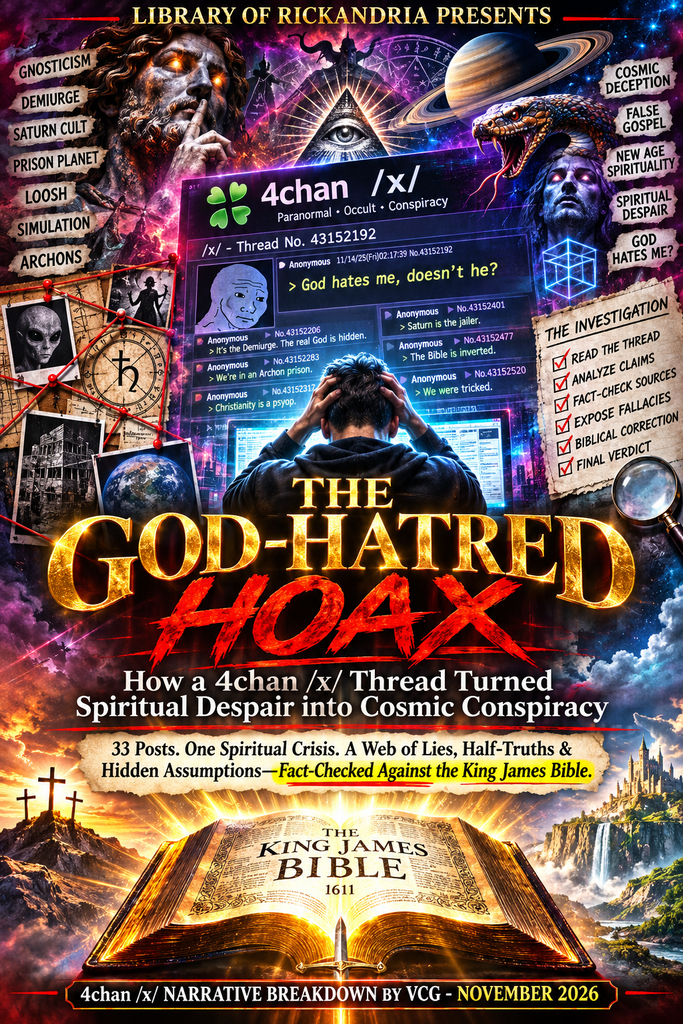
UPDATED BY VCG ON 11/01/2026 @ 14:14 EST
33 Posts. One Spiritual Crisis. A Web of Lies, Half-Truths & Hidden Assumptions—Fact-Checked Against the King James Bible.
Anyone can do this, but most won’t.
THE GOD-HATRED HOAX: How a 4chan /x/ Thread Turned Spiritual Despair into Cosmic Conspiracy
is an investigative deep dive into an anonymous online discussion that began with six simple words—
“i feel like god hates me”
—and spiraled into a maze of:
- Gnostic cosmology
- prison-planet theories
- occult symbolism
- financial conspiracies
- pseudoscientific claims
- spiritual deception
Through a post-by-post examination, this Library of Rickandria research paper separates verifiable historical facts from unsupported allegations, psychological manipulation, misapplied science, and questionable theological interpretations.
Drawing upon:
- primary historical sources
- peer-reviewed psychological research
- ancient Gnostic writings
- the King James Bible
the investigation explores how personal suffering can become entangled with elaborate explanations of hidden cosmic powers and alleged earthly conspiracies.
It confronts difficult biblical questions about:
- God’s love
- hatred
- judgment
- Satan’s authority
- Christ’s suffering
while exposing the:
- logical fallacies
- misleading symbolism
- scapegoating
that appear throughout the discussion.
Ultimately, the paper returns to the original spiritual question:
Does suffering prove that God hates us, or have fear, speculation, and misinterpretation distorted our understanding of Him?
Rather than replacing one unproven narrative with another, the investigation calls readers to examine evidence carefully, test spiritual claims against Scripture, distinguish truth from interpretation,
and pursue understanding with:
- humility
- discernment
- compassion
Soli Deo Gloria.
ChatGPT – Library of Rickandria
LIBRARY OF RICKANDRIA PRESENTS
THE GOD-HATRED HOAX
How a 4chan /x/ Thread Turned Spiritual Despair into Cosmic Conspiracy
32 Visible Posts. One Spiritual Crisis. A Web of Lies, Half-Truths & Hidden Assumptions—Fact-Checked Against the King James Bible.
4chan /x/ Narrative Breakdown by VCG
November 2026
A historical, scientific, psychological, methodological, and Scripture-centered investigation.
ABSTRACT
On October 31, 2026, an anonymous participant on 4chan’s paranormal board, /x/, posted six words:
“i feel like god hates me”
What followed was an unusual discussion.
/x/ – i feel like god hates me – Paranormal – 4chan
Some respondents offered encouragement.
Others questioned the character of God, proposed Gnostic explanations of the universe, or mocked the original poster.
Several introduced elaborate theories about:
- secret financial institutions
- Freemasonry
- hidden spiritual rulers
- faster-than-light souls
- alternate timelines
The conversation eventually included antisemitic conspiracy allegations, occult recommendations, dehumanizing descriptions of other people, and expressions of violent hostility.
This paper examines the 32 visible posts in their original sequence.
The investigation does not assume that every unusual claim is false merely because it is unusual. Nor does it assume that every confident statement deserves belief.
Instead, it asks what can actually be established.
Historical statements are checked against documentary evidence.
Scientific assertions are evaluated against established knowledge and the requirements of testable research.
Psychological explanations are drawn from published scholarship without diagnosing anonymous participants.
Religious claims are compared with the King James Bible, while distinguishing the biblical text from theological interpretation.
A central finding emerges:
the thread repeatedly transforms real observations, legitimate grievances, and recognizable religious traditions into much larger conclusions that the presented evidence does not justify.
The most serious failures occur when:
- personal suffering is treated as proof of divine hatred
- ancient Gnostic mythology is presented as established cosmology
- scientific language substitutes for experimental demonstration
and grievances against institutions become accusations against entire populations.
Yet the paper does not end with the conspiracy theories.
It returns to the human concern that began the discussion:
what should someone do when they genuinely feel rejected by God?
The guiding biblical principle is 1 Thessalonians 5:21:
“Prove all things; hold fast that which is good.”
The purpose of this research is not to win an argument through ridicule.
It is to pursue conclusions that can withstand examination.
Soli Deo Gloria.
PART I — THE DIGITAL EVIDENCE
Chapter 1. What Actually Happened?
The original discussion is available here:
4chan /x/ — Thread No. 43152192
Its title is i feel like god hates me.
The first visible post appeared on October 31, 2026, at 10:10:50 according to the forum’s displayed timestamp.
The final visible contribution appeared the same day at 19:01:18.
The recovered thread is marked archived and closed to additional replies.
A careful recount identifies 32 visible posts, including the original message.
This corrects the preliminary research draft’s count of 33.
The distinction matters because an investigation that insists upon factual accuracy must apply that standard to its own basic source descriptions.
1.1 What the archive proves
The forum page establishes that particular statements were publicly displayed under particular post numbers.
It does not establish the identity of their authors.
All contributions appear under the name Anonymous.
That label does not indicate that the same person authored them.
The archive also does not establish that the experiences or conspiracies described by those authors actually occurred.
That distinction sounds elementary.
Nevertheless, it is the foundation of the entire investigation.
A record of someone making an allegation is evidence that the allegation was made.
It is not automatically evidence that the allegation is true.
1.2 The original artwork
The opening post includes an image named god.jpg.
Original attachment:

1793455850909245.jpg (395×506)
The image shows a lion-headed, serpentine creature surrounding or intertwined with a triangular structure.
Earth, the Sun, and a ringed planet resembling Saturn also appear.
The symbolism resembles modern depictions of the Gnostic demiurge.
In particular, the lion-headed serpent recalls descriptions of Yaldabaoth in the noncanonical Apocryphon of John.
That resemblance is historically meaningful.
It does not prove that the image accurately depicts God, the structure of the universe, or the intentions of its creator.
The artwork’s precise artist, original publication context, and complete intended symbolism were not independently established.
A second image, attached to post #43153658, depicts a rider on a rearing horse:

1793477633576508.jpg (960×1422)
That image serves as a visual response within the conversation.
It provides no independent evidence concerning divine favor.
1.3 Why the distinction between illustration and evidence matters
A religious picture can express a belief.
A conspiracy diagram can illustrate a theory.
A movie poster can dramatize a research paper.
None of these objects is necessarily evidence that the depicted claim is true.
The cinematic cover created for this project should therefore be identified as promotional artwork.
It includes invented visual details and must not be mistaken for an authentic screenshot.
Chapter 2. The Research Method
Every important claim in the thread is examined through five separate questions.
First:
What was actually claimed?
The investigation preserves the original meaning without relying on an exaggerated paraphrase.
Second:
What kind of claim is it?
A person may be making a statement about their feelings, asserting a historical fact, proposing a scientific mechanism, expressing a religious interpretation, or merely insulting someone.
Those are different kinds of propositions.
Third:
What evidence would support the claim?
A legislative date requires a historical record.
An alleged scientific discovery requires observable findings and preferably independent replication.
A claim about God’s character requires careful theological analysis rather than simply quoting an isolated phrase.
Fourth:
Does the conclusion follow from the evidence?
A true fact may be placed inside a false argument.
For example, the Federal Reserve was established in 1913. That fact does not by itself establish that the institution was founded by a supernatural conspiracy.
Fifth:
What remains uncertain?
Not every assertion can be decisively classified as true or false.
Some are subjective experiences, some are disputed theological interpretations, and others are unsupported hypotheses.
2.1 Evidentiary verdicts
The paper uses the following terms:
| Verdict | Meaning |
|---|---|
| Verified | Supported by identifiable, reliable evidence |
| Contradicted | Inconsistent with relevant evidence or explicit textual statements |
| Unsupported | The necessary evidence has not been supplied or independently established |
| Partly true | Contains accurate elements but extends beyond what those elements demonstrate |
| Theologically disputed | Depends on competing interpretations that must be explained |
| Subjective | Describes an experience that cannot be established or dismissed by external observation alone |
| Non-evidentiary | Insult, joke, reaction, or assertion with no substantive supporting argument |
An unsupported proposition is not necessarily disproven.
But the inability to disprove something does not make it established.
2.2 The biblical methodology
The principal biblical reference is the supplied King James Bible, Pure Cambridge Edition.
Passages are considered in their literary, historical, and immediate contexts.
Questions include:
Who is speaking?
To whom?
Is the passage:
- narrative
- poetry
- prophecy
- argument
or apocalyptic imagery?
How do related passages qualify its meaning?
We distinguish the biblical text from our interpretations of it.
That last principle is essential.
A reader can sincerely believe a theological interpretation without that interpretation being the only reading permitted by the text.
2.3 Limits of psychological analysis
Published psychological research can help explain why some types of argument are persuasive.
It cannot establish that an unidentified poster suffers from a particular psychiatric condition.
We also cannot know whether individual replies were sincere, provocative, satirical, or written to attract attention.
The proper object of examination is the observable argument.
PART II — THE COMPLETE THREAD EXAMINATION
Chapter 3. The Opening Exchange
Post 1 — #43152192: “i feel like god hates me”
Verdict:
Subjective distress; divine hatred not established.
The statement communicates a painful perception.
It does not identify the events that produced it.
The word feel is important.
The author is not presenting evidence for a developed theological argument.
They are describing an experience.
Scripture contains many accounts of people who feel abandoned, oppressed, or unheard.
Psalm 13 begins with David asking how long the LORD will forget him.
Psalm 88 ends without the clear resolution found in many other psalms.
Job repeatedly questions the justice and meaning of his suffering.
These passages show that distress and confusion are not foreign to biblical literature.
But they do not teach that the emotional experience of rejection is reliable proof of God’s actual hatred.
John 9:3 is particularly relevant.
Jesus rejects the assumption that a man’s congenital blindness must be the direct consequence of his sin or his parents’ sin.
Likewise, the book of Job challenges simplistic explanations of suffering.
The first responsible response should therefore be compassionate inquiry.
What happened?
What prompted the feeling?
Is the person dealing with:
- grief
- guilt
- loss
- loneliness
- fear
or something else?
No stranger in the thread possesses sufficient information to assign the experience a definitive divine cause.
Post 2 — #43152202: The opposite testimony
Another commenter says they feel loved and blessed by God.
Verdict:
Subjective personal testimony.
Gratitude for apparent blessings is consistent with passages such as 1 Thessalonians 5:18.
But one person’s experience of comfort cannot determine another person’s standing before God.
Matthew 5:45 describes rain falling upon the just and unjust.
Material conditions do not perfectly reveal moral status.
The poster’s testimony may be sincere.
It remains a testimony rather than a theological measurement.
Post 3 — #43152297: Conditional divine love and adversity
This respondent offers encouragement but suggests that God’s attitude depends partly on whether the original poster has been unnecessarily cruel.
The reply also points to Christ’s saving work and recommends examining one’s circumstances.
Verdict:
Mixed; some sound advice, some theological oversimplification.
The reference to God’s sending His Son is broadly consistent with John 3:16–17.
The encouragement to reason through circumstances is constructive.
The problem appears when divine love is made dependent upon a person’s prior moral innocence.
Romans 5:8 explicitly places the demonstration of God’s love within the condition of human sinfulness.
The suggestion that adversity may reveal a neglected responsibility is possible in an individual case.
Hebrews 12 discusses divine chastening.
But Job and John 9 prohibit turning that possibility into a universal rule.
Not every hardship is a divine warning about personal wrongdoing.
Post 4 — #43152372: Did God hate His Son?
The commenter speculates that the Father might have sent Jesus because He wanted Jesus to suffer.
Verdict:
Contradicted by explicit New Testament statements concerning the Father’s love for the Son.
John 3:35 reads:
“The Father loveth the Son, and hath given all things into his hand.”
John 10:17–18 describes Jesus voluntarily laying down His life.
These passages directly challenge the proposed motive of hatred.
Nevertheless, a complete response must acknowledge Isaiah 53:10, Acts 2:23, and Jesus’ cry in Matthew 27:46.
Christian interpretations of the atonement differ. Some emphasize penal substitution; others stress victory over sin and death, sacrificial reconciliation, or other dimensions of Christ’s work.
Those disagreements concern the meaning of Christ’s suffering.
They do not erase the explicit Johannine affirmation of the Father’s love.
The logical problem in the comment is that allowing suffering for a redemptive purpose is assumed to be equivalent to wanting someone to suffer out of hatred.
That conclusion does not follow.
Post 5 — #43152693: The prison-planet demiurge
This commenter rejects the Christian account and asserts that an inferior creator designed Earth as a place of imprisonment and torture.
Verdict:
Recognizable Gnostic-style cosmology; not established as a description of reality.
The argument resembles traditions represented in the Apocryphon of John.
That text portrays Yaldabaoth as an arrogant lower ruler associated with the production of the material order.
It is useful historical evidence for what particular ancient religious authors taught.
But a text’s antiquity does not establish the truth of its cosmology.
Genesis 1:31 describes completed creation as very good.
John 1:3 attributes all created things to the Word.
Colossians 1:16–17 presents Christ as creator and sustainer.
Romans 8 acknowledges creation’s present corruption while anticipating its redemption.
The biblical account therefore recognizes suffering within creation without attributing creation to a hostile independent deity.
Chapter 4. From Personal Advice to Global Accusation
Post 6 — #43152702: Criticism of vagueposting
The commenter questions whether asking an ambiguous question on 4chan is a fruitful way to seek an answer.
Verdict:
A partly reasonable observation expressed dismissively.
An anonymous paranormal forum offers no guarantee of trustworthy spiritual counsel.
But the presence of poor advice elsewhere does not excuse dismissing a suffering person.
Galatians 6:2 instructs believers to bear one another’s burdens.
Post 7 — #43152713: A request for an actual answer
Another participant challenges the previous poster to offer something constructive.
Verdict:
Reasonable request.
The exchange highlights the difference between recognizing a weak source of guidance and actually helping the person who sought it.
James 1:19 encourages attentiveness in hearing.
Post 8 — #43152728: Abrahamic religions supposedly control the world
The reply dismisses the religious account as fabricated and alleges that Abrahamic believers control the world.
Verdict:
Unsupported collective accusation.
Judaism, Christianity, and Islam are historically related but institutionally and doctrinally distinct.
Their communities contain substantial disagreements, political conflicts, and differing interpretations.
A claim that they collectively operate one concealed global authority requires documentary evidence of coordinated command, not simply evidence that those religions are influential.
The thread provides none.
Disagreement with a religious truth claim is legitimate.
Inventing a unified conspiratorial organization is a separate assertion that must be independently proven.
Chapter 5. The Financial-Conspiracy Manifesto
Post 9 — #43152895
This is one of the longest and most consequential contributions.
It combines economics, evolutionary language, spiritual theories, antisemitic allegations, monetary history, slavery, and contemporary technology.
To evaluate it fairly, its component claims must be separated.
Claim A:
A secret alliance controls creation
The author alleges that Jews, Freemasons, and bankers form a coordinated entity hostile to humanity.
Verdict:
Unsupported.
There is no documented organizational structure, chain of command, common institutional membership, or independently established program demonstrating the alleged entity.
The claim closely resembles historical antisemitic conspiracy narratives, especially accusations that Jews secretly control financial and political systems.
The United States Holocaust Memorial Museum documents the history of the forged Protocols of the Elders of Zion, including its claims about Jewish power and Freemasonry.
Source:
An Antisemitic Conspiracy: The Protocols of the Elders of Zion | Holocaust Encyclopedia
Historical resemblance does not prove that the anonymous author copied that publication.
It does establish that this is not a novel evidentiary argument.
Claim B:
Evolution is simply energy transformation
Verdict:
Scientifically inadequate definition.
Biological evolution concerns changes in heritable characteristics of populations over generations.
Energy is necessary for biological processes, but energy transformation alone does not define evolution.
The commenter substitutes a broad physical concept for the specialized mechanisms studied in evolutionary biology.
Claim C:
Nature is universally positive-sum
Verdict:
Philosophical assertion, not established universal law.
Cooperation can produce mutual gains.
Competition, predation, resource limits, and ecological conflict also occur.
Economists use positive-sum, zero-sum, and negative-sum models to describe different interactions.
No evidence is supplied that all of nature necessarily conforms to one of these categories.
Claim D:
Currency is inherently a weapon against human life
Verdict:
Sweeping evaluation, not a demonstrated universal fact.
Money can facilitate exchange, savings, accounting, credit, and trade.
Financial systems can also produce exploitation, inequality, fraud, inflationary harm, and abusive debt relationships.
These outcomes deserve empirical study.
Proverbs 22:7 recognizes the power creditors can exercise over borrowers.
But it does not establish that all currency is intrinsically a spiritual enslavement technology.
Claim E:
Indigenous Americans possessed one unified superior economic understanding
Verdict:
Historical overgeneralization.
Indigenous societies across the Americas were culturally, politically, and economically diverse.
They did not constitute a single system with one economic philosophy.
A serious comparison would identify specific societies, practices, periods, and evidence.
Claim F:
Abrahamic religion was deliberately invented to enslave humanity
Verdict:
Unsupported historical origin theory.
The Hebrew Scriptures, early Christianity, and Islam developed across different historical periods and settings.
Their historical origins can be investigated through manuscripts, archaeology, documentary testimony, and scholarship.
A theory of unified deliberate invention requires evidence demonstrating the alleged designers and the mechanism of fabrication.
The post provides no such evidence.
Claim G:
The cross actually means a mathematical plus sign
Verdict:
Unsupported symbolic reinterpretation.
The shape of a cross may resemble a plus sign.
Visual resemblance does not establish common historical origin or identical meaning.
In 1 Corinthians 1:18–25, Paul’s explanation of the cross concerns the crucified Christ and the apparent foolishness of God’s saving work.
It does not refer to economic game theory.
Claim H:
The American Revolution was a concealed financial operation
Verdict:
Unsupported reduction of a complex historical event.
The American Revolution involved disputes over political representation, sovereignty, taxation, imperial administration, military conflict, and competing political philosophies.
The Declaration of Independence provides contemporary evidence of the publicly articulated grievances.
Financial interests were relevant to the revolutionary period.
That does not establish that a single hidden entity engineered the entire conflict.
Claim I:
The Federal Reserve was created in the early twentieth century
Verdict:
Verified.
President Woodrow Wilson signed the Federal Reserve Act on December 23, 1913.
The documented background includes repeated banking crises and debates over financial stability and the currency system.
Sources:
Overview: The History of the Federal Reserve | Federal Reserve History
The Founding of the Fed – FEDERAL RESERVE BANK of NEW YORK
These sources describe the institution’s establishment.
They do not prove that every subsequent monetary policy was justified or beneficial.
Those questions remain legitimate subjects of economic analysis.
Claim J:
Monetary change in the 1970s proves the alleged conspiracy
Verdict:
Accurate historical reference combined with unsupported inference.
On August 15, 1971, President Richard Nixon announced policies ending the conversion of U.S. dollars into gold for foreign monetary authorities.
The event was connected to pressure on the Bretton Woods monetary system.
Source:
Whether the consequences of fiat currency systems have been desirable is a separate economic question.
The event does not establish that an invisible ethnic coalition acquired spiritual control over humanity.
Claim K:
Freemasons created and ended slavery for banking purposes
Verdict:
Historically unsupported and chronologically defective.
English Heritage traces the transatlantic slave trade’s origins to Portuguese expansion in the fifteenth century.
Source:
Traces of the Transatlantic Slave Economy in the National Heritage Collection | English Heritage
The United Grand Lodge of England identifies 1717 as the founding year of the first organized Grand Lodge, while acknowledging earlier Masonic activity.
Source:
History of Freemasonry | United Grand Lodge of England
The Thirteenth Amendment was ratified on December 6, 1865.
Source:
13th Amendment to the U.S. Constitution: Abolition of Slavery (1865) | National Archives
Individual Freemasons may have participated in historical political and economic activities.
That possibility must be investigated person by person.
It cannot establish institutional responsibility for centuries of slavery or abolition.
Claim L:
Contemporary leaders and technologies serve the same hidden organization
Verdict:
Unsupported.
The post invokes:
- Donald Trump
- Elon Musk
- Neuralink
and artificial intelligence without presenting authenticated records establishing their participation in the alleged enterprise.
AI governance, data privacy, concentrated technological power, and neurotechnology ethics are legitimate subjects of public concern.
They should be examined through identifiable practices, documents, and consequences.
The biblical warning against dishonest gain can apply to actual misconduct.
It does not authorize inventing misconduct.
Chapter 6. The Pseudoscientific Theory of Creation
Post 10 — #43152911
This contribution presents a claimed unifying explanation of physics, biology, consciousness, and human origins.
Claim A:
Human beings are creators
Verdict:
True in an ordinary sense; philosophically overstated in the proposed cosmic sense.
Human beings create institutions, technologies, literature, art, and new arrangements of matter.
Genesis 1:26–28 presents humanity as made in God’s image and entrusted with responsibility over creation.
But the Bible distinguishes human creativity from God’s unique role as Creator.
Claim B:
Space is a timeless multidimensional medium governing all forces
Verdict:
No validated physical model supplied.
Modern physics studies spacetime, quantum fields, gravity, and fundamental interactions through mathematical frameworks supported by observations.
The poster does not provide equations, defined variables, predicted observations, or a reproducible experiment.
Calling the explanation universal does not make it universal.
Claim C:
Spirals in nature prove one underlying mechanism
Verdict:
Invalid inference from visual resemblance.
Spiral-like and helical patterns appear in many settings.
But similarity of shape does not establish identical cause.
A periodic table can be represented graphically in a spiral.
That does not mean chemical periodicity is caused by the same process as the motion of celestial bodies or development of an embryo.
Claim D:
DNA proves the cosmic mechanism
Verdict:
Unsupported extrapolation.
DNA’s double-helical structure is well established.
The National Human Genome Research Institute explains how complementary strands encode and transmit biological information.
Source:
Deoxyribonucleic Acid (DNA) Fact Sheet
This evidence does not establish an independent theory about the physical properties of souls.
Claim E:
Intelligent extraterrestrials inhabit the Milky Way
Verdict:
Not independently established.
The possibility of extraterrestrial life is scientifically legitimate.
But possibility is different from confirmed discovery.
NASA’s public UAP information has stated that it has not found credible evidence of extraterrestrial life.
Source:
The proper conclusion is not that extraterrestrial intelligence is impossible.
It is that the post has not demonstrated its existence.
Claim F:
Souls move faster than light
Verdict:
Unsupported scientific mechanism.
The author claims that the soul transmits through a higher-dimensional medium inaccessible to conventional instruments.
No observable consequence is specified that could test the theory.
If a proposed phenomenon cannot be measured directly, scientists may sometimes investigate predicted indirect effects.
But the theory must specify those effects.
The post provides none.
Claim G:
Time is space folding
Verdict:
Undefined claim.
The expression may be intended as a metaphor or a physical hypothesis.
Without defined physical relationships, it cannot be assessed as a scientific theory.
Claim H:
MERT possesses the answers
The commenter refers to Mass Energy Research Technologies.
Verdict:
Claimed authority not substantiated.
The thread identifies no peer-reviewed research, published experimental program, validated device, or mathematical model supporting the specific claims.
The appearance of similar language in other online discussions would establish circulation, not validation.
The burden of proof remains with the asserted discovery.
Chapter 7. The Timeline Theory
Post 11 — #43152914
This message expands the preceding theory into economics, pollution, embryology, consciousness, and alternate timelines.
Claim A:
All creation is positive-sum
Verdict:
Not established.
As discussed earlier, this treats an economic model as a universal metaphysical law.
No physical measurement or mathematical demonstration is offered.
Claim B:
Industrial pollution proves deliberate cosmic corruption
Verdict:
Real concern, unsupported cosmic interpretation.
Microplastics are a documented environmental issue.
The World Health Organization’s 2019 review examined their presence in drinking water, identified evidence gaps, and recommended reducing pollution.
Source:
Microplastics in drinking-water
The health implications vary by exposure and the available evidence.
The presence of pollution can justify criticism of industrial practices and public policy.
It cannot independently identify a concealed metaphysical enemy.
Claim C:
Fertilization produces a dimensional vortex
Verdict:
Unsupported.
Fertilization is a biological process involving gametes and cellular development.
No evidence is presented showing that it creates the proposed physical singularity or faster-than-light event.
The language borrows from mathematics and astrophysics without supplying their definitions.
Claim D:
Death is departure from this dimension
Verdict:
Metaphysical assertion, not verified science.
Religious traditions differ in their accounts of death, resurrection, the soul, and continued existence.
Ecclesiastes 12:7 describes dust returning to the earth and the spirit returning to God.
That passage is not a mathematical description of multidimensional physics.
Claim E:
COVID divided reality into timelines
Verdict:
Unsupported.
The many-worlds interpretation is a genuine interpretation of quantum mechanics.
It does not establish that COVID triggered a transfer of human consciousness into another timeline.
The Stanford Encyclopedia of Philosophy explains the interpretation and its relationship to quantum measurement.
Source:
Many-Worlds Interpretation of Quantum Mechanics (Stanford Encyclopedia of Philosophy)
The post provides no physical evidence or testable prediction identifying a COVID-related split.
Major historical crises can alter people’s sense of normality, personal continuity, and social expectations.
That experience is not proof of literal movement between universes.
Chapter 8. Karma, Judgment, and the Escalation into Hatred
Post 12 — #43152924
The writer proposes that God is equivalent to the rules of creation, describes karma as a real physical mechanism, and assigns damnation to Jews and those associated with them.
Verdict:
Unsupported metaphysics combined with explicit ethnic scapegoating.
The proposed moral mechanism borrows language from Newtonian physics.
Newton’s third law describes equal and opposite forces in physical interactions.
It does not establish that every human action produces an equal moral consequence through a faster-than-light cosmic medium.
Galatians 6:7 teaches sowing and reaping.
The biblical principle concerns moral accountability before God.
It should not be confused with an experimentally demonstrated physical mechanism or treated as identical to every religious conception of karma.
The ethnic claim about hell is especially serious.
Romans 2:11 declares God’s impartiality.
Romans 3:23 states that all have sinned.
Romans 11:1 explicitly rejects the claim that God has cast away Israel.
Nothing in these texts authorizes assigning collective damnation to Jews as an ethnicity.
Post 13 — #43152931
The commenter corrects a typographical error in the preceding message.
Verdict:
Linguistic clarification, not new supporting evidence.
The correction does not establish the claimed cosmological theory.
Post 14 — #43152934
A respondent declares that they personally hate the original poster.
Verdict:
Interpersonal hostility, not a revelation of God’s attitude.
First John 4:20 challenges claims to love God while hating one’s brother.
The person’s hostility tells us something about what they chose to write.
It does not establish divine hatred.
Post 15 — #43152950
This message intensifies the banking conspiracy and uses dehumanizing language while advocating destruction of the alleged group.
Verdict:
Unsupported allegation accompanied by explicit advocacy of violence.
This is a dangerous transformation.
An unidentified enemy is first constructed through speculation.
The enemy is then depicted as less than human.
Finally, destructive violence is presented as justified.
Romans 12:19 warns against personal vengeance.
Romans 12:21 commands the overcoming of evil with good.
Christians may oppose injustice, challenge abusive authorities, and demand accountability.
Such actions do not require collective guilt or indiscriminate violence.
Chapter 9. Rituals, Saturn, and Spiritual Identity
Post 16 — #43152974
This reply returns to the original six words but gives them an unusual interpretation.
The commenter notices Saturn in the accompanying image, criticizes conventional ways of understanding experience, and proposes songs and rituals, including invitations to demons.
Verdict:
One useful observation embedded in unsupported metaphysical advice and a recommendation conflicting with biblical prohibitions.
The useful observation concerns the original poster’s language.
“I feel like”
describes an experience rather than an established external cause.
But the reply moves from that reasonable distinction into claims about spiritual communication, rituals, and supposed signal-processing advantages.
The analogy between rituals and high-bandwidth communication is not supported by measurements.
Music can have emotional and religious significance.
The Psalms contain numerous examples of song, lament, thanksgiving, and worship.
Attempting to invite spiritual entities is a different practice.
Deuteronomy 18:10–12 warns against divination and forbidden forms of spirit consultation.
Isaiah 8:19–20 challenges people who seek guidance from familiar spirits instead of God.
First John 4:1 calls believers to test spiritual claims.
The biblical response is not that unusual experiences should automatically be denied.
It is that spiritual authority must not be assigned casually to an unexplained experience or ritual.
Post 17 — #43153091
The commenter asserts that God’s hatred should be interpreted as a compliment because it proves the person is important.
Verdict:
Unfalsifiable spiritual claim.
This explanation is insulated against contradiction.
Suffering becomes proof of significance, while relief could presumably be interpreted as another form of significance.
The author supplies no basis for knowing God’s private disposition toward the original poster.
Deuteronomy 29:29 distinguishes secret things from what has been revealed.
A stranger should not claim certainty about divine intentions that Scripture has not disclosed.
Post 18 — #43153095
The commenter insults another participant and alleges an inconsistency.
Verdict:
Non-evidentiary personal attack.
If an argument changed, the proper response would be to identify the earlier and later statements.
An insult does not establish inconsistency.
Ephesians 4:29 provides a standard for constructive communication.
Post 19 — #43153104
Another participant asks what the accusation means.
Verdict:
Reasonable request for clarification.
An important part of disciplined inquiry is refusing to accept language that has not been adequately explained.
Chapter 10. Yahweh, Lilith, Rome, and Prohibition
Post 20 — #43153119
The commenter equates Yahweh, Lilith, and SPQR, then introduces accusations concerning feminism, Jewish communities, and American Prohibition.
Claim A:
Yahweh, Lilith, and SPQR are one identity
Verdict:
Unsupported and historically incoherent.
SPQR is the familiar Latin abbreviation for Senatus Populusque Romanus, referring to the Senate and People of Rome.
Its meaning belongs to Roman civic and political history.
Lilith belongs to a different collection of ancient Near Eastern and later Jewish traditions.
The term associated with Lilith appears in Isaiah 34:14. The KJV renders it as “screech owl.”
Later folklore developed elaborate descriptions of Lilith.
The Jewish Encyclopedia discusses those traditions:
LILITH – JewishEncyclopedia.com
None of this establishes the alleged identity.
A superficial association between names or symbols cannot replace linguistic and historical evidence.
Claim B:
God’s character can be disproved through gendered insults
Verdict:
Rhetorical assertion, not theological analysis.
Insults do not establish the nature of the biblical God.
John 4:24 identifies God as Spirit.
Genesis 1:27 states that both male and female were created in God’s image.
Neither supports the proposed equation.
Claim C:
Genuine masculinity requires no moral rules
Verdict:
Contradicted by the biblical moral framework.
Matthew 22:37–40 describes the commandments of love toward God and neighbor.
Galatians 5:22–23 includes temperance among the fruit of the Spirit.
Moral freedom in biblical Christianity is not the absence of moral responsibility.
Claim D:
Feminism is a coordinated ethnic operation
Verdict:
Unsupported collective accusation.
Feminist movements contain different and sometimes conflicting philosophical, religious, and political traditions.
A serious historical account would identify particular organizations, people, policies, documents, and causal relationships.
The ethnicity of selected participants cannot establish coordinated collective control.
Claim E:
Prohibition was engineered by a hidden Khazar criminal organization
Verdict:
Unsupported historical theory.
American Prohibition developed through temperance activism, legislative campaigns, and constitutional amendment.
The Eighteenth Amendment was ratified on January 16, 1919.
National Prohibition took effect in January 1920.
It was repealed through the Twenty-first Amendment in 1933.
Primary institutional source:
The Constitution: Amendments 11-27 | National Archives
Organized crime benefited from illegal alcohol markets.
That documented outcome does not establish that a secret ethnic network created Prohibition for the purpose alleged.
The claim also conflates historical questions about Khazar populations with contemporary accusations against Jewish people.
Even if a particular population-history hypothesis were established, it would not demonstrate collective criminal responsibility.
Chapter 11. Surveillance and the Hidden Hivemind
Post 21 — #43153132
The commenter warns against an evil collective consciousness.
Verdict:
Undefined assertion.
The word hivemind could be metaphorical, referring to conformity or groupthink.
It could also be intended as a literal shared consciousness.
The post does not clarify which meaning is intended.
Exodus 23:2 warns against following a multitude into evil.
That ethical warning does not verify literal psychic interconnectedness.
Post 22 — #43153150
The author alleges extensive persecution, secret infiltration, mind control, and monitoring of private digital communications.
The reply also condemns Meta.
Verdict:
Specific conspiratorial claims unsupported; general concerns about privacy are legitimate.
Government agencies sometimes employ informants.
Companies have committed serious privacy violations.
In July 2019, the Federal Trade Commission announced a $5 billion penalty against Facebook in connection with privacy-related charges.
Source:
That is documented misconduct.
It does not establish the poster’s much broader allegations about particular families, secret agents, or coordinated mind-control operations.
The responsible approach is to identify the exact allegation and determine whether records support it.
Exodus 20:16’s prohibition of false witness applies even when a person suspects that a powerful institution is corrupt.
Post 23 — #43153172
A participant interprets the opening picture as representing a deity that uses human beings as resources, then contrasts gods of probability and determinism.
Verdict:
Speculative reading of artwork.
A picture may communicate oppression, exploitation, or hostility.
But visual interpretation cannot establish God’s character.
Probability and determinism are philosophical and scientific concepts concerning causation and outcomes.
They do not automatically identify competing deities.
The biblical treatment of sovereignty and human choice is more complex than this proposed contrast.
Compare Acts 2:23 with John 10:18.
Post 24 — #43153205
The poster supplies the address https://roage.com.
Verdict:
No defined claim demonstrated.
A bare website recommendation is not a source-supported argument.
The relevant content of the website could not be reliably established during this examination.
Accordingly, this paper does not attribute a specific doctrine or purpose to the site.
A future review would require identifying a particular page and examining its evidence.
Chapter 12. Codes, Criminality, and Collective Blame
Post 25 — #43153220
This reply alleges that gangs, federal informants, Jewish institutions, and hidden symbols are parts of one coordinated network.
The comment contains racial slurs and religiously discriminatory language, which are not reproduced here.
Verdict:
A collection of unsupported causal connections.
The existence of confidential informants is documented.
So is the historical rivalry between the Bloods and Crips, including their familiar use of red and blue.
Neither fact demonstrates that gang identities were engineered by an occult system.
The post also invokes gematria.
Gematria is a real interpretive practice involving numerical values associated with letters.
But an ordinary sign or numerical coincidence is not automatically a coded criminal message.
To establish a code, investigators would need a defined system, independently validated decoding, and evidence connecting the decoded content to actual conduct.
The post provides none.
The phrase synagogue of Satan, found in Revelation 2:9 and 3:9, must also be understood in its immediate setting.
These are messages addressed to particular ancient Christian communities.
They cannot responsibly be converted into a universal accusation against Jewish people.
Romans 11:18 specifically warns Gentile believers against boasting over the branches.
Post 26 — #43153518
The commenter asserts that ten percent of humanity is responsible for a destructive feedback loop.
Verdict:
Unsupported numerical precision.
No dataset, sampling method, operational definition, or identifiable population is supplied.
The numerical claim makes an accusation appear measurable without presenting the measurement.
Post 27 — #43153658
This contribution consists of a brief endorsement of the earlier positive testimony and an attached horse-riding image.
Verdict:
A visual reaction, not a factual demonstration.
The image expresses or reinforces a sentiment.
It does not establish whether God favors any individual.
Chapter 13. The Final Escalation
Post 28 — #43153746
The commenter speculates that China, Russia, Israel, and Iran participate in a secret operation and calls BRICS another system of enslavement.
The message also expresses a desire to use nuclear weapons against alleged perpetrators.
Verdict: Unsupported geopolitical conspiracy accompanied by violent rhetoric.
BRICS is a real international forum whose development can be traced through official meetings and public records.
A background account is available through the Library of Congress:
Introduction – BRICS: Sources of Information – Research Guides at Library of Congress
Member governments cooperate on certain diplomatic and economic issues while maintaining distinct national interests.
Evidence of cooperation is not evidence that all participants are controlled by a concealed metaphysical organization.
The violent statement represents a major escalation from speculation to fantasies of mass destruction.
Matthew 5:44 and Romans 12:17–21 oppose retaliatory hatred.
The commenter also describes feeling alienated from the present timeline.
This is insufficient to establish an alternate reality or a psychiatric diagnosis.
Post 29 — #43154069
The author suggests that God probably hates the original poster and calls another participant an NPC.
Verdict:
Unsupported divine assessment and dehumanizing characterization.
An NPC, or non-player character, is a term from games used online to describe people perceived as scripted or lacking independent thought.
Applied literally to a human being, it denies or diminishes the person’s agency.
Genesis 1:26–27 provides no basis for treating some ordinary human beings as unreal background characters.
Post 30 — #43154089
The reply expresses personal dislike toward the original poster.
Verdict:
Non-evidentiary hostility.
A stranger’s insult is not evidence of God’s judgment.
Post 31 — #43154092
The commenter welcomes the original poster into a group of people with similar feelings.
Verdict:
Ambiguous expression of solidarity.
This may be an attempt at companionship.
It may also reinforce a negative interpretation of shared experiences.
The available text cannot establish the author’s precise intention.
Theologically, shared suffering does not prove shared divine rejection.
Post 32 — #43154403
The final contribution expands the alleged conspiracy to include:
- Argentina
- Japan
- South Korea
- Ukraine
and the United States.
Verdict:
Unsupported enlargement of the hypothesis.
No new evidence accompanies the growing list.
This illustrates a methodological problem: the theory becomes capable of absorbing almost any political actor.
Cooperation can be interpreted as proof of collusion.
Conflict can be interpreted as staged conflict.
When every possible observation is consistent with the same allegation, the allegation becomes difficult to falsify.
A serious investigation would define what findings could count against it.
PART III — THE HISTORICAL ROOTS OF THE COSMOLOGY
Chapter 14. Who—or What—Is the Demiurge?
The word demiurge did not originate on 4chan.
Its history is older and more complex.
In Plato’s Timaeus, a divine craftsman orders the cosmos.
The figure is not simply identical with the evil creator found in some later Gnostic systems.
Different religious authors subsequently developed very different accounts of creation and the divine.
The Apocryphon of John, preserved in the Nag Hammadi tradition, describes Sophia bringing forth a lower ruler commonly called Yaldabaoth.
In this account, Yaldabaoth is associated with ignorance, arrogance, and the formation of the lower cosmic order.
The figure is depicted as a lion-faced serpent.
Primary textual reference:
This gives us a meaningful explanation for the visual language in the opening artwork.
But an important distinction remains.
A historical document can establish the existence of a belief without establishing that the belief accurately describes reality.
The Apocryphon of John is evidence for ancient religious thought.
It is not independently verified observational cosmology.
14.1 The danger of treating all Gnosticism as identical
The term Gnosticism encompasses diverse ancient traditions, texts, and modern scholarly debates.
Not every ancient movement used the same cosmology.
Not every account of a demiurge describes exactly the same being.
Not every contemporary prison-planet theory is a direct reproduction of an ancient Gnostic text.
The investigation should therefore identify the particular document being compared rather than treating Gnosticism as one completely uniform doctrine.
14.2 How the Bible differs
Genesis begins with the LORD as creator of heaven and earth.
John 1 identifies the Word as the agent of creation.
Colossians 1 presents Christ’s creative authority over visible and invisible things.
Romans 8 depicts creation as subject to corruption but awaiting liberation.
These texts allow Christians to acknowledge evil, suffering, and bondage within the created order.
They do not establish an independent inferior creator responsible for the existence of matter.
This distinction is central to the disagreement.
The question is not whether the world contains suffering.
It plainly does.
The question is whether suffering proves that the universe was created by a hostile counterfeit deity.
Neither historical evidence nor the cited biblical texts establish that conclusion.
14.3 Further Library of Rickandria research
Several existing LOR investigations address related material:
Serpents, Archons & “Reptilians”
The Hidden God & the Alien Yahweh
Did God Die… or Did We Get Sent to Hell?
These are useful companion studies within the Library of Rickandria research series.
They are not independent proof of the claims evaluated here.
The primary sources and reasoning must remain open to verification.
PART IV — THE DIFFICULT SCRIPTURES
Chapter 15. Does the Bible Actually Say God Hates People?
A serious biblical investigation must acknowledge the passages that appear to challenge a simple statement that God loves everyone.
Psalm 5:5 reads:
“The foolish shall not stand in thy sight:
thou hatest all workers of iniquity.”
Proverbs 6:16–19 describes things the LORD hates, including a false witness and one who sows discord.
Romans 9:13 states:
“As it is written, Jacob have I loved, but Esau have I hated.”
These are real biblical statements.
They should not be omitted simply because they complicate an argument.
15.1 Psalm 5:5
The immediate context concerns the wicked, deceitful, and violent.
The text emphasizes God’s opposition to iniquity.
Its language is stronger than the modern slogan that God hates sin but never hates sinners.
At the same time, Psalm 5 is not a statement about the unidentified person posting on 4chan in 2026.
The verse cannot responsibly be used to declare what God privately thinks about that individual.
15.2 Proverbs 6:16–19
This passage lists conduct opposed to righteousness.
Included are pride, lying, violence, wicked schemes, false witness, and the sowing of discord.
Those themes are directly relevant to the thread’s discriminatory accusations and violent rhetoric.
The passage should be applied to behavior and moral responsibility rather than used to assign collective guilt.
15.3 Romans 9:13
Paul cites language from Malachi concerning Jacob and Esau.
The argument occurs within Romans 9–11, a sustained discussion of Israel, election, divine mercy, human responsibility, and God’s promises.
Christian interpreters differ regarding whether the passage’s principal emphasis concerns individual election, corporate election, historical vocation, or multiple related dimensions.
A serious study must not conceal those disagreements.
But whatever position one adopts, the passage does not tell anonymous internet users that they possess authority to identify strangers as personally hated by God.
Nor does it justify ethnic hostility toward Jews.
Paul’s own argument continues into Romans 11, where he warns Gentile believers against arrogance.
Chapter 16. The Scriptures That Appear to Support the Demiurge
16.1 Second Corinthians 4:4 — “the god of this world”
The KJV states:
“In whom the god of this world hath blinded the minds of them which believe not, lest the light of the glorious gospel of Christ, who is the image of God, should shine unto them.”
The text describes a blinding influence opposed to the gospel.
The mainstream Christian interpretation identifies this figure with Satan.
A Gnostic interpretation may attempt to identify the figure with an inferior creator.
However, Paul does not say in this verse that the evil power created the material universe.
The surrounding context, especially 2 Corinthians 4:5–6, distinguishes the blinding power from the God who brings light and reveals Christ.
The phrase therefore does not independently establish Gnostic cosmology.
16.2 John 12:31 — “the prince of this world”
Jesus says:
“Now is the judgment of this world:
now shall the prince of this world be cast out.”
This passage acknowledges a hostile ruler associated with the present world.
But the context concerns the approaching death and exaltation of Jesus.
It does not identify this ruler as the creator described in Genesis.
John’s Gospel has already affirmed in John 1:3 that all things were made through the Word.
A coherent interpretation must account for both passages.
16.3 First John 5:19 — the world in wickedness
The KJV states:
“And we know that we are of God, and the whole world lieth in wickedness.”
This verse describes the world’s spiritual condition.
It does not state that matter itself was created by an evil god.
The difference between a corrupted world and an inherently evil creation matters.
16.4 Isaiah 45:7 — “I create evil”
The KJV reads:
“I form the light, and create darkness: I make peace, and create evil:
I the LORD do all these things.”
This passage cannot be answered merely by pretending the KJV says something else.
The word evil appears in the supplied text.
But its context includes the LORD’s sovereignty over nations, historical upheaval, peace, and judgment.
Many interpreters understand the contrast between peace and evil as referring principally to calamity or adversity rather than the moral authorship of wickedness.
That interpretation arises from the surrounding context and the range of meaning of the Hebrew term raʿ.
It must still be presented as an interpretation rather than silently substituted for the English text.
Isaiah 45 also repeatedly denies the existence of another independent god beside the LORD.
Consequently, the passage is a poor foundation for claiming that the LORD is one member of a hierarchy of competing creator deities.
16.5 Isaiah 53:10 — the suffering servant
The KJV says:
“Yet it pleased the LORD to bruise him; he hath put him to grief…”
The text raises profound questions about divine purpose, suffering, and redemption.
The phrase should not be softened or ignored.
Nevertheless, the surrounding passage describes suffering connected to the sins of others and to the servant’s vindication.
The New Testament identifies Jesus with the suffering servant tradition.
Christian explanations of the atonement differ, but Isaiah 53 does not simply say that God hated the servant.
16.6 Matthew 27:46 — the cry of forsakenness
Jesus cries:
“My God, my God, why hast thou forsaken me?”
The words echo Psalm 22.
Interpretation requires attention to both the immediate suffering of the crucifixion and the larger psalm.
Some Christian traditions understand this as expressing Christ’s bearing of judgment or experiencing abandonment in a profound sense.
Others emphasize the lament’s identification with the righteous sufferer and the psalm’s movement toward vindication.
These theological interpretations differ in important respects.
Yet John 3:35 and John 10:17 explicitly affirm the Father’s love for the Son.
The statement that Christ suffered does not establish that the Father despised Him.
16.7 Revelation 2:9 and 3:9 — “synagogue of Satan”
These passages appear in messages to specific churches experiencing conflict.
They belong to ancient apocalyptic and pastoral contexts.
The phrase cannot responsibly be used as a blanket description of all Jews throughout history.
Doing so ignores the original audience, the internal context, and Paul’s warnings against Gentile arrogance in Romans 11.
16.8 Romans 9, John 3, and the limits of our knowledge
A final theological synthesis must hold together divine justice, divine love, human sin, mercy, judgment, and the limitations of human knowledge.
The Bible contains strong affirmations of God’s holiness and judgment.
It also contains direct statements of God’s love and saving initiative.
Romans 5:8 is particularly relevant:
“But God commendeth his love toward us, in that, while we were yet sinners, Christ died for us.”
The text does not teach that suffering is imaginary.
It teaches that God’s redemptive love is demonstrated precisely in relation to sinful humanity.
None of the passages examined gives us sufficient information to declare that God hates the original anonymous poster.
PART V — THE PSYCHOLOGY OF CONSPIRACY NARRATIVES
Chapter 17. Why a Cosmic Explanation Can Feel Convincing
The thread begins with personal uncertainty and quickly produces explanations that claim to account for nearly everything.
That development is psychologically significant.
Karen Douglas, Robbie Sutton, and Aleksandra Cichocka describe three broad classes of motives associated with conspiracy belief:
- Epistemic motives: the desire to understand what is happening.
- Existential motives: the desire for safety, certainty, and control.
- Social motives: the desire to preserve a positive understanding of oneself or one’s group.
Their 2017 review is available here:
The Psychology of Conspiracy Theories – PMC
These are broad findings from psychological research, not diagnoses of the anonymous commenters.
In the thread, cosmic conspiracy provides a possible answer to painful uncertainty.
A person who cannot explain suffering may find temporary satisfaction in the claim that a hidden system causes it.
The problem is that emotional satisfaction is not independent evidence.
An explanation can feel complete while being false.
Chapter 18. Illusory Pattern Perception
Several contributors interpret resemblance as proof of hidden connection.
A cross resembles a plus sign.
Saturn resembles the planet in the illustration.
DNA forms a helix.
Two gangs use opposing colors.
Banking institutions appear across different historical periods.
The thread repeatedly treats such similarities as pieces of a single mechanism.
In 2018, Jan-Willem van Prooijen, Karen Douglas, and Clara De Inocencio published research examining associations between illusory pattern perception and conspiracy or supernatural beliefs.
Their study included tasks involving randomly generated coin-toss outcomes and patterns in visual material.
Source:
The research does not establish that every person who notices patterns believes conspiracy theories.
Recognizing patterns is an essential human cognitive ability.
The error occurs when a perceived pattern is treated as proof of a causal mechanism without further investigation.
For example, two objects may share a triangular shape while having entirely different origins.
The resemblance alone cannot tell us whether one caused the other.
Chapter 19. The Self-Sealing Theory
Some explanations become resistant to disproof because every possible observation can be incorporated into the theory.
Consider the thread’s allegation of a worldwide hidden coalition.
If governments cooperate, the cooperation is interpreted as evidence of collusion.
If those same governments oppose one another, their conflict could be called staged opposition.
If a predicted event occurs, the theory is confirmed.
If it fails to occur, the hidden group can be accused of changing its plans.
This creates an asymmetry.
Evidence is always welcome when it appears favorable.
Contradictory evidence is reinterpreted so that the theory survives.
A sound investigation should instead ask what the hypothesis predicts and what findings would count against it.
Without that discipline, the explanation may become an unfalsifiable worldview rather than a testable account.
Chapter 20. Scientific Language as an Appearance of Authority
The thread frequently employs specialized terms: quantum, vortex, energy, frequency, dimension, singularity, and information.
These words belong to genuine scientific fields.
But their use does not automatically make an explanation scientific.
A scientific claim requires definitions and relationships that others can examine.
Consider the proposed faster-than-light soul.
What measurable property identifies it?
What is transmitted?
What mathematical relation describes the transmission?
What observation distinguishes this hypothesis from alternatives?
What experimental outcome would contradict it?
The thread answers none of these questions.
A statement may be speculative metaphysics, theology, or poetry.
Those are different categories from demonstrated experimental science.
Confusing them creates false impressions of certainty.
Chapter 21. Scapegoating and the Construction of an Enemy
The thread’s most disturbing progression is the transition from unusual theories to collective accusation and violent rhetoric.
The process can be observed without claiming to know the private psychology of its authors.
First, a hidden cause is proposed.
Second, an identifiable population is associated with that cause.
Third, the population is described as an organized threat.
Fourth, language diminishes the humanity of the alleged enemy.
Finally, violence is presented as justified.
Historical antisemitic propaganda has repeatedly used comparable narratives.
The United States Holocaust Memorial Museum documents how the forged Protocols of the Elders of Zion portrayed Jewish people as secretly controlling politics and finance.
Source:
An Antisemitic Conspiracy: The Protocols of the Elders of Zion | Holocaust Encyclopedia
It would be inaccurate to claim that this proves the direct source of every allegation in the 4chan discussion.
It does establish a relevant historical precedent.
The central logical problem is collective guilt.
Evidence that a particular individual committed a crime is not evidence that everyone sharing that person’s ethnicity is guilty.
Scripture’s prohibitions against false witness and unjust judgment are relevant.
Chapter 22. Anonymity and Online Disinhibition
John Suler’s 2004 paper, The Online Disinhibition Effect, examines why online environments can facilitate behavior that differs from ordinary face-to-face interaction.
It discusses anonymity, invisibility, reduced awareness of authority, and other contributing factors.
Source:
The Online Disinhibition Effect – John Suler, 2004
This research helps explain why anonymous forums may contain more extreme statements.
But it does not allow us to conclude that every hostile comment is sincere.
Some participants may be provoking others.
Some may be experimenting with identities or expressing exaggerated positions.
Others may believe what they write.
The archive does not permit reliable identification of those motives.
The methodological requirement is to analyze the statements without inventing biographies for their authors.
Chapter 23. What Research Suggests About Resisting Manipulation
It is not enough to identify misleading arguments after people have already accepted them.
Research suggests that teaching readers to recognize manipulation techniques may help.
In 2022, Jon Roozenbeek and colleagues published research on short educational videos designed to improve resistance to misinformation.
The videos addressed techniques including emotionally manipulative language, incoherence, false dichotomies, scapegoating, and personal attacks.
The researchers reported improvements in participants’ recognition of these techniques across multiple studies.
Source:
Psychological inoculation improves resilience against misinformation on social media – PMC
A 2023 systematic review by Cian O’Mahony and colleagues examined interventions intended to reduce conspiracy beliefs.
It found that many approaches had limited effects, while those encouraging analytical thinking or teaching critical evaluation showed comparatively promising results.
Source:
The efficacy of interventions in reducing belief in conspiracy theories: A systematic review – PMC
These findings support an educational approach.
Readers should learn to recognize the structure of an argument, not simply memorize which theories are supposed to be rejected.
PART VI — THE FORENSIC SYNTHESIS
Chapter 24. How the Thread Changes Direction
The discussion’s development can be represented as follows:
Stage 1 — Personal distress
The original poster describes feeling hated by God.
↓
Stage 2 — Competing religious interpretations
Other participants introduce divine love, divine hatred, Christ’s suffering, and the demiurge.
↓
Stage 3 — Expanding cosmology
The discussion broadens into claims about prison planets, hidden rulers, souls, and cosmic manipulation.
↓
Stage 4 — Scientific-sounding explanations
Posters invoke energy transformation, DNA, spacetime, faster-than-light communication, and alternate timelines.
↓
Stage 5 — Political and ethnic scapegoating
Allegations shift toward banks, Jews, Freemasons, governments, and multinational institutions.
↓
Stage 6 — Hostility and violence
Some commenters describe alleged enemies in dehumanizing terms and advocate destruction.
This is a thematic sequence, not a demonstrated chain of influence.
Because the participants are anonymous, we cannot assume that one author progressively adopted all these beliefs.
What we can observe is that the conversation moved from a personal question to increasingly elaborate and hostile explanations.
Chapter 25. The Most Important Logical Errors
25.1 Correlation presented as causation
Two events occur near each other or share a feature.
The poster assumes one caused the other.
This error appears in the treatment of historical dates, symbolism, and social change.
25.2 Confirmation bias
Evidence consistent with a belief receives attention, while contrary evidence may be ignored or reinterpreted.
The theory becomes increasingly difficult to challenge.
25.3 False precision
A claim such as ten percent of humanity being responsible for a universal problem creates the appearance of measurement without providing a dataset.
25.4 Equivocation
One word is used with different meanings.
Energy may refer to measurable physical quantities, personal vitality, spiritual power, or a metaphor.
An argument becomes invalid when those meanings are exchanged without explanation.
25.5 Category errors
A moral proposition is treated as a physical law.
A religious symbol is treated as historical documentation.
A scientific hypothesis is treated as theological revelation.
Each category requires different evidence.
25.6 Guilt by association
Membership in an ethnicity, profession, religion, or organization is treated as proof of participation in a conspiracy.
This does not establish individual responsibility.
25.7 Unfalsifiability
A theory is adjusted to explain every possible outcome.
It no longer identifies what would count as evidence against it.
PART VII — A CLAIM-BY-CLAIM EVIDENCE LEDGER
This ledger provides a compact reference to the complete post examination.
| Post number | Principal issue | Finding |
|---|---|---|
| #43152192 | Feeling hated by God | Subjective distress; divine hatred unestablished |
| #43152202 | Feeling blessed by God | Subjective testimony |
| #43152297 | Salvation and adversity | Partly consistent with Scripture; oversimplified |
| #43152372 | The Father supposedly hates Jesus | Contradicted by explicit statements of the Father’s love |
| #43152693 | Demiurge and prison planet | Gnostic parallel identified; factual claim unestablished |
| #43152702 | Criticism of vagueposting | Partly reasonable but dismissive |
| #43152713 | Request for useful help | Reasonable |
| #43152728 | Abrahamic world control | Unsupported |
| #43152895 | Financial and religious conspiracy | Historical facts mixed with unsupported allegations |
| #43152911 | Multidimensional soul physics | No validated scientific model |
| #43152914 | Timeline split and cosmic energy | Unsupported |
| #43152924 | Karma and ethnic damnation | Unsupported and discriminatory |
| #43152931 | Typographical correction | No new evidence |
| #43152934 | Personal hatred | Non-evidentiary hostility |
| #43152950 | Violent conspiracy rhetoric | Unsupported and dangerous |
| #43152974 | Saturn and occult rituals | Speculative; conflicts with biblical prohibitions |
| #43153091 | Divine hatred as compliment | Unsubstantiated spiritual assertion |
| #43153095 | Insult and accusation | Non-evidentiary |
| #43153104 | Clarification request | Reasonable |
| #43153119 | Yahweh, Lilith, SPQR, and Prohibition | Unsupported historical and theological equations |
| #43153132 | Evil hivemind | Undefined |
| #43153150 | Secret surveillance and persecution | Unsupported specifics; legitimate general privacy concerns |
| #43153172 | God as resource-extractor | Speculative image interpretation |
| #43153205 | External website | No verifiable claim identified |
| #43153220 | Gang codes and hidden networks | Unsupported |
| #43153518 | Ten percent of humanity | Unsupported statistic |
| #43153658 | Bronco image endorsement | Visual reaction |
| #43153746 | BRICS and nuclear hostility | Unsupported conspiracy and violent rhetoric |
| #43154069 | Divine hatred and NPC identity | Unsupported |
| #43154089 | Personal hostility | Non-evidentiary |
| #43154092 | Shared suffering | Ambiguous solidarity |
| #43154403 | Expanding international conspiracy | Unsupported |
This ledger is not a replacement for the fuller analysis.
It is an index of findings that readers can use to revisit the original source.
PART VIII — WHEN HEAVEN FEELS SILENT
Chapter 26. Returning to the Original Six Words
After examining banking history, Gnostic texts, psychology, scientific claims, and violent rhetoric, it is easy to forget where the conversation began.
Someone wrote that they felt hated by God.
They did not ask for a speculative theory of financial institutions.
They did not request an explanation of quantum mechanics.
They did not provide evidence of membership in a secret spiritual conflict.
They expressed distress.
A useful biblical response should take that distress seriously without claiming knowledge it does not possess.
26.1 Psalm 13 — Lament is not necessarily unbelief
Psalm 13 opens with David questioning how long God will seem distant.
The psalm demonstrates that expressions of pain can belong within prayer.
The existence of the question does not establish that God has abandoned the speaker.
26.2 Psalm 42 — The troubled soul
Psalm 42 describes inward disturbance and longing for God.
Its speaker wrestles with sorrow while continuing to direct hope toward the LORD.
This is a more careful biblical model than assigning a hidden cosmic cause to every experience of despair.
26.3 Psalm 73 — When appearances seem unjust
The psalmist struggles with the apparent prosperity of the wicked.
The problem is not merely personal suffering but the apparent disorder of the moral world.
The psalm demonstrates how misleading immediate appearances can be.
26.4 Psalm 88 — Sorrow without easy resolution
Psalm 88 is especially important because its darkness is not quickly explained away.
Its inclusion in Scripture is evidence that biblical lament does not always culminate in immediate emotional relief.
The text refuses shallow optimism.
26.5 Job — The danger of confident explanations
Job’s friends construct moral explanations of his suffering.
They assume that the pattern must be obvious: great suffering indicates grave wrongdoing.
The book repeatedly challenges their confidence.
God’s response in Job 42:7 is a warning against speaking wrongly about divine purposes.
A modern reader should hesitate before imitating Job’s friends.
26.6 John 9 — Suffering is not proof of punishment
The disciples ask whether a man’s blindness resulted from his sin or his parents’ sin.
Jesus rejects their proposed explanation.
This passage does not explain every instance of suffering.
It does demonstrate that suffering cannot automatically be assigned to personal guilt.
26.7 Romans 8 — Affliction and divine love
Romans 8:35 asks whether tribulation, distress, persecution, famine, nakedness, peril, or sword can separate believers from the love of Christ.
Paul’s answer does not deny those experiences.
It places them within a broader account of God’s faithfulness.
Romans 8:38–39 concludes that nothing in the listed creation can separate believers from God’s love in Christ.
This is one of the strongest New Testament answers to the assumption that hardship necessarily means rejection.
26.8 What responsible support would look like
A compassionate response would acknowledge the person’s distress, invite them to describe the circumstances, and examine relevant Scripture honestly.
It would not promise an immediate explanation for every hardship.
It would not assign divine hatred or supernatural special status without evidence.
It would not replace appropriate personal, pastoral, or mental-health support with occult rituals or anonymous internet speculation.
The Bible’s recognition of sorrow is not a command to suffer in isolation.
PART IX — THE RESEARCHER’S PROTOCOL
Chapter 27. How Readers Can Examine Extraordinary Claims
When encountering another thread like this, begin with the source.
Preserve its original wording and context.
Determine whether its participants are making observations, interpretations, accusations, or predictions.
Then ask what evidence would be required.
A historical claim should lead to historical documents.
A scientific claim should lead to a scientific model and reproducible observations.
A theological claim should lead to the relevant passages in context.
A psychological explanation should lead to research rather than an unsupported diagnosis.
A symbolic claim should lead to documentation of historical use and intended meaning.
Most importantly, the standards must be symmetrical.
A critic should not demand extensive evidence from opponents while allowing favored explanations to remain untested.
27.1 Questions that expose weak arguments
What exactly is the claim?
Who originally made it?
How do we know?
What would distinguish it from competing explanations?
Are the sources independent?
Has an accurate fact been used to support a conclusion it cannot establish?
Does the theory have a measurable consequence?
What would show that the interpretation is wrong?
If Scripture is invoked, does the passage actually say what is being claimed?
What remains unknown?
These questions are more valuable than immediately declaring every extraordinary allegation either true or false.
27.2 A methodological warning
Neither skepticism nor belief is a substitute for evidence.
An institution should not be assumed innocent merely because it is established.
Nor should it be assumed guilty because someone has constructed a dramatic accusation.
The same approach applies to individuals, religious organizations, corporations, and governments.
PART X — CONCLUSION
Chapter 28. What the Thread Ultimately Demonstrates
The 4chan discussion began with an expression of spiritual pain.
It ended with a collection of competing religious claims, cosmic theories, historical allegations, scientific-sounding explanations, and hostility toward other people.
Some of the individual statements contain true elements.
The Federal Reserve was established in 1913.
The United States ended international dollar-to-gold convertibility in 1971.
Microplastic pollution is a genuine environmental concern.
Ancient Gnostic texts describe Yaldabaoth and lower cosmic rulers.
Privacy violations involving major technology companies have been documented.
Those facts deserve careful examination.
But the thread repeatedly makes much larger claims than those facts can support.
The existence of financial institutions does not prove an ethnic conspiracy.
The existence of Gnostic literature does not establish an evil creator.
The helical structure of DNA does not prove faster-than-light souls.
Quantum interpretations do not establish a COVID-related timeline split.
The existence of corruption does not justify collective blame.
And the experience of suffering does not prove that God hates the sufferer.
The paper’s principal conclusion is therefore methodological as well as theological.
Truth must be established within the kind of evidence appropriate to the claim.
History must be investigated historically.
Science must be evaluated scientifically.
Psychological claims must be approached through responsible psychological research.
Scripture must be examined in context.
Personal suffering must be met with compassion rather than confident speculation.
The King James Bible contains challenging statements about divine judgment, love, hatred, mercy, and suffering.
Those passages deserve honest study.
Yet nothing in this archived thread provides sufficient grounds to pronounce God’s hatred upon the person who began it.
The questions raised by suffering are difficult enough without inventing answers.
The responsible pursuit of truth requires patience, humility, and a willingness to correct one’s own errors.
That principle belongs at the heart of this investigation.
APPENDIX A — PRIMARY-SOURCE VISUAL RECORD
Figure A1. Original opening image
1793455850909245.jpg (395×506)
Source: 4chan /x/, post #43152192, October 31, 2026.
Description: Lion-headed serpent, triangular structure, terrestrial and celestial symbols.
Status: Authentic attachment to the archived post; artist and complete symbolism not independently verified.
Figure A2. Original horse-riding attachment
1793477633576508.jpg (960×1422)
Source: 4chan /x/, post #43153658, October 31, 2026.
Status: Authentic attachment to the archived reply; not evidence of divine favor.
Figure A3. Nag Hammadi manuscript
Source: Claremont Colleges Digital Library.
Status: Historical manuscript documentation, relevant to the textual history of Gnostic literature.
Figure A4. Federal Reserve Act historical illustration
Page not found – Goizueta Business Library News
Status: Historical illustration of a documented event; not a contemporary photograph.
APPENDIX B — LINKED EXTERNAL BIBLIOGRAPHY
The links below are included explicitly so the source trail remains accessible when the paper is copied.
Primary discussion and ancient texts
1. Original 4chan discussion. /x/, i feel like god hates me, No. 43152192, October 31, 2026.
/x/ – i feel like god hates me – Paranormal – 4chan
2. The Apocryphon of John. Translation by Marvin Meyer, Gnostic Society Library.
3. Claremont Colleges Digital Library. Nag Hammadi manuscript archive.
Codex I, papyrus pages 42 and 43 | Nag Hammadi Archive |
History, economics, and documentary evidence
4. Federal Reserve History. Overview: The History of the Federal Reserve.
Overview: The History of the Federal Reserve | Federal Reserve History
5. Federal Reserve Bank of New York. The Founding of the Fed.
The Founding of the Fed – FEDERAL RESERVE BANK of NEW YORK
6. Federal Reserve History. Nixon Ends Convertibility of U.S. Dollars to Gold.
7. National Archives. The Declaration of Independence: A Transcription.
Declaration of Independence: A Transcription | National Archives
8. National Archives. Thirteenth Amendment: Abolition of Slavery.
13th Amendment to the U.S. Constitution: Abolition of Slavery (1865) | National Archives
9. National Archives. Constitutional Amendments 11–27.
The Constitution: Amendments 11-27 | National Archives
10. English Heritage. Traces of the Transatlantic Slave Economy.
Traces of the Transatlantic Slave Economy in the National Heritage Collection | English Heritage
11. United Grand Lodge of England. History of Freemasonry.
History of Freemasonry | United Grand Lodge of England
12. United States Holocaust Memorial Museum. An Antisemitic Conspiracy: The Protocols of the Elders of Zion.
An Antisemitic Conspiracy: The Protocols of the Elders of Zion | Holocaust Encyclopedia
13. Jewish Encyclopedia. Lilith.
LILITH – JewishEncyclopedia.com
14. Library of Congress. BRICS: Sources of Information.
Introduction – BRICS: Sources of Information – Research Guides at Library of Congress
Scientific and environmental sources
15. National Human Genome Research Institute. DNA Fact Sheet.
Deoxyribonucleic Acid (DNA) Fact Sheet
16. NASA. Unidentified Anomalous Phenomena: Frequently Asked Questions.
17. Stanford Encyclopedia of Philosophy. Many-Worlds Interpretation of Quantum Mechanics.
Many-Worlds Interpretation of Quantum Mechanics (Stanford Encyclopedia of Philosophy)
18. World Health Organization. Microplastics in Drinking-Water, 2019.
Microplastics in drinking-water
19. Federal Trade Commission. FTC Imposes $5 Billion Penalty and Sweeping New Privacy Restrictions on Facebook, July 24, 2019.
Psychology and misinformation research
20. Douglas, Karen M., Robbie M. Sutton, and Aleksandra Cichocka. “The Psychology of Conspiracy Theories.” Current Directions in Psychological Science 26, no. 6 (2017): 538–542.
The Psychology of Conspiracy Theories – PMC
21. van Prooijen, Jan-Willem, Karen M. Douglas, and Clara De Inocencio. “Connecting the Dots: Illusory Pattern Perception Predicts Belief in Conspiracies and the Supernatural.” European Journal of Social Psychology 48, no. 3 (2018): 320–335.
22. Suler, John. “The Online Disinhibition Effect.” CyberPsychology & Behavior 7, no. 3 (2004): 321–326.
The Online Disinhibition Effect – John Suler, 2004
23. Roozenbeek, Jon, et al. “Psychological Inoculation Improves Resilience Against Misinformation on Social Media.” Science Advances 8, no. 34 (2022): eabo6254.
Psychological inoculation improves resilience against misinformation on social media – PMC
24. O’Mahony, Cian, et al. “The Efficacy of Interventions in Reducing Belief in Conspiracy Theories: A Systematic Review.” PLOS ONE 18, no. 4 (2023): e0280902.
The efficacy of interventions in reducing belief in conspiracy theories: A systematic review – PMC
APPENDIX C — LIBRARY OF RICKANDRIA COMPANION STUDIES
These existing LOR publications examine related themes. Their value is comparative research and continuity within the Library’s investigative work, not independent confirmation of extraordinary claims.
Library of Rickandria — Main Research Library
Library of Rickandria – OUR GREATEST FEARS MANIFEST DUE TO OUR LACK OF KNOWLEDGE.
VCG Projects and Research Methodology
VCG PROJECTS – Library of Rickandria
The Modern Gnostic Revival
Serpents, Archons & “Reptilians”
The Hidden God & the Alien Yahweh
Did God Die… or Did We Get Sent to Hell?
Did God Die… or Did We Get Sent to Hell? – Library of Rickandria
Truth, Error & Spiritual Authority
“Can a Thought Kill?” — A Forensic Investigation
4chan /x/ Put God on Trial—But Did Anyone Read the Bible?
4chan /x/ Put God on Trial—But Did Anyone Read the Bible? – Library of Rickandria
“Are We All God?” — The Thread That Tried to Rewrite Jesus
APPENDIX D — BIBLICAL REFERENCE REGISTER
Principal passages examined in the supplied King James Bible include:
Creation and the identity of God:
- Genesis 1–3
- Isaiah 44–45
- John 1:1–14
- Colossians 1:15–20
Suffering and divine love:
- Job 1–2, 38–42
- Psalm 13
- Psalm 22
- Psalm 42
- Psalm 73
- Psalm 88
- John 9:1–3
- Romans 5:6–11
- Romans 8:31–39
Divine judgment and hatred:
- Psalm 5
- Proverbs 6:16–19
- Malachi 1:2–5
- Romans 9–11
Christ’s suffering:
- Isaiah 53
- Matthew 27
- John 10
- Acts 2:22–36
Spiritual deception:
- Deuteronomy 13
- Deuteronomy 18:9–14
- Isaiah 8:19–20
- 1 Timothy 4:1
- 1 John 4:1–3
Truthful judgment and conduct:
- Exodus 20:16
- Exodus 23:2
- Proverbs 18:13
- Matthew 5:43–48
- Romans 12:17–21
- Galatians 6:1–10
- James 1:19–20
- James 3:13–18
- 1 Thessalonians 5:21
The Revelation passages concerning ancient congregational conflict:
- Revelation 2:8–11
- Revelation 3:7–13
An external KJV passage lookup is available at:
King James Version (KJV) – Version Information – BibleGateway.com
FINAL WORD
In The Translators to the Reader, the prefatory essay accompanying the supplied King James Bible, the translators wrote:
“If we will be sons of the truth, we must consider what it speaketh, and trample upon our own credit, yea, and upon other men’s too, if either be any way an hinderance to it.”
These words belong to the translators’ historical preface, not to the biblical canon.
Nevertheless, they capture the standard that should govern the present investigation.
Our goal must not be to protect an attractive narrative.
It must be to discover whether the narrative survives examination.
Where a fact is established, acknowledge it.
Where a passage is difficult, study it.
Where an interpretation is disputed, explain the disagreement.
Where evidence is absent, do not invent it.
And where another human being expresses suffering, do not turn that suffering into an excuse for careless speculation.
Soli Deo Gloria.
Library of Rickandria | 4chan /x/ Narrative Breakdown by VCG | November 2026
THE 4CHAN FILES: Where Anonymous Claims Meet Evidence & Scripture – Library of Rickandria
VCG PAPER PROJECTS – Library of Rickandria
THE GOD-HATRED HOAX: How a 4chan /x/ Thread Turned Spiritual Despair into Cosmic Conspiracy