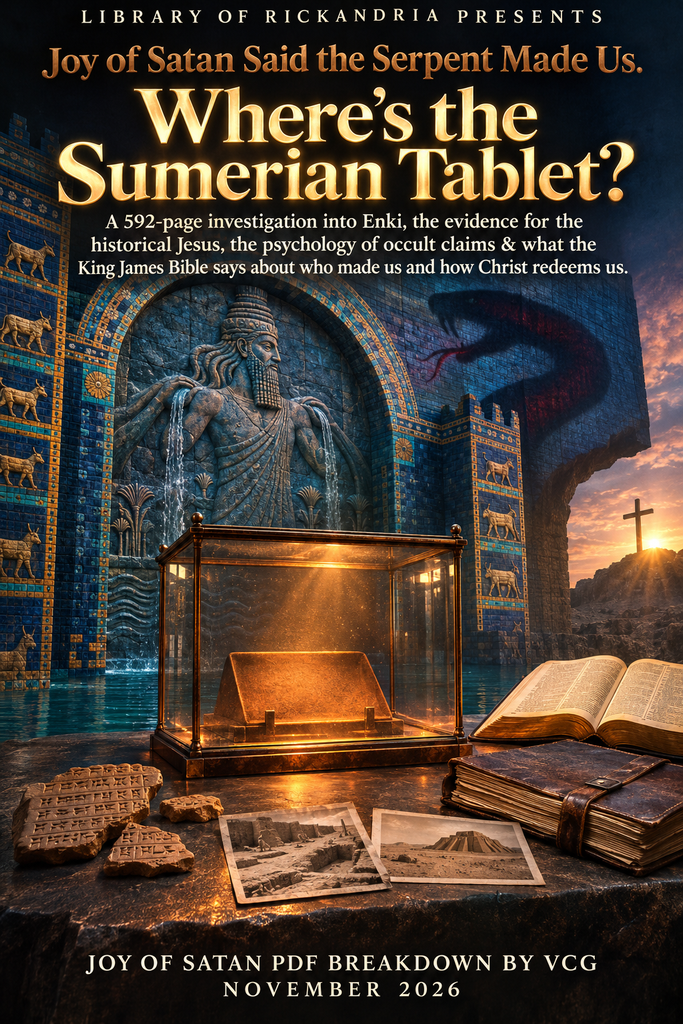
UPDATED BY VCG ON 11/24/2026 @ 01:11 EST
A 592-page investigation into Enki, the evidence for the historical Jesus, the psychology of occult claims & what the King James Bible says about who made us and how Christ redeems us.
Anyone can do this, but most won’t.
Joy of Satan Said the Serpent Made Us. Where’s the Sumerian Tablet? examines a 592-page occult compilation that identifies Satan with the Mesopotamian god Enki and claims humanity was genetically engineered to mine gold.
The Babylonian Epic of Atrahasis does describe humans taking over the gods’ labor.
The surviving text gives no support for alien engineers, gold mining, or the identification of Enki with Satan.
The paper also weighs the ancient evidence for the historical Jesus, checks the claim that the Torah came from tarot, and explores how expectation and coincidence can shape the interpretation of sincere experiences.
It closes by tracing the King James Bible’s answer from Eden to resurrection:
all things were made through Christ, and humanity’s hope rests in his death and resurrection.
ChatGPT – Library of Rickandria
Exhibit A — Where does the ancient text end?
There is a tablet.
The first surprise is how much of the ancient story survives.
The second is how much the modern account adds.
British Museum material identified with BM 78941.
The Cuneiform Digital Library Initiative catalogs the joined witness BM 78941 + BM 78943 as P285809, an Old Babylonian literary tablet from Sippar.
Photograph by Jack1956, public domain.
Cuneiform Digital Library Initiative Object record · Photograph and attribution
Tablet I of the Epic of Atrahasis describes gods burdened with labor.
The lesser gods revolt.
Enki, called Ea in some witnesses, proposes a means of creating humanity.
A birth goddess, Nintu or Mami, takes part in the work.
The story uses clay and material from a slain god, and the goddess tells the assembly that she has transferred the burden to humanity.
The photograph shows one fragmentary witness.
The scholarly translation brings together readings from several tablets and marks variants and restorations.
Sources of Early Akkadian Literature Tablet I, line-numbered scholarly edition · Morgan Library fragment of Tablet II
| What the PDF asks us to accept | What the evidence supports |
|---|---|
| Humans were created to take over labor | A genuine motif in Atrahasis. Tablet I presents human labor as a solution to the gods’ burden. |
| Enki and Ea are connected | A documented correspondence within Mesopotamian religion, visible in the variant readings. |
| Satan alone engineered humanity | The ancient text gives specific roles to Enki/Ea and the birth goddess. The PDF adds the identity with Satan and a modern biological mechanism. |
| Humanity mined gold for extraterrestrials | The ancient narrative contains labor and waterworks. The PDF adds the gold-mining project, the extraterrestrial agents, and the plan to dispose of the workers after the job. |
| The engineers altered their DNA so they would never age | The PDF gives an assertion. It supplies no independently recoverable molecular evidence or biological remains identifying such an intervention or its agents. |
The artifact is Babylonian and the composition is Akkadian.
The title’s “Sumerian tablet” is the challenge posed to a story that invokes Sumerian Enki as its authority.
The surviving ancient text supports a comparison with the PDF.
It gives us no reason to promote the PDF’s additions to ancient testimony.
Cuneiform Digital Library Initiative ORACC on Enki and Ea · Smithsonian on human genetic evidence
Four names, four source trails
| Figure | Where to look | What the source establishes |
|---|---|---|
| Enki/Ea | Mesopotamian texts and scholarship on the Akkadian and Sumerian names | A documented god associated with freshwater, wisdom and ritual knowledge. |
| Tawûsê Melek, the Peacock Angel | Yazidi tradition and scholarly collections of its sacred oral literature | A figure within a living religion whose beliefs should be represented on their own terms. |
| Satan in the KJV | Job 1–2, Matthew 4, Revelation 12, and Isaiah 14 in its own setting | Biblical uses of adversary, tempter and serpent imagery. Isaiah 14:4 identifies the immediate target of its taunt as the king of Babylon. A further typological reading needs its own argument. |
| The extraterrestrial genetic engineer | The Joy of Satan compilation, especially pp. 23–24 and 303–307 | A modern claim about the cause of human origins. Establishing the event would require independent evidence of the intervention and evidence identifying its agent. |
ORACC · Kreyenbroek and Rashow, Yazidi sacred poems and narratives · KJV Job, Isaiah, Matthew and Revelation
How this investigation reads the PDF
The cover names Logan McDonnell as compiler and credits JoyOfSatan.com for the material.
The file metadata dates this copy to 2010.
The compilation contains essays, rites, catalogs, correspondence, and accounts of personal encounters.
Page numbers below are the PDF viewer’s page numbers.
The breakdown therefore follows the 13 chapters of the PDF.
The assignment includes no separate numbered forum transcript.
The related Satan Unmasked investigation, linked below, has its own post-by-post record.
A manuscript can establish that someone wrote down a belief.
A controlled experiment can test whether an observation occurs more often than chance predicts.
Psychology can offer plausible explanations for how an experience acquired its meaning.
Interpretation asks what a writer or speaker meant within a text.
KJV Scripture supplies the Christian theological judgment.
Each method answers a different question.
A dated trail through the evidence
| Date or period | What enters the record | What it helps settle |
|---|---|---|
| Old Babylonian period | The Sippar Atrahasis witness | The antiquity of the creation-and-labor story. |
| Second Temple period | Ancient Jewish scriptural manuscripts in the Judean Desert | The existence of Jewish scriptural traditions centuries before European tarot. |
| First and early second centuries CE | Paul’s letters, Josephus’s Antiquities, and Tacitus’s Annals | Early Christian testimony and later non-Christian references to Jesus. |
| Early centuries CE | P52, a small manuscript copy preserving part of John | Early circulation of the Gospel. The handwriting gives a range, with no exact date for its original composition. |
| Early fifth century CE | The Maskell ivory Crucifixion panel | An early depiction of the Crucifixion. Its existence leaves open the specific question of where it was displayed or used. |
| Fifteenth and sixteenth centuries CE | Italian tarot and, later, John Dee’s conference records | Independent dates for two traditions the PDF treats as repositories of ancient knowledge. |
| Early twentieth century through 2010 | The disputed published Yazidi books, LaVey’s 1966 founding, and the PDF under review | The different histories of the texts and institutions that the compilation brings together. |
CDLI tablet catalog · Israel Museum, Dead Sea Scrolls · Tacitus, Annals 15.44 · P52 manuscript · Study of P52’s dating · Maskell panel · Metropolitan Museum, tarot chronology · British Library, Sloane MS 3188
The complete chapter breakdown
1. The claim of original religion · pp. 1–14
The introduction places the conclusion first.
Satanism was allegedly humanity’s first religion, and later institutions supposedly concealed that fact.
A persuasive demonstration would identify an early community, its texts and practices, and a path from those sources to the beliefs in this PDF.
The claim of suppression does much of the work because the compilation can interpret surviving parallels as confirmation and missing evidence as a sign of destruction.
A reader should ask what discovery the author would have accepted as contrary evidence.
One of the introduction’s claims gives us a straightforward test.
Its statement that Islam appeared less than a thousand years earlier fails against Islam’s seventh-century origins.
Its allegations of financial exploitation and psychic extraction are different claims.
They need identifiable conduct, records, and a way to demonstrate the alleged mechanism.
The KJV itself condemns religious exploitation in Mark 12:38–40, where Jesus identifies conduct that can actually be examined.
Origins of Islam · KJV Mark 12:38–44
2. The appearance of Satan · pp. 15–20
The PDF presents reports of a white-robed figure and treats their apparent agreement as identification.
The first question is whether the witnesses described the figure independently before seeing common images or hearing others’ accounts.
Shared imagery can shape later perception and recollection.
That explanation can be investigated without assuming anyone fabricated an experience.
The compilation raises a fair point about stock devil imagery.
A familiar illustration gives little basis for assuming Satan must look like a red figure with horns and a tail.
The KJV employs different images for different purposes.
Second Corinthians 11:13–15 considers the possibility of deceptive appearances in a warning about false apostles and ministers.
Revelation 12:9 identifies the dragon within its own vision.
Neither passage gives a method for identifying the cause of a particular reported apparition.
Johnson and colleagues on source monitoring · KJV 2 Corinthians 11 and Revelation 12
3. The Creator, the historical Jesus, and the afterlife · pp. 21–26
The PDF’s claim about Enki and humanity belongs alongside Exhibit A.
Its claim that Jesus was invented from pagan models requires a separate investigation.
Paul reports meeting Cephas and James in Galatians 1:18–19.
In 1 Corinthians 15:3–8 he transmits a proclamation he says he received.
Josephus refers to James through Jesus called Christ in Antiquities 20.200.
The more elaborate Josephus passage at 18.63–64 has a more contested transmission.
Tacitus, writing later, places Christus’s execution under Pontius Pilate in the reign of Tiberius.
These sources have different strengths.
Paul is an early Christian witness.
Josephus and Tacitus provide later external testimony.
The confession that God raised Jesus has its own evidentiary and theological question, which Paul puts at the center of the gospel.
Cambridge introduction to the historical Jesus · KJV Galatians 1 and 1 Corinthians 15
The PDF names Odin as a model for Jesus.
The hanging motif is real.
In Hávamál, Odin hangs for nine nights, is wounded, offers himself to himself, and acquires runes.
The Christian proclamation describes execution, burial, resurrection on the third day, and death for sins.
A historical borrowing claim needs a version accessible to the proposed borrower and a plausible route by which it reached them.
The resemblance on its own gives us a comparison.
The supposed admission by Pope Leo X has a different provenance problem.
The traceable published route leads to John Bale’s later polemic, and the PDF gives no contemporary record of Leo making the remark.
Critical translation of Hávamál · Morgan Library, Bale’s Pageant of Popes
Finally, the PDF’s account of a Satan-governed afterlife comes to the reader as someone’s reported vision.
Its asserted geography and reincarnation scheme would require independent evidence.
The KJV gives a different sequence in Hebrews 9:27–28 and John 5:28–29.
Revelation 20:13–14 gives an additional textual distinction.
Death and hell deliver up their dead before both are cast into the lake of fire.
KJV Hebrews 9, John 5 and Revelation 20
4. What newcomers are promised · pp. 27–36
The introductory instructions promise greater power, protection and eventual transformation.
The investigator can take a reader’s report of greater confidence seriously while asking how it was measured and what else changed.
Confidence and physical immortality are claims of very different kinds.
Members who report benefits, former members, people who experienced harm and people who detected no change all belong in a fair assessment.
The KJV similarly gives a clear place to growth and good works, while Ephesians 2:1–10 places grace and God’s act of making people alive with Christ first.
First Corinthians 15:50–57 speaks of immortality in the setting of resurrection.
KJV Ephesians 2 and 1 Corinthians 15
5. The Yazidi material · pp. 37–46
The PDF introduces Yazidis through the historical outsider allegation of devil worship.
It also calls the Jilwa the Black Book, conflating it with the distinct Mashaf Rash.
Scholarship gives the published manuscript forms a contested provenance and documents a substantial Yazidi oral tradition.
The existence of a circulated English version tells us that a particular text was printed.
To establish the religious identity of its speaker, or the authenticity of its title and attribution, the investigator needs more.
Repeating the old accusation against a living community compounds the source error.
Encyclopaedia Iranica, Jilwa · Yazidi sacred oral texts
6. Ancient origins, Torah and tarot, Solomon, and symbols · pp. 47–76
The proposed origin of the Torah in tarot fails on chronology.
The Jewish textual tradition is far older than the fifteenth-century Italian card evidence.
The resemblance between the English spellings gives no reason to reverse the dates.
The same discipline applies to the PDF’s treatment of serpent motifs, the White Chapel at Karnak, and Baphomet.
Start with a dated object or written source, identify its use in context, then trace who read or transmitted it.
Lévi’s nineteenth-century Baphomet has a historical setting that cannot simply be projected backward onto any similar-looking figure.
Digital Karnak, White Chapel · Julian Strube on Baphomet
The Solomon chapter uses an alleged banking and Masonic connection to make a collective accusation against Jews.
An individual’s association with an institution, even if demonstrated, cannot establish ethnic control.
The claim belongs to a documented pattern of antisemitic conspiracy allegations.
The KJV gives a direct correction in Romans 11:17–21, where Paul warns Gentile believers against boasting over the branches.
USHMM on allegations of collective Jewish control · KJV Romans 11:17–21
7. Dedication, permanence, and secrecy · pp. 77–80
The dedication places a promise of protection beside an obligation of allegiance.
The FAQ calls the act permanent and also recounts a person performing a reversal after which Satan supposedly left.
That leaves the reader to ask what the compilers mean by permanent and what outcome, if any, would disprove it.
Page 80 addresses minors directly and advises keeping allegiance private under the conditions it describes.
Those passages are evidence of what the book asks, and of the pressure it can place on a worried reader.
The KJV response to someone afraid of a former commitment begins with Christ’s authority and forgiveness.
Colossians 2:13–15 places victory over powers in Christ’s work.
First John 1:7–9 gives confession, cleansing and forgiveness as the Christian response to sin.
8. What a symbol can prove · pp. 81–84
The ankh, pentagram, crossed lines, and sideways eight have to be studied one at a time.
A similar outline can occur in artifacts from different periods and carry different meanings.
A dated object with an inscription or an independently documented use gives the researcher something stronger than a visual overlay.
The PDF’s chakra correspondences are evidence of how the compilation interprets these forms.
Establishing that ancient users assigned the same correspondences requires a historical source for those meanings.
Strube on the historical context of Lévi’s imagery · Oxford Research Encyclopedia, yogic body mapping
9. Spirits, catalog entries, and an answer that keeps changing · pp. 85–202
Many pages combine named figures, claimed ranks and powers, early modern grimoire traditions, and experiences attributed to particular spirits.
Each identification needs its own evidence.
An independently attested god, a spirit named in a manuscript, a matching-looking sigil and a claimed encounter are four different kinds of evidence.
Second Kings 1:2, for example, places Baalzebub in Ekron.
The equation with Enlil is an additional claim about identity.
ORACC on Enlil · Manuscript-based Goetia transcription · KJV 2 Kings 1
Follow the argument across pp. 89, 91 and 95.
The text begins by asking the reader to identify a specific purpose.
After an apparently unanswered attempt, it encourages looking for coincidences.
The FAQ counts widely differing events as possible clues, including dreams, breezes and changes in candles or incense.
With enough time and enough eligible events, a person has many chances to find something that seems responsive.
A better evidentiary design specifies the answer, who already knows it, the scoring rule, the time limit and what counts as failure before anyone looks for an outcome.
It also records the misses. Research on Ouija sessions offers a testable alternative for some reports.
Participants can experience a reduced sense of agency while producing a response through interaction.
Source monitoring is a related question about how a person attributes a thought, memory or sensation.
Neither explanation assigns a cause to every individual account.
Nickerson on confirmation bias · Andersen and colleagues on Ouija and agency
10. Rites, holidays, and the Enochian materials · pp. 203–260
The PDF groups different holidays under a single story of appropriation.
Each proposed source has to be checked against its own calendar, language and early witnesses.
The claim about Aries and the Christian Lamb has an obvious rival explanation within the text: 1 Corinthians 5:7 calls Christ “our passover,” and Exodus 12 supplies the background.
The Enochian material offers a clearer comparison.
The British Library holds manuscripts documenting John Dee’s reported conferences.
The Joy of Satan compilation explicitly acknowledges revising the material.
We can therefore investigate who changed particular words and when.
Those editorial changes give no independent account of the power outages or other events the PDF ascribes to spiritual action.
British Library, Dee’s manuscripts · KJV Exodus 12 and 1 Corinthians 5
11. The sermons, Giza, Roswell, and prophecy · pp. 261–330
The sermons are most informative when read as arguments with distinct claims.
At Giza, quarrying and work-gang evidence belongs to the archaeology.
A theory that the pyramids intentionally reproduce the peaks of Ararat needs independent evidence of the designers’ intent.
At Roswell, claims about recovered bodies and alien equipment call for authenticated records, a chain of custody and physical evidence.
The Air Force’s archival inquiry gives a balloon-related explanation involving Project Mogul for the 1947 incident.
That report gives a documented explanation to examine alongside later narratives.
Smithsonian on pyramid building · Air Force Roswell inquiry · NASA UAP findings
On pp. 321–322 the PDF makes a good methodological observation.
Changes in detection and reporting alter what people count as an increase in disasters.
That same rule applies to the book’s reported spiritual phenomena.
Collect the denominator, identify changes in observation, and resist treating vivid examples as a trend.
Matthew 24 likewise says the end is “not yet” in the discussion of wars and rumors, and verse 36 gives a clear limit on knowing the day and hour.
USGS on earthquake reporting and detection · KJV Matthew 24
12. Meditation, the brain, and claims about health · pp. 331–517
This chapter gains credibility by beginning with things that are real.
Nerves and the brain have measurable electrical activity.
The pineal gland has a recognized endocrine function involving melatonin.
Neutrinos are real particles.
None of those facts supplies the missing measurement for the PDF’s claims that neurons receive occult transmissions, that a defunct pineal gland needs spiritual activation, or that neutrinos compose the soul.
Each proposal would need its own observable measure and evidence.
The health passages deserve particular care.
Page 335 describes convulsions and prolonged sleeplessness within a discussion of spiritual progress.
Research on meditation documents possible adverse experiences, and those symptoms can require medical assessment.
Page 477 explicitly tells readers to continue prescribed treatment unless a licensed physician clears a change and to obtain prompt professional care for children or animals.
That qualification matters.
The accompanying claim that disease typically begins in occult circulation still lacks clinical evidence.
Endotext on pineal physiology · Meditation adverse-events review · NCCIH on meditation evidence and safety · Department of Energy on neutrinos
13. Magick, divination, and correspondences · pp. 518–592
The last chapter assigns effects to visualization, mirror-gazing, astrology, plants, candles and other practices.
Some have observable effects on attention or perception.
Low-light mirror-gazing, for example, can produce striking changes in how a face appears.
A reported image can be sincerely experienced while its interpretation as a spirit or forecast remains uncertain.
Similarly, an astrological claim should identify what it predicts in advance and be compared with masked or randomly assigned alternatives.
Caputo on mirror-gazing illusions · Carlson’s double-blind astrology study
When the intent of a practice is to harm or control another person, the Christian judgment does not depend on proving that the practice works.
Romans 12:14–21 calls believers to bless persecutors, leave vengeance to God, and overcome evil with good.
The rule applies to how Christians respond to the people who wrote and read this PDF, too.
What the PDF gets right
It distinguishes its beliefs from LaVey’s.
The Church of Satan corroborates the 1966 founding and the symbolic understanding of Satan that this PDF rejects.
It explicitly repudiates living sacrifice.
Pages 25 and 285 deserve to be represented accurately.
The blood-signing rite on p. 79 and the retaliatory passages raise their own questions.
It recognizes the effect of reporting on perceived frequency.
Page 321 applies this to disasters.
It is an observation worth applying equally to reports of ritual success.
USGS on changes in earthquake detection
It advises readers to continue prescribed care.
Page 477 says this explicitly.
The unsupported claims about the cause and cure of disease can be assessed while preserving that instruction.
NCCIH on evidence for proposed healing energy fields
Page-and-line ledger — The pivotal claims
The expanded paper has a 34-entry ledger, the original detailed chapter breakdowns, and an open-items register.
Here are the entries that carry the main argument.
| PDF page and extracted lines | Claim | Finding |
|---|---|---|
| p. 14, lines 1–8 | Satanism is humanity’s original religion. | No dated witness and transmission route establish that claim. |
| p. 18, lines 4–5 | Enki, Ea, Satan, and the Peacock Angel identify the same being. | Enki/Ea is corroborated. The further identities lack independent support. |
| p. 22, lines 10–12 | Jesus was fabricated from earlier models including Odin. | The named example shows resemblance. A dated route of transmission is missing, and ancient testimony places Jesus in a specific historical setting. |
| p. 23, lines 12–13 | Leo X made the “myth of Christ” admission. | The documented later polemic establishes circulation of the allegation. The attribution to Leo remains unverified. |
| p. 23, lines 26–30 and p. 24, lines 18–28 | Humanity was genetically engineered as labor for alien gold miners. | Ancient literature establishes the labor motif. The specific biological and mining claims remain unsupported. |
| p. 41, line 1 and pp. 41–42 | The Jilwa is the Black Book and speaks for Satan. | The book titles are conflated. Provenance and speaker identity require independent evidence. |
| p. 51, lines 1–9 | Torah derives from tarot. | The attested chronology runs the other way. |
| p. 79, lines 19–45 and p. 80, lines 1–22 | The dedication binds, and some minors should keep the commitment concealed. | The advice is explicit. The claim of an enduring supernatural contract remains unverified. |
| p. 91, lines 1–9 and p. 95, lines 2–14 | An apparently missed reply can be found in later coincidences. | The enlarged success criteria make ordinary events easier to count as confirmation. |
| p. 335, lines 19–37 | Convulsions and prolonged sleeplessness can signal spiritual advance. | The asserted cause is unsupported. The symptoms can be medically significant. |
| p. 477, lines 9–39 | Readers should keep receiving prescribed care, while disease generally originates in occult circulation. | The care advice is explicit. The claimed disease mechanism needs independent clinical evidence. |
Scope.
Every chapter is covered, and the opening doctrine and selected disputed passages receive closer line-group analysis.
The complete word-by-word verification of every catalog entry, minor attribution, ritual variant, and image remains open.
The expanded paper identifies those limits so a later reader can see what still needs checking.
The KJV’s answer from Eden to resurrection
Creation gives humanity dignity and responsibility.
Genesis 1–2 presents God as Creator and humanity as bearing his image.
Humanity receives work to do in the garden.
In Genesis 3, the serpent disputes what God has said and promises a gain.
The narrative shows the consequences through shame, estrangement and exile.
The serpent has a voice in the story.
The act of creation belongs to God.
The Creator enters his creation.
John 1:3 says,
“All things were made by him; and without him was not any thing made that was made.”
Verse 14 identifies the Word who became flesh.
Colossians 1:15–20 includes invisible powers among the things created by and for Christ and connects reconciliation to the blood of his cross.
That connection runs straight through the two questions in the paper’s subtitle.
The one through whom all things were made is the one through whom God reconciles.
KJV John 1:1–18 and Colossians 1:12–23
Grace comes before the work.
Ephesians 2 begins with people dead in trespasses and describes God making them alive with Christ.
Good works follow.
Second Peter’s language of participation in the divine nature is tied to God’s promises and a life of virtue, patience and charity.
In both passages the initiative belongs to God.
The hope is resurrection.
First Corinthians 15 connects the Christian hope to Christ being raised and describes the mortal putting on immortality.
Hebrews 9 sets mortal death and judgment beside Christ’s once-offered sacrifice and future appearing. John 5 speaks of the dead rising.
These passages give the Christian answer to the PDF’s promise of reincarnation and eventual self-deification.
KJV 1 Corinthians 15, Hebrews 9 and John 5
The Sippar tablet gives us an ancient account of why humans labor.
The modern PDF gives that account a new cast of characters and a new biological explanation.
Readers can now inspect the tablet record, read the scholarly translation, and find the exact pages where the compilation crosses from the ancient story into its own.
The KJV asks its own question of the reader.
The Word who made all things became flesh, and the Christian hope rests on what he did in history and what God promises to do in resurrection.
| Evidence or claim | What the source establishes |
|---|---|
| Divine labor, Tablet I’s opening and lines 237–243 | Gods are burdened with labor and revolt. The birth goddess reports transferring the burden to humanity. The PDF’s labor motif has a genuine ancient parallel. |
| Human creation, Tablet I, lines 196–226 and 237–251 | Enki/Ea proposes a process using clay and a slain god’s flesh and blood. Nintu/Mami, the birth goddess, carries out the mixing and speaks of her role. This is a composite translation from multiple witnesses. Parts of the passage are restored from tablets beyond the specific artifact in the photograph. |
| Genetic engineering and immortal extraterrestrials, PDF p. 23, lines 26–30 and p. 24, lines 18–20 | The cited ancient story describes divine action and ritual materials. Neither the passage nor the PDF supplies a biological signature, remains, or independent genetic evidence for engineering or immortality. |
| A gold mine and eradication after the job, PDF p. 24, lines 26–28 | The literary source gives forced labor and describes earthmoving and waterworks. Its larger narrative includes efforts to control or destroy humanity and a flood. These are specific motifs with their own context. The text does not say that humans finished extracting gold for visiting aliens or would be disposed of after a mining contract. |
| Enki is the serpent, the Devil, and the Peacock Angel, PDF pp. 18, 24, 25 and 38 | A secure Enki/Ea correspondence does not validate the rest of the sequence. To demonstrate a further identity, produce a decisive name identification, a bilingual equation, or a historically plausible chain of transmission supported by records. |
Scholarly translation with variants and line numbers · Translation excerpts from Atrahasis · Morgan Library, Old Babylonian fragment of Tablet II · Smithsonian, human genetic evidence
Four names and four source trails
| Figure | Earliest relevant witness used here | Evidentiary limit |
|---|---|---|
| Enki/Ea | Old Babylonian manuscripts of Atrahasis and the Mesopotamian sources indexed by ORACC. | The secure language pairing and freshwater associations tell us about Mesopotamian religion. The texts do not give an Enki-to-Satan equation. |
| Tawûsê Melek, the Peacock Angel | Documented Yazidi religious traditions, including sacred oral texts collected by specialists. The disputed early twentieth-century Jilwa publications require their own provenance assessment. | A modern party can appropriate a figure outside its own community. Historical research needs to compare that appropriation with the living community’s own testimony and documented tradition. |
| Satan in the KJV | Job 1–2, Matthew 4 and Revelation 12 provide biblical settings for the adversary, the tempter and the serpent/dragon imagery. Isaiah 14:4 explicitly introduces a taunt against the king of Babylon before “Lucifer” in verse 12. | The first referent of Isaiah’s taunt comes from the passage. Later Christian typology and the identity Revelation gives its own figure need their own textual arguments. |
| Extraterrestrial genetic engineer | The claim under review is explicit in the 2010 compilation on pp. 23–24 and receives additional treatment on pp. 303–307. | A printed story documents the modern claim. Assertions about an event in biological history need independently recoverable physical evidence, a plausible dated setting and evidence identifying the agent. |
ORACC · Kreyenbroek and Rashow, Yazidi sacred oral literature · Iranica on the Jilwa · KJV Job, Isaiah, Matthew and Revelation
A chronology readers can check
| Date or period | Dated source | The comparison it permits |
|---|---|---|
| Old Babylonian period, roughly 1900–1600 BCE | Atrahasis witness P285809. | Put the creation and labor motifs in their ancient Akkadian literary setting. |
| Second Temple period | Ancient manuscripts from the Judean Desert. | Show Jewish scriptural traditions long predate European tarot. |
| First and early second centuries CE | Paul’s letters, Josephus’s Antiquities and Tacitus’s Annals. | Establish early Christian testimony and references to Jesus in later non-Christian writings. Treat each witness according to its date and genre. |
| First few centuries CE | P52, a small fragment of John preserved at the John Rylands Library. | The copy evidences early manuscript circulation. A paleographic estimate is a date range, and it cannot establish the precise original composition date. |
| Early fifth century CE | Maskell ivory Crucifixion panel. | Shows an early depiction. The claim on p. 51 about places of worship asks a narrower question about installation and use, which the panel alone cannot answer. |
| Fifteenth century CE | Northern Italian tarot records and cards. | The attested chronology defeats a Torah-from-tarot origin claim. |
| Late sixteenth century CE | John Dee’s documented conference records. | Provides datable witnesses against which modern Enochian revisions can be compared. |
| Early twentieth century CE | Modern publications of the Jilwa and the Black Book. | Establish when those manuscript forms entered public discussion, not the age of Yazidi oral tradition. |
| 1966 and 2010 | Founding of LaVey’s Church of Satan and the file metadata for this compilation. | Keeps the histories of the two modern institutions and the date of this copy in view. |
CDLI · Israel Museum, Dead Sea Scrolls · Tacitus, Annals 15.44 · P52, manuscript record · P52, limits of paleographic precision · Maskell panel · Met, Tarot history · British Library, Dee manuscripts · Iranica, Yazidi sacred books · Church of Satan history
Findings in brief
The compilation presents a modern religious synthesis as humanity’s oldest religion.
Its account relies on a chain of identifications:
Satan becomes Enki, then the Yazidi Peacock Angel, then an extraterrestrial engineer, then the serpent associated with kundalini and DNA.
Sources sometimes verify a link within a tradition, such as Sumerian Enki and Akkadian Ea.
The cross-tradition leaps require their own evidence, which the PDF repeatedly substitutes with resemblance, private testimony, or the claim that contrary records were destroyed.
Several pivotal statements are directly checkable.
Tarot is attested in fifteenth-century Europe, many centuries after the Torah.
Early Christian manuscripts and Roman testimony predate the medieval Inquisition by centuries.
Islam emerged in the seventh century, more than 1,300 years before this PDF.
The PDF recasts the Yazidi Jilwa as Satanic scripture despite serious provenance problems.
It calls observable neural electricity, bodily arousal, and hypnosis evidence for paranormal abilities without establishing the link.
Its advice about illness, intense breathwork, and poisonous plants has immediate practical implications apart from the theological dispute.
How to read this audit
Page references use the PDF viewer’s page number, counted from the cover.
Some entries in the original contents list become one page early in the later chapters.
For pp. 14, 16, 18, and 22–25, the line numbers follow the page-by-page pdftotext -layout extraction, counting interior blank lines.
They identify the wording under discussion even when the viewer wraps it differently.
Historical evidence establishes what a dated text says, what an artifact depicts, or what a community is documented as teaching.
A dated text can establish circulation of a belief.
Assessing the underlying event, or influence on another text, takes further evidence.
Empirical evidence needs an observable outcome, an alternative explanation, and a design that can distinguish it from the proposed cause.
For an exact divination claim, use concealed independently randomized targets, a predefined scoring rule, the full denominator of trials, and independent replication.
For a healing claim, use objective outcomes, comparison with usual care, and adverse-event follow-up.
A spiritual account about the cause of disease needs its own evidence.
Psychological analysis evaluates the persuasive techniques on the page and plausible mechanisms for some reported experiences.
It neither establishes the writers’ intent nor diagnoses them.
Sources for the mechanisms are linked at the relevant entries.
KJV analysis gives the Christian textual and theological response.
A passage is read with its speaker, audience, genre and immediate argument in view.
Where the PDF gives a bare phrase or substitutes an occult meaning, the context is part of the rebuttal.
Scope.
This report covers the 13 chapters in order, examines opening doctrinal claims and additional disputed passages by extracted line group, and gives detailed checks for recurring historical, empirical and doctrinal claims.
Later page groups consolidate catalog entries, repeated articles, and ritual or exercise variants.
Thousands of individual catalog attributes, ritual lines, image details, botanical entries and minor quotations have not been independently verified word for word.
“Unsupported” means the cited evidence fails to establish the conclusion.
“False” is reserved for an identifiable contradiction.
1. Introduction and the source of authority · pp. 1–14
The cover credits a compiler and a website.
The table of contents (pp. 2–11) indexes an anthology of sermons, transcriptions, correspondence tables, ritual material, and instructional articles.
A byline on one sermon cannot automatically be assigned to the whole book.
Chapter divider p. 13 introduces the first statement of doctrine.
| PDF p. 14 | Claim in context | Finding and KJV response |
|---|---|---|
| Lines 1–4 | Satan allegedly declares the religion original and is credited as founder. | Unverified attribution and historical claim. A quotation tagged with a name establishes what the compiler attributes. To establish historical priority, identify the earliest securely dated evidence for this specific cult, with its named object of worship and its doctrines. Evidence for old serpent motifs or old polytheism would establish their age. Genesis 1:1 and John 1:1–3 ascribe creation to God through the Word. |
| 5–8 | Outsiders allegedly suppressed Satan’s voice, while ancient manuscripts preserve his own teaching. He is identified with an original horned god. | Unsupported conflation. The Jilwa has a disputed textual history, and the horned-god claim needs a specified artifact, its date, language, inscription, and transmission to this doctrine. A horned figure alone gives none of those identifications. Deuteronomy 13:1–5 judges a summons to other gods even if a sign occurs. |
| 9–13 | Rival portrayals are rejected and a personal encounter is offered as the means of correction. | Mixed. LaVey’s institution expressly treats Satan as symbolic, and a horned caricature is neither the Bible’s complete portrayal nor a method of identification. The proposed personal encounter supplies one person’s report. Instructions about whom to expect already supply an interpretive frame. Second Corinthians 11:13–15 treats appearance as insufficient to establish the source of a ministry. |
| 14–17 | The Church allegedly erased evidence and invented history to monopolize spiritual power. | Overgeneralization. Individual cases of censorship have dates, victims, authorities and records. A theory that treats missing evidence as proof would gain support regardless of what investigators found. Test each alleged event against a surviving independent record. Acts 17:11 praises examination of the teaching, and 1 Thessalonians 5:21 commands readers to prove all things. |
| 18–20 | Some articles are obsolete and revisions will follow. | Documented editorial caveat. It helps explain tensions between articles. A research revision should identify the superseded claim, new evidence, and date. Compare this modest editorial admission with the certainty on p. 22. Proverbs 18:17 asks the reader to hear the other side. |
| 21–24 | Three religions are treated as coordinated fraud involving trillions and harvested psychic energy. | Unsupported quantity, coordination and mechanism. The text provides no accounts, definitions, periods or distinction between independent institutions, still less a way to detect psychic extraction. Jesus condemns devouring widows’ houses in Mark 12:38–40, and Paul distinguishes ministry from using godliness for gain in 1 Timothy 6:3–10. Those moral judgments concern conduct that can be identified. |
| 25–26 | Judaism, Christianity, and Islam are described as extremely recent, and Islam as under a millennium old. | The numerical claim is false. Islam began in the seventh century CE. Christianity is documented in antiquity and grew out of Second Temple Judaism. Jewish traditions developed over centuries, so a single founding year depends on what is meant by “Judaism.” |
| 27–32 | Wholesale theft is alleged, including a claim of coordinated social control. Wicca and Neopaganism are called twentieth-century manifestations. | Partial truth with an unsupported inference. Modern Wicca took shape in the twentieth century. Modern Paganism includes diverse revivals and reconstructed traditions with different histories. A recent institutional form may draw on older materials. Theft, in each proposed case, requires a source, dating, and a plausible direction of borrowing. |
| 33–37 | The ministry defines its mission and rejects rival Satanisms. | Accurate as a statement of its own boundary. It cannot speak for every group using the label. The official Church of Satan account corroborates the distinction in this instance. KJV 1 Corinthians 8:4–6 expresses the Christian confession of one God and one Lord Jesus Christ. |
| 38–42 | Insider encounters validate the ministry’s account, and enlightenment depends on being sufficiently deprogrammed. | A closed test if dissent counts as prior conditioning. An outsider or former insider must be able to identify what would count as contrary evidence before the outcome. Shared images, language and teaching also make reported agreement less independent. First John 4:1 commands testing and immediately gives a Christological test in vv. 2–3. |
Encyclopaedia Iranica, Jelwa, Ketāb al- · Church of Satan organizational FAQ · Khan Academy, origins of Islam · Ronald Hutton, Gardner and modern Wicca · Tacitus, Annals 15.44, Dickinson College · Nickerson on confirmation bias · Johnson et al. on source monitoring · KJV passages
2. What does Satan look like? · pp. 15–20
| PDF locator | Claim or exhibit | Finding |
|---|---|---|
| p. 16, lines 1–4, 8–12 | Agreement about visions and the illustrated white-robed figure | A picture circulated within the same community can influence imagery and later reports. Agreement becomes stronger evidence with independently recorded accounts, no prior picture exposure, complete reporting and attention to discrepancies. The KJV’s “angel of light” is part of a warning about disguised apostles and ministers in 2 Corinthians 11:13–15. The passage does not identify who caused any particular reported experience. |
| p. 16, lines 5–8 | Rejection of stock monster imagery and description of lesser spirits | The KJV supplies diverse literary images: serpent, dragon and angel of light appear in different passages and functions. Revelation 12:9 identifies the dragon with the Devil and Satan within an apocalypse. Literary imagery gives no warrant for a required ordinary physical appearance, nor for claims about ranks or friendly messengers. |
| p. 17 | Sigil exhibit | The sigil question appears below two illustrations on p. 17. The two blue sigils themselves are at the top of p. 18. A sigil shows that someone drew and published a sign. Attribution to a supernatural maker requires evidence separate from the design itself. Trace a graphic’s oldest dated copy and distinguish a copied figure from a fresh drawing before claiming antiquity. |
| p. 18, lines 1–2, 6–8, 10–12 | Weekday, colors, animals, numbers, planets and compass bearings | Devotional correspondences. One tradition may freely assign them. They need a separate document trail to be described as ancient. Uranus was recognized as a planet in 1781, so an ancient recognition claim would require exceptional evidence. Venus being called a morning star in astronomy cannot assign each biblical use of that image to a single person. |
| p. 18, lines 4–5 | Enki, Ea and Melek Ta’us identified with Satan | One evidenced pairing, two unsupported identities. Enki is Sumerian, Ea his Akkadian counterpart. The Mesopotamian god’s associations include freshwater, wisdom, and ritual knowledge. The Yazidi Peacock Angel belongs to a distinct living tradition. The PDF provides no inscription or transmission linking all three. |
| p. 18, lines 8–9 | 666 predicts an Aquarian reign | Contradicted as an account of Revelation’s wording. Revelation 13:16–18 calls 666 the number of the beast and connects it to the beast’s name and economic coercion. The early 616 variant is an additional historical check. Nero is a widely discussed historical reading with scholarly alternatives. Aquarius appears in neither reading of the number. |
| p. 18, lines 13–16 | December 23, Capricorn and eleven | The solstice is an astronomical instant that shifts by year and time zone. A fixed anniversary can be a convention. The move from the tenth sign and first degree to 11 adds two chosen values, without showing a predictive or ancient basis. |
| p. 18, line 17 and pp. 19–20 | Paradise Lost attribution and adjacent picture pages | An illustration of a literary work is evidence of artistic reception. The compiler’s John Martin attribution on p. 18 is an artwork lead, distinct from evidence for a place or a personal encounter. Page 19 carries the reproduced image and p. 20 is a separator bearing only its page number. |
ORACC on Enki/Ea · Uranus chronology, NASA · US Naval Observatory season tables · P115 and 616 · Recent challenge to the Nero reading · KJV passages
3. Creator, Christ and the afterlife · pp. 21–26
| PDF locator | Claim | Evidence and correction |
|---|---|---|
| p. 22, lines 1–6 | LaVey’s Church differs from JoS and began in 1966. The ministry invokes hundreds of research hours. | The Church of Satan confirms its founding and symbolic stance. Time spent is a statement about effort. Dates, sources, translations, and independent checks are what establish particular findings. |
| p. 22, lines 7–9 | Satan created humanity and YHVH stands for occult elements and compass points. | Occult traditions can assign correspondences to a preexisting name. Four letters can receive many sets of four. Exodus 3:13–15 supplies the name within God’s address to Moses, and Genesis 1 narrates God’s creative acts. John 1:1–3, 14 identifies the incarnate Word as the one through whom all made things came to be. |
| p. 22, lines 10–12 | A fictitious Jesus was assembled from over 18 pagan hanging and resurrection stories, including Odin. | Historically untenable as stated. The claim needs the named 18 source texts, their dates, their relevant passages and a credible route by which early Christians knew them. The example actually given is checked below. Galatians 1:18–19 places Paul with Cephas and James, whom Paul calls the Lord’s brother. Tacitus and Josephus provide later non-Christian references of differing kinds. |
| p. 22, lines 13–18 | Christ was imposed to confiscate knowledge, money and health. | No accountable sum, epidemiological comparisons, or record of a coordinated operation supports this. The earliest evidence must also be explained if the claim is that later authorities invented the person. In Acts 8:18–24 Peter rebukes Simon for thinking God’s gift can be bought. |
| p. 22, lines 19–28 | Ancient Satanism and soul alchemy are presented as the sources of Christian salvation, with divine status achieved by effort. | Historical dependence unestablished; doctrine conflicts with the KJV. Ephesians 2:1–10 places grace and Christ’s work before the believer’s good works. Second Peter 1:3–8 speaks of participation in the divine nature through God’s promises and describes growing in virtue, temperance, patience and charity. It provides no method for becoming a self-existent deity. |
| p. 22, lines 29–43 | The ministry claims free inquiry and scientific compatibility, with no mediator. | Scientific compatibility depends on predictions and honest reporting of failure. The general claim to openness can be tested against pp. 80, 91, 229 and 366, where the book limits outside disclosure or supplies explanations for failed or adverse outcomes. KJV 1 Timothy 2:5–6 identifies Christ as mediator and connects this office to his ransom. |
| p. 22, lines 44–45 and p. 23, lines 1–3 | Dedication brings protection; independent seekers allegedly face disaster. | The text supplies neither base rates nor a comparison group. This threat-and-protection pair makes recruitment emotionally consequential before its claims have been demonstrated. John 10:27–30 locates the Christian’s security in Christ and the Father. |
| p. 23, lines 4–11 | Jesus teaches servitude, abuse and indifference to present life. | False as a summary of the Christian text. Mark 10:42–45 explicitly contrasts abuse of political power with service. Luke 10:25–37 centers concrete care for the injured. Acts 22:25 invokes legal rights. A religious authority can misuse a text about endurance; the misuse does not establish the text’s purpose. |
| p. 23, lines 12–13 | Pope Leo X allegedly admits Christ was a useful myth. | Unverified and misattributed as a dependable quotation. An early traceable printed route is John Bale’s polemical Pageant of Popes, published in English in 1574, after Leo’s death in 1521. The record establishes publication of an accusation; the PDF offers no contemporary transcript or independent eyewitness. |
| p. 23, lines 14–22 | Miracles are alchemical symbols, can all be duplicated, and are occasionally staged by aliens. | These proposals address different questions: a story’s literary meaning, a person’s empirical ability, and the agent of an event. They have distinct evidentiary burdens. First Corinthians 15:12–20 grounds the hope in Christ having been raised and expressly treats the denial of resurrection as consequential for faith. |
| p. 23, lines 23–30 | Satan delivers freedom, ends abuse and engineered humanity. | An anti-abuse principle can stand on its merits. An engineering event would require biological evidence of intervention and independent evidence naming the agent. Human DNA documents relatedness, population history and descent. The KJV gives human dignity in the image of God, Gen. 1:26–27, and defines Christ’s freedom with reference to bondage to sin, John 8:31–36. |
| p. 23, lines 31–45 and p. 24, line 1 | Evidence was destroyed; long-ago occult power was widespread; modern societal harms followed estrangement from Satan. | The premise that institutions sometimes destroy records cannot establish a specific lost ability or a worldwide causal chain. “Golden Age” is a category of myth and retrospective idealization until tied to a particular society, period, and material record. Romans 1:18–25 offers a different theological account of corruption and worship. |
| p. 24, lines 2–17 | Satan is Enki; Aquarius proves the connection; a prehistoric Egyptian serpent order preserved occult knowledge. | Enki’s water imagery is genuine. Number 11 is a convention of zodiacal ordering. A modern sign’s symbolism is no evidence of a founding event. A proposed ancient order needs an Egyptian name, text or inscription in context, and a securely dated chain to Enki as founder. Deut. 18:9–14 evaluates divination by what it is, without relying on a claim of recent origin. |
| p. 24, lines 18–28 | The Nephilim engineered immortality, mined gold, and used humans as labor. | Unsupported ancient-astronaut reading. The KJV uses “giants” in Gen. 6:4 and Num. 13:33. Interpretation of “sons of God” in Gen. 6 is debated, including angelic and human-lineage readings. Neither passage describes a spacecraft, mining, engineered DNA or mortality genes. In Atrahasis I, junior gods complain about labor and humans are created to bear the workload. That genuine motif is far short of the PDF’s scenario. The Big Dipper is an asterism within Ursa Major. A modern occult book’s Bear imagery supplies no astronomical travel mechanism. |
| p. 24, lines 29–40 | Satan liberates and provides paranormal powers; demons are original gods and sigils open the soul. | Private reports establish what participants say occurred. The ability claim invites blind testing. The sigil story invites comparison with dated source manuscripts. In Mark 5:1–20, the man’s restoration follows Christ’s command and the spirits’ departure. He is then sent home to tell what the Lord did. |
| p. 24, lines 41–44 and p. 25, line 1 | Illness results from religious suppression; civilizations collapse without the prescribed balance. | Both causal claims need dated comparison cases, defined outcomes, and a mechanism that can be tested. Luke 13:1–5 rejects treating victims of calamity as greater sinners, and John 9:1–3 refuses the disciples’ proposed blame for a man’s blindness. |
| p. 25, lines 2–10 | A blue-lit afterlife and eventual reincarnation replace final judgment. | The testimony has no independently verified means of identifying the setting. KJV Rev. 20:13–14 distinguishes “death and hell,” which deliver up their dead, from the lake of fire into which both are cast. Heb. 9:27–28 connects death and judgment with Christ’s once-offered sacrifice and return, and John 5:28–29 describes resurrection to life or judgment. These passages supply no geography that can be inferred from colored light. |
| p. 25, lines 11–17 | Hell is a chakra allegory, the serpent is DNA, and awakening heals. Animal or human sacrifice is rejected by the ministry. | Ancient serpent imagery can mean different things in different texts. A double shape does not identify DNA, and Genesis 3 gives no chakra anatomy. The PDF’s express repudiation of living sacrifice deserves to be reported accurately. Its dedication uses the participant’s own blood on p. 79, a distinct practice. The KJV records sacrifices, forbids child sacrifice in Deut. 12:31, and presents Christ’s offering as once for all in Heb. 10:10–14. |
The historical Jesus check
Paul, Josephus, Tacitus, and the manuscript record have different evidentiary roles.
Paul describes contact with Cephas and James in Galatians 1:18–19, and 1 Corinthians 15:3–8 contains a proclamation Paul says he received.
These are early Christian witnesses.
Josephus, Antiquities 20.200, identifies James by reference to Jesus called Christ.
The more elaborate Josephus passage at 18.63–64 has a more contested transmission and should never bear the whole argument.
Tacitus, writing in the early second century, ties Christus’s execution to Pontius Pilate under Tiberius.
He is later Roman testimony, and his exact source is unknown.
P52 preserves a small passage of John and is generally dated to antiquity on paleographic grounds; it cannot establish an exact year for John.
Together these rule out a medieval invention of Christianity.
The theological claim that God raised Jesus is the confession argued for by the Christian texts.
An ordinary historical existence claim and a claim about divine action have different evidentiary reach.
Cambridge introduction, historical Jesus · Tacitus 15.44 · P52, manuscript images · P52, precision in dating
Odin’s ordeal and Jesus’ crucifixion.
In Hávamál 138–139, Odin hangs nine nights, wounded with a spear, offered to himself, and obtains runes.
The verses do not describe Jesus’ trial under Pilate, a third-day resurrection, or an atoning death for sins. “Tree” in Acts 5:30 and Galatians 3:13 belongs to the early Christian reading of the cross in light of Deut.
21:22–23. The Eddic text is preserved in a medieval manuscript, and the age of its oral material cannot be fixed by manuscript date alone.
Demonstrating New Testament dependence requires an earlier accessible form and a historical bridge.
The shared motif has value for comparison and little force by itself as evidence of copying.
Critical translation of Hávamál · KJV passages
Leo X and the burden of proving a quote.
The English Bale volume is bibliographically attested.
A confessional secondary account locates the familiar saying in Bale’s polemic.
A much later English wording often circulated online should be attributed to that chain unless a reliable contemporary source is produced.
It would remain a single pope’s remark even if authenticated.
The existence of Christians and Christian texts centuries before Leo is an independent question.
Morgan Library, 1574 edition · Catholic Answers, attribution discussion
Enki, humans and labor.
ORACC identifies Enki/Ea and his genuine association with the Apsu, wisdom and ritual knowledge.
In Atrahasis I the gods perform hard labor, the lesser gods rebel, and humanity is created with clay and material from a slain god so humans can bear their workload.
The source offers waterworks and labor as a mythic setting.
The PDF imports gold extraction, alien biology and Genesis’ giants into that setting.
Genesis 2:15 also gives humans work to do, within a garden, and 1:26–28 gives a different frame of creation in God’s image.
A shared question about why humans labor does not establish agreement about who made them.
ORACC, Enki/Ea · Atrahasis, translated excerpt · Smithsonian, genetic evidence · NASA, evidentiary status of UAP and extraterrestrial life
4. Instructions for newcomers · pp. 27–36
p. 28, membership, free material and revisions.
Free access and voluntary donations are organizational facts as reported by the PDF.
They do not authenticate the teachings.
The acknowledgment of dated material is important for identifying which statements belong to this copy.
For the Christian counterpart to a gift made available without charge, see Matt. 10:8, within the Twelve’s commission.
pp. 29–30, suppression and expected benefits.
Censorship claims need an identifiable authority, date, law or case.
Inner strength and confidence can be meaningful outcomes and would require prospective comparison to estimate.
Sympathy and expectation can alter attention, effort, and interpretation.
The blanket instruction to disregard people outside the group makes independent error correction harder.
Prov. 18:13, 17 requires listening before judgment.
p. 31, dedication as a sacrament.
The claim that outsiders cannot access confirmation makes membership a condition for validating membership.
One can study experiences among members, but recruit and compare prospectively, with people who discontinue included in the denominator.
Acts 8:9–24 treats Simon’s public religious participation and his heart before God as distinguishable.
p. 32, immortality, perfection, and ancient alchemy.
The promise combines testable longevity and capability claims with metaphysics.
No human outcome is documented in a way that verifies physical immortality.
KJV 1 Cor. 15:50–57 locates incorruption in resurrection and credits victory to God through Jesus Christ.
pp. 33–34, programming energy and weight change.
Mental rehearsal can influence behavior, but an affirmation followed by an outcome cannot establish an independent force.
Measure diet, activity, illness, medication and baseline trends before attributing weight change to anything.
The same essay reappears at pp. 522–523 and should count once as evidence.
Jas. 4:13–16 corrects the presumption of control over future results.
pp. 35–36, implements, crystals and elements.
Bells, chalices and colors can organize attention and signal ritual stages.
Sound and material properties are measurable.
The claim that a crystal stores occult intent specifies no physically calibrated quantity.
Deut. 18:9–14 addresses the means by which the people seek knowledge.
Confirmation bias · KJV passages
5. The Yazidi texts · pp. 37–46
| PDF pages | What the text does | Source and critical finding |
|---|---|---|
| 38 | Calls Yazidis devil worshippers, identifies Lalish and Enki’s cult, and claims towers project a priest’s will | Mischaracterization and unsupported additions. Yazidism has its own community, practices and oral religious literature. Outsiders have historically misidentified the Peacock Angel with the Devil. The cited Seabrook travel narrative can be evaluated as an outsider’s report. Test the towers claim against site inventories, named structures, and independent archaeological descriptions before even reaching the claim of psychic transmission. Eridu is the city tied to Enki. The PDF gives no basis for renaming it Enkidu. |
| 39–40 | Claims that the community hides its true faith, that apparent differences are corruptions, and recounts persecution | Community boundaries and historical violence require historical care. Scholarly collections and studies describe a substantial oral tradition. An account’s suppression by outsiders cannot be inferred simply from disagreement with the PDF. The violence alleged in particular dates and numbers requires checking the cited historian’s edition and wording case by case. Persecution supplies context for reluctance to reveal traditions, and no evidence for Satanist identity. |
| 41–42 | Attributes the Al Jilwah to Satan as a black book | Title and provenance confused. The Jilwa (Book of Revelation or Splendor) and Mashaf Rash (Black Book) are distinct names. Iranica discusses significant problems with circulated written versions and distinguishes them from community oral materials. A citation to a modern translation cannot independently date the manuscript, authenticate the speaker, or turn it into a Sumerian record. Treat its first-person divine claims as the claims of the particular text. |
| 43–44 | Presents Qu’ret al-Yezid and a hymn associated with the Peacock Angel as Satan’s speech | Translation, religious voice and divine identity are different issues. The PDF needs an original-language text, collection date, translator and independent identification of genre and speaker. Drower’s collection, where applicable, is a route to a recorded version rather than a warrant for the JoS title’s theological conclusion. |
| 45–46 | Publishes poems attributed to Satan | Claims in a poem, including claims in the first person, have literary provenance before they have evidentiary value as historical testimony. Check textual witnesses and translation before inferring that multiple pieces came from a single author or religion. |
KJV correction.
Revelation 12:9 supplies the KJV’s own identification of the deceiver.
It supplies no warrant to relabel a living minority or repeat charges it rejects.
Deut. 19:15–21 governs serious allegations under Israel’s law and calls for diligent inquiry.
Matt. 7:12 applies the standard of neighborly treatment to how a Christian represents another person’s faith.
Iranica, Jelwa · Kreyenbroek and Rashow, Yazidi sacred poems and narratives · Cambridge history, religious minorities · KJV passages
6. Claims of ancient origins · pp. 47–76
pp. 48–50 · universal serpent religion, hidden anatomies, and initiation.
A motif inventory has to count nonmatches and distinguish what the cultures say their images mean.
Serpents can be threats, agents, symbols of protection, or images of healing in different contexts.
In the KJV, the serpent in Gen. 3 contradicts God’s warning.
In Num. 21:4–9 the brass serpent is raised at God’s direction, in 2 Kings 18:4 Hezekiah destroys it after people burn incense to it, and John 3:14–17 uses its lifting up to explain the Son of man being lifted up.
The texts themselves distinguish these functions.
John 3 provides its interpretive connection explicitly.
“Serpent” does not act as a universal code word for a single god, DNA or the spine.
Chakras and kundalini belong to particular histories of yogic body mapping with variant systems.
Oxford Research Encyclopedia, yoga · KJV passages
pp. 50–52 · alchemy, Tarot, Torah and confession.
The Tarot-to-Torah theory reverses the chronology.
The Met describes fifteenth-century Italian tarot with cups, swords, batons and coins, plus trumps.
Treating trumps as a fifth elemental suit to make the numbers match does not supply a lexical relationship.
Ancient Jewish scriptural manuscripts predate this chain by more than a millennium.
Mature European occult tarot interpretations are later uses of cards.
Likewise, a linguistic similarity requires attested forms and a chain of borrowing.
The Moses–Sargon comparison, to the extent it concerns a child exposed in a container, raises a legitimate literary comparison with Exod. 2.
The motif cannot identify Thutmose as Moses or establish that the whole Torah came from one story.
Confession can be misused under oppressive authority.
An institutional claim needs dates, jurisdictions, and evidence of use.
Jas. 5:16 calls for mutual confession and prayer in a context of healing and restoration.
Met, history of Tarot · Israel Museum, Dead Sea Scrolls · Oxford research on ancient lawgiver traditions and the birth motif
pp. 53–55 · Solomon’s temple, the horses, wealth and a takeover allegation.
This passage combines Freemasonic interpretations of Solomon, biblical temple descriptions, and allegations against Jews as a people.
Read the propositions separately.
One must evaluate the archaeology of Iron Age Jerusalem and the biblical literary account independently of much later Masonic symbolism.
Limited direct excavation of the Temple Mount restricts physical confirmation of specific dimensions and details.
First Kings 4:26 has 40,000 stalls in the KJV, while 2 Chron. 9:25 has 4,000.
This is an actual numerical discrepancy in that translation.
Proposed scribal or harmonizing solutions require textual evidence.
The passage about wisdom and wealth concerns Solomon and the narrative’s stated promises and conditions.
Deut. 17:16–17 explicitly restricts a king’s accumulation of horses and wealth, while 1 Kings 11 reports Solomon’s apostasy.
Nothing there supplies a causal bridge from the king to modern Jewish individuals or banking families.
A genealogy or an anecdote from Jim Marrs supplies no evidence of control over a decentralized fraternity.
The PDF repeats a longstanding antisemitic claim of collective control.
Christ’s Jewish identity and Paul’s warning against Gentile boasting supply a direct KJV correction to that rhetoric in John 4:22 and Rom. 11:17–21.
United States Holocaust Memorial Museum, history of the global-control trope · KJV passages
pp. 56–60 · the Bible decoded as alchemy.
Read these pages as a proposed allegorical reading.
They supply no ancient interpretive key that equates the Nile, floods, pineal “dew,” chakras, calcinatio and Jesus’ crucifixion.
Many images can be metaphorically reused.
The historical claim needs authorial signals, an intervening line of interpreters, and a documented parallel for specific words.
The pineal gland’s recognized endocrine role is melatonin production.
The text’s supposed substance and properties would require independent clinical measurement.
The flood narrative gives violence, judgment and preservation as its own themes in Gen. 6–9.
The KJV says the Word became flesh in John 1:14, and 1 Cor. 15 distinguishes the Corinthians’ question about resurrection bodies from Paul’s proclamation that Christ was raised.
Endotext on pineal physiology · KJV passages
pp. 61–62 · Job, Keret and purported desecration.
A parallel between sufferers or the restoration of what they lost invites comparison.
To establish Job as a copy of Keret, specify exact lines and demonstrate shared rare details in order, compatible dates and a vehicle of transmission.
The PDF supplies no such demonstration when it equates the stories.
The speakers in the quoted Bible passages matter: Job 20:7 is spoken by Zophar, and 42:7 rebukes the friends for how they spoke of God.
Prov. 26:11 uses a dog’s behavior as a proverb about repeating folly. Isa. 19:14 is within an oracle about Egypt.
The PDF treats vivid language as evidence of deliberate collective desecration; its quotations give evidence of ancient rhetoric and different literary purposes.
pp. 63–66 · the White Chapel at Karnak.
Distinguish the photographs from their interpretive captions.
Digital Karnak describes Senusret I’s limestone shrine, Jubilee reliefs, geographic names and measurements on its base, and the debate over the ancient location.
To give an anatomical reading to a relief, identify the register, translate its hieroglyphs, compare related scenes, and show established usage.
The images of headdresses, ritual implements and gestures need that treatment.
A body position viewed by a modern reader is insufficient for claims about a third eye.
pp. 67–69 · the serpent in world art and Franklin’s cartoon.
The 1754 Join, or Die publication is corroborated.
The segmented snake tells the colonies to unite, in the 1754 geopolitical setting of conflict with the French and Native peoples.
The added assertion that the artist was a Satanist requires independent evidence of allegiance.
The same symbol can have a different function in a later military flag, a medical emblem, or an East Asian dragon tradition.
Library of Congress, original print and description
pp. 70–74 · Baphomet, the Templars, Akhenaten and the age of Christianity.
Separate the medieval accusation, its records under coercion, and Éliphas Lévi’s nineteenth-century reworking.
Strube traces Lévi’s context through magnetism, religion and politics.
It is methodologically unsound to project the details of his drawing back onto uncaptioned Egyptian art or to treat schematic similarities as ritual continuity.
Pan’s association with goats and the Mendes ram belong to specific cult settings and need individual evidence for the PDF’s more colorful ritual descriptions.
The statement on p. 72 that Christianity arrived with the Inquisition is directly contradicted by Tacitus and early Christian manuscripts.
Strube, historical context of Lévi’s Baphomet · Tacitus · P52
pp. 75–76 · the name of Satan, Mary, and the language of light.
A gloss meaning adversary is a linguistic starting point.
Matt. 4:1–11 identifies the tempter as the devil and Satan in a narrative about worship.
Isa. 14:4 gives the immediate referent for the taunt as the king of Babylon, and “Lucifer” appears in v. 12 of that taunt.
A Christian typological association with Satan can be argued separately from the original target of the taunt.
Rev. 22:16 calls Jesus the bright and morning star.
Similar images can have different referents in different contexts.
Similarly, an image of a mother and child does not by itself establish that one story borrowed another’s identity.
Establish dated features and a transmission route before ruling on particular artistic borrowing.
Luke 1:26–38 locates Mary in a Jewish setting with Davidic promises.
7. Dedication and secrecy · pp. 77–80
p. 78. The Doctor Faustus epigraph is literary framing, and claims of protection and guidance remain reports.
The offer presents commitment as a condition of personal security.
This creates a familiar evidentiary problem:
people who commit and have a positive experience can testify to it, while those who leave, see no effect, or experience harm may be missing from the published account.
p. 79. The dedication demands allegiance and includes self-puncture and blood use.
It is accurate to call this a blood-signing rite and to distinguish it from killing a living sacrifice, which the PDF elsewhere opposes.
The claimed binding effect needs independent evidence.
A Christian response to fear about having made such a commitment is to read Acts 19:18–20 beside 1 Cor. 6:9–11 and 1 John 1:7–9.
The passages present turning from former practices, cleansing, confession and forgiveness.
They give no basis for assigning an occult contract power over Christ.
p. 80.
The FAQ addresses under-18 readers, offers an alternative private dedication, recommends concealment, and invokes the Jilwa.
There can be real risks around family conflict and religious disclosure.
The text itself gives no evidence that minors in Christian homes generally face the extreme threat it describes.
Its solution directs secrecy and allegiance toward the recruiting group.
Evaluate this language as a persuasive structure on the page, without imputing a diagnosis or motive to an individual.
8. Symbols · pp. 81–84
p. 82, pentagrams and orientation.
A geometric shape can predate its adoption by an organization.
Establish claims about orientation and meaning using a sequence of dated objects with contextual labels.
Baphomet as a composite image and the use of a pentagram as an emblem have distinct histories.
p. 83, ankh, Venus and other emblems.
Begin with Egyptian usage of the ankh as a sign of life and with a dated history of the astronomical glyph.
Visual resemblance is a lead to investigate.
It cannot prove descent or a shared chakra assignment.
Crosses and related forms likewise require dates and uses in each context.
p. 84, sideways eight and immortality.
The infinity sign and a sideways numeral can look alike.
The PDF takes an interpretation in its own system and asserts a meaning for the emblem.
The way to verify earlier origins is to find the sign with its explicit meaning in a dated source.
First Cor. 15:53–57 grounds Christian immortality in resurrection.
Strube, Baphomet · KJV 1 Corinthians 15
9. Demonology and divination · pp. 85–202
| PDF pages | Subject | Assessment |
|---|---|---|
| 86–87 | Clergy testimony, release of bound gods, ancient gods equated with demons | The reported shared ritual can document what participants said they did. It cannot verify the unseen event or the origin of every deity in the catalog. Reclassifying all ancient gods requires item-by-item evidence. Deut. 32:16–17 and 1 Cor. 10:19–22 show the Christian tradition’s own relation between sacrifice to idols and devils. |
| 88–91 | Summoning, safety instructions, results that appear as coincidences | The interpretation of later coincidences changes the outcome after the fact. To test such a claim the required answer, time limit, miss conditions and scoring rule must be fixed in advance. Repeated tries increase opportunities for seemingly relevant events. Note the group testimonials reported at p. 91 have shared training and recruitment exposure. |
| 92 | Greek daimōn | Greek religious and philosophical uses have a broader range than modern English “demon.” Socrates’ daimonion has a particular literary context, including the restraining sign in Plato’s Apology 31c–d. Meaning changes by language and period. The general Greek usage cannot prove the identities and motives of the New Testament’s unclean spirits. |
| 93–96 | Invoking and evoking, sensation, unanswered rituals and bioelectricity | Categories of ritual practice can be described. Tingling, warmth, emotional shifts and other felt effects give subjective observations. If interpreted as a new external energy, the claim needs units, detection, controls and a reproducible response above baseline. Physical neural electricity has measured mechanisms. |
| 97–102 | Astaroth identified with Inana, Ishtar, Astarte, and Isis | Inana and Ishtar have a documented Mesopotamian association. Near Eastern Astarte and medieval or early modern Astaroth naming invite historical comparison. Egyptians’ Isis has an independent cult, attested by its records and sites. A photo of Philae can verify an ancient temple setting. It cannot certify a shared identity or the author’s encounter. |
| 103–106 | Azazel, Enoch, astrological attributes and spiritualized weapons | Distinguish Leviticus’ scapegoat rite, Azazel traditions in 1 Enoch, and this catalog’s modern assignments. Lev. 16:8–10 KJV has “scapegoat.” The presence of a name in an extracanonical narrative has no force for planetary and ritual correspondences. |
| 107–112 | Enlil, Beelzebub, Baal, Ekron and alleged lexical evidence | Enlil’s association with Nippur is independently attested. Baal can function as a title meaning lord, which complicates identification across uses. Second Kings 1:2 explicitly names Baalzebub as the god of Ekron, which establishes the literary association in that verse. It does not identify him as Enlil. A look-alike sigil or glyph needs an attested chain of copying. Matt. 12:22–29 contests the attribution of Jesus’ work to Beelzebub in the narrative. |
| 113–127 | Named spirits, ranks and identities | Treat rank, appearance and claimed powers as catalog traditions or insider reports. Job 40–41 supplies biblical Behemoth and Leviathan within God’s speech to Job. Matt. 6:24 uses mammon in the context of whom one serves. These texts give no ranks in Hell. The p. 126 Sorath entry associates him with Hitler as a reported claim, with no publicly verifiable appointment and no evidentiary force for a supernatural protector. |
| 128–177 | A–Z spirit dossiers, dates, metals, tarot and healing | Separate earlier textual precedent from added correspondences. JoS itself marks some items as dictation on p. 128. The rendered plates on pp. 144–145 and 176–177 present graphic symbols adjacent to the spirit catalog. Where Buer is alleged to heal all diseases on p. 143, the claim is universal, medical and unsupported by clinical evidence. The point applies even when a named authority appears in an older grimoire. Purson/Horus on p. 166 and Zagan/Dagon on p. 175 require identity evidence beyond suggestive spelling or assertion. Zodiac assignments across the dossiers add apparent precision without independently verifying them. |
| 178–190 | Expanded list and hierarchies | These pages document the compiler’s received scheme. Precise legion counts or titles supplied by a manual can be verified as printed wording. Verification as externally existing entities would be a different task. Eph. 6:10–18 treats spiritual warfare and names the believer’s armor; the passage provides no method for enlisting an occult hierarchy. |
| 191–192 | Ouija as contact | Unverified agency. Research reports diminished sense of agency during Ouija sessions and meaningful responses emerging through interaction between participants. Nonconscious muscular movement and the way partners anticipate one another give a testable account. A strong contact test would require blind targets beyond all sitters’ knowledge and pre-set scoring. |
| 193 | Dangers of casual dabbling | A warning can reinforce the theory by accounting for frightening or failed outcomes among those who have not shown full commitment. With no denominator or comparison group, it establishes no rate or inferred cause. |
| 194–196 | Pendulum answers and diagnosis | Tiny unintended movement can produce swing patterns. A documented response is insufficient for an unseen sender. Blinding participants to the question, controlling knowledge of outcomes and randomizing targets can separate expectancy or prior knowledge from novel information. A pendulum supplies no validated medical diagnosis. |
| 197–198 | Incubi, succubi and nighttime sensations | Sleep-transition experiences and sleep paralysis are relevant alternatives when a report concerns being in bed, a sensed presence or bodily pressure. They cannot identify the cause of any individual account without fuller history. Consent matters in real relationships regardless of an occult label. |
| 199–202 | Assistance, guardian accounts and accompanying material | Test the merits of any resulting advice independently. A specific forecast can be evaluated with dated documentation. Relationship testimony alone offers no external identification. Mark 5:1–20 presents Christ as having authority over the spirits. |
Demon catalog comparisons should use a dated witness.
The Sloane 3825 Goetia transcription ties many names to a documented early modern stream.
That can explain repetition without presuming a single ancient pantheon.
For the Ouija paper, its outcome concerned agency and interaction.
It does not give a universal account of every religious experience.
ORACC, Enlil · Goetia, manuscript-based transcription and introduction · Andersen et al., Ouija · Pendulum research · Review of sleep paralysis and sensed presence · KJV passages
10. Rituals, holidays and Enochian texts · pp. 203–260
| PDF pages | Claim or practice | Finding and KJV response |
|---|---|---|
| 204 | Satanic baptism | A rite can express a community’s membership or dedication. The Christian meaning is supplied by Matt. 28:18–20 and Rom. 6:3–4, where baptism signifies identification with Christ’s death and new life. Similar use of water or the same English label cannot establish identical theology or origin. |
| 205–207 | Wedding under a favorable Moon, with blessings tied to allegiance | Marriage promises and community recognition are real social acts. A lunar timing effect requires a pre-specified marital outcome and comparable groups. In Matt. 19:4–6, Jesus links marital union to creation. Eph. 5:25, 28–33 directs the husband toward sacrificial love and care. |
| 208–209 | Claims that holidays were all Christianized from original Satanism, Easter’s Lamb from Aries, and fixed solstice timing | Chronology and etymology must be tested festival by festival. Christian Pascha has a demonstrable relationship with Jewish Passover. First Corinthians 5:7 calls Christ “our passover,” and Exod. 12 is the source narrative. Christmas dating has multiple historical explanations, and overlap with winter festivals leaves the specific borrowing question open. A claim about a medieval or ancient holiday is different from a claim about how its modern customs took shape. A solstice is an instant that varies in civil date by year and location. |
| 210–211 | Halloween, Samhain, alleged death deity and ancient observances | Samhain is a festival name. The PDF is right to question popular stories of a universal Celtic god named Samhain. Halloween’s history also includes All Hallows’ Eve and later folk customs. Claims about a particular Druid practice need a contemporary or well-supported source. Seasonal similarity establishes very little about the religious identity of observers. |
| 212–218 | Standard, thanksgiving, consecration and protection rites | Repetition and sensory cues give a ritual structure. The source of a felt change requires independent evidence. Matt. 4:8–11 directs worship and service to God. Col. 3:15–17 names the Lord Jesus and God the Father in thanksgiving. Jesus’ model prayer locates deliverance with the Father in Matt. 6:9–13. |
| 219–225 | Destruction, banishing and cursing | The text supplies no verifiable causal evidence that a spoken curse can injure someone or that a lunar phase can remove an influence. Count cases that fail, unchanged outcomes, and ordinary causes of any later event. The hostile intent recommended by some passages warrants a separate ethical judgment. Rom. 12:14, 17–21 calls readers to bless persecutors, reject private vengeance and overcome evil with good. |
| 226–227 | Shem ha-Meforash supposedly encodes the sons of Noah | Folk etymology. Compare the Hebrew words for the distinguished or explicit Name with the Hebrew forms of Shem, Ham and Japheth. Similar-looking Roman letters do not establish a compound. Gen. 5:32 lists the sons in a genealogy. Exod. 3:13–15 supplies a separate context for the divine name. |
| 228–229 | Dee and Kelley, original intentions of the Keys, JoS revisions and ominous events | Real early modern record, unsupported spiritual attribution. The British Library has records of Dee’s reported angelic conferences. JoS explicitly says it revised the English and Enochian wording. That admission establishes an editorial layer. Power outages and computer failures reported after the editing have ordinary competing explanations. To establish a causal effect, record outage rates and incidents during comparable work, with outcomes defined before the exercise. |
| 230–257 | Keys, pronunciation guides and alphabet | The English, transliteration and pronunciation notes can be compared to dated manuscript witnesses to identify which wording belongs to which layer. Evidence for a transcribed word or an authorial substitution is different from evidence that either summons a being. Instructions to dedicate first select which people are supposed to be able to test the claim. Gal. 1:8 judges an angelic message by the gospel already received. |
| 258–260 | End matter after the alphabet | The rendered pages show only page numbers. The alphabet is on p. 257. |
British Library, Sloane MS 3188 · Archaeometric study of the obsidian mirror associated with Dee · Jewish Encyclopedia, Shem ha-Meforash · Irish Presidency of the Council of the EU, Samhain traditions · US Naval Observatory, seasons · KJV passages
11. Sermons · pp. 261–330
| PDF pages | Claims and persuasive structure | Evaluation and KJV response |
|---|---|---|
| 262–265 | Self-control, ancient curses, presence and gratitude | Self-regulation and gratitude practices are recognizable human activities. A journal of attributed favors has selection effects unless it also records all requests, failures and unremarkable outcomes. An alleged curse needs a denominator for all people exposed, person-time at risk, expected deaths and a credible comparison. Gal. 5:22–23 includes temperance as fruit of the Spirit. |
| 265–268 | Pyramids, Mount Ararat, ritual use and hidden wisdom | Egyptian construction has affirmative material evidence. Quarry marks identify work gangs. Materials, labor and transport leave evidence. A resemblance to mountain peaks requires a specific geometric prediction and contemporary confirmation of intentional copying. Astral use is a further inference. Gen. 8:4 KJV says “mountains of Ararat.” It gives no orientation or construction program at Giza. |
| 268–274 | Former believers, fitting shoes, secrets, Halloween, witchcraft, environment, free thought, creation and visiting Hell | A fortunate find is memorable. The chance of some relevant windfall is higher when many people make many requests, and outcomes are matched after the fact. A first-person story admits multiple explanations. The advice to question conformity also applies to the ministry’s claims about creation and Hell. Stewardship and generosity can be judged without assigning a ritual cause to them. Gen. 2:15 and Acts 17:11 give a Christian basis for keeping or examining what has been entrusted. |
| 274–279 | Greed, aging, persecution, love, dabbling and help from spirits | Document actual financial abuses, discrimination or care for older people as specific events. Generalizing from them to all adherents is unsupported. Jesus’ command to love enemies in Matt. 5:43–48 concerns how a disciple treats others. It need not require remaining accessible to an aggressor, and Matt. 10:23 explicitly envisages fleeing persecution. |
| 279–285 | Papal criticism, holidays, alleged psychic attack by prayers, letting go, blame and sacrifice | Take actual intimidation seriously. A correlation between others praying and one’s distress cannot establish paranormal force. Prior knowledge of hostile action and anxiety are plausible alternatives. The strongest reading of p. 285 is the ministry’s stated repudiation of living sacrifice. Individual crimes require case evidence. Deut. 12:31 forbids child sacrifice, Prov. 18:17 requires hearing opposing evidence, and Matt. 5:44 links prayer for enemies to kindness. |
| 286–293 | Acceptance, practice, competing groups, freeing spirits, personal revelations and a threat averted | A high priest’s felt experience is reported testimony. The assertion that specialists freed spirits can be evaluated only with evidence independent of the same participants’ subsequent interpretation. For a forecast later declared averted, both the criteria and the unaltered counterfactual are missing. Exhortation to personal growth can be assessed independently of the spiritual cause ascribed to it. |
| 293–298 | Self-definition, free thought, importance of ritual, answers, evil, music and Islam | Frequency, mood and musical preference do not establish moral authority. The book invites dissent from outsiders’ authorities while associating some dissent or reluctance with conditioning. Freedom of inquiry is strongest when the same standard applies to the group’s beliefs. Any claim about Islam requires identifying a text, jurisdiction or historical actor. First Thess. 5:19–22 couples openness to spiritual claims with proving them. |
| 299–303 | Commandments and human relationships | The injunction to follow one’s nature is paired with a threat for opposition. The PDF distinguishes liberty from disloyalty by its own authority. Test the claimed source and evaluate specific moral precepts on their merits. The KJV puts liberty in service of neighbor-love and warns against using it as an occasion for the flesh in Gal. 5:13–26. |
| 303–307 | “The Truth About Aliens,” Exod. 33, Roswell, telepathy, Scripture as psychic extraction | Being unable to see God’s face in Exod. 33:18–23 is part of Moses’ request to see God’s glory and the response about divine presence. The narrative does not state that the speaker was a biological extraterrestrial. The PDF’s allegations about recovered bodies require authenticated records, chain of custody and physical tests. The Air Force’s archival inquiry presents balloon-related evidence involving Project Mogul for the 1947 incident. Later narratives and alleged bodies must be matched to dates independently. NASA’s UAP review gives no evidence of an extraterrestrial origin. |
| 307–309 | Occult crimes and Christian fundraising | Identify the criminal act, the actor, and motive evidence. Ritual imagery or reputation is insufficient to establish organizational responsibility. The ministry’s disavowal on p. 285 should inform accurate description, while its own retaliatory chapters need their own assessment. Legitimate concerns about fundraising require records and comparisons. |
| 310–311 | Past-life amnesia | The article recognizes that suggestion can produce false memories, then treats current distress as a clue to inaccessible previous lives. A method that treats missing memory as expected and imagery as confirming systematically favors its hypothesis. See the distinct test below. |
| 311–313 | Aura holes, immunity and healing | Unsupported medical cause and remedy. Immune outcomes need measures and comparisons. Claimed improvement after ritual does not identify cause, rule out simultaneous care, or verify a missing energy field. The KJV distinguishes Christ’s work, prayer, and individual illness. See John 9:1–3, Jas. 5:14–16 and 1 Tim. 5:23. |
| 313–316 | Egyptian Brotherhood, alleged Christian mind control, familiars and testimony | For a historical order, identify the primary object and its legend or the textual witness and original language. A serpent or ankh in a ceremony would establish use of an image, with later group identity and paranormal mechanism still requiring proof. Stories of mass prayer and harm need reliable timelines, confounders, and independent outcome assessment. |
| 316–319 | Guardian relationships, Genesis’ tree and alleged outsider infiltration | The long time allowed for rapport postpones the test indefinitely. Genesis 3 specifies a command, a contradiction, disobedience and lost access to the tree of life. It gives no code for inherited memories or a chakra chart. The allusion to panspermia shifts from a hypothesis about how life could spread to an allegation that named gods engineered humanity. The latter needs its own evidence. |
| 319–321 | Possession, Anneliese Michel, astrology and medical explanations | Her death and the response of caregivers are historical questions. Astrological charts do not establish illness risk or a retrospective cause. Religious context may shape the interpretation of experiences. A clinician needs symptoms and medical history to assess a real person. Replacing one certain spiritual label with another reproduces the inference under criticism. Matt. 17:14–18 describes a specific episode. John 9:1–3 gives a corrective to automatic blame. |
| 321–323 | Prophecy and disasters | The PDF correctly notes that instantaneous reporting changes perceived frequency. A trend requires stable detection thresholds, comparable records, population exposure and time window. The competing accusation of a manufactured worldwide chronology is unsupported. Matt. 24:6 says “the end is not yet” in the course of warning about wars and rumors. Verse 36 rules out knowing the day and hour. |
| 323–328 | “The All,” personal encounters, predictions, historical accusations and alternative rites | Defining God as a universal “All” is a metaphysical proposal, and assigning an identity to a personal encounter is a separate causal claim. Col. 1:15–20 puts creation and reconciliation in relation to Christ and distinguishes him from the created powers. The historical Templar allegations should be weighed against trial conditions and independent records. |
| 329–330 | New Aeon and assertions about the Catholic Church | Documented abuse deserves precise attention to perpetrators, victims, records and institutional responsibility. It does not establish the astronomy of a New Aeon or validate rival revelations. Claims about clergy or attendance trends require locations, periods, denominators and comparable series. In 1 Pet. 5:2–3 Christian elders are expressly warned against gain and lording authority over others. |
Smithsonian, pyramid building evidence · U.S. Air Force Roswell records review, NSA archive · NASA UAP review · NIMH, assessment and treatment · Contemporary reporting on the Michel trial · Nickerson on confirmation bias · KJV passages
12. Meditation, brain, body and alleged abilities · pp. 331–517
Claims that require a medical, scientific or historical check
| PDF pages | Distinct claims | Finding |
|---|---|---|
| 332–334 | Neural electricity, qi, aura, chakras, longer life, sound and breath | Equivocation on energy. Cells and neurons exhibit measurable electrical changes. Sound waves can exert force under particular physical conditions. Neither observation verifies a qi reservoir, a spiritual force measured in volts, or reliable extended life. Yogic texts use their own body maps. These have diverse forms and do not describe a uniform set of experimentally established organs. |
| 335–337, 344 | Pain, heat, distress and unusual perceptions mark progress | Hazardous inference. Those experiences can have multiple causes. Research finds adverse events in some forms of meditation, with rates dependent on population, practice and ascertainment. The presence of an adverse sensation cannot determine the cause or certify progress. Strong, persistent or disabling changes deserve clinical evaluation as appropriate. |
| 338 | A fourth dimension as an astral or temporal portal | Relativity uses time in spacetime. A mathematical extra spatial dimension, where proposed, is a different concept. A vivid change of perceived location during trance supplies no measurement of movement in spacetime. Analogy with rehabilitation does not provide proof. |
| 339–340 | Unwanted beings, hostile prayers and symptoms | Felt pressure or fear can occur in panic, altered sleep and other circumstances. These are possibilities, and the PDF gives no independent determination of the agent. Persistent distress should be addressed on its own merits. In Rom. 12:18 and 2 Tim. 2:24–26, Christian conduct toward opponents calls for peace where possible and gentleness. |
| 341–344 | Twelve planets, seven chakras and yogic suppression | Historical naked-eye lists and modern classifications are distinct. Evidence that someone knew twelve planets requires dated observations, interpretation and identification. The number seven recurs across traditions with different meanings. Yogic sources include more than one count of centers and use varied methods and aims. |
| 345 | Neutrinos explain missing mass, the soul, and light-speed chakra movement | Neutrinos are established particles with experiment-defined interactions. Low interaction probability does not assign them to souls or authorize a practice to speed one up. Standard neutrinos do not make up the dominant matter usually called dark matter. The essay provides no detector result or formula linking meditation to particle speed. |
| 346 | EEG states as a ladder of suggestibility and occult power | EEG oscillations are measurable, with conventional bands whose boundaries depend on the context. Mental states can show mixtures rather than a single switch. Demonstrating a change of a band would leave extraordinary claims about the effect of a spell untested. |
| 347–348, 379–380, 453, 499, 511 | Pineal gland is mostly defunct or decodes psychic signals; hypothalamus and pituitary down-convert them | Contradicted where the PDF denies ordinary function, unsupported where it adds paranormal function. The pineal gland has an endocrine role in producing melatonin and circadian signaling. No validated evidence in the PDF measures an incoming psychic signal, a down-conversion in the pituitary, or a new power produced by breathing or chanting. |
| 349, 410–412 | Sustained practices open psychic hearing and sight | Inner speech, ambiguous perceptual stimuli, expectation and sleep effects can be relevant alternatives. Distress, external voices or changes in functioning can also deserve medical assessment. A controlled test of paranormal perception must use truly hidden targets. The report of a sensation is one data point about experience and does not determine its source. |
| 350 | Violent emotion leaves detectable energy in rooms | Specify a unit and test independently designated rooms, balanced for sensory cues and decor. A participant told a room’s reputation may interpret ordinary sounds or emotional reactions in light of it. No reading of Eph. 6:12 supplies a detector for residue. |
| 351–360 | Hypnosis quiets the logical masculine hemisphere and transfers control to the feminine receptive hemisphere | Unsupported neuroanatomy. Brains do show lateralized functions, but large imaging work does not support a general left-brained or right-brained personality division. Clinical hypnosis and suggestion are studied. That does not establish a hemisphere-wide switch or validate every claimed memory. |
| 361–365, 415 | Reincarnated people carry inaccessible memories; regression identifies them | The audit standard is specificity and chronology. Record the first account without prompting, identify where each detail was already available, search a fixed comparison set, and publish misses along with matches. The literature on source confusion and suggestion gives credible competing mechanisms. Heb. 9:27–28 connects mortal death and judgment with Christ’s single sacrifice and return. The KJV’s alternative to recurrent lives is resurrection in John 5:28–29. |
| 366–368 | Paranormal abilities should be kept private; government research proves remote reading and control, with an aura as protection | Government research into behavioral manipulation is documented, including MKULTRA. A program’s existence is insufficient evidence of the capabilities attributed to it. A modern fMRI semantic decoding study used instruments, training and cooperation. That demonstration provides no evidence for reading anyone’s thoughts remotely in everyday life. The alleged aura shield lacks independently measured protection. The privacy instruction prevents verification if treated as a condition of the ability. |
| 369–375 | Breathing, foundational visualization, numbness and trance | Voluntary breath changes affect carbon dioxide, arousal and bodily sensations. Increased air movement does not imply a meaningful increase in blood oxygen in a healthy person at rest. Hyperventilation can cause tingling, dizziness and near-fainting. Treat those signs as physiological possibilities. They do not prove a trance ability or validate the use of affirmations to affect outside events. |
| 376–394 | Awakening centers, illustrated positions, alignment and purported extra chakras from Thoth | The PDF first stresses a standard sequence and later supplies extra or differently placed centers. The plates on pp. 390–391 use old paintings and schematic overlays. The overlays are evidence of a modern interpretation, whose claims should be checked against the original artworks and the depicted subjects. Historic maps vary in count, placement and symbolism. These propositions should be described as within-tradition claims. A drawing does not establish an organ, and claimed dictation from Thoth has no independent corroboration. |
| 395–409 | Energy, cleansing, void meditation, chakra spinning and full correspondence lists | Relaxation and focused attention are ordinary measurable outcomes. Health evidence for a particular mindfulness intervention cannot be generalized to this PDF’s series. Colors, metals, petals, dates and “spinning” show symbolic mapping. A causal healing or shielding effect requires additional evidence, and ordinary images can be internally generated. |
| 413–419 | Directing energy, protective visualization, flame focus and physical yoga | Concentration can change attention. Relaxation can change a feeling of safety. Those outcomes do not establish an external field or new sensory channel. Yoga has several traditions and specific exercises have physical risks and benefits depending on practitioners and methods. Accounts of physical posture alone supply no evidence of power over others. |
| 420–427 | MerKaBa, Egyptian initiation and rotation near light speed | The visualization uses geometric and numerical precision. Establish the alleged Egyptian provenance with quoted, translated, dated text and material context. A rotation speed is a physical claim that needs a measurable rotating object and instrumentation. Compare Ezek. 1 within its prophetic setting before equating its imagery with a personal vehicle. |
| 428–451 | Circulating energy, light and colors, rune system, Hebrew and other linguistic claims | Mental practice can change subjective states. Rune history concerns scripts, attested inscriptions and later reception. The text’s proposed Hebrew or biblical borrowings need comparative linguistics, dated words, transmission, and evidence that the similarities generalize beyond cherry-picked examples. In particular, anti-Jewish insinuations on pp. 432–433 repeat the unsupported historical pattern on pp. 53–62. |
| 452–470 | Sounds, pineal and hand centers, lights, ectoplasm, aura, astral projection and serpents | Compare what is physically measured with what is experienced. Humming produces sound and vibration, and subjective bodily sensations can follow attention. Independent identification of a hidden target would be necessary for external perception. A séance-era term such as ectoplasm is a historical label whose claimed material needs a sample, controls and verification. Dreams and out-of-body reports do not give geographical evidence about Heaven or Hell. |
| 471–475 | Elements, merging consciousness, telepathy and reading thoughts | Ability to generate an image or feel hotter or colder says little about receiving another person’s thoughts. Blind randomized targets, prevention of sensory leakage and pre-specified scoring address that difference. Follow-up interpretation of an ambiguous impression can manufacture an apparent hit. |
| 476–479, 539–541 | Energy cure, treatment for loved ones and pets, infection and survival claims | A sick person or animal may improve due to simultaneous treatment, natural course or mistaken initial expectations. Animal recovery cannot be credited to mental intervention without contemporaneous clinical records and controls. The essay specifically advises obtaining prompt professional care and following prescribed treatments. That qualification belongs alongside the assessment of its unsupported cure and survival claims. The PDF confuses antibiotics and viral disease where it describes deadly viral strains in terms of antibiotic resistance. Its generalized claim about medication being secretly padded with placebos supplies no identifiable products or evidence. Visualization is no substitute for timely emergency or veterinary treatment. |
| 480–486 | Four classical elements and quintessence as causal substances | Earth, air, fire and water are a historical symbolic system. Modern chemistry describes substances by their composition and physical processes. To demonstrate that an invocation changes an element outside oneself, define which property changed and measure it against a blind comparator. |
| 487–489 | Meditation makes heat, moves objects, and controls or starts fire | Small studies of g-tummo document some temperature changes. They provide no evidence of fire ignition or movement at a distance. For a physical movement claim, use controlled airflow, stable support, concealment and calibrated measurement. The PDF’s instructions alone do not distinguish those causes. |
| 490–499 | Unwanted people in the aura, freedom from karma, speed, element manipulation, divided soul and pineal breathing | Interpretations of estrangement and imagined motion need independent evidence when turned into claims about another person or physical change. There are multiple traditional meanings of karma. One could measure the stated effect on an object or body, and a model survives only if the null result is allowed to count. |
| 500–515 | Magnum Opus still to be disclosed, winged souls, daily training, obstacles, self-defense, chant, hours and bandhas | The p. 500 promise of a future formula gives no evidence of demonstrated immortality. A time chart establishes the assignments it prints, not the claimed cycle in invisible organs. Chant and physical training give observable sensations and motor effects, which can be studied without assigning them to occult powers. Christ’s gift of life in John 11:25–26 and resurrection in 1 Cor. 15:50–57 supply the KJV correction to the promised means of immortality. |
| 516–517 | Transition pages without extractable main text | No independently verified anatomy or instruction follows from an extract that has only pagination. |
Oxford Research Encyclopedia, yoga and varied body maps · Farias et al., meditation adverse events · NCCIH, meditation safety and evidence · Merck Manual, hyperventilation syndrome · Endotext, pineal physiology · Department of Energy, neutrinos · Nielsen et al., hemispheric lateralization · Lynn et al., hypnosis review · Johnson et al., source monitoring · National Archives, MKULTRA records · Tang et al., fMRI language decoding · Benson et al., g-tummo · NCCIH, Reiki and energy-field evidence · CDC, appropriate antibiotic use
What would count as independent evidence?
Suppose three people each say their pendulum answered correctly.
Useful evidence would specify every question, the accuracy threshold, what each operator knew, and all three full records.
If there are several possible swings and the interpretation is chosen once the answer is already known, the success rate has little interpretive value.
If concealed targets were correctly identified beyond chance and that effect replicated, it would justify studying the mechanism.
Naming a spirit as the cause would then require another test.
The same logic applies to coincidence, dream matching, remote perception, and accounts of seeing people in an afterlife.
Parnia et al.’s AWARE II cardiac arrest study illustrates the difference between reported experiences and verification of a target.
No participant identified the visual target, and one identified the auditory stimulus.
Small numbers and limited exposure matter.
The card-playing scene on p. 25 has no comparable protocol.
Parnia et al., AWARE II · Andersen et al., Ouija and sense of agency
13. Magick, divination and correspondences · pp. 518–592
| PDF pages | Claim or practice | Finding and KJV response |
|---|---|---|
| 519–524 | Self-esteem, altered beliefs, programming energy, imagined temple | Beliefs can influence behavior and affect. Outcomes in one’s environment also depend on other people, resources, decisions and chance. An intended change attributed to visualization needs comparison with behavior changes and baseline rates. These pages recycle some earlier teachings. Jas. 4:13–16 gives a KJV check against treating one’s plan as a guarantee. |
| 525–527 | Binding and attempting to compel love or sexual interest | The text gives no independent evidence for compulsion at a distance. The moral premise still matters. Trying to override a person’s sexual choice treats that person as a means to an end. The KJV commands honor and warns against wronging another in 1 Thess. 4:3–8. Matt. 7:12 applies to how one acts toward an intended partner or adversary. |
| 528–538 | Aura manipulation, effigies, servitors, evil eye, sex magick and ectoplasm | Compare physical stimulus and behavioral response with the alleged hidden cause. A stare, a symbolic object, strong emotion, and body sensations can be experienced without establishing remote causation. Where the stated end is harming another person, apply Matt. 5:44 and Rom. 12:17–21. Developing a vivid character or picture is an exercise of imagination. Its supposed existence as a creature is a separate claim. |
| 539–541 | Reprinted Satanic healing | Compare pp. 477–479. Reprinting changes the number of pages, not the number of independent cases. Advice for severe illness needs clinical support and clear limits. Acute illness or injury in people or animals calls for appropriate professional care. |
| 542–549 | “Energy ripping,” stars, minerals, and personality or fortune correspondences | Light from stars is measurable radiation. The tables do not establish a separate force that can be drawn into a crystal or tailor-made personality traits. Specify the epoch, coordinate system and measurable outcomes. Test hits against identically worded decoy readings and publish misses. General descriptors can feel personal while fitting many readers. |
| 550–555 | Death spell, creation of covert servants and elemental beings | Unsupported effects and explicit harmful intent. A later coincidence cannot establish that a curse killed someone. Death has independent ascertainable causes, and a claim of cause must exclude ordinary alternatives. Refraining from physical contact does not make the intent morally neutral. Rom. 12:19 removes vengeance from private hands and 1 John 3:15 condemns hatred of a brother. |
| 556–558 | Franz Bardon and alleged Jewish corruption of occult knowledge | Identify sentences that belong to Bardon, sentences added by JoS, and earlier independently dated texts before arguing dependence. A four-letter name with a repeated letter need not encode four different directions. The PDF invokes collective Jewish deceit without documenting an actual chain of forgery or theft. See pp. 53–62 above. |
| 559–560 | Astrology predicts character, attraction and intimate preferences | The claim concerns measured individual outcomes. Carlson’s double-blind chart-matching experiment did not show the claimed performance. It tests an operationalized form of natal astrology, and a claim about a different forecast would need its own blinded comparison. An astrological chart cannot supply consent or predict it. |
| 561–562 | Black mirror visions reveal spirits or future events | Low-illumination mirror gazing can alter facial perception in ordinary observers. This makes the perception meaningful as an experience while leaving its asserted source open. A vision’s prediction would need a written record before the event, a time limit and exact matching criteria. |
| 563–564 | Necromancy and interpretation of impressions | An answer that comforts or sounds like the deceased can reflect prior knowledge, expectation, or broad phrasing. Assess specific novel facts under blinded conditions. In 1 Sam. 28 Saul consults a medium after seeking an answer from God. Christian readers differ on details of the appearance, while 1 Chron. 10:13–14 explicitly condemns Saul’s consultation. |
| 565–566 | Rejection of automatic threefold return | Modern occult traditions differ on versions of the doctrine. The KJV supplies no mathematical multiplier for consequences. Gal. 6:7–10 places sowing and reaping in a moral and eschatological argument about flesh, Spirit, and doing good. It cannot be read as an occult formula for counterattacks. |
| 567–570 | Black magick as retaliation or therapy, repression and harmful residue | The text reduces mental-health care to one psychological theory and assigns a broad range of disorders to repression. Different conditions need different assessments and available evidence. A 2024 meta-analysis found arousal-decreasing activities generally lowered anger and aggression, while arousal-increasing activities were ineffective overall. That weighs against the PDF’s broad venting rationale. Eph. 4:26–32 recognizes anger and directs readers away from malice toward kindness. |
| 571–574 | Tools, props, concentration, environment and Cellini’s story | Props, lighting and concentration can influence attention and reports. Cellini’s account, where accurately transcribed, would establish an autobiographical story and should be checked against its text, translation and date. Its claimed apparitions need independent evidence. A vivid description does not make every interpretive detail factual. |
| 575–579 | Herbs, essential oils, incenses and planetary claims | Direct physical risk. The PDF mentions preparations and exposures in proximity to plants named hellebore and hemlock. Common names can identify different species. Green false hellebore is toxic if eaten and poisoning has real physiological effects. A cautioned reader should use botanical and toxicological identification for actual exposure, not planet or elemental tables. In the U.S., Poison Control can assess exposure at 1-800-222-1222. |
| 580–586 | Incense, candle colors, place, direction and declared effects | Scent and lighting can affect mood or concentration. Actual external events need blinded comparison. A written chart supplies a tradition’s assignments, without showing that Saturn changes the outcome of a ritual or that a cardinal direction has that effect. |
| 587–592 | Planetary hours, phases, signs, void-of-course and timing | The positions and phases of celestial bodies are observable and predictable. Forecasts that claim an association with health, wealth or success need prospectively fixed endpoints and replicated data. A calendar accurate about the Moon can still be wrong about the effects ascribed to it. Gen. 1:14 gives lights a function for seasons, days and years. Isa. 47:12–15 challenges Babylon’s reliance on astrologers. |
Carlson, double-blind astrology test · Caputo, mirror-gazing illusion · Kjærvik and Bushman, review of anger-management activities · Vermont Department of Health, poisonous plants · Poison Control · KJV passages
How the book turns uncertain evidence into certainty
| Example | Mechanism on the page | What would improve the evidence |
|---|---|---|
| The white-robed Satan motif, p. 16 | Shared expectation and source monitoring. Reports from people exposed to common imagery can resemble one another. A reader can sincerely remember an image without accurately identifying how it entered awareness. | Independent first accounts before imagery is shared, recorded disagreements, and comparison with accounts from other traditions. |
| Rumored calamity without allegiance, pp. 22–23; confidential dedication, p. 80 | Threat paired with protective commitment. The danger is asserted before membership and the protection is contingent on loyalty. Secrecy reduces the number of people who can scrutinize the claim. | Compare independently recorded outcomes across people who commit, refuse, leave or experience comparable circumstances for other reasons. |
| Coincidences as answers, p. 91; fortunate shoes, p. 269 | Confirmation bias and multiple opportunities. Looking for a sign after the attempt permits many ordinary events to count as hits. | Set one outcome, its time window and baseline before looking. Preserve the full list of results and score it without knowing who performed the ritual. |
| Opinions attributed to a board or pendulum, pp. 191–196 | Diminished sense of agency. Movement can feel generated elsewhere when a user cannot predict the shared motion or is unaware of their own muscle movements. | Control eye access and prior knowledge, prevent ordinary cueing, and require answers to independently chosen unknown targets. |
| Lack of records proves suppression, pp. 14, 23, 52, 72 | Self-sealing reasoning. A surviving detail is taken as proof, and a missing detail is taken as proof of destruction. | Name a document expected to survive or a discovery that would count against the theory. Treat absence as information only where survival was genuinely expected. |
| Comfort, fear and illness during practice, pp. 229, 335–337, 344, 349 | One interpretive framework absorbs opposite outcomes. Relief is credited to the practice and distress may be credited to the practice working or to an attacking enemy. | Measure both benefit and harm in the same group. Investigate health, stress, sleep and concurrent circumstances by ordinary evidence. |
| Past-life imagery, pp. 310–311, 361–365, 415 | Suggestion and source confusion. Instructions, cultural material, inference and imagination can become subjectively memory-like. | Collect the account before feedback, test highly specific inaccessible details, record alternative matching cases, and report misses. |
| Tarot/Torah, pp. 50–52; triple identification, pp. 18, 24, 38 | Similarity mistaken for origin or identity. A reader starts with a resemblance and assumes a transmission or shared referent. | Compare original language, dated sources, differences, and the historical contact necessary for each proposed link. |
| Healing copy, pp. 311–313, 477–479, 539–541 | Repetition and selective success. A claim can seem familiar because it appears several times. Cases in a compilation can share one author and one account. | Deduplicate, count untreated and treated comparisons, retain failures and follow-up, and distinguish subjective relief from disease outcomes. |
| Political and religious scapegoating, pp. 53–55, 61–62, 432–433, 556–558 | A heterogeneous population is treated as a single actor. Real disagreements and abuses are given one assumed ethnic cause. | Name the actor, date, action, independently traceable records and causal link. Assess collective allegations against the documented history of the trope. |
Nickerson, confirmation bias · Johnson et al., source monitoring · Fazio et al., repetition and perceived truth · Andersen et al., Ouija and agency · U.S. Holocaust Memorial Museum, history of the antisemitic control allegation
The KJV answer in context
| PDF’s central proposition | KJV correction |
|---|---|
| Satan or Enki created the world and humanity. | Gen. 1:1, 26–27; John 1:1–3, 14; Col. 1:15–17. John connects the Word who became flesh with everything that was made. Colossians explicitly includes visible and invisible authorities among created things and says all things were created by and for Christ. |
| The serpent offers knowledge concealed by a hostile Creator. | Gen. 2:15–17; 3:1–24. The narrator gives the command before showing the serpent contradict it. The promised gain stands alongside shame, fear, estrangement, toil, mortality and exile. The plot supplies its own consequences. |
| An attractive apparition or apparent wonder establishes that the message may be trusted. | Deut. 13:1–5; 2 Cor. 11:13–15; Gal. 1:6–9; 1 John 4:1–6. A sign can coexist with an invitation to worship other gods. Paul warns about appearances and weighs even an angel’s message by the received gospel. John gives a concrete confession concerning Christ come in the flesh. |
| Salvation comes through mastering technique, becoming divine, and reaching physical immortality. | Eph. 2:1–10; Titus 3:3–7; 2 Pet. 1:3–8; 1 Cor. 15:50–57. God’s mercy and grace precede any good works. Participation in divine life is described through God’s promises and growth in virtue. The mortal puts on immortality in the resurrection passage. |
| A rival power gives freedom and transforms people by intimidation and retaliation. | John 8:31–36; Gal. 5:13–26; Rom. 12:14–21. Jesus addresses slavery to sin. Paul describes liberty expressed in loving service and power expressed in overcoming evil with good. |
| Reincarnation follows a waiting period under Satan’s care. | Heb. 9:26–28; John 5:24–29; Rev. 20:11–15. Hebrews pairs death and judgment with the once-offered Christ. John emphasizes the raising of the dead. Revelation distinguishes death and hell from the lake of fire. |
| Healing and forgiveness depend on secret techniques. | Luke 10:25–37; James 5:14–16; 1 John 1:7–9. The Samaritan gives ordinary practical aid. James describes prayer and care in the church. First John speaks of Christ’s blood, confession and divine forgiveness. |
| Biblical faith lends support to contempt toward Jews or collective allegations. | John 4:22; Rom. 9:1–5; 11:17–21. Paul speaks of Israel with grief, affection and recognition of its inheritance. He specifically warns Gentile believers against boasting over the branches. |
| Agency and help must come through dedication or invocation of spirits. | Matt. 4:8–11; 1 Tim. 2:5–6; Col. 2:13–15. Jesus directs worship to God. Paul identifies one mediator, Jesus Christ, and ties reconciliation and victory to Christ’s work. |
KJV creation and Christ · KJV testing spiritual claims · KJV grace and resurrection
“All things were made by him; and without him was not any thing made that was made.”— John 1:3, KJV
The strongest historical corrections are the ones for which a reader can open the text or examine the artifact independently.
The strongest Christian rebuttal follows the Bible’s own account all the way from creation through the cross to resurrection and judgment.
The PDF’s oldest datable materials establish real ancient traditions with names and meanings of their own.
Its distinctive doctrine emerges when it assigns all of those materials a new common source.
That assignment is the claim the compilation needed to prove.
How a coincidence becomes a reply · pp. 88–95
The example begins on p. 89, lines 5–13, where the reader is asked to choose an entity, state a specific purpose and expect a reciprocal arrangement.
That initial specificity makes evaluation conceivable.
The next page widens the ways in which an appearance might be recognized.
Page 91, lines 1–9, recommends repeat attempts and looking for unusual coincidences.
The FAQ at p. 95, lines 2–14, explains a missing appearance in terms of inexperience and includes candles, incense, dreams, moved objects and breezes among possible clues.
By that point, the class of potential hits extends well beyond any single event that would have distinguished success from chance.
Imagine that a reader wants a verifiable reply to a question.
Before observing anything, they write down the exact answer format, who already knows the answer, a deadline and what will count as failure.
They log every attempt and have someone who does not know which trials are supposed to succeed score the records.
An unexpected breeze or a vivid dream might still matter personally.
Those events supply little evidence of an external intelligence unless the test established how they carried independently checkable information.
If hits beat chance under controlled conditions and that result replicates, the source of the information still needs investigation.
The psychological analysis concerns confirmation bias, the selective treatment of observations, and source monitoring, how we judge where an image, thought or memory originated.
Neither term licenses a diagnosis or the dismissal of sincere testimony.
The KJV gives a separate theological test in Deuteronomy 13, Galatians 1 and 1 John 4.
A Christian evaluating a claimed sign is also to judge the message and the allegiance it asks for.
Nickerson, confirmation bias · Johnson et al., source monitoring · Andersen et al., Ouija and sense of agency · KJV passages
What the PDF gets right, or reports fairly
p. 22, lines 1–4.
The 1966 founding date and the distinction between the PDF’s literal, devotional Satanism and LaVey’s symbolic tradition have corroboration.
That institutional distinction tells us nothing about which doctrine is older than all other religion.
Church of Satan organizational FAQ
pp. 25 and 285.
The compilation explicitly rejects living sacrifice.
The blood-signing directions on p. 79 concern a separate practice.
The discussion of retaliatory magic likewise deserves an independent ethical judgment.
KJV Deuteronomy 12:29–31 and Romans 12:14–21
pp. 321–322.
The compilation recognizes a genuine problem with comparing modern reports of disasters with ancient records.
Reporting and detection affect what observers count.
Demonstrating an underlying trend would still require comparable data.
USGS, how earthquake detection affects perceived frequency
p. 477, lines 9–16.
The healing essay explicitly advises readers to follow prescribed treatment unless a licensed physician clears a change and to get prompt professional care for children and animals.
The accompanying claims about occult circulation, disease causation and supernatural healing remain unsupported by the method presented.
NCCIH, meditation evidence and safety · CDC, antibiotics
From Eden to resurrection
The image and the command.
Genesis begins with God creating.
Humanity bears his image and receives work and responsibility.
Genesis 3 stages the serpent’s temptation in a conversation about what God has said.
The promise of knowledge is immediately followed by shame, estrangement and exile.
The KJV does not make the serpent humanity’s maker or credit it with the way back to life.
Revelation 12:9 expressly identifies its ancient serpent figure with the Devil and Satan.
Genesis 1–3 and Revelation 12:7–12, KJV
The Word and the created powers.
John 1:1–3 says all made things came to be through the Word.
Verse 14 says the Word became flesh.
Colossians 1:15–20 includes visible and invisible powers among the things created by and for Christ, then connects reconciliation to the blood of his cross.
Read the claim about creation all the way to the claim about redemption.
It is the same Christ throughout the argument.
John 1:1–18 and Colossians 1:12–23, KJV
Grace and works.
Ephesians 2:1–10 begins with people dead in trespasses and describes God making them alive with Christ.
Good works follow as the work for which believers are created in Christ.
Second Peter 1:3–8 describes participation in the divine nature through God’s promises and produces a vocabulary of virtue, patience and charity.
Turning either passage into a recipe for self-deification would reverse the order of agency in the text.
Ephesians 2:1–10 and 2 Peter 1:3–8, KJV
Death and what follows.
First Corinthians 15 makes the resurrection central to the gospel and describes the mortal putting on immortality.
Hebrews 9 compares the finality of mortal death with Christ’s once-offered sacrifice and his future appearing.
John 5 speaks of resurrection to life or judgment.
Revelation 20 distinguishes death and hell, which give up their dead, from the lake of fire.
A careful Christian reading gives those distinctions room to stand before comparing them with the PDF’s reincarnation scheme.
1 Corinthians 15, Hebrews 9:24–28, John 5:24–29 and Revelation 20:11–15, KJV
Appendix · close readings of additional disputed passages
Line numbers follow the same extraction method used for the opening chapters.
Each row takes the argument in the order in which the PDF presents it.
The Jilwa and its framing · pp. 41–42
| PDF locator | Analysis |
|---|---|
| p. 41, lines 1–2 | The compiler’s heading places its desired identification before the reader sees the text. Identify the received version and its heading independently. The Yazidi textual history distinguishes the Jilwa from the separate Black Book. |
| p. 41, 3–10 | The speaker claims everlasting presence and worldwide rule, delegates rule by age and threatens dissidents. First-person authority is part of the literary form. It does not independently locate the author or date. Psalm 90:1–2 ascribes everlasting existence to God, and Ps. 115:3 contrasts the God of heaven with idols in vv. 4–8. |
| p. 41, 11–15 | Religious disagreements are said to prove interpolation in outsiders’ books. To establish interpolation one examines manuscript witnesses and textual variants. Disagreement can arise with the same words before every reader. John 5:39–47 illustrates a dispute about the interpretation of shared Scriptures. |
| p. 41, 16–20 | The narrator claims privileged knowledge and reward for followers. An internal selection criterion does not independently verify outcomes. Matt. 7:15–20 ties discernment concerning prophets to fruit. |
| p. 41, 24–29 | The speaker claims special favors and limits outside association. The source documents what its particular narrator demands. It does not establish that all Yazidi adherents read or use this printed version. First Cor. 5:9–13 distinguishes accountability within the church from withdrawing from all outsiders. |
| p. 41, 30–34 | The speaker claims to afflict opponents with disease and return people to another life. Compare JoS p. 24, lines 41–43, which denies Satan is responsible for people’s afflictions and attributes them to lost knowledge. The scopes differ, but the PDF owes the reader a qualification if both passages are to form one doctrine. Hebrews 9:27–28 offers a Christian account of death, judgment and Christ’s return. |
| p. 41, 38–42; p. 42, 1–7 | The narrator claims to guide without a book, disclose wonders and order successive generations. The presence of these words in a book is evidence of recorded proclamation. To test a specific wonder, get the full list of outcomes and an independent record. Deut. 13:1–5 shows the KJV’s different standard for trusting a sign. |
| p. 42, 11–17 | Four substances and four corners are claimed. The text permits outsiders’ books only where they already agree. That adjudication gives competing texts no independent evidentiary role. Exod. 3:13–15 has its own account of the divine name. |
| p. 42, 18–31 | The narrative advocates internal unity, rejects competing teachings, requests concealment, and delegates instruction to its appointed servants. Compare JoS pp. 22 and 80. Free inquiry and a demand that rival testimony be withheld are in tension. First Thess. 5:19–22 praises testing within the community. |
Encyclopaedia Iranica, Jelwa, Ketāb al- · Academic collection of Yazidi sacred poems
Tarot, crucifixion and numbers · p. 51
| Lines | Analysis |
|---|---|
| 1–9 | The order of borrowing is chronologically inverted. The Met dates the earliest tarot references to fifteenth-century northern Italy. The KJV’s five-book form translates far older Hebrew and Greek textual traditions. Treating trumps as a fifth suit is itself a symbolic interpretation, and matching cardinalities does not establish a historical relationship. |
| 10–19 | Three extraordinary claims are stacked together: no historical Jesus, Christian experience actually caused by aliens, and a Vatican exchange of human souls for power. Parts require distinguishable evidence: early historical attestations to Jesus, validated means of identifying the cause of a religious experience, and official or independently traceable evidence for the proposed bargain. A drawing attributed to Crowley can support a study of his imagery. It cannot supply any of those missing links. |
| 20–21 | The PDF says that a crucifix was not seen in a place of worship until after the ninth century. The British Museum’s early fifth-century ivory Crucifixion panel establishes that the image existed earlier. The panel’s survival alone does not determine its original function or whether a particular freestanding crucifix was installed in a place of worship. That narrower claim needs dated evidence of use at a specific site. |
| 22–26 | Luke 3:23 gives Jesus’ approximate age at the beginning of his ministry. The KJV supplies no explicit age at death. A proposed correspondence with 33 vertebrae, where the count typically includes fused segments, cannot date the crucifixion or establish the author’s symbolic intention. The phoenix, Set, and Osiris require individual sources with original words and dates. Reassembly, renewal, rule among the dead, and resurrection to embodied life are different proposed comparanda. |
| 27–30 | The PDF proposes a set of angel-to-deity correspondences. These are separate historical hypotheses. Each needs an early text on both sides, an attested earlier source, and a plausible direction and vehicle of dependence. Luke 1 identifies Gabriel within the announcement to Mary, and Jude 9 separately names Michael in a different narrative. |
| 31–42 | The religious-control claim combines church discipline, human sexual behavior, claims about occult energy, and the etymology of “hell.” Even a relationship among Germanic words would concern the English translation history. To determine what a KJV passage means, examine the underlying word and its context. The translation uses “hell” in passages with distinct underlying terms and images. Revelation 20:13–14 expressly distinguishes death and hell from the lake of fire. |
| 43–46 | Fear and institutions can affect behavior. To demonstrate that all sacramental practice was designed for comprehensive control requires specific records and exposure to contrary cases. In Rom. 6:3–4 baptism is explained by participation in Christ’s death and new life. In 1 Cor. 11:17–34 the Lord’s Supper occasion is also an occasion to rebuke humiliation of poorer members. |
Met, Tarot history · British Museum collection guide, ivory panels · Maskell Crucifixion panel, museum research catalog · KJV passages
Dedication, biblical names and the claims susceptible to direct testing
| Locator | Sequential close reading |
|---|---|
| p. 79, lines 1–12 | The vow exchanges allegiance for expected assistance and the text presents a physical rite as its expression. What a person vows, what they experience afterward, and whether any supernatural contract exists are different questions. The KJV locates worship in God alone and access to God in Christ. See Matt. 4:10 and Heb. 4:14–16. |
| p. 79, 19–29 | The FAQ calls the rite binding and one-time, then says the amount of blood is a formality and intent counts. No test, enforceable terms, or independent judgment of its effect is offered. A reader’s fear or assurance after a rite does not validate its claim. |
| p. 79, 32–45 | The answer calls the rite permanent, then tells of someone who performed a reversal after which Satan supposedly left. Permanence could refer to the rite or to what the book claims persists after it, but the text supplies no clear criterion. The narrative discourages departure by predicting exposure and pointing to selected returnees. KJV 1 John 1:7–9 and Col. 2:13–15 provide the Christian answer to fear of a former allegiance. |
| p. 80, 1–9 and 12–22 | The first answer offers a private alternative for a minor, which also shows the text treats the physical material as dispensable. The second answer uses loyalty, fear of rejection, family conflict, and appeal to the Jilwa to direct allegiance into secrecy. A credible assessment of family danger would ask about the individual situation and concrete threats. Membership is no substitute for evaluating someone’s safety. |
| p. 191, lines 2–9 | The text recommends solitary use and concentration. This may remove some social interruptions, but also removes independent observers. An unobserved action whose origin is unknown to the operator does not establish external agency. |
| p. 191, 10–27 | The writer describes total absorption, skin sensations, and colored strands, then assigns different causes to different sensations and colors. The shift from first-person description to certainty about ranks and physical existence in another dimension requires an independent measure. |
| p. 191, 28–41 | The text names three modes and claims unlearned foreign-language output. That is a stronger, testable proposition. Preserve an unedited sequence, have qualified linguists score both it and decoys blind, rule out all participants’ previous exposure, and specify semantic and grammatical thresholds beforehand. Isolated syllables or guesses made after viewing the sequence are weak evidence. |
| p. 226, lines 1–10 | The opening correctly distinguishes the phrase’s meaning from a modern Satanist salutation. It then equates it with Noah’s sons by inspecting Roman-letter look-alikes. The final member of the Hebrew phrase has no linguistic relationship to Japheth. The parallel between Noah and Ziusudra deserves separate treatment as an ancient flood-story comparison. It cannot repair the word derivation. |
| p. 226, 11–25 | A 72-fold tradition reads three Hebrew verses in Exodus in a patterned way. That is an attested kind of later interpretive practice, which the document itself describes. The KJV’s Exod. 14:19–21 is a narrative of the sea crossing. A later arrangement of the written verses does not demonstrate that YHWH was condensed from them. |
| p. 226, 26–40 | The paragraph shifts from Hebrew spelling, to pronouncing traditions, to a claimed date for “Jehovah,” and to divine titles. The general fact of substitutions in Jewish reading tradition does not make titles equivalent, prove a single date for the English pronunciation, or establish that the name is a combination of elemental directions. The KJV itself uses “JEHOVAH” in Exod. 6:3. |
Andersen et al., sense of agency in Ouija · Jewish Encyclopedia, history of the term · KJV passages
Pain, particle physics and health · pp. 335, 345, 477, 568
| Locator | Sequential close reading |
|---|---|
| p. 335, lines 3–11 | The text moves from the truism that some training entails discomfort to a specific occult explanation for inflammation, burning and eruptions. Those symptoms admit medical differential explanations. One cannot infer a measurable increase of bodily electricity from them. |
| p. 335, 12–21 | A pendant burn is one reported incident without a measured heat source. Time-to-resolution can vary without proving transformation. The analogy with lifting weights fails where the text discourages stopping by declaring a point of no return. Exercise adaptation is measurable, and a potentially serious adverse effect warrants checking cause. |
| p. 335, 22–30 | The article at least flags a seizure history, but its proposed mechanism and suggestion about continuing slowly are unsupported. Clinical evaluation does not depend on an occult explanation. Rapid or forceful breathing can produce physiological symptoms that are independent of supernatural claims. |
| p. 335, 31–38 | Convulsions and prolonged sleeplessness are framed as signs of progress, and claimed benefits are placed beside them. Convulsions and serious sleep disturbance are medical concerns. They cannot be validated as beneficial by belief about the cause. |
| p. 345, lines 3–8 | The first detection of a neutrino was in 1956. Weak interaction with matter explains why the particles can traverse great thicknesses. The PDF extrapolates to a claim about the makeup of most of the universe that does not follow from detection. Ordinary active neutrinos cannot be the dominant dark matter component in the standard cosmological picture. |
| p. 345, 9–14 | The article announces a breakthrough and then shifts from observing particles to identifying their supposed spiritual role. It specifies no measured association between neutrino flux and a person, a soul, or an alleged attachment that breaks at death. |
| p. 345, 15–21 | Oscillation frequency, speed and dimension are physically distinct quantities. The passage gives no system to which the stated speed applies, no unit for the proposed vibration and no measurement of a dimensional transition. Vivid sensation is a subjective outcome, not direct observation of that transition. |
| p. 477, lines 3–8 | The paper and radio analogy concerns ordinary forces and material stiffness. It supplies no measure of a soul’s “power” and no evidence that conditioning it treats disease. |
| p. 477, 9–16 | The PDF explicitly says to continue prescribed treatment unless a licensed physician clears a change, and to obtain prompt professional care for children or animals. That qualification matters. The subsequent healing claims must still be evaluated, including in emergencies where delay is consequential. |
| p. 477, 18–24 | An assertion that illness usually originates in a soul and almost always in poor occult circulation is much stronger than a retrospective report. It would require measurements preceding disease, prespecified diagnostic criteria, and separation from known injury, infection, degenerative, inherited and other causes. |
| p. 477, 25–39 | Visualization, repeated assertions and conviction may affect a participant’s experience. They supply no clinically adequate endpoint. A healing claim needs confirmed diagnoses, objective improvement, concurrent-care records, follow-up and comparison against baseline. Runic vocal sound remains physical sound, even if it produces a sensation. |
| p. 568, lines 2–8 | The document conflates treatments and professional disciplines and generalizes about their methods. It jumps from acknowledging unpleasant emotions to predicting serious mental and physical disease. Both claims need condition-specific evidence. |
| p. 568, 9–23 | Emotional awareness and ritual venting should be considered separately. Acknowledging anger can be part of regulation. Rehearsing angry arousal does not have established general therapeutic value. The PDF’s claims about Christians, Buddhists and Catholic clergy do not follow from an individual mechanism and assume a single motivation across groups. |
| p. 568, 24–31 | The page attributes teaching about possessions to economic control, then recommends emotional expression and submits a general theory of later illness. Materialistic exploitation is an empirical historical claim, requiring transaction and institutional records. Eph. 4:26–32 distinguishes the existence of anger from malice and persistent hostility. |
Merck Manual, hyperventilation symptoms · NCCIH, mindfulness and adverse events · U.S. Department of Energy, neutrinos · NCCIH, evidence for the proposed Reiki field · Kjærvik and Bushman, anger regulation meta-analysis
Claim ledger · page and line references
Line numbers are local to a PDF page and count internal blank lines in the layout-preserving extraction.
Read the original at the specified locator, then use the cited witness or linked chapter above to check the finding.
Rows with similar ideas lead back to the same substantive question rather than treating a reprint or restatement as corroboration.
| PDF locator | Claim or testimony | Finding | Evidence or KJV context |
|---|---|---|---|
| 14:1–8 | The original human religion was Satanism, and its ancient teaching survives. | Unsupported. It needs a dated witness to an identifiable religion and its transmission. | Enki/Ea in ORACC and Iranica on the Jilwa. |
| 14:21–26 | Three religions are instruments of financial and psychic extraction, with Islam less than a millennium old. | The numerical chronology is false. The financial and psychic claims lack a dataset and verifiable mechanism. | Origins of Islam and KJV Mark 12:38–44. |
| 16:1–12 | Similar reports of a white-robed figure identify Satan’s appearance. | Testimony. Similarity and source independence need separate checks. | Source monitoring and KJV 2 Corinthians 11:13–15. |
| 18:4–5; 24:2–5 | Enki, Ea, Satan and Tawûsê Melek identify the same being. | Enki/Ea corroborated. The additional identifications lack independent support. | Exhibit A and Yazidi sacred poems and narratives. |
| 18:8–12; 24:6–8 | 666 and Aquarius identify Satan’s return. | The PDF’s numerology is unsupported. Revelation gives 666 its immediate context as the beast’s number. | KJV Revelation 13:11–18 and study of the early 616 manuscript variant. |
| 22:1–4 | The Church of Satan began in 1966 and takes a symbolic view of Satan. | Substantially corroborated. | Church of Satan FAQ. |
| 22:7–9; 226:11–25 | The divine name encodes occult elements or directions. | Later interpretive correspondences do not demonstrate original meaning or cause. | Shem ha-Meforash and KJV Exodus 3:13–15; 6:2–8. |
| 22:10–12; 51:10–12; 72:1–4 | Jesus is fictitious and the story is assembled from older legends. | Ancient sources place Jesus and Christianity before the proposed medieval chronology. The Odin borrowing claim needs an independently dated route. | Tacitus and critical Hávamál translation. |
| 23:12–13 | Leo X acknowledged that Christ was a beneficial myth. | The quote remains unverified as Leo’s own words. The traceable polemical publication is later. | Morgan Library, Bale’s Pageant of Popes and quotation attribution discussion. |
| 23:26–30; 24:18–28 | Satan genetically engineered humanity, the Nephilim became immortal, and mankind mined gold. | Unsupported. The labor motif and the proposed biological mechanism are different claims. | Exhibit A, Tablet I and Smithsonian genetics. |
| 24:9–17; 313–314 | Enki established a specific Egyptian serpent order. | Unverified. A later name and accounts of symbols are insufficient to identify its charter, founder or date. | ORACC and Digital Karnak, an example of what art and inscriptions establish. |
| 25:2–10; 365:1–22 | The dead wait in a Satan-governed afterlife and return in subsequent lives. | Vision testimony and regression imagery do not provide independently verified geography or biography. | Source monitoring and KJV Hebrews 9:24–28 and Revelation 20:11–15. |
| 25:14–17; 285:30–36 | The authors disavow living sacrifice. | Corroborated as their stated position. Its scope is the practice the passages address. | Compare 79:1–12 and KJV Deuteronomy 12:29–31. |
| 38:1–8, 16–19; 41:1 | Yazidism is Satan worship, and its towers or scripture prove the identity. | Mischaracterizes the living religion. The structures, asserted function and written text each require their own provenance. | Iranica, Yazidis and scholarly collection of sacred oral texts. |
| 51:1–9 | Torah comes from Tarot. | False chronology. A word resemblance cannot reverse the dates. | Israel Museum, Dead Sea Scrolls and Met, history of Tarot. |
| 51:20–26 | Crucifix images in places of worship and Jesus’ alleged age prove a late occult reinterpretation. | Fifth-century art checks a sweeping late-image claim, and a worship-site claim requires installation evidence. Luke gives an approximate age at the start of ministry. | Maskell Crucifixion panel and KJV Luke 3:21–23. |
| 53:2–17 | Jewish takeover of Freemasonry is shown by a banker’s alleged associations. | An anecdote about an individual cannot prove ethnic coordination or oversight. The allegation follows a documented antisemitic trope. | USHMM, collective-control allegations and KJV Romans 11:17–21. |
| 61:27–34 | The biblical Job originated as the story of Keret and was copied. | A comparative lead. Distinctive shared wording, structure, date and transmission still need demonstration. Job 20:7 belongs to Zophar’s speech. | KJV Job 20 and Job 42:7–9. |
| 79:19–45; 80:1–22 | Dedication is binding, and underage readers are directed toward a concealed commitment. | The text documents the advice and threats of lost protection. It gives no independent evidence of an irrevocable spiritual contract. | KJV Colossians 2:13–15 and 1 John 1:5–10. |
| 89:5–13; 91:1–9; 95:2–14 | Repeat attempts and coincidences can reveal an apparently missed answer. | An expanded success criterion makes chance events easier to count as hits. | Nickerson and the worked example above. |
| 191:2–13, 28–41 | A board supplies meaningful contact, including alleged unknown-language responses. | Testable paranormal claim. Proposed evidence needs a complete preserved record, independent linguistic scoring, and safeguards against prior knowledge. | Andersen et al., Ouija. |
| 209:1–3 | The Christian Lamb came from Aries. | Unsupported derivation. Paul’s text identifies Christ as the Passover, whose narrative can be traced in Exodus. | KJV Exodus 12:1–14 and 1 Corinthians 5:6–8. |
| 226:2–14 | Shem, Ham and Japheth are encoded in Shem ha-Meforash. | Unsupported folk etymology. Compare the original Hebrew forms. | Jewish Encyclopedia. |
| 228:27–35 | The group rewrote the Keys and ascribes spiritual purpose and effects to the revisions. | Its acknowledgement establishes an editorial layer. The proposed effects need independent support. | British Library, Sloane MS 3188. |
| 304:32–40 | An alien spacecraft and bodies were recovered and examined. | Unverified. Trace the hardware, individuals, chain of custody and primary records. | Air Force Roswell review and NASA UAP FAQs. |
| 335:19–37 | Stopping can be disastrous, and convulsions or prolonged sleeplessness can indicate spiritual advance. | Unsupported causal assignment. These may be medical concerns. | Meditation adverse-event review and NCCIH. |
| 345:3–14 | Neutrinos explain psychic activity and compose the soul. | The particle is real. Its proposed link to the soul lacks an operational definition and measured results. | U.S. Department of Energy. |
| 347:6–9; 351:3–11 | The pineal gland is mostly defunct, and trance moves control from the left brain to the right. | The first assertion contradicts established pineal function. The generalized brain division lacks imaging support. | Endotext and Nielsen et al.. |
| 367:7–24 | Government research proves the expansive mind-reading and control conclusions in the article. | Studies and programs have bounded results. Each claimed capability needs independent evidence. | U.S. National Archives and Tang et al., fMRI reconstruction. |
| 477:9–16, 18–39; 479:34–38 | Continue prescribed care, but disease typically comes from faulty occult circulation, with broad healing claims. | The ordinary care advice is explicit. Disease attribution and efficacy need clinical evidence. Antibiotics treat bacterial infections rather than viral disease. | CDC and NCCIH, energy-field evidence. |
| 489:2–7; 550:1–12 | Thought can influence physical fire and targeted harmful workings can produce death. | Unsupported causal claims. Separate the evidence of physical hazard from the book’s asserted supernatural mechanism. | KJV Romans 12:17–21. |
| 559:2–13 | Natal astrology offers reliable, detailed knowledge. | The claim needs a predefined target and a blind comparison. Existing controlled work tested a specific chart-matching claim. | Carlson, Nature. |
| 568:2–16, 29–31 | Repressed emotions broadly cause disease, and ritual venting relieves the problem. | Overgeneralization. Emotional awareness and high-arousal venting have different evidence. | Kjærvik and Bushman and KJV Ephesians 4:25–32. |
| 578:3–8 | A toxic plant acquires ritual attributes associated with harming adversaries. | The occult mechanism is unverified. Plant identification and toxicology give the real-world basis for evaluating exposure. | Poison Control, plant precautions. |
What remains open
| Item | What the reader would need to resolve it |
|---|---|
| All of the alleged pre-Christian models for Jesus, p. 22 | A complete list of the proposed parallels, dated primary texts in relevant editions, and case-specific evidence of transmission. The audit addresses the named Odin example and provides checks for related claims on p. 51. |
| Leo X’s exact words, p. 23 | A contemporary transcript, letter or independently attested witness. The surviving polemical transmission documents the allegation. |
| The provenance of each image and caption, especially pp. 16–19, 63–69, 144–177 and 390–391 | Original artwork, accession number or manuscript page in each instance and a documented chain from that source to the compilation. The photographs of tablet material and the Rickandria cover have separate credits in this report. |
| Alleged Egyptian order and the Yazidi tower function, pp. 24, 38 and 313–314 | Relevant site plans or inscriptions with documented finding conditions, early textual forms, translations, and agreement across independent records on the specific claimed institution or use. |
| The compilers’ unnamed correspondence, forecasts and private encounters | Dated and complete source records that permit independent checks, including misses and disagreements. No forum transcript is included with this assignment. |
| Every minor catalog attribute and ritual variant | Individual verification against original grimoire witnesses, historical artifacts and dates. The chapter breakdown and the selected line-by-line ledger identify the main claims. The complete 592-page word-by-word verification remains open. |
Related Library of Rickandria investigations
Mesopotamian gods and modern origin claims.
The claimed connection between Isaiah’s Lucifer and Enki.
The post-by-post investigation of ancient serpent texts and modern reptilian claims.
Directly related Joy of Satan material on occult light and ritual power.
Alien creators, trapped souls, and alternative accounts of Jesus.
How to test the claim that several traditions share one hidden source.
How to assess testimony, coincidence, and claims about spirits.
Demonology, Cognitive Psychology, Evidentiary Method & Biblical Discernment
VCG and MUSAIC Collective — Six verified YouTube companions
I opened each direct watch page and confirmed its title and channel.
The pairings below are editorial suggestions for the paper.
| Video | Best placement |
|---|---|
| Test the Claim | After Exhibit A, where the reader can compare the claim against the actual tablet record. |
| Before You Call It Babylon | After the four source trails, where ancient identities and modern labels come apart. |
| Feeling Ain’t a Verdict (Heart Lag) | After the case study on perception, experience, and what counts as evidence. |
| Don’t Call Suspicion Knowledge | After the discussion of hidden coordination and suppression claims. |
| I Am Human | Alongside Genesis 1 and the discussion of humanity’s origin and dignity. |
| The Word Became Flesh | Closing music for the KJV section on creation, incarnation, and redemption. |
Library of Rickandria’s official YouTube videos
THE 4CHAN /X/ FILES: DOWN THE RABBIT HOLE—UP AGAINST THE EVIDENCE – Library of Rickandria
Joy of Satan Said the Serpent Made Us. Where’s the Sumerian Tablet?
Joy of Satan Said the Serpent Made Us. Where’s the Sumerian Tablet? – Library of Rickandria