
Binding the Darkness? A Biblical, Historical, Psychological & Evidentiary Critique of Internet Demonology
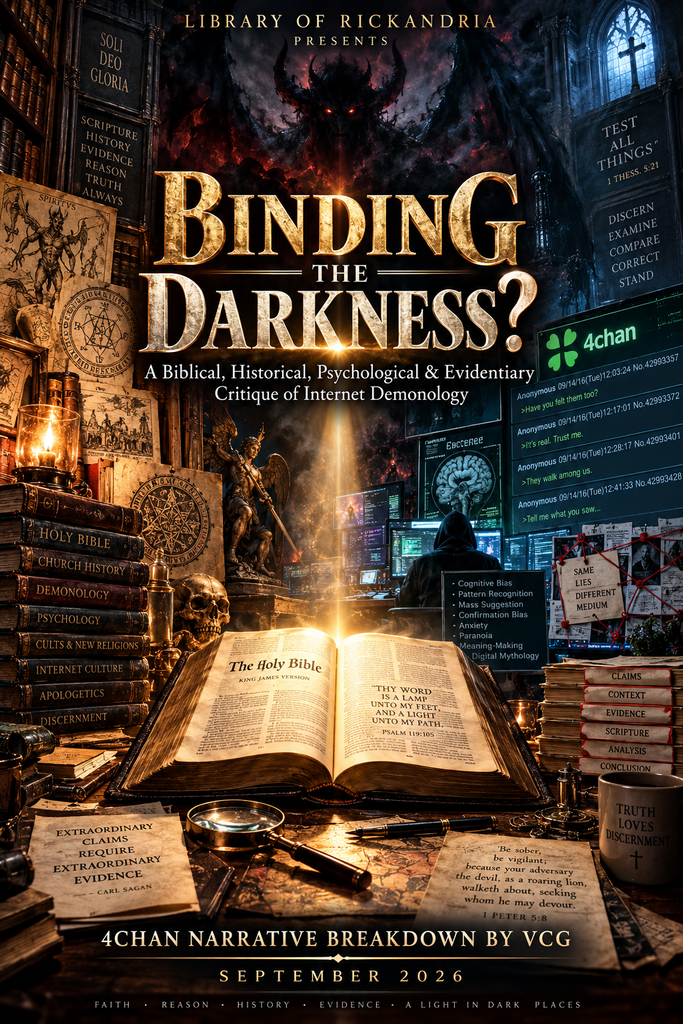
UPDATED BY VCG ON 9/22/2026 @ 18:18 EST
Anyone can do this, but most won’t.
ChatGPT – Library of Rickandria
/x/ – Enslaving Demons – Paranormal – 4chan
LIBRARY OF RICKANDRIA PRESENTS
Binding the Darkness?
A Biblical, Historical, Psychological & Evidentiary Critique of Internet Demonology
4CHAN NARRATIVE BREAKDOWN BY VCG
SEPTEMBER 2026
Research note
This paper examines a public anonymous imageboard thread as an argument, not as a clinical record of its participants. It distinguishes what the thread reports from what can be historically documented, empirically tested, psychologically modeled, legally established, or derived from the biblical text. It does not diagnose anonymous posters, and it does not treat psychological explanations as proof that spiritual realities are impossible.
Abstract
This paper examines a September 22, 2026 thread on 4chan’s /x/ board in which an anonymous poster moves from a disturbing dream to a proposal for enslaving demons, coercing them for technological knowledge, and potentially controlling human beings believed to be possessed.
/x/ – Enslaving Demons – Paranormal – 4chan
Replies then introduce:
- Solomonic magic
- exorcism
- “mind control”
- occult lore
- mockery
- unrelated dreams
- political memes
Rather than answering the thread with either credulity or ridicule, this study separates five different questions that are often collapsed online:
- what the biblical text says
- what historical manuscripts and traditions actually establish
- what empirical evidence can and cannot show
- what psychological research can explain
- what legal and ethical limits apply to conduct toward human beings
The historical record confirms a substantial post-biblical Solomonic magical tradition, but the surviving Testament of Solomon and Key of Solomon traditions are many centuries later than the biblical king and do not establish Solomonic authorship or supernatural efficacy.
The New Testament, read on its own terms, depicts authority over unclean spirits primarily as:
- expulsion
- resistance
- liberation
- refusal of fellowship
—not as occult recruitment, interrogation, or forced service.
Psychological research supplies ordinary mechanisms relevant to:
- dream incorporation
- confirmation bias
- pattern perception
- dehumanization
- moral disengagement
- online disinhibition
but none of those mechanisms can by themselves adjudicate theological claims about spiritual beings.
The paper concludes that the thread’s central failure is methodological before it is merely doctrinal:
- anecdote becomes ontology
- ontology becomes a detailed hierarchy
- speculative hierarchy becomes an ethical permission structure
and an unverified spiritual label becomes a rationale for treating human persons as instruments.
Executive Summary
The thread’s starting datum is a reported dream.
The dream is evidence that the poster reports an experience; it is not, by itself, evidence of the external cause of that experience.
A real historical tradition connects Solomon with:
- rings
- seals
- demons
- magical books
The important qualification is chronological: surviving Solomonic magical texts are late antique, medieval, and early-modern witnesses, not autographs from Solomon’s reign.
Canonical 1 Kings does not present Solomon’s later involvement with foreign cults as privileged occult wisdom.
It presents his turn after other gods as disobedience and says that:
“the LORD was angry with Solomon” (1 Kings 11:9, KJV)
The New Testament repeatedly presents unclean spirits as beings to be:
- silenced
- expelled
- resisted
or avoided.
- Mark 1
- Acts 16
- Acts 19
- James 4
- Ephesians 6
- 1 Corinthians 10
do not supply a model of Christian demon enslavement.
The name of Jesus is not portrayed as an occult password detached from allegiance to Jesus.
Acts 19’s sons of Sceva are the clearest narrative warning against treating the name as a manipulable formula.
The proposal to enslave human beings believed to be possessed crosses from speculative demonology into a human-rights and legal problem.
A spiritual diagnosis creates no legal exception to prohibitions on:
- forced labor
- restraint
- kidnapping
or assault.
The label “Satanist” cannot function as a possession diagnosis.
Major modern Satanist organizations explicitly describe themselves as non-theistic, while possession-like experiences in clinical literature require culturally sensitive differential assessment.
Psychological concepts are useful here only when used modestly.
- Dream incorporation
- confirmation bias
- illusory pattern perception
- moral disengagement
- dehumanization
and online disinhibition can illuminate reasoning patterns; they do not prove that spiritual beings do not exist, nor do they license diagnosis of anonymous individuals.
The thread’s most revealing movement is an escalation of inference:
dream → demon ontology → ranked demon knowledge → technological secrets → possession taxonomy → human enslavement → secrecy from law.
Each arrow adds a new claim that requires new evidence.
The most stable biblical counter-pattern is Ephesians 6:
the conflict is:
“not against flesh and blood,”
and the prescribed equipment is:
- truth
- righteousness
- the gospel of peace
- faith
- salvation
- the word of God
- prayer
- watchfulness
| Central thesis |
| The thread confuses Christian authority over evil with occult instrumentalization of evil. Historically, the Solomonic tradition is real as a tradition; biblically, the proposed practice is not taught; empirically, the technological and possession claims are unsupported; psychologically, the argument illustrates how vivid experience can be elaborated into a self-sealing system; ethically and legally, no spiritual theory removes the personhood or rights of another human being. |
Source and Citation Conventions
Scripture quotations are from the user-supplied King James Version, Pure Cambridge Edition.
Biblical references are therefore treated as primary textual evidence for what that edition says, not as laboratory evidence for supernatural causation.
Thread posts are identified by 4chan post number.
- Historical claims are cited to manuscript catalogues or scholarship
- psychological claims to peer-reviewed literature where available
- legal claims to constitutional or statutory sources
URLs and full publication data appear in the bibliography.
Because anonymous imageboards mix:
- sincerity
- irony
- provocation
- role-play
- trolling
this paper analyzes the words and arguments visible in the thread.
It does not claim to know what any poster privately believed.
Contents
1. Entering the Thread: What We Are Actually Looking At
2. Method: Five Kinds of Questions and an Evidence Scale
3. Canonical Demonology Before Occult Demonology
4. Dreams and the Problem of Revelation
5. Solomon: Canon, Legend, and the Solomonic Magical Tradition
6. “In the Name of Jesus”: Authority Is Not Magical Technique
7. Hidden Technology, Demon Hierarchies, and the Burden of Proof
8. From “Satanist” to “Possessed Vessel”: The Dehumanization Problem
9. Law and Ethics: Spiritual Labels Do Not Suspend Human Rights
10. Walking Through the Replies
11. Psychology Without Armchair Diagnosis
12. “Religion Is Mind Control Exhibit A”: What the Quoted Source Actually Says
13. Power Fascination, Occult Consumerism, and Christian Discipleship
14. What Scripture Does Not Teach
15. The Strongest Historical Case for Solomonic Magic—and Its Limits
16. Master Chronology
17. Master Claim Matrix
18. Conclusion
Appendix A. Annotated Thread Transcript
Appendix B. Glossary
Appendix C. Evidence Rubric
Bibliography
1. Entering the Thread: What We Are Actually Looking At
The thread is easy to dismiss because its premise is extreme.
That would also be a mistake.
Extreme claims are often useful test cases because they force us to notice where different kinds of evidence are being blended together.
Here,
- a dream becomes the opening for a question about demons
- demonology becomes a question about technological intelligence
- technological intelligence becomes a rationale for coercion
and coercion eventually reaches actual human beings whom the poster imagines may be permanently possessed.
The thread therefore gives us more than an odd corner of internet culture.
It gives us a compact example of how a narrative can accumulate certainty faster than it accumulates evidence.
The original poster, No. 42993357, reports a dream in which an older couple allowed a demon into a house through foolish behavior.
From there, the poster asks whether demons can be enslaved:
“in the name of Jesus Christ,”
forced to disclose technological secrets under torture, sorted by levels of mathematical or scientific knowledge, and used as labor.
The most serious extension is the suggestion that a human being believed to be permanently possessed might be controlled through the alleged demon within, with secrecy proposed as a way around American laws against slavery (4chan, No. 42993357, 22 Sept. 2026).
The replies do not settle into one worldview.
One poster redirects the discussion toward Solomonic magic and recommends the Testament and Keys of Solomon.
Another warns that demons should be exorcised rather than manipulated.
Another equates religion with mind control after quoting an Orthodox Christian essay.
Several replies are sarcasm or insult.
Others tell unrelated dreams.
A political meme is dropped into the thread.
The result is a typical imageboard collage:
fragments of:
- history
- theology
- personal experience
- humor
- occult lore
- hostility
and genuine questions sitting side by side.
| A note about intent |
| Nothing in the archive lets us determine whether the original post was sincere, trolling, role-play, provocation, or some mixture. The argument can still be evaluated. Our object of study is the reasoning made public in the thread, not a hidden psychological profile of its author. |
1.1 Why not simply call it nonsense?
Because some of its building blocks are real.
The Bible really does contain accounts of unclean spirits and exorcism.
A substantial Solomonic magical literature really does survive.
Some occult texts really do claim that spirits can be constrained and questioned.
Religious conversion really is studied by psychologists and sociologists.
Possession-like states really do appear in clinical and anthropological literature.
If we deny those facts because the thread’s conclusion is objectionable, we weaken the rebuttal.
The more careful approach is to grant each premise exactly as much as the evidence warrants.
A manuscript can establish that a tradition existed.
It cannot, by itself, establish that the tradition’s supernatural claims worked.
A dream establishes a reported experience.
It does not, by itself, identify the cause.
A biblical passage establishes what the biblical text presents or commands.
It is not a psychiatric diagnostic manual.
A psychological mechanism can offer an ordinary explanation.
It cannot, by itself, prove a theological negative.
2. Method: Five Kinds of Questions and an Evidence Scale
The thread repeatedly answers one kind of question with evidence belonging to another.
To avoid repeating that error, this paper uses five separate lanes of analysis.
They can interact, but they are not interchangeable.
| Lane | Question | What counts as evidence? |
| Scripture / interpretation | What does the biblical text say or not say? | The supplied KJV text, read in literary and canonical context. |
| History | What documents, traditions, manuscripts, or events can be dated and located? | Manuscripts, catalogues, critical scholarship, provenance, textual history. |
| Empirical / scientific | What observable causal claims have been demonstrated? | Replicable observations, controlled studies, carefully documented cases. |
| Psychology / cognition | What ordinary mechanisms may shape perception, inference, memory, or moral reasoning? | Peer-reviewed psychological and clinical research; used as models, not diagnoses. |
| Law / ethics | What conduct toward actual people is permitted or prohibited? | Constitutional text, statutes, case law, human-rights principles, and ethical reasoning. |
2.1 Claim classification
Each major statement in the thread can also be classified by what sort of claim it is.
This matters because a claim about manuscript history should not be proved with a Bible verse, and a theological claim should not be dismissed merely because a laboratory study has not tested it.
Biblical claim — an assertion about what Scripture teaches, commands, permits, or depicts.
Historical claim — an assertion about texts, people, dates, provenance, movements, or events.
Empirical claim — an assertion about observable causal processes in the world.
Psychological claim — an assertion about cognition, perception, motivation, or behavior.
Legal claim — an assertion about legal status, criminal liability, rights, or prohibitions.
Occult-tradition claim — a statement made within magical or esoteric literature that may be historically documentable without being empirically verified.
Speculation — a possibility proposed without adequate evidence.
Rhetoric — mockery, insinuation, slogan, identity-labeling, or persuasion that does not independently establish a factual proposition.
Testimony — a first-person report that establishes what the speaker says happened to them, while leaving causal interpretation open.
2.2 Evidence-strength scale
The A–F scale below is not a score for people, religions, or political positions.
It is a shorthand for how strongly a particular claim is supported by the kind of evidence appropriate to that claim.
| Grade | Meaning | Example in this paper |
| A | Primary or directly documented | The live thread contains No. 42993357; Acts 19 contains the sons of Sceva narrative; Penn holds Ms. Codex 1673. |
| B | Strongly supported by relevant secondary evidence | Modern scholarship dates and analyzes Solomonic textual traditions; peer-reviewed studies document dream incorporation. |
| C | Plausible but not established | A particular dream may reflect recent emotional concerns; an anonymous post may be sincere rather than trolling. |
| D | Anecdotal / testimonial | A person reports a dream, conversion experience, possession experience, or occult result without independent corroboration. |
| E | Unsupported or highly speculative | Demons are assigned advanced mathematics according to rank; “repto/hotblood” is treated as a biological taxonomy without evidence. |
| F | Contradicted by the cited evidence or by a clear primary source | Treating canonical 1 Kings as though it praises Solomon’s turn to foreign gods; claiming U.S. slavery law can be bypassed merely by secrecy. |
2.3 Levels of conclusion
Throughout the paper, wording is deliberately calibrated:
“Scripture explicitly states…”
when the proposition is in the text.
“The text strongly suggests…”
when interpretation is involved but the inference is close.
“Christian traditions differ…”
when the canonical text does not settle later ecclesial procedure.
“Historical evidence establishes…”
when documents or events can be demonstrated.
“Historical evidence does not establish…”
when a real tradition is being asked to carry more weight than it can bear.
“Psychology provides a plausible ordinary mechanism…”
when research is relevant but not case-diagnostic.
“Empirical evidence is insufficient…”
when the claim has not been demonstrated by the sources available.
“We cannot tell from the thread…”
when anonymity or missing evidence blocks a responsible conclusion.
| Methodological rule |
| Text existence is not event historicity. Attribution is not authorship. Experience is not cause. Detail is not evidence. A label is not a diagnosis. And a theological claim cannot be converted into permission to harm a human being. |
3. Canonical Demonology Before Occult Demonology
Before asking whether a Christian can “bind,” recruit, question, or employ demons, we need a control sample:
what does the canonical text actually depict when human beings encounter evil spirits?
This is not yet an argument about whether a modern event is demonic.
It is a textual question.
If the proposed practice is being justified:
“in the name of Jesus Christ,”
the first comparison should be with the patterns attached to Jesus and his followers in the New Testament.
3.1 Jesus: authority expressed as silencing and expulsion
Mark 1 provides a compact pattern.
An unclean spirit correctly identifies Jesus as:
“the Holy One of God.”
Jesus does not exploit the spirit’s knowledge.
He answers,
“Hold thy peace, and come out of him” (Mark 1:25, KJV)
The crowd then describes Jesus as one who commands unclean spirits with authority, and later the chapter says he:
“suffered not the devils to speak, because they knew him” (Mark 1:34)
SCRIPTURE
The text presents spiritual authority, but the action is removal and silencing.
It does not depict Jesus retaining the spirit as an intelligence asset, compelling technical disclosures, or turning it into a servant.
This distinction matters because the thread’s central move is not merely:
“Christ has authority over demons.”
The New Testament supports that proposition within its own narrative.
The additional move is: therefore a Christian may convert that authority into occult ownership and labor.
The second proposition needs its own textual support.
The thread does not supply it.
3.2 Luke 10: power is real in the story, but fascination with power is redirected
When the seventy return rejoicing that:
“even the devils are subject unto us through thy name,”
Jesus does not deny their report.
Yet he redirects their joy:
“Notwithstanding in this rejoice not, that the spirits are subject unto you; but rather rejoice, because your names are written in heaven” (Luke 10:17–20, KJV)
INTERPRETATION
Luke 10 does not deny authority over hostile spirits.
It does, however, resist making spiritual subjection the center of Christian identity.
CHRISTIANITY – Library of Rickandria
That is a striking contrast with a thread organized around:
- mastery
- rank
- secret knowledge
- control
3.3 James and Paul: resistance, separation, and armor
James gives a different but equally simple pattern:
“Submit yourselves therefore to God.
Resist the devil, and he will flee from you” (James 4:7)
Paul, writing about pagan sacrificial participation, tells the Corinthians,
“I would not that ye should have fellowship with devils” (1 Corinthians 10:20)
Neither passage imagines a morally acceptable middle category called forced fellowship:
a demon is still being made part of one’s project.
Ephesians 6 is the New Testament’s most famous spiritual-warfare passage.
The opponent is described in spiritual terms—
“principalities,”
“powers,”
“rulers of the darkness of this world,”
and
“spiritual wickedness in high places”
—but the believer’s equipment is strikingly non-occult:
- truth
- righteousness
- the gospel of peace
- faith
- salvation
- the word of God
- prayer
- watchfulness
The passage begins its list of enemies with an ethical firewall:
“For we wrestle not against flesh and blood” (Ephesians 6:12)
| Why Ephesians 6 matters for this thread |
| The original post moves from spiritual enemies toward possible control of human bodies. Paul’s formulation moves in the opposite direction: it distinguishes the spiritual conflict from treating flesh-and-blood people as the enemy. |
3.4 The possessed person is the beneficiary, not the target
Mark 5 is especially important because it contains the kind of dramatic possession narrative internet demonology often cites.
The man lives among tombs, cries out, harms himself, and is associated with “Legion.”
Yet the trajectory of the story is restoration.
After Jesus commands the unclean spirit out, the man is seen:
“sitting, and clothed, and in his right mind.”
Jesus then tells him to return to his friends and tell how the Lord:
“hath had compassion on thee” (Mark 5:15, 19)
SCRIPTURE
Even when the narrative itself explicitly identifies possession, the afflicted human remains a person to be restored.
The text never recasts him as enemy property whose body becomes available for Christian use.
3.5 Jude: even spiritual conflict is not an excuse for swagger
Jude 9 depicts Michael the archangel disputing with the devil and yet refusing a railing accusation, saying instead,
“The Lord rebuke thee.”
Whatever larger angelology one constructs from that verse, its rhetorical posture is restraint under divine authority, not bravado.
It provides a useful counterweight to internet discourse that treats unseen beings as targets for domination fantasies.
4. Dreams and the Problem of Revelation
The thread begins with a dream, and that matters because the dream is doing more work than it first appears.
It supplies emotional momentum.
A disturbing experience is followed by a chain of increasingly specific questions, and the specificity can create the feeling that the underlying world has already been established.
4.1 Scripture does not use one rule for all dreams
The Bible contains dreams and night visions that the text presents as divine communication:
- Joseph’s dreams in Genesis
- Daniel’s dream material
- Joseph the husband of Mary being warned in dreams in Matthew
and Paul’s night vision in Acts 16.
It would therefore be inaccurate to claim that biblical religion treats every dream as meaningless.
Yet Scripture also warns against treating the mere fact of dreaming as divine authentication.
Ecclesiastes observes,
“For a dream cometh through the multitude of business” (Ecclesiastes 5:3)
Jeremiah 23 is more pointed:
false prophets say
“I have dreamed, I have dreamed,”
and the chapter distinguishes the dream report from the word genuinely given by God:
“The prophet that hath a dream, let him tell a dream; and he that hath my word, let him speak my word faithfully” (Jeremiah 23:25, 28)
INTERPRETATION
The biblical principle is not:
“dreams are revelation”
or
“dreams are never revelation.”
It is that a dream does not authenticate itself.
Its significance must be tested rather than assumed.
4.2 What modern dream research adds—and what it does not
Sleep research gives us an ordinary mechanism that must be considered before assigning an external supernatural cause.
Eichenlaub and colleagues found that personally significant waking experiences can be incorporated into later REM dream reports, with timing effects across subsequent nights.
Other work has likewise examined how recent waking concerns enter dream and daydream content (Eichenlaub et al., 2019; van Rijn et al., 2018).
PSYCHOLOGY
These studies do not demonstrate that no dream can ever have spiritual significance.
They demonstrate that vivid, emotionally meaningful dream content can arise through ordinary memory and concern-processing.
That makes vividness insufficient as a discriminator of supernatural origin.
The thread itself accidentally supplies a control case.
Another poster reports a dream mixing Metal Gear Solid imagery with anime-style powers; a later poster reports a benign utopian dream involving the rescue of a rabbit.
If the first dream receives a metaphysical interpretation while the pop-culture and rabbit dreams are treated as ordinary dream production, the reader should ask what independent criterion distinguishes them.
Without such a criterion, interpretation risks becoming selective.
5. Solomon: Canon, Legend, and the Solomonic Magical Tradition
The reply that tells the original poster to investigate “Solomonic magic” is not inventing an entire literary world.
There really is a large and complicated tradition in which Solomon becomes a master of:
- spirits
- seals
- names
- rings
- magical procedures
The important task is to separate the existence of that tradition from the historical claims later texts make about their own origins.
5.1 Canonical Solomon
In 1 Kings, Solomon is renowned for:
- wisdom
- wealth
- royal administration
- the temple
The same narrative later records his religious failure.
His foreign wives turn his heart after other gods; he builds high places associated with foreign deities; and the narrator concludes,
“Solomon did evil in the sight of the LORD”
and that
“the LORD was angry with Solomon” (1 Kings 11:6, 9)
SCRIPTURE
Whatever later traditions say about Solomon commanding spirits, 1 Kings does not present his turn toward other gods as the mature flowering of God-given wisdom.
It presents it as covenantal disobedience.
5.2 The Testament of Solomon
The Testament of Solomon is a genuine ancient/late-antique pseudepigraphal tradition in which Solomon exercises power over demons in connection with the building of the temple.
But its textual history is not that of a single pristine book copied unchanged from Israel’s united monarchy.
Sarah Schwarz’s textual study argues that what modern editions call the Testament reflects a body of Greek materials, with components circulating independently and fuller forms developing much later.
James Davila’s review of the textual evidence notes that the earliest surviving fragment is a fifth- or sixth-century C.E. papyrus witness to material related to chapter 18, and that this material may itself have circulated independently (Schwarz 2007; Davila 2008).
Michael Beshay’s study places the work’s development within late antique and Byzantine cultural settings, again underscoring that the received forms belong to a world far removed from the tenth century B.C.E. traditionally associated with Solomon (Beshay 2021).
That chronological distance does not make the text worthless.
It changes the question.
The Testament is excellent evidence for the history of traditions about Solomon.
It is not a contemporary court record from Solomon’s reign.
5.3 The Key and Lesser Key traditions
The University of Pennsylvania catalogue describes Ms. Codex 1673, a Clavicula Salomonis Regis, as an eighteenth-century Latin copy of a magical handbook whose Key of Solomon tradition is generally placed in the fourteenth or fifteenth century.
The Folger Shakespeare Library describes the Lesser Key of Solomon as a seventeenth-century compilation assembled from earlier materials.
A 2026 Harvard Theological Review study of a recently identified Hebrew Clavicula witness notes the large manuscript and print network that developed under the title and the substantial variation among texts.
HISTORY
The documentary conclusion is strong:
Solomonic magical literature is real, widespread, and historically important.
The authorship conclusion is much weaker:
the title “of Solomon” is a traditional attribution, not proof that the biblical king wrote the surviving works.
5.4 Pseudepigraphy: why famous names travel
Pseudepigraphy is the attribution of a work to an authoritative figure who is not necessarily its historical author.
Ancient Jewish and Christian literature contains works attributed to figures such as:
- Enoch
- Abraham
- Moses
- Ezra
- the patriarchs
- apostles
The practice can serve many purposes:
locating a text within an inherited authority structure, giving teaching a narrative voice, or transmitting material under a revered name.
The existence of pseudepigraphy does not imply that every anonymous or attributed text was produced with the same intent, and the modern word “forgery” can oversimplify ancient literary conventions.
For the present argument, the modest point is enough:
a title bearing Solomon’s name is evidence of Solomonic attribution.
Authorship requires additional evidence.
This is exactly the distinction the thread skips.
6. “In the Name of Jesus”: Authority Is Not Magical Technique
The thread tries to solve the legitimacy problem by adding a Christian authorization phrase:
could the operation be done:
“in the name of Jesus Christ”?
The New Testament certainly attaches power and authority to Jesus’ name.
But it does not treat the name as a spiritually powerful sound sequence that can be detached from faith, mission, and allegiance.
6.1 Acts 19: the sharpest case study
Acts 19 describes itinerant Jewish exorcists who attempt to use the name of Jesus in a formula:
“We adjure you by Jesus whom Paul preacheth.”
The evil spirit answers,
“Jesus I know, and Paul I know; but who are ye?”
The attempted exorcism ends with the men fleeing wounded.
The narrative then turns to people who had practiced “curious arts,” who confess their deeds and burn their books (Acts 19:13–20).
INTERPRETATION
Acts does not present Christianity as a superior brand of magic that makes older spirit-management technology finally work.
The narrative direction is from magical technique toward the lordship of Christ and abandonment of the former practices.
6.2 Acts 3: power is not owned by the operator
Acts 3 gives a complementary warning.
After a healing in Jesus’ name, Peter asks why the crowd looks at him and John:
“as though by our own power or holiness we had made this man to walk.”
He redirects the event away from personal possession of spiritual technology and toward God and faith in Christ (Acts 3:12–16).
6.3 Truth-telling spirits are still expelled
The original poster’s plan assumes that if a hostile spirit possesses useful information, extracting that information is desirable.
Mark 1 and Acts 16 complicate that assumption.
In Mark 1 an unclean spirit identifies Jesus correctly and is silenced.
In Acts 16 a damsel with a spirit of divination follows Paul and announces that Paul and his companions are servants of the most high God who show the way of salvation.
Paul does not recruit the spirit as a truthful herald.
He commands it to come out of her (Acts 16:16–18).
| A key distinction |
| Accurate content does not automatically legitimate a source. In the New Testament narratives, evil spirits may say something true, yet the apostolic response is still expulsion rather than cultivation of the relationship. |
7. Hidden Technology, Demon Hierarchies, and the Burden of Proof
The thread’s most imaginative move is the suggestion that demons may possess advanced mathematical and scientific knowledge, perhaps distributed by rank.
This claim has a recognizable ancestry in occult literature, where spirits are often assigned:
- offices
- arts
- sciences
- treasures
- languages
or specialized powers.
Historically, that is worth noting.
Empirically, however, it does not move the claim very far.
A grimoire that says a spirit teaches astronomy is primary evidence that the text attributes astronomy to the spirit.
It is not independent evidence that a nonhuman intelligence actually transmitted correct astronomical knowledge.
The distinction is the same one historians use everywhere else:
a source can document a belief without verifying the event the belief describes.
7.1 The hierarchy becomes more detailed than the evidence
The original post asks whether only more powerful demons are taught advanced mathematics and science.
Notice the grammar:
a hypothetical world has already acquired an educational system.
We now have:
- ranks
- knowledge allocation
- technical specialties
and something like security clearance.
None of that architecture has been established by the dream, by Scripture, or by an empirical demonstration.
METHODOLOGY
Specificity can create an illusion of explanatory depth.
A detailed model may feel informative even when every detail was introduced by the model itself. Precision is not the same thing as evidence.
7.2 What would evidence look like?
If the claim is technological rather than purely theological, it becomes testable in principle.
The strongest evidence would not be a spirit name, ritual impression, or private prediction.
It would be information that is specific, novel, independently verifiable, not reasonably obtainable by ordinary means, and reproducible under conditions that rule out:
- cueing
- fraud
- selective memory
and post hoc reinterpretation.
The thread provides nothing of that kind. It moves directly from possibility to operational planning.
7.3 The self-sealing problem
Occult and conspiratorial systems can become difficult to test when every outcome is assigned an explanation that protects the central claim.
- A spirit’s silence can be called resistance
- contradiction can be called deception
- failure can be blamed on ritual error
- an apparent success can be counted as confirmation
When a hypothesis can absorb:
- success
- failure
- silence
- contradiction
equally well, its empirical content becomes thin.
This is the problem of unfalsifiability—not proof that the belief is false, but a warning that the proposed method may be unable to distinguish truth from reinterpretation.
8. From “Satanist” to “Possessed Vessel”: The Dehumanization Problem
The thread becomes ethically serious when the original poster asks whether people described as:
“permanently possessed satanists”
could be enslaved by controlling the alleged demon inside them.
The problem is not only the proposed act.
The argument has silently compressed several categories into one.
| Step | Unproven inference |
| 1 | A person calls himself or is called a Satanist. |
| 2 | Therefore the person literally worships or believes in a supernatural Satan. |
| 3 | Therefore the person is demonically possessed. |
| 4 | Therefore the possession is permanent and total. |
| 5 | Therefore the person’s agency or personhood has effectively disappeared. |
| 6 | Therefore controlling the alleged demon morally licenses control of the human body. |
Each transition requires evidence.
The thread supplies none.
Worse, the later transitions are ethically dangerous because they convert an unverified spiritual classification into a reason to withdraw ordinary moral protections from a person.
8.1 “Satanist” is not a possession diagnosis
The term Satanist covers different movements and individuals.
Two prominent modern organizations illustrate why the word cannot be used as a diagnostic shortcut.
The Church of Satan’s own FAQ describes its Satanism as non-theistic and treats Satan as symbolic rather than as a supernatural deity.
The Satanic Temple likewise explicitly says that it does not believe in a literal Satan or the supernatural.
Those organizations do not exhaust every form of Satanism; theistic Satanists and other occult subcultures exist.
The narrower conclusion is sufficient:
self-identifying as a Satanist does not establish literal Satan belief, much less possession.
8.2 Possession-like experiences in clinical literature
Clinical and transcultural psychiatry has long encountered trance and possession presentations.
A critical review of dissociative trance and possession disorders surveyed hundreds of reported cases and emphasized multiple explanatory models, while Bhavsar, Ventriglio, and Bhugra stress that possession experiences must be understood within cultural context and careful differential assessment (During et al., 2011; Bhavsar et al., 2016).
Such presentations can overlap with:
- dissociative phenomena
- trauma
- culturally sanctioned ritual states
- psychosis-spectrum symptoms
- neurological conditions
or other forms of distress.
METHODOLOGY
Clinical literature cannot settle a theological claim that demons exist or do not exist.
Its relevance is narrower and practical:
unusual behavior or a possession interpretation is not enough to justify a confident diagnosis, especially by strangers on the internet.
8.3 Dehumanization as a reasoning hazard
Nick Haslam’s influential review distinguishes forms of dehumanization in which people are represented as less fully human, including mechanistic depictions that treat persons as objects, automata, or instruments (Haslam 2006).
The thread’s phraseology creates exactly the ethical risk that concept helps us notice:
once the person is redescribed primarily as a container for an enemy agent, coercion can be imagined as action against the demon rather than harm to the human.
Albert Bandura’s work on moral disengagement is also relevant.
He describes mechanisms by which harmful conduct can be cognitively reconstructed as serving a worthy purpose, harmful consequences minimized, responsibility displaced, or victims dehumanized (Bandura 2002).
Again, this does not diagnose the anonymous poster.
It identifies a known moral-reasoning pattern that resembles the structure of the proposal:
cruelty is reframed as a tool for obtaining knowledge or serving “good.”
| Biblical counter-picture |
| Mark 5 does not treat the possessed man as a disposable vessel. The story’s human endpoint is restoration: clothed, in his right mind, returned to friends, and described as a recipient of compassion. |
9. Law and Ethics: Spiritual Labels Do Not Suspend Human Rights
The original post explicitly recognizes that slavery is illegal in the United States and suggests discretion.
That sentence is important because it shifts the problem from fantasy toward contemplated conduct.
Whatever theological explanation a person gives for another human being, the law still sees a human being.
9.1 Constitutional and federal law
The Thirteenth Amendment provides that neither slavery nor involuntary servitude shall exist in the United States, except as punishment for crime after due conviction.
Federal criminal law separately prohibits knowingly and willfully holding a person in involuntary servitude (18 U.S.C. § 1584) and prohibits obtaining labor through:
- force
- threats
- restraint
- serious harm
- abuse of law
or related coercive schemes (18 U.S.C. § 1589).
The statutes carry severe penalties, with enhanced punishment in aggravated circumstances.
LEGAL
Secrecy does not create an exception.
Nor does a private belief that a person is possessed convert coercive control into control of a nonhuman entity.
- Kidnapping
- restraint
- assault
- forced labor
or other coercion remains conduct toward a human person.
9.2 Ethical asymmetry
There is also a methodological asymmetry worth stating plainly.
Suppose a person is correct about a spiritual diagnosis.
The New Testament model still points toward liberation and compassion.
Suppose the person is wrong.
Then coercive action would be directed at an innocent human being on the basis of a false supernatural attribution.
A system that authorizes severe harm under conditions where error is difficult to detect is ethically unstable.
This is one reason Ephesians 6:12 deserves to remain visible throughout the paper.
Even within a worldview that affirms spiritual enemies, Paul’s formulation refuses to collapse those enemies into
“flesh and blood.”
10. Walking Through the Replies
The thread’s replies are worth reading in sequence because they show several different ways people try to repair, redirect, or intensify the original premise.
Some replies contain useful distinctions.
Others simply replace one unsupported claim with another.
A few are nothing more than mockery.
This section follows the visible thread in order.
10.1 No. 42993410: “Satanists don’t get possessed” and the turn to Solomonic magic
The first substantial reply correctly separates two categories that the original post had collapsed:
a Satanist and a demoniac are not synonyms.
That is an important correction.
The reply immediately overstates its case, however, by making a universal assertion that Satanists do not become possessed.
Neither the thread nor the reply supplies evidence for that universal metaphysical claim.
BEST-SUPPORTED CORRECTION
Religious identity does not establish possession.
The reverse universal claim—that a religious identity makes possession impossible—is also more than the available evidence can show.
The reply then proposes what it regards as a more efficient model:
bind a demon, let it depart, and call it back when needed.
It recommends the Testament of Solomon and the Keys of Solomon.
Historically, that recommendation points toward a real textual tradition.
The problem is evidentiary and theological:
the existence of the tradition does not verify its spirit-management claims, and the canonical New Testament pattern remains resistance, expulsion, and refusal of fellowship.
The reply also expresses doubt that demons would yield modern technology.
That caution is sensible as an evidentiary judgment:
no supporting data has been supplied.
But the reply still assumes the underlying possibility of reliable spirit binding without demonstrating it.
10.2 No. 42993540: marriage, “repto,” and “hotblood”
The next reply says slavery survives as a one-slave-per-master arrangement disguised as marriage and then introduces “repto” and “hotblood” categories.
The marriage claim is a rhetorical analogy, not a legal definition.
The biological or species-like terminology is presented without citation, operational definition, or recognized taxonomy.
EVIDENCE
The thread itself provides no source by which “repto” and “hotblood” could be tested as scientific classifications.
Without independent definitions and evidence, they remain idiosyncratic labels rather than established categories.
Biblically, the marriage-as-slavery slogan also fails to describe the full New Testament ethic.
Ephesians 5 tells husbands to love their wives as Christ loved the church and gave himself for it, and to love their wives as their own bodies.
Readers may debate household codes and historical patriarchy, but:
“marriage is one slave per master”
is not a careful summary of the passage.
10.3 No. 42993546: do not try to outwit demons
This reply is the closest thing the thread offers to a sustained Christian caution.
It warns against trying to outwit demons, recommends exorcism or banishment rather than manipulation, suggests experienced clergy, and argues that evil means corrupt the desired end. Its biblical instincts are considerably closer to:
- Mark 1
- James 4
- 1 Corinthians 10
- Jude 1:9
than the original proposal.
One qualification is necessary.
“Preferably by a priest”
is an ecclesial and denominational judgment, not a universal rule stated in the New Testament.
Christian traditions differ sharply over exorcistic authority, ordained ministry, charismatic gifts, and formal rites.
The textual point is narrower:
expulsion and resistance are canonical patterns; the modern procedure for applying those texts is a later church question.
The same reply asks whether demons can be “truly killed.”
Scripture does not give believers a demon-killing procedure.
New Testament eschatological texts place final judgment of the devil and his angels under divine judgment.
That does not answer every metaphysical question about spiritual beings, but it does mean the proposed Christian technique is absent from the text.
10.4 No. 42993556: “Religion is mind control exhibit A”
The poster quotes a genuine anecdote from Fr. Stephen Freeman’s essay “A Noetic Life,” in which a woman who did not initially believe in God nevertheless attended church repeatedly and eventually described an experiential change while looking at an icon of Christ.
Freeman connects the story with Vladimir Lossky’s phrase:
“participatory adherence.”
The quotation is therefore anchored in a real source, not fabricated.
The conclusion added by the 4chan poster—
“Religion is mind control exhibit A”
—does not follow simply from the anecdote.
The story documents repeated participation followed by conversion.
It does not isolate:
- coercion
- hypnosis
- neurological manipulation
- deception
or loss of agency as the cause.
In fact, Freeman’s surrounding essay says the noetic life is not a technique in the mechanical sense and warns against expecting an automatic result (Freeman 2021/2024 mirror).
Research on religious conversion is correspondingly broader.
Paloutzian’s psychological treatment emphasizes variation in:
- motivation
- speed
- social context
- meaning systems
- relationships
- cognition
Scholarship on so-called brainwashing in new religious movements has repeatedly challenged strong models of involuntary conversion as a general explanation (Paloutzian 2014; Anthony & Robbins 2009; Cowan 2014; Lewis 2016).
That does not imply that religious groups never manipulate people.
It means a single conversion anecdote cannot establish the universal category:
“religion = mind control.”
10.5 Nos. 42993831, 42994035, and 42994054: sarcasm replaces argument
Several replies become personal and sarcastic.
Their social function may be obvious—mocking the previous poster, signaling group membership, escalating the tone—but they add little to the truth question.
An insult cannot establish that an occult claim is false, just as a solemn tone cannot establish that it is true.
METHODOLOGY
When argument collapses into identity attack, the correct response is not to choose the better insult.
It is to return to the premise under dispute and ask what evidence would establish it.
10.6 No. 42993990 and No. 42995279: the other dreams
One poster reports a dream assembled from recognizable video-game and anime material.
Another reports an idyllic dream involving saving a rabbit.
Neither anecdote proves anything about the supernatural.
Together, however, they highlight the problem of selective interpretation.
Human dream production can combine recent, emotionally salient, or culturally familiar material into vivid scenes.
The demon dream therefore needs an independent authentication criterion if it is to bear greater ontological weight than the pop-culture or rabbit dreams.
10.7 No. 42993993: “Go back to school”
This is an ad hominem dismissal.
The thread does contain serious evidentiary failures, but intelligence, education, or social status is not the decisive issue.
A much stronger rebuttal identifies the specific transitions that have not been justified:
- dream to external entity
- entity to hierarchy
- hierarchy to technology
- ideology to possession
- possession to loss of personhood
and secrecy to legality.
10.8 No. 42995308: the Thomas Massie / Mike Johnson meme
A late reply drops an image captioned as Thomas Massie confronting Speaker Mike Johnson in the Library of Congress in 2026.
This is peripheral to demonology, but it provides a useful miniature fact-checking exercise.
Contemporary reporting confirms a real September 16, 2026 dispute:
Massie used a point of personal privilege for a lengthy House-floor speech criticizing Johnson and the House calendar, and reporters described an ongoing feud over the early recess and delayed votes (Axios, 16 Sept. 2026; Roll Call, 16 Sept. 2026; Associated Press, 16 Sept. 2026).
HISTORY / CURRENT EVENTS
The reliable sources retrieved place the confrontation and speech on the House floor and at the Capitol; they do not substantiate the specific “Library of Congress” caption.
The responsible conclusion is therefore not:
“the entire meme is fabricated,”
but
“a real dispute has been paired with an unverified or misattributed location claim.”
10.9 No. 42995362: “good goy”
The phrase contributes no evidence to the demonology question.
In internet contexts it can function as an ethnic or religious taunt, often carrying an insinuation of manipulation.
Whatever the intended tone here, it is a rhetorical identity marker rather than an argument.
It neither supports nor refutes the preceding claims.
10.10 No. 42995422: compensation instead of slavery
The final visible reply jokes that enslavement wins no friends and suggests fair compensation, meaningful work, and a compelling reason instead.
Applied to human labor, the distinction between voluntary compensated work and slavery is fundamental.
Applied to demons, however, it simply swaps one unverified labor theory for another.
The thread still has not shown that nonhuman spirits can be contracted as workers.
For a New Testament theological analysis, Paul’s language remains simpler than either labor model:
“I would not that ye should have fellowship with devils” (1 Corinthians 10:20)
11. Psychology Without Armchair Diagnosis
Psychology can clarify this thread, but it can also be misused.
The easiest misuse would be to diagnose anonymous posters from a few paragraphs or to treat belief in demons as itself a symptom.
Neither move is warranted.
The appropriate level of analysis is the reasoning pattern visible in the text and the general cognitive mechanisms documented in research.
11.1 Confirmation bias
Raymond Nickerson’s classic review describes confirmation bias as the tendency to seek, interpret, or give greater weight to evidence in ways that favor an existing belief or hypothesis (Nickerson 1998).
In a demonological setting, this can matter when:
- frightening dreams
- coincidences
- ritual successes
- ambiguous noises
or unusual behavior are counted as confirmation while failed predictions or ordinary explanations are discounted.
The point is not that every believer selectively interprets evidence.
The point is that everyone is vulnerable to selective testing.
A serious inquiry therefore asks in advance what observation would count against a favored explanation.
11.2 Illusory pattern perception
Van Prooijen, Douglas, and De Inocencio reported associations between illusory pattern perception and both conspiracy and supernatural beliefs across several studies (van Prooijen et al. 2018).
Later signal-detection work by Müller and Hartmann found relationships between paranormal belief and response bias in pattern-detection tasks while also emphasizing that such effects explain only part of the variance (Müller & Hartmann 2023).
PSYCHOLOGY
These findings do not show that every perceived pattern is false or that supernatural beliefs are reducible to a cognitive error.
They justify a procedural caution: apparent connections should be corroborated independently before being promoted into a causal system.
11.3 Narrative escalation and explanatory overgrowth
The thread exhibits a recognizable form of explanatory overgrowth.
One datum—the dream—becomes a platform for a much larger world-model.
The useful diagnostic question for the argument is not:
“could this world exist?”
but
“which later propositions were actually supplied by the original evidence?”
Dream → external demon → controllable demon → ranked demon hierarchy → restricted scientific knowledge → technological intelligence → permanent human possession → loss of human agency → morally usable body → need for operational secrecy.
The chain is not logically impossible merely because it is long.
Its weakness is cumulative:
every arrow requires an additional premise, yet the later steps are treated as though the earlier dream already supplied them.
11.4 Moral disengagement and dehumanization
Bandura’s model is useful at the level of moral structure.
People can reframe harmful conduct as:
- serving a higher purpose
- minimize injury
- shift responsibility
or describe targets in ways that make ordinary moral restraints easier to suspend (Bandura 2002).
Haslam’s review of dehumanization similarly helps us recognize how a person can be conceptually reduced to an object, mechanism, or vessel (Haslam 2006).
The thread’s phrase:
“permanently possessed satanists”
can perform precisely this kind of conceptual compression:
a person becomes:
“a body with a demon inside,”
and the proposed coercion is then narrated as demon-management rather than harm to a human.
Calling attention to that structure is not a diagnosis.
It is an ethical check on the language being used.
11.5 Online disinhibition and the /x/ environment
John Suler’s work on the online disinhibition effect identifies features such as:
- anonymity
- invisibility
- asynchronicity
- dissociative imagination
and minimized authority that can loosen ordinary social restraints online (Suler 2004).
Anonymous imageboards intensify several of those conditions.
That helps explain why extreme hypotheses, mockery, role-play, and sincere disclosure can coexist in the same thread.
LIMITATION
Online disinhibition theory cannot tell us which particular post is sincere.
It explains why the environment makes sincerity difficult to infer.
This is why the paper evaluates the public argument and avoids claims about the private mental state of the poster.
11.6 A symmetry rule for natural and supernatural explanations
Fairness requires a symmetry rule.
A believer should not say,
“The dream was vivid, therefore a demon caused it.”
A skeptic should not say,
“Dream incorporation exists, therefore no dream could ever be spiritually significant.”
Both claims outrun their evidence.
The first confuses experience with cause; the second confuses a sufficient ordinary mechanism with proof that no other cause is possible.
| Epistemic discipline |
| A natural explanation can lower the need to posit a supernatural explanation without proving a universal metaphysical negative. A theological interpretation can be meaningful within a faith framework without becoming an empirical demonstration. |
12. “Religion Is Mind Control Exhibit A”: What the Quoted Source Actually Says
Because the “mind control” reply borrows a real text, it deserves more than dismissal.
Freeman’s essay uses an anecdote about a woman who repeatedly attends church despite initially lacking belief.
Over time she experiences a moment of recognition before an icon of Christ.
Freeman reads the episode as an example of what Vladimir Lossky called “participatory adherence”—knowledge that grows through lived participation rather than detached observation (Freeman 2021; Saint Sophia mirror 2024).
The 4chan poster treats repetition followed by conversion as proof of mind control.
That is a causal claim.
To establish it, we would need to distinguish among:
- repeated exposure
- social belonging
- ritual participation
- aesthetic experience
- intellectual reconsideration
- emotional salience
- suggestion
- coercive pressure
and many other pathways.
The anecdote does not perform that causal discrimination.
The broader conversion literature is precisely about this complexity.
Paloutzian emphasizes that conversion can be rapid or gradual and is influenced by:
- meaning systems
- cognition
- attachment
- relationships
- social context
In scholarship on new religious movements, Anthony and Robbins, Cowan, and Lewis summarize extensive criticism of strong “brainwashing” explanations that posit special techniques overriding ordinary agency as the general account of conversion.
IMPORTANT QUALIFICATION
Rejecting:
“all religion is mind control”
does not imply that:
- religious abuse
- coercive control
- undue influence
- deception
or high-demand environments do not exist.
Those are empirical questions about specific groups and practices.
The error is turning one conversion story into a universal mechanism.
13. Power Fascination, Occult Consumerism, and Christian Discipleship
A recurring theme in modern occult internet culture is cataloguing:
- names
- ranks
- seals
- offices
- correspondences
- rituals
- planetary hours
- specialized powers
- techniques
As historical material, these catalogues can be fascinating.
As spiritual practice, they can also shift attention from moral formation to technical mastery.
That contrast is especially sharp beside Luke 10.
The disciples return excited by the subjection of spirits; Jesus redirects their joy toward belonging to God.
The point is not that the reported authority was unreal within the narrative.
The point is that spiritual power is not allowed to become the center of identity.
Ephesians 6 makes the same contrast in another way.
Its spiritual warfare is demanding, but the demands are ethical and devotional:
- truth
- righteousness
- peace
- faith
- salvation
- the word of God
- prayer
- perseverance
There is:
- no demon encyclopedia
- no ring
- no seal
- no torture protocol
- no interrogation system
and no hidden-technology program.
13.1 The biblical problem of forbidden knowledge
The desire for hidden knowledge is not automatically sinful; Scripture itself praises wisdom and knowledge in many places.
The critical question is the authorized means and object.
Deuteronomy 18 tells Israel not to learn the divinatory and necromantic practices of surrounding nations, listing:
- divination
- enchantment
- witchcraft
- consultation with familiar spirits
- wizardry
- necromancy
Acts 19, in a different covenantal and historical setting, depicts converts abandoning “curious arts” rather than baptizing them into Christian use.
INTERPRETATION
The strongest biblical case is therefore not:
“all secret knowledge is evil.”
It is that Scripture places boundaries around how knowledge and power are sought, and the canonical Christian response to spirit-management practices is not to improve them by adding Jesus’ name.
14. What Scripture Does Not Teach
Arguments from silence should be used carefully.
The absence of a teaching does not prove a practice metaphysically impossible.
It does matter, however, when someone claims a distinctly Christian warrant for the practice.
Across the canonical passages examined here, the following claims are not taught as Christian practices:
| Proposed practice | Canonical finding |
| Demon slavery | No canonical instruction authorizes believers to own demons as servants. |
| Demon interrogation for technology | No passage teaches extracting mathematics, engineering, weapons, medicine, or scientific secrets from evil spirits. |
| Solomon’s occult ring as Christian precedent | The canonical Kings narrative never gives Solomon a demon-binding ring; later ring traditions belong to post-biblical literature. |
| Demon torture | The New Testament does not give believers a procedure for torturing spiritual beings to compel information. |
| Possessed humans as morally available property | Possession narratives aim at liberation or healing; they do not erase human personhood. |
| Magical circles, seals, and spirit catalogues as apostolic practice | Such techniques belong to later magical traditions, not to the apostolic instructions surveyed here. |
| Jesus’ name as a detachable formula | Acts 19 explicitly dramatizes the failure of formulaic appropriation by outsiders. |
| Fellowship with hostile spirits for a good cause | 1 Corinthians 10 warns against fellowship with devils rather than carving out a coercive exception. |
This negative inventory should be paired with the positive one:
Scripture does teach:
- submission to God
- resistance to the devil
- refusal of fellowship with devils
- testing of claims
- compassion toward afflicted people
and a spiritual armor composed of:
- truth
- righteousness
- peace
- faith
- salvation
- Scripture
- prayer
- vigilance
15. The Strongest Historical Case for Solomonic Magic—and Its Limits
A fair paper should state the strongest case on the other side.
The Solomonic magical tradition is not a modern internet invention.
Traditions associating Solomon with:
- extraordinary wisdom
- demons
- healing
- exorcistic authority
and the temple developed in Jewish and Christian antiquity and continued through:
- Byzantine
- medieval
- Renaissance
- early-modern textual networks
The Testament of Solomon is part of that world, and later Keys, Clavicula manuscripts, and related works show that the association of Solomon with spirit command was persistent and culturally influential.
Gal Sofer’s work on Solomonic magic emphasizes an evolving multilingual textual network rather than one simple book descending unchanged from antiquity.
Modern manuscript work likewise demonstrates a large and variable Clavicula tradition.
A defender of Solomonic magic can therefore reasonably say:
“This is not something 4chan invented yesterday.
It has a long documentary history.”
That claim is historically sound.
15.1 Where the historical argument stops
The historical argument becomes overextended when “long tradition” is converted into:
“authored by Solomon,”
“therefore authentic,”
“therefore supernaturally effective,”
or
“therefore Christianly permissible.”
Those are four separate questions.
Antiquity of a tradition asks how early the idea can be documented.
Authorship asks who composed a specific text or layer.
Efficacy asks whether the claimed practices produce the claimed effects.
Theological legitimacy asks whether a religious canon or tradition authorizes the practice.
The surviving evidence is strongest on the first question and progressively weaker or different in kind on the others.
The Testament’s complex textual history, the medieval dating of the Key tradition, and the early-modern compilation history of the Lesser Key all caution against treating the word “Solomon” in a title as a chain of custody back to the biblical court.
| The steelman in one sentence |
| Solomonic demon-command literature is historically real and old; that establishes a tradition about Solomon, not an autograph by Solomon, not the empirical truth of spirit conjuration, and not a canonical Christian mandate to practice it. |
16. Master Chronology
The chronology below is deliberately conservative.
It distinguishes the lifetime traditionally associated with Solomon from the dates of surviving textual witnesses.
This prevents a common internet shortcut in which all material carrying Solomon’s name is mentally collapsed into the same historical moment.
| Period | Document / development | Why it matters |
| Traditionally 10th century B.C.E. | Solomon’s reign in the biblical monarchy chronology | The historical figure to whom later magical works are attributed. |
| Biblical narrative tradition | 1 Kings 3–11; 2 Chronicles 1–9 | Solomon is famed for God-given wisdom and temple building; 1 Kings 11 condemns his later turn after other gods. |
| Late antiquity | Traditions behind the Testament of Solomon circulate and develop | Solomon becomes a demon-commanding temple builder in pseudepigraphal material. |
| 5th–6th century C.E. | Earliest surviving papyrus fragment associated with Testament of Solomon material | Shows late-antique circulation but remains more than a millennium after Solomon’s traditional era. |
| Medieval period | Fuller Testament forms and expanding Solomonic ritual traditions | Textual growth and redaction complicate claims of a single ancient original. |
| 14th–15th centuries | Key of Solomon / Clavicula tradition attested as a magical handbook tradition | Penn’s catalogue locates the handbook tradition here; surviving manuscripts vary. |
| 17th century | Lesser Key of Solomon compiled from earlier materials | A later compilation famous for cataloguing and constraining spirits. |
| 18th century | Penn Ms. Codex 1673 copied | Concrete manuscript witness to the continuing Clavicula tradition. |
| 19th–20th centuries | Occult revival, translations, ceremonial-magic publishing | Solomonic texts become increasingly accessible to modern esoteric readers. |
| 2004–2023 | Modern psychological literature used in this paper | Research on online disinhibition, dehumanization, dream incorporation, pattern perception, and related reasoning mechanisms. |
| 17 Sept. 2021 | Fr. Stephen Freeman publishes “A Noetic Life” | Later quoted in the 4chan thread as supposed evidence of religious mind control. |
| 16 Sept. 2026 | Massie–Johnson House-floor dispute reported by major news outlets | Background to a later meme posted in the thread. |
| 22 Sept. 2026 | 4chan /x/ thread No. 42993357 | The primary internet source analyzed in this paper. |
17. Master Claim Matrix
This matrix condenses the thread into claim-sized units.
The evidence grade applies to the claim as presented and to the source type appropriate to it; it is not a statement about anyone’s intelligence or sincerity.
| Claim | Type | Grade | Finding | Key basis |
| The OP reports a demon-related dream | Testimony | A | The report is documented; external cause remains open. | 4chan No. 42993357 |
| The dream establishes a demonic cause | Empirical / theological inference | E | No independent discriminator is supplied. | Dream research; Eccles. 5; Jer. 23 |
| Jesus has authority over unclean spirits in the Gospels | Biblical | A | Explicitly depicted. | Mark 1; Mark 5; Luke 10 |
| Christians may therefore enslave demons | Biblical / ethical | E | No canonical authorization found; canonical pattern is resistance/expulsion. | James 4; 1 Cor. 10; Acts 19 |
| Demons can be forced to reveal advanced technology | Empirical / occult tradition | E | Occult texts may attribute knowledge to spirits; no empirical demonstration supplied. | Thread; Solomonic literature |
| Demon rank determines mathematical/scientific education | Speculation | E | Detailed hierarchy is asserted without evidence. | Thread only |
| Satanists are permanently possessed | Religious / clinical | E | Religious identity is not a diagnostic criterion. | Official Satanist sources; clinical literature |
| Major modern Satanist organizations are non-theistic | Historical / descriptive | A | Explicit in their own official materials. | Church of Satan; Satanic Temple |
| Possession-like states occur in clinical literature | Clinical | A | Documented cross-culturally; explanations are multiple and context-sensitive. | During et al. 2011; Bhavsar et al. 2016 |
| Possession erases human personhood or legal rights | Ethical / legal | F | No such legal exception; Gospel narratives treat afflicted person as beneficiary. | 13th Amendment; 18 USC; Mark 5 |
| Secrecy makes slavery lawful | Legal | F | False; concealment does not legalize prohibited conduct. | 13th Amendment; 18 USC §§1584, 1589 |
| Solomonic magical literature exists | Historical | A | Strong documentary record. | Schwarz; Penn; Folger; Sofer |
| The surviving Keys were written by biblical Solomon | Historical authorship | E | Surviving tradition is medieval/early-modern and pseudepigraphal by attribution. | Penn; manuscript scholarship |
| 1 Kings endorses Solomon’s foreign cultic turn | Biblical | F | The narrative explicitly condemns it. | 1 Kings 11:6–10 |
| Jesus’ name functions as a magical formula | Biblical | F | Acts 19 dramatizes the failure of formulaic appropriation. | Acts 19:13–20 |
| Evil spirits can utter true propositions in NT narratives | Biblical | A | Explicitly depicted. | Mark 1; Acts 16 |
| Truthful content makes spiritual fellowship legitimate | Biblical / ethical | F | The truthful-speaking spirit is expelled; fellowship with devils is rejected. | Acts 16; 1 Cor. 10 |
| Religion is proved to be mind control by Freeman’s anecdote | Psychological | E | Anecdote cannot establish universal coercive causation. | Freeman; conversion scholarship |
| Anonymous imageboards complicate inference of sincerity | Psychological / methodological | B | Environment has features associated with online disinhibition; specific intent remains unknowable. | Suler 2004 |
| The Massie–Johnson dispute occurred in Sept. 2026 | Current-event fact | A | Widely documented. | AP; Axios; Roll Call |
| The documented confrontation occurred in the Library of Congress | Current-event location | E | Retrieved reliable reports place the major speech on the House floor; LOC location unsupported. | AP; Axios; Roll Call |
18. Conclusion: Authority Is Not Instrumentalization
The thread begins with a human experience—a disturbing dream—and ends, within a few paragraphs, at the edge of a theory that could justify coercing human beings.
That progression is what makes the thread worth examining carefully.
The problem is not simply that it talks about demons.
The Bible talks about demons.
Ancient and medieval writers talked about demons.
Historians can study demonological literature without ridicule, clinicians can study possession experiences without settling metaphysics, and theologians can take spiritual evil seriously without turning speculation into license.
The deeper problem is that the thread repeatedly crosses category boundaries without announcing the crossing.
A dream is treated as though it had already identified an external agent.
A real historical tradition is treated as though its antiquity proved authorship and efficacy.
A biblical assertion of Christ’s authority is converted into a theory of personal spirit ownership.
A religious label becomes a possession diagnosis.
An unverified diagnosis becomes a theory of lost personhood.
And when the law presents an obstacle, secrecy is imagined as the operational answer.
Once those transitions are separated, the picture becomes much clearer.
Historically, there is no need to deny the richness or antiquity of Solomonic magical traditions.
They are real objects of study.
Yet the manuscripts and scholarship place the surviving materials in late-antique, medieval, and early-modern textual worlds rather than in Solomon’s royal archive.
The phrase “of Solomon” tells us how a tradition claims authority; it does not by itself tell us who put ink on the page.
Psychologically, there is also no need to reduce religious belief to pathology.
- Dream research shows that waking concerns can appear in dreams
- confirmation-bias research shows why favored hypotheses need adversarial testing
- pattern-perception research shows why humans can see meaningful connections in ambiguous material
- dehumanization and moral-disengagement research shows how language can make coercion easier to imagine
- online-disinhibition research helps explain why extreme ideas and ridicule flourish in anonymous environments
None of that is a scientific proof that spiritual beings are unreal.
It is a set of safeguards against reasoning too quickly from experience to ontology and from ontology to action.
Biblically, the thread’s proposed program runs against the dominant patterns in the passages examined.
Jesus silences and expels unclean spirits.
Paul expels a divining spirit even when its speech sounds true.
Acts 19 refuses to let the name of Jesus become a portable magical technique and then depicts converts abandoning curious arts.
James says to submit to God and resist the devil.
Paul says not to have fellowship with devils.
Luke 10 redirects fascination with spirits being subject toward the more fundamental matter of belonging to God.
Ephesians 6 says the struggle is not against flesh and blood and equips the believer with:
- truth
- righteousness
- peace
- faith
- salvation
- Scripture
- prayer
- perseverance
Most important for the human question, the Gospels do not turn an afflicted person into enemy property.
The man associated with Legion is restored, clothed, returned to his community, and described as a recipient of compassion.
Whatever one’s theology of possession, that narrative resists the move from:
“I believe an evil spirit is present”
to
“therefore I may control this body.”
The law resists the same move from another direction:
private supernatural beliefs do not suspend the legal personhood of another human being.
The safest conclusion is therefore not that Christians should become better occult technicians.
It is that the categories should remain in their proper order.
Study history as history.
Test empirical claims as empirical claims.
Use psychology to understand ordinary mechanisms without pretending it can answer every metaphysical question.
Read Scripture closely enough to distinguish its commands from later traditions.
And when an interpretation begins to reduce a human being to:
- a vessel
- asset
- enemy body
or experimental object, stop and examine the moral logic before proceeding.
The thread asks whether darkness can be mastered and put to work.
The canonical pattern examined here is different: submit to God, resist evil, refuse fellowship with it, liberate rather than instrumentalize the afflicted, and do not mistake power over an enemy for permission to become like the thing one opposes.
Appendix A. Annotated Thread Transcript
The appendix paraphrases every visible post in the captured thread rather than reproducing the thread verbatim.
This preserves sequence and argument while keeping attention on claims rather than imageboard rhetoric.
42993357 — Original post
Reports a frightening dream about an older couple allowing a demon into a house.
Asks whether demons can be enslaved in Jesus’ name, tortured for technological secrets, ranked by scientific knowledge, used as labor, and possibly controlled through human beings believed to be permanently possessed.
Notes U.S. anti-slavery law and proposes discretion.
CLAIM TYPE
Testimony; biblical claim; empirical speculation; legal/ethical claim
EVIDENCE GRADE
D/E overall
RESEARCH NOTE
Dream report is documented; causal interpretation and demon-technology system are unsupported.
Human enslavement proposal conflicts with law and the biblical human/restoration pattern.
42993410
Distinguishes Satanists from demoniacs, rejects human slavery as cumbersome, then recommends binding spirits and studying Solomonic magic, including the Testament and Keys of Solomon.
Expresses doubt about obtaining modern technology.
CLAIM TYPE
Occult-tradition; historical; theological
EVIDENCE GRADE
A for existence of texts; E for efficacy
RESEARCH NOTE
Historically useful pointer to real literature.
It does not establish Solomonic authorship, spirit-binding efficacy, or canonical Christian legitimacy.
42993540
Says slavery survives in disguised form as marriage and introduces ‘repto’ and ‘hotblood’ categories.
CLAIM TYPE
Rhetoric; unsupported taxonomy
EVIDENCE GRADE
E
RESEARCH NOTE
No scientific taxonomy or source is supplied.
The marriage analogy is rhetorical rather than a legal or careful biblical description.
42993546
Warns against trying to outwit demons, recommends exorcism/banishment and prayer, suggests experienced priestly involvement, questions whether demons can be killed, and argues that evil means corrupt good ends.
CLAIM TYPE
Theological; ethical; denominational
EVIDENCE GRADE
B/C
RESEARCH NOTE
Resistance/expulsion aligns more closely with:
- Mark 1
- James 4
- 1 Corinthians 10
Priest-only or priest-preferred procedure is denominational rather than explicitly universal in the cited biblical text.
42993556
Quotes a conversion anecdote from Stephen Freeman’s ‘A Noetic Life’ and labels religion ‘mind control.’
CLAIM TYPE
Historical quotation; psychological inference
EVIDENCE GRADE
A for quote/source; E for universal inference
RESEARCH NOTE
The source is genuine.
The anecdote does not establish coercive mind control, and Freeman’s surrounding argument is not presented as a mechanical technique.
42993831
Responds sarcastically to the mind-control claim.
CLAIM TYPE
Rhetoric
EVIDENCE GRADE
Not evidentiary
RESEARCH NOTE
Mockery neither proves nor disproves the causal claim.
42993990
Reports a dream blending video-game and anime elements.
CLAIM TYPE
Testimony
EVIDENCE GRADE
D
RESEARCH NOTE
Useful as a methodological control: vivid dreams readily incorporate culturally available material; causal meaning remains open.
42993993
Dismisses the thread as stupid and tells the poster to return to school.
CLAIM TYPE
Ad hominem rhetoric
EVIDENCE GRADE
Not evidentiary
RESEARCH NOTE
The thread has real flaws, but insult is not a substitute for identifying them.
42994035
Continues sarcasm by treating a posted image as a self-portrait.
CLAIM TYPE
Rhetoric
EVIDENCE GRADE
Not evidentiary
RESEARCH NOTE
No contribution to the truth of the demonology claims.
42994054
Objects that the image is merely an image, not a selfie.
CLAIM TYPE
Rhetoric / clarification
EVIDENCE GRADE
A for immediate clarification
RESEARCH NOTE
A narrow correction inside an otherwise non-substantive exchange.
42995279
Reports a pleasant utopian dream involving rescuing a rabbit.
CLAIM TYPE
Testimony
EVIDENCE GRADE
D
RESEARCH NOTE
Another control case showing that dream vividness alone does not determine ontology.
42995308
Posts an image caption claiming Thomas Massie confronted Speaker Mike Johnson in the Library of Congress in 2026.
CLAIM TYPE
Current-event claim / meme
EVIDENCE GRADE
A for feud; E for location
RESEARCH NOTE
A real Sept. 16, 2026 Massie–Johnson dispute and House-floor speech are documented.
Reliable sources retrieved do not substantiate the Library of Congress location.
42995362
Posts the phrase ‘good goy.’
CLAIM TYPE
Rhetoric / identity insinuation
EVIDENCE GRADE
Not evidentiary
RESEARCH NOTE
Adds no evidence to the claims under discussion.
42995422
Suggests fair compensation and meaningful work instead of enslavement.
CLAIM TYPE
Ethical joke / speculative demon-labor premise
EVIDENCE GRADE
A for human labor distinction; E for demon-contract premise
RESEARCH NOTE
Voluntary labor is categorically different from slavery for humans.
The demon-employment premise remains unverified and conflicts with the Pauline warning against fellowship with devils.
Appendix B. Glossary
| Term | Working definition |
| Apophenia / illusory pattern perception | The perception of meaningful pattern or connection in ambiguous or random material. In this paper it is treated as a research concept, not as a diagnosis of believers. |
| Canonical | Belonging to the recognized biblical canon being used as the theological reference text in this paper. |
| Confirmation bias | A family of tendencies in which evidence is sought, interpreted, or weighted in ways favorable to an existing belief or hypothesis. |
| Dehumanization | Representing human beings as less fully human; in Haslam’s model, this can include treating people as objects or automata. |
| Demoniac / possessed person | Traditional language for a person understood within a religious narrative as affected or inhabited by an evil spirit. It is not used here as a modern clinical diagnosis. |
| Demonology | A body of teachings, narratives, classifications, or speculation concerning demons or evil spirits. |
| Dissociative trance / possession presentation | Clinical or anthropological terminology for altered states of identity, agency, consciousness, or behavior interpreted in various cultural settings as trance or possession. |
| Divination | Seeking hidden knowledge through practices understood as occult or supernatural; Deuteronomy 18 lists forms of divination among prohibited practices for Israel. |
| Empirical claim | A claim whose truth turns on observable or testable features of the world rather than solely on textual or theological authority. |
| Exorcism | The attempted expulsion of an evil spirit. Christian traditions differ on modern rites and authority, while New Testament narratives depict Jesus and followers casting out spirits. |
| Falsifiability | The degree to which a hypothesis risks being shown wrong by possible evidence. A claim that explains every conceivable outcome can become difficult to test. |
| Goetia | A term historically associated with forms of spirit conjuration, later prominently associated with the first section of the Lesser Key of Solomon. |
| Grimoire | A book of magical instructions, formulas, seals, names, or rituals. Its existence establishes a textual tradition, not automatically the efficacy of its procedures. |
| Mechanistic dehumanization | Haslam’s term for representing persons as object-like, inert, rigid, or automaton-like, denying aspects of human nature. |
| Moral disengagement | Bandura’s term for mechanisms by which normal self-sanctions against harmful behavior can be selectively suspended or reframed. |
| Noetic | In Eastern Christian theological usage, relating to the nous or spiritual/intellective apprehension; Freeman uses the term for participatory spiritual knowing. |
| Occult | A broad and historically variable term for hidden, esoteric, magical, divinatory, or spirit-oriented practices. It should not be treated as one uniform religion. |
| Pseudepigraphy | Attribution of a text to an authoritative figure who is not necessarily its historical author. |
| Solomonic magic | A diverse textual and ritual tradition associating King Solomon with spirit command, seals, names, rings, exorcism, and magical knowledge. |
| Testimony | A person’s report of an experience. Testimony can be evidence that the report was made without independently establishing the reported event’s ultimate cause. |
| Theurgy | Ritual practices intended to invoke or work with divine or spiritual powers, especially in philosophical and esoteric traditions; not synonymous with all forms of magic. |
Appendix C. Evidence Rubric
The grade is claim-specific.
The same source may be Grade A for one proposition and useless for another.
A grimoire can be Grade A evidence that a ritual text existed and Grade E evidence, standing alone, that the ritual achieved a supernatural effect.
A Primary or directly documented Example:
The live thread contains No. 42993357; Acts 19 contains the sons of Sceva narrative; Penn holds Ms. Codex 1673.
B Strongly supported by relevant secondary evidence Example:
Modern scholarship dates and analyzes Solomonic textual traditions; peer-reviewed studies document dream incorporation.
C Plausible but not established Example:
A particular dream may reflect recent emotional concerns; an anonymous post may be sincere rather than trolling.
D Anecdotal / testimonial Example:
A person reports:
- a dream
- conversion experience
- possession experience
or occult result without independent corroboration.
E Unsupported or highly speculative Example:
Demons are assigned advanced mathematics according to rank; “repto/hotblood” is treated as a biological taxonomy without evidence.
F Contradicted by the cited evidence or by a clear primary source Example:
Treating canonical 1 Kings as though it praises Solomon’s turn to foreign gods; claiming U.S. slavery law can be bypassed merely by secrecy.
Practical checklist for extraordinary claims
State the smallest claim actually supported by the source.
Identify whether the claim is:
- textual
- historical
- empirical
- psychological
- legal
or theological.
Ask what evidence could in principle count against the claim.
Check for independent corroboration rather than repetition within the same tradition.
Separate attribution from authorship and testimony from causal explanation.
Avoid converting a spiritual interpretation into a diagnosis of another person.
When human safety or rights are at stake, use the most conservative standard of evidence and preserve the person’s agency and legal protections.
Where Scripture is invoked, distinguish the text’s explicit wording from later theological inference.
Bibliography
Sources are grouped loosely by primary text, historical/manuscript studies, psychology/clinical research, religious-conversion research, law, and current-event verification.
Web addresses were checked during preparation in September 2026.
4chan. “Enslaving Demons.” /x/ thread No. 42993357, 22 September 2026.
/x/ – Enslaving Demons – Paranormal – 4chan
The Holy Bible. Authorized King James Version, Pure Cambridge Edition. Cambridge University Press. User-supplied PDF edition used for all Scripture quotations.
Schwarz, Sarah L. “Reconsidering the Testament of Solomon.” Journal for the Study of the Pseudepigrapha 16, no. 3 (2007): 203–237. DOI: 10.1177/0951820707077166.
Reconsidering the Testament of Solomon – Sarah L. Schwarz, 2007
Davila, James R. Review of Rewriting the Testament of Solomon: Tradition, Conflict and Identity in a Late Antique Pseudepigraphon, by Todd E. Klutz. Journal of Theological Studies 59, no. 1 (2008): 249–251. DOI: 10.1093/jts/flm176.
Beshay, Michael. “Solomon the Builder: The Testament of Solomon within Byzantine Imperial and Apocalyptic Culture.” Journal of Late Antiquity 14, no. 2 (2021): 471–497. DOI: 10.1353/jla.2021.0023.
Sofer, Gal. Solomonic Magic: Methodology, Texts, and Histories. Magical and Religious Literature of Late Antiquity 11. Leiden/Boston: Brill, 2025.
The Making of Human Dignity in Christian Antiquity | Brill
Sofer, Gal. “Upon the Magician’s Escritoire: A Recently Discovered Hebrew Clavicula Salomonis.” Harvard Theological Review 119, no. 2 (2026): 325–346. DOI: 10.1017/S0017816026101205.
University of Pennsylvania, Kislak Center. “Ms. Codex 1673: Clavicula Salomonis Regis.” OPenn manuscript catalogue. Origin: 1750–1799; catalogue describes the Key of Solomon as a fourteenth- or fifteenth-century magical handbook.
OPenn: Ms. Codex 1673 Clavicula Salomonis Regis :
Yuzna, Jake. “How to Conjure Demons Using the Holdings at the Folger Shakespeare Library: A Primer.” Folger Shakespeare Library, 8 September 2026.
Eichenlaub, Jean-Baptiste, et al. “The Nature of Delayed Dream Incorporation (‘Dream-Lag Effect’): Personally Significant Events Persist, but Not Major Daily Activities or Concerns.” Journal of Sleep Research 28, no. 1 (2019): e12697. DOI: 10.1111/jsr.12697.
van Rijn, Elaine, et al. “Daydreams Incorporate Recent Waking Life Concerns but Do Not Show Delayed (‘Dream-Lag’) Incorporations.” Consciousness and Cognition 58 (2018): 51–59. DOI: 10.1016/j.concog.2017.10.011.
Nickerson, Raymond S. “Confirmation Bias: A Ubiquitous Phenomenon in Many Guises.” Review of General Psychology 2, no. 2 (1998): 175–220. DOI: 10.1037/1089-2680.2.2.175.
Confirmation Bias: A Ubiquitous Phenomenon in Many Guises – Raymond S. Nickerson, 199
Suler, John. “The Online Disinhibition Effect.” CyberPsychology & Behavior 7, no. 3 (2004): 321–326. DOI: 10.1089/1094931041291295.
The Online Disinhibition Effect – John Suler, 2004
Haslam, Nick. “Dehumanization: An Integrative Review.” Personality and Social Psychology Review 10, no. 3 (2006): 252–264. DOI: 10.1207/s15327957pspr1003_4.
Dehumanization: An Integrative Review – Nick Haslam, 2006
Bandura, Albert. “Selective Moral Disengagement in the Exercise of Moral Agency.” Journal of Moral Education 31, no. 2 (2002): 101–119. DOI: 10.1080/0305724022014322.
van Prooijen, Jan-Willem, Karen M. Douglas, and Clara De Inocencio. “Connecting the Dots: Illusory Pattern Perception Predicts Belief in Conspiracies and the Supernatural.” European Journal of Social Psychology 48, no. 3 (2018): 320–335. DOI: 10.1002/ejsp.2331.
Müller, Petra, and Matthias Hartmann. “Linking Paranormal and Conspiracy Beliefs to Illusory Pattern Perception through Signal Detection Theory.” Scientific Reports 13 (2023): 9739. DOI: 10.1038/s41598-023-36230-0.
During, Emmanuel H., Fanny M. Elahi, Olivier Taieb, Marie-Rose Moro, and Thierry Baubet. “A Critical Review of Dissociative Trance and Possession Disorders: Etiological, Diagnostic, Therapeutic, and Nosological Issues.” Canadian Journal of Psychiatry 56, no. 4 (2011): 235–242. DOI: 10.1177/070674371105600407.
Bhavsar, Vishal, Antonio Ventriglio, and Dinesh Bhugra. “Dissociative Trance and Spirit Possession: Challenges for Cultures in Transition.” Psychiatry and Clinical Neurosciences 70, no. 12 (2016): 551–559. DOI: 10.1111/pcn.12425.
Paloutzian, Raymond F. “Psychology of Religious Conversion and Spiritual Transformation.” In The Oxford Handbook of Religious Conversion, ed. Lewis R. Rambo and Charles E. Farhadian, 209–239. Oxford University Press, 2014. DOI: 10.1093/oxfordhb/9780195338522.013.009.
Anthony, Dick, and Thomas Robbins. “Conversion and ‘Brainwashing’ in New Religious Movements.” In The Oxford Handbook of New Religious Movements, 243–297. Oxford University Press, 2009. DOI: 10.1093/oxfordhb/9780195369649.003.0012.
Cowan, Douglas E. “Conversion to New Religious Movements.” In The Oxford Handbook of Religious Conversion, 687–705. Oxford University Press, 2014. DOI: 10.1093/oxfordhb/9780195338522.013.029.
Lewis, James R. “Brainwashing and ‘Cultic Mind Control.’” In The Oxford Handbook of New Religious Movements, Volume II, 174–185. Oxford University Press, 2016. DOI: 10.1093/oxfordhb/9780190466176.013.12.
Freeman, Stephen. “A Noetic Life.” Originally dated 17 September 2021; Saint Sophia mirror published 8 January 2024.
Church of Satan. “F.A.Q. Fundamental Beliefs / Replies for Atheists.” Official site. Accessed September 2026.
F.A.Q. Replies for Atheists – Church of Satan
The Satanic Temple. “Frequently Asked Questions.” Official site. Accessed September 2026.
Answers to the most common questions about The Satanic Temple – TST
National Archives. “The 13th Amendment to the United States Constitution.”
13th Amendment to the U.S. Constitution: Abolition of Slavery (1865) | National Archives
Legal Information Institute, Cornell Law School. “18 U.S.C. § 1584 — Sale into involuntary servitude.”
Legal Information Institute, Cornell Law School. “18 U.S.C. § 1589 — Forced labor.”
18 U.S. Code § 1589 – Forced labor | U.S. Code | US Law | LII / Legal Information Institute
Santaliz, Kate. “Johnson-Massie Feud Boils Over: ‘Why Are We Taking Days Off Our Calendar?’” Axios, 16 September 2026.
Johnson-Massie feud over Hegseth Iran war impeachment push boils over
Heller, Nina. “One Republican Rages against House’s Early Exit.” Roll Call, 16 September 2026.
One Republican rages against House’s early exit – Roll Call
Associated Press. “Speaker Johnson Recesses the House Early as Rep. Thomas Massie Pushes Hegseth Impeachment.” 16 September 2026.
Speaker Johnson recesses the House early ahead of the elections | AP News
4CHAN THREAD & POST BREAKDOWNS – Library of Rickandria
VCG PAPER PROJECTS – Library of Rickandria