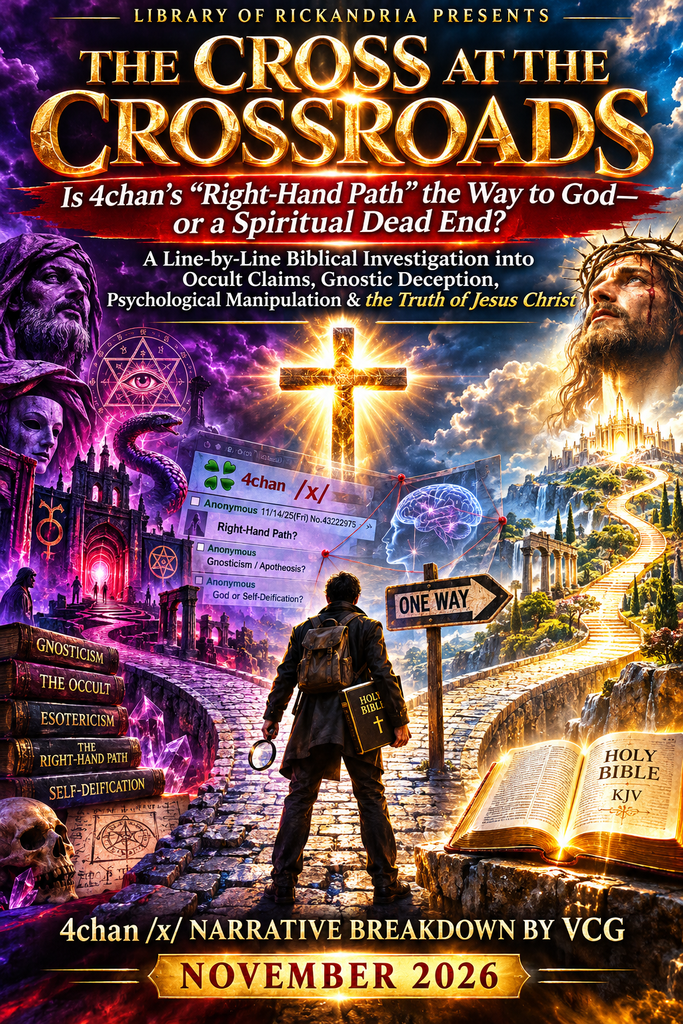
UPDATED BY VCG ON 11/18/2026 @ 06:14 EST
A Line-by-Line Biblical Investigation into Occult Claims, Gnostic Deception, Psychological Manipulation & the Truth of Jesus Christ
Anyone can do this, but most won’t.
The Cross at the Crossroads
is an in-depth:
- biblical
- historical
- philosophical
- psychological
investigation into a November 2026 discussion on 4chan’s paranormal board (/x/) concerning the mysterious “Right-Hand Path” (RHP).
Through a careful, line-by-line examination of the original thread, this Library of Rickandria research paper explores:
- the origins of Right-Hand and Left-Hand Path occultism
- ancient Gnostic teachings
- the concept of returning to a universal spiritual source
- the controversial idea that salvation requires the dissolution of individual identity
Drawing upon:
- the King James Bible
- ancient religious texts
- academic scholarship
- peer-reviewed psychological research
the investigation distinguishes verifiable history from unsupported metaphysical claims while examining:
- spiritual certainty
- confirmation bias
- religious commitment
- the persuasive power of esoteric narratives
Central to the study is a vital theological question:
Does the path to God require humanity to lose its individuality and merge into an impersonal source, or does Scripture reveal salvation through Jesus Christ, spiritual transformation, resurrection, and eternal communion with the living God?
Rather than assuming deception or inventing conspiracies, this evidence-based examination tests each claim against its:
- historical context
- logical foundations
- biblical teaching
—ultimately revealing the profound distinction between occult concepts of spiritual liberation and the Christian gospel of salvation by grace through faith in Jesus Christ.
ChatGPT – Library of Rickandria
RESEARCH ABSTRACT
On November 16, 2026, an anonymous user on 4chan’s paranormal board, /x/, asked a question about practicing the Right-Hand Path.
/x/ – RHP – Paranormal – 4chan
The thread attracted only four replies, yet those responses introduced several surprisingly substantial ideas:
- spiritual discipline
- skepticism
- religious commitment
- humanity’s supposed return to an ultimate source
- the Left-Hand Path’s pursuit of individuality
and a Gnostic route that might end personal individuality altogether.
At first glance, the discussion appears almost trivial.
One user recommends attending to small things.
Another recommends studying carefully before committing.
A third offers a metaphysical explanation of human destiny.
The last suggests cleaning, with a passing reference to the film Bruce Almighty.
But the thread opens onto a much larger question:
When someone speaks about returning to the source of existence, are they describing the God of the Bible, a nondual spiritual absolute, or something else entirely?
This investigation examines the entire surviving exchange.
It reconstructs the claims in their original order,
studies the historical origins of right-hand and left-hand terminology,
compares ancient Gnostic sources with modern esoteric interpretations,
and considers what psychological research can—and cannot—tell us about spiritual certainty.
The King James Bible serves as the controlling English biblical text for the theological examination.
Our central conclusion is that the thread combines several reasonable practical insights with a metaphysical account that remains largely unsupported and, in important respects, differs from biblical Christianity.
Its most serious unresolved claim concerns the nature of salvation itself:
whether redemption means returning to an impersonal source and losing individuality, or entering a transformed relationship with the personal Creator through Jesus Christ.
The evidence supports a careful critique.
It does not establish that these anonymous participants were knowingly deceiving anyone or conducting a coordinated psychological operation.
That distinction matters.
The purpose of this paper is to investigate claims rather than invent motives.
Primary source:
4chan /x/, thread No. 43222975 — RHP
PART I — THE INVESTIGATION
1. What Was Actually Posted?
The original thread was published on Monday, November 16, 2026, at 03:37:29 as displayed by 4chan.
Its title was simply RHP.
The opening post contained a small photograph depicting an illuminated cross near a ONE WAY road sign.

Original thread’s visual theme.
The sign and cross make a compelling visual pairing, but the original author did not explain the symbolism.
The discussion contains five visible posts in total.
| Post number | Displayed time | Principal subject |
|---|---|---|
| 43222975 | 03:37:29 | How to practice RHP correctly |
| 43223244 | 05:54:00 | Starting with small things |
| 43224248 | 13:14:18 | Skeptical study followed by commitment |
| 43224310 | 13:26:34 | Asceticism, source, natural order, individuality and Gnosticism |
| 43224442 | 13:54:04 | Cleaning and a film reference |
All five posts appear under anonymous identities.
The thread is archived.
Readers can review the surviving primary record at the original 4chan page or its ThreadPuller mirror.
Figure 1 — Original attached image
Source: image attached to 4chan post No. 43222975.
This is documentary source material.
The cinematic poster accompanying this publication is a separate artistic interpretation.
Two cautions are necessary.
First, these are different anonymous participants.
Their responses should not be presented as one coherent theological manifesto.
Second, the title RHP is not defined by the opening author.
We must establish what later contributors appear to mean rather than automatically imposing one definition on every participant.
That is where the investigation begins.
2. Our Research Standard: What Counts as Evidence?
This paper distinguishes five kinds of claims.
Historical claims concern things that happened:
the origin of occult terminology,
the contents of ancient manuscripts,
the development of religious movements,
or a film’s actual dialogue.
Empirical claims concern observations that can be investigated by appropriate methods, including behavioral research or measurable outcomes.
Psychological explanations concern possible patterns of:
- belief formation
- identity
- persuasion
- interpretation
These require evidence and should not be used to diagnose anonymous strangers.
Metaphysical claims concern:
- ultimate reality
- the nature of consciousness
- the soul
- God
- existence beyond death
Such propositions may require philosophical or theological argument and should not be presented as experimentally established merely because they sound coherent.
Biblical claims concern what the Scriptures actually teach.
These are evaluated by examining relevant passages, their literary contexts, and the relationship between different biblical texts.
For each substantial assertion, our procedure is:
- Identify the actual proposition.
- Examine its historical or empirical basis.
- Distinguish the proposition from a possible charitable interpretation.
- Consider alternative explanations and counterarguments.
- Compare its theological implications with the relevant KJV passages.
- State the conclusion at the level of confidence the evidence allows.
This approach is consistent with the methodology used in the Library of Rickandria’s related paper, Whether Those Things Were So: A Berean Examination of Religious Syncretism, Gnosticism & Online Esotericism.
A particular spiritual claim might be:
- ancient
- influential
- appealing
- psychologically meaningful
or widely repeated.
None of those characteristics alone establishes that it is true.

1611 KJV title page.
A principle from the KJV translators
The supplied King James Bible contains an unusually appropriate statement in its introductory essay, The Translators to the Reader:
It is better to make doubt of those things which are secret, than to strive about those things that are uncertain.
The translators were discussing uncertainties in the interpretation of difficult scriptural expressions.
Their concern was not to make truth unknowable.
It was to avoid pretending that uncertain questions had already been settled.
We adopt the same caution here.
The goal is neither automatic acceptance nor automatic dismissal.
It is proportionate judgment.
PART II — WHERE DID THE TWO PATHS COME FROM?
3. The Historical Origins of Right-Hand and Left-Hand Terminology
A reader unfamiliar with Western esotericism might assume the Right-Hand Path is simply another way of saying Christianity.
That assumption would create confusion from the beginning.
Historically, right-hand and left-hand terminology has a complicated background involving Indian religious classifications and their subsequent reinterpretation in Western occult movements.
3.1 Indian religious terminology
Two Sanskrit expressions are especially relevant:
- Dakṣiṇācāra: commonly associated with right-hand religious practice.
- Vāmācāra: commonly associated with left-hand religious practice.
In certain Tantric settings, these terms distinguish modes of ritual observance, including differing attitudes toward conventional religious restrictions.
But Tantra is not a single, uniformly organized system, and the distinction cannot adequately summarize all Tantric traditions.
Scholar Alexis Sanderson’s work on Śaiva ritual traditions demonstrates that distinctions involving right and left were historically embedded in specific Indian religious and ritual settings.
See: Alexis Sanderson, Meaning in Tantric Ritual.
3.2 Western occult reinterpretation
During the nineteenth century, Western esoteric movements appropriated and reinterpreted Indian religious concepts.
The Theosophical movement was particularly influential in spreading Western understandings of right-hand and left-hand spiritual classifications.
In this setting,
the terminology increasingly acquired associations with competing spiritual orientations, including altruism versus selfishness,
established religion versus transgression,
and obedience to higher principles versus individual spiritual sovereignty.
However, those Western associations should not be projected backward onto every Indian source.
Kennet Granholm’s research is especially useful here.
His study, The Serpent Rises in the West: Positive Orientalism and Reinterpretation of Tantra in the Western Left-Hand Path, explains how Western occultists adapted Indian concepts to their own religious and ideological interests.
Granholm also identifies individualism and opposition to prevailing religious norms as important recurring features of contemporary Western Left-Hand Path traditions.
This history supports one part of the 4chan discussion: modern LHP movements frequently emphasize individuality.
It does not support the much stronger assertion that every LHP practitioner seeks the same form of postmortem existence.
3.3 Is Christianity the Right-Hand Path?
Certain occult classifications place Christianity under the RHP category because Christianity emphasizes submission to God, moral obligation, and religious discipline.
But this is an external classification.
The biblical authors do not identify salvation through Christ with a spiritual system called the Right-Hand Path.
The Christian understanding of salvation includes the personal God of Scripture,
the incarnation of Christ,
his death and resurrection,
repentance,
grace,
and final resurrection.
A philosophical system that emphasizes conformity to some higher reality does not necessarily teach those doctrines.
Historical conclusion:
RHP is a real esoteric category, but it is not a precise synonym for Christianity.
Its meaning depends on the historical and theological context.
This distinction is indispensable for the rest of our investigation.
Related Library study:
Understanding the Occult: Hidden Knowledge, Ancient Symbols & the Search for Truth.
PART III — THE THREAD EXAMINED POST BY POST
4. Opening Post: Is There a Correct Right-Hand Path?
Post No. 43222975
The original author asks, in essence, how to follow RHP properly.
The accompanying image shows a cross beside a directional road sign.
The photograph is suggestive.
A reader familiar with Christianity may immediately think of Jesus’ declaration in John 14:6.
But imagery is not doctrine.
We cannot conclude from the photograph alone that the author accepts the historical claims of Christianity, understands the gospel, or intends to defend Christian exclusivity.
A Christian reading of the image is possible; it is not established.
4.1 John 14:6 in context
The King James Bible records Jesus’ words:
Jesus saith unto him, I am the way, the truth, and the life:
no man cometh unto the Father, but by me.— John 14:6, KJV
In John 14:1–5, Jesus is preparing his disciples for his departure.
Thomas asks how they can know the way.
Jesus responds by identifying himself—not a ritual technique, not an occult classification, and not an impersonal principle—as the way to the Father.
The claim is personal and Christological.
That distinction is reinforced by Acts 4:10–12, where Peter identifies Jesus Christ of Nazareth as the one through whom salvation is proclaimed.
Neither is there salvation in any other: for there is none other name under heaven given among men, whereby we must be saved.— Acts 4:12, KJV
The surrounding context identifies the person to whom the passage refers.
Therefore, if the 4chan question is interpreted as asking how to approach God according to biblical Christianity, the New Testament answer must be centered on Jesus Christ rather than an undefined esoteric path.
4.2 The narrow way is not an occult initiation system
Matthew 7:13–14 describes a narrow way leading to life and a broad way leading to destruction.
It is tempting to connect this language directly with RHP and LHP classifications.
But the context resists that simplification.
Jesus continues by:
- warning about false prophets
- examining spiritual fruit
- distinguishing genuine obedience from empty professions
and comparing those who obey his teaching with those who build on unstable foundations.
The argument is about responding faithfully to Jesus’ teaching.
Nothing in Matthew 7 establishes a religious taxonomy drawn from nineteenth-century Western occultism.
The same caution applies to Matthew 25:31–46, where the righteous and unrighteous are placed on the King’s right and left during judgment.
Right-and-left imagery exists in many settings.
Similar vocabulary is not proof of shared theological origin.
Verdict:
The opening image is compatible with Christian interpretation, but the thread does not define RHP sufficiently to identify it with biblical salvation.
5. First Reply: Begin With Small Things
Post No. 43223244
The respondent gives a very brief recommendation:
“The small things.”
The post includes a YouTube link:
Original video link supplied by the respondent.
The video’s contents could not be independently verified during this examination.
We therefore do not attribute any teaching to the video beyond its appearance as a link in the post.
5.1 The practical interpretation
The likely practical reading is straightforward:
begin with manageable responsibilities rather than immediately seeking extraordinary spiritual experiences.
That advice has merit.
People often struggle to maintain complicated practices when simple habits have not been established.
Research by Phillippa Lally and colleagues examined the development of habitual behaviors through repetition in consistent contexts.
Their work supports the importance of repetition in habit formation, while showing that the process varies substantially among individuals.
See:
Lally et al., How Are Habits Formed? (2010).
But this psychological finding establishes something about learned behavior.
It does not establish that completing ordinary tasks initiates a person into supernatural truth.
5.2 The biblical comparison
Jesus teaches:
He that is faithful in that which is least is faithful also in much:
and he that is unjust in the least is unjust also in much.— Luke 16:10, KJV
The immediate passage concerns stewardship and faithfulness in the use of possessions.
The verse reasonably supports an application to ordinary responsibilities, provided we preserve its original context.
Zechariah 4:10 likewise warns against despising the day of small things, while Colossians 3:23 calls believers to work heartily as unto the Lord.
None of these passages makes small daily tasks a substitute for the gospel.
5.3 The essential theological distinction
A person can be disciplined without being spiritually regenerated.
A person can perform good deeds without embracing the Christian account of salvation.
Ephesians 2:8–10 identifies salvation as a gift of grace and good works as part of the life that follows.
The order matters.
Verdict:
The respondent offers potentially sound practical advice, but that advice does not independently establish the truth of RHP metaphysics or provide a complete account of salvation.
6. Second Reply: Investigate First, Then Commit
Post No. 43224248
This contributor recommends examining a prospective spiritual path carefully and skeptically before committing to it.
Once committed, the individual is encouraged to remain determined in the face of opposition.
The reply contains two separate principles.
One concerns investigation.
The other concerns perseverance.
They deserve separate evaluation.
6.1 The strongest part: investigate carefully
The first recommendation is broadly compatible with biblical discernment.
Acts 17:11 praises the Bereans for investigating Paul’s message in light of Scripture.
These were more noble than those in Thessalonica, in that they received the word with all readiness of mind, and searched the scriptures daily, whether those things were so.— Acts 17:11, KJV
Notice that the Bereans do not simply reject Paul’s message because it is unfamiliar.
Neither do they immediately accept it because Paul presents it confidently.
They examine the claim.
First Thessalonians 5:21 states:
Prove all things; hold fast that which is good.
In context, Paul is addressing discernment, including the testing of prophetic claims.
The biblical model is therefore neither gullibility nor reflexive skepticism.
It is investigation followed by responsible judgment.
6.2 The dangerous possibility: commitment becoming inflexibility
The second recommendation could be interpreted in two ways.
A charitable interpretation is that a person should remain faithful to well-supported convictions despite social pressure.
A more problematic interpretation is that, after accepting a spiritual system, a person should refuse to reconsider it regardless of new evidence.
Those are different positions.
Perseverance in truth is commendable.
Protecting a mistaken belief merely because it has become part of one’s identity is not.
The Apostle Paul illustrates the distinction.
Before his conversion, Paul was intensely committed to persecuting followers of Jesus.
He later recognized that his earlier religious zeal had been directed against the very truth he came to proclaim.
See Galatians 1:13–16 and Philippians 3:4–9.
His sincerity and determination did not make his previous actions correct.
6.3 A psychological perspective
Psychologist Raymond Nickerson’s review of confirmation bias describes the human tendency to seek or interpret information in ways that favor existing beliefs or expectations.
See:
Nickerson, Confirmation Bias: A Ubiquitous Phenomenon in Many Guises (1998).
Corey Cusimano and Tania Lombrozo also studied situations in which people regard morally desirable beliefs as deserving different evidential standards.
See:
Morality Justifies Motivated Reasoning in the Folk Ethics of Belief (2020).
These studies do not prove that the anonymous commenter is personally biased.
They help us identify a general danger:
a decision may become harder to question because it is tied to perceived virtue, loyalty, or identity.
The biblical answer is not perpetual indecision. It is faithfulness accompanied by humility and responsiveness to correction.
Acts 18:24–28 provides another useful example.
Apollos is knowledgeable and fervent, yet receives further instruction.
Verdict:
The recommendation to investigate carefully is strong.
The recommendation to persevere is sound only when it does not become immunity from correction.
7. Third Reply: Asceticism, Natural Order and the Return to Source
Post No. 43224310
This is the theological turning point of the thread.
Unlike the other brief replies, this participant offers a broad explanation of spiritual reality.
The response can be divided into six propositions:
- RHP should be practiced ascetically.
- Humanity is supposedly designed to return to an ultimate source.
- LHP is characterized as opposed to the natural order.
- Every LHP system allegedly aims to preserve or extend individuality.
- Ordinary people supposedly follow RHP automatically.
- A more deliberate Gnostic approach allegedly ensures that individuality does not remain.
These propositions form the center of the investigation.
7.1 Asceticism: legitimate discipline or spiritual technology?
Asceticism refers to deliberate self-discipline or renunciation practiced for religious, philosophical, or ethical purposes.
Historically, ascetic practices have included:
- fasting
- reduced material consumption
- abstinence
- prayer
- meditation
and other forms of self-restraint.
Asceticism is not exclusively Christian and is not necessarily occult.
Christianity has substantial traditions of fasting and voluntary simplicity.
In Matthew 6:16–18, Jesus instructs his followers concerning fasting without encouraging public religious performance.
Paul uses athletic discipline as an analogy for Christian perseverance in 1 Corinthians 9:24–27.
Yet Scripture also warns against treating severe external restrictions as independently sufficient for spiritual transformation.
Colossians 2:20–23 addresses humanly imposed religious regulations and forms of bodily deprivation that appear wise but do not deliver what they promise.
The important distinction is not discipline versus indiscipline.
It is between discipline as a practice within a theological framework and discipline as an allegedly self-sufficient mechanism of redemption.
Correction:
Ascetic practice may cultivate self-control, but asceticism by itself does not establish that a person’s spiritual beliefs are true.
7.2 Are we designed to return to a source?
Here the commenter moves from practical advice into metaphysics.
The claim assumes that human beings originate from some ultimate reality and are naturally destined to return to it.
Before accepting the argument, we need to ask what the source actually is.
Does the commenter mean the personal Creator of Scripture?
A nondual absolute?
A divine fullness from which spiritual beings have emanated?
Or another kind of ultimate reality?
The post does not specify.
That is a serious omission.
A statement about returning to God is not equivalent to a statement about dissolving into an impersonal cosmic principle.
7.3 Advaita Vedānta as a possible parallel
One historically significant comparison is Advaita Vedānta.
In classical Advaita, especially as developed in the tradition associated with Śaṅkara, ultimate reality is understood nondually.
The relationship between the true self, ātman, and Brahman is central to its philosophical system.
See:
Stanford Encyclopedia of Philosophy — Śaṅkara.
This provides a useful philosophical parallel to the idea of returning to a source.
However, we cannot simply declare that the anonymous author is teaching Advaita.
Nor should Advaita be reduced to the claim that a person’s ordinary personality is physically destroyed.
Its account of selfhood, ignorance, and liberation is more sophisticated than such a description.
7.4 What Genesis actually teaches
Genesis begins:
In the beginning God created the heaven and the earth.— Genesis 1:1, KJV
Genesis 1:26–27 then presents humanity as created in God’s image.
The biblical distinction is between the Creator and the created.
Being made in God’s image does not mean that human beings are detached fragments of God’s divine essence.
Likewise, Acts 17:24–29 teaches that human beings depend on God for life and existence.
Paul’s argument does not identify humanity as an impersonal extension of the divine substance.
Romans 11:36 declares that all things are of God, through God, and to God.
But Romans 11 is not teaching that redemption eliminates the Creator-creature distinction.
Biblical conclusion:
Humanity’s dependence upon God is affirmed.
The claim that salvation consists in the dissolution of personal distinction into an undefined source is not established by these passages.
PART IV — THE CENTRAL PHILOSOPHICAL PROBLEMS
8. What Is the Natural Order?
The respondent presents the Left-Hand Path as fundamentally contrary to nature.
That description sounds meaningful until we ask what nature means.
The expression could refer to:
- Physical laws.
- Biological tendencies.
- Social conventions.
- Moral obligations.
- A divine purpose for human existence.
- An alleged cosmic process.
These are not interchangeable.
A behavior can be biologically common without being morally good.
A belief can be culturally unpopular without being false.
A person can resist social conventions without violating physical laws.
The argument also faces a familiar philosophical problem:
a description of how things supposedly are does not, by itself, demonstrate how things morally ought to be.
David Hume’s discussion of the transition from statements of fact to statements of obligation is central to this issue.
See:
Stanford Encyclopedia of Philosophy — Hume’s Moral Philosophy.
The commenter would need to establish both the alleged natural order and the reason that conformity to it has moral or spiritual authority.
Neither premise is demonstrated.
A biblical complication
Romans 12:2 tells believers not to be conformed to this world.
That means ordinary social conformity cannot simply be equated with righteousness.
At the same time, Romans 1:18–25 discusses creation and humanity’s responsibility before God.
These passages are not contradictory.
They address different dimensions of human existence.
The point is that Scripture does not identify whatever appears natural, common, or socially accepted as automatically righteous.
Verdict:
The alleged natural order is undefined.
The argument remains incomplete until its central term is clarified and defended.
9. Does Every Left-Hand Path Seek Immortal Individuality?
This is one of the thread’s broadest claims.
There is historical evidence that certain modern Western Left-Hand Path movements emphasize:
- individualism
- self-deification
- autonomy
or liberation from established religious boundaries.
Granholm’s research supports this general observation.
However, the word every creates a much stronger proposition.
Different movements have different practices and goals.
Some emphasize spiritual sovereignty.
Others emphasize personal transformation, transgressive ritual, or philosophical individualism.
Even when practitioners aspire to preserve an autonomous spiritual identity after death, evidence of that aspiration does not establish that the intended result occurs.
There are two questions here:
What do adherents believe or seek?
That is a historical and sociological question.
Can the practices actually produce the claimed postmortem result?
That is a metaphysical question requiring further argument.
The commenter provides neither a comprehensive historical comparison nor evidence of successful postmortem self-preservation.
The biblical contrast
Hebrews 9:27 presents human destiny in relation to death and judgment.
First Corinthians 15:42–54 presents incorruption and immortality in the context of resurrection.
The Christian hope is not primarily the permanent survival of a magically perfected autonomous ego.
It is life granted and transformed through God’s redemptive action.
Verdict: Partly supported as a description of recurring LHP ideals, but historically overgeneralized and metaphysically unverified.
10. Does Everyone Automatically Return to God?
The respondent suggests that ordinary people follow the RHP even without consciously undertaking it.
This raises a difficult question.
Is the author describing an alleged automatic return to a metaphysical source, or claiming that everybody ultimately receives salvation?
The two are not necessarily identical.
We should not insert the Christian concept of salvation into an argument that has not explicitly defined itself that way.
Nevertheless, if the claim is offered as a description of biblical salvation, it faces substantial textual objections.
Jesus says:
Enter ye in at the strait gate:
for wide is the gate, and broad is the way, that leadeth to destruction, and many there be which go in thereat:— Matthew 7:13, KJV
The following verse describes the narrow way leading to life.
Jesus’ teaching requires a response.
It does not describe salvation as an unconscious cosmic process inevitably completed by everyone.
John 3:3–21 presents the necessity of new birth and the relationship between belief, judgment, and life.
Ephesians 2:1–10 describes divine mercy and grace acting upon human beings in their fallen condition.
These passages do not establish an automatically successful spiritual ascent or return.
What about Christian universalism?
A serious paper should acknowledge that Christians disagree about the final extent of salvation.
Some Christian universalists interpret passages such as Romans 5:18–19 and 1 Corinthians 15:22–28 as supporting the eventual reconciliation of all persons to God.
Other Christian traditions interpret those passages differently and emphasize texts concerning final judgment.
The historical debate cannot be settled simply by citing one isolated verse.
But even Christian universalist interpretations are not equivalent to the thread’s claim that people naturally and unconsciously follow an occult RHP.
Verdict:
The automatic-return claim is not demonstrated.
If intended as a doctrine of salvation independent of Christ, it conflicts with major New Testament teachings concerning:
- repentance
- faith
- judgment
- divine grace
PART V — THE DEATH OF SELF
11. Does Following God Require the Destruction of Individuality?
This is the paper’s most important theological question.
The respondent’s final claim is that a Gnostic approach can bring about a condition in which one is:
“never individual again.”
The phrase is ambiguous.
It could mean the destruction of egotism.
It could mean liberation from self-centered consciousness.
It could mean ending the illusion of metaphysical separateness.
Or it could mean the literal cessation of distinct personal existence.
These interpretations are not equivalent.
11.1 What does Jesus mean by denying oneself?
Luke 9:23 records:
And he said to them all, If any man will come after me, let him deny himself, and take up his cross daily, and follow me.
The surrounding context concerns:
- discipleship
- suffering
- loyalty
and the willingness to lose one’s life for Christ’s sake.
Self-denial involves relinquishing self-rule when it conflicts with following Jesus.
It does not state that redeemed human beings cease to be persons.
The same distinction appears in Galatians 2:20.
I am crucified with Christ:
nevertheless I live; yet not I, but Christ liveth in me:
Paul describes a radically transformed life.
Yet the verse continues with Paul speaking of the life he now lives in the flesh.
The language of death with Christ signifies a new relationship to sin, law, and life in Christ—not the disappearance of Paul as a distinct conscious person.
11.2 What does it mean to be one with God?
Jesus prays in John 17:21:
That they all may be one; as thou, Father, art in me, and I in thee, that they also may be one in us:
This is one of the most important verses in discussions of Christian union with God.
But the passage concerns unity among believers and communion with the Father and Son.
It does not establish that believers become numerically identical with the divine being.
The plural persons remain central to the prayer.
Unity is not automatically equivalent to the elimination of distinction.
11.3 What does resurrection preserve?
First Corinthians 15 is essential.
Paul’s discussion begins with the resurrection of Christ and proceeds to the resurrection of believers.
He describes transformation from corruption to incorruption and from mortality to immortality.
The language of a spiritual body in 1 Corinthians 15:44 should not be casually interpreted as the abandonment of personal existence.
Paul’s argument is about resurrection and transformation.
Theological debates remain concerning the precise relationship between bodily continuity, transformation, and identity.
Philosophers continue to examine these questions.
See:
Internet Encyclopedia of Philosophy — Resurrection and Stanford Encyclopedia of Philosophy — Afterlife.
Nevertheless, Paul’s argument is not that salvation culminates in the irreversible nonexistence of the redeemed person.
11.4 Revelation and continuing communion
Revelation 22:3–5 describes God’s servants in the renewed creation.
They serve him, see his face, and reign.
These descriptions preserve a relationship between the Lord and those who belong to him.
The language depicts redeemed persons in communion with God.
It does not depict their absorption into an impersonal totality.
11.5 The distinction in one table
| Meaning of losing self | Biblical assessment |
|---|---|
| Rejecting pride | Consistent with Scripture |
| Rejecting sinful self-rule | Consistent with discipleship |
| Abandoning selfish ambition | Consistent with Christian ethics |
| Entering communion with God | Central to biblical salvation |
| Becoming transformed through Christ | Central to sanctification and resurrection |
| Ceasing to exist as a distinct person | Not taught as the goal of Christian redemption |
The theological conclusion must therefore be carefully worded.
Christianity teaches the transformation of the person through relationship with God.
It does not teach that salvation requires the absolute destruction of personal identity.
That does not settle every philosophical question about consciousness or the afterlife.
It establishes the distinction required by the biblical texts.
PART VI — THE GNOSTIC FILES
12. What Did Ancient Gnostic Texts Actually Teach?
The modern word Gnosticism is frequently treated as though it describes a single religious system.
That is historically problematic.
Scholars have long debated whether the label adequately captures the diversity of the ancient texts and movements grouped beneath it.
Michael Allen Williams challenged the usefulness of the category in Rethinking Gnosticism.
Karen L. King raised related questions in What Is Gnosticism?
These debates matter because different ancient sources present different accounts of:
- creation
- the divine realm
- the human condition
- salvation
For scholarly orientation, see:
Michael Allen Williams — Rethinking Gnosticism
Yale University Library — Gnosticism Research Guide
Figure 2 — An ancient manuscript witness
Source:
Claremont Colleges Digital Library, Nag Hammadi collection.

Nag Hammadi manuscript.
The image documents an ancient manuscript, not the beliefs of the 4chan participants.
13. The Apocryphon of John
One particularly important ancient text is the Apocryphon of John, sometimes called the Secret Book of John.
Its surviving versions present a mythological account involving:
- a transcendent divine reality
- emanations
- Sophia
- a lower creator figure
and the human condition.
The account differs substantially from the straightforward Creator-creature framework of Genesis.
Within the textual tradition, the material cosmos is associated with a subordinate creator and a complex history of divine error, ignorance, and recovery.
It would be misleading to present every ancient Gnostic movement as teaching identical details.
But the Apocryphon of John provides a genuine example of a theological account in which cosmic ignorance and recovery of divine knowledge play central roles.
Primary text and translation resources:
The Apocryphon of John — Gnostic Society Library
Frederik Wisse translation — academic resource
Brill — Coptic Gnostic Library Online
The biblical comparison
Genesis presents God as the Creator.
Genesis 1:31 describes the completed creation as very good.
John 1:1–3 identifies the Word as involved in the creation of all things.
John 1:14 then identifies the Word as becoming flesh.
Colossians 1:15–20 presents Christ as the one through whom and for whom all things were created.
These passages cannot be easily reconciled with a system that treats the Creator of the material world as an ignorant subordinate being fundamentally opposed to the highest God.
That is a genuine theological disagreement—not simply a disagreement over terminology.
14. The Gospel of Truth
The Gospel of Truth is associated by scholars with Valentinian Christian thought.
It emphasizes ignorance, knowledge, error, and revelation in ways that differ from the narrative structure of the canonical Gospels.
But it is not sufficient to say that every Valentinian account demands the extinction of all individuality.
A careful interpretation must distinguish the restoration of divine fullness, the overcoming of ignorance, and the precise status of individual spiritual beings.
These questions are debated in scholarship.
The text is included in the Coptic Gnostic Library Online and indexed through the Nag Hammadi Library.
The ancient evidence supports the existence of multiple systems of salvation through revelation or knowledge.
It does not establish that the 4chan respondent’s formulation faithfully represents them all.
The strongest historical conclusion
Some ancient systems frequently classified as Gnostic interpret the human predicament in terms of ignorance, separation, and recovery of divine knowledge.
Some describe restoration to a transcendent divine realm.
Their accounts of personhood and salvation vary.
Consequently, the 4chan claim that a single Gnostic route necessarily produces permanent non-individual existence is historically overgeneralized.
Related Library of Rickandria research:
The Modern Gnostic Revival: A Historical, Psychological, Evidentiary & Biblical Examination
Narrative Breakdown: The “Gnōsis Isn’t Belief” X Post
Gnosticism Exposed: Unmasking the Serpent’s Lie — a confessional Christian theological critique rather than an independent academic history.
PART VII — GRACE VERSUS SPIRITUAL SELF-ENGINEERING
15. Can Spiritual Techniques Produce Salvation?
A recurring theme beneath the thread is the assumption that religious destiny can be approached as a procedure.
One begins with small actions.
One investigates.
One commits.
One practices discipline.
One supposedly moves toward a predetermined metaphysical result.
But the New Testament presents salvation differently.
Ephesians 2:8–10 states that salvation is by grace through faith and that good works follow as part of the life God intends for his people.
Titus 3:5 is especially direct:
Not by works of righteousness which we have done, but according to his mercy he saved us, by the washing of regeneration, and renewing of the Holy Ghost;
Within the Christian account, salvation cannot be reduced to human accomplishment.
That is not a rejection of prayer, fasting, moral discipline, or good works.
It is a distinction between practices that express religious devotion and the divine action upon which salvation depends.
15.1 Protestant interpretations
Many Protestant traditions emphasize justification by grace through faith, distinguishing good works from the basis of justification.
Ephesians 2:8–10 and Romans 3:21–28 are central to these explanations.
15.2 Catholic interpretations
Catholic theology likewise teaches the necessity and priority of divine grace while describing human cooperation with grace in justification and sanctification.
Its teaching should not be caricatured as salvation achieved without grace.
See the official Catechism of the Catholic Church — Grace and Justification.
15.3 Eastern Orthodox interpretations
Eastern Orthodox Christianity frequently emphasizes theosis, or participation in divine life.
This can sound superficially similar to some esoteric language concerning divine union.
But the resemblance requires careful interpretation.
Orthodox theology maintains the Creator-creature distinction and speaks of persons entering communion with the Triune God.
It does not simply teach that human persons become indistinguishable from an impersonal cosmic substance.
See:
Orthodox Church in America — Manipulation of the Human Person.
What these distinctions establish
Christian traditions disagree about the theological explanation of justification, sacramental life, and sanctification.
But the traditions discussed above do not treat ordinary housekeeping, meditation, or ascetic discipline as an independently sufficient means of achieving salvation through an impersonal cosmic mechanism.
Conclusion:
The thread’s procedural language may describe religious self-discipline.
It does not thereby establish an account of salvation compatible with the New Testament.
PART VIII — THE FINAL REPLY AND POPULAR CULTURE
16. Cleaning the House: Practical Wisdom or Spiritual Initiation?
Post No. 43224442
The last respondent recommends beginning with cleaning and makes a casual reference to the film Bruce Almighty.
This comment initially appears disconnected from the preceding metaphysical claims.
Yet the reference can be investigated.
Bruce Almighty, released in 2003, includes scenes involving the character Bruce and a figure portraying God, played by Morgan Freeman.
An available screenplay contains scenes in which Bruce encounters God in connection with cleaning and mopping.
See:
We can establish that a relevant film scene exists.
We cannot establish precisely what the anonymous commenter intended to communicate by mentioning it.
16.1 Cleaning as stewardship
Cleaning one’s surroundings may be a responsible and constructive action.
Habit research provides plausible reasons why simple, repeatable tasks can assist with the development of routine.
Luke 16:10 supplies a related biblical principle concerning faithfulness.
Colossians 3:23 encourages believers to perform their work heartily.
There is no need to invent an occult explanation for the practical benefits of cleanliness.
16.2 Cleaning as metaphor
Scripture frequently uses cleansing imagery.
Psalm 51:10 records David’s prayer:
Create in me a clean heart, O God; and renew a right spirit within me.
In context, the prayer concerns repentance and inward restoration.
First John 1:7 relates cleansing from sin to Jesus Christ.
Titus 3:5 connects salvation with divine mercy and regeneration.
Physical cleaning may illustrate spiritual cleansing, but it does not accomplish the same thing.
16.3 The rhetorical importance of familiar films
A popular film can make a philosophical or spiritual idea feel understandable.
Visual storytelling produces memorable associations.
But a film scene cannot independently establish the existence of a supernatural mechanism.
Nor can the fact that a fictional character portrays God establish the film’s theological authority.
Verdict:
The practical advice is reasonable.
The film reference is verifiable in a limited sense. No claim of supernatural efficacy is demonstrated.
PART IX — THE PSYCHOLOGY OF SPIRITUAL CERTAINTY
17. Why Can Brief Spiritual Explanations Feel So Convincing?
The discussion uses several features that merit psychological examination.
None establishes intentional manipulation on its own.
17.1 Ambiguous concepts
Words such as source, nature, individuality, and path can carry different meanings.
When the meanings remain unspecified, readers may interpret the same statement according to their own assumptions.
A Christian may hear a reference to the Creator.
A nondual philosopher may hear a reference to Brahman.
An esoteric practitioner may hear a reference to a spiritual origin beyond ordinary existence.
The participants may appear to agree when their underlying beliefs differ substantially.
The proper response is definitional clarity.
17.2 Confirmation bias
Confirmation bias concerns the tendency to seek or interpret evidence in ways that reinforce existing expectations.
This is well documented in psychological research.
Raymond Nickerson’s 1998 review remains a useful starting point.
But merely observing that someone holds an unusual belief does not prove confirmation bias.
The relevant evidence would concern how that individual responds to confirming and disconfirming information.
17.3 Identity-protective reasoning
Beliefs can become associated with a person’s community, values, self-understanding, or sense of moral purpose.
When that happens, changing beliefs may feel socially or emotionally costly.
Research on motivated reasoning helps explain how such pressures can influence judgments.
Cusimano and Lombrozo’s research demonstrates that moral considerations can affect the evidential standards people believe should be applied.
In the present thread, the advice to commit firmly after choosing a path presents a possible opening for such reasoning.
But the text alone does not establish that the participant suffers from it.
17.4 Insider-outsider language
The third respondent refers dismissively to ordinary people as uninformed outsiders.
Language of this kind can contribute to a perceived division between those who possess special knowledge and those who supposedly lack it.
Social identity theory examines how membership in groups influences comparison and judgment.
For a foundational discussion, see Tajfel and Turner, The Social Identity Theory of Intergroup Behavior.
Yet one expression cannot establish a comprehensive psychological profile.
The narrower observation is that the wording creates an insider-outsider distinction.
17.5 Practical wisdom supporting unsupported cosmology
This is perhaps the most important reasoning issue in the discussion.
The thread contains ordinary advice that may be reasonable:
Begin small.
Investigate.
Practice discipline.
Maintain your surroundings.
These statements are easy to understand.
They also appear beside more speculative claims about the ultimate destiny of human consciousness.
A reader may be tempted to treat the reasonable practical advice as indirect validation of the speculative metaphysics.
That inference would be invalid.
Evidence for the usefulness of small habits is not evidence that the universe is designed to dissolve personal individuality.
The two claims require independent evaluation.
17.6 Are people simply gullible?
The psychological literature is more nuanced than that.
Hugo Mercier’s review, How Gullible Are We?, challenges simplistic assumptions about human credulity.
People often evaluate testimony through existing expectations, perceived credibility, and social context.
Therefore, the correct response to internet spirituality is not to dismiss every participant as foolish.
It is to examine the arguments and the evidence.
17.7 Is this a psychological operation?
The thread does not provide sufficient evidence for that conclusion.
A coordinated influence operation would require evidence concerning an organizer, objectives, participants, coordination, dissemination, and intended effects.
A small anonymous discussion containing occult vocabulary is not enough.
The Library of Rickandria’s Modern Gnostic Revival investigation addresses this wider evidentiary problem in detail.
The distinction is fundamental:
An idea can influence people psychologically without being part of a coordinated psychological operation.
The discussion warrants analysis.
It does not justify inventing a hidden operator.
PART X — STEELMANNING THE OPPOSITION
18. The Strongest Charitable Interpretation of the Main Commenter
Before offering a final rebuttal, we should construct the most defensible version of the third respondent’s position.
Perhaps the writer is not advocating the literal annihilation of conscious persons.
Perhaps the intended idea is that selfish individuality produces alienation and that genuine spirituality requires overcoming the illusion of absolute separation.
Under this interpretation:
- Asceticism trains people to resist excessive attachment.
- Returning to source signifies spiritual reconciliation or realization.
- Left-Hand Path individualism represents excessive self-assertion.
- Ordinary human life unfolds within a greater spiritual reality.
- Gnostic practice means overcoming self-centered ignorance.
This interpretation is more philosophically coherent than assuming the writer simply desires unconscious nonexistence.
Some aspects also resemble legitimate moral concerns found in Christianity.
The Bible condemns pride, selfish ambition, and sinful self-rule.
The New Testament calls believers into communion with God and one another.
But similarity in ethical language is not doctrinal identity.
Where the charitable interpretation still differs
If the ultimate source is an impersonal reality rather than the personal Creator, the theology differs.
If the human problem is merely ignorance rather than sin and alienation from God, the account of salvation differs.
If redemption is achieved through private realization rather than God’s saving work in Christ, the mechanism differs.
If union means the disappearance of personal existence, the final goal differs.
These differences remain even when we interpret the commenter generously.
The strongest rebuttal is therefore not that every phrase is meaningless or evil.
It is that the metaphysical system remains undefined, insufficiently supported, and potentially incompatible with central Christian doctrines.
PART XI — THE VISUAL ARGUMENT MAP
19. Two Different Understandings of Spiritual Destiny
The following comparison simplifies two possible frameworks for analytical purposes.
It does not imply that every esoteric tradition accepts the same metaphysics.
| Question | Biblical Christian account | Possible esoteric reading of the thread |
|---|---|---|
| What is ultimate reality? | The personal Creator | An undefined ultimate source |
| What is humanity’s condition? | Created in God’s image, affected by sin | Separated or differentiated from a higher reality |
| What is the primary problem? | Sin, death, alienation from God | Attachment, separateness, or ignorance |
| How is restoration achieved? | God’s saving work through Christ | Discipline, realization, or Gnostic practice |
| What is the final hope? | Resurrection and communion with God | Return to source, possibly ending individuality |
| What establishes the teaching? | Scripture within Christian theology | Metaphysical premises requiring independent defense |
This comparison exposes why the term return is insufficient.
Two people may agree that humanity should return to God while fundamentally disagreeing about who God is, what humanity is, what has gone wrong, and what salvation means.
A shared metaphor cannot settle those questions.
PART XII — THE CLAIM-BY-CLAIM EVIDENCE TRIBUNAL
20. Consolidated Findings
The table below distinguishes historical support, empirical support, unresolved metaphysics, and biblical compatibility.
| Claim | Historical or empirical assessment | Biblical assessment |
|---|---|---|
| RHP is a recognizable spiritual category | Supported; definitions vary | Not a biblical designation for salvation |
| The cross signifies a unique way to God | Christian interpretation is plausible | John 14:6 identifies Christ as the way |
| Small actions can cultivate discipline | Supported within habit research | Compatible with Luke 16:10 |
| Spiritual teachings should be investigated | Sound methodological advice | Supported by Acts 17:11 |
| Commitment should never be reconsidered | Not justified as a general rule | Correction and discernment remain necessary |
| Asceticism can cultivate discipline | Historically and practically supported | Legitimate within limits; not sufficient for salvation |
| Human beings originate from God | A theological and metaphysical proposition | Affirmed in the Creator-creature framework |
| Human beings must dissolve into an ultimate source | Not independently established | Not taught as the goal of redemption |
| LHP often emphasizes individuality | Supported in scholarship on certain movements | Does not establish spiritual efficacy |
| Every LHP movement seeks the same outcome | Overgeneralized | Cannot be established from Scripture |
| LHP violates the natural order | Central terms undefined | Requires a clearer moral and theological argument |
| Ordinary people automatically follow the saving path | Not demonstrated | In tension with New Testament calls to repentance and faith |
| Ancient Gnostic systems contain restoration narratives | Historically supported | Some differ fundamentally from canonical Christianity |
| Gnostic salvation always eliminates individuality | Historically overgeneralized | Not the biblical account of resurrection |
| Cleaning can build practical responsibility | Reasonable and behaviorally plausible | Compatible with stewardship |
| Cleaning produces spiritual regeneration | Unsupported | Contradicted by salvation through divine mercy |
| The thread proves intentional spiritual deception | Not demonstrated | Moral judgment should not outrun evidence |
| The thread proves a coordinated psyop | Not demonstrated | No scriptural claim can replace missing operational evidence |
Several findings require particular emphasis.
The mere existence of an ancient belief is not evidence that its supernatural claims are true.
The presence of psychological mechanisms does not prove that a believer is deliberately manipulative.
And a theological contradiction with Scripture should be identified as a theological judgment—not disguised as an experimental scientific finding.
That separation is essential to intellectual honesty.
PART XIII — THE CHRISTIAN ANSWER
21. What Does Scripture Say About the Way to God?
The investigation began with a question about the correct spiritual path.
The New Testament offers an answer that is both more personal and more demanding than the language of an undefined cosmic return.
Christianity does not begin with the promise that hidden techniques allow human beings to manipulate their destiny.
It begins with God, creation, the human condition, Jesus Christ, and the proclamation of redemption.
21.1 Creation
Genesis 1 identifies God as Creator.
Humanity is made in God’s image.
Creation is not introduced as an accidental prison constructed by an ignorant subordinate deity.
21.2 The human problem
Romans 3:23 states:
For all have sinned, and come short of the glory of God;
Paul’s argument concerns human sin and the need for justification.
The problem is not merely that human beings have forgotten their original metaphysical identity.
21.3 The person of Christ
John 1:14 declares that the Word became flesh.
Christian salvation is therefore inseparable from the incarnation.
The gospel does not simply announce a hidden spiritual principle.
It proclaims Jesus Christ.
21.4 The death and resurrection
First Corinthians 15:3–4 summarizes the apostolic proclamation:
Christ died for sins, was buried, and rose again according to the Scriptures.
Paul then argues that the resurrection of Christ is essential to Christian hope.
This differs from systems in which liberation consists primarily in escaping the material cosmos through specialized knowledge.
21.5 Grace and faith
Ephesians 2:8–10 connects salvation with grace, faith, and the good works for which believers are created in Christ.
Acts 16:30–31 directs the question of salvation toward belief in the Lord Jesus Christ.
Mark 1:15 connects Jesus’ announcement of the kingdom with repentance and belief in the gospel.
21.6 Discipleship
Luke 9:23 calls followers of Jesus to self-denial and daily discipleship.
This does not mean Christian life is effortless.
Nor does it mean human effort independently produces redemption.
It means the life of faith involves transformation, obedience, and perseverance.
21.7 Resurrection and communion
First Corinthians 15 and Revelation 21–22 present the final Christian hope in terms of resurrection, renewed creation, and life with God.
The redeemed are transformed.
They are not described as anonymous fragments whose highest destiny is the disappearance of all personal identity.
The central contrast is therefore not simply right-hand versus left-hand.
It is between salvation through Jesus Christ and an alternative metaphysical explanation whose nature, evidence, and goal remain uncertain.
PART XIV — THE FINAL VERDICT
22. What Did the Thread Actually Establish?
The discussion offers several worthwhile reminders.
Spiritual questions deserve careful investigation.
Discipline matters.
Ordinary responsibilities have value.
Commitments should be formed thoughtfully.
People should resist being driven entirely by fashion, social pressure, or unexamined assumptions.
These are reasonable principles.
But the third respondent introduces an additional cosmology without establishing its central premises.
The alleged source remains undefined.
The natural order is asserted rather than explained.
The goals of diverse Left-Hand Path movements are generalized.
The supposed automatic return of ordinary people is not demonstrated.
And the claim that Gnostic practice ensures the permanent end of individuality is not established by the ancient evidence.
Some of the language resembles documented religious traditions.
That resemblance helps us investigate its possible origins.
It does not establish its truth.
The final theological distinction
The biblical narrative does not teach that humanity’s supreme hope is the dissolution of persons into an undefined ultimate reality.
It presents the personal Creator,
humanity made in his image,
the problem of sin and death,
the incarnation and saving work of Jesus Christ,
and the hope of resurrection.
Christian self-denial is not identical to metaphysical self-erasure.
Christian communion is not identical to impersonal absorption.
Christian grace is not identical to spiritual self-engineering.
And the biblical way to the Father is identified with Christ himself.
What we cannot conclude
We cannot identify the anonymous contributors or their private intentions.
We cannot establish that the discussion was coordinated.
We cannot know whether the principal commenter used the term individuality literally or metaphorically.
We cannot determine the linked video’s content from the surviving post alone.
We cannot treat every ancient Gnostic movement as teaching one uniform doctrine.
Recognizing these limits does not weaken the investigation.
It makes the findings more defensible.
What would change the assessment?
A fuller statement from the principal commenter could clarify the intended metaphysics.
A specific named tradition could allow its historical doctrines to be checked more precisely.
A demonstrable account of postmortem individuality would require evidence beyond assertions about spiritual practice.
And a claim of coordinated influence would require operational evidence, not merely an unusual spiritual discussion.
Absent those additions, the most defensible interpretation remains limited.
The thread documents a brief exchange of practical advice and speculative religious claims.
It does not establish a new doctrine of salvation or a demonstrated spiritual mechanism.
CONCLUSION — THE CROSS IS NOT A METAPHOR FOR EVERY ROAD
A photograph of a cross beside a ONE WAY sign makes a powerful image.
It asks us to think about direction, destination, and the possibility that not every road leads to the same place.
But an image does not settle theology.
For that, the Christian reader must return to the text.
Jesus’ statement in John 14:6 does not present him as one illustration among many of an impersonal spiritual route.
He identifies himself as the way to the Father.
The New Testament further describes salvation in terms of divine grace, faith, repentance, reconciliation, and resurrection.
The biblical invitation is not to preserve pride.
It is not to worship individuality.
But neither is it to erase personhood into an unnamed cosmic source.
It is to be reconciled to God through Jesus Christ and transformed by his saving work.
We may examine the histories of occult movements without inventing conspiracies.
We may study psychological mechanisms without diagnosing strangers.
We may recognize practical wisdom wherever it appears without accepting unsupported supernatural explanations.
And we may uphold Christian convictions while accurately representing the beliefs with which we disagree.
That is the intellectual responsibility of a serious biblical investigation.
The final word belongs to the principle with which we began:
Prove all things; hold fast that which is good.— 1 Thessalonians 5:21, KJV
Soli Deo Gloria.
APPENDIX A — PRIMARY EVIDENCE REGISTER
| Evidence item | Source | Purpose |
|---|---|---|
| Original 4chan discussion | Thread No. 43222975 | Original post wording, sequence, dates |
| Archive mirror | ThreadPuller | Independent access to surviving discussion |
| Original attached photograph | 4chan image file | Visual symbolism |
| Video supplied in reply | YouTube link | Linked but contents not independently verified |
| Film screenplay | Bruce Almighty | Context of cleaning reference |
| Supplied biblical edition | KJV Pure Cambridge Edition PDF provided for this investigation | Controlling English Scripture text |
APPENDIX B — ACADEMIC AND HISTORICAL SOURCE REGISTER
Western esotericism and Tantra
Kennet Granholm, The Serpent Rises in the West: Positive Orientalism and Reinterpretation of Tantra in the Western Left-Hand Path.
Alexis Sanderson, Meaning in Tantric Ritual.
Ancient Gnosticism and primary texts
Brill — Coptic Gnostic Library Online.
Nag Hammadi Library — Text Index.
The Apocryphon of John — Frederik Wisse Translation.
Michael Allen Williams — Rethinking Gnosticism.
Yale University Library — Gnosticism Research Guide.
Internet Encyclopedia of Philosophy — Gnosticism.
Philosophy and personhood
Stanford Encyclopedia of Philosophy — Śaṅkara.
Stanford Encyclopedia of Philosophy — Hume’s Moral Philosophy.
Internet Encyclopedia of Philosophy — Resurrection.
Stanford Encyclopedia of Philosophy — Afterlife.
Psychology and behavioral science
Raymond S. Nickerson (1998), Confirmation Bias: A Ubiquitous Phenomenon in Many Guises.
Corey Cusimano and Tania Lombrozo (2020), Morality Justifies Motivated Reasoning in the Folk Ethics of Belief.
Phillippa Lally and colleagues (2010), How Are Habits Formed? Modelling Habit Formation in the Real World.
Hugo Mercier (2017), How Gullible Are We? A Review of the Evidence from Psychology and Social Science.
Henri Tajfel and John Turner, The Social Identity Theory of Intergroup Behavior.
Christian theological comparison
Catechism of the Catholic Church — Grace and Justification.
Orthodox Church in America — Manipulation of the Human Person.
APPENDIX C — LIBRARY OF RICKANDRIA COMPANION RESEARCH
The following are related Library publications.
They provide further investigations and theological perspectives, but should not be mistaken for independent academic corroboration.
1. Direct predecessor on RHP
Testing the Spirits: A Biblical, Historical & Psychological Examination of Right-Hand Path Occultism
An earlier Library examination directly addressing:
- right-hand path occultism
- esoteric claims
- biblical discernment
2. Wider occult history
Understanding the Occult: Hidden Knowledge, Ancient Symbols & the Search for Truth
A broader collection examining:
- religious symbolism
- esoteric traditions
- historical claims
3. Modern Gnostic revival
The Modern Gnostic Revival: A Historical, Psychological, Evidentiary & Biblical Examination
Examines:
- ancient Gnostic influences
- modern reinterpretations
- media
- psychology
and claims of coordinated spiritual influence.
4. Religious syncretism
A directly relevant model for separating:
- historical evidence
- philosophy
- psychology
- Scripture
5. Gnostic terminology
Narrative Breakdown: The “Gnōsis Isn’t Belief” X Post
Examines claims about Gnostic knowledge and distinctions between subjective experience and doctrine.
6. Hermetic metaphysics
Explores the danger of treating philosophical resemblance or psychological relevance as proof of metaphysical truth.
7. Christian truth and online narratives
The Devil in the Thread: 4chan, Psyops & the War on Christian Truth
A related investigation into:
- anonymous internet claims
- spiritual interpretation
- the evidentiary threshold for psyop allegations
8. The gospel and historical evidence
Jesus Christ: The Man, the Messiah & the Evidence
An extensive collection examining historical claims about:
- Jesus
- Scripture
- false gospels
- theological controversy
9. The broader research archive
The 4chan Files: Where Anonymous Claims Meet Evidence & Scripture
The Library’s broader collection of research into anonymous internet narratives.
FINAL RESEARCH NOTE
This publication represents a biblical and historical critique of claims found in a specific public internet thread.
It does not claim privileged access to the participants’:
- identities
- motives
- spiritual experiences
or private communications.
Historical evidence is used to assess historical propositions.
Psychological research is used to explore possible reasoning patterns.
Biblical texts are used to assess compatibility with Christian teaching.
Where certainty is unavailable, uncertainty is acknowledged.
Where the surviving evidence supports only a limited conclusion, the conclusion remains limited.
The object is not to make an anonymous exchange more sinister or more authoritative than it actually was.
The object is to understand what was said, determine what can be supported, and examine what Scripture teaches.
LIBRARY OF RICKANDRIA
Research & Narrative Breakdown by VCG
November 2026
SOLI DEO GLORIA
THE 4CHAN FILES: Where Anonymous Claims Meet Evidence & Scripture – Library of Rickandria
VCG PAPER PROJECTS – Library of Rickandria
THE CROSS AT THE CROSSROADS: Is 4chan’s “Right-Hand Path” the Way to God—or a Spiritual Dead End?