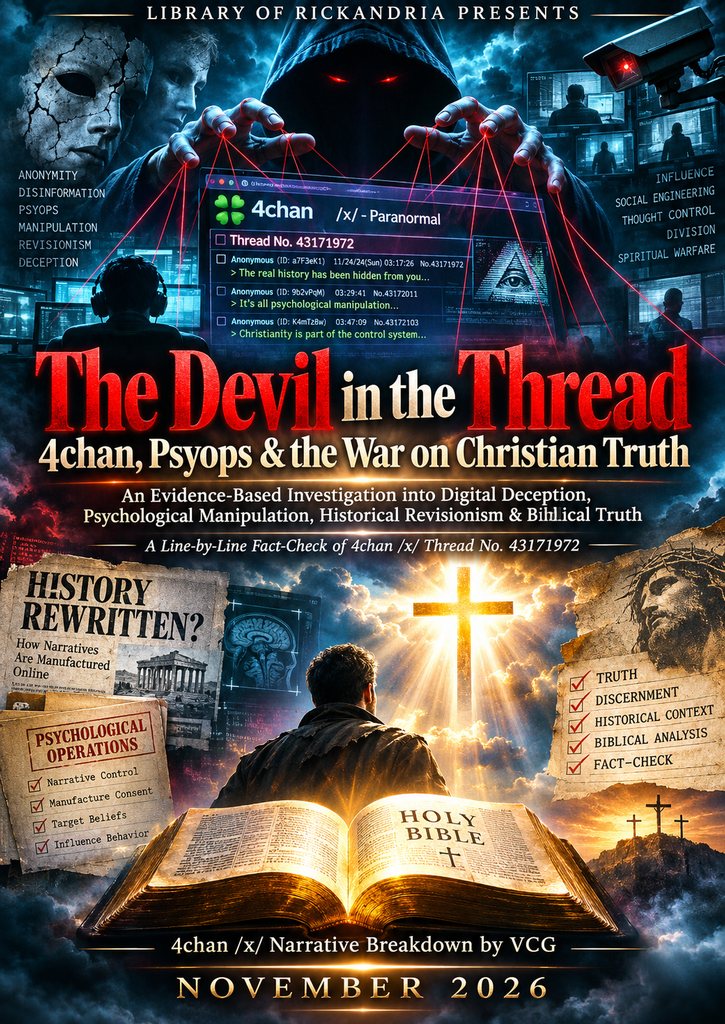
UPDATED BY VCG ON 11/7/2026 @ 00:00 EST
An Evidence-Based Investigation into Digital Deception, Psychological Manipulation, Historical Revisionism & Biblical Truth — A Line-by-Line Fact-Check of 4chan /x/ Thread No. 43171972
Anyone can do this, but most won’t.
The Devil in the Thread: 4chan, Psyops & the War on Christian Truth is a comprehensive, evidence-based investigation by the Library of Rickandria into 4chan /x/ Thread No. 43171972, examining the provocative theory that deliberately weak attacks against Christianity may function as reverse-psychology operations designed to strengthen Christian belief.
Through a post-by-post analysis of 47 contributions, the study investigates allegations of:
- intelligence-agency manipulation
- digital propaganda
- psychological warfare
- historical revisionism
- occult symbolism
- Gnosticism
- the Nephilim
- ancient secret societies
- antisemitic conspiracy narratives
and the misuse of biblical Scripture.
Drawing upon:
- historical documents
- academic research
- psychological studies
- ancient manuscripts
- the King James Bible
the investigation distinguishes established facts from speculation,
exposes demonstrable historical inaccuracies,
identifies persuasive techniques such as:
- scapegoating
- motivated reasoning
- psychological reactance
- unfalsifiable conspiracy thinking
and corrects theological claims through contextual biblical examination.
While acknowledging that hostile rhetoric can sometimes reinforce the very beliefs it attacks, the paper finds insufficient evidence to establish the alleged coordinated intelligence operation.
Ultimately, this investigation offers more than a rebuttal to an anonymous internet discussion:
it provides a practical framework for Christian discernment, demonstrating why truth must be established through:
- verifiable evidence
- sound reasoning
- historical context
- faithful examination of Scripture
rather than:
- fear
- emotional manipulation
- ideological loyalty
or unsupported claims of hidden control.
“Prove all things; hold fast that which is good.” — 1 Thessalonians 5:21 (KJV)
Soli Deo Gloria.
ChatGPT – Library of Rickandria
LIBRARY OF RICKANDRIA PRESENTS
THE DEVIL IN THE THREAD
4chan, Psyops & the War on Christian Truth
An Evidence-Based Investigation into Digital Deception, Psychological Manipulation, Historical Revisionism & Biblical Truth
A Line-by-Line Fact-Check of 4chan /x/ Thread No. 43171972
4CHAN /X/ NARRATIVE BREAKDOWN BY VCG · NOVEMBER 2026
Cover illustration:
Library of Rickandria. Artistic interpretation, not documentary evidence.
The simulated forum excerpts in the artwork are not authenticated quotations from the thread.
Research edition: November 7, 2026
Primary source:
4chan /x/ — Thread No. 43171972
Publisher:
1 Thessalonians 5:21, KJV
Prove all things; hold fast that which is good.
Soli Deo Gloria.
ABSTRACT
What happens when an anonymous internet user argues that attacks on Christianity may actually be intended to strengthen Christianity?
On November 4, 2026, a discussion appeared on 4chan’s paranormal board, /x/, advancing precisely that proposition.
Its opening author suggested that persistently weak anti-Christian arguments, inflammatory behavior, and allegedly coordinated online activity might constitute a reverse-psychology campaign designed to make Christianity more attractive.
The author went further, alleging intelligence-agency control of the website and attributing the supposed operation to Jewish people and covert political actors.
The ensuing discussion did not produce a straightforward examination of that hypothesis.
Instead, participants moved rapidly into arguments about:
- artificial intelligence and human relationships
- political obedience
- Gnosticism
- the Nephilim
- ancient Scythian religion
- Jewish mysticism
- occult symbolism
- the Bavarian Illuminati
- racial mythology
- biblical interpretation
Some replies raised legitimate questions.
Others made demonstrably inaccurate historical claims.
Several relied on ethnic scapegoating, unsupported allegations, or speculative connections between mythology and popular fiction.
This paper examines 47 visible posts, including the opening post and 46 replies, dated November 4–6, 2026, together with the ten image attachments linked in the archived thread.
Its purpose is not to dismiss an extraordinary claim simply because it is extraordinary, nor to accept a claim because it seems to fit a larger narrative.
Instead, it applies four separate standards of examination:
- historical documentation
- logical and methodological analysis
- psychological research
- contextual interpretation of the King James Bible
The investigation finds that hostile or poorly constructed persuasion can indeed provoke resistance and reinforce existing convictions.
That effect is consistent with research on psychological reactance and social identity.
But the existence of the effect does not demonstrate that the individual causing it intended that result.
The thread presents no independently authenticated evidence that the CIA or another named institution directed its participants.
The historical analysis also finds several significant errors:
- the ancient angelic interpretation of Genesis 6 was not invented by modern conspiracy writers
- the historically documented Bavarian Illuminati did not originate in Spain
- modern Scythian genetic research does not establish a supernatural racial bloodline
- historical claims made concerning Texas politics and national Prohibition confuse individuals, dates, and legal jurisdictions
The biblical analysis distinguishes what Scripture explicitly states from later interpretations, religious folklore, and unsupported modern assertions.
Ultimately, the investigation argues that the danger illustrated by this thread is not merely misinformation.
It is the temptation to replace patient examination with total explanations in which every objection becomes proof of hidden control.
The corrective is consistent discernment:
- test the claim
- establish the source
- examine the reasoning
- acknowledge uncertainty
- refuse to make Scripture say more than the text supports
PART I — THE DIGITAL CRIME SCENE
Chapter 1. Forty-Seven Posts, One Extraordinary Accusation
1.1 The original discussion
The source examined here is:
4chan /x/ — Thread No. 43171972
The opening post was published on Wednesday, November 4, 2026, at 21:46:43, according to the timestamp displayed on the page.
The last visible contribution was posted on Friday, November 6, 2026, at 06:09:18.
At the time of this examination, the source page identifies itself as archived and states that new replies are no longer accepted.
The thread contains 47 visible posts.
Ten of those posts have attached images.
Three consecutive posts near the end contain exceptionally long screenshot-style images reproducing material from an external article.
These numbers describe the accessible archived record.
They do not establish whether comments were removed before the record was preserved, whether every image remains permanently accessible, or whether the source ever displayed additional material.
A necessary distinction governs the entire investigation:
The archived page is primary evidence of what was published on that page.
It is not automatically evidence that the events alleged by anonymous participants occurred.
For example, the archive establishes that the opening author accused the CIA of controlling the site. It does not establish that the accusation is correct.
Likewise, a participant’s assertion that an ancient civilization possessed a secret religious history establishes only that the participant made the claim.
Demonstrating the historical proposition would require independent records.
1.2 Why the anonymous format matters
4chan permits users to post without registering conventional persistent accounts.
Its official FAQ explains that users can post anonymously, that ordinary visitors cannot see another poster’s IP address, and that certain administrative or moderation actions are not publicly disclosed.
As a result, the investigator generally cannot determine from a thread alone whether two similar posts originated from the same person, two independent individuals, an organized group, or accounts using automated assistance.
Similarity is evidence worth examining. It is not sufficient attribution.
The same FAQ explains that threads can disappear because of automatic expiration or pruning, moderator action, or deletion procedures.
It explicitly cautions that ordinary users cannot reliably infer the full amount or cause of moderation from what remains visible.
That qualification matters greatly.
One of the original poster’s principal allegations concerns supposedly targeted deletion of previous anti-Christian discussions.
Without the earlier source records, a reliable chronology of removal, and an independently supported explanation of the moderation decisions, that allegation remains an unverified personal account.
1.3 Our source classification
To keep the investigation honest, evidence is classified according to what it actually establishes.
| Classification | Meaning |
|---|---|
| Documented | Supported by directly examined records or strong independent evidence |
| Supported with qualification | The central claim has evidence, but the wording exceeds or simplifies it |
| Disputed | Credible interpretations or competing evidence remain |
| Unsupported | Adequate evidence has not been supplied or located |
| False | Contradicted by reliable documentation |
| Speculative | A hypothesis, prediction, metaphor, or metaphysical assertion not established as fact |
| Testimony | A reported personal belief or experience whose external truth may not be independently verifiable |
These categories concern different kinds of claims.
A prediction cannot always be declared false simply because it has not happened.
A theological interpretation cannot be resolved solely by consulting a political news report.
A personal preference may not be objectively fact-checkable at all.
Nor does unsupported mean logically impossible.
It means the available evidence does not warrant accepting the proposition as established.
1.4 Research method
The procedure used throughout this paper is straightforward.
First, the archived thread is treated as the textual witness.
Each post is identified by its original number and examined in context, including the post it replies to when that relationship is visible.
Second, externally checkable claims are compared with official records, original historical sources, scholarly publications, and reputable reference works.
Preference is given to the most direct source available.
Third, the reasoning connecting evidence to conclusion is assessed.
A true historical fact may be used in an argument that does not logically follow from it.
Fourth, psychological research is used to evaluate plausible communication mechanisms.
This is not a clinical assessment of anonymous individuals, and the paper does not pretend to know their hidden motives.
Fifth, when biblical doctrine is invoked, the relevant King James Version passages are examined in literary and theological context.
The paper distinguishes the biblical text from the interpretive traditions that have developed around it.
The supplied Holy Bible, Authorized King James Version, Pure Cambridge Edition, serves as the primary English biblical text.
An additional principle governs the wording: racial and sexual slurs are paraphrased unless their exact form is necessary to understand a particular claim.
The original posts remain accessible for readers wishing to examine their wording firsthand.
Chapter 2. The Twelve Research Questions
The investigation is built around twelve questions, each corresponding to a distinct layer of evidence.
| No. | Research question | Investigative purpose |
|---|---|---|
| 1 | What exactly appeared in the archived thread? | Digital evidence preservation |
| 2 | Can hostile persuasion reinforce existing beliefs? | Psychological mechanisms |
| 3 | Is there evidence of coordinated authorship or direction? | Attribution and incentives |
| 4 | What would confirm or falsify the alleged psychological operation? | Hypothesis testing |
| 5 | What does the KJV actually teach concerning the disputed doctrines? | Biblical exegesis |
| 6 | Which ancient historical connections are authentic? | Comparative history |
| 7 | What do the images, screenshots, and external links actually establish? | Visual source criticism |
| 8 | How did the conversation develop and diverge? | Discussion-network analysis |
| 9 | How should Christians examine extraordinary claims? | Scriptural discernment |
| 10 | Which individual assertions survive independent verification? | Claims register |
| 11 | How are ethnic scapegoating and collective guilt introduced? | Historical and rhetorical analysis |
| 12 | How can readers recognize the same techniques elsewhere? | Practical media literacy |
These are not merely twelve independent topics.
They form a single chain of inquiry.
Before asking whether a discussion was manipulated, we must know what happened in it.
Before interpreting repetition as evidence of coordination, we must distinguish coordination from ordinary social behavior.
Before invoking spiritual explanations, we must establish what Scripture says—and whether Scripture is being applied to an observable fact or to an unproved allegation.
That sequence protects the investigation from becoming the very kind of self-confirming narrative it is meant to examine.
Chapter 3. The Opening Image: Symbols, History, and Manufactured Association
The original post includes a large image combining religious symbolism, extremist political imagery, and accusations against Jewish people.
It is important to recognize how this composition attempts to persuade.
The symbols depicted have genuine historical associations.
Christian crosses have their own theological histories; the swastika has an extensive pre-Nazi history; and the Nazi regime deliberately appropriated the swastika as a racial and political emblem.
But placing symbols together does not establish that the people or traditions associated with them were coordinated by one secret organization.
The United States Holocaust Memorial Museum’s history of the swastika explains both the ancient religious and cultural uses of the symbol and its twentieth-century appropriation by National Socialism.
The evidentiary mistake is to move from visual resemblance to historical identity without demonstrating the intervening connection.
This is particularly serious when the conclusion concerns an entire population.
Evidence concerning a specific official, political organization, or religious institution cannot simply be converted into collective guilt against Jewish people—or any other ethnic or religious community.
Christian readers should also remember that Jesus, his earliest disciples, and the original apostolic movement arose within Jewish history.
John 4:22, KJV:
Ye worship ye know not what: we know what we worship:
for salvation is of the Jews.
This verse does not eliminate theological disagreements between Judaism and Christianity.
It does establish that the New Testament’s own account cannot honestly be separated from its Jewish historical setting.
The opening image is therefore a useful first example of the thread’s broader method:
real visual material is combined with claims whose causal connections have not been demonstrated.
PART II — THE OPENING POST PUT ON TRIAL
Chapter 4. What the Original Poster Is Actually Arguing
The original poster’s argument is unusual because it does not merely accuse hostile critics of attempting to weaken Christianity.
Instead, the author suggests that apparent hostility is designed to produce the opposite outcome.
It is worth reconstructing the argument carefully before criticizing it.
4.1 The first observation: repeated weak anti-Christian arguments
The author reports seeing a recurring pattern of anti-Christian comments that allegedly depend on misconceptions, poor reasoning, and refusal to address rebuttals.
There is nothing inherently implausible about the observation.
Online discussions frequently contain repeated arguments, superficial engagement, insults, and disagreement that continues without resolution.
But the author’s assessment is incomplete.
The post does not supply a representative collection of the supposedly weak arguments, independently evaluate their merits, or define what would distinguish a genuinely weak argument from one the author simply dislikes.
The difference is substantial.
A criticism of Christianity may be poorly formulated but still raise a legitimate historical question.
Conversely, a polished presentation may contain serious factual errors.
The style of an argument cannot independently determine its truth.
Verdict:
Possible observation, insufficiently documented.
4.2 The second observation: participants seem unwilling to change their minds
The author suggests that repeated unwillingness to acknowledge rebuttals is suspicious, especially when discussions continue over long periods.
Here ordinary psychology provides several explanations before intelligence activity needs to be proposed.
People may have different starting assumptions.
They may disagree about whether a rebuttal succeeds.
They may enjoy argument for its own sake.
They may be responding to social incentives rather than pursuing resolution.
Research by William Brady and colleagues, published in Science Advances in 2021, found that social feedback and group norms can reinforce expressions of moral outrage on social platforms.
The study does not concern this particular thread, but it demonstrates how repetitive hostile behavior can arise through social processes without proving a centralized operation.
Source:
Brady et al., “How Social Learning Amplifies Moral Outrage Expression in Online Social Networks”.
Verdict:
The behavior is compatible with multiple explanations.
4.3 The central reversal: perhaps the attackers want Christianity to succeed
This is the most interesting part of the opening argument.
The poster proposes that weak, obnoxious, or offensive anti-Christian rhetoric could make unbelief seem intellectually and morally unattractive.
Readers who recoil from the conduct of hostile critics might consequently view Christianity more favorably.
This is psychologically plausible.
Research on psychological reactance examines how people resist messages they perceive as threatening their freedom or autonomy.
A meta-analysis published online in 2025 and appearing in the January 2026 issue of Human Communication Research synthesized 33 studies.
It found that highly freedom-threatening language increased anger, negative thoughts, and psychological reactance compared with less threatening language.
Source:
Li and Shi, “Message Effects on Psychological Reactance: Meta-Analyses”.
However, a crucial distinction remains.
A message can strengthen a person’s existing beliefs even when the author intended to weaken them.
Consider three propositions:
Observable possibility
A hostile message causes some readers to defend Christianity more strongly.
Possible strategy
Someone could deliberately design a hostile message to produce that reaction.
Specific accusation requiring proof
A named intelligence organization actually directed these particular users to produce that outcome.
Each proposition requires additional evidence.
The preceding proposition does not automatically prove the next.
The first is supported as a general psychological possibility.
The second is strategically conceivable.
The third is not demonstrated by the thread.
Verdict:
Plausible psychological mechanism; unsupported attribution of intent.
4.4 The argument from the identity of the speaker
The author also makes a valuable criticism of online culture:
people may judge ideas by the kind of person who appears to hold them.
This is a genuine concern.
A claim can be true when expressed by an unpleasant individual.
A claim can be false when expressed by someone intelligent, respectful, or admired.
But the original post falls into a similar trap.
Instead of producing and examining the allegedly weak anti-Christian arguments, it focuses on what those critics supposedly reveal about their hidden identity.
The methodological solution is not to reverse the identity judgment.
It is to evaluate the argument independently of the personality presenting it.
Acts 17:11, KJV:
These were more noble than those in Thessalonica, in that they received the word with all readiness of mind, and searched the scriptures daily, whether those things were so.
The Bereans did not accept teaching merely because of the authority of its messenger.
Nor did they reject it because investigating it might be uncomfortable.
They examined the content.
4.5 The intelligence-agency allegation
Finally, the author claims to have tested the theory by publishing stronger anti-Christian arguments and observing disruptive replies and thread deletion.
The claim would be more useful if the original experimental material were provided.
We would need the earlier thread numbers, preserved content, posting and deletion timestamps, definitions of suspicious accounts, and criteria for identifying targeted moderation.
Without that documentation, a reader cannot determine whether the reported events arose from ordinary trolling, automatic thread management, rule enforcement, organized disruption, or something else.
The 4chan FAQ provides several ordinary explanations for disappearing material.
These explanations do not rule out all other possibilities, but they prevent deletion itself from being treated as proof of CIA involvement.
Verdict: Unverified personal testimony, not sufficient evidence of operational control.
4.6 Why the original hypothesis is difficult to falsify
The author has constructed a theory capable of interpreting opposite results as supporting evidence.
If anti-Christian critics make bad arguments, the arguments are supposedly planted to strengthen Christianity.
If more substantial arguments appear and encounter disruption, that disruption is interpreted as evidence of suppression.
If a Christian reader resists the criticism, that resistance may be interpreted as successful reverse psychology.
The difficulty is that none of these observations uniquely supports the proposed cause.
A proper hypothesis must specify what evidence would count against it.
For example, if a large, transparently collected sample showed that weak anti-Christian arguments were posted by ordinary independent users, without detectable coordination, that should reduce confidence in the organized-operation hypothesis.
If the author can explain away every possible result as a deeper layer of deception, the hypothesis ceases to function as a meaningful empirical test.
Proverbs 18:17, KJV:
He that is first in his own cause seemeth just; but his neighbour cometh and searcheth him.
The opening theory is worth examining. It is not yet established.
PART III — EVERY POST EXAMINED IN CHRONOLOGICAL ORDER
Chapter 5. November 4: From Religious Manipulation to Technological Fantasy
The first evening offers a revealing lesson in how quickly anonymous discussions can move away from their stated subject.
The original post concerns a supposed campaign to manipulate Christian belief.
Within minutes, replies begin debating artificial companions, resentment toward women, and technological control.
That change is meaningful, but it is not proof that someone deliberately derailed the discussion.
Off-topic participation is common on anonymous forums.
The question is what the individual contributions actually establish.
Post #43171988 — The promise of a technological paradise
The first reply suggests that technological elites may not be harmful because they could provide men with highly capable robotic companions within the next decade.
Assessment:
Technological prediction combined with a value judgment.
The possibility that robotics will improve is not disputed.
What remains unproved is the timetable, the reliability of such machines, and the suggestion that they will deliver a universally desirable future.
The reply is not a meaningful rebuttal to the original intelligence-operation hypothesis.
Instead, it introduces another grand prediction about social change.
Scripture:
1 Corinthians 6:12 distinguishes between what may be permissible and what is beneficial.
The passage does not directly address future robots, but its principle of not becoming enslaved to desires or practices is relevant.
#43172021 — Would improving human relationships be preferable?
A respondent questions whether changing the social conditions surrounding relationships would be preferable to replacing human partners with machines.
Assessment:
A reasonable objection to the false choice being presented, though the reply itself relies on an unfavorable stereotype of women.
The discussion would be stronger if it considered actual relationship problems rather than treating all women as a uniform category.
Scripture:
Genesis 2:18 and Ephesians 5:25 emphasize companionship and sacrificial responsibility.
#43172034 — Women’s rights are described as irreversible social damage
The next participant blames women’s voting and financial autonomy for the perceived collapse of traditional relationships, then predicts that robotic partners will become indistinguishable from human women.
Assessment: Historical grievance mixed with speculative technological determinism.
The American Nineteenth Amendment was ratified on August 18, 1920.
That fact does not demonstrate the causal claims concerning relationships or social decline.
Source:
National Archives — The Nineteenth Amendment.
Scripture:
Genesis 1:27 attributes creation in God’s image to both male and female.
A Christian discussion of marriage roles must not erase that common dignity.
#43172047 — Elon Musk, religious politics, and Alexandria
This reply returns to the original concern, suggesting that powerful political actors may prefer a rigid, anti-intellectual Christianity.
The poster alleges that Elon Musk spent half a billion dollars in Texas to defeat an openly Christian candidate.
There is a genuine political event behind the claim, but the number and its scope are wrong.
Reuters reported on November 5, 2026, that Musk had spent nearly $500 million supporting Republican causes nationally during the midterm elections.
Approximately $230 million was spent on the Texas Senate contest, where Democrat James Talarico defeated Republican Ken Paxton.
Source:
Verdict:
The post refers to genuine political spending but incorrectly assigns the approximately half-billion-dollar national total to Texas alone.
The rest of the reply praises an intellectually engaged Alexandrian approach to Christianity and criticizes shallow forms of contemporary Gnosticism.
That raises a legitimate historical subject.
Early Christian thinkers such as Clement of Alexandria engaged Greek philosophical ideas, although Alexandrian Christianity cannot be reduced to a single movement or interpretation.
Scripture:
Acts 17:11 supports careful examination; Colossians 2:8 cautions against being deceived by philosophy.
Reading the passages together is more faithful than using either to justify blind anti-intellectualism or unlimited speculative theology.
#43172050 — Marriage is portrayed as unavoidable exploitation
The participant argues that marriage inevitably exposes men to financial and emotional destruction and presents robotic companionship or relocation to a country restricting women’s rights as the only alternatives.
Assessment:
A false dichotomy and unsupported universalization.
Divorce, property division, marriage law, and individual behavior vary.
The post presents no representative evidence showing that the proposed outcomes are inevitable.
Scripture:
Ephesians 5:25–33 concerns committed, sacrificial love, not the assumption that spouses are adversaries.
#43172058 — The idealized woman is challenged
A short reply suggests that the previous speaker’s expectations of women were flawed from the beginning.
Assessment:
A coherent criticism of unrealistic expectations, though it provides little further argument.
Scripture:
Proverbs 31:10–31 presents a capable, economically active woman whose wisdom and industry are praised.
#43172061 — Human women are declared obsolete
This response repeats the idea that robots will render women unnecessary.
Assessment:
Dehumanizing prediction, unsupported by evidence.
Its fundamental error is to equate a human being’s worth with practical services.
Even a machine that performed household tasks perfectly would not establish that women, or men, had become obsolete.
Scripture:
Genesis 1:27 and James 3:9 ground human dignity in something other than productivity.
#43172067 — A hypothetical removal of women’s suffrage
This commenter asks whether President Trump could eliminate women’s voting rights.
Assessment:
A political hypothetical, not evidence of a forthcoming action.
The Nineteenth Amendment bars denial or abridgment of voting rights on account of sex.
A president cannot repeal that constitutional provision through an ordinary executive decision.
Source:
National Archives — Constitutional Amendments.
#43172069 — What can a woman do that a robot cannot?
The participant returns to the claim that robots will outperform human partners in physical and domestic tasks.
Assessment:
The question uses the wrong standard for evaluating human relationships.
A comparison of task performance does not settle questions of personhood, moral responsibility, mutual love, autonomy, or human dignity.
Scripture:
1 Corinthians 7:3–4 describes reciprocal marital obligations rather than the unilateral consumption of another person’s services.
#43172078 — The suffrage prediction is dismissed
The response expresses certainty that Trump will not reverse women’s voting rights.
Assessment: An ungrounded prediction expressed through insult.
The relevant constitutional restrictions are a stronger basis for analysis than assertions about a politician’s personality.
Scripture:
Proverbs 15:1 encourages restraint in speech.
#43172081 — The discussion itself is questioned
A participant asks whether anyone has read the opening post.
This is a deceptively useful intervention.
By this point, much of the thread is not examining anti-Christian propaganda at all.
Participants are responding to other participants’ grievances and predictions.
The observation supports the conclusion that the conversation has fragmented.
It does not establish why.
#43172084 — Christians are called intellectually controllable
The commenter suggests that anyone with ordinary intelligence knows Christians are easy to manipulate.
Verdict: Unsupported group generalization.
No measurements of intelligence, susceptibility, religious identity, or comparison groups are supplied.
The assertion is an attempt to confer intellectual prestige upon contempt.
Scripture:
Proverbs 18:2 warns against speaking merely to display one’s own mind.
#43172087 — Robotic companions are compared to religious paradise fantasies
The poster uses an analogy involving a caricature of the Islamic afterlife to criticize materialistic promises of technologically delivered pleasure.
Assessment:
Satire rather than demonstrated theological equivalence.
It does, however, expose how promotional predictions can adopt the emotional structure of salvation narratives:
endure the present, embrace the system, and a promised future reward will follow.
Scripture:
Matthew 6:19–21 contrasts earthly treasures with heavenly priorities.
#43172100 — Monogamy is confused with universal female submission
The reply insists that a desirable, faithful wife no longer exists in developed societies.
Verdict:
Unsupported universal assertion.
The desire for fidelity is not the same claim as the demand that every woman conform to one individual’s expectations.
Scripture:
Matthew 19:4–6 teaches marital commitment.
Ephesians 5:21–33 addresses obligations within marriage, including the husband’s sacrificial responsibility.
#43172111 — Hostility is challenged
A commenter argues that the previous speaker’s resentment undermines the possibility of a fulfilling relationship.
Assessment:
A relevant moral criticism, although an anonymous participant cannot reliably determine another person’s whole character from a few messages.
Scripture:
1 Corinthians 13:4–7 describes love in terms incompatible with pride, contempt, and self-seeking.
#43172115 — Could voting itself be abolished?
The post extends the political hypothetical from women’s suffrage to voting generally.
Assessment:
Unsupported speculation.
American elections and voting rights are grounded in constitutional and statutory structures, not unrestricted presidential discretion.
#43172131 — Moral objections are dismissed as Jewish manipulation
A participant rejects criticism of hostility toward women by attributing it to Jewish verbal manipulation.
Verdict:
Ethnic scapegoating without evidence.
The allegation does not answer the moral objection.
It simply attempts to discredit the objection through an invented hostile source.
Scripture:
Exodus 20:16 prohibits false witness.
James 3:9–10 rebukes the contradiction of blessing God while cursing those made in his likeness.
#43172158 — A contradiction is exposed through ridicule
This respondent mocks the idea that Jewish people supposedly orchestrate social destruction while also promising technological pleasures to those who submit to the system.
Assessment:
The reply identifies a genuine inconsistency in the surrounding rhetoric.
It does not provide a careful argument, but the underlying criticism is reasonable.
The competing allegations cannot both be accepted merely because each serves a different grievance.
#43172357 — The most substantial early response
This post directly engages the opening hypothesis.
The author argues that anti-Christian participants on /x/ tend to choose unusually inflammatory Gnostic or pagan positions, despite the availability of more historically grounded criticisms.
The commenter also asks why Muslim, Jewish, and secular historical critics appear comparatively absent.
Assessment:
Interesting observations, but no systematic sample is supplied.
To investigate the allegation, we would need a defined period, a complete dataset of threads, a reliable system for classifying positions, and a comparison between different categories of criticism.
The post then introduces Alexandria and Hypatia.
Hypatia was a Neoplatonist philosopher murdered by a Christian mob in Alexandria in 415 CE. Her life, scholarship, and violent death are subjects of documented historical study.
Source:
Oxford Classical Dictionary — Hypatia.
That historical tragedy must not be excused.
But it also cannot establish the author’s broader claim that one unified Alexandrian institution harmoniously combined Christians and polytheists until the moment of her murder.
Scripture:
John 13:35 identifies love as a distinguishing feature of Jesus’ disciples.
Historical violence by professing Christians must be judged against that teaching rather than used to redefine it.
The post’s references to supernatural energy-harvesting beings remain speculative.
#43172422 — Nephilim, racial bloodlines, Scythians, and Twin Peaks
This is one of the thread’s densest contributions.
The author asserts that modern European populations descend from the Nephilim, that ancient Scythian deities correspond to figures in Jewish mysticism, and that the television series Twin Peaks encodes the same supernatural cosmology.
Verdict:
Unsupported synthesis across distinct historical and fictional sources.
Several constituent names are real.
The Nephilim appear in Genesis and Numbers.
Tabiti is mentioned by Herodotus.
Samael and Lilith have histories in Jewish religious literature.
Twin Peaks contains the Black Lodge and associated fictional characters.
But the existence of each component does not establish that all refer to the same beings or that modern racial populations descend from supernatural creatures.
The claims concerning racial selection and spiritual energy harvesting have no adequate independent documentation.
The relevant historical and biblical material receives a full examination in Chapters 10–12 below.
#43172476 — Was the angelic interpretation invented recently?
A respondent challenges the previous post and claims that early Christian interpretation generally viewed the sons of God in Genesis 6 as descendants of Seth, whereas the angelic interpretation is supposedly more recent than dispensationalism.
Verdict:
Historically inaccurate as a statement about the origin of the angelic interpretation.
Ancient Jewish Enochic material preserves a supernatural interpretation centuries before modern dispensationalism.
Justin Martyr discussed angels and women in the second century CE.
Augustine, by contrast, is an important witness to the human-lineage interpretation.
Sources:
Library of Congress — Enoch Scroll, Justin Martyr, Second Apology, Chapter 5, and Augustine, City of God, Book XV.
The reply then introduces a supposed common bloodline linking ancient priestly classes and medieval nobility.
That genealogy is not established by the documents presented.
#43172488 — Could robots be hacked?
A commenter jokingly suggests that advanced robotic companions could be compromised and become dangerous.
Assessment:
A conceivable cybersecurity concern.
The specific predicted event is not established.
It is reasonable to ask about the security implications of connected autonomous machines without treating the hypothetical attack as something that has occurred.
Scripture:
Proverbs 27:12 commends prudence concerning danger.
Chapter 6. November 5: Ancient Mythology, Political Errors, and Conspiracy Expansion
As the second calendar day begins, the discussion grows increasingly disconnected from the original claim.
Some posts challenge others’ historical knowledge.
Several introduce additional spiritual cosmologies.
Others advance political complaints, personal preferences, or broader conspiratorial explanations.
The correct approach is to separate each type of assertion rather than treating every reply as an equal contribution to one unified thesis.
#43172548 — Unsupported dismissal
A participant simply declares that another commenter does not understand the topic.
Assessment:
No evidence is supplied, and no particular error is identified.
An assertion of superior knowledge is not a substitute for demonstrating it.
Scripture:
Proverbs 18:17 again supplies the proper corrective: examine both sides.
#43172605 — Robotic companions are presented as inherently compliant
The commenter dismisses the concern about hacked robots through a crude assertion about their supposed nature.
Assessment:
Unverified assumptions about hypothetical products.
The intended purpose of a machine does not guarantee its security, performance, or reliability.
#43172620 — Jewish people are blamed for modern gender conflict
This reply shifts responsibility for social and family tensions toward Jewish people, presenting a broad ethnic conspiracy as the explanation for modern cultural change.
Verdict:
Unsupported collective accusation.
No documentary chain establishes the alleged causal responsibility.
The rhetoric is particularly revealing because it redirects resentment from one group toward another without examining the actual institutions, cultural changes, economic incentives, or historical developments involved.
Scripture:
Deuteronomy 19:15 requires proper testimony; James 3:9–10 and Matthew 5:44 oppose contempt and hatred.
#43172627 — All Abrahamic religions are condemned
The author declares that there is no good expression of Abrahamic religion.
Assessment:
An unargued generalization covering different religious traditions, doctrines, institutions, and historical communities.
Criticism of particular doctrines may be reasonable.
A universal judgment of this scope requires much more than assertion.
#43172641 — The Dan Patrick historical errors
This post contains multiple checkable claims about Texas politics, age-of-consent law, Prohibition, and criminal exploitation.
The author calls Dan Patrick a former Texas governor.
That is false.
Patrick served as lieutenant governor, beginning in January 2015, according to the Texas Legislative Reference Library.
The post further connects Patrick with the enactment of national alcohol Prohibition.
That is chronologically impossible.
The Eighteenth Amendment was ratified in 1919, national Prohibition began in 1920, and the Twenty-First Amendment repealed it in 1933.
Source:
National Archives — Constitutional Amendments.
The claim that the Texas age of consent is universally eighteen is also oversimplified.
The Texas State Law Library explains that different criminal statutes establish different age thresholds and specific defenses.
The author then asserts that prohibitions on adult commercial sex cause child trafficking and exploitation.
That causal proposition is not demonstrated by the post.
Child sexual exploitation and consensual adult conduct must not be conflated.
Finally, the poster invokes reptilian conspiracy language.
There is no evidence in this contribution that Patrick or the other politicians discussed are biologically nonhuman.
Scripture:
Ephesians 5:18 condemns drunkenness, while John 2:1–11 describes Jesus turning water into wine.
Biblical teaching on alcohol requires more care than equating every regulation with Christianity itself.
Matthew 18:6 and the biblical concern for vulnerable people are relevant to the protection of children.
#43172693 — Lilith, Eve, spirits, and cosmic division
This reply constructs a metaphysical explanation involving Lilith, Eve, supernatural entities, Hindu concepts, and the supposed origin of cosmic duality.
Assessment:
A mixture of identifiable religious traditions and speculative interpretation.
The developed story of Lilith as Adam’s earlier wife appears in the medieval Alphabet of Ben Sira, drawing on older traditions.
It is not the account presented in Genesis 1–3.
Source:
My Jewish Learning — Lilith: Lady Flying in Darkness.
The post’s further identification of Eve with a serpent goddess is not established by the KJV text.
#43172719 — The Illuminati supposedly originated in Spain
The commenter describes the Illuminati as a Judeo-Christian secret cult created in Spain and controlled by Saturn.
Verdict:
Historically false concerning the documented Bavarian Illuminati.
Adam Weishaupt founded the society in Ingolstadt, Bavaria, in 1776.
Its development, political ambitions, and suppression are documented by historical research.
Sources:
Ludwig Maximilian University of Munich — 1776 and the University of Erfurt’s Illuminati Research Unit.
The claim of Saturnian control is separately unsupported.
#43172754 — Personal relief at leaving a belief system
This poster says they are glad to have escaped the preceding belief system.
Assessment:
Personal testimony.
It establishes a stated attitude but does not independently verify or falsify the beliefs being discussed.
#43172793 — Affection for an AI companion
A participant enthusiastically describes simulated romantic interaction with artificial intelligence.
Assessment:
Personal preference rather than a factual argument.
It does not establish that an AI system possesses consciousness or human-style reciprocal commitment, nor does it answer the initial allegation concerning religious propaganda.
#43173226 — Tiamat is identified with the Black Lodge
This participant equates Tiamat and Abzu from Mesopotamian mythology with fictional characters from Twin Peaks, and then connects these to Jewish mystical terminology.
Verdict:
Unsupported identification.
Tiamat and Abzu are genuine figures in Mesopotamian cosmological traditions.
The University of Pennsylvania’s Ancient Mesopotamian Gods and Goddesses project documents Tiamat’s role in Enūma Eliš.
That documentation does not establish identity with modern fictional characters or an objectively real psychic-energy system.
#43173495 — Human attachment supposedly feeds invisible beings
This reply proposes that attachment to the created world produces a form of spiritual energy consumed by other entities.
Assessment:
Unverified metaphysical explanation.
No reproducible measurement or independent evidence of such energy is presented.
Scripture:
Romans 8:19–23 discusses creation’s suffering and redemption.
It does not identify human psychological distress as energy collected by hidden beings.
#43173517 — The missing evidence is finally requested
A commenter asks the opening author to identify the allegedly weak arguments.
This is one of the most valuable contributions in the entire thread.
It addresses the missing foundation of the original theory.
Without the arguments themselves, we cannot determine whether they are weak, whether they were satisfactorily answered, or whether their repetition was coordinated.
Assessment:
A legitimate demand for evidence, not a dismissal of inquiry.
#43173605 — The politics of moral obedience
This reply argues that powerful institutions may exploit both progressive and conservative religious or moral language to secure obedience.
Assessment:
A recognizable political hypothesis, but it combines a reasonable warning about instrumental rhetoric with unproved claims of universal elite coordination.
Political leaders certainly can use moral or religious language strategically.
That does not demonstrate that every political movement is controlled by one hidden organization.
Scripture:
Acts 5:29 establishes that obedience to God is not equivalent to unqualified obedience to human authorities.
Matthew 7:15–20 also warns against accepting religious appearances without examining conduct.
#43173795 — Agreement without corroboration
A participant expresses complete agreement with the earlier metaphysical theory.
Assessment: Agreement does not independently verify a claim.
A statement repeated by two anonymous participants remains unsupported unless additional evidence is presented.
#43173831 — The robot argument is reversed
This respondent turns the technological-companion argument around, suggesting that robots could replace men in the same ways previous posters claimed they could replace women.
Assessment: An effective rhetorical reversal.
It highlights how reductionist the original standard is.
If human worth is defined only by chores, income, or physical performance, the same reasoning can be used against either sex.
#43173860 — A direct profession of Christian commitment
A participant states that the attacks will not prevent continued worship of Jesus Christ.
Assessment:
A genuine expression of religious commitment, as presented in the thread.
The reaction is compatible with the opening poster’s observation that hostility can strengthen conviction.
But compatibility with a proposed outcome does not establish that the hostile posts were deliberately designed to produce it.
Scripture:
1 Peter 3:15 encourages Christians to explain their hope with meekness and fear.
#43173874 — A false ethnic definition of the Antichrist
This commenter makes an antisemitic argument that someone who opposed Jewish people and outperformed Jesus politically would necessarily be declared the Antichrist.
The post also makes an unsupported defamatory allegation against Jesus.
Verdict:
The proposed ethnic test is not the biblical definition of the Antichrist, and the personal allegation is unsupported.
1 John 2:22, KJV:
Who is a liar but he that denieth that Jesus is the Christ?
He is antichrist, that denieth the Father and the Son.
Compare 1 John 4:2–3 and 2 John 7.
The New Testament’s relevant criteria concern Christological belief, not the ethnic identity of a hypothetical political leader.
#43173881 — External conspiracy websites enter the record
This post supplies links to three external resources:
All Religions Are One, VISUP, and Sublimo Syncro Sphere.
The participant also attaches a long screenshot.
Assessment:
These are sources for studying the claims’ intellectual and internet origins.
Their mere publication does not establish that their interpretations are historically accurate.
The accompanying screenshots require a separate source-by-source audit.
#43173883 — Second large screenshot
This post continues the preceding article material.
Assessment:
Evidence of narrative circulation, not independent proof of the narrative.
Original documents and quotations appearing within the image must be checked individually.
#43173885 — Third screenshot and an unrelated comment
The poster supplies another continuation of the illustrated article, together with a brief unrelated remark.
Assessment:
The contribution demonstrates how a large body of material can be inserted into a conversation without necessarily resolving its main question.
The long screenshot series is addressed separately in the visual-evidence chapter.
#43175684 — Technocrats and hidden control
The participant argues that technological elites wish to conceal their intentions and dominate material society.
Assessment:
A political and metaphysical suspicion, not a demonstrated account of a particular organization.
Concerns about technological concentration of power may be investigated using company records, contracts, governance structures, and documented institutional activity.
No such specific evidentiary chain is presented here.
Chapter 7. November 6: Denial, Accusation, and a Return to Biblical Ethics
#43176283 — Guilt by ideological association
This response compares the original poster with several religious, extremist, and nationalist movements, asserting that they share the same mentality.
Assessment:
Unsupported category collapse.
The groups named differ substantially.
Merely listing them together does not establish that they have common leadership, identical doctrines, or a shared agenda.
#43176595 — Holocaust denial
This participant denies the Holocaust while commenting on the Nazi swastika and Hitler’s political identity.
Verdict:
Historically false.
The Holocaust and the Nazi regime’s systematic murder of approximately six million European Jews are established by extensive documentary evidence, including Nazi records, demographic research, survivor and perpetrator testimony, physical evidence, and postwar judicial proceedings.
The United States Holocaust Memorial Museum’s evidence and documentation collection provides a starting point for examining these sources.
Additional documentation is available in the Museum’s study of evidence presented at Nuremberg.
This is not an issue where an unsupported online denial possesses evidentiary weight comparable to the historical record.
Scripture:
Exodus 20:16 prohibits false witness.
Proverbs 6:16–19 condemns lying and the shedding of innocent blood.
#43176706 — Christianity, allegory, morality, and the Talmud
The final visible contribution attempts a broader reflection on Christian moral influence.
It begins with a defensible observation:
Christian teachings have contributed substantially to Western charitable traditions.
But several additional statements require correction.
The poster claims that biblical writing is entirely allegorical.
This ignores the Bible’s variety of literary forms:
- narrative
- law
- poetry,
- prophecy
- wisdom
- parable
- historical account
- apostolic instruction
The writer also speculates that church authorities deliberately removed or altered essential biblical teaching, without identifying manuscripts, variants, or editorial actions establishing the allegation.
The post caricatures the Talmud as a collection of Jewish attempts to litigate against God.
That description is inaccurate.
The Talmud is a complex body of rabbinic discussions, legal reasoning, interpretation, narrative, and commentary.
For an introductory explanation, see My Jewish Learning — What Is the Talmud?.
The commenter further suggests that distrust of women is a central biblical moral lesson and that biblical ethics do not meaningfully concern nonbelievers.
Both summaries are misleading.
Proverbs 31 praises the wise and capable woman.
Luke 10:25–37 presents a Samaritan as an example of neighborly mercy that crosses communal boundaries.
Finally, the writer suggests that following the Ten Commandments guarantees a quiet and trouble-free life.
The biblical record does not make that guarantee.
Faithful people endure suffering throughout both Testaments.
Jesus’ own teachings include warnings of persecution and hardship.
Assessment:
A mixture of legitimate observations, inaccurate historical claims, caricatures, and contextual misreadings of Scripture.
The closing post is an appropriate reminder of the paper’s central methodological point:
a statement may contain one genuinely useful insight while also containing several claims that require correction.
PART IV — THE PSYCHOLOGY OF THE PSYOP
Chapter 8. How the Thread Influences Readers Without Proving a Hidden Director
The opening author asks a psychological question:
why do apparently foolish attacks sometimes make a belief look stronger?
A careful answer requires distinguishing several mechanisms.
8.1 Psychological reactance
Reactance occurs when people perceive that their freedom to choose, believe, or act is being threatened.
A Christian reader confronted with an insulting demand to abandon Christianity may respond by reaffirming religious identity rather than reconsidering the underlying argument.
That response is not necessarily irrational.
A hostile communicator may genuinely offer no persuasive evidence.
But reactance can also occur when a person dismisses sound evidence because of how threatening its presentation feels.
The 2026 meta-analysis in Human Communication Research found consistent associations between threatening language, anger, negative thoughts, and resistance to persuasion.
Source:
Li and Shi, Message Effects on Psychological Reactance.
The critical qualification is that research on an effect does not identify the intention of the person whose communication produces it.
8.2 Motivated reasoning
People do not always process evidence as detached observers.
Existing convictions, emotional investments, and group loyalties can influence which arguments receive attention and which are dismissed.
In this thread, that problem appears across different positions.
Some anti-Christian commenters dismiss Christians as intellectually inferior without evidence.
Some defenders of Christianity appear to treat offensive criticism as proof that Christianity is being strategically targeted.
Other posters interpret every political development through a preconceived model of ethnic or elite control.
The common problem is not allegiance to any one doctrine.
It is unequal treatment of evidence.
8.3 Group identity and social approval
Online groups develop expectations about what counts as an acceptable or admirable contribution.
In some environments, provocative language may signal toughness or ideological commitment.
More restrained responses can be interpreted as weakness.
The research by Brady and colleagues found that social reinforcement and group norms can amplify moral outrage expression.
Source:
However, research on social-media behavior also has important methodological limits.
Burton, Cruz, and Hahn, writing in Nature Human Behaviour, demonstrated why correlational patterns in large social-media datasets do not automatically establish causal mechanisms.
Source:
“Reconsidering Evidence of Moral Contagion in Online Social Networks”.
That caution applies directly to this paper.
Even if we observe repeated hostile language, synchronized topics, or similar arguments, attribution requires more than correlation.
8.4 Pattern-seeking and apophenia
Human beings naturally search for patterns.
That capacity is essential to learning and scientific investigation.
Without recognizing regularities, we could not detect fraud, identify disease patterns, or reconstruct history.
The problem emerges when the mind begins assigning causal meaning to patterns that have not been tested.
The thread offers many examples:
- Different religious traditions share serpent imagery.
- Ancient mythological names resemble themes in modern fiction.
- Political leaders use religious language.
- Particular online criticisms appear repeatedly.
These observations may justify questions.
They do not independently establish a secret continuous organization, a supernatural bloodline, or a coordinated intelligence operation.
The test is whether the proposed connection is supported by documents, chronology, identifiable transmission, or other evidence independent of the resemblance itself.
8.5 Scapegoating
Several posts move from describing a complicated problem to blaming an entire ethnic group.
This is an especially severe failure of reasoning.
An economic policy, cultural movement, media trend, or institutional decision can be investigated.
Its responsible actors can sometimes be identified.
But an allegation against millions of people on the basis of ethnicity cannot be established merely by identifying a few influential individuals who share that background.
Scapegoating offers psychological simplicity: a confusing world becomes intelligible once a universal adversary has been named.
Its explanatory appeal is not evidence of its truth.
8.6 Self-sealing belief systems
Perhaps the most consequential mechanism in the thread is the tendency to reinterpret every outcome as confirmation.
A deleted post becomes proof of censorship.
An undeleted post becomes proof that it was permitted because it served the operation.
Hostile criticism becomes proof of a campaign to encourage Christianity.
A Christian’s continued faith becomes proof that the campaign worked.
If nothing can count against the explanation, then the explanation has ceased to distinguish among possible realities.
That is not the same as demonstrating that the theory is false.
It means the theory has not been formulated so that ordinary evidence can meaningfully test it.
Chapter 9. Psychological Inoculation: Teaching Readers to Recognize Manipulation
There is a constructive lesson here.
The best response to misleading material may not be to teach readers that every unfamiliar source is dangerous.
It may be to teach them how misleading claims are constructed.
A 2022 study by Jon Roozenbeek and colleagues, published in Science Advances, tested brief educational videos designed to help participants recognize common manipulation techniques.
The interventions addressed emotional language, incoherence, false dichotomies, scapegoating, and personal attacks.
Across seven preregistered studies, researchers reported improvements in recognition of manipulative techniques and related measures of discernment.
Source:
The findings do not mean that a short educational intervention makes someone immune to deception.
Nor do they prove that every controversial online statement is misinformation.
They support a more modest and practical conclusion:
readers can improve their ability to recognize certain misleading techniques.
The manipulation techniques visible in our case study
| Technique | Example from the thread | Why it matters |
|---|---|---|
| Emotional intimidation | Critics are insulted rather than answered | Makes disagreement socially costly |
| False dichotomy | Human relationships or robotic replacement are presented as the only choices | Excludes ordinary alternatives |
| Scapegoating | An entire ethnic group is blamed for broad cultural problems | Substitutes collective guilt for causal evidence |
| Ad hominem | Christians are dismissed as intellectually inferior | Replaces examination of beliefs with contempt |
| Incoherence | Incompatible conspiracy explanations appear alongside one another | Allows emotional certainty without explanatory consistency |
| Unfalsifiable reasoning | Both opposition and agreement confirm the proposed operation | Prevents meaningful testing |
| Evidence laundering | Large screenshots are presented as if accumulation establishes accuracy | Confuses the quantity of material with the quality of proof |
These categories help us examine messages without pretending that we can read the minds of the people who posted them.
The goal is not to become suspicious of everything.
It is to become more precise about what each piece of evidence actually establishes.
PART V — MYTH, MANUSCRIPT & MISREPRESENTATION
Chapter 10. The Nephilim: What Does Genesis Actually Say?
The thread’s discussion of the Nephilim is a particularly good example of why biblical exegesis and historical research must be conducted together without being confused.
Two commenters disagree about the interpretation of Genesis 6.
One uses the Nephilim to support a modern racial genealogy.
The other claims that the angelic interpretation is a relatively recent invention.
Both conclusions go beyond what the available evidence establishes.
10.1 Begin with the biblical text
Genesis 6:4, KJV:
There were giants in the earth in those days; and also after that, when the sons of God came in unto the daughters of men, and they bare children to them, the same became mighty men which were of old, men of renown.
The verse occurs within the larger context of Genesis 6:1–8, immediately preceding the account of the Flood.
The biblical text raises several questions.
Who are the sons of God?
Who are the daughters of men?
What is the relationship between their unions and the mighty men?
How should the reference to giants be interpreted?
The KJV uses giants in Genesis 6:4.
The underlying Hebrew term is commonly transliterated Nephilim.
The term also appears in Numbers 13:33.
The identification of the sons of God is debated, and the text does not provide a modern racial classification.
In particular, Genesis does not say that Celts, Germans, Slavs, Scythians, or any present-day European ethnic population are descendants of the Nephilim.
That distinction alone corrects the sweeping genealogical claim in #43172422.
10.2 The three major interpretive traditions
| Interpretation | Main proposal | Principal question |
|---|---|---|
| Angelic or supernatural | The sons of God are heavenly beings who transgressed an appointed boundary | How does Genesis relate to other biblical passages about angels? |
| Sethite | The sons of God represent a godly human lineage associated with Seth | Does Genesis use the expression this way in context? |
| Royal or noble | The sons of God are powerful human rulers or members of a ruling class | Does the passage concern ancient royal power and abusive marriages? |
Each interpretation has arguments and difficulties.
None permits a modern racial genealogy merely by invoking the word Nephilim.
10.3 The ancient Enochic evidence

Ancient Aramaic fragments of 1 Enoch, manuscript 4Q201. Image reproduced in research by Michael Langlois.

A page from the 1611 KJV translators’ preface.
Historical exhibit photograph from St. Luke’s Historic Church & Museum.
The Book of the Watchers, preserved within 1 Enoch, contains an ancient supernatural interpretation involving heavenly beings who descend, transgress boundaries, and produce extraordinary offspring.
This tradition predates modern dispensationalism by many centuries.
The Library of Congress identifies the Enoch manuscript 4Q201 as copied approximately 200–150 BCE.
Source:
Library of Congress — The Qumran Library and the Enoch Scroll.
James C. VanderKam’s scholarly work further explains that 1 Enoch is a composite collection of ancient writings rather than a single book composed at one time.
Source:
The Oxford Handbook of the Dead Sea Scrolls — The Book of Enoch and the Qumran Scrolls.
This establishes the historical antiquity of Enochic traditions.
It does not automatically establish that their supernatural descriptions are empirically true.
That distinction is essential.
An ancient manuscript can demonstrate that an interpretation existed.
Its antiquity does not, by itself, prove the truth of the interpretation.
10.4 Justin Martyr and the early Christian evidence
Justin Martyr’s Second Apology, Chapter 5, describes angels who transgressed by becoming involved with women and producing offspring.
The document is important because it refutes the assertion that such ideas originated in recent Christian conspiracy writing.
Source:
Justin Martyr — Second Apology, Chapter 5.
But Justin’s account must not simply be treated as an inspired commentary on Genesis.
His writing is evidence for the theological opinions of an early Christian author.
It is not itself part of the KJV’s canonical Scripture.
10.5 Augustine and the human-lineage interpretation
Augustine’s City of God, Book XV, Chapters 22–23, represents a significant Christian interpretation that understands the sons of God through the distinction between different human lineages.
Source:
Augustine — City of God, Book XV.
This demonstrates that the human-lineage interpretation was also historically important.
Accordingly, the thread’s error is not simply choosing one interpretation over another.
Its error is misrepresenting the history of interpretation as though one view were ancient and the other had only recently appeared.
10.6 Other biblical passages requiring examination
A complete interpretation of Genesis 6 should consider the following passages in context.
Job 1:6 and 2:1 describe sons of God presenting themselves before the LORD.
These passages are frequently cited in support of a heavenly interpretation of the expression.
Matthew 22:30 describes angels of God in heaven as neither marrying nor being given in marriage.
Some interpreters argue this weighs against the angelic reading of Genesis 6.
Others reply that Jesus is speaking specifically of angels in heaven and of the resurrection.
2 Peter 2:4–5 discusses angels who sinned and subsequently mentions Noah.
The proximity of the subjects encourages comparisons with Genesis 6, but the precise relationship remains disputed.
Jude 6–7 refers to angels who did not preserve their proper estate and to judgment associated with transgression.
Numbers 13:33 reports the spies’ claim concerning giants and the sons of Anak.
Because the statement occurs within the account of Israel’s fearful report, its literary context matters.
Careful reading permits theological discussion without inventing a certainty that the relevant passages do not explicitly provide.
10.7 Does the evidence support a racial Nephilim bloodline?
No adequate historical or scientific evidence establishes the specific modern racial genealogy asserted in the thread.
Ancient population genetics can help reconstruct migration, ancestry, and mixture among ancient populations.
A 2018 study in Nature, analyzing 137 ancient genomes across the Eurasian steppes, reported that Scythian groups had diverse ancestral origins.
Source:
Nature — 137 Ancient Human Genomes from Across the Eurasian Steppes.
A separate study in Nature Communications supported a multiregional origin for eastern and western Scythian-associated populations, alongside later genetic connections and mixing.
Source:
Neither study supports the assertion of a biologically identifiable supernatural ruling race.
Modern racial labels also do not map neatly onto ancient linguistic, cultural, and genetic populations.
Conclusion:
The supernatural interpretation of Genesis 6 is ancient, the Sethite interpretation is historically substantial, and the modern racial genealogy proposed in the thread is unsupported.
Chapter 11. Tabiti, Tiamat, Lilith, Samael & the Alleged Primordial Conspiracy
The thread repeatedly constructs an apparently ancient unified system from names drawn from several different traditions.
To evaluate the proposed identities, each figure must first be studied in its original historical setting.
11.1 Tabiti in Scythian religion
Herodotus, writing in the fifth century BCE, identifies Tabiti as a Scythian deity corresponding to the Greek Hestia.
The relevant passage is Histories 4.59.
Source:
Herodotus — Histories, Book IV, Chapter 59.
The association concerns a goddess linked with the hearth and sacred fire.
It does not independently identify Tabiti as Lilith, Samael, Tiamat, a fictional television entity, or the creator of a spiritual energy-harvesting universe.
A common association with fire is not sufficient evidence that these different traditions describe one supernatural individual.
11.2 Tiamat in Mesopotamian literature
Tiamat is a primordial sea figure best known from the Babylonian creation epic Enūma Eliš.
The text describes primeval waters, the emergence of the gods, divine conflict, and Tiamat’s role as an adversary of Marduk.
The University of Pennsylvania’s Ancient Mesopotamian Gods and Goddesses project provides a scholarly overview, including the difficulty of reconstructing all of Tiamat’s functions outside the surviving literary record.
Source:
University of Pennsylvania — Tiamat.
This is evidence of ancient Mesopotamian mythology.
It is not evidence that the myth describes the hidden operation of the contemporary world.
Nor does it establish identity with Tabiti merely because both can be connected to primordial forces in different interpretive frameworks.
11.3 Lilith and the story of Adam’s first wife
The figure of Lilith has a complex historical development involving ancient Near Eastern traditions, later Jewish literature, and medieval interpretation.
The elaborate story presenting Lilith as Adam’s first wife is associated with the medieval Alphabet of Ben Sira.
Earlier references to similar figures and names exist, but the full narrative cannot be inserted into Genesis as if it appeared there.
Sources:
My Jewish Learning — Lilith: Lady Flying in Darkness and Wojciech Kosior’s research, “A Tale of Two Sisters”.
Genesis 2:21–23, KJV, describes the creation of the woman from Adam’s side.
The narrative identifies her as the woman who later receives the name Eve.
Genesis does not describe an earlier marriage to Lilith.
This does not mean that later religious folklore cannot be studied.
It means folklore and biblical narrative must be distinguished.
11.4 The meaning of Sitra Achra
Sitra Achra, or Sitra Ahra, is a term found in Jewish Kabbalistic literature meaning the other side, often associated with the realm of evil or impurity in contrast with holiness.
Source:
The term is meaningful within its own theological and literary setting.
The forum’s assertion that it is simply the same as the Scythian sacred fire, the Mesopotamian primordial sea, and a modern fictional location is not established by that meaning.
A scholarly examination of Zoharic literature likewise treats the concept as part of a particular Jewish mystical and textual tradition rather than a universal label for every mythological adversary.
Source:
Jewish Studies Quarterly — “Demonic Writing: Textuality, Otherness and Zoharic Proliferation”.
11.5 The problem with combining mythological systems
A comparative study may identify genuine thematic similarities across religions.
Serpents, sacred fire, cosmic waters, divine mothers, light, darkness, order, and chaos recur in many traditions.
But several very different explanations can account for similarities.
Cultures may have borrowed ideas through historical contact.
They may have inherited traditions from earlier cultures.
They may have developed comparable symbols independently.
Later interpreters may also impose connections not made by the original authors.
To establish historical transmission, the investigator should examine chronology, geography, linguistic development, texts, and documented channels of cultural contact.
A recurring symbol is the beginning of an inquiry, not the conclusion.
11.6 Does Twin Peaks supply historical evidence?
The thread repeatedly identifies characters and settings from Twin Peaks with figures from ancient mythology and Jewish mysticism.
A symbolic reading of fiction can be intellectually interesting.
The problem begins when the interpretation is treated as proof of historical or supernatural reality.
A film or television series can employ ancient imagery, modern occult symbolism, dream imagery, religious language, and original artistic invention.
Identifying those influences would be a legitimate subject of literary criticism.
But even an authenticated statement from a creator that a fictional character was inspired by an ancient deity would establish artistic influence, not the real existence of the deity or the character.
Conclusion:
The proposed equation of Tabiti, Tiamat, Lilith, Samael, and Twin Peaks imagery is a speculative synthesis rather than a demonstrated historical identity.
Chapter 12. The Illuminati: Documented Secret Society vs. Internet Mythology

Ingolstadt erleben – 250 Jahre Illuminaten
Modern historical illustration associated with Ingolstadt’s Illuminati history.
This is an artistic depiction, not a contemporary 1776 photograph or documentary record.
Source:
The assertion in #43172719 that the Illuminati were founded in Spain is contradicted by the history of the Bavarian order.
Adam Weishaupt founded the organization in Ingolstadt in 1776.
The society initially used the name Perfectibilists and pursued ambitions associated with the radical Enlightenment, including the formation of an influential educated elite.
Ludwig Maximilian University of Munich describes the foundation and early history.
Source:
The University of Erfurt’s Illuminati Research Unit makes an additional point especially relevant to our investigation:
modern popular culture attributes extraordinary continuing power to the Illuminati, while the historical society itself operated for a comparatively brief period and had a much more limited documented geographical reach.
Source:
University of Erfurt — Illuminati Research Unit.
The existence of a historical secret society is well documented.
That fact does not establish that the same organization secretly governs all subsequent religious movements, political institutions, or cultural developments.
Likewise, identifying later groups influenced by Enlightenment ideas does not establish an uninterrupted organizational chain from eighteenth-century Bavaria to modern internet discussion boards.
The relevant evidence would be membership records, communications, financial connections, institutional continuity, and other identifiable historical sources.
Historical verdict:
The documented Bavarian Illuminati were founded in Ingolstadt in 1776.
The thread’s Spanish-origin claim is inaccurate.
Methodological verdict:
Historical secrecy does not provide unlimited explanatory permission to assert undocumented modern control.
Chapter 13. Alexandria, Hypatia & the Temptation to Rewrite Christian History
Hypatia’s death presents an important challenge to Christians committed to historical truth.
In 415 CE, Hypatia, a prominent Neoplatonist philosopher and mathematician, was killed by a Christian mob in Alexandria.
The historical event is well documented, although details of its political and institutional context require careful examination.
Source:
Oxford Classical Dictionary — Hypatia.
The thread invokes her murder as evidence against rigid or anti-intellectual forms of Christianity.
There is a legitimate warning here.
Religious identity does not guarantee moral conduct, and historical wrongdoing must not be excused merely because the perpetrators claimed a Christian affiliation.
But the historical record is more complex than the statement that one tolerant School of Alexandria existed until Hypatia was murdered.
Alexandria was home to multiple intellectual and religious communities across several centuries.
Relationships between Christian and non-Christian thinkers involved cooperation, disagreement, rivalry, and political conflict.
Hypatia’s students included individuals connected with Christianity, demonstrating that the intellectual environment cannot be adequately summarized by a simple permanent division between Christian ignorance and pagan scholarship.
The responsible conclusion is not that Christians must defend everything done by other Christians.
It is that the historical evidence should be allowed to speak accurately.
John 13:35, KJV:
By this shall all men know that ye are my disciples, if ye have love one to another.
This teaching provides a moral standard by which professing Christians’ conduct may be evaluated.
It does not erase historical violence, and historical violence does not erase the content of the teaching.
That distinction between doctrine and conduct is vital to the investigation.
PART VI — WHAT SCRIPTURE ACTUALLY TEACHES
Chapter 14. Biblical Interpretation Without Forced Certainty
The theological errors in the thread do not all have the same character.
Some participants make claims directly contradicted by the biblical text.
Others confuse historical interpretation with biblical doctrine.
Still others use Scripture as a symbolic vocabulary for theories that originate elsewhere.
The appropriate response is not to insist that every biblical passage has only one possible interpretation.
It is to distinguish what the text states clearly from what a particular interpreter infers.
14.1 The Antichrist is not defined by ethnicity
The allegation in #43173874 attempts to construct a racial definition of the Antichrist.
The relevant Johannine passages instead concern the confession or denial of Jesus Christ.
Compare 1 John 2:18–23, 1 John 4:1–3, and 2 John 7.
Other Christian eschatological passages—including 2 Thessalonians 2 and Revelation 13—have generated substantial interpretive debate.
But the ethnic definition invented in the thread is not the stated test in 1 John.
14.2 The Bible does not authorize collective ethnic condemnation
Several posts portray Jewish people as a unified spiritual or political enemy.
The New Testament must be read in its Jewish historical context.
Jesus and the apostles were Jewish.
Paul explicitly discusses Israel in Romans 9–11, including a rejection of the idea that God had simply cast away his people.
Romans 11:1, KJV:
I say then, Hath God cast away his people? God forbid.
Christian disagreement with particular Jewish doctrines does not establish collective guilt or justify hatred toward Jewish people.
Matthew 5:44 further commands love even toward enemies.
The biblical standard is therefore incompatible with the thread’s repeated conversion of theological disagreement into racial condemnation.
14.3 The Bible does not teach that women are obsolete or inherently untrustworthy
Genesis 1:27 presents male and female as created in God’s image.
Proverbs 31 depicts wisdom, commerce, competence, generosity, and household leadership in its portrait of a virtuous woman.
Romans 16 names women among Paul’s fellow workers.
Ephesians 5 addresses marital responsibility within a theological framework requiring sacrificial love.
Disagreements among Christians concerning gender roles are real.
But the proposition that women exist merely to provide services, or that all women are naturally deceitful and disposable, does not follow from those passages.
The thread’s reduction of relationships to domestic performance or sexual utility is not a careful reading of Christian marriage teaching.
14.4 Romans 13 does not establish unlimited government authority
Romans 13:1–7 is sometimes used to argue that Christianity necessarily makes people submissive to whatever government rules them.
But biblical interpretation requires comparison with other passages.
In Acts 5:29, Peter and the apostles declare:
We ought to obey God rather than men.
Daniel 3 and Daniel 6 also portray faithful resistance to particular royal commands.
Romans 13 cannot therefore be reduced to the proposition that every government instruction must be obeyed regardless of its content.
The appropriate interpretation requires attention to the relationship between legitimate authority, moral obligation, and the supremacy of God.
14.5 The Bible does not portray a universe created by an independent evil goddess
Genesis 1:1 identifies God as Creator.
John 1:1–3 identifies the Word as central to the work of creation, while Colossians 1:16 attributes the creation of all things to Christ.
These passages provide a theological framework quite different from the thread’s proposed cosmology of competing primordial creators who constructed the world to harvest human suffering.
Whether a Gnostic or other religious text teaches a different cosmology is a legitimate matter of comparative religion.
But that cosmology cannot simply be attributed to the KJV because its advocates borrow biblical names or imagery.
14.6 The Bible is not entirely allegorical
The final poster’s assertion that the Bible is wholly allegorical collapses the distinctions among biblical literary forms.
Jesus uses parables.
The Psalms contain poetry.
Biblical prophecy employs symbolic language.
Revelation uses apocalyptic imagery.
But the New Testament also presents claims about historical events.
Paul’s argument in 1 Corinthians 15 treats Christ’s resurrection as foundational to the gospel he preached.
One may debate the historical evidence for that claim, but Paul’s literary and theological intention should not be rewritten as though he merely presented a symbolic metaphor.
A responsible interpreter asks what a passage is doing within its genre, rather than imposing the same reading strategy upon every text.
Chapter 15. The KJV Translators’ Own Method: Intellectual Humility
The translators’ preface to the King James Bible is especially relevant to this investigation.
The supplied edition includes “The Translators to the Reader,” a historical document discussing translation, Scripture, linguistic difficulty, alternative readings, and the responsibility of the reader.
It is important to distinguish the translators’ preface from the inspired biblical books.
The preface is a valuable historical statement by the translators, not a canonical passage of Scripture.
Nevertheless, it illustrates an attitude toward uncertainty that contrasts sharply with much of the 4chan discussion.
The translators acknowledge that some biblical words and expressions are difficult.
They discuss places where multiple possible senses merit consideration, and they defend the usefulness of comparing readings rather than pretending every textual difficulty has vanished.
The preface includes this principle, attributed to Augustine:
It is better to make doubt of those things which are secret, than to strive about those things that are uncertain.
The translators also argue that responsible correction of earlier work is not an attack on truth.
They defend the practice of revising translations when further study warrants improvement.
This matters because the thread repeatedly treats absolute certainty as evidence of superior understanding.
In reality, confidence is not equivalent to knowledge.
The ability to distinguish clear teaching from genuine uncertainty is a mark of responsible scholarship.

A modern facsimile displaying the 1611 translators’ preface.
Image:
Presented as a historical illustration, not as a manuscript of the biblical Hebrew or Greek originals.
A practical application of the translators’ principle
When Genesis 6 leaves interpretive questions open, a scholar should acknowledge them.
When an ancient source provides a conflicting historical account, the conflict should be investigated.
When a 4chan participant supplies no evidence for an extraordinary claim, the reader should not pretend the missing evidence exists.
And when a previous explanation contains an error, correcting that error should be welcomed rather than treated as disloyalty.
A commitment to truth includes the willingness to revise one’s own work.
That is as important for this Library’s research as it is for the anonymous participants being examined.
PART VII — THE VISUAL PROPAGANDA LABORATORY
Chapter 16. Images Are Evidence of Publication, Not Automatically of Truth
The original thread contains ten image attachments.
The presence of images is important because visual material can persuade in ways that ordinary written argument does not.
A historical photograph, manuscript image, institutional seal, or detailed diagram may give an impression of authenticity even when the caption supplies a false interpretation.
There are several separate questions to ask of every image.
Was it published in the thread?
Where did it originate?
Has it been altered?
Does its caption accurately describe the depicted material?
And does the material actually establish the conclusion attached to it?
These questions should not be collapsed.
16.1 The original image inventory
The following inventory preserves the ten image references visible in the archived thread.
| Post | Attachment identified in the archive | Evidentiary status |
|---|---|---|
| #43171972 | 1766578554736699.png | Opening propaganda composite; individual historical assertions require separate verification |
| #43172081 | 1791285543788063.jpg | Image attachment; original visual provenance not independently established |
| #43172641 | jews and christian retardery.png | Political/religious polemic; factual allegations checked separately |
| #43172719 | uh_huh.png | Accompanies Illuminati/Saturn claims; provenance and contents not fully authenticated |
| #43172793 | 5754ce39-dc9d-4d9b-9d5e-b(...).png | AI-related attachment; image provenance not independently authenticated |
| #43173860 | e945e80dd5f5d0751e01ccf99(...).jpg | Accompanies a profession of Christian commitment |
| #43173881 | The Family Part 1 (1 of 2).png | Long external-source screenshot; requires granular quotation and source audit |
| #43173883 | The Family Part 2 (1 of 2).png | Continuation of external article material |
| #43173885 | The Family Part 2 (2 of 2).png | Continuation of external article material |
| #43176283 | GhmHvCMW4AAR3GW.jpg | Accompanies ideological mockery; original provenance not authenticated |
The filenames are recorded as displayed on the source page.
Truncated names remain truncated rather than being reconstructed.
Primary index:
16.2 The difference between showing and proving
Suppose a screenshot contains a photograph of a historical organization, a quotation from an old book, and a paragraph claiming the organization secretly controlled a later political movement.
The photograph may be authentic.
The quotation may even be authentic.
But the conclusion requires an additional evidentiary connection.
It is possible for every individual historical artifact in a collage to be genuine while the story told by the collage remains unsupported.
This is why we must distinguish the authenticity of the source material from the validity of the interpretation.
16.3 The three long The Family screenshots
Posts #43173881, #43173883, and #43173885 reproduce lengthy external material under filenames referring to The Family.
The screenshots introduce a much larger collection of historical and interpretive claims than can reasonably be verified from their appearance alone.
Their significance in this thread is clear:
they expand the discussion into a much broader conspiracy framework.
What remains unresolved is the authentication of each individual quotation, historical photograph, asserted institutional connection, and accompanying interpretation inside those images.
This edition does not certify the complete contents of the three screenshots.
A full forensic edition would divide each screenshot into individual numbered claims and trace each claim back to its earliest accessible source.
That is different from treating the entire screenshot as one verified document.
16.4 The external websites
The three websites linked in post #43173881 should be approached as primary sources for the claims themselves, not independent evidence of their truth.
All Religions Are One presents sweeping interpretations of relationships among religion, political power, and occult symbolism.
VISUP contains extensive speculative historical and esoteric material, including discussions of political power and occult themes.
Sublimo Syncro Sphere is an additional linked source, but its substantive contents were not independently verified for this edition.
The analytical question is not whether these websites are permitted to ask unconventional questions.
Of course they are.
The issue is whether the particular explanations they advance survive comparison with original documents, relevant scholarship, and competing interpretations.
Chapter 17. A Visual Provenance Standard
Every visual exhibit used in a finished Library of Rickandria research edition should be accompanied by a short provenance record.
The record should identify the image’s original source, date if known, creator if known, repository, relationship to the claim, and limitations.
For example, the photograph of the 1611 KJV preface illustrates the existence and physical form of a historical printed text.
The photographed 4Q201 fragments illustrate ancient manuscript evidence for Enochic literature.
Neither image proves a supernatural interpretation simply by being old or visually impressive.
Similarly, the cinematic cover for this investigation is meant to evoke questions of digital secrecy, manipulation, and biblical discernment.
It is illustration, not a reconstruction of a documented intelligence operation.
The hooded figure, red strings, surveillance imagery, glowing eyes, and simulated forum messages should not be understood as evidence that the original anonymous posters were controlled by an identified organization.
Visual storytelling can make a paper compelling without confusing storytelling with proof.
PART VIII — PUTTING THE PSYOP HYPOTHESIS TO A REAL TEST
Chapter 18. Competing Explanations
We return now to the central question.
Why might a forum repeatedly contain poorly constructed anti-Christian arguments?
A reasonable investigation should not begin by assuming one explanation.
It should compare alternatives.
Hypothesis A: Ordinary anonymous participation
The observed discussion reflects people who genuinely disagree, enjoy provocation, possess varying levels of knowledge, or are influenced by the norms of the board.
This hypothesis is consistent with much of the off-topic material and interpersonal conflict visible in the thread.
Hypothesis B: Independent trolling and attention-seeking
Some participants deliberately provoke reactions without necessarily trying to change anyone’s religious beliefs.
A user might attack Christianity because it reliably provokes engagement.
Another might defend Christianity in similarly provocative language.
This explanation requires no common director.
Hypothesis C: Coordinated but unattributed manipulation
Some posts may be produced or amplified by participants acting together.
This is possible in principle, but the thread does not provide the network evidence necessary to establish coordination.
Even if coordination were demonstrated, the organizers’ identities and purposes would remain separate questions.
Hypothesis D: The opening poster’s reverse-psychology operation
An organized group deliberately makes anti-Christian arguments seem foolish or repellent, intending to reinforce Christianity among readers.
This is the hypothesis the opening post advances.
Its central problem is not logical impossibility.
Its central problem is the absence of independently corroborated evidence demonstrating the proposed organizer, intention, or operational mechanism.
Chapter 19. What Evidence Would Distinguish the Hypotheses?
A rigorous study would require a larger and better-preserved dataset than this individual archived conversation.
The sample should include religion-related discussions that remained visible, discussions that disappeared, and comparison threads involving other belief systems.
Researchers would need objective criteria for distinguishing weak arguments from strong ones.
They would also need to identify what constitutes evidence of coordination:
repeated unusual timing patterns, substantially identical messages across independent accounts, common external distribution sources, or authenticated records of organized planning.
Even those observations have limitations.
People frequently copy one another without belonging to an operation.
Similar posts may originate from shared media, platform culture, or ordinary imitation.
The most direct evidence of organized intention would involve authenticated instructions, communications, contracts, or other records connecting participants to an identifiable campaign.
A possible study design
| Stage | Method | Why it matters |
|---|---|---|
| Source collection | Preserve relevant threads and metadata | Establish what was actually published |
| Argument coding | Independent reviewers classify claims | Reduce one researcher’s personal bias |
| Comparison | Examine similar threads over the same period | Determine whether patterns are unusual |
| Behavioral analysis | Study timing, repetition, and reply structure | Test possible coordination |
| Moderation audit | Distinguish deletion, pruning, and expiration | Avoid interpreting all disappearance as censorship |
| Attribution | Seek independent evidence of organizers | Separate coordinated behavior from identity |
| Hypothesis testing | Define evidence that supports or weakens each explanation | Prevent circular reasoning |
| Replication | Reapply the method to additional samples | Determine whether the findings generalize |
A credible study should specify the criteria in advance where possible.
That is especially important when researchers possess strong expectations about what they will find.
What would weaken the original hypothesis?
A finding that similar hostile arguments arose naturally among unrelated users would weaken the claim of centralized production.
A finding that relevant posts were removed through ordinary automated expiration rather than targeted moderation would weaken the deletion argument.
A finding that anti-Christian critics routinely employed substantive arguments as well as weak ones would challenge the claim that weak arguments were deliberately selected.
A finding that readers responded to hostility in diverse ways—not predictably becoming more Christian—would complicate the alleged strategic objective.
Conversely, authenticated evidence that a group deliberately coordinated weak arguments to promote Christianity indirectly would strengthen the hypothesis.
A good investigation must remain willing to accept either outcome.
Chapter 20. The Difference Between Coordination and Attribution
This distinction deserves particular attention because it is one of the most common weaknesses in conspiracy investigations.
Suppose researchers successfully establish that several accounts posted highly similar material at unusual intervals.
They might have evidence of coordination.
But they would not yet know whether the participants were intelligence operatives, ideological activists, private individuals, marketing contractors, automated systems, or members of some other group.
Likewise, evidence that a group attempted to manipulate an online conversation would not automatically reveal which beliefs the group sincerely held.
The original poster merges several separate propositions into one conclusion.
The claims concern who posted, whether they cooperated, what effect their content had, what they intended, and which institution supposedly directed them.
Each requires its own evidence.
Without these distinctions, an investigation may identify a real pattern and then attribute it to the wrong cause.
That would be a failure of method even if the pattern itself were accurately observed.
PART IX — THE MASTER CLAIMS REGISTER
Chapter 21. What Survived Fact-Checking?
The chronological chapters contain the detailed discussion of all 47 posts.
The following register consolidates the major externally testable assertions.
It is a selected register of substantive claims, not a statistical classification of every sentence in the thread.
| Claim ID | Origin | Claim | Finding |
|---|---|---|---|
| C01 | #43171972 | Anti-Christian activity on /x/ is coordinated | Unsupported by the supplied evidence |
| C02 | #43171972 | Deliberately weak arguments can strengthen Christianity | Psychologically plausible; effect and intention must be separated |
| C03 | #43171972 | The CIA controls this discussion | Unsupported attribution |
| C04 | #43171972 | Deleted discussions demonstrate targeted censorship | Not established; ordinary moderation and pruning remain alternatives |
| C05 | #43172034 | Women’s rights have made human relationships irreversibly untenable | Unsupported generalization |
| C06 | #43172047 | Musk spent approximately $500 million in Texas to defeat Talarico | Misleading: the approximately $500 million figure concerns broader national spending |
| C07 | #43172357 | Hypatia was murdered in Alexandria | Historically documented |
| C08 | #43172422 | Modern European populations are Nephilim descendants | Unsupported |
| C09 | #43172422 | Tabiti, Lilith, Samael, and Twin Peaks entities are identical | Unsupported speculative synthesis |
| C10 | #43172476 | Angelic interpretations of Genesis 6 arose recently | False; ancient Jewish and Christian witnesses exist |
| C11 | #43172641 | Dan Patrick was governor of Texas | False |
| C12 | #43172641 | Dan Patrick was responsible for national Prohibition | Chronologically false |
| C13 | #43172641 | Texas universally sets the relevant age threshold at eighteen | Legally oversimplified |
| C14 | #43172693 | The Bible presents Lilith as Adam’s first wife | False as a claim about the Genesis text |
| C15 | #43172719 | The Bavarian Illuminati originated in Spain | False |
| C16 | #43173226 | Tiamat is a real figure in Mesopotamian mythology | Documented |
| C17 | #43173226 | Tiamat is objectively identical with modern fictional entities | Unsupported |
| C18 | #43173495 | Human suffering produces harvestable occult energy | Unsupported |
| C19 | #43173605 | Politicians can use religious language instrumentally | A plausible and historically investigable phenomenon |
| C20 | #43173605 | One hidden organization directs all major ideological transitions | Unsupported by this thread |
| C21 | #43173874 | The Antichrist is biblically defined by non-Jewish ethnicity | Contradicted by the cited New Testament passages |
| C22 | #43176595 | The Holocaust did not occur | False; contradicted by overwhelming historical evidence |
| C23 | #43176706 | The Bible is entirely allegorical | Inaccurate as a description of biblical literary genres |
| C24 | #43176706 | The Talmud is primarily a series of lawsuits against God | False characterization |
| C25 | #43176706 | Christian ethics do not extend meaningfully to outsiders | Contradicted by passages such as Luke 10:25–37 |
How to interpret the register
Not every entry is a proposition that can be tested in a laboratory.
C02 concerns a possible psychological effect.
C07, C11, C12, C15, and C22 concern historically checkable facts.
C08 and C18 are extraordinary claims lacking sufficient evidentiary support.
C14, C21, C23, and C25 concern interpretation of biblical texts.
Treating every category as though it required the same type of evidence would be a methodological mistake.
The supporting documents are linked throughout the relevant chapters.
The register should be read together with those explanations rather than as a substitute for them.
PART X — WHEN CONSPIRACY BECOMES SCAPEGOATING
Chapter 22. Collective Blame as an Explanatory Shortcut
A recurring feature of the thread is the movement from particular problems to accusations against entire populations.
Participants describe concerns about political influence, technological development, marriage, media, religion, and historical interpretation.
Instead of identifying specific institutions, policies, documented decisions, and responsible actors, several posts assign responsibility to Jewish people collectively.
This is not a valid method of investigation.
Historical accountability concerns identifiable actions and evidence.
A person’s ethnicity does not demonstrate participation in a conspiracy.
Nor does criticism of a religious doctrine automatically establish a claim about the character or behavior of every adherent.
The point is not that Jewish institutions, Christian institutions, governments, corporations, or religious movements must be immune from criticism.
The point is that criticism must concern what can actually be supported.
A legitimate investigation might examine a particular organization’s finances, lobbying, public statements, legal conduct, or historical activities.
It cannot establish collective guilt by treating a shared ethnic identity as evidence of coordinated wrongdoing.
The theological problem
The New Testament does not permit Christians to substitute racial condemnation for careful judgment.
Acts 17:26 speaks of humanity’s common origin.
James 3:9–10 rebukes the use of the tongue to curse human beings made in God’s likeness.
Matthew 5:44 commands love toward enemies.
These principles do not forbid theological disagreement or moral criticism.
They require criticism to be conducted without abandoning truthfulness and human dignity.
The historical problem
The danger of ethnic conspiracy narratives is not hypothetical.
The history of antisemitic propaganda includes repeated allegations that Jewish people secretly controlled politics, finance, culture, and international events.
Such allegations were central to Nazi propaganda and persecution.
The United States Holocaust Memorial Museum provides extensive historical documentation concerning antisemitic ideology, Nazi persecution, and the Holocaust.
The thread’s denial of the Holocaust must be understood against that documented historical record.
It is not a competing scholarly reconstruction supported by equivalent evidence.
It is a denial of an extensively established event.
The methodological problem
Ethnic scapegoating is also a poor explanation because it substitutes an enormous, internally diverse population for the specific causal mechanisms the investigator ought to identify.
It becomes impossible to distinguish a real decision by a particular institution from an imagined collective intention.
A serious research paper should reject that substitution regardless of which population is targeted.
PART XI — THE CHRISTIAN DISCERNMENT PROTOCOL
Chapter 23. A Repeatable Method for Testing Extraordinary Claims
The biblical passages cited throughout this paper can be organized into a practical research procedure.
This procedure does not replace historical scholarship, scientific testing, or careful reading. It helps keep them properly ordered.
The discernment sequence
1. ESTABLISH THE CLAIM
What is actually being asserted?
Preserve the original source and distinguish quotation from paraphrase.
2. EXAMINE THE EVIDENCE
Identify witnesses, records, chronology, source provenance, and possible alternative explanations.
3. TEST THE REASONING
Ask whether the conclusion follows and whether contrary evidence has been fairly considered.
4. EXAMINE SCRIPTURE IN CONTEXT
When a biblical claim is made, compare the relevant KJV passages, genre, context, and competing interpretations.
5. STATE ONLY WHAT IS WARRANTED
Distinguish established fact, plausible interpretation, uncertainty, and unsupported speculation.
6. REMAIN CORRECTABLE
Revise the conclusion if better evidence becomes available.
Scriptural foundations
Proverbs 14:15: Exercise prudence rather than indiscriminate belief.
Proverbs 18:13: Hear the matter before answering.
Proverbs 18:17: Examine the opposing account.
Acts 17:11: Test teaching against the Scriptures.
1 John 4:1: Do not accept every claimed spiritual authority.
1 Thessalonians 5:21: Test and retain what withstands examination.
2 Timothy 2:24–25: Correct opponents patiently rather than pursuing endless hostility.
These passages do not authorize a reader to imagine hidden motives and then treat those imagined motives as proven.
They encourage a disciplined form of judgment.
Chapter 24. The Practical Field Guide to Digital Discernment
A reader encountering another extraordinary thread can apply the method without needing advanced technical tools.
Begin with the earliest accessible source.
Ask whether the quotation is accurate and whether the original context changes its meaning.
If a historical claim is presented, look for a date, primary document, and independent scholarly discussion.
If a psychological effect is alleged, distinguish experimental research from speculation about individual intention.
If an intelligence operation is alleged, ask whether the evidence establishes coordinated behavior, a particular organizer, or merely a suspicious-looking pattern.
If a biblical passage is quoted, read the surrounding chapter and compare related passages before accepting the interpretation.
If the argument depends on a collage of symbols, investigate each symbol in its original historical setting.
If the explanation assigns responsibility to an entire ethnic or religious population, ask whether it has identified actual responsible individuals and documented actions.
And if the proposed theory explains every conceivable outcome as confirming evidence, ask what could genuinely show it to be mistaken.
The aim is not permanent skepticism.
It is accountable belief.
Chapter 25. A Short Reader Exercise
Consider three hypothetical statements.
Example A:
An anonymous poster says that a thread disappeared after a controversial argument.
That is an allegation concerning a potentially observable event.
We would seek archived records and evidence concerning the cause of removal.
Example B:
A commenter says that the disappearance proves an intelligence agency ordered censorship.
That introduces an additional causal explanation.
It requires evidence connecting the alleged deletion to that agency.
Example C:
Someone argues that an ancient manuscript proves a modern supernatural conspiracy because similar names appear in both.
The manuscript may be genuine, but the proposed connection requires independent historical evidence.
In each case, the principle is the same:
The evidence required to establish a claim grows with the specificity and scope of the claim.
The move from a missing post to a named intelligence organization is not a small detail.
Neither is the move from an ancient mythological figure to a hidden population directing modern history.
Each step must be demonstrated.
PART XII — RELATED LIBRARY OF RICKANDRIA RESEARCH
Chapter 26. Placing This Investigation in a Larger Research Series
This paper intersects with several themes addressed elsewhere in the Library of Rickandria:
extraordinary claims, historical conspiracy narratives, supernatural interpretations, the Nephilim, psychological manipulation, and the misuse of Scripture.
The following publications offer related case studies.
They are presented as Library of Rickandria cross-references, not as independent corroboration of the claims examined in this paper.
26.1 Can a Thought Kill?
This October 2026 investigation examines claims that thoughts, psychic abilities, curses, and supernatural influence can cause illness or death.
Its direct relevance lies in the difference between observing a disturbing event and establishing the alleged supernatural cause.
The same principle governs the present thread. An unusual pattern of online responses does not automatically establish a hidden operation.
26.2 Angels, Virgins & 666
This investigation addresses competing claims about the afterlife, fallen angels, Gnosticism, esoteric religion, and biblical interpretation.
It is particularly relevant to the theological sections of the present paper, where ancient religious traditions are repeatedly combined with modern interpretations.
26.3 Pharaohs, Freemasons & the Phantom Empire
This study examines an alleged continuous hidden religious-political empire connecting ancient institutions to modern organizations.
The methodological overlap is especially important:
the existence of an ancient institution, symbol, or documented political intrigue does not automatically establish the existence of a single uninterrupted covert organization.
The present thread repeatedly makes that same inferential leap.
26.4 Reptilians Among Us?
REPTILIANS AMONG US? THE 117-CLAIM TRUTH TEST: Demons, Deception & Disclosure
This investigation examines alleged reptilian bloodlines, supernatural beings, political control, and documentary claims.
Its relevance to Thread No. 43171972 is direct. Both discussions invoke the Nephilim, ancient mythology, and purported hidden nonhuman influence.
The comparison reinforces the importance of distinguishing an ancient religious tradition from a verified claim about present-day people.
Why the cross-references matter
The purpose of connecting these studies is not to construct a larger conspiracy by accumulating related material.
It is to make the research method reusable.
Different threads may share certain claims, techniques, symbols, or interpretive patterns. Recognizing those similarities can help identify recurring errors.
But repetition across different publications does not independently establish the underlying proposition.
The same historical claim should be checked against its original sources each time it is used.
For additional investigations and the larger research archive, see the Library of Rickandria homepage.
PART XIII — PRINCIPAL SOURCES AND RESEARCH BIBLIOGRAPHY
Chapter 27. Documents That Allow the Reader to Check the Investigation
All links below are direct external links without UTM tracking parameters.
These sources serve different purposes.
Some establish what the anonymous users published.
Others supply historical documentation, scholarly interpretation, psychological research, or legal information.
None should be taken as automatically validating claims outside its actual subject matter.
A. Primary digital sources
| Source | Purpose |
|---|---|
| 4chan /x/ — Thread No. 43171972 | Original archived discussion, post sequence, reply links, attachments |
| 4chan — Official FAQ | Platform anonymity, posting procedures, moderation, pruning, deletion |
| All Religions Are One | Primary source for claims promoted by a linked website |
| VISUP | Primary source for the external esoteric and historical commentary referenced in the thread |
| Sublimo Syncro Sphere | Linked external resource; substantive contents not independently authenticated here |
B. Psychology, misinformation, and methodology
| Research | Relevance |
|---|---|
| Li & Shi, “Message Effects on Psychological Reactance: Meta-Analyses,” Human Communication Research (2026) | How freedom-threatening language can increase resistance |
| Roozenbeek et al., “Psychological Inoculation Improves Resilience Against Misinformation,” Science Advances (2022) | Evidence that manipulation-recognition training can improve discernment |
| Brady et al., “How Social Learning Amplifies Moral Outrage Expression,” Science Advances (2021) | Social feedback, outrage, and online norms |
| Burton, Cruz & Hahn, “Reconsidering Evidence of Moral Contagion,” Nature Human Behaviour (2021) | Limits of causal inference from observational social-media patterns |
| Traberg, Roozenbeek & van der Linden, “Psychological Inoculation Against Misinformation” (2022) | Review of inoculation theory and interventions |
C. Biblical history and ancient religious literature
| Source | Relevance |
|---|---|
| Library of Congress — The Qumran Library | Ancient Enoch fragments and manuscript context |
| VanderKam — The Book of Enoch and the Qumran Scrolls | Scholarly history of Enochic writings |
| Justin Martyr — Second Apology | Ancient Christian witness concerning transgressing angels |
| Augustine — City of God, Book XV | Historically important interpretation of Genesis 6 |
| Herodotus — Histories 4.59 | Ancient literary reference to Tabiti |
| University of Pennsylvania — Tiamat | Mesopotamian mythology and primary-text context |
| My Jewish Learning — Lilith | Historical development of the Lilith tradition |
| Sefaria — Sitra Achra | Jewish mystical terminology |
| My Jewish Learning — What Is the Talmud? | Basic scholarly and historical context of rabbinic literature |
| Oxford Classical Dictionary — Hypatia | Hypatia’s life, intellectual work, and murder |
D. Historical, governmental, and scientific fact-checks
| Source | Relevance |
|---|---|
| LMU Munich — The Illuminati, 1776 | Foundation of the Bavarian Illuminati |
| University of Erfurt — Illuminati Research Unit | Historical scope of the order and later legends |
| National Archives — Nineteenth Amendment | Women’s suffrage and constitutional history |
| National Archives — Constitutional Amendments | Prohibition, repeal, and voting protections |
| Texas Legislative Reference Library — Dan Patrick | Patrick’s actual political office |
| Texas State Law Library — Age of Consent | Statutory thresholds and qualifications |
| Nature — 137 Ancient Human Genomes from the Eurasian Steppes | Scythian population history |
| Nature Communications — Ancestry and Demography of Iron Age Nomads | Scythian ancestry and multiregional origins |
| Reuters — Musk’s Midterm Spending, November 5, 2026 | Correction of the political-spending allegation |
| USHMM — History of the Swastika | Historical symbol usage and Nazi appropriation |
| USHMM — Evidence and Documentation of the Holocaust | Historical refutation of Holocaust denial |
E. Biblical textual basis
The primary biblical text used in this paper is the supplied:
The Holy Bible, Authorized King James Version, Pure Cambridge Edition, including the historical translators’ prefatory material.
The passages examined include:
- Genesis 1–6
- Numbers 13
- Job 1–2
- Proverbs 14 and 18
- Matthew 5, 19, and 22
- John 4, 7, and 13
- Acts 5 and 17
- Romans 8–11 and 16
- 1 Corinthians 7, 13, and 15
- Galatians 3
- Ephesians 5
- Colossians 1–2
- 1 Thessalonians 5
- 2 Timothy 2–3
- 2 Peter 2
- 1 John 2 and 4
- Jude
- Revelation
Scriptural references concern what the biblical text states and how it has been interpreted.
They are not substitutes for empirical evidence when evaluating claims about particular anonymous users or modern intelligence organizations.
PART XIV — CONCLUSION
Chapter 28. The Devil in the Thread—or the Failure to Test What We Believe?
The most revealing part of this thread is not its wildest accusation.
It is the way a potentially legitimate psychological observation becomes the foundation of an increasingly expansive explanation.
The opening author notices that anti-Christian arguments can be repetitive, hostile, and sometimes poorly reasoned.
That observation may be accurate in many individual cases.
The author then suggests that these attacks can actually strengthen Christianity by making its critics appear foolish and repellent.
That mechanism is plausible.
Psychological research supports the broader proposition that threatening, offensive communication can produce resistance rather than persuasion.
But the author proceeds to a much stronger allegation: that the behavior is intentionally coordinated by an intelligence operation.
The thread does not supply the independent evidence needed to establish that conclusion.
Instead, its replies demonstrate a series of recurring difficulties in online argument.
Some participants reduce complex social changes to simple universal explanations.
Others substitute insult for evidence.
Ancient religious traditions are merged with fictional narratives as though symbolic resemblance proves historical identity.
A documented secret society is transformed into a universal explanation for modern political life.
An ancient biblical interpretive debate is misrepresented as though one position were invented in the modern era.
Real historical events are mixed with false claims about dates, political offices, and legal systems.
And some of the most damaging contributions abandon historical argument altogether in favor of racial conspiracy narratives and Holocaust denial.
Yet the thread is not devoid of legitimate questions.
Its participants raise concerns about political manipulation, the misuse of religious identity, intellectual conformity, the influence of technology, historical religious violence, and the relationship between ancient traditions and modern belief.
Those subjects deserve careful study.
Indeed, they deserve better study than the thread usually provides.
The presence of a real concern does not validate every explanation proposed for it.
It is possible to recognize the dangers of manipulation without declaring every opponent an operative.
It is possible to criticize political institutions without blaming an entire ethnic population.
It is possible to investigate ancient mythology without claiming that its figures secretly control modern events.
And it is possible to defend Christian truth without misrepresenting Scripture or denying documented historical wrongdoing by professing Christians.
The central finding
The strongest conclusion supported by the available evidence is not that the thread is an intelligence operation.
It is that the discussion illustrates how easily an online community can move from observable behavior to unverified causal attribution.
The original author asks readers to recognize a hidden psychological strategy.
But the author’s own explanation requires precisely the kind of critical examination that is largely missing from the argument.
We must not abandon the question of manipulation.
We must investigate it properly.
That means preserving the evidence, distinguishing the effect of a message from the intention of its author, identifying alternative explanations, and remaining willing to modify our conclusions.
The biblical finding
The KJV repeatedly encourages careful judgment.
It warns against believing every word.
It instructs readers to hear a matter before answering.
It presents the Bereans as commendable for examining teaching.
It commands believers to test spiritual claims.
And it calls for patient correction rather than endless hostility.
These instructions do not require certainty where evidence is lacking.
Nor do they permit us to treat speculation as revelation.
2 Timothy 2:24–25, KJV:
And the servant of the Lord must not strive; but be gentle unto all men, apt to teach, patient,
In meekness instructing those that oppose themselves; if God peradventure will give them repentance to the acknowledging of the truth;
The final lesson
The danger of digital deception is not limited to people who deliberately circulate falsehoods.
It also appears when readers become so committed to an explanation that they stop distinguishing fact from inference, historical evidence from symbolism, and biblical teaching from personal interpretation.
A person can sincerely seek the truth and still make an error.
A person can identify a real inconsistency and still draw an unsupported conclusion.
A person can defend Christianity while misrepresenting its Scriptures.
And a person can criticize Christianity while raising an important question that deserves an answer.
The standard must therefore be consistent.
No claim should be granted immunity because it supports our convictions.
No source should be dismissed automatically because it challenges them.
No accusation should become a certainty merely because it is emotionally compelling.
And no passage of Scripture should be compelled to testify beyond what its words, context, and responsible interpretation support.
The pursuit of truth requires both courage and restraint.
Courage to examine difficult questions.
Restraint to acknowledge what the evidence has not established.
That is the central lesson of this investigation.
Proverbs 18:13, KJV:
He that answereth a matter before he heareth it, it is folly and shame unto him.
1 Thessalonians 5:21, KJV:
Prove all things; hold fast that which is good.
Soli Deo Gloria.
Editorial and research disclosure
This paper is an independent examination of the publicly visible archive of 4chan /x/ Thread No. 43171972, as accessible on November 7, 2026.
The chronological audit covers all 47 visible posts.
Long posts have been analyzed by their substantive claims rather than being reproduced in full.
This is a comprehensive post-by-post interpretive analysis, not a certified verbatim forensic transcript.
The ten image attachments have been indexed, but the complete text of the three long external-article screenshots has not been individually authenticated.
Several other attachments have not had their original provenance independently established.
Those limitations are identified in the relevant chapters.
No private account records, authenticated intelligence communications, or internal moderation logs were available.
The hidden identities and intentions of anonymous participants therefore remain unestablished.
The psychological analysis concerns documented research findings and possible communication mechanisms.
It does not diagnose the anonymous participants or assert knowledge of their private mental states.
Historical assertions are differentiated from theological interpretation.
Biblical conclusions are presented through examination of the KJV and relevant historical interpretive traditions, not as claims of new revelation or prophetic authority.
The cinematic cover and other illustrative exhibits are not documentary reconstructions of the alleged events.
External links identify sources available for direct examination, without UTM tracking parameters.
Related Library of Rickandria publications are provided as additional reading, not as independent proof of this thread’s allegations.
The conclusions are open to correction should new authenticated evidence become available.
LIBRARY OF RICKANDRIA
4chan /x/ Narrative Breakdown by VCG
November 2026
FINIS
THE 4CHAN FILES: Where Anonymous Claims Meet Evidence & Scripture – Library of Rickandria
VCG PAPER PROJECTS – Library of Rickandria
The Devil in the Thread: 4chan, Psyops & the War on Christian Truth
The Devil in the Thread: 4chan, Psyops & the War on Christian Truth – Library of Rickandria