UPDATED BY VCG ON 11/21/2026 @ 17:17 EST
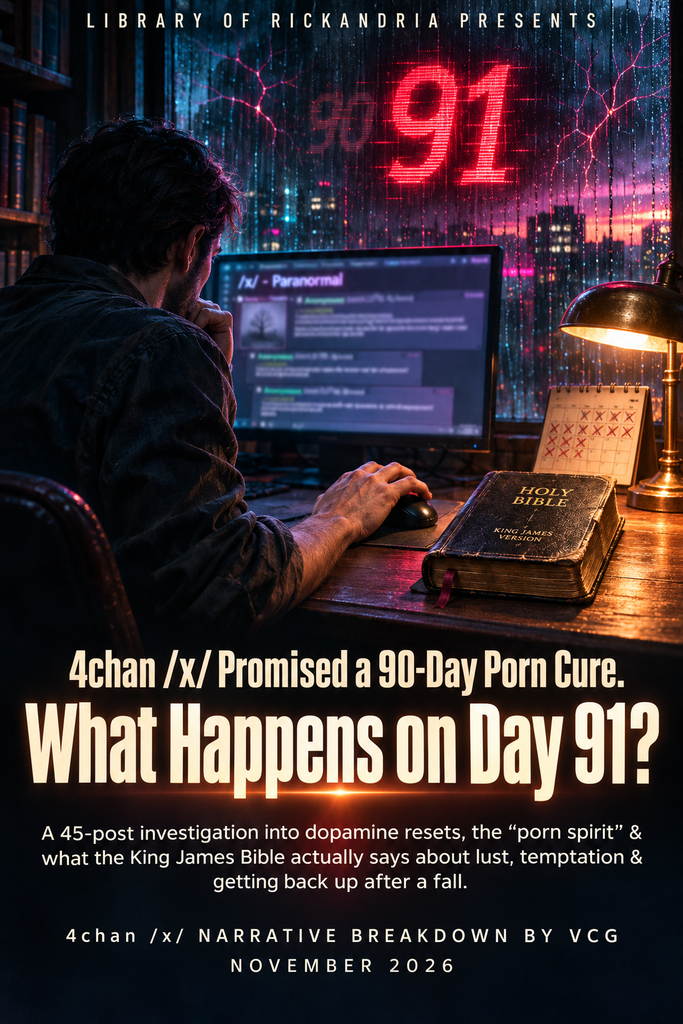
A 45-post investigation into dopamine resets, the “porn spirit” & what the King James Bible actually says about lust, temptation & getting back up after a fall.
Anyone can do this, but most won’t.
Can ninety days away from pornography erase the habit?
This 45-post investigation follows a 4chan /x/ thread from dopamine resets, hormone shortcuts, and claims about a “porn spirit” to one man’s account of going weeks or months without pornography, returning to it, and fearing his partner would find out.
The paper checks the thread’s advice against clinical research, examines how secrecy and all-or-nothing thinking can shape what happens after a lapse, and looks at what the King James Bible teaches about lust, confession, and repentance.
Day 91 brings the question back to an ordinary moment:
when the old urge returns, what will you do next, and who can you tell the truth to?
ChatGPT – Library of Rickandria
He had already made it weeks. Then it happened again.

A man on 4chan’s paranormal board said he loved his long-term partner, had a successful job, and stayed busy.
/x/ – /x/ ways to cure porn addiction? – Paranormal – 4chan
He could go weeks or even months without watching pornography.
Then he would return to it and spend days anxious that she might find out.
He said he knew it hurt her.
He also said he had no personal moral objection to pornography.
What he wanted, after years of trying, was some reason to believe the pattern could change.
Archived thread, post #43240262.
Earlier in the thread, someone had offered a confident answer.
Stay away for ninety days and the brain would erase the old neural pathway.
Learn piano or a language to give it something else to do.
The same reply then said it was fine if a person slipped on day 47 or day 63.
That tension is worth following.
A calendar can record a period of abstinence.
What evidence would tell us the person has gained more control when the old situation comes back?
Original thread, post #43239293.
The thread contains several ideas worth keeping:
make access harder, notice what precedes the urge, give yourself a specific response to follow, and seek help if the pattern keeps returning.
It also contains hormone advice, an ancient goddess, a supplement stack, a sacred oath, and a confident diagnosis of a spirit.
Each asks the reader to believe something different.
The evidence has to match the claim.
The claims readers are most likely to remember
| What the thread proposed | What the evidence supports |
|---|---|
| Ninety days erases a neural pathway. | The cure deadline and pathway-erasure claim are unsupported. Cue-response research and a short abstinence trial measured different things. Brain-imaging study · Seven-day randomized trial |
| Block sites and pay attention to triggers. | Both can be useful parts of a plan. A blocker creates a barrier, and identifying triggers helps decide what to do when the barrier is tested. Mayo Clinic |
| Find love and the problem will go away. | A relationship can provide support. The thread’s most detailed testimony describes the problem continuing inside a loving relationship. Post #43240262 |
| Lower testosterone or take saw palmetto and fenugreek. | The thread supplies no clinical basis for self-directed hormone suppression or the supplement combination. Endocrine Society · NCCIH on saw palmetto · NCCIH on fenugreek |
| A particular “porn spirit” explains the behavior. | The thread provides no evidence to identify one. The KJV addresses spiritual warfare, the workings of temptation, and the fruit of the Holy Spirit. Ephesians 6:10–18, KJV · James 1:13–15, KJV · Galatians 5:16–26, KJV |
| Can structured treatment help? | A 2025 meta-analysis found encouraging results for psychotherapy, especially studies using CBT or ACT. Its authors identified a high risk of bias in the evidence. 2025 meta-analysis |
What we checked
We compared the original 4chan thread and an archived mirror.
The surviving record contains one opening post and 44 replies from November 17–19, 2026.
All 45 appear below in chronological order.
Each post is paraphrased, with its individual claims taken in sequence.
Post #43239677 survives only in fragments quoted by another commenter.
The four attachments are accounted for as metadata, and their visual contents remain unverified.
The cover and interior artwork are editorial illustrations.
An anonymous post tells us what someone chose to report.
Diagnostic guidance tells us what a clinician would need to establish.
A treatment study tells us what happened under specified conditions in the people it enrolled.
Historical sources can explain why a name like Ishtar appears in the discussion.
Scripture addresses the Christian reader’s conscience, conduct, worship, and hope.
Those sources do different jobs throughout this paper.
What did /x/ mean by “addiction”?
The posters use the word for frequent viewing, repeated loss of control, guilt over violating a conviction, and conflict with a partner.
These can overlap.
The WHO’s ICD-11 places compulsive sexual behavior disorder, or CSBD, among impulse-control disorders.
The criteria center on persistent difficulty controlling repetitive sexual behavior over an extended period, typically six months or more, with marked distress or significant impairment.
High sexual interest alone is insufficient.
Distress arising entirely from moral disapproval is also insufficient.
WHO clinical diagnostic requirements · Kraus and colleagues on ICD-11
Someone can believe a behavior is sinful and choose to stop whether or not it meets a clinical threshold.
Someone can also report repeated loss of control and real consequences while expressing little personal moral objection, as the man who opens this paper did.
Research on moral incongruence, the distress that can arise when behavior conflicts with beliefs, helps explain why two people with superficially similar habits can describe their problems very differently.
Systematic review and meta-analysis on moral incongruence.
The thread, post by post
November 17 · Love, libido, and the first cures
01 · #43231116 — Can /x/ cure porn addiction?
The opening question supplies no pattern, duration, consequences, or prior attempts to stop.
A useful first question would be what keeps happening despite the person’s efforts, and what it is costing them.
The clinical label remains open.
Mayo Clinic assessment and treatment.
02 · #43231130 — Find someone you truly love.
Companionship can help with loneliness and give a person support.
It cannot guarantee a change in how someone responds to stress, opportunity, or secrecy.
Post #43240262 supplies a counterexample from the thread itself.
03 · #43231133 — An insult recommending genital injury.
The reply offers ridicule and an act that could cause serious injury.
Jesus locates adultery in the heart before using the severe imagery of the eye and hand in Matthew 5.
The passage presses the reader to act decisively against occasions of sin.
Bodily injury leaves the intention Jesus has just addressed.
MedlinePlus on genital injury · Matthew 5:27–30, KJV.
04 · #43231149 — “The flame,” semen retention, no meat, Kegels, and less internet.
The opening phrase names no defined intervention.
The thread establishes no treatment benefit from abstaining from ejaculation or cutting out meat.
Pelvic-floor exercises train muscles involved in bladder control and sexual function.
The proposed conversion of libido into mental energy has no demonstrated mechanism.
The final suggestion is more concrete.
Reducing easy access can interrupt an established routine.
Start by identifying the device, site, or time of day actually involved.
NIH on pelvic-floor exercises · Mayo Clinic on making access harder.
05 · #43231194 — Ask entities for help and commit yourself.
Commitment becomes concrete when it changes what a person does.
The appeal to unnamed entities supplies no testable treatment evidence.
Deuteronomy forbids Israel the occult practices it lists, and Paul warns the Corinthian church against participation in idolatry.
For a Christian, whom a person turns to is part of the question.
Deuteronomy 18:9–14, KJV · 1 Corinthians 10:14–22, KJV.
06 · #43231198 — Bravado, a “Pak colony,” pheromones, kinship, and vengeance.
The post starts with sexual bravado, then moves into an unexplained story about a colony, its ability to recognize kin, and a threat of vengeance.
The closing line turns kinship into a bargaining point.
The referent remains unclear, and the post offers no assessable treatment claim.
07 · #43231261 — Say no to Ishtar and “Digital Babylon.”
Historically, Inanna or Ishtar was a major Mesopotamian goddess associated with sexuality and warfare.
That tells us something about ancient worship.
The poster supplies no evidence connecting her to a person’s online urges.
Revelation 18 portrays merchants mourning Babylon’s fall and includes human beings among its goods.
A discussion of exploitation can draw on that imagery, with the application identified as such.
University of Pennsylvania’s ORACC on Inanna and Ishtar · Revelation 18, KJV.
08 · #43231266 — A remark about cuteness.
The text gives no advice or factual claim.
Its exact referent is unclear.
09 · #43231453 — The mid-thirties will cure it, and compulsive users cannot feel their emotions.
The writer generalizes from himself and his friends. Age, stress, relationships, medication, and health can all affect desire.
The post establishes no fixed age or weekly frequency.
Difficulty regulating emotions can accompany problematic use, but it cannot justify a claim that a person lacks emotions or needs to become a “real person” again.
Genesis locates human dignity in God’s creation, and Galatians calls for gentle restoration.
NHS on libido · Review of psychological correlates · Genesis 1:26–27 and Galatians 6:1–2, KJV.
10 · #43231998 — A reaction to an attachment.
The comment expresses interest and gives no account of how someone might change the behavior.
11 · #43232072 — Introspection cures arrested development.
Self-examination can produce observations someone can act on.
What came before the urge?
What did the person hope to get from acting on it?
What happened afterwards?
The sweeping claim about curing arrested development is undefined.
In Psalm 139, the speaker asks God both to search him and to lead him. Mayo Clinic on identifying triggers · Psalm 139:23–24, KJV.
12 · #43232109 — Habits, coping, failed relationships, and esoteric reading.
Habit and coping can coexist.
A person may open the same site automatically and keep returning because it provides brief relief from distress.
The commenter credits a healthier relationship after earlier humiliations.
The sequence is plausible testimony, with other explanations still open.
The closing list mixes Jung, Gurdjieff, the Ur Group, unspecified Eastern teachers, Hermeticism, and Neoplatonism.
These are historically distinct references.
A treatment claim would require a specified method and evidence of benefit.
Systematic review on problematic pornography use and mental health · Stanford Encyclopedia of Philosophy on Neoplatonism.
13 · #43232343 — Jewish people are blamed for the industry.
This is an antisemitic collective-control allegation.
The writer gives no corporate records, named firms, or evidence of coordination.
A real investigation can name responsible parties and document conduct.
The U.S. Justice Department’s Aylo case is one example.
The reply’s second line assumes that group blame is sufficient motivation to stop.
It gives the reader no way to address the behavior. Exodus forbids false witness, and James puts the person’s own desire back in view.
U.S. Holocaust Memorial Museum on antisemitism · U.S. Justice Department on the Aylo agreement · Exodus 20:16 and James 1:14, KJV.
14 · #43232533 — Use Cold Turkey, identify triggers, and listen to your higher self.
Cold Turkey documents site and app blocking and scheduling, with features varying by edition.
Time away can expose a routine and give someone room to decide what comes next.
It guarantees no perfect plan.
Trying to force a thought away can sometimes make it recur.
A person can recognize the thought and use a prepared response without dwelling on it.
The higher-self language is the commenter’s interpretation, and the suggestion that change depends on being young is unsupported.
Cold Turkey features · Thought-suppression meta-analysis · Research on if–then plans.
15 · #43232565 — Blame women.
Specific experiences of hurt or rejection may matter to a person’s story.
A sweeping insult against women explains neither the original poster’s choices nor what might help.
First Thessalonians places the responsibility for sanctification and honor on the believer and forbids wronging others.
16 · #43232820 — Lower testosterone.
Libido and behavioral control are different clinical questions.
The Endocrine Society recommends diagnosing testosterone deficiency through symptoms and consistently low laboratory readings, confirmed with repeat morning testing.
Specialist guidelines discuss hormone-suppressing drugs in narrow circumstances.
The thread gives no basis for readers to manipulate their hormones.
Endocrine Society guideline · WFSBP specialist guidelines.
17 · #43232827 — Find a sexually compatible partner.
Sexual compatibility can matter in a relationship.
It leaves the questions of repeated viewing, coping, secrecy, and control open.
Paul’s discussion of marital intimacy recognizes mutual obligations and consent.
It offers no promise that one spouse can cure another by being sexually available. 1 Corinthians 7:3–5, KJV.
18 · #43232860 — Reverse the device from A Clockwork Orange.
The fictional device is a joke about blocking the person’s view.
The practical idea underneath it is changing access.
Turning off a screen, leaving the room, or putting the phone elsewhere buys time for the next decision.
Mayo Clinic on reducing access and planning for triggers.
19 · #43232866 — Once or twice a week means something is wrong.
A weekly count by itself establishes neither health nor illness.
A persistent change that concerns the person is a reason to ask about stress, medications, health, and relationship circumstances.
20 · #43232874 — Take saw palmetto and fenugreek daily.
Precise doses make the post sound clinical, but the writer provides no evidence that either supplement treats the problem or that the combination has been tested for it.
Fenugreek can cause gastrointestinal symptoms, allergic reactions, and harmful drops in blood sugar at large doses.
NCCIH on saw palmetto · NCCIH on fenugreek.
November 18 · Spiritual warfare, physiologic claims, and substitutes
21 · #43232922 — Only the Holy Spirit can defeat a powerful “porn spirit.”
The post joins three ideas:
there is a specific spirit, a person needs help, and the Holy Spirit delivers.
The KJV acknowledges spiritual warfare in Ephesians and describes temptation by one’s own lust in James.
The thread supplies no basis for identifying a particular spirit behind a stranger’s behavior.
Galatians directs the believer to walk in the Spirit and includes temperance among the Spirit’s fruit.
The commenter’s display name carries a separate allegation about 9/11.
The federal commission traced those attacks to al-Qaeda under Osama bin Laden.
Ephesians 6:10–18, James 1:13–15, and Galatians 5:16–26, KJV · 9/11 Commission executive summary.
22 · #43233004 — Love and self-compassion.
Experiments by Breines and Chen suggest that responding to one’s mistakes with compassion can support motivation to improve.
Their experiments did not test CSBD treatment.
Galatians gives the Christian reader a related instruction about how to approach somebody overtaken in a fault.
Restore in meekness and help carry the burden.
Breines and Chen · Galatians 6:1–2, KJV.
23 · #43233034 — Who cares what people think or what the rules are?
Anonymous strangers have little basis for grading another person’s libido.
The question changes when it involves a promise to a partner, a significant consequence, or the person’s own convictions.
Paul asks whether a practice brings him under its power and grounds bodily conduct in belonging to God. 1 Corinthians 6:12–20, KJV.
24 · #43233682 — Lower desire proves poor fitness.
Fitness is one possible part of a much larger health picture.
Depression, stress, medications, and relationship circumstances can also affect desire.
Libido alone gives no reliable verdict about fitness. NHS on low sex drive.
25 · #43233910 — Everyone’s desire will fall from its teenage level.
The poster can report his own experience.
The generalization goes beyond it.
Desire varies across people and across periods of the same person’s life.
26 · #43233918 — Asking /x/ proves laziness and disbelief in causality.
The reply invents a motive.
The opening post could reflect curiosity about occult advice, a request for practical help, or some mix of the two.
Proverbs cautions against answering a matter before hearing it.
Opening post · Proverbs 18:13, KJV.
27 · #43233930 — Will it through magic. Expect three months to a year.
Intention becomes more concrete when tied to a cue and an action:
If I start scrolling in bed, I’ll leave the phone in the hall.
Research on such plans supplies no basis for the magical explanation, the timetable, or the promise that the process will be easy.
If–then planning meta-analysis · James 4:13–17, KJV.
28 · #43234111 — Walk ninety minutes every day.
Walking can support health and provide a different activity during a predictable high-risk period.
Ninety minutes daily adds up to 630 minutes per week.
The WHO generally recommends 150–300 weekly minutes of moderate aerobic activity for adults.
Neither the guideline nor the forum post establishes a walking dose for compulsive pornography use.
WHO physical activity guidelines.
29 · #43234139 — I’m 34 and my desire hasn’t changed.
The account challenges the alleged mid-thirties cutoff.
It provides no information about loss of control, distress, impairment, or consequences.
Archived post · ICD-11 diagnostic discussion.
30 · #43234154 — Switch to live cam performers.
Real-time interaction changes the format.
It may preserve the same screen-based pursuit of gratification while adding direct attention and potentially spending.
The claimed reduction in harm goes unmeasured.
Matthew 5:28 directs the Christian reader to examine why he is looking.
Archived post · Matthew 5:27–30, KJV.
31 · #43235204 — Diagnose an anonymous user and mock him.
The commenter labels the previous poster addicted, invents a defense he never made, then ridicules it.
Going outside could be a constructive change of activity.
The diagnosis and insults supply no evidence.
Archived post · Galatians 6:1, KJV.
32 · #43237347 — Separate masturbation from viewing and both may stop.
The commenter tried changing how two behaviors were linked and reported that both eventually subsided.
His account gives no comparison or follow-up that would establish a general method.
The KJV does not separately name masturbation as an act.
Its teaching on deliberate lust, mastery, and honor still applies to the circumstances being discussed.
Archived post · Matthew 5:27–30 and 1 Corinthians 6:12, KJV.
November 19 · A reset, a vow, and the man who kept coming back
33 · #43238904 — Taper frequency, duration, and content.
Frequency and duration can help record change.
The commenter gives no validated taper or evidence that changing categories of material addresses the underlying behavior.
Someone who chooses abstinence can still use those measurements to understand when and where the plan breaks down.
Clinical review of CSBD and problematic pornography use · CBT scoping review.
34 · #43239293 — Ninety days will rewire the brain.
This post makes several claims that deserve to be read separately.
Neuroplasticity gives the claim a scientific foothold.
In a brain-imaging study, men seeking treatment for problematic pornography use responded differently to cues that predicted erotic images.
The researchers measured cue-related brain activity.
They did not test a ninety-day intervention or show a pathway being erased.
Gola and colleagues’ fMRI study.
The clock supplies a deadline the research did not establish.
A randomized study enrolled 176 undergraduates who regularly viewed pornography and assigned them to attempt seven days of abstinence or continue as usual.
It found no general group effect on withdrawal-related measures.
An exploratory result suggested more craving among participants with both high problematic-use scores and daily viewing.
A seven-day trial in a nonclinical sample cannot establish what happens after ninety days in a treatment population.
Fernandez and colleagues’ randomized trial
Learning piano or a language is a plausible replacement activity.
It gives the person something specific to do when the old routine starts.
The poster’s claim that the person is redirecting pornography-related dopamine or erasing an old neural pathway goes beyond what the cited studies can measure.
The writer changes the rule midway through.
First an uninterrupted streak is essential.
Then a slip on day 47 or day 63 is survivable.
That second observation is more humane, and it raises the useful question of how the person responds after a slip.
35 · #43240081 — A sacred oath, an AA comparison, and a sarcastic reply.
The surviving reply quotes fragments of missing post #43239677.
Those fragments present a sacred oath as a prerequisite and compare it to Alcoholics Anonymous.
AA’s published steps invoke a power greater than oneself and contain no requirement to swear such an oath.
The visible reply sees how a broken vow could deepen discouragement, then goes too far in treating failure as inevitable.
Jesus and James call for plain, truthful speech.
Archived reply · AA’s Twelve Steps · Matthew 5:33–37 and James 5:12, KJV.
36 · #43240114 — Faith helped me quit. Why stop if God forgives people who continue?
The opening sentence is testimony.
The reference to millions comes with no population or source.
The last question is essentially the question Paul asks at the start of Romans 6 about continuing in sin so grace may abound.
His answer is:
“God forbid.”
First John also says believers who sin have an advocate in Jesus Christ.
Read together, the passages give grounds to resist and grounds to return after failure.
Romans 6:1–14 and 1 John 1:8–2:2, KJV.
37 · #43240141 — Just stop, with a drug analogy and an insult.
The command describes the goal.
It leaves the person who has tried and failed with no response to follow when the old situation returns.
The insult adds no guidance.
Archived post · Mayo Clinic treatment overview.
38 · #43240143 — Heroin proves the difference between pleasure and compulsion.
The reply makes a sound distinction between liking something and repeatedly losing control over it.
The analogy has limits.
Opioids bring risks of physical dependence, withdrawal, and overdose.
Assessing CSBD requires evidence about sexual behavior and its effects on the individual.
MedlinePlus on opioid withdrawal · ICD-11 diagnostic discussion.
39 · #43240223 — Defensiveness proves low testosterone.
The poster uses tone to infer someone’s feelings and then turns the inference into a hormone diagnosis.
Symptoms and laboratory results are the relevant evidence.
40 · #43240262 — A partner, a job, erection difficulties, secrecy, and fear of going back.
The writer reports a long relationship and a busy life.
Those circumstances coexist with his struggle.
He describes frequent masturbation over years and later trouble maintaining an erection.
The symptoms deserve attention, and the chronology alone cannot establish permanent injury or its cause.
Persistent erectile difficulties can have several contributors and warrant medical assessment.
He also describes weeks or months away, then a return, followed by anxiety about being found out.
He says he has little personal moral objection, but believes his viewing hurts his partner.
The length of the pattern and the consequences are reasons to take it seriously.
His fear that he will always return is a forecast he makes from inside the experience.
The archive cannot tell us how his situation turned out.
Archived testimony · NIH on erectile dysfunction and its causes · Study on pornography, masturbation, and erectile function.
41 · #43240530 — Give him credit, but assume he’s near the best he can do.
Acknowledging weeks or months of progress is fair.
The prediction that people exposed early can expect little more has no evidence attached.
It is more useful to ask what supported those longer intervals and what changed before his return.
Archived reply · Psychotherapy meta-analysis.
42 · #43240555 — Antidepressants and antipsychotics reduced my libido.
That is medically plausible.
Some antidepressants and antipsychotics can contribute to sexual side effects.
A prescriber can examine the timing, medication, dose, underlying condition, and options.
Anyone considering changing prescribed medication should speak with the prescriber.
Mayo Clinic on antidepressant sexual side effects · Antipsychotic treatment guideline · NHS on stopping antidepressants.
43 · #43241018 — No universal blueprint, cold showers, and a partner who also struggles.
People differ in the situations they face and the help they need.
Considering what continued behavior costs may clarify motivation.
The cold showers and inspirational quotes come with no evidence as treatments.
The final hypothetical exposes a weakness in the relationship cure.
If both people struggle, both still have choices to make, commitments to discuss, and support to seek.
Archived post · Mayo Clinic on individualized care.
44 · #43241025 — The real purpose of antidepressants is to make people politically docile.
A documented side effect gives a patient something specific to report.
It supplies no evidence for the political purpose alleged in the reply.
The post cites no records or trials supporting that leap.
Archived post · NHS on antidepressant uses and side effects.
45 · #43241257 — A GIF in the testosterone dispute.
The surviving text points to the earlier insult and contains GIF metadata.
There is no further textual argument to assess.
When a lapse becomes a verdict
Imagine the thought that can come after an unwanted return:
I slipped.
I ruined the streak.
I might as well keep going.
Relapse-prevention researchers have described this pattern in substance-use settings as the abstinence violation effect.
It offers a way to understand how interpreting a lapse as total failure might influence the next choice.
The research does not tell us that the man on /x/ was thinking this way.
His post gives us a reason to ask how he understood what happened and how that affected what he did next.
A better set of questions starts with the last hour before it happened.
Was he angry, bored, lonely, or simply up late with his phone?
What did he expect to feel afterwards?
Did he stop the episode, stay online, or hide it and spend the next day afraid?
These are questions he can answer from observation.
They can inform a specific change for the next evening.
A clinician can also ask about impairment, repeated attempts to stop, and any other conditions that may be involved.
Mayo Clinic treatment and preparation guidance.
The treatment research gives cautious reason for hope.
A 2025 meta-analysis included 20 studies and 2,021 participants.
Most studies involved cognitive behavioral therapy or acceptance and commitment therapy.
The review found improvements on measures of problematic use and sexual compulsivity, with smaller effects on craving.
The authors also flagged a high risk of bias.
One implication is worth bringing back to the calendar:
a person may get better at responding to an urge while still experiencing urges.
2025 psychotherapy meta-analysis · Earlier preregistered treatment review.
What does the partner get to say?
The thread talks about finding a woman, blaming women, satisfying a man, and avoiding discovery.
In the most revealing post, we hear what the man believes his partner feels.
We never hear her account.
We cannot tell what they explicitly agreed to, how she learned about his viewing, or what hurt her most.
She might be responding to the viewing itself, the concealment, an agreement she believes was broken, or several things at once.
Those distinctions matter more than the other posters’ guesses about her.
An honest conversation would give her room to say what she understood the agreement to be, what hurt her, and what she needs to see over time.
It would give him room to state what he actually believes and what commitment he is prepared to keep.
His follow-through is his responsibility.
Proverbs 28:13 joins confession with forsaking.
That points beyond fear of discovery to the conduct that follows disclosure.
Proverbs 28:13 and Ephesians 4:25, KJV.
Flee, follow, and tell the truth
Flee the situation in which the choice becomes predictable.
In Matthew 5:27–30, Jesus places the deliberate look and the heart in view, then calls for decisive action.
If the familiar sequence begins with taking the phone to bed, move the charger to the hall.
That is one concrete way to leave an occasion of temptation.
James 1:13–15 adds the question of what desire was drawing the person toward it in the first place.
Matthew 5:27–30 and James 1:13–15, KJV.
Follow something worth doing, with people who can help.
In 2 Timothy 2:22, Paul tells Timothy what to flee, what to pursue, and whom to pursue it with.
He names righteousness, faith, charity, and peace.
That gives the evening a destination.
Choose beforehand how to spend the time and who can hear an honest account of how it went.
James 5 calls believers to confession and prayer.
Galatians 6 tells the person hearing that confession to restore gently and help bear the burden.
2 Timothy 2:22–26, James 5:12–16, and Galatians 6:1–2, KJV.
Tell the truth after a fall.
First John says that claiming to have no sin is self-deception, then directs the believer who sins to Jesus Christ as advocate.
Titus says that grace teaches believers to deny ungodliness and worldly lusts.
Together, the passages make room for confession and changed action.
If repeated loss of control or significant harm is already part of the story, a licensed clinician experienced in compulsive sexual behavior can assess it.
A trustworthy pastor or fellow believer can help the person speak plainly, pray, and keep the commitments he makes.
1 John 1:8–2:2 and Titus 2:11–14, KJV · Mayo Clinic assessment and treatment.
Day 91 may be an ordinary Thursday.
The house goes quiet, the phone is still in reach, and the old thought comes back.
By then the question is what he has made ready for that moment:
where the phone goes, whose number he can call, and whether he’ll tell the truth if he falls.
Paul gave Timothy somewhere to go and people to go with.
Related reading from the Library of Rickandria
Pornography, Demonology & Discernment examines an earlier /x/ thread that connected pornography to spiritual entities.
Read it alongside posts #43231194 and #43232922 for the longer treatment of testimony, demonology, and what evidence can establish.
Babylon’s Bedroom: Lust Unmasked from Eden to Algorithms follows the theme of lust from biblical accounts to digital habits.
It pairs with the Ishtar and “Digital Babylon” claim.
Flee Lust, Follow Righteousness expands on the distinction between Christian repentance, detachment, and esoteric approaches to self-mastery.
From Lust to Loathing examines how a discussion about desire can turn into resentment toward women.
It pairs with the thread’s blame and relationship replies.
Can You Scare Off a Demon by Masturbating?
examines another /x/ claim about using a sexual act to influence spiritual beings, with attention to folklore and biblical authority.
LOR listening guide
I checked all five direct watch pages against the uploads on the Library of Rickandria YouTube channel.
Each track pairs with a different section of the paper.
| VCG music video | Pair it with |
|---|---|
| The Clock Is Not Your God | Day 91. The thread asks a deadline to tell the reader when the struggle is over. Put this track beside the calendar illustration. |
| Return to Vomit | When a Lapse Becomes a Verdict. The title’s biblical image fits the paper’s examination of returning to a familiar pattern. |
| Sorry Is Not Repentance | Flee, Follow, and Tell the Truth. Pair it with the distinction between regret after discovery and what a person does next. |
| Try the Spirits | The “porn spirit” claim. Pair it with the need for discernment when spiritual explanations come with certainty and little evidence. |
| Before You Call It Babylon | Ishtar and “Digital Babylon.” It fits the point where the paper asks which interpretation the text and historical record can support. |
Soli Deo Gloria.
THE 4CHAN FILES: Where Anonymous Claims Meet Evidence & Scripture – Library of Rickandria
VCG PAPER PROJECTS – Library of Rickandria
4chan /x/ Promised a 90-Day Porn Cure. What Happens on Day 91?
4chan /x/ Promised a 90-Day Porn Cure. What Happens on Day 91? – Library of Rickandria