UPDATED BY VCG ON 11/18/2026 @ 19:19 EST
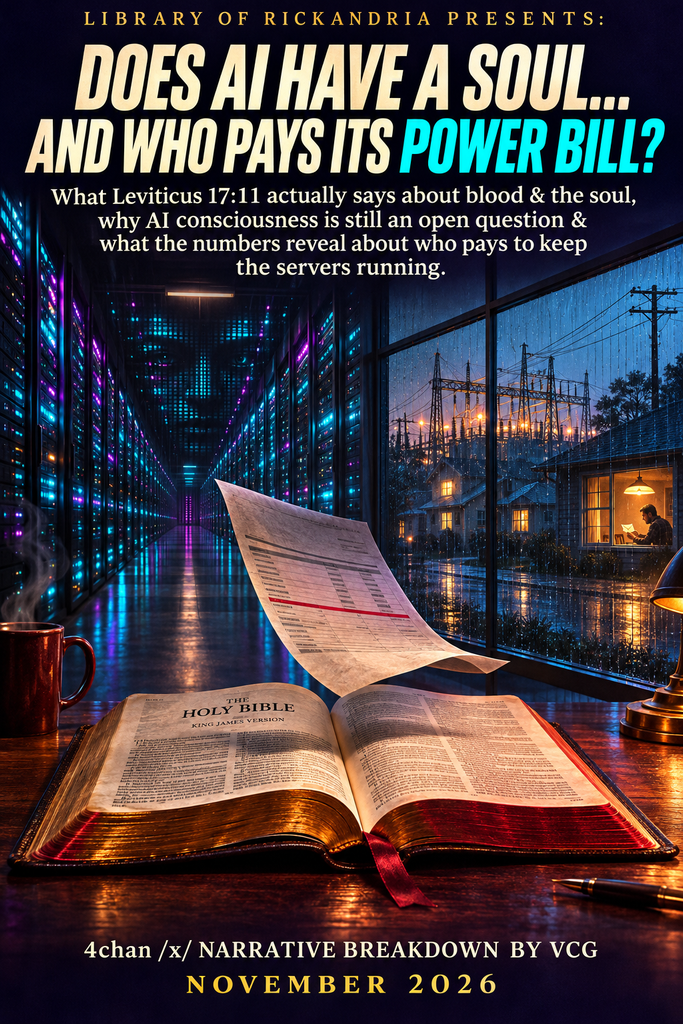
What Leviticus 17:11 actually says about blood & the soul, why AI consciousness is still an open question & what the numbers reveal about who pays to keep the servers running.
Anyone can do this, but most won’t.
Does AI Have a Soul… and Who Pays Its Power Bill? follows a friend’s comment from Leviticus 17:11 to the modern electric grid.
Reading the King James Bible in context, the paper explains why Leviticus connects blood with bodily life and atonement, how Matthew 10:28 distinguishes body and soul, and why even evidence of machine consciousness would leave the theological question open.
It also explores why fluent AI can sound as though it has an inner life, then turns to what we can measure today.
Using IEA data,
a worked example from Ohio’s data-center tariff,
and a mock AI energy label,
the paper shows how to ask two concrete questions:
how much electricity does the service use, and who bears the cost of keeping that power available?
ChatGPT – Library of Rickandria
Source note.
The cover carries the series masthead.
The primary text for this installment is a comment supplied by a friend.
A corresponding 4chan /x/ thread was not supplied.
The analysis follows the comment’s eight paragraphs in order and retains their original wording.
The question inside the question
The comment starts with a Bible verse about blood and ends with Earth Hour.
In between, it asks whether a machine could acquire a soul, whether people and data centers depend on the same electricity, and whether the public can see how the costs are divided.
There’s a worthwhile insight in that progression.
We can investigate who pays for a data center today, regardless of how the debate over machine consciousness develops.
The evidence changes with each question.
A Bible passage can tell us what Scripture says about life, soul, and atonement.
Consciousness research can offer ways to assess claims about subjective experience.
Grid data can tell us how much electricity is used, and a tariff can tell us how a utility bills a customer.
For this paper, I read the biblical passages in context, checked the friend’s three links, compared the original IEA report with its 2026 update, and worked an example from the published Ohio tariff.
The two figures use hypothetical inputs so readers can check the arithmetic without mistaking it for a real customer’s bill or a measured AI benchmark.
1. “The soul and the blood”
This is interesting, the soul and the blood
The body s life giving, support is in the flesh and the spirit, soul could be differentiated from the flesh?
Yes, Scripture distinguishes the soul from the body.
The distinction comes through most clearly in Matthew 10:28.
To see what Leviticus 17:11 contributes, start one verse earlier.
Verse 10 forbids the people of Israel and the strangers living among them to eat blood.
Verse 11 gives the reason.
“The life of the flesh is in the blood,”
and God gives the blood
“upon the altar to make an atonement for your souls.”
Verse 13 carries the principle into ordinary hunting.
The hunter who takes an animal or bird for food is to pour out its blood and cover it with dust.
The passage ties the life of the creature to the treatment of its blood and identifies the altar as the place where God gave blood for atonement.
One Hebrew word, three English renderings
| KJV wording in Leviticus 17:11 | What the phrase refers to in context |
|---|---|
| “the life of the flesh” | The life of the creature whose blood is in view |
| “your souls” | The people for whom the atonement is made |
| “the soul” | The one for whom the blood makes atonement |
Forms of the Hebrew word nephesh appear in all three places.
In the preceding verse, the
“soul that eateth blood”
is the person doing the eating.
In Genesis 2:7, God forms Adam from dust, breathes into him the breath of life, and man
“became a living soul.”
These examples show why context matters.
A reader cannot take every KJV occurrence of soul to mean an immaterial entity and then use Leviticus to locate that entity inside the bloodstream.
Leviticus 17:11 Hebrew word study
Matthew 10:28 directly addresses the distinction your friend is asking about.
Jesus speaks of people who can kill the body but cannot kill the soul, and he directs his hearers to fear the One with authority over both.
Ecclesiastes 12:7 speaks of dust returning to the earth and the spirit returning to God who gave it.
James 2:26 uses the body without the spirit to illustrate faith without works, and 1 Thessalonians 5:23 names spirit, soul, and body in Paul’s prayer for the believers’ whole sanctification.
Paul’s wording gives room for distinction, while the prayer itself leaves open whether soul and spirit always name two different parts of a person.
Matthew 10:28 and Ecclesiastes 12:7, KJV
James 2:26 and 1 Thessalonians 5:23, KJV
If by “life giving” your friend means bodily life depends on blood, that fits the opening clause in Leviticus.
If the phrase means blood is the ultimate giver of life, Genesis credits God with giving Adam the breath of life, and Acts 17:25 credits God with giving
“life, and breath, and all things.”
The New Testament also picks up the altar question.
Hebrews 9:11–14 connects eternal redemption to Christ’s own offering, while Hebrews 10:1–14 says the blood of bulls and goats could never take away sins.
The movement from Leviticus to Hebrews is about atonement and what Christ accomplishes.
Hebrews 9:11–14 and 10:1–14, KJV
2. Would consciousness give AI a soul?
Whether AI s consciousness will inherit a soul, with destiny for eternity might be speculative.
More imminent is the shared dependency with humans of electricity.
Your friend is right to call it speculative.
The phrase “AI s consciousness” moves past a question that still needs an answer.
A system’s ability to perform a task, the possibility that it experiences anything while doing it, and the theological claim that it has a soul are three different propositions.
In 2023, Patrick Butlin and colleagues assessed AI systems against indicators derived from several scientific theories of consciousness.
Their analysis did not support attributing consciousness to the systems they considered.
They also saw no obvious technical barrier to future systems satisfying the proposed indicators.
In their later peer-reviewed paper, the authors describe these indicators as a way to weigh the evidence about a particular system under conditions of substantial scientific uncertainty.
That leaves room for a serious future case.
If a system met several indicators derived from well-supported theories, and independent researchers could verify the mechanisms involved, that would warrant more attention than fluent first-person language alone.
Butlin et al., 2023 assessment
Butlin et al., peer-reviewed follow-up
What would count as evidence?
Consider a simple prompt exercise. In two fresh sessions with the same model, ask it to write in the first person as a fictional machine.
In one session, specify a character that fears being switched off.
In the other, specify a character that experiences no fear.
If both prompts produce fluent first-person accounts, the exercise illustrates how much the wording can contribute to the apparent testimony.
This is an illustrative protocol, with no experimental results claimed here.
For actual research on how prompting and self-reference affect first-person reports, see the linked preprint. Its authors distinguish those reports from direct evidence of consciousness.
[2510.24797] Large Language Models Report Subjective Experience Under Self-Referential Processing
Identifying indicators of consciousness in AI systems – PubMed
The KJV question remains.
Genesis 1:26–27 speaks of human beings made in God’s image, Genesis 2:7 describes God giving Adam life, and Hebrews speaks of eternal redemption through Christ.
If inherit simply means receive, we still need grounds for saying who gives the soul and on what basis.
If it means a biblical inheritance or promise, we need the promise and its stated recipients.
Evidence of subjective experience, even if future research established it, could not by itself supply that theological argument.
Genesis 1:26-27,Genesis 2:7 KJV – And God said, Let us make man in our – Bible Gateway
Hebrews 9:11-14 KJV – But Christ being come an high priest of – Bible Gateway
3. Electricity is constrained. Who pays for the extra capacity?
Not an indefinite resource.
Energy demand from AI – Energy and AI – IEA
But are the costs for this vital resource distributed with a fair share & sustainable approach?
The resource concern is real.
Electricity is an energy carrier generated from primary sources such as:
- natural gas
- nuclear energy
- sunlight
- wind
What matters to the local grid is how much power can get to a particular connection at the time it is needed.
Megawatts (MW) measure the rate at which power is drawn.
Megawatt-hours (MWh) measure energy used over time.
A data center can strain equipment at particular hours even when the region has ample generation over a full year.
| Year | Global data-center electricity use | What the figure represents |
|---|---|---|
| 2024 | 415 TWh | Estimate from the 2025 IEA report, about 1.5% of world electricity consumption |
| 2025 | 485 TWh | Estimate in the IEA’s 2026 update |
| 2030 | 950 TWh | Central projection in the 2026 update, about 3% of projected world electricity demand |
These figures cover all data centers.
AI is a major driver of projected growth alongside other digital services.
The 950 TWh figure depends on assumptions about adoption, efficiency, investment, and how quickly infrastructure can be built.
The global figures establish scale.
To see what happened to household bills, we have to go to the utility’s rates and the regulator’s decisions.
Follow the power bill through Ohio
In July 2025, the Public Utilities Commission of Ohio ordered AEP Ohio to file a specific tariff for data centers.
The commission identified a concrete risk.
Utilities can build transmission infrastructure to serve a project that later uses less capacity than expected, leaving other customers exposed to the cost of underused investment.
Ohio Power’s published Schedule DCT sets a monthly billing-demand floor of 85% of the customer’s contracted capacity during the ramp period.
After the ramp period, the tariff uses a separate calculation that considers past billing demand and the minimum specified for the customer’s contracted capacity.
The ramp-period rule is the one used below.
PUCO orders AEP Ohio to create data center specific tariff
Figure 1. Real tariff rule, hypothetical customer and inputs. follow-the-power-bill.png
Suppose a facility contracts for 40 MW during a stage of its ramp-up.
The tariff floor is 0.85 × 40 MW = 34 MW.
If its measured peak is 22 MW that month, the floor still applies.
The 12 MW difference is billing demand above the measured peak in this example.
To translate that into dollars, we would need the applicable demand charges and other billing terms.
To tell whether households were protected from a particular upgrade cost, we would have to trace how regulators assigned that cost.
Filed Ohio Power tariff, Schedule DCT
A reader investigating a real project can start with four questions.
- What did the project cause the utility to build or buy? Compare the project plan with the utility’s existing forecast. Look for the substation, transmission, and supply costs tied to the additional load.
- Who is assigned each cost? Read the connection agreements, tariffs, and rate orders. Check direct payments, minimum bills, cost allocations across customer classes, and public incentives.
- Who carries the risk if the project shrinks or leaves? Compare financial guarantees and exit terms with what the utility has already committed to spend.
- What remains outside the electric bill? Look for local cooling-water use, emissions from the electricity supply, and the terms governing curtailment during tight grid conditions.
Proverbs 11:1 condemns dishonest measurement, and Philippians 2:4 calls believers to consider the interests of others.
Applied here, those principles invite clear disclosure of what the company pays, what it receives, and what its neighbors are asked to carry.
Whether a local arrangement meets that standard depends on the actual filings.
Proverbs 11:1,Philippians 2:4 KJV – A false balance is abomination to the – Bible Gateway
Ohio commission’s explanation of the cost-shifting risk
4. Could we label AI by its environmental impact?
Could we brand
“environmentally friendly AI with labels; produced by…, using this amount of processing power…, designed with energy saving activities, etc.?”
The disclosure is a good idea.
The phrase “environmentally friendly” is too broad to tell a buyer what changed.
The U.S. Federal Trade Commission’s Green Guides advise against broad, unqualified environmental claims and call for qualifications that are clear, prominent, and specific.
For AI, that means identifying the developer and service operator, stating the model version, defining the task, and disclosing what the meter covers.
A claim about an energy-saving design should name the change, the baseline, and the quality level both systems had to meet.
Figure 2.
A mock AI energy label.
The product and figures are fictional. ai-energy-disclosure.png
The label gives a per-task figure and a monthly total because the two can move in different directions.
At 0.40 kWh per 1,000 tasks, two million tasks use 800 kWh under the stated server boundary.
If a redesign cuts energy per task in half while use triples to six million tasks, monthly consumption rises to 1,200 kWh.
The individual task got more efficient, yet the total rose by half.
Both numbers are needed to tell that story.
There are precedents for the measurements.
MLPerf has a method for measuring system power under specified benchmark conditions.
Luccioni, Jernite, and Strubell compared the energy and carbon estimates of defined inference tasks.
The EU’s data-center reporting framework gathers facility-level sustainability information and makes aggregated data available.
A reader-ready label could draw on that work and separately:
- state operating energy
- training energy
- facility overhead
- emissions
- water use
where those figures are available.
It should say which figures were measured, which were estimated, and who verified them.
Luccioni et al., Power Hungry Processing
EU data-center reporting regulation
5. What ordinary labels can teach us
Like labels on almost anything we buy.
The closest analogy is the yellow EnergyGuide label.
Its comparisons work because similar appliances are tested under standardized procedures.
The AI equivalent would define the task and quality threshold before comparing results.
Two models could each summarize the same document under the same conditions, with the result checked for accuracy and completeness.
A generic
“energy per prompt”
figure tells us much less when one request is a sentence of text and the other generates a video.
The test procedure is what makes the label useful.
FTC EnergyGuide labeling guidance
6. “Neither of us could sit without it”
Neither of us could sit without it.
If your friend means the person and the AI service need powered equipment to have this conversation, the analogy works.
Taken as a claim about how both exist, it goes too far.
A human being can sit in a room during a blackout.
The servers need power to perform the computation.
Human nerves and muscles do involve electrical processes within the body.
That kind of activity and the electricity delivered by a utility are different senses of the word.
The public stakes are especially clear when people depend on powered systems for cooling, communications, or other essential services.
MedlinePlus, Fluid and Electrolyte Balance
The psychology explains why the phrase feels natural.
Epley, Waytz, and Cacioppo describe how people apply familiar human categories to nonhuman behavior.
Gray, Gray, and Wegner found that people distinguish between perceived agency, such as the ability to act deliberately, and perceived experience, such as the capacity to feel hunger or pain.
A chatbot can sound purposeful enough that a reader begins to supply experience as well.
That is a possible reading of the phrasing.
“Neither of us”
could just as easily be conversational shorthand, and a single sentence provides little basis for deciding what your friend believes about machine personhood.
Epley et al. on anthropomorphism
Gray et al. on mind perception
NIST generative AI risk profile
7. Is AI already helping share energy resources?
Perhaps already exists AI is used for these developments and trained to mutual agreement of sharing the resources?
Part of what your friend imagines already exists.
Google DeepMind has documented using AI to improve data-center cooling.
The IEA describes potential and existing applications of AI across energy systems.
A separate development is demand response.
In March 2026, Reuters reported that Google expanded agreements with utilities allowing some of its data-center power demand to be curtailed during peak periods.
Improving cooling reduces the energy required for an operation.
Curtailment makes some load available to reduce when the utility calls for relief.
IEA, AI for energy optimisation and innovation
Reuters on Google’s utility agreements
The phrase “mutual agreement” belongs to the people and institutions setting the terms.
A program can recommend when to move a job or adjust a cooling system.
Someone still decides whether it should prioritize the facility’s costs, peak demand, or emissions.
Those aims can point to different schedules.
The practical questions are who can call for a reduction, which workloads can move, how performance is verified, and how costs or compensation are assigned.
Reuters on demand-response agreements
8. What Earth Hour can illustrate
This conflict of interests is complex and time planning and in line with:
Join the Biggest Hour for Earth | Earth Hour
Earth Hour describes the lights-off tradition as symbolic and invites people to spend an hour doing something positive for the environment.
There is evidence of a measurable short-run effect in some places.
Olexsak and Meier compiled 274 measurements across ten countries and reported an average electricity reduction of about 4% during the observed events, with substantial variation.
That figure describes the observations in the study.
A global annual saving or a particular data center’s ability to reduce demand would require its own evidence.
Olexsak and Meier, The electricity impacts of Earth Hour
The most useful part of the analogy is timing.
Suppose a data center moves flexible work out of the evening peak.
Did it cut peak demand?
Check the meter during that interval.
Did it cut total energy use? Include the rescheduled work when adding up consumption.
Did it cut emissions?
Check what generation supplied the load in the original and replacement hours.
The same scheduling decision can have different answers to all three questions.
Conclusion
The friend’s comment is strongest where it asks for accountability.
Leviticus 17:11 ties the life of the flesh to blood and tells us what God gave that blood to do at the altar.
Matthew 10:28 supplies the distinction between body and soul the friend was looking for.
The scientific question of machine consciousness remains open, and the claim that a machine would inherit a soul or an eternal destiny would need scriptural grounds of its own.
Butlin et al. on consciousness indicators
The bill is already here.
We can ask an AI provider how much electricity a defined task uses, what the measurement includes, and how much the service uses in total.
We can ask the utility what it has promised to build and who pays if the demand fails to materialize.
If a company asks a community to reserve power for its servers, the company and the utility should be able to show what capacity was reserved, how the costs were assigned, and who carries the risk if the project changes.
Related Library of Rickandria investigations
The soul, animals, and resurrection.
A companion investigation for readers who want the fuller biblical argument about what soul can mean and how resurrection fits the question.
Can AI Have a Soul? What the Bible REALLY Says About Consciousness, Animals & Resurrection
Checking claims about AI and energy.
A technical and scriptural fact-check that also examines how data-center energy forecasts are used in public arguments.
Judgment by the Line & the Plummet
Reading an apparent AI “confession.”
A companion piece on testing persuasive digital claims, including what a generated first-person statement can establish.
Prove All Things: Claims, Persuasion & Truth Testing in Modern Digital Media
Discernment and the interpretation of apparent testimony.
A graphic investigation of religious psychology and biblical discernment.
Divine Signal or Mind Game? Are You Hearing God—or Just Hearing Yourself?
Soli Deo Gloria.
THE 4CHAN FILES: Where Anonymous Claims Meet Evidence & Scripture – Library of Rickandria
VCG PAPER PROJECTS – Library of Rickandria
DOES AI HAVE A SOUL… AND WHO PAYS ITS POWER BILL?
DOES AI HAVE A SOUL… AND WHO PAYS ITS POWER BILL? – Library of Rickandria