
They Said Rick and Morty Was Saying Goodbye. Here’s What Was Actually Ending.
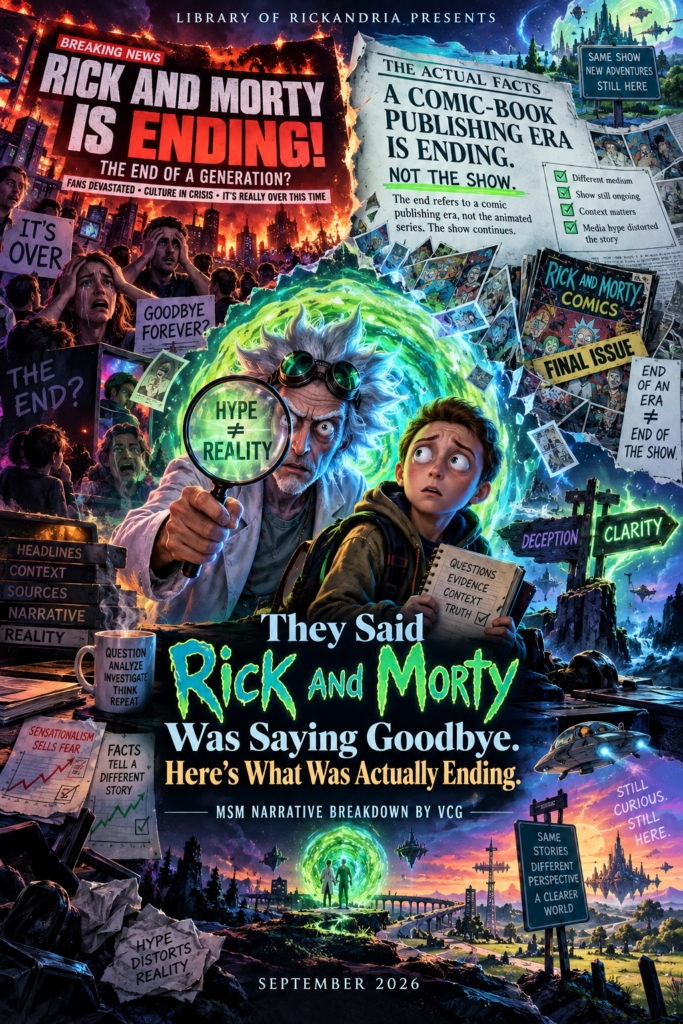
UPDATED BY VCG ON 9/17/2026 @ 03:33 EST
Anyone can do this, but most won’t.
ChatGPT – Library of Rickandria
Abstract
On September 14, 2026, an entertainment article by TJ Mills of ScreenRant, subsequently distributed through MSN, appeared under the headline:
“Rick And Morty Say Goodbye In 2 Months, Confirming End Of An Era.”
IMDb independently records the article under that:
- title
- date
- author
- publisher
while a syndicated copy preserves substantially more of its text.
Rick and Morty say goodbye in 2 months, confirming end of an era
The underlying event is real.
Oni Press, which had published Rick and Morty comics for roughly a decade and more than 100 issues, concluded its run of new Rick and Morty comics in 2026.
But the chronology matters.
Oni announced Rick and Morty: The End on September 9, 2025, not in December 2025 as the article states.
Oni later announced Rick and Morty Forever #0 as the final issue of Oni Press’s run, scheduled for May 27, 2026.
The November 3, 2026 product around which the article creates a new countdown is not another final new comic story.
It is a hardcover collection containing The End #1–6 and Forever #0. Penguin Random House currently lists that hardcover at 208 pages and $34.99.
Meanwhile, the television program itself is not ending.
Warner Bros. Discovery announced in October 2024 that Adult Swim had ordered Seasons 11 and 12, extending the program through 2029, and Season 9 aired in 2026.
This paper therefore does not classify the article as invented news.
Its more defensible conclusion is that a real, narrow publishing event was framed in language broad enough to suggest a larger franchise farewell before the article supplied the necessary qualifier.
The article then used:
- emotional language
- future-oriented urgency
- superlatives
- consumer recommendations
and publisher-derived promotional material to turn an already-completed comic-book ending into a fresh
“end of an era”
story.
That makes the piece useful as a case study in a subtler media problem:
a story does not need to fabricate its basic facts in order to leave a reader with an exaggerated first impression.
I. Why This Article Is Worth Studying
There are easier articles to fact-check.
Some contain a plainly false number or misidentify a person.
This one is more interesting because most of its underlying facts are legitimate.
There really was a decade-long Oni Press Rick and Morty publishing run.
There really was a final storyline called The End.
There really was a farewell issue called Rick and Morty Forever #0.
There really is a hardcover scheduled for November 3, 2026.
The problem emerges when we ask a different question:
What impression is created before all of those qualifications are supplied?
The headline does not say:
Oni Press’s Rick and Morty Comic Publishing Run Gets Final Hardcover Collection in November.
It says:
“Rick And Morty Say Goodbye In 2 Months, Confirming End Of An Era.”
The reader therefore enters the story with a much larger category in mind:
Rick and Morty.
Only after the headline and opening emotional framing does the article narrow the event to Oni Press comics.
The article does make that clarification.
That point is important and should not be concealed.
This is not an article that maintains a false claim that the Adult Swim television series is ending.
But the clarification does not erase the rhetorical work already performed by the headline.
The most useful question, then, is not simply,
“Is the article true or false?”
A better set of questions is:
What exactly happened?
When did it happen?
What is actually ending?
What had already ended?
What is still continuing?
Which statements are facts?
Which are opinions?
Which words enlarge the emotional significance of the event?
Which details were inherited from promotional copy?
And what does responsible discernment require before we accuse anyone of deliberate deception?
Those questions form the method of this paper.
II. Source Note: MSN Is the Distributor, Not the Original Reporter
The link under review is an MSN-hosted version of the story.
Direct automated retrieval of the MSN page was unavailable during this research because MSN blocked machine access.
That creates a source limitation that should be disclosed rather than hidden.
The article can nevertheless be independently identified.
IMDb’s news index lists
“Rick And Morty Say Goodbye In 2 Months, Confirming End Of An Era,”
dated September 14, 2026, written by TJ Mills, with ScreenRant named as the publisher.
A syndicated reproduction at HeadTopics likewise attributes the article to ScreenRant and preserves the article’s:
- opening paragraphs
- chronology
- hardcover description
- evaluative language
and substantial sections of its text.
That distinction matters.
Calling this simply an
“MSN article”
is understandable because MSN hosted the version encountered by the reader, but the editorial source appears to be ScreenRant.
MSN functioned here as a distributor or aggregator.
That means this paper should not use one entertainment feature to make unsupported claims about every institution that someone might place under the broad label “mainstream media.”
The case is strong enough without enlarging it beyond the evidence.
III. Research Method
The analysis uses four separate layers.
The first is historical verification.
- Dates
- issue counts
- publishing status
- television renewal status
- price
- page count
and release information are checked against primary or near-primary sources wherever possible.
The second is textual analysis.
The article’s:
- headline
- opening structure
- adjectives
- temporal language
- category choices
and promotional statements are examined as language.
The third is psychological and communication research.
Claims concerning:
- clickbait
- curiosity gaps
- forward reference
- emotional arousal
- negativity
- attention
and credibility are compared with peer-reviewed research.
Importantly, these studies can illuminate mechanisms.
They cannot prove the private motives of a particular writer.
The fourth is biblical evaluation.
Scripture is not used to determine whether Oni published a comic on May 27.
That is a historical question answered through documentary evidence.
Scripture is used instead to establish principles concerning:
- truth
- examination
- testimony
- wisdom
- communication
- discernment
- philosophy
and what the mind is encouraged to dwell upon.
Those categories should remain distinct.
A publishing catalog is not Scripture.
A psychology experiment is not theology.
A biblical proverb is not a bibliographic database.
Each source answers a different kind of question.
IV. The Chronology Before the Narrative
The easiest way to see what happened is to place the events in their actual order.
On September 9, 2025, Oni Press formally announced Rick and Morty: The End #1.
The publisher described it as issue one of a six-issue series and explicitly connected the project to the end of its long-running comic-book era.
Oni said the company had published Rick and Morty for:
“10 years and 100+ issues.”
Issue #1 was scheduled for December 3, 2025.
Oni reinforced that messaging in October and November.
An October 20 release again called The End a six-part finale and added an especially useful qualifier: it was occurring
“only in comic shops and not on TV.”
The publisher therefore distinguished the comic-book finale from the television program months before the September 2026 ScreenRant story.
On February 9, 2026, Oni announced that The End would not be the literal last publication after all.
A double-sized epilogue, Rick and Morty Forever #0, would follow.
Oni explicitly described Forever #0 as the
“final issue of Oni Press’ immortal run”
and scheduled it for May 27, 2026.
That issue was the real final new comic-book installment in Oni’s run.
Several months later, a hardcover collection was catalogued for November 3, 2026.
Penguin Random House currently lists Rick and Morty: The End as a 208-page hardcover, priced at $34.99, collecting The End #1–6 and Rick and Morty Forever #0.
Then, on September 14, 2026, the article under review appeared.
This order matters because the headline announces a goodbye that is supposedly coming
“in 2 months.”
But the final new Oni comic had already arrived almost four months earlier.
The November product is not the moment when Oni’s serialized storytelling ends.
It is the collected edition of material through which that ending had already occurred.
That is the paper’s most important chronological distinction.
V. What Was Happening on Television at the Same Time?
The broader franchise was not disappearing.
On October 17, 2024, Adult Swim announced two additional seasons of Rick and Morty. Warner Bros.
Discovery’s own press release states that the renewal ensures the show reaches Season 12 and continues through 2029.
That remained consistent with subsequent activity.
Warner Bros. Discovery announced Season 9’s May 24, 2026 premiere, describing Rick and Morty as Adult Swim’s number-one series.
Season 9 concluded in July 2026, less than two months before the ScreenRant article appeared.
The franchise was even expanding in another direction.
In June 2026, Adult Swim announced President Curtis, a new animated series co-created by Dan Harmon and James Siciliano and situated within the wider Rick and Morty creative universe.
Against that background,
“Rick and Morty say goodbye”
is not a useful description of the television property’s overall status.
It can be defended only after supplying an implied object:
Rick and Morty say goodbye to their publishing era at Oni Press.
That missing qualifier is the entire dispute in miniature.
VI. A Claim-by-Claim Evidence Ledger
| Article claim or framing | Evidence | Assessment |
|---|---|---|
| “Rick And Morty Say Goodbye In 2 Months” | November 3 hardcover is real, but Oni’s final new comic was Forever #0 on May 27. | Misleading without the Oni-comics qualifier. The future date belongs to a collected edition, not the end of new Oni storytelling. |
| “End of an era” | Oni’s comic run lasted about ten years and 100+ issues. | Defensible if “era” means Oni’s publishing era. |
| Fans face the ending “in two months” | Article appeared Sept. 14; hardcover releases Nov. 3, about 50 days later. | Ordinary approximation, but creates future urgency around an ending that had narratively already happened. |
| “Bittersweet” ending | No objective metric establishes how fans collectively feel. | Emotional characterization / opinion. |
| “Supersize sendoff” | Hardcover is a larger collected edition. | Promotional description built around a real product. |
| Fans “won’t want to miss” it | Predicts consumer desire. | Persuasive language, not fact. |
| Rick and Morty “reign supreme” on Adult Swim | Series is prominent and officially described by Adult Swim as its #1 series, but “reign supreme” is undefined. | Rhetorical superlative resting on a real success story. |
| Comic run lasted ten years and 100+ issues | Oni repeatedly uses this description. | Supported. |
| Comic run “rivals even the TV show” | No criterion for “rivals” is supplied. | Subjective evaluation. |
| Oni “officially announced” The End in December 2025 | Oni’s official announcement is dated September 9, 2025. Dec. 3 was issue #1’s publication date. | Clear chronology error. |
| The End was six issues | Oni announcement and hardcover catalog identify #1–6. | Supported. |
| Forever #0 released May 27, 2026 | Oni gives May 27 and calls it the final issue of its run. | Supported. |
| Forever #0 “officially wrapped up” Rick and Morty’s Oni run | This matches Oni’s own framing. | Supported. |
| November brings a “proper send-off” | It brings a hardcover collection of already-published finale material. | Opinion/promotional framing, not a new narrative finale. |
| Hardcover is 200 pages | ScreenRant copy says 200; Target also carries 200-page metadata. Current Penguin Random House catalog says 208. | Metadata discrepancy, not strong evidence of fabrication. |
| Hardcover costs $34.99 and arrives Nov. 3 | Current publisher/distributor catalog supports both. | Supported. |
| Hardcover collects The End #1–6 and Forever #0 | PRH catalog confirms. | Supported. |
| Another publisher could someday acquire the comics rights | Possible in principle but no evidence cited that this will happen. | Clearly labeled speculation. |
| Collection is “gorgeous,” “excellent,” “perfect,” and a “10/10 send-off” | These are judgments. | Review language, not factual reporting. |
| Plot synopsis describes Rick as wanted across universes and facing trial | Essentially the official promotional synopsis distributed with the hardcover. | Accurate description of fictional promotional copy, not a real-world factual claim. |
The pattern is worth noticing.
Most of the article’s narrow facts survive checking.
The strongest problems occur at the level of chronology, category, scale, and rhetoric.
VII. The Most Concrete Error: September Became December
The article states that Oni officially announced Rick and Morty: The End in December 2025.
That is not what Oni’s publication record shows.
Oni’s announcement is dated September 9, 2025.
The release itself repeatedly states that The End #1 would go on sale December 3, 2025.
The likely explanation is mundane: the writer appears to have confused the series’ launch date with its announcement date.
There is no need to construct a larger theory to account for this.
It is a normal factual error.
But it matters because the paper is examining chronology, and this article’s central dramatic device is chronological: something supposedly ends in two months.
When a story trades heavily on dates, its dates deserve particular scrutiny.
VIII. The 200-Page Question
The ScreenRant copy calls the forthcoming book a 200-page hardcover.
Penguin Random House now gives the book as 208 pages.
Its:
- main catalog
- library catalog
- comics catalog
- international sales database
and retail catalog are internally consistent on 208 pages.
At first glance that looks like another simple error.
But there is a complication.
Target currently lists the same ISBN and November 3 street date while still showing 200 pages.
That suggests older or alternate metadata circulated through the retail ecosystem.
The fair conclusion is therefore not,
“ScreenRant invented the page count.”
The fair conclusion is:
The article used a 200-page figure that conflicts with the distributor’s current 208-page specification and appears to reflect older catalog metadata.
That is a good example of why proper fact-checking should distinguish a false statement from an understandable metadata mismatch.
IX. The Most Important Distinction: Ending Versus Packaging the Ending
This is the conceptual center of the case.
A serialized story ends when its final new installment is published.
A hardcover collection can commemorate that ending later.
Those are not the same event.
Oni could hardly have been clearer about Forever #0.
In February 2026 the publisher described it as its final issue, the last entry after a 100-plus-issue run, and scheduled it for May 27.
The November hardcover, by contrast, is described by Penguin Random House as a volume collecting The End #1–6 and Forever #0.
So imagine the same structure applied elsewhere.
If a television series aired its final episode in May and then released a complete-series Blu-ray box in November, it would be strange to write in September:
“The show says goodbye in two months.”
One could poetically call the box set a final send-off.
But it would not be the date on which the series actually ended.
That is essentially what happened here.
X. The Headline’s Scope Problem
A headline works before a reader reaches the article body.
That makes nouns and qualifiers especially important.
“Rick and Morty say goodbye”
identifies the entire property.
“Oni Press ends its Rick and Morty comic run”
identifies the actual domain.
Those are different scopes.
To its credit, the article does not hide the comics distinction for very long.
After its broad opening, it pivots to the fact that Rick and Morty has a comic-book history at Oni Press.
This is important because it limits how severe the criticism should be.
The article is not a sustained hoax in which the reader is led all the way to the end believing Adult Swim cancelled the program.
The better criticism is more precise:
The headline and first emotional beat invite an interpretation broader than the underlying event, and the article then narrows that interpretation after the reader has already clicked.
That structure has a name in communication research.
XI. Forward Reference and the Curiosity Gap
In 2015, Jonas Nygaard Blom and Kenneth Reinecke Hansen examined 100,000 online news headlines and described forward-reference as a recurring clickbait technique.
In a forward-referencing headline, some important information needed for full understanding is postponed.
The resulting uncertainty can encourage the reader to continue into the story.
Kate Scott later analyzed clickbait through the idea of an information gap:
a headline supplies enough information to make the reader aware that something significant is missing while withholding the information necessary to complete the picture.
Her analysis specifically examines devices such as definite expressions, superlatives, and under-specified references that stimulate curiosity.
This headline is not the purest textbook example of a pronoun-driven curiosity gap—something like
“You Won’t Believe What Happened Next”
would be more obvious.
But it produces a related problem through missing scope.
Rick and Morty are saying goodbye.
Goodbye to what?
The whole show?
A character?
Adult Swim?
The franchise?
The comics?
Oni Press?
The missing object carries almost the entire meaning of the story.
The reader receives it only after entering the article.
XII. Does That Kind of Language Actually Capture Attention?
Laboratory evidence suggests that forward-reference can affect attention allocation.
An EEG study published in the International Journal of Human–Computer Interaction found that clickbait headlines using forward-reference attracted more attention resources and triggered involuntary attention allocation more quickly than comparable headlines without the device.
That finding should be used carefully.
It does not prove that this specific ScreenRant headline caused a particular neurological reaction in every reader.
It does show that there is an empirically studied reason why incomplete or suspense-producing headline structures can be effective.
Another experimental study on clickbait found that such headlines can evoke curiosity and emotional arousal, with curiosity playing an important role in intention to read.
Again, the lesson is mechanism, not motive.
The research lets us say:
This kind of construction is capable of attracting attention through uncertainty and curiosity.
It does not let us say:
We have proved what TJ Mills was consciously thinking when the headline was written.
We do not even know from the available record whether the final headline was written by the named author or altered by an editor.
That uncertainty belongs in the paper.
XIII. Emotional Amplification
The opening does more than announce a publication.
It preloads an emotional response.
The event is framed as a “bittersweet” end involving an “iconic” and “beloved” chapter and a large sendoff.
Later, the hardcover becomes a “gorgeous” collectible, an “excellent” farewell, a “perfect” way to catch up, and finally a “10/10” sendoff.
None of those phrases is a historical fact.
They are evaluations.
That does not make them illegitimate.
ScreenRant is an entertainment outlet, not a wire service, and entertainment writing routinely mixes:
- news
- fandom
- opinion
- recommendation
But readers should recognize the genre change.
The piece begins by sounding like news:
Something significant is ending.
It then becomes product information:
Here is the hardcover, the price, the contents, and release date.
And finally it becomes consumer advocacy:
This is beautiful, important, worth owning, and highly rated.
Those modes are allowed to coexist.
They should not be mistaken for one another.
XIV. Negativity and Loss as Attention Signals
The most dramatic part of the headline is not
“hardcover coming.”
It is
“say goodbye”
and
“end of an era.”
Loss carries emotional weight.
Large-scale experimental research published in Nature Human Behaviour examined more than 105,000 headline variants across hundreds of millions of impressions.
The researchers found that negative words increased click-through rates; for an average-length headline, each additional negative word was associated with roughly a 2.3 percent increase in click-through rate.
That does not mean “goodbye” automatically adds 2.3 percent to this ScreenRant article.
The study’s data came from Upworthy headline experiments and cannot simply be transplanted as a precise estimate.
But it demonstrates a broader and well-supported fact:
Negative or loss-oriented language can increase online news consumption.
An impending disappearance is usually more attention-grabbing than a forthcoming compilation.
“THE END”
is inherently more dramatic than:
“COLLECTED HARDCOVER.”
Oni itself knew this and used deliberately exaggerated end-times marketing language throughout its comic promotion.
The difference is that Oni’s own releases repeatedly identified what was ending:
its comic-book run.
XV. Temporal Urgency: Why “In Two Months” Matters
The article could have said:
A hardcover collecting Oni Press’s final Rick and Morty stories arrives November 3.
Instead, the event becomes a countdown:
Rick and Morty say goodbye in two months.
On September 14, November 3 was about 50 days away.
There is nothing inherently dishonest about calling that roughly two months.
The important issue is psychological and narrative.
A countdown creates a future event.
The reader is not invited to reflect upon something that concluded in May.
The reader is invited to anticipate something that will happen soon.
That converts old news—the end of new Oni comic storytelling—into a fresh urgency narrative surrounding a new retail object.
Chronologically, the narrative operates like this:
The actual creative finale happened.
Months passed.
A collection was scheduled.
The collection was reframed as the coming goodbye.
That is what this paper means by temporal reframing.
XVI. Category Expansion
Another mechanism is what we can call category expansion.
The narrow factual category is:
Oni Press’s licensed Rick and Morty comic-book publishing run.
The headline category is:
Rick and Morty.
The difference matters because readers generally know the television property more readily than they know the licensing history of a specific comics publisher.
The larger category carries larger stakes.
“Rick and Morty is ending”
sounds culturally significant.
“Oni Press is concluding its licensed comic line”
sounds industry-specific.
The article never literally states that the television series is cancelled.
Instead, it allows the famous larger category to carry the opening emotional load and supplies the narrower category in the body.
That is why this case is better described as scope inflation than as a simple false statement.
XVII. Pragmatics: How a Statement Can Be Defensible and Still Mislead
One of the most relevant studies for this case comes from research on ambiguous clickbait.
Valentina Apresjan and Alexander Orlov analyzed clickbait headlines that permit two interpretations: one salient but misleading interpretation and another, less obvious interpretation that fits the article’s actual content.
They describe how ambiguity and conversational implication can enable a headline to avoid a direct lie while still producing a misleading first reading.
Their empirical work concerns Russian online media, so its linguistic findings should not be treated as a direct experiment on English ScreenRant headlines.
But the pragmatic structure they describe is remarkably relevant.
Applied here:
Interpretation A, the broad one:
Rick and Morty are ending or leaving in two months.
Interpretation B, the narrower one:
The collected-edition farewell to Oni Press’s already-ended comics run arrives in two months.
B is defensible.
A is the more dramatic reading.
The body resolves the ambiguity toward B.
That is exactly why the headline can feel deceptive to a reader even though lawyers or editors could defend each individual word.
XVIII. “Technically True” Is Not the Whole Standard
This distinction deserves its own treatment.
Suppose a statement is technically compatible with the facts but predictably communicates something larger.
Is that enough?
In ordinary human communication, meaning comes not merely from dictionary definitions but from:
- context
- relevance
- omission
- implication
and shared assumptions.
If I tell someone:
“The restaurant is closing tonight.”
they reasonably assume the business is shutting down.
If I later explain:
“I only meant it closes every night at 10 p.m.”
the individual words were technically defensible, but the communication was poor because an obvious and stronger interpretation was allowed to stand.
The same principle operates here.
“Rick and Morty say goodbye”
is technically salvageable if the intended completion is
“to Oni Press.”
But because the franchise is still active on television through already-ordered future seasons, the omitted object is not trivial.
It changes the scale of the story.
XIX. Promotional Copy Entering Journalism
The article’s long plot synopsis is especially revealing because much of it closely follows the official sales description distributed for the hardcover.
Penguin Random House describes Rick as the most wanted man across universes following destruction of the Prime Universe, then explains that Morty is uniquely positioned to bring him in before Rick stands trial for crimes against existence.
The catalog concludes by describing the story as the end after ten years and 100-plus issues.
The ScreenRant article reproduces that basic promotional architecture.
There is nothing unusual about this.
Entertainment reporting frequently depends on:
- press releases
- solicitations
- publisher descriptions
- trailers
- advance publicity
But it creates a useful source-chain question:
Where does reporting stop and marketing begin?
Oni’s copy is intentionally theatrical.
The company jokes, exaggerates, writes in all caps, calls its creators cosmic annihilators, and openly mocks its own promotional methods.
In the Forever #0 announcement, Oni even jokingly calls the issue a promotional stunt.
That voice belongs naturally in advertising.
When an entertainment article adopts the same emotional intensity while also presenting itself as news, the boundaries become less clear.
The reader is not necessarily receiving false information.
The reader is receiving factual information through a promotional frame.
XX. The Source Chain
The informational flow can be reconstructed with reasonable confidence.
The original rights holder and publisher communicate the end of the comic line through Oni Press announcements.
The distributor catalog packages the finale material into a November hardcover and supplies sales copy, specifications, price, and synopsis.
ScreenRant turns that product and its history into an entertainment feature.
MSN distributes that feature to a broader audience.
At each stage, the information is repurposed.
Oni’s goal is to sell and celebrate comics.
Penguin Random House’s catalog exists to identify and distribute a book.
ScreenRant’s article seeks readers.
MSN seeks to distribute content to its audience.
None of those institutional functions proves dishonesty.
But they create incentives for increasingly broad and attention-oriented framing.
The important observation is not conspiratorial.
It is structural.
Online information passes through institutions whose goals are not identical to the reader’s goal of obtaining the most precise summary possible.
XXI. Click Economics Without Mind-Reading
The digital news environment rewards attention.
That proposition does not require speculation about a particular writer.
A theoretical model published in the Journal of Public Economics examines media firms whose revenues depend upon visits and clicks.
The researchers show how revenue incentives can produce strategic distortions or uncertainty because keeping audiences consulting the outlet has economic value.
That is a general model, not proof about ScreenRant’s finances or editorial process.
Likewise, research on clickbait and credibility indicates that sensational or clickbait-style headlines can reduce perceived credibility or quality, although effects vary by study design and the quality of the underlying writing.
Another experimental study involving U.S. and Indian participants found that clickbait headlines significantly reduced perceived credibility of the associated news items.
The broader irony is obvious.
Attention-maximizing headlines may win the click while slowly weakening confidence in the publisher.
The short-term incentive and long-term interest can point in opposite directions.
XXII. The Strongest Defense of the Article
A fair paper should make the best case for the text it criticizes.
The headline is not completely unreasonable.
Oni Press really is ending a notable publishing relationship that lasted about a decade and exceeded 100 issues.
“End of an era”
is a perfectly normal phrase for such a transition.
The November hardcover is intended as a commemorative collected edition of that final storyline.
Calling it a “sendoff” is ordinary entertainment language.
The article also corrects the possible television inference fairly early.
It explicitly says the television property remains on Adult Swim and explains that the ending concerns the comics.
The article never states:
“Adult Swim cancelled Rick and Morty.”
It never states:
“Season 9 was the final season.”
It never states:
“There will be no Season 10.”
It also uses qualifiers when discussing the future.
The possibility of another comics publisher is presented as a possibility, not a certainty.
Furthermore, entertainment sites routinely write in an enthusiastic fan voice.
Calling a comic “gorgeous” or giving it a “10/10” is not necessarily an attempt to masquerade opinion as objective reporting; readers of the genre may understand those sentences as criticism or recommendation.
Finally, the page-count discrepancy has a plausible catalog explanation because at least one major retailer also displays 200 pages.
Those facts moderate the case.
XXIII. Why the Criticism Still Stands
The strongest defense does not solve the chronology problem.
The final new Oni comic was May 27.
The November item is a compilation.
Yet the September headline tells readers the goodbye occurs in two months.
The defense also does not solve the scope problem.
The television show was not only continuing; Warner Bros. Discovery had already ordered it through Season 12 and 2029.
And it does not solve the factual error about Oni’s announcement date.
September 9, 2025 is September 9, 2025.
December 3 was the publication date of issue #1.
The criticism therefore survives, but in a more disciplined form:
The article contains mostly real underlying facts while using a headline and temporal frame that make a narrow, already-completed comics ending appear like a broader and more immediate Rick and Morty farewell.
That is stronger than calling everything fake because it can be demonstrated.
XXIV. What the Evidence Does Not Prove
This investigation does not prove a coordinated MSN strategy to deceive readers.
It does not prove a conspiracy among:
- Warner Bros. Discovery
- Oni Press
- ScreenRant
- MSN
or any other organization.
It does not prove the author knowingly wrote something he believed to be false.
It does not establish who personally composed or approved the final headline.
It does not prove every reader interpreted the headline as referring to the television program.
It does not prove that words such as “bittersweet,” “end,” or “goodbye” were chosen after consulting psychological literature.
It does not prove that entertainment journalism as a whole is fraudulent.
And it does not prove that a reader who enjoyed the article was manipulated in some clinically measurable sense.
A strong investigation loses nothing by stating those limits.
In fact, those limits make the demonstrable findings more credible.
XXV. Why “MSM Narrative Breakdown” Should Remain a Case Study, Not a Universal Theory
The title of this paper uses
“MSM Narrative Breakdown”
because that is the project series under which we are examining the article.
But methodologically, “mainstream media” is too broad a category to serve as the explanation for every error found here.
The article originated with an entertainment website.
It was syndicated through a large web portal.
Its subject was pop culture and comic-book publishing.
Its rhetorical style resembles entertainment promotion more than investigative reporting.
Therefore, the proper unit of analysis is this story and its distribution chain, not “the media” as a single mind.
That keeps the paper from committing the same error it criticizes.
If the headline improperly expands an Oni Press event into a broad
“Rick and Morty goodbye,”
the paper should not improperly expand one ScreenRant article into a verdict on every journalist and publisher.
Precision must work both ways.
XXVI. A Biblical Standard for Investigation
The biblical framework begins not with suspicion, but with examination.
Proverbs 18:13 says:
“He that answereth a matter before he heareth it, it is folly and shame unto him.”
A few verses later:
“He that is first in his own cause seemeth just; but his neighbour cometh and searcheth him.”
Both statements appear in the supplied King James Bible.
That is an unusually useful pair of principles for media analysis.
The first prohibits premature judgment.
The second warns that the first account can appear complete until additional evidence is examined.
Applied here, it means neither the headline nor our suspicion about the headline gets the final word automatically.
We go to Oni.
We go to the distributor catalog.
We go to Adult Swim.
We establish chronology.
Then we judge the claim.
XXVII. “The Simple Believeth Every Word”
Proverbs 14:15 says:
“The simple believeth every word:
but the prudent man looketh well to his going.”
That verse is sometimes used as though it said:
“Never believe established media.”
It does not.
It says the simple person believes every word.
That warning applies to every information ecosystem.
It applies to television networks.
It applies to newspapers.
It applies to alternative media.
It applies to podcasts.
It applies to social-media posts.
It applies to viral screenshots.
It applies to people who tell us what we already want to hear.
It applies to this paper.
Biblical discernment is not merely distrust.
It is disciplined testing.
XXVIII. “Prove All Things”
Paul writes in 1 Thessalonians 5:21:
“Prove all things; hold fast that which is good.”
The immediate context concerns spiritual instruction, so the verse should not be ripped from its setting and turned into a modern journalism manual.
Yet the underlying disposition is plainly compatible with careful inquiry:
test;
examine;
retain what survives.
Acts 17 supplies an even more concrete example.
The Bereans received Paul’s teaching with readiness yet still
“searched the scriptures daily, whether those things were so.”
Notice the combination.
Readiness of mind did not exclude verification.
Verification did not require hostility.
That posture is worth preserving.
XXIX. Truthful Speech Is More Than Avoiding Direct Lies
Ephesians 4:25 says:
“Wherefore putting away lying, speak every man truth with his neighbour:
for we are members one of another.”
The direct command concerns lying and truthful speech among believers.
Applying it to journalism requires interpretation rather than pretending Paul was discussing digital headlines.
Still, the ethical principle is relevant.
Truthful communication is not served merely by finding a technically defensible interpretation after the fact.
A speaker should care about what the hearer is reasonably led to understand.
This is where the article becomes an interesting ethical case.
“Rick and Morty say goodbye”
can be defended once the missing words
“to Oni Press”
are supplied.
But communication should be judged partly by whether the important qualifier was necessary to prevent a foreseeable misunderstanding.
In this case, it was.
XXX. Biblical Discernment Also Corrects the Critic
There is another side to this.
The critic can lie by exaggeration too.
Calling the entire article fabricated would be inaccurate.
Claiming the television program was secretly cancelled would contradict official evidence.
Claiming the author intentionally deceived readers would go beyond what can be demonstrated.
Claiming all news institutions operate according to one conspiracy would require evidence this case does not provide.
The same Scripture that challenges careless reporting challenges careless rebuttal.
A commitment to truth cannot become situational.
If accuracy binds the journalist, it binds the fact-checker.
XXXI. Philippians 4:8 and the Attention Economy
Philippians 4:8 tells believers:
“whatsoever things are true, whatsoever things are honest, whatsoever things are just, whatsoever things are pure, whatsoever things are lovely, whatsoever things are of good report…think on these things.”
That verse concerns much more than media consumption.
But it raises a question especially relevant to digital life:
What trains our attention?
The attention economy rewards interruption.
Fear interrupts.
Anger interrupts.
Loss interrupts.
Sexuality interrupts.
Outrage interrupts.
Mystery interrupts.
Urgency interrupts.
The Christian question is therefore larger than whether any individual article contains technically false information.
It also asks whether our habits of consumption teach us to be constantly agitated, suspicious, distracted, or emotionally jerked from one artificial crisis to another.
The headline under review is mild compared with the worst examples online.
But it participates in the same competition for attention.
Something is ending.
You have two months.
The era is over.
Click to discover what that means.
XXXII. Colossians 2:8 and Worldview Discernment
Paul warns:
“Beware lest any man spoil you through philosophy and vain deceit, after the tradition of men, after the rudiments of the world, and not after Christ.”
This verse should not be misused to condemn all philosophical reasoning.
Paul himself reasons extensively throughout his letters.
The target is philosophy joined to vain deceit and systems that displace Christ.
That distinction matters when we turn from the media article to Rick and Morty itself.
The show is fiction.
A fictional multiverse is not a scientific claim merely because characters use scientific vocabulary.
A joke about God is not automatically a philosophical demonstration.
A cynical character’s speech is not necessarily the creator’s final doctrine.
Responsible analysis therefore asks how ideas function in the narrative rather than treating every line of dialogue as a manifesto.
XXXIII. Rick and Morty and Nihilism
There is legitimate academic scholarship examining nihilism in Rick and Morty.
Lucas Miranda’s 2017 article explicitly analyzes nihilism and alienation in the show.
More recently, Nicholas Holm and Jennalee Donian argued that the series does more than simply represent popular nihilism; across its development, it explores, exhausts, challenges, and potentially moves beyond nihilistic attitudes.
That qualification is important.
It would be too simplistic to say:
“Rick and Morty teaches nihilism.”
The series frequently gives nihilistic claims to Rick, stages universes in which ordinary categories of meaning are destabilized, treats cosmic insignificance as comedy, and repeatedly asks what moral or emotional commitments mean in an apparently infinite multiverse.
But the narrative also repeatedly shows the damage produced by Rick’s detachment.
Relationships matter to him despite his denials.
Loss matters.
Morty matters.
Beth matters.
Diane matters.
Guilt matters.
Love matters.
Consequences keep returning.
Holm and Donian specifically argue that the series increasingly works through the limitations of nihilism rather than simply celebrating it.
A biblical critique should engage that complexity rather than attack a caricature of the show.
XXXIV. Intelligence Is Not Wisdom
Rick’s defining cultural identity is intelligence.
He is repeatedly marketed as an extraordinary scientific mind.
The official franchise description itself calls him a genius scientist.
Scripture makes a distinction modern culture often blurs.
Intellectual power is not identical to wisdom.
Technical mastery is not righteousness.
The ability to manipulate nature does not establish moral authority.
Romans 1 describes men who became vain in their reasoning while:
“Professing themselves to be wise.”
Paul similarly asks in 1 Corinthians:
“Where is the wise? where is the scribe? where is the disputer of this world?”
and contrasts the wisdom of the world with the wisdom of God centered upon Christ.
The point is not anti-intellectualism.
The Bible repeatedly praises:
- knowledge
- understanding
- counsel
- learning
- wisdom
Proverbs begins:
“The fear of the LORD is the beginning of knowledge.”
Rick therefore provides an interesting literary contrast.
He can solve impossible technical problems and still fail relationally.
He can cross dimensions and still fail to govern himself.
He can defeat enemies and remain wounded by his past.
He can understand mechanisms without possessing a stable moral answer to the question of what life is for.
That distinction between power over creation and wisdom about life is a far more substantial biblical critique than simply saying science is bad.
XXXV. The Multiverse and Meaning
The fictional multiverse allows Rick and Morty to ask a recurring question:
If there are endless versions of everyone and everything, why should any particular person or choice matter?
That is a narrative device.
It should not be confused with a demonstrated scientific fact about reality.
From a biblical perspective, human value is not grounded in cosmic rarity.
Genesis grounds humanity’s significance in creation by God.
Biblical meaning is therefore not erased merely by imagining a larger physical cosmos.
Even if the created order were vastly larger than human beings currently understand, scale would not determine value.
A human is not valuable because the universe is small.
A human is valuable within the biblical worldview because God’s purposes give creation its meaning.
Thus a fictional multiverse can dramatize existential anxiety, but it does not by itself refute biblical teleology.
XXXVI. Family, Detachment, and the Cost of Cynicism
One of the more interesting features of Rick and Morty is that its emotional story often undercuts Rick’s verbal philosophy.
The character may treat relationships as replaceable because alternate versions exist.
Yet the series repeatedly builds drama from relationships that prove emotionally non-interchangeable.
A replacement is not experienced as identical to the person who was lost.
Grief does not disappear merely because another version exists.
This is one reason a serious Christian reading should not treat the show only as an enemy text.
Sometimes the narrative itself exposes the weakness of its character’s cynicism.
The biblical correction is then not merely external.
The story provides evidence that Rick’s professed detachment does not successfully explain his own behavior.
That tension is precisely what makes the character interesting.
XXXVII. Entertainment Is Not Spiritually Meaningless
A common modern assumption is that entertainment is morally neutral because it is fictional.
Scripture does not provide a television-rating system.
It does not name Rick and Morty.
Christians can therefore disagree about whether watching a particular program is wise in particular circumstances.
But Scripture does care about:
- imagination
- desire
- speech
- laughter
- imitation
- attention
and what fills the mind.
Philippians 4:8 is relevant here not as a mechanical censorship code but as a positive orientation.
What do we repeatedly place before ourselves?
What do we learn to laugh at?
What do we normalize?
What forms of cruelty stop disturbing us?
What forms of cynicism start sounding intelligent merely because they are delivered by an intelligent character?
What desires are strengthened through repetition?
Those are legitimate questions.
So is another:
Can a viewer recognize the ugliness of an idea precisely because a story portrays its consequences?
The answer need not always be simple.
Discernment is harder than prohibition slogans.
XXXVIII. The Danger of Becoming What We Criticize
There is a final psychological trap worth naming.
Once someone recognizes sensational framing, it becomes tempting to find manipulation everywhere.
Suspicion itself can become rewarding.
The critic begins to experience every inconsistency as proof of a larger scheme.
Every wording choice becomes deliberate conditioning.
Every typo becomes evidence.
Every coincidence becomes coordination.
That mindset is not careful investigation.
It is another form of narrative addiction.
Proverbs 18:17 remains useful here.
The first story seems right until another examines it.
But that principle applies recursively.
Our rebuttal also needs examination.
A biblical commitment to truth therefore resists two opposite temptations:
credulity toward institutional media;
and credulity toward anti-institutional narratives.
“The simple believeth every word”
does not tell us which tribe’s words to believe.
It tells us not to be simple.
XXXIX. A Reconstructed Straight-News Version
If the goal were maximum informational clarity rather than maximum emotional impact, the story could be summarized this way:
Oni Press will release a hardcover collection of its final Rick and Morty comics on November 3, 2026.
The publisher’s decade-long run of new Rick and Morty comics actually concluded on May 27 with Rick and Morty Forever #0.
The collection contains Rick and Morty: The End #1–6 and Forever #0 and is currently listed by Penguin Random House at 208 pages and $34.99.
The ending applies to Oni Press’s comic-book run, not the Adult Swim television series, which Warner Bros. Discovery has renewed through Season 12 and 2029.
Nothing essential is lost.
The only thing reduced is drama.
That is why the comparison is instructive.
XL. Media-Literacy Checklist
When encountering another dramatic entertainment headline, a reader can work through the following questions before sharing it:
- What exactly is the subject? Is the entire franchise ending, or one publisher, actor, contract, edition, platform, storyline, or licensing arrangement?
- What noun or qualifier is absent from the headline? Ask what would make the headline less dramatic but more precise.
- What date marks the actual event? Separate announcement date, publication date, finale date, collection date, and streaming date.
- What already happened? A countdown may be attached to packaging or commemoration of an event that is already over.
- Which statements can be verified? Dates, prices, contracts, issue counts, renewals, page counts, and official announcements belong here.
- Which statements are evaluations? “Beloved,” “perfect,” “epic,” “gorgeous,” “historic,” and numerical ratings are not documentary facts.
- Who is the original source? Distinguish publisher press release, distributor catalog, journalist, aggregator, social account, and commentary.
- Does the source’s wording appear downstream? Repeated promotional language can reveal where framing originated.
- What is the strongest interpretation in the headline? Then ask whether the article later narrows it.
- What evidence would prove my own interpretation wrong? A method that cannot be falsified is not a serious fact-check.
- Am I inferring motive from effect? Language can have manipulative effects without proving conscious malicious intent.
- Am I applying the same standard to sources I agree with? Discernment that works only against opponents is confirmation bias wearing a lab coat.
XLI. Findings
After separating:
- fact
- chronology
- rhetoric
- psychology
- interpretation
- Scripture
the findings are comparatively straightforward.
The story’s basic event is real.
Oni Press ended its long-running Rick and Morty comic era.
The run lasted roughly a decade and more than 100 issues.
Rick and Morty: The End was a genuine finale project.
Rick and Morty Forever #0 was genuinely announced as Oni’s final issue.
The November hardcover genuinely exists.
Its $34.99 price and November 3 U.S. release date are supported by Penguin Random House.
But the article’s framing enlarges the event.
The title uses the full franchise name rather than identifying Oni Press comics.
The final new comic was already published in May, while the story makes November sound like the coming moment of farewell.
The article gives the original The End announcement as December 2025 when Oni announced it September 9.
Its 200-page specification conflicts with the distributor’s current 208-page catalog, although retail metadata shows that the 200-page figure circulated elsewhere.
Much of the prose after the factual core becomes review or promotional language.
And the article’s largest implicit interpretation—that Rick and Morty itself is approaching some kind of disappearance—is contradicted by Adult Swim’s official renewal through Season 12 and 2029.
XLII. Conclusion: What Was Actually Ending?
Rick and Morty was not ending.
The Adult Swim television program was not ending.
The franchise was not disappearing.
The characters were not being retired from Warner Bros. Discovery’s entertainment portfolio.
What was ending was specific:
Oni Press’s decade-long run of publishing new Rick and Morty comic-book stories.
And even that ending was not two months away when the article appeared.
The final new Oni issue had already been published on May 27, 2026.
What was two months away was the hardcover collection.
That distinction is the whole case.
The headline takes a narrow publishing transition and expresses it through the broadest recognizable identity:
Rick and Morty.
It takes a past narrative ending and attaches it to a future retail date.
It surrounds the event with words of:
- loss
- finality
- affection
- grandeur
- urgency
- recommendation
Communication research gives us good reasons to understand why such language can attract attention.
Forward-reference can create information gaps.
Emotional wording can increase arousal.
Negative language can increase click-through.
Ambiguous headlines can preserve a narrow technically correct interpretation while allowing a more dramatic interpretation to reach the reader first.
But the evidence stops there.
It does not prove a secret psychological operation.
It does not prove malicious intent.
It does not prove a coordinated mainstream-media conspiracy.
A careful researcher does not need those claims.
The observable record is sufficient.
This is a story about how true facts can be arranged so that the first impression is larger than the event itself.
And that observation produces a media lesson broader than Rick and Morty.
Truthfulness involves more than avoiding sentences that can be defended technically.
It involves proportion.
Context.
Chronology.
Scope.
Clarity.
And a willingness to let evidence correct the story we first expected to tell.
That standard applies to journalists.
It applies to publishers.
It applies to media critics.
It applies to us.
The biblical posture is therefore neither naïve belief nor reflexive suspicion.
It is examination.
“The simple believeth every word:
but the prudent man looketh well to his going.” — Proverbs 14:15
“He that answereth a matter before he heareth it, it is folly and shame unto him.” — Proverbs 18:13
“He that is first in his own cause seemeth just; but his neighbour cometh and searcheth him.” — Proverbs 18:17
“Prove all things; hold fast that which is good.” — 1 Thessalonians 5:21
That is a better foundation for media discernment than either trusting every headline or distrusting every institution.
Appendix A — Evidence and Source Apparatus
The article under examination is identified by IMDb as TJ Mills, ScreenRant, “Rick And Morty Say Goodbye In 2 Months, Confirming End Of An Era,” September 14, 2026. A syndicated copy at HeadTopics preserves its main text and identifies ScreenRant as the source.
The principal historical source for Rick and Morty: The End is Oni Press’s September 9, 2025 announcement, which identifies the project as a six-issue series, gives the December 3 release date for issue #1, and describes the preceding Oni run as ten years and more than 100 issues.
Oni Press’s February 9, 2026 announcement for Rick and Morty Forever #0 identifies the issue as the final issue in the publisher’s run and gives the May 27 release date.
Penguin Random House’s current record for ISBN 9798894883434 identifies Rick and Morty: The End as a 208-page Oni Press hardcover scheduled for November 3, 2026 at $34.99, collecting The End #1–6 and Forever #0.
Target’s listing for the same ISBN preserves a 200-page figure, demonstrating that conflicting metadata circulated in commerce.
Warner Bros. Discovery’s October 17, 2024 Adult Swim announcement states that two additional seasons would bring Rick and Morty through Season 12 and 2029. Its March 11, 2026 release confirms Season 9’s May 24, 2026 premiere.
The psychological discussion draws particularly upon Blom and Hansen’s research on forward-reference in online headlines; Kate Scott’s analysis of clickbait, relevance, and curiosity gaps; Robertson and colleagues’ large randomized study of headline negativity and clicking; Pengnate, Chen, and Young’s experimental work on curiosity and arousal; research on attention allocation from forward-reference; and Apresjan and Orlov’s pragmatic analysis of ambiguous clickbait.
The worldview section draws upon peer-reviewed scholarship examining nihilism in Rick and Morty, including Lucas Miranda and Nicholas Holm with Jennalee Donian.
Scripture quotations are taken from the supplied Authorized King James Version, Pure Cambridge Edition.
Appendix B — Research Integrity Statement
This investigation intentionally distinguishes five levels of confidence.
A documented fact is supported directly by primary or authoritative records, such as an Oni Press announcement or Warner Bros. Discovery renewal statement.
A textual observation describes words or structural choices visible in the article.
A research-supported mechanism identifies a communication or psychological effect established in published research without assuming that the article’s author consciously intended that effect.
An interpretation explains what a pattern may mean while remaining open to competing readings.
A biblical application applies principles found in Scripture to communication, entertainment, discernment, and worldview while distinguishing the original biblical context from the modern application.
Where those categories cannot be kept separate, confidence should decrease rather than rhetoric increase.
The purpose of this paper is not to replace one narrative with another.
It is to reconstruct the event carefully enough that the reader can see where the facts end and the framing begins.
Soli Deo Gloria.
VCG NOTES: They Said Rick and Morty Was Saying Goodbye. Here’s What Was Actually Ending.
4CHAN THREAD & POST BREAKDOWNS – Library of Rickandria
VCG PAPER PROJECTS – Library of Rickandria
They Said Rick and Morty Was Saying Goodbye. Here’s What Was Actually Ending.