
From Sanzu to Revelation: A Fact-Checked Examination of Syncretism, Comparative Mythology, Psychological Pattern-Making & Biblical Claims in a 4chan Esoterica Thread
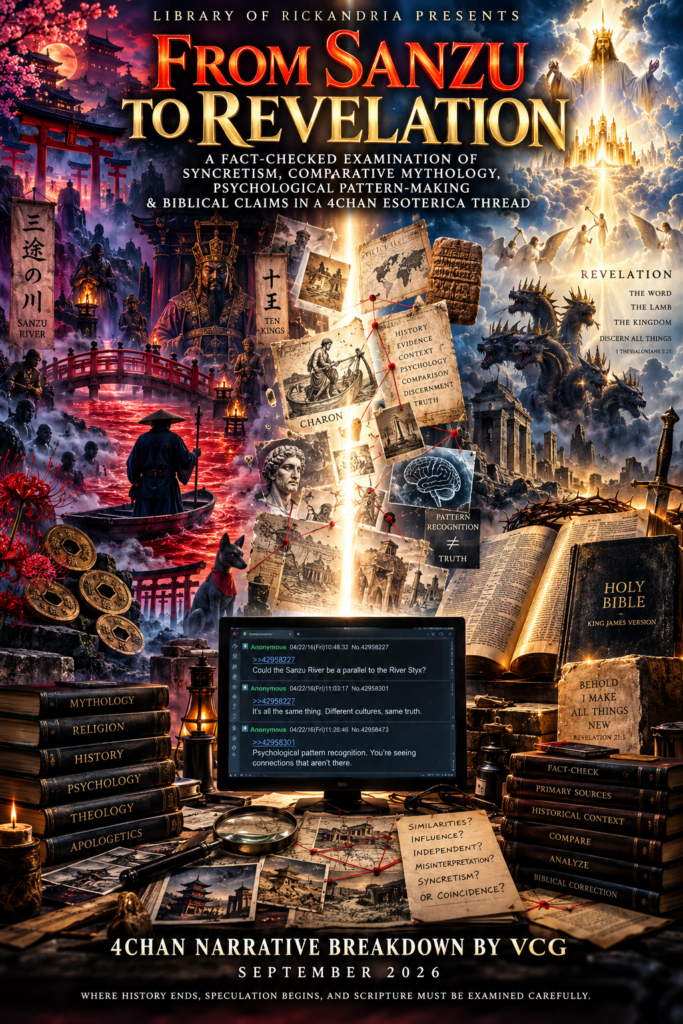
UPDATED BY VCG ON 9/15/2026 @ 21:21 EST
Anyone can do this, but most won’t.
ChatGPT – Library of Rickandria
Abstract
On September 13, 2026, a thread appeared on 4chan’s /x/ board under the title THE AFTERLIFE IN JAPAN — EXPLAINED.
/x/ – THE AFTERLIFE IN JAPAN — EXPLAINED – Paranormal – 4chan
What began as an attempt to describe Japanese Buddhist ideas about death quickly expanded into a much larger conversation involving:
- the Sanzu River
- the Ten Kings
- Enma
- Shinto
- Amaterasu
- Inari
- kitsune
- Greek underworld traditions
- Mesopotamian cosmology
- Kabbalah
- Revelation
- ancient Chinese religion
- Norse and Māori creation accounts
- Christianity
- antisemitic conspiracy rhetoric
- Japanese history
- Oganesson
and eventually Minecraft.
That range is part of what makes the thread worth examining.
It contains genuine facts.
It contains genuine religious traditions.
It notices several genuine cross-cultural similarities.
It occasionally asks worthwhile questions.
Yet those sound observations are repeatedly joined to propositions for which substantially less evidence is available.
The central problem is therefore not simply that the thread contains:
“false information.”
Its more interesting problem is how true information becomes the foundation for unsupported conclusions.
This paper examines the thread at five deliberately separate levels.
Historical claims are checked against historical sources.
Descriptions of Buddhism and Shinto are compared with authoritative institutional and scholarly descriptions of those traditions.
Scientific claims are tested against scientific sources.
Psychological research is used to illuminate general reasoning processes without diagnosing anonymous posters.
Finally, biblical claims are examined against the King James Bible, with Scripture distinguished from historical argument and from theological inference.
The thread’s most important methodological failure can be summarized in one sentence:
Similarity is evidence for comparison; it is not, by itself, evidence of identity, borrowing, common origin, or secret equivalence.
The resulting investigation leads to a conclusion more interesting than
“4chan is wrong.”
The thread repeatedly encounters real pieces of:
- history
- folklore
- religion
- symbolism
The difficulty arises when the evidentiary strength of those pieces is transferred to the speculative bridges connecting them.
The appropriate response is therefore not less curiosity, but better method.
I. What We Are Actually Studying
The thread was opened as No. 42958227 on September 13, 2026.
The opening poster presented what was described as:
“the afterlife in Japan,”
beginning with a link to an official Tendai Buddhist source.
The OP then described a Japanese dead person entering Meido, crossing the Sanzu River, paying a ferryman with six mon, appearing before the Ten Kings, potentially entering Jigoku, Tengoku, another rebirth, or service under Enma as an Oni.
Subsequent posts expanded the system into:
- Shinto apotheosis
- Amatsu-kami status
- Takamagahara
- fox reincarnation
- occult spirit consultation
- comparative mythology
- Revelation
- ancient Mesopotamia
and other subjects.
As of the research pass for this paper on September 15, the visible thread ended at No. 42967661.
There is an immediate complication.
“The thread”
does not represent one coherent doctrine.
Different anonymous posters disagree, mock one another, introduce unrelated systems, and sometimes appear to be joking.
Consequently, this paper does not treat the thread as though it were a manifesto written by one author.
Instead, each claim is assigned to the poster or stage of discussion in which it appears.
This matters because an error introduced by a reply should not be attributed to the OP, and a later correction should not retroactively make an earlier claim more rigorous.
II. What Counts as Evidence?
Before fact-checking religion, we need to establish what kind of fact we are checking.
An official Tendai website can tell us what a Tendai institution currently teaches.
It cannot independently demonstrate that postmortem judgment literally occurs.
An archaeological object can demonstrate that a funerary practice existed.
It cannot automatically prove the supernatural explanation associated with that practice.
A biblical text can establish what that biblical text teaches.
It cannot, merely by being quoted, demonstrate that a particular Japanese custom historically originated in demonic activity.
Likewise, psychological research may help us understand why human beings form patterns, defend beliefs, or behave differently online.
It cannot tell us that one anonymous poster has a psychiatric disorder.
Throughout this paper, claims will therefore be kept in their proper evidentiary categories.
| Type of question | Appropriate evidence | What that evidence can establish |
|---|---|---|
| What did the poster claim? | Thread itself | Content of the thread |
| What does Tendai teach? | Tendai sources; Buddhist scholarship | Tendai doctrine/tradition |
| What does Shinto teach? | Shrine sources; Shinto scholarship | Shinto traditions and their diversity |
| What happened historically? | Primary sources; historical scholarship; museums | Historical probability and development |
| Did one tradition borrow from another? | Chronology, contact, transmission, textual correspondence | Historical dependence |
| Is a scientific statement correct? | Scientific institutions and literature | Physical/scientific facts |
| Why might reasoning take this form? | Psychological research | General cognitive mechanisms |
| What does Scripture teach? | Biblical text in context | Biblical teaching |
| Is the supernatural claim literally true? | Philosophical/theological argument beyond ordinary historical verification | Not settled merely by cataloging traditions |
This distinction protects the investigation from an easy mistake: using one kind of source to answer a question it was never designed to answer.
III. Source Hierarchy
Not all sources in this investigation serve the same function.
The strongest historical evidence normally comes from:
- primary documents
- early texts
- inscriptions
- archaeological materials
and carefully edited textual corpora.
- Peer-reviewed historical scholarship
- university reference works
- major museum collections
and specialist encyclopedias then help interpret them.
An official religious institution is especially valuable when the question is,
“What does this religious body say it teaches?”
But its authority is internal rather than magically universal.
Tendai can accurately describe Tendai doctrine without thereby proving Buddhist cosmology to:
- a Christian
- atheist
- Shinto practitioner
or historian.
Government agencies are useful for:
- administrative
- archival
- monetary
- treaty
- scientific facts
within their areas of competence.
Finally, anonymous imageboard posts are primary evidence for what anonymous imageboard posters said.
They are not reliable secondary sources for:
- Buddhism
- nuclear physics
- ancient history
or biblical interpretation.
This sounds obvious.
Much of the thread’s confusion results from forgetting it.
IV. A Short Chronological Map
Chronology is one of the fastest ways to discipline comparative claims.
| Approximate period | Relevant development |
|---|---|
| Ancient Mesopotamia | Sumerian compositions preserve cosmological traditions involving Enlil and the separation of heaven and earth. The Oxford ETCSL preserves a Song of the Hoe passage in which Enlil separates heaven from earth. |
| First millennium BC | Greek traditions concerning the underworld, Charon, Cronus, Uranus, Aphrodite and related mythology are attested in classical literature and material culture. Hesiod describes the Uranus-Cronus episode and Aphrodite’s emergence. |
| Ancient Israel / Second Temple period | Biblical texts develop their own creation, judgment, resurrection and eschatological frameworks. |
| Early centuries BC onward | Buddhist traditions develop in South Asia and spread into Central and East Asia. |
| Early centuries AD | Buddhism develops extensively in China before its large-scale Japanese institutionalization. |
| ca. sixth century AD | Buddhism is conventionally associated with formal introduction into Japan from the Korean peninsula, followed by long interaction with indigenous kami traditions. Kokugakuin describes later shinbutsu shūgō as deep Buddhist-kami amalgamation. |
| Tang China, 618–907 | The Ten Kings postmortem judicial system develops in Chinese Buddhism. The Metropolitan Museum specifically describes it as transforming Indian Buddhist after-death judgment into a Chinese bureaucratic process. |
| Late twelfth century | Historical Kabbalah begins taking recognizable form in Provence, although earlier Jewish mystical traditions certainly existed. |
| Medieval Japan | Ten Kings and other continental Buddhist traditions are received, adapted, ritualized, and combined with Japanese religious culture. |
| Edo period | The six-coin funerary custom becomes broadly generalized, although it had earlier regional precedents. |
| 1522–1566 | The particular Chinese imperial creation hymn quoted in the thread is documented in the Ming Jiajing-era ritual corpus; it is not properly presented as a verbatim 1000 BC Shu Jing quotation. |
| 1854 | Treaty of Kanagawa signed between the United States and Japan; it provided access and protections but did not itself establish the later commercial relationship of the 1858 treaty. |
| 1868 onward | Meiji government orders formal separation of Buddhism and Shinto. In some regions this contributes to destructive haibutsu kishaku anti-Buddhist campaigns. |
| 2026 | These traditions are recombined on an anonymous paranormal board into a new digital synthesis. |
That last row deserves attention.
The thread is itself an example of religious syncretism happening in real time—not necessarily as formal worship, but as conceptual recombination.
- Buddhist
- Shinto
- Greek
- Mesopotamian
- Christian
- occult
- pop-cultural
- video-game
concepts are assembled into one improvised explanatory universe.
V. A Working Glossary
Meido refers broadly in Japanese religious language to the realm or journey of the dead.
The term is not equivalent in every context to a single precisely mapped geographical afterlife.
Sanzu no Kawa, the Sanzu River, is a Japanese Buddhist/folk river of the dead.
Traditional accounts associate it with postmortem passage and different forms of crossing.
Rokudōsen are funerary coins associated with the “six paths” and, popularly, with payment connected to crossing the Sanzu River.
Chūin / chūu is an intermediate period between death and rebirth.
Tendai’s Q&A describes a maximum period of forty-nine days.
Jūō, the Ten Kings, are postmortem judges whose system developed especially in medieval Chinese Buddhism and was transmitted into Japan.
Enma is the Japanese form of Yama, incorporated into the Ten Kings system.
In the Tendai scheme cited by the thread, Enma presides over the fifth judgment, on the thirty-fifth day.
Taizan-ō is another of the kings.
Tendai identifies him with the judgment associated with the forty-ninth day and interprets him as a manifestation of Yakushi Nyorai.
Jigoku denotes hell-realms in Japanese Buddhist cosmology.
Gokuraku Jōdo is the Pure Land, particularly associated with Amitābha/Amida.
It should not casually be reduced to the generic English word “heaven.”
Kami is a difficult Shinto category encompassing divine/sacred beings and powers.
It should not simply be translated “god” in every context.
Amatsukami ordinarily refers to heavenly kami, particularly those associated with Takamagahara.
Takamagahara is the heavenly plain of kami found in Japanese mythic tradition.
Shinbutsu shūgō means the historical combination or amalgamation of kami worship and Buddhism.
Kokugakuin describes a long history in which some shrines and temples became so thoroughly intertwined that the categories were difficult to separate.
Shinbutsu bunri refers to the Meiji-era formal separation of Shinto and Buddhism beginning in 1868.
Inari Ōkami is the kami worshipped at Inari shrines.
Foxes are traditionally associated with Inari, but Fushimi Inari Taisha explicitly states that foxes are messengers or kindreds of Inari; Inari is not simply “a fox god.”
VI. Walking Through the Opening Post
The OP begins with a powerful rhetorical move:
“Here is the afterlife in Japan.”
That sentence sounds descriptive.
In practice it makes an enormous universal claim.
Japan does not possess one postmortem doctrine binding Shinto, every:
- Buddhist school
- folk religion
- secular Japanese people
- Christians
- new religious movements
and the religiously unaffiliated.
Kokugakuin University’s Encyclopedia of Shinto is particularly helpful here.
Its discussion of spirit concepts states that Shinto contains such a diversity of theories that no single definition is possible and specifically notes that there is no agreement concerning where human spirits go after death.
The OP would have been on considerably firmer ground saying:
Here is one important complex of Japanese Buddhist and folk beliefs about the journey of the dead.
That sounds less dramatic, but it is substantially more accurate.
VII. The Sanzu River: Real Tradition, Overextended Conclusion
The OP says that every Japanese person must cross the Sanzu River.
The Sanzu River is not invented.
Nor is the connection between funerary coins and passage across it.
Japan’s Ministry of Finance, discussing the history of rokudōsen, says that Japan has long had a custom of placing money with the dead and explains that these coins came to be understood as passage money for the Sanzu River.
It describes three possible crossings, notes that six one-mon coins became common because of the Buddhist six realms, and states that actual practices differed according to period and region.
The custom became broadly generalized during the Edo period and continues in some sects and regions today, often with paper substitutes because metal coins are unsuitable for cremation.
That gives the OP considerably more historical support than a casual debunker might expect.
But the same source also shows why the OP’s universal language fails.
The number and type of coins varied.
Practices varied by region.
Practices varied by period.
The custom is not universal even today.
And none of this establishes that Japanese nationality itself metaphysically requires passage through the Sanzu River.
This is our first clear instance of the pattern that will recur throughout the thread:
True anchor: there is a Sanzu River tradition.
True anchor: there is a funerary six-coin tradition.
Unsupported bridge: therefore every Japanese person must literally possess six ancient mon or suffer supernatural consequences.
A traditional ritual may express belief without functioning as a universal supernatural contract.
VIII. The Ten Kings: The OP’s Best Source Corrects the OP
The OP’s strongest move is linking an official Tendai source.
The problem is that the Tendai source is more precise than the retelling.
According to Tendai’s own Q&A, the deceased may remain in an intermediate condition for up to forty-nine days. During that period, judgment is associated with seven-day intervals.
When the system developed further in China, the Ten Kings came to function as judges.
Enma’s judgment is explicitly identified as the fifth, occurring on the thirty-fifth day.
Seven judgments take place during the forty-nine-day period.
The remaining three kings are associated with later reconsiderations on the hundredth day, the first anniversary, and the third anniversary.
The Metropolitan Museum independently describes essentially the same structure.
It dates development of the Ten Kings theme to the second half of the Tang dynasty and explains that the system turned Indian Buddhist postmortem judgment into a recognizably Chinese bureaucratic process:
seven weekly judgments, then the eighth king on the hundredth day, the ninth after a year, and the tenth in the third year.
That historical information is extremely important.
The Ten Kings are not evidence of an unchanged primordial world religion secretly appearing everywhere. Their form has a traceable history.
Indian Buddhist ideas entered China.
Chinese religious culture elaborated them.
A bureaucratic judicial model emerged.
That system traveled to Japan.
Japan adapted it further.
This is precisely what historical religious development looks like.
And the official Tendai page gives another detail absent from the thread’s grim presentation.
It interprets the frightening judges through Buddhist compassion.
Enma is associated with Jizō; Taizan is associated with Yakushi.
Tendai explicitly says that although the judges appear terrifying, their purpose should not simply be understood as tormenting the deceased; their role is framed within a desire for salvation and further opportunities for deliverance.
That does not make the doctrine Christian.
It does show that:
“ten terrifying kings waiting to punish you”
is an incomplete description even on its own Tendai terms.
IX. “They Judge Every Bug You Squashed”
This claim is more complicated than either accepting or laughing at it.
Tendai’s own Q&A lists non-killing among its ethical precepts.
Buddhism therefore does take the treatment of living beings seriously.
But classical Buddhist moral analysis places great importance on intention.
Scholarly treatments of Buddhist ethics repeatedly emphasize intentional or volitional action in discussions of karma.
So:
“Buddhism morally cares about killing living beings”
is supportable.
“Every accidentally squashed insect is mechanically entered as an identical item in an afterlife criminal ledger”
is something else.
The second statement requires evidence the thread does not supply.
This distinction may look pedantic.
It is actually the difference between describing a moral tradition and converting it into a cosmic points system.
X. Meido, Jigoku, Tengoku and the Video-Game Skill Tree
The OP’s next step is to present the afterlife almost like branching game logic:
large sinner → Jigoku;
large hero → Tengoku;
ordinary person → reincarnation;
possible side-career → Oni working for Enma.
The first three categories loosely touch real religious ideas: hell-realms, heavenly realms, and rebirth.
The particular package, however, is not established by the official Tendai source cited.
Tendai speaks about rebirth, the six realms, postmortem judgment, Pure Land aspirations, merit, memorial rites and Buddhahood.
It does not present a universal “hero score” that sends someone to generic Tengoku, nor does the cited material offer
“employment under Enma as an Oni”
as a recognized postmortem vocation.
We should be careful about what follows from this.
It does not follow that no:
- Japanese folktale
- regional tradition
- manga
- temple story
- modern occult group
or popular religious imagination has ever depicted such a thing.
It means only that the claim has not been established as Tendai doctrine by the evidence offered.
That narrower conclusion is the responsible one.
XI. “Tendai Allows Shinto”
Here the thread contains a crude sentence pointing toward a profound historical reality.
Buddhism and kami worship interacted deeply in Japan.
Kokugakuin describes shinbutsu shūgō as a long-running process of Buddhist-Shinto amalgamation.
Temples were established at shrines; sutras were recited before kami; Buddhist terminology was applied to kami; Buddhist clergy participated in shrine contexts; and various theological systems interpreted kami and Buddhist figures in relation to one another.
It is therefore fair to say that Japanese Tendai history developed extensive relationships with kami traditions.
But:
“Tendai allows Shinto”
makes centuries of religious history sound like a software permission setting.
More accurate terms include:
- syncretism
- accommodation
- identification
- reinterpretation
- ritual integration
- institutional interdependence
and later enforced separation.
This is exactly why vocabulary matters.
XII. Becoming an Amatsu-kami
The OP next proposes that Shinto provides the possibility of becoming an Amatsu-kami serving Amaterasu, provided one’s “kami form” is created in Takamagahara.
There is a legitimate background fact:
Japanese religious traditions do include humans who became objects of kami worship after death. Historical examples include figures such as Sugawara no Michizane and Tokugawa Ieyasu.
But that does not establish a general postmortem promotion system in which deceased humans acquire custom-created celestial bodies and become Amatsu-kami.
The thread is synthesizing separate concepts:
human → postmortem kami traditions
plus
Amatsukami → heavenly kami
plus
Takamagahara → realm of heavenly kami
plus
Amaterasu → central heavenly kami
and then treating the combined sequence as though the tradition itself had supplied it.
That is a classic compositional inference:
every component exists, therefore the proposed relationship among the components must also exist.
It does not follow.
XIII. Oni Reincarnation, Retained Memory and “Movie Heavens”
The thread next states that becoming an Oni preserves the possibility of later reincarnation and speculates that memory is retained after death.
It also declares that many heavens are essentially spiritual movies comparable to dreams.
These propositions should not be bundled together.
Rebirth through different realms is entirely at home within Buddhist cosmology.
Persistent ordinary autobiographical memory across death and rebirth is more complicated, particularly in a religion famous for denying a permanent, unchanging self in the form many Western readers intuitively assume.
“Many heavens are just movies,”
meanwhile, is simply asserted.
No Tendai text is supplied.
No Shinto text is supplied.
No historical source is supplied.
No scientific evidence could presently verify the claim.
It therefore belongs in the paper’s category personal metaphysical assertion.
This category is useful because “unsupported” does not mean
“therefore demonstrably metaphysically impossible.”
It means exactly what it says:
the thread has not demonstrated it.
XIV. Buddha Becomes Mercury
Another poster then makes an abrupt linguistic and mythological move:
Buddha is identified with Mercury and
“divine intellect.”
The philological evidence does not support this.
The term buddha belongs to an Indo-Aryan linguistic family associated with the Sanskrit/Pāli root budh.
Scholarly debate exists over whether the best English emphasis is “awakened” or “enlightened,” because the root carries senses associated with awakening, knowing, perceiving and understanding.
None of that supplies an etymological path to the Roman deity Mercury.
One may construct a comparative symbolic analogy:
Buddha → wisdom/knowledge
Mercury/Hermes → intellect, communication, interpretation
But that is not etymology.
And it is not historical identity.
The distinction is crucial:
symbolic analogy:
“These figures can both be associated with intelligence.”
historical claim:
“Buddha is Mercury.”
The first may generate an interesting comparative essay.
The second requires evidence that is absent.
XV. “Mesopotamian MKA BA LA”
The same poster invokes what is called
“Mesopotamian MKA BA LA”
in connection with Kabbalah.
The established history of the term points elsewhere.
The Jewish Theological Seminary describes Kabbalah as literally meaning “tradition” or “receiving” and places the emergence of recognizably Kabbalistic theology in late twelfth-century Provence, with important medieval texts including the Bahir and later Zohar.
Earlier Jewish mystical traditions existed, but that does not transform the word Kabbalah into a Mesopotamian phrase.
No linguistic derivation from “MKA BA LA” is provided.
No cuneiform source is identified.
No chain of phonological change is demonstrated.
No ancient lexical evidence is supplied.
This is not historical linguistics.
It is resemblance-driven segmentation of a word.
To establish such an etymology, one would need attested forms, chronological development, relevant language families, regular sound correspondences, and a plausible transmission history.
A word that can be visually or phonetically broken into suggestive syllables is not thereby decoded.
XVI. Ten Kings = Revelation’s Ten Horns?
This is one of the thread’s clearest examples of numerical pattern-matching.
One poster juxtaposes the Buddhist Ten Kings with the ten horns of Revelation’s beast.
The problem is that Revelation itself interprets the symbol.
Revelation 17:12 KJV reads:
“And the ten horns which thou sawest are ten kings…”
But the rest of the verse matters: they are kings who receive political power with the beast.
The following verses describe them giving their strength to the beast and making war with the Lamb.
Whatever interpretive school one adopts for Revelation—
- preterist
- futurist
- historicist
- idealist
or combinations thereof—the immediate literary context does not describe ten Buddhist judges examining deceased souls.
The thread has matched:
ten supernatural/religious figures
with
ten apocalyptic kings
because both use the number ten.
That is low-specificity evidence.
Ten is a common organizational number.
So are three, seven, twelve and forty.
The biblical text actually gives us a safeguard against unconstrained symbol matching:
when Revelation itself explains the horns, that internal interpretation should carry greater exegetical weight than a much later cross-cultural resemblance.
There is also a small but revealing textual error.
The thread’s quotation says:
“upon his head the name of blasphemy.”
Revelation 13:1 KJV says the beast has seven heads and ten horns and “upon his heads the name of blasphemy.”
The error does not destroy the poster’s entire argument.
It does demonstrate why checking the source text matters.
XVII. “Ask the Spirits Yourself”
The OP later says that memory after death is being assumed and suggests asking spirits directly.
This creates a clear divide between occult epistemology and biblical epistemology.
From a biblical standpoint,
“ask the spirits and see”
is not an acceptable neutral experiment.
Deuteronomy 18 forbids divination, consultation with:
- familiar spirits
- wizardry
- necromancy
Isaiah 8 answers the suggestion that the living seek knowledge from the dead by directing the people instead:
“to the law and to the testimony.”
Yet Scripture’s alternative is not naïve supernatural credulity.
First John 4:1 instructs believers not to believe every spirit but to test them.
First Thessalonians 5:21 says:
“Prove all things; hold fast that which is good.”
The biblical position therefore contains two simultaneous propositions:
Do not seek occult revelation from the dead.
Do not accept supernatural claims merely because they are presented as spiritual.
That combination is relevant to /x/ precisely because paranormal discourse often assumes only two possibilities:
materialist dismissal or total openness to spiritual experimentation.
The Bible presents neither.
XVIII. “There Are Only Two Spirits, and Both Are You”
A later poster introduces a monistic claim: there are only two spirits, “mother” and “father,” everything else is illusion, and even those two are ultimately the self.
No source is supplied.
It is not demonstrated as Tendai.
It is not demonstrated as Shinto.
It is not demonstrated as historical Kabbalah.
It is not Christian anthropology.
Biblically, Genesis begins not with the human self dividing itself into cosmic parental aspects but with a Creator who is already present and who creates a world distinct from himself:
“In the beginning God created the heaven and the earth.”
That verse alone does not settle every Christian philosophical question concerning divine immanence, human consciousness or the soul.
It does establish a basic Creator-creature distinction fundamentally unlike the poster’s assertion that all spirits ultimately are “you.”
XIX. The Thread’s Christian Intervention
An anonymous poster states that without faith in Jesus Christ there is no eternal life.
The tone is terse, but the central exclusivist claim is recognizably New Testament Christianity.
John 14:6 records Jesus saying:
“I am the way, the truth, and the life: no man cometh unto the Father, but by me.”
Acts 4:12 similarly presents salvation as uniquely associated with Jesus Christ.
The phrase:
“you will only die forever,”
however, introduces another issue.
Christians agree that Scripture teaches judgment and that salvation is in Christ, but they have historically disagreed over the precise nature of final punishment.
Eternal-conscious-torment, conditional-immortality/annihilationist, and other interpretations have been defended by Christians using different combinations of biblical texts.
This paper therefore distinguishes:
clear canonical claim: judgment is real; eternal life is associated with Christ.
debated theological question: exactly how final punishment and
“the second death”
should be understood.
What is far clearer for comparison with the thread is that the New Testament’s central eschatological hope is resurrection, not repeated karmic rebirth.
First Corinthians 15 makes resurrection indispensable to Christian proclamation and repeatedly speaks of the resurrection of the dead.
This is not merely another vocabulary for reincarnation.
Reincarnation moves through successive births.
Biblical resurrection raises the dead.
Those are different anthropological systems.
XX. Christianity as a “Jewish Scam”
The Christian claim is answered by another poster with an explicitly antisemitic argument:
Christianity is dismissed as a Jewish scam, and Jews are characterized collectively as a people of scammers whose God conveniently favors them.
This fails in two ways.
First, it substitutes an ethnic stereotype for an argument about Christianity’s truth.
The United States Holocaust Memorial Museum identifies collective claims that Jews are inherently greedy, financially manipulative or deceptive as longstanding antisemitic stereotypes.
It also documents the way such stereotypes become foundations for larger conspiracy narratives.
Whether Christianity is true cannot logically be settled by insulting the ethnicity from which it historically emerged.
Second, the
“exclusive tribal contract”
characterization badly describes early Christianity.
Jesus and his first disciples were indeed Jews.
That is not hidden information; it is basic Christian history.
Cambridge’s history of early Christianity notes both Christianity’s Jewish origins and the rapid incorporation of non-Jews into the movement.
The New Testament itself repeatedly insists on a Gentile mission.
Paul asks in Romans whether God is the God of Jews only and answers that he is God of Gentiles also.
Revelation itself depicts a redeemed multitude drawn from:
- nations
- kindreds
- peoples
- tongues
The legitimate historical observation is therefore:
Christianity began as a Jewish Jesus movement.
The conspiratorial transformation is:
therefore Christianity is an ethnic scam designed to subordinate Gentiles.
The first proposition is historical.
The second does not follow from it.
XXI. An Unexpectedly Good Question: Did Funeral Customs Create Afterlife Beliefs?
One reply wonders whether afterlife beliefs may simply derive from funeral customs.
This is one of the better questions in the thread because it is framed as a hypothesis rather than certainty.
Ritual and belief can influence one another.
A community may perform a ritual because of a belief.
Later generations may infer a belief from an inherited ritual.
New theological explanations may be attached to older customs.
A symbolic object may become literalized.
The history of rokudōsen illustrates this complexity.
The Ministry of Finance describes changing coin customs, regional differences, Buddhist six-realm symbolism and popular Sanzu explanations developing together historically.
What we cannot responsibly say merely from the existence of funeral coins is:
“People buried coins first, therefore they invented the river afterward.”
Nor can we reverse it automatically:
“They believed in a literal river first, therefore every instance of burial coinage comes directly from that belief.”
Ritual history is rarely that tidy.
The useful question is causal.
The answer requires historical evidence.
XXII. Oganesson and the Moment the Thread Leaves Physics
The thread later claims that an “Oganesson molecule” can be stabilized by increasing
“the atomic number from 118 to mass 294.”
This is simply a category error in nuclear terminology.
The Royal Society of Chemistry defines atomic number as the number of protons.
Oganesson has atomic number 118. Its listed isotope ^294Og has relative/isotopic mass approximately 294, and the RSC gives that isotope a half-life of about 0.9 seconds.
It describes Oganesson as highly radioactive.
Atomic number 118 and mass number 294 are therefore not alternative settings of the same property.
You do not stabilize element 118 by
“increasing 118 into 294.”
118 identifies the proton count.
294 refers to the nucleon count of the isotope.
The surrounding Minecraft claims about netherite armor and enchanted swords belong to fantasy or joking speculation unless the poster intended them literally.
This section illustrates another methodological principle:
technical vocabulary can create an impression of precision even when the relationship among the terms is incorrect.
XXIII. Sanzu River and Charon: A Real Parallel
Now we reach one of the thread’s genuinely interesting observations.
A poster notices that the Sanzu River, ferryman and funerary payment resemble Greek traditions concerning Charon.
That resemblance is real.
The Metropolitan Museum describes the Greek obol as the mythological fee paid to Charon, ferryman of the underworld, who conveyed the shades of the dead across Styx or Acheron. Its Attic example dates to approximately 454–404 BC.
Japanese sources likewise document funerary currency associated with passage across the Sanzu River.
We therefore have a legitimate comparison:
| Greek complex | Japanese complex |
|---|---|
| dead | dead |
| underworld journey | postmortem journey |
| river | river |
| ferryman | river-crossing figures/traditions |
| coin/payment | coin/payment |
| funerary custom | funerary custom |
That is more specific than:
“both traditions have gods.”
It is worth investigating.
But even here, historical dependence has not yet been demonstrated.
To move from parallel to borrowing, we would need evidence explaining how, when and through whom the motif moved.
Did the Japanese version emerge independently?
Did it develop through Chinese Buddhist intermediaries?
Could aspects have been transmitted along wider Eurasian networks?
Did later contact influence popular retellings?
Those are historical questions.
The similarity gives us permission to ask them.
It does not give us permission to answer them in advance.
XXIV. Similarity Is Not Identity
This is the methodological center of the paper.
Comparative religion exists because human traditions genuinely share patterns.
But comparison is not the same activity as declaring everything secretly identical.
Historian of religion Jonathan Z. Smith repeatedly emphasized that good comparison requires attention to difference, context and the researcher’s criteria rather than simply collecting things that
“look alike.”
His work cautions against reducing complex religious systems to one supposed essence.
For this investigation, a proposed historical dependence should be tested against six questions.
| Test | Question |
|---|---|
| Chronology | Did the proposed source exist before the alleged borrower? |
| Contact | Is there evidence the relevant communities could have encountered one another? |
| Transmission | Is there a plausible route—textual, commercial, migratory, missionary, political? |
| Specificity | Are the shared elements unusual enough to make borrowing more likely than coincidence? |
| Direction | Can we determine which tradition influenced which? |
| Development | Can intermediate forms show the idea changing along the route? |
A correspondence that satisfies only
“they resemble one another”
has not yet passed the historical-dependence test.
This is not skepticism for skepticism’s sake.
It protects real cases of borrowing from being diluted by imaginary ones.
XXV. The Comparative Creation-Myth Avalanche
The thread then produces a rapid sequence of creation accounts:
- Sumerian
- Greek
- Egyptian
- Chinese
- Māori
- Babylonian
- Aztec
- Norse
- Phoenician
The visual and rhetorical effect is powerful.
One example might be coincidence.
Two are suggestive.
Eight begin to feel like revelation.
But before drawing a conclusion, we should inspect the individual cases.
Mesopotamia
The core parallel is real.
The Oxford Electronic Text Corpus of Sumerian Literature preserves The Song of the Hoe, which describes Enlil separating heaven from earth and earth from heaven.
The thread is therefore correct that a Sumerian heaven-earth separation motif exists.
What is less secure is its casual attachment of an exact “2900 BC” date to the narrative as though the thread had cited a tablet copied in that year.
Ancient composition dates, surviving manuscripts and reconstructed traditions are different things.
Greece
The thread calls Cronus “Saturn,” Uranus “Uranus,” and Aphrodite “Venus.”
The underlying myth is Greek. Hesiod recounts Cronus attacking Uranus and the birth of Aphrodite from the resulting sea foam.
Calling them Saturn and Venus overlays later Roman equivalents on a Greek account.
The mythic comparison remains interesting.
The nomenclature is historically sloppy.
Egypt
Egyptian religion does include a prominent image of Shu separating or holding apart the sky goddess Nut and earth god Geb.
The British Museum identifies the separation of Geb and Nut as a creation scene.
Again, the core motif is genuine.
But Egyptian cosmology is not thereby
“the same story”
as Hesiod.
The divine genealogies, theological contexts, ritual functions and narrative details remain different.
Māori tradition
This parallel is also real.
Te Papa describes Tāne separating Ranginui, the sky, from Papatūānuku, the earth, and another Te Papa resource explicitly places that Māori separation story beside Genesis as distinct cosmological traditions.
That tells us humans in widely separated cultures have indeed narrated creation using images of sky and earth being separated.
It still does not tell us why.
The Chinese quotation
This is where the thread’s presentation becomes substantially misleading.
It attributes a striking creation hymn beginning
“Of old in the beginning…”
to the Chinese Shu Ching around 1000 BC.
The quoted wording is documented in a much later source context.
Research on James Legge’s encounter with Chinese imperial religion traces the hymn to the Collected Statutes of the Ming dynasty, in connection with sacrifices presided over during the Jiajing emperor’s reign, 1522–1566.
This does not mean ancient Chinese religion lacked Shangdi, heaven-earth cosmology or ancient ritual traditions.
It means that the specific quotation cannot simply be introduced as a verbatim 1000 BC passage from the Shu Jing.
That is a textbook example of source inflation:
an old religious tradition lends its antiquity to a much later quotation.
Norse Ymir
The Norse motif of the cosmos being fashioned from Ymir’s body is genuinely preserved in medieval Scandinavian literature.
The thread’s approximate thirteenth-century written date refers to surviving literary transmission, not necessarily the date at which the oral material originated.
That distinction—composition, oral antiquity, manuscript date—is essential in mythological chronology.
Phoenician Sanchuniathon
The thread presents “Sanchuniathon” as though we possess a straightforward ancient Phoenician creation book.
We do not.
Our material comes through Philo of Byblos, a writer of the Roman imperial period, whose purported translation of ancient Sanchuniathon was later preserved in fragments.
The Oxford Classical Dictionary says Philo’s claim to direct translation should be treated with considerable skepticism, while acknowledging that some genuine Phoenician traditional material appears to survive within the account.
That is a much more interesting situation than either extreme:
“pure forgery”
is too simple.
“verbatim prehistoric Phoenician scripture”
is also too simple.
Real textual history lives between those slogans.
XXVI. Why Sky-and-Earth Separation Keeps Appearing
Once the examples have been cleaned up, the comparative question remains.
Why do so many traditions imagine heaven and earth separating?
Several hypotheses are logically available.
One tradition could borrow from another.
Several could descend from an older common tradition.
Similar human environments could independently generate similar imagery.
Later interpreters could emphasize similarities while suppressing differences.
Or several mechanisms could operate at once.
The mistake is assuming that only one mechanism is possible and then declaring it proven.
Sky is above us.
Earth is beneath us.
Light often appears as the sky opens.
Birth creates life through separation from a previously enclosed condition.
Human beings observe horizons where earth and sky seem to touch.
The motif is therefore cognitively and environmentally available even without historical contact.
That does not disprove transmission.
It means the motif by itself has low discriminatory power.
A far more convincing borrowing case would involve a cluster of unusual details appearing in a plausible historical sequence.
XXVII. Genesis Is Comparable, but Not Interchangeable
The thread’s comparative impulse naturally raises the biblical creation account.
Genesis 1 begins:
“In the beginning God created the heaven and the earth.”
Genesis then includes differentiation:
light and darkness, waters above and below, sea and dry land.
Those features can certainly be compared with other ancient cosmologies.
But comparison also reveals major differences.
Genesis does not begin with Sky Father sexually united to Earth Mother.
God does not emerge from the cosmos.
God is not castrated.
Creation is not fashioned from God’s corpse.
No divine child violently frees creation from intertwined divine parents.
The world is differentiated by divine command.
That does not, by itself, prove Genesis historically independent of every ancient Near Eastern cultural environment.
Serious biblical scholarship has long compared Genesis with surrounding ancient Near Eastern texts.
It does mean that:
“they all have heaven and earth”
is too crude to establish:
“they are the same story.”
A comparison that notices only resemblance is incomplete.
Differences are data too.
XXVIII. Japanese Religion Is Not “Chinese Buddhism Plus Mistakes”
A reply dismisses Japanese religion as Chinese Buddhism containing misunderstandings or mistranslations plus “paganism.”
There is one factual seed here:
Japanese Buddhism was profoundly shaped by continental Asian Buddhism.
But the reduction is historically inadequate.
Buddhism itself developed through centuries of movement from India through Central and East Asia.
By the time Buddhist traditions reached Japan through Korean and Chinese channels, they already possessed complex histories.
Japan then produced further religious developments:
- Tendai
- Shingon
- Pure Land traditions
- Zen institutions
- Nichiren movements
- esoteric systems
- mountain asceticism
and elaborate relationships with kami cults.
Kokugakuin’s history of shinbutsu shūgō shows that Japanese religion was not simply
“Buddhism accidentally mistranslated.”
It became a centuries-long environment of active theological, ritual and institutional recombination.
Religions change when they cross cultures.
Change is not synonymous with translation error.
XXIX. The Treaty of Kanagawa Detour
The OP eventually responds to a Christian poster by saying Japan should
“pull the Treaty of Kanagawa.”
Whatever political sentiment motivated the remark, it is evidentially unrelated to the thread’s afterlife claims.
Historically, the treaty was signed on March 31, 1854.
The U.S. National Archives describes it as the first treaty between the United States and Japan, providing access to ports and protections while noting that it did not yet establish commercial trade; that came with the later 1858 treaty.
Whether one approves or disapproves of the treaty’s history is a political and historical discussion separate from whether the Sanzu River exists in Buddhist tradition.
The argumentative category here is a non sequitur.
The topic changes.
The prior religious question remains unanswered.
XXX. Can Tendai Rituals “Turn You Into a Real Buddha”?
Another poster says Tendai rituals can theoretically be used to become “a real Buddha.”
The statement is both closer to something authentically Buddhist and more misleading than it first appears.
Tendai does teach the possibility of Buddhahood.
Tendai Buddhism emphasizes that sentient beings possess the possibility of awakening, and ritual initiation, precepts, meditation, doctrinal study and other practices are real components of Tendai religious life.
But
“conduct ritual → transform into Buddha”
sounds like pressing a metaphysical button.
That obscures the larger Tendai soteriological framework.
Even the Tendai Q&A quoted earlier emphasizes:
- ethical precepts
- practice
- merit
- compassionate activity
and becoming a disciple of the Buddha.
The correct response is therefore not
“Tendai has no rituals concerned with Buddhahood.”
It does.
The correction is that “ritual” cannot be isolated from the doctrinal and ethical system and presented as a magical species-change procedure.
XXXI. Catholic-Shinto Alliance Against Buddhist Monks?
A later reply claims that Catholics and Shinto forces “teamed up” to destroy greedy Buddhist monks.
There are several real historical events that could be confused here.
Christian converts and Buddhist institutions did experience conflict during Japan’s sixteenth-century religious upheavals.
Separately, the Meiji Restoration inaugurated shinbutsu bunri in 1868, formally separating Shinto and Buddhism after centuries of syncretism.
Kokugakuin documents how some local authorities, nativists and shrine actors then interpreted the policy in aggressively anti-Buddhist ways, resulting in haibutsu kishaku and the destruction of temples and Buddhist objects.
Those events are separated by centuries and different political circumstances.
Collapsing them into one
“Catholics + Shinto versus Buddhist monks”
coalition is chronological compression.
This reasoning technique is common in conspiracy narratives because thematic similarity replaces chronology.
There was conflict A.
There was conflict B.
Both involved Buddhism.
Therefore A and B become one continuous hidden operation.
History does not permit that shortcut.
XXXII. Inari and Becoming a Kitsune
Near the thread’s end, a user asks how to reincarnate as a kitsune.
The OP directs the user toward Inari and then constructs a sequence in which Enma assigns the animal realm and Taizan determines fox rebirth.
There is a strong true anchor here:
foxes are deeply associated with Inari.
Fushimi Inari Taisha’s own English FAQ says foxes are regarded as messengers or kindreds of Inari Ōkami and explicitly adds that this does not mean Inari Ōkami is a fox.
There is also a second true anchor:
Enma and Taizan belong to Japanese Ten Kings traditions.
But the proposed mechanism—
Inari worship → Enma assigns animal realm → Taizan selects fox—
is not established by either source.
Tendai’s Q&A identifies Enma as the fifth judge and Taizan as the later forty-nine-day judge associated with Yakushi.
It does not describe Taizan as selecting animal species for reincarnation.
Here again the thread takes several authentic religious nouns and invents a verb connecting them.
That is the pattern in its purest form.
XXXIII. The True-Anchor / Speculative-Bridge Model
We can now formalize what has happened repeatedly.
A typical thread argument has this structure:
A is true.
B is true.
A resembles B.
Therefore C explains both.
The weakness is that C may require evidence entirely independent of A and B.
Consider several examples.
| True Anchor A | True Anchor B | Speculative Bridge |
|---|---|---|
| Japanese dead have Sanzu coin traditions | Greeks have Charon coin traditions | Therefore one directly descends from the other |
| Buddhism has Ten Kings | Revelation has ten horns/kings | Therefore they describe the same entities |
| Inari is associated with foxes | Buddhist cosmology contains animal rebirth | Therefore Inari worship can cause fox reincarnation |
| Tendai has ritual practice | Tendai teaches Buddhahood | Therefore a ritual mechanically makes one a Buddha |
| Kabbalah is mystical | Mesopotamia had ancient esoteric religion | Therefore “Kabbalah” is a Mesopotamian coded phrase |
| Many cultures separate sky and earth | Their stories resemble one another | Therefore they are surviving fragments of one exact primordial account |
| Christianity began among Jews | Christianity later evangelized Gentiles | Therefore Christianity is a Jewish ethnic scam |
The model matters because every first column can be thoroughly documented and every conclusion in the third can still fail.
Evidence does not transfer across an inferential gap automatically.
XXXIV. “What Would Prove This?”
A useful research habit is to ask not only
“Why is this wrong?”
but:
What evidence would make us change our minds?
Suppose someone argues that the Japanese Sanzu payment directly derives from Greek Charon traditions.
Evidence that would materially strengthen that hypothesis might include an identifiable textual or artistic transmission route; intermediary Central Asian or Chinese examples showing progressive development; early East Asian texts containing distinctively Greek details; historical evidence of translators transmitting the motif; or linguistic borrowing connected to the practice.
If those things were discovered, the historical conclusion should change.
Suppose someone argues that the Ten Kings are the same entities as Revelation’s ten horns.
Evidence would need to explain why Revelation itself interprets the horns as political kings associated with the beast, why the Chinese Buddhist Ten Kings system appears in a different historical context, and how a demonstrable transmission connects the systems.
Suppose someone argues that Taizan determines fox reincarnation.
A Tendai text, ritual manual, sermon, doctrinal commentary or recognized regional tradition saying precisely that would transform the claim from personal synthesis into documented tradition.
This is an important intellectual discipline:
A good investigation specifies the evidence that could falsify or strengthen its own conclusion.
XXXV. Psychology: Why These Connections Feel So Powerful
Psychology should be used cautiously here.
One poster insults the OP using a psychiatric slur.
That is not a diagnosis.
Nothing in an anonymous thread allows us to diagnose:
- schizophrenia
- psychosis
- mania
or any other mental-health condition.
The responsible psychological question is instead:
What ordinary cognitive processes can make dense networks of religious similarities feel compelling?
Confirmation bias
Raymond Nickerson’s classic review describes confirmation bias as a family of processes through which people disproportionately seek, interpret or weight evidence in ways that reinforce a hypothesis or belief already under consideration.
Importantly, this need not involve conscious dishonesty.
That matters here because once the hypothesis
“all religions encode the same ancient system”
is adopted, every additional resemblance becomes confirmatory while differences become secondary noise.
Ten becomes important.
Different roles of the ten figures become unimportant.
River becomes important.
Different theological functions of the rivers become unimportant.
Sky-earth division becomes important.
Everything else in the creation narratives becomes unimportant.
Motivated reasoning
Motivated reasoning research likewise shows that desired conclusions can influence which inferential strategies and supporting considerations become psychologically available.
Again, this does not mean a person consciously fabricates evidence.
People are often excellent lawyers for conclusions they already find meaningful.
Illusory pattern perception
Whitson and Galinsky experimentally defined illusory pattern perception as detecting a coherent relationship among random or unrelated stimuli and found that participants placed in conditions of reduced control showed increases in several forms of perceived pattern, including illusory correlations, conspiracy perceptions and superstitious connections.
This study should not be abused.
We do not know whether any poster in the thread feels low personal control.
Later scholarship has also complicated simplistic causal stories about control and conspiratorial belief.
The broader lesson is narrower:
subjective recognition of a pattern is not identical to demonstration that the pattern exists externally.
Online disinhibition
John Suler’s work on the online disinhibition effect identifies:
- anonymity
- invisibility
- asynchronicity
- dissociative imagination
and reduced authority cues among factors that can make people disclose or act more intensely online than in face-to-face settings.
That helps explain the thread’s abrupt transitions among:
- scholarship
- personal revelation
- obscenity
- ethnic abuse
- joking
- grand metaphysical claims
- political declarations
It does not tell us which claims are true.
Psychology explains behavior.
It does not replace fact-checking.
XXXVI. The Rhetoric of Esoteric Certainty
The thread repeatedly uses rhetorical techniques that make weak inferences feel stronger.
One is accumulation.
Five screenshots and eight mythological names create a sense of evidentiary mass even if no source establishes the connecting thesis.
Another is technical vocabulary.
Terms such as:
- Enma
- Taizan
- Oganesson
- Takamagahara
- Kabbalah
- Sanchuniathon
create an atmosphere of specialized knowledge.
Specialized terminology may be completely accurate while the inference linking the terms is wrong.
Another is compression.
Several centuries of religious development disappear into a sentence such as:
“Japanese religion is Chinese Buddhism with mistranslations.”
Another is absolute language.
“All Japanese people,”
“the same thing,”
“this is what happens,”
and similar phrases convert possibility into certainty without adding evidence.
Another is mockery as substitution.
Calling a person an NPC, fool, psychiatric slur or ethnic stereotype creates social dominance without addressing the proposition under dispute.
And finally there is mystery escalation.
When one proposed connection is questioned, the explanation expands to include another religion, civilization, celestial system or hidden linguistic code.
The more complicated the theory becomes, the harder it may feel to challenge because criticism of one component leaves twenty others on the board.
But quantity of connections is not quality of evidence.
XXXVII. A Biblical Method for Handling the Thread
The biblical portion of this paper should not be conducted by searching for one verse that sounds vaguely similar to every foreign religious motif.
That would repeat the thread’s own methodological error.
A responsible biblical analysis asks:
What does the passage actually say?
What does its immediate context say?
Does Scripture itself interpret the symbol?
How does the claim relate to the wider canonical teaching?
Where does the text end and theological inference begin?
Acts 17 commends the Bereans for receiving teaching while searching the Scriptures to determine whether the claims were so.
That posture combines openness with verification.
The same discipline applies here.
XXXVIII. Biblical Anthropology Versus Reincarnation
The thread’s afterlife model assumes repeated rebirth through different forms.
The New Testament’s dominant structure is different.
Human beings die.
Judgment follows.
The dead are raised.
First Corinthians 15 makes resurrection foundational:
if the dead do not rise, Paul’s Christian proclamation collapses.
It culminates not in another reincarnation but in the defeat of death.
John 5 likewise speaks of those in the graves hearing Christ’s voice and coming forth.
Revelation 20 presents the dead standing before God in judgment and concludes with the second death, followed in Revelation 21 by the new creation.
Within Christian interpretation there are significant disputes regarding the intermediate state, the millennium, the timing of eschatological events and the exact nature of final punishment.
But reincarnation is not the ordinary biblical mechanism resolving those disputes.
This distinction should be stated without caricaturing Buddhism.
Buddhist rebirth is itself more subtle than the Western idea of an immortal soul simply climbing into new bodies.
Christian resurrection is likewise more subtle than a disembodied:
“soul going to heaven.”
The two systems deserve to be compared in their strongest forms.
XXXIX. Biblical Discernment and Occult Knowledge
The thread asks why not question spirits directly.
Scripture says not to.
But Scripture also gives a positive epistemology.
Isaiah contrasts consulting the dead with seeking divine revelation.
First John commands testing spiritual claims.
First Thessalonians commands proving things.
Deuteronomy prohibits necromancy.
The biblical position is therefore not:
“Nothing supernatural exists.”
Nor is it:
“If something supernatural answers, believe it.”
It is:
supernatural claims require discernment, and certain means of obtaining hidden knowledge are themselves forbidden.
That is a much sharper biblical response to occult experimentation than merely saying
“spirits are scary.”
XL. Idols, Gods and Demons: Scripture Is More Nuanced Than an Internet Chart
A Christian rebuttal can itself become irresponsible if it responds to every Japanese religious figure by assigning a specific demon identity.
Scripture does not give us a table reading:
Enma = demon A
Amaterasu = demon B
Inari = demon C
Charon = demon D
Psalm 96:5 says:
“For all the gods of the nations are idols:
but the LORD made the heavens.”
Paul says in 1 Corinthians 8 that an idol is nothing in the world and that there is one God.
Yet 1 Corinthians 10 also warns that pagan sacrifice may involve fellowship with devils.
Those texts create a theological distinction.
An idol is not a genuine rival creator-god equal to the LORD.
Idolatrous worship may nevertheless possess spiritual danger.
That is enough for the biblical argument.
We do not need to invent demon genealogies Scripture does not provide.
“Scripture warns against idolatry”
is biblical.
“Enma is secretly this named demon from another text”
requires additional evidence.
The distinction exemplifies the principle guiding this paper:
say everything the evidence supports, and stop when it stops.
XLI. Does Revelation Decode Every Religion?
No.
Revelation contains extraordinary symbolic imagery.
But extraordinary symbolism does not turn the book into an unlimited codebook into which any world religion can be inserted.
Revelation itself interprets many of its images.
The ten horns become ten kings.
The dragon is identified as the Devil and Satan.
Waters can be interpreted as peoples, multitudes, nations and tongues.
Those internal explanations should constrain interpretation.
A biblical interpreter who ignores Revelation’s own explanations and instead connects symbols to whatever happens to share the same number is practicing the same
“pattern first, provenance later”
method criticized elsewhere in this paper.
Scripture deserves better than conspiracy-board hermeneutics.
XLII. Christianity and the Nations
The thread’s antisemitic criticism of Christianity also requires a biblical correction from another direction.
Christianity does not erase its Jewish origin.
Jesus is Jewish.
The apostles are Jewish.
The Hebrew Scriptures are foundational to the New Testament.
Paul warns Gentile believers against arrogance.
At the same time, the New Testament presents the gospel as extending beyond ethnic Israel.
Matthew closes with a mission to all nations.
Acts narrates expanding Gentile inclusion.
Paul insists God is also God of the Gentiles.
Revelation pictures an innumerable multitude from:
- nations
- peoples
- kindreds
- tongues
The biblical structure is therefore neither:
“Jews are irrelevant”
nor
“Gentiles become ethnic servants of Jews.”
The New Testament tells a theological story in which Israel’s Scriptures, Israel’s Messiah and a mission to the nations are connected.
One may accept or reject that theology.
It should first be described accurately.
XLIII. Steelmanning the Thread
A responsible critique should state the strongest version of the case it is criticizing.
The strongest version is not absurd.
Human cultures really do preserve strikingly similar stories.
Greek and Japanese funerary-payment traditions really are comparable.
- Mesopotamian
- Egyptian
- Greek
- Māori
traditions really do contain forms of cosmic separation.
Buddhist ideas really did move across vast geographic distances.
Japanese religion really does contain extensive syncretism.
Ancient trade networks moved stories as well as merchandise.
- Missionaries
- pilgrims
- monks
- merchants
- prisoners
- migrants
- diplomats
really have carried religious motifs between cultures.
Funeral customs really can preserve ancient ideas long after people cease to know their full origin.
And modern categories sometimes artificially separate traditions that historically overlapped.
All of that deserves study.
The thread’s best instinct is therefore:
“Look again.
These similarities might matter.”
Its recurring mistake is:
“They look similar, therefore I already know why.”
The first sentence is research.
The second prematurely ends research.
XLIV. Syncretism Is Not the Same as Common Origin
This distinction deserves its own section.
Syncretism means traditions interact and recombine.
Borrowing means one tradition adopts something from another.
Common ancestry means two traditions inherit something from an earlier common source.
Convergence means similar patterns arise independently.
Typological similarity means two phenomena resemble one another without establishing how the resemblance arose.
Metaphysical identity means two traditions are supposedly referring to the exact same supernatural reality.
These are not interchangeable explanations.
Shinto-Buddhist interaction is historically demonstrable syncretism.
Sanzu and Charon are demonstrably comparable.
Direct Greek → Japanese borrowing has not been demonstrated by the evidence presently supplied.
Ten Buddhist judges and Revelation’s ten kings share a number.
Their metaphysical identity has not been demonstrated.
A careful paper should preserve those degrees of confidence.
XLV. Claim Classification Matrix
| Thread claim | Category | Assessment | Reason |
|---|---|---|---|
| Sanzu River belongs to Japanese afterlife tradition | Religious/historical | Supported | Well-attested Japanese Buddhist/folk tradition |
| Six coins associated with Sanzu passage | Funeral history | Supported with qualification | Rokudōsen documented; practice varies by time, region and sect |
| Every Japanese person must cross Sanzu | Universal metaphysical claim | Unsupported | Japanese religion is diverse; Shinto itself lacks one universal afterlife doctrine |
| Temple must bury everyone with six literal mon | Ritual claim | Overstated | Tradition exists; not universal; paper substitutes occur |
| Ten Kings judge the deceased | Buddhist tradition | Supported | Chinese Buddhist/Japanese tradition documented |
| Enma is most important and controls human rebirth | Doctrinal interpretation | Partly supported/overstated | Enma is fifth judge in cited Tendai framework |
| Every squashed bug is mechanically counted | Doctrinal detail | Unsupported as stated | Non-killing matters; poster supplies no source for literal ledger mechanics |
| Meido is endless battle | Afterlife claim | Unsupported by cited Tendai source | OP supplies no authoritative evidence |
| Heroes automatically go to “Tengoku” | Afterlife claim | Unsupported simplification | Buddhist heavens/Pure Land are more complex |
| Humans can become kami | Shinto/history | Supported in some traditions | Human enshrinement/deification exists |
| Humans routinely become Amatsukami via Takamagahara | Shinto claim | Unsupported | Components exist; proposed postmortem mechanism not demonstrated |
| Oni work for Enma after human death | Folklore/metaphysics | Unsupported by cited evidence | No Tendai source given |
| Buddha is Mercury | Comparative/etymological | Unsupported | Buddha derives from budh, not Mercury |
| Kabbalah = Mesopotamian “MKA BA LA” | Etymology | Unsupported | Historical term means receiving/tradition; medieval Kabbalah traceable historically |
| Ten Kings = Revelation’s ten horns | Comparative theology | Unsupported | Revelation interprets horns as kings allied with beast |
| Sanzu resembles Charon | Comparative religion | Supported parallel | River/ferryman/payment complex exists in both |
| Therefore Sanzu derived from Charon | Historical dependence | Unestablished | Transmission evidence needed |
| Enlil separates heaven and earth | Ancient mythology | Supported | ETCSL text supports motif |
| Cronus/Uranus/Aphrodite motif | Greek mythology | Broadly supported | Poster mixes Roman names with Greek narrative |
| Shu separates Geb and Nut | Egyptian mythology | Supported | Ancient Egyptian motif |
| Tāne separates Rangi and Papa | Māori cosmology | Supported | Te Papa documents tradition |
| Quoted Chinese hymn = Shu Jing, 1000 BC | Textual history | Misattributed/misdated | Quoted form tied to Ming ritual corpus |
| Sanchuniathon account is straightforward ancient Phoenician document | Textual history | Overstated | Material survives through Philo; authenticity/transmission complex |
| Oganesson stabilized by changing 118 to 294 | Science | False | 118 = atomic number; 294 = isotope mass; ^294Og highly unstable |
| Christianity began among Jews | History | Supported | Jesus/earliest followers Jewish |
| Christianity is therefore an ethnic scam | Conspiracy argument | Unsupported | Conclusion does not follow; relies on antisemitic stereotype |
| Catholics + Shinto jointly caused anti-Buddhist destruction | History | Misleading conflation | Different historical episodes compressed together |
| Inari associated with foxes | Shinto | Supported | Foxes regarded as messengers/kindreds |
| Taizan chooses fox reincarnation | Tendai claim | Unsupported | Not present in cited Tendai material |
| Scripture teaches reincarnation | Biblical claim | Contradicted by ordinary NT framework | NT emphasizes death, judgment and resurrection |
XLVI. Corrections Log
Several corrections deserve to be kept in a compact record because they illustrate different kinds of error.
| Error | Correction | Error type |
|---|---|---|
| Enma presented as primary/decisive Ten Kings judgment | Enma is fifth judge, day 35, in the cited Tendai scheme | Source misreading |
| Ten Kings treated as ten weekly judges immediately after death | Seven weekly judgments occur within 49 days; later three occur at later memorial periods | Compression |
| Six mon presented as universal compulsory rule | Genuine tradition, but historically variable and not universal | Overgeneralization |
| “Every Japanese person” follows one afterlife | Japanese traditions are religiously diverse | Universalization |
| Buddha = Mercury | No demonstrated philological connection | False etymology |
| Ten Kings = ten horns | Numerical match without contextual match | Numerological association |
| Revelation quotation uses singular “head” | KJV has “heads” | Textual inaccuracy |
| Chinese hymn labeled Shu Jing, 1000 BC | Quoted form is documented in Ming Jiajing ritual material | Misdating/misattribution |
| Saturn/Venus inserted into Hesiodic Greek myth | Greek figures are Cronus and Aphrodite | Cultural conflation |
| Sanchuniathon treated as transparent ancient source | Survives through Philo; source history debated | Source-critical omission |
| Oganesson 118 “raised to” mass 294 | Atomic number and mass number are different quantities | Scientific category error |
| Catholics + Shinto = single anti-Buddhist alliance | Multiple episodes from different periods conflated | Chronological compression |
| Inari = fox | Fushimi Inari states foxes are messengers, not Inari himself | Religious simplification |
| Taizan selects fox rebirth | No supporting Tendai source found | Invented mechanism |
XLVII. Ethical Problems in Conspiracy Reasoning
The antisemitic portion of the thread shows why methodology has moral consequences.
When evidence is replaced by collective stereotype, whole populations can be converted into explanatory devices.
A historical person behaved badly.
Therefore his ethnic group behaves badly.
Some members of a group worked in finance.
Therefore the group secretly controls finance.
A religion arose among Jews.
Therefore the religion must be a Jewish plot.
These moves are not merely impolite.
They are analytically useless because they replace causal evidence with identity.
The U.S. Holocaust Memorial Museum documents how precisely such economic and conspiratorial stereotypes became recurring components of antisemitism.
A sound research rule is therefore:
collective guilt is not a substitute for causal evidence.
The same rule should apply to every ethnicity and religion.
XLVIII. Limitations of This Investigation
This paper does not prove that every supernatural claim in the thread is false.
Historical research cannot establish that the Sanzu River literally does or does not exist as a supernatural reality in the same way chemistry can establish Oganesson’s proton number.
It can establish that traditions about Sanzu exist.
It can reconstruct when particular versions become visible.
It can compare those traditions.
It can determine whether a poster accurately represents known sources.
Similarly, this paper has not proven that Greek and Japanese river traditions developed independently.
It has concluded that direct dependence remains unestablished by the evidence examined.
That distinction matters.
Absence of demonstrated transmission is not proof of impossible transmission.
Nor should current official institutional explanations be assumed to capture every local, historical or folk variant.
Japanese religion is unusually rich in regional practice and cross-traditional borrowing.
A future discovery could legitimately modify conclusions here.
That is not a weakness.
It is how historical research works.
XLIX. The Thread’s Deepest Lesson
The thread is most instructive at the exact point where it is most tempting.
It keeps finding real things.
A real river.
Real coins.
Real judges.
Real fox symbolism.
Real Buddhist-Shinto syncretism.
Real creation parallels.
Real Greek funerary customs.
Real Mesopotamian cosmology.
Real Christian apocalyptic numbers.
Real medieval mysticism.
Real political history.
Real physics terminology.
Then it joins them.
And because the pieces are real, the joint can feel real too.
But the evidentiary burden usually resides in the joint.
That is the principle readers should carry out of this investigation:
A chain of individually true facts can still produce a false conclusion when the links between those facts have not been demonstrated.
L. A Biblical Closing Perspective
The appropriate biblical answer to a thread like this is not fear of investigation.
Nor is it indiscriminate belief in every supernatural story.
The KJV’s own prefatory tradition commends:
- searching Scripture
- comparing
- translating
- studying carefully
The biblical text likewise praises examination.
Acts 17:11 describes the Bereans receiving Paul’s teaching while searching the Scriptures to determine whether it was so.
First Thessalonians 5:21 gives the compact command:
“Prove all things; hold fast that which is good.”
That is a useful motto for the entire investigation.
If the Sanzu tradition is historically real, say so.
If the six coins are historically documented, say so.
If Buddhism and Shinto genuinely interacted, say so.
If the Charon comparison is striking, do not pretend otherwise.
If a Chinese hymn has been badly dated, correct it.
If a Bible verse has been misquoted, correct it.
If a scientific statement confuses atomic number and mass number, correct it.
If a Christian interpretation goes beyond Scripture, correct that too.
Truth does not benefit from protecting weak arguments simply because they belong to one’s preferred side.
The Scriptures themselves make a far different eschatological claim from the reincarnation system developed in the thread.
The New Testament centers its hope on Jesus Christ, judgment, and resurrection.
First Corinthians 15 goes so far as to say that without resurrection the Christian proclamation collapses.
Revelation’s apocalyptic imagery should therefore be interpreted first according to Revelation rather than repurposed as a universal cipher for whatever foreign religious symbol happens to share its numbers.
Likewise, biblical warnings concerning idolatry and spirits should be stated as Scripture states them, rather than expanded into unsupported charts identifying individual Japanese religious beings with named demons.
The discipline is the same in theology as in history:
do not claim more than the source gives you.
LI. Conclusion
The 4chan thread THE AFTERLIFE IN JAPAN — EXPLAINED begins with a legitimate religious subject and an unusually valuable decision by its OP to cite an official Tendai source.
Ironically, that source supplies the best correction to the thread.
The actual Tendai presentation is more structured and more restrained:
a forty-nine-day intermediate period; judgments at seven-day intervals; seven judgments within those forty-nine days; Enma as the fifth judge on day thirty-five; three later opportunities represented by the remaining kings; and a compassionate soteriological interpretation of the judges themselves.
The six-coin funerary tradition is also real, but historically variable rather than universally compulsory.
Buddhist-Shinto syncretism is real, but it does not establish every improvised postmortem mechanism involving kami.
Inari’s fox association is real, but it does not establish a Tendai fox-reincarnation procedure.
The Greek Charon parallel is real, but resemblance does not yet establish direct borrowing.
Ancient cultures really did narrate separations of heaven and earth, but each narrative must be dated, sourced and interpreted individually before claims of common origin are made.
The Chinese hymn demonstrates exactly why.
A magnificent quotation that appears to provide a 3,000-year-old parallel loses much of its evidentiary function when its quoted form turns out to belong to a sixteenth-century Ming imperial ritual context rather than the date assigned by the poster.
The thread’s psychological interest lies not in diagnosing its participants but in observing ordinary human reasoning under unusual informational conditions:
- confirmation
- associative pattern-building
- motivated interpretation
- rhetorical accumulation
- online disinhibition
Its theological significance lies in the sharp difference between the Buddhist-Shinto cosmologies being assembled and the biblical structure of:
- creation
- death
- judgment
- salvation
- resurrection
And its central methodological lesson is broader than religion.
The problem is not pattern recognition.
Pattern recognition is indispensable to scholarship.
The problem is stopping the investigation at the moment a pattern is noticed.
A resemblance should produce a question.
A question should produce a search.
A search should produce sources.
Sources should be placed in chronology.
Chronology should be tested for contact and transmission.
Alternative explanations should be considered.
Only then should a historical conclusion be drawn.
That method leaves room for unexpected discoveries while protecting the researcher from the seduction of premature certainty.
In that sense, the answer to bad comparative religion is not less comparison.
The answer is better comparison.
And the answer to careless biblical interpretation is not fewer Scriptures.
It is Scripture read more carefully.
Similarity is not identity.
Tradition is not proof of metaphysical mechanism.
Association is not etymology.
Parallel is not genealogy.
A symbol is not automatically a cipher.
And a collection of true facts does not validate an unsupported bridge between them.
The investigator’s task is to find exactly where the evidence ends.
Then stop there.
APPENDIX A — ANNOTATED THREAD MAP
| Post | Main contribution | Research significance |
|---|---|---|
| 42958227 | OP’s Japanese-afterlife map: Meido, Sanzu, six mon, Ten Kings, Enma, Jigoku/Tengoku, Oni | Establishes central claims and cites Tendai |
| 42958260 | Amatsukami/Takamagahara postmortem aspiration | Combines Buddhist and Shinto concepts |
| 42958297 | Oni reincarnation; movie-heaven claim | Introduces personal metaphysics |
| 42958298–307 | Mesopotamia/Kabbalah/Buddha/Mercury/Revelation | Begins universal syncretic comparison |
| 42958492 | Retained memory; “ask spirits” | Introduces occult epistemology |
| 42958532 | Mother/Father spirits; all are self | Monistic metaphysical assertion |
| 42959023 | Christian exclusivist response | Introduces biblical salvation question |
| 42959036 | Jesus/Israel caricature | Ethnic-conspiracy argument |
| 42959535 | Funeral customs may generate afterlife beliefs | Legitimate historical hypothesis |
| 42960724 | Oganesson + Minecraft | Scientifically testable claim mixed with fantasy |
| 42961000 | Sanzu compared with Charon | Strong comparative observation |
| 42961056 | Japanese religion dismissed as mistranslated Chinese Buddhism | Historical reductionism |
| 42961084–090 | Large comparative creation-myth compilation | Main “parallelomania” case study |
| 42961092 | NPC/golem insult | Rhetoric replaces argument |
| 42961222 | Treaty of Kanagawa | Political non sequitur |
| 42961448 | Tendai ritual → Buddha | Overcompressed soteriology |
| 42961596 | Japan-China Minecraft geopolitical vision | Speculative cultural/political tangent |
| 42965585 | Antisemitic rejection of Christianity | Conspiratorial ethnic generalization |
| 42966169 | Catholics + Shinto vs Buddhists | Chronological/historical conflation |
| 42966181 | Psychiatric insult toward OP | Cannot function as diagnosis |
| 42966718 | Inari proposed as path to kitsune | Real Inari association becomes speculative mechanism |
| 42967595 | Enma/Taizan fox-selection system | Unsupported synthesis |
| 42967661 | “few lifetimes” joke | Thread closes within reincarnation framework |
APPENDIX B — HISTORICAL-DEPENDENCE WORKSHEET
Whenever two traditions resemble one another, ask:
| Question | If “yes” | If “no” |
|---|---|---|
| Does A predate B? | Dependence remains possible | Proposed direction probably fails |
| Could communities A and B interact? | Transmission becomes plausible | Independent development more plausible |
| Is there an intermediary source? | Stronger | Missing link |
| Are shared traits unusual? | Stronger | Generic similarity has weak force |
| Is wording or iconography shared? | Potentially very strong | Structural resemblance only |
| Can transformation be traced? | Historical genealogy strengthened | Connection remains speculative |
| Do major differences remain? | Must be explained | Never suppress counterevidence |
| Are independent origins plausible? | Must remain live alternative | Direct borrowing becomes more attractive |
APPENDIX C — SELECTED SOURCE BASE
The principal thread analyzed is 4chan /x/, THE AFTERLIFE IN JAPAN — EXPLAINED, thread No. 42958227, September 13–15, 2026.
For Japanese Buddhist doctrine and funerary practice, this paper relies especially on the official Tendai Q&A and on the Japanese Ministry of Finance/Mint discussion of rokudōsen.
For the Ten Kings’ historical development, the Metropolitan Museum’s Chinese Buddhist collection record supplies a concise historical chronology.
For Shinto and Buddhist-Shinto syncretism, Kokugakuin University’s Digital Museum and Encyclopedia of Shinto provide institutional scholarly reference material.
For Inari, Fushimi Inari Taisha’s official materials are used to distinguish Inari from fox messengers.
For Greek Charon tradition, the Metropolitan Museum’s Attic obol record documents the traditional funerary payment association.
For Sumerian cosmology, the University of Oxford’s Electronic Text Corpus of Sumerian Literature provides the Enlil heaven-earth separation passage.
For Greek cosmogony, the Perseus edition of Hesiod’s Theogony provides the Cronus-Uranus-Aphrodite material.
For Māori cosmology, Te Papa materials document Tāne’s separation of Rangi and Papa.
For Sanchuniathon/Philo source criticism, the Oxford Classical Dictionary provides the necessary caution concerning Philo’s claim to transmit an ancient Phoenician writer.
For the Chinese imperial creation hymn, research into James Legge and Ming ritual records locates the quoted wording in Jiajing-era imperial liturgy rather than the date assigned in the thread.
For Kabbalah, the Jewish Theological Seminary’s historical overview is used for the meaning of the term and medieval emergence of recognizable Kabbalistic traditions.
For Oganesson, the Royal Society of Chemistry supplies atomic number, isotope data and half-life.
For the Treaty of Kanagawa, the U.S. National Archives supplies the treaty’s date and provisions.
For early Christianity, the Cambridge History of Christianity is used to document its Jewish origins and rapid Gentile expansion.
For antisemitic stereotype analysis, the United States Holocaust Memorial Museum’s Holocaust Encyclopedia supplies the historical context of economic and conspiratorial anti-Jewish stereotypes.
For psychological methodology, this paper draws on Nickerson’s review of confirmation bias, Whitson and Galinsky’s work on illusory pattern perception, and Suler’s research on online disinhibition.
For Scripture, quotations and textual comparisons use the supplied Authorized King James Version, Pure Cambridge Edition.
4CHAN THREAD & POST BREAKDOWNS – Library of Rickandria
VCG PAPER PROJECTS – Library of Rickandria