
Testing the Spirits: Werewolves, Possession, Ancient Parallels & the Perils of Perennialist Synthesis
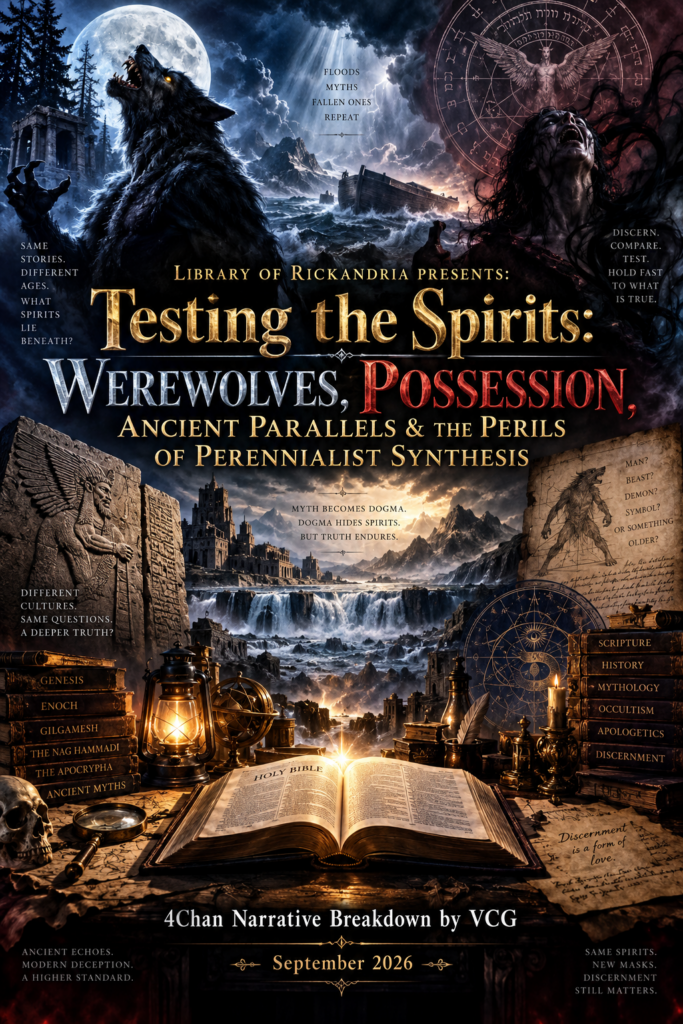
UPDATED BY VCG ON 9/11/2026 @ 00:00 EST
Anyone can do this, but most won’t.
ChatGPT – Library of Rickandria
LIBRARY OF RICKANDRIA PRESENTS
TESTING THE SPIRITS
Werewolves, Possession, Ancient Parallels & the Perils of Perennialist Synthesis
A 4Chan Narrative Breakdown by VCG
September 2026
Abstract
/x/ – werewolves, possession, and transformation – Paranormal – 4chan
A strange thing happens when an internet thread is built from facts that are individually more substantial than its final theory.
That is what makes 4chan /x/ thread No. 42942952 worth examining carefully.
The thread moves through:
- biblical demon possession
- the Epic of Gilgamesh
- classical werewolf traditions
- the Zār possession complex
- Islamic jinn
- Jewish dybbuk traditions
- Vodou
- Hebrew rûaḥ
- Greek pneuma
- Egyptian ka
- Yoruba aṣẹ
- Kabbalistic reincarnation
- Gnostic archons
- Ibn ʿArabī’s “Breath of the All-Merciful”
- Egyptian decans
- seventy-two spiritual powers
- Meltwater Pulse 1B
- colonial reports of shapeshifting
and modern psychological speculation.
Many of those things are real subjects of historical study.
Several of the thread’s individual factual observations are substantially correct.
The difficulty lies in what happens next.
Again and again, an attested tradition becomes evidence that the tradition’s interpretation was objectively correct; similarity becomes identity; cultural parallels become independent witnesses; words with partially overlapping meanings become names for the same metaphysical substance; and systems separated by centuries are assembled into a supposed primordial spiritual science.
Those transitions require evidence of their own.
This paper therefore does not ask the reader to choose between two equally careless positions:
“all of this is nonsense”
or
“all of this reveals the same ancient truth.”
Instead, it applies a consistent method:
TEXT SAYS → HISTORY SHOWS → PSYCHOLOGY ALLOWS → SCRIPTURE TEACHES → VERDICT
The resulting conclusion is more nuanced.
Ancient and early-modern sources unquestionably preserve traditions of:
- possession
- animal transformation
- spirit beings
- cosmic powers
- ritual trance
- catastrophic floods
Human beings can also undergo powerful transformation and possession experiences that are clinically documented without corresponding physical metamorphosis.
Neither observation by itself settles the metaphysical question.
Meanwhile, the biblical text explicitly presents personal spiritual evil as real, but it does not supply the thread’s theory of a fragmented world-soul, seventy-two pneumatic emanations, reincarnating spirits, or a universal occult science.
The central problem in the thread, then, is not supernaturalism.
It is perennialist synthesis without adequate historical controls.
For Scripture quotations, this paper uses the supplied King James Bible, Pure Cambridge Edition.
I. Why This Thread Deserves More Than Ridicule
The easiest way to answer a thread about:
- werewolves
- spirits
- dybbukim
- jinn
- occult numbers
- ancient floods
would be to laugh at it.
That would also be the least interesting response.
Several posters clearly know pieces of real religious and historical material.
Zār is real. Dybbuk traditions are real.
Jinn are real within Islamic scripture and theology. Gilgamesh really contains a wolf transformation.
Herodotus really records an alleged recurring human-to-wolf transformation.
Thomas Gage really published extraordinary shapeshifting reports from colonial Guatemala.
Clinical psychiatry really contains cases in which people experience themselves as becoming animals.
Egyptian decans really existed.
Jewish and Christian esoteric traditions really developed systems involving the number seventy-two.
The thread becomes vulnerable not because all its facts are fake, but because the facts are made to carry more weight than they can bear.
Consider the difference between these statements:
An ancient Mesopotamian text contains a man-to-wolf transformation.
and:
Ancient Mesopotamians therefore witnessed literal biological werewolves.
The first can be demonstrated from a text.
The second requires an entirely different evidentiary argument.
Or consider:
Hebrew rûaḥ and Greek pneuma can both denote wind, breath, or spirit.
That is a linguistic observation.
But:
Therefore Hebrew and Greek writers knew that consciousness consists of a literal pneumatic cosmic substance.
That is metaphysics.
The first proposition does not secretly contain the second.
This distinction—between what a source says and what the existence of that source proves—will govern the entire investigation.
II. The Five Levels of a Claim
Before touching werewolves or demons, we need a way to grade evidence.
Internet discussions often fail because several entirely different questions are answered with the same word: “true.”
For this paper, a claim can occupy at least five evidentiary levels.
| Level | Question being asked | Example |
|---|---|---|
| Attested | Does a source actually say this? | Does Gilgamesh contain wolf transformation? |
| Historically believed | Did a community or writer understand something this way? | Were Zār illnesses understood as caused by spirits/winds? |
| Plausibly inferred | Does the evidence reasonably suggest something beyond the explicit source? | Did two traditions influence one another? |
| Empirically demonstrated | Has the external phenomenon itself been independently established? | Has human biological transformation into a wolf been demonstrated? |
| Biblically taught | Does Scripture itself teach this proposition? | Does Mark present unclean spirits as personal agents? |
These categories can overlap, but they cannot simply be substituted for one another.
A culture’s belief is a historical fact about that culture even if the object’s existence remains undecided.
A biblical claim may be theological truth within a Christian reading of Scripture even where modern experimental science has no way to reproduce the event.
A psychiatric explanation may establish a possible natural pathway without proving that every apparently similar religious case has that pathway.
And a metaphysical possibility is not automatically a historical fact.
The burden of proof belongs precisely at these boundaries.
III. A Claim-Evidence Map of the Thread
Before working through each post in detail, it helps to see the architecture.
| Thread claim | What survives fact-checking? | Main problem | Verdict |
|---|---|---|---|
| Mark 5 concerns possession | Yes; Mark explicitly identifies an unclean spirit | Cannot be used to authenticate every later possession system | Supported, then overextended |
| Gilgamesh contains a werewolf-like transformation | Yes; a shepherd is transformed into a wolf | Literary transformation ≠ observed biological metamorphosis | Supported textual claim |
| Antiquity reports werewolves | Yes; Herodotus and others contain such traditions | Reports and myths are not automatically eyewitness confirmation | Supported historical claim |
| MWP-1B “nearly exactly” coincides with Noah’s Flood | MWP-1B is real | Chronology is disputed scientifically and does not match conventional biblical chronologies | Misleading / unsupported |
| Zār is a possession tradition involving spirits/winds | Broadly yes | Practitioner explanation ≠ independently proven causation | Substantially supported |
| Zār, jinn, dybbukim, lwa, etc. are the same kind of being | No historical demonstration supplied | Functional similarity treated as ontological identity | Unsupported |
| rûaḥ, pneuma, ka, aṣẹ name one life-breath substance | They have interesting partial analogies | Their semantic fields and cultural roles differ substantially | Misleading synthesis |
| Dybbuk/gilgul preserve primordial spirit science | Later Kabbalistic connection is real | Early-modern development projected into prehistory | Partly factual, speculative conclusion |
| Ancient cosmology divided spiritual powers into 72 | Some later 72-fold esoteric systems exist | Egyptian decans are 36; Gnostic archon systems vary | Historically conflated |
| Primordial divine Breath fragmented into spirits | Comparable ideas exist in certain metaphysical systems | Presented as universal history without transmission evidence | Metaphysical assertion |
| Suppressed instinct creates a “Werewolf Principle” | Suppression can affect physiological arousal | No established psychological law of that name or mechanism | Interesting metaphor, not established theory |
| Thomas Gage witnessed evidence of shapeshifters | He recorded remarkable cases and personally saw injuries | He did not witness bodily metamorphosis | Important testimony, insufficient for transformation |
The pattern should already be visible.
Very often the thread’s first sentence survives.
The problem appears in the second or third inferential step.
IV. Chronology: The Cure for False Convergence
One of the simplest ways to test a proposed primordial synthesis is to put its ingredients on a timeline.
The result matters.
| Approximate historical setting | Material relevant to the thread |
|---|---|
| Ancient Mesopotamian tradition | Gilgamesh literature includes divine human-to-wolf transformation |
| Ancient Egypt | Decanal star/timekeeping system built around 36 decans |
| Biblical Israel / Jewish Scripture | Hebrew rûaḥ, flood narrative, prohibitions on divination and necromancy |
| 5th century BC | Herodotus records and explicitly doubts the Neuri werewolf report |
| Greco-Roman period | Greek pneuma traditions; Ovid’s Lycaon transformation |
| 1st century AD | Mark depicts unclean spirits as personal agents subject to Christ |
| Late antiquity | Diverse Gnostic archon cosmologies emerge; important systems use planetary/sevenfold structures |
| Medieval Islamic mysticism | Ibn ʿArabī develops the Nafas al-Raḥmān, “Breath of the All-Merciful” |
| 16th century | A documented dybbuk possession case appears at Safed in 1571; Kabbalistic gilgul traditions provide context |
| Early 16th century onward | Seventy-two-name traditions receive elaborate Jewish/Christian esoteric development |
| 1648 | Thomas Gage publishes his Guatemala shapeshifting accounts |
| Modern period | Clinical lycanthropy/therianthropy and dissociative possession states enter psychiatric literature |
This does not disprove historical transmission.
It tells us what historical transmission would have to explain.
A genuine genealogy requires bridges:
- manuscripts
- teachers
- translations
- migrations
- borrowings
- identifiable transformations of terminology
or at least chronological opportunities for contact.
Without those bridges, a timeline becomes a collage.
That is especially important for the thread’s theory of
“72 winds.”
Egyptian decans belong to one system; late-antique archons to other systems; medieval and early-modern seventy-two-name traditions to still others.
Their coexistence on a modern diagram does not prove their identity in antiquity.
V. Walking Through the Thread
Post No. 42942952: Werewolves, Mark 5, Gilgamesh, Antiquity, and the Flood
The opening post places several questions beside one another:
- biblical possession
- ancient werewolf traditions
- Gilgamesh
- classical testimony
- Meltwater Pulse 1B
and worldwide flood narratives.
The juxtaposition is rhetorically effective.
Once enough mysterious subjects are gathered together, they begin to feel mutually corroborative.
But evidence does not accumulate merely because subjects are strange.
We need to separate them.
Mark 5:5 — What Does the Passage Actually Say?
The OP points specifically to Mark 5:5, where the man among the tombs is described as crying and cutting himself.
Taken alone, verse 5 gives behavior:
“And always, night and day, he was in the mountains, and in the tombs, crying, and cutting himself with stones.”
But Mark does not leave the cause undefined.
Jesus says:
“Come out of the man, thou unclean spirit.”
The spirit answers:
“My name is Legion:
for we are many.”
The narrative then distinguishes the spirits from the man by describing them leaving him and entering the swine.
Afterward the man is found
“sitting, and clothed, and in his right mind.”
If we are reading Mark as Mark presents himself, the text does not merely report symptoms that the narrator vaguely calls madness.
It narratively presents personal unclean spirits.
A purely reductive interpretation—
“Mark simply mistook psychiatric illness for demons”
—therefore contradicts the explanation given by Mark’s narrative.
Someone may reject Mark’s account as history, but that is a different argument from claiming Mark itself does not teach possession.
Yet the opposite mistake is just as serious.
Mark 5 does not tell us that:
Zār winds are demons;
dybbukim are the same beings;
jinn belong to Mark’s taxonomy;
zodiacal archons explain possession;
spirits are fragments of a world-soul;
or seventy-two cosmic winds govern psychological disorder.
None of those propositions appears in Mark.
Indeed, Mark itself distinguishes ordinary disease from unclean spirits.
In Mark 1, the narrative says people brought to Jesus both
“all that were diseased”
and
“them that were possessed with devils”
Jesus then
“healed many that were sick of divers diseases, and cast out many devils.”
That is a useful corrective in both directions.
Scripture acknowledges spiritual affliction without turning every illness into spiritual possession.
TEXT SAYS
Mark presents a man afflicted by actual unclean spirits.
HISTORY SHOWS
Possession categories existed in antiquity and remain widespread cross-culturally.
PSYCHOLOGY ALLOWS
Some behaviors superficially resembling possession also occur in psychiatric, dissociative, neurological, intoxicant-related, and culturally patterned states.
SCRIPTURE TEACHES
Unclean spirits are real within Mark’s narrative, but Scripture does not command us to infer demon possession from every unusual symptom.
VERDICT
The thread is right to take Mark’s supernatural claim seriously.
It is wrong if Mark is then used as a blank authorization for later occult cosmologies.
VI. The Wolf in Gilgamesh
The OP is also correct about an easily overlooked part of Gilgamesh.
In Tablet VI, Gilgamesh rebukes Ishtar by recounting what happened to her former lovers.
A shepherd is struck by her and turned into a wolf, after which those around him turn against him. The transformation is genuinely present in the text.
That is worth acknowledging plainly.
But
“there is a werewolf in Gilgamesh”
is already a little more interpretive than
“the text depicts a man transformed into a wolf.”
The later European werewolf complex usually includes its own constellation of features:
- recurrent transformation
- curses
- magical skins or belts
- lunar associations in later folklore and popular culture
- predation
- accusations of witchcraft
and so forth.
Gilgamesh gives us something simpler:
mythic divine transformation.
That matters because genre matters.
A literary transformation proves the antiquity of the motif.
It does not automatically establish an ancient zoological observation.
We would not argue that because Homer describes gods assuming forms, therefore those passages constitute biological case reports.
Nor should we demand that ancient literature be worthless because it contains supernatural narrative.
The responsible middle position is to identify exactly what sort of source we possess.
The source proves an ancient transformation tradition.
Whether some deeper phenomenon lies behind that tradition remains a separate question.
VII. Herodotus: An Ancient Skeptic Records a Werewolf Story
Herodotus gives us something even more interesting.
In Histories 4.105, he reports that Scythians and Greeks claimed the Neuri were transformed into wolves for several days each year before becoming human again.
Then Herodotus does something remarkably useful.
He tells us he does not believe it.
His informants swear that it is true, but the report does not persuade him.
This single passage should become a methodological emblem for the whole paper.
Herodotus preserves the testimony.
He does not erase it because it sounds strange.
But neither does he confuse recording a claim with verifying the claim.
That distinction is more sophisticated than much modern internet argument.
Ancient testimony deserves to be transmitted accurately.
Ancient testimony does not receive automatic immunity from source criticism merely because it is ancient.
Ovid’s story of Lycaon likewise preserves a famous human-to-wolf transformation, but Metamorphoses is mythic poetry.
It is excellent evidence for a cultural motif and poor evidence, by itself, for a biologically documented event.
VIII. Meltwater Pulse 1B and the Biblical Flood
The weakest factual assertion in the OP is the statement that Meltwater Pulse 1B
“coincided nearly exactly”
with the biblical Flood.
MWP-1B is a real scientific research problem.
A 2025 Nature Communications study places the commonly discussed episode around 11.45–11.1 thousand years ago while emphasizing that its:
- timing
- rate
- magnitude
and even the character of the event remain controversial.
New Great Barrier Reef data also challenge older assumptions about a globally uniform abrupt sea-level jump of the magnitude inferred from Barbados records.
What does that have to do with Noah?
The Bible itself does not state:
“Noah’s Flood occurred in 11,300 BP,”
or:
“Noah’s Flood occurred in 9350 BC,”
or any modern geological date.
Chronological dates for the Flood are constructed from:
- biblical genealogies
- textual traditions
- synchronisms
- chronological assumptions
The famous Ussher chronology, for example, places the end of the Flood in 2348 BC.
That is one historically influential Masoretic-based chronology, not a verse of Scripture.
Roughly speaking, an event around 11.3 ka BP falls many thousands of years earlier than Ussher’s date.
Other biblical textual traditions yield different chronological totals, and Christians have proposed a range of chronological models.
But that diversity does not rescue the specific phrase
“coincided nearly exactly.”
A correlation must be demonstrated rather than announced.
The correct statement is therefore:
MWP-1B may be relevant to the broader study of postglacial sea-level rise, catastrophic inundation, and the environmental background in which flood traditions developed.
What has not been established is:
MWP-1B = Noah’s Flood.
That equation requires a geological argument, a biblical chronological argument, and a demonstration that both datasets refer to the same event.
The thread supplies none of those.
IX. Worldwide Flood Traditions: Important, but Count Them Correctly
Flood traditions are undeniably widespread.
This is not something that should be dismissed merely because it is sometimes used apologetically.
But
“many cultures possess flood narratives”
can support more than one explanatory model.
Some may preserve memories of local catastrophic floods.
Some may be historically related through cultural transmission.
Some may be literary transformations of older traditions.
Some may reflect the ordinary vulnerability of riverine and coastal societies.
A Christian may argue that diverse traditions preserve distorted memories of an actual ancient judgment.
A historical critic may instead emphasize literary dependence and environmental recurrence.
Those positions are not identical, but both agree on one methodological point:
dependent witnesses cannot automatically be counted as independent witnesses.
John Day’s comparative study of Genesis and Ancient Near Eastern flood traditions explicitly warns scholars against “parallelomania”—the tendency to find correspondences everywhere without adequately weighing their significance.
Historical-critical scholarship also identifies particularly close relationships among Mesopotamian flood traditions and the biblical narrative.
Mesopotamian flood literature has a long history extending through Sumerian material, Atrahasis, Gilgamesh, and later reception; scholars debate the exact literary relationships, but they do not usually treat every Ancient Near Eastern flood text as an isolated independent witness.
This does not decide whether there was a historical Noahic Flood.
It decides how evidence must be counted.
If A influenced B, then A + B is not automatically
“two independent civilizations remembering the same thing.”
That principle will return when we reach:
- spirits
- breath concepts
- occult numbers
X. Post No. 42942978: Zār — Where the Thread Is Mostly Right
The next substantive post introduces Zār.
This is one of the thread’s better historical contributions.
Zār traditions are genuinely associated with spirit possession in parts of Northeast Africa and the Middle East.
In southern Iran, for example, ethnographic description refers to harmful “winds” associated with spirit-possession beliefs.
Particular winds may be understood as producing particular illnesses or disturbances, and ritual practice can involve music, rhythmic movement, incense, and procedures intended to pacify the possessing force.
There is therefore nothing fictitious about the basic anthropological claim.
The important question is grammatical:
Do we write:
“The spirit causes the illness.”
or:
“Within the tradition, the illness is attributed to a possessing spirit or wind.”
For anthropology, the second sentence is safer.
It preserves what practitioners believe without pretending that ethnography has independently identified the causal agent.
This distinction is sometimes called the difference between an emic description—how participants understand their own experience—and an etic or external analysis.
Neither should simply erase the other.
The clinician who says,
“This person has a dissociative disorder, therefore the person’s cultural world is irrelevant,”
can miss crucial information.
The believer who says,
“My culture identifies a spirit, therefore medical differential diagnosis is unnecessary,”
can make the opposite mistake.
A review of hundreds of published dissociative trance and possession cases found:
- possession experiences
- hallucinations
- amnesia
- somatic complaints
- considerable cross-cultural variation
Importantly, the researchers concluded that multiple explanatory models may coexist and recommended careful sociocultural and individual assessment.
So, the Zār post gives us a valuable datum.
What it does not give us is evidence that Zār spirits are identical to:
- jinn
- dybbukim
- biblical demons
- lwa
- Gnostic archons
or primordial cosmic winds.
That claim arrives next.
XI. Post No. 42942986: When Comparison Becomes Identity
The next poster makes a much larger assertion.
Zār, jinn, dybbukim, Vodou spirits, and other invisible agents are grouped as surviving forms of a single ancient pneumatic ontology.
Hebrew rûaḥ, Greek pneuma, Egyptian ka, and Yoruba aṣẹ are likewise aligned as remnants of one life-breath doctrine.
At first glance, this sounds impressive because there really are similarities.
But we need to ask the most important comparative-religion question in this paper:
Similar in what respect?
A bird, a bat, and an airplane all fly.
That does not make them one species.
Two traditions may share:
a metaphor;
a ritual function;
a phenomenological experience;
a word translated “spirit”;
a belief in invisible agency;
or a theory of vitality.
None of those is automatically evidence of ontological identity.
XII. Ruach, Pneuma, Ka, and Aṣẹ: Similarity Is Not Identity
Hebrew rûaḥ genuinely carries a broad semantic range involving:
- wind
- breath
- spirit
- disposition
- divine activity
depending on context.
Modern lexical and biblical scholarship continues to discuss precisely this breadth.
Greek pneuma likewise has a semantic history involving:
- breath
- blowing
- wind
- life
- spirit
That is a meaningful comparison.
Breath is an obvious human metaphor for life because breathing distinguishes the living from the dead and because invisible air can be felt without being seen.
But Egyptian ka is not simply:
“the Egyptian word for pneuma.”
Museum scholarship describes the ka as an element of Egyptian personhood or life-force with a specific role in funerary anthropology; it could separate at death and formed part of a larger Egyptian account involving other aspects of the person, including the ba.
Likewise, Yoruba aṣẹ is commonly discussed as creative efficacy, authority, or power—something capable of being expressed and actualized—not simply as an interchangeable synonym for Hebrew rûaḥ.
Smithsonian bibliographic material itself characterizes the concept in terms of
“creative power.”
The proper comparative conclusion is therefore modest:
Several cultures use concepts connecting:
- life
- agency
- breath
- power
or invisible efficacy.
That is interesting.
But the stronger proposition—
All of these words originally named the same objective spiritual substance—
requires evidence that the linguistic comparison itself does not provide.
This is a recurring error in esoteric synthesis:
semantic overlap becomes metaphysical proof.
Language cannot bear that weight by itself.
XIII. “All Afroasiatic Civilizations”
The same post describes the alleged pattern as belonging broadly to “Afroasiatic civilizations.”
That phrase sounds precise but is being used imprecisely.
“Afroasiatic” is principally a linguistic family designation, covering branches such as Semitic and Egyptian among others.
It does not describe a single ancient religious civilization possessing one uniform metaphysical system.
A linguistic relationship can be historically important.
It may even enable the study of inherited vocabulary.
But:
same language family ≠ same theology;
same theology ≠ same ritual;
same ritual ≠ same metaphysics;
and none of these automatically implies one primordial esoteric science.
The category has been stretched farther than it can responsibly go.
XIV. Post No. 42942991: Dybbuk, Gilgul, Jinn, Baal Shem, and the Number 72
The next post is a particularly useful example because it contains several genuine historical facts embedded within a speculative genealogy.
Let us separate them.
The Dybbuk and Gilgul
The dybbuk is not a timeless pan-Jewish term for any invading spirit.
Specialist historical work locates the recognizable dybbuk-possession tradition in the early-modern Kabbalistic world.
One important documented case comes from Safed in 1571, and the concept became connected with gilgul—the Kabbalistic doctrine of transmigration or reincarnation of souls.
This is important because the thread treats dybbuk terminology as if it were a transparent fossil from primordial antiquity.
The historical evidence points instead to a much more specific development.
A dybbuk could be conceptualized as a deceased human soul attaching itself to the living.
That is already enough to distinguish it from several other categories in the thread.
A Dybbuk Is Not Simply a Jinn
Islamic jinn are not ordinarily defined as dead human souls.
The Qur’an describes jinn as created from fire and depicts them as morally diverse: some righteous, some otherwise.
One does not need to accept the Qur’an as Christian Scripture to make this historical point.
If we are comparing religions honestly, we should permit each tradition to define its own beings before we merge them.
Thus:
dybbuk = typically a deceased human soul in later Jewish possession lore;
jinn = a separate created category in Islamic cosmology;
Zār = spirits/winds within particular possession complexes;
biblical unclean spirits = defined through biblical narratives and terminology.
Perhaps a theologian might eventually argue that some of these traditions misidentify the same underlying spiritual agents.
But that would be a theological interpretation imposed after comparison, not something historical similarity alone demonstrates.
That distinction must remain visible.
The Baal Shem
The thread also invokes the baʿal shem, the
“master of the Name.”
That too has a real historical basis.
Jewish possession and exorcistic traditions include wonder-workers or specialists associated with divine names and ritual procedures, and dybbuk literature can involve the baʿal shem in exorcistic roles.
But the next leap—
therefore the baʿal shem is heir to a primordial theurgic science—
does not come from the historical datum.
It is an interpretation placed upon it.
The difference is crucial.
XV. The “72” Investigation
The number seventy-two deserves its own chapter because it is where the thread’s method becomes especially visible.
The argument effectively assembles several ideas:
seventy-two winds;
seventy-two cosmic beings;
zodiacal subdivisions;
Egyptian decans;
archons;
seventy-two divine names;
and later seventy-two-spirit traditions.
Then numerical resemblance is treated as evidence that all these traditions derive from one ancient system.
The historical record is much messier.
Egyptian Decans: 36, Not 72
Egyptian decans were star groups associated with calendrical and nocturnal timekeeping.
The standard system contains 36 decans, corresponding to thirty-six ten-day units, with the remaining days completing the Egyptian civil year.
The Metropolitan Museum’s description is explicit on this point.
That alone creates a major problem for the thread’s confident equivalence:
seventy-two winds = zodiacal archons = Egyptian decans.
If the historical decanal system is thirty-sixfold, “72 decans” cannot simply be assumed.
One might propose doubling, paired rulers, later reinterpretation, or another transformation.
But now one needs historical evidence for that transformation.
Arithmetic after the fact is not transmission history.
Gnostic Archons Are Not Uniformly Seventy-Two Either
“Archon” is another term that can create false unity.
Late-antique Gnostic cosmologies are diverse.
Important discussions of the Apocryphon of John, for example, involve seven archons or planetary powers within parts of the system.
That does not mean every Gnostic system had seven rulers.
It means there is no warrant for treating “archons” as a universal seventy-two-member class.
The thread is taking a flexible comparative label and silently converting it into a fixed taxonomy.
Where 72 Really Does Appear
There are genuine Jewish and Christian esoteric traditions surrounding seventy-two divine names.
A later tradition derives seventy-two letter-groups from Exodus 14:19–21, each Hebrew verse having seventy-two letters in a particular traditional arrangement.
Early-modern Christian reception developed elaborate uses of this material; research on a 1513 Latin prayer, for example, documents the diffusion of a seventy-two-name system.
Later magical traditions likewise made extensive use of seventy-twofold catalogues.
That is historically interesting.
But a later seventy-two-name or seventy-two-spirit catalogue cannot retroactively turn the Egyptian decans into seventy-two entities or prove that a late-antique seven-archon arrangement descended from seventy-two prehistoric winds.
The number may be transmitted in some contexts.
It may be independently attractive in others.
It may be constructed from:
- mathematical
- calendrical
- scriptural
or astrological considerations.
Each occurrence needs its own genealogy.
TEXT SAYS
The thread presents seventy-two as evidence of one underlying system.
HISTORY SHOWS
Egyptian decans are 36; some Gnostic archon arrangements are sevenfold; seventy-two-name traditions have their own documented later history.
PSYCHOLOGY ALLOWS
Once a number becomes salient, people naturally notice its reappearance and underweight mismatches.
SCRIPTURE TEACHES
Scripture contains no doctrine of seventy-two cosmic winds governing possession.
VERDICT
The number 72 is historically real in some esoteric systems, but the thread’s universal seventy-twofold genealogy is not established.
XVI. Post No. 42942999: The Primordial Breath
The next poster makes the metaphysics explicit.
The theory is that a primordial divine Breath constitutes the first emanation of Being, subsequently fragmenting into secondary centers—
- Logoi
- daimones
- angels
- archons
and other beings—eventually accounting for:
- jinn
- dybbukim
- demonic influences
- possession
- psychological imbalance
This should not be mocked as meaningless.
Parts of this language have real analogues in historic metaphysical traditions.
Ibn ʿArabī, for example, really does develop the image of the Breath of the All-Merciful in relation to divine self-disclosure, creative speech, and the manifestation of created realities.
Neoplatonic metaphysics likewise contains hierarchical accounts of reality’s dependence upon the One, although modern scholarship cautions that the common word “emanation” can oversimplify Plotinus’s actual account.
So, the post’s metaphysical vocabulary is not invented from nothing.
The difficulty lies in the word universal.
The existence of a Sufi Breath doctrine does not mean Hebrew rûaḥ secretly refers to Ibn ʿArabī’s metaphysics.
The existence of Greek pneuma does not make Egyptian ka the same substance.
And the existence of Neoplatonic procession does not mean the Gospel of John’s Logos is one derivative cosmic Logos among many.
This is precisely where Scripture creates a sharp boundary.
XVII. Biblical Ontology: Creation, Not Fragmentation
John begins:
“In the beginning was the Word, and the Word was with God, and the Word was God.”
Then:
“All things were made by him; and without him was not any thing made that was made.”
And finally:
“And the Word was made flesh, and dwelt among us…”
That is not a picture of Christ as one secondary fragment of an impersonal primordial substance.
The Word stands on the Creator side of the Creator-creature distinction.
Colossians makes the point even more explicitly:
“For by him were all things created, that are in heaven, and that are in earth, visible and invisible…”
Paul then includes:
“thrones, or dominions, or principalities, or powers”
and concludes:
“all things were created by him, and for him.”
Whatever exact taxonomy Paul intends by:
- thrones
- dominions
- principalities
- powers
they are created realities.
They are not fragments broken off from the divine essence.
The thread’s metaphysical scheme therefore differs from biblical ontology at the foundation.
| Biblical pattern | Thread’s perennialist pattern |
|---|---|
| God creates | Being emanates |
| Christ is Creator | Secondary Logoi emerge |
| Spiritual powers are creatures | Spiritual centers are fragments/emanations |
| Creator and creature remain distinct | Reality exists on a continuous metaphysical chain |
| Salvation is reconciliation through Christ | Spiritual disorder becomes fragmentation/imbalance |
| Resurrection and judgment | Reincarnation/transmigration may be incorporated |
That does not mean Christians cannot study:
- Neoplatonism
- Sufism
- Kabbalah
- Gnosticism
or ritual traditions.
It means those systems cannot be quietly inserted into biblical words and then called
“what Scripture really meant.”
XVIII. Reincarnation Versus Resurrection
The thread’s dybbuk/gilgul synthesis also imports reincarnation into the proposed primordial system.
Here another biblical distinction matters.
Hebrews states:
“And as it is appointed unto men once to die, but after this the judgment.”
The ordinary New Testament expectation is death followed by resurrection and judgment, not repeated embodiment through a sequence of human lives.
Likewise, 1 Thessalonians describes
“the dead in Christ”
rising at Christ’s coming.
That is resurrection.
Gilgul or metempsychosis is something else.
One may compare the traditions historically, but comparison should not erase contradiction.
XIX. Post No. 42943223: The Thread’s Best Methodological Instinct
One poster explicitly says he is not especially committed to werewolves or possession, recognizes mental and neurological possibilities, and is interested in understanding rather than simply declaring an answer.
Methodologically, this is the strongest instinct in the thread.
A Christian investigation does not need the false dilemma:
either demons exist,
or neurological disease exists.
Scripture itself resists that collapse.
As already noted, Mark can distinguish sickness from demonic affliction.
Likewise, modern clinical literature demonstrates that possession-form experiences may occur amid:
- dissociation
- hallucination
- trauma-related phenomena
- culturally structured trance
and other psychiatric presentations.
Therefore, the responsible posture in an actual contemporary case is differential reasoning.
A person can be taken seriously without immediately endorsing the person’s explanation of the experience.
A spiritual worldview need not prevent medical evaluation.
And medical evaluation does not, by itself, issue a universal philosophical ruling that no spiritual event is possible.
That is a much healthier framework than forcing one explanation onto every case.
XX. A Possession Differential Framework
When someone reports:
- possession
- loss of agency
- alien voices
- involuntary movement
- trance
- amnesia
- supernatural identity
or violent spiritual oppression, several explanatory categories need to remain distinguishable.
| Possible category | What it can explain | What it does not automatically establish |
|---|---|---|
| Biblical spiritual affliction | Scripture explicitly narrates unclean spiritual agents | Does not let us diagnose a modern case merely by resemblance |
| Culturally patterned possession/trance | Experiences shaped by learned ritual and religious categories | Does not prove or disprove an external spirit |
| Dissociative phenomena | Altered agency, memory, identity, trance | Does not explain every religious possession report |
| Psychotic disorder | Hallucinations, delusional interpretations, disorganization | Does not mean all unusual religious experience is psychosis |
| Neurological illness | Seizures, automatisms, confusion, altered consciousness | Does not account for every possession narrative |
| Intoxication/toxic-metabolic cause | Agitation, hallucination, delirium, behavioral changes | Must be established case by case |
| Trauma-related states | Dissociation, hyperarousal, intrusive phenomena | Not a universal possession explanation |
| Ritual performance | Learned trance, role enactment, social expectations | Performance may still be subjectively profound |
| Malingering/fraud | Deliberately produced symptoms | Requires evidence; should not be presumed |
| Unknown/mixed cause | Cases where available data remain insufficient | “Unknown” is not proof of supernatural or natural causation |
The last row is often the hardest to tolerate.
Human beings dislike unresolved categories.
But
“we do not know”
is sometimes the most accurate conclusion available.
XXI. Medical and Ethical Safeguard
This distinction becomes more than academic when a person is in crisis.
- Sudden confusion
- severe agitation
- hallucinations
- seizures
- loss of consciousness
- fever
- self-injury
- delirium
- intoxication signs
- catatonia
- abrupt personality change
or other acute neurological or psychiatric symptoms can have urgent medical causes.
Such symptoms warrant appropriate medical assessment.
A person’s spiritual interpretation of the episode may be discussed without delaying treatment for potentially dangerous physical or psychiatric conditions.
This is not philosophical materialism.
It is ordinary prudence.
The biblical text itself does not instruct readers to classify every fever, seizure, wound, or disturbance as demonic; the Gospels freely speak both of illnesses and of unclean spirits.
XXII. Post No. 42943253: “So Many Things Line Up”
Another poster remarks that many discoveries seem to line up with biblical events and other religious traditions.
This sentence captures one of the deepest problems in pattern-based research.
What does “line up” mean?
Within ten years?
Within one hundred years?
Within five thousand?
Do the sources provide dates independently?
Are the traditions themselves independent?
Was the match criterion selected before or after the data were seen?
How many failed correlations were examined before the successful-looking one was noticed?
The MWP-1B claim demonstrates the danger perfectly.
“Flood event”
+
“biblical flood”
sounds aligned until actual chronology is placed on the table.
Once that happens, the supposed exactness becomes much less obvious.
The lesson is not
“never compare.”
It is:
define the match before celebrating the match.
XXIII. Post No. 42943375: The “Werewolf Principle”
This post is interesting for a different reason.
The writer proposes a psychological
“Werewolf Principle”
suppressed instincts or emotions accumulate until the disowned “beast” breaks through, accompanied by:
- heat
- tension
- altered breathing
- involuntary behavior
The writer also clearly labels the idea as personal interpretation.
That qualification deserves credit.
There is a legitimate psychological observation beneath the metaphor.
Experimental research suggests that deliberate emotional suppression can modestly increase physiological stress reactivity under some conditions.
A 2024 meta-analysis of 24 studies found experimentally manipulated suppression associated with greater overall physiological reactivity, especially in cardiac, hemodynamic, and neuroendocrine measures, although effects depended on study design and suppression type.
So, it would be unfair to answer:
“Suppressed emotion never affects the body.”
It can.
But this is much weaker than a law according to which suppressed instinct inevitably accumulates until an autonomous animal-self erupts.
There is no established psychological mechanism known as the
“Werewolf Principle.”
The metaphor may be useful.
It should remain a metaphor.
XXIV. What About the Moon?
If the moon in the post is meant poetically, there is nothing to fact-check.
If it is meant as a claim that full-moon phases reliably trigger psychiatric or transformation episodes, the evidence is poor.
A study examining 8,473 psychiatric admissions and 1,909 emergency psychiatric evaluations found no significant association between lunar phase and psychiatric admission or emergency presentation.
That does not prove the moon has no biological effects whatsoever.
It means the popular claim that full moons produce a general surge in psychiatric disturbance is not supported by that large dataset.
Again, precision improves the discussion.
XXV. Clinical Lycanthropy and Therianthropy
Werewolf traditions also need a clinical category.
Modern psychiatry contains documented cases in which people believe, perceive, or experience themselves as changing into animals.
A 2025 systematic review identified 77 published cases of clinical therianthropy, with canine forms predominating.
Reported cases occurred alongside psychotic disorders, psychotic depression, bipolar disorder, Cotard syndrome, and other presentations.
This proves something important.
A human being can experience animal transformation with extraordinary subjective conviction without any demonstrated anatomical transformation occurring.
That does not logically prove that no supernatural transformation could ever occur.
It does establish that testimony such as:
“I felt myself becoming a wolf,”
“I knew I had become an animal,”
or:
“My body seemed to change,”
cannot by itself establish biological metamorphosis.
There is a known human pathway by which sincere transformation experience can occur without a corresponding species change.
That possibility must remain in the differential.
XXVI. A Taxonomy of “Werewolves”
Much confusion disappears when we stop using one word for several different things.
| Category | Example | Kind of evidence |
|---|---|---|
| Mythic divine transformation | Shepherd in Gilgamesh; Lycaon in Ovid | Literary/mythological |
| Folkloric recurring shapeshifter | Neuri report in Herodotus | Ethnographic/hearsay tradition |
| Colonial witchcraft/shapeshifting accusation | Thomas Gage’s Guatemala accounts | Historical testimony and legal-social context |
| Clinical therianthropy | Modern psychiatric cases | Clinical observation |
| Symbolic “inner beast” | 4chan “Werewolf Principle” | Psychological metaphor |
| Literal biological human-wolf metamorphosis | Strongest supernatural claim | Requires direct physical evidence not supplied by the thread |
These categories may interact historically.
But they should not be collapsed evidentially.
XXVII. Post No. 42944375: Thomas Gage and the Nagual Accounts
Thomas Gage’s material deserves serious attention precisely because it is stranger and better documented than an ordinary internet anecdote.
Gage published The English-American, His Travail by Sea and Land in 1648 and described alleged shapeshifting in colonial Guatemala.
In one episode involving John Gonzalez, local people reportedly believed Gonzalez could transform into a lion.
A Spaniard fired upon a lion; afterward Gage saw Gonzalez with injuries to his face and nose.
Gonzalez first attributed the injuries to a fall, then later accused the Spaniard who claimed he had shot only at the animal.
That is a remarkable coincidence.
But notice what Gage did not see.
He did not see Gonzalez become a lion.
The Spaniard did not report watching a lion visibly become Gonzalez.
What survives is:
a shapeshifting reputation;
an animal encounter;
an injury;
and conflicting explanations.
Those facts are historically interesting.
They are not a continuous observation of metamorphosis.
XXVIII. Gomez and Lopez: The Stronger Gage Case
The second account is more elaborate.
Gage personally saw John Gomez badly injured.
Later testimony connected Gomez and Sebastian Lopez with a reported fight involving a lion and a tiger-like animal.
The animals disappeared from view; the men were then found near the location.
Gomez subsequently died, and Gage attended examination of the body, observing extensive injury. Lopez was eventually tried and executed amid the accusations.
Yet Gage himself inserted the crucial sentence:
“I could not resolve what to beleeve.”
That admission matters enormously.
He was not a twenty-first-century skeptic sanitizing the supernatural out of the record.
He was a seventeenth-century Christian observer surrounded by a world where:
- witchcraft
- spiritual agency
- colonial conflict
- indigenous cosmology
- supernatural causation
were live categories.
And still he recognized an evidentiary gap.
Modern anthropological work on Gage and the nagual material likewise emphasizes the need to understand the reports within overlapping European and indigenous conceptual worlds rather than reading them as transparent video recordings of events.
This makes Gage an excellent case study in honest source criticism.
The right conclusion is not:
“Nothing happened.”
Something plainly happened to Gomez.
Nor is it:
“Therefore the man transformed into a tiger.”
The surviving evidence does not establish the metamorphosis itself.
A disciplined historian preserves both statements.
XXIX. The Psychology of Esoteric Synthesis
At this point we can ask a different question.
Why does the thread’s final cosmology feel so persuasive?
This is not a question about whether anonymous posters are mentally healthy.
We have no basis to diagnose them, and doing so would be intellectually lazy.
Instead, we can examine reasoning mechanisms that affect everyone.
Pattern Detection
Human cognition is designed to detect meaningful patterns.
That ability is indispensable.
It lets us learn language, identify danger, infer causes, recognize faces, and discover scientific regularities.
But a system optimized to find patterns will sometimes find patterns that are not causally meaningful.
Experimental work has found that illusory pattern perception can correlate with stronger belief in supernatural and conspiratorial explanations.
Again, that does not prove a given supernatural claim false.
It tells us why pattern-detection needs external controls.
Confirmation Bias
Once a hypothesis becomes attractive, evidence matching it becomes easier to notice, remember, and interpret favorably.
Confirmation bias is a well-established tendency to seek or interpret evidence in ways partial to an existing belief or hypothesis.
Look at what happens with “72.”
A 72-fold system supports the hypothesis.
A 36-fold system can be doubled.
A sevenfold archon system can be called another expression.
A different spirit category can be called degeneration.
A late historical appearance can be called survival.
A missing link can be called secrecy.
When every result can be incorporated, the theory becomes difficult to test.
Semantic Association
Words such as:
breath;
wind;
spirit;
air;
life;
fire;
soul;
power;
and consciousness
have enormous metaphorical overlap.
That makes them fertile ground for comparative study.
But it also creates the illusion that linguistic similarity is a physical equation.
Rûaḥ and pneuma really do overlap.
That does not make ka identical.
Nor does it make aṣẹ a forgotten Hebrew doctrine.
The proper question is not:
“Can these concepts be placed on the same diagram?”
It is:
“Can we demonstrate that the historical communities themselves inherited or intended the same ontology?”
Chronological Telescoping
The thread moves effortlessly between:
ancient Egypt;
Mesopotamia;
biblical Hebrew;
Greek philosophy;
late-antique Gnosticism;
medieval Sufism;
early-modern Kabbalah;
colonial Guatemala;
later ceremonial magic;
and modern psychiatric categories.
Once these are placed in a single paragraph, temporal distance disappears.
A reader experiences them as simultaneous witnesses.
They are not.
The timeline is therefore not decorative.
It is an antidote to chronological telescoping.
Narrative Compression
Compare these two statements:
“A seventeenth-century author personally saw an injured man whose community attributed the injuries to an animal-form combat episode that the author did not witness.”
and:
“A seventeenth-century eyewitness documented a shapeshifter.”
The second is easier to remember.
It is also less accurate.
Narrative compression strips away evidentiary qualifiers.
After repeated compression, “people said X” becomes “X happened.”
Selective Skepticism
A particularly important pattern in esoteric synthesis is asymmetric skepticism.
Mainstream chronology is questioned aggressively.
Medical explanations are treated as incomplete.
Historical skepticism is suspected of materialist bias.
But a mystical correspondence from a late source may be accepted with very little scrutiny.
A serious investigation should reverse none of these prejudices.
It should use the same evidentiary standard in every direction.
The:
- scholar
- mystic
- physician
- priest
- eyewitness
- anonymous poster
- ancient poet
all need to be asked:
What exactly do you know?
How do you know it?
What would show you were mistaken?
XXX. The “Ancient Means Reliable” Error
Ancient sources deserve respect.
They do not deserve automatic literalization.
Ancient writers transmitted:
history;
poetry;
propaganda;
omens;
rumors;
religious stories;
genealogies;
court records;
myths;
geography;
satire;
natural observation;
and second-hand marvels.
The date of a source does not tell us its genre.
Herodotus himself gives us the perfect antidote.
He preserves the Neuri wolf tradition while explicitly telling us it did not persuade him.
Ancient people were capable of skepticism.
We should not honor them by pretending they were incapable of distinguishing report from proof.
XXXI. Transmission Versus Independent Corroboration
Suppose three manuscripts tell essentially the same story.
How much evidence do we have?
It depends.
If Manuscripts B and C copied Manuscript A, then we possess three witnesses to transmission, but not three independent witnesses to the original event.
The same rule applies to religious parallels.
For every proposed cross-cultural match we should ask:
Did one tradition borrow from another?
Did both inherit something from a common predecessor?
Did similar human conditions independently generate similar ideas?
Are we dealing with a broad archetypal similarity rather than detailed correspondence?
Or is genuine independent observation the best explanation?
The thread tends to move straight to the last option without eliminating the others.
That is especially risky in the interconnected worlds of the:
- Mediterranean
- Near East
- Islamic intellectual culture
- Kabbalah
and later European occultism, where texts and ideas demonstrably traveled.
Independent corroboration is powerful evidence.
But independence must itself be established.
XXXII. Syncretism Versus Comparative Religion
Comparative religion asks:
How are these traditions alike?
How are they different?
Can historical contact explain the similarity?
What does each tradition mean by its own terminology?
What functions do these beliefs serve?
A syncretic or perennialist reconstruction goes farther:
These traditions are imperfect expressions of one hidden truth.
The thread crosses that boundary repeatedly.
There is nothing dishonest about proposing such a metaphysical theory if it is labeled as metaphysics.
The trouble begins when metaphysical synthesis is presented as though historical comparison has already proved it.
“Zār and jinn both involve invisible beings”
is comparison.
“Zār and jinn are culturally distorted memories of the same pneumatic species”
is interpretation.
“Rûaḥ and pneuma overlap semantically” is linguistics.
“They therefore describe one primordial substance”
is metaphysics.
“Seventy-two appears in several esoteric systems”
is historical observation.
“They descend from seventy-two prehistoric winds”
is a genealogical hypothesis.
Those sentences belong to different disciplines.
The paper’s entire purpose is to keep their labels attached.
XXXIII. Steelmanning the Thread
Before rejecting the thread’s synthesis, we should state its strongest possible form.
A serious advocate might reason as follows.
Human beings across widely separated cultures report experiences of:
- external agency
- trance
- altered identity
- spirit intrusion
- invisible beings
- animal transformation
and communication with nonhuman intelligences.
Many cultures also use breath, wind, or air as metaphors for spirit and life.
Catastrophic flood memories recur in numerous traditions.
Some historical reports are difficult to reduce confidently to fraud or ordinary error.
Scripture itself affirms spiritual beings and demonic activity.
Therefore it may be premature to assume every cross-cultural supernatural tradition is purely fictional.
That argument is much stronger than
“werewolves are real because 4chan says so.”
Several parts deserve serious consideration.
The mistake comes with the next step:
Therefore all these traditions refer to the same beings and preserve one primordial seventy-twofold pneumatic science.
That conclusion is not required by the preceding evidence.
The evidence could fit several models.
XXXIV. Competing Explanatory Models
| Model | What it explains well | Where it struggles |
|---|---|---|
| Common human psychology | Recurrent motifs, agency experiences, transformation states, archetypal fears | Does not by itself establish why particular historical details recur |
| Cultural transmission | Detailed similarities across connected societies | Cannot explain every distant parallel |
| Shared environmental catastrophe | Flood memories in flood-prone societies | Does not prove one global event |
| Literary borrowing | Close textual correspondences | Requires demonstrable contact/textual pathways |
| Symbolic/archetypal recurrence | Animal-human boundaries, death/rebirth, spirit metaphors | Difficult to falsify if used too broadly |
| Genuine spiritual activity | Compatible with biblical accounts of nonhuman spiritual agents | Historical cases still require case-by-case identification |
| Primordial perennialist system | Provides one elegant explanation for many similarities | Requires extensive undocumented genealogical connections |
| Mixed-cause model | Allows different cases to have different causes | Less narratively elegant, but often more realistic |
The least dramatic model may ultimately be the strongest:
different phenomena can have different causes.
Some possession experiences may be dissociative.
Some rituals may be socially learned.
Some testimony may preserve extraordinary unexplained events.
Some legends may descend from other legends.
Some biblical episodes, if Scripture is accepted on its own terms, explicitly involve spiritual agents.
There is no methodological rule demanding that every case receive one universal explanation.
XXXV. The “Suppressed Knowledge” Problem
One of the most dangerous moves in unconventional research is to make lack of evidence support the theory.
Consider:
Why is there no evidence of the primordial system?
Because it was suppressed.
Why are traditions different?
Because the original doctrine was corrupted.
Why are the numbers inconsistent?
Because the knowledge was encoded.
Why are the beings called different things?
Because cultures forgot their original identity.
Why does mainstream scholarship disagree?
Because institutions reject forbidden knowledge.
Any of these might theoretically be true in an individual historical case.
But if all are automatically true whenever evidence is missing, the hypothesis becomes self-sealing.
“Suppression”
is itself a historical claim.
It requires evidence:
documents;
censorship orders;
burned archives;
prohibited books;
institutional correspondence;
witness accounts;
known transmission breaks;
or other positive indicators.
The absence of evidence cannot be converted into evidence merely by naming a hidden suppressor.
XXXVI. Falsifiability: What Would Change Our Mind?
A useful question for any large historical theory is:
What observation would count against it?
For the seventy-two-wind theory, would a thirty-six-decan system count against it?
If not, why not?
Would a sevenfold archon system count against it?
If not, why not?
Would a demonstrably late origin for dybbuk terminology matter?
If not, why not?
Would clear cultural transmission between two supposedly independent traditions weaken the independent-witness argument?
If not, why not?
A theory that survives every conceivable outcome may be emotionally durable but evidentially weak.
Good hypotheses take risks.
They tell us what should not be found if the hypothesis is correct.
XXXVII. What Would Count as Strong Evidence for Literal Shapeshifting?
Suppose we wanted to establish human-to-animal physical transformation seriously.
What would move the argument forward?
A strong modern case would ideally include contemporaneous observation from multiple independent witnesses; continuous recording through the alleged transformation; authenticated biological samples before, during, and after; documented changes in anatomy or genetics incompatible with known physiology; reliable chain of custody; exclusion of prosthetics, digital manipulation, mistaken identity, intoxication, psychiatric explanation, and animal substitution; and replication or repeated observation under conditions designed to prevent ordinary deception.
That sounds demanding because the claim is demanding.
This is not
“science refusing the supernatural.”
It is what would allow the supernatural claim to become distinguishable from:
misperception;
folklore;
fraud;
dream;
psychosis;
ritual experience;
or literary narrative.
Extraordinary claims should not be excluded in advance.
They should be made testable wherever possible.
XXXVIII. What Would Count as Strong Evidence for a Primordial Spirit System?
The historical claim requires a different sort of evidence.
We would want to find early texts documenting the alleged system clearly; chronological priority; stable terminology; identifiable transmission pathways; intermediate texts linking apparently separate traditions; numerical structures that remain consistent rather than being retrofitted; explicit statements connecting categories rather than modern diagrammatic resemblance; and predictive discoveries—for example, the theory correctly identifying a previously unknown correspondence before the relevant manuscript is discovered.
That kind of evidence would be exciting.
The thread does not provide it.
At present, the synthesis works mainly by retrospective association.
XXXIX. Scripture Interpretation Controls
The theological portion of this study requires its own rules.
Scripture should not be turned into another dataset to be fitted into the occult synthesis.
Several controls help.
First, immediate context comes before lexical resemblance.
If rûaḥ can mean wind, breath, or spirit, the correct meaning in a verse must be determined from that verse and its context.
Second, Scripture interprets Scripture before later occult systems are imported.
A Kabbalistic or Gnostic usage centuries later cannot simply dictate what Moses, Isaiah, Mark, or Paul meant.
Third, narrative description and doctrinal inference must remain distinct.
Mark 5 tells us something happened in the narrative; building a complete taxonomy of demon biology from that episode would go beyond the text.
Fourth, the existence of genuine spiritual evil does not authenticate every spiritual system.
Fifth, parallels can illuminate background without becoming authorities over Scripture.
The KJV translators themselves counseled modesty regarding genuine uncertainties, warning against dogmatizing where the underlying evidence remains doubtful. That attitude is entirely appropriate here.
XL. Biblical Discernment Is Not Materialism
The biblical response to spiritual claims is strikingly unlike both modern materialist dismissal and occult credulity.
Paul writes:
“Prove all things; hold fast that which is good.” — 1 Thessalonians 5:21
John writes:
“Beloved, believe not every spirit, but try the spirits whether they are of God…” — 1 John 4:1
Those commands only make sense if spiritual deception is possible.
But they also make indiscriminate belief impossible.
Biblical supernaturalism is therefore anti-credulous.
The existence of spirits is not permission to trust spirits.
The existence of spiritual phenomena is not permission to adopt the ontology supplied by whoever experiences them.
XLI. Pagan Spirituality: Nothing, Demons, or Both?
First Corinthians 10 provides an especially careful biblical framework.
Paul first asks:
“What say I then? that the idol is any thing, or that which is offered in sacrifice to idols is any thing?”
Then he adds:
“the things which the Gentiles sacrifice, they sacrifice to devils, and not to God.”
This is a remarkably useful distinction.
The idol does not become the god the pagan claims it is.
Yet Paul does not therefore describe pagan worship as metaphysically neutral.
Within Paul’s theology, demonic involvement may stand behind idolatrous worship.
That gives Christians a possible framework for comparative religion without falling into perennialism.
A pagan tradition might contain genuine spiritual activity.
It does not follow that the tradition’s own taxonomy correctly identifies the spirits involved.
Thus a Christian could theoretically say:
“There may be real spiritual deception here,”
while refusing to say:
“Therefore the Zār, jinn, dybbuk, lwa, archon, and biblical demon are one species exactly as occult synthesis teaches.”
The first statement is compatible with Paul’s warning.
The second requires evidence Scripture does not provide.
XLII. Scripture and Occult Inquiry
The thread’s growing fascination with reconstructing hidden spiritual taxonomies creates another biblical problem.
Deuteronomy 18 warns Israel against:
- divination
- enchantment
- witchcraft
- familiar spirits
- wizards
- necromancy
Isaiah likewise responds to the invitation to seek familiar spirits and wizards:
“should not a people seek unto their God?”
Then:
“To the law and to the testimony…”
The biblical answer to an occult plurality of voices is therefore not:
build the most comprehensive occult concordance possible.
It is:
seek God;
test the claim;
return to revealed testimony.
That should shape Christian research into these subjects.
Study is not the same as participation.
Understanding an occult system historically is not the same as consulting it spiritually.
XLIII. Colossians and the Attraction of Hidden Hierarchies
Colossians is particularly relevant to the thread’s atmosphere.
Paul warns his readers against being spoiled through
“philosophy and vain deceit,”
against worshipping angels, and against
“intruding into those things which he hath not seen,”
while failing to hold fast to Christ as Head.
This passage should not be weaponized against all philosophy or historical research.
Paul himself reasons carefully and engages ideas.
But the warning is strikingly relevant to elaborate spiritual systems promising hidden knowledge of intermediary beings while shifting attention away from Christ.
The biblical emphasis is not mastering every tier of the unseen hierarchy.
It is the supremacy and sufficiency of Christ over
“all principality and power.”
XLIV. Biblical Spiritual Warfare
Ephesians 6 plainly teaches that Christian conflict is not reducible to human opposition:
“For we wrestle not against flesh and blood, but against principalities, against powers, against the rulers of the darkness of this world, against spiritual wickedness in high places.”
But what does Paul prescribe?
Not astrological decoding.
Not naming seventy-two spirits.
Not reconstructing ancient wind tables.
Not identifying reincarnating entities.
He prescribes:
truth;
righteousness;
the gospel of peace;
faith;
salvation;
the word of God;
and prayer.
Whatever one’s demonology, that emphasis should remain controlling.
XLV. A Biblical Ontology Map
| Category | What Scripture permits us to say | What the thread adds |
|---|---|---|
| God | Creator, not part of creation | Primordial Being sometimes treated as source-substance |
| Christ / the Word | Divine Creator; all things made by him | One or more secondary “Logoi” in emanation chain |
| Holy Ghost | Divine Spirit, personally active | Can be blurred into universal pneumatic substance |
| Angels / powers | Created beings under God’s authority | Folded into cross-cultural spirit continuum |
| Devil / evil spiritual powers | Personal spiritual opposition is real | Identified with many outside categories without proof |
| Human beings | Created embodied persons; accountable to God | Sometimes treated as microcosmic containers/fragments |
| Death | Followed by judgment and resurrection hope | Reincarnation/gilgul incorporated into larger system |
| Idolatrous spiritual activity | May involve demons without validating the idol | Pagan ontologies treated as partial maps of one truth |
| Occult practice | Divination/necromancy forbidden | Occult taxonomies mined for hidden common doctrine |
| Discernment | Test; compare with truth; hold fast to good | Convergence itself often treated as validation |
This is the theological center of the paper.
Christian supernaturalism and perennialist occultism are not the same worldview with different vocabulary.
They differ on what God is, what creation is, what spirits are, what human beings are, what happens after death, where reliable revelation comes from, and how spiritual knowledge should be sought.
XLVI. Where Psychology Stops
Because this paper uses psychiatric and cognitive research, an equally important warning is needed.
Psychology cannot disprove spirits merely by identifying natural mechanisms.
Suppose a person experiences a hostile voice during psychosis.
That shows psychosis can produce such an experience.
It does not logically prove that every report of an external spiritual voice in human history arose from psychosis.
Likewise, showing that people detect illusory patterns does not prove every perceived pattern is illusory.
Showing that emotion suppression increases physiological arousal does not prove every “inner beast” tradition reduces to suppression.
Good psychological analysis supplies alternative pathways.
It should not be turned into metaphysical dogma.
The same standard applies to supernatural explanations.
Knowing that Mark 5 contains demons does not prove every hallucination is a demon.
Both sides can commit the same category mistake.
XLVII. Where History Stops
History can tell us:
what a manuscript says;
approximately when it appears;
which traditions resemble one another;
whether borrowing is plausible;
what communities believed;
how concepts changed;
and how testimonies were transmitted.
History has much greater difficulty proving:
that an invisible being objectively caused an event;
that a ritual contacted a real entity;
that a human physically became an animal;
or that several cultures’ spiritual beings are ontologically identical.
Those are no longer merely historical questions.
The historian can document the evidence surrounding the claim.
The metaphysical judgment requires additional reasoning.
Keeping that boundary visible is not cowardice.
It is methodological honesty.
XLVIII. Where Scripture Stops—and Where It Speaks Clearly
Scripture does not answer every question raised by the thread.
It does not tell us whether every Zār case is natural, spiritual, mixed, or fraudulent.
It does not identify Thomas Gage’s alleged shapeshifters.
It does not tell us whether every flood tradition descends from Noah.
It does not give a table equating jinn, dybbukim, lwa, daimones, and archons.
It does not reveal a hidden seventy-twofold taxonomy.
Where Scripture does speak clearly, however, the thread sometimes crosses it.
Scripture presents personal spiritual evil as real.
Scripture presents Christ as Creator over every invisible power.
Scripture distinguishes Creator from creature.
Scripture directs the believer away from necromancy and occult consultation.
Scripture teaches death, judgment, and resurrection rather than reincarnation.
Scripture commands spiritual claims to be tested.
Scripture centers spiritual warfare on truth, righteousness, faith, the gospel, God’s word, and prayer.
Those are strong conclusions because they arise from the text rather than from an imported synthesis.
XLIX. Final Post-by-Post Verdicts
| Post | Strongest element | Principal problem | Final assessment |
|---|---|---|---|
| 42942952 | Real biblical, Mesopotamian, classical and geological subjects | Juxtaposition becomes implied corroboration; MWP chronology overstated | Mixed |
| 42942978 | Fair description of Zār possession traditions | Emic causation must not be treated as independently proven | Mostly supported |
| 42942986 | Recognizes genuine cross-cultural spirit/breath motifs | Conflates linguistic, ritual and ontological categories | Speculative synthesis |
| 42942991 | Dybbuk/gilgul/Baal Shem material has historical basis | Primordial genealogy and 72-fold structure not demonstrated | Partly factual, largely speculative |
| 42942999 | Draws on recognizable Sufi/Neoplatonic-style metaphysics | Treats one metaphysical theory as universal historical fact | Metaphysical, not demonstrated history |
| 42943223 | Maintains neurological/mental and supernatural possibilities | Needs explicit medical-safety boundary | Methodologically strongest |
| 42943253 | Encourages comparison | “Line up” is undefined and vulnerable to post-hoc fitting | Too vague to prove anything |
| 42943375 | Useful symbolic insight into suppression/arousal | Metaphor becomes quasi-law if taken literally | Psychologically suggestive, not established theory |
| 42944375 | Genuine and fascinating primary historical source | Testimony about transformation ≠ observation of transformation | Important evidence of belief/report, insufficient proof of metamorphosis |
L. What the Thread Has Actually Established
After all of this material is separated into its proper categories, several conclusions remain standing.
Human cultures have repeatedly narrated animal transformation.
That is historically established.
Human cultures have repeatedly described external:
- spiritual agency
- possession
- trance
- invisible beings
That is historically established.
Several religious languages employ:
- breath
- wind
- life
or invisible power as spiritually important concepts.
That is historically and linguistically established, though the concepts differ.
Flood narratives are widespread and some major Ancient Near Eastern examples are historically related.
That is established.
Clinical transformation and possession-form experiences exist and can occur without corresponding physical metamorphosis or demonstrated external spirits.
That is established.
Scripture itself presents personal unclean spirits and evil spiritual powers as real.
That is textually clear within the biblical corpus.
None of those statements establishes that literal werewolves exist.
None establishes that every possession report is demonic.
None establishes that every possession report is psychiatric.
None establishes that all religious spirit beings are the same beings.
None establishes that breath/spirit vocabulary arose from one primordial substance doctrine.
None establishes the thread’s seventy-twofold pneumatic cosmology.
None establishes MWP-1B as Noah’s Flood.
None establishes a primordial universal occult science from which all later traditions descended.
That is the line between what the evidence presently supports and what interpretation adds.
LI. Conclusion: Biblical Discernment Is Neither Credulity nor Materialism
The deepest lesson of this thread is not about werewolves.
It is about how human beings reason when confronted with mystery.
There is a form of skepticism that refuses evidence before examining it.
That is not intellectual courage.
There is also a form of credulity that mistakes every correspondence for confirmation.
That is not discernment.
The thread becomes most interesting precisely because some of its evidence is genuine.
The Gilgamesh transformation is real as literature.
Herodotus really preserves a werewolf report.
Zār really involves possession traditions. Dybbuk lore really developed around spirit attachment and Kabbalistic transmigration.
Seventy-two really becomes important in later esoteric traditions.
Thomas Gage really recorded extraordinary shapeshifting accusations.
Psychology really documents therianthropic and possession-form experiences.
But truth is not served by turning all true fragments into one unproved system.
A careful investigator must repeatedly ask:
What exactly does the source establish?
Is this source independent?
Am I comparing similar functions or identical beings?
Am I importing later terminology backward?
Could an ordinary psychological or historical mechanism explain the similarity?
If I claim spiritual causation, what evidence discriminates it from alternatives?
If I claim suppression, corruption, or hidden transmission, what positive evidence demonstrates it?
What would change my mind?
And, for the Christian reader:
What does Scripture actually say?
That last question produces a position more discriminating than either naïve supernaturalism or reductive materialism.
Mark 5 leaves no doubt about how Mark himself interprets Legion: unclean spirits are personal agents and Christ has authority over them.
Ephesians leaves no doubt that Paul considers spiritual wickedness real.
First Corinthians leaves room for genuine demonic activity behind pagan worship without granting that the pagan idol’s own theology is correct.
Colossians refuses to place spiritual powers alongside Christ as fragments of the same cosmic substance: they are created by him and for him.
Deuteronomy and Isaiah forbid the attempt to obtain hidden knowledge through occult consultation and direct God’s people back to God and his testimony.
And Paul gives perhaps the best summary of the method this entire investigation has tried to follow:
“Prove all things; hold fast that which is good.”— 1 Thessalonians 5:21
That command does not say:
Reject all strange things.
Nor does it say:
Believe all spiritual things.
It says:
prove.
That is a higher standard.
The result of applying it to thread No. 42942952 is not that the spiritual world disappears.
It is that the distinctions return.
History remains history.
Psychology remains psychology.
Metaphysical speculation is identified as metaphysical speculation.
Testimony remains testimony.
Uncertainty is allowed to remain uncertainty.
And Scripture is permitted to speak in its own categories rather than being absorbed into a modern occult synthesis assembled from every tradition that happens to resemble it.
That is not less open-minded.
It is more careful.
And in a subject where:
- deception
- mystery
- fear
- fascination
- spiritual claims
and genuine human suffering all intersect, carefulness is not the enemy of discernment.
It is part of it.
APPENDIX A
Condensed Thread Claim Index
No. 42942952: Werewolves and possession; Mark 5; Gilgamesh; classical transformation accounts; MWP-1B; worldwide flood traditions.
No. 42942978: Zār as spirit/wind possession associated with illness, music, trance, ritual and appeasement.
No. 42942986: Zār, jinn, dybbukim and other spirit traditions interpreted as one pneumatic ontological category; rûaḥ, pneuma, ka, aṣẹ treated as remnants of one life-breath concept.
No. 42942991: Dybbuk/gilgul, jinn, Baal Shem, macrocosm/microcosm and seventy-twofold zodiacal/spiritual hierarchy synthesized into one ancient sacred science.
No. 42942999: Primordial divine Breath proposed as source of Logoi, daimones, angels, archons, jinn, pretas, dybbukim, possession and psychic imbalance.
No. 42943223: Poster keeps neurological, psychiatric and supernatural possibilities open.
No. 42943253: General assertion that modern discoveries increasingly “line up” with biblical and other religious events.
No. 42943375: “Werewolf Principle” proposed as metaphor/model of suppressed instinct erupting through bodily arousal and involuntary behavior.
No. 42944375: Thomas Gage offered as historical evidence for colonial Guatemalan shapeshifting.
APPENDIX B
Selected Bibliography
Primary and Historical Sources
The Holy Bible, King James Version, Pure Cambridge Edition. Scripture text used throughout this study.
The Epic of Gilgamesh, Tablet VI. Ancient Mesopotamian literary source containing the shepherd’s transformation into a wolf.
Herodotus. Histories 4.105. Records the Neuri werewolf tradition while explicitly withholding belief.
Ovid. Metamorphoses, Book I. Lycaon’s transformation into a wolf.
Gage, Thomas. The English-American, His Travail by Sea and Land (1648). Colonial Guatemala accounts involving Gonzalez, Gomez, Lopez and alleged animal transformation.
Historical and Comparative Scholarship
Day, John. Comparative study of Genesis and Ancient Near Eastern flood traditions; especially useful for the methodological danger of “parallelomania.”
Oxford Classical Dictionary / Mesopotamian Flood Traditions. Historical overview of the Mesopotamian flood complex and its transmission.
Encyclopaedia Iranica, “Zār.” Ethnographic treatment of spirit/wind possession traditions in southern Iran.
Faierstein, Morris. Historical work on dybbuk possession traditions, Safed, gilgul, and early-modern Jewish exorcistic contexts.
Metropolitan Museum of Art. Egyptian decans and calendrical/timekeeping traditions; thirty-sixfold decanal system.
Campanini and related University of Bologna scholarship. Early-modern seventy-two-name tradition and the reception of the Exodus 14:19–21 arrangement.
Brill scholarship on the Apocryphon of John. Useful for the diversity and planetary/sevenfold character of important Gnostic archon arrangements.
Chittick / Muhyiddin Ibn Arabi Society. Study of Ibn ʿArabī’s “Breath of the All-Merciful” and creative manifestation.
Stanford Encyclopedia of Philosophy, “Plotinus.” Philosophical background for the One, hierarchy, dependence, and the limitations of simplistic “emanation” language.
Pitt-Rivers, Julian. Study of Thomas Gage and nagual traditions, emphasizing the interpretive cultural setting of colonial shapeshifting reports.
Linguistic and Conceptual Sources
Carlson, Reed. Study of the semantic breadth of Hebrew rûaḥ: wind, breath, spirit and related senses.
Liddell-Scott Greek Lexicon / Perseus-Scaife. Greek pneuma: breath, wind, spirit and related usages.
Metropolitan Museum Egyptian educational material. Egyptian ka as a specific life-force/personhood concept within a wider funerary anthropology.
Smithsonian bibliographic material on Yoruba aṣẹ. Aṣẹ described through creative power, verbal and visual efficacy.
Cambridge scholarship on Afroasiatic. Afroasiatic as a linguistic family rather than a singular religious civilization.
Psychology and Psychiatry
Blom & Sharpless et al. (2025). Systematic review of clinical therianthropy; 77 published transformation cases involving a range of psychiatric presentations.
During et al. Review of dissociative trance and possession cases, emphasizing varied symptoms, cultural contexts and complementary explanatory models.
Tyra, Fergus & Ginty. “Emotion suppression and acute physiological responses to stress in healthy populations.” Meta-analysis showing modestly increased physiological stress reactivity under experimentally manipulated suppression.
Lunar-cycle psychiatric admissions study. Large hospital dataset finding no significant association between lunar phase and psychiatric admission or emergency psychiatric evaluation.
van Prooijen et al. Experimental research connecting illusory pattern perception with conspiracy and supernatural belief tendencies.
Nickerson. Classic review of confirmation bias and preferential interpretation of evidence supporting existing hypotheses.
Geology and Chronology
Webster et al., Nature Communications (2025). Great Barrier Reef reconstruction relevant to Meltwater Pulse 1B; stresses continuing uncertainty over timing, rate and magnitude and challenges simplistic global-step interpretations.
Ussher chronology. Historically influential chronology placing the Flood in the third millennium BC, illustrating the large gap between MWP-1B and a conventional Masoretic-based biblical chronology.
APPENDIX C
Scripture Index
| Subject | Principal passages |
|---|---|
| Creation and Creator-creature distinction | Genesis 1; John 1:1–14; Colossians 1:15–17 |
| Christ’s authority over spirits | Mark 1:23–27; Mark 5:1–20 |
| Disease distinguished from demon possession | Mark 1:29–34 |
| Spiritual warfare | Ephesians 6:10–18 |
| Principalities and powers as created realities | Colossians 1:16; Ephesians 6:12 |
| Warning against hidden spiritual speculation | Colossians 2:8, 18–19 |
| Idolatry and demons | 1 Corinthians 10:19–21 |
| Testing spiritual claims | 1 Thessalonians 5:19–22; 1 John 4:1–6 |
| Divination, familiar spirits, necromancy | Deuteronomy 18:9–12; Isaiah 8:19–20 |
| Death and judgment | Hebrews 9:27 |
| Resurrection rather than reincarnation | 1 Thessalonians 4:13–18 |
| Human desire and moral agency | James 1:13–15 |
| Scripture as the standard against occult counsel | Isaiah 8:19–20 |
Final Research Standard
Throughout this paper, the same five-part test should govern future Library of Rickandria narrative investigations:
TEXT SAYS
What does the document actually say?
HISTORY SHOWS
What can reasonably be established about:
- provenance
- chronology
- transmission
- context
- independent corroboration
PSYCHOLOGY ALLOWS
What known features of:
- cognition
- perception
- trauma
- dissociation
- social expectation
or psychopathology could contribute without being turned into a universal explanation?
SCRIPTURE TEACHES
What does the biblical text affirm, deny, distinguish or leave unanswered?
VERDICT
What conclusion is justified—and, equally important, what conclusion would exceed the evidence?
The purpose of that method is not to make mystery disappear.
It is to keep us from confusing mystery with proof.
Soli Deo Gloria.
4CHAN THREAD & POST BREAKDOWNS – Library of Rickandria
VCG PAPER PROJECTS – Library of Rickandria