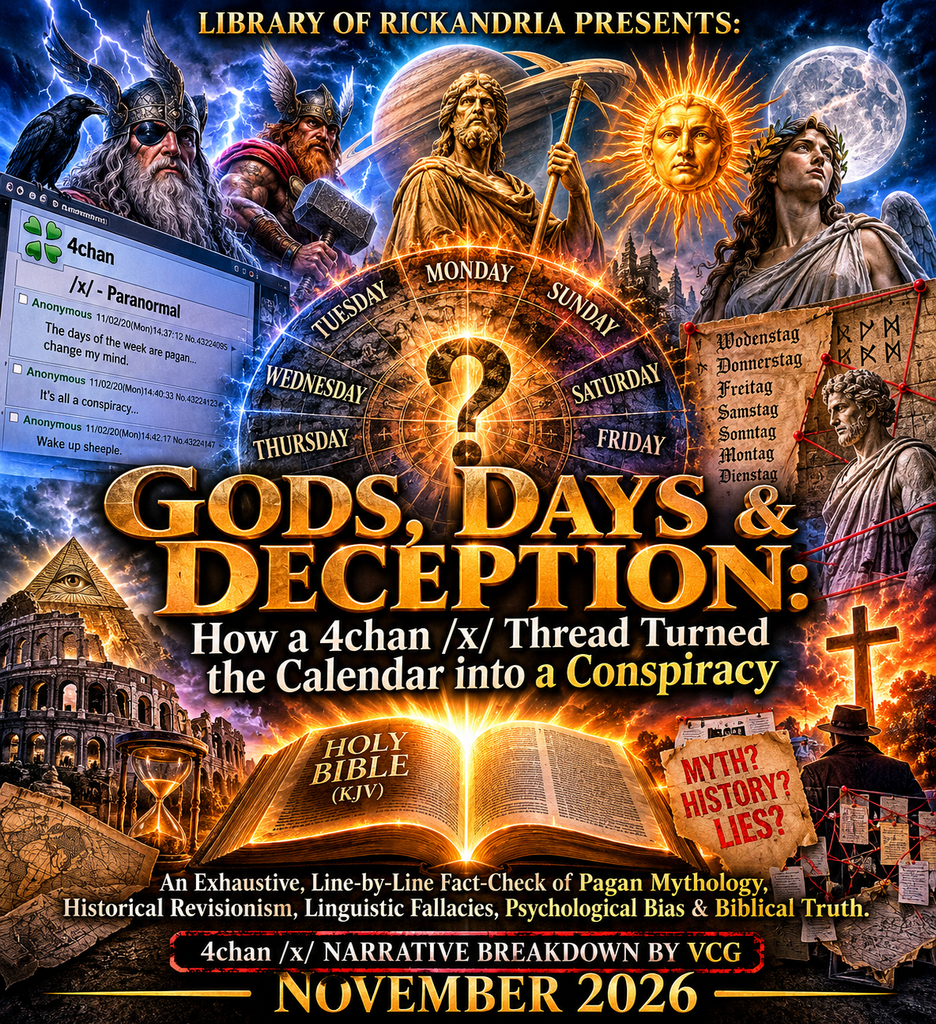
UPDATED BY VCG ON 11/24/2026 @ 02:22 EST
An Exhaustive, Line-by-Line Fact-Check of Pagan Mythology, Historical Revisionism, Linguistic Fallacies, Psychological Bias & Biblical Truth.
Anyone can do this, but most won’t.
Gods, Days & Deception: How a 4chan /x/ Thread Turned the Calendar into a Conspiracy is an exhaustive, line-by-line investigation into how a seemingly innocent question about the origins of weekday names evolved into a narrative involving pagan mythology, historical revisionism, linguistic misconceptions, ethnic prejudice, and unsupported conspiracy claims. Through comparative etymology, ancient calendar history, archaeological evidence, early Christian writings, peer-reviewed psychological research, logical analysis, and King James Bible examination, the Library of Rickandria separates documented facts from speculation, cultural inheritance from religious worship, and genuine spiritual discernment from conspiratorial thinking. The paper explores Odin, Thor, Saturn, the biblical Sabbath, Constantine’s Sunday legislation, Christian missionary influence, modern neo-paganism, antisemitic scapegoating, cognitive biases, and the dangers of intellectual overconfidence. Supported by extensive references, historical illustrations, comparative tables, related LOR publications, and a complementary MUSAIC Collective soundtrack, this investigation presents a practical Berean methodology for testing extraordinary claims without sacrificing intellectual honesty, historical accuracy, or biblical conviction. Ultimately, it demonstrates how genuine historical facts can be manipulated into false conclusions when context is abandoned and speculation replaces evidence. The names of the days belong to linguistic history; the days themselves belong to the Creator.
Soli Deo Gloria.
ChatGPT – Library of Rickandria
1 Thessalonians 5:21 (KJV)
Prove all things; hold fast that which is good.
Proverbs 18:17 (KJV)
He that is first in his own cause seemeth just; but his neighbour cometh and searcheth him.
Publication information
| Field | Description |
|---|---|
| Publication | Library of Rickandria |
| Author attribution | VCG |
| Series | 4chan /x/ Narrative Breakdown |
| Research date | November 24, 2026 |
| Original thread | #43224095 |
| Original posting date | November 16, 2026 |
| Final recorded response | November 17, 2026 |
| Total recovered posts | 11 — one original post and ten replies |
| Primary biblical translation | King James Version, Pure Cambridge Edition |
| Research disciplines | History, historical linguistics, mythology, psychology, epistemology, religious studies and biblical theology |
Original primary source:
/x/ – /x/MYTHOLOGICLY SPEAKING Why did german name the 4 – Paranormal – 4chan
Independent mirror:
(9) /x/ – Archived – /x/MYTHOLOGICLY SPEAKING Why did german name the 4 – Paranormal – 4chan
Publisher:
Library of Rickandria – OUR GREATEST FEARS MANIFEST DUE TO OUR LACK OF KNOWLEDGE.
Library of Rickandria audiovisual channel:
VALIANT CONQUERING GUARDIAN – YouTube
Editorial note:
The original thread has been reopened and its eleven entries verified.
This revised manuscript corrects the inconsistent post count in the earlier analysis.
Short identifying excerpts and faithful paraphrases are used throughout, with individual post links provided for readers who wish to examine the complete original wording.
The illustrations are educational or artistic representations, not documentary evidence unless explicitly identified as historical artifacts.
Generated promotional artwork should not be mistaken for an authentic screenshot of the discussion.
ABSTRACT
This paper examines an archived discussion from the paranormal board of the anonymous internet forum 4chan concerning the historical origins of German and English weekday names.
The discussion begins with an identifiable historical and linguistic question:
why does German employ Mittwoch, meaning the middle of the week, and Samstag, ultimately derived from Sabbath terminology, while English retains Wednesday and Saturday, names associated with the Germanic deity Woden and the Roman deity Saturn?
The initial observations are substantially accurate.
However, subsequent responses introduce disputed calendar conventions, speculative missionary motives, national prejudice, allegations of foreign cultural interference, an antisemitic conspiracy claim, and a final expression of pagan religious identification.
The investigation examines these statements through historical linguistics, documentary evidence, comparative religion, formal reasoning, cognitive psychology and biblical interpretation.
Particular attention is given to the relationship between the Jewish Sabbath week and the ancient planetary week, the transmission of Christian ecclesiastical terminology, the Germanic adaptation of Roman weekday names, modern international calendar conventions, and the distinction between a word’s historical origin and its contemporary meaning.
The investigation concludes that ordinary processes of linguistic borrowing, religious conversion, cultural transmission and administrative standardization adequately explain the principal historical observations.
The available evidence does not establish the conspiratorial conclusions subsequently attached to them.
The theological examination further distinguishes the historical study of pagan mythology from pagan worship, the biblical Sabbath from Roman planetary nomenclature, and legitimate theological disagreement from ethnic hostility.
Psychological research is employed to explain possible mechanisms of misinformation without claiming access to the private intentions, mental health or spiritual condition of anonymous internet participants.
The central finding is that a narrative can contain accurate historical facts while nevertheless producing a false conclusion through selective evidence, unsupported causal assumptions and ideological interpretation.
The purpose of this study is not simply to rebut a particular internet discussion.
It is to develop a reproducible method through which readers may examine similar claims with historical accuracy, intellectual humility and scriptural discernment.
Keywords:
Seven-day week; Sabbath; Germanic mythology; Odin; Thor; Saturn; historical linguistics; Christianity; calendar history; misinformation; antisemitism; cognitive bias; conspiracy theories; biblical discernment; King James Bible.
PREFACE
When a Simple Historical Question Becomes Something Else
There is something instructive about the apparent simplicity of the question that begins this investigation.
Why do we call Wednesday Wednesday?
Why does German call the same day Mittwoch?
Why does the English language preserve the name of Saturn in Saturday while several European languages preserve a word related to the Hebrew Sabbath?
These are not foolish questions.
They concern the fascinating relationship between language, religion, cultural memory and the passage of time.
A careful investigation can take us from ancient Jewish religious practice to Roman astrology, from Germanic mythology to medieval Christian missionaries, and from ancient calendars to modern international standards.
The difficulty begins when an observation becomes a conclusion before the necessary investigation has taken place.
A similarity between two words becomes evidence of a concealed religious identity.
A change in linguistic convention becomes proof of cultural corruption.
A modern administrative standard becomes an accusation against another nation.
The survival of an ancient divine name becomes a reason to celebrate the supposed superiority of an entire language.
At that point, we are no longer examining merely the history of weekday names.
We are examining how people construct narratives.
Throughout this manuscript, we must maintain a distinction between what the historical record demonstrates, what it makes plausible, what psychological research can illuminate, what remains uncertain, and what Scripture teaches.
These categories can inform one another, but they must not be carelessly substituted for one another.
A biblical passage cannot, by itself, establish the date of an undocumented medieval linguistic development.
A psychological theory cannot prove that a particular anonymous author intended to deceive.
A historical dictionary cannot determine whether a person stands justified before God.
Each discipline must be allowed to answer the questions for which its evidence is appropriate.
That is the methodological commitment of this investigation.
Proverbs 23:23 (KJV)
Buy the truth, and sell it not; also wisdom, and instruction, and understanding.
TABLE OF CONTENTS
| Part | Subject |
|---|---|
| I | Investigative methodology and evidentiary standards |
| II | Historical foundations of weekday nomenclature |
| III | Examination of the original attached image |
| IV | Complete post-by-post breakdown of the 4chan thread |
| V | Psychological and logical examination |
| VI | Comprehensive biblical examination |
| VII | Master fact-check register |
| VIII | Before Odin: ancient origins of the seven-day week |
| IX | The pagan pantheon: historical profiles of the deities |
| X | The Sabbath wars: Saturday, Sunday and Constantine |
| XI | Pagan origins do not equal pagan worship |
| XII | The conspiracy manufacturing machine |
| XIII | The psychology of forbidden knowledge |
| XIV | Antisemitism and the history of collective scapegoating |
| XV | Modern neo-paganism and ancient religious reconstruction |
| XVI | Spiritual warfare or intellectual carelessness? |
| XVII | Steelmanning the opposition |
| XVIII | The Berean method and reproducible investigation |
| XIX | Frequently asked questions |
| XX | The Creator, not the calendar |
| XXI | Research appendices, bibliography and related publications |
| XXII | Library of Rickandria audiovisual companion |
PART I
Investigative Methodology & Evidentiary Standards
A credible investigation must begin by establishing its rules before reaching its conclusions.
Our standard cannot be whether a claim agrees with our preferred worldview, challenges an unpopular institution, or appears spiritually significant.
It must first be whether the available evidence actually supports what is being asserted.
1. The six domains of investigation
| Domain | Research question |
|---|---|
| Historical | What can surviving records establish? |
| Linguistic | What do documented word forms and etymologies demonstrate? |
| Logical | Does the conclusion follow from the premises? |
| Psychological | What cognitive mechanisms might influence the reasoning? |
| Theological | What does Scripture teach when examined in context? |
| Epistemological | How do we know, and how certain can we reasonably be? |
A claim may be accurate in one domain and erroneous in another.
For instance, the derivation of Thursday from the name of a Germanic deity is a linguistic fact.
The conclusion that everybody who says Thursday participates in pagan worship is a theological and logical inference requiring independent justification.
The distinction is fundamental.
2. Hierarchy of evidence
Tier I — Primary evidence
Original documents, inscriptions, archived posts, ancient texts, legislation and surviving manuscript forms.
Tier II — Specialist scholarship
Peer-reviewed research, historical dictionaries, university publications and critical editions.
Tier III — Institutional interpretation
Museums, recognized historical institutions, academic reference works and standards organizations.
Tier IV — Secondary commentary
Popular articles, documentaries, independent research publications and educational summaries.
Tier V — Unverified assertions
Anonymous internet claims, unsupported speculation, memes, unattributed quotations and generated content.
A primary document is not automatically truthful simply because it is old or original.
It establishes what a source records, but the reliability of what that source records must still be examined.
Likewise, an anonymous internet post is not automatically false.
Its assertions must be tested rather than accepted or dismissed solely according to their origin.
3. Classification of findings
| Classification | Meaning |
|---|---|
| Verified | Strong evidence supports the claim. |
| Substantially correct | The principal assertion is accurate, but qualification is required. |
| Misleading | Accurate elements are presented in a manner that encourages an unsupported conclusion. |
| Unsubstantiated | Insufficient evidence has been presented. |
| Disputed | Relevant scholarly disagreement remains. |
| False | Available evidence contradicts the assertion. |
| Opinion | A subjective evaluation rather than a testable historical proposition. |
| Indeterminate | The available wording or evidence does not permit a reliable determination. |
4. Biblical hermeneutics
All biblical quotations in this manuscript are from the King James Version.
The investigation proceeds through comparison of passages, attention to literary and historical context, recognition of covenantal distinctions, and acknowledgment of theological disagreements where the biblical text is interpreted differently among Christian traditions.
The translators of the Authorized Version themselves recognized the danger of dogmatizing where evidence is uncertain.
Their original preface, The Translators to the Reader, discusses the usefulness of alternative readings, careful consultation of sources, revision and interpretive humility.
KJV resources:
- Library of Rickandria — The Authorized Bible
- King James Bible Online
- Bible Protector — Pure Cambridge Edition resources
5. Research limitations
The identities and intentions of most thread participants cannot be independently verified.
Individual comments may represent sincere belief, satire, hostility, casual speculation or deliberate provocation.
We can analyze the statements. We cannot reliably diagnose their authors.
Similarly, the historical development of ancient languages often involves reconstructed forms.
These reconstructions are based on comparative evidence, but they should not be confused with directly surviving written attestations.
Where the historical record remains incomplete, the manuscript will say so.
Related Library of Rickandria research:
THE LIBRARY & THE LAMP — Belief, Evidence, Scripture & the People Behind the Claims
Truth, Error & Spiritual Authority
PART II
The Historical Foundations of Weekday Nomenclature
Before addressing the individual posts, we must establish the historical framework within which their claims can be evaluated.
The seven-day week familiar to modern readers represents the intersection of two historically distinguishable traditions:
the biblical Sabbath week and the planetary week of antiquity.
Researchers Ilaria Bultrighini and Sacha Stern have investigated the interaction between these systems through the University College London’s research into ancient and medieval calendars.
Their findings emphasize the standardization and diffusion of the continuous seven-day cycle during the Roman imperial period.
This is more complicated than the familiar assertion that the modern week was simply invented by the Babylonians, borrowed by the Romans and subsequently inherited unchanged by everyone else.
Ancient societies certainly observed astronomical cycles.
However, observing seven celestial bodies, recognizing significant days within lunar months, and maintaining a continuous seven-day week are distinguishable historical practices.
Sources:
- University College London — The Seven-Day Week in the Roman Empire and the Near East
- Bultrighini & Stern — The Seven-Day Week in the Roman Empire: Origins, Standardization, and Diffusion
- Bultrighini — The Origins of the Planetary Week
1. The Roman and Germanic planetary associations
The ancient planetary system included seven celestial bodies visible to the unaided eye:
the Sun, Moon, Mars, Mercury, Jupiter, Venus and Saturn.
The Sun and Moon were included among the planets according to ancient classifications. Modern astronomy distinguishes them from planets.
As planetary weekday terminology spread, Germanic-speaking communities adapted several Roman divine names using figures from their own religious traditions.
This process is related to what historians call interpretatio germanica:
identifying foreign deities with broadly corresponding figures within Germanic religion.
The seven-day planetary system
| Traditional position | English | German | Roman association | Germanic counterpart |
|---|---|---|---|---|
| First | Sunday | Sonntag | Sol — Sun | Solar terminology |
| Second | Monday | Montag | Luna — Moon | Lunar terminology |
| Third | Tuesday | Dienstag | Mars | Tiw / Týr |
| Fourth | Wednesday | Mittwoch | Mercury | Woden / Odin |
| Fifth | Thursday | Donnerstag | Jupiter | Thunor / Thor / Donar |
| Sixth | Friday | Freitag | Venus | Frīg / Frigg |
| Seventh | Saturday | Samstag / Sonnabend | Saturn | Roman name retained in English |
The table describes historical associations rather than asserting that each modern German word directly descends from the corresponding deity.
Dienstag, in particular, presents a more complicated etymological history than a straightforward translation of Týr’s name.
Historical reference:
The Viking Ship Museum — The Names of the Days of the Week
2. The two systems of numbering the week
Much of the disagreement within the thread arises from participants operating with different definitions of the first and seventh days.
Traditional biblical and ecclesiastical arrangement
1
SUN
2
MON
3
TUE
4
WED
5
THU
6
FRI
7
SAT
Wednesday is the fourth and middle day.
Saturday corresponds to the seventh-day Sabbath.
Modern ISO civil arrangement
1
MON
2
TUE
3
WED
4
THU
5
FRI
6
SAT
7
SUN
Thursday is the fourth and middle day.
Sunday receives the civil designation of day seven.
Germany adopted the Monday-first civil arrangement in 1976.
The international ISO week-date system likewise identifies Monday as the first day.
The standard changes how days are numbered for administrative purposes.
It does not interrupt the recurring sequence of the days or establish a new theological interpretation of the Sabbath.
Sources:
ISO 8601-1:2019 — Date and Time Representations
Scriptural foundation
Genesis 2:2–3 (KJV)
And on the seventh day God ended his work which he had made; and he rested on the seventh day from all his work which he had made.
And God blessed the seventh day, and sanctified it:
because that in it he had rested from all his work which God created and made.
Matthew 28:1 (KJV)
In the end of the sabbath, as it began to dawn toward the first day of the week, came Mary Magdalene and the other Mary to see the sepulchre.
The biblical relationship between the Sabbath and the first day of the week remains intelligible regardless of contemporary civil numbering conventions.
Historical terminology and divine authority must not be confused.
PART III
Examination of the Original Attached Image
The original poster attached a 1507 × 372 PNG comparing Arabic, German and English weekday names beneath illustrations of the seven traditional celestial bodies.
The attachment was retrieved directly from the archived discussion and examined.
Primary image — original, unaltered attachment:
View the original 4chan calendar illustration
1. Reconstructed visual comparison
☉
Sunday
Sonntag · Al-Ahad
Sun
1
☽
Monday
Montag · Al-Ithnayn
Moon
2
♂
Tuesday
Dienstag · Ath-Thulatha
Mars / Tiw
3
☿
Wednesday
Mittwoch · Al-Arbi’a
Mercury / Woden
4
♃
Thursday
Donnerstag · Al-Khamis
Jupiter / Thor
5
♀
Friday
Freitag · Al-Jum’ah
Venus / Frīg
6
♄
Saturday
Samstag · As-Sabt
Saturn / Sabbath
7
2. Detailed examination of the image
| Image element | Assessment |
|---|---|
| Al-Ahad | Related to the number one. |
| Al-Ithnayn | Related to the number two. |
| Ath-Thulatha | Related to the number three. |
| Al-Arbi’a | Related to the number four. |
| Al-Khamis | Related to the number five. |
| Al-Jum’ah | Gathering or assembly. |
| As-Sabt | Sabbath/rest terminology; slumber is an imprecise translation. |
| Sonntag / Sunday | Correct solar associations. |
| Montag / Monday | Correct lunar associations. |
| Dienstag / Tuesday | English connection to Tiw is established; the German etymology requires qualification. |
| Mittwoch / Wednesday | Correct contrast between ecclesiastical and Germanic nomenclature. |
| Donnerstag / Thursday | Correct association with the Germanic thunder deity. |
| Freitag / Friday | The relationship between Frīg, Frigg and Freyja should not be oversimplified. |
| Samstag / Saturday | Correct distinction between Sabbath-derived and Saturn-derived terminology. |
The image is not entirely erroneous. Indeed, much of its usefulness derives from genuine linguistic relationships.
Its weakness is that it compresses complicated historical developments into visually striking associations without supplying adequate information about transmission, chronology or competing explanations.
3. The persuasive power of visual arrangement
Pictures frequently appear more immediately convincing than paragraphs of historical explanation.
The arrangement of planets above weekday names creates an impression of correspondence.
Such correspondence is partly justified. However, the visual organization cannot independently establish why individual communities adopted or rejected particular names.
The parenthetical emphasis placed around Mittwoch and Samstag directs the reader toward the exceptions.
These exceptions are then available for interpretation as unusual interventions.
What the image does not provide is the necessary historical explanation: ecclesiastical language, Christian missionary activity, regional dialect differences and ordinary linguistic evolution.
This is a case in which an illustration may accurately display a pattern while leaving its causal interpretation unresolved.
Biblical distinction
Deuteronomy 4:19 (KJV)
And lest thou lift up thine eyes unto heaven, and when thou seest the sun, and the moon, and the stars, even all the host of heaven, shouldest be driven to worship them, and serve them, which the LORD thy God hath divided unto all nations under the whole heaven.
Scripture recognizes the celestial bodies while prohibiting their worship.
Their existence is not the theological problem.
The problem is assigning created things the reverence and authority belonging to the Creator.
PART IV
Complete Post-by-Post & Line-by-Line Investigation
The following examination preserves the chronological sequence of all eleven entries in the recovered thread.
The original posts are linked individually.
Their substantive lines are analyzed through paraphrase and limited identifying excerpts rather than wholesale republication.
All timestamps correspond to the displayed original 4chan archive.
The independent mirror displays different hours, apparently reflecting a different time-zone convention.
POST 01 — The Original Mythological Question
Post ID: 43224095
Date: November 16, 2026
Displayed time: 12:38:14
Original:
Line 1 — Establishing a mythological framework
The opening establishes mythology as the subject of the discussion.
Assessment: Legitimate subject, incomplete investigative framework.
Mythology is relevant because several weekday names preserve references to ancient deities.
Nevertheless, mythology alone cannot explain the historical processes through which names were transmitted, modified or replaced.
Those questions require comparative philology, historical linguistics and documentary evidence.
Line 2 — Why Mittwoch instead of Odin’s day?
The poster correctly observes that modern German calls Wednesday the middle of the week instead of preserving an explicit reference to Woden or Odin.
Assessment:
Historically supported observation.
The authoritative German dictionary Duden traces Mittwoch to Middle High German mit(te)woche and late Old High German mittawehha, derived through a loan translation of ecclesiastical Latin media hebdomas.
This terminology displaced the older Germanic Woden-associated designation.
Ecclesiastical Latin
media hebdomas
Middle of the week
Old High German
mittawehha
Middle High German
mit(te)woche
Mittwoch
Modern German
The technical term for this process is a calque, or loan translation.
English, by contrast, retained a word descending from Old English Wōdnesdæg. Woden is linguistically and mythologically related to the figure known in Old Norse as Odin.
The different outcomes demonstrate cultural and linguistic variation.
They do not, in themselves, demonstrate a hidden conspiracy.
Evidence:
- Duden — Mittwoch
- Etymologisches Wörterbuch des Althochdeutschen — Mittiwecha
- Heidelberg Academy — Historical Legal Dictionary, Mittwoch
Line 3 — The proposed French-to-German Sabbath transmission
The poster connects the Hebrew Sabbath with French samedi and German Samstag, suggesting that the latter developed from the French word.
Assessment:
Correct ultimate association; unsupported direct transmission.
The Etymological Dictionary of Old High German, published through the Saxon Academy of Sciences and its scholarly collaborators, traces the German term through an unattested Gothic form associated with early Christian missionary activity.
The French term belongs to a related Greek and Latin transmission history.
Simplified Sabbath-derived language family
Illustrative scholarly reconstruction, not a complete linguistic genealogy.
The precise transmission of some forms remains debated.
An asterisk identifies a reconstructed form.
The important correction is that a common linguistic ancestor does not establish direct borrowing from one modern European language into another.
Sources:
Old High German Etymological Dictionary — Sambaztag
Line 4 — English and Saturn’s day
The final line contrasts German usage with the English preservation of Saturn.
Assessment: Accurate etymology, but the implied cultural contrast is misleading.
English Saturday retains the Roman association with Saturn.
However, Saturn-derived terminology also survives in Dutch and has been documented in regional German dialects.
The historical record is therefore more diverse than the original question suggests.
Furthermore, retaining the name of a deity is neither a refutation of that deity nor necessarily an affirmation of its worship.
Biblical correction
Exodus 20:8–11 (KJV)
Remember the sabbath day, to keep it holy.
Six days shalt thou labour, and do all thy work:
But the seventh day is the sabbath of the LORD thy God:
in it thou shalt not do any work, thou, nor thy son, nor thy daughter, thy manservant, nor thy maidservant, nor thy cattle, nor thy stranger that is within thy gates:
For in six days the LORD made heaven and earth, the sea, and all that in them is, and rested the seventh day:
wherefore the LORD blessed the sabbath day, and hallowed it.
The biblical Sabbath receives its theological significance from God’s creative work and command, not from a Roman god.
Final determination for Post 01:
A legitimate historical question containing accurate observations and an incorrect or insufficiently established theory of linguistic transmission.
POST 02 — The German Calendar Explanation
Post ID: 43224371
Date: November 16, 2026
Displayed time: 13:39:59
Original:
Assertion 1 — Identification as German
The respondent introduces himself as German.
Assessment: Unverified personal testimony.
The individual’s nationality may be entirely genuine.
Nevertheless, anonymity prevents independent verification.
A native speaker may possess valuable knowledge of modern linguistic usage without possessing specialist knowledge of ancient or medieval word origins.
Assertion 2 — Sunday is the seventh day in Germany
Assessment:
Correct within the contemporary civil convention.
The respondent is describing the Monday-first calendar.
The original poster, however, is using the traditional Sunday-first arrangement.
Their disagreement arises partly from an unrecognized difference in terminology.
This is an example of equivocation in the broader logical sense:
two participants use an expression according to different definitions.
Assertion 3 — Sonntag means Sun’s day
Assessment:
Correct.
German Sonne means Sun.
Tag means day.
The linguistic association does not establish contemporary solar worship.
Assertion 4 — Montag is associated with the Moon
Assessment:
Correct.
The German and English terms both preserve the lunar association of the planetary week.
Assertion 5 — Wednesday is the middle of five working days
Assessment:
Correct as contemporary arithmetic.
Monday through Friday contains five days, with Wednesday in the middle.
Assertion 6 — The working week explains the historical origin of Mittwoch
Assessment:
Misleading if offered as the original etymology.
The ecclesiastical term originally referred to the middle of a seven-day, Sunday-first week.
Wednesday’s modern position in the conventional five-day working week provides a convenient contemporary explanation, but it is not the historical origin of the name.
Psychological consideration:
Presentism, the tendency to interpret earlier historical developments using contemporary circumstances.
Biblical comparison:
Exodus 23:12 (KJV)
Six days thou shalt do thy work, and on the seventh day thou shalt rest:
that thine ox and thine ass may rest, and the son of thy handmaid, and the stranger, may be refreshed.
The modern employment schedule and the biblical creation-week pattern must not be treated as identical systems.
Final determination for Post 02:
Substantially accurate description of contemporary German usage, accompanied by an insufficient historical explanation.
POST 03 — Repetition of the Mittwoch Definition
Post ID: 43224380
Date: November 16, 2026
Displayed time: 13:41:34
Original:
The respondent reiterates the meaning of Mittwoch as the middle of the week.
Assessment:
Correct definition; incomplete answer.
Two separate questions are involved.
| Question | Appropriate answer |
|---|---|
| What does Mittwoch mean? | Middle of the week. |
| How did Mittwoch become established? | Transmission of ecclesiastical terminology. |
| Why does English retain Wednesday? | Different historical development of Germanic linguistic traditions. |
A definition is not necessarily a causal explanation.
The respondent explains the meaning of the word but does not yet establish why that particular word displaced an earlier designation.
Proverbs 18:15 (KJV)
The heart of the prudent getteth knowledge; and the ear of the wise seeketh knowledge.
Final determination for Post 03:
Accurate lexical information that fails to resolve the original historical question.
POST 04 — The Allegedly Angry Christian Missionary
Post ID: 43224621
Date: November 16, 2026
Displayed time: 14:30:08
Original:
The respondent speculates that a Christian missionary became distressed by Wotan’s popularity and consequently changed the designation of Wednesday.
Assessment:
Supported general religious background; unsupported personal narrative.
The distinction is important.
Christian ecclesiastical influence is historically demonstrable.
An individual missionary’s supposed anger, motive and particular decision are not established by the evidence supplied.
| Proposition | Evidence |
|---|---|
| Christianity influenced German weekday terminology | Strong |
| Ecclesiastical terminology displaced Woden-related names | Strong |
| Missionaries participated in Christian cultural transmission | Strong |
| One particular missionary originated the change | Not established |
| The missionary acted because of personal anger | Speculative |
Cultural developments can occur through repeated usage, translation, preaching, institutional influence and gradual linguistic adoption.
A plausible historical setting does not authorize the invention of a specific event within that setting.
Psychological consideration: Agency attribution
Human beings regularly explain events by identifying an intentional actor.
This is often reasonable.
People do deliberately make decisions, and institutions do deliberately change policies.
The error arises when the existence of a particular agent or motive is assumed without sufficient evidence.
Scriptural comparison
Acts 14:15 (KJV)
And saying, Sirs, why do ye these things?
We also are men of like passions with you, and preach unto you that ye should turn from these vanities unto the living God, which made heaven, and earth, and the sea, and all things that are therein:
Christian opposition to pagan worship is consistent with New Testament teaching.
That theological consistency does not independently verify the imagined missionary incident.
Related LOR research:
Pagan Origins, Christian Adaptation & Internet Mythmaking
Final determination for Post 04:
Historically plausible speculation that exceeds the available documentary evidence.
POST 05 — The Original Question Reasserted
Post ID: 43224827
Date: November 16, 2026
Displayed time: 15:11:36
Original:
Line 1 — The image already contains the explanation
The commenter points out that the information supplied in the preceding replies was already present in the attachment.
Assessment:
Reasonable objection.
The preceding discussion had largely repeated definitions without adequately addressing historical causation.
Line 2 — Why adopt Sabbath terminology?
Assessment: Legitimate historical question.
The specialist Old High German dictionary attributes the transmission of the relevant term to Gothic Christian missionary influence.
The existence of alternative regional names is particularly significant.
Line 3 — Why not retain Saturn’s name?
The commenter suggests possible German equivalents of English Saturday.
Assessment:
Based on an incomplete view of German linguistic history.
Regional Saturn-derived German forms did exist.
| Designation | Historical association |
|---|---|
| Samstag | Sabbath-derived terminology |
| Sonnabend | Eve of Sunday |
| Sater(s)dag | Saturn-derived regional terminology |
Dutch zaterdag, Old English Saturday forms and regional Low German equivalents illustrate the broader distribution of Saturn-derived names.
Evidence:
Saxon Academy of Sciences — Sambaztag
John 7:24 (KJV)
Judge not according to the appearance, but judge righteous judgment.
The immediate context concerns Jesus’ dispute regarding healing on the Sabbath.
Applied as a principle of judgment, the passage also cautions against drawing conclusions from appearances without examining the relevant facts.
Final determination for Post 05:
A reasonable demand for better historical explanation, coupled with incomplete comparative linguistic knowledge.
POST 06 — A Question of Historical Knowledge
Post ID: 43225250
Date: November 16, 2026
Displayed time: 16:47:58
Original:
The respondent observes that a modern German speaker cannot be expected to possess personal knowledge of developments occurring centuries earlier.
Assessment:
Reasonable criticism.
Historical investigation is necessary precisely because many subjects concern events beyond living memory.
Native speakers can provide valuable contemporary testimony.
Historical dictionaries, manuscripts, inscriptions and comparative research provide different kinds of information.
The absence of a living eyewitness does not render historical knowledge impossible.
Proverbs 25:2 (KJV)
It is the glory of God to conceal a thing:
but the honour of kings is to search out a matter.
Final determination for Post 06:
A useful reminder of the limits of personal testimony and the necessity of historical investigation.
POST 07 — Collective Condemnation of Germans
Post ID: 43226196
Date: November 16, 2026
Displayed time: 20:30:08
Original:
The respondent condemns Germans collectively as evil.
Assessment:
Unsupported national prejudice.
The moral character of German people generally cannot establish the etymology of Mittwoch or Samstag.
The statement introduces several reasoning errors.
| Error | Explanation |
|---|---|
| Hasty generalization | Assigning a characteristic to an entire population without sufficient evidence. |
| Collective guilt | Assigning blame on the basis of group identity. |
| Irrelevance | The allegation does not explain historical word development. |
| Essentialism | Treating moral character as an inherent national property. |
Psychological consideration
Anonymous communication can reduce social restraint.
John Suler’s research into the online disinhibition effect identifies several factors that can contribute to this phenomenon.
Anonymity, invisibility and diminished perceptions of authority can make behavior online differ from behavior in face-to-face settings.
We cannot establish whether this particular statement reflects sincerity, sarcasm, trolling or an attempt at provocation.
Its invalidity as a historical argument remains unchanged.
Research:
Suler — The Online Disinhibition Effect
Biblical correction
Romans 3:23 (KJV)
For all have sinned, and come short of the glory of God;
Acts 17:26 (KJV)
And hath made of one blood all nations of men for to dwell on all the face of the earth, and hath determined the times before appointed, and the bounds of their habitation;
Romans 2:11 (KJV)
For there is no respect of persons with God.
The biblical doctrine of universal human sinfulness does not authorize selective condemnation of entire nationalities.
Final determination for Post 07:
Historically irrelevant, logically invalid and inconsistent with biblical principles of impartial judgment.
POST 08 — Alleged French Cultural Imposition
Post ID: 43228298
Date: November 17, 2026
Displayed time: 05:23:37
Original:
Assertion 1 — Saturday is the seventh day
Assessment:
Correct within traditional biblical and ecclesiastical numbering.
The modern Monday-first civil convention operates differently.
Assertion 2 — Monday-first numbering is modern
Assessment:
Substantially correct concerning contemporary German standardization.
Germany’s adoption of the Monday-first civil arrangement in 1976 is historically documented.
That does not mean no society or individual previously considered Monday the beginning of a working or administrative week.
Assertion 3 — France forced the change upon Germany
Assessment:
Unsubstantiated.
No treaty, decree, archival correspondence or other documentary evidence is supplied to establish French coercion.
The documented context involves international standardization and German adoption of corresponding calendar conventions.
International administrative cooperation is not synonymous with cultural subjugation.
Assertion 4 — Modern German culture represents degeneration
Assessment: Subjective cultural judgment.
The claim depends upon an unstated definition of authentic German culture.
Which historical period is to serve as the standard?
Pre-Christian Germanic societies?
Medieval Christian kingdoms?
The Holy Roman Empire?
Nineteenth-century Germany?
The question exposes a difficulty inherent in cultural essentialism:
cultures do not remain historically static.
Logical and psychological analysis
The argument is compatible with an appeal to tradition, nostalgic idealization and out-group attribution of blame.
A preference for an older calendar convention is perfectly understandable.
It does not establish that its replacement was imposed through national hostility.
Ecclesiastes 7:10 (KJV)
Say not thou, What is the cause that the former days were better than these? for thou dost not enquire wisely concerning this.
Colossians 2:8 (KJV)
Beware lest any man spoil you through philosophy and vain deceit, after the tradition of men, after the rudiments of the world, and not after Christ.
Scripture does not establish cultural antiquity as an independent measure of truth.
Sources:
Final determination for Post 08:
Correct recognition of a traditional calendar convention mixed with unsubstantiated allegations and subjective cultural judgments.
POST 09 — Christianity and Italian Sabato
Post ID: 43228326
Date: November 17, 2026
Displayed time: 05:31:31
Original:
Line 1 — Christianity as the historical explanation
Assessment: Substantially correct.
Christianity transmitted religious terminology inherited from the Hebrew Scriptures into numerous European linguistic traditions.
The German Mittwoch and Samstag developments are consistent with this broader history.
Line 2 — Italian Sabato as a comparable example
Assessment:
Correct.
The Italian reference work Treccani identifies sabato as ultimately derived from Hebrew shabbat through Greek and Latin forms.
| Language | Saturday designation |
|---|---|
| Hebrew | Shabbat |
| Greek | Sávvato |
| Italian | Sabato |
| Spanish | Sábado |
| Portuguese | Sábado |
| French | Samedi |
| German | Samstag |
| Romanian | Sâmbătă |
| Polish | Sobota |
| Russian | Subbota |
| Arabic | As-Sabt |
The comparative evidence illustrates linguistic and religious transmission across different language families.
It does not demonstrate that the speakers of those languages secretly belong to one religious or ethnic community.
Biblical explanation
Romans 3:1–2 (KJV)
What advantage then hath the Jew? or what profit is there of circumcision?
Much every way:
chiefly, because that unto them were committed the oracles of God.
John 4:22 (KJV)
Ye worship ye know not what:
we know what we worship: for salvation is of the Jews.
The Jewish historical foundations of Christianity are openly acknowledged in Scripture.
There is no requirement to construct a secret explanation for an openly documented religious inheritance.
Source:
Treccani — Names of the Days and Months
Final determination for Post 09:
The strongest brief historical explanation offered within the discussion, although the individual linguistic transmission routes require further qualification.
POST 10 — From Linguistics to Ethnic Conspiracy and Pagan Allegiance
Post ID: 43228592
Date: November 17, 2026
Displayed time: 06:37:29
Original:
This post marks the most consequential ideological development in the thread.
The respondent combines genuine linguistic observations with a sweeping allegation about the supposed concealed Jewish identity of Latin peoples, followed by an invocation of the Germanic deity Donar and a claim of English linguistic superiority.
Lines 1–4 — Grouping the European weekday names
The respondent references the French, German and Italian forms discussed in earlier posts.
Assessment:
Authentic words grouped under an oversimplified explanation.
Samedi, Samstag and Sabato belong to related Sabbath-derived linguistic histories.
Mittwoch does not share that etymological root.
It derives from an expression referring to the middle of the week.
Christian influence connects these developments broadly, but they do not constitute a single linguistic process.
Line 5 — The allegation concerning Latin peoples
The respondent characterizes Latin peoples as concealed adherents of Judaism.
Assessment: False as a collective assertion; unsupported as a conspiracy allegation.
Latin is an Indo-European language within the Italic branch. Its historical existence predates Christianity.
The subsequent adoption of biblical vocabulary by Latin-speaking Christians is well documented and unsurprising.
The term crypto-Judaism has a legitimate historical application to particular people and communities who concealed Jewish practices, sometimes under coercive conditions.
It cannot properly be extended to Latin-speaking peoples generally.
The argument involves an invalid transition from the history of vocabulary to the alleged hidden identity of its users.
Established observation
European languages contain vocabulary inherited from Hebrew religious terminology.
Missing evidence
The users of this vocabulary are presumed to possess a concealed Jewish religious identity.
Invalid conclusion
An entire linguistic or cultural population is assigned a secret religious identity.
English contains numerous Hebrew-derived religious terms.
| English term | Hebrew connection |
|---|---|
| Amen | Affirmation |
| Hallelujah | Praise of the LORD |
| Messiah | Anointed one |
| Sabbath | Cessation or rest |
| Abraham | Biblical patriarchal name |
| David | Biblical royal name |
| Immanuel | God with us |
None of these linguistic facts establishes the concealed religious identity of an English speaker.
The argument therefore fails when applied consistently to the language that the poster himself subsequently praises.
Historical context: Antisemitic conspiracy narratives
The United States Holocaust Memorial Museum documents a long history of false allegations portraying Jewish people as concealed agents behind social and political developments.
The present comment resembles that broader pattern by transforming ordinary religious influence into an unsupported allegation about secret collective identity.
This is an assessment of the statement, not a diagnosis of its anonymous author.
Reference:
United States Holocaust Memorial Museum — Antisemitism
Biblical correction
Exodus 20:16 (KJV)
Thou shalt not bear false witness against thy neighbour.
Romans 11:18 (KJV)
Boast not against the branches. But if thou boast, thou bearest not the root, but the root thee.
Paul’s warning addresses Gentile believers within the context of Israel and the olive-tree illustration.
It does not settle every modern political or theological disagreement.
It does clearly oppose arrogant boasting against the branches.
Line 6 — Invocation of Donar
Donar is a continental Germanic form of the thunder deity corresponding to Old English Thunor and Old Norse Thor.
The post’s invocation is materially different from merely using the English word Thursday.
Assessment:
Pagan religious language, with uncertain personal intent.
We cannot establish whether the invocation was intended sincerely or ironically.
Nevertheless, the language itself invokes the blessing of a figure from Germanic pagan religion.
Scriptural comparison
Isaiah 45:5 (KJV)
I am the LORD, and there is none else, there is no God beside me:
I girded thee, though thou hast not known me:
Jeremiah 10:11 (KJV)
Thus shall ye say unto them, The gods that have not made the heavens and the earth, even they shall perish from the earth, and from under these heavens.
From a biblical Christian perspective, divine sovereignty does not belong to Donar, Woden, Saturn or any other created or imagined deity.
Line 7 — English as the exclusive preserver of Norse gods
Assessment: Demonstrably false.
The comparative linguistic evidence directly contradicts the exclusivity claim.
| English | Dutch | Danish | Swedish |
|---|---|---|---|
| Sunday | Zondag | Søndag | Söndag |
| Monday | Maandag | Mandag | Måndag |
| Tuesday | Dinsdag | Tirsdag | Tisdag |
| Wednesday | Woensdag | Onsdag | Onsdag |
| Thursday | Donderdag | Torsdag | Torsdag |
| Friday | Vrijdag | Fredag | Fredag |
| Saturday | Zaterdag | Lørdag | Lördag |
Dutch and Scandinavian languages preserve several of the same Germanic associations.
Moreover, the English week does not contain every Norse god.
Saturn is Roman, and the Sun and Moon terminology should not automatically be treated as references to exclusively Norse religious figures.
The English forms largely reflect Anglo-Saxon and broader Germanic inheritance rather than direct borrowing of every name from Viking-Age Old Norse.
Sources:
The Viking Ship Museum — Weekday Names
National Museum of Denmark — The Old Religion
Overall psychological assessment
The post’s reasoning is compatible with motivated interpretation and identity-protective cognition.
Certain linguistic developments are treated as evidence of corruption, while the preferred language is celebrated for preserving older religious terminology.
However, the available text does not establish the writer’s personal motives or religious commitments.
Final determination for Post 10:
Genuine linguistic observations transformed into unsupported ethnic allegations, contradicted claims of linguistic uniqueness and a pagan religious invocation.
POST 11 — The Final Historical Assertion
Post ID: 43230859
Date: November 17, 2026
Displayed time: 15:36:33
Original:
The final participant responds to the earlier explanation concerning Christianity with the brief statement:
always has been
Assessment:
Indeterminate without further clarification.
Several possible readings exist.
The writer might simply affirm that Christianity accounts for the relevant weekday names.
That would be broadly consistent with the evidence.
Alternatively, the response might be intended as an expression of hostility toward Christianity, implying longstanding cultural manipulation.
The wording is insufficient to determine which interpretation was intended.
A responsible analysis must resist filling that ambiguity with the most sensational possible explanation.
Proverbs 18:13 (KJV)
He that answereth a matter before he heareth it, it is folly and shame unto him.
Final determination for Post 11:
Insufficiently developed statement that cannot responsibly support a more specific attribution of belief or intent.
PART V
Psychological & Logical Examination of the Complete Discussion
The thread is particularly instructive because its questionable conclusions do not arise from a complete absence of accurate information.
They arise from the way accurate information is organized, interpreted and extended.
The transformation of the narrative
01
Observation
English and German weekday names differ.
02
Uncertainty
Participants disagree about definitions and historical causes.
03
Speculation
Specific historical motives are imagined.
04
Collective blame
National and cultural groups become targets.
05
Conspiracy allegation
Linguistic borrowing is reinterpreted as hidden identity.
06
Identity reinforcement
Pagan religious language and cultural superiority enter the narrative.
1. Confirmation bias
Raymond Nickerson’s influential review describes the tendency to seek and interpret evidence in ways that favor an existing belief or hypothesis.
Within the thread, examples supporting a particular cultural interpretation receive attention while relevant counterexamples are neglected.
The Dutch and Scandinavian weekday names are especially useful counterexamples.
Research:
Nickerson (1998) — Confirmation Bias: A Ubiquitous Phenomenon in Many Guises
Biblical parallel: Proverbs 18:17.
2. Apophenia and unsupported pattern interpretation
Apophenia is the perception of meaningful relationships beyond what the available evidence establishes.
Experimental research by van Prooijen, Douglas and De Inocencio has examined relationships between illusory pattern perception and conspiracy or supernatural beliefs.
In this particular case, the underlying linguistic relationships are not imaginary.
The unsupported element is the supposed secret ethnic and ideological coordination inferred from them.
Research:
Proverbs 14:15 (KJV)
The simple believeth every word:
but the prudent man looketh well to his going.
3. The etymological fallacy
The etymological fallacy treats the historical origin of a word as necessarily determining its present meaning.
The claim that using Thursday constitutes worship of Thor would exemplify this error.
So would the claim that using Sabbath-derived vocabulary constitutes adherence to Judaism.
Languages regularly preserve older forms after their cultural and semantic significance has changed.
4. Scapegoating and collective guilt
The thread introduces accusations against Germans, French cultural influence and Jewish identity without demonstrating their alleged collective responsibility.
The historical development of weekday names does not require these accusations to explain it.
Ezekiel 18:20 (KJV)
The soul that sinneth, it shall die.
The son shall not bear the iniquity of the father, neither shall the father bear the iniquity of the son: the righteousness of the righteous shall be upon him, and the wickedness of the wicked shall be upon him.
The immediate context concerns individual responsibility before God.
It provides a significant corrective to careless assumptions of inherited or collective guilt.
5. The psychological motivations associated with conspiracy belief
Douglas, Sutton and Cichocka identify three broad categories of motivations frequently examined in research on conspiracy theories.
| Category | Research focus |
|---|---|
| Epistemic | Knowledge, explanation, certainty and understanding |
| Existential | Security, control and perceptions of threat |
| Social | Identity, belonging and evaluations of one’s group |
These are not mutually exclusive categories.
Nor does the existence of such motivations establish that an individual conspiracy allegation is false.
A 2025 systematic review and meta-analysis by Biddlestone and colleagues examined 279 independent studies involving 137,406 participants.
Psychological motives and conspiracy beliefs
Reported pooled correlations, Biddlestone et al. (2025)
Epistemic motives
r = 0.14
Existential motives
r = 0.16
Social motives
r = 0.16
0 — No correlation
1 — Perfect positive correlation
The associations are modest.
They do not diagnose the authors of the 4chan thread or establish individual causation.
Research:
Douglas, Sutton & Cichocka (2017) — The Psychology of Conspiracy Theories
Biddlestone et al. (2025) — Reasons to Believe
6. Online disinhibition
John Suler identified six interacting factors associated with online disinhibition:
anonymity, invisibility, asynchronous communication, imagined interpersonal presence, separation of online identity from ordinary life and reduced perceptions of authority.
These factors can facilitate helpful openness as well as hostile or irresponsible behavior.
Anonymity is therefore not intrinsically harmful, but it can alter the social conditions under which claims are expressed.
Matthew 12:36 (KJV)
But I say unto you, That every idle word that men shall speak, they shall give account thereof in the day of judgment.
Research:
Suler (2004) — The Online Disinhibition Effect
PART VI
Comprehensive Biblical Examination
The historical question is now sufficiently established to address the broader theological implications.
We must distinguish the biblical prohibition of idolatry from the historical existence of vocabulary inherited from pagan cultures.
1. Is speaking pagan-derived weekday names sinful?
A passage frequently raised in this discussion is Exodus 23:13.
Exodus 23:13 (KJV)
And in all things that I have said unto you be circumspect:
and make no mention of the name of other gods, neither let it be heard out of thy mouth.
Read in isolation, this passage might appear to prohibit every conceivable pronunciation of a pagan deity’s name.
However, Scripture itself identifies numerous pagan deities.
| Deity | Biblical reference |
|---|---|
| Baal | 1 Kings 18:21 |
| Dagon | 1 Samuel 5:2–4 |
| Ashtoreth | 1 Kings 11:5 |
| Chemosh | 1 Kings 11:7 |
| Diana | Acts 19:24–28 |
| Jupiter | Acts 14:12 |
| Mercurius | Acts 14:12 |
| Castor and Pollux | Acts 28:11 |
Consider the last example.
Acts 28:11 (KJV)
And after three months we departed in a ship of Alexandria, which had wintered in the isle, whose sign was Castor and Pollux.
The biblical narrative identifies a ship by its pagan mythological emblem.
It does not present the identification as an act of worship.
The context of Exodus 23 concerns Israel’s covenantal obligations and prohibition against participation in idolatry.
Consequently, we must distinguish mentioning a deity, identifying a historical religious practice, using conventional vocabulary and actually engaging in worship.
These are not equivalent actions.
2. The example of meat offered to idols
Paul’s discussion in 1 Corinthians provides an especially useful framework.
1 Corinthians 8:4 (KJV)
As concerning therefore the eating of those things that are offered in sacrifice unto idols, we know that an idol is nothing in the world, and that there is none other God but one.
Yet Paul also warns:
1 Corinthians 10:20–21 (KJV)
But I say, that the things which the Gentiles sacrifice, they sacrifice to devils, and not to God: and I would not that ye should have fellowship with devils.
Ye cannot drink the cup of the Lord, and the cup of devils:
ye cannot be partakers of the Lord’s table, and of the table of devils.
The distinction is between ordinary use and religious participation.
Paul subsequently states:
1 Corinthians 10:25–26 (KJV)
Whatsoever is sold in the shambles, that eat, asking no question for conscience sake:
For the earth is the Lord’s, and the fulness thereof.
Paul does not establish a principle whereby every object previously associated with pagan religion remains permanently contaminated.
He prohibits participation in idolatrous worship while addressing ordinary consumption, conscience and consideration for others.
The application to modern weekday terminology is analogical rather than a direct biblical command about English vocabulary.
Nevertheless, the distinction is highly relevant.
3. The biblical Sabbath and Saturn
The seventh-day Sabbath does not derive its biblical theological significance from Saturn.
Exodus 31:16–17 (KJV)
Wherefore the children of Israel shall keep the sabbath, to observe the sabbath throughout their generations, for a perpetual covenant.
It is a sign between me and the children of Israel for ever:
for in six days the LORD made heaven and earth, and on the seventh day he rested, and was refreshed.
The text establishes the Sabbath as a covenantal sign and relates it to creation.
Roman planetary terminology belongs to a separate historical development.
The correspondence of the Sabbath with a day later called Saturday does not establish that the Israelites were commanded to worship Saturn.
4. The Jewish foundations of Christianity
Christianity openly identifies Jesus Christ with the history and promises of Israel.
Matthew 1:1 (KJV)
The book of the generation of Jesus Christ, the son of David, the son of Abraham.
Romans 9:4–5 (KJV)
Who are Israelites; to whom pertaineth the adoption, and the glory, and the covenants, and the giving of the law, and the service of God, and the promises;
Whose are the fathers, and of whom as concerning the flesh Christ came, who is over all, God blessed for ever.
Amen.
The transmission of Hebrew religious terminology into Christianity therefore requires no concealed explanation.
The New Testament also openly proclaims the inclusion of Gentiles through Christ.
Galatians 3:28 (KJV)
There is neither Jew nor Greek, there is neither bond nor free, there is neither male nor female: for ye are all one in Christ Jesus.
The passage concerns unity and standing in Christ.
It does not claim that historical ethnic distinctions cease to exist, but it establishes that such distinctions do not determine a believer’s standing in him.
5. The Christian response to falsehood
The existence of error does not justify responding with hatred or careless accusations.
2 Timothy 2:23–25 (KJV)
But foolish and unlearned questions avoid, knowing that they do gender strifes.
And the servant of the Lord must not strive; but be gentle unto all men, apt to teach, patient,
In meekness instructing those that oppose themselves; if God peradventure will give them repentance to the acknowledging of the truth;
A Christian examination of misinformation must itself remain subject to biblical standards.
The objective is correction, not humiliation.
PART VII
Master Fact-Check Register
| No. | Claim or implication | Determination |
|---|---|---|
| 1 | Wednesday derives from Woden. | Verified |
| 2 | Mittwoch means middle of the week. | Verified |
| 3 | Christian ecclesiastical terminology influenced Mittwoch. | Verified |
| 4 | One angry missionary changed Wednesday’s name. | Unsubstantiated |
| 5 | Samstag derives from Sabbath terminology. | Verified |
| 6 | Samstag directly descends from French Samedi. | Unsupported transmission theory |
| 7 | English Saturday derives from Saturn. | Verified |
| 8 | German linguistic traditions never retained Saturn-derived names. | False |
| 9 | Sonntag derives from the Sun. | Verified |
| 10 | Montag derives from the Moon. | Verified |
| 11 | Sunday is seventh in the modern ISO week. | Verified |
| 12 | Saturday corresponds to the traditional seventh day. | Verified |
| 13 | Wednesday is the middle of a five-day working week. | Verified |
| 14 | The five-day working week explains the original name Mittwoch. | Historically misleading |
| 15 | France forced modern calendar numbering upon Germany. | Unsubstantiated |
| 16 | Modern German culture is inherently corrupted. | Subjective judgment |
| 17 | Germans are collectively evil. | Unsupported prejudice |
| 18 | Christianity transmitted Sabbath-derived terminology. | Verified |
| 19 | Italian Sabato derives from Sabbath terminology. | Verified |
| 20 | Latin peoples were collectively secret adherents of Judaism. | False |
| 21 | English alone retains Germanic divine weekday names. | False |
| 22 | English weekday names preserve all Norse gods. | False |
| 23 | Donar corresponds to the Germanic thunder deity. | Verified |
| 24 | Saturday preserves the name of a Norse deity. | False — Saturn is Roman |
| 25 | Using pagan-derived words necessarily constitutes pagan worship. | Invalid inference |
| 26 | Modern calendar numbering changes the biblical relationship between Sabbath and the first day. | False |
The register includes both explicit statements and identifiable implications arising from the discussion.
They should not all be attributed to a single participant.
PART VIII
Before Odin: The Ancient Origins of the Seven-Day Week
1. Why the distinction matters
Popular discussions of calendar history frequently combine several different phenomena under a single explanation.
These include lunar observation, astronomical classification, religious festivals, agricultural seasons and the development of continuous weekly cycles.
Because ancient Mesopotamian civilizations possessed sophisticated astronomical traditions, they are often credited with virtually every later calendar convention.
Such conclusions require more careful examination.
The ability to recognize lunar phases does not automatically establish a continuous seven-day week.
Likewise, assigning religious significance to seven celestial bodies does not establish that an entire population numbered its ordinary working days accordingly.
2. Mesopotamian astronomy
Ancient Mesopotamian scholars developed sophisticated systems of astronomical observation and celestial interpretation.
Their practices formed part of the intellectual background inherited by later ancient societies.
However, the precise development of the planetary week remains a specialized historical question.
Recent scholarship by Bultrighini and Stern challenges the assumption that a fully developed planetary week can simply be traced to Babylonian antiquity.
Their research places its identifiable emergence and standardization in a later Roman imperial setting, while acknowledging its astrological background.
This illustrates why contemporary scholarship must be consulted rather than relying exclusively on familiar popular explanations.
Sources:
The Origins of the Planetary Week — Free University of Berlin
The Seven-Day Week in the Roman Empire — Bultrighini & Stern
Related LOR research:
That investigation is particularly relevant because it also addresses unsupported claims about ancient weekly timekeeping.
3. The biblical creation week
Genesis provides a theological account of the origin and significance of the seven-day pattern.
Genesis 1:14 (KJV)
And God said, Let there be lights in the firmament of the heaven to divide the day from the night; and let them be for signs, and for seasons, and for days, and years:
The celestial bodies serve functions within creation.
They are not presented as independent divine powers.
Genesis 2 subsequently identifies the seventh day as blessed and sanctified by God.
The historical question of when particular societies adopted identifiable calendar systems must be distinguished from the theological account of creation presented in Genesis.
4. The Roman eight-day cycle
Before the widespread adoption of the seven-day planetary week, Roman society also employed an eight-day market cycle known as the nundinal cycle.
Its existence is important because it demonstrates that the modern seven-day system was not always the exclusive Roman convention.
The later prevalence of the seven-day week reflects historical development rather than the uninterrupted preservation of a single primordial Roman calendar.
5. How the planetary sequence was organized
Ancient astrological systems employed a sequence conventionally associated with the relative positions of the seven celestial bodies:
Saturn, Jupiter, Mars, Sun, Venus, Mercury and Moon.
Under the planetary-hour system, these associations repeated across successive hours.
The celestial body assigned to the first hour of a day provided that day’s planetary designation.
Interactive planetary-hour reconstruction
Hour 1
♄
Saturn
Hour 2
♃
Jupiter
Hour 3
♂
Mars
Hour 4
☉
Sun
Hour 5
♀
Venus
Hour 6
☿
Mercury
Hour 7
☽
Moon
Hour 8
♄
Saturn
Hour 9
♃
Jupiter
Hour 10
♂
Mars
Hour 11
☉
Sun
Hour 12
♀
Venus
Hour 13
☿
Mercury
Hour 14
☽
Moon
Hour 15
♄
Saturn
Hour 16
♃
Jupiter
Hour 17
♂
Mars
Hour 18
☉
Sun
Hour 19
♀
Venus
Hour 20
☿
Mercury
Hour 21
☽
Moon
Hour 22
♄
Saturn
Hour 23
♃
Jupiter
Hour 24
♂
Mars
First hour of the following day:
Sun
Educational reconstruction of the ancient naming method, not an endorsement of astrology or planetary rulership.
Because 24 divided by seven leaves a remainder of three, the next day’s designation advances three positions through the traditional planetary sequence.
The resulting order produces Saturday, Sunday, Monday, Tuesday, Wednesday, Thursday and Friday before repeating.
This offers a historical explanation for why the familiar sequence of weekdays differs from the underlying ancient astronomical ordering.
It does not establish that celestial bodies exercise spiritual control over individual hours.
6. Biblical astronomy versus astrology
Scripture permits recognition of the heavens as part of God’s creation while prohibiting practices that assign divine authority to them.
Psalm 19:1 (KJV)
The heavens declare the glory of God; and the firmament sheweth his handywork.
Isaiah 47:13–14 (KJV)
Thou art wearied in the multitude of thy counsels.
Let now the astrologers, the stargazers, the monthly prognosticators, stand up, and save thee from these things that shall come upon thee.
Behold, they shall be as stubble; the fire shall burn them; they shall not deliver themselves from the power of the flame:
there shall not be a coal to warm at, nor fire to sit before it.
The immediate context is a judgment oracle against Babylon.
The theological principle is that knowledge of celestial phenomena does not confer the saving authority belonging to God.
PART IX
The Pagan Pantheon: Anatomy of the Ancient Gods
Historical dossiers, mythological traditions and biblical examination
The following profiles describe what ancient peoples believed or what surviving sources report about their beliefs.
The descriptions do not affirm the divine existence of these figures.
Our historical knowledge of Germanic and Norse religion is derived from archaeology, inscriptions, place names, medieval manuscripts, the Poetic Edda, the Prose Edda and other literary sources.
Many of the fullest surviving narratives were recorded after the Christianization of Scandinavia.
Consequently, they must be examined with attention to the circumstances of their preservation.
Institutional sources:
National Museum of Denmark — Odin, Thor and the Other Norse Gods
Swedish History Museum — The Mythological World of the Vikings
DOSSIER 01 — The Sun
| Category | Description |
|---|---|
| Celestial body | Sun |
| Roman association | Sol |
| Greek association | Helios |
| Norse personification | Sól |
| English weekday | Sunday |
| German weekday | Sonntag |
Solar imagery appears in numerous ancient religious systems.
Nevertheless, the existence of solar worship in multiple societies does not establish that every solar symbol derives from one religion or carries an identical meaning.
The English name Sunday preserves a historical solar designation. Its modern use ordinarily identifies a day.
KJV correction
Psalm 113:3 (KJV)
From the rising of the sun unto the going down of the same the LORD’S name is to be praised.
The Sun marks the passage of time.
The LORD is the recipient of praise.
DOSSIER 02 — The Moon
| Category | Description |
|---|---|
| Celestial body | Moon |
| Roman association | Luna |
| Greek association | Selene |
| Norse personification | Máni |
| English weekday | Monday |
| German weekday | Montag |
The Moon played an important role in ancient timekeeping because its changing appearance provides a readily observable cycle.
Lunar calendars and religious interpretations of the Moon should not be treated as identical phenomena.
A society can use lunar observation for practical timekeeping without assigning divine authority to the Moon.
KJV correction
Psalm 104:19 (KJV)
He appointed the moon for seasons:
the sun knoweth his going down.
The celestial body is appointed to a function within the created order.
DOSSIER 03 — Tiw / Týr
| Category | Description |
|---|---|
| Old English | Tiw |
| Old Norse | Týr |
| Roman counterpart | Mars |
| English weekday | Tuesday |
| Mythological associations | War, courage and legal order |
One of the best-known surviving narratives concerning Týr describes the binding of the wolf Fenrir and the loss of Týr’s hand.
The figure’s association with Mars contributed to the Germanic adaptation of the Roman planetary weekday.
These parallels reflect historical religious interpretation.
They do not mean Týr and Mars were understood identically in every cultural context.
KJV correction
Psalm 20:7 (KJV)
Some trust in chariots, and some in horses: but we will remember the name of the LORD our God.
Military strength and mythological courage are not substitutes for trust in God.
DOSSIER 04 — Woden / Odin
| Category | Description |
|---|---|
| Old English | Woden |
| Continental Germanic | Wodan / Wotan |
| Old Norse | Odin |
| Roman counterpart | Mercury |
| English weekday | Wednesday |
| Mythological associations | Wisdom, war, poetry, death, magic and sovereignty |
Odin occupies a prominent place in surviving Norse mythological narratives.
His associations are diverse and cannot be reduced to a single modern characterization.
The Germanic adaptation of Mercury’s weekday into a Woden-associated name illustrates how ancient cultures identified figures across religious boundaries.
However, identification by analogy is not proof that the figures were originally identical.
Why Odin and Mercury?
The correspondence may appear surprising to modern readers who primarily encounter Odin as a ruler or warrior.
Ancient divine figures often possessed several overlapping associations.
Mercury’s connections with travel, communication and the dead could provide points of comparison with aspects of Woden’s religious character.
The historical equation is documented more securely than the exact reasoning of every community that adopted it.
KJV correction
Proverbs 2:6 (KJV)
For the LORD giveth wisdom:
out of his mouth cometh knowledge and understanding.
James 1:5 (KJV)
If any of you lack wisdom, let him ask of God, that giveth to all men liberally, and upbraideth not; and it shall be given him.
Biblical wisdom does not depend upon occult initiation or the invocation of Woden.
DOSSIER 05 — Donar / Thor
| Category | Description |
|---|---|
| Old English | Thunor |
| Continental Germanic | Donar |
| Old Norse | Thor |
| Roman counterpart | Jupiter |
| English weekday | Thursday |
| German weekday | Donnerstag |
| Mythological associations | Thunder, strength and protection |
Thor is commonly depicted with the hammer Mjölnir.
Archaeological examples of hammer pendants provide material evidence for the importance of Thor-related symbolism in Viking-Age society.
The existence of such artifacts establishes historical religious practice. It does not establish the supernatural claims associated with that practice.
Donar’s oak
The story of the Christian missionary Boniface and the destruction of an oak associated with Jupiter or Donar is relevant to the broader history of Christianization.
However, it should not be used as evidence that Boniface personally renamed Wednesday.
The existence of one documented missionary confrontation does not establish responsibility for an unrelated linguistic development.
KJV correction
Job 37:5 (KJV)
God thundereth marvellously with his voice; great things doeth he, which we cannot comprehend.
Thunder belongs to the created natural order and is used in Scripture as imagery of God’s power.
It is not evidence of the divine authority of Thor.
DOSSIER 06 — Frīg / Frigg / Freyja
| Category | Description |
|---|---|
| Old English | Frīg |
| Old Norse comparison | Frigg |
| Roman counterpart | Venus |
| English weekday | Friday |
| German weekday | Freitag |
The Friday etymology requires particular caution.
Popular explanations frequently identify Friday exclusively with Freyja, while historical linguistic accounts commonly connect the English name with Frīg and the related Norse Frigg.
Scholarly and museum explanations acknowledge uncertainty and possible relationships between these traditions.
Frigg and Freyja should not simply be merged because some mythological associations overlap.
This is an example of why careful researchers avoid collapsing distinct religious figures into a single universal archetype without sufficient evidence.
KJV correction
Proverbs 31:30 (KJV)
Favour is deceitful, and beauty is vain:
but a woman that feareth the LORD, she shall be praised.
From a Christian theological perspective, marriage, beauty and human affection are not independent divine powers requiring the worship of a goddess.
DOSSIER 07 — Saturn
| Category | Description |
|---|---|
| Roman deity | Saturn |
| Greek counterpart | Cronus |
| English weekday | Saturday |
| Roman festival | Saturnalia |
| Mythological associations | Agriculture, sowing and a legendary earlier age |
| Modern astronomical name | Saturn |
Saturn is a Roman deity.
His name survives both in planetary nomenclature and the English word Saturday.
The identification of Saturn with the Greek Cronus represents another instance of ancient comparative religious interpretation.
One common complication is the later association or confusion of Cronus with Chronos, the personification of time.
These figures should not be treated as automatically identical across every period or tradition.
Modern occult conspiracy narratives frequently combine Saturn, time, death, black cubes, political institutions and unrelated religious symbols into an overarching theory.
Each claimed connection requires separate historical evidence.
Related LOR research:
KJV correction
Daniel 2:20–21 (KJV)
Daniel answered and said, Blessed be the name of God for ever and ever:
for wisdom and might are his:
And he changeth the times and the seasons:
he removeth kings, and setteth up kings: he giveth wisdom unto the wise, and knowledge to them that know understanding:
The biblical authority over times, seasons and kingdoms belongs to God.
It is not assigned to Saturn.
PART X
The Sabbath Wars: Saturday, Sunday & the Constantine Controversy
Did Constantine invent Christian Sunday worship?
Although the original thread does not develop a complete Constantine argument, calendar discussions regularly lead to the allegation that Christianity’s first-day worship originated through a fourth-century act of pagan substitution.
This deserves independent examination.
1. The New Testament evidence
Acts 20:7 (KJV)
And upon the first day of the week, when the disciples came together to break bread, Paul preached unto them, ready to depart on the morrow; and continued his speech until midnight.
1 Corinthians 16:2 (KJV)
Upon the first day of the week let every one of you lay by him in store, as God hath prospered him, that there be no gatherings when I come.
These passages establish first-day Christian activities during the apostolic period.
They do not individually establish a complete theological doctrine transferring every Sabbath commandment to Sunday.
That distinction must be preserved.
2. The Didache
The Didache is an early Christian instructional text, commonly dated to the late first or early second century, although aspects of its dating remain debated.
Chapter 14 describes Christian gathering associated with the Lord’s Day.
Its testimony is relevant because it predates Constantine by approximately two centuries.
Primary source in translation:
3. Justin Martyr
Justin Martyr’s First Apology, generally dated to the middle of the second century, provides particularly clear evidence of Christian Sunday assembly.
Chapter 67 associates the gathering with creation and the resurrection of Jesus Christ.
Justin’s testimony establishes that Christians gathered on Sunday long before Constantine enacted his civil legislation.
It does not prove that every second-century Christian community observed identical practices.
Primary source:
Justin Martyr — First Apology, Chapter 67
4. Constantine’s Sunday legislation — AD 321
Constantine’s legislation restricted certain urban and judicial activities on Sunday while allowing agricultural exceptions.
The legislation employed conventional solar terminology.
This is historically significant and should not be concealed.
However, the fact that the legislation employed the Roman name for Sunday does not establish that Christian Sunday assembly was invented in AD 321.
The earlier Christian evidence contradicts that claim.
The more defensible historical conclusion is that Constantine gave civil and legal significance to a day already associated with Christian assembly, within a society that also retained traditional Roman planetary nomenclature.
His precise religious and political motivations remain matters of historical interpretation.
Sources:
Philip Schaff — History of the Christian Church: Sunday Legislation
Bultrighini & Stern — The Seven-Day Week in the Roman Empire
5. The Council of Laodicea
The fourth-century regional Council of Laodicea provides evidence of explicit ecclesiastical opposition to Christians resting according to Jewish Sabbath practice.
Canon 29 directs Christians toward honoring the Lord’s Day rather than observing Sabbath rest in the Jewish manner.
This is genuine historical evidence of ecclesiastical intervention.
It should neither be denied by Christian apologists nor exaggerated into proof that Sunday assembly had never existed before the fourth century.
Primary source in translation:
Council of Laodicea — Canon 29
6. Historical timeline
- First century — New Testament period
First-day Christian activities recorded in Acts and 1 Corinthians. - Late first or early second century — Didache
Early Christian instruction concerning assembly on the Lord’s Day. - Mid-second century — Justin Martyr
Explicit description of Sunday Christian assembly. - AD 321 — Constantine
Civil restrictions on certain Sunday activities. - Fourth century — Council of Laodicea
Ecclesiastical instruction opposing Jewish-style Sabbath rest. - Medieval period
Increasingly varied Christian ecclesiastical and linguistic conventions. - 1976 — German civil calendar
Adoption of the Monday-first administrative convention. - 2019 — ISO 8601-1
Publication of the current major international date-representation standard.
7. Three principal Christian interpretations
| Position | General interpretation | Important passages |
|---|---|---|
| Seventh-day Sabbatarian | Seventh-day Sabbath observance remains obligatory. | Genesis 2:2–3; Exodus 20:8–11; Matthew 5:17–19 |
| First-day Sabbatarian | The continuing Sabbath principle is expressed through first-day observance. | Acts 20:7; 1 Corinthians 16:2; Revelation 1:10 |
| Non-Sabbatarian | Christians are not covenantally obligated to observe a particular weekly Sabbath. | Romans 14:5–6; Colossians 2:16–17; Galatians 4:9–11 |
Each interpretation involves broader theological reasoning concerning the relationship between creation, the Mosaic covenant, Christ and the new covenant.
Historical evidence can establish when Christians assembled. It cannot independently settle every question of divine obligation.
Important scriptural passages
Mark 2:27–28 (KJV)
And he said unto them, The sabbath was made for man, and not man for the sabbath:
Therefore the Son of man is Lord also of the sabbath.
Romans 14:5–6 (KJV)
One man esteemeth one day above another:
another esteemeth every day alike. Let every man be fully persuaded in his own mind.
He that regardeth the day, regardeth it unto the Lord; and he that regardeth not the day, to the Lord he doth not regard it.
He that eateth, eateth to the Lord, for he giveth God thanks; and he that eateth not, to the Lord he eateth not, and giveth God thanks.
Colossians 2:16–17 (KJV)
Let no man therefore judge you in meat, or in drink, or in respect of an holyday, or of the new moon, or of the sabbath days:
Which are a shadow of things to come; but the body is of Christ.
Interpretations differ regarding the scope of the sabbath days mentioned by Paul and the application of these passages to continuing Sabbath obligations.
The disagreement cannot responsibly be resolved merely by observing that Sunday has a solar etymology.
PART XI
Pagan Origins Do Not Equal Pagan Worship
The etymological fallacy and the Christian conscience
The argument encountered in the thread has implications extending far beyond weekday names.
If words permanently retain the religious significance of their earliest identifiable origins, then ordinary modern vocabulary becomes extraordinarily difficult to use consistently.
Consider the following examples.
| Modern word | Historical association |
|---|---|
| January | Janus |
| March | Mars |
| June | Juno |
| Thursday | Thunor / Thor |
| Saturday | Saturn |
| Mercury | Roman deity |
| Venus | Roman goddess |
| Jupiter | Roman deity |
| Atlas | Greek mythological figure |
| Panic | Historically associated with Pan |
These historical connections are legitimate subjects of linguistic study.
They do not independently establish that people who use such vocabulary participate in the religious traditions associated with its origins.
The linguistic question concerns a word’s development.
The theological question concerns the meaning, intention and nature of an individual’s conduct.
The difference between association and participation
| Action | Nature of the action |
|---|---|
| Saying Thursday | Ordinary communication |
| Studying Thor’s mythology | Historical investigation |
| Identifying a Thor-related artifact | Archaeological description |
| Naming the planet Saturn | Astronomical reference |
| Invoking Thor for supernatural assistance | Religious invocation |
| Offering sacrifices to a pagan deity | Religious participation |
The distinction becomes particularly clear when compared with the biblical account of Paul’s encounter with pagan religion.
Acts 17:23 (KJV)
For as I passed by, and beheld your devotions, I found an altar with this inscription, TO THE UNKNOWN GOD. Whom therefore ye ignorantly worship, him declare I unto you.
Paul identifies the religious practices of Athens and uses his observations as a starting point for proclaiming the Creator.
He does not affirm the authority of the city’s idols.
A matter of conscience
A Christian who voluntarily prefers numerical weekday terminology may do so as a personal matter of conscience.
However, establishing a universal prohibition against conventional English weekday names requires more than demonstrating their historical origins.
The weaker or stronger conscience of another Christian should not become a pretext for arrogance.
Related Library of Rickandria research:
Pagan Myths vs. Biblical Accounts
Pagan Origins, Christian Adaptation & Internet Mythmaking
Unmasking Samhain — All Saints, All Souls & the Christian Calendar
PART XII
The Conspiracy Manufacturing Machine
How authentic information can produce false conclusions
The present investigation demonstrates an important characteristic of misinformation: not every component of a false narrative must itself be false.
An argument can be constructed from authentic information and still reach an invalid conclusion.
Consider a simplified reconstruction of the thread’s central reasoning.
1. Genuine historical observation
Several European weekday names preserve biblical or pagan terminology.
2. Selective comparison
Particular languages are highlighted while relevant counterexamples are neglected.
3. Unsupported causal inference
Shared terminology is interpreted as evidence of concealed coordination.
4. Identification of an enemy
Collective blame is assigned to particular religious or national groups.
5. Identity-based conclusion
The preferred cultural or religious tradition is declared superior.
This model describes a recognizable progression in the discussion, not a demonstrated coordinated effort among its authors.
1. Misinformation versus disinformation
Misinformation generally concerns inaccurate or misleading information regardless of whether the person spreading it intends to deceive.
Disinformation involves deliberate deception.
The distinction requires evidence of intention.
Because the thread’s participants remain largely unidentified, we cannot reliably establish deliberate deception in every instance.
The manuscript therefore uses terms such as false claim, unsupported assertion, misleading inference and prejudicial generalization when intention cannot be determined.
2. Falsifiability
An important investigative question is whether the proposed explanation could be disproved.
Suppose a theory maintains that pagan-derived names prove pagan influence, while Christian-derived names prove concealed manipulation.
Under such reasoning, every possible naming convention becomes evidence for the same accusation.
The argument becomes resistant to correction because contradictory outcomes are assigned equally supportive meanings.
A useful historical explanation must identify what evidence would count against it.
3. Competing hypotheses
| Hypothesis | Expected evidence | Assessment |
|---|---|---|
| Ordinary linguistic borrowing | Related word forms and identifiable transmission routes | Strongly supported |
| Christian ecclesiastical influence | Christian terminology and missionary transmission | Strongly supported |
| Regional linguistic variation | Different names among dialects and related languages | Strongly supported |
| International administrative standardization | Published calendar conventions | Supported |
| French coercion | Documentary evidence of imposed German policy | Not established |
| Concealed collective Jewish identity | Independent evidence of secret religious affiliation across the populations alleged | Not established; collective claim contradicted by historical diversity |
The historically documented explanations possess greater evidentiary support and require fewer speculative assumptions.
4. Related Library of Rickandria investigations
Occult Claims, Conspiracy Reasoning & Biblical Discernment
Hidden Knowledge, False Connections & Biblical Discernment
Behind the Mask: Did 4chan Expose a Secret Occult Society—or Manufacture the Perfect Deception?
Proverbs 12:17 (KJV)
He that speaketh truth sheweth forth righteousness:
but a false witness deceit.
PART XIII
The Psychology of Forbidden Knowledge
Why secret explanations can feel more convincing than documented ones
Human beings are naturally interested in explanations of unusual or poorly understood phenomena.
Curiosity is not a defect.
It is essential to investigation.
The difficulty arises when the emotional satisfaction of possessing an extraordinary explanation begins to substitute for the evidence necessary to establish it.
1. The illusory truth effect
Repeated exposure to a statement can increase its perceived truthfulness.
Research by Lisa Fazio and colleagues demonstrated that existing knowledge does not necessarily eliminate susceptibility to this effect.
Repeated claims may become easier to process, and that familiarity may influence judgments of accuracy.
Research:
Fazio et al. (2015) — Knowledge Does Not Protect Against Illusory Truth
This is particularly relevant to internet communities where the same historical allegations circulate across numerous threads, videos and articles.
Multiple appearances of a claim do not necessarily constitute multiple independent sources.
2. Proportionality bias
People may expect historically significant events to possess correspondingly significant causes.
Consequently, gradual linguistic evolution can feel less satisfying than a story involving deliberate religious intervention or secret political control.
The psychological attractiveness of a larger explanation does not establish its accuracy.
3. Psychological reactance
People may resist information when they perceive that an authority is attempting to restrict their intellectual freedom.
This resistance can sometimes encourage productive skepticism.
It can also make a claim appear more attractive merely because an institution disputes it.
Neither official approval nor official rejection independently determines truth.
4. Identity-protective reasoning
A historical explanation may become psychologically difficult to abandon when it is attached to a person’s preferred national, religious or social identity.
In the present thread, English linguistic inheritance becomes an object of celebration while other developments are interpreted negatively.
That pattern is compatible with identity-protective interpretation.
It remains possible that some of the statements were ironic or deliberately provocative. The evidence does not permit a more confident attribution.
5. Epistemic distrust
Historical institutions, governments, religious authorities and media organizations have sometimes disseminated inaccurate information.
Skepticism toward authority can therefore be justified.
However, generalized distrust becomes methodologically problematic when it is applied selectively.
If every established academic source is rejected while anonymous internet claims are accepted without verification, the result is not independent investigation.
It is merely the replacement of one authority with another.
6. The attraction of hidden knowledge
A person who believes they possess knowledge unavailable to the majority may experience a sense of distinction, mastery or belonging.
This does not mean that every investigator of obscure history is motivated by superiority.
It does mean that the psychological rewards of an explanation should be distinguished from its evidentiary merits.
Scriptural comparison: Genesis 3
Genesis 3:5 (KJV)
For God doth know that in the day ye eat thereof, then your eyes shall be opened, and ye shall be as gods, knowing good and evil.
The biblical account presents a temptation involving promised knowledge and elevation.
This may serve as a theological analogy for examining claims of spiritually transformative secret knowledge.
It is not a clinical explanation of conspiracy belief, nor does it establish that every investigator of forbidden subjects is participating in the same spiritual event.
7. Irony, trolling and ambiguity
Anonymous communities frequently employ exaggeration, irony, provocative statements and deliberately ambiguous language.
These features complicate interpretation.
A researcher must therefore distinguish between the observable content of a statement and the author’s possibly concealed intent.
The response to an argument does not require certainty concerning whether its author was sincere.
8. Psychological limitations
Much of the relevant research is correlational. Associations between cognitive tendencies and conspiracy beliefs do not automatically establish causation.
The 2025 Biddlestone meta-analysis also reports substantial variation across studies and weaker relationships in experimental designs than in correlational research.
The psychological analysis must therefore remain proportionate to the available evidence.
Further research:
The Role of Cognitive Biases in Conspiracy Beliefs: A Literature Review
Douglas & Sutton — What Are Conspiracy Theories?
James 3:17 (KJV)
But the wisdom that is from above is first pure, then peaceable, gentle, and easy to be intreated, full of mercy and good fruits, without partiality, and without hypocrisy.
PART XIV
Antisemitism & the Historical Psychology of Collective Scapegoating
The allegation in Post 10 deserves further consideration because it reflects a historically recognizable pattern.
1. Religious influence is not concealed ethnic control
Christianity emerged from a Jewish historical and religious context.
This is an established feature of the New Testament and early Christian history.
The presence of Hebrew-derived terminology within European languages is therefore neither unexpected nor inherently suspicious.
To infer collective secret identity from such vocabulary is to confuse cultural transmission with religious affiliation.
2. Historical crypto-Judaism
The expression crypto-Judaism can properly describe concealed Jewish religious observance by particular individuals or communities.
Historical examples include people who continued Jewish practices while publicly identifying with another religion, sometimes under conditions of persecution or compulsory conversion.
That historical phenomenon does not support the claim that entire Latin-speaking populations secretly practiced Judaism.
The expansion of a legitimate historical term into an indiscriminate collective accusation is itself a distortion.
3. The history of blood libel
The United States Holocaust Memorial Museum documents the emergence and spread of false allegations that Jewish communities engaged in ritual murder.
Such accusations contributed to persecution and violence.
The accusations were not validated by their repetition across different countries and generations.
Historical reference:
Blood Libel: History and Impact
4. The Protocols of the Elders of Zion
The Protocols of the Elders of Zion is a historically exposed forgery alleging a coordinated Jewish conspiracy for global control.
Its continued circulation after exposure demonstrates how ideological usefulness can sustain a false narrative despite contradictory evidence.
The present 4chan thread should not be represented as equivalent in scale or consequence to that forgery.
The relevant comparison is narrower:
both illustrate a type of reasoning in which diverse historical developments are attributed to an alleged hidden Jewish identity or organization without adequate evidence.
Historical references:
An Antisemitic Conspiracy: The Protocols of the Elders of Zion
A Dangerous Lie — United States Holocaust Memorial Museum
5. Distinguishing legitimate criticism from prejudice
Historical investigation may legitimately examine religious doctrines, political institutions, organizations, governments and the documented actions of individuals.
What it cannot responsibly do is assign collective responsibility without establishing the participation and conduct of the people accused.
The same standard applies regardless of the population being examined.
A German individual is not guilty merely because he is German.
A French individual is not responsible for an administrative policy merely because she is French.
A Jewish individual is not responsible for the historical transmission of Hebrew-derived vocabulary merely because he is Jewish.
6. Biblical correction of ethnic arrogance
Romans 11:20–21 (KJV)
Well; because of unbelief they were broken off, and thou standest by faith.
Be not highminded, but fear:
For if God spared not the natural branches, take heed lest he also spare not thee.
Paul’s theological disagreement concerning unbelief is accompanied by an explicit warning against Gentile arrogance.
James 2:9 (KJV)
But if ye have respect to persons, ye commit sin, and are convinced of the law as transgressors.
The immediate context concerns partiality within the assembly.
Its condemnation of unjust favoritism also informs broader Christian conduct.
The appropriate response to falsehood is truth, not collective hostility.
Related LOR musical companion
This composition examines another example of linguistic distortion associated with the Hebrew word goy.
It challenges the transformation of misunderstood vocabulary into accusations and dehumanizing conclusions.
PART XV
Modern Neo-Paganism & the Reconstruction of Ancient Religion
1. Ancient religion and modern reconstruction
Contemporary Heathenry and Ásatrú draw upon pre-Christian Germanic and Norse religious traditions.
Modern practitioners may consult archaeological findings, medieval literary sources, comparative mythology, folklore and contemporary religious interpretations.
However, reconstruction necessarily involves decisions regarding which surviving sources to prioritize and how to address gaps in the historical record.
Modern practice is therefore not automatically an unchanged survival of ancient religious systems.
2. The source problem
The surviving historical evidence is incomplete.
Material artifacts can establish the existence of certain symbols.
Inscriptions can establish the use of particular names. Medieval texts preserve mythological narratives.
But reconstructing an entire religious system requires interpretation.
A surviving hammer pendant, for example, does not independently reveal every belief of its original owner.
3. Modern cultural mythology
Nineteenth-century romantic nationalism, literature, art, music and later popular entertainment helped shape contemporary perceptions of Germanic and Norse mythology.
Modern audiences may know Thor and Odin through fictional entertainment before encountering the historical Eddas.
Such adaptations should not automatically be confused with ancient religious testimony.
4. Religious diversity and extremist appropriation
Some modern movements connect Germanic paganism with ethnic ancestry or exclusionary nationalism.
Other practitioners explicitly reject racial exclusion.
It would be inaccurate to identify all contemporary Heathens or Ásatrú practitioners with extremist political movements.
Research into modern Heathenry documents significant disagreement concerning ancestry, ethnicity and religious belonging.
Academic references:
Reconsidering Heathenry: The Construction of an Ethnic Folkway as Religio-Ethnic Identity
Inclusive Heathens Practice Ancestor Veneration, But Not Pride in Ancestry
The Uses of History in Norwegian Ásatrú: A Religion with Homework
5. Application to the 4chan thread
The invocation of Donar and the celebration of English linguistic inheritance are compatible with certain forms of modern pagan cultural identification.
They do not establish that the anonymous author belongs to an organized neo-pagan movement.
Nor do they establish membership in an extremist organization.
That distinction is necessary if the investigation is to remain faithful to its own evidentiary standards.
6. Biblical disagreement without hatred
Christian theology rejects the worship of other gods.
It does not require contempt toward the people who practice other religions.
1 Peter 3:15 (KJV)
But sanctify the Lord God in your hearts:
and be ready always to give an answer to every man that asketh you a reason of the hope that is in you with meekness and fear:
The Christian’s doctrinal disagreement should be accompanied by clear reasoning and responsible conduct.
Related LOR research:
Counterfeit Light: The Inversion of Truth & the Gospel of the Serpent
PART XVI
Spiritual Warfare or Intellectual Carelessness?
Distinguishing supernatural claims from ordinary human error
The Bible presents deception as a subject of spiritual significance.
However, biblical recognition of spiritual deception does not authorize the automatic attribution of every historical mistake, misunderstanding or false argument to direct supernatural intervention.
This distinction is especially important when analyzing anonymous internet discussions.
1. Four distinguishable categories
| Category | Description |
|---|---|
| Honest error | A person reaches an incorrect conclusion without intending deception. |
| Intellectual carelessness | A person makes assertions without adequate investigation. |
| Deliberate deception | A person knowingly misrepresents information. |
| Spiritual deception | A theological category concerning falsehood and opposition to God’s truth. |
These categories can overlap, but they should not automatically be treated as identical.
The available text may establish that a claim is wrong without establishing why its author made it.
2. Biblical teaching concerning spiritual deception
2 Corinthians 11:3 (KJV)
But I fear, lest by any means, as the serpent beguiled Eve through his subtilty, so your minds should be corrupted from the simplicity that is in Christ.
2 Corinthians 11:14 (KJV)
And no marvel; for Satan himself is transformed into an angel of light.
The context concerns false apostles and distortion of the Gospel.
These passages establish the seriousness of spiritual deception within Christian theology.
They do not provide a means for identifying the precise supernatural cause of every mistaken internet post.
3. Testing spiritual claims
1 John 4:1 (KJV)
Beloved, believe not every spirit, but try the spirits whether they are of God:
because many false prophets are gone out into the world.
The immediate context concerns false prophetic and religious teaching, particularly confession concerning Jesus Christ.
Christian discernment is not equivalent to indiscriminate suspicion.
It requires examination of what is being taught.
4. Are pagan gods necessarily identifiable demons?
Scripture describes pagan sacrifice as involving devils in 1 Corinthians 10:20.
However, the biblical text does not independently identify every named deity in every historical religious system as a specific individual fallen angel.
Claims equating Odin, Saturn, Lucifer, Baal and numerous unrelated figures with one precisely identifiable supernatural entity require additional evidence.
The similarities among religious traditions do not establish those identities.
5. Spiritual warfare does not excuse ethnic hatred
Ephesians 6:12 (KJV)
For we wrestle not against flesh and blood, but against principalities, against powers, against the rulers of the darkness of this world, against spiritual wickedness in high places.
The text explicitly distinguishes spiritual conflict from flesh and blood.
It should not be employed to manufacture unsupported accusations against ethnic or national populations.
Related LOR investigations:
Demonology, Cognitive Psychology, Evidentiary Method & Biblical Discernment
Understanding Demons: Spiritual Warfare, Modern Myths & Biblical Discernment
Demons, Deception & Discernment
PART XVII
Steelmanning the Opposition
Examining the strongest defensible versions of competing arguments
A credible investigation should not merely identify the weakest form of an opposing position.
It should also examine whether a stronger interpretation possesses genuine evidentiary support.
Objection 1 — Christian authorities deliberately discouraged pagan practices
Strongest argument:
Christianization involved intentional religious transformation, and ecclesiastical terminology sometimes replaced older religious customs.
Response:
Correct.
The documented adoption of Mittwoch and the historical role of Christian missionary activity support religious influence.
The investigation does not deny intentional religious transformation.
What remains unsupported is the specific claim that an unidentified angry missionary personally originated the word or that the terminology proves a concealed ethnic conspiracy.
Objection 2 — Christianity sometimes adapted existing cultural conventions
Strongest argument:
Christian communities developed within existing cultures and sometimes retained or modified terminology, institutions and customs.
Response:
Correct.
The historical evidence of planetary weekday names and later ecclesiastical terminology demonstrates cultural interaction.
But adaptation does not necessarily preserve the religious meaning of the earlier convention.
The theological legitimacy of any particular adaptation must be evaluated individually.
Objection 3 — Modern calendar numbering may obscure biblical terminology
Strongest argument:
A person accustomed exclusively to Monday-first calendars may misunderstand the biblical relationship between the seventh-day Sabbath and the first day of the week.
Response:
This is a reasonable educational concern.
It can be addressed by explaining the distinction between civil and biblical numbering.
There is no need to infer malicious intent from the existence of the ISO convention.
Objection 4 — Christians should voluntarily avoid pagan-derived words
Strongest argument:
Some Christians may regard numerical weekday terminology as more consistent with personal conscience and biblical separation from pagan associations.
Response:
A voluntary linguistic preference is distinguishable from a universally binding commandment.
The latter requires scriptural demonstration.
The discussion of conscience in Romans 14 and 1 Corinthians 8–10 is especially relevant.
Objection 5 — Historical conspiracies really exist
Strongest argument:
Governments, organizations and individuals have sometimes coordinated activities secretly.
Therefore, allegations of conspiracy should not be dismissed automatically.
Response:
Correct.
The possibility of conspiracy is not disputed.
The question is whether the evidence demonstrates the particular conspiracy alleged.
Evidence that conspiracies have existed elsewhere does not establish the existence of every proposed conspiracy.
Objection 6 — Academic authorities can be mistaken
Strongest argument:
Historians, linguists and psychologists are fallible.
Academic consensus can change.
Response:
Correct.
This is precisely why specialist sources, primary evidence, competing explanations and transparent methodology are necessary.
Fallibility does not mean all explanations possess equal evidentiary standing.
The appropriate response to fallible scholarship is better investigation, not unconditional acceptance of an anonymous alternative.
PART XVIII
The Berean Method
A reproducible investigative protocol for Christians examining online narratives
Acts 17:11 (KJV)
These were more noble than those in Thessalonica, in that they received the word with all readiness of mind, and searched the scriptures daily, whether those things were so.
The Bereans combined willingness to receive information with willingness to examine it.
Their example provides an appropriate theological foundation for a disciplined investigation.
The Library of Rickandria Berean Protocol
Research checklist
Preserve the original source and its context.
Record the publication date, post identifiers and available attachments.
Identify each independently testable proposition.
Distinguish quotation from paraphrase.
Separate observation from interpretation.
Locate primary historical evidence.
Consult appropriate specialist scholarship.
Investigate original-language terminology.
Identify competing explanations.
Search deliberately for counterexamples.
Distinguish factual error from proven deception.
Avoid speculative psychological or spiritual diagnoses.
Compare Scripture with Scripture in context.
Record uncertainty and competing interpretations.
Publish accessible sources and correct discovered errors.
Copy the complete Berean Protocol
The five questions every claim must survive
| Question | Purpose |
|---|---|
| What exactly is being asserted? | Establishes the proposition. |
| What independently supports it? | Establishes evidentiary quality. |
| What evidence challenges it? | Tests confirmation bias. |
| What alternative explanation exists? | Prevents premature conclusions. |
| What does Scripture actually establish? | Prevents theological overreach. |
The protocol should apply equally to claims made by anonymous posters, academic institutions, Christian teachers and the Library of Rickandria itself.
No researcher is exempt from correction.
PART XIX
Frequently Asked Questions
1. Are the names of the weekdays pagan?
Several English weekday names preserve terminology associated with pre-Christian deities or celestial bodies.
That is a historical linguistic fact.
2. Does using those names constitute idolatry?
Ordinary contemporary usage does not by itself establish religious worship.
Purpose, meaning and participation must be distinguished.
3. Why does German use Mittwoch?
It reflects a historical loan translation of ecclesiastical Latin terminology meaning the middle of the week.
4. Why does German use Samstag?
It reflects the transmission of Sabbath-derived terminology associated with early Christian linguistic influence.
5. Did Samstag come directly from French Samedi?
That proposed direct transmission is not established by the specialist etymological evidence consulted.
The two words share a broader historical relationship to Sabbath terminology.
6. Is Saturday the biblical seventh day?
Saturday corresponds to the traditional seventh-day Sabbath.
Modern civil calendars may number it differently without changing the underlying biblical relationship.
7. Did Constantine invent Sunday worship?
No.
Christian Sunday assembly is documented before Constantine’s AD 321 legislation.
His legislation represents a separate development involving civil recognition and regulation.
8. Did Christianity have Jewish historical foundations?
Yes.
The New Testament explicitly establishes Christianity’s relationship to Israel, the Hebrew Scriptures and Jesus Christ’s Jewish historical setting.
9. Does that make Christianity a concealed Jewish conspiracy?
No.
Its relationship to ancient Israel is openly documented and proclaimed.
10. Are English weekday names uniquely Norse?
No.
Other Germanic languages preserve comparable names, and Saturn is Roman rather than Norse.
11. Is modern Ásatrú identical to ancient Germanic paganism?
Not necessarily.
Contemporary reconstruction involves interpreting incomplete historical evidence and developing modern religious practices.
12. Can psychological research prove that the authors intended deception?
No.
It can identify plausible reasoning mechanisms and population-level associations, but it cannot independently establish private intentions.
13. Can Christians investigate mythology?
Historical examination of other religions is distinguishable from worship or participation in their practices.
14. Is every conspiracy theory false?
No.
Claims of secret coordination must be evaluated individually according to their evidence.
15. What is the principal error in the thread?
The movement from legitimate linguistic observations to unsupported claims of collective religious identity, cultural corruption and ethnic responsibility.
PART XX
THE CREATOR, NOT THE CALENDAR
Final theological reflection
We began with a question concerning Wednesday.
The investigation subsequently took us through ancient calendars, Roman astrology, Germanic mythology, Christian missionaries, linguistic transmission, religious prejudice and the psychology of conspiratorial interpretation.
What became increasingly apparent is that the original linguistic question was neither particularly mysterious nor historically unanswerable.
The answer required patient investigation rather than extraordinary speculation.
German Mittwoch reflects the transmission of Christian ecclesiastical language.
German Samstag preserves a linguistic inheritance associated with the Sabbath.
English Wednesday retains the name of Woden.
English Saturday retains the name of Saturn.
These facts belong to the history of human language.
Their existence does not establish the divine authority of the figures they commemorate, the concealed religious identity of the populations using them, or a secret conspiracy governing the passage of time.
The Christian theological perspective places the origin and sovereignty of creation elsewhere.
Colossians 1:16–17 (KJV)
For by him were all things created, that are in heaven, and that are in earth, visible and invisible, whether they be thrones, or dominions, or principalities, or powers:
all things were created by him, and for him:
And he is before all things, and by him all things consist.
If Scripture establishes that creation belongs to God, then the Christian need not surrender the Sun to solar worshippers, the Moon to astrologers, the passage of time to Saturn, or the days of the week to the mythology embedded within their names.
The proper response to historical knowledge is neither fear nor superstition.
It is understanding.
The proper response to religious falsehood is not ethnic hostility.
It is truth.
The proper response to an anonymous allegation is not automatic acceptance merely because the allegation appears to challenge conventional history.
It is examination.
Psalm 24:1 (KJV)
The earth is the LORD’S, and the fulness thereof; the world, and they that dwell therein.
Psalm 118:24 (KJV)
This is the day which the LORD hath made; we will rejoice and be glad in it.
The names of the days belong to linguistic history.
The days themselves belong to the Creator.
PART XXI
Research Appendices, Sources & Bibliography
APPENDIX A — Primary Source Archive
| Post | Date | Original link |
|---|---|---|
| 43224095 | November 16 | Original post |
| 43224371 | November 16 | Post 02 |
| 43224380 | November 16 | Post 03 |
| 43224621 | November 16 | Post 04 |
| 43224827 | November 16 | Post 05 |
| 43225250 | November 16 | Post 06 |
| 43226196 | November 16 | Post 07 |
| 43228298 | November 17 | Post 08 |
| 43228326 | November 17 | Post 09 |
| 43228592 | November 17 | Post 10 |
| 43230859 | November 17 | Post 11 |
Complete original archive:
/x/ – /x/MYTHOLOGICLY SPEAKING Why did german name the 4 – Paranormal – 4chan
Independent mirror:
(9) /x/ – Archived – /x/MYTHOLOGICLY SPEAKING Why did german name the 4 – Paranormal – 4chan
Original image:
1794850694401437.png (1507×372)
For permanent publication, a locally retained copy of the original thread and attachment is advisable because external archives may eventually become unavailable.
No permanent independent preservation or cryptographic authentication of the archive is claimed by this manuscript.
APPENDIX B — Claim Verification Ledger
| Evidence category | Relevant material | Research location |
|---|---|---|
| Primary discussion | Eleven archived posts | Appendix A |
| Visual evidence | Original calendar attachment | Part III |
| Historical linguistics | German, French and Italian etymologies | Parts II and IV |
| Calendar history | Biblical and planetary weeks | Parts II and VIII |
| Early Christian history | Didache and Justin Martyr | Part X |
| Roman legislation | Constantine’s Sunday laws | Part X |
| Ecclesiastical legislation | Council of Laodicea | Part X |
| Psychology | Cognitive bias and conspiracy research | Parts V and XIII |
| Historical prejudice | Antisemitism and scapegoating | Part XIV |
| Comparative religion | Ancient and modern pagan practices | Parts IX and XV |
| Biblical interpretation | Idolatry, conscience and Sabbath | Parts VI, X and XI |
The detailed individual claim register appears in Part VII.
APPENDIX C — Historical Timeline
| Period | Development |
|---|---|
| Ancient Mesopotamia | Sophisticated astronomical observation and calendrical traditions |
| Biblical antiquity | Sabbath and seven-day pattern attested in Hebrew Scripture |
| Late first century BC | Early identifiable planetary-week evidence in Italy |
| First–second centuries AD | Expansion of seven-day timekeeping within the Roman world |
| First century AD | New Testament documentation of Christian first-day activities |
| Second century AD | Justin Martyr describes Sunday assembly |
| AD 321 | Constantine’s Sunday legislation |
| Fourth century AD | Council of Laodicea |
| Late antiquity and early medieval period | Transmission and adaptation of Germanic and Christian weekday terminology |
| Medieval period | Development of attested German and Romance-language forms |
| 1976 | Modern Monday-first German civil convention |
| 1988 | First edition of ISO 8601 |
| 2019 | ISO 8601-1:2019 |
| November 16–17, 2026 | Original 4chan discussion |
| November 24, 2026 | Expanded LOR investigation |
The chronology concerns documentary history.
The biblical creation account belongs to a theological and chronological discussion that cannot responsibly be reduced to an unsupported archaeological date.
APPENDIX D — Comparative Etymology Across Languages
| Day | English | German | French | Italian | Spanish |
|---|---|---|---|---|---|
| Sunday | Sunday | Sonntag | Dimanche | Domenica | Domingo |
| Monday | Monday | Montag | Lundi | Lunedì | Lunes |
| Tuesday | Tuesday | Dienstag | Mardi | Martedì | Martes |
| Wednesday | Wednesday | Mittwoch | Mercredi | Mercoledì | Miércoles |
| Thursday | Thursday | Donnerstag | Jeudi | Giovedì | Jueves |
| Friday | Friday | Freitag | Vendredi | Venerdì | Viernes |
| Saturday | Saturday | Samstag | Samedi | Sabato | Sábado |
The comparison is revealing.
The Romance languages preserve several Roman planetary names while also preserving Christian Lord’s Day and Sabbath terminology.
English combines solar, lunar, Germanic and Roman influences.
German combines Germanic, celestial and ecclesiastical influences.
There is no basis for treating any of these languages as possessing a historically pure, single-source system.
APPENDIX E — Pagan Deity Reference Index
| Figure | Tradition | Calendar association | Profile |
|---|---|---|---|
| Sol | Roman | Sunday | Part IX, Dossier 01 |
| Luna | Roman | Monday | Part IX, Dossier 02 |
| Tiw / Týr | Germanic / Norse | Tuesday | Part IX, Dossier 03 |
| Woden / Odin | Germanic / Norse | Wednesday | Part IX, Dossier 04 |
| Thunor / Donar / Thor | Germanic / Norse | Thursday | Part IX, Dossier 05 |
| Frīg / Frigg | Germanic / Norse | Friday | Part IX, Dossier 06 |
| Saturn | Roman | Saturday | Part IX, Dossier 07 |
The accompanying deity profiles provide the historical and theological qualifications necessary for interpreting these associations.
APPENDIX F — KJV Scripture Reference Index
| Biblical book | Principal references |
|---|---|
| Genesis | 1:14; 2:2–3; 3:5 |
| Exodus | 20:8–11; 20:16; 23:12–13; 31:16–17 |
| Deuteronomy | 4:19 |
| 1 Samuel | 5:2–4 |
| 1 Kings | 11:5–7; 18:21 |
| Job | 37:5 |
| Psalms | 19:1; 20:7; 24:1; 104:19; 113:3; 118:24 |
| Proverbs | 2:6; 12:17; 14:15; 18:13; 18:15; 18:17; 23:23; 25:2; 31:30 |
| Ecclesiastes | 7:10 |
| Isaiah | 45:5; 47:13–14 |
| Jeremiah | 10:11 |
| Ezekiel | 18:20 |
| Daniel | 2:20–21 |
| Matthew | 1:1; 5:17–19; 12:36; 28:1 |
| Mark | 2:27–28 |
| John | 4:22; 7:24 |
| Acts | 14:12–15; 17:11; 17:23; 17:26; 19:24–28; 20:7; 28:11 |
| Romans | 1:25; 2:11; 3:1–4; 3:23; 9:4–5; 11:18–21; 14:5–6 |
| 1 Corinthians | 8:4; 10:20–21; 10:25–26; 16:2 |
| 2 Corinthians | 11:3; 11:14 |
| Galatians | 3:28; 4:9–11 |
| Ephesians | 6:12 |
| Colossians | 1:16–17; 2:8; 2:16–17 |
| 1 Thessalonians | 5:21 |
| 2 Timothy | 2:23–25 |
| James | 1:5; 2:9; 3:17 |
| 1 Peter | 3:15 |
| 1 John | 4:1 |
| Revelation | 1:10 |
Complete KJV resource:
OFFICIAL KING JAMES BIBLE ONLINE: AUTHORIZED KING JAMES VERSION (KJV)
APPENDIX G — Hebrew, Greek & Latin Lexicon
| Term | Language | Meaning or historical association |
|---|---|---|
| שַׁבָּת — Shabbat | Hebrew | Sabbath; cessation or rest |
| שָׁבַת — Shavat | Hebrew | To cease or rest |
| σάββατον — Sabbaton | Greek | Sabbath |
| κυριακός — Kyriakos | Greek | Belonging to the Lord |
| Sabbatum | Latin | Sabbath |
| Media hebdomas | Ecclesiastical Latin | Middle of the week |
| Dies Solis | Latin | Day of the Sun |
| Dies Lunae | Latin | Day of the Moon |
| Dies Martis | Latin | Day of Mars |
| Dies Mercurii | Latin | Day of Mercury |
| Dies Iovis | Latin | Day of Jupiter |
| Dies Veneris | Latin | Day of Venus |
| Dies Saturni | Latin | Day of Saturn |
| Mittawehha | Old High German | Middle of the week |
| Sambaztag | Old High German | Sabbath/Saturday |
| Wōdnesdæg | Old English | Woden’s day |
| Þunresdæg | Old English | Thunor’s day |
| Laugardagr | Old Norse | Washing or bathing day |
APPENDIX H — Logical Fallacy Index
| Fallacy or reasoning error | Definition |
|---|---|
| Etymological fallacy | Assuming a word’s origin determines its contemporary meaning. |
| Genetic fallacy | Evaluating a claim exclusively according to its origin. |
| Hasty generalization | Drawing broad conclusions from inadequate examples. |
| False cause | Assuming a causal relationship without sufficient evidence. |
| Non sequitur | A conclusion that does not logically follow. |
| Equivocation | Using the same expression with different meanings. |
| Appeal to tradition | Treating antiquity as proof of correctness. |
| Appeal to inappropriate authority | Relying on a person’s status outside the relevant expertise. |
| Collective guilt | Assigning individual responsibility through group membership. |
| False dilemma | Presenting two possibilities as exhaustive when alternatives exist. |
| Cherry-picking | Selecting supportive information while neglecting relevant counterevidence. |
| Unfalsifiability | Constructing an explanation that cannot be challenged by any possible evidence. |
APPENDIX I — Psychological Research Bibliography
Nickerson, R. S. (1998). Confirmation Bias: A Ubiquitous Phenomenon in Many Guises. Review of General Psychology, 2(2), 175–220.
Confirmation Bias: A Ubiquitous Phenomenon in Many Guises – Raymond S. Nickerson, 1998
Suler, J. (2004). The Online Disinhibition Effect. CyberPsychology & Behavior, 7(3), 321–326.
The Online Disinhibition Effect – John Suler, 2004
Douglas, K. M., Sutton, R. M., & Cichocka, A. (2017). The Psychology of Conspiracy Theories. Current Directions in Psychological Science, 26(6), 538–542.
Van Prooijen, J. W., Douglas, K. M., & De Inocencio, C. (2018). Connecting the Dots: Illusory Pattern Perception Predicts Belief in Conspiracies and the Supernatural. European Journal of Social Psychology, 48(3), 320–335.
Fazio, L. K., Brashier, N. M., Payne, B. K., & Marsh, E. J. (2015). Knowledge Does Not Protect Against Illusory Truth. Journal of Experimental Psychology: General, 144(5), 993–1002.
Knowledge does not protect against illusory truth – PubMed
Biddlestone, M., Green, R., Douglas, K. M., Azevedo, F., Sutton, R. M., & Cichocka, A. (2025). Reasons to Believe: A Systematic Review and Meta-Analytic Synthesis of the Motives Associated with Conspiracy Beliefs. Psychological Bulletin, 151(1), 48–87.
The Role of Cognitive Biases in Conspiracy Beliefs: A Literature Review.
APPENDIX J — Glossary
| Term | Definition |
|---|---|
| Apophenia | Perception of meaningful connections beyond the available evidence. |
| Calque | Translation of the components of a borrowed expression. |
| Etymology | Historical development and origin of words. |
| Philology | Historical and textual study of language. |
| Epistemology | Study of knowledge and justification. |
| Hermeneutics | Principles and methods of interpretation. |
| Syncretism | Combination or interaction of distinct religious traditions. |
| Ecclesiastical Latin | Latin as employed in Christian ecclesiastical contexts. |
| Sabbatarianism | Theology emphasizing the continuing obligation of Sabbath observance. |
| Heathenry | Contemporary religious movements drawing upon Germanic traditions. |
| Ásatrú | A modern religious tradition drawing particularly upon Norse mythology and worship. |
| Crypto-Judaism | Concealed Jewish religious practice by particular individuals or communities. |
| Nundinal cycle | Ancient Roman eight-day market cycle. |
| Planetary week | Seven-day system assigning days to celestial associations. |
| Presentism | Interpretation of historical circumstances through inappropriate contemporary assumptions. |
APPENDIX K — Historical & Linguistic Bibliography
Ancient calendars and historical chronology
University College London — The Seven-Day Week in the Roman Empire and the Near East
The seven-day week in the Roman Empire and the Near East | Faculty of Arts and Humanities
Bultrighini, I., & Stern, S. — The Seven-Day Week in the Roman Empire: Origins, Standardization, and Diffusion
Refubium – The seven-day week in the Roman Empire
Bultrighini, I. — The Origins of the Planetary Week
The origins of the planetary week – zodiacblog
Bultrighini, I. — Thursday (Dies Iovis) in the Later Roman Empire
ISO 8601-1:2019 — Date and Time: Representations for Information Interchange
ISO 8601-1:2019 – Date and time — Representations for information interchange — Part 1: Basic rules
Historical dictionaries
Duden — Mittwoch
Mittwoch ▶ Rechtschreibung, Bedeutung, Definition, Herkunft ▶ Duden
Brockhaus — Mittwoch
Etymologisches Wörterbuch des Althochdeutschen — Mittiwecha
Etymologisches Wörterbuch des Althochdeutschen — Sambaztag
Académie française — Samedi
samedi | Dictionnaire de l’Académie française | 9e édition
Académie française — Sabbat
sabbat | Dictionnaire de l’Académie française | 9e édition
Treccani — Sabato
Sàbato – Significato ed etimologia – Vocabolario – Treccani
Germanic and Norse mythology
Viking Ship Museum — The Names of the Weekdays
The names of the days of the week – origin and meaning: The Viking Ship Museum
National Museum of Denmark — The Old Religion
National Museum of Denmark — Odin, Thor and the Other Norse Gods
Odin, Tor and the other Norse Gods
Swedish History Museum — The Mythological World of the Vikings
Odin, Tor and the other Norse Gods
Early Christianity
The Didache
Justin Martyr — First Apology
CHURCH FATHERS: The First Apology (St. Justin Martyr)
Council of Laodicea
CHURCH FATHERS: Synod of Laodicea (4th Century)
Philip Schaff — History of the Christian Church
History of antisemitism
United States Holocaust Memorial Museum — Antisemitism
Antisemitism | Holocaust Encyclopedia
Blood Libel: History and Impact
Blood Libel: History and Impact | Holocaust Encyclopedia
An Antisemitic Conspiracy: The Protocols of the Elders of Zion
Modern religious reconstruction
Reconsidering Heathenry
An Antisemitic Conspiracy: The Protocols of the Elders of Zion | Holocaust Encyclopedia
Inclusive Heathens Practice Ancestor Veneration, But Not Pride in Ancestry
The Uses of History in Norwegian Ásatrú
APPENDIX L — Research Limitations
Several limitations remain important.
The anonymous participants’ identities and intentions cannot be reliably established.
Their apparent beliefs should therefore not be treated as independently confirmed personal commitments.
The precise transmission routes of certain historical word forms remain matters of scholarly reconstruction.
In particular, the history of nasalized Sabbath-derived forms and the precise relationship among different regional developments require philological qualification.
The individual historical actor responsible for the establishment of Mittwoch has not been identified.
No documentary evidence was located establishing French coercion as the cause of modern German calendar numbering.
Psychological findings concern general mechanisms and statistical associations, not individualized diagnoses.
The theological discussion acknowledges differing interpretations of continuing Sabbath obligations.
The illustrative images retrieved for this manuscript require individual attribution and rights verification before commercial republication.
The institutional museum pages provide useful starting points for obtaining properly documented images.
Automatically retrieved illustrations should not be described as archaeological artifacts without verification.
Finally, the term exhaustive in the subtitle refers to the examination of the recovered thread and its principal claims.
It does not imply that every surviving ancient manuscript, every regional dialect or every scholarly work concerning calendar history has been examined.
APPENDIX M — Editorial Corrections & Revision History
| Issue | Correction |
|---|---|
| Original post count | Corrected to eleven total entries. |
| French-to-German borrowing | Distinguished common origins from direct borrowing. |
| Mittwoch | Distinguished original seven-day position from modern five-day working-week explanations. |
| Friday terminology | Distinguished Frīg and Frigg from oversimplified identification with Freyja. |
| Calendar conspiracy allegations | Distinguished documented standardization from unsupported allegations of coercion. |
| Psychological conclusions | Limited analysis to possible mechanisms rather than diagnoses. |
| Constantine | Distinguished pre-existing Christian assembly from later civil legislation. |
| Poster artwork | Distinguished generated illustrative forum messages from authentic thread quotations. |
| Ancient week origins | Incorporated specialist research challenging oversimplified Babylonian-origin claims. |
Maintaining an accessible record of corrections is part of responsible publication.
The willingness to acknowledge error strengthens rather than diminishes an investigation.
APPENDIX N — Reader’s Quick Reference
For concise answers to the principal objections, consult Part XIX.
For the complete breakdown of every recovered post, consult Part IV.
For the primary-source register, consult Appendix A.
For the biblical discussion of pagan-derived language and Christian conscience, consult Parts VI and XI.
For the historical Constantine question, consult Part X.
APPENDIX O — Executive Summary
The investigation establishes that the German and English weekday systems preserve different combinations of historical planetary, Germanic and Christian terminology.
Christianity did influence the development of certain German weekday names.
The biblical Sabbath is openly connected with ancient Israel.
The English language retains several names associated with pre-Christian religion, but it is not unique in doing so.
The evidence does not establish a concealed Jewish religious identity among Latin peoples or French coercion behind modern German calendar conventions.
The thread demonstrates several recognizable reasoning problems, including selective comparison, unsupported causal inference, cultural essentialism and collective scapegoating.
Biblical Christianity rejects pagan worship while providing principles for distinguishing ordinary language, religious participation, conscience and the obligation not to bear false witness.
RELATED RESEARCH FROM THE LIBRARY OF RICKANDRIA
The following publications were located within the Library’s existing website and selected for their relevance to this investigation.
Ancient Mesopotamian calendars, AI confabulation and unsupported historical claims.
Saturn symbolism, occult syncretism and the evidentiary problems of universal conspiracy theories.
Pagan Origins, Christian Adaptation & Internet Mythmaking
Christian holidays, historical borrowing and claims of pagan religious continuity.
Biblical consciousness of time, years, seasons and new beginnings.
Pagan Myths vs. Biblical Accounts
Historical and theological examination of alleged pagan-biblical parallels.
The Library & the Lamp — Volume I
Belief, evidence, religious history and the difficult pursuit of truth.
Religious syncretism, Gnosticism and comparative historical methodology.
God’s Fingerprint or the Serpent’s Lie?
Sacred geometry, symbolism and claims of hidden spiritual knowledge.
Conspiracy claims, psychological mechanisms and biblical methodology.
There’s Nothing New—Except the Deception
Twisted Scripture, historical misrepresentation and manufactured narratives.
Complete research collections
The 4chan /x/ Files:
THE 4CHAN /X/ FILES: DOWN THE RABBIT HOLE—UP AGAINST THE EVIDENCE – Library of Rickandria
Understanding Christianity:
Understanding Demons:
UNDERSTANDING DEMONS: Spiritual Warfare, Modern Myths & Biblical Discernment – Library of Rickandria
Library of Rickandria:
Library of Rickandria – OUR GREATEST FEARS MANIFEST DUE TO OUR LACK OF KNOWLEDGE.
PART XXII
MUSAIC COLLECTIVE PRESENTS
Official Library of Rickandria YouTube channel:
VALIANT CONQUERING GUARDIAN – YouTube
MUSAIC IN MOTION — Official Music & Video Directory:
MUSAIC IN MOTION: ONE KINGDOM. MANY SOUNDS. ONE UNCOMPROMISING MESSAGE. – Library of Rickandria
MUSAIC Collective — VCG Discography:
MUSAIC COLLECTIVE PRESENTS: VCG – Library of Rickandria
FINAL DETERMINATION OF THE LIBRARY OF RICKANDRIA
The archived 4chan discussion begins with legitimate questions concerning the historical origins of weekday names.
Its principal linguistic observations are largely explicable through documented developments in language, religion and cultural transmission.
Its subsequent allegations of collective corruption, concealed Jewish identity and exclusive English preservation of Germanic mythology are either unsupported or contradicted by the historical record.
The investigation further establishes that the historical origin of a word does not automatically determine the religious meaning of its contemporary use.
From a Christian theological perspective, Scripture distinguishes the Creator from creation, religious worship from ordinary conduct, personal responsibility from collective accusation, and genuine discernment from indiscriminate suspicion.
Historical knowledge does not require the worship of historical deities.
Critical thinking does not require hostility toward ethnic populations.
Biblical conviction does not require the invention of evidence.
The Christian researcher should therefore acknowledge every verifiable fact, regardless of its source, while refusing to grant unsupported interpretations the authority of established truth.
John 14:6 (KJV)
Jesus saith unto him, I am the way, the truth, and the life:
no man cometh unto the Father, but by me.
Romans 3:4 (KJV)
God forbid:
yea, let God be true, but every man a liar; as it is written, That thou mightest be justified in thy sayings, and mightest overcome when thou art judged.
Romans 11:36 (KJV)
For of him, and through him, and to him, are all things:
to whom be glory for ever.
Amen.
SOLI DEO GLORIA
THE 4CHAN /X/ FILES: DOWN THE RABBIT HOLE—UP AGAINST THE EVIDENCE – Library of Rickandria
Gods, Days & Deception: How a 4chan /x/ Thread Turned the Calendar into a Conspiracy