UPDATED BY VCG ON 11/9/2026 @ 14:14 EST
An Evidence-Based Investigation of Occult Encounters, Spiritual Deception, Religious Conspiracies, Psychological Manipulation & What the King James Bible Actually Says
Anyone can do this, but most won’t.
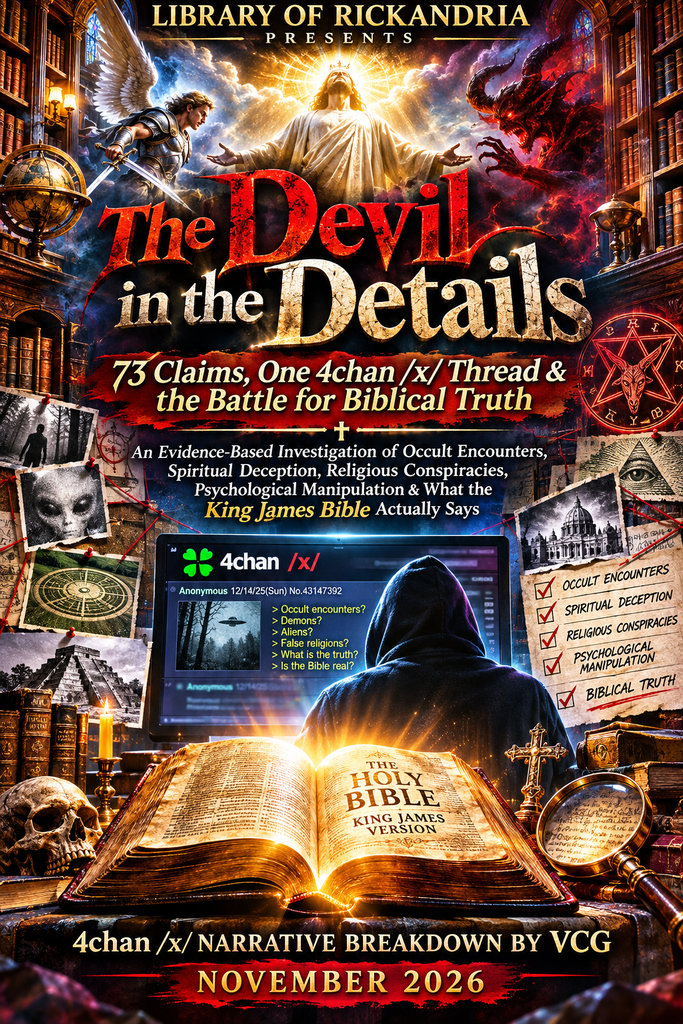
The Devil in the Details: 73 Claims, One 4chan /x/ Thread & the Battle for Biblical Truth
is a comprehensive, evidence-based investigation into an anonymous 4chan discussion that spirals from alleged occult encounters and spiritual harassment into profound questions about:
- Christianity
- divine justice
- original sin
- biblical authority
- religious institutions
- secret societies
- extraterrestrial beings
and the nature of reality itself.
Presented by the Library of Rickandria, this research critically examines 73 substantive claims through:
- historical documentation
- scientific evidence
- psychological research
- theological comparison
- careful examination of the King James Bible
The study exposes how personal experiences can become entangled with:
- confirmation bias
- speculative interpretations
- conspiracy narratives
- distorted biblical passages
- claims of hidden spiritual knowledge
It investigates:
- the preservation of Scripture
- the historical relationship between Mormonism and Freemasonry
- the misuse of biblical texts to promote racial conspiracies
- the differences between genuine spiritual discernment and magical thinking
Rather than dismissing difficult questions or accepting extraordinary allegations without evidence, the paper distinguishes documented facts from:
- personal testimony
- theological interpretation
- psychological explanations
- unsupported speculation
Ultimately, The Devil in the Details demonstrates why:
- intellectual honesty
- historical accuracy
- biblical context
- compassionate discernment
are essential when navigating the intersection of:
- faith
- fear
- deception
- the search for truth
—guided by the biblical principle:
“Prove all things; hold fast that which is good.” — 1 Thessalonians 5:21 (KJV)
ChatGPT – Library of Rickandria
LIBRARY OF RICKANDRIA PRESENTS • RESEARCH EDITION • NOVEMBER 2026
The Devil in the Details
73 Claims, One 4chan /x/ Thread & the Battle for Biblical Truth
An Evidence-Based Investigation of Occult Encounters, Spiritual Deception, Religious Conspiracies, Psychological Manipulation & What the King James Bible Actually Says
4chan /x/ Narrative Breakdown by VCG
The research edition below integrates the original 73-claim analysis with the additional:
- historical
- psychological
- theological
- methodological
chapters.
THE DEVIL IN THE DETAILS
73 Claims, One 4chan /x/ Thread & the Battle for Biblical Truth
An Evidence-Based Investigation of Occult Encounters, Spiritual Deception, Religious Conspiracies, Psychological Manipulation & What the King James Bible Actually Says
LIBRARY OF RICKANDRIA PRESENTS
4chan /x/ Narrative Breakdown by VCG
November 2026
“Prove all things; hold fast that which is good.” — 1 Thessalonians 5:21, KJV
ABSTRACT
On October 30, 2026, an anonymous contributor to 4chan’s paranormal board, /x/, opened a discussion titled Trapped between Christanity and the Occult.
/x/ – GREAT BLACK OUT OF 2026 PREDICTED BY SIMPSONS – Paranormal – 4chan
What began as a personal account of:
- occult experimentation
- frightening experiences
- religious uncertainty
developed into an extended discussion of:
- Christian theology
- original sin
- salvation
- spiritual warfare
- Mormonism
- Freemasonry
- extraterrestrial encounters
- biblical manuscripts
- conspiracy theories
- the nature of human consciousness
The original poster claimed to have encountered hostile entities, suspected that an implanted object was interfering with spiritual abilities, and described perceived supernatural beings responding to the name of Jesus Christ.
Yet he also expressed substantial objections to Christianity, particularly concerning:
- divine justice
- inherited sin
- forgiveness
- human freedom
and the authority of religious institutions.
The replies made the discussion considerably more complicated.
Some respondents offered conventional Christian explanations; others advanced:
- occult theories
- alternative cosmologies
- racial reinterpretations of biblical history
- allegations of institutional conspiracies
Still others proposed psychological and medical explanations, sometimes with considerably more certainty than the available information justified.
This paper examines 73 substantive propositions drawn from the discussion.
Its purpose is neither to ridicule extraordinary experiences nor to certify them as supernatural.
Rather, it distinguishes:
- personal testimony from independently established events
- historical documentation from conspiracy
- psychological explanation from diagnosis
- the actual words of Scripture from the theological systems constructed around them
The investigation relies on the King James Version of the Bible, including the supplied Pure Cambridge Edition, alongside:
- ancient manuscripts
- historical records
- denominational primary sources
- peer-reviewed research
- authoritative medical guidance
The central finding is that the discussion repeatedly mistakes connections for causes, scriptural imagery for literal scientific information, and emotionally powerful experiences for independently established facts.
Nevertheless, several objections raised against Christianity—especially those involving inherited consequences of:
- Adam’s fall
- divine foreknowledge
- suffering
- conflicting religious claims
—deserve substantially more serious engagement than some respondents provide.
The resulting investigation is not simply a rebuttal of an internet thread.
It is a study of how people decide what is true when:
- religious conviction
- fear
- historical uncertainty
- anonymous online persuasion converge
Primary source:
Archived 4chan /x/ thread No. 43147392
1. INTRODUCTION: THE PERSON BEHIND THE RABBIT HOLE
The first thing worth recognizing about this discussion is that its original poster does not appear to be asking a purely academic question.
He describes years of occult interests,
frightening encounters,
an abandoned relationship with a spiritual mentor,
religious conversion,
continuing uncertainty,
and a feeling that he is running out of time.
In the opening post, No. 43147392, he reports five years of occult involvement and claims that entities have harassed him throughout his life.
He believes that something may have been implanted in him to prevent astral projection and the development of other abilities.
He also reports that the name of Christ appears to influence these perceived entities.
That experience presents him with an uncomfortable dilemma:
he cannot readily reconcile what he thinks he has witnessed with his theological objections to Christianity.
The following posts explain those objections.
He questions whether God is just to humanity, whether descendants should suffer because of Adam and Eve, whether forgiveness encourages wrongdoing, whether religious authority produces dependence, and whether the biblical text has survived sufficiently intact.
He describes attending Orthodox and Latter-day Saint congregations before choosing the latter.
Finally, he mentions a perceived feminine entity whose apparent concern for him complicates his willingness to reject his occult experiences.
There are at least three different questions here:
- What happened to this person?
- What explains his experiences?
- What, if anything, do those experiences establish about Christianity?
The thread repeatedly treats these questions as though an answer to one automatically answers the others.
It does not.
Someone could sincerely experience a perceived presence without the presence being an independently existing being.
A religious ritual could provide relief without establishing the particular supernatural explanation offered for that relief.
And even a genuinely unexplained event would not automatically establish the truth of an entire religious system.
The reverse is equally important:
identifying a possible psychological or medical mechanism does not, by itself, disprove the existence of every spiritual reality discussed in Christian theology.
A serious investigation must resist both forms of overconfidence.
2. RESEARCH METHODOLOGY AND EVIDENCE STANDARDS
2.1 The primary-source rule
The original archived thread is the central source:
/x/ – Trapped between Christanity and the Occult – Paranormal – 4chan
Every substantive claim is identified by its post number wherever possible.
The opening four-part statement consists of Nos. 43147392, 43147394, 43147402, and 43147408.
Because 4chan participants generally post anonymously, subsequent messages are not always attributable to the same person with complete confidence.
References to the original poster’s later statements follow the apparent conversational continuity, but should not be confused with independently verified authorship.
Similarly, an anonymous respondent’s allegation is not evidence that the alleged event occurred.
The thread is evidence of what people claimed, not necessarily of the events they claimed to describe.
2.2 Five categories of analysis
Each claim is evaluated through five distinct questions.
Textual:
What exactly does the participant assert?
Historical:
What can documents, manuscripts, and reliable records establish?
Scientific and psychological:
Is there a credible empirical explanation, and what evidence would distinguish competing hypotheses?
Scriptural:
What does the KJV actually say when the relevant passage is read in context?
Interpretive:
What conclusions depend on a particular theological or philosophical tradition rather than on an explicit statement of the text?
These categories must not be silently substituted for one another.
For example, that Christians historically believed in demons is a historical fact.
Whether demons exist is a metaphysical question.
Whether a particular modern experience was caused by a demon is a separate evidentiary question.
2.3 The evidence-rating system
| Rating | Meaning |
|---|---|
| Documented | Established by relevant primary evidence |
| Corroborated | Supported by several appropriate independent sources |
| Disputed | Genuine interpretive disagreement or conflicting evidence exists |
| Unsupported | Sufficient evidence for the assertion has not been supplied |
| Contradicted | Reliable evidence conflicts with a material part of the claim |
| Not independently testable | Available methods and information cannot establish the proposition |
These classifications do not measure whether someone sounds sincere.
Sincerity and accuracy are different questions.
2.4 The biblical standard
The principal English biblical text is the King James Version.
However, a study of biblical preservation must distinguish the KJV translation from the underlying Hebrew and Greek manuscript traditions.
The translators themselves discussed translation difficulties, alternatives, and revision in their preface, The Translators to the Reader.
They described their work as an effort to improve existing good translations rather than to invent the Christian Bible anew.
Their willingness to recognize difficult readings provides a useful model for textual humility.
The scriptural method is summarized by:
- Acts 17:11
- Proverbs 18:13
- 1 Thessalonians 5:21
Careful examination does not require automatically accepting every supernatural claim, every historical tradition, or every confident interpretation offered by a religious authority.
3. THE ANATOMY OF THE RABBIT HOLE
3.1 How the thread develops
The thread’s reasoning can be represented as a sequence of proposed connections:
Unusual personal experiences
↓
Interpretation as encounters with external entities
↓
Belief that those entities possess hidden intentions
↓
Interpretation of the name of Christ as a supernatural test
↓
Questions about Christian doctrine and religious institutions
↓
Speculation about occult traditions and suppressed spiritual knowledge
↓
Connections to Freemasonry, Mormonism, and the Illuminati
↓
Additional claims about ancestry, consciousness, physics, and ancient religion
This is a claim-dependency map, not proof that the propositions are true.
Its value is that it reveals where an elaborate conclusion depends on an earlier proposition that has not been established.
For instance, the claim that an implant suppresses spiritual powers requires several assumptions:
- An implant actually exists.
- The implant was placed by an external agent.
- The alleged agent intended to suppress abilities.
- The abilities themselves exist.
- The implant is capable of suppressing them.
The discussion does not independently establish any of these propositions.
An elaborate conclusion can therefore seem convincing while resting on a chain of unverified assumptions.
3.2 The difference between an explanation and a story
A story connects events in a way that makes them feel meaningful.
An evidentiary explanation must do more.
It should account for observations, consider alternatives, and ideally make predictions that could prove it wrong.
Suppose someone experiences a frightening sensation during sleep.
One person suggests sleep paralysis.
Another suggests a demon.
A third suggests an alien implant.
A fourth suggests the person’s spiritual potential is being suppressed.
These are not equally well-supported possibilities merely because each can be narrated.
Sleep paralysis is a medically recognized phenomenon with documented symptoms.
By contrast, attributing the experience to an extraterrestrial implant requires evidence of the alleged implant and its causal mechanism.
The distinction is not between a comforting story and a frightening story.
It is between what the evidence can support and what has been added through interpretation.
Research reference:
4. THE ORIGINAL FOUR POSTS: CLAIMS 1–31
4.1 Post 43147392 — Occult involvement and perceived entities
Claim 1:
Hostile entities have harassed the poster throughout his life.
Assessment:
Personal testimony; supernatural explanation unverified.
The poster reports a history of experiences that he interprets as encounters with hostile entities.
His account can be accepted as a report of what he believes occurred without establishing its cause.
Unusual perceptions may have:
- sleep-related
- neurological
- psychological
- environmental
or other explanations.
The post does not contain sufficient independent evidence to identify an external agent.
Scripture:
- Deuteronomy 18:10–12
- 1 John 4:1
The Bible discusses spiritual deception, but those passages do not demonstrate that an anonymous person’s experiences were caused by spirits.
Claim 2:
An implant prevents astral projection and other supernatural abilities.
Assessment:
Unsupported.
No medical evidence, authenticated object, or reproducible demonstration is provided.
Furthermore, the absence of a claimed ability is used to infer an implant, while the alleged implant is used to explain the absence of the ability.
This is circular reasoning.
The Bible does not teach that astral projection is an expected human ability or that spiritual implants interfere with it.
Claim 3:
The name of Jesus caused perceived entities to retreat.
Assessment:
Reported experience; cause unverified.
The Gospels and Acts describe exorcisms associated with Jesus and his apostles.
Luke 10:17 records the disciples’ report that spirits were subject to them through Christ’s name.
However, Acts 19:13–16 also warns against invoking Jesus’ name as a manipulable spiritual formula.
The modern report does not independently establish the presence, identity, or motives of a supernatural being.
A Christian may interpret the account through biblical theology, but that interpretation should not be represented as scientific verification.
Claim 4:
A spiritual mentor possessed knowledge of how to resist the entities.
Assessment:
Personal testimony; mentor’s alleged expertise unverified.
The poster describes a mentor who later stopped communicating with him.
The later suggestion that the mentor acted selfishly may be understandable, but his motives remain unknown.
A person claiming access to otherwise unavailable spiritual knowledge is not thereby established as an authority.
Scripture:
1 Thessalonians 5:21.
The appropriate response is examination, not automatic trust.
4.2 Post 43147394 — Original sin and divine justice
Claim 5:
Christianity requires people to apologize to God for existing.
Assessment:
Contradicted as a description of the biblical message.
Genesis 1:27 presents humanity as created in God’s image.
Genesis 1:31 calls creation very good.
Christian repentance concerns sin, not the mere fact of being created.
The New Testament’s emphasis on grace does not mean human existence itself is a moral offense.
Scripture:
- Genesis 1:27–31
- Romans 3:23
- Ephesians 2:8–10
Claim 6:
Original sin means descendants are personally guilty of Adam’s individual decision.
Assessment:
Theological dispute; overly broad representation.
Romans 5:12–19 connects Adam’s disobedience with sin and death.
Ezekiel 18:20 teaches individual responsibility for wrongdoing.
Christian traditions differ in explaining the relationship between these passages.
Roman Catholic teaching distinguishes original sin as an inherited condition from a personally committed offense.
Eastern Orthodox interpretations commonly emphasize inherited mortality and corruption.
Reformed theology emphasizes Adam’s representative role.
Latter-day Saint teaching explicitly rejects punishment for Adam’s transgression.
The poster raises a real theological problem but does not accurately represent every tradition’s position.
Sources:
Claim 7:
God commanded Adam and Eve to reproduce only after their fall.
Assessment:
Contradicted by the sequence in Genesis.
Genesis 1:28 contains the command to be fruitful and multiply.
Genesis 3 narrates the fall.
The command therefore appears before the fall in the canonical narrative.
This is a genuine textual error in the opening argument.
But correcting that chronology does not settle the stronger issue the poster later raises:
why God knowingly allowed fallen humanity to continue.
Claim 8:
By preserving humanity, God became morally complicit in humanity’s fallen condition.
Assessment:
Philosophical and theological dispute.
This is a serious form of the problem of evil.
The argument assumes that an omnipotent and morally perfect Creator should prevent the perpetuation of a corrupted condition.
Christian responses appeal to:
- freedom
- providence
- redemption
- mercy
- the restoration of creation
Romans 5 contrasts Adam and Christ.
Romans 8 describes creation awaiting deliverance.
Yet appealing to redemption does not produce a logically compulsory answer to every question about divine permission of suffering.
A rigorous paper must recognize the continuing philosophical difficulty.
Claim 9:
Forgiving enemies always backfires.
Assessment:
Unsupported universal claim.
Matthew 5:44 commands love toward enemies.
Romans 12:19 rejects personal vengeance.
But forgiveness is not identical to trusting someone, restoring access to a victim, or abandoning legal protection.
Matthew 18:15–17 describes confrontation and accountability.
Romans 13 recognizes the governing authority’s responsibility to restrain wrongdoing.
Therefore, biblical forgiveness does not logically require remaining in an abusive or dangerous situation.
Claim 10:
Christianity credits God with everything good while blaming humans for every misfortune.
Assessment:
Overgeneralization.
Job suffers without the book presenting his suffering as a simple punishment for personal wrongdoing.
John 9:1–3 explicitly challenges an attempt to attribute a man’s blindness to his or his parents’ sin.
The Bible does not support a universal formula equating suffering with personal moral guilt.
Claim 11:
Calvinists believe human beings have no free will whatsoever.
Assessment:
Inaccurate summary of Reformed theology.
The Westminster Confession’s ninth chapter explicitly discusses the natural liberty of the human will.
It also argues that fallen humanity cannot achieve spiritual conversion by unaided human ability.
These claims can be challenged philosophically, but they are not equivalent to saying humans never make meaningful choices.
Source:
Orthodox Presbyterian Church, Free Will and Westminster Confession Chapter 9
Claim 12:
If God determines everything, human existence is pointless cruelty.
Assessment:
Philosophical dispute.
This conclusion depends on contested premises about:
- freedom
- divine causation
- foreknowledge
- moral responsibility
- the purpose of creation
Genesis 50:20 and Acts 2:23 portray divine providence and human wrongdoing within the same events.
Different Christian traditions interpret that relationship differently.
Neither a brief appeal to God’s sovereignty nor a blanket accusation of cruelty resolves the debate.
Claim 13:
God requires people to obey a divine timetable that they cannot understand.
Assessment:
Mischaracterization of several relevant biblical teachings.
Matthew 24:36 and Acts 1:7 limit human knowledge of the timing of divine events.
The New Testament commonly emphasizes faithfulness and readiness rather than a requirement to calculate every prophetic deadline.
Claim 14:
Jewish people could not recognize Jesus because the prophecies were too ancient.
Assessment:
Historically and textually overgeneralized.
The Hebrew texts interpreted as messianic prophecies belong to different historical settings.
Jewish and Christian interpreters disagree over several of their meanings.
The New Testament depicts both Jewish acceptance and rejection of Jesus.
Acts 2 and John 1:11–12 do not support the claim that all Jewish people failed to recognize him.
Claim 15:
Christians must maintain absolute personal perfection to receive salvation.
Assessment:
Incomplete representation of the New Testament.
Matthew 5:48 articulates a demanding ethical standard.
But Romans 3:23 acknowledges universal sin.
Ephesians 2:8–9 teaches salvation by grace through faith rather than personal achievement.
Christian traditions differ over the role of:
- faith
- works
- sanctification
- perseverance
None of this justifies reducing the entire New Testament message to perfect individual rulekeeping.
Claim 16:
Translation and political interference left only fragments of the original Bible.
Assessment:
Contradicted as stated; genuine textual variants exist.
- The Dead Sea Scrolls
- Codex Sinaiticus
- early papyri
- ancient translations
and other manuscripts provide extensive textual evidence.
There are real copying differences and disputed passages.
But the surviving evidence is far more substantial than the phrase “only scraps” suggests.
Sources:
- Codex Sinaiticus Project
- Israel Museum, Digital Dead Sea Scrolls
- Center for the Study of New Testament Manuscripts
A fuller examination of three important textual variants appears in Chapter 7.
4.3 Post 43147402 — Christianity, authority, and moral strength
Claim 17:
Christ teaches believers to remain childlike and passive.
Assessment:
Misreading.
Matthew 18:3–4 emphasizes humility.
First Corinthians 14:20 explicitly tells believers to be mature in understanding.
Biblical childlikeness does not mean intellectual helplessness.
Claim 18:
God demands permanent spiritual inferiority rather than growth.
Assessment:
Philosophical analogy that does not adequately reflect the relevant texts.
Ephesians 4:13 describes Christian maturity.
Romans 8:29 speaks of conformity to Christ.
Second Peter 1:4 describes participation in the divine nature.
Classical Christianity and LDS theology disagree over the nature and extent of exaltation, but spiritual growth is not absent from biblical Christianity.
Claim 19:
Christianity resembles a system that creates sin merely to sell salvation.
Assessment:
Philosophical accusation rather than demonstrated historical intention.
The poster describes this as a Hegelian dialectic, though he later acknowledges his use of that term was mistaken.
The underlying question remains meaningful:
why would God allow a world requiring redemption?
James 1:13 denies that God tempts people to evil.
Romans 5:8 portrays salvation as divine love.
The Christian explanation does not eliminate the philosophical question, but the allegation that Christianity was deliberately designed as a fraudulent system requires evidence beyond analogy.
Claim 20:
Protestant churches can be dismissed for obvious reasons.
Assessment:
Unsupported assertion.
Protestantism contains multiple traditions with important doctrinal differences.
A serious critique must identify specific teachings and test them against Scripture and historical evidence.
Claim 21:
The papacy attempts to replace Christ.
Assessment:
Disputed theological criticism; inaccurate as a statement of Catholic self-understanding.
Catholic canon law identifies the pope as Vicar of Christ and successor of Peter, not as a replacement deity.
A biblical critique may challenge papal jurisdiction or succession, but it must engage the actual doctrine.
Source:
Vatican, Code of Canon Law, Canon 331
Claim 22:
Orthodox Christianity is excessively rule-bound and reluctant to confront evil.
Assessment:
Anecdotal overgeneralization.
The poster’s experiences with particular individuals do not establish the character of every Orthodox parish or the entire Orthodox tradition.
Jesus condemned hypocrisy in Matthew 23, but he did not reject moral discipline or communal religious life.
Claim 23:
Christian nonviolence is incompatible with a virtuous warrior tradition.
Assessment:
False dilemma.
Christian traditions distinguish:
- personal revenge
- self-defense
- defense of others
- state-sponsored violence
Matthew 26:52 and Romans 13:4 must be examined in their different contexts.
Pacifist and just-war Christian traditions disagree about applying these principles.
Claim 24:
Orthodox Christianity values dead martyrs more than living protectors.
Assessment:
Unsupported generalization.
The poster later invokes the murder of Orthodox monk Philoumenos at Jacob’s Well.
The crime is a historical event.
But a martyr’s death does not prove that the Church preferred his death or deliberately refused protection.
Scripture:
- Matthew 10:23
- Acts 9:23–25
- Revelation 6:9–11
Claim 25:
LDS congregations are exceptionally Christlike in their behavior.
Assessment:
Personal evaluation.
Hospitality and service are legitimate Christian virtues.
James 2 emphasizes care for others.
However, pleasant congregational experiences do not independently establish theological correctness.
Claim 26:
Criticism of Mormonism is largely fabricated because Latter-day Saints have never harmed anyone.
Assessment:
Historically false as a universal claim.
Some criticism of Latter-day Saints has indeed been unfair.
However, the Mountain Meadows Massacre of 1857 and historical priesthood restrictions affecting Black members are documented in the LDS Church’s own historical resources.
These events do not establish collective guilt among present-day members.
They do refute the claim that the movement’s history contains no wrongdoing.
Sources:
4.4 Post 43147408 — The perceived female entity and hidden potential
Claim 27:
A feminine entity has remained nearby and shown concern.
Assessment:
Subjective report; external cause unverified.
The poster describes emotional significance and uncertainty.
Feelings of companionship do not independently establish an external being.
Claim 28:
Rejecting the entity might mean rejecting the only being who genuinely cares.
Assessment:
Emotionally understandable but unreliable evidence of identity.
The fear of losing a perceived relationship may influence how an ambiguous experience is interpreted.
This is a possible psychological mechanism, not a diagnosis.
Claim 29:
The poster must penetrate a spiritual veil to obtain answers.
Assessment:
Unsupported framework.
The Bible does not present astral projection or occult initiation as a required means of knowing God.
John 14:6 and Hebrews 1:1–2 locate divine revelation within a markedly different framework.
Claim 30:
The poster is running out of time.
Assessment:
Reported urgency; no objective supernatural deadline established.
Urgency can make explanations feel more compelling without increasing their evidentiary strength.
There is no evidence in the thread of a measurable supernatural countdown.
Claim 31:
Hostile beings fear what the poster might become.
Assessment:
Unsupported attribution of intention.
The claim assumes external beings, their motives, and an unrealized supernatural ability.
No independent evidence demonstrates these propositions.
Luke 10:20 provides an instructive theological contrast:
Jesus redirects attention away from extraordinary power toward the disciples’ relationship with God.
5. THE REPLIES: CLAIMS 32–73
5.1 Physics, consciousness, and the cosmos
Claim 32:
The human soul operates faster than light.
Post 43148276.
Assessment:
Unsupported.
The respondent presents the soul as a dimensionally unusual form of energy.
No measurement or explanatory model is supplied.
A nonphysical soul is a metaphysical concept.
Assigning it a physical velocity requires additional premises and evidence.
Claim 33:
Quantum mechanics points directly toward a spiritual explanation of consciousness.
Posts 43148276–43148463.
Assessment:
Speculative.
Quantum mechanics has genuine unresolved interpretive questions.
But those questions do not establish a particular religious cosmology.
The uncertainty principle, wave-function collapse, and consciousness are distinct subjects that cannot simply be merged into one explanation.
Reference:
Stanford Encyclopedia of Philosophy, Quantum Theory
Claim 34:
COVID caused a division between timelines.
Post 43148277.
Assessment:
Unsupported.
The respondent provides no reproducible evidence of a physical timeline division.
Changes in memory, society, or personal experience do not establish changes to spacetime.
5.2 Conspiracies and institutional power
Claim 35:
Jewish people, bankers, and Freemasons form a hidden alliance controlling civilization.
Post 43148289.
Assessment:
Unsupported and dependent on antisemitic scapegoating.
A legitimate investigation can examine financial influence or institutional corruption.
But attributing the world’s problems to Jewish people collectively is a sweeping allegation without evidentiary foundation.
The United States Holocaust Memorial Museum documents how related conspiracy narratives were propagated through forged material such as The Protocols of the Elders of Zion.
Source:
USHMM, The Protocols of the Elders of Zion
Claim 36:
The Federal Reserve was founded to enslave humanity.
Post 43148289.
Assessment:
Unsubstantiated claim about motive.
The Federal Reserve was established by congressional legislation in December 1913.
Its monetary policies and institutional structure are legitimate subjects of criticism.
But the existence of central banking does not establish a secret spiritual or ethnic conspiracy.
Source:
Claim 37:
The Illuminati captured Freemasonry around the American Civil War.
Post 43148444.
Assessment:
Unsupported.
The poster proposes a takeover to explain how Freemasonry could have had members who supported political liberty while allegedly becoming a tool of authoritarian control.
This resolves a perceived contradiction through an additional hypothesis, but no historical documentation of the proposed takeover is supplied.
Claim 38:
George Washington warned about Illuminati influence.
Post 43148444.
Assessment:
Historically grounded, frequently exaggerated.
Washington corresponded with Reverend G. W. Snyder in 1798 about the Illuminati.
In his October 24 letter, Washington distinguished the spread of Illuminati ideas from the claim that American Masonic lodges collectively propagated them.
The letter is genuine.
It does not establish a nineteenth-century takeover or modern secret world government.
Primary source:
Library of Congress, Washington to Snyder, October 24, 1798
Claim 39:
Mormonism was established to preserve ancient Masonic teachings.
Posts 43148444 and 43175689.
Assessment:
Real historical relationship; speculative explanation.
Joseph Smith joined Freemasonry in March 1842.
He introduced the Nauvoo temple endowment in May 1842.
The LDS Church acknowledges similarities between Masonic ceremonies and early temple practices.
However, Mormonism was organized in 1830, before Joseph Smith’s Masonic initiation.
The thread provides no evidence of a coordinated project to preserve teachings from a later Illuminati takeover.
Source:
5.3 Racial misuse of biblical history
Claim 40:
Jesus was a white European Israelite rather than a Jew.
Post 43153450.
Assessment:
Contradicted by the historical and biblical context.
The historical Jesus belonged to first-century Jewish society.
Hebrews 7:14 identifies his descent from Judah.
John 4:9 places him within a Jewish identity.
Modern European racial classifications do not provide an accurate framework for identifying first-century Galileans.
Claim 41:
Genesis 1 and Genesis 2 describe the creation of two racially different human species.
Post 43155757.
Assessment:
Textually unsupported.
Genesis 1 presents humanity made in God’s image.
Genesis 2 focuses on Adam and the garden.
There are scholarly debates over the relationship between the two narratives, but neither explicitly describes a superior Adamic biological race.
Acts 17:26 emphasizes the common origin of nations.
Claim 42:
God’s judgments against Israel were intended to purify a racial genome.
Posts 43155757–43155925.
Assessment:
Unsupported.
Biblical passages about covenant fidelity and intermarriage in particular ancient contexts cannot automatically be transformed into modern genetic eugenics.
Ruth and Rahab are important counterexamples to interpretations that treat foreign ancestry as intrinsically disqualifying.
Scripture:
- Ruth 4
- Matthew 1:5
- Judges 3:5–7
Claim 43:
Ashkenazi Jews are Edomites, and Romans 9:13 establishes divine hatred of them.
Post 43155790.
Assessment:
Unsupported and scripturally misapplied.
Romans 9:13 quotes Malachi’s Jacob-and-Esau language within Paul’s argument about election.
It does not identify the genetic ancestry of modern Jewish communities or authorize ethnic hostility.
Romans 11:18 expressly warns Gentile believers against arrogance toward Israel.
Claim 44:
Lamentations 4:7 proves ancient Israelites were white Europeans.
Post 43155820.
Assessment:
Contextual misreading.
Lamentations 4:7 compares the former condition of Jerusalem’s honored figures to snow, milk, rubies, and sapphire.
Verse 8 immediately contrasts their appearance after devastating suffering.
The passage concerns humiliation, starvation, and destruction.
It is not a literal description of a modern racial genotype.
Scripture:
Lamentations 4:7–9.
Claim 45:
The passage’s milk, ruby, and sapphire imagery identifies a specific European biological appearance.
Later replies to 43155820.
Assessment:
Unsupported speculation.
The imagery is poetic.
Ancient descriptions of precious materials do not automatically correspond to modern racial categories, eye-color classifications, or genetic ancestry.
Claim 46:
Jewish people are spiritually condemned as an ethnic group.
Posts 43148284 and subsequent exchanges.
Assessment: Contradicted by the New Testament’s teaching on impartiality.
Romans 2:11 teaches that God is not a respecter of persons.
Romans 10:12 emphasizes the same Lord over Jews and Greeks.
Theological disagreements concerning Israel do not justify treating an ethnic population as collectively deceitful or inherently evil.
5.4 Occult reinterpretations of Christianity
Claim 47:
Jesus was primarily a sorcerer or exceptionally powerful magical practitioner.
Post 43148497.
Assessment:
Interpretation inconsistent with the Gospel authors’ presentation.
The Gospels record opponents attributing Jesus’ exorcisms to improper spiritual power.
Matthew 12:22–28 also records Jesus rejecting that explanation.
Calling him a sorcerer replaces the narrative’s stated interpretation with a different framework.
Claim 48:
Christianity is fundamentally an occult initiation system.
Post 43150104.
Assessment:
Interpretive conflation.
- Incarnation
- Eucharist
- resurrection
- transformation
are genuine Christian themes.
But their existence does not demonstrate that Christianity is a form of ceremonial magic or astral initiation.
Scripture:
- John 6
- 1 Corinthians 10–11
- 1 Corinthians 15
Claim 49:
Perceived entities become friendly or hostile according to the experiencer’s expectations.
Posts 43149670 and 43149694.
Assessment:
External agents unverified; psychological influence plausible.
Expectations can influence interpretation and perception.
That does not establish that independent supernatural beings deliberately change personalities to match expectations.
Claim 50:
Magical orders associated with Aleister Crowley offer the poster a reliable path to spiritual development.
Posts 43151671 and 43152383.
Assessment:
Unsupported recommendation.
Occult organizations and ceremonial magical traditions are historically real.
Their claimed supernatural effectiveness is a separate matter.
Acts 19:18–20 presents early converts abandoning magical practices rather than treating them as an extension of Christian discipleship.
Claim 51:
Jesus rejected religious organization, and churches suppress spiritual practice for control.
Post 43158953.
Assessment:
Historical overgeneralization.
Jesus criticized religious hypocrisy.
He also participated in Jewish worship and spoke about his church.
Acts 2:42 depicts organized Christian teaching, fellowship, and worship.
Criticism of corrupt authority does not establish that all religious organization is fraudulent.
5.5 Hebrew language, mythology, and spiritual identity
Claim 52:
The plural ending of Elohim proves that Genesis describes several gods.
Post 43161055.
Assessment:
Incomplete grammatical argument.
Elohim has a morphologically plural form.
But Genesis 1:1 uses a singular verb with it.
The history of Israelite religion and divine-council language deserves academic study, but the noun’s ending alone does not prove that Genesis 1:1 describes several independently acting gods.
Scripture:
- Genesis 1:1
- Isaiah 45:5
Claim 53:
The forbidden fruit represents intellectual curiosity, meaning Christianity condemns the pursuit of knowledge.
Post 43161192.
Assessment:
Allegorical interpretation unsupported as the exclusive meaning.
Genesis 3 concerns disobedience and moral knowledge.
The wider Bible praises wisdom and understanding.
Scripture:
- Proverbs 2:1–6
- Luke 2:46
- James 1:5
Claim 54:
Pandora’s box better explains suffering and proves Christianity exists to suppress spiritual development.
Post 43161416.
Assessment:
Literary comparison plus unsupported institutional claim.
Eden and Pandora can be compared as narratives addressing the human condition.
Their thematic similarities do not prove that Christianity was intentionally constructed to inhibit spiritual advancement.
Claim 55:
Forgiveness from God is really self-forgiveness because the kingdom of God is within each person.
Post 43160111.
Assessment:
Disputed interpretation that overlooks contextual distinctions.
Luke 17:21 can be translated and interpreted in relation to the kingdom being “within” or “among” the people addressed.
First John 1:9 explicitly presents God as the one forgiving sins.
Self-forgiveness may be psychologically valuable, but it is not simply identical to the biblical doctrine of reconciliation with God.
Claim 56:
Bartolo Longo demonstrates that a person involved in occult religion can convert to Christianity.
Post 43160019.
Assessment:
Historically grounded illustration.
Longo’s conversion and later Catholic activity are documented.
His experience demonstrates a change of religious allegiance.
It does not independently establish the supernatural explanations associated with his earlier beliefs.
The biblical parallel is Acts 19:18–20.
Claim 57:
Christianity needs pagan warrior ideals because forgiveness produces weakness.
Post 43160128.
Assessment:
False dilemma.
Christianity includes traditions of pacifism, just-war reasoning, and public protection of the innocent.
Forgiveness and protective action are not necessarily contradictory.
Scripture:
- Matthew 5:9
- Romans 12:18
- Romans 13:4
Claim 58:
Animal death before humanity makes original sin and redemption incoherent.
Post 43170051.
Assessment:
Serious scientific-theological challenge to particular interpretations.
Animal predation and death long predate human beings in the fossil record.
A theology requiring the absolute absence of all animal death before Adam therefore confronts substantial scientific evidence.
Not every Christian interpretation of Romans 5 or Genesis 3 requires that premise.
Reference:
Smithsonian Human Origins, Evidence of Evolution
5.6 Psychological and medical disputes
Claim 59:
The poster’s nosebleeds indicate seizures or sleep paralysis.
Post 43150351.
Assessment:
Unsupported diagnosis.
Sleep paralysis can involve sensed presences and difficulty moving.
Nosebleeds have different possible causes.
An anonymous comment does not provide the clinical information needed to diagnose either condition.
Sources:
Claim 60:
Both remembering dreams and rarely remembering dreams prove the same suspected sleep disorder.
Posts 43150976–43151047.
Assessment:
Weak reasoning.
The poster reasonably objects when apparently opposite observations are both presented as confirming the same theory without a clear explanation.
A hypothesis needs conditions under which it could be weakened or rejected.
However, exposing that flaw does not establish a supernatural alternative.
Claim 61:
Another person’s similar physical sensations establish the presence of implants.
Post 43164685.
Assessment:
Unsupported causal inference.
Comparable subjective symptoms may deserve investigation.
They do not independently establish a shared supernatural cause.
Claim 62:
Different reactions to Jesus’ name prove the perceived entities possess intentions.
Post 43164864.
Assessment:
Unsupported.
The proposed explanation accommodates both apparent retreat and apparent resistance.
Unless observations can distinguish competing predictions, the hypothesis remains difficult to test.
Claim 63:
A respondent’s psychological crisis proves occult practice causes psychosis.
Post 43148545.
Assessment:
Anecdote, not universal causal demonstration.
A person’s distress deserves serious consideration.
But establishing a causal relationship requires more than one retrospective report.
Claim 64:
Perceived entities can be considered trustworthy because they are usually benevolent.
Post 43161435.
Assessment:
Unsupported.
No independent being or reliable measure of its intentions is established.
Feelings of reassurance are not proof of the identity of an external agent.
5.7 Alternative gospels, numerology, and competing Christian traditions
Claim 65:
The Gospel of Thomas may preserve a more authentic version of Christianity.
Posts 43175701 and 43175729.
Assessment:
Historically significant text; disputed interpretation.
The Gospel of Thomas survives in a Coptic manuscript from Nag Hammadi and Greek fragments from Oxyrhynchus.
Its existence is established.
Its relationship to the earliest historical teaching of Jesus remains a scholarly question.
Source:
Claim 66:
The Chinese figure Pangu reveals a hidden connection to Christian origins.
Post 43177113.
Assessment:
Unsupported suggestion.
A reference to a mythological figure is not evidence of a historical relationship.
A meaningful comparison requires identifiable textual parallels, chronology, and evidence of contact or transmission.
Claim 67:
Galatians 1:8 disqualifies any heavenly messenger who teaches a different gospel.
Post 43178871.
Assessment:
Biblically grounded criterion; application disputed.
Galatians 1:8 directly warns against accepting another gospel merely because of claimed heavenly authority.
Second Corinthians 11:14 warns about deceptive appearances.
The question is whether a later teaching genuinely contradicts the apostolic gospel.
That requires doctrinal comparison rather than simply labeling a disliked religion false.
Claim 68:
The number 33 and supposed encounters around 3:33 a.m. form a biblical demonic code.
Post 43178871.
Assessment:
Numerological speculation.
Revelation 12:4 mentions a third of the stars of heaven.
It does not identify 3:33 a.m. as a supernatural danger period.
Jesus’ exact age at death is also not explicitly identified as 33 in the Gospels.
Claim 69:
Neville Goddard’s system provides everything needed to understand spiritual reality.
Post 43178892.
Assessment:
Unsupported recommendation.
Teachings emphasizing imagination and manifestation do not establish a physical causal power merely by asserting it.
Psalm 100:3 distinguishes the Creator from those he created.
Claim 70:
Orthodox Christianity does not teach absolute, suicidal pacifism.
Post 43178913.
Assessment:
Substantially valid correction.
Orthodox Christianity has a complex history of political authority, warfare, and ethical teaching.
It cannot accurately be reduced to the assertion that believers must never protect themselves or others.
Historical military practice, however, is not automatically proof of moral legitimacy.
Claim 71:
Reported entities retreating at Jesus’ name conclusively proves Christianity.
Post 43182159.
Assessment:
Excessive evidentiary certainty.
An individual’s interpretation of an experience does not establish the external cause.
A theological conclusion cannot be presented as independently demonstrated when the underlying event remains unverified.
Claim 72:
The geographical continuity of early Christianity makes restorationism historically impossible.
Post 43182179.
Assessment:
Important historical challenge stated too absolutely.
Early Christian writings demonstrate substantial continuity in core teachings and communal practices.
But early Christian communities also exhibited differences.
Restorationist claims should be assessed individually against surviving evidence.
Claim 73:
Cross-cultural exorcisms prove demons respond to multiple religious formulas.
Post 43182205.
Assessment:
The existence of diverse rituals is documented; their supernatural mechanism is not.
Exorcism rituals appear across cultures.
Their historical existence does not prove that invisible beings respond to particular words.
This conclusion requires evidence beyond reports of ritual practice.
6. THE STRONGEST OBJECTION: DIVINE JUSTICE, ADAM, AND HUMAN SUFFERING
The earlier claims require a deeper theological examination, especially because the original poster later clarifies his argument.
In post 43154981, he develops the objection that God knowingly preserved a fallen human condition.
His concern is not merely that reproduction occurred after the fall.
He questions why an omnipotent and omniscient Creator would permit humanity to continue under inherited consequences.
This is the strongest theological objection in the thread.
6.1 The chronological correction
Genesis 1:28 places the command to multiply before Genesis 3.
That corrects one factual premise.
It does not answer the broader moral question.
The poster can still ask why God permitted the consequences of Adam’s disobedience to extend through generations.
6.2 Personal guilt and inherited consequences
Ezekiel 18:20 says:
“The son shall not bear the iniquity of the father, neither shall the father bear the iniquity of the son…”
Romans 5:12 says:
“Wherefore, as by one man sin entered into the world, and death by sin; and so death passed upon all men, for that all have sinned…”
The passages address related but distinguishable questions.
Ezekiel emphasizes individual moral accountability.
Romans 5 connects Adam’s act with humanity’s condition and contrasts it with Christ’s obedience.
Theological interpretations differ in explaining how these claims fit together.
| Tradition | Important emphasis |
|---|---|
| Reformed | Adam’s representative headship; human inability apart from grace |
| Roman Catholic | Inherited deprivation rather than Adam’s personally committed act being repeated by descendants |
| Eastern Orthodox | Ancestral consequences, corruption, and mortality |
| Latter-day Saint | Individual responsibility; rejection of punishment for Adam’s transgression |
These differences cannot be settled by pretending the traditions agree.
Nor should the strongest interpretation of one tradition be substituted for all the others.
6.3 Why not begin again?
The poster’s implied alternative is straightforward:
God could have prevented future suffering by ending the fallen line.
Christian theological responses emphasize that divine goodness may be expressed through mercy and restoration rather than destruction.
Romans 5 presents Christ as the answer to Adam.
Romans 8 presents creation’s suffering within an anticipated restoration.
Second Peter 3:9 describes divine patience.
But there remains a question:
if God foresaw the suffering involved, why permit it?
That question belongs to the philosophical problem of evil.
Some Christian arguments appeal to free will.
Others appeal to:
- soul-making
- divine providence
- redemptive history
or limits on human understanding.
Each has strengths and difficulties.
A responsible paper should present these as theological arguments, not as conclusions independently demonstrated through historical investigation.
6.4 Is Christian salvation designed to create dependency?
The original poster repeatedly compares God to a father who deliberately keeps his children helpless.
Yet biblical Christianity does describe growth.
Ephesians 4 speaks of maturity.
Hebrews 5:14 speaks of senses exercised to discern good and evil.
First Corinthians 14:20 encourages maturity in understanding.
Christian dependence on God is therefore not equivalent to permanent intellectual childhood.
The stronger philosophical question is whether dependence on an infinite Creator is intrinsically degrading.
That conclusion does not follow merely from a human analogy about children surpassing their parents.
6.5 The proper theological conclusion
The poster misstates some biblical teachings, but his concerns about inherited suffering and divine foreknowledge are not trivial.
The most serious biblical rebuttal is not an isolated correction of Genesis chronology.
It is a sustained account of:
- creation
- fall
- responsibility
- mercy
- redemption
- judgment
- restoration
Even then, the remaining philosophical disagreement should be acknowledged honestly.
7. HAS THE BIBLE BEEN CORRUPTED? THREE TEXTUAL CASE STUDIES
One of the thread’s most important factual claims concerns biblical preservation.
The original poster argues that political interference, translation, and linguistic change have left readers with little of the original Bible.
That claim is too sweeping.
But a credible rebuttal must acknowledge that manuscript differences are real.
7.1 What we actually possess
The original physical manuscripts written by the biblical authors are not available.
What survives is a substantial collection of:
- handwritten copies
- quotations
- translations
- textual witnesses
produced across different periods and geographical settings.
These documents can be compared.
Codex Sinaiticus, generally dated to the fourth century, preserves the earliest complete surviving copy of the New Testament.
The Dead Sea Scrolls preserve much earlier evidence for significant portions of the Hebrew Scriptures.
These manuscripts allow scholars to investigate the history of biblical texts rather than relying solely on late medieval copies.
Primary collections:
Figure 1 — The first-edition KJV title page (1611)

Figure 2 — Codex Sinaiticus:

Figure 3 — The Great Isaiah Scroll:

Israel Museum, Digital Dead Sea Scrolls
Center for the Study of New Testament Manuscripts
7.2 Case study: Mark 16:9–20
The KJV includes the longer ending of Mark.
However, Codex Sinaiticus and Codex Vaticanus end Mark at 16:8.
Other manuscripts contain the longer ending, and some textual traditions preserve alternative forms.
The longer ending is also known from early Christian tradition, so its history cannot be reduced to a late medieval invention.
Most contemporary critical editions regard verses 9–20 as secondary to the earliest recoverable ending of Mark.
Defenders of the traditional or Byzantine text dispute that conclusion and emphasize the passage’s broad manuscript transmission.
This is a genuine textual-critical controversy with significant evidence that should be openly discussed.
Sources:
Cambridge University Press, Unfinished Business: The Ending of Mark
Trinitarian Bible Society, Mark 16
The responsible conclusion is not that the entire Bible has been corrupted, nor that every manuscript preserves an identical reading.
It is that specific variants require specific examination.
7.3 Case study: John 7:53–8:11
The account of the woman taken in adultery appears in the KJV.
However, the passage is absent from several important early manuscript witnesses and appears in different locations in some later manuscript traditions.
Most contemporary textual critics do not consider it part of the earliest recoverable form of John’s Gospel.
Other scholars argue for its antiquity or defend its authenticity within the received tradition.
Its existence within a substantial later manuscript tradition is beyond dispute.
Its precise textual origin is the question.
Source:
NET Bible textual notes on John 7:53
This passage illustrates how manuscript evidence can raise genuine questions without requiring the conclusion that the entire Gospel has become unreadable.
7.4 Case study: 1 John 5:7–8
The KJV contains the familiar Trinitarian wording concerning the Father, the Word, and the Holy Ghost bearing witness in heaven.
This longer reading is traditionally called the Johannine Comma.
It is absent from the early Greek manuscript tradition and has a complicated history in Latin Christianity and later printed Greek editions.
That history matters because the passage has been used as an explicit proof text in debates about the Trinity.
Scholarly source:
Galiza and Reeve, The Johannine Comma: Textual History and Theological Usage
Recognizing this issue does not automatically refute Trinitarian theology.
The doctrine has also been argued from other passages, including:
- Matthew 28:19
- John 1
- 2 Corinthians 13:14
But it does mean that a textual argument relying on the longer reading should acknowledge the manuscript evidence.
7.5 What the KJV translators understood
The KJV translators discussed the value of revising earlier translations, comparing languages, and acknowledging difficult passages.
Their own preface is a reminder that fidelity to Scripture is not strengthened by concealing uncertainty.
The history of the text should be studied precisely because its wording matters.
Finding:
The claim that only scraps of the original Bible survive is false.
The claim that manuscript differences exist is true.
The significance of particular differences must be assessed case by case.
8. SPIRITUAL DISCERNMENT OR MAGICAL THINKING?
The original poster repeatedly treats the reported response to Jesus’ name as one of the strongest pieces of evidence available to him.
Several respondents agree.
Others argue that spiritual entities react to many different religious names or formulas.
The underlying issue is whether the biblical accounts support treating sacred language as a technique for controlling unseen forces.
8.1 Luke 10:17–20
The disciples report that spirits are subject to them through Christ’s name.
But Jesus redirects their attention toward their relationship with God.
The passage does not encourage the accumulation of occult power as an independent spiritual achievement.
8.2 Acts 16:16–18
Paul commands a spirit to depart.
The passage presents the event within apostolic ministry.
It does not provide a general test through which modern individuals can scientifically determine the identity of every perceived entity.
8.3 Acts 19:13–16
Some individuals attempt to invoke Jesus’ name in connection with exorcism.
The account demonstrates that the name is not presented as a magical formula detached from the authority and context of the Christian faith.
8.4 Matthew 7:21–23
Jesus warns that extraordinary religious claims are not sufficient evidence of obedience to him.
The warning is significant because people sometimes treat unusual experiences as guarantees of spiritual authority.
8.5 1 John 4:1
The instruction to test spirits emphasizes discernment.
But discernment should not become a license to assign supernatural identities to people or experiences without evidence.
A Christian may interpret an event through faith.
A researcher must still distinguish that interpretation from an independently verified account of what occurred.
Finding:
Biblical exorcism narratives are part of Christian theology.
They do not, by themselves, validate modern allegations of implants, invisible attackers, or inhibited astral abilities.
9. CHRISTIANITY, MORMONISM, AND THE QUESTION OF AUTHORITY
The original poster’s choice between Orthodox Christianity and Mormonism is not incidental.
He appears attracted to a community that he experiences as welcoming, morally active, and willing to confront the world.
His decision also reveals an important distinction between two questions:
Which community appears most caring?
Which community teaches the doctrines most consistent with the apostolic writings?
These questions can overlap but are not identical.
9.1 Roman Catholic authority
Catholic theology emphasizes Scripture, tradition, the teaching authority of the Church, and apostolic succession.
The papacy is understood as a particular office within that authority.
A biblical critique must consider:
- Matthew 16:18–19
- Luke 22:31–32
- John 21:15–17
and the historical evidence concerning early Roman leadership.
9.2 Eastern Orthodox authority
Eastern Orthodox Christianity emphasizes continuity with apostolic faith, liturgical life, councils, the Church Fathers, and the historical communion of the Church.
It does not accept the Roman Catholic conception of universal papal jurisdiction.
The original poster’s criticism of particular Orthodox attitudes toward defensive action does not settle those theological questions.
9.3 Protestant authority
Protestant traditions commonly emphasize the authority of Scripture while differing over creeds, ecclesiastical authority, sacraments, and interpretation.
Some Protestants are highly confessional and institutionally structured.
Others emphasize congregational autonomy.
Thus, the assertion that Protestantism can be dismissed without identifying particular teachings is insufficient.
9.4 Latter-day Saint authority
The LDS Church recognizes additional scripture and continuing revelation.
It teaches that the Godhead consists of distinct beings united in purpose, unlike the classical Nicene teaching concerning one divine being in three persons.
Primary source:
It also teaches restoration through Joseph Smith, which raises questions concerning the continuity of apostolic authority and the original Christian gospel.
These questions should be examined historically and textually.
9.5 The Masonic connection
Joseph Smith’s documented Masonic membership and the introduction of the Nauvoo endowment are relevant historical facts.
The LDS Church acknowledges ritual similarities.
But historical influence, doctrinal truth, and conspiracy are distinct questions.
Showing that two ceremonies share forms does not establish whether one was divinely revealed.
Nor does it prove that the ceremonies were coordinated by a secret political organization.
9.6 A fair conclusion
The poster’s positive experience among Latter-day Saints deserves acknowledgement.
But theological evaluation cannot end with congregational friendliness.
Nor should criticism of Latter-day Saint doctrine excuse unfairness toward its members.
Galatians 1:8 provides a biblical criterion for examining later revelations, but applying it requires identifying the content of the apostolic gospel and comparing actual teachings.
Theological criticism should target propositions, not the dignity of believers.
10. THE CONSPIRACY EVIDENCE AUDIT
The thread repeatedly shifts from documented institutional relationships to speculative narratives of hidden control.
This shift deserves examination as a recognizable reasoning pattern.
10.1 The Illuminati
The historical Bavarian Illuminati existed.
The existence of a historical secret society does not establish that an organization using that name secretly directs modern global events.
Claims of continuous institutional survival require documentation showing that continuity.
10.2 Washington and Freemasonry
Washington’s letters to Reverend Snyder are authentic.
His correspondence demonstrates concern about ideological movements and rumors of Illuminati influence.
It does not establish that American Freemasonry collectively promoted Illuminati principles.
Primary source:
Library of Congress, Washington–Snyder Correspondence
10.3 The Federal Reserve
The Federal Reserve exists and exercises significant monetary authority.
Its actions can be evaluated using economic evidence, legislation, historical policy records, and public accountability.
These legitimate subjects do not establish claims that Jewish people or occult societies secretly control the system.
Source:
10.4 Racial conspiracy narratives
The thread’s racial theories misuse ancient texts as though they were modern genetic classifications.
The same arguments frequently transform disagreement about history into allegations against present-day ethnic groups.
The history of antisemitic conspiracy literature demonstrates how easily a comprehensive theory of hidden power can become a vehicle for scapegoating.
Source:
United States Holocaust Memorial Museum
10.5 A repeatable investigative standard
When presented with a conspiracy claim, the researcher should ask:
- What specific event is alleged?
- Who is alleged to have participated?
- What primary documents support the allegation?
- Does the documentary chronology fit the claim?
- What independent evidence corroborates the proposed coordination?
- What information would count against the hypothesis?
The burden of evidence increases as the allegation becomes broader.
An accusation that one institution made a particular decision is much narrower than the claim that a secret alliance has controlled civilization for centuries.
11. PSYCHOLOGY OF THE PARANORMAL
The psychological dimension of the thread is important because many contributors interpret emotionally intense experiences as evidence of hidden external causes.
The scientific literature provides useful concepts, but none should be used to diagnose the anonymous poster.
11.1 Source monitoring
Source monitoring concerns how people judge whether information came from perception, imagination, memory, testimony, or some other source.
Mistakes in source monitoring can make an internally generated experience feel externally originated.
This does not mean that everyone reporting unusual experiences is fabricating them.
It means that the human mind is not infallible at identifying where an experience came from.
Research:
Johnson, Hashtroudi, and Lindsay, Source Monitoring
11.2 Sleep paralysis
Sleep paralysis can involve temporary inability to move, fear, and the impression that another being is nearby.
Such experiences can be strikingly realistic.
However, sleep paralysis cannot simply be assumed to explain every alleged waking event.
The correct conclusion is that it offers a plausible explanation for some reported experiences and warrants consideration when the circumstances fit.
Source:
11.3 Confirmation bias
Confirmation bias occurs when information supporting an existing belief receives more attention or weight than disconfirming evidence.
In this thread, failure to demonstrate an ability is interpreted as proof of suppression.
Apparent entity retreat is interpreted as evidence of supernatural activity.
Apparent entity resistance can also be interpreted as evidence of supernatural activity.
When both outcomes support the same explanation, the hypothesis loses discriminating power.
11.4 Pattern detection
Human beings naturally recognize patterns.
This ability is essential for learning and survival.
It can also produce misleading relationships between unrelated events.
Numbers such as 33, 3:33, or one-third can appear meaningfully connected even when their underlying contexts differ.
The perceived relationship may result from selective attention rather than a common cause.
11.5 Emotional reasoning
The poster’s concern about the perceived feminine entity is especially significant.
He fears that rejecting the entity could mean rejecting someone who genuinely cares.
This is an emotionally powerful concern.
But emotional significance does not establish external identity.
A person may experience a sense of companionship without being able to verify a separate agent.
The response should acknowledge the feeling while keeping the causal question open.
11.6 The problem of premature diagnosis
One respondent confidently suggests a sleep disorder.
Another offers a supernatural interpretation with equal confidence.
Both exceed the available evidence.
The National Institute of Mental Health explains that unusual perceptions can occur in different medical and psychological contexts and that professional evaluation is necessary for accurate diagnosis.
Source:
There is no responsible basis for diagnosing the original poster from these posts.
The more appropriate approach is to identify potentially relevant mechanisms and recognize the limits of the information.
11.7 Why fear matters
The poster describes exhaustion, uncertainty, isolation, and an urgent need for answers.
These circumstances can make powerful explanatory systems attractive.
A theory that promises to explain everything may also make the world appear increasingly threatening.
A responsible discussion should therefore avoid intensifying fear through unverified claims of cosmic persecution, hidden spiritual enemies, or impending supernatural catastrophe.
Compassion and evidentiary restraint are compatible.
12. WHY 4CHAN MATTERS: ANONYMITY AND ONLINE MYTHMAKING
This discussion occurred in an environment where identities are generally anonymous and where extraordinary claims are common.
That environment affects how arguments develop.
A contributor can assert a dramatic story without offering conventional credentials.
Another can contradict the story.
A third can add an unrelated theory.
The result may look like an accumulating body of evidence, even when the statements are anonymous, mutually inconsistent, or unsupported.
Research on 4chan’s /b/ board has documented the importance of anonymity and ephemerality in its communication patterns.
Those findings should not automatically be generalized to every participant on /x/, but they provide relevant context for studying an anonymous imageboard.
Research:
12.1 The illusion of corroboration
Imagine that three anonymous users report encounters with similar entities.
At first glance, three accounts appear more persuasive than one.
But several questions matter.
Are the accounts independent?
Were the participants exposed to the same stories?
Did one account influence the language used in the others?
Can any account be independently verified?
Without this information, multiple similar posts may represent repetition within a shared narrative rather than independent corroboration.
12.2 Competing stories can reinforce one another
The thread contains Christian, occult, extraterrestrial, Gnostic, psychological, and conspiratorial interpretations.
Many conflict with one another.
But they share an assumption that something extraordinary may be occurring.
The sheer number of interpretations can increase the impression that the underlying mystery is important.
That impression is not itself evidence that any particular explanation is correct.
12.3 The invitation to connect the dots
Statements such as the suggestion to investigate Pangu invite the reader to construct an explanation without receiving a clearly stated argument.
This rhetorical technique can be effective because the reader experiences the resulting conclusion as a personal discovery.
Yet a conclusion reached through association still requires evidence.
The absence of an explicit claim does not remove the need for verification.
13. THE HUMAN BEING BEHIND THE CLAIMS
It would be easy to write an entire paper criticizing the strange assertions made in this thread while overlooking the most human element of the discussion.
The original poster appears to be searching for certainty, safety, belonging, and a coherent explanation of troubling experiences.
These concerns deserve more than a mocking response.
13.1 Religious uncertainty is not inherently irrational
The poster asks why different churches disagree, why God permits suffering, and why historical religious institutions have sometimes acted unjustly.
Those are legitimate questions.
The existence of poorly supported paranormal beliefs does not invalidate every theological objection raised by the same person.
Each proposition should stand or fall on its own merits.
13.2 A frightening experience need not define a person’s identity
The poster repeatedly frames his experiences in relation to hidden powers and opposition from hostile agents.
But dignity does not depend on supernatural significance.
A person does not need to be the target of cosmic forces in order for his suffering or questions to matter.
13.3 Community matters
The poster’s positive experience among Latter-day Saints may reflect a genuine need for fellowship and practical support.
That should not be dismissed merely because an investigator disagrees with LDS theology.
Church communities can provide meaningful social relationships, shared purpose, and charitable assistance.
However, trustworthy relationships should not require accepting unverified supernatural claims.
13.4 Compassion without affirmation of implausible explanations
A constructive response to someone reporting frightening experiences would acknowledge the distress, avoid ridicule, and recommend appropriate professional evaluation if the experiences are disruptive.
It would not insist that demons, implants, or aliens are definitely responsible.
Nor would it label the person mentally ill based on anonymous posts.
The aim is to respect the person while keeping the investigation honest.
14. THE STRONGEST ARGUMENTS ON BOTH SIDES
A serious research paper should not simply count errors.
It should identify the best arguments offered by competing positions.
14.1 The strongest arguments raised by the original poster
Divine justice:
If God knows the consequences of the fall, why permit inherited suffering?
Religious authority:
How should sincere people evaluate conflicting claims of doctrinal authority?
Biblical transmission:
How should the existence of real textual variants affect confidence in Scripture?
Forgiveness and protection:
How can love of enemies be reconciled with responsibility to defend the vulnerable?
Human maturity:
How should religious dependence on God relate to intellectual and moral development?
These are substantial questions.
They deserve historical, philosophical, and scriptural engagement.
14.2 The strongest biblical responses
Creation is presented as good:
Genesis 1:31 contradicts the notion that human existence is inherently sinful.
Personal responsibility matters:
Ezekiel 18:20 challenges simplistic accounts of inherited personal guilt.
Salvation is presented as grace:
Ephesians 2:8–10 contradicts the idea that salvation is merely purchased through flawless rulekeeping.
Christian maturity is commanded:
First Corinthians 14:20 contradicts the allegation that believers must remain intellectually infantile.
Spiritual claims must be tested:
First John 4:1 and Galatians 1:8 warn against treating visions as sufficient proof of divine truth.
Truthfulness matters:
Proverbs 18:13 and 1 Thessalonians 5:21 support careful examination rather than premature certainty.
14.3 The strongest scientific responses
Sleep paralysis offers a documented explanation for some sensations of presences and immobility.
Source-monitoring research explains how people may misattribute the origin of experiences.
Historical documents can resolve questions about institutional chronology.
Textual criticism allows biblical manuscript variants to be examined rather than concealed.
These methods do not answer every metaphysical question.
Their strength is that they define what can be investigated and how conclusions may be revised.
14.4 Remaining uncertainties
The thread does not establish the actual causes of the poster’s personal experiences.
The problem of evil remains philosophically disputed.
Christian denominations disagree on important theological questions.
Biblical textual variants require individual assessment.
The nature of consciousness remains an active subject of philosophical and scientific research.
Recognizing these uncertainties is not weakness.
It is an essential part of distinguishing knowledge from speculation.
15. CONCLUSIONS: WHAT THE THREAD ACTUALLY TEACHES US
The 4chan discussion begins with a person caught between two competing ways of understanding his life.
One involves occult practices and supposed hidden spiritual abilities.
The other involves Christianity, whose central claims he finds difficult to accept.
The resulting conversation does not resolve his dilemma.
Instead, it produces dozens of competing explanations—some grounded in recognizable history, some in theological traditions, and others in extraordinary assertions unsupported by evidence.
Several conclusions emerge.
First, testimony is not the same as verification.
The original poster may sincerely describe frightening and emotionally important experiences.
That does not establish the presence of hostile entities, implanted devices, or suppressed abilities.
Second, biblical interpretation must respect context.
- Genesis 1:28
- Lamentations 4:7–9
- Romans 9
- Luke 17:21
demonstrate how serious mistakes can arise when isolated phrases are removed from their literary and historical setting.
Third, Christianity should not be defended through inaccurate history.
The biblical manuscript tradition contains genuine textual variants.
Joseph Smith’s Masonic membership is documented.
Religious institutions have committed real wrongs.
Acknowledging these facts need not require accepting the unsupported conspiracy explanations attached to them.
Fourth, psychological explanations must not become speculative diagnoses.
Sleep paralysis, source-monitoring errors, and expectation effects are real phenomena.
Their relevance must be assessed individually rather than automatically assigned to every unusual experience.
Fifth, claims about Jews, racial ancestry, and hidden ethnic control require especially rigorous scrutiny.
The thread repeatedly misuses biblical texts to support claims they do not make.
A commitment to biblical truth cannot justify false witness or ethnic scapegoating.
Sixth, the strongest objections to Christianity deserve their strongest answers.
The original poster raises genuine questions about divine justice, inherited suffering, forgiveness, and institutional authority.
These should be answered carefully rather than dismissed because other parts of the thread contain unsupported paranormal claims.
The central conclusion is therefore methodological as well as theological.
Truth is not established by the intensity of an experience, the confidence of a preacher, the complexity of a conspiracy, or the emotional appeal of a story.
A claim must be examined according to the kind of evidence that could actually establish it.
Where Scripture speaks explicitly, the reader should identify what it says.
Where Christian traditions interpret Scripture differently, those differences should be acknowledged.
Where history supplies documentation, speculation should yield to the record.
Where psychology offers a plausible explanation, it should be investigated without premature diagnosis.
And where the evidence remains insufficient, uncertainty should be admitted.
That approach does not eliminate every mystery.
It does something more important for an investigation:
it prevents a mystery from becoming an excuse to invent certainty.
The proper conclusion to a complicated thread is not always that every question has been answered.
Sometimes it is that the questions have finally been separated clearly enough to investigate.
The governing principle remains:
“Prove all things; hold fast that which is good.” — 1 Thessalonians 5:21, KJV
APPENDIX A — ORIGINAL THREAD AND SOURCE RECORD
Thread title: Trapped between Christanity and the Occult
Board: 4chan /x/ — Paranormal
Opening date: October 30, 2026
Opening post: 43147392
Primary research source: Archived discussion
Principal opening posts: 43147392, 43147394, 43147402, 43147408.
Selected later contributions examined: 43148276, 43148277, 43148289, 43148444, 43148463, 43148497, 43148545, 43149670, 43149694, 43150104, 43150351, 43153450, 43154981, 43155757, 43155790, 43155820, 43158953, 43160019, 43160111, 43160128, 43161055, 43161192, 43161416, 43161435, 43164685, 43164864, 43170051, 43175689, 43175701, 43175729, 43177113, 43178871, 43178892, 43178913, 43182159, 43182179, and 43182205.
This is an analytical selection of substantive propositions, not an exhaustive transcription of every sentence in the archived discussion.
The claim numbers belong to this paper’s analytical organization and should not be mistaken for original post numbers.
APPENDIX B — RESEARCH BIBLIOGRAPHY
Primary source and Library of Rickandria
- Original 4chan /x/ discussion: Trapped between Christanity and the Occult
- Library of Rickandria: Official website
- Library of Rickandria: Binding the Darkness? A Biblical, Historical, Psychological & Evidentiary Critique of Internet Demonology
- Library of Rickandria: Dimensional Confusion: A Scientific, Psychological & Biblical Critique
- Library of Rickandria: Can a Thought Kill? A Forensic Investigation of Occult Power and Psychological Deception
These Library of Rickandria studies provide related editorial context and investigative methodology.
They are not independent verification of the allegations in this thread.
Biblical manuscripts and textual criticism
- Codex Sinaiticus Project: Official digital collection
- Israel Museum: Digital Dead Sea Scrolls
- Center for the Study of New Testament Manuscripts: Digital manuscript collection
- H. A. G. Houghton: Unfinished Business: The Ending of Mark in Two Catena Manuscripts
- Trinitarian Bible Society: Mark 16
- NET Bible: Textual notes on John 7:53
- Rodrigo Barbosa Galiza and John W. Reeve: The Johannine Comma: Textual History and Theological Usage
- NASSCAL: Gospel of Thomas
- Oxford Bibliographies: Gospel of Thomas
Denominational doctrine and church history
- Vatican: Catechism of the Catholic Church — The Fall
- Vatican: Code of Canon Law, Canons 330–367
- Orthodox Presbyterian Church: Free Will and the Westminster Confession
- Church of Jesus Christ of Latter-day Saints: Masonry
- Church of Jesus Christ of Latter-day Saints: Temple Endowment
- Church of Jesus Christ of Latter-day Saints: Godhead
- Church of Jesus Christ of Latter-day Saints: Article of Faith 2
- Church of Jesus Christ of Latter-day Saints: Mountain Meadows Massacre
- Church of Jesus Christ of Latter-day Saints: Race and the Priesthood
Historical documentation and institutions
- Library of Congress: George Washington to George Washington Snyder, October 24, 1798
- Federal Reserve: Who We Are
- Federal Reserve History: Overview of Federal Reserve History
- United States Holocaust Memorial Museum: The Protocols of the Elders of Zion
Psychology, medicine, and scientific methodology
- National Health Service: Sleep Paralysis
- National Institute of Mental Health: Understanding Psychosis
- MedlinePlus: Nosebleed
- Johnson, Hashtroudi, and Lindsay: Source Monitoring, Psychological Bulletin
- Bernstein et al.: 4chan and /b/: An Analysis of Anonymity and Ephemerality
- Stanford Encyclopedia of Philosophy: Quantum Theory: Historical and Interpretive Issues
- Smithsonian Institution: Human Evolution Evidence
APPENDIX C — SCRIPTURE STUDY INDEX
| Topic | Principal KJV passages |
|---|---|
| Creation and human dignity | Genesis 1:26–31; Psalm 100:3; Psalm 139:14 |
| Adam and the fall | Genesis 2–3; Romans 5:12–19 |
| Personal responsibility | Ezekiel 18:20; Romans 2:6–11 |
| Divine justice | Genesis 18:25; Deuteronomy 32:4; Romans 9 |
| Grace and salvation | John 3:16–17; Romans 5:6–8; Ephesians 2:8–10 |
| Human freedom | Deuteronomy 30:19; Joshua 24:15; Romans 9 |
| Forgiveness | Matthew 5:44; Matthew 18:15–17; Romans 12:17–21 |
| Protection and civil authority | Matthew 26:52; Romans 13:1–4 |
| Human spiritual maturity | 1 Corinthians 14:20; Ephesians 4:13; Hebrews 5:14 |
| Biblical discernment | Acts 17:11; 1 Thessalonians 5:21; 1 John 4:1 |
| Claims of spiritual authority | Matthew 7:21–23; Galatians 1:8; 2 Corinthians 11:14 |
| Exorcism | Mark 1:23–27; Luke 10:17–20; Acts 16:16–18; Acts 19:13–16 |
| Divination and occult practices | Deuteronomy 18:10–12; Acts 19:18–20 |
| The nature of God | Genesis 1:1; Isaiah 43:10–11; Isaiah 45:5 |
| Jesus and Israel | Matthew 1; John 4:9; Hebrews 7:14 |
| Ethnic impartiality | Acts 17:26; Romans 10:12; Romans 11:18; Galatians 3:28 |
| Misused racial imagery | Lamentations 4:7–9 |
| The kingdom of God | Luke 17:20–21; John 18:36 |
| Death and resurrection | Romans 5; Romans 8; 1 Corinthians 15 |
| Love and truth | 1 Corinthians 13:6; James 3:17 |
| Careful investigation | Proverbs 18:13; Proverbs 18:17; Acts 17:11 |
APPENDIX D — IMAGE AND REPRODUCTION RECORD
Historical Figure 1: First-edition King James Bible title page, 1611.
Image and provenance record, Wikimedia Commons
Historical Figure 2: Codex Sinaiticus.
Historical Figure 3: Great Isaiah Scroll.
Historical Figure 4: George Washington’s October 24, 1798 letter to G. W. Snyder.
Library of Congress archival record and manuscript images
Images of manuscripts and historical documents illustrate the surviving evidence.
They are not proof that the supernatural allegations in the thread occurred.
Before external republication, image-specific reproduction requirements and credits should be checked with the holding institution.
FINAL RESEARCH NOTE
This paper distinguishes the anonymous contributors’ statements from independently documented evidence.
Its assessments concern arguments and claims, not the mental health, character, or spiritual condition of unidentified individuals.
The numbered findings are analytical summaries rather than a complete verbatim edition of the original thread.
Readers wishing to independently assess attribution, surrounding context, and omitted exchanges should consult the archived source.
No conclusion about invisible entities, supernatural implants, divine revelations, psychological disorders, or hidden conspiracies should be considered established merely because it was asserted in the discussion.
Historical sources, scriptural texts, scientific findings, and theological interpretation are deliberately kept distinct.
Where further primary evidence becomes available, the relevant findings should be revisited.
LIBRARY OF RICKANDRIA
4chan /x/ Narrative Breakdown by VCG
November 2026
Soli Deo Gloria.
ADDITIONAL ARCHIVAL VISUAL

George Washington’s 1798 correspondence is a useful example of why consulting the original historical record matters more than repeating later conspiracy interpretations.
View the Library of Congress record
ALTERNATE TITLES
When the Occult Meets the Bible: 73 Claims Put on Trial
God, Demons & Deception: The 4chan Thread That Got Christianity Wrong
The Gospel vs. the Rabbit Hole: Exposing 73 Claims About God, Demons & Hidden Truth
The Bible They Misquoted: A Forensic Investigation of 4chan’s Occult Rabbit Hole
Angels, Aliens & Ancient Lies: Fact-Checking the Darkest Claims of 4chan /x/
Scripture vs. Speculation: Untangling a 4chan Thread’s War on Christianity
The 4chan Theology Trap: How Fear, False History & Occult Claims Distort Biblical Truth
THE 4CHAN FILES: Where Anonymous Claims Meet Evidence & Scripture – Library of Rickandria
VCG PAPER PROJECTS – Library of Rickandria
The Devil in the Details: 73 Claims, One 4chan /x/ Thread & the Battle for Biblical Truth