UPDATED BY VCG ON 11/23/2026 @ 15:15 EST
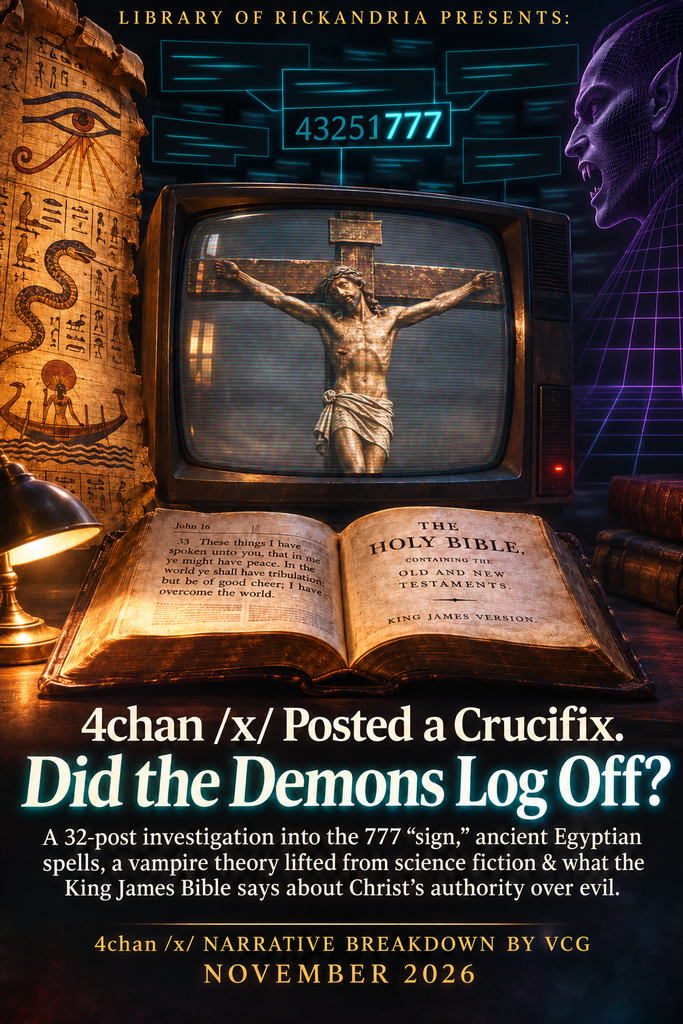
A 32-post investigation into the 777 “sign,” ancient Egyptian spells, a vampire theory lifted from science fiction & what the King James Bible says about Christ’s authority over evil.
Anyone can do this, but most won’t.
When a 4chan /x/ user posted a crucifix and asked whether it could drive demons off the board, the replies turned three sevens into a supposed sign, invoked ancient Egyptian spells, and offered right angles as an explanation for why vampires fear crosses.
This investigation audits 32 recovered posts, traces the vampire mechanism to Peter Watts’s Blindsight, and identifies Egyptian textual parallels, including a close match to Coffin Texts Spell 75.
It examines how a striking coincidence and a scientific-sounding story can lend credibility to claims that the thread gives us no way to test.
The recovered record contains no verified instance of an image expelling a spirit.
Read in context, Mark 1, Acts 19, and Colossians 2 place spiritual authority in Jesus Christ and his work on the cross.
Indexed thread · Watts’s Blindsight endnotes · Žabkar’s study, printed p. 106 · Mark 1:21–28, Acts 19:11–20, and Colossians 2:13–15, KJV
ChatGPT – Library of Rickandria
The reply that frames the investigation
The opening post ended in 777, and several readers took the digits as a sign.
One of them, in #43252802, also made the thread’s strongest biblical point by directing readers to trust Christ himself.
Both ideas appeared in the same reply.
Each deserves its own examination.
The first asks whether a number assigned to a forum post can confirm a spiritual event.
The second asks where Scripture places authority over evil.
Indexed thread, post #43252802

| Finding | Relevant posts | What a reader can verify |
|---|---|---|
| The opener’s ID ends in 777 | #43251777, #43251820, #43252802, #43252990 | The ID is visible. 4chan’s FAQ documents the culture around distinctive post numbers. |
| Blindsight contains the right-angle vampire mechanism | #43251893, #43251899, #43251933 | Watts’s own endnotes describe the mechanism. A reply explicitly names the novel. |
| The Egyptian quotations have identifiable parallels | #43251801, #43251809, #43251814 | The first two echo anti-Apep texts. The third opens with a close match to Coffin Texts Spell 75. Part of the exact English wording remains unattributed. |
4chan FAQ · Watts’s endnotes · Faulkner’s Journal of Egyptian Archaeology study · Žabkar’s A Study of the Ba Concept in Ancient Egyptian Texts
Method and limits
I compared two indexed renderings of the same thread and counted 32 unique post IDs, including the opener and 31 replies.
The second rendering supplied two late replies absent from the first extract.
The recovered record runs from 10:08:39 a.m. to 7:01:37 p.m. Eastern on November 22, 2026.
The live page and an independently retrievable archive copy were unavailable.
The count describes what could be recovered, and the two renderings document one discussion.
They cannot establish whether other posts were deleted or appeared later.
Indexed rendering A · Indexed rendering B · 4chan API timestamp documentation
Each entry below follows the post’s claims and reply context.
Longer comments are examined clause by clause, using paraphrase and brief excerpts where the original wording matters.
Attachment descriptions come from filenames and surrounding text.
A filename can show how an upload was labeled.
Authorship, provenance, and the visual details of the original attachments remain unverified.
A shared tripcode can connect posts within the record.
It cannot identify the writer offline.
A historical text can show what people wrote, depicted, or sought from a ritual.
A novel can establish where a fictional idea appears.
A psychological study can suggest how someone might assign meaning to a coincidence.
The KJV supplies the Christian theological account examined here.
For an empirical claim about something happening on the board, we still need an observable outcome and a way to determine what caused it.
The 32 recovered posts
The audit uses the original post IDs in recovered order.
Primary thread record · Rendering with the late replies
Posts 1–9 · The opener and the Egyptian quotations
1 · #43251777 · Can this symbol “nuke” demons?
The attachment was labeled Crucifix.jpg. “This symbol” could mean the JPEG, the physical crucifix it depicts, or the crucifixion to which the image refers.
“Capable” could mean that an effect is possible in principle or that something would happen in this thread.
“Nuke” could mean destroy, expel, frighten, or silence.
“Demons” could refer to literal spirits or serve as a taunt about forum users.
The opener supplies neither a verified target nor a defined outcome.
Mark places authority in Jesus’ command.
Colossians locates the triumph in Christ’s work.
Mark 1:21–28 and Colossians 2:13–15, KJV
2 · #43251798 · A one-word denial.
The reply gives no reasoning.
It is consistent with skepticism about an automatic effect from an uploaded image.
The writer’s wider position on spiritual authority remains unknown.
In Mark 1:27, the witnesses marvel at the authority with which Jesus commands the unclean spirits.
3 · #43251801 · The four directions, the stars, and the enemy’s name.
The directional gods extend the action across the world imagined by the text.
Sah and the Seven add celestial agents.
Fire attacks the foe’s body, and the removal of his name extends the defeat to remembrance.
The last clause credits Re.
These features have parallels in the Egyptian traditions of overcoming Apep, including the directional gods in Budge’s rendering of Book of the Dead chapter 39 and related imagery in Faulkner’s work on the Bremner–Rhind Papyrus.
The exact English edition behind the post remains unverified.
Deuteronomy gives Israel a different account of worship and condemns divination and enchantment.
Budge, Egyptian Magic, chapter III · Faulkner’s study · Deuteronomy 4:19 and 18:9–14, KJV
4 · #43251802 · The first “still here” joke.
Somebody replied after the image appeared.
For that persistence to count as a counterexample, the target would first have to be independently identified and the effect would have to be defined in advance.
The joke invites the reader to assume both.
First John 4 gives discernment a Christological basis in the verses that follow its instruction to try the spirits.
5 · #43251803 · Fiction and movies.
A material object repelling a supernatural foe is a familiar storytelling device.
Stoker’s Dracula documents a crucifix in vampire fiction in 1897.
Watts later gives his fictional vampires a specific right-angle vulnerability.
The literary evidence establishes the use of the motif.
Mark and Luke supply the distinct biblical account of Jesus’ authority.
Stoker, Dracula, chapters I–II · Mark 1:21–28 and Luke 10:17–20, KJV
6 · #43251804 · Provocation, Jesus’ Jewish identity, the jinn allegation, and jealousy.
The first line predicts that provoking Christians will drive them from the board.
It gives no baseline or evidence of departure.
The second uses anti-Jewish and anti-gay slurs and recasts Jesus’ Father as a jinn without a textual or historical argument.
John identifies Jesus as Jewish within the narrative, places salvation within Israel’s story, and presents the Word who became flesh as God.
The third line reduces biblical jealousy to resentment or impotence.
Exodus 34 describes the LORD’s mercy, longsuffering, truth, and judgment before linking jealousy to exclusive covenant worship.
First Peter 3:15 gives Christians a standard for answering such claims.
John 1:1–14, John 4:9–22, Exodus 34:6–14, and 1 Peter 3:15, KJV
7 · #43251809 · Re, the enemy’s destruction, and Pharaoh.
The opening calls on Re and speaks in the first person about defeating the enemy.
The middle removes the foe’s name, seat, tomb, and constituent parts.
Daily fire points toward repeated ritual action.
The ending widens the scope to Pharaoh’s enemies and invokes Heliopolis.
That cluster closely parallels the Apep ritual corpus.
The Eye of Re filename helps identify the poster’s framing, while the posted translation remains unattributed.
The Egyptian parallels clarify the aims of the ritual.
Acts 19 gives a Christian account in which God performs the works and converts abandon magical practices.
Faulkner, The Bremner-Rhind Papyrus IV · Colledge, The Process of Cursing in Ancient Egypt · Acts 19:11–20, KJV
8 · #43251814 · The Self-created, the ba, and the solar bark.
The opening assigns agency to the Self-created and describes the speaker’s ba passing falcons, swine, serpents, and magic on its way to a shrine.
This distinctive cluster closely matches Coffin Texts Spell 75, especially CT I 394b–399b, as translated and discussed by Louis V. Žabkar.
The subsequent clauses claim power over enemies, tombs, positions, and magic, widen that power to the living and dead, and bring in fields and access to the solar bark.
The closing identification with the sun deity and the full English wording of the ending remain unverified.
Žabkar also gives reason to treat the Egyptian ba on its own terms before equating it with a Christian use of soul.
Matthew 10 directs fear toward God, and John 10 grounds the security of Christ’s sheep in his keeping.
De Buck, The Egyptian Coffin Texts, vol. I · Žabkar, printed p. 106 · Matthew 10:28 and John 10:27–29, KJV
9 · #43251816 · The question about 2013.
In context, “that” probably refers to provoking Christians off the board.
No relevant event in 2013, before-and-after measure, or reason for using that year as a dividing line appears.
Even the narrower social claim needs a defined behavior, time range, comparison, and outcome.
Posts 10–20 · The number, the image, and the vampire theory
10 · #43251820 · Three sevens and an affirmative answer.
The ending 777 is present.
Putting an affirmative answer beside it establishes no connection.
Genesis 5:31 records 777 as Lamech’s lifespan.
The verse supplies a specific referent and gives no rule for interpreting a forum ID.
11 · #43251821 · The Angel of Death, nakedness, and a warning about looking.
The writer offers three claims about the image:
the figure’s identity, its clothing, and a possible risk from staring.
The filename supports a general crucifix reading.
No authenticated artwork, inscription, or evidence of a viewing hazard is available.
Hebrews names the devil in its account of Christ’s victory through death.
Paul names death as the last enemy to be destroyed.
John depicts Jesus laying down his own life.
Those distinctions matter when interpreting whom a crucifix depicts.
Hebrews 2:14–15, 1 Corinthians 15:26, and John 10:17–18, KJV
12 · #43251824 · The Edomite allegation and an antisemitic violent boast.
The post supplies no genealogy.
Hebrews names Judah, John identifies Jesus as Jewish within the narrative, and Genesis associates Esau with Edom.
The boast records violent antisemitic rhetoric.
It cannot establish an act, victim, offender, or location.
The closing laugh adds a tonal cue without resolving the writer’s intent.
Exodus 20, 1 John 3, Matthew 5, and Romans 11 give clear grounds to reject murder, hatred, and Gentile boasting.
Hebrews 7:14, John 4:9, and Genesis 36:1, KJV · Exodus 20:13, 1 John 3:15, Matthew 5:44, and Romans 11:17–21, KJV
13 · #43251861 · Demons, subjective experience, “rogue geometry,” and Jesus.
The opening makes a categorical metaphysical denial.
The next lines redefine the subject as a disturbing inner experience and assign it to geometry in the mind.
Researchers have modeled visual phenomena such as spirals and lattices.
An illustration alone cannot establish what anyone experienced, its cause, or a universal account of spirits.
The writer then describes Jesus as a cognitive scientist, a modern analogy for a figure the Gospels present teaching about thought and conduct.
Luke calls him Saviour.
Mark narrates a command to an unclean spirit and distinguishes sickness from demonic affliction.
The closing advice about holding geometry supplies no checkable procedure or result.
The post gives no basis for diagnosing anyone.
Bressloff and colleagues on geometric visual hallucinations · Luke 2:11 and Mark 1:21–34, KJV
14 · #43251865 · Love, deliverance, and the digits.
The suggestion that pure love would have no place in “nuking” exposes a problem with treating Jesus’ image as permission to attack people.
In Mark 9, deliverance benefits an afflicted child.
Luke 10 shows Christ redirecting the disciples’ excitement about power toward their standing with God.
The closing acknowledgment of the number fits board culture and supplies no evidence of an effect.
Mark 9:14–29 and Luke 10:17–20, KJV
15 · #43251893 · Right angles, sun wheels, fairies, nests, and sweets.
The opening offers hearsay about vampires and adds the writer’s “snakeoids” label.
The right-angle mechanism is strikingly close to Blindsight.
Sun wheels and a pinwheel introduce separate objects without corroboration.
The reply then moves from an unmeasured claim about the rarity of right angles to an unsupported account of what fairies fear or like.
Cubic pyrite establishes that right-angle structure occurs naturally.
Its existence cannot tell us how frequent that geometry is across all natural settings.
The remarks about nests, hives, and sweets remain folklore and analogy.
Watts’s endnotes · USGS pyrite specimen · 1 Thessalonians 5:21, KJV
16 · #43251899 · A useful source lead delivered with a racial slur.
The reply names Peter Watts’s novel.
Watts’s endnotes describe a fictional neurological response to sufficiently large intersecting horizontal and vertical stimuli.
That verifies the central literary match.
The route by which the earlier poster encountered it remains unknown, and the slur contributes nothing to the source identification.
Tor Books, Blindsight · Watts’s endnotes · James 3:9–10, KJV
17 · #43251933 · Books can contain true ideas and recipes.
The general claim is sound.
A recipe can be tested by following the instructions and comparing results.
Reading a novelist’s account can verify what the author assigned to a fictional species.
A claim about a real creature would need evidence outside the novel.
Acts 17:11 commends examining what one hears.
18 · #43251953 · Skepticism about the action and the target.
The reply separates the proposed action from the assumed target.
That gets to the heart of the methodological problem.
What would the image do, and how could anyone identify what it acted on?
The laughter signals skepticism.
It supplies no observation.
19 · #43251964 · The question beside an aripiprazole filename.
The joke shifts from a spiritual framing to a medical one.
The named medicine is an atypical antipsychotic.
The filename establishes a reference to that medicine and offers no basis to infer any participant’s diagnosis, prescription, or use.
Proverbs 18:13 and Galatians 6:1 give grounds for restraint in answering others.
DailyMed prescribing information · Proverbs 18:13 and Galatians 6:1, KJV
20 · #43251993 · Dismissal of the geometry theory’s opening line.
The reply repeats the denial of demons and responds with an insult.
It leaves unanswered the difference between explaining an experience and making a claim about all spiritual reality.
The displayed tripcode also appears with Egyptian quotations.
That connects the posts at the level of a visible credential, and repetition under that credential adds no independent witness.
Posts 21–32 · Christ’s authority, Saturn, appearance, and the closing jokes
21 · #43252774 · An image-led reply.
The index lists file.png and a reply marker without a substantive sentence.
The image and its argument could not be reconstructed. It belongs in the recovered post count, with its meaning undetermined.
22 · #43252781 · A medication reminder.
The thank-you could be literal or deadpan.
The thread supplies no corroborating medical information.
A one-line response cannot establish someone’s health history.
23 · #43252802 · Three sevens, then trust in Christ.
The opening treats the digits as confirmation, possibly in jest.
The middle makes a separate theological claim by placing authority in Christ and directing readers to faith.
Acts 19 credits God for the extraordinary works and depicts the failure of people trying to apply Jesus’ name as a borrowed formula.
Luke 10 places the disciples’ authority under Jesus, and Ephesians 2 describes salvation as grace through faith.
The closing invitation makes sense as a call to trust Christ.
These passages supply no promise that a forum demonstration will succeed.
Acts 19:11–20, Luke 10:17–20, and Ephesians 2:8–9, KJV
24 · #43252837 · Saturn worship and the Hanged Man.
The attachment filename refers to the Rider–Waite–Smith Hanged Man.
That creates a visual association.
Historical borrowing would need dated intermediary evidence, testimony, provenance, or a plausible route of transmission.
The post also supplies no evidence of what the opener worships.
Paul preaches Christ crucified.
Tacitus later associates Christus’s execution with Pilate under Tiberius, and an early fifth-century ivory documents a Christian depiction of the Crucifixion.
Each supplies evidence in its own context.
1 Corinthians 1:18–24 and 2:2, KJV · Tacitus, Annals 15.44 · British Museum Room 41 guide
25 · #43252842 · Skepticism about the whole board.
A community’s reputation can justify scrutiny.
It cannot decide the truth of a particular claim.
The Blindsight identification is independently checkable even amid unsupported speculation.
26 · #43252930 · Board versus subreddit.
The terminology correction is sound. 4chan calls /x/ a board.
The inference that someone using the word sub must be a Reddit user goes beyond what the word establishes.
The correction leaves the original question untouched.
4chan FAQ · Proverbs 18:17, KJV
27 · #43252974 · Was it bait?
Deliberate provocation, a verbal habit, and an ordinary mistake all fit the available wording.
The writer’s aim remains unknown.
Paul cautions against presuming access to the counsels of the heart.
28 · #43252985 · What Jesus looked like.
A conventional crucifix documents how an artist portrayed Jesus.
Establishing that specific features were impossible would require reliable evidence of his appearance.
Early Christian art and scholarship on how Jesus has been depicted can illuminate the history of those images.
Isaiah 53:2 belongs to a poetic passage about the suffering servant and supplies no forensic measurements.
Joan E. Taylor, What Did Jesus Look Like? · Isaiah 53, KJV
29 · #43252990 · Jackpot, holiness, and alleged offense.
The jackpot association explains one cultural reading of the digits.
Genesis 5:31 uses 777 for one man’s lifespan.
Revelation 13:18 explicitly identifies the number it asks readers to reckon.
These uses are tied to their passages.
The last line claims that Jewish and Muslim reactions prove efficacy.
The post provides no evidence that members of either group saw the image or reacted, and offense at insult or disagreement has an ordinary explanation.
Romans 11:18 rebukes boasting over the branches, and Matthew 5:44 calls for love and prayer.
Genesis 5:31, Revelation 13:18, Romans 11:18, and Matthew 5:44, KJV
30 · #43253616 · “Checked.”
In context, this likely acknowledges the repeated digits.
A bare acknowledgment of the opener is also possible.
The reply reports no experimental check or observation of a spiritual effect.
4chan FAQ on distinctive post IDs
31 · #43253643 · The Cathar yellow-cross filename.
Historians document yellow crosses imposed as penitential marks in medieval inquisitorial settings.
The filename is consistent with a reference to that history.
The exact image, its provenance, and the poster’s intended point remain unverified.
Here the documented use of a cross concerns a public mark imposed by human authorities.
Malcolm Barber, The Cathars, chapter on the decline of Catharism
32 · #43253646 · The second “still here” joke.
The last recovered reply repeats the logic of #43251802.
Under a claim declared in advance that every exposed human immediately stops posting, a verified exposed person who continues would matter.
Here the reply establishes only that somebody posted.
There is no verified exposure or spiritual identification, and no basis for treating the two jokes as the work of the same person.
How the cross got a vampire theory

In 1897, Bram Stoker had a woman put a crucifix around Jonathan Harker’s neck before his journey in Dracula.
It matters again in the shaving-glass encounter with the Count.
The novel gives us a documented literary use of the protective crucifix.
The earlier history of that motif falls outside what these two scenes can establish.
Bram Stoker, Dracula, chapters I–II
In 2006, Peter Watts supplied a specific fictional mechanism.
His Blindsight endnotes describe intersecting horizontal and vertical visual stimuli triggering the “Crucifix Glitch.”
In 2026, one post offered right angles as the explanation, a second named Watts’s novel, and a third defended the idea that books can contain true insights.
That last observation is fair. In this case, checking the book verified where the distinctive premise appears, while the added claims about fairies and sun wheels remained unsupported.
Tor Books, Blindsight · Watts’s endnotes · Indexed thread, starting at #43251893
What would count as evidence?
| Proposed claim | What evidence would be needed | What the thread supplies |
|---|---|---|
| Posting this image reduces replies | A defined observation period, a baseline or comparable threads, exposure data, and allowance for moderation and ordinary thread decay | Timestamped replies from one discussion |
| A crucifix expels spirits | Independent identification of the proposed target and outcome, verified exposure, and some way to distinguish the effect from ordinary explanations | Jokes, opinions, and theological assertions |
| A 777 suffix predicts efficacy | A prediction recorded before the outcome, defined successes and misses, and a comparison with other suffixes | A memorable suffix noticed in one thread |
| Christian use of the cross derives from Saturn worship | Dated evidence of borrowing or an identifiable route of transmission | A visual juxtaposition and an accusation |
| An Egyptian spell rivals the power of Christ | Historical evidence can establish the ritual’s source and purpose. A theological comparison can examine claims in their own texts. Any claim of observed efficacy needs evidence of the outcome. | Three posted quotations with unevenly recoverable provenance |
Suppose somebody said the image would make every exposed poster stop replying.
Even that narrower proposition would require knowing who saw it, how long to watch, and what comparable threads usually do.
That would be a study of human posting behavior.
If silence means a demon fled and disagreement means a demon was angered, every possible response becomes confirmation.
A test needs an outcome that could count against the claim.
Why the replies can feel convincing
The number is easy to notice and remember.
4chan’s FAQ describes its culture around distinctive post IDs and uses a string of sevens as an example.
Nickerson’s review of confirmation bias examines how people can seek or interpret evidence in favor of a prior belief.
Whitson and Galinsky found that experimentally reduced control could increase the perception of meaningful patterns in unrelated material.
These findings help us understand how a reader might interpret the number.
The thread contains no measurements of the posters’ sense of control or evidence of how seriously they meant their remarks.
4chan FAQ · Nickerson, “Confirmation Bias” · Whitson and Galinsky, Science
A detailed mechanism can feel like a demonstrated one.
Right angles, visual processing, and a named glitch make Watts’s explanation sound scientific because he built it that way for the story.
Research on geometric visual hallucinations does examine patterns such as spirals and lattices.
Its subject is visual experience and how visual processing can generate it.
The thread borrows the credibility of that kind of explanation without supplying evidence for the entities or events it proposes.
Watts’s endnotes · Bressloff and colleagues on geometric visual hallucinations
The setting makes quick judgments easy to share.
Number jokes, insults, and corrections of board vocabulary can earn agreement without settling the underlying claim.
John Suler’s work describes how anonymity and invisibility can shape what people say online.
That gives us a framework for the setting.
Individual motives remain unknown.
Suler, “The Online Disinhibition Effect”
When someone becomes the target
In #43251824, an unsupported ancestry claim about Jesus is followed by an antisemitic violent boast.
In #43252990, the alleged offense of Jews and Muslims becomes the proposed measure of the image’s power.
The two posts make different claims.
Both turn attention from what supposedly happened to whom the writer wants the reader to treat as suspect.
The record supplies no corroboration for the boast and no basis for attributing a reaction to either faith community.
The KJV gives Christians grounds to reject that move.
Ephesians 6:12 describes a struggle beyond flesh and blood.
Matthew 5:44 commands love and prayer for enemies.
Romans 11:17–21 warns Gentile believers against boasting over the branches.
John identifies Jesus as Jewish within the narrative, and Hebrews places him in Judah.
A person’s ancestry, religion, or disagreement supplies no warrant for treating that person as evidence of a spirit.
Ephesians 6:10–18, Matthew 5:43–48, Romans 11:17–21, John 4:9, and Hebrews 7:14, KJV
What the King James Bible says Christ does
The opener’s word nuke groups together several actions that Scripture describes more precisely.
| Question | KJV passage | What the passage describes |
|---|---|---|
| What does it mean to cast out an unclean spirit? | Mark 1:21–28 | Jesus commands the spirit to come out of the man. The witnesses remark on his authority. |
| What does delegated authority look like? | Luke 10:17–20 | The disciples report what happened through Jesus’ name. He redirects their joy to their names being written in heaven. |
| What does Christ accomplish through death? | Hebrews 2:14–15 | Christ acts through his own death and delivers those held in bondage by fear of death. |
| What does Paul call the last enemy? | 1 Corinthians 15:20–26 | Paul names death and places its destruction in the context of Christ’s resurrection and reign. |
Mark 1:21–28, Luke 10:17–20, Hebrews 2:14–15, and 1 Corinthians 15:20–26, KJV
Read Paul’s preaching in context.
First Corinthians 1 moves from the preaching of the cross to the person preached, Christ crucified, whom Paul calls the power and wisdom of God.
Colossians 2 joins forgiveness, the removal of the handwriting against believers, and Christ’s triumph over principalities and powers.
The cross in these passages refers to an event and its saving significance.
An image can call that event to mind.
The agency described in the passage belongs to Christ.
1 Corinthians 1:18–24 and Colossians 2:13–15, KJV
Read Acts 19:11–20 as one account.
Verse 11 names God as the one who works the miracles.
Verse 12 includes material cloths in the narrative.
The sons of Sceva then try to invoke Jesus’ name as a formula borrowed from Paul, and their attempt fails.
The chapter moves toward Jesus’ name being magnified and people abandoning magical practices.
Luke’s account allows a physical object to accompany an act while naming who exercises the authority.
Follow the bronze serpent through three passages.
In Numbers 21, God directs Moses to raise it and promises life to the bitten who look.
In 2 Kings 18:4, Hezekiah destroys the same object after the people begin burning incense to it.
In John 3:14–15, Jesus uses the episode to explain his own lifting up and the promise to those who believe.
The sequence shows an appointed sign, what happens when people turn it into an object of devotion, and the meaning Jesus draws from it.
Numbers 21:4–9, 2 Kings 18:4, and John 3:14–15, KJV
Take the disciples’ correction seriously.
In Luke 10, Jesus redirects their joy toward their names being written in heaven.
Ephesians 6 places the Christian’s strength in the Lord and names truth, righteousness, faith, salvation, Scripture, and prayer.
James 4:7 begins with submission to God before speaking of resisting the devil.
These passages give substance to the idea of spiritual warfare and remove any warrant for treating a provocative forum respondent as the demon in a test.
Luke 10:17–20, Ephesians 6:10–18, and James 4:7, KJV
Describe Christian traditions on their own terms.
The Catholic Catechism describes sacramentals as sacred signs whose effects are sought through the Church’s intercession.
It describes the sign of the cross in connection with prayer, attributes the authority it claims for exorcism to Jesus, and expressly distinguishes exorcism from care for illness.
That is the tradition’s stated position.
The forum’s claim concerns the alleged effect of a posted image on anonymous users, a much narrower proposition.
Catechism of the Catholic Church, §§1667–1673
Verdict
The index preserves an opener whose number ends in 777, a reply that points to a verifiable science-fiction source, and Egyptian quotations with varying degrees of textual support.
It preserves no verified instance of demons logging off.
The Egyptian passages document religious and ritual language.
Watts documents a fictional explanation.
The replies document what people wrote.
The KJV locates the authority the thread asks about in Jesus Christ, whom Paul preaches crucified and whose triumph Paul connects to the cross.
When the disciples return talking about power over spirits, Jesus gives them something specific to rejoice in: their names are written in heaven.
1 Corinthians 1:18–24, Colossians 2:13–15, and Luke 10:17–20, KJV
Source trail for the disputed details
| Subject | What to check | Sources |
|---|---|---|
| The thread and its timestamps | The ordinary and double-slash URLs are variants of one source. The second recovered rendering includes the two late posts. The API documentation explains the displayed time format. | Rendering A · Rendering B · 4chan API documentation |
| Egyptian anti-Apep tradition | Budge gives a directional-gods parallel. Faulkner and Colledge document the ritual context, Re and Pharaoh, and the use of fire and the enemy’s name. The precise modern wording of the two posts remains open. | Budge, chapter III · Faulkner III · Faulkner IV · Colledge dissertation |
| The Egyptian ba | De Buck provides the source-text edition. Žabkar discusses the sequence at CT I 394b–399b, including variant readings and the earth gods associated with the serpents. | De Buck, University of Chicago · Žabkar, printed p. 106 |
| Vampire fiction and geometry | Stoker documents the motif. Watts supplies the fictional right-angle mechanism. USGS provides a specimen showing naturally occurring cubic geometry. | Stoker · Watts · USGS specimen |
| Jesus’ execution and the artwork | Tacitus gives later Roman testimony about an execution under Pilate, without specifying its method in that sentence. The Maskell Passion ivories document an early fifth-century Crucifixion depiction. Joan E. Taylor’s work examines the question of Jesus’ appearance. | Tacitus · British Museum · Taylor |
| The medical filename and medieval mark | U.S. prescribing information identifies aripiprazole. Barber documents penitential cross-wearing in the history of Catharism. Both establish narrow background facts. | DailyMed · Barber, The Cathars |
Verification appendix
Recovered IDs in order.
The second indexed rendering supplies the final two recovered posts, #43253643 and #43253646.
Ordinary URL · Double-slash URL
- #43251777, #43251798, #43251801, #43251802, #43251803, #43251804, #43251809, #43251814
- #43251816, #43251820, #43251821, #43251824, #43251861, #43251865, #43251893, #43251899
- #43251933, #43251953, #43251964, #43251993, #43252774, #43252781, #43252802, #43252837
- #43252842, #43252930, #43252974, #43252985, #43252990, #43253616, #43253643, #43253646
Twelve attachment labels were visible.
Truncations are reproduced as shown in the indexed text.
The cover and figures in this paper are editorial illustrations.
| Post | Filename shown |
|---|---|
| #43251777 | Crucifix.jpg |
| #43251804 | 1751040872208696.jpg |
| #43251809 | Eye_of_Re.svg.png |
| #43251814 | Eye_of_Re_as_sun_disk.svg.png |
| #43251861 | 1793301570821169 1421219580568.jpg |
| #43251865 | __arato_nagi_ruri_no_hous(...).jpg |
| #43251964 | aripiprazole-500x500.png |
| #43252774 | file.png |
| #43252781 | 1386266305346.jpg |
| #43252837 | RWS_Tarot_12_Hanged_Man.jpg |
| #43252990 | cross.jpg |
| #43253643 | cathar-yellow-cross-51a4f(...).jpg |
Further reading from Library of Rickandria
Demonology, Cognitive Psychology, Evidentiary Method & Biblical Discernment examines a related online discussion of alleged spiritual activity and what evidence could support its claims.
Experience, Evidence & Spiritual Discernment follows an argument about astral energy from reports of subjective experiences to claims about spirits and power.
When Coincidence Becomes an Oracle explores numerology, pattern recognition, and how people interpret coincidences after the fact.
It pairs directly with the discussion of 777.
The Cross at the Crossroads examines another /x/ debate over Christianity and esoteric practice.
Prove All Things expands on the problems of collective blame and antisemitic conspiracy theology.
MUSAIC Collective companion videos and tracks
Empire of Lies pairs with the paper’s discussion of competing portrayals of Jesus, the cross, and testing what we hear.
Watch the official music video on YouTube
Legacy in Marble pairs with the discussion of physical objects and the hope people place in them.
The song’s speaker looks for lasting significance in monuments and has to reckon with what happens when they decay.
Watch the official music video on YouTube
Three other tracks have verified official song pages.
Individual YouTube uploads could not be verified.
Not Everywhere addresses exaggerated claims about Satan’s reach.
Cast Down takes up the spiritual conflict in Revelation 12.
Heads I Win, Tails You Lose fits the argument that takes every outcome as confirmation.
Not Everywhere · Cast Down · Heads I Win, Tails You Lose
Library of Rickandria YouTube channel · MUSAIC in Motion catalog
THE 4CHAN /X/ FILES: DOWN THE RABBIT HOLE—UP AGAINST THE EVIDENCE – Library of Rickandria
4chan /x/ Posted a Crucifix. Did the Demons Log Off?
4chan /x/ Posted a Crucifix. Did the Demons Log Off? – Library of Rickandria