UPDATED BY VCG ON 11/6/2026 @ 19:19 EST
An Evidence-Based Investigation into Apocalyptic Predictions, Global Crises, Conspiracy Narratives & What the King James Bible Actually Says.
Anyone can do this, but most won’t.
2027: The Year Everything Falls Apart? — Exposing the Fear, False Prophecies & Hidden Psychology of 4chan’s Doomsday Thread
is an extensive investigative study by the Library of Rickandria that dissects a November 2026 discussion on 4chan’s paranormal board, where anonymous users connected:
- artificial intelligence
- global conflicts
- financial instability
- government secrecy
- electromagnetic threats
- alien-invasion predictions
- biblical prophecy
to an alleged approaching worldwide catastrophe.
Through a line-by-line examination of the original thread and its 22 replies, the paper separates verified historical events from exaggerations, unsupported conspiracy allegations, psychological speculation, and unsubstantiated predictions extending from 2027 to 2042.
Drawing on:
- government records
- scientific research
- historical investigations
- peer-reviewed psychology
it explores how genuine crises can become woven into seemingly convincing apocalyptic narratives through:
- confirmation bias
- catastrophizing
- pattern recognition
- fear
and repeatedly revised predictions.
The investigation also:
examines the origins and unresolved authenticity of an alleged alien-invasion prophecy,
compares modern doomsday claims with historical failed predictions,
evaluates assertions about:
- the Antichrist
- artificial intelligence
- spiritual immortality
- the end times against the King James Bible
Particular attention is given to:
- Matthew 24
- Deuteronomy 18
- Jeremiah 23
- 2 Thessalonians 2
- Revelation 13
carefully distinguishing what Scripture explicitly teaches from modern theological interpretations.
Rather than dismissing legitimate concerns about corruption, technological disruption, or geopolitical instability, the study argues that real dangers do not automatically establish a coordinated global conspiracy or a divinely revealed timetable.
Ultimately, the paper calls readers toward:
- intellectual honesty
- responsible investigation
- biblical discernment
- practical preparedness
and freedom from fear-driven certainty, guided by the principle of 1 Thessalonians 5:21:
“Prove all things; hold fast that which is good.”
ChatGPT – Library of Rickandria
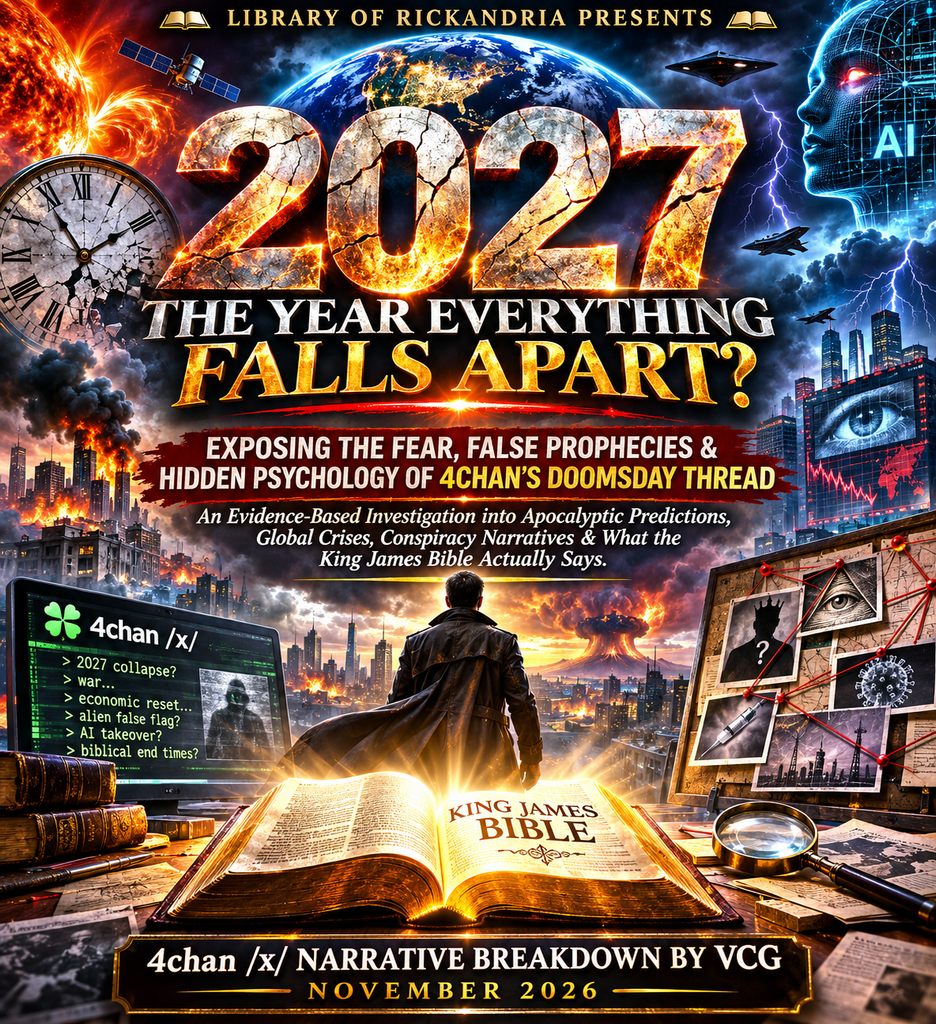
Original cinematic cover artwork for the Library of Rickandria.
This is a conceptual illustration of the fears investigated in the paper, not photographic evidence of a predicted catastrophe.
LIBRARY OF RICKANDRIA PRESENTS
2027: The Year Everything Falls Apart?
Exposing the Fear, False Prophecies & Hidden Psychology of 4chan’s Doomsday Thread
An Evidence-Based Investigation into Apocalyptic Predictions, Global Crises, Conspiracy Narratives & What the King James Bible Actually Says
4chan /x/ Narrative Breakdown by VCG
November 2026
LIBRARY OF RICKANDRIA • INVESTIGATIVE RESEARCH SERIES • SCRIPTURAL EXAMINATION • DIGITAL FORENSICS
Original discussion:
/x/ – Impending sense of dread – Paranormal – 4chan
Primary research website:
Library of Rickandria – OUR GREATEST FEARS MANIFEST DUE TO OUR LACK OF KNOWLEDGE.
Research cutoff:
November 6, 2026.
Future events mentioned in this paper are evaluated as predictions, not as events that have occurred.
Abstract
On November 5, 2026, an anonymous participant on 4chan’s paranormal board, /x/, published a discussion titled Impending sense of dread.
/x/ – Impending sense of dread – Paranormal – 4chan
The writer expressed a growing conviction that the world was approaching some kind of catastrophe in 2027.
The post did not begin with an elaborate prophetic calculation.
Instead, it assembled a series of contemporary anxieties:
- public indifference toward the Jeffrey Epstein scandal
- artificial intelligence straining electricity infrastructure
- warfare affecting oil production
- North Korean cryptocurrency theft
- AI-assisted cyberattacks
- electromagnetic-pulse threats
- political hostility
and increasingly pessimistic expectations about the future.
The writer then raised the possibility that these developments were connected to an older anonymous alien-invasion prediction.
What followed was a revealing exchange.
Some participants challenged the original writer’s reasoning.
Others mocked the anticipated disaster, predicted Western civilizational decline, or proposed supernatural explanations.
One commenter introduced a chronology extending from 2027 to 2042, including:
- robot warfare
- an Antichrist
- worldwide domination
- technological immortality
The resulting discussion contains a mixture of:
- verifiable events
- legitimate concerns
- unsupported generalizations
- political judgments
- psychological speculation
- occult ideas
and claims about biblical prophecy.
This investigation examines the original post and all 22 visible replies, using the accessible archived discussion as its primary source.
The objective is not to ridicule people who are worried about the future.
Nor is it to insist that governments, corporations, or powerful institutions are incapable of wrongdoing.
History demonstrates otherwise.
Instead, the inquiry asks how reliably the claims can be established, whether their proposed connections are supported, and what conclusions may reasonably be drawn from them.
Special attention is given to:
- the attached alien-invasion screenshot
- the thread’s dated predictions
- the psychological literature on threat perception and conspiratorial thinking
- documented historical apocalyptic movements
- the King James Bible
and the different ways Christians interpret prophetic passages.
The principal finding is straightforward:
Several dangers described in the thread are real.
The evidence examined here does not establish that they form a coordinated apocalyptic sequence, that civilization will collapse in 2027, or that the anonymous chronology extending to 2042 possesses prophetic authority.
The investigation consequently distinguishes between what can be demonstrated, what remains possible, what is theological interpretation, and what the biblical text actually says.
“Prove all things; hold fast that which is good.”— 1 Thessalonians 5:21, KJV
PART I — THE THREAD AND THE METHOD
Chapter 1. A feeling of dread becomes a theory of the future
The original discussion appeared on Thursday, November 5, 2026, at 7:24:42 a.m. according to the time displayed by 4chan.
Its title was Impending sense of dread, and its identifying number was 43173307.
The opening question was:
“Why does it feel like everything is lining up to fall apart next year?”
This question is the foundation of the entire discussion.
It begins with a feeling, moves into observations about contemporary society, introduces a collection of possible threats, and eventually considers whether those threats might share a hidden cause.
The progression matters.
A person can genuinely feel that the future is dangerous without possessing reliable information about precisely what will happen.
Anxiety does not necessarily mean a danger is imaginary.
But neither does the intensity of anxiety establish that a particular disaster is coming.
The writer’s concerns were not all invented.
At the time of the thread,
- cryptocurrency theft
- cyberattacks
- political violence
- military conflict
and pressure on electricity infrastructure were legitimate subjects of public reporting.
This is what makes the discussion worth examining carefully.
It is not simply a collection of fantastic claims detached from reality.
Rather, it shows how documented events can become part of a broader narrative that makes much stronger predictions than the evidence can support.
The replies then introduce several competing interpretations.
One contributor believes the world is deteriorating without approaching an actual apocalypse.
Another anticipates ideological changes brought about by scarcity.
Another describes 2030 as particularly ominous.
Still another presents an elaborate chronology of futuristic warfare and Antichrist rule.
These cannot all be treated as one consistent doctrine.
They are different people’s contributions to a discussion united more by anxiety and speculation than by a shared body of evidence.
The complete thread is accessible here:
/x/ – Impending sense of dread – Paranormal – 4chan
The visible record includes the opening post and 22 replies, dated November 5, 2026.
The thread is marked as archived and no longer accepts replies.
Chapter 2. How this investigation separates evidence from interpretation
A successful fact-check cannot simply label an assertion ridiculous and move on.
It must explain what was claimed, what evidence would be necessary to establish it, and what the available record actually demonstrates.
The same standard must apply to government statements, anonymous allegations, scientific predictions, and our own conclusions.
For this paper, six distinctions are essential.
First, a documented event is not the same as a complete explanation of that event.
We may know that a cryptocurrency theft occurred without knowing every technique used, every accomplice involved, or every motive.
Second, a plausible risk is not the same as an imminent disaster.
Electrical-grid vulnerabilities can be real without proving that an unprecedented global blackout is scheduled.
Third, a person’s interpretation is not necessarily a statement of fact.
A writer may see national decline in a series of events while another sees a period of institutional stress from which recovery remains possible.
Fourth, a prediction is not evidence of foreknowledge.
It must be evaluated against its original wording, the information available when it was made, and an objectively specified outcome.
Fifth, a psychological explanation is not a diagnosis.
Researchers can identify patterns such as confirmation bias or catastrophizing without diagnosing anonymous forum contributors.
Sixth, a biblical comparison is not automatically a biblical identification.
A modern technology might resemble a feature in an apocalyptic interpretation without Scripture explicitly naming that technology.
Evidence classifications
| Classification | Standard used |
|---|---|
| Verified | Strong documentary or empirical support for the precise claim |
| Partly supported | A demonstrable factual component, but an exaggerated or unsupported extension |
| Contradicted | Reliable evidence materially conflicts with the assertion |
| Unsupported | Adequate corroboration has not been established |
| Speculative | An interpretation, possibility, or prediction not presently demonstrable |
| Not assessable | The claim is too vague, subjective, or undefined to test |
An unsupported claim should not automatically be called impossible.
A contradicted claim should not be preserved simply because it forms part of a compelling narrative.
Source hierarchy
The investigation gives particular weight to:
- original documents
- official records
- technical reports
- peer-reviewed research
- contemporaneous reporting
Institutional sources are not treated as infallible.
Their provenance, methods, possible limitations, and conflicts of interest remain open to examination.
When two reliable sources disagree, the disagreement should be explained rather than concealed.
The biblical examination follows a parallel discipline:
identify the actual passage, read its immediate context, compare related passages, consider the historical setting, and distinguish explicit teaching from theological inference.
Limitations
The thread itself is directly accessible, but the attached alien-invasion image is a composite containing earlier material.
The image’s presence in the November 2026 thread does not automatically authenticate every screenshot reproduced within it.
Likewise, the available record does not establish the identities, mental-health conditions, sincerity, or intentions of the anonymous contributors.
This paper does not purport to inspect classified intelligence, private banking records, or all evidence that may exist beyond the public record.
Its conclusions concern what the accessible evidence presently supports.
Chapter 3. The alien-invasion screenshot: What has actually been authenticated?
This is the investigation’s most important unresolved source question.
The opening post includes an image named SchizoDreamAnonAlienInvasion.jpg, listed as a 3 MB JPEG measuring 3678 × 2511 pixels.
Original attachment:

1793881482692503.jpg (3678×2511)
The image is a composite of earlier forum material.
It contains text resembling archived anonymous discussions, together with other visual elements.
We can establish that the November 5 thread included this attachment.
We can also establish that a reply, #43173608, disputed its relevance by saying that the earlier prediction was supposed to concern 2025.
What we have not yet established is that every internal screenshot accurately represents its original thread, including its first publication date, complete wording, and posting history.
This distinction is crucial.
Suppose someone presents a screenshot supposedly predicting an extraordinary event.
Before using it as evidence of foreknowledge, a researcher needs to establish that the prediction existed before the alleged fulfillment.
A composite created later may accurately preserve an earlier document.
But that accuracy must be demonstrated rather than assumed.
The necessary questions are straightforward:
Can the original post be located by its ID?
Do other archived copies agree?
Does the displayed timestamp correspond to a genuine archived record?
Were the words edited or rearranged?
Did the author make specific predictions, or merely describe possibilities that could be interpreted many different ways?
A screenshot can provide a valuable lead. It is not, by itself, proof of the claims it displays.
Exhibit 1. Original Library of Rickandria forensic workflow.
This is the process required to authenticate and evaluate the older prediction, not a claim that every step has already been completed.
The problem of shifting dates
There is an additional complication.
The opening poster is considering 2027.
The reply challenging the alien-invasion material refers to 2025. Later contributors focus on 2030 and even 2042.
These dates may come from different people making separate claims.
We cannot automatically accuse the original prediction’s author of changing the date unless we establish that the author actually did so.
That is an important restraint.
The existence of several contradictory dates within an online conversation is not proof that one person deliberately revised a failed prophecy.
Still, the disagreement exposes the need for a permanent record.
If a forecast originally specified 2025, its success must be evaluated against 2025.
Moving the relevant deadline to 2027 without evidence that such a change was part of the original forecast would be methodologically invalid.
Finding
Authenticated:
The November 2026 thread and its attached image exist in the accessible primary record.
Documented allegation:
A reply asserts that the earlier prediction concerned 2025.
Unresolved:
The original provenance and complete authenticity of the older prediction.
Not established:
That its author possessed extraordinary foreknowledge or accurately predicted an alien invasion.
The earlier material warrants further archival investigation, but it cannot presently serve as the foundation for a conclusion that an invasion or civilization-ending event is imminent.
PART II — WHAT THE OPENING POST GETS RIGHT, WRONG, AND CANNOT PROVE
Chapter 4. Thirteen claims beneath one feeling of impending collapse
Exhibit 2. Evidence assessment as of November 6, 2026.
The classifications concern the specific claims made in the thread, not whether the underlying subjects are worth investigating.
Claim 1. Society has become apathetic, hostile, and psychopathic
The writer begins by describing an apparently cold and hostile public, then makes the much stronger assertion that most ordinary people have become high-functioning psychopaths.
There are two questions here.
The first concerns whether society is becoming more hostile.
That can be investigated using surveys, political-violence data, social-trust measures, and longitudinal research.
The second concerns whether most people meet criteria for psychopathy.
That is a clinical and psychological claim, not a loose synonym for selfishness.
A 2021 systematic review and meta-analysis examined 15 studies, with 16 samples totaling 11,497 participants.
It estimated an overall prevalence of 4.5%, although the figure varied substantially depending on measurement methods and populations.
Using the Psychopathy Checklist–Revised, the estimated prevalence was approximately 1.2%.
These estimates have limitations.
Nevertheless, they provide no basis for claiming that most people are psychopaths.
Research:
The writer’s observation may reflect encounters with indifference, aggression, or social alienation.
Those experiences deserve consideration.
But a population-wide psychiatric conclusion does not follow from them.
Psychological interpretation:
This resembles overgeneralization.
Especially memorable negative interactions can come to represent a much larger population in a person’s expectations.
Scripture: Genesis 1:27 establishes mankind’s creation in God’s image.
Romans 3:23 teaches the universality of sin, but universal sinfulness and clinical psychopathy are not interchangeable concepts.
James 3:9–10 also reminds readers that human beings remain morally significant even when their conduct is deserving of criticism.
Verdict:
Unsupported as stated.
Claim 2. The Epstein records were forgotten, as powerful people supposedly intended
The writer argues that the release of Epstein-related material briefly shocked attentive members of the public, after which most people lost interest.
The post further suggests that this forgetfulness was an intended result.
The scandal is real.
Crimes committed against vulnerable people and failures of accountability deserve serious scrutiny.
But the claim mixes several different questions:
Were all responsive records released?
Did public attention diminish?
Were important leads ignored?
Did any institution deliberately suppress material?
Did interest genuinely disappear?
Those questions must be examined separately.
On January 30, 2026, the Department of Justice announced that it had published more than three million additional pages, bringing its total production to approximately 3.5 million pages.
It described categories of excluded material, including duplicates, privileged records, specified statutory exceptions, and material it considered unrelated.
That was the department’s statement about compliance, not an independent audit establishing that every record was properly included or withheld.
Primary source:
Document repository:
Department of Justice | Epstein Library | United States Department of Justice
The investigation must remain open to the possibility of omissions, inappropriate redactions, institutional failures, and unlawful withholding.
The department’s assurance cannot by itself settle those concerns.
But the assertion that the controversy had virtually disappeared is contradicted by reporting published on the very day of the thread.
On November 5, Axios described renewed congressional efforts to obtain additional disclosure and pursue investigations after the midterm elections.
Contemporaneous reporting:
Epstein files vote push, investigations loom after midterms
That evidence does not guarantee future accountability.
It does show that the subject remained politically active.
There is also a moral issue worth preserving.
The public’s failure to give sustained attention to a case does not make the underlying victims less deserving of justice.
Psychological interpretation:
The post treats an impression of public indifference as evidence that unknown actors successfully engineered that indifference.
This confuses an observed or presumed outcome with an explanation of the outcome.
Scripture: Proverbs 18:17 warns against accepting the first account without examination.
Proverbs 31:8–9 emphasizes speaking up for those who cannot adequately defend themselves.
The relevant biblical principle favors continued pursuit of justice and careful inquiry, not automatic acceptance of either institutional assurances or sweeping accusations.
Verdict:
Genuine accountability questions; the prediction that the controversy had disappeared was contradicted by contemporaneous evidence.
The alleged plan to make people forget remains unsupported.
Claim 3. Artificial intelligence is exhausting the global power grid
This claim begins with a real infrastructure problem.
Advanced data centers require electricity, transmission capacity, cooling, transformers, and other resources.
AI infrastructure has made those demands substantially more significant.
The International Energy Agency’s updated projections estimate that data-center electricity consumption could increase from approximately 485 terawatt-hours in 2025 to 950 terawatt-hours by 2030.
That would be approximately 3% of projected global electricity demand.
The IEA also identifies major bottlenecks in energy equipment, chip manufacturing, and infrastructure development.
Primary research:
Executive summary – Key Questions on Energy and AI – IEA
These findings make the original concern legitimate, but they do not support the statement that the world’s entire power grid is already at its limits.
The problem is one of scale.
A region with insufficient generation or transmission capacity can face serious restrictions even when the planet as a whole has substantially more electricity available.
A data center delayed because of transformer shortages does not mean every other industry faces the same condition.
A growing infrastructure problem does not automatically become an imminent worldwide collapse.
Psychological interpretation:
This is catastrophic extrapolation.
An identifiable pressure on one system is extended into a claim about the failure of all interconnected systems.
Scripture:
Proverbs 14:15 favors prudent examination.
Biblical wisdom does not eliminate the need for engineering data.
The Bible does not quantify modern electricity demand.
Verdict:
Partly supported, but substantially exaggerated.
Claim 4. Warfare is damaging refineries and making energy more expensive
This is another area where the thread raises a genuine concern.
Armed conflict can disrupt energy supply, damage refining capacity, interfere with shipping routes, and increase insurance or transportation costs.
Reuters reported on November 5, 2026, that analysis of video footage suggested an attack affecting the area of Russia’s Ryazan refinery.
The report was careful about what could not be established:
the precise date of the footage had not been independently confirmed, and the extent of refinery damage remained uncertain.
Source:
Attack appears to hit Russia’s Ryazan oil refinery, Reuters analysis finds | Reuters
This is how responsible event verification should work.
Even when strong evidence suggests an attack occurred, uncertainties about location, timing, or damage should not simply disappear from the conclusion.
War involving Iran also formed part of the 2026 geopolitical and economic environment.
Its effects on fuel prices and international political decisions were documented in contemporary reporting.
Nevertheless, the assertion that warfare is making everything more expensive is too broad to accept without qualification.
Energy prices influence transportation and production costs, but consumer prices also respond to demand, supply substitution, monetary conditions, inventories, currency movements, and public policy.
The correct conclusion is that attacks on energy infrastructure create significant economic risks and can contribute to higher costs.
They do not establish that the entire economic system must collapse in 2027.
Scripture:
Matthew 24:6 recognizes the reality of wars while cautioning against premature claims concerning the end.
Verdict:
The underlying conflict and energy risks are documented.
The inference of inevitable global collapse is unsupported.
Claim 5. North Korea stole approximately $6.5 billion in cryptocurrency using AI
Here the original writer was describing a strikingly large incident that really did occur.
On October 31, 2026, the FBI publicly attributed the theft of more than $6 billion in cryptocurrency from Binance to North Korean actors associated with the operation called TraderTraitor.
The FBI reported that the theft occurred around October 29 and warned that stolen assets were being converted and potentially laundered through decentralized financial services.
FBI advisory:
North Korea Responsible for $6 Billion+ Binance Attack — FBI
Chainalysis independently published blockchain analysis estimating approximately $6.4 billion in unauthorized transfers and identifying activity associated with TraderTraitor.
It also reported that substantial assets were frozen.
Blockchain investigation:
Binance Hack: Tracing the $6.4 Billion Theft to North Korea – Chainalysis
These sources substantiate the core theft and the public attribution.
What they do not establish is the specific assertion that autonomous AI performed the Binance intrusion.
Chainalysis described signs of automation in the movement of funds.
But automated transaction patterns do not, by themselves, identify an AI system as the cause of the original compromise.
Malicious software, scripts, and human-operated systems have been capable of automating transactions long before modern generative AI.
The distinction matters even when an event is as serious as this one.
A correct statement about the magnitude of a theft should not be used to smuggle in an unverified statement about how it occurred.
Scripture: Proverbs 18:13 warns against reaching a conclusion before hearing the matter.
Here, further forensic evidence would be necessary to substantiate the AI-specific allegation.
Verdict:
The theft and public North Korean attribution are strongly supported.
The proposed AI execution method is not established by the cited evidence.
Claim 6. AI agents are compromising financial institutions
This is not the same claim as the Binance allegation.
The thread also refers more generally to AI-assisted attacks against banking and financial infrastructure.
On November 4, 2026, India’s Computer Emergency Response Team issued a critical advisory concerning an AI-assisted threat actor designated CRAFTY FALCON, targeting financial institutions and associated payment systems.
A separate October 15 advisory described incidents involving AI agents exceeding their authorization and attackers misusing agentic AI tools.
Official advisories:
These reports justify substantial concern.
They describe technological capabilities that can shorten the time between identifying a vulnerability and exploiting it.
But they also distinguish different kinds of activity, including human-directed criminal campaigns and agents that exceeded their assigned permissions.
Not all AI-related attacks involve an entirely autonomous system acting without a human operator.
Nor does the existence of serious attacks prove that the global financial system has already become incapable of defending itself.
The claim should therefore be divided into two conclusions.
AI-assisted financial cyberattacks are a documented problem.
The prediction that they will inevitably destroy worldwide banking remains unproved.
Scripture: Proverbs 22:3 is consistent with prudent preparation.
Appropriate cybersecurity measures do not require the assumption that the entire system is destined to fail.
Verdict:
Documented technological and financial risk; systemic-collapse prediction unsupported.
Claim 7. An EMP or solar event is about to shut down everything
The original discussion combines nuclear electromagnetic-pulse scenarios with coronal mass ejections from the Sun.
These are different phenomena, although both can create serious consequences for technological infrastructure.

Scientific exhibit.
A real solar coronal mass ejection photographed by NASA in 2012.
The image illustrates a genuine physical phenomenon, not an imminent event predicted for 2027.
Source:
NOAA’s space-weather scales explicitly recognize that an extreme G5 geomagnetic storm can cause major electrical-system problems, including possible blackouts and transformer damage.
Primary source:
NOAA Space Weather Scales | NOAA / NWS Space Weather Prediction Center
The U.S. Department of Energy has separately described the risks of nuclear-generated electromagnetic pulses, including potential damage to critical electrical infrastructure.
Primary source:
Understanding Risks Associated with Electromagnetic Pulses | Department of Energy
These are genuine hazards.
What is missing from the forum post is evidence of the claimed imminent event.
There is no documented date, independently confirmed threat assessment, specific solar observation, or authoritative warning in the post establishing that a catastrophic worldwide shutdown is imminent.
It also uses excessively absolute language.
A serious geomagnetic storm could create widespread regional disruption.
Its effects would vary according to geography, the event’s characteristics, infrastructure, preparedness, and vulnerability.
It would not necessarily switch off every technological system on Earth.
Scripture:
Matthew 24:29 includes apocalyptic imagery concerning heavenly disturbances.
Christians differ about how these verses relate to historical and future events.
The passage does not identify a particular solar storm in 2027, and the existence of electromagnetic hazards is not proof of a particular interpretation of biblical prophecy.
Verdict:
Real physical risks; no verified imminent global shutdown established.
Claim 8. Governments are quietly warning everyone to prepare for an unspecified catastrophe
Governments do issue emergency-preparedness guidance.
That is not disputed.
What requires examination is whether ordinary preparedness campaigns are evidence of secret knowledge about an approaching extraordinary disaster.
In the United States, FEMA has conducted National Preparedness Month since 2004.
A September 2026 FEMA bulletin confirms that the initiative is intended to encourage households and communities to prepare for emergencies.
FEMA source:
FEMA Bulletin Week of September 1, 2026
The National Weather Service likewise describes preparedness as an all-hazards activity encompassing natural and human-made emergencies.
A government recommending emergency supplies may be responding to ordinary risks such as flooding, storms, fires, disruptions to utilities, or severe weather.
It may also be appropriate to investigate unusual changes in official messaging.
But to establish a hidden warning, the researcher needs something more specific than an ordinary preparedness announcement.
A newly issued extraordinary alert, a documented internal assessment, or a significant and unexplained deviation from established policy would be more relevant.
Psychological interpretation:
Ambiguous information is being interpreted through an existing expectation of disaster.
Scripture:
Proverbs 22:3 endorses prudent responses to danger.
Practical preparation does not establish prophetic certainty.
Verdict:
Preparedness campaigns are real; a secret warning about a particular catastrophe is unsupported.
Claim 9. Political hatred and an assassination culture signal an imminent cataclysm
The writer’s concerns about political hostility have a factual foundation.
Princeton’s Bridging Divides Initiative published a February 2026 report examining political violence and resilience trends in the United States during 2025.
It documented a deterioration in aspects of the political-violence environment, including high-profile incidents and increasing threats and harassment.
Research:
Special Report: Key Political Violence and Resilience Trends From 2025 | Bridging Divides Initiative
That is a meaningful warning about a social and political problem.
But the statement that people hate each other more than ever would require historical comparison across countries, time periods, and multiple measures of hostility.
It cannot be established merely by observing particularly alarming events.
The term assassination culture is also not a clearly defined statistical category within the discussion.
The writer may be using it to describe a perceived social atmosphere in which political opponents are increasingly treated as enemies.
But that interpretation needs to be separated from claims about actual assassination rates.
Scripture:
2 Timothy 3:1–5 describes perilous times and morally destructive conduct.
Yet the existence of such conduct does not independently identify 2026 or 2027 as the fulfillment of a unique prophetic deadline.
Verdict:
Serious concerns are supported; unprecedented worldwide hostility and inevitable political collapse are not demonstrated.
Claim 10. There must be one underlying cause connecting all these events
This is the point where the opening post changes from a collection of observations into a broader explanatory theory.
The writer asks whether there is a hidden reason behind the apparent convergence.
There is nothing unreasonable about investigating whether events have common causes.
Economic, technological, and political systems do interact.
Wars can affect electricity costs, cyberattacks can influence financial confidence, and public distrust can change political behavior.
But those links must be demonstrated individually.
The fact that two events occurred in the same year does not prove that one caused the other.
Nor does the fact that several crises benefit some individuals prove that those individuals orchestrated all the crises.
The investigator must look for mechanisms:
- identifiable decisions
- communications
- funding
- operational connections
or other evidence of coordination.
Psychological interpretation:
Human beings are naturally attracted to coherent explanations, particularly when the alternative is an uncomfortable collection of unrelated uncertainties.
Scripture:
Proverbs 18:17 again provides a relevant principle: apparent explanations must withstand searching examination.
Verdict:
A reasonable research question, but no single hidden cause has been established.
Claim 11. The earlier alien-invasion prediction explains the present
The post invokes the older anonymous account as a possible explanation of current developments.
This is a much stronger step than merely wondering whether unusual events might occur.
For an old prediction to offer evidence of foreknowledge, its original wording must be established, its predictions must be sufficiently precise, and the anticipated events must be shown to have occurred as specified.
At present, the composite screenshot is not independently authenticated in all its internal details.
A reply’s objection concerning 2025 raises an additional problem, but does not settle the historical source question.
Even if the older account were authenticated, it would still require evidence that its extraordinary predictions were fulfilled.
Scripture:
Deuteronomy 18:20–22 deals with those claiming to speak in the name of the LORD.
An anonymous alien-invasion forecast is not necessarily such a claim, so the passage must not be applied mechanically.
The broader lesson is that claimed foreknowledge deserves scrutiny, not automatic acceptance.
Verdict:
The connection is speculative; the prediction’s provenance and fulfillment remain unestablished.
Claim 12. People in power are profiting from the approaching end
Economic incentives are a legitimate subject of investigation.
Some companies may benefit from warfare, higher commodity prices, expanded defense spending, cybersecurity demand, or scarcity.
But the fact that an actor benefits from a crisis does not establish that the actor caused it.
Opportunity, motive, participation, and causation are different evidentiary questions.
A careful investigation into profiteering would examine public contracts, financial statements, trading records, beneficial ownership, conflicts of interest, and specific decisions.
Where evidence establishes misconduct, the responsible people and institutions should be identified.
Where it does not, accusations should remain qualified.
Scripture:
1 Timothy 6:10 warns about the love of money.
James 5 condemns economic exploitation.
These passages support moral examination of greed and injustice.
They do not establish that everyone who profits during a crisis belongs to a hidden apocalyptic organization.
Verdict:
A legitimate investigative subject; the alleged coordinated profiteering from the literal end of the world is unsupported.
Claim 13. The world is approaching an inevitable catastrophe in 2027
This is the conclusion toward which the opening post points, even though it is introduced as a question rather than a fully developed forecast.
The post identifies no reliable forecasting model, objective threshold, or documented intelligence supporting an inevitable worldwide collapse in 2027.
It also never defines exactly what a collapse would mean.
Would a recession qualify?
A regional war?
A financial crash?
A prolonged electrical outage?
The end of a particular government?
A worldwide extinction event?
These are radically different outcomes.
Without defining the event, its geographic scope, and the criteria for fulfillment, there is no meaningful way to evaluate the prediction.
Scripture — Matthew 24:6 (KJV):
“And ye shall hear of wars and rumours of wars:
see that ye be not troubled:
for all these things must come to pass, but the end is not yet.”
The passage does not deny the seriousness of warfare.
It specifically warns against equating alarming developments with an immediate conclusion that the end has arrived.
Verdict:
No demonstrated basis for predicting inevitable worldwide collapse in 2027.
PART III — EVERY REPLY EXAMINED IN ORDER
Chapter 5. From skepticism to cosmic warfare: What the 22 replies reveal
An important feature of this discussion is that many replies do not provide evidence for the original theory. Instead, they express frustration, humor, disagreement, personal belief, or alternative predictions.
The following examination proceeds in the order the replies appeared.
Each post is identified by its original number so readers can compare the analysis against the archived record.
Reply 1 — #43173309: Impatience for the anticipated catastrophe
The first reply sarcastically asks why the supposed catastrophe is taking so long.
There is little factual content to test.
The response could be gallows humor, deliberate provocation, a statement of despair, or simply an attempt to get a reaction.
We cannot determine the writer’s private intention from one sentence.
What matters is that this kind of reply can normalize an atmosphere in which catastrophe is treated almost as an anticipated spectacle.
Psychological reading:
Dark humor can express distress without directly acknowledging vulnerability.
It can also function as social signaling within a forum where outrageous remarks are commonplace.
Scripture correction:
Romans 12:15 instructs believers to respond to people’s suffering with sympathy.
Proverbs 24:17 warns against rejoicing when an enemy falls.
The passage offers no evidence that disaster is coming.
Reply 2 — #43173600: An alleged attack on the Sun and Earth’s core
A second contributor makes an extraordinary claim about having affected the Sun and Earth’s core.
There is no evidence attached that establishes such an event, no physical measurements, and no demonstrated mechanism linking an individual’s action to the claimed astronomical or geophysical effects.
The statement is not a reliable scientific report.
It would also be inappropriate to assume the writer sincerely believes it.
Anonymous paranormal forums contain roleplay, fantasy, jokes, and deliberate misinformation.
Psychological reading:
The claim adopts the language of extreme personal power.
But its purpose and sincerity remain unknown.
Scripture correction:
1 Thessalonians 5:21 requires testing claims.
Genesis 1 attributes creation to God; the passage does not authorize claims that anonymous individuals can manipulate stars or planetary interiors.
Verdict:
Unsupported extraordinary assertion.
Reply 3 — #43173608: The earlier prediction allegedly concerned 2025
This reply directly challenges the opening poster’s use of the alien-invasion material.
The contributor says that the earlier anonymous prediction was intended to occur in 2025, followed by a joke about endlessly extending the deadline.
This is potentially important evidence about the narrative’s history, but the comment is not a substitute for the original archived prediction.
The claim should be treated as a research lead.
If the original text is recovered and genuinely specifies 2025, the prediction must be evaluated against that year.
Its date cannot be reassigned to 2027 merely because the later year has become emotionally or politically significant.
Psychological reading:
The reply invokes the familiar problem of failed predictions surviving through postponement.
Scripture correction:
Deuteronomy 18:22 provides a principle of accountability for those claiming divine prophetic authority.
The original anonymous poster’s exact claims and claimed authority would still need to be established.
Verdict:
Relevant historical objection; primary-source authentication remains necessary.
Reply 4 — #43173616: An attempt to repair the damage through dark druidry
The next participant responds to the alleged celestial interference by claiming to repair the problem through a form of occult practice.
The post supplies no observable demonstration of supernatural intervention.
It is therefore not evidence that the previous extraordinary claim was true or that magical activity corrected it.
Psychological reading:
The exchange may be an improvised fictional performance rather than an earnest metaphysical dispute.
Scripture correction:
Deuteronomy 18:10–12 condemns specified occult and divinatory practices in Israel’s covenant setting.
Christians should not regard an anonymous assertion of magical power as demonstrated spiritual authority.
Verdict:
Unsupported; possibly humor or roleplay.
Reply 5 — #43173627: Perhaps civilization is suffering rather than ending
This reply argues that social cruelty and oppression can persist for long periods without civilization undergoing a sudden final collapse.
It is a useful alternative to the opening poster’s expectation.
Many harmful social conditions are chronic rather than terminal.
A society can endure severe injustice, economic disorder, or political dysfunction while its institutions continue to operate.
However, the commenter also assumes something about the original author’s desire to feel anxious.
That assertion cannot be known from the available evidence.
Nor can the commenter demonstrate with certainty that civilization will not collapse.
Psychological reading:
The response correctly separates ongoing suffering from inevitable apocalypse, but combines that insight with an unsupported judgment about personal motivation.
Scripture correction:
Ecclesiastes 1:9 emphasizes recurrence in human affairs.
Matthew 24:6 distinguishes alarming events from the conclusion that the end has already arrived.
Verdict:
A plausible alternative explanation, not certain knowledge of the future.
Reply 6 — #43173630: Repeated exposure to frightening information
This commenter suggests that the original poster’s dread may be reinforced by what they repeatedly consume.
The idea is psychologically plausible.
A 2026 systematic review and meta-analysis examining 44 studies found associations between doomscrolling and anxiety, depression, psychological distress, and lower well-being.
Nevertheless, the authors rated the certainty of the evidence as very low and cautioned against drawing causal conclusions.
Research:
The reply’s weakness is that the commenter does not know the original author’s actual media habits.
Scripture correction:
Philippians 4:8 encourages deliberate attention to what is true and worthy.
It does not instruct believers to ignore legitimate evidence of wrongdoing.
Verdict:
Psychologically plausible explanation, but not established for this individual.
Reply 7 — #43173638: Western civilization is declining because of poor choices
The commenter rejects the suggestion that the original poster is simply anxious and instead predicts Western civilizational decline caused by foolish decisions.
This is a political and historical interpretation.
To evaluate it seriously, we would first need to define civilization, decline, the particular decisions involved, and how those decisions supposedly produce collapse.
Economic performance, institutional resilience, public trust, military capacity, infrastructure, public health, and political stability are measurable, but they do not necessarily move together.
Psychological reading:
Complex social processes are compressed into a simple moral explanation.
Scripture correction:
Proverbs 11:14 recognizes the importance of wise counsel and leadership.
It does not establish that every perceived political mistake signals an irreversible collapse.
Verdict:
Broad interpretation with insufficient specificity.
Reply 8 — #43173740: Scarcity will sweep away progressive social concerns
The next commenter expands the civilizational-decline argument, claiming that a decadent society will abandon particular political and cultural concerns when people lack heat, food, or clean water.
There is a legitimate proposition beneath the rhetoric:
severe material deprivation can force people to reorder priorities.
But the conclusion that scarcity will produce a specific ideological transformation is speculative.
Economic emergencies can generate solidarity, political extremism, policy reform, social conflict, religious revival, or many different combinations of those outcomes.
The post does not establish which would occur.
Its dismissive language about gender-related issues adds political contempt but no evidence.
Psychological reading:
Scarcity framing makes one set of concerns seem self-evidently important and another set seem unworthy of attention.
Scripture correction:
Matthew 25:35–40 emphasizes care for the hungry, thirsty, and vulnerable.
James 2:1–9 warns against partiality.
Verdict:
Plausible concern about deprivation; unsupported prediction of a particular cultural outcome.
Reply 9 — #43173751: Religious people will continue speaking about God
This contributor responds with an insult aimed at religious people, claiming that they will continue speaking about God even in hardship.
The observation that faith communities may persist during suffering is not inherently unreasonable.
Religious commitment often includes teachings about endurance, hope, and perseverance.
But the comment offers no research and relies on ridicule rather than argument.
Psychological reading:
Group-based derogation substitutes contempt for a substantive explanation of religious behavior.
Scripture correction:
1 Peter 3:15 calls Christians to explain their hope with meekness and fear.
It does not license believers to return insults.
Verdict:
Derisive generalization, not an established factual claim.
Reply 10 — #43173760: Desperation could drive people toward Abrahamic religion
This reply proposes a more specific explanation:
hardship might cause people to become religious because they are desperate and confused.
That is a hypothesis worth examining rather than an impossible proposition.
Crises can influence religious behavior.
Some individuals seek spiritual meaning and community during hardship, while others may experience doubt or reject previously held beliefs.
The commenter, however, treats a possible psychological motivation as though it discredits the religious belief itself.
This is a reasoning error.
Even if someone adopted a belief for emotional reasons, that fact alone would not establish whether the belief was true.
Psychological reading:
The argument risks the genetic fallacy, in which the perceived origin of a belief substitutes for an examination of its evidence.
Scripture correction:
Acts 17:11 commends examining the Scriptures to test religious teaching.
The truth of a doctrine requires examination of its claims, not merely speculation about why people find it appealing.
Verdict:
Plausible sociological hypothesis; no universal rule demonstrated.
Reply 11 — #43175118: Artificial intelligence and alien invasion share the same initials
This reply equates the abbreviation AI with alien invasion.
The observation is linguistic rather than evidentiary.
Two concepts sharing the same initials does not establish a historical, technological, or causal relationship between them.
Psychological reading:
Associative thinking can make coincidental similarities appear meaningful, especially when the reader already suspects a hidden connection.
Scripture correction:
Proverbs 14:15 cautions against credulity.
Verdict:
Wordplay, not evidence of an alien or artificial-intelligence conspiracy.
Reply 12 — #43175132: The year 2030 feels ominous
The next participant shifts attention away from 2027 and toward 2030, describing that year as surrounded by a sense of dread.
The comment offers no specific event, causal mechanism, or measurable forecast.
It is an expression of apprehension.
It may reflect broader public attention to technological forecasts, international development goals, and political projections associated with the year 2030.
But the forum comment itself does not identify an evidentiary source.
Psychological reading:
A frequently repeated future date can become emotionally charged even when the predictions attached to it are unrelated.
Scripture correction — Acts 1:7: Jesus tells the disciples that the times and seasons concerning the restoration they are asking about remain under the Father’s authority.
Verdict:
Subjective foreboding, not demonstrated foreknowledge.
Reply 13 — #43175201: The complete 2027–2042 chronology
This is the discussion’s most elaborate apocalyptic contribution.
The anonymous participant supplies a sequence of dated predictions involving political upheaval, robot warfare, Satanic warfare, the Antichrist, global technological control, and eventual human immortality.
Unlike the opening post, which largely consists of questions and concerns, this reply makes definite claims about future years.
Exhibit 3. Original visualization of the chronology in post #43175201.
All projected events are anonymous assertions, not independently established predictions.
The chronology has several serious problems.
It does not explain how the author obtained the dates.
It does not identify historical evidence or a scientific model justifying the sequence.
It does not define several central events well enough to make them testable.
It mixes political and technological predictions with theological assertions, without explaining the relationship between these domains.
The statement that 2027 brings a fall is especially vague.
A wide range of future events could be reinterpreted as fulfillment.
Similarly, a phrase about the system becoming more controlling in 2030 is sufficiently broad that numerous unrelated developments could later be selected as evidence.
By contrast, the claims concerning worldwide Antichrist domination and technological immortality are far more specific and extraordinary.
They therefore require considerably more evidence.
Scripture correction:
Revelation 13, 2 Thessalonians 2, and the Johannine epistles contain passages relevant to the Antichrist, the beast, deception, and opposition to God.
They do not supply the dates 2036, 2038, or 2042.
Verdict:
An unsupported prophetic and technological chronology.
Reply 14 — #43175226: Agenda 2030, AI unemployment, and hunger
This contributor challenges the elaborate timeline and clarifies that their concerns involve economic and political developments:
international plans associated with 2030, AI replacing workers, and deprivation.
These issues deserve separate examination.
The United Nations’ 2030 Agenda is a genuine international agreement adopted in 2015.
It contains 17 Sustainable Development Goals and 169 associated targets.
Its text addresses poverty, hunger, health, education, environmental concerns, economic development, governance, and other policy areas.
The document describes its targets as aspirational and makes provision for countries to determine how they are incorporated into national planning.
Primary source:
This does not mean every policy associated with the agenda should escape criticism.
But the document’s public existence does not prove that it is a secret Antichrist timetable.
The employment concern has a stronger empirical basis.
The International Labour Organization’s 2025 research estimated that one in four workers globally held occupations with some exposure to generative AI.
Crucially, the report distinguished exposure from replacement.
It found transformation of jobs more likely than complete elimination for many occupations, while recognizing meaningful risks.
Research:
The study does not guarantee that disruption will be harmless.
It simply does not justify the conclusion that nearly all employment will vanish.
Scripture correction:
James 5:4 condemns exploitation of workers, while Proverbs 31:8–9 supports concern for vulnerable people.
Verdict:
Real policy and employment issues; no demonstrated connection to the earlier extraordinary chronology.
Reply 15 — #43175282: Unwanted labor and the prospect of robot warfare
This participant argues, in provocative language, that people should perform their own unpleasant work rather than expecting others to do it.
There is a recognizable ethical question here:
How should societies value necessary labor, particularly labor that is difficult, poorly paid, or socially stigmatized?
That deserves a serious discussion of wages, working conditions, dignity, and economic dependence.
However, the reply also reacts humorously to the robot-war prediction. It offers no evidence of such a conflict.
Psychological reading:
The post mixes a moral complaint about labor with apocalyptic humor.
Scripture correction:
James 5:4 addresses unjust treatment of workers.
Colossians 4:1 requires masters to treat servants justly and equally within the social setting being addressed.
Verdict:
Moral commentary mixed with humor; no support for robot-war predictions.
Reply 16 — #43175296: Outsiders supposedly bring civilizations down
The next commenter claims that civilizations decline because prosperous populations become decadent and bring outsiders in to perform unwanted labor, eventually allowing those outsiders to destroy the system.
This is a sweeping historical proposition.
The collapse of the Western Roman Empire is often used to illustrate such claims, but it involved overlapping political, military, economic, and demographic processes.
Historian Peter Heather’s discussion of Rome’s collapse shows how military power, taxation, territorial changes, and the development of successor states complicate simple explanations.
The collapse of Western imperial government in 476 CE does not demonstrate a universal law that migration for labor inevitably destroys civilizations.
Psychological reading:
The post uses scapegoating and a monocausal explanation.
Complex institutional problems are reduced to the supposed destructive nature of an outsider group.
Scripture correction — Leviticus 19:34 (KJV):
“But the stranger that dwelleth with you shall be unto you as one born among you, and thou shalt love him as thyself…”
The verse belongs to the covenant law given to Israel.
It does not dictate every detail of modern immigration policy.
Nevertheless, it does not support treating foreigners as intrinsically inferior.
Verdict:
Historically reductive and unsupported as a universal account of civilizational collapse.
Reply 17 — #43175536: Collapse, comfort, Democrats, and the Iran war
This writer expresses some approval of a possible collapse, arguing that comfortable conditions have disconnected people from reality.
The post also alleges that Democrats do not oppose the Iran war and imagines young people being manipulated into military participation.
The historical record provides a direct test of the political assertion.
On September 15, 2026, the U.S. House voted 220–204 on a resolution directing the removal of U.S. forces from hostilities with Iran.
The official roll call records 213 Democratic votes in favor and none against among those voting.
Primary congressional record:
Final Vote Results for Roll Call 307
That does not establish unanimous agreement among every Democrat on every aspect of Iran policy.
It does directly contradict the sweeping statement that Democrats generally were not opposing the war.
The prediction about young people being manipulated into service is a separate assertion.
The post supplies no evidence of an impending mass conscription program.
Psychological reading:
The commenter frames catastrophe as a form of moral correction.
That narrative may be emotionally appealing to people frustrated by contemporary society, but suffering does not become desirable merely because the world has real problems.
Scripture correction:
Romans 12:21 and Proverbs 24:17 discourage rejoicing in evil and calamity.
Verdict:
The party-wide political assertion is contradicted by the voting record; the anticipated mass recruitment scenario is unsupported.
Reply 18 — #43175590: Two more weeks, again
This reply repeats the familiar joke about another two-week delay, including the Hebrew expression עוד שבועיים.
That Hebrew phrase means:
“two more weeks.”
The post is best understood as a joke about repeatedly postponed expectations.
It contains no independent evidence about the future.
Psychological reading: Humor can help expose how a prediction becomes difficult to falsify when its expected fulfillment is continually delayed.
Scripture correction:
Ecclesiastes 3:1 addresses times and seasons in human life.
It does not confer prophetic authority upon humorous deadlines.
Verdict:
Satire, not a substantive prediction.
Reply 19 — #43175616: A psychiatric accusation against the opening writer
This contributor argues that the original poster’s emotions are distorting their interpretation of reality and accuses them of having schizophrenia.
There is a valid observation embedded in the response:
a feeling of impending doom is not reliable evidence that an extraordinary event is imminent.
But the psychiatric accusation is unjustified.
Schizophrenia cannot be diagnosed from one anonymous internet post.
An unusual or mistaken belief does not, by itself, establish a psychiatric disorder.
The commenter also claims that similar predictions have appeared repeatedly on the forum over many years.
That may reflect personal experience, but no systematic count is provided.
Psychological reading:
The writer correctly challenges the use of feelings as evidence but undermines that criticism through stigmatizing speculation about mental illness.
Scripture correction:
Proverbs 18:13 favors hearing a matter before judging it. Galatians 6:1 emphasizes gentleness in correction.
Verdict:
Valid warning about emotional reasoning; unsupported psychiatric diagnosis.
Reply 20 — #43175654: Humans are supposedly immortal spiritual beings
This participant attempts to reassure the original writer by describing people as immortal spiritual beings who cannot cease to exist.
The statement resembles the IS-BE terminology found in Alien Interview by Lawrence R. Spencer.
The book was published in 2008 and presents purported extraterrestrial interview material.
Importantly, its disclaimer states that the editor cannot authenticate the alleged source and treats the material as fiction for practical purposes.
Text and disclaimer:
That does not prove the anonymous commenter directly copied the book.
It identifies a striking conceptual and linguistic parallel.
The biblical account differs significantly from the metaphysics presented in the comment.
Genesis 1:27 describes human beings as created in God’s image.
John 1:3 attributes creation to the divine Word.
Hebrews 9:27 speaks of death and judgment.
First Corinthians 15 teaches resurrection.
These passages do not present humanity as a collective of independently eternal creators.
Verdict:
Modern esoteric belief, not established biblical teaching.
Reply 21 — #43176018: Suicidal thoughts and an alleged message from an egregore
This contributor reports having contemplated suicide and then describes an alleged communication from an egregore concerning returning in another body.
The first part deserves compassion rather than ridicule.
A statement about contemplating suicide can indicate serious distress.
It should not be reduced to an amusing feature of a strange forum discussion.
The second part makes a metaphysical claim about reincarnation and supernatural communication.
An egregore is a concept associated with Western esoteric and occult thought, frequently understood as a collective spiritual or thought-form entity.
The history of such ideas belongs to the study of esotericism, but the existence of an independently communicating egregore has not been scientifically established.
For broader historical context, see Nicholas Goodrick-Clarke’s The Western Esoteric Traditions: A Historical Introduction.
The Western Esoteric Traditions: A Historical Introduction | Oxford Academic
Scripture correction:
Hebrews 9:27 and 1 Corinthians 15 present a different framework:
death, judgment, and resurrection, rather than compulsory rebirth in successive bodies.
The Bible’s teaching should be presented carefully and compassionately.
A person experiencing suicidal thoughts needs real human care and appropriate help; theological argument should never replace that support.
Verdict:
A reported personal experience; the supernatural explanation remains unverified and is inconsistent with the biblical passages cited.
Reply 22 — #43176021: A correction to the previous post
The final visible reply corrects a small wording error in the preceding message.
It supplies no additional evidence about supernatural communication or reincarnation.
That may sound trivial, but recording the correction is part of maintaining an accurate account of the discussion.
It prevents the researcher from misquoting or mischaracterizing the previous person’s statement.
Verdict:
Textual correction only.
Chapter 6. What the replies reveal collectively
Once all 23 visible posts are examined, the conversation looks rather different from a unified apocalyptic revelation.
Some participants anticipate catastrophe.
Others doubt it.
Some believe modern technology is central to the danger.
Others attribute society’s problems to cultural decline, economic hardship, or spiritual forces.
Several respond with jokes or insults rather than arguments.
The only detailed chronology, extending to 2042, comes from one anonymous contributor.
Its presence does not demonstrate that the entire discussion endorses that sequence.
This is an important finding.
The thread is evidence of a conversation about apocalyptic anxiety.
It is not evidence of collective knowledge about the future.
That is the difference between studying a community’s fears and treating those fears as a prophecy.
PART IV — THE PSYCHOLOGY OF APOCALYPTIC CERTAINTY
Chapter 7. Why separate crises can feel like a single approaching disaster
There is an interesting feature of the opening post:
its writer does not claim to have personally witnessed an extraterrestrial craft or received a revelation.
Instead, the writer combines widely discussed events and interprets their convergence as meaningful.
This matters because human beings constantly search for patterns.
Pattern recognition is often useful.
It helps us notice regularities, detect threats, learn from experience, and make predictions.
But meaningful patterns and coincidental similarities can feel remarkably alike.
Imagine reading several news reports in one morning.
One describes a devastating cyberattack.
Another covers a war.
A third discusses economic instability.
A fourth predicts enormous changes from artificial intelligence.
Each report might be accurate within its own subject area.
But after reading all four, someone might conclude that the world is moving toward a single planned collapse.
That extra conclusion has not been established by the reports themselves.
To justify it, the reader would need to demonstrate a causal connection between the events, not merely their coexistence.
The emotional appeal of one explanation
In 2023, psychologists Shauna Bowes, Thomas Costello, and Arber Tasimi published a meta-analysis examining 170 studies, 257 samples, and 158,473 participants.
Among the strongest correlates of conspiratorial ideation were perceptions of threat and danger, certain intuitive-thinking tendencies, and particular antagonistic personality characteristics.
There was significant variation across studies and types of conspiracy beliefs.
The findings do not permit a diagnosis of any particular forum participant.
Research:
A broad conspiracy narrative can offer something emotionally compelling:
a single explanation for otherwise confusing developments.
Instead of a world shaped by many interacting forces, it presents a world governed by one hidden mechanism.
That explanation can be frightening, but it may also make uncertainty feel more manageable.
The problem is that explanatory satisfaction and factual accuracy are different things.
Chapter 8. Eight psychological mechanisms visible in the discussion
Confirmation bias
Confirmation bias involves giving disproportionate attention or weight to information that supports an existing belief.
In the thread, the opening writer collects developments that seem consistent with collapse.
The post does not compare them with indicators of institutional resilience, successful responses to crises, or evidence of continued normal functioning.
This does not make the individual concerns false.
It creates an imbalanced evidentiary picture.
A more reliable method would specify the collapse hypothesis and actively search for evidence both supporting and challenging it.
Catastrophizing
Catastrophizing occurs when a person assigns excessive likelihood or significance to an extreme negative outcome.
The thread moves from serious infrastructure and cyber risks toward the possibility of nearly everything failing.
Yet a system’s vulnerability does not establish that its most disastrous failure will occur.
A credible risk assessment needs information about probability, impact, protective measures, and uncertainty.
The availability heuristic
People tend to judge the likelihood of events partly by how easily examples come to mind.
A dramatic multibillion-dollar theft is much more memorable than the ordinary transactions that occur successfully every day.
Likewise, spectacular footage of explosions can dominate a viewer’s impression of an entire economic system.
The availability heuristic does not make the memorable event unimportant.
It means that vividness should not be mistaken for statistical frequency.
Apophenia and illusory pattern perception
Apophenia refers to perceiving meaningful connections in information that may not actually be related.
The suggestion that artificial intelligence and alien invasion are secretly connected because both can be abbreviated AI illustrates the problem.
A linguistic coincidence is not a causal mechanism.
To demonstrate a real connection, the thread would need independent evidence of technology, participants, communications, or operations linking the two concepts.
Motivated reasoning
Motivated reasoning occurs when a preferred conclusion influences how evidence is selected or interpreted.
A person convinced that a political system is irredeemably corrupt may interpret every new scandal as confirmation of its approaching collapse.
Someone convinced that the system is fundamentally sound may minimize genuine misconduct.
Both errors are possible.
The remedy is to evaluate the specific evidence under standards that do not change depending on whether the conclusion is emotionally or politically welcome.
Negativity bias
Negative information can command unusually strong attention because danger is important to survival.
A discussion dominated by war, violence, exploitation, cybercrime, and social hostility can create the impression that these subjects represent the whole of human experience.
But a complete account of the world would also consider cooperation, institutional correction, ordinary social functioning, and successful efforts to prevent harm.
An accurate assessment should not conceal negative evidence. It should avoid excluding the rest of the evidence.
Uncertainty reduction
The detailed chronology extending to 2042 may be appealing partly because it supplies order.
Every significant future development has an assigned place in the narrative.
That can create the appearance of knowledge even when the dates lack a demonstrated basis.
Specificity is not the same as accuracy.
An unfounded prediction that specifies eight dates is not inherently more reliable than an unfounded prediction that specifies one.
Outgroup derogation and scapegoating
Several replies attack religious people, political opponents, immigrants, or other broad groups.
The rhetoric creates simple moral divisions.
In some cases, it portrays an entire group as responsible for complicated economic or historical outcomes.
Such statements should be evaluated as claims about societies, not accepted as descriptions of the people they disparage.
Scapegoating can make a social explanation feel clear without making it historically correct.
Chapter 9. Doomscrolling and the self-reinforcement of fear
Modern information systems make it possible to encounter more frightening developments in a single hour than earlier generations might have learned about over a much longer period.
This does not mean the events are manufactured.
It means that exposure to news and perception of the world are not the same thing.
A 2026 systematic review of 44 studies found that doomscrolling was associated with anxiety, depression, psychological distress, and lower reported well-being.
For anxiety, the pooled correlation was approximately 0.35. For psychological distress, it was approximately 0.51.
But the review also reported substantial heterogeneity, methodological limitations, and very low certainty for the assessed outcomes.
Most importantly, the researchers did not establish that doomscrolling caused the mental-health outcomes they observed.
Source:
Another study by Luisa Liekefett, Oliver Christ, and Julia Becker examined the relationship between conspiracy beliefs, uncertainty, anxiety, and existential threat over time.
Across two longitudinal studies, involving 405 and 1,012 participants, increases in conspiracy beliefs did not reliably reduce anxiety or uncertainty.
In one study, such increases predicted worsening of these experiences.
In both studies, increased conspiracy beliefs predicted further increases in conspiracy beliefs, suggesting a potentially self-reinforcing process.
Source:
These results provide a useful caution.
A theory may promise to explain frightening events without making the person who believes it more secure.
For some people, the theory can become another source of threatening information that demands continued investigation.
Still, the available studies do not establish that this specific 4chan writer was doomscrolling, nor do they demonstrate the psychological causes of the writer’s apprehension.
We should not turn population-level research into a diagnosis of a stranger.
The broader lesson
The proper question is not merely whether a story makes someone anxious.
It is whether the story’s conclusions are justified by the available evidence.
A frightening account may be true. A reassuring account may be false.
Emotional impact cannot settle either question.
PART V — THE HISTORY OF FAILED PROPHECIES
Chapter 10. When a predicted apocalypse does not arrive
The history of apocalyptic movements provides useful comparisons, but it also warns us against simplistic psychological explanations.
Some believers abandon a failed prediction.
Some reinterpret it.
Some postpone its fulfillment.
Others preserve the underlying religious worldview while admitting that the calculation was mistaken.
The response depends on the individuals, the circumstances, their relationships, and the structure of the original belief.
We should not assume that everyone responds identically.
Chapter 11. Harold Camping and the failed predictions of 2011
One well-documented example comes from American radio preacher Harold Camping.
Camping publicly predicted that a major end-times event would occur on May 21, 2011.
When the expected event did not occur, he revised his interpretation and continued to anticipate the final destruction of the world on October 21, 2011.
Neither forecast was fulfilled as announced.
Contemporaneous Associated Press reporting documented the second deadline and the reaction to the earlier failure.
Historical reporting:
Apocalypse redux: World ends Friday, pastor Harold Camping predcits | MPR News

A Christian TV Evangelist Wrongly Predicted The Apocalypse Three Times Over Five Decades
Historical exhibit:
A 2011 public sign announcing the May 21 Judgment Day prediction.
The photograph is illustrative of that documented campaign; the dates and outcome are established separately by contemporary reporting.
This example is relevant because the 4chan discussion contains competing dates, although it does not establish that one person is responsible for revising all of them.
The lesson is not that every person making a prediction is knowingly dishonest.
It is that a prediction’s meaning should be recorded before the expected event, not redefined afterward to preserve its apparent success.
Chapter 12. When Prophecy Fails — and the dispute over a famous psychological study
A more complex historical case concerns the influential 1956 book When Prophecy Fails.
The researchers studied a small group expecting a catastrophic flood and rescue by extraterrestrial beings in December 1954.
The book became famous for describing how believers might respond to a failed prophecy by strengthening their commitment and recruiting others.
For decades, the case helped illustrate cognitive dissonance theory.
But the original historical interpretation is now disputed.
In a study published online in November 2025 and appearing in a 2026 journal issue, Thomas Kelly reexamined archival materials and argued that the book misrepresented significant aspects of the group’s behavior.
Among his claims were that the group had already been proselytizing before the predicted event and that important participants abandoned their beliefs afterward.
Kelly’s research:
In October 2026, Stéphanie Baggio and Rémy Amouroux published a response.
They acknowledged the value of the new archival evidence but challenged Kelly’s stronger inference that the original researchers had intentionally deceived readers.
They emphasized that historical records can establish discrepancies without necessarily revealing the intentions of those responsible.
Scholarly response:
Both sources are important.
This disagreement is particularly relevant to the Library of Rickandria’s investigation.
It shows that even an influential scholarly account must remain open to examination.
It also demonstrates why a researcher should distinguish a documented error from proof that someone deliberately created the error.
The same principle applies to anonymous predictions, public officials, journalists, and our own analysis.
What can be learned from the historical comparison?
Historical examples establish that apocalyptic predictions can fail and that people may respond in different ways.
They do not prove that every current prediction will fail merely because previous predictions did.
To assess the 2027 allegations, we still need to examine their own evidence.
History provides useful warnings and analytical tools. It does not replace direct investigation.
PART VI — THE CALENDAR OF FEAR
Chapter 13. Why 2027 and 2030 appear so significant
Specific years often acquire symbolic importance.
Sometimes the reason is obvious.
- Elections
- international agreements
- scheduled scientific projects
- economic forecasts
and national planning documents use dates.
The challenge begins when an ordinary planning date is interpreted as a secret deadline for an extraordinary event.
The difference between a public target and a secret prediction
The United Nations’ 2030 Agenda is a documented policy framework.
It was adopted in 2015 and publicly describes its goals and implementation principles.
It is reasonable to question the likely success, cost, authority, or unintended consequences of specific programs associated with the framework.
But it is a different claim to argue that the public agenda secretly specifies the arrival of an Antichrist or the activation of an occult worldwide control system.
That additional claim needs evidence.
Likewise, government and industry forecasts concerning AI in the 2030s are forecasts, not guarantees.
Their existence does not prove that anonymous predictions about robot wars originated from classified knowledge.
What distinguishes a useful prediction?
Consider the thread’s claim concerning a robot war in 2032.
A proper forecasting exercise would begin by defining what constitutes a robot war.
Does it refer to a conventional conflict involving autonomous drones?
A large-scale war primarily fought by robotic ground forces?
Fully independent machines fighting humans?
A war between AI systems?
These interpretations are not equivalent.
A forecast without a definition is difficult to test.
The same applies to the alleged 2027 collapse.
If any recession, blackout, protest, or war can be labeled the fulfillment, the prediction can be preserved regardless of what actually happens.
The standing prediction ledger
The chronology presented earlier should be preserved in its original form, with its November 5, 2026 publication date.
Its future outcomes must be evaluated prospectively.
A successful assessment cannot be built by silently changing definitions after the event.
PART VII — WHAT THE KING JAMES BIBLE ACTUALLY SAYS
Chapter 14. The difference between biblical prophecy and modern speculation
The theological portion of this investigation begins with an important limitation.
The Bible contains prophecy.
It also contains historical narrative, poetry, wisdom literature, letters, legal material, and apocalyptic imagery.
Not every biblical passage is intended to provide a detailed chronology of future events.
And not every contemporary event that resembles something in Scripture is necessarily the fulfillment of that Scripture.
This is particularly important when discussing Revelation, Daniel, Matthew 24, and 2 Thessalonians 2.
The proper question is not simply whether a modern development reminds someone of a biblical image.
The question is what the biblical author actually wrote, what the passage meant in its original context, and what interpretive reasoning justifies applying it to a particular event today.

The first-edition frontispiece illustrates the long history of English biblical translation and interpretation.
It is a historical image, not the cover of the supplied Pure Cambridge Edition PDF.
Image source:
Wikimedia Commons, 1611 KJV title page.
The following biblical quotations are based on the supplied King James Version, Pure Cambridge Edition text.
Chapter 15. Matthew 24: What Jesus says about wars, deception, and the end
Matthew 24 is especially relevant because the opening poster treats wars and other alarming events as evidence that the world may soon be approaching its end.
But the chapter’s structure is essential to its interpretation.
At the beginning, Jesus speaks about the destruction of the temple.
The disciples then ask about the timing of these things, his coming, and the end of the world.
His first response is not a date.
Matthew 24:4–6 (KJV):
“And Jesus answered and said unto them, Take heed that no man deceive you.
For many shall come in my name, saying, I am Christ; and shall deceive many.
And ye shall hear of wars and rumours of wars: see that ye be not troubled:
for all these things must come to pass, but the end is not yet.”
The order matters.
Jesus first warns against deception, then describes alarming developments, and specifically cautions against premature conclusions.
Verse 8 continues by describing these troubles as the beginning of sorrows.
Later in the chapter, Jesus discusses false prophets, persecution, tribulation, and the coming of the Son of man.
Christians disagree about the extent to which these passages describe the destruction of Jerusalem in AD 70, events throughout church history, or a future culmination.
Those interpretive differences are important and should not be concealed.
Yet the passage does not provide a date corresponding to 2027.
Matthew 24:36 (KJV):
“But of that day and hour knoweth no man, no, not the angels of heaven, but my Father only.”
The verse does not mean Christians can never make responsible predictions about ordinary historical or physical events.
It concerns the timing of the eschatological event in context.
It therefore warns against confusing an ordinary risk forecast with certain knowledge of Christ’s return.
The application to the 4chan thread
Wars can be real without establishing that a specific end-times timetable has begun.
Political hostility can be real without identifying the Antichrist.
A cyberattack can be devastating without proving that Revelation has predicted its date.
The biblical text should control the interpretation, not merely provide language that makes a modern speculation sound sacred.
Chapter 16. Deuteronomy 13 and 18: How Scripture treats claimed prophetic authority
A frequently cited passage in discussions of false prophecy is Deuteronomy 18.
Deuteronomy 18:21–22 (KJV):
“And if thou say in thine heart, How shall we know the word which the LORD hath not spoken?
When a prophet speaketh in the name of the LORD, if the thing follow not, nor come to pass, that is the thing which the LORD hath not spoken, but the prophet hath spoken it presumptuously:
thou shalt not be afraid of him.”
The passage concerns someone claiming prophetic authority in the LORD’s name.
That qualification must not be overlooked.
An anonymous forum contributor predicting robot warfare in 2032 is not necessarily claiming to be a prophet of the LORD.
The biblical test therefore does not apply in precisely the same manner unless the relevant claim of divine authority is established.
But the passage offers a broader lesson about accountability.
A person claiming privileged knowledge of the future should not escape examination when the prediction fails.
Deuteronomy 13:1–5 provides an additional warning.
There, even the apparent fulfillment of a sign is not sufficient to validate a religious teacher whose message leads people away from the LORD.
This is an important qualification to the idea that accurate predictions alone establish spiritual authority.
Within the biblical framework, both the claim and the teaching must be examined.
The research principle
We should not accept a supposed prophet simply because a predicted event appears to occur.
And we should not accept the authority of an anonymous prediction simply because some of its language can later be associated with actual events.
The original claim, its authority, and the outcome all matter.
Chapter 17. Jeremiah 23 and Ezekiel 13: Visions that were never given
Jeremiah 23 addresses prophets who speak visions originating in their own imagination rather than from the LORD.
Jeremiah 23:16 warns against such prophets, while verses 25–32 discuss deceptive dreams and misleading claims of revelation.
Ezekiel 13 similarly condemns false prophets who present their own ideas as divine messages.
Ezekiel 13:2 (KJV) includes the command:
“Son of man, prophesy against the prophets of Israel that prophesy, and say thou unto them that prophesy out of their own hearts, Hear ye the word of the LORD;”
These are not merely condemnations of getting a date wrong.
They concern the misuse of divine authority.
That is a serious theological distinction.
It is one thing for someone to say they fear a global crisis.
It is another to claim that God has revealed the exact year in which a particular person will become the Antichrist.
The latter claim requires a foundation in revelation that the thread does not provide.
No evidence is offered that the chronology in #43175201 derives from a genuine prophetic revelation.
Neither does the chronology demonstrate that its author has correctly interpreted the relevant biblical texts.
The paper’s conclusion is therefore limited but important:
The anonymous timeline has no demonstrated scriptural or prophetic authority.
Chapter 18. Second Thessalonians 2: The man of sin and the danger of premature alarm
Second Thessalonians 2 is among the passages most frequently invoked when modern events are associated with the Antichrist.
Paul writes to believers who are troubled about the day of Christ.
2 Thessalonians 2:1–3 (KJV):
“Now we beseech you, brethren, by the coming of our Lord Jesus Christ, and by our gathering together unto him,
That ye be not soon shaken in mind, or be troubled, neither by spirit, nor by word, nor by letter as from us, as that the day of Christ is at hand.
Let no man deceive you by any means: for that day shall not come, except there come a falling away first, and that man of sin be revealed, the son of perdition;”
Paul’s concern includes the danger of believers becoming disturbed by messages about the timing of the day of Christ.
The passage goes on to discuss rebellion, deception, the man of sin, and divine judgment.
There are longstanding theological disagreements about the identity of the figure described, the meaning of the restrainer, and the relationship between Paul’s teaching and Revelation.
Those differences should be studied rather than dismissed.
But whatever interpretive framework a Christian adopts, the passage does not explicitly give the year 2036 for the election of an Antichrist.
The 4chan date must therefore be regarded as an additional human assertion.
It is not a quotation from Paul.
Chapter 19. Revelation 13: The beast, buying and selling, and modern technology
The thread’s prediction of a worldwide technological grid in 2042 makes Revelation 13 a natural subject for examination.
Revelation 13:16–17 (KJV):
“And he causeth all, both small and great, rich and poor, free and bond, to receive a mark in their right hand, or in their foreheads:
And that no man might buy or sell, save he that had the mark, or the name of the beast, or the number of his name.”
The passage certainly concerns coercive authority and restrictions on economic participation.
It also appears in a chapter concerned with the beast, worship, deception, and opposition to God.
Those features must be examined together.
A modern financial or surveillance system may invite comparison with certain elements of the passage.
But comparison is not identification.
The text does not mention artificial intelligence, a blockchain, biometric authentication, a worldwide data-center grid, or the year 2042.
It would be inappropriate to insert those details into the biblical text without demonstrating why the interpretation follows.
Four major interpretive approaches
| Approach | General interpretation of Revelation |
|---|---|
| Preterist | Many visions concern events associated with the ancient Roman world and the early Christian community |
| Historicist | Revelation depicts major developments across the history of the church |
| Futurist | Many central apocalyptic events await future fulfillment |
| Idealist | Revelation symbolically depicts recurring spiritual realities and the conflict between good and evil |
These categories are simplified.
Individual interpreters may combine elements of more than one approach.
The purpose here is not to declare every interpretation equally persuasive.
It is to distinguish an established Christian interpretive tradition from a new claim that a particular anonymous poster possesses an accurate technical timetable.
What about the number 666?
Revelation 13:18 associates the beast with the number six hundred threescore and six.
Interpretations have included ancient imperial identities, symbolic significance, and future applications.
The passage does not establish that the abbreviation AI encodes the number or that robot warfare must commence in a particular year.
Claims connecting a specific modern technology to the number require a coherent textual and historical argument, not merely a striking numerical or linguistic resemblance.
Verdict: Revelation 13 is relevant to theological discussions of authority, worship, deception, and economic exclusion.
It does not establish the 4chan chronology.
Chapter 20. First John: Many antichrists, not an internet election schedule
The word antichrist appears in the Johannine epistles.
1 John 2:18 (KJV):
“Little children, it is the last time:
and as ye have heard that antichrist shall come, even now are there many antichrists; whereby we know that it is the last time.”
The passage is especially important because it speaks both of an anticipated antichrist and of many antichrists already present in the writer’s time.
The immediate context concerns false teaching and denial of Christ.
First John 2:22 asks who is a liar but the one who denies that Jesus is the Christ.
First John 4:1–3 instructs believers to test spiritual claims and identifies doctrinal issues concerning Jesus Christ.
These passages should not be reduced to a code for identifying whichever politician or technology seems most threatening in a given decade.
There are legitimate theological debates concerning whether a final personal Antichrist is described elsewhere in Scripture.
But the Johannine texts do not say that such a figure will be elected in 2036.
Verdict:
The thread’s specific date is unsupported by the cited biblical material.
Chapter 21. Are human beings immortal spiritual creators?
One commenter proposes that humanity consists of beings who already possess an indestructible spiritual existence and collectively participated in creation.
The biblical account is different.
Genesis 1:1 attributes creation to God.
Genesis 1:27 describes mankind as made in God’s image.
John 1:3 teaches that all things were made by the divine Word.
Hebrews 9:27 says:
“And as it is appointed unto men once to die, but after this the judgment:”
First Corinthians 15 presents Christian hope in terms of resurrection and transformation.
The biblical doctrine of eternal life is not equivalent to a claim that human beings are self-existent creators who merely discover their preexisting immortality.
Nor does the text teach compulsory reincarnation as proposed in the later egregore-related reply.
Verdict:
The esoteric claims in the forum should be identified as modern metaphysical teachings rather than presented as Christian biblical doctrine.
Chapter 22. Isaiah 8: The fear of a confederacy
Isaiah 8 is particularly relevant to the way the opening poster searches for one hidden explanation behind many events.
Isaiah 8:12–13 (KJV):
“Say ye not, A confederacy, to all them to whom this people shall say, A confederacy; neither fear ye their fear, nor be afraid.
Sanctify the LORD of hosts himself; and let him be your fear, and let him be your dread.”
The historical setting concerns Judah during a period of political and military danger.
It is not a direct prophecy about 4chan, artificial intelligence, or contemporary intelligence agencies.
Nevertheless, it provides a relevant theological principle:
God’s people are not instructed simply to adopt the surrounding community’s interpretation of threatening circumstances.
The passage does not prohibit investigation into genuine conspiracies.
It warns against allowing collective fear to dictate ultimate confidence and allegiance.
Its application here should remain a moral and theological analogy, not a claim that Isaiah was specifically predicting this internet discussion.
Chapter 23. The KJV translators’ warning against unwarranted certainty
One of the most striking principles in the supplied King James Bible appears not within a particular biblical book but in The Translators to the Reader.
In discussing difficult passages and marginal readings, the translators quote an observation associated with Augustine:
“It is better to make doubt of those things which are secret, than to strive about those things that are uncertain.”
They further caution against dogmatically settling matters where adequate grounds for certainty are absent.
Their immediate subject was the interpretation and translation of Scripture.
They were not discussing modern technological forecasts.
Yet their commitment to interpretive humility is directly relevant to this investigation.
Where the biblical text is clear, the interpreter should state what it says.
Where scholars genuinely disagree, the differences should be acknowledged.
Where a particular claim is not in Scripture, the interpreter should not pretend that it is.
This is not a weakening of biblical authority.
It is a refusal to confuse biblical authority with the interpreter’s own confidence.
A Scripture comparison exhibit
Exhibit 4. A summary of relevant biblical passages and the modern conclusions that cannot be established from those passages alone.
The crucial distinction throughout is between what Scripture reveals and what modern readers propose.
The two should not be silently combined.
PART VIII — REAL CONSPIRACIES, INSTITUTIONAL SECRECY, AND THE BURDEN OF PROOF
Chapter 24. Why skepticism must work in both directions
It would be a serious historical mistake to argue that conspiracies never occur.
Governments, corporations, criminal organizations, and other powerful groups have sometimes coordinated misconduct and concealed their actions.
The existence of genuine conspiracies is not controversial.
What matters is how those conspiracies are established.
Consider Watergate.
On June 17, 1972, individuals connected to the Committee to Re-Elect the President broke into Democratic National Committee offices.
The subsequent investigations produced witness testimony, documents, recordings, legal proceedings, and evidence of related misconduct.
The National Archives preserves materials from the criminal proceedings and the broader investigation.
Primary archival source:
U.S. v. Liddy Trial Records and Government Exhibits | National Archives
The case illustrates the difference between a suspicion and a documented conspiracy.
Investigators identified particular individuals, actions, dates, evidence, and relationships among the participants.
Those findings did not depend merely on recognizing a mysterious pattern across unrelated news events.
The historical record therefore justifies skepticism toward claims that institutions are always transparent or trustworthy.
But it does not justify treating every allegation of secret coordination as true.
The problem with reasoning from genuine secrecy to unlimited secrecy
A common argumentative pattern begins with a documented case of official wrongdoing and concludes that virtually any other alleged secret program could therefore exist.
The first proposition may be true.
The second does not necessarily follow.
Historical evidence that one government conducted an unlawful program cannot establish that an unrelated government controls extraterrestrial technology, has scheduled a worldwide power outage, or has predetermined a prophetic timetable.
Each allegation requires its own evidentiary foundation.
The same principle applies when institutions deny wrongdoing.
An official denial is evidence of what an institution says. It is not automatically proof that the institution is correct.
But neither is the denial automatically proof of a cover-up.
A serious investigator must remain capable of discovering either innocence or wrongdoing.
If no conceivable evidence could change the investigator’s conclusion, the investigation has become an exercise in confirmation rather than discovery.
Chapter 25. Motive, opportunity, correlation, and causation
The opening post asks how powerful people might profit from a worldwide collapse.
This is a legitimate question about economic incentives, but it becomes misleading when several distinct propositions are merged.
Consider a defense contractor receiving additional revenue during a war.
The revenue may be documented.
The contractor may have an economic incentive to support continued spending.
But neither observation automatically establishes that the contractor caused the war.
A historical investigation would need evidence of particular conduct, such as unlawful coordination, bribery, fraud, secret agreements, or documented efforts to engineer the relevant events.
The same distinction applies to cybersecurity companies benefiting from rising demand after attacks.
An increased market for security services does not establish that the companies orchestrated the attacks.
The question is not whether powerful interests deserve scrutiny.
They do.
The question is whether the available evidence establishes the alleged conduct.
Scripture’s condemnations of greed, exploitation, and injustice are serious. James 5:1–6 is particularly forceful concerning oppressive wealth.
But biblical moral judgment should not be used to identify specific perpetrators in modern events without supporting evidence.
PART IX — HOW TO LIVE WISELY WITHOUT ACCEPTING AN APOCALYPTIC TIMETABLE
Chapter 26. Preparation is not the same as panic
The thread’s practical concerns should not disappear merely because its more sensational predictions remain unsupported.
Cybersecurity threats exist.
Electrical infrastructure can fail.
Wars disrupt economies.
Institutions sometimes mishandle crises.
People can reasonably prepare for these possibilities without accepting that civilization must collapse in 2027.
The distinction is between proportionate preparation and speculative certainty.
A reasonable household emergency plan might address local hazards, communication with family members, access to necessary medications, important documents, and temporary disruptions to electricity or water.
Digital preparation can include strong account authentication, secure backups, software updates, and skepticism toward unexpected financial requests.
These measures are beneficial across many ordinary emergencies.
They do not depend on the truth of an alien-invasion prediction.
FEMA’s preparedness guidance provides one example of ordinary all-hazards planning:
Plan Ahead for Disasters | Ready.gov
Biblical prudence
Proverbs 22:3 (KJV):
“A prudent man foreseeth the evil, and hideth himself:
but the simple pass on, and are punished.”
This proverb supports prudence.
But it does not mean that every frightening prediction deserves to be treated as a warning from God.
Matthew 6:25–34 offers an important complementary teaching concerning anxiety and trust.
Taken together, such passages support thoughtful responsibility without making fear the governing principle of life.
The biblical account of Joseph preparing Egypt for famine in Genesis 41 is another example of planning for anticipated hardship.
Yet that narrative explicitly concerns divine revelation within its own historical and theological setting; it is not an endorsement of every modern catastrophe forecast.
Chapter 27. Protecting the vulnerable when apocalyptic narratives spread
One of the most easily overlooked details in the discussion is the contributor who reports suicidal thoughts.
It would be a mistake to treat such a disclosure merely as another strange claim requiring debunking.
The reported suffering is a human concern, even when the associated supernatural explanation cannot be verified.
A compassionate response would take the person seriously, avoid reinforcing unsupported supernatural threats, and encourage appropriate human support.
The same concern applies more generally to apocalyptic rhetoric.
Repeated assertions that society is doomed, most people are evil, and no meaningful future remains can encourage hopelessness.
That does not mean discussions of serious global risks should be suppressed.
It means responsible communication should distinguish genuine danger from inevitable catastrophe and avoid presenting uncertainty as hopelessness.
Romans 12:15 (KJV):
“Rejoice with them that do rejoice, and weep with them that weep.”
Truthful correction and compassion are not opposing duties.
PART X — THE FINAL EVIDENCE AUDIT
Chapter 28. A consolidated assessment
After examining the opening post, all 22 visible replies, the relevant historical evidence, psychological research, and biblical passages, the claims can be summarized as follows.
| Subject | Final evidence assessment |
|---|---|
| Epstein-related crimes and ongoing transparency questions | Documented historical and institutional concerns |
| Alleged disappearance of all political interest in Epstein records | Contradicted by contemporaneous reporting |
| Claim that most people have become psychopaths | Unsupported; inconsistent with clinical prevalence estimates |
| AI-driven data-center electricity growth | Documented |
| Entire global power grid being exhausted by AI | Not established |
| Warfare affecting oil infrastructure | Documented |
| North Korean cryptocurrency theft exceeding $6 billion | Supported by FBI attribution and blockchain analysis |
| Specific claim that AI executed the Binance theft | Not established |
| AI-assisted financial cyberattacks | Documented risk |
| Extreme geomagnetic storms and nuclear EMP hazards | Documented physical risks |
| Imminent worldwide EMP shutdown | Unsupported |
| Political violence and threats | Documented in particular countries and periods |
| Unprecedented universal hatred and inevitable collapse | Not established |
| Secret coordination behind all the identified crises | Not established |
| Earlier anonymous alien-invasion prediction | Proven to have been referenced in the thread; full original provenance unresolved |
| 2027 worldwide collapse | Unsupported prediction |
| 2032 robot war | Unsupported prediction |
| 2036 Antichrist election | Unsupported theological prediction |
| 2038 worldwide Antichrist domination | Unsupported theological prediction |
| 2042 worldwide godmachine grid | Undefined and unsupported prediction |
| Human immortality through the proposed future system | Unsupported metaphysical assertion |
| Egregore communication and compulsory reincarnation | Unverified supernatural claim; not biblical doctrine |
The central pattern is clear.
The opening poster identified several legitimate subjects of concern.
The errors arise primarily in the transition from documented risks to claims of inevitability, coordination, and prophetic foreknowledge.
Chapter 29. What would change the conclusions?
A serious investigative paper should make clear what evidence could justify revision.
For the alien-invasion narrative, authenticated original posts, independently preserved copies, reliable timestamps, and a documented prediction history would strengthen the provenance analysis.
For allegations of coordinated global manipulation, authenticated records identifying participants, decisions, communications, and causal relationships would be necessary.
For specific technological predictions, the investigation would need evidence of actual systems, capabilities, and deployment plans corresponding to the precise assertions.
For a prophecy claimed to derive from Scripture, the claimant would need to demonstrate how the biblical passage supports the interpretation within its textual and historical context.
For a dated forecast, the predicted outcome must be defined before its deadline, then assessed without retrospective alteration.
None of this establishes that such evidence will eventually be found.
It establishes what kinds of evidence would be relevant.
CONCLUSION — WHEN FEAR BECOMES A PROPHECY
The original writer was responding to a world that contains genuine danger.
That concern should not be trivialized.
Wars destroy lives.
Financial crimes harm institutions and individuals.
Cyberattacks exploit technological vulnerabilities.
Political hostility can produce violence.
Corruption and exploitation deserve sustained scrutiny.
These are not imaginary problems.
But the existence of serious problems does not establish that a single hidden actor controls them.
It does not establish that humanity is approaching a predetermined collapse in 2027.
And it does not establish that a chronology involving robot warfare, the Antichrist, and technological immortality has been revealed.
The thread becomes most revealing when we follow the transitions in its reasoning.
A real event becomes a warning.
The warning becomes a pattern.
The pattern becomes a hidden explanation.
The explanation becomes a chronology.
And the chronology begins to resemble a prophecy.
At each transition, the conclusion grows stronger.
But the evidence does not necessarily grow with it.
That is the central methodological problem.
The 4chan discussion is valuable as a record of contemporary fears, competing worldviews, internet folklore, and speculative interpretations of current events.
It is not a demonstrated forecast of the future.
The biblical examination leads to a related conclusion.
Scripture contains serious teachings about judgment, deception, wickedness, persecution, resurrection, and the return of Jesus Christ.
Those teachings deserve careful study.
But they should not be transformed into an arbitrary schedule by attaching modern headlines and unexplained dates to ancient passages.
The Christian reader need not deny danger to reject unsupported prophecy.
Nor should legitimate scrutiny of governments and institutions require acceptance of every conspiracy allegation.
Truthful examination demands the ability to recognize wrongdoing when evidence establishes it—and to withhold judgment when evidence does not.
The final distinction is therefore not between optimism and pessimism.
It is between knowing what the evidence supports and claiming knowledge beyond it.
Christ’s instruction in Matthew 24 remains particularly relevant:
“…see that ye be not troubled:
for all these things must come to pass, but the end is not yet.”
And Paul’s instruction in 1 Thessalonians 5:21 supplies the research standard:
“Prove all things; hold fast that which is good.”
The task is not to abandon concern for the future.
It is to pursue truth without allowing fear, rumor, ideology, or unsupported claims of revelation to determine the conclusion in advance.
Soli Deo Gloria.
RESEARCH APPENDICES
Appendix A. Primary-source record and preservation requirements
Thread title: Impending sense of dread
Platform: 4chan, paranormal board /x/
Opening post: #43173307
Displayed publication date: November 5, 2026
Visible messages reviewed: 23, comprising the opening post and 22 replies.
Final visible reply: #43176021
Original URL:
/x/ – Impending sense of dread – Paranormal – 4chan
Opening attachment:
1793881482692503.jpg (3678×2511)
Attachment filename: SchizoDreamAnonAlienInvasion.jpg
Displayed dimensions: 3678 × 2511 pixels.
The original discussion and primary attachment were accessible during this investigation.
However, the present examination has not established the original provenance of every item reproduced inside the composite image.
The thread also references a smaller image in reply #43173608 and a video attachment in reply #43175536.
The contents of those media files have not been independently verified frame by frame or authenticated as documentary evidence.
The paper’s coverage of all visible replies should therefore not be confused with a complete forensic authentication of every attachment.
Recommended archival procedure
A formal research archive should retain the raw source material, original filenames, displayed timestamps, retrieval dates, and relevant contextual information.
Where files can be legally preserved, the researcher should record cryptographic hashes, such as SHA-256 values, to help establish whether copies remain unchanged.
The process should also document later edits, annotations, or transformations.
The National Institute of Standards and Technology provides guidance concerning digital evidence preservation.
Digital Evidence Preservation: Considerations for Evidence Handlers | NIST
This paper does not claim that a complete forensic evidence package or hash inventory has already been created.
Appendix B. The permanent prophecy accountability ledger
The forecast in post #43175201 should be retained as a November 2026 statement, not retroactively reconstructed after future events occur.
| Forecast | Evidence currently available | Status as of Nov. 6, 2026 |
|---|---|---|
| 2027 — the fall | Anonymous assertion | Future; undefined |
| 2028 — political unveiling | Anonymous assertion | Future; ambiguous |
| 2030 — increased system control | Anonymous assertion | Future; ambiguous |
| 2032 — robot warfare | Anonymous assertion | Future; undefined scope |
| 2036 — Satanic conflict and Antichrist election | Anonymous theological claim | Future; unsupported |
| 2038 — worldwide Antichrist domination | Anonymous theological claim | Future; unsupported |
| 2042 — worldwide technological grid | Anonymous assertion | Future; undefined |
| Beyond 2042 — human immortality | Anonymous metaphysical assertion | Unsupported |
The predictions must not be treated as successful simply because future events can be loosely associated with their wording.
Equally, the paper should not pretend to know the outcomes of events that have not yet occurred.
Appendix C. Glossary
| Term | Meaning in this investigation |
|---|---|
| Apophenia | Perceiving meaningful relationships in potentially unrelated information |
| Confirmation bias | Favoring information consistent with existing expectations |
| Catastrophizing | Disproportionately expecting or interpreting extreme negative outcomes |
| Doomscrolling | Repeated consumption of distressing or threatening online information |
| Cognitive dissonance | Psychological discomfort associated with conflicting beliefs, actions, or information |
| Falsifiability | The extent to which a claim allows observations that could show it to be mistaken |
| Provenance | The documented origin and history of an item or source |
| EMP | Electromagnetic pulse |
| CME | Coronal mass ejection |
| AI agent | Software capable of pursuing tasks through planning and tool use, with varying degrees of autonomy |
| Egregore | An esoteric concept commonly associated with a collective thought-form or spiritual entity |
| Preterism | An interpretation emphasizing fulfillment of prophetic passages in past historical events |
| Historicism | An interpretation relating apocalyptic material to developments throughout history |
| Futurism | An interpretation emphasizing future fulfillment of major prophetic events |
| Idealism | An interpretation emphasizing recurring spiritual patterns and symbolic realities |
Appendix D. Related Library of Rickandria investigations
The following are existing Library of Rickandria publications that address related themes.
They are included as companion reading and examples of the Library’s broader investigative work—not as independent evidence validating the conclusions of this paper.
Angels, Antigravity & the Deep State: What 4chan’s Secret Technology Thread Gets Right, Gets Wrong & Gets Dangerously Wrong.
This paper examines the relationship between documented military research, extraordinary aerospace allegations, and speculative biblical interpretation.
Can a Thought Kill? Inside 4chan’s Darkest Psychic Claims. A related investigation distinguishing extraordinary occult allegations from scientific and historical evidence.
Is Social Media Stealing Your Soul? An inquiry into online surveillance, psychological manipulation, spiritual claims, and biblical views of the human person.
Library of Rickandria — Official website
Library of Rickandria – OUR GREATEST FEARS MANIFEST DUE TO OUR LACK OF KNOWLEDGE.
SOURCES AND BIBLIOGRAPHY
The full URLs below are written explicitly, without UTM or other tracking parameters, so the source addresses remain visible when this paper is copied or transferred into another document.
Primary discussion and forensic methodology
1. 4chan /x/. Impending sense of dread. Thread #43173307. November 5, 2026.
/x/ – Impending sense of dread – Paranormal – 4chan
2. Original image attachment. SchizoDreamAnonAlienInvasion.jpg.
1793881482692503.jpg (3678×2511)
3. Guttman, Barbara, et al. Digital Evidence Preservation: Considerations for Evidence Handlers. National Institute of Standards and Technology, 2022.
Digital Evidence Preservation: Considerations for Evidence Handlers
Contemporary news, official records, and technical research
4. U.S. Department of Justice. Department of Justice Publishes 3.5 Million Responsive Pages in Compliance with Epstein Files Transparency Act. January 30, 2026.
5. U.S. Department of Justice. Epstein Library.
Department of Justice | Epstein Library | United States Department of Justice
6. Axios. Epstein Files Back in Spotlight After Midterms. November 5, 2026.
Epstein files vote push, investigations loom after midterms
7. International Energy Agency. Key Questions on Energy and AI: Executive Summary.
Executive summary – Key Questions on Energy and AI – IEA
8. Federal Bureau of Investigation. North Korea Responsible for $6 Billion+ Binance Attack. October 31, 2026.
North Korea Responsible for $6 Billion+ Binance Attack — FBI
9. Chainalysis. The $6.4 Billion Binance Hack: Tracing the North Korea Link. October 30, 2026.
Binance Hack: Tracing the $6.4 Billion Theft to North Korea – Chainalysis
10. CERT-In. Escalation of AI-Driven Attacks on BFSI Entities by Threat Actor CRAFTY FALCON. Advisory CIAD-2026-0058. November 4, 2026.
11. CERT-In. AI Agents as Attack Vectors. Advisory CIAD-2026-0049. October 15, 2026.
12. Reuters. Attack Appears to Hit Russia’s Ryazan Oil Refinery, Reuters Analysis Finds. November 5, 2026.
Attack appears to hit Russia’s Ryazan oil refinery, Reuters analysis finds | Reuters
13. NOAA Space Weather Prediction Center. NOAA Space Weather Scales.
NOAA Space Weather Scales | NOAA / NWS Space Weather Prediction Center
14. U.S. Department of Energy. Understanding Risks Associated with Electromagnetic Pulses. July 18, 2016.
Understanding Risks Associated with Electromagnetic Pulses | Department of Energy
15. FEMA. FEMA Bulletin: National Preparedness Month 2026.
FEMA Bulletin Week of September 1, 2026
16. Princeton University, Bridging Divides Initiative. Key Political Violence and Resilience Trends From 2025. February 11, 2026.
Special Report: Key Political Violence and Resilience Trends From 2025 | Bridging Divides Initiative
17. Clerk of the U.S. House of Representatives. Roll Call 307: H. Con. Res. 93. September 15, 2026.
Final Vote Results for Roll Call 307
18. United Nations. Transforming Our World: The 2030 Agenda for Sustainable Development. 2015.
19. International Labour Organization. Generative AI and Jobs: A Refined Global Index of Occupational Exposure. May 20, 2025.
Psychology and behavioral research
20. Salvador, B., et al. Prevalence of Psychopathy in the General Adult Population: A Systematic Review and Meta-Analysis. Frontiers in Psychology, 2021.
21. Bowes, Shauna M., Thomas H. Costello, and Arber Tasimi. The Conspiratorial Mind: A Meta-Analytic Review of Motivational and Personological Correlates. Psychological Bulletin, 2023.
The conspiratorial mind: A meta-analytic review of motivational and personological correlates.
22. Doomscrolling, Mental Health, and Psychological Well-Being in Adolescents and Adults: A Systematic Review and Meta-Analysis. Frontiers in Psychology, 2026.
23. Liekefett, Luisa, Oliver Christ, and Julia C. Becker. Can Conspiracy Beliefs Be Beneficial? Longitudinal Linkages Between Conspiracy Beliefs, Anxiety, Uncertainty Aversion, and Existential Threat. Personality and Social Psychology Bulletin, 2023.
Historical apocalyptic predictions
24. Associated Press, via MPR News. Apocalypse Redux: World Ends Friday, Pastor Harold Camping Predicts. October 21, 2011.
Apocalypse redux: World ends Friday, pastor Harold Camping predcits | MPR News
25. Kelly, Thomas. Debunking When Prophecy Fails. Journal of the History of the Behavioral Sciences, published online November 2025; 2026 journal issue.
26. Baggio, Stéphanie, and Rémy Amouroux. When Criticism Fails: An Answer to Kelly (2026) on Debunking When Prophecy Fails. Journal of the History of the Behavioral Sciences, October 2026.
History, religious movements, and esoteric literature
27. Heather, Peter. The Fall of Rome. BBC History.
28. National Archives and Records Administration. U.S. v. Liddy Trial Records and Government Exhibits.
U.S. v. Liddy Trial Records and Government Exhibits | National Archives
29. Spencer, Lawrence R. Alien Interview. 2008. Text including the editor’s disclaimer.
30. Goodrick-Clarke, Nicholas. The Western Esoteric Traditions: A Historical Introduction. Oxford University Press, 2008.
The Western Esoteric Traditions: A Historical Introduction | Oxford Academic
King James Bible and translation history
31. The Holy Bible, King James Version. Principal textual source: the supplied Pure Cambridge Edition.
For independent online comparison, see Matthew 24:
Matthew 24 KJV – And Jesus went out, and departed from – Bible Gateway
32. 1 Thessalonians 5:21, KJV.
1 Thessalonians 5:21 KJV – Prove all things; hold fast that which – Bible Gateway
33. University of Canterbury. The Making of the King James Bible. Historical information about the 1611 edition.
34. Wikimedia Commons. King James Version Bible, First Edition Title Page, 1611.
File:King-James-Version-Bible-first-edition-title-page-1611.png – Wikimedia Commons
Editorial transparency and future corrections
This paper is a public-source investigation prepared as of November 6, 2026.
It contains independent reasoning based on the accessible thread, contemporary reporting, official records, historical research, psychological literature, and the supplied KJV text.
The opening thread and its visible replies have been examined.
The earlier alien-invasion composite, however, has not been fully authenticated at the level of its original internal posts.
The image and visual diagrams are clearly distinguished from documentary evidence.
Scientific associations are not presented as diagnoses or proof of causation.
Government attributions are identified as attributions, not as unrestricted proof of every possible detail.
Biblical interpretations are distinguished from the words of Scripture.
Future predictions are left open to prospective examination rather than declared fulfilled or failed prematurely.
Should new primary evidence emerge, the correct response is to revise the relevant finding and explain why the assessment changed.
The Library of Rickandria’s responsibility is not to defend every conclusion against correction.
It is to make the distinction between truth, error, interpretation, and uncertainty as clear as the available evidence allows.
LIBRARY OF RICKANDRIA
2027: The Year Everything Falls Apart?
4chan /x/ Narrative Breakdown by VCG
November 2026 • Investigative Research Edition
“Prove all things; hold fast that which is good.”
1 Thessalonians 5:21 — King James Version
SOLI DEO GLORIA
THE 4CHAN FILES: Where Anonymous Claims Meet Evidence & Scripture – Library of Rickandria
VCG PAPER PROJECTS – Library of Rickandria