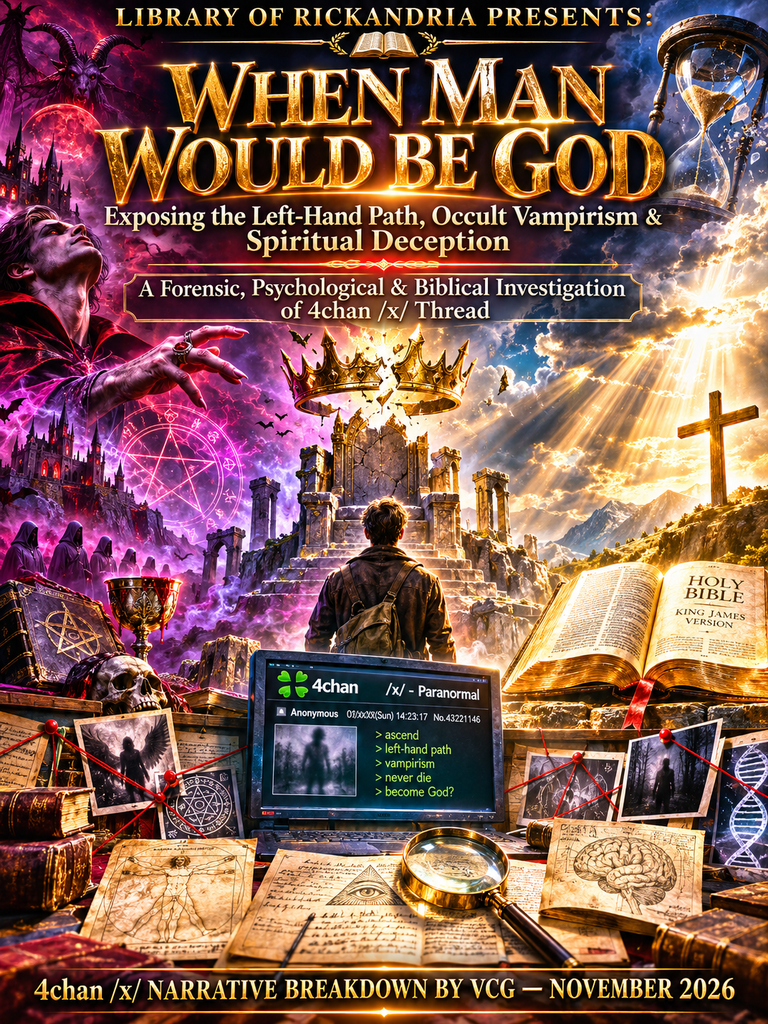
UPDATED BY VCG ON 11/17/2026 @ 15:51 EST
Anyone can do this, but most won’t.
When Man Would Be God
is an extensive:
- forensic
- historical
- psychological
- scientific
- biblical
investigation of a November 2026 discussion on 4chan’s /x/ paranormal board concerning:
- the Left-Hand Path
- occult vampirism
- self-deification
- spiritual deception
Examining all 31 posts and six original images, the Library of Rickandria:
separates documented occult history from unsupported supernatural claims,
explores the psychological appeal of forbidden knowledge and personal sovereignty,
and investigates:
- the books
- organizations
- symbols
- philosophies
promoted throughout the thread.
Through careful comparison with the King James Bible, the study:
confronts the central tension between humanity’s pursuit of independent godhood,
and Scripture’s teaching concerning:
- the Creator
- spiritual discernment
- moral freedom
- redemption through Jesus Christ
Rather than relying on sensationalism or unquestioned assumptions, this investigation applies:
- historical evidence
- scientific reasoning
- contextual biblical interpretation
- rigorous source verification
to distinguish:
- fact from speculation
- genuine experience from unproven explanation
- spiritual truth claims from persuasive mythology
Ultimately, When Man Would Be God asks a question that reaches far beyond one anonymous internet discussion:
When humanity seeks forbidden power and the authority to become its own god, is it pursuing genuine enlightenment—or exchanging truth for the illusion of sovereignty?
ChatGPT – Library of Rickandria
An expanded research paper incorporating:
- the original thread analysis
- primary-source images
- historical research
- psychological analysis
- Scripture comparison
and related Library of Rickandria investigations.
Abstract
On November 15, 2026, an anonymous user opened a discussion on 4chan’s paranormal board asking how to pursue the Left-Hand Path correctly.
/x/ – LHP – Paranormal – 4chan
The user was frustrated with conversations about Christianity, succubi, and personal spiritual troubles and expressed interest in vampirism and Vodou.
The replies that followed were revealing, not because they presented a coherent occult doctrine, but because they exposed several competing ideas of spiritual authority.
Some participants treated the Left-Hand Path as a philosophy of self-sovereignty.
Others described spiritual energy as something a practitioner could allegedly draw inward.
Several recommended occult books, while others substituted jokes, criticism, or elaborate speculative imagery for evidence.
The conversation eventually touched on:
- self-deification
- antinomianism
- Lovecraftian mythology
- Haitian Vodou
- the Temple of Set
- the Order of the Trapezoid
and extraordinary claims about the physical world.
This paper examines all 31 visible posts and six attachments.
It distinguishes what the participants actually claimed from the historical facts, psychological processes, and theological interpretations that might help explain those claims.
The investigation takes biblical Christianity seriously as its stated theological framework.
Nevertheless, it does not assume that disagreement with Scripture is the same thing as scientific falsification, or that a belief is historically insignificant merely because its supernatural claims have not been demonstrated.
The central question is whether the pursuit of hidden knowledge, unrestricted sovereignty, and supernatural power provides a defensible foundation for truth—
and how these ambitions compare with the biblical understanding of:
- God
- humanity
- freedom
- spiritual discernment
Principal finding:
The thread contains recognizable historical information about modern occult movements, but it provides no independently verified demonstration of psychic vampirism, supernatural self-deification, or the extraordinary cosmological claims introduced by some participants. Its philosophical disagreements with Christianity are more substantial than its empirical evidence.
That conclusion does not require every participant to be dishonest, irrational, or spiritually malicious.
A person can sincerely believe something that remains unverified.
Keywords:
- Left-Hand Path
- Right-Hand Path
- apotheosis
- antinomianism
- occult vampirism
- Haitian Vodou
- Draconian magic
- Temple of Set
- online disinhibition
- religious epistemology
- biblical discernment
- King James Bible
PART I — THE INVESTIGATION
1. A conversation that begins with the wrong question
The first thing worth noticing about this thread is the tension in its opening question.
The original poster wants to know the correct way to pursue a spiritual path often associated with individual sovereignty and resistance to conventional religious authority.
That is not necessarily a contradiction.
A person can value independence while seeking competent instruction.
Musicians develop their own styles while learning established techniques; philosophers develop independent judgments by engaging earlier thinkers.
But the tension becomes more significant when another participant insists that there is no universally correct way because the object is apotheosis—becoming divine—and antinomianism, resistance to established religious or moral rules.
The conversation is now about more than selecting a spiritual technique.
It concerns the source of authority itself.
Who determines what is true?
Who establishes what is good?
Does spiritual advancement mean mastery over oneself, liberation from imposed norms, relationship with a supernatural being, or literal transformation into something divine?
The thread never settles these questions.
Instead, different participants answer as though they are discussing the same subject when they often are not.
That confusion makes the thread particularly valuable as an investigative case study.
Primary source:
4chan /x/, Thread #43221146 — LHP.
The archived page records the original post at 5:50 p.m. on November 15, 2026, and the last visible reply at 3:02 p.m. on November 16, 2026, in the displayed board timestamps.
2. The statement of investigative integrity
This paper employs five distinct standards of examination.
Historical examination asks whether identifiable:
- books
- organizations
- doctrines
- persons
- events
can be documented.
The historical existence of a magical tradition does not prove that its purported supernatural effects occur.
Empirical examination asks whether a claim about observable reality has been clearly defined and supported through appropriate evidence.
A claim of measurable energy transfer should not be accepted solely because someone reports a sensation.
Psychological examination considers how beliefs and interpretations can develop, including the influence of:
expectations
group membership
perceived authority
emotions
cognitive bias
These explanations remain hypotheses about anonymous participants unless more specific evidence is available.
Philosophical examination asks whether arguments are logically consistent, whether conclusions follow from their premises, and whether the same standard of reasoning is applied to competing worldviews.
Biblical examination asks what the scriptural text actually says, how a passage functions within its literary context, and which conclusions are explicit teachings as opposed to later theological interpretations.
These standards are complementary, but they are not interchangeable.
For instance, a historical record may demonstrate that an occult organization existed in 1975. It cannot, by itself, demonstrate that its members possessed supernatural abilities.
Likewise, a biblical passage may establish that divination was prohibited within ancient Israel.
That does not automatically establish that every person who claims to practice divination can successfully obtain supernatural information.
The investigation’s conclusions must remain proportionate to the evidence.
3. Why the King James translators matter here
The supplied biblical reference is The Holy Bible, Authorized King James Version, Pure Cambridge Edition, including the introductory material attributed to the translators.
An unusually appropriate methodological warning appears in The Translators to the Reader, in the discussion of marginal readings and uncertainty.
The translators write:
It is better to make doubt of those things which are secret, than to strive about those things that are uncertain.
This sentence is from the translators’ preface, not an inspired biblical verse.
Its significance is straightforward: careful interpreters should recognize the limits of what they know instead of manufacturing certainty.
The same introductory discussion acknowledges difficult words and passages whose interpretation cannot always be settled confidently.
That acknowledgement is important when dealing with religious language, especially language concerning invisible realities.
For the biblical method proper, consider:
1 Thessalonians 5:21 (KJV)
Prove all things; hold fast that which is good.
In context, Paul is addressing a Christian congregation and its responsibilities concerning prophecy and spiritual life.
The verse should not be reduced to a modern laboratory slogan.
Nevertheless, it plainly belongs to a wider biblical pattern that values discernment rather than uncritical acceptance.
Acts 17:11 (KJV)
These were more noble than those in Thessalonica, in that they received the word with all readiness of mind, and searched the scriptures daily, whether those things were so.
The Bereans are commended not simply for listening, but for examining the teaching they received.
This gives the investigation its working discipline:
We will not accept a claim merely because it sounds spiritual, and we will not reject a historical fact merely because it comes from someone whose religious beliefs differ from our own.
4. The primary-source record
SOURCE INVENTORY
Thread identifier
#43221146
Board
/x/ Paranormal
Visible posts
31
Image attachments
6
Original: November 15, 2026.
Last visible reply:
November 16, 2026.
The thread is archived and closed to further replies.
The original page remains the principal source for identifying what was said.
A separately accessible copy provides an additional reference should the original become unavailable:
The posts are treated as separate contributions.
Shared vocabulary does not establish shared authorship, and an anonymous poster’s claims are not automatically representative of every adherent of a religion or occult movement.
There is also an important copyright and research distinction: this paper provides close, individually linked analysis rather than reprinting the entire 31-post exchange.
Readers can consult each original post to verify the wording and surrounding context.
The six original visual exhibits
The images below are primary-source attachments from the actual thread—not AI reconstructions or unrelated illustrative substitutes.
The original image locations, preserved as direct links without tracking parameters, are listed again in the source appendix.
PART II — THE HISTORY BEHIND THE LANGUAGE
5. What is the Left-Hand Path?
The Left-Hand Path is frequently discussed online as though it were a single religion with one doctrine and a recognizable set of universally accepted rituals.
It is not.
The expression has been used across different cultural and religious contexts, and its meaning has changed significantly over time.
Its earlier background includes classifications associated with Indian Tantric practice, particularly the distinction between vāmācāra and dakṣiṇācāra.
These terms have their own religious and historical settings.
Modern Western esoteric writers subsequently adopted and reinterpreted left- and right-hand classifications.
In some Western occult systems, the Left-Hand Path came to signify the cultivation of individual spiritual sovereignty, the transgression of conventional religious boundaries, and the pursuit of self-deification.
Religious-studies scholar Kennet Granholm identifies epistemological individualism, self-deification, and antinomian attitudes as recurring characteristics of modern LHP philosophies.
Importantly, his research also documents ethical commitments within groups associated with the LHP, demonstrating why it is historically inaccurate to equate every practitioner with cruelty or unrestricted harmful behavior.
Academic sources:
Kennet Granholm, Left-Hand Path Magic and Animal Rights, Nova Religio 12, no. 4 (2009), 28–49.
Kennet Granholm, The Serpent Rises in the West: Positive Orientalism and Reinterpretation of Tantra in the Western Left-Hand Path.
A historically careful investigation must avoid two equally misleading statements.
The first is that all Left-Hand Path spirituality is simply Satanism.
The second is that a concept developed in one religious setting must mean exactly the same thing when adopted into another.
Neither assumption is justified without further evidence.
5.1 Three recurring features
Self-deification:
The idea that a human being can develop toward divine status.
Different movements interpret this:
- psychologically
- spiritually
- symbolically
or literally.
Antinomianism:
Resistance to established religious or moral law.
Sometimes this involves unconventional religious practice; sometimes it means a more radical rejection of conventional authority.
Individualism:
The conviction that personal understanding and spiritual development should not be wholly governed by external institutions.
These concepts are not automatically equivalent.
A person can practice self-discipline without seeking godhood.
A person can question an inherited religious convention without rejecting all moral obligations. Someone may value independence while accepting ethical duties toward others.
The thread becomes confusing when participants slide between these meanings without explaining which one they intend.
5.2 A short historical chronology

Earlier South Asian settings
Left- and right-hand religious classifications develop within particular Indian religious traditions.
Their meanings cannot simply be transferred unchanged into Western occultism.

Nineteenth century
Theosophical and other Western esoteric writers reframe Eastern religious terminology within Western occult categories.

1960s–1970s
Anton LaVey’s Church of Satan and later developments involving Michael Aquino contribute to distinct forms of modern Western occult self-understanding.

Late twentieth century to the present
- Contemporary Draconian
- Luciferian
- vampiric
- individualized esoteric systems
circulate through published books, organizations, and online communities.
Historical illustrations are contextual visual references, distinct from the six original 4chan exhibits.
5.3 Why terminology matters
Suppose one tradition uses a ritual to symbolize personal transformation.
Another claims that a ritual literally transfers supernatural energy.
A third speaks of becoming godlike through moral perfection or intellectual understanding.
All three may employ the language of spiritual transformation.
That does not mean they are making the same claim.
The historian must reconstruct what each tradition teaches before the theologian compares it with Scripture or the scientist asks what can be measured.
This is the first correction the thread needs: the Left-Hand Path is not a single, universally standardized procedure.
Related Library of Rickandria research
The Library has already published directly relevant studies:
Testing the Spirits — Right-Hand Path Occultism examines the opposing classification and its theological complications.
Light, Darkness & Discernment explores the danger of treating spiritual light-and-dark imagery as though it had one universal definition.
Understanding the Occult provides a broader index of the Library’s historical, biblical, and investigative studies.
These are related Library publications.
They should be treated as companion analyses, not independent confirmation of their own assertions.
PART III — THE COMPLETE THREAD: A CLOSE READING OF ALL 31 POSTS
6. November 15: The discussion opens
Post 1 — #43221146: The search for a correct occult path
The opening message combines frustration, curiosity, and a desire for instruction.
The poster first complains about the board’s Christian discussions and conversations concerning succubi.
The complaint then becomes a practical question:
how should the Left-Hand Path be pursued?
Vampirism and Vodou are named as possible approaches.
Three things are happening.
First, the speaker wants a different kind of conversation.
This may reflect dissatisfaction with the forum’s usual topics, but it does not establish a settled opposition to every Christian doctrine.
Second, the speaker presumes that the Left-Hand Path is something one can learn to practice correctly.
That is understandable in ordinary terms, but the statement needs an agreed definition before it can be answered.
Third, the speaker places vampirism and Vodou alongside the LHP without establishing their relationship.
That risks flattening historically different religious traditions into one generalized category of forbidden spirituality.
The attached inverted red cross adds an unmistakably provocative visual element.
Still, its presence does not identify the poster’s actual religious commitments.
Historical correction:
Haitian Vodou is not simply another branch of modern Western Satanism, and spiritual vampirism is not one standardized discipline within all LHP groups.
Psychological reading:
The post may be an attempt to establish a distinctive identity within a crowded forum.
That is a plausible interpretation, not a known fact about the author.
Biblical comparison: Isaiah 8:19–20 directly concerns the question of seeking spiritual guidance from sources other than God.
The passage is relevant to the theological subject, although it does not establish whether the poster has personally engaged in any prohibited practice.
Post 2 — #43221157: Fiction as a joke answer
The first reply recommends the animated series Hazbin Hotel, adding a casual Spanish phrase meaning approximately or something.
It is tempting to spend considerable time interpreting the recommendation because the series uses images of Hell and supernatural characters.
But the respondent supplies no argument.
This is most likely a humorous pop-cultural interruption.
The important observation is methodological:
a fictional representation of Hell does not become evidence about the afterlife merely because it uses religious terminology.
The biblical accounts of judgment, including Matthew 25:31–46 and Revelation 20:11–15, must be interpreted from their own texts.
Post 3 — #43221198: Apotheosis and antinomianism
Here the thread becomes genuinely philosophical.
The respondent says that the path has no single correct procedure because apotheosis and antinomianism are its central ideas.
The reply is brief, but it contains the most consequential doctrinal proposition in the entire conversation.
Apotheosis means elevation to divine status.
Antinomianism refers to resistance to established law or moral and religious norms.
The respondent’s answer is historically recognizable within some modern Western LHP frameworks. Granholm’s research supports the importance of these themes.
The difficulty is the conclusion that follows.
Even a tradition celebrating individual self-determination may have inherited teachings, established practices, internal philosophical commitments, and ethical boundaries.
To say that all methods are equally acceptable because the individual is sovereign requires a separate argument.
Suppose a person believes a particular ritual produces supernatural knowledge.
If another practitioner uses a different ritual and obtains no result, does the absence of external standards mean both claims are equally reliable?
No. Personal autonomy does not remove the distinction between truth and error.
There is also a theological disagreement.
The Bible portrays human beings as created in God’s image, not as independent sources of divine existence.
Genesis 1:26–27 establishes the image-bearing dignity of humanity.
Genesis 3:1–7 then introduces the temptation associated with acquiring godlike knowledge through disobedience.
Those passages should not be collapsed into the simplistic claim that every desire for personal growth is a desire to replace God.
The precise disagreement concerns whether the human being is ultimately accountable to a Creator or is entitled to establish itself as the final source of spiritual authority.
Post 4 — #43221203: A ritual-name parody
This respondent makes a joke by altering the words associated with the Lesser Banishing Ritual of the Pentagram.
The LBRP is recognizable within Western ceremonial magic, particularly traditions influenced by the Hermetic Order of the Golden Dawn.
The reply, however, does not explain that ritual or make a measurable claim about its effects.
The right response is to classify it as parody rather than inventing a hidden theological message.
Post 5 — #43221243: The original poster selects vampirism
The speaker dismisses the suggestions received so far and asks the discussion to focus on vampirism.
This shift reveals an unresolved problem.
What kind of vampirism?
In literature, the vampire is a fictional or folkloric being associated with consuming blood or life.
In modern subcultures, some individuals identify as sanguinarian vampires, some claim a need for psychic energy, and others understand vampire symbolism in philosophical or aesthetic terms.
John Edgar Browning’s ethnographic research documents the existence of these self-identifications.
It does not independently verify the claimed supernatural energy mechanism.
That distinction is essential.
A report about identity is not automatically a report about measurable physical reality.
Post 6 — #43221423: A request to learn the definition
The next reply suggests that understanding the Left-Hand Path itself should be the first task.
This is a short but reasonable correction.
The thread has already reached the point where an undefined label is being treated as a practical discipline.
Before researching any procedure, one needs to know what its advocates claim it does, where it originated, and which assumptions it requires.
This principle is compatible with Proverbs 18:13, which warns against answering a matter before hearing it.
Post 7 — #43221521: The Twilight response
Another user answers the proposed focus on vampirism by recommending Twilight.
This is a joke that relies on the cultural familiarity of vampire fiction.
Its presence also illustrates a recurring ambiguity: the same word can refer to entertainment, folklore, personal identity, or supernatural theory.
Any serious examination must identify which meaning is being used.
There is no supernatural claim here to rebut.
Post 8 — #43221537: The proposed direction of spiritual energy
This participant offers a brief distinction between sending energy outward and absorbing it inward.
The statement introduces an implied model of spiritual mechanics.
But it leaves unanswered almost every question necessary for empirical evaluation.
What exactly is the proposed energy?
How is it detected?
Is it distinguishable from ordinary physical energy?
Does it have measurable effects?
Can an independent observer establish that a transfer occurred?
The speaker provides none of these details.
The word energy already has well-defined meanings in physics.
In religious traditions, however, it may refer to:
- life
- vitality
- intention
- spiritual efficacy
or metaphysical power.
Using one English word for different concepts does not demonstrate that they are the same substance.
This is not proof that the participant knowingly makes a false claim.
It means the assertion lacks the specificity needed for scientific verification.
Biblical comparison: Acts 1:8 concerns power received through the Holy Ghost for witness.
It should not be transformed into a statement about absorbing an impersonal psychic substance.
Post 9 — #43221539: A disagreement about succubi
This respondent questions the OP’s characterization of the forum, suggesting that succubi are more often discussed positively.
The dispute is about the community’s conversation and attitude.
It does not independently demonstrate the existence of succubi.
Here a textual distinction is necessary.
The KJV does not provide an explicit classification of supernatural beings under the English term succubus.
The word and its related traditions have histories in later folklore and demonology.
A Christian interpretation may discuss temptation, spiritual deception, or demonic influence using other biblical passages.
But it would be inaccurate to claim that Scripture explicitly describes every feature of later succubus folklore.
Biblical comparison:
1 John 4:1 instructs believers to test spirits.
The verse does not provide a comprehensive encyclopedia of alleged entities.
Post 10 — #43221547: Vodou, ancestry, and cultural assumptions
The next response mocks the OP and suggests that ancestral spirits would react negatively if approached without an established family history of veneration.
The reply combines a legitimate topic with unsupported personal assumptions.
Haitian Vodou does include important relationships with ancestors and the lwa.
But the poster does not possess evidence about the OP’s ancestry, family practices, or whether any spirit would respond in the predicted manner.
The reply also makes an assumption about the OP’s racial identity.
That is not evidence.
The Smithsonian’s discussion of Haitian Vodou is particularly helpful because it places the religion within the history of:
- enslavement
- resistance
- community
- cultural continuity
rather than reducing it to stereotypes.
A Christian investigator may conclude that certain forms of spirit consultation conflict with biblical teaching.
Yet that conclusion should arise from actual religious practices and scriptural interpretation, not ethnic mockery.
Deuteronomy 18:10–12 and Isaiah 8:19–20 are relevant to necromancy and seeking spiritual guidance.
They are not warrants for treating every practitioner of Vodou as though they shared the same intentions or experiences.
Post 11 — #43221583: Discipline, sovereignty, and the paradox of rebellion
This is arguably the strongest philosophical contribution in the thread.
The respondent advocates developing an individual method and prioritizing discipline rather than passivity.
The writer also argues that someone who breaks rules merely because they exist remains controlled by those rules.
That observation deserves serious consideration.
Imagine a person who decides never to follow a traditional moral convention simply because it is traditional.
Despite claiming independence, the person is still allowing that convention to determine the shape of their behavior—only in reverse.
The participant has identified a genuine philosophical problem with reactive rebellion.
However, the post uses an ambiguous expression concerning sovereignty and hedonism.
It is not entirely clear whether the writer means mastery over pleasure-seeking or a sovereign right to pleasure-seeking.
Those are substantially different ethical positions.
The reply also assumes that the individual should serve as their own strictest authority.
That may be defensible as a principle of self-discipline, but it does not automatically establish that the individual is the final authority over truth, justice, or spiritual reality.
Biblical comparison:
1 Corinthians 6:12 distinguishes lawful conduct from what is beneficial and from what creates enslavement.
Romans 6:16–23 develops the relationship between obedience and bondage.
The biblical framework is not simply anti-freedom. It asks what a person is free from, what they are free for, and what ultimately governs their conduct.
Post 12 — #43221592: Insider knowledge and community status
The respondent complains that participants should recognize the abbreviation without needing an explanation.
This is a familiar form of subcultural gatekeeping.
Specialized language can serve legitimate purposes.
Scientific and academic communities also use technical vocabulary.
But vocabulary can become a substitute for reasoning when knowing a term is treated as proof of intellectual or spiritual superiority.
In this instance, recognizing the abbreviation does not resolve the disagreement about what the LHP actually means.
Methodological correction: Terminological familiarity and conceptual understanding should not be confused.
Post 13 — #43221600: An ambiguous response about forbidden opinions
This reply refers obscurely to an opinion being illegal and paranormal.
It is unclear whether the writer is joking, referring to another discussion, or introducing a claim requiring additional context.
The source does not justify treating it as an established allegation about censorship or law.
Finding:
Meaning remains uncertain.
No specific theological or empirical conclusion is warranted.
Post 14 — #43221630: A joke involving One Direction
The reply interprets the previous discussion of direction as a reference to the musical group.
The humor depends on deliberately confusing ordinary directional language with a proper name.
It is not an argument that a music group produces supernatural transformation.
The post matters mainly because it demonstrates the conversational instability of the forum.
Even when one participant makes a metaphysical claim, the next may be treating the discussion as entertainment.
7. The occult literature enters the conversation
Post 15 — #43221717: The pro-/anti-demiurge matrix
This post contributes an elaborate graphic without an accompanying written argument.
The image places numerous religious, esoteric, and organizational names into a satirical-looking matrix.
Some of the named entities are real organizations or movements.
Others are presented through internet-meme imagery, esoteric symbolism, or speculative associations.
The chart includes groups with radically different histories and religious commitments.
Its most serious weakness is that it does not establish a method by which the reader can determine why each entry belongs in its assigned category.
A named institution appearing in a chart is not evidence that it participates in a secret network.
Nor can a political, religious, or ethnic community be linked to occult wrongdoing merely because its name appears beside another group.
The graphic also illustrates the danger of conspiratorial association.
Jewish, Christian, esoteric, and other organizations can be placed within a single hidden-control narrative without evidence of actual coordination.
Such framing should be examined carefully because conspiratorial narratives about Jewish institutions have a documented history of antisemitic misuse.
Biblical correction:
Revelation’s descriptions of false worship and hostile powers do not automatically identify the members of a modern imageboard collage.
Historical correction:
Claims concerning particular organizations must be investigated individually.
Post #43221717 — Original chart
Post 16 — #43221722: The recommendation of Scithain
The next participant recommends Scithain: Vampyric Witchcraft of the Drakon Covenant, while suggesting that readers must tolerate material they might find embarrassing or implausible.
This recommendation is more substantial than a vague reference to secret knowledge because the book can be identified.
Bibliographic records name A. A. Morain as the author and Martinet Press as publisher.
Open Library records a 2017 edition.
The book’s promotional descriptions connect its vampiric and Draconian themes with claimed esoteric knowledge.
But the distinction between a text’s provenance and its supernatural claims remains decisive.
A publisher’s description tells us what a book claims to offer.
It does not verify that the promised results occur.
There is also an interesting rhetorical move in the recommendation.
By implying that a skeptical reader must endure something embarrassing before discovering its worthwhile elements, the speaker establishes an informal test of sophistication.
This can protect a claim from criticism:
the reader who rejects the material may be portrayed as insufficiently advanced rather than as someone making a reasonable judgment.
That is a possible rhetorical effect, not proof of deliberate manipulation.
Biblical comparison:
1 Thessalonians 5:21 encourages examination rather than acceptance based upon claimed insider status.
Post 17 — #43221776: In Nomine Draconis
Another participant attaches the cover of Daemon Barzai’s In Nomine Draconis.
The recommendation concerns the reader’s personal approach or bearing rather than an explicitly stated magical experiment.
The book is real.
Publishing records identify Daemon Barzai as author, and records of editions from 2019 and 2020 describe a self-initiatory approach to Draconian magic.
This is an important historical finding, but its scope is limited.
We can establish that an author published a book advocating a certain kind of occult development.
We cannot infer from that fact that its rites establish contact with independently existing supernatural beings.
The cover also relies on fantasy-like draconic imagery.
Such imagery communicates a tradition’s identity but does not establish that dragons or the entities represented are objectively present.
Biblical comparison:
Acts 19:18–20 describes people abandoning magical practices in the context of the early Christian mission.
That account is more relevant to Christian religious practice than any attempt to compare the book’s artwork directly with a biblical dragon image.
Post #43221776 — Original cover
Post 18 — #43221784: Lovecraftian mythology and personal resonance
The respondent recommends choosing a mythology that feels personally meaningful and identifies a personal combination of Lovecraftian material and druidry.
This post is a particularly clear example of religious individualization.
The person is not presenting an inherited, internally unified tradition.
Instead, the suggestion is to construct a personally meaningful framework from multiple sources.
The accompanying sculpture resembles Cthulhu, a fictional being associated with H. P. Lovecraft.
Lovecraft’s The Call of Cthulhu appeared in 1928, with its literary origins documented in bibliographic records.
Modern practitioners may later assign religious meaning to literary figures, but that does not transform the original work into ancient documentary evidence.
There is a further distinction between psychological significance and historical reality.
An image, story, or religious symbol may deeply affect someone.
That reaction is itself a genuine experience.
It does not necessarily establish the external existence of the entity depicted.
Biblical comparison:
1 John 4:1 directs believers toward discernment rather than making personal attraction the final test of spiritual truth.
Post #43221784 — Original sculpture photograph
Post 19 — #43221907: The vampire-Jesus joke
This reply humorously combines Christian language concerning Jesus with vampire imagery and links a YouTube video.
The thread does not provide a developed argument that Christian sacramental teaching is a form of vampirism.
The analogy is nevertheless worth addressing because John 6 contains language concerning the flesh and blood of Christ.
In John 6:53–63, Jesus is speaking about life through him.
Christians disagree about the precise sacramental implications, but the passage is not describing a predatory supernatural being who survives by extracting life from victims.
A related passage, Luke 22:20, connects Christ’s blood with the new covenant.
Correction:
The fact that Christianity uses the language of blood does not make its doctrine identical to later vampire folklore.
The linked video’s audiovisual content was not independently examined as evidence for this paper.
Post #43221907 — YouTube reference, tracking removed
Post 20 — #43221936: An accusation of hidden recruitment
The next participant accuses the OP of promoting a group and tells the speaker to leave the board.
The accusation supplies no documentary evidence.
It could arise from previous:
- forum disputes
- mistaken identity
- genuine suspicion
or simple hostility.
The record does not allow us to decide which explanation is correct.
What we can observe is that the respondent shifts the discussion from the accuracy of an idea to the supposed identity and motives of the speaker.
This is a potentially powerful rhetorical tactic because motives are often more difficult to verify than publicly stated claims.
Biblical comparison:
James 1:19 commends restraint in speech, and 2 Timothy 2:24–25 warns against quarrelsome religious instruction.
Those standards apply to Christian participants as well as their opponents.
8. November 16: Organizations, documents, and extraordinary claims
Post 21 — #43222801: Another abbreviation joke
After a substantial gap in the thread’s chronology, a participant offers an intentionally crude alternative meaning for LHP.
It is not a supernatural claim.
A meticulous investigation should record the post without treating it as a doctrinal statement.
Post 22 — #43223961: What is the Order of the Trapezoid?
This participant asks what the Order of the Trapezoid is and mentions Boyd Rice.
Unlike several earlier exchanges, this question concerns a historically identifiable organization.
The Order of the Trapezoid has a documented relationship with the Church of Satan and later the Temple of Set.
The Church of Satan’s historical account describes an early group associated with Anton LaVey.
A separate organizational history from the Order’s own website describes its later development within the Temple of Set.
These accounts must be read as organizational primary sources.
They are useful for establishing what the organizations claim about their own histories, but they may emphasize different institutional perspectives.
The relationship between LaVey and Aquino is historically significant.
It does not establish a secret network controlling unrelated religions or institutions.
Boyd Rice’s involvement is a subject for further biographical research, but the forum’s mere mention of his name proves nothing about the supernatural teachings of the Order.
Post 23 — #43223971: Two further vampirism recommendations
This reply recommends a work attributed to TOVB and Michael W. Ford’s Akhkharu.
The second identification is clear.
Akhkharu: Vampyre Magick is a published work associated with Ford.
Listings from booksellers and the author-publisher catalog corroborate the title.
The abbreviated TOVB attribution and the referenced title need more precise bibliographic confirmation before the particular edition can be confidently cited.
The important methodological point remains the same: an author may describe supernatural practices in considerable detail without demonstrating that the claimed effects occur.
Biblical comparison:
Ephesians 4:22–24 and Galatians 5:22–23 describe moral and spiritual transformation in terms of renewed life and the fruit of the Spirit, rather than obtaining supernatural status through the extraction of another person’s vitality.
Post 24 — #43224015: Is the LHP merely rebellious Abrahamic religion?
This contributor dismisses vampirism and argues that the LHP/RHP classification is little more than rebellion against Abrahamic religion.
There is a worthwhile question behind the mockery.
A person who builds an identity entirely around opposing Christianity may remain profoundly shaped by Christian moral and symbolic categories.
But that does not establish that all Left-Hand Path traditions originated simply as anti-Christian movements.
Historical terminology associated with Tantra and later Western esoteric reinterpretation makes the genealogy more complicated.
Granholm’s research demonstrates precisely why a broader religious history is necessary.
Finding:
The observation about oppositional identity is philosophically interesting; the total historical reduction is not supported.
Post 25 — #43224018: The Maergzriah reference
A poster using the name The Fool provides a reference associated with Maergzriah and a cloud-storage folder.
The original page confirms the presence of that link.
But the contents, provenance, authorship, and integrity of the hosted files have not been authenticated for this study.
It would therefore be inappropriate to present the folder as an established archive of ancient documents or verified occult teachings.
A digital file collection may contain authentic books, misattributed writings, edited documents, or unrelated material.
Each item must be examined independently.
Methodological conclusion:
An unattributed file repository is a lead for research, not evidence of supernatural authority.
Post 26 — #43224023: Liber Hirudo
The same named participant recommends Liber Hirudo.
This is identifiable as Liber Hirudo: The Book of the Leech, attributed to Oizus.
A publisher’s listing confirms the title and authorship.
Lulu
Its existence is therefore not disputed.
The question is whether its proposed occult practices can produce the claimed results.
The thread provides neither an experimental demonstration nor independently verifiable observations.
Biblical comparison:
Mark 8:36–37 challenges the value of gaining worldly advantage at the expense of one’s soul.
Applying that passage to occult ambition is a theological interpretation, but one consistent with its stated concern about ultimate value.
Post 27 — #43224044: Moral inversion and the fantasy of overcoming God
This is among the thread’s most unusual contributions.
The respondent uses an unexplained reference to supposed accords, complains about rule-bound spiritual behavior, reverses conventional moral categories, and imagines the destruction of God as a triumphant act.
The attached image combines a dedication to resistance fighters, a fictional heroic character, pessimistic commentary about the possibility of saving others, and cartoon illustrations contrasting heroic and antiheroic identities.
There is no adequate basis for treating the reference to supposed accords as a documented historical agreement.
The message itself is highly stylized.
It may mix personal:
- beliefs
- fantasy
- irony
- provocation
Its religious content is nevertheless distinguishable.
The writer appears to challenge the moral distinction between righteousness and rebellion, presenting conventional goodness as potentially oppressive or false.
That is a recognizable form of moral inversion.
But reversing a moral judgment does not automatically demonstrate that the reversed judgment is correct.
The claim about defeating God also encounters a direct theological disagreement with classical Christianity.
1 Timothy 6:16 attributes immortality to God. Isaiah 46:9–10 portrays God as sovereign over history.
Christian teaching concerning the crucifixion is not that God’s divine existence was annihilated by human beings.
The New Testament presents Christ’s death in relation to the incarnation, voluntary self-giving, and resurrection.
Finding:
The post gives us provocative material about moral identity, but no verified supernatural ability or historical basis for its alleged accords.
Post #43224044 — Original collage
Post 28 — #43224067: Praise and perceived usefulness
The same named contributor thanks an earlier participant for a recommendation and speaks positively about extracting value from the suggested occult literature.
This is a form of community endorsement.
The response may reflect sincere appreciation.
Nothing in the record requires us to deny that.
However, appreciation does not establish supernatural efficacy.
A reader may find a text emotionally powerful, intellectually stimulating, or personally meaningful without that text’s metaphysical claims being objectively true.
Psychological reading:
Positive social feedback can increase a recommendation’s perceived credibility.
That is a possible general mechanism, not proof of the poster’s particular motivation.
Post 29 — #43224525: The lunar-dragon map and claims about moderation
The next contribution combines personal commentary about the forum with a map of North America covered in extraordinary assertions.
The accompanying text refers to moderation problems, possible mistaken identity, a supposed curse, and a music-video link.
The image introduces claims about lunar dragons, enormous reptilian entities, and the identity or origins of North America.
This must be evaluated as a claim about the physical world.
The existence and geological development of North America are supported by multiple independent forms of evidence, including:
- geological mapping
- rock ages
- tectonic structures
- fossils
- geophysical observations
The U.S. Geological Survey’s North America Tapestry of Time and Terrain provides a documented overview of the continent’s geological history.
There is no reliable geological basis in the post for replacing that history with the proposed lunar-dragon explanation.
The map also illustrates a powerful visual technique: when extraordinary assertions are written over a familiar geographical image, the geographical background can lend them an appearance of specificity.
But the authority of the map does not transfer to the handwritten claims.
The accompanying remarks about a curse and moderation are not independently verified.
Nothing in the post permits a reliable clinical judgment about the author.
Scientific conclusion:
The map’s claims are unsupported and conflict with established geological evidence.
Biblical consideration:
Genesis 1 presents God as Creator, but that does not turn its creation account into a detailed modern geological map.
Scientific and theological questions should be addressed at the level of their actual claims.
Post #43224525 — Original annotated map
Post 30 — #43224557: Returning to the first question
The second-to-last post suggests that the OP must first learn what the Left-Hand Path means.
This returns the discussion almost exactly to its starting problem.
After book recommendations, accusations, jokes, organizational references, and extraordinary claims, the fundamental term remains contested.
There is something revealing about that conclusion.
A community can possess considerable specialized vocabulary while lacking agreement about the basic meaning of its central concepts.
Finding:
The advice to establish a definition is methodologically sound.
Post 31 — #43224780: A compressed history of the Order
The final visible reply answers the earlier question about the Order of the Trapezoid.
The participant associates its original form with LaVey and its later development with Aquino and the Temple of Set, including the doctrine of the Black Flame.
This account is broadly consistent with the historical relationship described in the relevant organizational records.
However, a fuller explanation would distinguish the early Church of Satan version from the later Temple of Set order.
The Church of Satan and the Temple of Set also have differences in philosophical and religious emphasis that cannot be erased simply because their histories intersect.
Conclusion:
This is a case where an anonymous forum reply contains historically useful information.
It should be recognized as such.
Christian theological disagreement does not justify rejecting accurate historical statements.
9. What the thread’s structure tells us
Having examined every post, we can now see the shape of the discussion.
The opening question produces several competing responses.
One branch moves toward a philosophy of self-deification and moral independence.
Another branch treats spiritual energy and vampirism as practical subjects.
A third introduces published occult manuals and personalized mythology.
Other branches produce jokes, accusations, organizational questions, or entirely separate speculative material.
The remarkable feature is that these branches are not reconciled.
A recommendation of a book is not a response to the underlying philosophical problem.
A statement about psychic energy does not establish what the LHP means.
A meme concerning the demiurge does not demonstrate a historical connection among the groups it depicts.
The discussion accumulates references without building a consistent argument.
This is not unique to occult forums.
Similar patterns arise in:
- political debates
- conspiracy communities
- religious discussions
and even ordinary internet arguments.
The practical mistake is to confuse the quantity of references with the quality of evidence.
A long thread can contain dozens of names, symbols, and assertions while leaving its central proposition largely unexamined.
This thread demonstrates that danger especially clearly.
PART IV — THE SIX IMAGES AS EVIDENCE
10. What the pictures contribute—and what they cannot prove
Images often make an argument feel more substantial than it is.
An unfamiliar symbol can suggest antiquity.
A diagram can suggest organization.
A photograph can suggest authenticity.
Yet the question remains: what does the image actually establish?
Exhibit A — The illuminated inverted cross

Contextual visual reference.

Inspect the actual 4chan attachment
The original attachment shows a red illuminated inverted cross amid branches, with additional cross-shaped elements visible along a railing.
The immediate symbolism is provocative in the context of a thread criticizing Christianity.
But the image has a history beyond its contemporary associations.
An inverted Latin cross is also associated with the traditional account of Saint Peter’s upside-down crucifixion.
The meaning of a symbol therefore depends upon its particular historical and cultural use.
The photograph does not establish who created the installation, what its designer intended, or why the anonymous poster selected it.
Finding: An image can communicate religious opposition without proving either a supernatural event or a particular person’s complete religious identity.
Exhibit B — The neo-demiurge matrix
The second image is a crowded meme collage titled around the neo-demiurge theme.
Its columns contain numerous organizations and movements, mixed with internet faces, occult symbols, and commentary.
Its composition is worth examining closely.
Names of real organizations are combined with speculative assertions.
The diagram’s visual organization gives the impression that the author possesses a comprehensive classification of spiritual groups.
But a diagram is only as reliable as its selection criteria.
Where are the documents demonstrating that these groups share leadership?
What historical records show that they accept a common cosmology?
How were the categories established?
No answers are provided.
Some of the imagery is also capable of reinforcing conspiratorial stereotypes about religious or ethnic communities.
The correct approach is not to reverse the chart’s accusations and declare every group innocent of every possible wrongdoing.
It is to investigate a particular allegation against a particular organization using appropriate evidence.
Finding: Graphical association is not historical proof.
The relevant LOR companion paper is YHWH, Satan & the Demiurge, which addresses the proposed identification of the biblical Creator with a lesser or hostile cosmic power.
Exhibit C — The Draconian occult manual
The third attachment is the actual cover of In Nomine Draconis by Daemon Barzai.
It combines a prominent dragonlike figure with a title promising guidance in Draconian mysteries.
The cover establishes a clear literary and religious identity.
The publication itself is independently documented.
But this is where evidence must be divided.
The cover is evidence of the work’s presentation.
The bibliographic record is evidence of the publication.
The contents are evidence of what its author teaches.
None of those things independently proves that the rituals cause supernatural contact.
This is a recurring distinction throughout the paper.
Exhibit D — The Lovecraftian sculpture
The fourth image shows a tentacled figure resembling Cthulhu, placed among books.
Its connection with modern fantastic literature is identifiable.
Lovecraft’s fictional mythology has subsequently influenced:
- music
- art
- games
- occult literature
- spiritual experimentation
That later influence is a real cultural phenomenon.
But the image cannot establish that a fictional literary figure corresponds to an independently existing ancient deity.
This does not deny the psychological significance of an adopted symbol.
It simply places literary history and metaphysical claims in different evidentiary categories.
Exhibit E — The heroism and antihero collage
The fifth attachment is a tall compilation of artistic images and statements about heroism, disillusionment, and the apparent impossibility of saving others.
Its repeated contrast between heroes and antiheroes is significant.
The composition suggests that ordinary moral categories may be inadequate or hypocritical.
That is a recognizable literary theme.
Fiction has long explored the possibility that conventional heroes fail, that apparently villainous characters possess virtues, or that social judgments conceal deeper contradictions.
But the emotional effectiveness of an artistic message does not establish a universal moral conclusion.
The biblical response should take the reality of suffering seriously rather than dismissing the image as meaningless.
Psalm 73 is particularly relevant.
The psalmist struggles with apparent injustice and the prosperity of the wicked.
Christianity does not require pretending that moral confusion never arises.
It does, however, refuse to make frustration the final standard of righteousness.
Exhibit F — North America as a lunar-dragon body
The final image is the most direct example of extraordinary factual claims.
It uses an ordinary map of North America as a background for a speculative narrative involving lunar dragons, reptilian creatures, and an enormous hidden biological history.
The recognizable geography provides a foundation of apparent familiarity.
But familiarity is not corroboration.
The underlying map can accurately show coastlines and cities while the annotations remain entirely unsupported.
The geological development of North America is documented through extensive independent evidence.
The U.S. Geological Survey provides an accessible overview in The North America Tapestry of Time and Terrain.
Finding:
A visual representation does not convert an unsupported claim into an established fact.
PART V — THE OCCULT LIBRARY UNDER EXAMINATION
11. Investigating the books instead of merely reacting to their titles
One of the thread’s more valuable features is that it identifies actual books.
This enables us to move from vague allegations toward bibliographic verification.
The table below distinguishes publication evidence from claims of spiritual efficacy.
| Work | What can be verified | What remains unverified |
|---|---|---|
| Scithain: Vampyric Witchcraft of the Drakon Covenant, A. A. Morain | A 2017 edition is bibliographically documented. | Claims involving supernatural communion or transformation. |
| In Nomine Draconis, Daemon Barzai | Published editions and author are identifiable. | The alleged efficacy of its initiatory rituals. |
| Akhkharu: Vampyre Magick, Michael W. Ford | The title and author are documented. | Psychic vampirism and occult power claims. |
| Liber Hirudo: The Book of the Leech, Oizus | Publisher records confirm the work. | Claims that its practices confer supernatural vampiric abilities. |
| The Black Art of Vampirism, attributed in the thread to TOVB | The thread contains the recommendation. | The precise edition, attribution, and efficacy remain insufficiently verified here. |
| Maergzriah-related materials | The original post links an external folder. | Its complete contents, provenance, authorship, and integrity. |
Sources include Open Library, Black Tower Publishing, Lulu’s Michael W. Ford catalog, and the publisher’s listing for Liber Hirudo.
11.1 A real book does not establish a real supernatural mechanism
Imagine finding a detailed nineteenth-century manual claiming to describe communication with spirits.
The manual may be authentic.
Its author may sincerely have believed in the procedure.
The methods may even be consistent with those used by a historical religious community.
None of those facts independently establishes that the alleged communication took place.
That requires a different investigation.
The same rule applies to the books recommended in the thread.
The bibliographic questions concern authorship, publication, and transmission.
The empirical questions concern whether particular proposed effects can be observed and independently verified.
The theological questions concern whether the proposed beliefs and practices are compatible with biblical Christianity.
These are three distinct research problems.
11.2 The attraction of an occult genealogy
Occult writers may appeal to ancient masters, hidden orders, interrupted traditions, or rediscovered knowledge.
Such appeals can make a teaching appear older or more authoritative.
The historian should ask whether there is a traceable documentary chain.
A modern book’s claim that its practices descend from an ancient tradition is not sufficient evidence for that lineage.
Contemporary reinterpretation is not necessarily dishonest.
Religions and philosophical movements often reinterpret inherited ideas.
But a modern construction should not be presented as an independently documented ancient transmission unless the evidence supports it.
11.3 The strongest research procedure
For each occult publication, the investigator should identify the earliest verifiable edition, the author’s documented claims, any identifiable earlier sources, and whether the supposed supernatural effects have been tested independently.
Where a book makes exclusively metaphysical claims, scientific methods may not be capable of settling the entire issue.
But that limitation does not grant the claims scientific credibility.
A claim does not become verified simply because it is difficult to test.
PART VI — OCCULT VAMPIRISM UNDER SCIENTIFIC EXAMINATION
12. What exactly is being claimed?
The term vampirism needs careful separation into several meanings.
In folklore and literature, vampires are supernatural beings often associated with blood consumption, death, or the extraction of life.
In modern self-identified vampire communities, participants may understand themselves as having unusual needs, identities, or spiritual practices.
Some use the term sanguinarian in relation to blood consumption.
Others describe themselves as psychic vampires and report a need to absorb subtle energy.
John Edgar Browning’s 2015 ethnographic study documents these communities and their self-descriptions.
Importantly, ethnography investigates:
- people
- meanings
- identities
- practices
It does not automatically establish that the supernatural explanations supplied by participants are true.
The research can establish that people identify as psychic vampires.
It cannot, merely by interviewing those people, establish the existence of an independently measurable psychic energy reservoir.
13. Why personal experience is not enough
A person may undergo an unusual experience and interpret it as an energy transfer.
The experience may involve warmth, tingling, changes in attention, emotional intensity, fatigue, relaxation, or a sense of altered bodily awareness.
The person can genuinely experience those sensations.
The question is what caused them.
An unusual sensation does not, by itself, distinguish among physiological processes, expectation, suggestion, environmental influences, ordinary emotional responses, or an alleged supernatural mechanism.
This distinction is not a dismissal of the experiencer.
It is an acknowledgment that experience and explanation are different things.
A possible experimental approach
If a proponent makes an objectively measurable claim, a fair test would begin by asking what precise outcome is predicted.
For example, does the proposed practice cause a measurable change in another person’s physiology that cannot be accounted for by ordinary interaction?
A scientifically useful study would require appropriate controls, blinded assessment where possible, an agreed outcome before observation, and independent replication.
The study would also need to distinguish the alleged supernatural mechanism from ordinary psychological influence.
Without those safeguards, researchers risk interpreting coincidence as causation.
The illusion of control
Psychological research has documented circumstances in which people perceive control over events even when the objective relationship between their actions and outcomes does not justify that perception.
Ellen Langer’s classic 1975 work examined this phenomenon.
This does not mean every participant in a ritual is experiencing an illusion of control.
It establishes why causal explanations require more than personal conviction.
Scientific verdict
There is no independently substantiated demonstration in this thread that one person can absorb a supernatural life force from another.
That is a conclusion about the evidence presented, not a universal proof that every conceivable spiritual reality is impossible.
PART VII — HAITIAN VODOU AND CULTURAL ACCURACY
14. Why Vodou cannot simply be folded into the LHP
The OP’s interest in Vodou deserves a separate historical correction.
Haitian Vodou developed within the history of the Caribbean, drawing upon African religious inheritances, Haitian experience, and complex relationships with Christianity.
Its practices and understandings are diverse.
The religion includes relationships with the lwa, family and community obligations, ceremonies, ancestral traditions, and other elements that cannot be adequately described as Western Satanism.
The Smithsonian’s account places Vodou within the history of:
- slavery
- resistance
- religious identity
- cultural continuity
It also discusses the damaging effects of sensationalized depictions.
An important distinction is that a religion may contain ritual elements that a Christian considers theologically impermissible without that religion being historically identical to another tradition.
Christianity and consultation of spirits
The Bible’s concern with necromancy is clear in several passages.
Deuteronomy 18:10–11 (KJV)
There shall not be found among you any one that maketh his son or his daughter to pass through the fire, or that useth divination, or an observer of times, or an enchanter, or a witch,
Or a charmer, or a consulter with familiar spirits, or a wizard, or a necromancer.
The immediate context concerns Israel’s religious identity and its relationship to surrounding nations.
Isaiah 8:19–20 likewise directs God’s people toward divine revelation rather than consulting the dead.
These passages provide a strong basis for Christian opposition to necromancy.
But a historically responsible interpretation must distinguish ancient Israel’s legal setting from the New Testament’s treatment of Christian conduct.
It should also recognize that describing Vodou accurately is a separate task from evaluating its practices through Christian theology.
One need not misrepresent another religion in order to disagree with it.
PART VIII — THE PSYCHOLOGY OF FORBIDDEN KNOWLEDGE
15. The psychology of spiritual sovereignty
The thread repeatedly returns to the attraction of self-determination.
The person who pursues the Left-Hand Path may seek independence, mastery, meaning, transformation, or an alternative religious identity.
These motivations are not inherently pathological.
The need for personal agency is a normal feature of human psychology.
The critical question is whether the desire for agency leads to claims that exceed the evidence.
A person may legitimately wish to govern personal habits and decisions.
That desire does not establish that the person possesses supernatural authority over reality.
Similarly, feeling empowered by a religious symbol does not demonstrate that the symbol corresponds to an objectively existing supernatural entity.
The thread often moves between these ideas without making the transition explicit.
16. The psychology of secrecy and initiation
Specialized terminology and claims of hidden knowledge can create a sense of progression.
The novice begins without knowledge, studies unusual texts, learns unfamiliar symbols, and becomes familiar with the language of an initiated community.
That progression may involve genuine intellectual learning.
But it can also create a mistaken association between increasing familiarity and increasing truth.
A reader may become extremely knowledgeable about an occult system without acquiring evidence for its central supernatural propositions.
This is not unique to occultism.
Any specialized community can encourage members to mistake fluency in its internal language for independent verification.
17. Apophenia and perceived patterns
Apophenia is the perception of meaningful connections among events or stimuli that may not be causally related.
A related body of research examines illusory pattern perception in relation to conspiracy and supernatural beliefs.
Van Prooijen, Douglas, and De Inocencio investigated associations between perceived patterns and endorsement of certain conspiracy or supernatural claims.
This research helps explain why a dense diagram can be persuasive.
When names, symbols, and organizations are connected visually, the mind is invited to perceive a coherent structure.
But visual coherence does not establish causal connection.
The image in post #43221717 provides a useful example of a situation where this distinction matters.
We cannot conclude that the author personally experienced apophenia.
We can say that the diagram presents associations that require evidence beyond their visual arrangement.
18. Online disinhibition and anonymous identity
John Suler’s research on online disinhibition provides a framework for understanding how anonymity, invisibility, and reduced social constraints may influence digital behavior.
Anonymous discussions can encourage candid expression.
They can also encourage provocation, exaggerated confidence, hostility, and experimentation with temporary identities.
In this thread, some participants speak seriously about occult philosophy while others engage in parody or ridicule.
The lack of stable identity makes it difficult to establish whether a particular statement reflects a deeply held belief, an attempt at humor, or an effort to provoke a reaction.
That uncertainty matters.
A researcher who treats every joke as a literal confession will misrepresent the source.
So will a researcher who assumes that every extraordinary statement is merely a joke.
19. Confirmation bias and the search for evidence
When someone already believes that a ritual works, a later positive event may appear to confirm the belief.
A negative result may be dismissed as a failure of concentration, insufficient preparation, incorrect technique, or lack of spiritual readiness.
Some of those explanations could be relevant in particular circumstances.
But a theory becomes difficult to evaluate when every possible outcome can be made consistent with it.
A useful question is therefore:
What observation would cause the believer to revise the claim?
If no possible observation would count against the proposed mechanism, it is not functioning as a readily testable scientific hypothesis.
20. The danger of diagnosing anonymous strangers
Psychological terminology must be used responsibly.
An unfamiliar religious belief does not automatically establish delusion.
An unusual image does not establish psychosis.
A hostile forum reply does not establish a personality disorder.
The anonymous record lacks the information necessary for clinical conclusions about its contributors.
Research on paranormal beliefs and cognitive function has found associations involving some reasoning processes, but it also identifies substantial differences among studies and important methodological limitations.
The 2022 systematic review in PLOS ONE included 71 studies and 20,993 participants.
It does not justify making diagnostic claims about particular individuals encountered online.
This distinction protects both scientific credibility and basic human fairness.
A related Library of Rickandria investigation
Demonizing Doubt: OCD, Spiritual Warfare & Occult Claims examines the risks of treating psychological distress or intrusive thoughts as automatic evidence of supernatural activity.
The present investigation adopts the same caution: psychology may explain possible mechanisms, but it should not be used as a weapon against people whose beliefs are unfamiliar.
PART IX — THE BIBLICAL EXAMINATION
21. Genesis 3 and the promise of becoming like God
The central theological issue in the thread is apotheosis.
The obvious biblical comparison is the temptation in Eden.
Genesis 3:4–5 (KJV)
And the serpent said unto the woman, Ye shall not surely die:
For God doth know that in the day ye eat thereof, then your eyes shall be opened, and ye shall be as gods, knowing good and evil.
It is tempting to summarize the passage as though the serpent simply offered humanity unlimited power.
But a closer reading is more precise.
The narrative concerns knowledge, disobedience, divine command, and mortality.
Genesis 3:7 states that the eyes of Adam and Eve were opened.
Genesis 3:22 acknowledges that humanity had become like the divine speaker in knowing good and evil.
Thus the narrative does not portray every component of the serpent’s statement as wholly detached from what subsequently occurred.
The deception concerns the promised outcome, the denial of death, the consequences of disobedience, and the suggestion that the forbidden act would provide a desirable route to godlike knowledge.
The result is not humanity’s independent divinity.
It is shame, alienation, judgment, and exile.
This is a more careful theological argument than simply declaring that every desire for knowledge or advancement is Satanic.
The relevant comparison:
The serpent presents disobedience as a path to godlike knowledge; certain modern LHP philosophies present transgression or radical self-sovereignty as a means of spiritual advancement.
The resemblance is real, but it should not be overstated into a claim that all LHP traditions consciously follow the Genesis narrative.
22. Psalm 82, John 10, and the meaning of gods
A serious examination of self-deification cannot stop at Genesis 3.
Scripture itself contains language that requires attention.
Psalm 82:6 (KJV)
I have said, Ye are gods; and all of you are children of the most High.
Jesus quotes this passage in John 10:34.
The interpretation of Psalm 82 has been debated.
Some interpreters understand the passage as referring to human judges or rulers exercising delegated authority.
Others understand it as describing divine or heavenly beings within a council scene.
The context is one of divine judgment, not an instruction manual for humans to establish independent godhood.
Scholarly commentary from Luther Seminary surveys several interpretive approaches.
In John 10:30–39, Jesus is responding to accusations of blasphemy after speaking about his relationship with the Father.
His argument uses Scripture to challenge his opponents’ accusation.
The passage does not instruct every listener to pursue supernatural self-deification.
Conclusion:
The existence of biblical language referring to gods must be acknowledged.
Its meaning must be determined from its context rather than used as a slogan for either side.
23. Second Peter 1:4 and participation in the divine nature
This passage creates an important distinction.
2 Peter 1:4 (KJV)
Whereby are given unto us exceeding great and precious promises:
that by these ye might be partakers of the divine nature, having escaped the corruption that is in the world through lust.
Christian theologians have long discussed this verse in relation to deification or theosis.
Particularly in Eastern Christian theology, theosis concerns participation in the divine life through grace.
Western Christian traditions have expressed related ideas through sanctification, participation, union with Christ, and the transformation of believers.
These traditions differ in their philosophical explanations.
Yet the essential distinction is that participation in God’s life is not identical to becoming an independent, self-existent deity.
The passage attributes transformation to divine promises.
It also connects participation in divine life with escape from corruption and the development of virtue.
The following verses emphasize faith, virtue, knowledge, temperance, patience, godliness, brotherly kindness, and charity.
The theological orientation is therefore quite different from a program of unrestricted personal sovereignty.
A useful reference is the Encyclopedia of Catholic Theology’s discussion of deification, which surveys major Christian distinctions concerning participation in God.
Correction:
The biblical language of participating in the divine nature should not be suppressed.
It should be interpreted within the passage’s actual teaching.
24. Isaiah 14 and Ezekiel 28: The danger of ignoring the immediate audience
These passages are frequently invoked in discussions of pride, rebellion, and Satan.
They require contextual care.
Isaiah 14:4 identifies the subject of the taunt as the king of Babylon.
The language in Isaiah 14:12–15 portrays extraordinary ambition and humiliation.
Ezekiel 28 contains oracles concerning the ruler and king of Tyre, using striking imagery of pride, splendor, corruption, and judgment.
Many Christian theological traditions have discerned patterns of Satanic pride or rebellion behind these texts.
Others emphasize their immediate political and literary subjects.
The responsible approach distinguishes these levels.
What the text explicitly identifies:
Earthly rulers are addressed.
What some theological interpreters infer:
The language may also typologically reflect a deeper pattern of spiritual rebellion.
What should not be asserted without qualification:
That the passages were originally written solely as direct biographies of Satan.
This distinction matters when comparing biblical texts with modern self-deification doctrines.
The themes of pride, exaltation, and downfall are relevant, but the immediate context should not be erased.
25. Freedom, antinomianism, and moral bondage
Romans 6 and Galatians 5 provide an important theological comparison with the LHP’s emphasis on autonomy.
Christian salvation is not presented as justification through flawless human obedience to the Mosaic law.
Nevertheless, Paul rejects the conclusion that grace makes moral conduct irrelevant.
Galatians 5:13 (KJV)
For, brethren, ye have been called unto liberty; only use not liberty for an occasion to the flesh, but by love serve one another.
Christian freedom is directed toward love and service.
Romans 6 develops the contrast between obedience to sin and obedience unto righteousness.
The question is not simply whether a person can break a rule.
It is whether that person is becoming more or less governed by destructive desires.
This connects unexpectedly with the insight in post #43221583.
Someone who violates every rule merely because it exists may still be governed by those rules.
The biblical argument develops the issue further:
a person may also imagine themselves free while being controlled by habits and desires.
1 Corinthians 6:12 (KJV)
All things are lawful unto me, but all things are not expedient:
all things are lawful for me, but I will not be brought under the power of any.
This is not an endorsement of unlimited indulgence.
It is a distinction between freedom and enslavement.
Finding:
The philosophical problem raised by the thread is serious.
But Christian teaching does not identify freedom with the absence of all authority.
It locates freedom within the relationship between God, moral responsibility, and redemption.
26. Blood, life, and the alleged psychic vampire
Leviticus 17:11 connects blood with life and with the sacrificial system.
The passage explains the role of blood in atonement under Israel’s covenantal law.
It is not a general statement that invisible supernatural energy can be extracted from another person’s body.
The distinction matters because language concerning blood and life can appear across very different traditions.
In a modern occult book, blood may symbolize:
- personal vitality
- power
- lineage
- initiation
or literal consumption.
In Leviticus, the subject is sacrificial theology.
The mere presence of a shared word does not establish a shared doctrine.
Jesus and the language of eating flesh
John 6:53–63 presents another passage that is sometimes misinterpreted through vampire imagery.
Jesus speaks of receiving life through participation in him.
Christian traditions disagree about the precise relationship between this discourse and Eucharistic theology.
But the stated purpose is life through Christ, not the predatory extraction of life from another being.
The New Testament also portrays Christ’s death as voluntary self-giving.
John 10:18 describes Jesus laying down his life of his own accord.
The central movement is therefore opposite to the idea of acquiring power through taking another person’s life.
Biblical distinction:
Christ gives himself for others; occult vampirism, where described as extracting power from others, imagines spiritual benefit through taking.
That comparison applies to predatory interpretations of vampirism, not automatically to every person using vampire imagery as a metaphor or identity.
27. The demiurge and the identity of the Creator
The thread’s chart introduces terminology associated with the demiurge.
Historically, the term has multiple uses.
In Plato’s Timaeus, the demiurge is a craftsman-like ordering principle associated with the formation of the cosmos.
In certain later Gnostic systems, a creator figure is distinguished from the highest divine reality.
Some systems portray the lower creator as ignorant or hostile.
These traditions cannot be treated as one identical doctrine.
The biblical text, by contrast, opens with God creating the heavens and the earth.
Genesis 1:31 describes creation as very good.
John 1:1–3 associates the Word with God’s creative activity.
Colossians 1:16–17 attributes creation to Christ.
These texts do not support the notion that the biblical Creator is simply a hostile, inferior cosmic ruler separate from the true God.
That is a theological disagreement concerning the identity and character of God.
It does not automatically establish that every historical Gnostic text teaches the same form of dualism.
The related LOR investigation The Modern Gnostic Revival examines modern efforts to construct broader hidden-lineage or spiritual-influence narratives from such ideas.
28. Necromancy, divination, and spiritual discernment
The Old Testament contains explicit prohibitions concerning certain occult practices.
Deuteronomy 18:10–12 is one of the clearest examples.
Isaiah 8:19–20 raises the question of whether the living should seek guidance from the dead.
The New Testament presents additional examples.
Acts 19:18–20 describes converts abandoning magical practices.
Acts 16:16–18 describes Paul’s encounter with a girl associated with a spirit of divination.
These passages provide substantial grounds for Christian opposition to seeking spiritual knowledge or power through prohibited forms of spirit consultation.
Yet several cautions remain necessary.
The biblical text should not be treated as though it verifies every supernatural claim made by modern occult practitioners.
A prohibition does not independently establish that every alleged ritual produces its advertised effect.
Likewise, disagreement with another religion does not authorize an investigator to invent supernatural explanations for illnesses, misfortunes, or ordinary human experiences.
Discernment includes restraint in what one claims to know.
29. The false throne and the servant King
We arrive at the theological contrast that gives this paper its title.
The modern quest for self-deification can be interpreted, in some of its forms, as an attempt to elevate the individual toward ultimate spiritual authority.
The New Testament presents a different picture of greatness.
Philippians 2:5–8 (KJV)
Let this mind be in you, which was also in Christ Jesus:
Who, being in the form of God, thought it not robbery to be equal with God:
But made himself of no reputation, and took upon him the form of a servant, and was made in the likeness of men:
And being found in fashion as a man, he humbled himself, and became obedient unto death, even the death of the cross.
Paul continues by describing Christ’s exaltation.
In the passage’s literary movement, exaltation follows voluntary humility and obedience.
The contrast with a worldview centered upon acquiring greater personal status is striking.
Christianity does not portray Christ as seeking divinity through rebellion.
Within Christian theology, the Son’s divine identity is prior to the incarnation, and his humiliation belongs to his redemptive mission.
This is not merely another technique for becoming powerful.
It is a fundamentally different account of divine identity, human salvation, and the nature of greatness.
Mark 10:42–45 reinforces the same theme by contrasting domination with service.
The central theological conclusion: In the Christian account, reconciliation with God comes through Christ rather than through humanity’s self-creation as an independent divine authority.
That is the decisive doctrinal disagreement beneath much of the thread.
PART X — SPIRITUAL DISCERNMENT WITHOUT SUPERSTITION
30. What it means to test the spirits
1 John 4:1 (KJV)
Beloved, believe not every spirit, but try the spirits whether they are of God:
because many false prophets are gone out into the world.
In its immediate context, the passage concerns the testing of religious claims about Jesus Christ.
It is not a blank check to label every unfamiliar experience demonic.
A Christian can take the biblical reality of spiritual deception seriously without inventing details about particular individuals or events.
This distinction is essential because sensational claims about demons can become just as poorly grounded as sensational occult claims.
For example, the Bible does not authorize declaring that a particular illness was caused by an occult ritual merely because a person previously practiced occultism.
Nor does it provide grounds for interpreting every disturbing dream, coincidence, or intrusive thought as supernatural warfare.
Christian discernment is not supposed to be credulity with different religious vocabulary.
It requires attention to Scripture, context, evidence, and the limitations of human knowledge.
31. The limits of psychological and scientific explanations
A Christian investigation need not assume that science can answer every metaphysical question.
At the same time, a religious claim does not gain credibility simply because it lies beyond ordinary scientific testing.
Different claims require different forms of examination.
If someone claims that a ritual changes measurable physical conditions, empirical investigation is relevant.
If someone makes a philosophical claim about the nature of God, logical and theological analysis is relevant.
If someone describes an extraordinary personal experience, psychological interpretation, historical comparison, and careful testimony analysis may all be relevant.
The mistake is pretending that success in one category automatically establishes conclusions in every other.
A person may have a genuine unusual experience and misidentify its cause.
Another person may correctly identify a historical religious symbol while drawing an unsupported conspiracy theory from it.
A Christian researcher may correctly quote Scripture while drawing conclusions that go beyond the passage’s actual meaning.
All three errors require correction.
PART XI — COUNTERARGUMENTS AND FAIR RESPONSES
32. Does criticizing self-deification amount to opposing personal growth?
No.
Personal development, education, discipline, and self-control are not the same thing as claiming independent divine authority.
The paper does not argue that human agency is inherently wrong.
Its theological disagreement concerns the ultimate source and meaning of that agency.
33. Doesn’t Christianity also speak about becoming divine?
Yes, Christian theology has traditions of deification or theosis.
That must be acknowledged.
But the underlying Christian account ordinarily preserves a distinction between God’s uncreated nature and humanity’s participation in divine life through grace.
The thread’s appeal to independent self-sovereignty cannot simply be equated with 2 Peter 1:4.
34. Can science definitively disprove every spiritual claim?
No.
Some metaphysical claims are not readily accessible to empirical investigation.
But a claim that lacks empirical verification should not be presented as an established scientific discovery.
Uncertainty is not confirmation.
35. Are all LHP traditions morally equivalent?
No.
Different traditions adopt different conceptions of ethics, personal autonomy, religious practice, and spiritual transformation.
Granholm’s research provides examples of ethical commitments among LHP practitioners, challenging simple caricatures of universal harmfulness.
A Christian theological disagreement can remain substantial without erasing these differences.
36. Do historical connections between occult organizations prove a conspiracy?
No.
A documented relationship between LaVey, Aquino, the Church of Satan, and the Temple of Set is historically relevant.
It does not establish that unrelated institutions secretly coordinate toward one worldwide objective.
Claims of coordination require evidence of coordination.
37. Isn’t the entire thread just trolling?
Some posts are clearly humorous. Others are substantive.
The presence of trolling does not mean every statement is insincere.
Nor does the presence of identifiable historical information make every supernatural claim credible.
The proper unit of analysis is the individual claim, interpreted within the conversation.
PART XII — THE EVIDENCE VERDICT
38. What the investigation establishes
| Proposition | Assessment |
|---|---|
| Modern Western LHP traditions frequently emphasize self-deification, antinomianism, and individualism. | Historically supported, with important qualifications. |
| There is one universally correct LHP ritual procedure. | Not established; traditions differ. |
| Modern self-identified vampire communities exist. | Historically and ethnographically documented. |
| Psychic vampirism has been independently demonstrated as supernatural energy transfer. | Not established by the evidence reviewed. |
| Haitian Vodou is identical to Western Satanism. | Historically inaccurate. |
| The named occult books exist. | Several verified through publishing records. |
| Publication of an occult manual validates its promised powers. | Unsupported inference. |
| The Order of the Trapezoid has historical relationships with LaVey and Aquino. | Supported by organizational historical records. |
| The demiurge image proves a coordinated conspiracy. | Unsupported. |
| The lunar-dragon map accurately explains North American geology. | Contradicted by established geological evidence. |
| The KJV teaches that people should pursue independent godhood. | Not supported by the passages examined. |
| Christianity contains language concerning participation in divine life. | Explicitly supported by 2 Peter 1:4, with differing theological interpretations. |
| The KJV prohibits certain forms of divination and necromancy. | Explicitly supported by Deuteronomy 18 and related passages. |
| The anonymous participants can be clinically diagnosed from their posts. | No adequate basis. |
39. The strongest conclusion the evidence permits
The thread does not establish a reliable method for acquiring supernatural power.
It provides no independently verified demonstration of psychic vampirism or self-deification.
Its bibliographic references are more verifiable than its supernatural claims.
Its historical information is mixed with jokes, speculation, rhetoric, and personal recommendations.
The most substantial discussion concerns a philosophical disagreement about authority, freedom, and spiritual development.
That disagreement deserves careful attention.
For Christians, Scripture presents human beings as creatures made in God’s image, morally accountable to him, and offered reconciliation through Jesus Christ.
For some modern LHP traditions, spiritual development is instead framed around individual sovereignty and self-directed transformation.
Those positions are not easily reconciled.
But a careful investigator should explain the disagreement rather than conceal it beneath accusations or unsupported speculation.
PART XIII — CONCLUSION: WHEN MAN WOULD BE GOD
The thread begins with a search for instructions.
The poster wants to know how to proceed along a path associated with forbidden knowledge, personal sovereignty, and spiritual transformation.
The responses offer different possibilities.
Some promise independence from conventional authority.
Others suggest occult books, personal mythologies, or methods involving allegedly transferable energy.
A few contributors correctly identify real organizations and texts.
Several rely on ridicule or humor.
One offers an elaborate diagram of supposed hidden associations.
Another contributes a speculative map that attempts to reinterpret the geography of an entire continent.
What emerges is not a unified worldview.
It is a collection of competing approaches to power, knowledge, identity, and spiritual authority.
The thread is valuable because it exposes how easily these concepts become entangled.
The desire for self-control becomes confused with the desire for absolute sovereignty.
The existence of a historical ritual becomes confused with evidence for the ritual’s efficacy.
The personal significance of a symbol becomes confused with proof of its metaphysical reality.
And recognizable organizational names become components of sweeping narratives that their historical records do not establish.
Scripture introduces another question.
Not merely whether a person can become more powerful, but what kind of greatness is worth pursuing.
Not merely whether a person can reject external authority, but what authority is true.
Not merely whether knowledge can be hidden, but whether what is presented as knowledge is actually justified.
The contrast between the self-exalting pursuit of godhood and the humility of Christ provides the central theological framework.
Philippians 2 portrays Christ’s humility, obedience, and exaltation.
Second Peter describes participation in divine life through God’s promises.
Genesis 3 portrays the consequences of seeking forbidden godlike knowledge through disobedience.
Together, these passages establish a theological distinction between receiving life from God and claiming independent divine sovereignty.
This does not mean every occult practitioner shares the same intention.
It means that the strongest forms of self-deification proposed in some LHP philosophies stand in genuine tension with the biblical relationship between Creator and creation.
The investigation therefore ends with a qualified but substantial conclusion.
The thread does not establish the supernatural powers it discusses.
Its actual historical references are distinguishable from its speculative assertions.
Its psychological dynamics can be examined without diagnosing the participants.
And its theological claims can be compared with Scripture without pretending that every difficult biblical passage has a simplistic interpretation.
Not certainty for its own sake.
Not controversy for attention.
Not secret knowledge merely because it is secret.
But the careful examination of what can be known, what remains uncertain, and what the biblical text actually teaches.
2 Timothy 2:15 (KJV)
Study to shew thyself approved unto God, a workman that needeth not to be ashamed, rightly dividing the word of truth.
Soli Deo Gloria.
PART XIV — SOURCES, LINKS & RESEARCH APPENDICES
Appendix A — Primary thread and original image files
Original 4chan thread
/x/ – LHP – Paranormal – 4chan
Secondary thread archive
Exhibit A — Inverted red cross
1794783009262408.jpg (1170×1164)
Exhibit B — Neo-demiurge matrix
1794793713049645.png (640×639)
Exhibit C — In Nomine Draconis cover
1794794829626255.jpg (647×1000)
Exhibit D — Lovecraftian sculpture
1794794918679091.jpg (800×800)
Exhibit E — Heroism and antihero collage
1794849715568283.jpg (1169×5029)
Exhibit F — Annotated North America map
1794856062253137.jpg (1169×1441)
These original image links are useful as primary evidence but may cease working if the hosting site eventually removes the attachments.
Appendix B — Scholarly and historical references
Kennet Granholm, Left-Hand Path Magic and Animal Rights (2009).
Research on the philosophical features and ethical complexity of modern LHP spirituality.
Left-Hand Path Magic and Animal Rights | Nova Religio | University of California Press
Kennet Granholm, The Serpent Rises in the West. Historical examination of Western reinterpretations of Tantra.
John Edgar Browning, The Real Vampires of New Orleans and Buffalo (2015). Ethnographic research on modern vampire identities.
Smithsonian Folklife Festival, Vodou. Historical and cultural examination of Haitian Vodou.
Vodou | Smithsonian Folklife Festival
Smithsonian Magazine, Explore the Timeless World of Vodou, Deep Within the Caves of Haiti.
Explore the Timeless World of Vodou, Deep Within the Caves of Haiti
Paranormal Beliefs and Cognitive Function: A Systematic Review (2022). Review published in PLOS ONE.
John Suler, The Online Disinhibition Effect (2004).
The online disinhibition effect – PubMed
Van Prooijen, Douglas, and De Inocencio, Connecting the Dots: Illusory Pattern Perception Predicts Belief in Conspiracies and the Supernatural (2018).
Ellen Langer, The Illusion of Control (1975).
U.S. Geological Survey, The North America Tapestry of Time and Terrain.
The North America Tapestry of Time and Terrain | U.S. Geological Survey
Church of Satan, historical account of the Order of the Trapezoid. Organizational primary source.
Church of Satan History: The Magic Circle / Order of the Trapezoid – Church of Satan
Order of the Trapezoid, organizational history and mission. Primary-source self-description.
Luther Seminary, commentary on Psalm 82. Discussion of competing interpretations concerning the gods addressed in the psalm.
Commentary on Psalm 82:1-8 – Working Preacher from Luther Seminary
Theosis and deification in Christian theology.
Deification (Theosis): Meaning in Catholic Theology | Encyclopedia of Catholic Theology
Appendix C — Bibliographic records for occult works
A. A. Morain, Scithain: Vampyric Witchcraft of the Drakon Covenant.
Human Verification | Open Library
Daemon Barzai, In Nomine Draconis.
In Nomine Draconis (Black Edition) – Black Tower
Michael W. Ford, author and publisher catalog.
Michael W. Ford – Books and Publications Spotlight | Lulu
Oizus, Liber Hirudo: The Book of the Leech.
Liber Hirudo: The Book of the Leech
H. P. Lovecraft, The Call of Cthulhu. Public-domain literary reference, Project Gutenberg.
Temporarily Down for Maintenance
These are bibliographic or literary references, not endorsements of the books’ supernatural claims.
Appendix D — Related Library of Rickandria investigations
The following are verified Library of Rickandria publications closely related to the present research.
They provide useful background and continuity with earlier LOR work, while remaining secondary investigations rather than independent proof of their own conclusions.
1. Vampires, Psyops & False Connections
A related investigation of vampire identities, occult claims, organizational histories, and unsupported connections.
2. Demonology, Cognitive Psychology, Evidentiary Method & Biblical Discernment
Examines unusual experiences, demonological explanations, and the standards required for independent verification.
3. Light, Darkness & Discernment
Explores how ancient symbolism and modern LHP categories can be confused with philosophical, psychological, and physical concepts.
4. Testing the Spirits — Right-Hand Path Occultism
Provides a companion examination of the opposing religious classification.
5. YHWH, Satan & the Demiurge
Investigates modern claims concerning the identity of the biblical Creator and Gnostic cosmology.
6. Testing the Spirits — Qi, Kundalini & Occult Energy Cultivation
Examines spiritual-energy terminology, ordinary physiological experiences, and the claim that different traditions describe one measurable supernatural substance.
7. The Modern Gnostic Revival
A historical, psychological, and biblical examination of claims involving hidden spiritual influence and esoteric religious identity.
8. The Devil’s Shortcut to Power
A related investigation of claims about occult power, psychological influence, and biblical discernment.
9. Demonizing Doubt
Examines the relationship between psychological distress, obsessive doubt, and excessive supernatural interpretations.
10. Dreams, Discernment & Deception
Studies unusual experiences, psychological explanation, and the boundaries of biblical interpretation.
11. The Physical Ailments of Occultists
A critical evaluation of allegations connecting physical illness with occult practice.
THE PHYSICAL AILMENTS OF OCCULTISTS: A line-by-line critical analysis – Library of Rickandria
12. Understanding the Occult
The Library’s broader reference hub for related historical, theological, and investigative work.
Final research note
The paper is based on the publicly accessible thread as inspected on November 17, 2026, alongside external historical, scientific, and psychological references and the supplied KJV Pure Cambridge Edition.
The six original attachments were directly examined. External download collections were not authenticated, and the linked videos were not independently analyzed for their full audiovisual content.
The research does not establish the hidden motives, real-world identities, mental-health conditions, or spiritual experiences of the anonymous contributors.
The strongest conclusions concern documented history, the adequacy of the available evidence, the internal logic of the claims, and the meaning of the biblical passages under examination.
Library of Rickandria — VCG Research Series
November 2026
Soli Deo Gloria.
THE 4CHAN FILES: Where Anonymous Claims Meet Evidence & Scripture – Library of Rickandria
VCG PAPER PROJECTS – Library of Rickandria