
Spiritual Experience, Epistemic Certainty & Online Esotericism: A Case Study of Discernment, Psychology, & Scripture in a 4chan /x/ Discussion
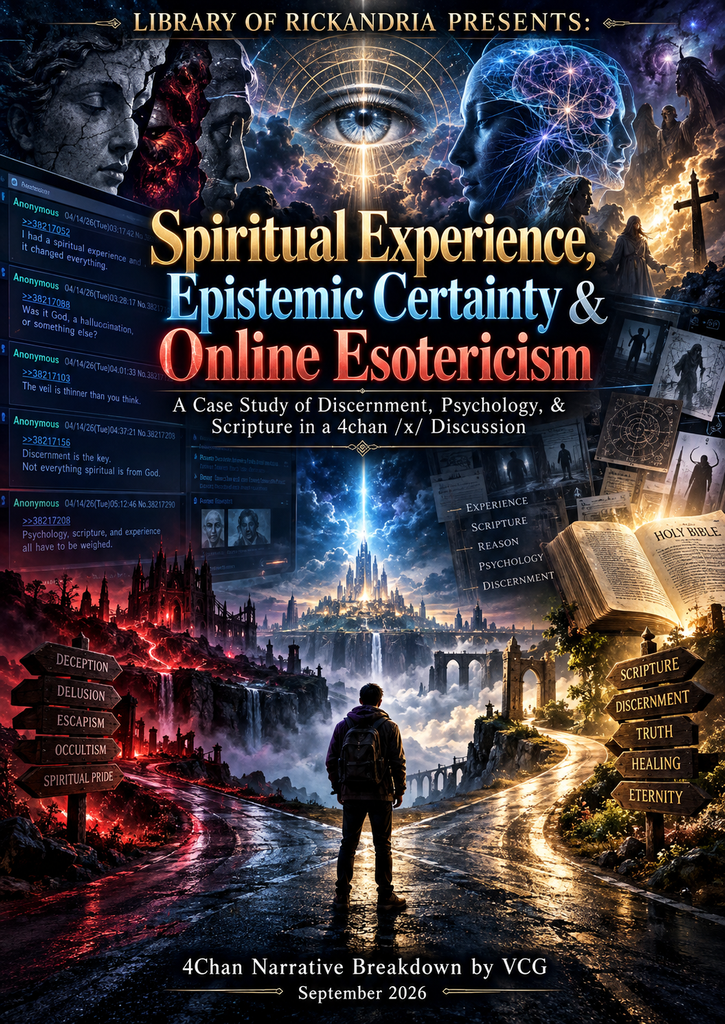
UPDATED BY VCG ON 9/30/2026 @ 06:14 EST
Anyone can do this, but most won’t.
ChatGPT – Library of Rickandria
Abstract
On September 28–29, 2026, an anonymous discussion on 4chan’s /x/ board developed around a poster who described an increasingly powerful urge to abandon ordinary life and simply continue walking away from home.
/x/ – overwhelming urge to walk away – Paranormal – 4chan
The poster associated this impulse with years of philosophical and mystical inquiry, profound alienation from ordinary life,
emotional emptiness,
uncertainty about family obligations,
and the sense that one particular road represented something like “destiny.”
Other anonymous participants interpreted the experience through radically different explanatory systems:
- intuition
- occultism
- natal astrology
- dissatisfaction with life
- post-traumatic stress
- dissociation
- psychotherapy
- reincarnation
and a form of spiritual anthropology resembling Valentinian distinctions between “pneumatic” and materially oriented human beings.
The discussion eventually also invoked Ecclesiastes and biblical ideas about meaning.
This paper examines the thread as a case study in how ambiguous personal experiences become metaphysical conclusions online.
Its central methodological distinction is between an experience, an interpretation of that experience, and a claim about external reality.
A person may sincerely experience alienation, compulsion, emotional numbness, or unusual significance without the experience itself demonstrating that:
- a supernatural summons
- horoscope
- past-life mechanism
- trauma disorder
or Gnostic anthropology explains it.
The paper therefore does not attempt to prove that the original experience was:
“merely psychological,”
nor does it assume that spiritual realities are impossible.
Instead, it asks a more disciplined question:
what does the available evidence actually permit us to conclude?
The resulting analysis finds that some psychological descriptions raised in the thread are plausible areas for further inquiry but cannot be diagnosed from anonymous forum posts; that the deterministic astrological claims are not supported by controlled tests of natal-chart personality interpretation; that several historical assertions concerning monasticism and “Gnostic” spirituality require substantial qualification; and that numerous responses confuse confidence, intuition, or esoteric vocabulary with independent evidence.
From a biblical perspective, the paper argues that Scripture neither commands reflexive disbelief toward extraordinary experiences nor permits extraordinary experiences to authenticate themselves.
Its recurring methodological principle is 1 Thessalonians 5:21:
“Prove all things; hold fast that which is good.”
The biblical quotations in this study have been checked against the supplied Authorized King James Version, Pure Cambridge Edition.
1. What This Paper Is—and Is Not—Trying to Do
It would be easy to approach an /x/ thread looking for either confirmation or ridicule.
One reader might see every unusual experience as demonic deception.
Another might see evidence of:
- awakening
- synchronicity
- reincarnation
- hidden spiritual identity
or supernatural destiny.
A third might decide immediately that the poster is mentally ill.
All three approaches can make the same methodological mistake:
deciding what the experience is before establishing what the evidence actually shows.
The original poster gives us first-person testimony.
That testimony matters.
If someone says that ordinary accomplishments have become hollow, that they feel disconnected from the emotional life other people seem to possess, and that a particular action feels extraordinarily compelling, dismissing those statements merely because they appeared on 4chan would be unwarranted.
But testimony about an experience is not automatically testimony about its cause.
There is a difference between:
“I experienced an overwhelming sense that I should take this road.”
and:
“Therefore an external spiritual reality was directing me down this road.”
There is another difference between:
“Nothing seems meaningful to me.”
and:
“Therefore I am a spiritually superior pneumatic whose true nature is incompatible with material existence.”
And yet another between:
“I feel emotionally numb.”
and:
“Therefore I have PTSD.”
The purpose of this paper is to keep those steps from collapsing into each other.
That distinction becomes especially important because 4chan deliberately permits anonymous participation.
According to 4chan’s own FAQ, users do not need registered accounts, “Anonymous” simply means that the Name field was left blank, and no ordinary account-registration process exists.
Consequently, “Anonymous” should never automatically be treated as one continuous speaker unless the reply structure or content independently supports continuity.
This also means we cannot establish the posters’:
- identities
- medical histories
- sincerity
- education
- religious commitments
or circumstances beyond what they voluntarily disclosed.
The thread is therefore best treated not as a clinical case file but as a documented conversation about interpretation.
2. Methodology: How the Claims Were Tested
The analysis uses five different evidentiary categories because different kinds of claims require different kinds of evidence.
A first-person experiential claim—for example,
“I feel hollow”
—is treated initially as testimony about subjective experience.
We cannot independently verify the feeling, but neither do we need to invent an alternative feeling for the poster.
A psychological claim—for example,
“this is PTSD”
—is compared against clinical descriptions and treatment guidance from institutions such as:
- NIMH
- the VA National Center for PTSD
- the CDC
and relevant peer-reviewed psychological literature.
A historical claim—for example, claims about ancient monks or “pneumatics”—is compared against historical scholarship rather than Scripture alone.
An empirical claim—such as the ability of natal charts to reveal personality—is evaluated against controlled research where such testing exists.
A theological claim is treated differently again.
The statement:
“reincarnation contradicts canonical Christian teaching”
is a theological comparison between two systems.
It is not the same type of statement as:
“this experiment failed to validate natal astrology.”
That separation matters.
Evidence and certainty scale
| Classification | Meaning in this paper |
|---|---|
| Directly established | The primary evidence explicitly establishes the point. |
| Strongly supported | Multiple credible sources substantially support the conclusion. |
| Plausible | Compatible with the evidence, but alternatives remain. |
| Speculative | Possible, but not established by the available evidence. |
| Unsupported | Asserted without sufficient supporting evidence. |
| Contradicted | Relevant evidence directly conflicts with the claim. |
This scale intentionally leaves room for:
“we do not know.”
That answer is sometimes the intellectually strongest one available.
3. The Narrative Development of the Thread
The thread starts with uncertainty.
That fact is worth noticing because the conversation does not begin with a developed occult doctrine.
It begins with a person trying to describe an experience that they themselves do not understand. =
The poster connects years of philosophical and mystical inquiry with increasing alienation and describes a powerful impulse to abandon the expected course of ordinary life.
They also acknowledge reasons not to follow the impulse, including the possible destruction of relationships and their own welfare.
Then the interpretations begin.
The experience becomes, successively,
- evidence about intuition
- spiritual vocation
- natal astrology
- psychological dissatisfaction
- PTSD or dissociation
- psychotherapy
- reincarnation
and finally “pneumatic” alienation from material society.
This produces the paper’s central narrative map:
Experience of alienation and compulsion
→ interpretation as destiny
→ intuition treated as epistemic authority
→ astrological confirmation
→ psychological reinterpretation
→ trauma hypothesis
→ reincarnation narrative
→ pneumatic/Gnostic-style anthropology
The striking feature is that the amount of interpretation increases far more rapidly than the amount of new evidence.
The same handful of experiences becomes compatible with multiple explanatory systems.
That fact does not by itself prove that all of the systems are false.
It does demonstrate that the experience alone cannot discriminate reliably between them.
If the same feeling can be offered as evidence for:
- astrology
- PTSD
- reincarnation
- Gnostic alienation
- mystical destiny
or ordinary dissatisfaction, then something besides the feeling must adjudicate among those explanations.
4. From Experience to Ontology
This is the intellectual center of the thread.
A person experiences something unusual.
That experience acquires meaning.
The meaning becomes an explanation.
The explanation eventually becomes a statement about the structure of reality.
That transformation often happens almost invisibly.
Suppose a person reports:
“I feel as though I do not belong here.”
Several interpretations are possible.
It could describe social alienation.
It could reflect dissatisfaction with current circumstances.
It could accompany depression.
It could arise after traumatic experiences.
It could be an existential or religious crisis.
It could be metaphorical.
Within a spiritual worldview, someone could also wonder whether spiritual factors are involved.
But none of those possibilities follows automatically from the sentence.
The crucial error occurs when:
“I feel alien”
quietly becomes:
“Therefore I am ontologically different from the people around me.”
The thread eventually makes precisely this kind of transition by introducing “false humans” and the possibility that the poster is a “pneumatic.”
At that point we have moved far beyond phenomenology.
We are no longer describing what a person feels.
We are describing what human beings supposedly are.
That requires additional evidence.
5. Emotional Reasoning: When Feelings Become Evidence
Psychology has a useful concept for one part of this process:
emotional reasoning.
A systematic review by Paredes-Mealla and colleagues defines emotional reasoning as using feelings rather than objective evidence as information for evaluating an external situation.
The review found evidence associating emotional reasoning with greater severity of anxious symptoms, while the evidence concerning depression was less clear; importantly, only nine studies met the review criteria, so this is not a license to diagnose every emotionally driven belief as pathology.
The concept is nevertheless relevant to a statement such as:
“This feels like destiny; therefore it probably is destiny.”
The problem is not having the feeling.
The problem is allowing the intensity of the feeling to serve as evidence for the explanation of the feeling.
Intensity and truth are different variables.
A frightening thought does not become more objectively probable because it is frightening.
A consoling thought does not become true because it creates peace.
A spiritual impression does not establish its source merely because it feels spiritually overwhelming.
This is one reason careful discernment has to preserve a gap between:
experience
and
interpretation.
6. Is Intuition Worthless? No—and That Is Precisely Why the Question Is More Interesting
A crude rebuttal would say that intuition is irrational and should simply be ignored.
Research does not support such a simplistic view.
Daniel Kahneman and Gary Klein—scholars associated with traditions that often disagreed about intuitive expertise—jointly examined the conditions under which intuitive judgments can become genuinely skilled.
Their important point is that intuition becomes more trustworthy when a person operates in an environment containing sufficiently regular patterns and has repeated opportunities to learn those patterns through meaningful feedback.
Subjective confidence by itself does not prove that intuitive judgment is accurate.
A firefighter may develop highly sophisticated intuitions about fire behavior.
A chess master may recognize board configurations almost immediately.
A nurse with extensive experience may notice subtle patterns that a novice misses.
But what is the corresponding feedback environment for recognizing a metaphysical destiny embedded in a particular road?
That calibration has not been demonstrated.
This does not prove the poster’s intuition false.
It means the thread cannot legitimately say:
strong intuition = reliable revelation.
The response advising the poster to wait rather than act rashly contains a sensible risk-reduction principle.
But when it adds that the eventual disappearance of hesitation will indicate the correct time to leave, certainty itself quietly becomes the validation criterion.
Human beings can become completely certain of things that are completely wrong.
Confidence therefore needs an external check.
7. One of the Best Questions in the Thread
One responder asks the poster to explain concretely what “satisfaction” would actually mean and why previous pursuits failed to produce it.
Methodologically, that question is excellent.
It moves from:
“Nothing means anything.”
toward:
“Which activities?
What expectations?
What emotional response?
How long?
Under what circumstances?”
That is how vague totalizing conclusions become investigable.
Suppose someone says:
“Nothing ever works.”
The useful next question is not immediately:
“Which planet causes that?”
nor:
“Which spirit causes that?”
nor:
“Which disorder causes that?”
It is:
“What exactly happened?”
Concrete description is an antidote to premature metaphysics.
8. Emotional Numbness: A Symptom Is Not a Diagnosis
Later the poster describes an absence of ordinary emotional reward:
success does not seem to produce happiness, failure does not seem to produce sadness, and actions feel deeply hollow.
The poster also acknowledges that wandering away probably would not solve the underlying problem.
At this point the conversation contains material that overlaps with recognizable psychological symptoms.
NIMH lists:
- loss of interest or pleasure
- an “empty” mood
- withdrawal
- detachment
- isolation
and impaired responsibilities among possible symptoms or behavioral changes associated with depression.
Major depression, however, requires a broader diagnostic pattern involving:
- duration
- frequency
- impairment
and other clinical considerations; NIMH also notes that medications and medical conditions can produce similar symptoms.
So it would be reasonable to say:
“These descriptions overlap with symptoms clinicians would take seriously.”
It would not be reasonable to say:
“The poster therefore has major depressive disorder.”
That is the difference between recognizing a differential possibility and conducting an internet diagnosis.
9. PTSD and Dissociation: The Thread Moves Too Quickly
Another participant suggests that the poster’s emotional disconnection “could” reflect PTSD-related dissociation.
The wording matters.
“Could” is much more defensible than “is.”
PTSD requires more than emotional numbness.
NIMH describes PTSD as a disorder developing after traumatic exposure and involving patterns of symptoms such as re-experiencing, avoidance, heightened arousal/reactivity, and changes in cognition or mood that persist and interfere with life.
Emotional detachment or difficulty experiencing positive emotions can occur, but those features by themselves do not establish PTSD.
We do not know from the thread whether the poster experienced a qualifying trauma.
We do not have the necessary symptom history.
We do not know duration.
We do not have a clinical interview.
Therefore:
PTSD is a hypothesis raised by a participant—not an established explanation of the poster’s experience.
That distinction needs to remain intact.
10. “If You Have PTSD, You’re Screwed”: A Direct Factual Error
The thread then contains one of its clearest empirically testable claims:
because past events cannot be undone, someone with PTSD is supposedly permanently “screwed.”
That reasoning confuses two propositions:
The past cannot be erased.
and:
The present effects of the past cannot improve.
The first is obvious.
The second is false.
The 2023 VA/DoD Clinical Practice Guideline recommends trauma-focused psychotherapies including:
- Prolonged Exposure (PE)
- Cognitive Processing Therapy (CPT)
- Eye Movement Desensitization and Reprocessing (EMDR)
as the psychotherapies with the strongest support for PTSD.
NIMH likewise describes evidence-based psychotherapy as capable of helping people:
- identify triggers
- process trauma-related material
- restructure interpretations
and reduce distressing symptoms.
Treatment does not require changing history.
It works by changing the person’s present relationship to the consequences of history.
11. Is Psychotherapy “Mind Control” or “Soul Harvesting”?
The thread next asks whether psychotherapy is really some form of:
“mind control soul harvesting.”
Another poster replies that psychotherapy is essentially talking through what happened so that the experience exerts less control over the present.
Both descriptions need correction.
There is no evidence presented for literal:
“soul harvesting.”
At the same time, psychotherapy is broader than merely:
“talking about what happened.”
Depending on the treatment and condition, it can involve:
- cognitive restructuring
- exposure exercises
- behavioral work
- interpersonal interventions
- skills training
and other structured methods.
Professional psychotherapy is also supposed to operate under informed-consent standards.
The American Psychological Association’s ethics code requires psychologists to explain the nature and anticipated course of:
- therapy
- fees
- relevant third-party involvement
and limits of confidentiality, while providing clients an opportunity to ask questions.
When a technique lacks generally established:
- procedures
- risks
- alternatives
and the voluntary nature of participation are to be disclosed.
That does not mean every therapist is competent.
It does not mean every school of therapy rests on equally strong evidence.
It does not mean Christians must accept every psychological theory attached to therapeutic practice.
It means that criticizing psychotherapy responsibly requires criticizing:
- actual therapeutic methods
- assumptions
- evidence
- practices
rather than invoking an unsubstantiated metaphysical mechanism.
“Prove all things”
applies to psychologists too.
But it also applies to accusations against them.
12. The Autism Detour: Writing Style Is Not a Diagnosis
A second participant—explicitly identifying themselves as not the original poster—asks whether their typing sounds autistic, immature, or AI-generated after recalling that someone once insulted their communication style.
A few lines of anonymous text cannot establish autism.
NIMH notes that adult ASD evaluation involves professional assessment of:
- social communication
- sensory issues
- repetitive behaviors
- restricted interests
and often developmental history.
CDC guidance likewise emphasizes that diagnosis depends on multiple sources of information and standardized criteria rather than a single isolated feature.
An unusual writing style may prompt questions.
It is not a diagnostic instrument.
This becomes another useful methodological rule:
A resemblance is not an identification.
13. Online Disinhibition and the Strange Intimacy of Anonymous Forums
There is a social-psychological feature of the thread that deserves attention independent of its religious content.
Within a short anonymous exchange, strangers:
- reveal existential despair
- discuss death
- provide psychological speculation
- read natal charts
- offer life-direction advice
- insult one another
and accept spiritual authority from people whose identities they do not know.
John Suler’s classic description of the online disinhibition effect identified several features of computer-mediated interaction—including:
- anonymity
- invisibility
- asynchronicity
and reduced authority cues—that can contribute to unusually open disclosure or unusually uninhibited behavior online.
Suler did not claim that anonymity makes everyone irrational, nor should the concept be used retrospectively to diagnose individual posters.
It is a model for understanding the environment in which the conversation occurs.
4chan intensifies several of those conditions structurally.
Ordinary users do not need registered identities, and “Anonymous” can represent countless unrelated people.
This creates an unusual epistemic situation:
very high emotional intimacy combined with very low accountability and very little verifiable biography.
Someone may disclose more to an anonymous stranger than to a sibling.
Then, minutes later, that stranger may become a spiritual adviser.
Understanding the person emotionally is not the same thing as knowing the cause of their condition.
Empathy is evidence that someone may understand an experience.
It is not evidence that their metaphysical explanation of the experience is correct.
14. Astrology Enters the Thread
The conversation changes significantly when a respondent asks for the poster’s natal chart.
Before the chart appears, the available data consist primarily of the poster’s words.
After the chart appears, the respondent infers tendencies involving:
- melancholy
- instability
- maternal strain
- spiritual delusion
- difficulties with settlement
and certain social strengths, then offers recommendations about stabilizing daily life and cultivating relationships.
It is important not to commit an inverse fallacy here.
Some of the resulting advice is perfectly reasonable.
“Develop friendships.”
“Stabilize your mundane life.”
“Examine your motivations.”
“Stop moving endlessly between pursuits.”
Those recommendations do not become false because an astrologer offered them.
But sensible advice does not validate the method allegedly used to generate it.
That is the methodological distinction.
15. Natal Astrology and Controlled Testing
The relevant empirical question is not whether astrology can produce emotionally resonant language.
It clearly can.
The question is whether natal-chart information demonstrates dependable discriminatory power concerning personality or life outcomes.
In a 1985 Nature study, Shawn Carlson conducted double-blind tests of natal astrology designed in consultation with astrologers, specifically testing whether natal charts could accurately characterize personality.
The reported results did not support the tested astrological predictions beyond chance expectations.
A later double-blind study by Alyssa Wyman and Stuart Vyse asked 52 students to identify genuine versus bogus personality descriptions generated either from the NEO Five-Factor Inventory or from astrological natal charts.
Participants showed discriminatory ability for the standardized psychological profiles but not for their genuine astrological summaries.
No single experiment can refute every conceivable form of astrology.
That would be too sweeping.
But these studies are directly relevant to what occurs in the thread:
using natal information to produce individualized psychological claims.
The available controlled evidence does not justify treating such interpretations as a reliable diagnostic or vocational instrument.
16. The Barnum Effect and Personalized Language
The Barnum effect is the tendency to experience general or broadly applicable personality descriptions as uniquely applicable to oneself.
The APA Dictionary of Psychology explicitly uses astrology as an example of the phenomenon.
That does not mean every sentence in every horoscope is deliberately vague.
It means humans are remarkably good at recognizing themselves in flexible descriptions.
Consider the kinds of statements that can feel highly personal:
You desire connection but sometimes withdraw.
You fear instability yet resist confinement.
You have potential that is blocked by uncertainty.
You have been misunderstood.
You want meaning but are dissatisfied with superficial answers.
For many people, those statements will feel intimate because they concern common tensions in human life.
The correct test is therefore not merely:
“Did this feel accurate?”
but:
“Could the method distinguish me from plausible alternatives under blinded conditions?”
That is a much harder standard.
And it is precisely why controlled testing matters.
17. Astrology Can Also Become Self-Sealing
Another difficulty appears when an interpretive system can explain virtually every possible outcome.
If a person follows the horoscope and succeeds, the chart was accurate.
If they fail, perhaps they misunderstood the chart.
If they resist the reading, that resistance can itself be interpreted astrologically.
If they later recognize the prediction, the chart was prophetic.
If they never recognize it, perhaps the relevant transit has not arrived.
A framework becomes epistemically weak when contrary outcomes cannot meaningfully count against it.
This is not unique to astrology.
- Religious movements
- political ideologies
- conspiracy theories
- psychoanalytic systems
- personality typologies
and even badly practiced scientific theories can become self-insulating.
The solution is the same:
Ask in advance what evidence would count against the interpretation.
If the answer is “nothing,” the theory is no longer being tested.
18. The Second Natal Chart and High-Stakes Advice
Later, the participant who says they are not OP posts another chart while discussing an imminent physically demanding undertaking and expressing unusually stark language about failure and death.
A chart reader responds with strong vocational reassurance.
That creates a more serious methodological problem.
For a physically demanding occupation, the relevant evidence would ordinarily include matters such as:
- physical condition
- training
- medical status
- skill
- occupational requirements
- supervision
- preparation
and actual performance.
A natal chart does not substitute for those variables.
This is particularly important when someone is already framing failure in catastrophic terms.
Strong certainty offered to a distressed stranger may feel compassionate.
But compassion does not eliminate the need for calibrated confidence.
19. The Historical Claim About Monks, Gurus, and Withdrawal
One reply argues, in effect, that genuine spiritual workers do not actually function without worldly institutions sustaining them.
There is an important truth here: even radical ascetics often exist within economic and social networks.
But as an absolute historical statement it is too strong.
Studies of early Christian monasticism describe Desert Fathers pursuing increasingly radical solitude; the earliest Christian monks included hermits and anchorites who deliberately withdrew into near-isolation.
At the same time, scholarship on anchoritic life emphasizes that solitude rarely meant metaphysical independence from all human support.
Medieval anchorites might live without spiritual companions yet depend upon servants or others for basic domestic needs; studies of:
“solitude in community”
likewise stress the continuing relationship between recluses and surrounding Christian communities.
CHRISTIANITY – Library of Rickandria
So, the historically defensible conclusion is more nuanced:
Radical religious withdrawal is historically real. Complete material independence from human society is much rarer.
That is very different from either romanticizing the hermit or pretending hermits did not exist.
20. The “Pneumatic” Turn: What History Actually Says
One responder eventually tells the poster that society and “false humans” are unnatural and suggests that if the poster is a “pneumatic,” material existence and ordinary ego life would naturally feel corrosive.
The term does have historical parallels.
But first, terminology needs care.
Modern scholars increasingly caution that “Gnosticism” is not a simple name for one unified ancient religion.
Cambridge scholarship notes that the word itself is modern and that the identity of ancient groups called gnōstikoi is difficult to define.
Recent work goes further, arguing that “Gnosticism” can obscure the diversity of ancient Christian movements and should sometimes be replaced by analysis of specific texts, groups, and doctrines.
So instead of saying:
“The commenter is teaching Gnosticism.”
it is historically more precise to say:
“The comment resembles particular forms of Valentinian anthropology.”
That claim can be documented.
21. Pneumatic, Psychic, and Material Humans in Valentinian Traditions
Recent Cambridge scholarship discussing Valentinian texts describes a tripartite anthropology involving pneumatic/spiritual, psychic/animate, and material categories.
In some Valentinian presentations, these categories become relatively fixed kinds of human beings associated with differing capacities for spiritual knowledge.
That is much closer to the vocabulary appearing in the thread.
But historical similarity is not evidence that the ancient anthropology is true.
Knowing that an idea is old establishes provenance, not validity.
And the phrase “false humans” goes further still.
The ancient categories may provide the conceptual background for a modern esoteric claim, but they do not independently demonstrate that the people surrounding the poster are ontologically inferior, spiritually counterfeit, soulless, or unreal.
22. The Ethical Danger of “False Humans”
The phrase deserves special attention because it can become psychologically and ethically corrosive regardless of one’s theology.
Imagine an interpretive system in which:
People who understand you are spiritually real.
People who do not understand you are:
- “hylic”
- fake
- asleep
- NPC-like
- spiritually dead
or counterfeit.
Ordinary society feels alien because you are spiritually superior.
Disagreement becomes evidence that the other person lacks the necessary spiritual faculty.
In that structure, human disagreement no longer tests the theory.
It confirms it.
The framework becomes self-sealing while simultaneously reducing the moral status of outsiders.
Historically, Valentinian anthropologies are more complex than a modern internet phrase like “false humans.”
Biblically, the contrast is even sharper.
Genesis presents humanity as created in the image of God and the created order as originally pronounced “very good.”
Christian theology certainly distinguishes belief from unbelief, flesh from Spirit, righteousness from sin, and regeneration from the natural condition.
But those distinctions do not license the conclusion that inconvenient neighbors are literally counterfeit humans.
That is an interpretation the text does not require.
23. Does Paul Himself Use “Spiritual” and “Natural” Categories?
Yes.
That is important because a careless rebuttal could wrongly suggest that any distinction between “spiritual” and “natural” people must be foreign to Christianity.
In 1 Corinthians 2 Paul contrasts the spiritual (pneumatikos) and natural (psychikos) person.
But the surrounding argument centers on receiving the things of the Spirit of God and culminates in:
“But we have the mind of Christ.”
Paul then immediately rebukes the Corinthians for:
- envy
- strife
- division
- spiritual immaturity
Whatever one concludes about the precise Pauline anthropology, the passage does not straightforwardly support an internet ontology in which some strangers are “false humans.”
Later Valentinian systems developed Pauline vocabulary in distinctive ways.
Historical scholarship specifically notes that the Tripartite Tractate can frame pneumatic, psychic, and material people as relatively fixed human categories.
That historical development should not simply be read backward into Paul’s letters.
24. Christianity and Materiality
The thread’s “pneumatic” interpretation treats material social existence as something from which the true spiritual person naturally longs to escape.
Canonical Christianity contains serious warnings concerning “the flesh,” worldly desires, corruption, and the present fallen order.
But biblical “flesh” cannot simply be equated with the proposition:
matter itself is intrinsically evil.
Genesis presents created reality as God’s work and calls the completed creation “very good.”
The New Testament centers on incarnation:
“Every spirit that confesseth that Jesus Christ is come in the flesh is of God.”—1 John 4:2
Paul speaks of the body as belonging to God and ultimately expects resurrection rather than permanent liberation from embodiment.
Most decisively, 1 Corinthians 15 does not conclude with souls forever escaping matter.
It describes the dead being raised, mortality putting on immortality, and corruption putting on incorruption.
Christian eschatology transforms embodiment.
It does not merely discard it.
25. Reincarnation Enters Without Argument
Another responder offers an elaborate metaphysical story:
consciousness chooses humanity,
enters earthly existence,
dies,
returns to a formless condition,
and then begins another existence as someone or something else.
Notice what has happened methodologically.
No evidence is supplied.
The statement is presented directly as an explanation of the poster’s spirituality.
It may belong to a recognizable family of reincarnation or New Age metaphysics.
But within the thread, it is simply asserted.
The epistemic distance between:
“You feel alienated.”
and:
“Your preexistent consciousness voluntarily chose incarnation and will reincarnate again.”
is enormous.
A personal feeling cannot carry that metaphysical burden by itself.
26. Reincarnation and the Biblical Resurrection Framework
Within the canonical biblical framework, reincarnation and resurrection are not interchangeable.
Hebrews 9:27 states:
“And as it is appointed unto men once to die, but after this the judgment:”
The immediate context compares human death with Christ’s once-for-all sacrificial death, so the verse should not be detached from that argument.
Nevertheless, its stated sequence is death → judgment, not repeated earthly embodiment.
John 5 describes those in the graves eventually coming forth to resurrection.
1 Thessalonians 4 says:
“the dead in Christ shall rise first.”
And 1 Corinthians 15 builds its eschatological hope around the resurrection and transformation of the body.
Therefore the responsible conclusion is:
Within canonical Christian theology, the thread’s reincarnation model conflicts with the dominant resurrection-and-judgment framework.
That is a theological comparison.
It should not be falsely presented as though a Bible verse were a laboratory experiment proving reincarnation scientifically impossible.
27. Ecclesiastes Finally Appears
Near the end of the discussion, a participant recommends Ecclesiastes as an answer to the problem of meaning.
The original poster responds that they have already read the Bible repeatedly and dislike it.
Reading a book three times does not logically force agreement with it.
Likewise, disliking a book does not refute it.
The appropriate question is what Ecclesiastes actually argues.
After prolonged examination of:
- pleasure
- labor
- wealth
- wisdom
- injustice
- mortality
- uncertainty
and “vanity,” the book concludes:
“Let us hear the conclusion of the whole matter:
Fear God, and keep his commandments: for this is the whole duty of man.
For God shall bring every work into judgment, with every secret thing, whether it be good, or whether it be evil.”—Ecclesiastes 12:13–14
That conclusion does not erase the emotional problem described by the poster.
It gives a different answer to the question of meaning.
Meaning is not located in discovering a secret esoteric identity or obeying whatever impulse feels most destined.
It is located in relation to:
- God
- obedience
- creaturely limitation
- final judgment
28. A Biblical Method of Discernment
The most useful biblical correction to the thread is not a catalogue of everything Christians should fear.
It is a methodology.
1 John 4:1
“Beloved, believe not every spirit, but try the spirits whether they are of God…”
Notice the balance.
John does not say:
“There are no spirits.”
He also does not say:
“Any experience that feels spiritual should be believed.”
The existence of spiritual claims creates a need for greater testing, not less.
1 Thessalonians 5:19–21
“Quench not the Spirit.
Despise not prophesyings.
Prove all things; hold fast that which is good.”
This may be the most fitting passage for the entire case study.
Paul places openness and scrutiny beside one another.
Do not quench.
Do not despise.
But prove.
Then hold fast.
That is different from both gullibility and cynical dismissal.
Acts 17:11
The Bereans are commended because they receive teaching readily while simultaneously searching the Scriptures to determine whether the claims are true.
Their openness does not cancel examination.
Their examination does not cancel openness.
Isaiah 8:19–20
When Israel is directed toward mediums and familiar spirits, Isaiah redirects them toward God and His revelation:
“To the law and to the testimony…”
The underlying principle is that spiritual claims are not permitted to create their own independent standard of truth.
Deuteronomy 13
An especially important text warns that even a successful sign or wonder does not automatically authenticate a religious message if that message draws Israel away from the God already revealed to them.
Within its historical context this belongs to Israel’s covenant order.
Its ancient civil sanctions should not simply be imported into modern society.
But the epistemic principle is remarkable:
the extraordinary event does not outrank revealed truth.
A supernatural occurrence, even if genuine, would not necessarily validate the interpretation attached to it.
29. Astrology and Biblical Divination Texts
Deuteronomy 18 forbids Israel from adopting surrounding practices of:
- divination
- enchantment
- consultation with spirits
- necromancy
and related means of supernatural guidance.
Care is necessary here.
The passage is not a modern technical definition of every practice now called astrology.
Nor does the Bible condemn observing the heavens as astronomy; Genesis itself speaks of celestial lights marking seasons, days, and years.
The stronger biblical argument concerns function.
When celestial configurations become a means of divining an individual’s:
- hidden character
- destiny
- spiritual condition
or vocational future, the practice begins functioning as divinatory guidance.
That is precisely how the charts operate in the thread.
The question is no longer:
“Where is Saturn?”
It becomes:
“What does Saturn tell me about who this person is and what they should do?”
That is the point at which the biblical concern becomes directly relevant.
30. Feeling Is Not Revelation
One of the thread’s deepest assumptions is that sufficient intensity eventually authenticates itself.
The poster feels drawn.
Another person says wait until all hesitation disappears.
Another says follow instinct.
Another treats astrology as confirmation.
Yet Scripture repeatedly gives reasons not to make subjective certainty the highest court of appeal.
The heart can condemn incorrectly.
People can be deceived.
False prophets can speak religiously.
Signs can mislead.
Spirits must be tested.
Doctrines must be compared.
Fruit matters.
Truth matters.
This does not make feelings worthless.
Fear may warn us.
Compassion may reveal something morally important.
Conscience matters.
Conviction matters.
Desire exposes what we value.
But feelings belong among the evidence to be interpreted.
They are not automatically the interpreter of all other evidence.
31. Ordinary Providence Versus Esoteric Destiny
The thread sometimes assumes that the genuinely spiritual path must be the dramatic path.
Walk away.
Abandon the expected life.
Find the hidden destiny.
Reject the mundane.
Yet the New Testament is surprisingly comfortable with ordinary faithfulness.
Paul tells the Thessalonians:
“study to be quiet, and to do your own business, and to work with your own hands…”
=—1 Thessalonians 4:11
This appears in the same chapter that soon turns to the return of Christ and resurrection.
The mundane and the eschatological are not enemies.
Christianity contains:
- wilderness prophets
- missionaries
- martyrs
- monks
- radical acts of obedience
- journeys
- departures
- costly callings
But dramatic disruption is not automatically holier than ordinary fidelity.
Sometimes obedience means leaving.
Sometimes it means staying.
Sometimes the most spiritually responsible thing available is:
- going to work tomorrow
- keeping a promise
- caring for somebody
- sleeping
- eating
- praying
- telling the truth
and refusing to manufacture revelation where God has not given it.
32. Family Responsibility: Neither Absolute Bondage nor Disposable Attachment
The poster expresses fear about what leaving might do to a troubled family and later explains having been given some responsibility for maintaining things.
Neither extreme interpretation is warranted.
We do not know enough to say:
“You must remain in this family arrangement forever.”
We also do not know enough to say:
“You owe them nothing; just disappear.”
1 Timothy 5:8 speaks strongly about providing for one’s own household, but its immediate context concerns concrete care for dependent family members and widows.
It would therefore be an abuse of the passage to transform it into a universal command never to:
- leave one’s family home
- change roles
- establish boundaries
- travel
- marry
- relocate
or pursue legitimate responsibilities elsewhere.
Biblical family duty is real.
So are the need for wisdom, truth, and properly ordered obligations.
The thread does not contain enough information to adjudicate the poster’s precise duty.
33. The High-Risk Language Cannot Be Spiritualized Away
The original conversation includes references to personal ruin, possible early death,
“doing something crazy,”
disappearance, and—by the second poster—failure being worse than dying.
Not every dramatic mention of death means suicidal intent.
Internet speech is often hyperbolic.
But responsible analysis should not romanticize such language as proof of destiny.
NIMH includes thoughts of death or suicide among clinically significant warning signs that deserve attention; depression can also involve withdrawal, impulsivity, high-risk behavior, and detachment.
In an actual pastoral, clinical, family, or friendship setting, the responsible next move would therefore include direct questions about safety.
Not:
“Your willingness to die proves this is your calling.”
Not:
“The stars say you’re made for it.”
And not:
“If you are spiritually advanced, death no longer matters.”
A person’s life should not become evidence in someone else’s metaphysical experiment.
34. The Strongest Charitable Reading of the Esoteric Side
A fair critique should present the strongest version of the position it is criticizing.
The intuition-oriented posters are not necessarily saying that every random impulse deserves obedience.
Their better argument could be reconstructed like this:
Modern life can suppress forms of knowledge that are difficult to verbalize.
Human beings often recognize misalignment before they can rationally explain it.
Persistent dissatisfaction can indicate that one’s present life is badly ordered.
Excessive dependence on social expectations can prevent genuine self-knowledge.
A person should therefore take profound recurring intuitions seriously rather than dismiss them simply because they are unconventional.
Much of that is reasonable.
Psychology itself recognizes nonconscious pattern processing.
Religious traditions recognize:
- conscience
- conviction
- vocation
- spiritual discernment
A person may indeed need to change their life radically.
The disagreement begins with the next step:
How do we tell a trustworthy intuition from:
- fear
- compulsion
- trauma
- wishful thinking
- escapism
- obsession
- social influence
or misinterpretation?
“Trust intuition” does not answer that question.
It merely restates it.
The strongest version of the esoteric argument therefore strengthens the case for discernment rather than eliminating it.
35. Internal Contradictions in the Thread
The replies do not converge on a common explanatory model.
That matters.
If the same symptoms are confidently explained by:
intuition,
astrology,
mundane dissatisfaction,
PTSD,
reincarnation,
and
pneumatic alienation,
then the agreement of commenters that the experience is important should not be mistaken for agreement about what it means.
Their explanations are not merely different words for the same mechanism.
Some are psychologically naturalistic.
Some are astrological.
Some presuppose reincarnation.
Some resemble ancient esoteric anthropologies.
Some invoke biblical wisdom.
They cannot all be treated as independently confirmed simply because each can narrate the same facts.
This is a classic underdetermination problem:
multiple theories can fit the same limited data.
What is needed is evidence capable of distinguishing among them.
36. Claim Dependency: Where the Certainty Actually Comes From
One useful way to expose the structure is to ask which conclusions depend on which earlier assumptions.
Consider this chain:
The road feels uniquely compelling
→ therefore the feeling reveals destiny
→ therefore intuition should outrank contrary reasoning
→ therefore walking away becomes spiritually privileged.
But the first sentence does not establish the second.
Or:
The poster feels alienated
→ therefore the poster is spiritually different
→ therefore the poster may be a pneumatic
→ therefore ordinary humans may be “false” or merely material.
Again, every arrow requires an argument.
Or:
The chart contains certain placements
→ therefore those placements reveal melancholy and instability
→ therefore the chart explains the poster’s crisis
→ therefore astrology is useful for deciding what to do.
The empirical research on natal personality assessment directly challenges the reliability of that middle inference.
An argument can appear impressive because its final conclusion contains specialized vocabulary.
The real question is whether the arrows are justified.
37. Common Rhetorical and Cognitive Patterns in the Thread
Several recurring techniques deserve attention, not because their presence automatically proves a claim false, but because they can make weakly supported ideas feel stronger than they are.
Authority through specialized vocabulary occurs when technical-sounding language—
- houses
- rulers
- Neptune
- pneumatic identity
—creates a sense that a mechanism has been demonstrated when it may only have been named.
Personal validation occurs when broad descriptions feel uniquely tailored to the reader, the terrain in which Barnum effects become relevant.
Self-sealing explanation occurs when every possible reaction confirms the framework.
Retrospective fitting occurs when meaning is assigned after an event without prior criteria that would permit failure.
False dichotomy appears when reason and intuition are treated as mutually exclusive rather than complementary faculties requiring calibration.
Spiritual elitism appears when alienation from others becomes evidence of superior ontological status.
Misreading appears when one participant turns the poster’s fear of harming the family and personally dying early into the claim that the family members themselves will die.
The question then attacks a proposition the poster had not actually stated.
None of these labels should substitute for argument.
Their value is that they show where the argument should be slowed down and examined.
38. What the Thread Gets Right
A serious paper should preserve what is reasonable even when it appears alongside weak arguments.
Several responses advise delay rather than immediate irreversible action.
That is sensible.
Several recommend talking honestly with family.
That may be constructive, depending on circumstances.
One respondent explicitly admits that their explanation involves assumptions.
That is good epistemic hygiene.
The question asking what “satisfaction” concretely means is excellent.
The suggestion to transform a dramatic fantasy of permanent disappearance into a limited, reversible walk is materially safer than encouraging an immediate irreversible departure, even though the respondent unnecessarily overlays the experiment with claims about spiritual growth.
The astrology responder also gives some ordinary advice—stabilize life, build friendships, identify motivations—that can be worthwhile independently of astrology.
The PTSD suggestion is phrased tentatively rather than diagnostically.
And the poster’s own statement—
“In case I’m mistaken”
—is one of the most intellectually responsible moments in the entire discussion.
Fallibility is not spiritual weakness.
It is the beginning of discernment.
39. What Scripture Does Not Allow This Paper to Claim
Biblical critique can itself become irresponsible if it claims more than Scripture establishes.
Nothing in this thread permits us to declare that the original poster is demon-possessed.
Nothing permits us to declare that a demon literally caused the road experience.
Nothing establishes divine calling.
Nothing establishes reprobation.
Nothing establishes mental illness.
Nothing establishes that the poster is saved or unsaved.
Nothing establishes that every unusual intuition is demonic.
Nothing establishes that psychotherapy is always spiritually harmless.
Nothing establishes that every psychological explanation is sufficient.
Nothing establishes that every mystical experience is fraudulent.
Scripture commands discernment.
It does not give interpreters permission to fabricate facts.
That distinction is crucial.
A Christian rebuttal loses integrity if it answers occult overconfidence with Christian overconfidence.
40. Why “Prove All Things” Is the Better Model
The thread frequently behaves as if only two approaches exist.
Either follow the mysterious experience.
Or reduce everything to mundane psychology.
The New Testament allows neither shortcut.
1 Thessalonians says:
“Quench not the Spirit.”
Then:
“Despise not prophesyings.”
Then:
“Prove all things.”
And only then:
“hold fast that which is good.”
The sequence matters.
Openness.
Testing.
Retention.
Christian discernment therefore does not begin with the assumption that every unusual event is supernatural.
Nor does it begin with the assumption that supernatural realities are impossible.
It asks what is being claimed, what evidence supports the claim, whether the teaching accords with revealed truth, whether contrary evidence is allowed to count, what fruit the belief produces, and where certainty exceeds evidence.
That is much harder than following a feeling.
It is also much safer.
41. A Responsible Discernment Model
The entire case can be reduced to an eight-stage process:
- Describe the experience before explaining it. State what happened, what was perceived, and what was felt without immediately assigning a supernatural or psychological cause.
- Separate observation from interpretation. “I felt compelled” is observation about experience; “God told me,” “the universe called me,” “trauma caused it,” and “Saturn caused it” are interpretations.
- Generate multiple plausible explanations. Spiritual, psychological, circumstantial, relational, physiological, and cognitive possibilities should not be prematurely collapsed into one another.
- Match evidence to the claim. Medical claims need clinical evidence; historical claims need historical sources; empirical claims need testing; theological claims need responsible exegesis.
- Look for disconfirming evidence. Ask what would show the preferred explanation to be mistaken.
- Prefer reversible tests when consequences are high. Irreversible decisions demand stronger evidence than temporary experiments.
- Test theological claims against Scripture in context. Do not merely attach isolated verses to a conclusion already chosen.
- Preserve uncertainty where uncertainty remains. “I do not know yet” is preferable to false revelation.
42. Conclusion
The most important thing about this 4chan thread is not astrology.
It is not Gnosticism.
It is not PTSD.
It is not even the strange road that begins the discussion.
It is the speed with which experience becomes certainty.
A person begins with an honest problem:
Something in life feels profoundly wrong.
A particular action feels unusually compelling.
Ordinary rewards feel hollow.
Family obligations complicate everything.
The person does not know what the experience means.
That uncertainty is then surrounded by interpreters.
One calls it intuition.
One brings a horoscope.
One suggests trauma.
One speaks of reincarnation.
One speaks of pneumatics and false humans.
One points toward Ecclesiastes.
And slowly the original question—
“What is happening to me?”
risks becoming—
“Which grand explanation should I believe?”
But there is an intermediate question that must come first:
“What have we actually established?”
We have established that the poster describes:
- distress
- alienation
- unusual subjective significance
- emotional hollowness
- uncertainty
We have not established a supernatural summons.
We have not established a psychiatric diagnosis.
We have not established astrological causation.
We have not established reincarnation.
We have not established a Valentinian anthropology.
We have not established the existence of “false humans.”
Historical study can tell us where some of these ideas came from.
Psychology can tell us how:
- feelings
- intuition
- anonymous communication
- emotional reasoning
- personality interpretation
- trauma symptoms
and cognitive biases sometimes operate.
Clinical literature can tell us what is and is not sufficient for diagnosis.
Controlled experiments can test certain astrological claims.
And Scripture can tell us whether a proposed theology accords with its own teaching.
Those disciplines should illuminate one another without being confused with one another.
The final biblical principle is therefore neither:
“Believe every spiritual experience.”
nor:
“There are no spiritual experiences.”
It is:
“Prove all things; hold fast that which is good.”—1 Thessalonians 5:21
The spiritual claim is tested.
The psychological claim is tested.
The historical claim is tested.
The scientific claim is tested.
Our own preferred interpretation is tested too.
That final requirement may be the most important of all.
Appendix A — Post-by-Post Source Audit
The following ledger preserves the complete argumentative progression of the thread as retrieved on September 30, 2026.
It summarizes rather than reproduces the posts so readers can consult the primary thread directly.
| Post | Function in the discussion | Evidentiary assessment |
|---|---|---|
| 43017280 | Original experience and “destiny” interpretation | Experience is testimony; destiny is interpretation. |
| 43017348 | Intuition presented as eventual guide | Waiting is prudent; certainty alone is not validation. |
| 43017444 | Occult/world architecture and monastic claim | Philosophical claim plus historically overstated generalization. |
| 43018784 | “Become who you are” aphorism | Inspirational but non-evidentiary. |
| 43018794 | Identity/family/cult accusation | Unsupported inference from insufficient information. |
| 43020181 | OP says advice will be taken seriously | Demonstrates real influence of anonymous responses. |
| 43020814 | Requests natal chart | Changes proposed evidence base from biography to astrology. |
| 43020824 | Chart supplied | Data submission, not validation of method. |
| 43020838 | Ordinary career discouraged | Advice lacks necessary vocational evidence. |
| 43020892 | Detailed natal personality reading | Specific-sounding but empirically unsupported as diagnostic method. |
| 43021012 | Meaninglessness and inability to remain rooted | Clinically relevant testimony; diagnosis remains open. |
| 43021040 | Mundane dissatisfaction/escape hypothesis | Plausible and self-qualified; “last exit” language is unsafe. |
| 43021044 | Requests concrete definition of satisfaction | Strong methodological move. |
| 43021147 | Wait until hesitation disappears | Delay is prudent; vanished hesitation is not proof. |
| 43021405 | Emotional emptiness described more explicitly | Important symptom report; wandering acknowledged as unlikely cure. |
| 43021662 | PTSD/dissociation hypothesis | Possible differential, not diagnosis. |
| 43021705 | Non-OP asks for chart; catastrophic failure language | Separate participant; high-stakes decision deserves non-astrological evidence. |
| 43021712 | PTSD declared effectively hopeless | Contradicted by treatment evidence. |
| 43021719 | Insult/demand for chart | No substantive argument. |
| 43021725 | Writing style/autism question | Text style cannot establish ASD. |
| 43021731 | Psychotherapy described as reducing past influence | Broadly correct. |
| 43021762 | Hostile joke | No substantive argument. |
| 43021782 | Psychotherapy equated with mind control/soul harvesting | Unsupported metaphysical accusation. |
| 43021806 | Psychotherapy reduced to talking through events | Directionally reasonable but oversimplified. |
| 43021830 | Preexistence and reincarnation worldview asserted | Metaphysical assertion without supporting argument. |
| 43021839 | Insult toward previous poster | No rebuttal offered. |
| 43021934 | Reason contrasted with intuition; OP misread | False opposition plus misreading of family/death claim. |
| 43022159 | OP acknowledges possibility of being mistaken | Strong epistemic humility. |
| 43022183 | “False humans” and pneumatic explanation | Historical analogue exists; application remains unsupported. |
| 43022190 | OP trusts responder who seems to understand | Empathy establishes rapport, not explanatory truth. |
| 43022713 | Ecclesiastes recommended | Theological proposal that can be checked textually. |
| 43022750 | Bible reportedly read repeatedly and rejected | Autobiographical attitude, not an argument. |
| 43022764 | Insult concerning Ecclesiastes | No substantive argument. |
| 43022803 | Dissatisfaction plus limited/reversible walk | Reversibility is prudent; spiritual certainty remains unsupported. |
| 43022994 | Unqualified appeal to instinct | Confidence without evidentiary test. |
| 43023000 | Second chart used for career reassurance | High-confidence vocational claim unsupported by validated method. |
Appendix B — Claim, Evidence, and Verdict Matrix
| Major claim | Relevant evidence | Assessment |
|---|---|---|
| The road feeling proves destiny | Subjective experience only | Unsupported |
| Strong intuition eventually becomes self-validating | Intuition literature requires appropriate learning conditions | Unsupported as a general rule |
| Natal charts reliably reveal personality | Controlled natal-chart studies | Not supported under tested conditions |
| Emotional numbness proves PTSD | PTSD requires broader symptom/trauma pattern | Unsupported diagnosis |
| PTSD is hopeless because history cannot change | Evidence-based treatments improve symptoms/function | Contradicted |
| Psychotherapy is literally soul harvesting | No evidence supplied | Unsupported |
| Psychotherapy can reduce trauma’s present influence | Clinical treatment literature | Strongly supported |
| Writing style can diagnose autism | ASD requires broader professional evaluation | Unsupported |
| No serious spiritual ascetic ever withdrew radically | History of hermits/anchorites | Contradicted as an absolute claim |
| Solitary spiritual life is completely independent of community | Historical studies of anchoritic support networks | Generally contradicted/overstated |
| “Pneumatics” have an ancient analogue | Valentinian anthropology | Historically established parallel |
| OP is therefore a pneumatic | No independent evidence | Unsupported |
| Other people are “false humans” | No evidence | Unsupported |
| Reincarnation describes the poster’s spiritual condition | Assertion only | Unsupported within the thread |
| Reincarnation accords with canonical Christianity | Resurrection/judgment texts | Theologically contradictory |
| Extraordinary spiritual claims should be tested | 1 John 4; 1 Thessalonians 5; Acts 17 | Explicit biblical principle |
Appendix C — Source and Method Limitations
The primary source is an anonymous, ephemeral internet thread.
Identity continuity cannot be presumed merely because posts are labeled “Anonymous.”
4chan itself explicitly states that Anonymous is not a single individual and that ordinary participation does not require account registration.
The posters’ statements may be:
- sincere
- exaggerated
- ironic
- incomplete
- mistaken
- performative
or some mixture of these.
We cannot independently verify autobiographical claims.
The original poster’s:
- full medical
- developmental
- spiritual
- relational
- occupational
and family history is unknown.
No psychiatric diagnosis can responsibly be made from the thread.
Historical analogy does not establish doctrinal identity.
The appearance of the term pneumatic creates a meaningful comparison with Valentinian anthropology, but the modern poster should not automatically be classified as a historically faithful Valentinian.
Scientific studies of astrology test particular claims and methods.
Their negative results justify skepticism regarding the tested forms of natal interpretation, but they should not be misrepresented as experiments on every possible metaphysical proposition ever associated with astrology.
Finally, the biblical analysis in this paper is intentionally canonical and Christian.
It answers the question:
How do these claims compare with the biblical text?
That is a theological inquiry distinct from demonstrating Christianity experimentally.
Maintaining those limitations is not weakness.
It is part of the method.
Selected External Bibliography and Research Links
Primary source: 4chan /x/, thread No. 43017280, “overwhelming urge to walk away,” retrieved September 30, 2026. Read the primary 4chan thread
4chan platform methodology: 4chan, Frequently Asked Questions, explaining anonymous posting, lack of ordinary user registration, and the meaning of “Anonymous.” 4chan FAQ
Emotional reasoning: Paredes-Mealla, M., et al. “Is there evidence that emotional reasoning processing underlies emotional disorders in adults? A systematic review.” Current Psychology 42 (2023): 28738–28754.
Open the systematic review
Intuition and expertise: Kahneman, D., & Klein, G. “Conditions for intuitive expertise: a failure to disagree.” American Psychologist 64, no. 6 (2009): 515–526.
PubMed record
Online disinhibition: Suler, J. “The online disinhibition effect.” CyberPsychology & Behavior 7, no. 3 (2004): 321–326.
PubMed record
Natal astrology—Carlson: Carlson, S. “A double-blind test of astrology.” Nature 318 (1985): 419–425.
Nature article
Natal astrology—Wyman & Vyse: Wyman, A. J., & Vyse, S. “Science versus the stars: a double-blind test of the validity of the NEO Five-Factor Inventory and computer-generated astrological natal charts.” Journal of General Psychology 135, no. 3 (2008): 287–300.
PubMed record
Barnum effect: American Psychological Association, APA Dictionary of Psychology, “Barnum effect.”
APA Dictionary entry
Depression and anhedonia: National Institute of Mental Health, Depression.
NIMH Depression guide
PTSD symptoms and treatment: National Institute of Mental Health, Post-Traumatic Stress Disorder.
NIMH PTSD guide
Evidence-based PTSD psychotherapy: U.S. Department of Veterans Affairs, National Center for PTSD, Overview of Psychotherapy for PTSD.
VA National Center for PTSD treatment overview
Psychotherapy ethics and informed consent: American Psychological Association, Ethical Principles of Psychologists and Code of Conduct.
APA Ethics Code
Autism diagnosis: National Institute of Mental Health, Autism Spectrum Disorder, and CDC clinical diagnostic guidance.
NIMH Autism Spectrum Disorder guide
CDC clinical diagnosis guidance
History and problems of the category “Gnosticism”: Moore, E., & Turner, J., “Gnosticism,” in The Cambridge History of Philosophy in Late Antiquity. The authors emphasize that there is no simple answer to “What is Gnosticism?” and that the term itself is modern.
Cambridge chapter
Recent reassessment of “Gnosticism”: Williams, M. A., “Gnosticism,” in The Cambridge Companion to Christian Heresy (2025), discussing the classification problems surrounding the category.
Cambridge Companion chapter
Valentinian pneumatic anthropology: Cambridge scholarship on the Tripartite Tractate and Valentinian distinctions among pneumatic, psychic, and material humanity.
Cambridge — Nag Hammadi Codices and their Ancient Readers
Harvard Theological Review — Valentinian Pneumatics
Christian monastic withdrawal: Cambridge scholarship on the Desert Fathers, hermits, anchorites, and the continuing tension between radical solitude and communal/material support.
Cambridge excerpt — Desert Fathers and early Christian solitude
Cambridge — Anchorites and solitary life
Final Thesis
The thread provides a valuable miniature example of a much larger human problem:
Powerful experiences demand interpretation, but powerful experiences do not automatically authenticate their interpretations.
Psychology can help us recognize cognitive and emotional processes without explaining away every spiritual question.
History can identify the ancestry of ideas without proving them true.
Empirical research can test claims that expose themselves to testing.
Scripture can evaluate theological claims without pretending to be a psychiatric diagnostic manual.
And responsible discernment requires enough humility to distinguish:
what happened,
what might explain it,
what we can demonstrate,
and
what we merely believe we know.
The biblical answer is therefore unusually concise:
“Prove all things; hold fast that which is good.”
Soli Deo Gloria.
4CHAN THREAD & POST BREAKDOWNS – Library of Rickandria
VCG PAPER PROJECTS – Library of Rickandria