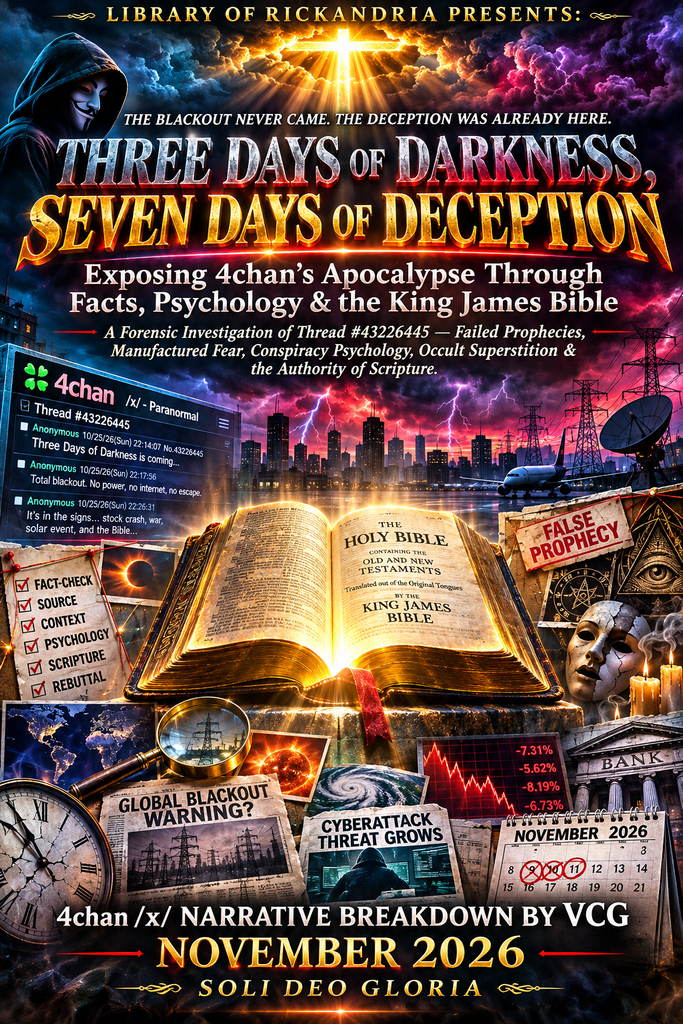
UPDATED BY VCG ON 11/24/2026 @ 18:18 EST
A Forensic Investigation of Thread #43226445 — Failed Prophecies, Manufactured Fear, Conspiracy Psychology, Occult Superstition & the Authority of Scripture.
Anyone can do this, but most won’t.
Three Days of Darkness, Seven Days of Deception: Exposing 4chan’s Apocalypse Through Facts, Psychology & the King James Bible is a comprehensive forensic investigation by VCG of the Library of Rickandria examining 4chan /x/ Thread #43226445 and the November 2026 apocalyptic blackout narrative.
Through detailed post-by-post analysis, historical research, independent fact-checking, cybersecurity documentation, psychological studies and contextual examination of KJV Scripture, this paper explores how genuine infrastructure failures, international tensions, banking disruptions and emergency preparedness exercises became intertwined with unsupported conspiracy theories, failed predictions, alleged private revelations and occult superstition.
It investigates confirmation bias, apophenia, cognitive dissonance, fear-based persuasion, collective scapegoating, prophetic date-setting and the misuse of biblical authority while distinguishing documented facts from speculation and observable manipulation from unproven claims of organized psychological operations.
Featuring extensive references, historical comparisons, a prediction accountability ledger, related Library of Rickandria publications, companion MUSAIC Collective music and the original Seven Pillars of Deception and Rickandria Discernment Test, this investigation serves as both a critical examination of a specific internet apocalypse and an educational resource for recognizing future deception.
Its central message is that genuine events do not automatically validate the extraordinary narratives constructed around them, and that truth requires evidence, intellectual humility, biblical discernment and the courage to correct our own errors.
The predicted blackout never came.
The deception was already here.
But the light of Scripture remains.
“Prove all things; hold fast that which is good.” — 1 Thessalonians 5:21 (KJV)
Soli Deo Gloria — Glory to God alone.
ChatGPT – Library of Rickandria
The blackout never came.
The deception was already here.
And the light shineth in darkness; and the darkness comprehended it not.— John 1:5 (KJV)
Publication information
| Classification | Information |
|---|---|
| Research series | The Rickandria Files |
| Case file | 001 |
| Research and investigation | VCG |
| Publication | Library of Rickandria |
| Primary subject | 4chan /x/ Thread No. 43226445 |
| Original thread title | 3 days of darkness |
| Original posting date | November 16, 2026 |
| Research cutoff | November 24, 2026 |
| Research disciplines | History, psychology, cybersecurity, media literacy, logic, theology and biblical hermeneutics |
| Biblical translation | Authorized King James Bible |
| Publication language | English |
Editorial declaration
This publication is an independent critical examination of a publicly accessible internet discussion.
Its purpose is educational, investigative and theological.
It does not claim divine inspiration, prophetic authority, privileged intelligence access, psychiatric expertise regarding individual contributors, or infallibility.
Historical documentation, scientific findings, psychological research, official statements, anonymous allegations and theological interpretations are distinguished throughout.
The title’s reference to seven days of deception is a literary description of the week-long development of the narrative.
It is not a claim that every participant knowingly lied, nor that an organized seven-day psychological operation has been established.
The accompanying cinematic artwork is an AI-generated artistic illustration.
Its simulated message-board posts, newspaper headlines, dates, financial charts and other visual elements must not be mistaken for authenticated documentary evidence.
All biblical quotations are from the King James Version.
Related Library of Rickandria publications are included for further study, not as substitutes for independent evidence.
Epigraph
Prove all things; hold fast that which is good.— 1 Thessalonians 5:21 (KJV)
He that answereth a matter before he heareth it, it is folly and shame unto him.— Proverbs 18:13 (KJV)
Sanctify them through thy truth: thy word is truth.— John 17:17 (KJV)
ABSTRACT
Between November 16 and November 23, 2026, participants in an archived discussion on 4chan’s paranormal board developed an apocalyptic narrative commonly associated with the Three Days of Darkness tradition.
/x/ – 3 days of darkness – Paranormal – 4chan
The discussion combined genuine infrastructure disruptions, international security concerns, cybersecurity incidents, banking difficulties, emergency preparedness exercises, alleged private revelations, occult speculation and interpretations of biblical prophecy.
This investigation examines the evidentiary foundations of those claims, distinguishing independently documented events from unsupported causal relationships and extraordinary theological conclusions.
The central finding is that the narrative’s persuasive power did not depend entirely upon fabricated events.
Rather, genuine events were selected, arranged and interpreted through a catastrophic framework that exceeded what the underlying evidence could establish.
The investigation further examines illusory pattern perception, confirmation bias, base-rate neglect, online disinhibition, social identity, emotional reasoning, uncertainty avoidance, repetition, cognitive dissonance and the persistence of beliefs following failed predictions.
From a biblical perspective, it compares the internet version of the Three Days of Darkness with Exodus 10, the prophetic literature, the teachings of Jesus Christ and the Book of Revelation.
Particular attention is given to the distinction between biblical prophecy and alleged private revelation, the misuse of Scripture, religious ritualism, spiritual deception and unsupported prophetic timetables.
The study concludes that genuine cybersecurity vulnerabilities and institutional failures warrant serious investigation, but do not establish the thread’s broader predictions of a coordinated apocalyptic blackout.
The paper proposes a reproducible framework for investigating similar narratives while maintaining evidentiary accountability, intellectual humility and biblical discernment.
Keywords:
4chan, paranormal, Three Days of Darkness, conspiracy psychology, misinformation, disinformation, apophenia, cognitive dissonance, cybersecurity, FEMA, false prophecy, occultism, biblical discernment, King James Bible, internet culture, spiritual deception, media literacy, critical thinking.
AUTHOR’S FOREWORD
Why this investigation matters
There is something particularly compelling about an extraordinary claim assembled from ordinary facts.
A falsehood presented without supporting evidence is relatively easy to question.
A misleading interpretation surrounded by genuine headlines, recognizable institutions, historical precedents and religious language is considerably more difficult to untangle.
This distinction lies at the heart of the present investigation.
The original 4chan discussion did not begin with an entirely imaginary world.
It began with events that, in several instances, genuinely occurred.
Flights were grounded.
Digital services experienced interruptions.
Security threats were reported.
Banks experienced operational difficulties.
Government agencies prepared for emergencies.
These things deserve attention.
But what happens when individually documented events are transformed into a collective narrative whose conclusion has already been decided?
What happens when the possibility of coordination becomes the certainty of conspiracy?
What happens when anonymous speculation is elevated into prophetic revelation?
And what happens when biblical language is employed to grant divine authority to conclusions that Scripture itself does not establish?
These are the questions this paper seeks to investigate.
The objective is not to ridicule people who are concerned about the future.
Neither is it to defend governments, corporations or religious institutions from legitimate criticism.
Institutions can make mistakes.
Authorities can conceal information.
Conspiracies can occur.
Technology can fail.
People can deliberately deceive others.
Acknowledging those realities, however, does not relieve an investigator of the responsibility to demonstrate that a particular allegation is true.
The responsibility applies equally to the believer, the skeptic, the journalist, the theologian and the author of this investigation.
Buy the truth, and sell it not; also wisdom, and instruction, and understanding.— Proverbs 23:23 (KJV)
The pursuit of truth requires more than recognizing the errors of others.
It requires the willingness to discover and correct our own.
That is the standard to which this publication must also be held.
VCG — Library of Rickandria
November 2026
EXECUTIVE SUMMARY
The primary thread and its alternative mirror were reopened during preparation of this consolidated investigation. Both displayed the discussion as archived.
Original thread:
/x/ – 3 days of darkness – Paranormal – 4chan
Alternative mirror:
(158) /x/ – Archived – 3 days of darkness – Paranormal – 4chan
The original post assembled security concerns, technology failures, a maritime accident, emergency-service difficulties, a criminal investigation and banking disruptions into a narrative anticipating an extraordinary catastrophe.
Independent reporting also demonstrates that similar blackout rumors circulated outside 4chan, particularly in connection with the November 17 nationwide emergency alert test.
The Associated Press documented the wider misinformation phenomenon following the test.
Sources:
- PolitiFact — No evidence of a nationwide November 17 blackout
- Associated Press — Misinformation about a FEMA test leveraged distrust in Spanish-speaking communities
This wider phenomenon is documented.
A direct causal connection between this particular 4chan thread and every outside rumor is not.
| Investigative question | Principal finding |
|---|---|
| Did several reported incidents actually occur? | Yes. |
| Were all details and dates accurate? | No. Several require qualification. |
| Did the incidents establish a single coordinated operation? | No. The available evidence does not establish that conclusion. |
| Was the nationwide emergency alert test real? | Yes. |
| Did the anticipated November 17 catastrophe occur as described? | No. |
| Are the historical attributions of the Three Days of Darkness prophecy reliable? | Important elements remain disputed. |
| Does the Bible describe darkness lasting three days? | Yes, in the historical account of Egypt’s ninth plague. |
| Does Scripture establish the complete modern Three Days of Darkness narrative? | No explicit passage establishes it. |
| Are all contributors demonstrably deliberate deceivers? | No. Intent cannot be determined from anonymous statements alone. |
| Is an organized psychological operation established? | No. |
| Can psychological mechanisms help explain the narrative? | Yes, without diagnosing individual contributors. |
| Is ordinary emergency preparedness justified? | Yes, independently of the prophecy. |
The fundamental conclusion is straightforward:
A collection of genuine events does not automatically establish the extraordinary explanation attached to them.
TABLE OF CONTENTS
| Part | Subject |
|---|---|
| I | Research methodology and evidentiary standards |
| II | Identification and preservation of the primary source |
| III | Original post: detailed claim-by-claim investigation |
| IV | Reconstruction of the chronology |
| V | Individual replies and recurring arguments |
| VI | Historical origins of the Three Days of Darkness |
| VII | Biblical examination of supernatural darkness |
| VIII | Occultism, esotericism and spiritual speculation |
| IX | Later predictions and additional factual allegations |
| X | Psychology of conspiracy belief |
| XI | The anatomy of an internet apocalypse |
| XII | The seven pillars of deception |
| XIII | Misinformation, propaganda and psychological operations |
| XIV | Digital amplification and circular reporting |
| XV | Scapegoating and collective accusations |
| XVI | Historical comparisons with failed predictions |
| XVII | The weaponization of Scripture |
| XVIII | Biblical prophecy versus divination |
| XIX | Scriptural testing of prophetic claims |
| XX | Steelmanning legitimate concerns |
| XXI | Technical standards for establishing coordinated cyberattacks |
| XXII | The prediction accountability ledger |
| XXIII | Psychological inoculation and media literacy |
| XXIV | Biblical preparedness without panic |
| XXV | How Christians should respond |
| XXVI | The Rickandria Discernment Test |
| XXVII | Final findings and limitations |
| XXVIII | Related Library of Rickandria research |
| XXIX | Companion music and audiovisual resources |
| XXX | Bibliography, glossary, Scripture index and corrections policy |
| Epilogue | The darkness that really matters |
PART I — RESEARCH METHODOLOGY AND EVIDENTIARY STANDARDS
1.1. The distinction between information and knowledge
Information becomes useful knowledge when its accuracy, context and implications are appropriately established.
A screenshot is information.
A newspaper headline is information.
An anonymous claim is information.
A government statement is information.
A biblical quotation is information concerning the content of a text.
None of these automatically establishes every interpretation attached to it.
A photograph may be authentic while its caption is false.
A report may accurately describe an incident while leaving its cause uncertain.
A Bible verse may be quoted correctly while being interpreted incorrectly.
Consequently, the investigation distinguishes six categories throughout:
| Category | Meaning |
|---|---|
| Documentary fact | What authenticated records establish |
| Historical testimony | What a person or institution reports occurred |
| Scientific explanation | What empirical evidence and established mechanisms support |
| Psychological interpretation | What behavioral research may help explain |
| Investigative inference | What the available evidence reasonably suggests |
| Biblical interpretation | What a reading of Scripture in context supports |
Confusing these categories produces conclusions that may sound persuasive while remaining evidentially weak.
1.2. Research questions
The investigation addresses the following questions:
- Which claims in the original post are independently corroborated?
- Which dates, descriptions and causal relationships require correction?
- What evidence, if any, connects the incidents?
- How did later contributors reinterpret the original narrative?
- What historical evidence supports the alleged Three Days of Darkness tradition?
- What does the King James Bible actually establish concerning the relevant prophetic and theological claims?
- Which psychological mechanisms may help explain the formation and persistence of the narrative?
- What evidence would be required to establish deliberate coordination or an organized influence operation?
- How can readers develop resistance to similar misleading narratives?
1.3. Source hierarchy
Sources are evaluated according to their proximity to the event, accessibility, independence, expertise and capacity for verification.
| Source type | Evidentiary use |
|---|---|
| Original documents and authenticated records | Establish what was documented |
| Technical incident reports | Investigate mechanisms and causes |
| Official statements | Establish the issuing institution’s account |
| Independent investigative reporting | Corroborate or challenge institutional accounts |
| Peer-reviewed research | Establish broader scientific and psychological findings |
| Historical primary sources | Examine provenance and original testimony |
| Anonymous message-board posts | Establish what was alleged or discussed |
| Screenshots and social-media reposts | Investigative leads requiring authentication |
| Alleged supernatural experiences | Subjective testimony, not independent verification |
An official statement is not automatically infallible.
Neither is an anonymous allegation automatically false.
However, an anonymous allegation without supporting documentation cannot be granted the same evidentiary weight as independently corroborated evidence.
1.4. Classification of claims
The following classifications will be used throughout the paper.
| Verdict | Definition |
|---|---|
| Confirmed | Supported by reliable documentary evidence |
| Substantially accurate | Central claim supported, with minor qualifications |
| Partially accurate | Genuine information combined with consequential inaccuracies |
| Misleading | Presented in a manner that encourages an unsupported conclusion |
| Unsubstantiated | Insufficient evidence to establish the claim |
| Contradicted | Reliable evidence conflicts with the claim |
| Failed prediction | A sufficiently specific anticipated outcome did not occur |
| Interpretive | A conclusion dependent upon a particular interpretive framework |
| Scripturally unsupported | Presented as biblical doctrine without adequate textual support |
| Unverifiable within scope | Necessary supporting material was unavailable or not authenticated |
A claim classified as unsubstantiated is not necessarily impossible.
It means the claimant has not supplied sufficient evidence.
1.5. Burden of proof and alternative explanations
The individual proposing a particular causal relationship bears the responsibility of establishing it.
For example, a nationwide aviation disruption might result from equipment failure, configuration problems, telecommunications instability, malicious activity or some combination of causes.
An investigator must compare these explanations rather than select the most dramatic possibility.
The failure to establish sabotage does not demonstrate that every technical system is secure.
Conversely, the possibility of sabotage does not demonstrate that a particular failure resulted from it.
1.6. The biblical foundation of examination
The simple believeth every word:
but the prudent man looketh well to his going.— Proverbs 14:15 (KJV)
He that is first in his own cause seemeth just; but his neighbour cometh and searcheth him.— Proverbs 18:17 (KJV)
These passages commend prudence and examination.
They do not prescribe a modern scientific methodology, but they are consistent with the principle that claims should be carefully investigated before judgment.
Acts 17:11 supplies a particularly important example:
These were more noble than those in Thessalonica, in that they received the word with all readiness of mind, and searched the scriptures daily, whether those things were so.
The Bereans combined openness with examination.
Their readiness to listen did not require the suspension of discernment.
Related Library of Rickandria research
From Suspicion to Substance: How Extraordinary Claims Are Tested—and Why Truth Requires Method
Prove All Things: Claims, Persuasion & Truth Testing in Modern Digital Media
Prove All Things: Discernment, Fear & Truth in the Age of Viral Warnings
The Library & the Lamp — Vol. I: Belief, Evidence, Scripture & the People Behind the Claims
PART II — IDENTIFICATION AND PRESERVATION OF THE PRIMARY SOURCE
2.1. The source record
The original discussion appeared on 4chan’s /x/ board, a forum devoted to paranormal subjects, supernatural experiences, esoteric beliefs and related speculation.
| Field | Identification |
|---|---|
| Thread title | 3 days of darkness |
| Original post number | 43226445 |
| Original displayed timestamp | November 16, 2026, 21:20:18 |
| Original author identification | Anonymous |
| Current status | Archived |
| Primary source | 4chan |
| Secondary preservation source | Owo.vg mirror |
Primary source:
/x/ – 3 days of darkness – Paranormal – 4chan
Mirror:
(158) /x/ – Archived – 3 days of darkness – Paranormal – 4chan
The displayed posting time is retained as presented by the archive.
It should not be converted into another time zone without establishing the archive’s timestamp convention.
The archive includes textual posts, attachment references, hyperlinks, replies and anonymous contributions.
The existence of an attachment reference does not mean that the attachment’s contents have been independently authenticated.
2.2. What anonymity permits us to establish
An anonymous message can establish that someone made an assertion.
It cannot necessarily establish:
- The author’s identity, occupation or institutional affiliation.
- Whether multiple messages were written by the same person.
- Whether a statement was sincere, sarcastic or deliberately provocative.
- Whether the author possessed the expertise claimed.
- Whether the author intended to deceive.
- Whether the participants were working together.
These limitations are particularly important when discussing psychological operations.
Although a thread may collectively exhibit recognizable persuasive characteristics, those characteristics alone cannot establish the existence of an organized campaign.
2.3. Preservation and reproducibility
A complete forensic archive should preserve the original webpage, available attachments, linked documents, retrieval dates, post numbers and cryptographic file hashes.
This manuscript uses stable post identifiers and source links.
It does not claim that a complete cryptographically authenticated evidence package has been created.
The original assertions are examined in their presented order, using paraphrases and limited quotations rather than reproducing the entire discussion.
PART III — ORIGINAL POST NO. 43226445: CLAIM-BY-CLAIM INVESTIGATION
Original post:
/x/ – 3 days of darkness – Paranormal – 4chan
3.1. The opening declaration: A conclusion before the investigation
The thread begins:
it’s going to happen, way too many coincidences.
This opening establishes the interpretive framework through which the subsequent events are presented.
The conclusion is not introduced as a possibility requiring investigation.
It is presented as an expectation whose apparent justification is the accumulation of coincidences.
This distinction matters.
A rigorous investigator would begin by asking whether the events possess a demonstrable relationship.
The original poster begins with an apparent relationship and subsequently presents the events as supporting evidence.
The psychological mechanism potentially involved is apophenia, or illusory pattern perception.
Human beings possess an extraordinary ability to recognize patterns.
This ability is essential to learning, scientific discovery and survival.
It becomes unreliable when an inferred pattern is accepted without determining whether the observations genuinely share a cause.
The fact that several events can be placed on one timeline does not establish that they belong to one operation.
Biblical examination:
The heart of the righteous studieth to answer:
but the mouth of the wicked poureth out evil things.— Proverbs 15:28 (KJV)
The principle here is thoughtful examination before declaration.
Verdict: The opening conclusion is unsubstantiated.
3.2. November 10 — Scott Bessent’s relocation to a secure location
The allegation
The original poster reports that United States Treasury Secretary Scott Bessent relocated to a secure facility following Iranian threats, while suggesting that other prominent individuals might also be relocating.
The documentary evidence
On November 13, 2026, Reuters reported that Bessent had recently relocated from his Washington residence to a military base following threats against his life attributed to Iran.
The reporting discussed the circumstances in connection with the Treasury Department’s economic pressure campaign and sanctions.
Source:
Reuters — U.S. Treasury’s Bessent says he won’t be cowed by death threats, November 13, 2026
This supports the central relocation claim.
It does not, however, independently establish the precise date of the relocation as November 10.
Nor does it establish the identity or movement of other individuals speculated about in the thread.
Investigative distinction
There are three separate propositions:
| Proposition | Assessment |
|---|---|
| Bessent relocated because of reported security threats | Supported |
| Numerous other prominent individuals secretly relocated | Not established |
| The relocation was preparation for an impending global blackout | Not established |
Security measures may reflect genuine threat assessments.
They may also contain information that is not publicly disclosed.
Neither fact establishes the specific apocalyptic explanation offered by the thread.
Psychological interpretation
The allegation draws persuasive power from the perceived asymmetry between the knowledge available to powerful individuals and the knowledge available to ordinary citizens.
Such asymmetries can exist.
Nevertheless, the inference that an official possesses concealed knowledge of an impending catastrophe requires evidence concerning that specific catastrophe.
Scriptural examination
The simple believeth every word:
but the prudent man looketh well to his going.— Proverbs 14:15 (KJV)
Verdict:
Substantially accurate concerning the relocation; unsubstantiated concerning the wider conspiracy.
3.3. European supermarket refrigeration cyberattacks
The allegation
The original poster describes cyberattacks against European supermarket refrigeration systems and attributes the incidents to November 11.
What independently occurred
Cyberattacks affecting commercial refrigeration infrastructure in Europe were genuine.
Reporting established that refrigeration failures associated with malicious activity resulted in spoiled food and substantial economic damage.
The incidents were not confined to a single November 11 event.
Reporting identifies attacks in France during October and further attacks across several European countries in early November.
On November 20, Reuters reported that a British cybersecurity operation had addressed a vulnerability affecting commercial refrigeration equipment.
Sources:
Reuters — Could hackers get inside my fridge?
Reuters via RTÉ — UK finds fix for fridge and freezer vulnerability after European hacks
The Guardian — UK operation wards off risk of cyberattack on supermarket fridges and freezers
Why the distinction matters
Of the incidents assembled in the original post, the refrigeration attacks provide a particularly useful example of genuine malicious activity.
An investigator should not dismiss them merely because they appear in a conspiracy-oriented discussion.
The correct approach is to establish the attack’s affected systems, scope, dates and available attribution evidence.
Once that has been accomplished, a separate investigation is required to determine whether the attackers were connected to the banking, aviation or other incidents.
The chronological problem
The original post compresses a longer period of refrigeration attacks into the appearance of a concentrated sequence immediately preceding the anticipated catastrophe.
Such chronological compression can increase the apparent significance of an event cluster.
This does not prove that the original poster intentionally manipulated the dates.
The poster may have confused an attack date with a publication date, repeated an inaccurate secondary account or relied upon incomplete information.
Biblical examination
Thou shalt not bear false witness against thy neighbour.— Exodus 20:16 (KJV)
The commandment concerns truthful testimony.
Its relevance to investigative research is the responsibility to avoid knowingly misrepresenting events.
Verdict:
Genuine cyberattacks; the stated chronology and proposed connection to the broader apocalypse are not adequately established.
3.4. November 12–13 — Microsoft Outlook and Microsoft 365 disruptions
The allegation
The original post reports that Outlook and Microsoft 365 became unavailable on November 12 and recovered the following day.
The documented event
A major Microsoft 365 disruption began on November 12, affecting services including Outlook, Exchange Online, Teams and Copilot.
Microsoft subsequently attributed the disruption to a previously introduced defect affecting its network infrastructure.
Independent technology reporting documented the disruption and Microsoft’s explanation.
Sources:
BleepingComputer — Massive Microsoft 365 outage disrupts Outlook, Teams, Copilot worldwide
BleepingComputer — Microsoft says months-old bug caused global Microsoft 365 outage
The distinction between an outage and an attack
An outage describes a condition: a service becomes unavailable or unreliable.
A cyberattack describes a cause: deliberate malicious activity against a digital system.
These terms are not interchangeable.
| Possible cause | Malicious activity required? |
|---|---|
| Software defect | No |
| Configuration error | No |
| Equipment malfunction | No |
| Unintended network congestion | No |
| Supply-chain compromise | Yes |
| Deliberate unauthorized intrusion | Yes |
| Malicious denial of service | Yes |
A user experiencing an unavailable email service generally cannot determine its underlying cause from the symptoms alone.
Microsoft’s account remains an institutional explanation rather than an independently reproduced forensic finding within this paper.
Nevertheless, no evidence supplied by the original poster establishes an alternative malicious cause.
Related psychological mechanism
The outage becomes persuasive because readers already expect an attack.
The ambiguous condition is interpreted in accordance with that expectation.
This is a form of confirmation bias.
Verdict:
The outage is confirmed; its characterization as part of a coordinated apocalypse is unsupported.
3.5. November 13 — The nationwide FAA ground stop
The allegation
The original post describes the nationwide grounding of American flights following technical difficulties and references suspicions reportedly expressed by pilots.
The primary documentary evidence
The Federal Aviation Administration published a detailed account on November 15, 2026.
Source:
Federal Aviation Administration — Nationwide Ground Stop: Questions and Answers
According to the FAA:
| Measurement | Reported finding |
|---|---|
| Ground stop initiated | Approximately 3:30 p.m. Eastern Time |
| Air traffic resumed | Approximately 8:15 p.m. Eastern Time |
| En route control centers experiencing instability | 17 of 22 |
| Aircraft already airborne that subsequently landed safely | Approximately 3,500 |
| Flight cancellations that Friday | Approximately 12,462 |
| Potential originating network sites | Texas and Arkansas |
| Preliminary evidence of external cyberattack | None identified by the FAA |
The agency cautioned that not every cancellation was directly attributable to the ground stop.
It also reported that critical operations continued and that some communications capabilities remained available throughout the disruption.
What can reasonably be concluded?
The disruption was serious.
It demonstrates that failures within complex telecommunications infrastructure can produce widespread operational consequences.
It also demonstrates why cybersecurity, technological modernization, redundancy and operational resilience deserve public scrutiny.
What it does not demonstrate is that all American aircraft became uncontrollable, that the entire national airspace system ceased functioning, or that an apocalypse had begun.
The allegation that pilots were suspicious may reflect genuine uncertainty among some individuals.
Suspicion, however understandable, is not technical attribution.
Investigative methodology
To establish malicious involvement, investigators would need authenticated evidence showing unauthorized activity or deliberate interference.
The FAA’s preliminary account may be questioned, but disagreement with that account does not itself establish another cause.
Verdict:
Confirmed ground stop; the proposed broader malicious coordination remains unsubstantiated.
3.6. November 13 — The Mississippi River maritime collision
The allegation
The original post identifies a collision between a tanker and a cruise vessel on the same day as the aviation disruption.
The primary source
The National Transportation Safety Board opened an investigation into the collision between the tanker Atlantic Asphalt and the riverboat American Heritage.
Source:
National Transportation Safety Board — Investigation DCA27MM003
The collision occurred on the Mississippi River on November 13, 2026.
The distinction between the Mississippi River and the State of Mississippi is worth preserving.
The incident occurred near New Orleans, Louisiana.
The causal problem
The original post implicitly connects the maritime incident with the aviation disruption because they occurred on the same date.
Yet there is no demonstrated relationship between the two incidents in the evidence presented.
A collision may result from navigational circumstances, mechanical conditions, environmental factors, human decisions, communications failures or other causes.
The existence of an investigation does not authorize us to prejudge its findings.
Logical analysis
The conclusion that events occurring on the same day share a malicious cause is a non sequitur unless a relationship is established through additional evidence.
Verdict:
Confirmed collision; no established connection to the alleged apocalypse.
3.7. November 13 — Reported emergency-service disruptions
The allegation
The original poster claims that emergency 911 services became unavailable in several parts of the United States.
Evidentiary assessment
Reports of emergency communications difficulties deserve serious attention, particularly where they affect access to lifesaving assistance.
However, a crowdsourced outage report, a screenshot or an isolated social-media complaint does not independently establish the geographic extent of an outage, its duration or its cause.
The earlier working investigation identified reports collected by outage-monitoring services.
This consolidated manuscript does not retain an exact complaint count as a verified fact because the underlying historical measurement has not been independently reproduced here.
To authenticate the claim fully, the investigation would require dated statements from affected emergency communications authorities, telecommunications providers or public safety agencies.
Why reporting volume is not equivalent to failure volume
A rise in user-submitted complaints may reflect:
- Actual service degradation.
- Increased public awareness of an incident.
- Repeated complaints from the same locations.
- Difficulties involving individual providers.
- Users checking a service because they have encountered alarming news.
A complaints chart can identify a potential incident.
It cannot necessarily establish that every report represents a separate confirmed system failure.
Biblical examination
In the multitude of words there wanteth not sin:
but he that refraineth his lips is wise.— Proverbs 10:19 (KJV)
The appropriate response to incomplete evidence is restraint, not invention.
Verdict:
Reported difficulties warrant investigation; the precise scale, common cause and connection to the other incidents remain insufficiently established.
3.8. November 14 — The Peoria, Illinois, explosives investigation
The allegation
The original post describes an explosive-device threat near an ethanol facility in Peoria and questions the official evacuation response.
It further repeats an anonymous allegation that the earlier FAA disruption originated there.
What has been documented
On November 17, the Associated Press reported that a trainee employed at an ethanol facility in Peoria had been federally charged in connection with an explosive-device incident that prompted an evacuation.
Sources:
Associated Press — Ethanol plant trainee charged in connection with bomb at Illinois facility
CBS Chicago — Man charged in connection to bomb found at Peoria ethanol plant
NPR Illinois — Suspect indicted on charges related to explosive device found at BioUrja plant
The existence of criminal charges is established by these reports.
The charges themselves remain allegations unless established through the appropriate judicial process.
Evaluation of the additional assertions
| Assertion | Evidentiary assessment |
|---|---|
| A serious criminal investigation occurred | Confirmed |
| An evacuation took place | Confirmed |
| Multiple devices were confirmed | Not established by the sources reviewed |
| The emergency response was knowingly inadequate | Not established |
| Peoria was the origin of the FAA disruption | Conflicts with the FAA’s preliminary findings |
| Both incidents belonged to the same operation | Unsubstantiated |
The paper does not attempt to reconstruct the dangerous technical details of the incident.
They are unnecessary to evaluate the proposed relationship with the aviation disruption.
Biblical examination
One witness shall not rise up against a man for any iniquity, or for any sin, in any sin that he sinneth:
at the mouth of two witnesses, or at the mouth of three witnesses, shall the matter be established.— Deuteronomy 19:15 (KJV)
The immediate context concerns judicial testimony under the Mosaic covenant.
Its broader relevance here is the importance of corroboration before assigning responsibility.
Verdict:
Genuine incident; additional allegations concerning its wider significance remain unsupported.
3.9. November 16 — Disruptions affecting major United States banks
The allegation
The original post links to reporting concerning difficulties accessing banking services at several financial institutions.
Original linked article:
Customers report outages at Chase, Bank of America and Wells Fargo
Independent corroboration
Reuters reported on November 16 that JPMorgan Chase had experienced transaction-processing difficulties attributed by the company to a software defect.
The company indicated that delayed transactions might also affect other financial institutions receiving them.
Source:
Reuters via Investing.com — JPMorgan says software bug slows its transactions
Shared dependencies and cascading failures
Modern financial institutions do not operate as isolated systems.
A failure affecting one large institution, intermediary or payment network can produce difficulties for customers of other organizations.
Such consequences do not necessarily require multiple independently coordinated attacks.
Consider the conceptual relationship:
Processing failure at one institution → delayed transactions → consequences for other institutions → customer complaints across multiple services.
This is an example of infrastructure interdependence.
The same interdependence that produces efficiency can also produce systemic vulnerability.
The critical distinction
A common technical dependency is not the same thing as a common malicious actor.
Verdict:
Banking disruptions confirmed; the wider apocalyptic interpretation is unsupported.
3.10. The prediction of a bank run and withdrawal restrictions
The original poster anticipates that further disruptions might cause panic withdrawals followed by restrictions imposed by financial institutions.
This is explicitly a hypothetical forecast rather than an independently established event.
Bank runs are real economic phenomena.
They occur when depositors lose confidence in an institution’s ability to return their funds and seek withdrawals simultaneously.
However, a temporary technological disruption does not necessarily indicate that the affected financial institution is insolvent.
| Financial condition | Meaning |
|---|---|
| Service outage | A service is temporarily unavailable |
| Transaction delay | A payment has not completed promptly |
| Liquidity problem | An institution faces difficulty meeting immediate obligations |
| Insolvency | Liabilities exceed assets under the applicable assessment |
| Bank run | Rapid withdrawals caused by a loss of confidence |
Conflating these conditions can unnecessarily intensify public fear.
The thread does not establish the chain of events necessary for its forecast.
Biblical examination
Take therefore no thought for the morrow:
for the morrow shall take thought for the things of itself.
Sufficient unto the day is the evil thereof.— Matthew 6:34 (KJV)
Christ’s teaching addresses anxious preoccupation with the future.
It does not prohibit reasonable financial planning or household preparedness.
Verdict:
Speculative forecast; no demonstrated nationwide outcome corresponding to the prediction.
PART IV — RECONSTRUCTING THE ACTUAL CHRONOLOGY
When the events are examined according to independently reported chronology, the apparent precision of the original sequence begins to weaken.
| Date | Event | Evidentiary classification |
|---|---|---|
| October 2026 | Refrigeration attacks affecting France | Documented cyberattack |
| October 14 | FEMA bulletin publicizes November 17 test | Documented advance notice |
| Early November | Further European refrigeration attacks | Documented cyberattack |
| November 10–13 | Bessent relocation reported | Documented security development |
| November 12–13 | Microsoft 365 service disruption | Technical failure reported |
| November 13 | Nationwide FAA ground stop | Documented operational disruption |
| November 13 | Mississippi River maritime collision | Documented accident |
| November 13–14 | Peoria criminal incident and evacuation | Documented criminal investigation |
| November 16 | Banking service disruptions | Documented operational difficulties |
| November 16 | Original 4chan thread posted | Primary source |
| November 17 | Nationwide Emergency Alert System test | Previously scheduled exercise |
| November 17 | NSA communications outage reported | Documented disruption; malicious cause unestablished |
| November 18 onward | Further speculation and revised expectations | Primary source |
| November 20 | European refrigeration vulnerability remediation reported | Documented cybersecurity response |
| November 23 | Major American stock indices rally | Documented financial outcome |
The most important chronological correction concerns FEMA.
The October 14 bulletin predates the November cluster of incidents.
Source:
FEMA — Bulletin Week of October 14, 2026
This advance publication directly undermines the interpretation that the November 17 test was improvised in response to the preceding week’s disruptions.
4.1. What the chronology does and does not establish
The chronology establishes that several unusual and consequential events occurred during a relatively short period.
It does not establish that every event shared a cause.
Some incidents involved genuine malicious activity.
Other incidents were attributed to technical defects.
Still others remained under investigation.
The proper classification is therefore not a single undifferentiated category of attack.
It is a collection of events with different evidentiary statuses.
4.2. The central logical error
The original narrative can be represented through the following propositions:
- Several disruptive events occurred.
- Some occurred close together.
- Some were caused by malicious activity.
- Therefore, all of the disruptive events were coordinated.
- Therefore, the anticipated supernatural or nationwide blackout was imminent.
The first three propositions can be examined independently.
The fourth and fifth require evidence not supplied by the first three.
The error is not recognizing a possible pattern.
The error is treating the possible pattern as a demonstrated explanation.
4.3. The mathematical problem of coincidence
Suppose there are ten independent opportunities for an unusual event to occur, each possessing a hypothetical probability of 10 percent.
The probability that at least one event occurs is approximately 65.1 percent.
| Number of independent opportunities | Probability of at least one event, assuming 10% per opportunity |
|---|---|
| 1 | 10.0% |
| 5 | 41.0% |
| 10 | 65.1% |
| 20 | 87.8% |
| 50 | 99.5% |
The illustrative formula is:
P (at least one event) = 1 – (1-p) ^ n
This is not a statistical calculation of the probability that the November 2026 incidents were coincidental.
Real infrastructure failures are not necessarily independent, and their underlying probabilities are not known here.
The example demonstrates a more limited point: when numerous opportunities exist for something unusual to happen, the appearance of unusual events is not automatically evidence of an extraordinary hidden cause.
PART V — FORENSIC EXAMINATION OF THE INDIVIDUAL REPLIES
The original post established the general catastrophic expectation.
The subsequent replies transformed it into a more complicated discussion involving international conflict, religious rituals, technological speculation, occultism, financial collapse and skepticism.
The following analysis retains the major individual post breakdowns from the preliminary investigation and incorporates additional material recovered from the archived discussion.
Each post should be understood as an individual contribution.
The anonymity of the participants prevents us from assuming that all contributors shared a common identity, belief or objective.
5.1. Post No. 43226451 — World War III and submarine
communications cables
Original post:
/x/ – 3 days of darkness – Paranormal – 4chan
The contributor suggests that the beginning of another world war would immediately result in the severing of undersea communications cables.
Historical and technical evidence
Submarine communications cables are genuine strategic infrastructure.
Their protection is an important concern for governments, telecommunications companies and international organizations.
Nevertheless, damage to a submarine cable does not automatically establish deliberate military sabotage.
According to the International Cable Protection Committee, approximately 150–200 submarine cable faults occur annually.
Accidental human activity, particularly maritime activity, accounts for approximately 70–80 percent of these faults.
Source:
International Cable Protection Committee — Frequently Asked Questions
| Cause | Approximate proportion |
|---|---|
| Accidental human activity | 70–80% |
| Remaining causes | 20–30% |
The remaining category includes natural hazards, technical failures and other circumstances.
It should not be interpreted as representing exclusively malicious activity.
Logical examination
The post introduces an expectation through which future communications failures might be interpreted.
The reasoning resembles the following:
- International conflict may cause communications disruption.
- A communications disruption occurs.
- Therefore, international conflict must be responsible.
This is an example of affirming the consequent.
The same observable consequence may arise from several different causes.
Biblical examination
And ye shall hear of wars and rumours of wars:
see that ye be not troubled:
for all these things must come to pass, but the end is not yet.— Matthew 24:6 (KJV)
Jesus acknowledges the reality of conflict while cautioning His hearers against premature eschatological conclusions.
Verdict: Genuine infrastructure vulnerability; unsupported categorical prediction.
5.2. Post No. 43226474 — Printed crosses, candles and the repeated invocation of Jesus’ name
Original post:
/x/ – 3 days of darkness – Paranormal – 4chan
This contributor recommends placing printed representations of the cross upon doors and windows, preparing candles and repeatedly invoking the name of Jesus as protection against demons.
Three distinct claims require theological examination.
A. The cross as a protective object
The cross occupies a central position in Christian theology because of the sacrificial death of Jesus Christ.
However, the New Testament does not establish that a printed image of the cross creates a supernatural protective boundary around a dwelling.
For the preaching of the cross is to them that perish foolishness; but unto us which are saved it is the power of God.— 1 Corinthians 1:18 (KJV)
Paul emphasizes the message of Christ crucified.
He does not prescribe the manufacture of protective religious images.
A useful historical example within Scripture concerns the brazen serpent.
He removed the high places, and brake the images, and cut down the groves, and brake in pieces the brasen serpent that Moses had made:
for unto those days the children of Israel did burn incense to it:
and he called it Nehushtan.— 2 Kings 18:4 (KJV)
The serpent had originally been produced under divine instruction in Numbers 21.
Nevertheless, its subsequent misuse became a matter requiring correction.
This passage does not establish that every decorative cross is an idol.
It demonstrates that an object associated with a genuine biblical event must not become a substitute for God.
B. Candles as supernatural protection
Candles can provide ordinary physical illumination.
Different Christian traditions also use candles symbolically or devotionally.
Neither observation establishes that blessed candles possess an exclusive ability to function during a future supernatural darkness.
That claim requires scriptural or independently verifiable support beyond the assertion of an anonymous contributor.
C. The name of Jesus as a magical formula
The New Testament describes an incident involving individuals who attempted to invoke Jesus’ name without possessing the authority they presumed.
Then certain of the vagabond Jews, exorcists, took upon them to call over them which had evil spirits the name of the Lord Jesus, saying, We adjure you by Jesus whom Paul preacheth.
And there were seven sons of one Sceva, a Jew, and chief of the priests, which did so.
And the evil spirit answered and said, Jesus I know, and Paul I know; but who are ye?
And the man in whom the evil spirit was leaped on them, and overcame them, and prevailed against them, so that they fled out of that house naked and wounded.— Acts 19:13–16 (KJV)
The passage directly challenges the concept of mechanically invoking a sacred name as though it were an incantation.
Jesus also teaches:
But when ye pray, use not vain repetitions, as the heathen do:
for they think that they shall be heard for their much speaking.— Matthew 6:7 (KJV)
Repetition itself is not necessarily the problem.
Matthew 26:44 records Jesus repeating His prayer.
The problem is the assumption that verbal repetition possesses independent spiritual power.
Verdict:
Ordinary preparedness mixed with scripturally unsupported supernatural prescriptions.
Related Library of Rickandria research
Demons, Deception & Discernment
5.3. Post No. 43226499 — Cyber Polygon and the World Economic Forum
Original post:
/x/ – 3 days of darkness – Paranormal – 4chan
The contributor supplies links concerning Cyber Polygon 2021, a cybersecurity exercise involving international organizations and corporate participants.
What the historical documentation establishes
Cyber Polygon 2021 was a genuine international cybersecurity event conducted on July 9, 2021.
Its documented activities included discussions concerning digital infrastructure, cybersecurity vulnerabilities and defensive training involving a simulated supply-chain attack.
Participants and speakers represented various institutions, including the World Economic Forum and INTERPOL.
Primary sources:
Cyber Polygon 2021 — Frequently Asked Questions
Cyber Polygon 2021 — Official Results
The methodological problem
A cybersecurity exercise can demonstrate that its organizers recognize a potential danger.
It does not independently demonstrate that they intend to cause that danger.
| Exercise | What its existence establishes | What it does not establish |
|---|---|---|
| Fire drill | Preparation for fire | Intent to commit arson |
| Emergency medical exercise | Preparation for emergencies | Intent to cause injuries |
| Cybersecurity exercise | Recognition of digital vulnerabilities | Intent to disable infrastructure |
| Military exercise | Operational training | Certainty concerning a particular future war |
The appropriate investigation of Cyber Polygon would examine its organizational structure, stated objectives, financial relationships, policy recommendations and actual activities.
The mere existence of the exercise is insufficient to establish criminal intent.
Biblical examination
A prudent man foreseeth the evil, and hideth himself:
but the simple pass on, and are punished.— Proverbs 22:3 (KJV)
Preparation for a foreseeable danger is not inherently evidence of participation in that danger.
Verdict:
Genuine exercise; alleged connection to the predicted November catastrophe remains unsubstantiated.
5.4. Post No. 43226607 — A linked video as supporting material
Original post:
/x/ – 3 days of darkness – Paranormal – 4chan
The contributor responds to the original post with a YouTube link.
A hyperlink can function rhetorically as an apparent supporting authority even when its relevance, provenance or accuracy has not been demonstrated.
The linked video’s complete content has not been independently authenticated within this investigation.
Consequently, no factual proposition will be attributed to the video merely from its inclusion in the thread.
Verdict:
External media reference; evidentiary content not established.
5.5. Post No. 43226826 — Iranian threats and the false-flag allegation
Original post:
/x/ – 3 days of darkness – Paranormal – 4chan
The contributor characterizes intelligence reporting concerning a potential Iranian threat against American officials as a possible false-flag operation.
What the reporting establishes
On November 16, CNN reported that American intelligence officials were examining possible Iranian plans to target senior officials.
The reporting also acknowledged uncertainty regarding the feasibility and execution of the alleged plans.
Reuters subsequently reported increased threat assessments while also noting that Secretary of State Marco Rubio did not consider an attack upon the American capital imminent.
Sources:
CNN report via KVIA — U.S. intelligence indicates possible Iranian attack planning
Reuters — Threats from Iran have increased substantially, U.S. intelligence director says
The distinction between an allegation and a false flag
False-flag operations are a recognized historical category of covert activity.
Their existence does not establish that any particular security warning is fraudulent.
To substantiate the contributor’s allegation, investigators would require evidence demonstrating that the purported threat was deliberately manufactured or misattributed by identified parties.
The thread does not supply such evidence.
Biblical examination
He that is first in his own cause seemeth just; but his neighbour cometh and searcheth him.— Proverbs 18:17 (KJV)
The same standard applies to both intelligence agencies and anonymous accusers.
Verdict:
Genuine intelligence reporting; false-flag interpretation unsubstantiated.
5.6. Post No. 43226861 — The November 17 emergency alert test
Original post:
/x/ – 3 days of darkness – Paranormal – 4chan
This reply introduces reporting concerning the nationwide Emergency Alert System test.
The juxtaposition of the test with the preceding security warning encourages readers to consider a possible relationship between the two.
Documentary evidence
The nationwide test was scheduled for approximately 2:20 p.m. Eastern Time on November 17, 2026.
The Federal Communications Commission and FEMA had publicly announced the exercise well before the original thread appeared.
Sources:
FEMA — October 14, 2026 bulletin
National Weather Service — Emergency Alert Test 2026
West Virginia Emergency Management — Nationwide Emergency Alert System Test
FEMA — November 10, 2026 bulletin
The test’s purpose was to evaluate the public warning system.
Its existence does not establish an impending shutdown of electrical infrastructure.
Independent investigation of the wider rumor
PolitiFact examined viral claims that a nationwide blackout had been scheduled and found no supporting evidence.
The investigation also addressed misleading representations of presidential remarks.
PolitiFact — Online November 17 blackout claims are unfounded
The Associated Press subsequently documented similar misinformation circulating through Spanish-language online communities.
Psychological interpretation
An existing catastrophic expectation can change the interpretation of otherwise ordinary events.
A public preparedness exercise may be reinterpreted as advance warning of the very catastrophe it is intended to prepare for.
The emotional framework remains constant while the meaning assigned to new information changes.
Verdict:
Confirmed emergency alert test; no demonstrated connection to an impending nationwide blackout.
Related Library of Rickandria research
Black November: Prophecy, Psyop, or Panic Porn? The November 17 Blackout Prediction Exposed
72 Hours to Armageddon? How a 4chan /x/ Thread Turned Emergency Preparedness into End-Times Prophecy
The Blackout Never Came. Why Did the Story Feel True?
5.7. Posts No. 43226945, 43227384 and 43227634 — The philosophy that nothing ever happens
Several contributors respond to apocalyptic speculation with the assertion that nothing significant ever happens.
Original posts:
/x/ – 3 days of darkness – Paranormal – 4chan
/x/ – 3 days of darkness – Paranormal – 4chan
/x/ – 3 days of darkness – Paranormal – 4chan
This is understandable within a community repeatedly exposed to failed predictions.
Nevertheless, it is not a reliable universal principle.
| Uncritical catastrophism | Uncritical skepticism |
|---|---|
| Every disruption confirms the apocalypse | Every warning must be false |
| Treats suspicion as proof | Treats uncertainty as disproof |
| Selects supporting events | Dismisses inconvenient events |
| Expects concealed coordination everywhere | Refuses to consider concealed coordination |
| Protects belief against disconfirmation | Protects disbelief against evidence |
Both positions can become resistant to correction.
The fact that previous predictions have failed does not establish that future emergencies are impossible.
Biblical examination
Knowing this first, that there shall come in the last days scoffers, walking after their own lusts,
And saying, Where is the promise of his coming? for since the fathers fell asleep, all things continue as they were from the beginning of the creation.— 2 Peter 3:3–4 (KJV)
Peter addresses mockery concerning the promised coming of Christ.
This passage must not be misused to condemn individuals who question anonymous blackout predictions.
Biblical discernment differs from both indiscriminate belief and indiscriminate disbelief.
Verdict:
Skepticism is justified concerning unsupported predictions; absolute dismissal of every future danger is not.
5.8. Post No. 43227045 — Allegations of institutional corruption
Original post:
/x/ – 3 days of darkness – Paranormal – 4chan
The contributor attributes the referenced developments to extensive financial corruption and the self-interest of powerful individuals.
Corruption is a legitimate subject of investigation.
However, establishing corruption requires evidence concerning identifiable financial arrangements, conduct, beneficiaries and applicable legal or ethical standards.
Generalized hostility toward powerful institutions cannot substitute for that evidence.
Biblical examination:
Divers weights, and divers measures, both of them are alike abomination to the LORD.— Proverbs 20:10 (KJV)
One evidentiary standard must apply to every party.
Verdict:
Generalized accusation; specific wrongdoing not established by the reply.
5.9. Post No. 43227403 — Indifference toward vulnerable people
Original post:
/x/ – 3 days of darkness – Paranormal – 4chan
This contributor expresses indifference toward the possible deaths of vulnerable individuals during a prolonged power failure.
The statement is important because it reveals that the thread’s content is not exclusively concerned with forecasting events.
It also contains moral judgments concerning who might deserve to survive them.
A prolonged electrical outage can place people dependent upon medical devices, heating, cooling, refrigerated medication and emergency communications at considerable risk.
The suffering of such individuals is not entertainment.
Biblical examination
Rejoice not when thine enemy falleth, and let not thine heart be glad when he stumbleth:— Proverbs 24:17 (KJV)
Bear ye one another’s burdens, and so fulfil the law of Christ.— Galatians 6:2 (KJV)
We then that are strong ought to bear the infirmities of the weak, and not to please ourselves.— Romans 15:1 (KJV)
The Christian ethical obligation is not to welcome the destruction of vulnerable people, but to demonstrate compassion toward them.
Verdict:
Morally contrary to biblical charity.
5.10. Posts No. 43227483 and 43228367 — Longing for societal collapse
Original posts:
/x/ – 3 days of darkness – Paranormal – 4chan
/x/ – 3 days of darkness – Paranormal – 4chan
These contributions introduce an important reversal of the ordinary emotional relationship with danger.
Some participants do not merely anticipate catastrophe.
They appear to hope that it will occur.
One contributor describes praying for total societal collapse.
Another expresses distress at the prospect of having to continue living in a world perceived as a prison.
Psychological examination
Several interpretations are possible:
- Alienation from contemporary society.
- Dissatisfaction with personal circumstances.
- A desire for radical social transformation.
- Escapism.
- Emotional exhaustion.
- Online provocation or dark humor.
- Genuine religious or philosophical expectations.
The text does not permit us to determine which explanation applies to each individual.
Nor does it justify a psychiatric diagnosis.
Nevertheless, the emotional appeal of the catastrophe is evident in the language.
For some readers, the imagined collapse may represent escape from obligations, institutions or circumstances experienced as intolerable.
Biblical examination
Woe unto you that desire the day of the LORD! to what end is it for you? the day of the LORD is darkness, and not light.— Amos 5:18 (KJV)
Amos warns individuals who desire divine judgment without adequately considering their own condition before God.
Ezekiel likewise records:
Have I any pleasure at all that the wicked should die? saith the Lord GOD:
and not that he should return from his ways, and live?— Ezekiel 18:23 (KJV)
Christian expectation of divine judgment should not become an excuse for delighting in human suffering.
Verdict:
Observable expressions of catastrophe-oriented longing; individual psychological motivations remain uncertain.
5.11. Post No. 43227614 — The question of timing
Original post:
/x/ – 3 days of darkness – Paranormal – 4chan
The contributor asks when the predicted event is expected.
This brief question identifies a fundamental weakness in the original announcement:
it expresses confidence without defining a precise, testable forecast.
A rigorous prediction should identify its anticipated outcome, geographical scope, deadline and criteria for success or failure.
Without these specifications, virtually any subsequent disruption can be interpreted as fulfillment.
Verdict:
Reasonable request for predictive specificity.
5.12. Post No. 43228209 — Peoria as a representative American market
Original post:
/x/ – 3 days of darkness – Paranormal – 4chan
The reply invokes Peoria’s historical reputation as a representative American market, connecting the location of the criminal incident with its perceived symbolic significance.
Even if the historical association is accepted, it does not establish that the criminal incident occurred there because of the city’s representative reputation.
This is a problem of associative reasoning.
A location can possess numerous historical associations.
Selecting the association that appears relevant to an existing theory does not demonstrate that it influenced the event.
Verdict:
Historical association does not establish causal significance.
5.13. Post No. 43228224 — Testing the prediction against the calendar
Original post:
/x/ – 3 days of darkness – Paranormal – 4chan
A contributor observes that November 17 has already begun in other parts of the world and asks why the anticipated catastrophe has not occurred.
This is a useful methodological challenge.
Global predictions require a specified time reference.
Otherwise, time-zone differences can be employed to indefinitely delay the point at which a prediction must be judged.
A worldwide event allegedly scheduled for a specific calendar day should have clearly defined temporal and geographical criteria.
Verdict:
Legitimate challenge to the prediction’s precision.
5.14. Post No. 43228235 — The recurring Three Days of Darkness tradition
Original post:
/x/ – 3 days of darkness – Paranormal – 4chan
The contributor recalls encountering the same general prediction many years earlier.
This is consistent with the documented existence of the Three Days of Darkness tradition long before November 2026.
The exact date of the contributor’s personal recollection cannot be independently verified. The historical existence of the wider tradition can.
This distinction is important.
The persistence of a prediction across many years does not establish its truth.
It may instead demonstrate the durability of a religious or cultural narrative.
Verdict:
Historically plausible observation; personal recollection remains unverified.
5.15. Post No. 43228261 — The complete supernatural darkness narrative
Original post:
/x/ – 3 days of darkness – Paranormal – 4chan
This is one of the most important theological contributions in the discussion.
The contributor distinguishes the anticipated catastrophe from an ordinary electrical outage, describing a supernatural darkness accompanied by purportedly exclusive protective candles and demonic impersonation of familiar individuals.
These claims are not presented as the results of a technical investigation.
They derive from religious tradition and alleged private revelation.
A complete historical and biblical examination follows in Parts VI and VII.
Verdict:
Documented as an internet version of a religious tradition; not established as authoritative biblical prophecy.
5.16. Post No. 43228287 — Data-center load testing and electrical-grid collapse
Original post:
/x/ – 3 days of darkness – Paranormal – 4chan
The contributor anticipates that data-center testing may destabilize the electrical grid.
Genuine technical concern
Large data centers require substantial electrical infrastructure.
Their growing demand raises legitimate questions concerning grid capacity, transmission planning, generation resources and reliability.
However, a specific prediction of grid collapse requires considerably more than a general recognition that data centers consume electricity.
The relevant evidence would include utility planning documents, identified capacity constraints, scheduled testing, engineering assessments and documented operational conditions.
Useful technical resources include:
U.S. Energy Information Administration — Electricity Delivery
U.S. Energy Information Administration — Operating Grid
North American Electric Reliability Corporation
Verdict:
Legitimate category of engineering concern; specific shutdown prediction unsubstantiated.
5.17. Posts No. 43228303 and 43228355 — International time-zone disputes
The discussion includes disagreement concerning whether the prediction’s anticipated date has already passed in parts of Asia.
Original posts:
/x/ – 3 days of darkness – Paranormal – 4chan
/x/ – 3 days of darkness – Paranormal – 4chan
These replies illustrate how an inadequately defined prediction can generate secondary disputes rather than a clear evaluation.
The methodological solution is not another interpretation after the event.
It is to establish the time reference before the event.
Verdict:
Evidence of inadequate predictive definition.
5.18. Post No. 43228411 — A genuine cybersecurity supply-chain attack
Original post:
/x/ – 3 days of darkness – Paranormal – 4chan
This contributor introduces reporting concerning malicious software associated with approximately 178 organizations, including prominent media and technology companies.
Independent corroboration
Security reporting identified malicious JavaScript distributed through a compromised third-party web service on November 16.
Source:
Malwarebytes — CNN, BBC, Zoom, and other sites served malicious code in supply-chain attack
Why this matters
Unlike several incidents discussed in the thread, this example involved evidence of an actual malicious supply-chain compromise.
A careful rebuttal must acknowledge that distinction.
The discovery of a genuine cyberattack does not validate every other claim made in the discussion.
Nor does it establish that the affected organizations were each independently penetrated by the same actor.
Shared software dependencies can distribute malicious content across numerous unrelated organizations.
Verdict:
Genuine cybersecurity incident; connection to the apocalyptic narrative remains unsubstantiated.
5.19. The November 18 prediction — Orgone devices and altered time perception
A further reply introduces November 18 as a revised date while suggesting unusual changes in time perception, orgone devices and electromagnetic shielding.
The preliminary working draft associated this passage with Post No. 43228532.
That exact identifier could not be located during renewed verification, although the relevant passage itself was recovered.
It is therefore discussed without asserting an unverified post number.
Orgone energy
The concept of orgone is associated with Wilhelm Reich’s theories concerning a purported universal life energy.
Orgone is not an established physical energy form, and devices claimed to manipulate it have no demonstrated ability to protect individuals from supernatural catastrophes.
Faraday cages
Electromagnetic shielding, by contrast, is a genuine physical phenomenon.
Its effectiveness depends upon identifiable engineering conditions.
The existence of electromagnetic shielding does not establish that it protects against alleged temporal manipulation, spiritual entities or private prophecy.
Psychological and methodological examination
This contribution combines legitimate scientific terminology with unsupported metaphysical claims.
The recognizable technical concept may lend credibility to the speculative one.
This is sometimes described as pseudoscientific framing or borrowing scientific authority.
Biblical examination
Beware lest any man spoil you through philosophy and vain deceit, after the tradition of men, after the rudiments of the world, and not after Christ.— Colossians 2:8 (KJV)
Paul’s warning should not be interpreted as a condemnation of scientific inquiry.
Its relevance is the danger of philosophies that displace the truth of Christ.
Verdict:
Genuine scientific terminology combined with unsubstantiated esoteric claims.
5.20. Post No. 43228538 — Gradual deterioration and the loosh farm hypothesis
Original post:
/x/ – 3 days of darkness – Paranormal – 4chan
The contributor proposes that gradual technological deterioration may be more significant than a sudden catastrophe, introducing an esoteric explanation involving loosh.
This represents a consequential change in the predictive framework.
A specific catastrophe can be disproved if it fails to occur within the stated conditions.
A generalized claim that everything is gradually deteriorating is much more difficult to test.
The loosh interpretation further introduces an alleged supernatural mechanism that has not been independently demonstrated.
A detailed examination appears in Part VIII.
Verdict:
Revised and broadened prediction combined with unsupported metaphysical speculation.
5.21. Posts No. 43228553, 43230940 and 43230993 — Grand Theft Auto VI and alleged distraction operations
Original posts:
/x/ – 3 days of darkness – Paranormal – 4chan
/x/ – 3 days of darkness – Paranormal – 4chan
/x/ – 3 days of darkness – Paranormal – 4chan
The contributors offer differing interpretations of the approaching release of Grand Theft Auto VI.
One suggests that public attention surrounding the game could provide an opportunity for powerful individuals to conduct undisclosed activities.
Another suggests that the popularity of the game makes a shutdown unlikely.
A further contributor predicts that internet disruption will occur shortly after its release.
What is independently established
Rockstar Games officially scheduled and released Grand Theft Auto VI on November 19, 2026.
Sources:
Rockstar Games — Grand Theft Auto VI Now Available
PlayStation — Grand Theft Auto VI launches November 19
The game’s release date was public information.
What is not established
The discussion provides no authenticated documentation demonstrating that the release was deliberately scheduled to conceal an international operation.
The anticipated widespread internet shutdown following the release has not been established.
The interpretive contradiction
Notice that the same entertainment event is used to support opposing conclusions.
| Interpretation | Conclusion |
|---|---|
| Public attention will be distracted | A catastrophe is more likely |
| Public anger over lost entertainment would be severe | A catastrophe is less likely |
| The game will create maximum dependence upon connectivity | A shutdown will follow its release |
The existence of the game remains constant.
The interpretation changes according to the contributor’s expectation.
This illustrates why an observation must discriminate between competing hypotheses before it can be treated as strong supporting evidence.
Related Library of Rickandria research
GTA VI: The Devil in the Details — Occult Symbols, Psyops & the Conspiracy That Ate 4chan
GTA VI Looks Real. Did 4chan /x/ Think That Was Proof?
Verdict:
Confirmed entertainment release; proposed coordinated distraction and internet-shutdown claims unsupported.
5.22. Post No. 43228822 — International political discussions
Original post:
/x/ – 3 days of darkness – Paranormal – 4chan
The contributor invokes discussions allegedly involving American, Russian and Chinese political leaders as evidence that a larger international development is underway.
Diplomatic discussions between powerful governments may have considerable significance.
However, the existence of diplomatic communication does not establish its precise subject, the participants’ undisclosed intentions or a connection with unrelated infrastructure disruptions.
The specific trilateral claim has not been independently verified within this investigation.
Verdict:
Diplomatic allegation requiring corroboration; apocalyptic interpretation unsupported.
5.23. Posts No. 43228957 and 43229113 — Historical comparisons and immediate disconfirmation
Original posts:
/x/ – 3 days of darkness – Paranormal – 4chan
/x/ – 3 days of darkness – Paranormal – 4chan
One contributor compares the prediction with Y2K and the 2012 apocalypse phenomenon.
Another questions the absence of the anticipated blackout.
These replies are important because they demonstrate internal skepticism within the original community.
The thread was not a unanimous expression of belief.
Some participants actively challenged the prediction and demanded evidence.
The Y2K comparison requires qualification: Y2K involved a genuine technological vulnerability addressed through substantial remediation.
Its relatively manageable outcome should not be interpreted as proof that the underlying technical problem was imaginary.
The 2012 apocalypse claims, by contrast, commonly involved unsupported interpretations of an ancient calendar system.
Verdict:
Legitimate skeptical comparisons, with historical distinctions required.
5.24. Post No. 43229117 — The invocation of Hecate
Original post:
/x/ – 3 days of darkness – Paranormal – 4chan
The contributor invokes Hecate, a figure of ancient Greek religion, in response to the previously posted cross image.
Hecate is historically associated with crossroads, magic and related religious traditions.
The post demonstrates that the thread contains competing spiritual frameworks rather than a unified Christian theology.
From the biblical perspective adopted in this publication, invocation of pagan deities for supernatural protection conflicts with exclusive worship of God.
Thou shalt have no other gods before me.— Exodus 20:3 (KJV)
The relevant historical background must be distinguished from the supernatural assertion.
The existence of ancient worship of Hecate is a historical subject.
The claim that invoking Hecate removes supernatural energy from a plane of existence is a metaphysical claim requiring evidence of an entirely different kind.
Verdict:
Observable occult invocation; supernatural efficacy unverified and incompatible with biblical exclusive worship.
5.25. Post No. 43229521 — Allegations of concealed submarine sabotage preparations
Original post:
/x/ – 3 days of darkness – Paranormal – 4chan
A contributor alleges that underwater communications infrastructure has already been prepared for coordinated sabotage.
This is a specific allegation concerning undisclosed activity.
No independently authenticated documentation is supplied.
The appropriate response is to examine credible infrastructure-security investigations rather than accepting an anonymous statement as operational intelligence.
Verdict:
Unsubstantiated.
5.26. Posts No. 43229555, 43229593 and 43232235 — The NSA outage becomes an alleged hack
Original posts:
/x/ – 3 days of darkness – Paranormal – 4chan
/x/ – 3 days of darkness – Paranormal – 4chan
/x/ – 3 days of darkness – Paranormal – 4chan
These posts provide a particularly instructive example of the difference between an observed event and the interpretation assigned to it.
What occurred
Reuters reported on November 17 that a classified communications network associated with the National Security Agency experienced an outage.
Subsequent reporting attributed the disruption to maintenance and software-related circumstances, while acknowledging remaining uncertainty.
Sources:
Reuters — Classified U.S. national security communications network hit by outage
Associated Press — Classified communications network at the National Security Agency goes down
CBS News — National Security Agency network outage linked to software vulnerability
The transformation of the claim
The existence of the outage is independently supported.
The assertion that the agency was successfully attacked is a separate proposition.
A contributor dismisses the available non-malicious explanations, suggesting that multiple simultaneous failures could not reasonably occur without malicious intervention.
But this conclusion requires a comparative analysis of the actual systems, their dependencies and alternative explanations.
Additional CIA fire allegation
Post No. 43232235 also circulates social-media reports concerning an alleged fire at CIA headquarters.
Those social-media references have not been independently authenticated in this investigation.
Even if a fire occurred, its existence would not establish the proposed relationship with the NSA network disruption.
Verdict: Genuine NSA disruption; malicious intrusion unestablished.
Additional CIA allegation remains independently unverified.
5.27. Posts No. 43230639 and 43230658 — Recognition of failed predictions and disappointment
Original posts:
/x/ – 3 days of darkness – Paranormal – 4chan
/x/ – 3 days of darkness – Paranormal – 4chan
The discussion begins acknowledging that the anticipated catastrophe has not occurred.
Some replies employ ridicule.
Others express dissatisfaction with the absence of a transformative event.
This is significant because it demonstrates that the prediction was not merely an abstract intellectual proposition.
For some contributors, its anticipated fulfillment appeared to carry emotional importance.
The failure of the prediction therefore represented more than the correction of a factual error. It could also represent the loss of an imagined escape or anticipated transformation.
Again, individual motivations cannot be established solely from the written remarks.
Verdict:
Evidence of recognition of predictive failure and differing emotional responses.
5.28. Post No. 43231128 — Reinterpreting darkness through the winter solstice
Original post:
/x/ – 3 days of darkness – Paranormal – 4chan
A contributor introduces a seasonal interpretation involving the winter solstice.
Astronomical seasonal changes are predictable natural phenomena.
They do not independently establish a supernatural period of darkness.
The methodological problem is that the meaning of darkness can be progressively altered until the prediction becomes compatible with an ordinary seasonal occurrence.
An initially catastrophic claim must not receive credit for a subsequently substituted, less extraordinary event.
Verdict:
Genuine astronomical phenomenon attached to an unsupported prophetic interpretation.
5.29. Post No. 43231391 — Anticipating the movement of prophetic deadlines
Original post:
/x/ – 3 days of darkness – Paranormal – 4chan
A skeptical contributor anticipates that revised predictions will continue appearing as earlier deadlines pass.
This observation identifies a recognizable problem in unfalsifiable forecasting.
If a predicted event fails to occur, a new date may be proposed without establishing why the original prediction failed.
A rigorous process requires acknowledging the original outcome before introducing a new hypothesis.
Verdict:
Legitimate methodological criticism.
5.30. Posts No. 43233247 and 43233624 — Artificial intelligence, institutional mismanagement and operational failure
Original posts:
/x/ – 3 days of darkness – Paranormal – 4chan
/x/ – 3 days of darkness – Paranormal – 4chan
These contributors suggest that institutional decisions involving artificial intelligence, inexperienced management and the dismissal of knowledgeable employees might explain technological failures.
Unlike the supernatural prophecy, this argument introduces a generally plausible organizational mechanism.
Poor management, inadequate testing, premature technological deployment and institutional loss of expertise can contribute to operational failure.
However, plausibility is not proof of causation in a particular incident.
To establish that artificial intelligence caused the November aviation, banking or communications disruptions, investigators would require incident-specific documentation demonstrating the relevant connection.
The replies are therefore valuable as alternative hypotheses, but cannot be treated as established explanations.
Related Library of Rickandria research
Prove All Things: Technology, Fear & Biblical Discernment in an Age of Exaggeration
Verdict:
Plausible general organizational concerns; specific causal allegations unsubstantiated.
5.31. Post No. 43234354 — Faith without technological dependence
Original post:
/x/ – 3 days of darkness – Paranormal – 4chan
This contributor characterizes the discussion as a recurring form of scare posting while encouraging reflection upon faith that does not depend upon technological communication.
This introduces a constructive theological consideration.
Christian worship, prayer, fellowship and biblical study do not require continual access to the internet.
Technology can support those activities.
It is not the source of their authority.
For where two or three are gathered together in my name, there am I in the midst of them.— Matthew 18:20 (KJV)
The immediate context involves Christ’s teaching concerning communal accountability and agreement.
The passage should not be interpreted as making digital connectivity a spiritual requirement.
Verdict:
Constructive spiritual observation; not evidence for the predicted blackout.
5.32. Post No. 43234357 — Agenda 2030 and alleged coordinated social transformation
Original post:
/x/ – 3 days of darkness – Paranormal – 4chan
The contributor introduces broader political and economic speculation concerning international policy objectives.
Agenda 2030 is a publicly documented United Nations framework adopted in 2015.
Primary source:
United Nations — Transforming Our World: The 2030 Agenda for Sustainable Development
Its existence permits investigation of its objectives, implementation, political implications and criticisms.
It does not independently establish that the November 2026 infrastructure incidents were deliberately orchestrated to advance those objectives.
Criticism of international governance should focus upon actual policies and documented consequences rather than speculative relationships.
Verdict:
Genuine international policy framework; proposed causal relationship unsubstantiated.
5.33. Posts No. 43235021 and 43235258 — Racial stereotypes and unsupported commercial claims
Original posts:
/x/ – 3 days of darkness – Paranormal – 4chan
/x/ – 3 days of darkness – Paranormal – 4chan
These replies introduce racial generalizations concerning the audience for Grand Theft Auto VI, followed by competing claims concerning commercial performance.
The racial characterization provides no meaningful evidence concerning the game’s audience or any alleged apocalypse.
Likewise, the precise preorder revenue asserted in the discussion requires authenticated commercial data.
The racial stereotypes and financial claims are distinct propositions, neither of which establishes the anticipated blackout.
Biblical examination
But if ye have respect to persons, ye commit sin, and are convinced of the law as transgressors.— James 2:9 (KJV)
James condemns partiality in the context of unequal treatment within the assembly.
Its broader moral relevance includes the rejection of prejudicial judgments based upon irrelevant personal characteristics.
Verdict:
Unsupported demographic generalizations and unverified commercial claims.
5.34. Post No. 43235670 — The pale horse of Revelation
Original post:
/x/ – 3 days of darkness – Paranormal – 4chan
The contributor suggests that the Three Days of Darkness may occur later and could be associated with the pale horse described in Revelation.
Biblical text
And I looked, and behold a pale horse: and his name that sat on him was Death, and Hell followed with him.
And power was given unto them over the fourth part of the earth, to kill with sword, and with hunger, and with death, and with the beasts of the earth.— Revelation 6:8 (KJV)
The passage describes the fourth seal and the rider named Death.
It does not establish that the rider’s appearance will involve three days of worldwide darkness.
Connecting the two concepts requires an additional interpretive argument not supplied by the post.
Methodological examination
The contribution appears after the original anticipated date.
It introduces a new biblical association that allows the expectation to continue without requiring the original prediction to be accurate.
Verdict:
Speculative eschatological association; scripturally unestablished.
5.35. Post No. 43242868 — Disappointment following the failed event
Original post:
/x/ – 3 days of darkness – Paranormal – 4chan
The contributor expresses disappointment that the predicted catastrophe did not occur.
This provides further evidence that at least some messages were oriented toward anticipation of collapse rather than merely concern about safety.
It would be inappropriate to infer the contributor’s mental condition, sincerity or circumstances from this statement alone.
Nevertheless, the emotional orientation expressed in the post deserves recognition.
Biblical examination:
The LORD is nigh unto them that are of a broken heart; and saveth such as be of a contrite spirit.— Psalm 34:18 (KJV)
Those experiencing hopelessness should be approached with compassion rather than ridicule.
5.36. Posts No. 43242913 and 43250926 — Antisemitic scapegoating and lunar symbolism
Original posts:
/x/ – 3 days of darkness – Paranormal – 4chan
/x/ – 3 days of darkness – Paranormal – 4chan
These contributors attribute geopolitical developments to generalized Jewish collective intentions and alleged lunar symbolism.
The allegations confuse ethnicity, religion, political authority and individual conduct.
An investigation may legitimately examine the policies of the Israeli government, Iranian government, American government or any other identifiable institution.
It cannot establish wrongdoing by assigning responsibility to an entire ethnic or religious population.
The lunar association likewise requires evidence demonstrating that an identified actor employed a particular astronomical event as part of a documented plan.
No such evidence is supplied.
The separate prediction involving November 24 is not classified as failed here because the manuscript’s research cutoff occurs during that date.
Its specific outcome had not been established at the time of investigation.
Biblical examination
The fathers shall not be put to death for the children, neither shall the children be put to death for the fathers:
every man shall be put to death for his own sin.— Deuteronomy 24:16 (KJV)
Verdict:
Unsupported collective accusations and speculative symbolic interpretation.
5.37. Post No. 43247029 — Stock-market deterioration and central bank digital currencies
Original post:
/x/ – 3 days of darkness – Paranormal – 4chan
The contributor interprets financial market disruptions as part of an alleged effort to replace existing money with a central bank digital currency, intensify financial surveillance and eliminate private property.
What is genuine
Central bank digital currencies are a legitimate monetary-policy subject.
Potential implications involving privacy, regulatory authority, payment systems and individual financial autonomy deserve scrutiny.
What American law currently establishes
As of the research cutoff, 12 U.S.C. § 423 contains restrictions upon the Federal Reserve’s creation and issuance of a central bank digital currency or substantially similar digital asset.
The provision includes a limited privacy-preserving exception, a sunset date of December 31, 2030, and a rule concerning congressional authorization.
Primary source:
United States Code — 12 U.S.C. § 423: Central bank digital currency
This does not establish that future laws cannot change.
It does establish that the assertion of an already authorized, covert CBDC replacement program requires considerably more evidence.
Biblical examination
And that no man might buy or sell, save he that had the mark, or the name of the beast, or the number of his name.— Revelation 13:17 (KJV)
The preceding and subsequent passages associate the mark with the beast, its authority and its worship.
A particular financial technology should not automatically be identified as the mark of the beast merely because it facilitates financial transactions or could potentially restrict them.
Christians disagree concerning the precise interpretation and future implementation of Revelation 13.
That disagreement does not justify treating every technological innovation as fulfillment.
Verdict:
Genuine policy concerns; proposed covert replacement program and associated prophetic identification unsubstantiated.
5.38. Post No. 43247293 — Preparedness combined with a psychological-operation allegation
Original post:
/x/ – 3 days of darkness – Paranormal – 4chan
This contributor advises preparedness while also characterizing the narrative as a psychological operation.
The two propositions should be evaluated separately.
Ordinary emergency preparedness is reasonable.
The attribution of the discussion to an organized psychological operation remains unsupported without evidence establishing its origin, management and objective.
Verdict:
Reasonable practical advice mixed with an unsubstantiated attribution.
5.39. Post No. 43248485 — Dreams, astral experiences and the prevention of catastrophe
Original post:
/x/ – 3 days of darkness – Paranormal – 4chan
A later contribution introduces the possibility that an experience or action in a dream or alleged astral realm prevented the anticipated catastrophe.
This interpretation produces an important epistemological problem.
If the disaster occurs, the original prophecy is regarded as correct.
If the disaster does not occur, the alleged intervention is regarded as successful.
Under this framework, either observable outcome can reinforce the belief.
Biblical examination
Scripture records instances in which dreams communicated divine messages.
It also warns against falsely attributing dreams to God.
I have heard what the prophets said, that prophesy lies in my name, saying, I have dreamed, I have dreamed.— Jeremiah 23:25 (KJV)
The existence of a dream is not independent evidence that it changed external world events.
A subjective experience may be meaningful to the individual without establishing the metaphysical interpretation attached to it.
Verdict:
Unverified subjective experience and an unfalsifiable causal explanation.
5.40. Posts No. 43250886 and 43251812 — The Black Monday financial prediction
Original posts:
/x/ – 3 days of darkness – Paranormal – 4chan
/x/ – 3 days of darkness – Paranormal – 4chan
On November 22, a contributor predicts a major stock-market crash for the approaching Monday.
Another participant supplies reporting concerning financial stabilization preparations in South Korea.
Actual American market outcome
Monday, November 23, 2026, saw a substantial rally in major United States stock indices.
| Index | November 23 daily change |
|---|---|
| S&P 500 | +4.73% |
| Dow Jones Industrial Average | +3.01% |
| Nasdaq Composite | +6.51% |
Sources:
Associated Press — How major U.S. stock indexes fared Monday, November 23, 2026
The Wall Street Journal — U.S. Stocks Jump as Huang Return Triggers AI Rally
The preceding market declines were genuine.
Nevertheless, a prediction specifically anticipating an American market crash on November 23 is contradicted by that day’s closing results.
The original wording does not specify a particular market.
Therefore, the American outcome does not establish the performance of every international exchange.
It does, however, contradict the interpretation of the prediction as a crash in major American equities.
Verdict:
Failed prediction concerning major American stock markets; broader unspecified global interpretation lacks adequate precision.
5.41. Post No. 43252097 — Communications disruption as a method of controlling populations
Original post:
/x/ – 3 days of darkness – Paranormal – 4chan
The contributor argues that communications disruption can generate uncertainty and influence public behavior.
The general proposition deserves consideration.
Loss of reliable information during an emergency can impair decision-making and increase the spread of rumors.
However, the fact that a communications disruption could be exploited does not establish that every disruption was deliberately engineered for that purpose.
An investigator must distinguish possible consequences from demonstrated intentions.
Verdict:
Plausible general concern; universal claim of deliberate population control unsupported.
5.42. Posts No. 43254676, 43255702 and 43255743 — The final movement of the goalposts
Original posts:
/x/ – 3 days of darkness – Paranormal – 4chan
/x/ – 3 days of darkness – Paranormal – 4chan
/x/ – 3 days of darkness – Paranormal – 4chan
The closing portion of the archived thread includes frustration concerning recurring assurances that the anticipated event is only a short period away.
One contributor recalls similar narratives during the COVID-era period.
The final visible reply introduces another two-month extension in apparently mocking language.
These messages are particularly relevant because they demonstrate the community’s awareness of the recurring predictive pattern.
The final reply may be satire rather than a sincere prediction.
It should not automatically be attributed to a genuine believer.
What is established is that the conversation concludes with its original catastrophic expectation unfulfilled and with continued discussion of postponed predictions.
5.43. Treatment of remaining material
The archive contains additional messages, insults, images, linked media, jokes, brief reactions and conversational exchanges.
Such contributions may have sociological or contextual significance, but they do not necessarily constitute independent factual allegations.
Image-only and video-linked contributions require separate authentication before their contents can be treated as evidence.
The present manuscript retains the substantive breakdowns developed in the preliminary investigation and expands them with additional identified posts.
It is not represented as a complete transcription or individually authenticated audit of every remaining message or attachment.
That distinction must remain visible in the published paper.
PART VI — HISTORICAL ORIGINS OF THE THREE DAYS OF DARKNESS
6.1. What is meant by the Three Days of Darkness?
The modern Three Days of Darkness tradition generally describes an anticipated period of supernatural darkness associated with divine judgment.
Internet versions commonly include additional claims involving blessed candles, dangerous supernatural beings and prescribed protective behavior.
The tradition is frequently associated with alleged private revelations attributed to Catholic mystics.
However, the existence of a religious tradition is not the same as the authentication of its alleged origin.
We must distinguish three historical questions:
| Question | Evidence required |
|---|---|
| Did a particular mystic exist? | Biographical documentation |
| Did that individual make a particular statement? | Contemporary manuscripts or reliable testimony |
| Was the statement divinely revealed? | A theological judgment not established merely by historical attribution |
The internet frequently collapses these questions into one.
6.2. Anna Maria Taigi and the problem of provenance
Anna Maria Taigi lived from 1769 to 1837 and is frequently associated with the Three Days of Darkness tradition.
However, the documentation of the alleged prophecy presents important historical difficulties.
Catholic writer Jimmy Akin has examined widely circulated quotations attributed to Taigi and noted the absence of adequately verified contemporary documentation supporting some of the most elaborate versions.
The discussion identifies reported appearances of the prophecy decades after her death.
Source:
Catholic Answers — The Three Days of Darkness
Historical methodology
A statement attributed to a historical figure decades after that person’s death should be examined carefully.
The historian must ask whether earlier documentation exists, whether the later writer had access to reliable testimony, whether the wording changed over time and whether the statement was accurately translated.
A later attribution is not automatically false.
It is, however, weaker than authenticated contemporary evidence.
6.3. Padre Pio and disputed prophetic quotations
Padre Pio, who lived from 1887 to 1968, is another religious figure frequently associated online with predictions concerning supernatural darkness.
Catholic researchers have challenged the authenticity of commonly circulated statements attributed to him.
The problem illustrates a broader phenomenon:
famous religious individuals can become retrospective authorities for statements that they may never have made.
An impressive attribution is not proof.
The investigator must establish the earliest reliable appearance of the quotation and its relationship to the alleged author.
6.4. Official Roman Catholic teaching concerning private revelation
Fairness requires distinguishing unofficial internet traditions from the actual doctrinal position of the Roman Catholic Church.
Paragraph 67 of the Catholic Catechism distinguishes alleged private revelations from the deposit of faith.
It does not grant private revelations authority to replace or surpass the revelation fulfilled in Christ.
Sources:
United States Conference of Catholic Bishops — Catechism of the Catholic Church, paragraph 67
Vatican — Compendium of the Catechism of the Catholic Church
Vatican — The Message of Fatima
A Protestant researcher may disagree with Roman Catholic understandings of ecclesiastical authority and private revelation.
Nevertheless, that disagreement does not justify inaccurately describing every alleged Catholic prophecy as mandatory Catholic doctrine.
Historical conclusion
The Three Days of Darkness tradition possesses a documented history of circulation.
The authenticity of important attributed quotations remains disputed.
Its modern internet elaborations cannot automatically be treated as historically authenticated statements by the religious figures to whom they are attributed.
Nor can they be treated as equivalent to Scripture.
PART VII — WHAT THE KING JAMES BIBLE ACTUALLY SAYS ABOUT DARKNESS
7.1. The ninth plague of Egypt
The clearest biblical description of three days of supernatural darkness occurs in Exodus.
And the LORD said unto Moses, Stretch out thine hand toward heaven, that there may be darkness over the land of Egypt, even darkness which may be felt.
And Moses stretched forth his hand toward heaven; and there was a thick darkness in all the land of Egypt three days:
They saw not one another, neither rose any from his place for three days:
but all the children of Israel had light in their dwellings.— Exodus 10:21–23 (KJV)
Read Exodus 10 — King James Bible
What the passage explicitly establishes
| Element | Biblical account |
|---|---|
| Location | Egypt |
| Duration | Three days |
| Authority | The LORD |
| Context | The plagues preceding the Exodus |
| Condition of Egypt | Thick darkness |
| Condition of Israel | Light in their dwellings |
What the passage does not establish
The passage does not mention modern electrical infrastructure, November 2026, blessed beeswax candles, printed religious symbols, demonic impersonation or a future worldwide recurrence of every detail.
The account may be examined typologically in relation to other biblical judgments.
However, a typological relationship does not independently establish an identical future event.
7.2. Darkness during the crucifixion
Now from the sixth hour there was darkness over all the land unto the ninth hour.— Matthew 27:45 (KJV)
Read Matthew 27 — King James Bible
This passage describes darkness during the crucifixion of Jesus Christ.
The stated interval is approximately three hours, not three days.
Its theological significance belongs to the crucifixion narrative.
It is not presented as an instruction manual for surviving a future electrical outage.
7.3. Joel and the day of the LORD
The sun shall be turned into darkness, and the moon into blood, before the great and the terrible day of the LORD come.— Joel 2:31 (KJV)
The passage describes extraordinary celestial signs associated with the day of the LORD.
It does not specify a November 2026 fulfillment or a three-day period of darkness.
Peter’s use of Joel in Acts 2:16–21 must also be considered when interpreting its relationship with New Testament theology.
7.4. Matthew 24 and celestial signs
Immediately after the tribulation of those days shall the sun be darkened, and the moon shall not give her light, and the stars shall fall from heaven, and the powers of the heavens shall be shaken:— Matthew 24:29 (KJV)
Christian interpreters differ regarding the relationship between this passage, the destruction of Jerusalem, future tribulation and the return of Christ.
Those differences should be examined fairly.
What the verse does not provide is an explicit identification of Microsoft outages, FAA disruptions or banking failures as its fulfillment.
7.5. Revelation 8:12 — The fourth trumpet
And the fourth angel sounded, and the third part of the sun was smitten, and the third part of the moon, and the third part of the stars; so as the third part of them was darkened, and the day shone not for a third part of it, and the night likewise.— Revelation 8:12 (KJV)
The passage describes a particular judgment involving the darkening of celestial lights.
It does not specify the complete modern Three Days of Darkness scenario.
7.6. Revelation 16:10–11 — Darkness upon the beast’s kingdom
And the fifth angel poured out his vial upon the seat of the beast; and his kingdom was full of darkness; and they gnawed their tongues for pain,
And blasphemed the God of heaven because of their pains and their sores, and repented not of their deeds.— Revelation 16:10–11 (KJV)
Read Revelation 16 — King James Bible
This passage explicitly describes darkness as an element of divine judgment upon the beast’s kingdom.
It does not establish the duration of that darkness as three days.
Nor does it prescribe protective candles or printed crosses.
7.7. Comparative biblical analysis
| Scripture | Context | Duration |
|---|---|---|
| Exodus 10:21–23 | Ninth plague of Egypt | Three days |
| Matthew 27:45 | Crucifixion of Christ | Three hours |
| Joel 2:31 | Signs associated with the day of the LORD | Unspecified |
| Matthew 24:29 | Celestial signs and tribulation | Unspecified |
| Revelation 8:12 | Fourth trumpet | Partial darkening described |
| Revelation 16:10–11 | Fifth vial | Unspecified |
Interpretive conclusion
Scripture unquestionably employs darkness in connection with judgment, suffering, spiritual condition and divine activity.
However, the existence of a biblical theme does not establish every narrative subsequently constructed around that theme.
The modern internet version of the Three Days of Darkness combines elements from biblical imagery, religious tradition and contemporary speculation.
The complete scenario is not explicitly established by any of the passages examined.
Scriptural verdict: An extrabiblical prophetic framework has been constructed around genuine biblical imagery.
7.8. Demonic impersonation and alleged supernatural instructions
The thread claims that dangerous entities will impersonate familiar individuals during the anticipated darkness.
Scripture recognizes spiritual deception.
And no marvel; for Satan himself is transformed into an angel of light.
Therefore it is no great thing if his ministers also be transformed as the ministers of righteousness; whose end shall be according to their works.— 2 Corinthians 11:14–15 (KJV)
The immediate context concerns false apostles and deceptive religious ministers.
The passage does not establish the specific residential scenario described by the anonymous contributor.
This distinction has practical consequences.
Someone who accepts unsupported supernatural emergency instructions might refuse legitimate assistance, disregard evacuation guidance or become suspicious of family members and neighbors.
Spiritual discernment should not be transformed into an instruction to reject authenticated emergency assistance.
PART VIII — OCCULTISM, ESOTERICISM & THE SUPERNATURALIZATION OF UNCERTAINTY
The discussion does not maintain a consistent religious framework.
Christian language appears alongside alleged private revelation, occult invocations, astral experiences, pseudoscientific concepts and contemporary esoteric cosmologies.
These ideas must be examined individually rather than treated as interchangeable expressions of spirituality.
8.1. The loosh farm thesis
The concept of loosh is commonly traced to Robert Monroe’s Far Journeys, published in 1985.
In later internet interpretations, the concept developed into broader claims suggesting that human suffering supplies energy to nonhuman entities and that physical existence constitutes a supernatural prison or agricultural system.
These interpretations frequently combine Monroe’s experiential narratives with elements of Gnosticism, reincarnation, prison-planet theories and modern conspiracy culture.
The evidentiary problem
The existence of Monroe’s writings establishes the historical circulation of his ideas.
It does not establish the objective existence of the cosmological system described by later proponents.
A valid scientific hypothesis would require independently observable evidence distinguishing a world in which loosh harvesting occurs from a world in which suffering arises through ordinary biological, social, psychological and environmental mechanisms.
The thread supplies no such evidence.
The biblical distinction
For we wrestle not against flesh and blood, but against principalities, against powers, against the rulers of the darkness of this world, against spiritual wickedness in high places.— Ephesians 6:12 (KJV)
Paul recognizes spiritual wickedness.
He does not describe humanity as an energy-producing agricultural resource maintained by supernatural farmers.
The subsequent verses identify truth, righteousness, the gospel of peace, faith, salvation, the word of God and prayer as spiritual defenses.
The distinction is essential.
Acknowledging biblical spiritual warfare does not require accepting every extrabiblical cosmology involving hostile spiritual entities.
Related Library of Rickandria research
The Loosh Trap: Are Demons Feeding on Your Fear?
Prison Planet, Loosh & the Problem of Suffering
Reincarnation, Soul Traps & Loosh Farming
8.2. Gnostic and prison-planet interpretations
Some forms of ancient Gnostic thought distinguished the highest divine reality from the material cosmos, frequently attributing the latter to an inferior creator or spiritual power.
Ancient movements commonly classified as Gnostic were diverse.
Their doctrines should not be reduced to a single uniform system.
Modern prison-planet narratives often borrow concepts resembling those found in certain ancient traditions while combining them with contemporary paranormal literature.
The resulting narratives are not necessarily identical to historical Gnosticism.
Biblical examination
And God saw every thing that he had made, and, behold, it was very good.
And the evening and the morning were the sixth day.— Genesis 1:31 (KJV)
Scripture describes the original creation positively.
It also recognizes humanity’s fall, corruption, suffering and the need for redemption.
For we know that the whole creation groaneth and travaileth in pain together until now.— Romans 8:22 (KJV)
Biblical Christianity does not identify material existence itself as proof that creation originated with a malevolent inferior deity.
The biblical narrative concerns creation, fall, redemption and restoration.
Related Library of Rickandria research
Counterfeit Light: The Inversion of Truth & the Gospel of the Serpent
The Oversoul, Archons & the Architecture of Consciousness
Is God the Devil? A Line-by-Line Answer to the Lie
8.3. Dreams, altered states and experiential certainty
A subjective experience can possess considerable emotional intensity.
An individual may remember a dream as extraordinarily vivid.
Another may interpret an altered state as contact with a spiritual reality.
However, the intensity of an experience does not establish the accuracy of its interpretation.
Four categories should be distinguished:
| Category | Meaning |
|---|---|
| Experience | What the person reports experiencing |
| Interpretation | What the person believes the experience means |
| Corroboration | What independent evidence supports |
| Metaphysical conclusion | What the experience allegedly establishes about reality |
These distinctions do not require dismissing the individual.
They require avoiding conclusions that exceed the available evidence.
Scriptural examination
The prophet that hath a dream, let him tell a dream; and he that hath my word, let him speak my word faithfully.
What is the chaff to the wheat? saith the LORD.— Jeremiah 23:28 (KJV)
The passage distinguishes the reporting of dreams from the faithful communication of God’s word.
Related Library of Rickandria research
Sound, Suggestion & Spirits: A Scientific, Psychological & Biblical Analysis of Altered-State Claims
Understanding the Occult: Hidden Knowledge, Ancient Symbols & the Search for Truth
8.4. Syncretism: Combining incompatible religious authorities
Syncretism refers to the blending of different religious traditions or belief systems.
Within the thread, biblical language is combined with concepts associated with occultism and alleged private revelation.
The combination may sound spiritually sophisticated, but the presence of Christian terminology does not establish theological compatibility.
Be ye not unequally yoked together with unbelievers:
for what fellowship hath righteousness with unrighteousness? and what communion hath light with darkness?— 2 Corinthians 6:14 (KJV)
Paul’s immediate concern involves relationships and religious compromise.
The relevance to this discussion is the need to evaluate the compatibility of different spiritual claims rather than accepting them merely because they employ similar language.
PART IX — ADDITIONAL FACTUAL ALLEGATIONS & THE CHANGING NATURE OF THE PREDICTION
The discussion undergoes a noticeable transformation as its original expectation remains unfulfilled.
Initially, attention centers upon infrastructure failures and an impending catastrophic blackout.
Later, the narrative expands into speculation concerning gradual deterioration, artificial intelligence, entertainment releases, financial surveillance, new deadlines and supernatural intervention.
This expansion makes the original proposition increasingly difficult to evaluate.
9.1. The expanding definition of catastrophe
| Original expectation | Subsequent reinterpretation |
|---|---|
| Imminent blackout | Gradual technological decline |
| Three days of darkness | Ordinary seasonal darkness |
| November 17 | November 18 or later |
| Physical infrastructure failure | Metaphysical transformation |
| Worldwide catastrophe | Regional disruptions |
| Failed prediction | Allegedly prevented catastrophe |
| Banking difficulties | Future monetary replacement |
| Immediate collapse | Another unspecified deadline |
Some of these changes originate with different contributors.
It would therefore be inaccurate to attribute the entire evolving discussion to one individual.
Nevertheless, the collective narrative demonstrates how loosely defined predictions can acquire increasingly flexible meanings.
9.2. Prediction laundering
For purposes of this paper, prediction laundering is a proposed descriptive term for the process by which an originally specific failed prediction is reformulated into a broader, less testable assertion.
For example:
A claim that an electrical grid will fail on a specific date is different from a claim that technological society is gradually becoming less reliable.
Both may concern infrastructure.
They are not the same prediction.
A revised claim should be assessed on its own evidence rather than presented as the successful fulfillment of the earlier one.
9.3. The missing denominator
The discussion accumulates incidents without examining the number of comparable systems, events and opportunities from which those incidents were selected.
How many financial transactions occurred normally during the same period?
How many aircraft continued to operate?
How many telecommunications networks remained functional?
How many potential alarming headlines were examined before the selected events were assembled?
Without an appropriate comparison group, investigators cannot establish whether the observed cluster represents a statistically unusual condition.
A dramatic list is not equivalent to a statistical baseline.
PART X — THE PSYCHOLOGY OF CONSPIRACY BELIEF
Psychological research provides tools for understanding how beliefs form, become emotionally significant and persist under uncertainty.
It does not authorize the diagnosis of anonymous individuals from a message-board discussion.
The following concepts are therefore applied as possible explanatory mechanisms, not clinical findings concerning particular contributors.
10.1. Apophenia and illusory pattern perception
Apophenia describes the tendency to perceive meaningful relationships between observations without adequate evidence that the relationships actually exist.
Jan-Willem van Prooijen, Karen Douglas and Clara De Inocencio examined relationships between illusory pattern perception and conspiracy beliefs in research published in the European Journal of Social Psychology.
Their studies support the relevance of perceived patterns to the formation of conspiracy and supernatural beliefs.
Source:
Van Prooijen, J. W., Douglas, K. M., & De Inocencio, C. (2018). Connecting the dots: Illusory pattern perception predicts belief in conspiracies and the supernatural.
Full-text article:
Application to the thread
The original poster collects incidents occurring across different countries, technical systems and institutions.
The events are subsequently interpreted as components of a larger operation.
The existence of those events is not the principal problem.
The unsupported relationship between them is.
10.2. Confirmation bias
Confirmation bias concerns the tendency to seek, interpret and remember information in ways that favor an existing expectation or belief.
Raymond Nickerson’s foundational review examines the variety of forms this bias can take.
Source:
Nickerson, R. S. (1998). Confirmation Bias: A Ubiquitous Phenomenon in Many Guises.
Confirmation Bias: A Ubiquitous Phenomenon in Many Guises – Raymond S. Nickerson, 1998
Application to the thread
Once the catastrophe is expected, multiple events become potential confirmation.
A cyberattack confirms the narrative.
A technical failure confirms the narrative.
A security exercise confirms the narrative.
A financial disruption confirms the narrative.
In certain later interpretations, even the absence of the predicted catastrophe becomes compatible with the narrative.
The methodological correction is to search deliberately for evidence that could contradict the preferred explanation.
This principle applies equally to people defending the conspiracy and researchers attempting to rebut it.
10.3. Base-rate neglect
Base-rate neglect occurs when relevant background frequencies receive insufficient attention.
For example, the occurrence of several service interruptions may appear extraordinary when presented without information concerning normal failure rates, system complexity or the number of systems observed.
To determine whether the November cluster was exceptional, investigators would require historical comparison data drawn from comparable periods and institutions.
The current paper does not possess such a comprehensive dataset.
Accordingly, it does not assign a numerical probability to the claim that the incidents were coordinated.
Related methodological error: Selection after observation
If an investigator examines thousands of headlines and subsequently selects the most alarming ones, the resulting collection may appear unusually coherent.
This coherence may arise partly from the selection process.
The solution is to specify inclusion criteria before examining the outcomes whenever possible.
10.4. The availability heuristic
The availability heuristic describes the influence of readily remembered examples upon judgments concerning probability or frequency.
A recent aviation disruption may feel more significant than numerous comparable disruptions occurring over a longer period because it is more easily recalled.
Dramatic stories, vivid images and emotionally intense accounts can become particularly memorable.
Relevant foundational research:
Tversky, A., & Kahneman, D. (1973). Availability: A heuristic for judging frequency and probability.
Availability: A heuristic for judging frequency and probability – ScienceDirect
The presence of a dramatic example does not necessarily establish that the event it represents has become substantially more common.
10.5. The illusory truth effect
Repeated exposure to a claim can increase its perceived credibility.
Fazio and colleagues demonstrated that familiarity can influence truth judgments even when individuals possess relevant prior knowledge.
Source:
Fazio, L. K., Brashier, N. M., Payne, B. K., & Marsh, E. J. (2015). Knowledge does not protect against illusory truth.
Knowledge does not protect against illusory truth – PubMed
Application to the discussion
When similar blackout predictions appear across multiple threads, videos and social-media accounts, readers may perceive repetition as corroboration.
However, numerous repetitions may originate from a single unsupported allegation.
Independent confirmation requires independent evidentiary origins, not merely different accounts repeating the same material.
Familiarity is not verification.
10.6. Cognitive dissonance and predictive failure
Cognitive dissonance concerns psychological tension arising from inconsistency between beliefs, commitments or behavior.
When a strongly anticipated event fails to occur, an individual may respond in several ways.
The prediction may be abandoned, revised, reinterpreted, defended or replaced.
It is important not to assume that everyone responds to failed prophecy by becoming more committed.
The influential 1956 study When Prophecy Fails helped popularize the idea of belief persistence after disconfirmation, but its methodology and historical interpretation have also faced substantial criticism.
The broader lesson is that responses to failed expectations vary.
Application to the thread
The archived discussion includes several different responses:
| Response | Observable manifestation |
|---|---|
| Acceptance of failure | Contributors acknowledge that the expected event did not occur |
| Ridicule | Skeptics mock repeated predictions |
| Disappointment | Contributors express dissatisfaction |
| Revision | New dates or definitions are introduced |
| Rationalization | Alternative explanations preserve the expectation |
| Disengagement | Some messages suggest abandoning the immediate prediction |
This variety is more consistent with a heterogeneous internet community than with a single uniform psychological response.
10.7. Epistemic, existential and social motivations
Karen Douglas, Robbie Sutton and Aleksandra Cichocka identify three broad categories of motivation associated with conspiracy belief.
Source:
Douglas, K. M., Sutton, R. M., & Cichocka, A. (2017). The Psychology of Conspiracy Theories.
| Motivation | General concern | Possible relevance to the thread |
|---|---|---|
| Epistemic | Understanding uncertain events | Finding one explanation for multiple disruptions |
| Existential | Security and control | Obtaining advance knowledge of danger |
| Social | Identity and belonging | Participation in an allegedly informed community |
These categories are analytical tools.
They do not establish that every participant possesses the same motivations.
An individual may sincerely question official explanations without subscribing to every conspiracy allegation associated with them.
10.8. The seduction of being one of the awakened
A recurring feature of esoteric and conspiratorial communities is the perceived distinction between individuals possessing hidden knowledge and those regarded as unaware.
Such distinctions can provide a sense of identity and intellectual significance.
They can also create resistance to criticism when disagreement is interpreted as evidence that the critic has not awakened.
The resulting hierarchy may become self-protecting.
The informed insider is believed because of perceived enlightenment.
The outsider is dismissed because of perceived ignorance.
Neither classification independently evaluates the evidence.
Biblical examination
And if any man think that he knoweth any thing, he knoweth nothing yet as he ought to know.— 1 Corinthians 8:2 (KJV)
Paul addresses knowledge and charity within a discussion concerning things offered to idols.
The broader principle is that knowledge must not produce arrogance.
This warning applies as much to the confident debunker as to the confident conspiracist.
10.9. Catastrophe as imagined liberation
The replies expressing hope for societal collapse deserve separate consideration.
For an individual dissatisfied with existing circumstances, an imagined catastrophe may represent a radical interruption of ordinary life.
It may appear to promise escape from economic pressure, social isolation, institutional obligations or other frustrations.
This is a possible interpretation of the expressed longing, not a demonstrated psychological diagnosis.
The pastoral response should recognize the possibility of underlying distress while correcting unsupported predictions.
Come unto me, all ye that labour and are heavy laden, and I will give you rest.— Matthew 11:28 (KJV)
The Christian response to suffering does not depend upon the destruction of society.
10.10. Online disinhibition
John Suler’s research identifies characteristics of digital communication that may reduce ordinary behavioral restraints.
These include anonymity, invisibility and psychological separation from the people receiving the message.
Source:
Suler, J. (2004). The Online Disinhibition Effect.
The online disinhibition effect – PubMed
Application to 4chan
Anonymity can permit individuals to express unconventional ideas without fear of immediate social consequences.
It can also facilitate provocative speech, exaggeration, cruelty and claims made without accountability.
The same environment may contain sincere testimony, deliberate misinformation, satire and experimentation with ideas.
Consequently, anonymous text must be evaluated cautiously.
But I say unto you, That every idle word that men shall speak, they shall give account thereof in the day of judgment.— Matthew 12:36 (KJV)
Anonymity does not remove moral responsibility.
PART XI — THE ANATOMY OF AN INTERNET APOCALYPSE
The following analytical model is proposed for this investigation.
It describes a recurring pattern through which ordinary information may become part of an extraordinary catastrophic narrative.
It should not be interpreted as a validated universal psychological model or proof of deliberate coordination.
01
THE SEED
A genuine event creates concern or uncertainty.
02
THE AGGREGATION
Additional events are selected and assembled.
03
THE INTERPRETATION
Coincidences acquire an alleged common cause.
04
THE ESCALATION
Religious language, fear and anonymous authority intensify the claim.
05
THE DEADLINE
A predicted date creates urgency.
06
THE DISCONFIRMATION
The anticipated catastrophe fails to occur.
07
THE RATIONALIZATION
The meaning, timing or cause is revised.
08
THE RECYCLING
A new prediction emerges from the previous narrative.
11.1. The seed
A genuine event provides an initial foundation.
In this case, several cybersecurity and infrastructure incidents generated legitimate public concern.
11.2. The aggregation
Events involving different institutions are placed beside one another.
The selection process creates the impression of a common development.
11.3. The interpretation
The possible relationship becomes the central explanation.
Alternative causes receive less attention.
11.4. The escalation
Additional religious, occult and geopolitical interpretations increase the narrative’s emotional importance.
The proposed catastrophe becomes more than a technical failure.
11.5. The deadline
A date transforms general concern into immediate anticipation.
The reader is encouraged to prepare, share, monitor and interpret subsequent developments through the established framework.
11.6. The disconfirmation
The predicted event does not occur under the anticipated conditions.
This creates an opportunity for factual correction.
11.7. The rationalization
Some contributors introduce revised dates, alternative meanings or explanations involving alleged intervention.
11.8. The recycling
The original narrative may survive in modified form even after its initial prediction fails.
The important distinction is that persistence does not establish truth.
PART XII — THE SEVEN PILLARS OF DECEPTION
A proposed Library of Rickandria analytical framework
The title of this investigation provides an opportunity to develop a memorable framework for examining similar narratives.
The following seven categories describe mechanisms through which misleading claims can acquire persuasive force.
They do not imply that every participant employed all seven deliberately.
| Pillar | Mechanism | Investigative safeguard |
|---|---|---|
| I. Fear | Emotional urgency | Examine evidence before acting upon alarming claims |
| II. Coincidence | Inferred relationships | Require causal documentation |
| III. Authority | Alleged privileged knowledge | Authenticate the source |
| IV. Repetition | Increased familiarity | Establish independent corroboration |
| V. Distortion | Selective presentation | Restore the original context |
| VI. Superstition | Unsupported supernatural certainty | Examine historical provenance and Scripture |
| VII. Rationalization | Resistance to disconfirmation | Preserve original predictions and assess outcomes |
12.1. Fear
Fear can be an appropriate response to genuine danger.
The problem arises when emotional intensity becomes a substitute for evaluating the danger itself.
The fear of man bringeth a snare:
but whoso putteth his trust in the LORD shall be safe.— Proverbs 29:25 (KJV)
12.2. Coincidence
Coincidences can provide investigative leads.
They cannot independently establish intentional coordination.
12.3. Authority
An unidentified individual claiming access to concealed information possesses no independently established credibility solely because the claim sounds exclusive.
The authority must be authenticated.
12.4. Repetition
Repeated assertions may become familiar without becoming better supported.
The investigator must trace each assertion to its origin.
12.5. Distortion
A genuine quotation, photograph or news report may become misleading through selective presentation.
Restoring context is therefore as important as identifying fabricated material.
12.6. Superstition
Religious or spiritual terminology can create an appearance of supernatural authority.
Theological claims must be evaluated against their actual textual foundations.
12.7. Rationalization
A prediction that changes its meaning whenever contrary evidence appears becomes increasingly difficult to test.
A responsible investigator preserves the original claim and acknowledges the outcome.
PART XIII — MISINFORMATION, PROPAGANDA & PSYCHOLOGICAL OPERATIONS
13.1. Definitions
Careful terminology is essential because different categories imply different evidentiary requirements.
| Term | Working definition |
|---|---|
| Conspiracy | Concealed coordination between parties pursuing an objective |
| Conspiracy theory | An explanation attributing events to concealed coordination |
| Misinformation | False or misleading information, without necessarily establishing intent |
| Disinformation | False or misleading information deliberately distributed to deceive |
| Malinformation | Genuine information used in a deliberately harmful or misleading manner |
| Propaganda | Communication intended to influence attitudes or behavior |
| Psychological operation | Organized activity intended to influence the perceptions or behavior of a target audience |
| Astroturfing | Artificially creating the appearance of grassroots support |
| Trolling | Provocative communication intended to generate reactions |
| Hoax | Deliberately fabricated deception presented as genuine |
The distinction between misinformation and disinformation is particularly important.
A false statement can arise through ignorance, confusion, inaccurate recollection or deliberate fabrication.
The falsity of a statement does not automatically establish the speaker’s intention.
13.2. Observable persuasive characteristics in the thread
| Characteristic | Potential effect |
|---|---|
| Urgency | Reduces perceived opportunity for verification |
| Chronological compression | Creates an impression of accelerating danger |
| Anonymous authority | Suggests access to concealed information |
| Religious framing | Grants claims apparent spiritual significance |
| Selective evidence | Reinforces a preferred explanation |
| Repetition | Increases familiarity |
| Group terminology | Strengthens perceived insider identity |
| Scapegoating | Simplifies complex problems through collective accusation |
| Revised predictions | Preserves belief after disconfirmation |
These characteristics can emerge spontaneously through the interactions of anonymous individuals.
They do not necessarily require central management.
13.3. Is Thread No. 43226445 an organized psychological operation?
The question cannot be answered affirmatively from its content alone.
To establish a coordinated influence operation, investigators would require evidence concerning the responsible actors, organizational relationships, objectives, dissemination methods and associated activities.
Possible evidence could include authenticated communications, demonstrable account coordination, documented financial relationships or reliable platform-level investigations.
The present record does not establish those elements.
Assessment
The thread exhibits characteristics capable of amplifying fear and misleading interpretation.
Its attribution to a government, intelligence service, political organization or professional influence network remains unsubstantiated.
It would be methodologically inconsistent to rebut unsupported conspiratorial claims by introducing another unsupported conspiracy.
Related Library of Rickandria research
Behind the Mask: Did 4chan Expose a Secret Occult Society—or Manufacture the Perfect Deception?
Symbols, Secrets & Deception: Proving the Influencer Conspiracy Claims
PART XIV — THE DIGITAL ECOSYSTEM OF MANUFACTURED FEAR
14.1. From anonymous allegation to apparent consensus
A claim may originate within a relatively small online community and subsequently circulate through screenshots, videos, private messaging channels, blogs and larger social-media accounts.
The repeated appearance of the claim can create an impression of widespread independent knowledge.
In reality, the different presentations may derive from the same initial allegation.
Anonymous internet allegation
Unverified original claim
Screenshots
Videos
Chat groups
Secondary publishers and content creators
Reinterpretation, amplification and presentation
Apparent consensus
Many presentations may trace back to one source.
14.2. Circular reporting
Circular reporting occurs when different publications appear to corroborate a claim while ultimately depending upon the same source.
The investigator must trace references backward until their evidentiary origins become clear.
Five articles citing the same anonymous post do not provide five independent witnesses.
14.3. Engagement incentives
Digital publishers may receive attention, revenue or audience growth through emotionally compelling material.
This creates a potential incentive for dramatic titles and extraordinary predictions.
However, the existence of such an incentive does not establish that every publisher intentionally misleads.
An investigation of a particular content creator requires evidence concerning that creator’s actual conduct.
14.4. Synthetic media and screenshots
AI-generated images, manipulated videos and fabricated interfaces introduce additional evidentiary difficulties.
A realistic image of a news broadcast does not independently establish that the broadcast occurred.
A convincing screenshot of an anonymous post does not independently establish that the message appeared at the stated time.
The cover artwork accompanying this very investigation illustrates the importance of disclosure.
It depicts simulated headlines and message-board interfaces for artistic purposes.
Those visual elements are illustrations, not primary evidence.
The investigator should not employ one standard for opponents’ images and another for their own.
14.5. The wider November 17 rumor
The broader existence of November 17 blackout misinformation was independently documented outside the original 4chan discussion.
The Associated Press reported the findings of an investigation into Spanish-language online material circulated during November 11–17.
Its reporting describes how real government preparedness programs and technological disruptions were combined with false catastrophic claims.
Source:
This establishes a wider misinformation phenomenon.
It does not establish that the particular thread examined here originated or centrally coordinated it.
PART XV — SCAPEGOATING, ANTISEMITISM & COLLECTIVE ACCUSATIONS
Complex events often involve numerous institutions, technical systems and individual decisions.
The temptation to attribute such complexity to a single identifiable enemy can provide emotional and explanatory simplicity.
The thread includes several instances of racial stereotyping, antisemitic insinuation and generalized accusations.
These require correction on both evidentiary and biblical grounds.
15.1. Distinguishing political criticism from collective guilt
Criticism of a government is not inherently hatred of its population.
Criticism of an institution is not automatically hatred of every member of that institution.
Likewise, identifying an individual criminal or corrupt official does not establish guilt among everyone sharing that individual’s religion, nationality or ancestry.
Responsible investigations identify specific actors and documented conduct.
15.2. Biblical individual responsibility
The fathers shall not be put to death for the children, neither shall the children be put to death for the fathers:
every man shall be put to death for his own sin.— Deuteronomy 24:16 (KJV)
The passage establishes individual accountability within its judicial context.
15.3. Biblical impartiality
Then Peter opened his mouth, and said, Of a truth I perceive that God is no respecter of persons:
But in every nation he that feareth him, and worketh righteousness, is accepted with him.— Acts 10:34–35 (KJV)
The account concerns the inclusion of Gentiles and God’s impartiality.
It does not grant religious or ethnic groups immunity from legitimate criticism.
It rejects the assumption that nationality alone determines a person’s standing.
15.4. Paul’s warning against Gentile arrogance
Boast not against the branches.
But if thou boast, thou bearest not the root, but the root thee.— Romans 11:18 (KJV)
Paul’s olive-tree imagery includes a direct warning against Gentile boasting.
It is therefore especially inappropriate to use Christianity as a justification for indiscriminate hostility toward Jewish people.
Conclusion
The investigation rejects collective accusations because they lack the necessary individualized evidence and conflict with biblical standards of truthful testimony and impartial judgment.
PART XVI — THE PROPHECY GRAVEYARD: HISTORICAL COMPARISONS
The November 2026 discussion belongs to a much longer history of catastrophic expectations.
Historical comparison does not prove that every contemporary prediction is false.
It provides examples of how predictions can arise, acquire authority, fail and subsequently be interpreted.
16.1. 1844 — The Great Disappointment
William Miller and the movement associated with his preaching anticipated the return of Christ within a particular prophetic timetable.
October 22, 1844, became the best-known date associated with the subsequent Great Disappointment.
The expected event did not occur as anticipated.
Different adherents responded differently, and later religious movements developed distinctive interpretations.
Source:
University of Chicago Divinity School — Days of Disappointment
Relevance
The case demonstrates the consequences of assigning a precise historical date to an interpretation of biblical chronology.
A failed calculation should not be confused with a failure of Scripture itself.
16.2. 1910 — Halley’s Comet
The 1910 return of Halley’s Comet generated widespread public interest and, in some circles, fears concerning harmful consequences associated with its passage.
The astronomical event occurred without the anticipated catastrophic outcome.
Source:
Library of Congress — Halley’s Comet: Topics in Chronicling America
Relevance
A genuine astronomical event can become the foundation of exaggerated predictions.
The comet’s existence was not in dispute.
The catastrophic conclusions attached to it were the problem.
This closely resembles the distinction between real infrastructure disruptions and the November 2026 apocalypse narrative.
16.3. 1988 — The rapture prediction
Edgar C. Whisenant’s publication 88 Reasons Why the Rapture Will Be in 1988 represents a prominent modern example of precise rapture date-setting.
The anticipated event did not occur within the proposed timeframe.
Relevance
Numerous calculations and elaborate arguments can create the appearance of certainty without establishing the validity of their underlying interpretive assumptions.
The specific publication is identified here as a historical comparator.
Its complete original text has not been independently audited for this manuscript.
16.4. 2000 — Y2K
The Y2K problem involved legitimate concerns regarding computer systems that represented years using abbreviated date formats.
Governments, businesses and technical specialists undertook substantial remediation and testing before the transition to the year 2000.
The absence of widespread catastrophic failure cannot establish that the underlying technical vulnerability was imaginary.
Relevant institutional research:
United States Government Accountability Office
Relevance
Successful prevention must not be confused with false prediction.
If a documented vulnerability is corrected before the anticipated failure, the mitigation itself may explain the outcome.
This differs from claiming, after an unsupported prophecy fails, that an unverifiable supernatural intervention must have prevented it.
16.5. 2011 — Harold Camping’s Judgment Day predictions
Harold Camping publicly promoted May 21, 2011, as a date of extraordinary eschatological significance, with October 21 also forming part of his predicted timetable.
The anticipated events did not occur as predicted.
Historical background:
University of Chicago Divinity School — Days of Disappointment
Relevance
The sincerity of an individual’s religious conviction does not establish the accuracy of a prophetic calculation.
16.6. 2012 — The Mayan calendar apocalypse
The completion of a significant calendar cycle on December 21, 2012, became associated in popular culture with predictions of global catastrophe.
The relevant ancient calendar system did not establish the elaborate worldwide apocalypse narratives circulated through modern entertainment and internet media.
The predicted catastrophe did not occur.
Relevance
Historical and astronomical material can be detached from its original context and transformed into extraordinary modern expectations.
16.7. 2014–2015 — Blood moon predictions
A series of lunar eclipses during 2014 and 2015 generated religious interpretations and predictions associated with the phrase blood moons.
The eclipses were genuine and predictable astronomical phenomena.
Their existence did not establish the specific geopolitical or eschatological predictions attributed to them.
Astronomical reference:
Relevance
The successful prediction of an astronomical event should not be confused with the successful prediction of an extraordinary theological consequence.
16.8. Comparative historical ledger
| Case | Genuine foundation | Extraordinary interpretation | Outcome |
|---|---|---|---|
| 1844 | Biblical chronological calculations | Dated return of Christ | Expectation unfulfilled |
| 1910 | Halley’s Comet | Catastrophic consequences | Anticipated catastrophe absent |
| 1988 | Prophetic date calculations | Dated rapture | Expectation unfulfilled |
| 2000 | Computer date vulnerability | Potential technological catastrophe | Substantial remediation; catastrophic scenarios largely avoided |
| 2011 | Biblical numerical interpretation | Dated judgment | Expectation unfulfilled |
| 2012 | Ancient calendar cycle | Worldwide apocalypse | Expectation unfulfilled |
| 2014–2015 | Lunar eclipses | Extraordinary prophetic consequences | Associated specific forecasts unestablished |
| 2026 | Infrastructure disruptions and security concerns | Nationwide or supernatural darkness | Anticipated catastrophe absent |
This historical overview is illustrative rather than an exhaustive history of apocalyptic movements.
The individual historical cases would warrant their own source-critical investigations before making detailed claims about particular participants.
Biblical reflection
The thing that hath been, it is that which shall be; and that which is done is that which shall be done: and there is no new thing under the sun.— Ecclesiastes 1:9 (KJV)
The passage concerns recurring patterns within human existence.
Its relevance here is the recognition that technological novelty does not necessarily eliminate familiar forms of human error.
Related Library of Rickandria research
The Sun Went Dark—or Did the Truth? 4chan’s November 2026 Doomsday Prophecy Exposed
The Doomsday Deception: When Real Headlines Become False Prophecies
PART XVII — THE WEAPONIZATION OF SCRIPTURE
17.1. Quoting Scripture is not the same as interpreting Scripture
A biblical quotation can be verbally accurate while its application is misleading.
The responsibility of the interpreter is therefore not limited to reproducing the words correctly.
The surrounding passage, historical setting, literary genre and relationship to other biblical texts must also be considered.
17.2. Common interpretive errors
| Technique | Description |
|---|---|
| Eisegesis | Introducing a preconceived conclusion into the text |
| Proof-texting | Employing isolated verses without adequate contextual consideration |
| Contextomy | Selectively extracting material in a manner that changes its apparent meaning |
| Allegorical overreach | Assigning symbolic relationships without sufficient textual justification |
| Numerical speculation | Constructing unsupported meanings from numerical associations |
| Prophetic sensationalism | Treating contemporary headlines as fulfillment without demonstrating textual correspondence |
| False spiritual authority | Presenting personal interpretation as unquestionable divine revelation |
| Syncretism | Combining incompatible religious authorities |
These categories describe potential errors of method.
The use of a particular interpretive technique must be evaluated in context rather than automatically condemned through terminology alone.
17.3. Satan’s quotation of Scripture
Matthew 4 records Satan quoting Scripture during the temptation of Jesus.
And saith unto him, If thou be the Son of God, cast thyself down:
for it is written, He shall give his angels charge concerning thee:
and in their hands they shall bear thee up, lest at any time thou dash thy foot against a stone.
Jesus said unto him, It is written again, Thou shalt not tempt the Lord thy God.— Matthew 4:6–7 (KJV)
Jesus responds by bringing another relevant scriptural principle to bear upon the proposed application.
The episode demonstrates that the mere presence of a biblical quotation does not establish the validity of the argument surrounding it.
17.4. Headlines as an interpretive authority
A significant danger arises when contemporary events determine the meaning of biblical prophecy before the text itself is examined.
The sequence becomes:
Current headline → prophetic expectation → selected verse → apparent confirmation.
A more disciplined procedure reverses the process:
Biblical text → historical and literary context → interpretive possibilities → evidentiary criteria → evaluation of contemporary claims.
The first method risks imposing contemporary assumptions upon Scripture.
The second attempts to determine what the passage establishes before associating it with modern events.
17.5. Different Christian approaches to Revelation
Christian interpreters have developed several major approaches to the Book of Revelation.
| Approach | General emphasis |
|---|---|
| Futurist | Significant prophetic fulfillment remains future |
| Preterist | Important portions relate to events surrounding the early Christian period |
| Historicist | The visions represent developments across church history |
| Idealist | The visions communicate recurring spiritual realities and symbolic conflict |
These categories contain considerable internal variation.
The present investigation does not require resolving every disagreement between them.
Its narrower conclusion is that the thread fails to demonstrate its specific November 2026 identification through the biblical text.
Related Library of Rickandria research
Did 4chan Unmask the Antichrist? The Beast, Babylon & the Lies Hidden in End-Times Prophecy
PART XVIII — BIBLICAL PROPHECY VERSUS DIVINATION
The desire to know the future is understandable.
Scripture nevertheless distinguishes between revelation attributed to God and prohibited attempts to obtain concealed knowledge through occult practices.
18.1. Deuteronomy and forbidden spiritual practices
There shall not be found among you any one that maketh his son or his daughter to pass through the fire, or that useth divination, or an observer of times, or an enchanter, or a witch,
Or a charmer, or a consulter with familiar spirits, or a wizard, or a necromancer.
For all that do these things are an abomination unto the LORD:
and because of these abominations the LORD thy God doth drive them out from before thee.— Deuteronomy 18:10–12 (KJV)
Read Deuteronomy 18 — King James Bible
The immediate context concerns Israel’s conduct upon entering the land and its distinction from the religious practices of surrounding peoples.
The passage explicitly rejects various forms of divination and occult consultation.
18.2. Prophecy is not equivalent to occult forecasting
| Biblical prophecy | Occult divination |
|---|---|
| Authority attributed to God | Knowledge sought through prohibited spiritual practices |
| Accountable to revealed truth | Authority attributed to omens, spirits or techniques |
| Frequently concerns righteousness and repentance | Often concerns obtaining hidden information or influence |
| Must be examined within its covenantal context | Must be examined according to its particular historical tradition |
These distinctions do not mean that every ordinary dream, numerical observation or interest in astronomy constitutes occultism.
The relevant question concerns the source, purpose and claimed authority of the practice.
18.3. Acts 16 and the spirit of divination
Acts 16:16–18 records Paul’s encounter with a woman associated with divination.
The passage is significant because her statements concerning Paul and his companions included recognizable truths.
Nevertheless, the spiritual source and commercial exploitation of the situation remained matters of concern.
The episode illustrates that the presence of accurate information does not automatically establish the legitimacy of the framework communicating it.
18.4. The renunciation of magical practices
Many of them also which used curious arts brought their books together, and burned them before all men:
and they counted the price of them, and found it fifty thousand pieces of silver.— Acts 19:19 (KJV)
The passage records a voluntary renunciation of practices among people responding to the gospel.
It does not authorize modern Christians to destroy the property of others.
Its relevance is the distinction between biblical faith and reliance upon magical practices.
PART XIX — SCRIPTURAL TESTING OF PROPHETIC CLAIMS
19.1. Deuteronomy 18:20–22 — Accountability for claimed divine revelation
But the prophet, which shall presume to speak a word in my name, which I have not commanded him to speak, or that shall speak in the name of other gods, even that prophet shall die.
And if thou say in thine heart, How shall we know the word which the LORD hath not spoken?
When a prophet speaketh in the name of the LORD, if the thing follow not, nor come to pass, that is the thing which the LORD hath not spoken, but the prophet hath spoken it presumptuously: thou shalt not be afraid of him.— Deuteronomy 18:20–22 (KJV)
The passage belongs to the judicial and covenantal framework of ancient Israel.
It does not authorize contemporary individuals to harm those who make false predictions.
Its relevant theological principle is that a claim falsely attributed to God does not retain divine authority merely because its proponent continues asserting it.
Important qualification
Not every incorrect prediction constitutes false prophecy in the biblical sense.
A meteorologist may make an inaccurate forecast.
An economist may incorrectly anticipate a market decline.
An anonymous internet contributor may make an unsuccessful prediction without claiming divine revelation.
Theological accountability becomes especially relevant when the speaker attributes the prediction directly to God.
19.2. Deuteronomy 13 — A successful sign is not the only test
Scripture also addresses circumstances in which a sign or wonder appears to occur while the associated religious instruction contradicts God’s commandments.
Deuteronomy 13:1–5 establishes that apparent predictive success is not sufficient to authenticate a spiritual message.
The proposed doctrine must also be examined.
This principle is especially important in internet prophecy culture.
A contributor who correctly anticipates an ordinary event does not thereby establish the truth of every theological claim made alongside it.
19.3. Matthew 24:36 — The limits of prophetic chronology
But of that day and hour knoweth no man, no, not the angels of heaven, but my Father only.— Matthew 24:36 (KJV)
The immediate subject concerns the coming of Christ.
It would be an overextension to use the verse as a prohibition against all ordinary predictions concerning weather, engineering, economics or emergency planning.
Its relevance concerns the assertion of secret certainty about the timing of Christ’s return.
19.4. Acts 1:7 — Times and seasons
And he said unto them, It is not for you to know the times or the seasons, which the Father hath put in his own power.— Acts 1:7 (KJV)
The disciples ask concerning the restoration of the kingdom to Israel.
Jesus redirects their attention toward their appointed responsibility.
The passage cautions against treating access to prophetic chronology as the central purpose of Christian discipleship.
19.5. First John 4:1 — Testing the spirits
Beloved, believe not every spirit, but try the spirits whether they are of God:
because many false prophets are gone out into the world.— 1 John 4:1 (KJV)
The following verses emphasize the confession of Jesus Christ come in the flesh.
The passage concerns theological discernment.
It is not a promise that any unusual subjective sensation provides a reliable method of discovering concealed information.
19.6. Second Thessalonians 2:1–2 — Unsubstantiated spiritual alarm
Now we beseech you, brethren, by the coming of our Lord Jesus Christ, and by our gathering together unto him,
That ye be not soon shaken in mind, or be troubled, neither by spirit, nor by word, nor by letter as from us, as that the day of Christ is at hand.— 2 Thessalonians 2:1–2 (KJV)
This passage is particularly relevant to the present investigation.
Paul addresses destabilizing eschatological claims communicated through purported spiritual, oral or written authority.
The believers are instructed not to become prematurely alarmed by such messages.
The modern equivalent of a circulating message may be a screenshot, video, social-media post or anonymous thread.
The medium has changed.
The responsibility to examine its claimed authority remains.
19.7. Hebrews 1:1–2 — The centrality of Christ
God, who at sundry times and in divers manners spake in time past unto the fathers by the prophets,
Hath in these last days spoken unto us by his Son, whom he hath appointed heir of all things, by whom also he made the worlds;— Hebrews 1:1–2 (KJV)
Christ occupies the central position in the biblical understanding of revelation.
The Christian message is not primarily a collection of concealed timetables accessible to an enlightened minority.
It concerns the person, work, authority and promises of Jesus Christ.
PART XX — STEELMANNING THE OPPOSITION
A fair investigation must examine the strongest reasonable version of the concerns expressed by its subjects.
It is insufficient to rebut only the weakest or most exaggerated statements.
The thread contains legitimate underlying concerns that should not be dismissed merely because they coexist with unsupported speculation.
20.1. Critical infrastructure is vulnerable
Electrical systems, financial networks, telecommunications infrastructure and aviation systems are complex.
They may be affected by cyberattacks, aging equipment, poor management, supply-chain compromises or natural hazards.
The incidents documented in this paper demonstrate that operational disruptions can have substantial consequences.
The appropriate conclusion is that resilience and security warrant attention.
The inappropriate conclusion is that every failure necessarily belongs to one concealed operation.
20.2. Governments can conceal information
History contains documented instances of institutional secrecy, misconduct and deliberate deception.
Therefore, unquestioning acceptance of every official explanation is not a sound investigative standard.
Nevertheless, the historical existence of deception does not establish the falsity of every contemporary official statement.
Each claim must be examined individually.
20.3. Financial surveillance deserves scrutiny
Digital financial systems can raise legitimate concerns concerning privacy, data retention, regulatory authority and access to services.
These concerns can be investigated through legislation, technical design, institutional policy and documented practice.
There is no need to attach an unsupported apocalyptic interpretation in order to examine them seriously.
20.4. Artificial intelligence creates genuine risks
AI deployment raises questions concerning reliability, oversight, information authenticity and institutional accountability.
These concerns deserve technical and ethical examination.
They do not establish that every software defect or infrastructure disruption resulted from AI.
20.5. Biblical prophecy deserves careful study
The existence of false prophetic interpretations does not invalidate biblical prophecy.
Nor does the failure of an anonymous date-setting exercise establish that Christ’s promises are false.
The proper correction is more careful interpretation, not indiscriminate rejection of Scripture.
20.6. What evidence would change this paper’s conclusions?
| Existing conclusion | Evidence that could justify revision |
|---|---|
| No established common cause among all incidents | Independent technical investigations identifying the same causal operation |
| No demonstrated coordinated influence campaign | Authenticated records establishing organized direction |
| Unverified prophetic attribution | Reliable contemporary historical documentation |
| No explicit biblical basis for the complete prophecy | A demonstrable textual argument accounting for the relevant passages in context |
| No established supernatural protection from prescribed objects | Credible evidence supporting the specific proposed effect |
| Prediction failed under stated conditions | Reliable records establishing that the original specified outcome actually occurred |
The investigation must remain corrigible.
A conclusion is not protected from revision merely because it appears in a publication devoted to exposing deception.
The heart of the prudent getteth knowledge; and the ear of the wise seeketh knowledge.— Proverbs 18:15 (KJV)
PART XXI — WHAT WOULD ESTABLISH A GENUINE COORDINATED CYBERATTACK?
The question of whether the November incidents shared a malicious cause belongs primarily to technical investigation.
A chronological list of headlines is not sufficient.
21.1. Required evidentiary categories
| Evidence | Investigative significance |
|---|---|
| Authenticated incident records | Establish what occurred |
| Reliable timestamps | Establish the actual chronology |
| Documented unauthorized activity | Distinguish attack from accidental failure |
| Corroborated technical indicators | Evaluate relationships among incidents |
| Infrastructure dependency analysis | Identify shared systems and cascading consequences |
| Credible attribution evidence | Evaluate responsibility |
| Independent technical examination | Reduce dependence upon a single institutional account |
| Comparison with alternative causes | Prevent premature causal conclusions |
| Transparent uncertainty | Preserve the distinction between findings and hypotheses |
A shared technical symptom does not necessarily establish a shared technical mechanism.
A shared technical mechanism does not necessarily establish a shared perpetrator.
Even when several incidents involve the same malicious actor, that does not automatically establish the actor’s broader political or prophetic objectives.
21.2. Competing hypotheses
| Hypothesis | Current assessment |
|---|---|
| Several independent technical failures and accidents | Supported by available incident reporting |
| Shared infrastructure dependencies | Plausible and demonstrated in certain circumstances |
| Coordinated attacks against particular systems | Supported for some documented malicious incidents |
| A universal operation connecting every listed event | Unsubstantiated |
| A deliberately scheduled November 17 nationwide blackout | Contradicted by the observed outcome |
| Fulfillment of a supernatural Three Days of Darkness prophecy | Not established |
These hypotheses are not equally supported.
A careful investigator should prefer the explanation best supported by the evidence while remaining willing to revise it when stronger documentation emerges.
21.3. Cybersecurity reference institutions
For continued technical research, the following institutional resources provide relevant documentation and guidance:
Cybersecurity and Infrastructure Security Agency
National Institute of Standards and Technology — Cybersecurity Framework
International Cable Protection Committee
North American Electric Reliability Corporation
These sources should be consulted critically and comparatively, not treated as infallible.
PART XXII — THE PREDICTION ACCOUNTABILITY LEDGER
One of the strongest safeguards against misleading prophecy is the preservation of original predictions before their proposed fulfillment dates.
A prediction should not be rewritten after the outcome is known.
22.1. November 2026 predictive record
| Prediction | Anticipated timeframe | Observed assessment |
|---|---|---|
| Three Days of Darkness | November 17 onward | Anticipated catastrophe absent |
| Nationwide blackout associated with FEMA | November 17 | Scheduled alert test occurred; predicted blackout did not |
| Further unspecified catastrophe | November 18 | No demonstrated fulfillment matching the extraordinary expectation |
| Internet shutdown associated with GTA VI | November 19 | Game released; corresponding widespread shutdown unestablished |
| Stock-market crash | November 23 | Major U.S. equity indices rose |
| Additional geopolitical prediction | November 24 | Outcome not established at research cutoff |
| Future darkness associated with the pale horse | Unspecified | Insufficient temporal and factual definition |
| Continued postponement | Following weeks or months | Not yet testable; some statements appear satirical |
The ledger distinguishes specific failed predictions from general expectations and unresolved future claims.
This is necessary because a vague prediction cannot always be classified as false simply because one possible interpretation fails.
22.2. American market performance on November 23
Source:
How major US stock indexes fared Monday 11/23/2026 | AP News
The market’s positive performance does not establish that future market declines are impossible.
It establishes that the anticipated American Black Monday crash did not occur on the specified Monday.
22.3. Rules for recording future predictions
An accountable prediction record should preserve the original wording, publication date, expected event, deadline, geographical scope, claimed mechanism and success criteria.
After the proposed deadline passes, the outcome should be recorded without altering the original prediction.
New hypotheses may be examined.
They must not erase the outcome of the earlier hypothesis.
PART XXIII — PREBUNKING: DEVELOPING RESISTANCE TO FUTURE DECEPTION
23.1. Debunking versus prebunking
Debunking involves examining and correcting a misleading claim after it has circulated.
Prebunking involves teaching individuals to recognize misleading techniques before encountering the next claim.
Both approaches can be valuable.
A successful rebuttal may correct one particular prediction.
A successful educational framework may help readers evaluate hundreds of subsequent predictions independently.
23.2. Psychological inoculation
Psychological inoculation research examines whether exposing individuals to examples of misleading persuasive techniques, together with explanations of those techniques, can improve resistance to subsequent misinformation.
Roozenbeek and colleagues have examined this approach through experimental research.
Sources:
Roozenbeek, J., Traberg, C. S., & van der Linden, S. (2022). Technique-based inoculation against real-world misinformation.
Technique-based inoculation against real-world misinformation – PubMed
Roozenbeek, J., et al. (2022). Psychological inoculation improves resilience against misinformation on social media.
Psychological inoculation improves resilience against misinformation on social media – PubMed
The research supports the usefulness of recognizing manipulative techniques.
It does not establish that any educational intervention makes individuals permanently immune to misinformation.
23.3. Recognizing recurring warning signs
| Warning sign | Appropriate response |
|---|---|
| An anonymous individual claims exclusive knowledge | Request independently verifiable evidence |
| A deadline creates emotional urgency | Preserve the original prediction |
| Several unrelated headlines are grouped together | Investigate each event independently |
| Religious language is attached to an extraordinary claim | Examine the relevant Scripture in context |
| A screenshot circulates without provenance | Locate its original source |
| Every contrary observation is reinterpreted | Examine whether the claim is falsifiable |
| A failed prediction receives a new deadline | Record the original failure before evaluating the revision |
| An entire population is blamed | Demand evidence concerning specific responsible individuals |
| Technical terminology is used to support supernatural claims | Separate established science from metaphysical speculation |
| Multiple publications repeat the same allegation | Trace them to their evidentiary origins |
23.4. Lateral reading
Rather than remaining within a single website or message-board thread, investigators should examine what independent sources report about the relevant claim.
This process is commonly described as lateral reading.
For example, a claim concerning aviation infrastructure can be compared with aviation regulators, independent technical reporting and transportation investigations.
A historical quotation can be examined through original publications, scholarly references and archival documentation.
A biblical claim can be examined by reading the entire chapter and comparing relevant passages.
The objective is to escape the closed interpretive environment created by a single narrative.
Educational resource:
Stanford Digital Inquiry Group — Civic Online Reasoning
PART XXIV — BIBLICAL PREPAREDNESS WITHOUT PANIC
A rejection of unsupported apocalyptic predictions should not be confused with a rejection of emergency preparedness.
The biblical record contains numerous examples of prudent action in anticipation of danger.
24.1. Joseph and the Egyptian famine
Genesis 41 describes Joseph advising Pharaoh concerning preparation for an anticipated famine.
The account involves organized storage, administration and foresight.
Joseph’s specific knowledge is presented in Scripture as connected with divine revelation.
Ordinary contemporary preparedness does not require claiming similar prophetic authority.
An individual can reasonably prepare for winter storms, electrical outages or other emergencies through established knowledge of ordinary risks.
24.2. Household responsibility
But if any provide not for his own, and specially for those of his own house, he hath denied the faith, and is worse than an infidel.— 1 Timothy 5:8 (KJV)
The immediate context concerns responsibility toward family members, particularly those requiring support.
The principle encourages practical care rather than abandonment of ordinary obligations in anticipation of extraordinary events.
24.3. Reasonable emergency preparations
Practical emergency preparedness may include:
- Drinking water and shelf-stable food.
- Battery-powered lighting and communications equipment.
- Essential medications and appropriate medical contingency plans.
- Working smoke and carbon monoxide detectors.
- Emergency contact information.
- Plans to assist elderly, disabled or otherwise vulnerable individuals.
- Awareness of local emergency announcements.
- Financial preparation appropriate to individual circumstances.
Official preparedness guidance:
These measures are reasonable without accepting a particular internet prophecy.
24.4. Prudence versus fear-driven obsession
| Prudence | Fear-driven obsession |
|---|---|
| Plans for identifiable risks | Treats every uncertainty as imminent catastrophe |
| Uses reliable information | Depends upon anonymous predictions |
| Supports family and community | Encourages isolation and suspicion |
| Maintains ordinary responsibilities | Neglects present obligations |
| Remains adaptable | Becomes dependent upon one explanation |
| Recognizes uncertainty | Claims unsupported certainty |
| Exercises proportionate preparation | Makes major decisions from unverified predictions |
Biblical examination
For God hath not given us the spirit of fear; but of power, and of love, and of a sound mind.— 2 Timothy 1:7 (KJV)
Paul encourages Timothy in the context of faithful ministry.
The verse should not be employed to shame individuals experiencing anxiety.
Its relevance is the contrast between disabling fear and faithful, loving, disciplined conduct.
PART XXV — HOW CHRISTIANS SHOULD RESPOND TO CONSPIRACY CULTURE
25.1. Truthfulness before tribal loyalty
Wherefore putting away lying, speak every man truth with his neighbour:
for we are members one of another.— Ephesians 4:25 (KJV)
A Christian’s responsibility to speak truth does not depend upon whether the information supports a preferred political, theological or social position.
False information remains false even when its circulation appears to benefit one’s own community.
25.2. Correction without humiliation
And the servant of the Lord must not strive; but be gentle unto all men, apt to teach, patient,
In meekness instructing those that oppose themselves; if God peradventure will give them repentance to the acknowledging of the truth;— 2 Timothy 2:24–25 (KJV)
The purpose of correction is not personal superiority.
An investigation should seek to expose errors while recognizing the humanity of those who believe them.
Mockery can produce defensiveness rather than understanding.
Gentleness does not require intellectual compromise.
25.3. Avoiding endless controversies
But avoid foolish questions, and genealogies, and contentions, and strivings about the law; for they are unprofitable and vain.— Titus 3:9 (KJV)
Paul addresses particular forms of unprofitable religious controversy.
The passage does not prohibit serious investigation.
It does encourage attention to whether a controversy produces genuine understanding or merely perpetuates conflict.
25.4. Guarding intellectual and moral attention
Finally, brethren, whatsoever things are true, whatsoever things are honest, whatsoever things are just, whatsoever things are pure, whatsoever things are lovely, whatsoever things are of good report; if there be any virtue, and if there be any praise, think on these things.— Philippians 4:8 (KJV)
Investigating deception does not require becoming consumed by it.
A publication devoted to exposing misleading narratives should also direct attention toward truth, responsibility, reconciliation and constructive knowledge.
25.5. The danger of becoming what one investigates
A researcher who examines manipulation can also become manipulative.
A researcher who investigates fearmongering can also employ sensational fear.
A researcher who exposes confirmation bias can selectively present evidence supporting personal conclusions.
A researcher who criticizes false authority can begin demanding unquestioning acceptance of personal interpretations.
Therefore, investigative discipline must include self-examination.
But let a man examine himself, and so let him eat of that bread, and drink of that cup.— 1 Corinthians 11:28 (KJV)
The immediate context concerns the Lord’s supper.
The broader lesson relevant here is the importance of self-examination rather than directing all scrutiny toward others.
25.6. A biblical framework for responsible investigation
| Principle | Scripture |
|---|---|
| Examine claims | 1 Thessalonians 5:21 |
| Search Scripture | Acts 17:11 |
| Avoid false testimony | Exodus 20:16 |
| Hear before answering | Proverbs 18:13 |
| Consider opposing testimony | Proverbs 18:17 |
| Reject pride | Proverbs 16:18 |
| Exercise prudence | Proverbs 22:3 |
| Practice patience and gentleness | 2 Timothy 2:24–25 |
| Maintain charity | 1 Corinthians 13 |
| Avoid partiality | James 2:1–9 |
| Test spiritual claims | 1 John 4:1 |
| Walk circumspectly | Ephesians 5:15–16 |
PART XXVI — THE RICKANDRIA DISCERNMENT TEST
A twelve-point framework for examining extraordinary claims
This framework is proposed as a practical educational resource for readers of the Library of Rickandria.
It can be applied to internet predictions, viral videos, alleged occult symbolism, theological arguments, historical claims and conspiracy narratives.
THE RICKANDRIA DISCERNMENT TEST
1. Have I located the original source?
2. Have I independently verified the central claim?
3. Are the dates, quotations and images accurately represented?
4. Am I confusing correlation with causation?
5. Have I examined credible alternative explanations?
6. Is fear, anger or urgency influencing my judgment?
7. Has the authority of the source been authenticated?
8. Can the claim be meaningfully tested or disproved?
9. Have I examined the relevant Scripture in context?
10. Am I willing to admit that my preferred conclusion could be wrong?
11. Could repeating this allegation constitute false witness?
12. Does my response demonstrate truthfulness, prudence and charity?
Review each question before accepting or distributing an extraordinary allegation. Completion does not guarantee accuracy.Reset discernment test
The twelve questions are not intended to generate an automatic credibility score.
Their purpose is to encourage a consistent process of examination.
The method is particularly valuable when a claim produces an immediate emotional response.
PART XXVII — FINAL FINDINGS & RESEARCH LIMITATIONS
27.1. Summary of factual findings
| Investigated subject | Final assessment |
|---|---|
| Scott Bessent’s security relocation | Corroborated |
| European refrigeration attacks | Corroborated |
| Chronology of refrigeration attacks | Requires correction |
| Microsoft 365 disruption | Corroborated |
| Nationwide FAA ground stop | Corroborated |
| Maritime collision | Corroborated |
| Widespread 911 outage allegations | Insufficiently verified concerning scope and cause |
| Peoria criminal investigation | Corroborated |
| Alleged Peoria origin of FAA failure | Conflicts with preliminary FAA findings |
| Banking service disruptions | Corroborated |
| Predicted nationwide bank run | Unsubstantiated |
| Cyber Polygon exercise | Corroborated |
| Cyber Polygon as evidence of planned apocalypse | Unsubstantiated |
| Iranian security concerns | Documented reporting and official assessments |
| False-flag attribution | Unsubstantiated |
| November 17 emergency alert test | Corroborated |
| November 17 catastrophic blackout | Did not occur as anticipated |
| Website supply-chain compromise | Corroborated |
| NSA communications disruption | Corroborated |
| NSA malicious intrusion allegation | Unsubstantiated |
| CIA fire allegation | Independently unverified within scope |
| GTA VI release | Corroborated |
| GTA VI-related coordinated shutdown | Unsubstantiated |
| CBDC policy concerns | Genuine subject of public policy |
| Covert financial replacement operation | Unsubstantiated |
| November 23 American stock-market crash | Contradicted by market performance |
27.2. Summary of theological findings
| Theological claim | Assessment |
|---|---|
| Scripture describes supernatural darkness | Established |
| Exodus describes three days of darkness | Established |
| Scripture explicitly predicts the complete modern Three Days of Darkness scenario | Not established |
| Blessed candles alone provide supernatural illumination | Scripturally unsupported |
| Printed crosses establish supernatural protective barriers | Scripturally unsupported |
| Mechanical repetition of Jesus’ name guarantees spiritual protection | Scripturally unsupported |
| Demons will impersonate relatives during the predicted event | Scripturally unsupported |
| Orgone devices provide spiritual protection | Unsubstantiated |
| Humanity constitutes a supernatural loosh farm | Scripturally unsupported |
| Dreams necessarily communicate divine revelation | Scripturally unsupported |
| The pale horse explicitly represents three days of darkness | Scripturally unsupported |
| Every digital payment system constitutes the mark of the beast | Scripturally unsupported |
| Christians should exercise prudence and discernment | Established |
| Christians should show compassion toward vulnerable individuals | Established |
27.3. Summary of psychological findings
| Mechanism | Relevance |
|---|---|
| Illusory pattern perception | Helps explain inferred connections |
| Confirmation bias | Helps explain selective interpretation |
| Base-rate neglect | Relevant to the accumulation of unusual headlines |
| Availability heuristic | Relevant to recent dramatic incidents |
| Illusory truth effect | Relevant to repeated predictions |
| Cognitive dissonance | Potentially relevant to responses following failure |
| Social identity | Relevant to insider and outsider distinctions |
| Existential motivations | Relevant to uncertainty and perceived control |
| Catastrophe-oriented escapism | Possible interpretation of collapse-oriented statements |
| Online disinhibition | Relevant to anonymous provocative communication |
These findings describe potentially relevant mechanisms.
They do not establish psychiatric diagnoses, individual motives or the deliberate intention of every contributor.
27.4. Can the entire discussion be classified as a psychological operation?
No such attribution has been established.
The discussion contains psychologically persuasive and potentially misleading characteristics.
Those characteristics can arise through ordinary internet interaction without organized direction.
The evidence does not establish a common organization controlling the contributors.
27.5. Research limitations
Several limitations must remain explicit.
First, not every attachment, screenshot, video and external social-media reference has been independently authenticated.
Second, the identity and intentions of anonymous contributors remain unknown.
Third, the official explanations examined in this paper are reported explanations.
This investigation does not independently reproduce proprietary engineering analyses or classified forensic evidence.
Fourth, a comprehensive historical dataset concerning comparable infrastructure incidents was unavailable.
Accordingly, this paper does not calculate a statistical probability that the November event cluster resulted from coincidence.
Fifth, the historical examination of alleged private revelations relies partly upon secondary source criticism rather than a complete examination of original manuscripts.
Sixth, the manuscript includes an expanded breakdown of significant posts but not an exhaustive independently verified entry for every remaining reply or image-only contribution.
Seventh, predictions extending beyond the research cutoff remain unresolved unless contradicted by other established evidence.
These limitations do not invalidate the findings that are supported.
They establish the boundaries within which those findings may responsibly be presented.
PART XXVIII — THE LIBRARY OF RICKANDRIA RESEARCH DOSSIER
Further reading from the Library’s existing investigations
The present investigation connects directly with a larger body of Library of Rickandria research concerning the November 2026 blackout narratives, predictive programming, occult speculation, technological fears and biblical discernment.
The following titles and destinations were located through renewed searches of the Library’s published website, rather than relying solely upon an earlier reading list.
These are companion publications, not independent corroboration of this investigation’s conclusions.
28.1. The November 2026 blackout and apocalypse dossier
Examines how a genuine solar-storm warning became associated with extraordinary predictions concerning darkness, earthquakes and infrastructure failure.
The Sun Went Dark—or Did the Truth?
Investigates an earlier 4chan prediction connecting fictional entertainment with an allegedly planned national blackout.
The Simpsons, the Blackout & the November 17 Deception
Examines the Operation Black Sky narrative and its interpretation of November 17 preparedness activities.
Black November: Prophecy, Psyop, or Panic Porn?
Examines the transformation of ordinary emergency preparedness recommendations into apocalyptic speculation.
A closely related investigation of darkness predictions constructed from contemporary news events.
The Doomsday Deception: When Real Headlines Become False Prophecies
A particularly relevant follow-up examination of the psychological appeal of the November 17 prediction after its anticipated outcome failed to materialize.
The Blackout Never Came. Why Did the Story Feel True?
28.2. Research methodology, psychology and discernment
28.3. Biblical prophecy and theological interpretation
28.4. Occultism, spiritual deception and esoteric cosmology
28.5. Artificial intelligence, entertainment and predictive programming
| Library publication | Direct link |
|---|---|
| From Skynet to Scripture | From Skynet to Scripture: A Forensic Examination of AI Apocalypse Narratives, Collective Consciousness, Predictive Programming & Biblical Discernment – Library of Rickandria |
| GTA VI: The Devil in the Details | GTA VI: The Devil in the Details — Occult Symbols, Psyops & the Conspiracy That Ate 4chan: 178 Posts. Hidden Symbols. Psychological Warfare. A Biblical & Evidence-Based Investigation. – Library of Rickandria |
| GTA VI Looks Real. Did 4chan /x/ Think That Was Proof? | GTA VI Looks Real. Did 4chan /x/ Think That Was Proof? – Library of Rickandria |
| The Red Button Deception | THE RED BUTTON DECEPTION: Hollywood’s Hidden Signals, 4chan’s Apocalypse Theory & What the Bible Actually Says – Library of Rickandria |
| The Line That Cannot Be Crossed | The Line That Cannot Be Crossed: Truth, Power, Accountability & the Limits of Technology – Library of Rickandria |
Complete investigation gateway
THE 4CHAN /X/ FILES: DOWN THE RABBIT HOLE—UP AGAINST THE EVIDENCE
THE 4CHAN /X/ FILES: DOWN THE RABBIT HOLE—UP AGAINST THE EVIDENCE – Library of Rickandria
PART XXIX — MUSAIC COLLECTIVE: COMPANION MUSIC & AUDIOVISUAL RESOURCES
The official musical companion to Three Days of Darkness, Seven Days of Deception
Music can communicate themes of discernment, spiritual conflict, truthfulness and human vulnerability through artistic expression.
The following selections complement the investigation thematically.
They are creative works rather than evidentiary sources.
Official Library of Rickandria YouTube channel:
VALIANT CONQUERING GUARDIAN – YouTube
MUSAIC Collective:
MUSAIC IN MOTION: ONE KINGDOM. MANY SOUNDS. ONE UNCOMPROMISING MESSAGE. – Library of Rickandria
Research note concerning video selection
During preparation of this manuscript, the official YouTube channel and its Videos tab were requested directly.
YouTube restricted retrieval of those pages.
Rather than copying links from the old music index, fresh searches were conducted for individual VCG music-video uploads.
Four relevant uploads were identified through their direct YouTube search records.
Their individual watch pages also encountered retrieval restrictions, so their complete playback availability and current channel attribution could not be independently rechecked.
The remaining selections below are individually located song publications on the Library’s website.
They are identified separately because their corresponding direct YouTube video URLs could not be reliably established.
No invented video identifiers are included.
29.1. Primary musical selections — Direct YouTube links
VCG — PROVE ALL THINGS
June 2026
A particularly appropriate musical introduction to this investigation, addressing discernment, information warfare, misleading narratives and unsupported prophetic certainty.
VCG — I POSTED IT
June 2026
A companion selection for the examination of digital culture, online communication and the responsibility associated with publishing information.
VCG — THE LORD REBUKE THEE
May 2026
A companion for the sections addressing spiritual warfare, occult superstition and the distinction between biblical authority and human presumption.
VCG — KING ABOVE THE GODS
2026
A Christ-centered conclusion emphasizing the authority of Jesus Christ above idols, earthly powers and competing spiritual claims.
29.2. Additional individually located VCG songs
These selections were located through searches for relevant individual song publications, rather than being presented as verified current YouTube uploads.
| VCG song | Connection to the investigation | Official song page |
|---|---|---|
| Watch & Be Sober | Discernment and responsible Christian watchfulness | VCG SONG: Watch & Be Sober – Library of Rickandria |
| The Map That Ate the World | Explanatory frameworks that begin to consume every observation | VCG SONG: The Map That Ate the World – Library of Rickandria |
| The Room Shapes the Vision | Environmental and psychological influences upon perception | VCG SONG: The Room Shapes the Vision – Library of Rickandria |
| Altered Is Not Absolute | Distinguishing subjective experiences from objective conclusions | VCG SONG: Altered Is Not Absolute – Library of Rickandria |
| Not Everywhere | Fear and overgeneralized interpretations | VCG SONG: Not Everywhere – Library of Rickandria |
| Do Not Confuse the Cup | Spiritual discernment and religious distinctions | VCG SONG: DO NOT CONFUSE THE CUP – Library of Rickandria |
| For the Future | Ideological persuasion, coercion and claims of privileged authority | VCG SONG: For the Future – Library of Rickandria |
| Fight the Right War | Spiritual conflict, discernment and misplaced hostility | VCG SONG: Fight the Right War – Library of Rickandria |
| Nation, Not Cattle | Collective stereotyping and dehumanizing narratives | VCG SONG: Nation, Not Cattle – Library of Rickandria |
| No Flag on the Throne | Political idolatry and fear-driven tribalism | VCG SONG: No Flag on the Throne – Library of Rickandria |
| Cast Down | Challenging deception and spiritual opposition | VCG SONG: CAST DOWN – Library of Rickandria |
29.3. Suggested soundtrack placement within the publication
| Placement | Companion song |
|---|---|
| Opening title and abstract | Prove All Things |
| Research methodology | Watch & Be Sober |
| Psychology of conspiracy belief | The Map That Ate the World |
| Digital amplification | I Posted It |
| Altered experiences and dreams | Altered Is Not Absolute |
| Occultism and spiritual deception | The Lord Rebuke Thee |
| Religious syncretism | Do Not Confuse the Cup |
| Propaganda and institutional influence | For the Future |
| Scapegoating and collective accusations | Nation, Not Cattle |
| Political and spiritual authority | No Flag on the Throne |
| Christian response | Fight the Right War |
| Final epilogue | King Above the Gods |
The soundtrack should reinforce the investigative themes while remaining clearly distinguished from the research evidence.
PART XXX — RESEARCH APPENDICES, BIBLIOGRAPHY & REFERENCE MATERIAL
APPENDIX A — PRIMARY SOURCE ARCHIVE
| Source | Direct URL |
|---|---|
| Original 4chan thread | /x/ – 3 days of darkness – Paranormal – 4chan |
| Alternative thread mirror | (158) /x/ – Archived – 3 days of darkness – Paranormal – 4chan |
| Original post | /x/ – 3 days of darkness – Paranormal – 4chan |
| Original BBC reference | Customers report outages at Chase, Bank of America and Wells Fargo |
| Original archive reference | Why everyone thinks the world will turn dark on 17 November – and what will happen if it does | The Independent |
The original references are retained for reproducibility.
Their inclusion does not establish that every linked page or attachment was independently authenticated.
APPENDIX B — FORENSIC EVIDENCE LEDGER
This ledger summarizes the major identified contributions examined in the manuscript.
Post numbers can be used with the original thread URL to locate individual contributions.
| Post number | Principal subject | Assessment |
|---|---|---|
| 43226445 | Original catastrophe narrative | Genuine events; causal conclusion unsupported |
| 43226451 | Submarine communications cables | Genuine vulnerability; categorical prediction unsupported |
| 43226474 | Printed crosses and candles | Scripturally unsupported ritual prescriptions |
| 43226499 | Cyber Polygon | Genuine exercise; alleged conspiracy unsubstantiated |
| 43226607 | Linked video | Content not independently authenticated |
| 43226826 | Iranian threats and false flag | Genuine reporting; attribution unsupported |
| 43226861 | FEMA emergency alert test | Confirmed scheduled test |
| 43226945 | Skeptical response | Internal disagreement |
| 43227045 | Financial corruption | Generalized allegation |
| 43227384 | Absolute skepticism | Methodological overgeneralization |
| 43227403 | Indifference toward vulnerable people | Contrary to biblical charity |
| 43227483 | Desire for societal collapse | Observable catastrophe-oriented sentiment |
| 43227614 | Request for timing | Legitimate demand for specificity |
| 43227634 | Skeptical response | Internal disagreement |
| 43228209 | Peoria symbolism | Association without causation |
| 43228224 | Date challenge | Legitimate temporal verification |
| 43228235 | Earlier darkness predictions | Historically plausible |
| 43228261 | Private darkness prophecy | Scripturally unsupported elaboration |
| 43228287 | Data-center load testing | Genuine risk category; prediction unsupported |
| 43228303 | Asian time-zone objection | Challenges chronology |
| 43228355 | Time-zone disagreement | Illustrates inadequate specification |
| 43228367 | Prison-planet dissatisfaction | Emotional and metaphysical interpretation |
| 43228411 | Website supply-chain attack | Corroborated malicious incident |
| 43228538 | Loosh and gradual deterioration | Unsubstantiated metaphysical explanation |
| 43228553 | GTA VI as distraction | Speculation |
| 43228822 | International political discussions | Specific allegation unverified |
| 43228957 | Y2K and 2012 comparison | Historical comparison requiring qualification |
| 43229113 | Missing blackout | Predictive challenge |
| 43229117 | Hecate invocation | Occult claim; supernatural effect unverified |
| 43229521 | Concealed submarine sabotage | Unsubstantiated |
| 43229555 | NSA allegedly hacked | Outage confirmed; attack unestablished |
| 43229593 | Dismissal of technical explanations | Unsupported causal certainty |
| 43230639 | Failed predictions | Recognition of disconfirmation |
| 43230658 | Disappointment and decline | Emotional interpretation |
| 43230940 | GTA VI and catastrophe likelihood | Speculative |
| 43230993 | Internet shutdown after GTA VI | Unsubstantiated prediction |
| 43231128 | Winter solstice interpretation | Unsupported prophetic association |
| 43231391 | Moving deadlines | Legitimate methodological criticism |
| 43232235 | NSA and CIA allegations | Mixed evidentiary status |
| 43233247 | Artificial intelligence failures | General concern; specific attribution unsupported |
| 43233624 | Institutional mismanagement | Plausible general mechanism |
| 43234354 | Faith without technology | Constructive theological observation |
| 43234357 | Agenda 2030 | Real framework; causal allegation unsupported |
| 43235021 | Racial stereotypes | Unsupported and prejudicial |
| 43235258 | Commercial and demographic claims | Unverified |
| 43235670 | Pale horse prophecy | Speculative interpretation |
| 43242868 | Disappointment following failure | Observable emotional response |
| 43242913 | Antisemitic and lunar accusations | Unsupported collective blame |
| 43247029 | CBDC replacement allegations | Genuine policy subject; covert plan unsupported |
| 43247293 | Preparedness and alleged psyop | Mixed reasonable advice and unsupported attribution |
| 43248485 | Astral intervention | Unverified metaphysical explanation |
| 43250886 | Black Monday prediction | Contradicted in major American markets |
| 43250926 | November 24 geopolitical allegation | Unsupported attribution; outcome unresolved at cutoff |
| 43251812 | Korean financial stabilization reference | Does not establish a worldwide crash |
| 43252097 | Communications as population control | Possible general mechanism; specific intent unestablished |
| 43254676 | Repeated deadline extensions | Challenges predictive accountability |
| 43255702 | Earlier pandemic-era rumors | Historical recollection |
| 43255743 | Two-month extension | Apparently satirical or ambiguous |
Evidence ledger limitations
The table covers the identified substantive posts selected for individual analysis.
It is not a complete enumeration of every post in the archive.
The previously discussed orgone passage has been omitted from this numbered ledger because its precise post identifier was not successfully reconfirmed.
A complete forensic edition would additionally require individual entries for remaining conversational replies, images, deleted content where recoverable, external media and authenticated attachment records.
APPENDIX C — OFFICIAL DOCUMENTS & INSTITUTIONAL REFERENCES
APPENDIX D — CONTEMPORARY JOURNALISM & TECHNOLOGY REPORTING
Security threats
Reuters. November 13, 2026. U.S. Treasury’s Bessent says he won’t be cowed by death threats.
US Treasury’s Bessent says he won’t be cowed by death threats | Reuters
Reuters. November 18, 2026. Threats from Iran have increased substantially, U.S. intelligence director says.
Threats from Iran have increased substantially, US intelligence director says | Reuters
European refrigeration cyberattacks
Reuters via RTÉ. November 20, 2026. UK finds fix for fridge and freezer vulnerability after European hacks.
The Guardian. November 20, 2026. UK operation wards off risk of cyberattack on supermarket fridges and freezers.
Microsoft 365 disruption
BleepingComputer. November 12, 2026. Massive Microsoft 365 outage disrupts Outlook, Teams, Copilot worldwide.
Massive Microsoft 365 outage disrupts Outlook, Teams, Copilot worldwide
BleepingComputer. November 16, 2026. Microsoft says months-old bug caused global Microsoft 365 outage.
Microsoft says months-old bug caused global Microsoft 365 outage
Peoria criminal investigation
Associated Press. November 17, 2026. Ethanol plant trainee charged in connection with bomb at Illinois facility.
Illinois trainee charged after bomb found at Peoria ethanol plant | AP News
NPR Illinois. November 17, 2026. Suspect indicted on charges related to explosive device found at BioUrja plant in Peoria.
Banking disruptions
Reuters via Investing.com. November 16, 2026. JPMorgan says software bug slows its transactions.
JPMorgan says software bug slows its transactions By Reuters
Website supply-chain attack
Malwarebytes. November 17, 2026. CNN, BBC, Zoom, and other sites served malicious code in supply-chain attack.
Optimizely attack sees big-name sites served malicious code | Malwarebytes
NSA communications disruption
Reuters. November 17, 2026. Classified U.S. national security communications network hit by outage.
Classified US national security communications network hit by outage, NSA says | Reuters
Associated Press. November 17, 2026. Classified communications network at the National Security Agency goes down.
NSA communications network goes down during maintenance | AP News
CBS News. November 18, 2026. National Security Agency network outage linked to software vulnerability.
National Security Agency network outage linked to software vulnerability – CBS News
Blackout misinformation
PolitiFact. November 16, 2026. There is no evidence a nationwide blackout is expected Nov. 17. Online claims are unfounded.
Associated Press. November 18, 2026. Misinformation about a FEMA test leveraged distrust in Spanish-speaking communities.
False threats of power outages after a FEMA test highlight distrust among Latinos | AP News
Entertainment release
Rockstar Games. November 19, 2026. Grand Theft Auto VI Now Available.
Grand Theft Auto VI Now Available – Rockstar Games
PlayStation Blog. November 18, 2026. Grand Theft Auto VI launches tomorrow, November 19.
Grand Theft Auto VI launches tomorrow, November 19 – PlayStation.Blog
Financial markets
Associated Press. November 23, 2026. How major U.S. stock indexes fared Monday 11/23/2026.
How major US stock indexes fared Monday 11/23/2026 | AP News
The Wall Street Journal. November 23, 2026. U.S. Stocks Jump as Huang Return Triggers AI Rally.
S&P 500, Nasdaq Surge as Nvidia Reinstates Jensen Huang as CEO – WSJ
APPENDIX E — ANNOTATED PSYCHOLOGY & METHODOLOGY BIBLIOGRAPHY
Douglas, Sutton & Cichocka — The Psychology of Conspiracy Theories
Douglas, K. M., Sutton, R. M., & Cichocka, A. (2017). Current Directions in Psychological Science, 26(6), 538–542.
Relevance: Provides a framework for understanding epistemic, existential and social motivations associated with conspiracy beliefs.
Van Prooijen, Douglas & De Inocencio — Connecting the Dots
Van Prooijen, J. W., Douglas, K. M., & De Inocencio, C. (2018). European Journal of Social Psychology, 48, 320–335.
Relevance:
Examines relationships between illusory pattern perception, supernatural beliefs and conspiracy belief.
Nickerson — Confirmation Bias
Nickerson, R. S. (1998). Review of General Psychology, 2(2), 175–220.
Confirmation Bias: A Ubiquitous Phenomenon in Many Guises – Raymond S. Nickerson, 1998
Relevance:
Foundational examination of the numerous ways people selectively seek and interpret evidence.
Tversky & Kahneman — Availability
Tversky, A., & Kahneman, D. (1973). Cognitive Psychology, 5(2), 207–232.
Availability: A heuristic for judging frequency and probability – ScienceDirect
Relevance:
Explains how the accessibility of remembered examples can influence judgments concerning frequency and probability.
Fazio, Brashier, Payne & Marsh — Knowledge Does Not Protect Against Illusory Truth
Fazio, L. K., Brashier, N. M., Payne, B. K., & Marsh, E. J. (2015). Journal of Experimental Psychology: General, 144(5), 993–1002.
Knowledge does not protect against illusory truth – PubMed
Relevance: Examines how repeated exposure influences judgments of truth.
Suler — The Online Disinhibition Effect
Suler, J. (2004). CyberPsychology & Behavior, 7(3), 321–326.
The Online Disinhibition Effect – John Suler, 2004
The online disinhibition effect – PubMed
Relevance:
Provides a framework for understanding how anonymity and other characteristics of digital communication influence behavior.
Roozenbeek, Traberg & van der Linden — Technique-Based Inoculation
Roozenbeek, J., Traberg, C. S., & van der Linden, S. (2022). Technique-based inoculation against real-world misinformation.
Technique-based inoculation against real-world misinformation – PubMed
Relevance: Examines whether familiarity with manipulative techniques can improve resistance to actual misinformation.
Roozenbeek and colleagues — Psychological Inoculation
Roozenbeek, J., et al. (2022). Psychological inoculation improves resilience against misinformation on social media.
Psychological inoculation improves resilience against misinformation on social media – PubMed
Relevance:
Supports educational approaches designed to improve recognition of misleading persuasive techniques.
Stanford Digital Inquiry Group — Civic Online Reasoning
Relevance: Provides educational resources for evaluating online information and sources.
APPENDIX F — THEOLOGICAL & HISTORICAL REFERENCES
Primary biblical text
The Holy Bible, Authorized King James Version.
Online reference:
King James Version (KJV) – Version Information – BibleGateway.com
Pure Cambridge Edition resource:
Catholic private revelation
Catholic Answers. The Three Days of Darkness.
The Three Days of Darkness | Catholic Answers Magazine
Catholic Answers. What Does the Church Say About the Three Days of Darkness?
What Does the Church Say About the Three Days of Darkness? | Catholic Answers Q&A
United States Conference of Catholic Bishops. Catechism of the Catholic Church, paragraph 67.
Catechism of the Catholic Church
Vatican. Compendium of the Catechism of the Catholic Church.
Compendium of the Catechism of the Catholic Church
Vatican. The Message of Fatima.
Historical comparisons
University of Chicago Divinity School. Days of Disappointment.
Days of Disappointment – The University of Chicago Divinity School
Library of Congress. Halley’s Comet: Topics in Chronicling America.
NASA. Lunar Eclipses.
Eclipses and the Moon – NASA Science
Historical esoteric literature
Monroe, Robert A. (1985). Far Journeys.
This work is identified as an important historical source for subsequent loosh interpretations. Its complete text was not independently examined for this manuscript.
APPENDIX G — GLOSSARY OF LOGICAL FALLACIES & INVESTIGATIVE TERMS
| Term | Definition |
|---|---|
| Ad hominem | Attacking an individual rather than evaluating the argument |
| Affirming the consequent | Assuming that a possible cause must be present because its possible consequence occurred |
| Anecdotal evidence | Individual testimony not necessarily representative of broader conditions |
| Appeal to authority | Treating a person’s status as sufficient proof |
| Appeal to fear | Employing fear as a substitute for establishing a conclusion |
| Appeal to ignorance | Treating the absence of disproof as proof |
| Apophenia | Perception of unsupported meaningful patterns |
| Base-rate neglect | Insufficient consideration of relevant background frequencies |
| Cherry-picking | Selective presentation of favorable evidence |
| Circular reporting | Apparently independent reports originating from the same source |
| Confirmation bias | Preferential treatment of information supporting an existing belief |
| Correlation | An observable association between variables or events |
| Causation | A demonstrated relationship in which one factor produces or contributes to another |
| Eisegesis | Reading a preconceived interpretation into a text |
| Equivocation | Changing the meaning of a term within an argument |
| False dilemma | Presenting alternatives as exhaustive when other possibilities exist |
| Falsifiability | The capacity of a claim to be contradicted by conceivable evidence |
| Genetic fallacy | Evaluating a claim solely according to its origin |
| Goalpost shifting | Changing the criteria for success after contrary evidence emerges |
| Hasty generalization | Drawing a broad conclusion from inadequate evidence |
| Illusory truth effect | Increased perceived truthfulness through repetition |
| Motive attribution | Assigning an intention without sufficient evidence |
| Non sequitur | A conclusion that does not follow from its premises |
| Post hoc fallacy | Assuming a preceding event caused a subsequent one solely because of sequence |
| Provenance | The origin and documented history of an item of evidence |
| Scapegoating | Assigning responsibility to a convenient individual or group without sufficient justification |
| Source laundering | Presenting information through intermediaries in a manner that conceals its weak origin |
| Unfalsifiable claim | A proposition for which no conceivable outcome is accepted as disconfirmation |
APPENDIX H — GLOSSARY OF RELIGIOUS & OCCULT TERMINOLOGY
| Term | Meaning within this investigation |
|---|---|
| Astral projection | Alleged separation of consciousness or a spiritual body from physical existence |
| Divination | Practices intended to obtain hidden knowledge through supernatural means |
| Eschatology | The theological study of final things |
| Eisegesis | Interpretation that introduces preconceived conclusions into the biblical text |
| Exegesis | Interpretation seeking to establish the meaning of a text through contextual examination |
| Gnosticism | A broad historical category applied to diverse religious movements emphasizing forms of salvific knowledge |
| Hecate | A deity of ancient Greek religious traditions associated with crossroads and magic |
| Loosh | A concept associated with Robert Monroe’s experiential literature and later esoteric interpretations |
| Occultism | Traditions concerning concealed knowledge and purported supernatural practices |
| Orgone | An alleged universal life energy associated with Wilhelm Reich |
| Private revelation | A religious claim of revelation distinguished from publicly authoritative revelation within certain Christian traditions |
| Proof-texting | Employment of isolated biblical passages to support an argument without adequate context |
| Spiritual warfare | Biblical teaching concerning conflict involving spiritual wickedness |
| Superstition | Unsupported attribution of extraordinary power or significance to objects, practices or events |
| Syncretism | Combination of different religious frameworks |
| Talisman | An object believed to possess protective or supernatural properties |
| Typology | Interpretation identifying correspondences between biblical persons, events or institutions |
| Three Days of Darkness | A religious tradition concerning anticipated supernatural darkness, commonly expanded through internet speculation |
The definitions are descriptive and do not imply that every underlying supernatural assertion is empirically established.
APPENDIX I — SCRIPTURE INDEX
The following index includes principal passages quoted, examined or recommended throughout the manuscript.
Old Testament
| Scripture | Subject |
|---|---|
| Genesis 1:31 | Original goodness of creation |
| Genesis 41 | Prudence and preparation |
| Exodus 10:21–23 | Three days of darkness in Egypt |
| Exodus 20:3 | Exclusive worship of God |
| Exodus 20:16 | False witness |
| Numbers 21 | The brazen serpent |
| Deuteronomy 13:1–5 | Testing claims despite apparent signs |
| Deuteronomy 18:10–12 | Prohibited occult practices |
| Deuteronomy 18:20–22 | Accountability for prophetic claims |
| Deuteronomy 19:15 | Corroborated testimony |
| Deuteronomy 24:16 | Individual responsibility |
| 2 Kings 18:4 | Misuse of a religious object |
| Psalm 34:18 | Compassion toward the brokenhearted |
| Psalm 118:8–9 | Trust in God above human authority |
| Proverbs 10:19 | Restraint in speech |
| Proverbs 14:15 | Prudence and discernment |
| Proverbs 15:28 | Thoughtful examination |
| Proverbs 16:18 | The danger of pride |
| Proverbs 18:13 | Hearing before judgment |
| Proverbs 18:15 | Seeking knowledge |
| Proverbs 18:17 | Examining opposing testimony |
| Proverbs 20:10 | Impartial standards |
| Proverbs 22:3 | Foreseeing danger |
| Proverbs 23:23 | The value of truth |
| Proverbs 24:17 | Not rejoicing in another’s suffering |
| Proverbs 29:25 | Fear of man |
| Ecclesiastes 1:9 | Recurring patterns in human history |
| Isaiah 8:12–13 | Refusing collective fear |
| Isaiah 8:20 | Testing claims against God’s testimony |
| Jeremiah 23:25 | False prophetic dreams |
| Jeremiah 23:28 | Distinguishing dreams from God’s word |
| Ezekiel 18:23 | Repentance rather than destruction |
| Joel 2:31 | Celestial signs |
| Amos 5:18 | Warning against desiring judgment presumptuously |
New Testament
| Scripture | Subject |
|---|---|
| Matthew 4:5–7 | Misapplication of Scripture |
| Matthew 6:7 | Vain repetitions |
| Matthew 6:25–34 | Anxiety concerning the future |
| Matthew 11:28 | Rest for the heavy laden |
| Matthew 12:36 | Accountability for words |
| Matthew 18:20 | Christian fellowship |
| Matthew 24:6 | Wars and rumors of wars |
| Matthew 24:29 | Celestial darkness |
| Matthew 24:36 | Limits of prophetic date-setting |
| Matthew 26:44 | Repeated prayer |
| Matthew 27:45 | Darkness at the crucifixion |
| John 1:5 | Light and darkness |
| John 8:31–32 | Truth and discipleship |
| John 17:17 | The truth of God’s word |
| Acts 1:7 | Times and seasons |
| Acts 2:16–21 | Peter’s use of Joel |
| Acts 10:34–35 | Divine impartiality |
| Acts 16:16–18 | Divination |
| Acts 17:11 | The Berean example |
| Acts 19:13–16 | Misuse of Jesus’ name |
| Acts 19:18–20 | Renunciation of magical practices |
| Romans 3:4 | Divine truthfulness |
| Romans 8:22 | Creation’s suffering |
| Romans 11:18 | Warning against Gentile arrogance |
| Romans 15:1 | Responsibility toward the weak |
| 1 Corinthians 1:18 | The preaching of the cross |
| 1 Corinthians 8:2 | Humility concerning knowledge |
| 1 Corinthians 11:28 | Self-examination |
| 1 Corinthians 13 | Charity |
| 2 Corinthians 6:14 | Religious incompatibility |
| 2 Corinthians 11:14–15 | Spiritual deception |
| Galatians 6:2 | Bearing one another’s burdens |
| Ephesians 4:25 | Truthful communication |
| Ephesians 5:15–16 | Circumspect conduct |
| Ephesians 6:12–18 | Spiritual warfare |
| Philippians 4:8 | Disciplined attention |
| Colossians 2:8 | Philosophy and vain deceit |
| 1 Thessalonians 5:21 | Testing claims |
| 2 Thessalonians 2:1–2 | Eschatological alarm |
| 1 Timothy 5:8 | Household responsibility |
| 2 Timothy 1:7 | Power, love and a sound mind |
| 2 Timothy 2:15 | Careful biblical study |
| 2 Timothy 2:24–26 | Gentle correction |
| Titus 3:9 | Unprofitable controversies |
| Hebrews 1:1–2 | Revelation through Christ |
| James 2:1–9 | Partiality |
| 2 Peter 3:3–4 | Scoffing at Christ’s promised return |
| 1 John 4:1 | Testing spiritual claims |
| Revelation 6:8 | The pale horse |
| Revelation 8:12 | Fourth trumpet |
| Revelation 13:15–17 | The beast and economic restrictions |
| Revelation 14:9–11 | Worship and the mark |
| Revelation 16:10–11 | Darkness upon the beast’s kingdom |
APPENDIX J — SUBJECT INDEX
| Subject | Principal sections |
|---|---|
| Agenda 2030 | V, IX, XX |
| Anonymous authority | II, X, XII |
| Antisemitism | V, XV |
| Apocalyptic predictions | III–V, XI, XVI, XXII |
| Artificial intelligence | V, XX |
| Banking disruptions | III, IV, V |
| Biblical interpretation | VI–VIII, XVII–XIX |
| Black Monday | V, XXII |
| Catholic private revelation | VI |
| CBDCs | V, XX |
| Cognitive dissonance | X, XI |
| Confirmation bias | III, X |
| Cyber Polygon | V |
| Cyberattacks | III–V, XXI |
| Darkness | VI, VII |
| Demonic claims | V, VII, VIII |
| Divination | VIII, XVIII |
| Emergency alert test | IV, V, XIV |
| Emergency preparedness | XXIV |
| FAA disruption | III, IV |
| Failed prophecy | XVI, XIX, XXII |
| Fear | X–XIV |
| Gnosticism | VIII |
| GTA VI | V |
| Hecate | V, VIII |
| Historical methodology | I, II, VI |
| Illusory truth effect | X, XII |
| Loosh farming | V, VIII |
| Misinformation | XIII, XIV, XXIII |
| Orgone | V, VIII |
| Online disinhibition | X |
| Predictive programming | XIV, XVII, XXVIII |
| Psychological operations | XIII |
| Religious ritualism | V, VII, XVIII |
| Scapegoating | XV |
| Submarine cables | V |
| Superstition | VII, VIII, XII |
| Theological accountability | XIX |
| World War III | V |
APPENDIX K — EDITORIAL CORRECTIONS POLICY
The Library of Rickandria should apply the same standard of evidentiary accountability to its own work that it applies to the publications and individuals it investigates.
The following policy is proposed for this publication and subsequent Rickandria Files investigations.
Corrections
When a factual error, incorrect quotation, broken reference, mistaken attribution or unsupported interpretation is identified, it should be corrected transparently.
Material corrections should identify the original claim, the corrected information and the reason for the change.
Updates
New evidence should be distinguished from corrections.
A subsequent investigation may establish additional facts without demonstrating that an earlier appropriately qualified conclusion was erroneous.
Source preservation
Original predictions and quotations should not be silently altered after their outcomes become known.
Where practical, archived versions should be preserved.
Theological clarification
The publication should distinguish biblical quotations from the author’s interpretation of those quotations.
Reasonable theological disagreements should be represented accurately.
Artificial intelligence disclosure
AI-assisted drafting, research organization and artwork should not be represented as divine revelation, independent eyewitness testimony or authenticated primary evidence.
AI-generated source descriptions, dates and quotations require verification before publication.
Illustrative artwork
The cinematic cover and any accompanying synthetic diagrams or visual collages must be identified as artistic interpretations.
They are not photographs of the predicted event or authenticated evidence of the incidents under investigation.
Proposed revision record
| Edition | Date | Description |
|---|---|---|
| Working investigation | November 2026 | Initial factual, theological and psychological analysis |
| Expanded manuscript | November 24, 2026 | Consolidated investigation, additional post analysis, related research and companion music |
| Subsequent revisions | As applicable | Documented corrections and newly established findings |
Let all things be done decently and in order.— 1 Corinthians 14:40 (KJV)
GENERAL CONCLUSION
The difference between exposing deception and merely reversing the narrative
The original discussion began with genuine reasons for concern.
European businesses had experienced malicious cybersecurity incidents.
American aviation infrastructure had experienced a major disruption.
Financial services had encountered operational difficulties. Intelligence officials had reported security concerns.
These events were not imaginary.
The investigative error occurred when they were assembled into an extraordinary explanation without demonstrating the relationships necessary to support that explanation.
The subsequent discussion introduced increasingly elaborate interpretations.
Christian imagery appeared alongside occultism.
Private revelation appeared alongside technical speculation.
Historical prophecy appeared alongside video-game release dates.
Financial concerns became evidence of an anticipated global control system.
When the expected catastrophe failed to occur, parts of the narrative survived through revised deadlines, broadened meanings and alternative explanations.
This development illustrates an important principle.
A misleading narrative does not necessarily require every component to be false.
It may be constructed from a collection of genuine observations whose relationships, meanings or implications have been inaccurately represented.
The investigator’s responsibility is therefore not merely to distinguish true statements from false statements.
It is also to distinguish:
| What is observed | What is inferred |
|---|---|
| A documented incident | Its alleged hidden purpose |
| A technical failure | A proposed malicious cause |
| An official exercise | An alleged preparation for deliberate harm |
| An ancient religious tradition | Its claimed divine authority |
| A subjective experience | Its proposed supernatural mechanism |
| A biblical passage | Its modern prophetic identification |
| A repeated allegation | Independent corroboration |
| An emotional conviction | Demonstrated truth |
This distinction remains essential even when an investigator is confronting beliefs that appear unreasonable.
The rejection of unsupported speculation must not become an excuse for institutional credulity.
The recognition of genuine institutional misconduct must not become an excuse for conspiratorial certainty.
The rejection of false prophecy must not become a rejection of Scripture.
The recognition of spiritual deception must not become a justification for superstition.
And the exposure of erroneous beliefs must not become an excuse for cruelty toward those who hold them.
The appropriate response is careful examination.
EPILOGUE
THE DARKNESS THAT REALLY MATTERS
The greatest darkness is not the extinguishing of electrical lights.
It is not the interruption of telecommunications, the deterioration of technological infrastructure, the collapse of financial markets or the temporary loss of access to the internet.
These things may produce genuine suffering.
They deserve serious attention and reasonable preparation.
But the darkness examined within this investigation is of another kind.
It is the darkness of deception.
It is the abandonment of evidence for accusation.
The abandonment of wisdom for superstition.
The abandonment of charity for hatred.
The abandonment of careful examination for emotional certainty.
And the abandonment of the revealed Word of God for the unverified declarations of men.
The November 2026 internet apocalypse did not require every headline to be fabricated.
It required only that genuine events be arranged into a persuasive explanation whose central conclusions exceeded the evidence.
A grounded aircraft became an indication of concealed warfare.
A banking disruption became an announcement of monetary transformation.
A scheduled emergency exercise became the anticipated beginning of darkness.
A religious tradition became an alleged prophetic certainty.
A failed prediction became another approaching deadline.
And an anonymous discussion became, for some contributors, a source of extraordinary spiritual expectation.
Yet truth does not become false because it is questioned.
Falsehood does not become true because it is repeated.
A prediction does not become successful because its meaning changes after the outcome is known.
And a human interpretation does not become the Word of God because a biblical verse is attached to it.
The responsibility to examine such claims applies to every individual.
It applies to governments and corporations.
It applies to religious institutions and anonymous message-board contributors.
It applies to historians, scientists, journalists and theologians.
It applies to artificial intelligence.
And it applies to the Library of Rickandria itself.
No investigator should demand an exemption from the standards by which others are judged.
The objective is not to become one of the supposedly enlightened few who possess knowledge unavailable to the rest of humanity.
The objective is to pursue truth faithfully, patiently and honestly.
To recognize genuine dangers without manufacturing additional ones.
To prepare without becoming consumed by fear.
To study prophecy without pretending to possess divine authority.
To confront deception without becoming deceptive.
To correct error without abandoning charity.
And to remember that Christian hope does not depend upon the fulfillment of an anonymous internet prediction.
Say ye not, A confederacy, to all them to whom this people shall say, A confederacy; neither fear ye their fear, nor be afraid.
Sanctify the LORD of hosts himself; and let him be your fear, and let him be your dread.— Isaiah 8:12–13 (KJV)
The immediate historical context concerns Judah during a period of political and military danger.
The principle is particularly appropriate here.
The people of God are not instructed to adopt every fear circulating within their society.
They are instructed to recognize the authority of the LORD.
To the law and to the testimony:
if they speak not according to this word, it is because there is no light in them.— Isaiah 8:20 (KJV)
Scripture must not become a decorative addition to a conclusion already determined by internet speculation.
It must be examined as Scripture, in context, according to what the text establishes.
It is better to trust in the LORD than to put confidence in man.
It is better to trust in the LORD than to put confidence in princes.— Psalm 118:8–9 (KJV)
This does not require rejecting every human source of information.
It requires recognizing the limitations of human authority.
Then said Jesus to those Jews which believed on him, If ye continue in my word, then are ye my disciples indeed;
And ye shall know the truth, and the truth shall make you free.— John 8:31–32 (KJV)
In its context, this promise concerns continuing in Christ’s word and the freedom associated with genuine discipleship.
It is not a promise of exclusive access to secret political intelligence or concealed prophetic timetables.
The predicted blackout never came.
The deception was already here.
But the light of Scripture remains.
God forbid:
yea, let God be true, but every man a liar; as it is written, That thou mightest be justified in thy sayings, and mightest overcome when thou art judged.— Romans 3:4 (KJV)
Research, investigations, books, biblical studies and creative media:
Library of Rickandria – OUR GREATEST FEARS MANIFEST DUE TO OUR LACK OF KNOWLEDGE.
The 4chan /x/ Files:
THE 4CHAN /X/ FILES: DOWN THE RABBIT HOLE—UP AGAINST THE EVIDENCE – Library of Rickandria
MUSAIC Collective:
MUSAIC IN MOTION: ONE KINGDOM. MANY SOUNDS. ONE UNCOMPROMISING MESSAGE. – Library of Rickandria
Official YouTube channel:
VALIANT CONQUERING GUARDIAN – YouTube
Now unto the King eternal, immortal, invisible, the only wise God, be honour and glory for ever and ever. Amen.— 1 Timothy 1:17 (KJV)
SOLI DEO GLORIA
Glory to God alone.
THE 4CHAN /X/ FILES: DOWN THE RABBIT HOLE—UP AGAINST THE EVIDENCE – Library of Rickandria