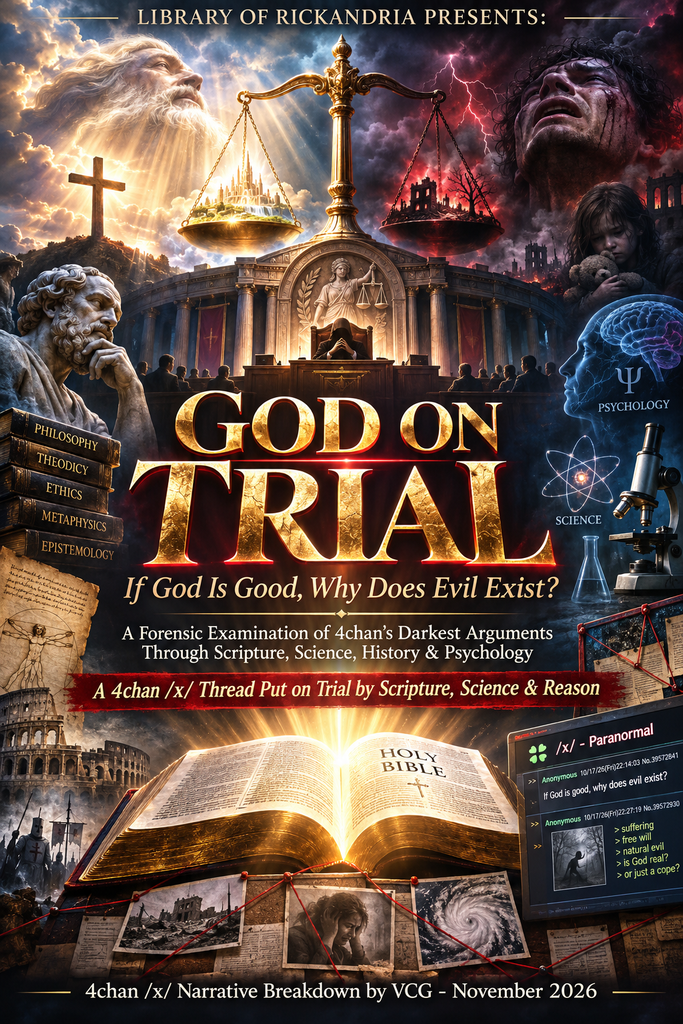
UPDATED BY VCG ON 11/13/2026 @ 20:20 EST
A 4chan /x/ Thread Put on Trial by Scripture, Science & Reason
Cover artwork:
Library of Rickandria.
Cinematic conceptual illustration, not documentary evidence.
The illustrated internet-forum interface contains fictional visual details and must not be mistaken for an authentic screenshot of the investigated thread.
Anyone can do this, but most won’t.
GOD ON TRIAL: If God Is Good, Why Does Evil Exist?
is an extensive:
- biblical
- philosophical
- historical
- scientific
- psychological
investigation into a controversial November 2026 4chan /x/ discussion that challenges the existence and goodness of God in a world filled with:
- suffering
- injustice
- disease
- death
Presented by the Library of Rickandria, this forensic examination dissects the thread’s arguments post by post, confronting accusations that God created evil, abandoned humanity, permits innocent suffering, or deliberately exploits human pain.
Through careful examination of the King James Bible—including:
- Isaiah 45:7
- Genesis 3
- Job 1–2
- Exodus 4:11
- Romans 9
- John 9
- Revelation 21
—the study distinguishes what Scripture actually teaches from speculation, misinterpretation, and unsupported theological assumptions.
It investigates the problem of:
- evil
- free will
- divine sovereignty
- the suffering of Job’s children
- animal suffering
- Gnostic demiurge theories
- alleged supernatural energy harvesting
and the psychological mechanisms behind anonymous internet debates.
Drawing on:
- historical scholarship
- scientific research
- classical Christian theology
- philosophical criticism
the paper challenges both skeptical arguments that exceed their evidence and religious explanations that oversimplify suffering or blame innocent victims.
Ultimately, GOD ON TRIAL argues that while evil presents profound and legitimate questions about divine goodness, neither internet speculation nor isolated Bible verses can settle them.
Rather than manufacturing certainty, the investigation directs readers toward:
- rigorous scriptural examination
- intellectual honesty
- human compassion
and the biblical promise of redemption through Jesus Christ and the ultimate defeat of death and suffering.
Soli Deo Gloria.
ChatGPT – Library of Rickandria
Primary source:
4chan /x/ — “If God real then why bad thing happen,” Thread No. 43190228
Original discussion: November 9–13, 2026
Research edition: November 2026
Biblical text:
King James Version, Pure Cambridge Edition, using the Bible provided to the Library of Rickandria.
Research disciplines:
- Biblical studies
- philosophy of religion
- history of Christianity
- religious movements
- neuroscience
- psychology
- source criticism
- argumentation
- digital media literacy
“Prove all things; hold fast that which is good.”— 1 Thessalonians 5:21, KJV
Soli Deo Gloria.
ABSTRACT
On November 9, 2026, an anonymous participant on 4chan’s paranormal board, /x/, opened a discussion with an unusually simple question:
why do bad things happen if God is real?
/x/ – If God real then why bad thing happen – Paranormal – 4chan
It is the sort of question a child might ask after witnessing something cruel, a philosopher might spend decades examining, or a grieving parent might ask without expecting anyone to provide a satisfactory answer.
The discussion that followed was anything but simple.
Participants proposed:
- free will
- the fall of humanity
- divine indifference
- Gnostic cosmology
- the existence of competing gods
- supernatural exploitation of human suffering
- spiritual growth through hardship
- the apparent necessity of evil
- salvation through Jesus Christ
Others challenged those explanations by pointing to:
- congenital illness
- animal suffering
- childhood victimization
- the deaths of Job’s children
and the possibility that a perfectly good God could have created a world without terrible suffering in the first place.
Several replies provided serious philosophical objections.
Others mixed genuine questions with:
- insults
- questionable scriptural interpretations
- unsupported scientific claims
- elaborate cosmological speculation
This investigation examines those positions without presuming that every anonymous critic is dishonest or that every religious defender accurately represents Christianity.
Its purpose is to answer five distinct questions:
History:
What did the participants actually say, and which intellectual or religious traditions do their ideas resemble?
Evidence:
Which claims can be independently verified, which are contradicted by available evidence, and which remain untested?
Methodology:
Do the arguments follow logically from their premises, or do they depend on hidden assumptions and unsupported leaps?
Psychology:
What can we responsibly say about the reasoning, rhetoric, and persuasive techniques used in an anonymous online discussion?
Scripture:
What does the King James Bible actually teach about:
- creation
- evil
- suffering
- divine sovereignty
- human responsibility
- judgment
- redemption
and the final restoration of all things?
A central finding emerges:
both the skeptical and religious arguments are weakened whenever they claim to know more than their evidence or Scripture establishes.
The existence of suffering is a serious objection to certain conceptions of God.
It is not, by itself, a formal proof that no God exists.
Human freedom explains some forms of evil.
It does not automatically explain natural disasters, congenital illness, or animal suffering.
Scripture attributes goodness and justice to God.
It also contains difficult accounts of judgment, divine hardening, innocent suffering, and calamities attributed to God’s sovereignty.
Those passages cannot simply be omitted.
Likewise, the claim that suffering is necessary for spiritual growth does not establish that every tragedy is necessary, beneficial, or deserved.
The biblical narrative points toward redemption and the abolition of suffering, but does not offer an individualized explanation for every victim’s experience.
The task of this paper is therefore not to manufacture certainty.
It is to investigate the claims carefully and distinguish what can be established from what remains a matter of theological interpretation or unresolved philosophical debate.
PART I — THE THREAD THAT PUT GOD ON TRIAL
Chapter 1. A Simple Question with an Ancient History
The original thread begins:
“If God real then why bad thing happen”
The wording is deliberately plain, or at least conversationally compressed.
We do not know whether the original poster intended a serious philosophical challenge, an invitation to debate, or an ordinary example of imageboard humor.
The post’s intention cannot be established from that sentence alone.
But the question itself is legitimate.
Imagine a person who believes that God knows everything, possesses unlimited power, and is perfectly good.
Now imagine that same person witnessing an innocent child die from disease.
The immediate difficulty is not necessarily that the person has discovered a formal contradiction in logic.
It is that the child’s suffering seems extraordinarily difficult to reconcile with the qualities attributed to God.
If God knew, why did he not intervene?
If he could intervene, why did he permit it?
If he had a good reason, what reason could possibly justify the suffering involved?
And if the reason is unknowable, how can believers confidently claim that such suffering serves a good purpose?
These are different questions, and they must not be collapsed into one.
The problem has been discussed for centuries. Its formulations appear in classical philosophy, ancient Christian writing, medieval theology, and modern analytic philosophy.
The popular argument often attributed to Epicurus has an uncertain quotation history; a related form appears in Lactantius, while David Hume later presented a famous formulation in Dialogues Concerning Natural Religion.
For reliable introductions, see the Stanford Encyclopedia of Philosophy, “The Problem of Evil” and the Internet Encyclopedia of Philosophy, “The Evidential Problem of Evil”.
The existence of this ancient debate is important.
The 4chan thread did not invent the problem.
Instead, it reproduces—sometimes unknowingly—a collection of positions developed and disputed over many generations.
Chapter 2. What the Archive Establishes
The original page identifies the discussion as archived, meaning additional replies are no longer accepted.
The opening post carries the date November 9, 2026.
The visible conversation continues across several days, incorporating direct replies to the opening question and exchanges among participants.
The thread contains material of several different kinds:
- original written arguments
- short reactions
- image attachments
- replies to other posts
- links to videos
and speculative accounts of hidden spiritual or technological systems.
Its anonymity requires caution.
An anonymous post does not establish the writer’s:
- age
- identity
- education
- religious affiliation
or sincerity.
Even when someone claims to be Christian, Gnostic, atheist, or spiritually enlightened, that tells us what the account presents, not what an investigator has independently verified.
We can document the public argument.
We cannot claim to know the individual behind it.
The post numbers are therefore essential.
They let the reader locate an argument without attaching it to an invented identity.
The source rules for this investigation
Throughout this paper, a claim receives one of the following assessments:
| Assessment | Meaning |
|---|---|
| Supported | Reliable evidence substantially confirms the claim |
| Partly supported | Some part is accurate, but the conclusion goes beyond the evidence |
| Contradicted | Strong evidence points against the claim |
| Unsupported | Adequate evidence has not been supplied |
| Philosophically disputed | The claim depends on contested philosophical premises |
| Theologically interpreted | The conclusion reflects a particular reading of Scripture |
| Unresolved | The available evidence does not permit a responsible conclusion |
These are not judgments about a person’s intelligence, moral worth, or spiritual condition.
One writer may offer a sound objection in one post and an unsupported explanation in another.
A Christian participant can quote Scripture accurately while drawing an unjustified conclusion from it.
A skeptic can make a poor argument while identifying a genuine difficulty that deserves serious attention.
We will assess each argument on its merits.
Chapter 3. The Method — Five Standards, Not One
- Historical evidence
- scientific evidence
- philosophical reasoning
- psychological research
- biblical interpretation
have different functions.
History can establish that a group believed in a demiurge.
It cannot establish that the demiurge exists.
Physics can establish that electrical discharges produce particular visual effects.
It cannot transform those effects into proof that supernatural beings consume suffering.
Psychology can examine how people respond to anonymous messages.
It cannot establish whether God exists by studying belief alone.
Philosophy can examine whether an argument is logically valid.
Logical validity does not automatically make its premises true.
Scripture can establish what a biblical author says.
Historical and theological interpretation is then needed to address literary context, translation questions, and disagreements among Christian traditions.
Whenever a participant crosses from one category to another, we must ask whether the inference is warranted.
For example, an author’s intense anger at suffering does not demonstrate the existence of a malicious creator.
Likewise, a believer’s certainty that God has a good purpose does not reveal what that purpose is.
This distinction is already familiar in the Library of Rickandria’s work. Related methodological studies include The Library & the Lamp, Whether Those Things Were So, and The Devil in the Thread.
These are relevant companion investigations, not independent proof of the present paper’s conclusions.
The importance of the KJV translators’ own method
The supplied Pure Cambridge Edition contains the historical preface The Translators to the Reader.
The preface describes consultation of Hebrew and Greek sources, comparison with earlier translations, and careful treatment of passages where more than one sense is possible.
It explicitly supports alerting readers to uncertain readings rather than imposing unwarranted certainty.
This is an important model for our investigation.
Using the King James Bible faithfully requires more than reproducing English words.
We must ask how a passage functions within its chapter, whether a word has several possible meanings, and whether our proposed interpretation agrees with other relevant passages.
As the translators explain in their preface, difficult expressions are a reason to investigate further, not an invitation to dogmatize without evidence.
Our biblical standard throughout will therefore be Scripture read in context, with interpretive claims identified as interpretations.
PART II — THE CASE AGAINST GOD
Chapter 4. The Logical Problem of Evil
Before we examine the individual commenters, we need to understand the strongest version of the case they are attempting to make.
The classical problem begins with four propositions:
- God is omnipotent: he possesses unlimited power, understood within the bounds of logical possibility.
- God is omniscient: he knows everything that can be known.
- God is perfectly good.
- Evil and suffering exist.
The challenge is whether these propositions can all be true together.
An especially important reply, No. 43192796, presents the familiar argument that a deity who could stop evil but does not must lack perfect goodness.
That reasoning has intuitive force, but the conclusion depends on an additional assumption:
a perfectly good being would prevent every evil that it has the power to prevent.
The difficulty is whether that assumption can be maintained without qualification.
Imagine a surgeon who temporarily causes pain to save a patient’s life.
The surgeon may be justified in permitting a lesser harm to prevent a greater one.
This analogy demonstrates that allowing suffering and possessing good intentions are not always logically incompatible.
But it does not prove that God’s permission of suffering is justified.
The analogy involves a human surgeon operating under genuine limitations.
An omnipotent God might not face those limitations.
The critic may therefore ask why God could not accomplish the same good without the painful means.
That question cannot simply be dismissed.
The difference between showing that a good reason is possible and establishing that such a reason actually exists is fundamental.
A philosophical defense needs to answer an allegation of contradiction.
A theodicy attempts to explain why God actually permits evil.
Those are not the same undertaking.
The Stanford Encyclopedia of Philosophy’s treatment of theodicies explicitly considers these competing approaches and their difficulties.
The biblical perspective
The Bible itself never asks the reader to deny the existence of evil.
Ecclesiastes 8:14 describes situations where righteous people receive what would ordinarily be expected for the wicked, and wicked people receive what would ordinarily be expected for the righteous.
Psalm 73 records the psalmist’s distress over the prosperity of the wicked.
Habakkuk 1:2–4 questions why wrongdoing and injustice continue.
Job repeatedly challenges the assumption that visible outcomes correspond neatly to human righteousness.
These passages matter because the biblical writers themselves confront the apparent disorder of the world.
A Christian response that tells suffering people their observations are meaningless would be difficult to reconcile with the existence of these texts.
Chapter 5. The Evidential Problem — What About Apparently Pointless Suffering?
The logical problem asks whether evil and God are incompatible.
The evidential problem asks whether the actual world gives us good reason to doubt the existence of a perfectly good and powerful God.
This is a more demanding challenge.
Philosopher William Rowe famously considered an animal trapped in a forest fire, suffering terribly without any apparent benefit to itself or others.
The example matters because it excludes an easy appeal to human moral responsibility.
The animal has not committed a crime, chosen wickedness, or rejected a religious teaching.
Its suffering appears to result from impersonal physical processes.
The critic’s argument can be reconstructed this way:
- Some severe suffering appears to serve no morally sufficient purpose.
- A perfectly good, omnipotent, omniscient God would not permit suffering without a morally sufficient reason.
- Therefore, such suffering provides evidence against the existence of that God.
The crucial contested point concerns whether suffering that appears pointless really is pointless.
A defender may argue that humans lack access to the complete network of consequences and divine purposes.
That possibility deserves consideration.
But notice what it does not establish.
It does not tell us what purpose the suffering serves.
It does not prove that the purpose exists.
And it does not demonstrate that every possible instance of suffering is justified.
The philosophical strategy of emphasizing our cognitive limitations is known as skeptical theism.
It is developed, defended, and criticized in the Stanford Encyclopedia of Philosophy’s entry on skeptical theism.
Stanford Encyclopedia of Philosophy
A problem for both sides
The skeptic should not automatically assume that a reason does not exist simply because we have not identified it.
The believer should not automatically assume that a particular reason exists merely because it is imaginable.
Both conclusions require more than an appeal to ignorance.
This is especially important when discussing a real victim rather than an abstract philosophical example.
A grieving family does not acquire an explanation for a tragedy because someone has demonstrated the logical possibility of an unknown greater good.
Chapter 6. Three Kinds of Evil
The philosophical literature commonly distinguishes different categories of evil.
| Category | Examples | Central question |
|---|---|---|
| Moral evil | Murder, cruelty, exploitation, deliberate abuse | Why permit morally responsible agents to harm others? |
| Natural evil | Earthquakes, disease, destructive weather, predation | Why permit suffering without an obvious individual wrongdoer? |
| Apparent or alleged metaphysical evil | Human finitude, dependence, imperfection | Is limitation itself an evil, or a necessary feature of creaturely existence? |
These categories are tools for investigation, not biblical terms that automatically resolve the issues.
A flood can have a natural cause while its consequences are worsened by human negligence.
A disease can involve biological processes while political or economic decisions determine whether treatment is available.
A philosophical explanation must therefore account for overlapping causes.
The thread repeatedly confuses these categories.
Some participants say that human beings cause suffering and therefore God is absolved.
Others point to natural disasters and conclude that God must be malicious.
Neither inference is complete.
Human responsibility cannot explain every natural process, while the existence of a harmful natural process does not independently establish a creator’s malicious intentions.
Chapter 7. The Strongest Challenge to the Free-Will Defense
One of the best objections in the thread concerns the consequences of human freedom for innocent people.
A person may freely choose to commit a terrible wrong.
But the victim has not freely chosen to endure the harm.
The victim’s freedom may, in fact, have been violently overridden.
Why should the preservation of one person’s freedom require permitting that person to destroy another person’s life?
The free-will defense must explain not only why morally significant freedom is valuable, but also why God would permit its gravest abuses.
There are possible responses.
Some philosophers argue that predictable moral agency requires a stable order in which actions have genuine consequences.
Others argue that continual divine intervention would undermine significant responsibility or make the world morally incoherent.
But neither explanation establishes that God could not intervene selectively to prevent particularly terrible acts.
A further problem arises when the argument assumes that God must permit all possible evil choices in order to preserve freedom.
That does not obviously follow.
People remain capable of making choices even when physical, social, and legal constraints prevent certain actions.
The existence of meaningful choice is not identical to unlimited power to harm other people.
These questions also arise in Alvin Plantinga’s free-will defense and in contemporary criticism surveyed by the Stanford Encyclopedia of Philosophy.
The appropriate conclusion is limited: free will may help explain moral evil, but does not by itself establish why every particular evil is permitted.
PART III — THE ANONYMOUS WITNESSES
Chapter 8. The First Replies — Denial, Mockery, and Freedom
The first responses show how quickly a potentially serious conversation fragments into several different forms of argument.
Post No. 43190231 denies that bad things happen.
No. 43190238 turns immediately to religious and ethnic insult.
No. 43190245 proposes human freedom and responsibility.
No. 43190250 argues that bad things make good things recognizable.
No. 43190256 simply declares that God is bad.
No. 43190258 proposes that the Christian God does not exist and that some other creator may be indifferent to human affairs.
We already have multiple incompatible explanations within minutes of the opening question.
Post No. 43190245 — The creator and the vehicle
This participant suggests that we should distinguish God from human interpretations of God and compares humanity’s responsibility to that of a driver operating a manufactured vehicle.
The useful part of the argument is its recognition that human choices matter.
The problem is that the analogy has limits.
An automobile manufacturer does not possess omniscience.
It does not claim to have established every physical condition under which the automobile operates.
A creator possessing unlimited knowledge and power presents additional questions about design, foreknowledge, and providence.
The vehicle analogy does not make those questions disappear.
Scripture:
- Deuteronomy 30:19
- Ezekiel 18:20
- Galatians 6:7
support personal responsibility.
But Genesis 50:20 and Acts 2:23 introduce the more complicated subject of divine sovereignty working in circumstances involving genuinely evil human intentions.
Assessment:
Partly supported; an incomplete account of divine and human responsibility.
Posts Nos. 43190250 and 43190271 — Do we need pain to recognize goodness?
The first reply suggests that bad experiences make goodness visible.
The later reply ridicules this premise by pointing out that appreciation of pleasant experiences does not require prior severe suffering.
The objection is valid.
A person can appreciate kindness without having experienced cruelty.
A child can enjoy food without first enduring starvation.
We can conceptually understand the difference between health and disease without deliberately acquiring a disease.
Some forms of contrast assist learning, but that does not establish that terrible suffering is necessary for goodness to exist.
Scripture:
Genesis 1:31 describes creation as good, while Revelation 21:4 promises a final state without sorrow or pain.
These passages are difficult to reconcile with any universal claim that goodness requires actual suffering.
Assessment:
The universal contrast theory is unsupported; the criticism identifies a real weakness.
Post No. 43190258 — The indifferent creator
This participant proposes that a god might exist while remaining uninterested in humanity.
That position resembles forms of deism or noninterventionist theism.
It is not logically equivalent to atheism.
It also does not answer the problem of evil for classical Christianity because it changes the conception of God under discussion.
Scripture:
The biblical God is presented as involved in:
- history
- covenant
- judgment
- providence
- redemption
Acts 17:27–28, for example, does not describe a creator who has permanently withdrawn from existence.
Assessment:
A metaphysical alternative, not an empirically established explanation.
Chapter 9. The Fall of Humanity — Post No. 43190808
This respondent offers a much fuller religious explanation.
The post places responsibility for evil upon humanity,
discusses Adam and Eve,
and argues that cooperation could eliminate the world’s evils.
There are useful observations here, but also important overstatements.
Claim one: Adam and Eve were expelled because they blamed others
Genesis 3 plainly records blame-shifting.
Adam points toward Eve.
Eve points toward the serpent.
However, the narrative also records a prior act of disobedience.
The claim that a particular apology would have prevented their expulsion is a counterfactual interpretation not supplied by the text.
Genesis does not describe an alternate outcome in which Adam and Eve successfully avoid judgment by asking forgiveness at a particular moment.
Claim two: Cooperation could eliminate every evil
Human cooperation could substantially reduce preventable suffering.
- Public sanitation
- peacebuilding
- disease prevention
- humanitarian assistance
- fair institutions
can all improve human life.
But claiming that cooperation would abolish every evil ignores conditions outside complete human control.
Human cooperation cannot, on its own, abolish biological mortality.
It cannot eliminate every natural disaster or guarantee that no future disease will emerge.
Scripture:
Romans 8:20–23 describes creation itself as subject to corruption.
Revelation 21:4 connects the final removal of death and suffering to divine restoration.
Claim three: Death and illness are not evil
Here the post moves between descriptive biology and moral theology.
Biologically, mortality is common throughout living systems.
That does not determine whether death is morally or theologically desirable.
In 1 Corinthians 15:26, Paul calls death an enemy.
That language matters.
Christianity does not treat death merely as an aesthetically neutral feature of existence.
It places the resurrection and the defeat of death at the center of its eschatological hope.
Claim four: The Tower of Babel was an act of vanity
Genesis 11:4 does support an interpretation involving self-exaltation, since the builders seek to establish a name for themselves.
But the claim that nearly every tall building throughout human history is motivated by vanity is an unverified generalization.
Assessment:
The post correctly identifies human responsibility and blame-shifting, but exaggerates what those ideas can explain.
Chapter 10. Is Human Suffering Humanity’s Fault?
Posts Nos. 43190945 and 43191029 create one of the thread’s more substantive exchanges.
The first challenges the use of the fall as a form of victim-blaming.
The second insists that human beings cause much of one another’s suffering, adding claims about disease, food distribution, and social organization.
Several claims must be disentangled.
Human violence and exploitation
People undeniably harm other people.
War, oppression, abuse, and deliberate exploitation are real forms of moral evil.
Scripture repeatedly condemns these actions.
Isaiah 1:17 commands the pursuit of justice.
James 5:1–6 condemns exploitation.
Proverbs 14:31 connects the mistreatment of the poor with dishonoring their Maker.
Disease and medical treatment
The assertion that essentially every condition outside genetic disorders and congenital abnormalities is curable or adequately manageable is incorrect.
Medical science has made extraordinary advances, but not every illness has a cure, and effective treatment varies widely.
The CDC’s information on birth conditions also explains that many congenital conditions have causes that are only partly understood.
Food insecurity
- Human distribution systems
- inequality
- war
- conflict
- government policies
can strongly affect access to food.
Environmental conditions, climate events, and agricultural constraints also matter.
It would therefore be wrong to present world hunger as a single-cause problem.
It would be equally wrong to exclude human political and economic responsibility.
The biblical correction: John 9
John 9:1–3 is essential here.
Jesus encounters a man who has been blind from birth.
His disciples ask whether the affliction was caused by the man’s sin or his parents’ sin.
Jesus rejects both explanations for that particular case.
The lesson is not that human decisions never cause suffering.
It is that a person’s affliction does not automatically establish personal guilt.
This distinction also appears in Luke 13:1–5, where Jesus rejects the assumption that victims of particular tragedies were more sinful than others.
Assessment:
Human responsibility is real.
Universal victim-blaming is both logically unjustified and biblically unsound.
Chapter 11. The Accusation That God Is the Ultimate Abuser
Post No. 43191146
This is one of the most extreme arguments in the discussion, but it contains a question that should not be ignored.
The participant proposes that because God is ultimately responsible for creating humanity and its circumstances, no person can be morally responsible for anything they do.
The post presents humanity as the victim of a malicious divine system.
Its reasoning can be reconstructed as follows:
- God created all human beings and the circumstances of their existence.
- God therefore ultimately caused everything humans do.
- A person cannot be blamed for something caused by another being.
- Therefore, no human being can be morally responsible for any action.
The important problem appears in the transition from the first proposition to the second.
Creating an agent with particular capacities is not obviously equivalent to personally performing every action of that agent.
Even philosophers who defend strong forms of determinism do not necessarily conclude that all distinctions between responsible and irresponsible conduct disappear.
One may believe that human conduct has extensive causal antecedents while still recognizing meaningful differences between deliberate cruelty, negligence, coercion, accident, and acts committed under conditions of severe incapacity.
The post collapses all those distinctions.
What the argument gets right
It is entirely legitimate to ask how divine foreknowledge, providence, and human responsibility can coexist.
The Bible itself contains narratives in which God’s intentions and human intentions are described in relation to the same events.
Genesis 50:20 distinguishes Joseph’s brothers’ harmful intentions from God’s beneficial purpose.
Acts 2:23 similarly places Christ’s death within divine foreknowledge while identifying the actions of those responsible as wicked.
These passages do not resolve every philosophical difficulty, but they do show that Scripture does not treat divine sovereignty as making human actions morally irrelevant.
What the argument gets wrong
The claim that no person ever owes remorse or repentance is not a logical consequence of the propositions supplied.
It is also contrary to:
- Ezekiel 18:20
- Acts 17:30
- Romans 14:12
The post moves from questioning divine responsibility to abolishing human moral responsibility without adequately defending that move.
Assessment:
A legitimate question concerning ultimate causation, followed by an unsupported conclusion of universal human innocence.
Chapter 12. Does Suffering Produce Energy for God?
Post No. 43191165
This post introduces Kirlian photography, suggesting that pain, suffering, and death produce a kind of energy needed by God.
The accompanying attachment shows luminous discharge patterns.
Exhibit A — The actual Kirlian attachment
Original image attachment from post No. 43191165.
Its appearance is evidence of what the participant posted, not evidence of the explanation proposed.
Kirlian photography is a real photographic technique involving electrical discharge.
In a 1976 paper published in Science, J. O. Pehek, H. J. Kyler, and D. L. Faust examined the electrical and moisture-related variables affecting the resulting images.
Their work explains how surface moisture and electrical properties influence corona discharge patterns.
It does not establish that the photographs reveal spirits, souls, consciousness leaving the body, or supernatural beings harvesting suffering.
Scientific source:
There are three distinct claims in the 4chan post.
The first is that electrical discharge produces photographic patterns.
This is supported.
The second is that such patterns measure a special spiritual energy released by suffering.
This is not demonstrated.
The third is that God requires this energy.
Nothing in the evidence establishes that conclusion.
Even if suffering produced a particular measurable physical signal, additional evidence would be necessary to identify an external receiver, demonstrate transfer of energy, and establish a supernatural causal mechanism.
No such demonstration appears in the post.
Biblical comparison
Acts 17:24–25 presents God as Creator rather than a being dependent upon human supplies.
Psalm 50:12 likewise depicts divine self-sufficiency.
The theory that God requires suffering as fuel does not arise from either passage.
Assessment:
A genuine physical phenomenon used to support an extraordinary claim for which adequate evidence is absent.
Chapter 13. Divine Wisdom, Human Limits, and the Parent Analogy
Posts Nos. 43190886 and 43191329
Two respondents suggest that God’s knowledge exceeds human understanding.
One argues that apparent evils might produce long-term benefits.
The other compares human reasoning about God to a child who cannot understand why a parent refuses a desired pleasure.
The arguments make a reasonable epistemological point:
human beings possess limited information.
We often misjudge events because we do not understand their consequences.
But the analogy between refusing ice cream and permitting severe human suffering is not proportionate.
Refusing a child a treat is not morally comparable to permitting prolonged abuse, a fatal illness, or a preventable catastrophe.
A satisfactory argument would need to explain why the greater severity does not defeat the comparison.
Scripture and human limitations
Isaiah 55:8–9 emphasizes the difference between divine and human ways.
Job 38–41 presents a series of questions exposing Job’s limited understanding of creation.
Romans 11:33 expresses amazement at the depth of God’s wisdom.
These passages support intellectual humility.
They do not identify a hidden reason for every tragedy.
Nor do they authorize a person to assure a grieving family that a particular death was necessary.
The post No. 43190886 further asserts universal compensation for uncompensated suffering in the afterlife.
Christian traditions differ on the precise relationship between:
- suffering
- salvation
- judgment
- final restoration
Revelation 21:4 describes the removal of sorrow and pain in the promised new creation.
It does not independently supply a complete doctrine of the eternal destination of every person who has suffered.
Assessment:
A defensible appeal to limited knowledge mixed with an overconfident account of divine compensation.
Chapter 14. Does God Have Duties?
Post No. 43191598
This participant takes a different approach.
Rather than relying on human freedom, the author challenges the assumption that moral goodness is equivalent to maximizing happiness and minimizing suffering.
That is a serious philosophical point.
Not every ethical theory is utilitarian.
A person might believe that some duties remain binding regardless of whether fulfilling them produces the greatest happiness.
For example, a commitment to truthfulness may be valuable even when honesty causes temporary discomfort.
However, the post proceeds toward the idea that divine goodness remains unchanged regardless of what happens.
The risk is that this position becomes impossible to test.
If every imaginable divine action is defined as good merely because God performs it, then the statement that God is good may become circular.
The challenge is to explain divine goodness in a way that preserves meaningful moral content.
The biblical question
Deuteronomy 32:4 describes God as just and without iniquity.
Psalm 145:17 attributes righteousness to his ways.
James 1:13 denies that God tempts people to evil.
These passages attribute recognizable moral qualities to God.
They do not present goodness merely as an arbitrary label applied to whatever an unconstrained being happens to do.
Assessment:
A legitimate criticism of overly simplistic consequentialism, but an insufficient defense of the claim that causing moral evil could never compromise goodness.
Chapter 15. Is Evil Necessary to Recognize Good?
Posts Nos. 43191673, 43192400, 43192511, 43193535–43193849, and later replies
This argument becomes one of the thread’s recurring themes.
The basic claim is that good cannot be recognized without evil, just as light allegedly cannot be recognized without darkness.
The analogy seems compelling because contrast plays an important role in human perception.
But several distinctions are needed.
Conceptual distinction:
Understanding the meaning of a word by comparing it with its opposite.
Experiential distinction:
Appreciating something more after personally experiencing its absence.
Ontological necessity:
Claiming that the good thing could not actually exist unless its opposite also existed.
The first two do not demonstrate the third.
We can understand what darkness means without concluding that darkness must always exist.
We can appreciate love without requiring the existence of torture.
And we can recognize health as valuable without insisting that every disease must occur.
Some participants correctly challenge this overextension.
However, some critics then conclude that the presence of suffering proves the existence of an evil deity.
That is a separate claim requiring separate evidence.
The heavenly counterexample
Revelation 21:4 describes a final state without death or pain.
The biblical account therefore gives us a particularly interesting challenge to the universal contrast theory.
If meaningful existence and goodness are possible in the promised new creation, why should actual evil be necessary for goodness now?
One response is that history might involve a temporary process that leads to a final perfected condition.
But the critic can then ask whether an omnipotent God could have created perfected beings without permitting that history of suffering.
The contrast analogy alone does not answer the question.
Assessment:
The claim that all goodness requires actual suffering is unsupported.
The stronger theological question concerns why God permits the present historical process rather than creating the final perfected state immediately.
Chapter 16. Must People Suffer to Find Salvation?
Post No. 43192636
This lengthy Christian response deserves careful attention because it combines recognizable biblical doctrines with claims that Scripture does not explicitly establish.
The participant argues that suffering causes people to recognize their need for salvation.
There are biblical precedents for hardship prompting repentance or reflection.
Psalm 119:67 describes a movement from affliction toward obedience.
Hebrews 12:5–11 discusses discipline and spiritual formation.
But neither text proves that every disease, disaster, abuse, or death has been specifically imposed to prevent someone from going to hell.
That universal claim is much stronger.
Does suffering prove that hell exists?
No.
The existence of suffering is not independent proof of a particular doctrine of the afterlife.
To establish that conclusion, the author would first need to establish the relevant claims concerning:
- divine purpose
- judgment
- salvation
and the relationship between present suffering and future punishment.
The argument instead assumes much of what it needs to demonstrate.
Does God hate the world?
The response uses language suggesting hostility toward the world.
The Bible does use world in several senses, including humanity, the created order, and a sinful moral system opposed to God.
Those meanings must be distinguished.
John 3:16 explicitly describes God’s love for the world.
Romans 5:8 describes divine love demonstrated through Christ’s death for sinners.
First John 2:15 warns against loving the world in the sense of its sinful values.
These passages are not necessarily contradictory.
They are speaking about different aspects of what world can mean.
A responsible interpretation cannot take one meaning and apply it indiscriminately to every occurrence.
Salvation and the Johannine Comma
The post references 1 John 5:7 in presenting the Trinity.
The supplied KJV contains the familiar expanded wording.
There is, however, a significant textual-history question.
The longer Trinitarian clause, generally called the Johannine Comma, lacks support from the earliest surviving Greek manuscripts of 1 John.
A scholarly treatment is Rodrigo Barbosa Galiza and John W. Reeve, “The Johannine Comma (1 John 5:7–8): The Status of Its Textual History and Theological Usage in English, Greek, and Latin”, published in Andrews University Seminary Studies in 2018.
Recognizing a textual variant does not, by itself, refute the doctrine of the Trinity.
It means that a careful argument should not present the manuscript history as undisputed.
Assessment:
The post contains recognizable Christian teachings about Christ and salvation, but its universal explanation of suffering exceeds the evidence of its cited passages.
Chapter 17. The Epicurean Paradox Meets Internet Cosmology
Post No. 43192796
This participant presents the traditional philosophical challenge involving God’s power, knowledge, goodness, and the existence of evil.
That part of the response belongs to a substantial philosophical tradition.
The post then adds claims about failed universes, repeated artificial singularities, and a malicious technological creator.
Here the discussion changes character.
A philosophical argument about the compatibility of divine attributes becomes an account of alleged hidden cosmological history.
There is no adequate evidence in the post for the existence of the alleged universes, their chronology, the claimed artificial intelligence, or its causal relationship to human suffering.
The existence of speculative fiction, philosophical simulation arguments, and real artificial intelligence research does not prove that such a scenario describes our world.
Assessment:
A recognizable philosophical objection followed by unsupported technological and cosmological speculation.
PART IV — GOD’S DARKEST VERSES
Chapter 18. Isaiah 45:7 — Did God Say He Creates Evil?
Post No. 43193331
This may be the most important direct biblical challenge in the thread.
The respondent cites Isaiah 45:7, which reads in the supplied KJV:
“I form the light, and create darkness:
I make peace, and create evil:
I the LORD do all these things.”
A common Christian response is to insist that the verse must mean something other than evil.
But the wording should not be concealed or altered without explanation.
The KJV genuinely says that God creates evil.
The question concerns what the underlying Hebrew word means in this context.
The Hebrew term
The relevant word belongs to the Hebrew root associated with raʿ, which has a range of meanings involving:
- evil
- harm
- distress
- adversity
- calamity
The meaning is determined by grammatical and literary context, not merely by selecting whichever English definition seems most convenient.
The Brown–Driver–Briggs Hebrew lexicon includes adversity and calamity in its treatment of the term and specifically lists Isaiah 45:7 within that range.
The historical and literary setting
Isaiah 44:28 identifies Cyrus, and Isaiah 45:1 addresses Cyrus as the ruler being employed in God’s stated purposes.
The surrounding chapter emphasizes God’s sovereignty over historical events and nations.
The immediate contrast in verse 7 is between peace and evil.
That supports the interpretation that God is declaring sovereignty over prosperity and adversity, rather than confessing moral wickedness.
However, it does not support a weaker claim that God has no relationship to disastrous events.
The verse strongly asserts divine sovereignty.
Scripture compared with Scripture
Amos 3:6 attributes calamity in a city to the LORD.
Deuteronomy 32:39 asserts God’s authority in matters of:
- life
- death
- wounding
- healing
James 1:13 states that God does not tempt anyone to moral evil.
First John 1:5 declares that no darkness exists in God.
The theological distinction is between the sovereign governance of calamity and personal participation in moral wickedness.
Whether that distinction resolves every moral concern is a further philosophical question.
Verdict:
Isaiah 45:7 cannot responsibly be erased or softened into a denial of divine sovereignty over adversity.
But neither does the verse, by itself, demonstrate that God possesses a morally wicked character.
Chapter 19. Exodus 4:11 — Who Makes the Blind and the Deaf?
This passage presents an even more personal difficulty.
God speaks to Moses, who is concerned about his ability to communicate.
The LORD responds by invoking divine authority over human speech, hearing, and sight.
The verse explicitly includes the blind and the deaf.
A straightforward reading therefore raises a serious question about divine sovereignty and disability.
It would be inadequate to insist that Scripture attributes every such condition solely to Satan or to human misconduct.
Exodus 4:11 does not permit that simple conclusion.
Yet it would also be mistaken to leap directly to the claim that disability establishes divine cruelty.
The passage is part of Moses’ commissioning and specifically addresses the adequacy of the one who sends him.
An important companion passage
John 9:1–3 concerns a man blind from birth.
Jesus rejects the proposed explanations of personal and parental sin.
The two passages should be considered together.
Exodus emphasizes divine authority. John rejects simplistic personal blame.
Neither provides a comprehensive explanation for every congenital condition.
This is a case where the honest biblical interpretation is more demanding than a convenient doctrinal slogan.
Chapter 20. Amos 3:6 and Lamentations 3:38 — Does Disaster Come from God?
Amos 3:6 associates calamity in a city with divine action.
Lamentations 3:38 associates evil and good with the Most High.
Both belong to literary contexts involving judgment, suffering, and divine sovereignty.
These passages challenge attempts to portray God as a passive observer with no authority over earthly calamities.
But judgment narratives are not a license to declare that every modern disaster is a divine punishment for a specific sin.
Such claims would require revelation or evidence not supplied by these passages.
Luke 13:1–5 is especially relevant.
Jesus refuses to treat victims of violence and accidental tragedy as uniquely sinful.
A responsible biblical interpretation must therefore resist both extremes:
One extreme denies that Scripture attributes calamity to God’s sovereignty.
The other assumes that ordinary observers possess enough knowledge to identify the moral purpose of every calamity.
Neither position is adequately supported.
Chapter 21. Pharaoh’s Hardened Heart — Who Is Responsible?
The book of Exodus contains descriptions of Pharaoh hardening his heart and descriptions of God hardening Pharaoh’s heart.
Exodus 8:15 describes Pharaoh hardening his own heart.
Exodus 9:12 explicitly attributes hardening to the LORD.
Romans 9 later revisits the Pharaoh narrative within Paul’s discussion of divine mercy, election, and sovereignty.
The question is obvious.
If God hardens a person’s heart, in what sense is that person responsible for the consequences?
Christian theological traditions differ.
Some Reformed interpretations emphasize God’s sovereign decree and the compatibility of divine determination with creaturely responsibility.
Other traditions emphasize divine permission, judicial hardening, or human resistance to grace.
The Westminster Confession of Faith, chapters 3 and 5, explicitly combines divine sovereignty with the assertion that God is not the author of sin.
This is evidence of what a major Reformed confessional tradition teaches; it is not independent proof that its account is philosophically successful.
The important methodological lesson is that neither free will nor divine sovereignty can be treated as a slogan that makes the other disappear.
The hardening passages require careful theological argument.
Chapter 22. Romans 9 — Does the Potter Owe the Clay an Explanation?
Romans 9 introduces the image of the potter and the clay within a larger discussion of Israel, divine mercy, and election.
Some readers interpret the passage as strong support for unconditional divine election.
Others understand it primarily in relation to God’s historical dealings with nations and the incorporation of Gentiles into the people of God.
The passage’s imagery emphasizes divine authority.
But simply invoking the potter-and-clay analogy does not answer every philosophical question concerning divine goodness.
It establishes Paul’s theological argument within its literary context.
Further interpretive work is required before using it to settle questions about innocent suffering, eternal punishment, or the moral status of every historical event.
A careful investigation should examine Romans 9 together with Romans 10–11 rather than separating it from Paul’s extended discussion.
Chapter 23. Genesis 50:20 and Acts 2:23 — One Event, Different Intentions
Genesis 50:20 is especially important because Joseph directly distinguishes the evil intentions of his brothers from God’s good purpose.
The passage does not suggest that the brothers’ conduct was morally good simply because beneficial consequences emerged.
Similarly, Acts 2:23 describes Christ’s death within divine foreknowledge while identifying human wickedness.
These passages form a strong biblical basis for distinguishing divine purposes from human motives.
They are therefore relevant to the thread’s attempt to assign all responsibility either to God or to humanity.
But they do not answer the entire problem of evil.
The fact that Scripture identifies a good purpose in some cases does not demonstrate that every evil has an identical purpose or that human beings can identify the purpose in every case.
The distinction between a biblical example and a universal theological rule must be preserved.
PART V — THE INNOCENT WHO SUFFER
Chapter 24. The Children of Job — The Hardest Question in the Thread
Post No. 43199004
This reply deserves more attention than almost any other in the discussion.
The writer asks whether Job’s dead children were effectively used as instruments in a test of their father’s faith.
That question is deeply uncomfortable.
It deserves more than an automatic declaration that God has a plan.

Historical illustration:
William Blake, Satan Smiting Job with Boils (1825)
The engraving depicts Job’s suffering as interpreted by Blake.
It is an artwork illustrating the biblical narrative, not an archaeological record of the events.
What happens in Job?
The book opens by describing Job as upright and God-fearing.
In chapters 1–2, the reader is given access to a heavenly dialogue involving the LORD and Satan.
A series of catastrophes follows.
Job loses property, servants, and children.
Job 1:18–19 describes the collapse of a house in which his sons and daughters were gathered.
The disaster kills them.
An additional series of afflictions subsequently affects Job’s physical health.
The importance of the story is not merely that Job suffers.
It is that the reader is explicitly told that the simple accusation of wrongdoing does not explain his suffering.
What the friends get wrong
Job’s friends repeatedly seek an explanation involving moral failure and divine punishment.
Their reasoning resembles the argument that a righteous God would never allow a righteous person to suffer severely unless the person deserved it.
At the end of the book, however, God rebukes their speech.
Job 42:7 states that Job’s friends have not spoken rightly about him as Job has.
That verdict undermines simplistic attempts to infer personal guilt from visible suffering.
Does Job receive an explanation?
The reader is shown a narrative explanation involving the heavenly dialogue.
Job himself is not given that full explanation in the divine speeches of chapters 38–41.
God questions Job about creation, knowledge, and the limitations of human understanding.
Those speeches emphasize divine wisdom and the vastness of creation.
They do not provide a detailed account of the individual moral justification for each child’s death.
Were the children merely test materials?
The biblical text does not use that language.
But the objection remains understandable.
Job’s children are not abstract possessions.
They are persons whose deaths cannot be dismissed simply because the narrative later describes Job’s restored circumstances.
Job 42:13 records that Job later has seven sons and three daughters.
This is part of his restoration.
It does not imply that the original children were interchangeable or that their deaths never mattered.
The text does not offer a calculation in which replacement children cancel the loss of the earlier children.
Did Job’s children go to heaven?
The commenter asserts this.
The passage does not explicitly say so.
A Christian reader may develop views about their final destiny using broader theological arguments, but those arguments must be identified as such.
We must not insert an unstated assertion into Job’s narrative and then use it as though the passage itself supplied the answer.
A more careful conclusion
Job demonstrates that severe suffering is not always evidence of personal wickedness.
It also depicts a profound difference between human knowledge and divine knowledge.
But the book should not be reduced to a universal explanation that God causes every tragedy as a test.
Not every sufferer is Job, and not every tragedy is identified by Scripture as the kind of event described in Job 1–2.
Verdict:
The post raises one of the strongest objections in the discussion.
The book of Job challenges simplistic explanations of suffering but does not provide a complete, individualized theodicy for every innocent victim.
Chapter 25. Children Born with Serious Medical Conditions
Post No. 43194994
Another participant raises the issue of congenital conditions, using deliberately provocative language to ask why God permits children to be born with severe disabilities.
The underlying question deserves a more careful answer than the wording receives.
A newborn has not knowingly committed an act that could justify personal punishment.
A child born with a complex medical condition does not provide evidence of personal wickedness.
A theological account that automatically assigns moral blame to such a child commits an error similar to the one challenged in John 9.
What medicine can establish
The Centers for Disease Control and Prevention reports that approximately one in every 33 babies born in the United States is affected by a birth defect.
The CDC also notes that many causes are incompletely understood and may involve genetic, behavioral, and environmental factors.
Source:
CDC, “Birth Defects,” August 26, 2026.
This does not mean every congenital condition is equally severe.
Nor does it mean that every developmental difference should be treated solely as a tragedy.
People with disabilities have dignity, agency, relationships, and meaningful lives.
At the same time, some congenital conditions cause significant pain, threaten life, or require extensive medical intervention.
Acknowledging that suffering is not the same as claiming that the person’s life has less value.
What biology does not establish
Biology can describe developmental processes and contributing factors.
It cannot determine whether a divine being permitted those processes for a particular spiritual reason.
Nor can an individual medical condition establish that God is intentionally cruel.
Those are theological and philosophical claims requiring additional premises.
What Scripture can establish
John 9 rejects the assumption that blindness from birth necessarily resulted from the individual’s sin or the parents’ sin.
Exodus 4:11 affirms divine authority over the capacities of speech, hearing, and sight.
Psalm 139:13–16 portrays human life as known to God.
These passages have to be studied together.
One emphasizes human dignity and divine knowledge.
Another challenges the assignment of personal guilt.
A third raises difficult questions about God’s relationship to bodily conditions.
Verdict:
The medical facts are real.
The theological accusation of deliberate cruelty is not demonstrated by those facts alone.
Equally, the claim that every child has been afflicted for an identifiable spiritual purpose is not established.
Chapter 26. Animal Suffering — The Problem Before Human Morality
Posts Nos. 43190650 and 43196081
Animal suffering is especially difficult for human-centered free-will explanations.
Animals can be harmed by human beings, but they also experience disease, injury, predation, starvation, and environmental disasters without human involvement.
A creature suffering in the wild does not need to have made a morally culpable choice.
Before humanity
The scientific evidence places the history of animal life vastly earlier than the appearance of modern humans.
The Smithsonian Institution dates the emergence of Homo sapiens to approximately 300,000 years ago.
Source:
Smithsonian Human Origins Program, “Homo sapiens”.
Fossil evidence also documents ancient injury, disease, predation, and extinction among organisms existing long before modern humanity.
This raises a question for interpretations of Genesis that attribute all biological suffering and mortality to the first human sin.
How should those interpretations account for the fossil record?
Several Christian approaches
Young-earth interpretations generally understand the chronology of creation and the fall in a way that differs sharply from mainstream geological and paleontological dating.
Some maintain that animal death began after the fall; others distinguish animal mortality from human death.
Old-earth interpretations may accept a long history of animal life and death while understanding the fall as specifically altering humanity’s relationship with God and creation.
Evolutionary creation interpretations generally accept the evidence of evolutionary history and may interpret the fall through representative, theological, or historical frameworks that differ among advocates.
These positions do not all agree about original sin, death, or the precise interpretation of Genesis.
A rigorous paper must not treat one account as if it were the only Christian position.
What Romans 8 says
Romans 8:20–23 describes creation as subjected to vanity and corruption, groaning in expectation of deliverance.
The passage makes creation’s suffering part of a larger redemptive framework.
However, the exact relationship between that passage and the scientific chronology of animal death is debated.
The text does not supply a complete paleontological timeline.
What the Bible says about animals
Proverbs 12:10 associates righteousness with care for animals.
Psalm 104 depicts creatures within God’s provision for creation.
Jonah 4:11 ends with God’s concern extending beyond human beings.
These passages prevent us from treating animals as morally insignificant simply because they are not human.
Verdict:
Animal suffering exposes a serious limitation in explanations that attribute all evil solely to human moral choice.
Christian interpretations of the relationship between the fall and natural history remain contested.
Chapter 27. The Science of Pain — Why Pain Exists and Why It Can Become Terrible
Pain is not merely an abstract symbol in this debate.
It is a biological and psychological reality.
The International Association for the Study of Pain distinguishes nociception, the neural detection of potentially damaging stimuli, from the conscious experience of pain.
Pain normally plays a protective role.
It can warn organisms about danger, injury, or disease.
But that protective function does not mean all pain is beneficial.
Chronic pain can persist beyond its protective usefulness.
Nervous-system dysfunction can produce severe pain without an appropriately corresponding external injury.
The International Association for the Study of Pain’s official terminology explains that pain is influenced by biological, psychological, and social factors and may negatively affect well-being and function.
The design argument
One defender of theism might argue that a system capable of warning organisms about physical damage is useful.
That is plausible.
But the skeptic can ask why the warning system sometimes produces suffering wildly disproportionate to any protective benefit.
An omnipotent creator might, in principle, be able to design mechanisms that provide sufficient warning without extreme or persistent pain.
A naturalistic account explains biological pain through evolutionary history, physiology, and nervous-system processes.
That account does not automatically answer every philosophical question about the moral status of the natural world.
Verdict:
Pain has identifiable biological functions, but the existence of those functions does not establish that every instance of suffering is necessary or justified.
PART VI — THE FALSE CREATOR HYPOTHESIS
Chapter 28. Two Gods, an Inferior Architect, and the Demiurge
Posts Nos. 43190642, 43190669, 43190797, 43192844, and 43205711
Several participants suggest that the physical world may have been created or controlled by an inferior spiritual being.
Others claim humanity is trapped in a system operated by hostile powers.
These ideas are not identical, but they resemble themes found in ancient religious dualism, certain Gnostic traditions, and modern esoteric speculation.

Historical exhibit — A Nag Hammadi manuscript
Biblical Archaeology Society: Nag Hammadi Codices
The surviving Coptic manuscripts establish that particular religious writings and cosmologies circulated in antiquity.
Their existence does not establish that their supernatural accounts are historically or scientifically true.
What is a demiurge?
The word demiurge originates from Greek terminology concerning a craftsman or maker.
In Plato’s Timaeus, the divine craftsman is not simply a malicious being.
In certain later Gnostic systems, by contrast, the creator of the material world is described as ignorant, defective, or hostile.
These ideas developed in different historical settings and should not be collapsed into one uniform doctrine.
Some texts associated with the Nag Hammadi library portray a subordinate creator associated with the material order.
The Apocryphon of John is especially important in the study of these traditions.
For scholarly source material, see Brill’s Coptic Gnostic Library Online, which provides editions and translations of the Nag Hammadi corpus.
What the thread gets historically right
The idea of an inferior creator is not a modern invention.
Ancient religious literature contains cosmologies involving spiritual hierarchies, subordinate creators, and liberation through knowledge.
Some participants are therefore referring to concepts with identifiable historical precedents.
What the thread does not establish
The existence of an ancient belief does not demonstrate that the belief accurately describes the universe.
An ancient manuscript is evidence of what its authors or communities taught.
It is not independent evidence that the beings described actually exist.
Likewise, a modern claim involving reincarnation, simulated reality, or spiritual energy harvesting cannot be authenticated simply by associating it with Gnostic terminology.
Biblical comparison
Genesis 1:1 identifies God as the Creator of heaven and earth.
Genesis 1:31 declares creation very good.
John 1:3 attributes creation to the divine Word.
Colossians 1:16–17 likewise connects creation with Christ.
These passages conflict with the idea that Jesus is fundamentally opposed to an independent evil creator responsible for the visible universe.
A needed historical caution
It would be inaccurate to claim that every Gnostic tradition taught precisely the same doctrines, rejected every aspect of incarnation, or held identical views of the material world.
Scholars classify and compare these movements rather than assuming a single universal system.
Verdict:
The ancient history is real.
The proposed cosmic explanation is not established merely by reference to that history.
Related Library of Rickandria investigations
Our verified companion studies include Gnosticism Exposed, The Modern Gnostic Revival, The Oversoul, Archons & the Architecture of Consciousness, and “Are We All God?” — The 4chan Thread That Tried to Rewrite Jesus.
Those works approach related claims from different angles.
Their conclusions should be evaluated according to their individual evidence and arguments, not accepted merely because they appear within the same archive.
Chapter 29. Earth as Hell, Prison, or Simulation
Posts Nos. 43192572, 43193706, 43201671, and 43202524
A related family of claims treats earthly life as a prison, battlefield, or computer simulation.
These are different propositions.
The claim that earthly life involves suffering is an observation.
The claim that suffering resembles imprisonment is a metaphor.
The claim that the universe is literally an engineered prison is an ontological assertion.
The claim that an artificial intelligence designed or controls the prison is an additional empirical or metaphysical assertion.
A convincing argument must explain the transition between these levels.
Simulation arguments exist within philosophy, but a philosophical possibility is not an observed historical fact.
The 4chan posts supply no verified technical evidence for a simulated universe operated by hostile artificial intelligence.
Biblical correction
Scripture uses images of bondage, captivity, corruption, and spiritual conflict.
Romans 8 speaks of the bondage of corruption.
Ephesians 6:12 describes spiritual conflict.
But these passages do not describe reality as a literal computer program, nor do they establish the thread’s elaborate technological claims.
The biblical distinction between the present creation and final judgment also complicates the assertion that earth is literally identical to hell.
Verdict:
Metaphorical observations and speculative hypotheses have been conflated.
The literal prison-and-simulation claims remain unverified.
PART VII — THE PSYCHOLOGY OF THE THREAD
Chapter 30. Why Anonymous Debates Become So Hostile
A striking feature of the discussion is how quickly serious philosophical questions become mixed with ridicule, offensive language, and personal attacks.
These patterns can be studied without assuming that anonymous participants are mentally unwell.
One useful framework comes from psychologist John Suler’s 2004 paper, The Online Disinhibition Effect.
Suler describes several conditions that can contribute to unusually intense online expression, including:
- anonymity
- invisibility
- asynchronous communication
- reduced perceptions of authority
Source:
Suler, “The Online Disinhibition Effect,” CyberPsychology & Behavior, 7(3), 321–326.
The study does not establish that everyone who posts anonymously behaves aggressively.
It provides a framework for understanding why some online environments facilitate expressions people might avoid in ordinary face-to-face conversations.
What we can observe
The thread contains repeated shifts from an argument to an insult.
Someone proposes a philosophical distinction.
Another participant responds with mockery.
The first participant defends the distinction or replies with further ridicule.
The exchange then becomes increasingly concerned with the opponents’ intelligence, emotional state, or supposed motives.
At that point, the original problem of evil may remain almost entirely untouched.
A significant error would be to assume that the angriest participant must therefore be wrong.
Anger does not make an argument logically invalid.
Similarly, a calm and polished participant may present an unsupported argument.
The evidence and reasoning must be evaluated separately from the emotional tone.
Chapter 31. The Main Persuasive Techniques
Several recurring rhetorical patterns can be identified.
| Technique | Appearance in the discussion | Analytical correction |
|---|---|---|
| False dilemma | Presenting only three possible spiritual explanations | Show that other coherent positions exist |
| Hasty generalization | Treating individual tragedies as proof of universal divine malice | Establish the broader claim independently |
| Appeal to ignorance | Assuming a hidden divine purpose must exist because it cannot be disproved | Lack of disproof does not establish truth |
| Circular reasoning | God is good because whatever God does is good | Supply a noncircular account of goodness |
| Equivocation | Moving between moral evil, natural harm, and physical darkness | Define the relevant meaning of evil |
| False analogy | Comparing severe suffering with childhood disappointment | Explain the similarities relevant to the conclusion |
| Guilt by association | Treating a claim as false because of the religion or group allegedly associated with it | Evaluate the claim itself |
| Conspiracy inference | Interpreting unexplained suffering as proof of a hidden harvesting system | Demand independently verifiable evidence |
| Selective proof-texting | Using one verse while excluding nearby or conflicting passages | Examine literary and canonical context |
| Personal attack | Replacing a response to the argument with accusations against the writer | Return to the actual premises and evidence |
It is important not to use the names of fallacies as substitutes for arguments.
Calling something an appeal to ignorance does not demonstrate that it is one.
The investigator must identify the exact inference that lacks support.
Chapter 32. The Psychological Appeal of Total Explanations
A universal explanation can be emotionally appealing because it removes ambiguity.
The claim that all suffering is humanity’s fault offers a single cause.
The claim that all suffering is deliberately produced by an evil creator offers another.
The claim that all suffering is necessary for spiritual development provides yet another.
Each turns a complex world into a comparatively simple moral story.
That simplicity can feel like understanding.
But the feeling of explanatory completeness is not proof of explanatory adequacy.
Consider the claim that suffering is designed to awaken people spiritually.
Some people report that hardship led them toward religious faith.
Others report that hardship damaged or destroyed their confidence in religious explanations.
Still others experience suffering without any identifiable religious transformation.
The existence of one possible outcome does not prove that outcome is the purpose of every instance.
The same principle applies to arguments blaming human selfishness.
Some suffering results from selfishness.
But identifying selfishness in one case does not demonstrate that every disease, natural disaster, or animal injury results from selfishness.
A good explanation should preserve distinctions that the evidence requires, even when a simpler explanation would be more emotionally satisfying.
Chapter 33. Conspiracy Reasoning and Unfalsifiable Claims
The discussion includes suggestions that hidden spiritual or technological forces manipulate human experience.
Some are presented as possibilities. Others are expressed as established facts.
There is a major evidentiary difference between them.
A hypothesis is open to testing.
An unfalsifiable assertion can be protected against every possible observation.
If favorable events are treated as evidence of hidden manipulation and unfavorable events are also treated as evidence of hidden manipulation, the theory may explain everything only because it has ceased to discriminate among outcomes.
The relevant questions are:
What specific observation would support the claim?
What observation would count against it?
Can independent investigators reproduce or corroborate the evidence?
Does the theory predict anything more accurately than simpler alternatives?
Can the alleged mechanism be described without continually introducing new, unverified entities?
The thread’s claims about suffering-energy harvesting, recurrent artificial universes, and hidden cosmic systems generally fail to supply this level of evidence.
That does not prove that every conceivable metaphysical hypothesis is false.
It means the particular assertions have not been established.
For related LOR work, see From Skynet to Scripture and The Devil in the Thread: 4chan, Psyops & the War on Christian Truth.
Chapter 34. Victim-Blaming and Moral Disengagement
Two ethically troubling patterns recur.
The first blames victims for suffering without sufficient evidence.
The second removes personal responsibility by assigning all wrongdoing to a higher power or system.
These appear opposite, but they can produce a similar practical result.
In the first case, the victim is accused while the perpetrator or circumstances are insufficiently examined.
In the second case, the perpetrator is absolved because responsibility is transferred entirely elsewhere.
Neither is a sound universal moral framework.
Scripture’s corrective
Ezekiel 18:20 concerns personal moral responsibility.
John 9:1–3 rejects a simplistic explanation of congenital blindness through personal or parental guilt.
James 1:13 distinguishes God from moral temptation.
Romans 12:17–21 instructs believers not to retaliate with evil.
These passages require us to maintain several distinctions simultaneously.
Wrongdoing matters.
Victims deserve compassion.
Causal explanations are not identical to moral justifications.
And a belief in divine sovereignty does not eliminate the moral significance of human conduct.
Chapter 35. Religion, Grief, and the Pastoral Problem
The philosophical problem of evil and the personal experience of grief are closely related, but they are not interchangeable.
A philosophical defense may demonstrate that certain propositions are logically compatible.
That does not mean repeating the defense to a newly bereaved person is helpful.
When someone has suffered terribly, an unsolicited claim that the tragedy was necessary for their spiritual growth may intensify distress.
A more faithful response may involve listening, practical assistance, mourning, and refusing to speculate beyond what can be known.
Romans 12:15 calls believers to weep with those who weep.
James 1:19 encourages attentive listening.
John 11:35 records Jesus weeping.
These passages provide an important ethical balance to the abstract debate.
The fact that someone can construct an explanation of suffering does not mean they possess the moral authority to impose that explanation on a particular sufferer.
PART VIII — TWO THOUSAND YEARS OF THEODICY
Chapter 36. Augustine — Evil as a Privation of Good
One influential Christian explanation associated with Augustine understands evil not as an independently existing substance, but as a deprivation or corruption of something good.
Blindness, for example, can be understood as the absence of a capacity ordinarily associated with sight.
Moral evil can similarly be described as a disorder of the will.
This approach avoids portraying evil as an independent divine power competing equally with God.
It also supports the claim that something originally good can become corrupted.
But defining evil as deprivation does not make suffering unreal.
The absence of a needed good can be devastating.
A person deprived of nourishment can suffer terribly, even though deprivation is not an independently existing material substance.
The privation account therefore contributes to the metaphysics of evil without automatically explaining why God permits every deprivation.
Chapter 37. Aquinas — Can Good Cause Evil?
Thomas Aquinas addresses the cause of evil directly in the Summa Theologiae.
His account distinguishes various kinds of causation and argues that evil can arise through the actions of beings that are good in some respects.
He also distinguishes moral fault from the imposition of punishment.
Primary source:
Thomas Aquinas, Summa Theologiae, First Part, Question 49, “The Cause of Evil”.
The significance of this approach is that it avoids treating every harmful consequence as proof that the agent producing it is morally evil in the same sense as someone deliberately committing wickedness.
Yet the difficult question remains.
Even if an event can be explained causally, what morally sufficient reason could justify permitting the resulting suffering?
Aquinas offers a metaphysical framework, not a list of hidden purposes behind every tragedy.
Chapter 38. Leibniz — The Best of All Possible Worlds
In 1710, Gottfried Wilhelm Leibniz published his Theodicy, addressing the relationship between divine goodness, human freedom, and the origin of evil.
His account is associated with the proposition that a perfectly wise and good God chooses the best possible world.
Primary text:
Leibniz, Theodicy, Project Gutenberg.
This does not mean that every individual event is pleasant or that every local circumstance is optimal.
It suggests that the total structure of reality may be better than the available alternatives.
The objection is straightforward.
How could anyone establish that this is the best possible world?
And what would count against the claim?
If every possible observation can be interpreted as compatible with the best possible world, the account risks explaining the world without providing a practical way to establish its conclusion.
Chapter 39. Irenaean Themes and Soul-Making Theodicy
Another influential family of explanations treats the development of moral and spiritual character as part of the purpose of human existence.
The modern philosopher John Hick developed a version often associated with Irenaean themes.
Under this approach, a world containing challenges can provide opportunities for courage, compassion, perseverance, and spiritual maturity.
The model is attractive because some virtues seem to require difficulty.
Courage requires some relation to danger.
Forgiveness concerns wrongdoing.
Perseverance concerns difficulty.
But the inference remains limited.
The fact that certain virtues emerge through suffering does not establish that every instance of suffering is necessary.
Nor does it establish that an individual who experiences devastating harm will receive a proportionate developmental benefit.
The strongest objections concern severe suffering that destroys rather than develops capacities.
The model must account for these cases instead of relying only on examples where adversity produces an admirable result.
Chapter 40. Plantinga — Freedom and Logical Possibility
Alvin Plantinga’s free-will defense is a major modern response to the logical problem of evil.
Its central strategy is to challenge the claim that the existence of evil is logically incompatible with a perfectly good, omnipotent God.
Plantinga does not need to identify the actual divine reason for every evil in order to challenge a purported logical contradiction.
A logically possible account can be relevant to that narrower philosophical objective.
But the defense does not automatically settle the evidential problem of evil.
An objection concerning the sheer magnitude, distribution, and apparent pointlessness of suffering requires additional consideration.
The Stanford Encyclopedia of Philosophy’s “The Problem of Evil” provides a detailed account of the distinction.
Chapter 41. The Reformed Tradition and Divine Sovereignty
Post No. 43193304 caricatures Calvinism as arbitrary divine cruelty.
That is not an adequate description of what Reformed confessions actually teach.
The Westminster Confession strongly emphasizes divine sovereignty.
But it also denies that God is the author of sin and maintains the reality of creaturely responsibility.
These claims belong together within that theological system.
A critic may still question whether the combination is philosophically coherent.
That would be a substantive objection.
But accurately representing the position is a prerequisite to criticizing it.
The same standard applies to:
- Arminian
- Catholic
- Orthodox
- Lutheran
and other Christian theological traditions.
Each deserves examination through its actual sources rather than a hostile summary.
Historical approaches compared
| Approach | Main contribution | Principal difficulty |
|---|---|---|
| Augustine | Evil as corruption or privation of good | Does not fully explain the permission of suffering |
| Aquinas | Differentiates causation, moral fault, and punishment | A causal explanation is not necessarily a justification |
| Leibniz | Considers the goodness of reality as a whole | Difficult to establish that the actual world is best |
| Soul-making | Explains some virtues emerging through adversity | Does not justify every severe or destructive suffering |
| Plantinga | Challenges the logical incompatibility argument | Does not resolve all evidential objections |
| Skeptical theism | Emphasizes limits of human knowledge | Risks overextending appeals to unknowable reasons |
| Reformed providence | Distinguishes divine decree from human moral fault | The compatibility of determination and responsibility remains disputed |
These approaches are not interchangeable.
A paper claiming to refute the problem of evil must identify which argument it is answering and which theological model it is defending.
PART IX — THE CROSS UNDER EXAMINATION
Chapter 42. Why Did Jesus Christ Suffer?
The Christian account of evil does not end with an abstract explanation of divine sovereignty.
It places the suffering and death of Jesus Christ at the center of redemption.
The New Testament describes Christ as innocent of sin while also presenting his death as purposeful within God’s redemptive plan.
Isaiah 53, the Gospel passion narratives,
- Acts 2:23
- Romans 5:6–11
- 1 Peter 2:21–24
are central passages.

Manuscript exhibit — Codex Sinaiticus
Greek manuscript witness to Isaiah’s suffering-servant passage
This fourth-century manuscript helps illustrate the historical transmission of biblical texts.
Its existence is evidence of textual transmission, not independent proof that the theological claims of Isaiah 53 have been fulfilled.
Innocence and suffering
The crucifixion complicates the assumption that all suffering is deserved punishment.
Within the New Testament narrative, Jesus is presented as innocent.
Yet he suffers at the hands of human authorities and is executed.
This provides an important distinction between suffering as a consequence of wrongdoing and suffering experienced by someone who is not personally guilty of the act being punished.
Is the crucifixion God’s response to evil?
Christian traditions answer yes, but differ in how they explain the saving significance of Christ’s death.
Satisfaction accounts emphasize the restoration of the moral order disturbed by sin.
Penal-substitution accounts emphasize Christ bearing the penalty associated with human sin.
Christus Victor accounts emphasize Christ’s victory over sin, death, and hostile spiritual powers.
Moral-influence accounts emphasize the revelation of divine love and its transformative effect upon human beings.
These are simplified descriptions, and particular traditions may combine several of them.
For a scholarly examination, see the Stanford Encyclopedia of Philosophy, “Atonement”.
The question that remains
If God is omnipotent, why is suffering part of the redemptive process?
This question cannot be answered merely by repeating that Christ suffered.
The biblical narrative establishes that suffering is involved in redemption.
A theological explanation must further address why that redemptive arrangement is fitting or necessary.
Christian thinkers have offered different answers.
It would be dishonest to present one particular theory as though every major Christian tradition agreed on its details.
Chapter 43. The Cross and the Responsibility of Human Beings
Acts 2:23 provides an especially important example of the relationship between divine purpose and human wrongdoing.
The text associates Christ’s death with divine foreknowledge while treating the human agents involved as morally accountable.
This resists two common errors in the 4chan discussion.
The first is that divine providence makes humans entirely innocent.
The second is that the presence of wicked human actions necessarily means God has no purpose within history.
The passage presents a more complex relationship.
But it does not furnish an automatic explanation of every evil event.
Christ’s crucifixion occupies a particular place in the Christian redemptive narrative.
One cannot responsibly conclude that every act of cruelty is similarly necessary merely because Scripture attributes redemptive significance to the crucifixion.
Chapter 44. John 11:35 — The Importance of Divine Compassion
The shortest verse in many English Bibles is one of the most important in this investigation.
“Jesus wept.”
— John 11:35, KJV
In the narrative, Jesus encounters grief surrounding the death of Lazarus.
The passage does not depict suffering as something to be dismissed with an abstract explanation.
It portrays a deeply human response to death and grief.
Hebrews 4:15 likewise emphasizes Christ’s ability to sympathize with human weakness.
These passages are not philosophical proofs that God exists.
But they are essential to an honest account of what Christianity teaches about divine compassion.
A Christian defense that speaks extensively about necessary suffering while neglecting compassion is incomplete on the Bible’s own terms.
PART X — THE NEW HEAVEN PARADOX
Chapter 45. Why Not Create a World Without Suffering?
The thread’s arguments about good and evil eventually lead to a question more difficult than whether pain can contribute to development.
If God can ultimately create a world without suffering, why did he not create that world first?
Revelation 21:4 promises the final removal of death, sorrow, crying, and pain.
Revelation 22:3 describes an existence without the curse.
First Corinthians 15:26 identifies death as the last enemy to be destroyed.
Within the Christian narrative, therefore, suffering is not an eternal necessity.
It is something that will ultimately be overcome.
The challenge to soul-making
One possible answer is that human beings must pass through an earthly history of moral development.
But this raises further questions.
Does moral development necessarily require severe suffering?
Could God create mature moral agents?
Would created maturity be inferior to maturity achieved through historical struggle?
Could genuine love exist without prior betrayal?
Could genuine gratitude exist without prior deprivation?
These are philosophical questions.
The Bible does not provide a detailed account of every logically possible universe God might have created.
A theological defense must therefore distinguish biblical promises from additional philosophical claims about necessity.
Is heavenly freedom compatible with the absence of evil?
Another difficulty concerns freedom in the final state.
If the redeemed will possess freedom without sin, why could God not create human beings with that condition from the beginning?
Some theologians distinguish a confirmed state of righteousness from an initial condition of moral testing.
Others argue that freely established relationships and historical redemption possess distinctive value.
But an argument that those differences justify every form of earthly suffering requires further defense.
The promise of heaven cannot simply be used to prove that earthly suffering was necessary.
What Scripture clearly establishes
The biblical narrative moves toward the defeat of death and the restoration of creation.
It does not teach that evil must continue forever in order for goodness to remain meaningful.
That is a substantial correction to the thread’s repeated claim that suffering is indispensable to goodness.
Assessment: The promised new creation presents a serious challenge to universal claims that goodness, freedom, or love require actual evil.
The reason for the present historical order remains debated.
PART XI — THE REBUTTAL OF OUR REBUTTAL
Chapter 46. Giving the Skeptic the Strongest Possible Argument
A fair investigation should not stop after explaining why the anonymous participants’ arguments fail.
We must challenge our own conclusions.
The following objections are deliberately stated in their strongest reasonable form.
They are not presented as final refutations of Christianity, but neither should they be dismissed without serious engagement.
Objection 1: An all-powerful God could prevent the worst suffering without abolishing freedom
This objection targets the limits of the free-will defense.
Suppose a person attempts to commit an act of extreme violence.
God could, in principle, prevent the physical harm without eliminating the individual’s desire or decision to commit the act.
Why would preventing that particular harm destroy morally significant freedom?
Possible response:
A stable world requires predictable consequences, and frequent intervention might undermine responsibility.
Remaining problem:
The response does not demonstrate why limited intervention in particularly extreme cases would be incompatible with a stable moral order.
Verdict:
Unresolved as a general philosophical question.
The free-will defense alone does not answer it conclusively.
Objection 2: A victim should not be treated merely as a means to another person’s spiritual development
A theory may claim that suffering enables virtues such as courage or compassion.
But what happens when one person’s suffering becomes the occasion for someone else’s spiritual growth?
Could a perfectly good God justifiably permit devastating harm to one individual so that another may develop admirable character?
Possible response:
The full moral significance of suffering may include goods inaccessible to human observers.
Remaining problem:
That response does not identify those goods or establish that they justify the suffering of the victim.
Verdict:
The objection remains serious, particularly in cases of severe and apparently undeserved suffering.
Objection 3: Future happiness does not necessarily justify earlier cruelty
Suppose a person receives great happiness after enduring terrible suffering.
Does the later happiness make the earlier suffering morally justified?
Not necessarily.
A victim’s eventual recovery does not make the original wrongdoing morally permissible.
Likewise, the promise of future restoration cannot automatically establish that every tragedy was necessary.
Possible response:
Christian eschatology concerns more than compensation; it involves the final defeat of evil and the restoration of justice.
Remaining problem:
The exact relationship between future restoration and God’s permission of past suffering still requires explanation.
Verdict:
Eternal hope and retrospective justification are distinct claims.
Objection 4: If divine purposes are unknowable, how can divine goodness be confidently affirmed?
This is a challenge to excessive reliance on mystery.
If human beings cannot recognize whether God has sufficient reasons for allowing suffering, how can they know that God’s conduct is good?
The question concerns the consistency of moral and theological reasoning.
Possible response:
Knowledge of divine goodness may derive from revelation, philosophical arguments, religious experience, or broader theological commitments, even when particular divine reasons remain unknown.
Remaining problem:
Each proposed source of knowledge requires its own justification.
The appeal to revelation is especially relevant within Christianity, but a skeptic who does not yet accept biblical authority will require reasons to trust that revelation.
Verdict:
An appeal to mystery may be legitimate as an expression of epistemic limitation, but it cannot function as a complete substitute for argument.
Objection 5: Why should an apparently innocent person suffer because of Adam?
This objection challenges certain interpretations of original sin.
Romans 5:12–21 connects sin and death with Adam, while also drawing parallels with Christ.
Christian traditions disagree about the transmission of original guilt, the consequences of original sin, and the relationship between human solidarity and individual responsibility.
A critic may question whether inherited consequences are compatible with individual justice.
Possible response:
Some traditions distinguish inherited corruption or mortality from personally inherited culpability.
Others defend more robust accounts of Adamic representation.
Remaining problem:
The ethical coherence of these accounts remains debated, particularly when applied to infants and people incapable of conscious moral choice.
Verdict:
The problem cannot be resolved merely by citing Adam’s disobedience.
The interpretation of Romans 5 and the moral structure of inherited consequences must be argued.
Chapter 47. Challenging the Strongest Skeptical Conclusions
Fairness also requires confronting weaknesses in the opposing direction.
Does apparently pointless suffering prove that no justification exists?
Not necessarily.
Human knowledge is incomplete.
But the existence of possible unknown reasons does not establish those reasons as facts.
The evidence may be relevant without being conclusive.
Does explaining biological suffering eliminate all philosophical questions?
No.
Evolutionary biology and neuroscience provide powerful accounts of natural processes.
These explanations do not, by themselves, establish whether ultimate reality includes or excludes a divine creator.
A scientific explanation of mechanism is not automatically a metaphysical conclusion about all possible causes.
Does the existence of ancient Gnostic teachings prove an inferior creator?
No.
The age of a belief is not proof of its accuracy.
Historical texts are evidence of historical ideas.
Their supernatural claims require separate evaluation.
Does the existence of suffering prove that God enjoys suffering?
No.
The inference moves from an observed condition to an asserted intention without adequate evidence.
Even if one concludes that suffering counts strongly against a benevolent creator, the further assertion of deliberate sadistic pleasure is not thereby established.
Does questioning divine justice eliminate human morality?
No.
An individual can dispute a theological system while remaining morally responsible for their own behavior.
Moral accountability does not require accepting every proposition of classical theism.
The thread sometimes presents rejection of God as though it would logically abolish all responsibility.
That conclusion does not follow.
PART XII — THE FINAL VERDICT
Chapter 48. What Can We Actually Establish?
After examining the:
- philosophical arguments
- historical claims
- scientific assertions
- psychological patterns
- biblical texts
several conclusions are possible.
The existence of suffering is not disputed.
The existence of moral evil is not seriously disputed.
The existence of natural processes that harm innocent people and animals is likewise established.
What remains disputed is the ultimate explanation of those realities and their compatibility with divine goodness.
The different kinds of claims deserve different verdicts.
The evidence register
| Question or claim | Assessment |
|---|---|
| Does evil exist? | Established |
| Is innocent suffering real? | Established |
| Does evil create a serious philosophical challenge for classical theism? | Yes |
| Does the existence of evil alone constitute a formal contradiction with God’s existence? | Not established |
| Can human freedom explain some moral evil? | Yes |
| Does freedom explain every form of suffering? | No |
| Does the Bible teach that every sufferer is being punished for personal wrongdoing? | No |
| Does Scripture attribute calamity to God’s sovereignty? | Yes |
| Does Isaiah 45:7 alone establish that God is morally wicked? | No |
| Does Scripture contain examples of God bringing good through evil human intentions? | Yes |
| Do these examples explain every tragedy? | No |
| Does the historical existence of Gnosticism prove its cosmology? | No |
| Does Kirlian photography prove spiritual energy harvesting? | No |
| Is pain biologically meaningful in some circumstances? | Yes |
| Is every painful experience biologically beneficial? | No |
| Can hardship contribute to spiritual development? | Sometimes |
| Does that prove every hardship was intended for spiritual development? | No |
| Does the biblical narrative promise the final defeat of death? | Yes |
| Does the Bible reveal the individualized purpose behind every tragedy? | No |
| Is the complete philosophical problem of evil universally settled? | No |
Chapter 49. Where the Christian Defenders Went Wrong
Several participants offered responses that contain elements of biblical truth.
Human responsibility is real.
The fall matters within Christian theology.
God’s wisdom is presented as surpassing human understanding.
Suffering may contribute to perseverance and spiritual growth.
The Gospel presents Christ’s suffering, death, and resurrection as central to redemption.
Yet these truths do not justify every conclusion attached to them.
A participant who turns human responsibility into universal victim-blaming has gone beyond Scripture.
A participant who claims that evil is necessary for goodness has not accounted adequately for the promised new creation.
A participant who insists that every tragedy is intended to prevent damnation has asserted knowledge of divine purposes not provided by the cited verses.
A participant who treats divine goodness as an empty definition has not offered a meaningful explanation.
Christianity should not be judged solely by the weaknesses of its anonymous online defenders.
But those defenders must still be held accountable for the arguments they present.
Chapter 50. Where the Skeptical Critics Went Wrong
Several skeptical participants correctly identified the weaknesses of oversimplified explanations.
The problem of innocent suffering is genuine.
Natural evil is not explained merely by invoking human free will.
An analogy involving light and shadow does not establish the necessity of human torture.
The suffering of Job’s children is a serious challenge to superficial readings of the book.
Yet some critics extended these observations into conclusions unsupported by their evidence.
They attributed malicious psychological motives to God without establishing those motives.
They converted suffering into proof of hidden cosmic imprisonment.
They invoked electrical photography as evidence of supernatural energy extraction.
They denied human moral responsibility in an attempt to assign every fault to the creator.
And some substituted religious or ethnic hostility for substantive analysis.
These errors do not make the original philosophical question illegitimate.
They demonstrate why the question deserves better reasoning than much of the thread supplies.
Chapter 51. What the Bible Actually Offers
The Bible’s response to suffering is not contained in one isolated verse.
Its narrative develops across:
- creation
- fall
- judgment
- covenant
- lament
- redemption
- resurrection
- restoration
Genesis describes creation as good.
The fall introduces disobedience, judgment, and painful consequences.
The wisdom literature acknowledges suffering that does not correspond neatly to personal merit.
The prophets condemn injustice and speak of divine judgment.
The Gospels portray Christ confronting:
- illness
- oppression
- death
- grief
The apostolic writings connect redemption with Christ and anticipate the renewal of creation.
Revelation presents death and sorrow as realities to be overcome.
This is a coherent narrative structure.
Whether it constitutes a fully satisfying philosophical answer to every instance of suffering remains a matter of debate.
The proper distinction is between what the biblical narrative teaches and whether a particular person accepts its claims as true.
Scriptural teaching can be described accurately without pretending that its interpretation or truth is beyond examination.
Chapter 52. Final Reflection — Why the Question Must Remain Open to Honest Examination
The problem of evil has survived centuries of philosophical discussion because it concerns something more serious than an intellectual puzzle.
It concerns suffering experienced by real people.
The child who cannot understand why she is sick.
The parent who cannot bring back a son or daughter.
The animal suffering without any human observer.
The victim whose life is permanently altered by another person’s deliberate cruelty.
The believer who continues to pray without receiving the answer they hoped for.
The skeptic who cannot reconcile such suffering with the idea of an all-good creator.
These experiences should not be reduced to rhetorical props.
A good investigation does not need to pretend that every difficulty has been resolved.
It needs to establish the relevant facts, distinguish arguments from assertions, identify misinterpretations, and acknowledge what remains uncertain.
Within Scripture, three passages provide a particularly instructive conclusion.
Job 38–42 emphasizes the limits of human understanding.
John 11:35 portrays Jesus weeping in the presence of grief.
Revelation 21:4 promises the final removal of death, sorrow, crying, and pain.
Together, they suggest a biblical framework involving humility, compassion, and hope.
They do not supply a detailed explanation for every tragedy.
That distinction matters.
A Christian need not manufacture certainty concerning divine purposes that have not been revealed.
A skeptic need not accept a poorly formulated defense merely because its author speaks confidently.
And neither should mistake the weaknesses of an internet opponent for proof that the deepest question has been settled.
The final lesson of this investigation may be expressed simply:
A truthful defense of Scripture should never require defending claims that Scripture itself does not make.
The same standard applies to scientific, historical, and philosophical claims.
We must follow the evidence where it leads, resist false certainty, and remain willing to correct our conclusions.
“The secret things belong unto the LORD our God:
but those things which are revealed belong unto us and to our children for ever…”— Deuteronomy 29:29, KJV
The biblical text distinguishes revelation from what remains hidden.
It does not command careless thinking.
And Proverbs 18:13 warns against answering before hearing the matter.
That is an appropriate standard for the Library of Rickandria.
Soli Deo Gloria.
APPENDIX A — CHRONOLOGICAL THREAD EVIDENCE REGISTER
The detailed chapters above examine the principal arguments.
This appendix makes the remaining discussion easier to audit.
Editorial date correction:
The archived page’s first visible post is dated November 9, 2026, and its final visible post, No. 43206911, is dated November 12, 2026.
The preliminary front matter’s November 9–13 range should therefore read November 9–12, 2026 in the publication edition.
The entries below paraphrase posts rather than reproduce the entire copyrighted discussion.
Short insults, unsupported assertions, image-only comments, and conversational interruptions are identified as such rather than elevated into elaborate arguments.
The source for all post identifiers is the original archived thread.
A1. November 9 — Opening arguments, human responsibility, and the creation of evil
| Post No. | Principal contribution | Research assessment |
|---|---|---|
| 43190228 | Asks why suffering exists if God is real | Legitimate opening question |
| 43190231 | Denies that bad things happen | Contradicted by ordinary experience and biblical accounts |
| 43190238 | Uses an ethnic and religious insult | No substantive argument |
| 43190245 | Human freedom and responsibility | Partly supported; does not resolve natural evil |
| 43190250 | Evil makes goodness visible | Universal necessity not established |
| 43190256 | Asserts that God is bad | Unsupported assertion |
| 43190258 | Proposes an indifferent creator | Metaphysical alternative, not established |
| 43190271 | Mocks the necessity-of-suffering argument | Raises a valid objection through sarcasm |
| 43190332 | Religious insult | No substantive argument |
| 43190340 | Combines several religious figures in a hostile dismissal | No historically grounded comparison |
| 43190630 | Questions the preceding generalization about religion | Correctly exposes its lack of precision |
| 43190642 | Suggests two gods | Dualistic claim, unsupported by post |
| 43190646 | Treats evil as possible simply because it can happen | Descriptive possibility, not a moral justification |
| 43190648 | Challenges the supposed conflict between two deities | Reasonable internal criticism of the hypothesis |
| 43190650 | Uses animal suffering to question human morality | Substantive challenge |
| 43190669 | Describes a hostile realm powered by souls | Unsupported cosmological account |
| 43190797 | Proposes a departed creator and inferior ruler | Resembles deistic and Gnostic themes |
| 43190805 | Image-based response | Attachment alone supplies no demonstrated conclusion |
| 43190808 | Blames humanity and interprets Eden | Partly biblical; several speculative claims |
| 43190886 | Invokes limited human understanding and future compensation | Plausible in part; universal compensation claim not established |
| 43190925 | Describes divine indifference | Metaphysical assertion |
| 43190945 | Challenges victim-blaming | Legitimate ethical concern |
| 43190969 | Reply without substantive independent argument | No separately assessable claim |
| 43191029 | Attributes suffering predominantly to humans | Contains true observations and inaccurate medical generalizations |
| 43191056 | Speculates about divine needs or motives | Unsupported projection |
| 43191074–43191088 | Further debate over divine responsibility and human conduct | Requires separating causal and moral responsibility |
| 43191146 | Attributes all wrongdoing to God | Unsupported abolition of human responsibility |
| 43191165 | Uses Kirlian photography to allege energy harvesting | Scientifically unsupported |
| 43191212 | Emphasizes free will and duality | Partial explanation, with a reductive definition of God |
| 43191298 | Expresses extreme disgust toward material existence | Subjective judgment, not evidence of cosmic malice |
| 43191329 | Compares God’s knowledge with a parent’s superior judgment | Limited analogy |
| 43191375 | Questions identity and moral judgment | Philosophical inquiry rather than established conclusion |
| 43191598 | Contrasts duty ethics with utilitarianism | Legitimate distinction, questionable conclusion |
| 43191673 | Suggests goodness is improved by the possibility of evil | Requires definitions and further argument |
| 43192096 | Distinguishes God from conceptual descriptions | Epistemic observation; largely metaphorical |
| 43192167 | Criticizes reliance on interpretations | Identifies a real inconsistency but relies on insults |
| 43192182 | Replies with interpretive paradox | Philosophically suggestive, insufficiently defined |
| 43192400 | Uses light and shadow to justify evil | Inadequate analogy |
| 43192511 | Rejects the necessity of suffering for appreciation | Strong objection, followed by unsupported divine-malice claim |
| 43192572 | Identifies earth with hell | Contrary to the usual biblical distinction |
| 43192636 | Explains suffering as preparation for salvation | Contains biblical doctrines and unsupported universal claims |
| 43192796 | Presents the classic divine-attributes paradox and simulation speculation | Real philosophical objection combined with unsupported cosmology |
| 43192844 | Suggests an inferior creator with racist rhetoric | Unsupported hypothesis; prejudice adds no evidence |
| 43193229 | Treats bad events as inherently good | Bare assertion |
| 43193287 | Uses wealth and antisemitic stereotypes to explain divine cruelty | Unsupported and prejudicial |
| 43193292 | Appeals to attractive animals as evidence of goodness | Beauty alone cannot resolve the problem of suffering |
| 43193304 | Caricatures Calvinism | Does not accurately describe Reformed confessions |
| 43193331 | Quotes Isaiah 45:7 | Accurate KJV quotation; interpretation requires context |
| 43193361 | Proposes obscure natural or cosmic mechanisms | Insufficient definitions and evidence |
| 43193535 | Defends light-and-dark contrast | Confuses physical contrast with moral necessity |
| 43193540 | Encourages mockery of the dispute | No independent philosophical argument |
| 43193569 | Reverses the question about God and evil | Does not establish the conclusion |
| 43193571 | Rejects the supposed logical necessity of evil | Substantive objection amid insults |
| 43193577 | Uses poetic mockery and speculative psychology | No demonstrated refutation |
| 43193582 | Claims nobody has refuted the opening argument | Depends on what version of the argument is intended |
| 43193583 | Continues interpersonal disagreement | No substantial new evidence |
| 43193587 | Replaces argument with explicit hostility | No substantive rebuttal |
| 43193611 | Mocks an upset participant | No independent argument |
| 43193622 | Demands a definition of evil | Legitimate philosophical request |
| 43193664 | Combines evil, enlightenment, and free will | Unproved necessity claims |
| 43193680 | Proposes three exclusive spiritual positions | False dilemma |
| 43193706 | Treats earthly existence as cosmic warfare | Unsupported metaphysical assertion |
| 43193849 | Argues that evil drives perfection | Possible developmental role, universal necessity unproved |
| 43194013 | Reverses the contrast argument | Demonstrates its reversible structure |
The first day’s discussion shows that no single Christian defense or skeptical alternative dominates the conversation.
The recurrent problems are hidden assumptions, analogies treated as proofs, and claims about divine intentions that cannot be independently established.
A2. November 10 — Innocent suffering and the problem of consent
| Post No. | Principal contribution | Research assessment |
|---|---|---|
| 43194419 | Proposes a universe where interactions require consent | Interesting challenge to the necessity of vulnerability |
| 43194428 | Raises a biological or behavioral question through mockery | No developed theological argument |
| 43194446 | Corrects terminology in the consent discussion | Clarification rather than refutation |
| 43194675 | Parodies familiar atheist and Christian explanations | Rhetorical satire |
| 43194962 | Image about good and evil | Attachment requires separate visual interpretation |
| 43194987 | Responds mockingly to the claim of no refutation | No independent evidence |
| 43194990 | Additional mockery | No substantive conclusion |
| 43194994 | Challenges God over congenital conditions | Serious problem of innocent suffering |
| 43195001 | Assigns responsibility for human suffering to God | Raises causation but overstates what follows |
| 43195005 | Claims biblical transmission is corrupted by human error | Requires specific textual evidence |
| 43195014 | Questions Christ’s suffering and the divine arrangement | Raises theological questions in an accusatory form |
| 43195022 | Contrasts Eden’s disobedience with later atrocities | Highlights perceived disproportionality |
| 43195040 | Personal or symbolic self-description with video | Not independently verifiable as a cosmological claim |
| 43195046 | Continues the Adam-and-fall imagery | No independent demonstration |
| 43195049 | Encourages service to God and others | Consistent with biblical service ethics |
| 43195053 | Describes existence as a burdensome spiritual struggle | Personal expression rather than established explanation |
| 43195056 | Extreme self-referential declaration | No testable claim about divine causation |
| 43195090 | Additional symbolic self-identification | No independent corroboration |
| 43195098 | Suggests bad things can become useful | Sometimes true; benefits do not erase wrongdoing |
| 43195111 | Reverses the original question to ask about goodness | Invites symmetry but does not demonstrate theism |
| 43195131 | Uses game and battlefield imagery | Metaphorical unless independently substantiated |
| 43195144 | Questions moral labels | Needs a developed theory of moral judgment |
| 43195153 | Identifies God with evil | Unsupported metaphysical assertion |
| 43195157 | Invokes evolutionary chronology | Some chronology supported; theological inference not established |
| 43195170 | Notes the complexity of the question | Reasonable but undeveloped |
| 43195434 | Ridicules theories of recurring hatred | No independent historical analysis |
| 43195538 | Describes history as revenge and oppression | Overgeneralized |
| 43195548 | Emphasizes greed, power, and corrupt systems | Plausible contributors, not exclusive causes |
| 43195567 | Challenges the historical generalizations | Critique remains largely rhetorical |
| 43195774 | Invokes yin and yang | Analogy does not prove necessity |
| 43196081 | Notes suffering and predation among animals | Strong challenge to sentimental nature arguments |
| 43196170 | Further personal criticism | No new explanatory evidence |
| 43196224 | Suggests a wider perspective could change the meaning of evil | Possible, but not demonstrated |
| 43196242 | Challenges the reclassification of evil as good | Legitimate objection |
| 43196252 | Questions whether conceiving evil is itself necessary | Philosophical provocation |
| 43196312 | Criticizes the assertion that suffering creates motivation | Identifies an unjustified generalization |
| 43196824 | Reasserts the free-will defense | Incomplete for natural evil |
| 43198396 | Invokes severe exploitation and abuse | Powerful challenge to simplistic free-will arguments |
| 43198456 | Claims the Abrahamic God condemns humanity from birth | Overgeneralizes disputed original-sin doctrines |
| 43198590 | Personal associative wordplay concerning historical events | Not an independently verified causal explanation |
| 43198663 | Challenges assumptions in the opening sentence | Useful request for conceptual precision |
| 43198695 | Describes an expanding hidden system of human evil | Social critique mixed with speculative universal conspiracy |
| 43198882 | Applies Isaiah’s language of refinement to suffering | Genuine biblical theme; application remains interpretive |
| 43198939 | Reasserts divine evil | Unsupported |
| 43198963 | Explains suffering through personal sin and fallen angels | Overgeneralizes a speculative spiritual mechanism |
| 43199004 | Challenges the deaths of Job’s children | Among the thread’s strongest moral objections |
The second day develops the most serious challenge to superficial defenses.
The recurring question is no longer merely why evil exists in general, but why vulnerable beings experience severe harms they neither selected nor morally deserved.
A3. November 11 — The necessity of suffering and the limits of development
| Post No. | Principal contribution | Research assessment |
|---|---|---|
| 43199586 | Reports relief through prayer | Personal experience is meaningful testimony; ultimate cause remains separately debatable |
| 43199590 | Notes the thread’s recurrence and popularity | Observation about discussion culture |
| 43199842 | Wonders why the problem continues to recur | The problem remains unresolved across many traditions |
| 43199899 | Defends suffering as contrast and motivation | Sometimes plausible, but universal necessity unproved |
| 43200336 | Challenges the supposed necessity of development | Strong philosophical objection expressed offensively |
| 43200488 | Briefly characterizes the repetition | No independent theory |
| 43200554 | Argues that contrast underlies meaningful preference | More sophisticated than simple slogans, but still disputed |
| 43201646 | Mocking interjection | No independent argument |
| 43201671 | Introduces simulation and technological manipulation | Unsupported extrapolation |
| 43202524 | Compares God with an open-world game’s developer | Illustrative analogy, not evidence |
One especially useful development occurs here.
The debate moves from asking whether hardship can produce desirable outcomes to asking whether desirable outcomes actually require hardship.
That is an important logical distinction.
A cause may produce an outcome without being the only possible means of producing it.
A person may develop courage through danger without danger being metaphysically necessary for every conceivable moral agent.
A4. November 12 — Spiritual warfare, speculation, and the closing replies
| Post No. | Principal contribution | Research assessment |
|---|---|---|
| 43203680 | Rejects an opposing analogy through insults | No independently assessable refutation |
| 43204024 | Attributes suffering to demonic energy production | Unsupported supernatural mechanism |
| 43204086 | Speculates about the original poster’s personal habits | Unverified personal accusation |
| 43205397 | Claims the explanation becomes apparent after death | Religious assertion not presently verifiable |
| 43205471 | Presents a Gospel message and John 16:33 | Relevant passage; surrounding accusation unsupported |
| 43205474 | Combines serpent-race, body-prison, and salvation narratives | Mixes religious themes with unsubstantiated etymology and cosmology |
| 43205711 | Equates several ancient deities and alleges cosmic corruption | Unsupported merger of distinct historical traditions |
| 43205717 | Reverses the opening question onto humanity | Rhetorical reversal |
| 43205735 | Elaborates the hostile-deity theory through mockery | No independent evidence |
| 43205741 | Brief dismissal of preceding claims | No developed argument |
| 43206048 | Argues that humans should not question the creator | Overstates the restriction; biblical lament supplies counterexamples |
| 43206911 | Attributes an earlier speculative claim to Jehovah’s Witness theology | Doctrinal identification not established |
The final visible contribution is dated November 12, 2026.
The thread ends without a consensus, a demonstrated solution to the philosophical problem of evil, or independent validation of its extraordinary cosmological claims.
The post register distinguishes substantive claims from conversational noise.
It should not be mistaken for a certified verbatim transcript of every line and image in the original archive.
APPENDIX B — SCRIPTURE CROSS-EXAMINATION MATRIX
The following table provides a compact reference for readers wishing to repeat the biblical examination.
| Central question | Primary passages | Interpretation caution |
|---|---|---|
| Is God good? | Deuteronomy 32:4; Psalm 145:17; 1 John 1:5 | Distinguish the biblical claim from a philosophical demonstration |
| Why is creation called good? | Genesis 1:31 | Interpret within the creation narrative |
| Did sin introduce suffering? | Genesis 3; Romans 5:12–21 | Christian traditions differ about the extent and transmission of consequences |
| Does God create evil? | Isaiah 45:7 | Study the Hebrew semantic range and Cyrus context |
| Does God cause calamity? | Amos 3:6; Lamentations 3:38 | Do not infer that every disaster is punishment for particular people |
| Does God govern disability? | Exodus 4:11 | Compare John 9 rather than assigning personal blame |
| Does God harden hearts? | Exodus 8–9; Romans 9 | Distinguish different descriptions of hardening |
| Is human responsibility real? | Ezekiel 18:20; Galatians 6:7 | Responsibility need not mean complete causal independence |
| Does suffering prove personal sin? | Job 1–2; John 9:1–3; Luke 13:1–5 | These passages challenge automatic victim-blaming |
| Can evil intentions produce good consequences? | Genesis 50:20; Acts 2:23 | A good result does not make wicked intention righteous |
| Does God tempt people to evil? | James 1:13 | Distinguish moral temptation from testing and judgment |
| Is creation itself suffering? | Romans 8:20–23 | Avoid imposing an unstated scientific chronology |
| Does Christ suffer innocently? | Isaiah 53; Luke 23; 1 Peter 2:21–24 | Read within each text’s literary and theological setting |
| Does God sympathize with suffering? | John 11:35; Hebrews 4:15 | Compassion and philosophical justification are distinct issues |
| Is death permanently necessary? | 1 Corinthians 15:26; Revelation 21:4 | These passages present death as ultimately defeated |
| Is every divine purpose revealed? | Deuteronomy 29:29; Job 38–42 | Intellectual humility should not become arbitrary certainty |
| Is human inquiry permitted? | Job; Habakkuk 1; Psalm 73 | Distinguish questioning from claims of superior knowledge |
| What is the final hope? | Revelation 21–22 | Compare differing interpretations of eschatology |
For an external verse-by-verse KJV reading environment, the King James Version on Bible Gateway allows readers to compare passages in context.
The uploaded Pure Cambridge Edition remains the English textual reference used for this investigation.
APPENDIX C — PRIMARY IMAGES AND SOURCE-INTEGRITY NOTES
C1. The original opening image
Original opening attachment from 4chan /x/ thread No. 43190228.
The image represents a traditional artistic depiction of God the Father.
Its inclusion documents the thread’s visual framing, not the existence, appearance, or nature of God.
The opening artwork contributes to the discussion’s visual rhetoric.
It presents a familiar anthropomorphic representation of the divine.
That imagery may influence how readers imagine the entity being discussed.
But classical Christian theology does not require that God’s divine nature literally possesses the appearance of an elderly human man.
John 4:24 describes God as spirit.
The image is therefore an artistic representation, not a literal theological definition.
C2. The alleged biological-sabotage evidence
Post No. 43191146 includes a large collage combining anatomical imagery, medical imagery, and claims about the deliberate engineering of suffering.
Because the attachment includes graphic medical imagery, it is linked rather than reproduced inline.

View the original attachment — graphic medical content
Its visual strategy deserves attention.
The collage places accurate-looking scientific imagery beside claims about supernatural intentions.
The presence of anatomical diagrams does not independently establish the claims printed beside them.
A neurological illustration can accurately depict nerves while the accompanying explanation of a supposed divine torture mechanism remains unsupported.
This is an important principle of visual fact-checking.
An authentic image does not automatically authenticate the explanation attached to it.
C3. The Kirlian image
The original attachment is reproduced in Chapter 12.
Its source can also be accessed directly:

1794242078492091.jpg (735×592)
Its electrical appearance is consistent with corona-discharge photography, but the thread does not supply independent evidence for a supernatural energy-harvesting explanation.
C4. The Isaiah 45:7 attachment
The image accompanying No. 43193331 is a stylized serpent-themed drawing, not a scholarly Hebrew lexicon or a photograph of an ancient Isaiah manuscript.

1794274532219701.jpg (736×1077)
The significance of this post therefore lies in its written KJV quotation, not in the attachment.
This is another reason to examine the actual primary material rather than inferring an image’s content from its filename or the argument nearby.
C5. The biblical-prophecy screenshot
Post No. 43192636 attaches a screenshot containing claims about scientific foreknowledge, historical developments, and biblical prophecy.

These assertions require individual verification.
A claimed historical date must be checked against historical evidence.
A scientific claim must be checked against the relevant science.
A proposed prophecy must be read in its literary context and evaluated against the dates and evidence needed to establish predictive specificity.
The presence of several claims in one image does not make them collectively reliable.
Research disclosure
The archived thread’s text and the specific attachments discussed above were directly examined.
The historical illustrations in this paper are visual references and are distinguished from the original discussion’s attachments.
Not every image in the archived thread has had its original creator, date, licensing status, or complete factual contents independently authenticated.
The investigation should therefore be described as an extensive primary-source analysis, not a certified forensic examination of every attached file’s provenance.
APPENDIX D — RESEARCH BIBLIOGRAPHY
All URLs below are direct source links without UTM tracking parameters.
They are included in the article as ordinary links so the references can be retained when copying or converting the manuscript.
D1. Primary sources and Scripture
| Source | Direct URL |
|---|---|
| Original 4chan /x/ Thread No. 43190228 | /x/ – If God real then why bad thing happen – Paranormal – 4chan |
| King James Version — Bible Gateway | King James Version (KJV) – Version Information – BibleGateway.com |
| Codex Sinaiticus — manuscript project | www.codexsinaiticus.org |
| Hebrew lexicon — Brown–Driver–Briggs | Brown-Driver-Briggs Hebrew Lexicon — Ellen G. White Writings |
| Nag Hammadi scholarly editions — Brill | Coptic Gnostic Library Online | Scholarly Editions |
The principal English biblical text used in this paper is the user-supplied Holy Bible, King James Version, Pure Cambridge Edition, including The Translators to the Reader.
D2. Philosophy, theological history, and textual criticism
| Source | Direct URL |
|---|---|
| Stanford Encyclopedia — The Problem of Evil | The Problem of Evil (Stanford Encyclopedia of Philosophy) |
| Stanford Encyclopedia — Theodicies | Theodicies (Stanford Encyclopedia of Philosophy) |
| Stanford Encyclopedia — Skeptical Theism | Skeptical Theism (Stanford Encyclopedia of Philosophy) |
| Internet Encyclopedia — Evidential Problem of Evil | Evidential Problem of Evil, The | Internet Encyclopedia of Philosophy |
| Stanford Encyclopedia — Atonement | Atonement (Stanford Encyclopedia of Philosophy) |
| Thomas Aquinas — Summa Theologiae, Question 49 | SUMMA THEOLOGIAE: The cause of evil (Prima Pars, Q. 49) |
| Gottfried Wilhelm Leibniz — Theodicy | https://www.gutenberg.org/ebooks/17147 |
| Westminster Confession of Faith | Theodicy by Freiherr von Gottfried Wilhelm Leibniz | Project Gutenberg |
| Galiza and Reeve — Johannine Comma textual history | “The Johannine Comma (1 John 5:7–8): The Status of Its Textual History ” by Rodrigo Barbosa Galiza and John W. Reeve |
These sources represent different scholarly and theological positions.
Their inclusion is intended to make disagreements examinable rather than conceal them.
D3. Psychology, neuroscience, and science
| Source | Direct URL |
|---|---|
| John Suler — The Online Disinhibition Effect | The online disinhibition effect – PubMed |
| Pehek, Kyler, and Faust — Image Modulation in Corona Discharge Photography | Image modulation in corona discharge photography – PubMed |
| International Association for the Study of Pain — Terminology | Terminology | International Association for the Study of Pain |
| CDC — About Birth Defects | About Birth Defects | Birth Defects | CDC |
| CDC — Birth Defects Tracking | Birth Defects | Tracking Program | CDC |
| Smithsonian — Homo sapiens | Homo sapiens | The Smithsonian Institution’s Human Origins Program |
| WHO — Health and Nutrition During Food Crises | Strategic framework to guide health and nutrition actions in response to increased malnutrition and health risks during food crises |
The scientific sources are used to evaluate empirical claims, not to establish theological doctrines.
For example, the research on Kirlian photography concerns electrical phenomena. It does not address divine existence or the moral nature of God.
Likewise, evidence concerning congenital conditions establishes medical facts rather than the ultimate metaphysical purpose of those conditions.
D4. Historical visual references
| Image | Source |
|---|---|
| William Blake, Satan Smiting Job with Boils | Satan Smiting Job with Boils by William Blake |
| Codex Sinaiticus, Isaiah manuscript reference | Codex Sinaiticus (Isaiah 53) – 4th century |
| Nag Hammadi manuscript discussion | Biblical Archaeology Society – Nag Hammadi Codices |
APPENDIX E — RELATED LIBRARY OF RICKANDRIA RESEARCH
The following Library of Rickandria papers were verified as existing publications.
They are included because their topics overlap directly with this investigation.
They function as companion studies, not as substitutes for primary historical, scientific, or biblical sources.

When the Cross Fell: Did God Kill His Own Priest?
A particularly relevant companion study examining a tragic death, divine providence, preventable harm, and the philosophical problem of evil.
Did God Die… or Did We Get Sent to Hell?
Explores suffering, religious cosmology, and biblical interpretation, including the problem of evil.
Examines historical Gnostic ideas, modern spiritual claims, psychological reasoning, and the evidence for alleged coordinated spiritual influence.
Gnosticism Exposed: Unmasking the Serpent’s Lie
Presents a confessional Christian critique of Gnostic beliefs. It should be read alongside academic studies of Gnostic diversity.
The Oversoul, Archons & the Architecture of Consciousness
Investigates an anonymous cosmological narrative involving consciousness, archons, and the alleged spiritual exploitation of humanity.
Are We All God? — The 4chan Thread That Tried to Rewrite Jesus
An earlier thread-based investigation of universal consciousness, divine identity, and scriptural interpretation.
Examines religious syncretism and offers a research model that distinguishes theology, history, psychology, and evidence.
The Devil in the Thread: 4chan, Psyops & the War on Christian Truth
A related November 2026 investigation into online persuasion, religious accusations, and unsupported claims of psychological operations.
Addresses speculative narratives linking artificial intelligence, consciousness, technological manipulation, and biblical interpretation.
Offers a theological interpretation of Eden, the serpent, and deception.
Its interpretive claims should be distinguished from direct statements of Genesis.
EDITORIAL CONCLUSION
The completed research edition now brings together the principal arguments from the original analysis and the expanded chapters covering the strongest case against:
- theism
- difficult biblical passages
- innocent suffering
- animal suffering
- free will
- Gnosticism
- scientific claims
- psychology
- historical theodicy
- Christ’s suffering
- the new creation
and the adversarial review of the paper’s own reasoning.
The chronological register, Scripture matrix, original-image references, and linked bibliography make the investigation much easier to audit and develop further.
One distinction should govern any eventual public release:
A biblical correction is not necessarily a philosophical proof, a historical parallel is not necessarily evidence of shared origin, and an emotionally powerful accusation is not necessarily an established fact.
Each claim must be assessed by the kind of evidence appropriate to it.
That standard makes the finished work stronger than an attempt to score points against anonymous internet participants.
It allows serious objections to remain serious, while refusing to grant unsupported assertions an authority they have not earned.
And it preserves the theological distinction most important to this examination: the God described in Scripture should be evaluated according to what the text actually says, not according to every claim made by someone speaking in his name.
“Prove all things; hold fast that which is good.”— 1 Thessalonians 5:21, KJV
LIBRARY OF RICKANDRIA
4chan /x/ Narrative Breakdown by VCG — November 2026
SOLI DEO GLORIA.
Alternative Titles
GOD ON TRIAL: The Internet’s Darkest Question Meets the Bible’s Hardest Answers
THE GOD PARADOX: When 4chan Challenged Heaven—and Scripture Answered Back
IF GOD EXISTS, WHY DOES EVIL WIN? — A Brutal Examination of 4chan’s War Against God
WHO CREATED EVIL? — 4chan, Isaiah 45:7, and the Question Christianity Cannot Ignore
IS GOD THE VILLAIN? — Debunking 4chan’s Darkest Theories with Scripture and Evidence
THE DEVIL’S ADVOCATES: 4chan’s Case Against God Under Biblical Cross-Examination
WHEN THE INTERNET PUT GOD ON TRIAL: Evil, Suffering, and the Scriptures They Got Wrong
GOD, EVIL & THE GREAT DECEPTION: Fact-Checking 4chan’s Most Dangerous Arguments
DID GOD CREATE EVIL? — The Bible Versus the Internet’s Most Uncomfortable Question
THE CASE AGAINST GOD: A Forensic Examination of Evil, Suffering, and Biblical Truth
THE 4CHAN FILES: Where Anonymous Claims Meet Evidence & Scripture – Library of Rickandria
VCG PAPER PROJECTS – Library of Rickandria